

.svg)


.svg)
.svg)








From Strategy to Results: 11 Partner Enablement Best Practices That Work in 2026
Partner enablement looks simple on paper: give partners the right resources, and they’ll sell your product. In practice, most programs stall because content is scattered, training is generic, and no one can tell which partners are actually ready to close deals.
The difference between a partner program that generates attributable revenue and one that drains resources usually comes down to structure — clear goals, the right content at the right time, and data that lives in your CRM instead of a forgotten portal. This guide breaks down partner enablement best practices from strategy through execution, plus the metrics that tell you if it’s working.
Was ist Partner-Enablement?
Partner enablement is the system you build to help external partners sell (and often implement) your product effectively. That system typically includes structured onboarding, tailored training, and easy access to the right resources so partners can move deals forward without waiting on your team.
When partner enablement is done well, partners don’t just understand what you do. They can position it, handle objections, run a clean handoff, and create repeatable wins — the same way a high-performing internal sales team would.
What partner enablement typically includes
- Training and certification: Product knowledge, positioning, and selling motions (with a quality bar partners must meet).
- Sales and marketing resources: Collateral, templates, and campaigns partners can use with prospects.
- Tools and portal access: Systems that streamline deal registration, content access, and communication.
- Ongoing communication: A predictable cadence for updates, feedback, and performance reviews.
Why partner enablement matters for revenue growth
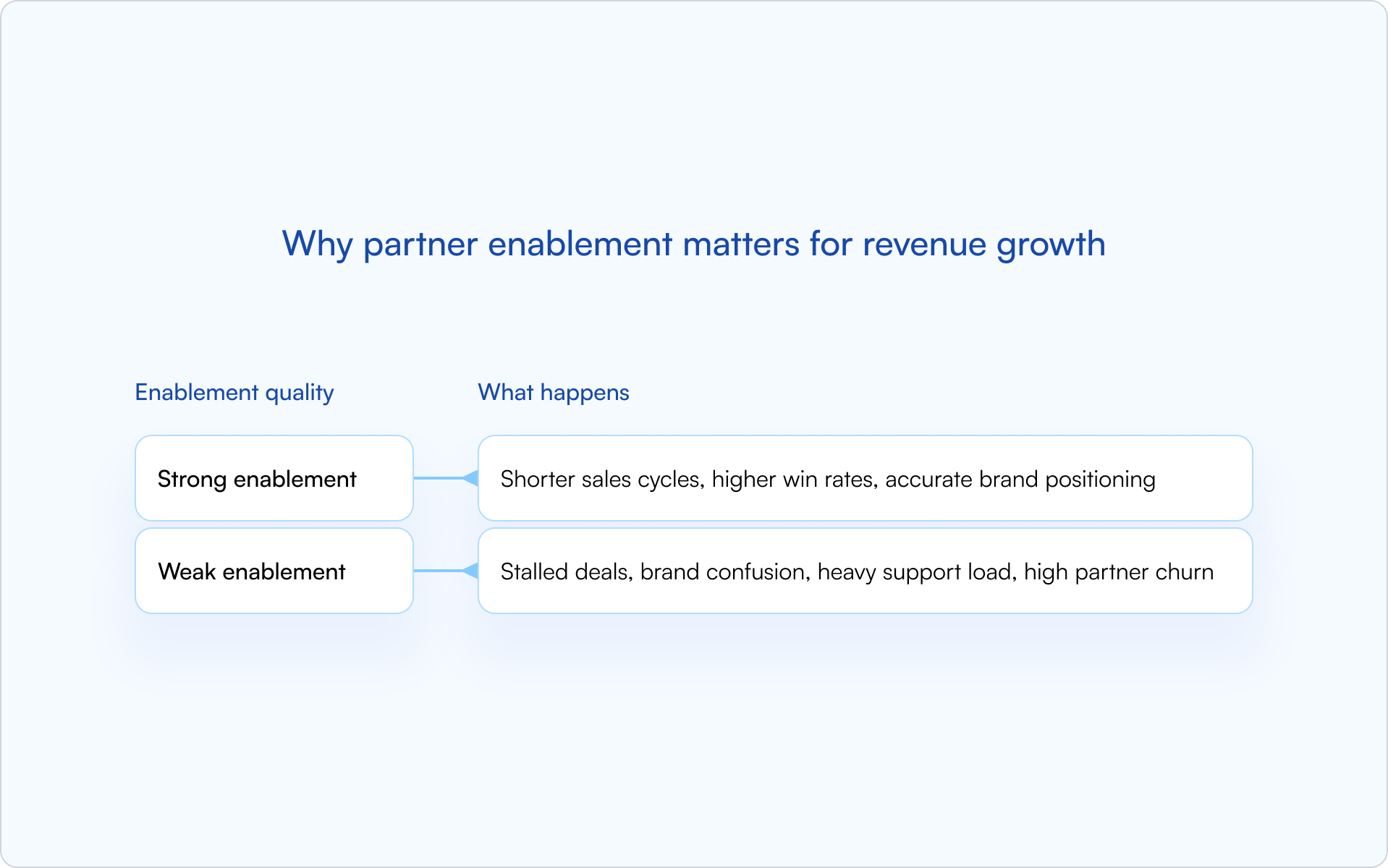
Enabled partners drive revenue because they can execute without friction. They close deals faster, represent your brand accurately, and generate pipeline you can actually attribute.
Weak enablement is expensive in quieter ways: partners misposition the product, opportunities stall, your team becomes the bottleneck, and high-potential partners churn because “it’s too hard to work with you.”
What a partner enablement program includes
A complete channel partner enablement program isn’t a portal full of PDFs. It’s a structured system that helps partners learn, launch, and improve — with clear ownership and measurable outcomes.
Partnerschulung und -zertifizierung
Training forms the foundation: product knowledge, competitive positioning, and your sales methodology. Certification acts as a gate, ensuring partners meet a minimum quality bar before they’re authorized to sell on your behalf.
Partner sales enablement
Partner sales enablement means giving partners the same caliber of sales tools your direct team uses, adapted to their role. Think: battle cards, demo scripts, objection-handling guides, and pricing documentation.
Marketing support and co-marketing
Effective enablement helps partners generate demand, not just close it. Co-branded assets, “campaign-in-a-box” kits, and structured lead-sharing programs all increase partner-sourced pipeline.
Partner portals (and why login friction kills adoption)
A partner portal should be a self-service hub for training, collateral, deal registration, and updates. But there’s a common failure mode: partners avoid portals that require a separate, inconvenient login.
CRM-first portals reduce that friction by connecting directly to HubSpot or Salesforce, so partners can work inside the flow of real deals instead of “checking another system.”
Performance tracking and ongoing communication
Enablement is ongoing, not a one-time launch. A strong program includes visibility into partner activity, a consistent communication cadence, and mechanisms for gathering feedback and improving the experience.
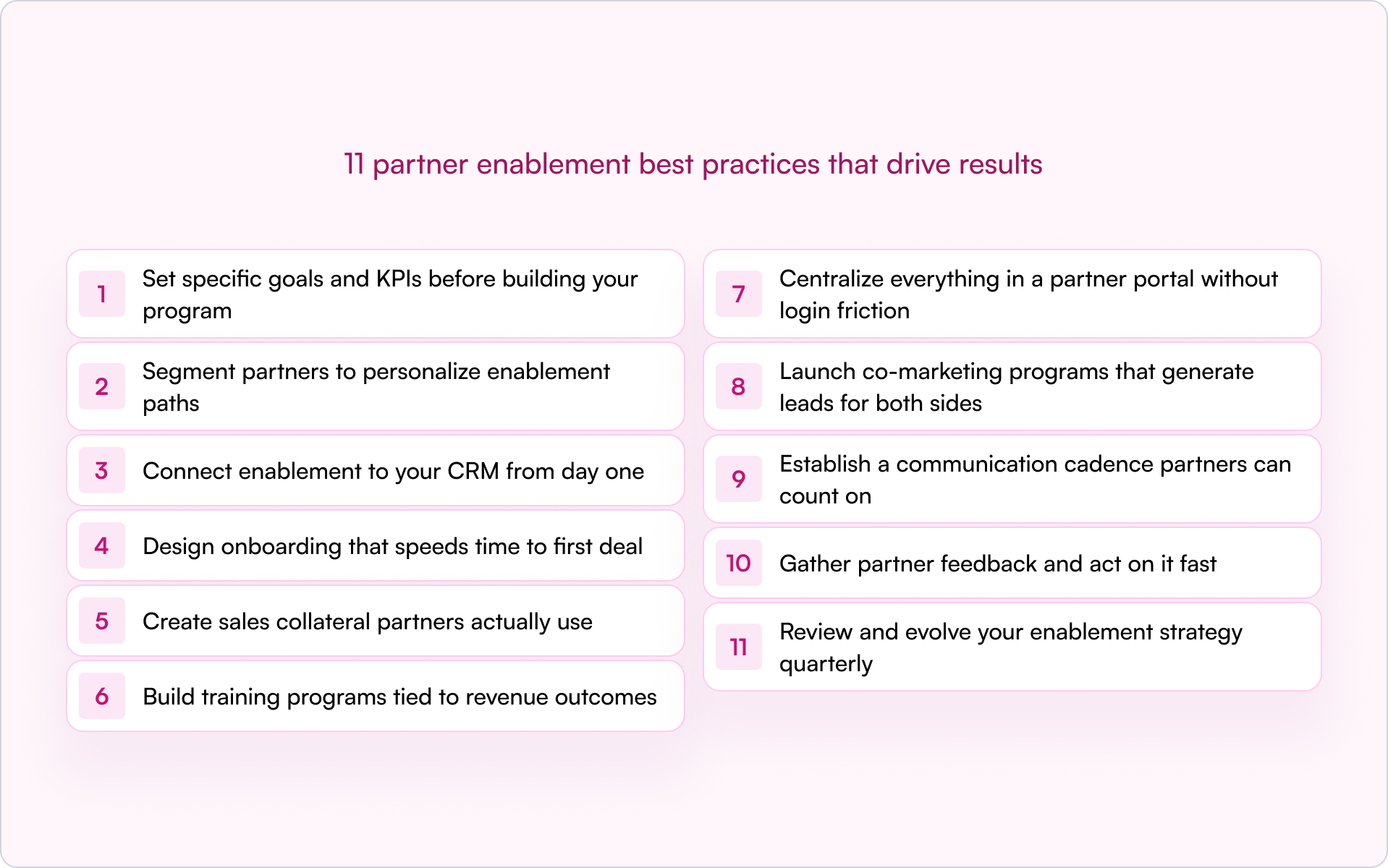
11 partner enablement best practices that drive results
If you’re building a partner program inside a startup, your constraint is almost never “ideas.” It’s focus and execution. These partner enablement best practices move from strategy through rollout and iteration — with an emphasis on what actually shows up in pipeline.
1. Set specific goals and KPIs before building your program
Before you create a single asset, define what success looks like. Start with outcomes — partner-sourced revenue targets, certification completion rates, and a target time-to-first-deal — then work backward into the program.
- Partner-sourced pipeline value
- Certification completion rate
- Average time from onboarding to first registered deal
- Content engagement (downloads, video views)
2. Segment partners to personalize enablement paths
Not all partners need the same materials. Segment by partner type (reseller, referral, systems integrator), vertical focus, or performance tier, then tailor training and content accordingly.
3. Connect enablement to your CRM from day one
For true visibility and attribution, all your enablement data — certifications, content consumption, deal registrations — lives best in your CRM, not in a disconnected system.
A CRM-first approach provides a single source of truth. When partner activity syncs directly to HubSpot or Salesforce, your sales team and RevOps see the same reality. No more chasing updates or reconciling spreadsheets. (If deal attribution is a pain point today, it’s worth tightening up your workflow around partner deal registration specifically.)
4. Design onboarding that speeds time to first deal
Partner onboarding works best as a structured, time-bound journey — not a massive content dump. The goal is to get partners to their first real opportunity quickly, then reinforce with deeper training once momentum is real.
A strong onboarding checklist includes:
- Welcome and program overview
- Product and Ideal Customer Profile (ICP) training
- Competitive positioning
- Deal registration process walkthrough
- First co-sell or shadow opportunity
5. Create sales collateral partners actually use
Don’t reinvent the wheel. Audit the sales collateral your direct team uses most effectively and adapt it for your partners. Prioritize assets that accelerate live deals: one-pagers, battle cards, ROI calculators, and customer stories.
The fastest way to avoid producing content no one opens is simple: ask partners what they need to win the deals they already have, then build for that.
6. Build training programs tied to revenue outcomes
Training works best when it’s modular, role-based, and tied to certification. Use certification as a gate — for example, require a partner to complete key modules before they can register deals or request MDF.
On-demand training offers flexibility; live sessions drive engagement for complex topics. Most teams land on a hybrid model.
7. Centralize everything in a partner portal without login friction
A partner portal should be the single place to find enablement content, register deals, and get program updates. But portals fail when they add friction — especially separate logins, stale content, and unclear navigation.
If you want adoption, reduce steps. Portals built directly on the CRM (with SSO or no-login options) make access feel seamless, which is often the difference between “partners love it” and “partners ignore it.”
8. Launch co-marketing programs that generate leads for both sides
Co-marketing goes beyond providing partners with your logo. Joint webinars, co-branded content like eBooks or case studies, and Market Development Funds (MDF) programs actively help partners generate demand.
If you’re a founder, this is one of the highest-leverage shifts you can make: partners often need help creating pipeline, not just closing it.
9. Establish a communication cadence partners can count on
Define a predictable rhythm. Partners shouldn’t have to guess where to find updates or whether deal registration is working. Use channels like email and Slack to reach partners where they already operate — don’t rely solely on them logging into a portal.
10. Gather partner feedback and act on it fast
Enablement is a two-way street. Collect feedback through surveys, QBR conversations, and portal analytics — then close the loop by making changes and telling partners what you changed.
Partners keep investing when they feel momentum. Small, fast improvements create that signal.
11. Review and evolve your enablement strategy quarterly
Partner enablement isn’t set-and-forget. Quarterly, review what’s working and what isn’t by analyzing content engagement, certification rates, and revenue impact. Then adjust your program like you’d adjust product — based on usage and outcomes.
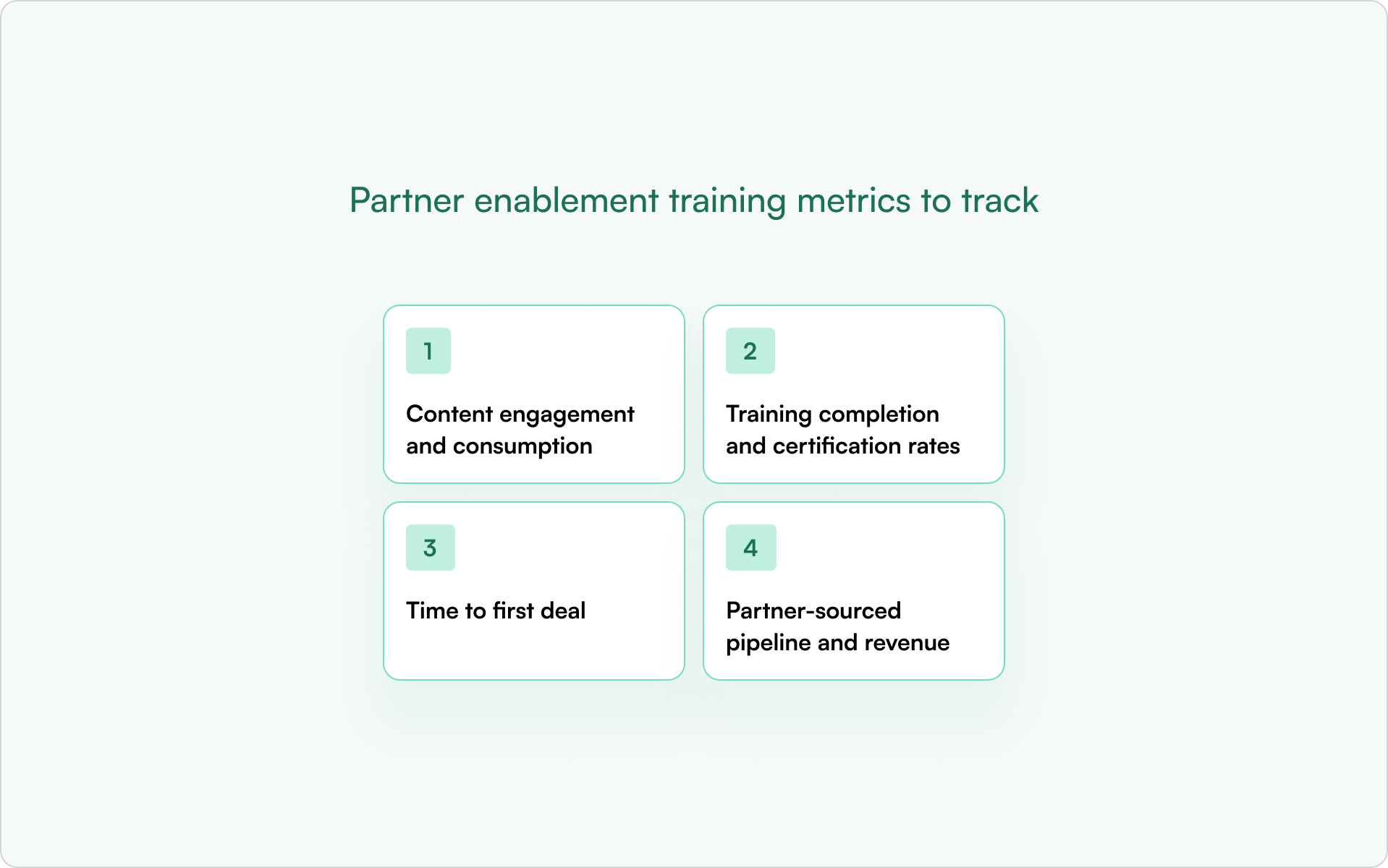
Partner enablement training metrics to track
To understand if your partner enablement process is working, track metrics that connect enablement activities directly to revenue outcomes — not just vanity activities.
Content engagement and consumption
Track which resources partners actually use: downloads, video completion rates, and page views. Low engagement can signal the content isn’t relevant, is hard to find, or doesn’t match what partners need in active deals.
Training completion and certification rates
Measure how many partners complete onboarding and earn certifications. Completion rates help you pinpoint drop-off points so you can shorten, reorder, or redesign modules.
Zeit bis zum ersten Geschäft
Track the time between partner activation and their first registered deal. This is one of the cleanest indicators that onboarding is working — or that partners are stuck.
Partner-sourced pipeline and revenue
This is the ultimate scoreboard. Track pipeline and closed-won revenue generated by partners. To do it well, you need tight CRM attribution so enablement activity can be tied to financial results without manual cleanup.
How to automate your partner enablement process
Automation lets you scale partner enablement without scaling headcount. The goal isn’t to make the experience robotic — it’s to make it consistent, timely, and measurable.
CRM-based automation is ideal because it keeps data and workflows in one system. That’s how you avoid the “portal says one thing, CRM says another” problem.
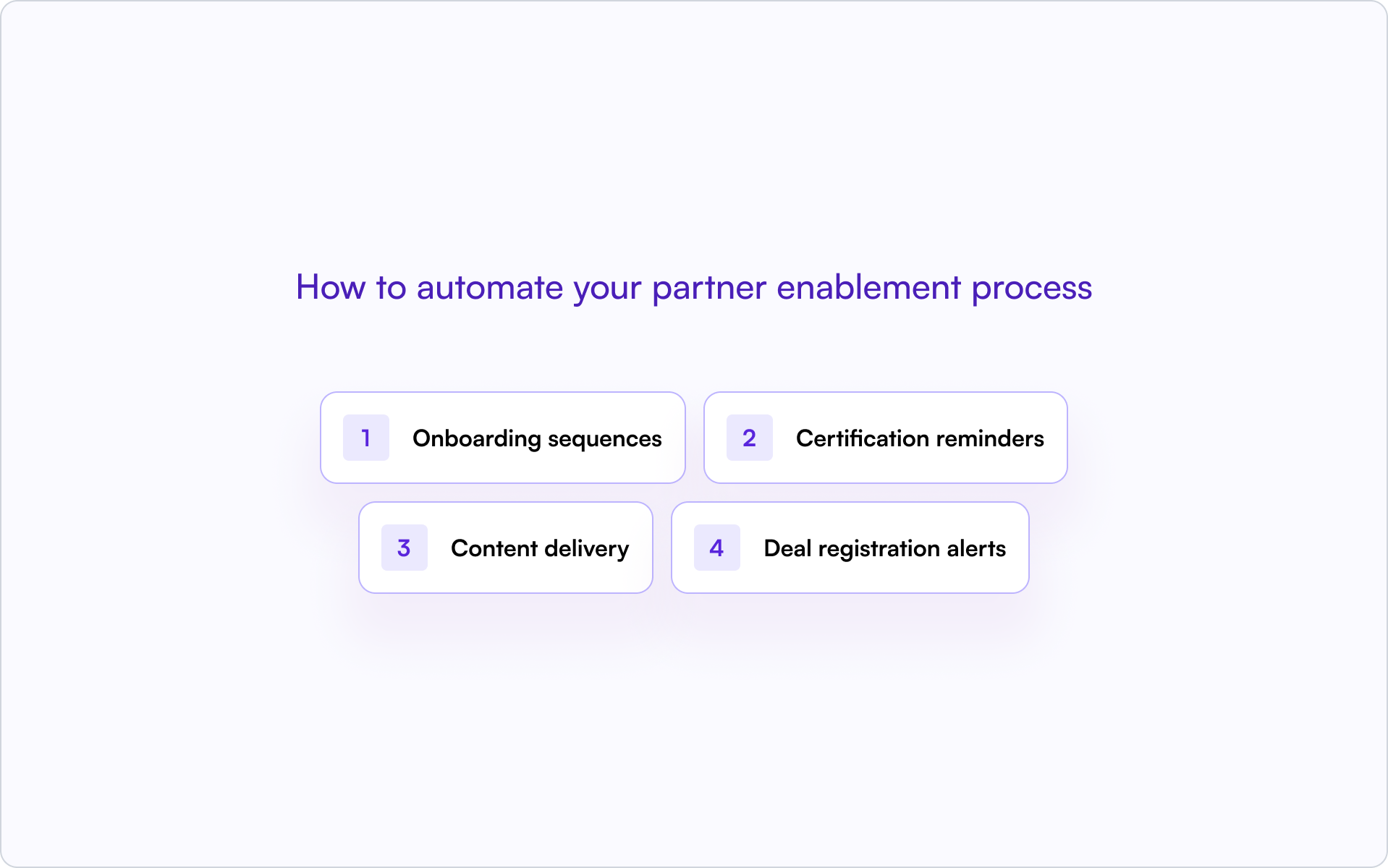
- Onboarding sequences: Automatically enroll new partners in training modules and send welcome materials as soon as they sign up.
- Certification reminders: Trigger automated alerts to partners and partner managers before certifications expire.
- Content delivery: Push relevant collateral to partners based on their segment, tier, or deal stage.
- Deal registration alerts: Automatically notify partners of the status of their registered deals.
Turn partner enablement into a revenue engine with Introw
Introw is the CRM-first PRM that makes best-practice partner enablement practical and scalable. Because it’s built on HubSpot and Salesforce, Introw centralizes your entire partner program where you already work.
It includes a partner portal for centralizing enablement content without login friction, deal registration with real-time visibility, and off-portal collaboration so partners can reply via email while data syncs automatically to your CRM.
If you’re trying to get out of spreadsheet chaos and into measurable partner-sourced revenue, get a demo.
Fazit
The best partner enablement programs aren’t built on more content — they’re built on clarity. Clear goals, segmented paths, CRM-connected workflows, and a focus on speed-to-first-deal turn “partners we signed” into “partners who ship revenue.”
Use these partner enablement best practices as a blueprint, then iterate quarterly based on what your data (and your partners) tell you.

