

.svg)


.svg)
.svg)







Blog

The 13 Best AI Sales Coaching Software Tools for Partner and Channel Sales in 2026
What is AI sales coaching software?
AI sales coaching software helps your team improve how they handle deals, sales calls, and buyer conversations by providing guidance while work is happening, not just after the fact. It uses sales coaching AI to surface next steps, suggest responses to objections, and highlight what’s most likely to move a deal forward.
The category has expanded quickly since 2024, and today, an AI sales coach isn't just one type of tool. It covers several different approaches to coaching sales reps across the full sales cycle.
Here are the five main categories you need to know before choosing a solution:
Most “best sales coaching software” lists only compare conversation intelligence and roleplay tools. But teams working in indirect revenue models or partner sales need visibility into partner and channel deal coaching as well. Understanding all five categories makes it easier to choose the right sales coaching platform for your business.
AI sales coaching software comparison table
This table compares leading tools across the five coaching categories so you can quickly see where each one fits and whether it supports internal reps, external partners, or both.
Most tools support internal sales teams only, so if your partners help close deals, you’ll need software built to coach them inside real pipeline activity, not just review calls after the fact.
The 13 best AI sales coaching software tools in 2026
Here’s how the leading AI sales coaching tools compare across the five main categories buyers should evaluate today.
Category 1: partner and channel deal coaching
This is the newest and fastest-growing category of AI-powered sales coaching. These tools guide external partners on live opportunities inside the environments they already use, including partner portals, Slack, and email, so coaching happens while deals are moving instead of after they stall. They’re best for companies that sell through resellers, referral partners, distributors, or ecosystem programs and want to improve partner close rates without adding more partner managers.
#1 Introw – Best for AI deal coaching in partner and channel sales

What it does:
Introw is the only PRM with built-in AI deal coaching that creates a dedicated AI sales coach for each pipeline, such as reseller, referral, or co-sell. That means every partner deal gets stage guidance, objection handling, asset recommendations, and rules of engagement automatically inside the deal itself through deal coaching.
Who it’s best for:
B2B companies that rely on partners, resellers, or ecosystem motions and want partner-sourced pipeline to close more like direct pipeline without hiring more partner managers.
Wichtigste Features:
- Dedicated AI coach per partner segment with templates for reseller, co-sell, and referral motions
- Stage guidance that tells partners what to do next at each deal step
- Context-aware objection handling based on deal stage and engagement signals
- Asset recommendations surfaced inside the opportunity when partners need them
- Rules of engagement that clarify when to involve your internal team
CRM integrations:
Works with HubSpot and Salesforce.
Pricing:
Custom pricing from Starter to Enterprise based on the number of seats and configuration, and you can start for free.
Category 2: conversation intelligence and call coaching
These sales coaching tools record and analyze sales calls, then turn those conversations into coaching insights your sales managers can use to coach sales reps more consistently. They’re best for internal sales teams that want better visibility into sales conversations, rep performance, and patterns across customer interactions.
#2 Gong – Best for revenue intelligence and call pattern analysis

What it does:
Gong records and analyzes customer calls, meetings, and emails to surface patterns that affect deal outcomes. It helps sales leaders understand what top performers do differently and uses conversation intelligence to highlight risks, competitor mentions, and coaching opportunities across the sales cycle.
Who it’s best for:
Mid-market and enterprise sales teams that run high volumes of sales calls and want data-driven insights to improve team performance.
Wichtigste Features:
- Call recordings with speech and sentiment analysis
- Pipeline risk alerts and deal insights based on conversation patterns
- Manager dashboards that support structured coaching feedback
CRM integrations:
Works with Salesforce, HubSpot, and other major sales cloud environments.
Pricing:
Custom pricing, typically reported between $100 and $150 per user per month depending on contract size and feature access.
Partner/channel gap:
Gong is designed for internal sales professionals using company-managed meeting tools. Partners usually sell independently, which limits how often they appear in recorded workflows that support channel partner sales enablement or structured co-selling.
#3 Chorus by ZoomInfo – Best for call coaching inside the ZoomInfo ecosystem

What it does:
Chorus by ZoomInfo captures sales conversations and turns them into coaching cues using artificial intelligence. It highlights talk ratios, objection-handling moments, and deal risks so sales managers can deliver more consistent coaching across customer calls.
Who it’s best for:
Sales teams already using ZoomInfo that want AI coaching tools connected to prospecting intelligence and enrichment data.
Wichtigste Features:
- Call recording with AI-generated summaries and coaching cues
- Conversation analytics tied to ZoomInfo contact and company data
- Performance analytics that help identify skill gaps across teams
CRM integrations:
Integrates with Salesforce and HubSpot for pipeline visibility and activity capture.
Pricing:
Bundled within ZoomInfo platform subscriptions with custom pricing based on package level.
Partner/channel gap:
Like most AI sales coaching tools in this category, Chorus depends on recorded meetings inside your stack. That makes it harder to support distributed partner ecosystems where deals often happen outside internal call tracking environments.
#4 Clari – Best for pipeline forecasting with coaching signals
.png)
What it does:
Clari is a revenue platform that combines forecasting, pipeline inspection, and activity capture to generate coaching signals from sales data rather than only analyzing call recordings. It helps sales leaders identify deal risks earlier and supports more accurate planning across enterprise sales teams.
Who it’s best for:
Revenue leaders and sales managers focused on forecast accuracy, pipeline health, and predictable revenue growth.
Wichtigste Features:
- Forecast modeling based on pipeline movement and activity capture
- Deal inspection workflows that highlight performance improvement opportunities
- AI-driven insights connected to pipeline coverage and execution
CRM integrations:
Primarily integrates with Salesforce and related revenue infrastructure tools.
Pricing:
Custom enterprise pricing based on deployment scope and forecasting modules.
Partner/channel gap:
Clari focuses on internal pipeline visibility rather than external partner execution. It doesn’t provide coaching inside partner workflows such as shared deal registration processes supported by deal registration or distributed partner deal collaboration.
Category 3: AI roleplay and practice
These AI coaching tools simulate sales conversations so reps can practice objection handling, discovery calls, and positioning in a safe environment. They’re best for onboarding new reps and reinforcing consistent messaging before live customer interactions.
#5 Second Nature – Best for AI-powered sales roleplay simulations
.png)
What it does:
Second Nature creates AI-powered sales roleplay simulations where reps practice conversations with a virtual buyer that responds in real time. The platform scores performance and highlights areas for improvement so teams can run targeted training at scale.
Who it’s best for:
Sales enablement teams running onboarding programs, product launches, or messaging rollouts that require consistent training across distributed teams.
Wichtigste Features:
- AI conversational roleplay simulations with adaptive buyer responses
- Performance scoring tied to predefined sales coaching techniques
- Custom scenario builder for product positioning and objection handling
CRM integrations:
Limited CRM integrations. Primarily used as a standalone sales training platform.
Pricing:
Custom enterprise pricing based on deployment scope and team size.
Partner/channel gap:
Can support partner training if partners log into the system, but it isn’t embedded in the deal flow or partner portal environments typically used for channel partner sales enablement.
#6 Hyperbound – Best for AI cold call and discovery practice
.png)
What it does:
Hyperbound simulates realistic cold call and discovery conversations using AI buyer personas that react dynamically during practice sessions. Reps receive instant feedback and scoring to help refine talk tracks and improve early-stage pipeline conversations.
Who it’s best for:
SDR and BDR teams focused on improving outbound performance and discovery call execution.
Wichtigste Features:
- AI buyer personas designed for cold call and discovery practice
- Instant feedback with scoring across coaching moments
- Leaderboards that help managers track rep performance improvement
CRM integrations:
Minimal CRM connectivity. Designed primarily as a standalone AI sales training environment.
Pricing:
Typically starts around $40 to $60 per user per month depending on configuration.
Partner/channel gap:
Built for internal outbound teams rather than partner programs. It doesn’t support ongoing deal review workflows or structured partner enablement.
#7 Quantified – Best for AI avatar-based sales simulations
.png)
What it does:
Quantified uses AI-generated video avatars to simulate realistic buyer presentations so reps can practice delivery, positioning, and messaging before live meetings. The platform evaluates performance using AI feedback and benchmarking across teams.
Who it’s best for:
Enterprise sales teams focused on presentation readiness and improving messaging consistency across complex sales cycles.
Wichtigste Features:
- AI video avatars that simulate live buyer presentation scenarios
- Messaging analysis aligned with your sales methodology
- Benchmarking dashboards that compare results across teams
CRM integrations:
Limited CRM integrations. Primarily deployed as a structured sales training software layer.
Pricing:
Custom enterprise pricing based on rollout scope.
Partner/channel gap:
Designed for structured training rather than live pipeline execution. It doesn’t support deal-level coaching or workflows connected to partner ecosystems such as those covered in this partner enablement guide.
Category 4: sales enablement with coaching features
These platforms manage sales content such as decks, battle cards, and playbooks, then add guided selling and coaching layers on top. They’re best for teams that want content control and contextual support in one system instead of separate sales coaching solutions.
#8 Highspot – Best for content management with guided selling
.png)
What it does:
Highspot is a sales enablement platform that manages content, training, and buyer engagement while adding AI-powered sales coaching tools like guided selling and content recommendations that support reps during live opportunities.
Who it’s best for:
Enterprise sales and enablement teams managing large content libraries that need structured guidance on what to send and when.
Wichtigste Features:
- Centralized content management with usage tracking
- Guided selling plays aligned to a specific sales methodology
- AI content recommendations based on deal context
CRM integrations:
Integrates with Salesforce and Microsoft Dynamics.
Pricing:
Custom enterprise pricing based on deployment scope and content volume.
Partner/channel gap:
Includes some partner content sharing workflows, but coaching is primarily designed for internal sales teams rather than embedded channel sales enablement across partner-managed deals.
#9 Showpad – Best for sales content and coaching in one platform
.png)
What it does:
Showpad combines sales content management with interactive training and coaching layers so teams can align messaging, improve onboarding, and support consistent execution across the sales cycle.
Who it’s best for:
Mid-market sales teams that want sales training software and content management in a single platform.
Wichtigste Features:
- Content management with version control and engagement tracking
- Interactive training modules that support targeted training programs
- Coaching dashboards that highlight skill gaps across teams
CRM integrations:
Integrates with Salesforce, HubSpot, and Microsoft Dynamics.
Pricing:
Custom pricing based on team size and feature configuration.
Partner/channel gap:
Supports partner content distribution, but coaching features are designed mainly for internal rep workflows rather than structured channel partner sales enablement.
#10 Seismic – Best for enterprise-scale sales enablement and coaching
.png)
What it does:
Seismic is an enterprise sales enablement platform that combines content automation, training, coaching scorecards, and analytics with AI-powered sales guidance to help organizations improve execution consistency at scale.
Who it’s best for:
Large enterprise sales organizations managing complex content ecosystems and structured training programs.
Wichtigste Features:
- Content automation with governance controls
- AI content recommendations aligned to buyer stage
- Seismic Learning for structured training and coaching programs
CRM integrations:
Integrates with Salesforce and Microsoft Dynamics.
Pricing:
Custom enterprise pricing based on rollout scope.
Partner/channel gap:
Includes partner-facing capabilities, but coaching layers are designed primarily for internal seller workflows rather than ongoing partner deal execution.
Category 5: sales training and LMS with coaching layers
These platforms focus on structured learning paths, certifications, and readiness tracking, then add coaching layers like scorecards and manager feedback. They’re best for teams that want consistent training tied to performance improvement across sales teams.
#11 Mindtickle – Best for sales readiness and coaching scorecards
.png)
What it does:
Mindtickle is a sales readiness platform that combines structured learning paths, call analysis, and AI-powered coaching scorecards so enablement teams can track how training affects rep performance over time.
Who it’s best for:
Sales enablement leaders who want to measure readiness across teams and connect training programs to coaching outcomes.
Wichtigste Features:
- Role-based learning paths with certification tracking
- AI coaching scorecards tied to readiness indexes
- Call recordings analysis connected to sales training progress
CRM integrations:
Integrates with Salesforce and HubSpot.
Pricing:
Custom enterprise pricing based on deployment scope and enablement modules.
Partner/channel gap:
Primarily designed for internal sales professionals. Partners typically require separate onboarding to access training environments.
#12 Allego – Best for video coaching and peer-to-peer learning
.png)
What it does:
Allego is a sales learning platform centered on video-based practice, peer-to-peer coaching, and conversation intelligence so teams can reinforce messaging through recorded examples and feedback loops.
Who it’s best for:
Organizations that want collaborative coaching environments where reps learn from shared recordings and structured video practice.
Wichtigste Features:
- Video-based coaching workflows with manager feedback
- Conversation intelligence tied to recorded customer calls
- Peer-to-peer learning supported by shared practice libraries
CRM integrations:
Integrates with Salesforce.
Pricing:
Custom pricing based on rollout scope and learning configuration.
Partner/channel gap:
Built for internal rep coaching and structured learning rather than ongoing partner deal execution.
#13 Brainshark by Bigtincan – Best for sales readiness and onboarding
.png)
What it does:
Brainshark by Bigtincan delivers structured onboarding, certification paths, and readiness scorecards with video coaching features that help teams standardize early-stage training and onboarding outcomes.
Who it’s best for:
Sales teams focused on onboarding consistency and certification-driven readiness programs.
Wichtigste Features:
- Training content authoring with certification tracking
- Video coaching workflows tied to readiness scorecards
- Mobile learning access for distributed sales representatives
CRM integrations:
Integrates with Salesforce.
Pricing:
Custom enterprise pricing based on deployment scope and certification needs.
Partner/channel gap:
Focused on structured training rather than deal-level coaching. It does not support partner pipeline execution or external partner coaching workflows.
There are many strong tools in this space, and they solve very different problems. That can make the decision feel harder than it should be.
The key is to match the type of coaching to how your team actually sells, especially if partners are part of your pipeline.
How to evaluate AI sales coaching software (buyer checklist)
Use this checklist to compare AI sales coaching software capabilities across vendors before you decide.
Teams that sell through partners should also confirm whether the platform supports partner workflows alongside internal sales processes.
Which type of AI sales coaching software do you need?
Start with where coaching needs to happen in your workflow.
- If partners, resellers, or referral teams help close deals, you’ll get the most impact from tools that guide external sellers inside active opportunities. That matters even more once you see how partner-sourced opportunities typically perform compared to direct deals. You can evaluate that difference using these partner deal stats.
- If most revenue comes from direct sellers, conversation intelligence platforms help improve call quality and pipeline visibility.
- If your priority is onboarding or messaging consistency, roleplay tools help new reps practice before speaking with customers.
- If your challenge is keeping partner training aligned with how deals actually move, a structured partner LMS helps reinforce learning inside your partner motion.
When both direct and partner pipeline matter, coaching works best when guidance appears automatically at the right moment inside each deal.
That’s where support from an embedded AI agent helps teams deliver consistent next steps without adding manual coaching overhead.
Why Introw is the best choice for partner teams
By now, you’ve probably noticed most AI sales coaching tools are built for internal reps. That works if your pipeline lives inside your team. It’s harder when partners are responsible for part of your revenue and you don’t always see what’s happening inside their deals.
Introw supports execution inside the deal itself. Partners see what to do next at each stage, which reduces stalled opportunities and removes the need for constant partner manager involvement.
As partner programs scale, execution naturally becomes less consistent across resellers, referral partners, and co-selling motions. Introw helps standardize how deals move forward by adapting guidance to deal stage, partner role, and engagement signals.
What you'll see:
- Fewer deals going quiet
- Clearer collaboration between partners and internal teams
- More predictable partner pipeline.
This is especially valuable in organizations where partner-led and direct pipeline often run side by side.
If partner deals are already part of your revenue motion, you can Request a demo to see what deal-level coaching looks like inside an active partner workflow.
15 MDF Best Practices for High-Impact Partner Programs
Why most MDF programs underperform
Most MDF programs don’t fail because the strategy is wrong. They fail because the operations around them are unclear, slow, or invisible to partners. Aligning early on expectations, ownership, and even the definition of MDF helps teams avoid the most common execution gaps.
The budget exists, but partners often don’t use it. In fact, roughly 60% of market development funds go unclaimed each year, not because partners aren’t interested, but because the process makes participation difficult.
.png)
Across many partner ecosystems, the same issues show up repeatedly:
- Channel partners don’t know funds are available
- The approval process takes too long
- Requests get lost in email or spreadsheets
- Marketing activities run without measurable outcomes
- Finance teams can’t track how marketing dollars were used
- Partner marketing teams can’t connect MDF investments to pipeline
Without structure, market development funds rarely support partner engagement or revenue growth. When MDF programs are tied to clear execution plans and measurable partner marketing campaigns, they become a predictable lever for demand generation instead of unused budget.
15 MDF best practices for SaaS partner programs
If you want market development funds to drive pipeline instead of sitting unused, you need a repeatable system. The following market development funds best practices are the framework strong SaaS teams use to make MDF programs predictable, measurable, and aligned with revenue.
.png)
1. Design your fund structure before you launch
Start with the question most teams skip: how should we allocate MDF in the first place?
Decide early whether MDF allocation is:
- Fixed per partner tier
- Performance-based
- Motion-based across reseller, referral, or integration channel partners
Also define:
- Eligible marketing activities
- Fiscal period (quarterly vs. annual)
- Whether unused MDF funds expire or roll over
Without this structure, approvals become inconsistent, and partners lose confidence in the program.
This is the foundation of strong MDF program management and best practices.
2. Make budget visibility self-service
Ask yourself this: can partners see their available budget without emailing you?
If not, adoption drops immediately.
Partners should always see:
- Total MDF allocation
- Pending requests
- Approved spend
- Remaining marketing budget
Real-time visibility improves partner engagement and increases participation in MDF campaigns faster than almost any other change you can make.
3. Build a standardized request form, not email
Inbox-driven requests slow everything down.
Instead, create a structured marketing development funds template partners complete before submitting requests. At minimum, capture:
- Campaign type
- Target audience
- Expected pipeline or qualified leads
- Zeitachse
- Budget requested
- Success metrics
When requests attach directly to CRM records, your MDF process becomes measurable from day one. Platforms designed for managing marketing development funds handle this automatically.
4. Set approval SLAs and default statuses
Partners don’t stop submitting requests because budgets are small. They stop because responses are slow.
Set a clear approval process, such as:
Submitted → Under review → Approved or declined
Then define an internal SLA, for example, five business days.
Predictability increases participation and improves demand generation activities across your partner ecosystem. It is one of the simplest MDF program best practices to implement.
5. Require a campaign brief, not just a budget ask
If a partner asks for marketing budget without a plan, pause.
Strong MDF programs require a short campaign brief that explains:
- What they want to run
- Who they want to reach
- What results they expect
- How the activity supports your strategic objectives
This improves strategic alignment and makes it easier to compare performance across MDF campaigns later.
6. Enable collaboration, not just approval
Approval is not execution.
After funding is approved, partners still need shared visibility into assets, timelines, and next steps. Otherwise, marketing initiatives disappear into email threads.
A structured collaboration environment improves partner marketing outcomes and keeps joint marketing initiatives visible across teams. It also strengthens ongoing partner engagement during campaign execution.
7. Link campaigns to deals and leads
Here’s the question leadership eventually asks: what did this spend actually generate?
If MDF campaigns are not connected to deals or sales leads, you cannot answer it.
Linking MDF-funded activities directly to pipeline turns market development funds into a measurable growth lever. It also helps channel managers understand which partners consistently generate qualified leads.
This is where many MDF programs break, and where the biggest gains usually happen. Make sure to use modern PRM that links all these activities directly in you CRM.
8. Track ROI automatically, not manually
If ROI lives in spreadsheets, you’re always reacting too late.
Modern MDF programs are being tracked directly in your CRM where you can connect spend directly to pipeline contribution so you can see which partners, campaigns, and marketing efforts drive revenue growth in real time.
That visibility helps you shift marketing investment toward activities that expand market reach and improve sales performance.
9. Gate future funds on proof of performance
A simple rule improves accountability quickly: show results before requesting more budget.
Ask partners to demonstrate:
- Campaign reach
- Lead generation
- Pipeline-Beitrag
before approving additional MDF funds.
This ensures MDF investments support partners who execute and helps drive partner success across co-op programs and co-op funds.
10. Review and iterate quarterly
Treat MDF like a planning lever, not a reimbursement process.
Each quarter, review:
- Which partners used their allocation
- Which MDF campaigns generated pipeline
- Which marketing activities underperformed
These reviews strengthen your channel partner marketing strategy and make future MDF allocation easier to justify.
11. Segment MDF by partner motion, not just partner tier
Many teams allocate development funds by partner tier alone. That’s rarely enough.
Referral partners, resellers, and integration partners contribute differently to market development. Segmenting MDF allocation by motion improves market presence and ensures shared marketing resources support the right expected outcomes.
This is one of the most overlooked market development fund best practices.
12. Pre-approve high-performing campaign templates
Instead of reviewing every request from scratch, give partners a shortlist of proven campaign options.
Examples include:
- Co-branded campaigns
- Digital ads
- Local events
- Vertical webinars
Pre-approved templates reduce approval time and increase the likelihood of generating qualified leads.
They also help partners understand how to obtain marketing development funds faster because expectations are clear.
13. Tie MDF allocation to pipeline coverage targets
Not every region needs the same level of funding.
If pipeline coverage is weak in a segment or geography, allocate MDF funds there first. If another area already performs well, shift marketing investment elsewhere.
This ensures MDF allocation supports strategic priorities instead of spreading budget evenly across the partner program.
14. Combine MDF with incentive programs to change partner behavior
Funding alone doesn’t change behavior. Incentives do.
Pair MDF campaigns with structured channel partner incentive programs to encourage participation in demand generation campaigns and improve execution quality across channel partners.
This combination helps generate leads faster and strengthens overall partner performance.
15. Reserve budget for strategic initiatives, not reactive requests
Leave part of your development funds unallocated at the start of the quarter.
Use that reserve to support:
- New product launches
- Expansion into new regions
- Demand generation for priority segments
- Initiatives that increase brand visibility
This ensures MDF investments stay aligned with long-term strategic priorities instead of being consumed by opportunistic requests.
MDF request form template and checklist
A strong MDF request form does two things at once.
It makes approvals faster for your team, and it makes it easier for partners to submit campaigns that actually generate pipeline.
Without a structured request format, MDF campaigns become hard to evaluate, hard to compare, and almost impossible to attribute later.
A standardized marketing development funds template fixes that by ensuring every request captures the information needed to support demand generation, track sales performance metrics, and align spend with strategic objectives.
Use the template below as a default structure inside your partner program.
.png)
MDF request form checklist
Use this checklist to confirm your MDF process captures everything required for attribution and execution:
.png)
In a CRM-connected workflow, this structure also gives both you and your partners real-time visibility into MDF campaigns from request through execution and attribution, which is what makes modern MDF programs scalable.
Where Introw comes in
If you follow the framework above, your MDF program becomes structured. What most teams still struggle with is proving what that structure actually produces.
Introw closes that gap by connecting MDF requests directly to the partners, campaigns, and deals they are meant to influence inside your CRM. Instead of tracking approvals separately from pipeline, everything lives in one workflow.
That changes how MDF programs operate day to day:
- Partners submit structured requests without email back-and-forth
- Every request attaches automatically to the right partner and campaign
- Approvals follow a consistent approval process instead of ad-hoc routing
- Both you and your channel partners see available MDF funds in real time
- Marketing campaigns link directly to qualified leads and influenced deals
- ROI updates automatically as pipeline moves
This is what makes market development funds (MDF) measurable.
When a deal is generated or closed, you can see whether MDF supported it. When planning next quarter’s MDF allocation, you can see which partners generated pipeline and which marketing initiatives did not.
It also changes adoption. Because partners can see their allocation, submit requests quickly, and stay aligned on campaign execution, MDF funds get used instead of sitting unused across the partner ecosystem.
For a partner marketing manager managing Market Development Funds, that means fewer spreadsheets, clearer attribution, and better conversations with leadership about where marketing investment should go next.
If you want to see how structured MDF programs work when requests, approvals, campaigns, and pipeline all stay connected in one place, request a demo today.
Neueste Artikel
15 Best ChannelScaler Alternatives for Partner Teams in 2026
What is ChannelScaler (and why do teams seek alternatives)?
ChannelScaler is a partner relationship management (PRM) platform created through the merger of Allbound and Channel Mechanics. It combines deal registration, MDF management, incentives, partner marketing, and through-channel marketing automation in one platform.
For many businesses, that’s exactly what they need.
Others look for deeper CRM integration, a simpler partner experience, stronger automation, or more flexibility as their partner program grows.
Common reasons teams evaluate ChannelScaler competitors include:
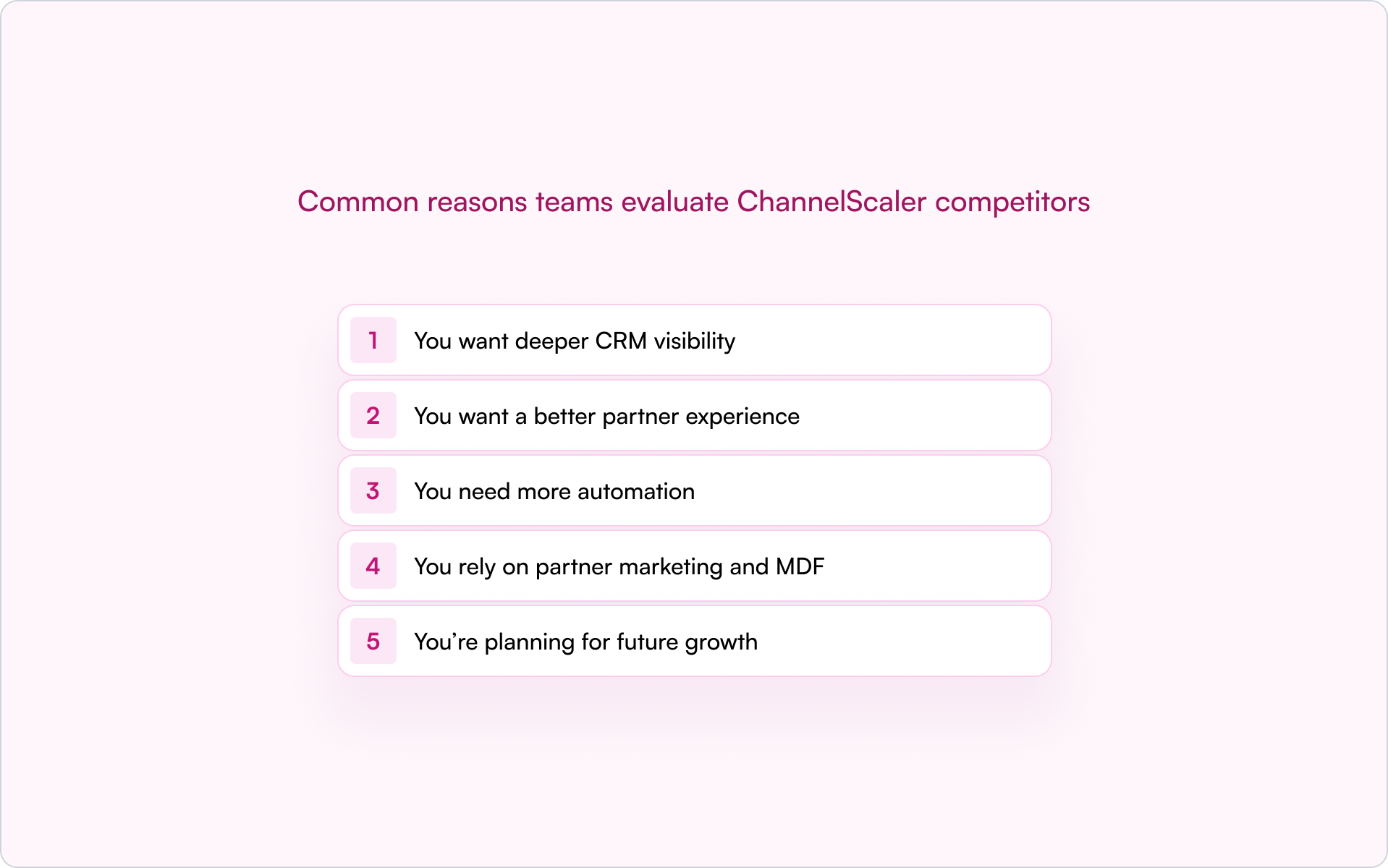
1. You want deeper CRM visibility
Many teams want deal registration, attribution, partner data, and reporting tied more closely to Salesforce or HubSpot.
2. You want a better partner experience
As partner ecosystems grow, adoption matters. Teams often look for ways to reduce friction and make it easier for partners to engage.
3. You need more automation
Automation can reduce manual work across onboarding, approvals, notifications, reporting, and partner operations.
4. You rely on partner marketing and MDF
If MDF management, partner marketing, and through-channel marketing automation are important, it’s worth comparing how each platform supports those workflows.
5. You’re planning for future growth
The right platform should support your partner ecosystem today and continue to scale with your business.
ChannelScaler alternatives at a glance
If you’re shortlisting ChannelScaler alternatives, this table gives you a quick overview of where each platform fits before diving into the detailed reviews.
The right choice depends on your partner program, growth goals, and how your team prefers to work.
The 15 best ChannelScaler alternatives in 2026
Choosing a PRM is often less about features and more about fit. The platforms below take very different approaches to partner relationship management, partner engagement, channel automation, and partner marketing.
1. Introw

What it does:
Introw is a CRM-first partner relationship management platform built for SaaS companies running referral, reseller, and co-sell programs. It keeps partner data, deal registration, attribution, forecasting, and partner operations directly inside Salesforce or HubSpot.
Partners can collaborate through email, Slack, forms, and lightweight portal experiences, helping teams scale partner revenue with less administrative overhead and a more frictionless channel experience.
Why it’s a good ChannelScaler alternative:
While ChannelScaler combines partner management, MDF management, incentives, and channel marketing in one platform, Introw takes a CRM-first approach. It’s a strong fit for teams that want deeper Salesforce or HubSpot integration, AI-powered workflows, faster implementation, and less reliance on a traditional partner portal.
Who it’s best for:
SaaS companies that want to manage their partner ecosystem from Salesforce or HubSpot and improve partner engagement, partner experience, pipeline visibility, and partner-sourced revenue without relying heavily on a traditional partner portal.
Wichtigste Features:
- Native Salesforce and HubSpot integration with support for custom objects and partner data
- AI-powered deal coaching that delivers guidance, content recommendations, and next steps inside active opportunities
- Deal registration, attribution, forecasting, and reporting built directly around CRM workflows
- Email and Slack-based partner collaboration that reduces portal dependency and improves partner engagement
- MDF management, partner marketing workflows, and partner program automation within a single platform
Pricing:
Custom pricing. Contact Introw for a quote based on your partner program requirements.
2. Impartner
.png)
What it does:
Impartner is an enterprise partner relationship management platform focused on partner onboarding, deal registration, partner engagement, MDF management, and channel automation. It’s designed to help businesses manage complex partner programs from a single platform.
Why it’s a good ChannelScaler alternative:
Impartner offers enterprise-grade partner relationship management, MDF management, incentives, onboarding, and channel marketing capabilities with extensive customization and advanced workflow automation.
Who it’s best for:
Mid-market and enterprise businesses with mature channel sales motions that need advanced workflows, structured partner programs, and strong MDF management capabilities.
Wichtigste Features:
- Partner onboarding, training, certification, and deal registration workflows
- MDF management with approval processes, reimbursement tracking, and ROI tracking
- Automated partner engagement, reporting, and channel program management
Pricing:
Custom pricing. Contact Impartner for a personalized quote.
3. ZINFI
.png)
What it does:
ZINFI is a partner relationship management and through-channel marketing automation platform designed to support the full partner lifecycle, from recruitment and onboarding to deal registration, partner marketing, incentives, and analytics.
Why it’s a good ChannelScaler alternative:
ZINFI offers broad channel automation capabilities across partner management, MDF management, partner engagement, and channel marketing. It’s a strong fit for businesses managing multiple partners across complex partner programs.
Who it’s best for:
Large partner ecosystems that need end-to-end partner program automation and global channel operations.
Wichtigste Features:
- Partner onboarding, deal registration, and partner portal management
- MDF management, incentives, and partner performance tracking
- Through channel marketing automation and partner marketing tools
Pricing:
Custom pricing.
4. Unifyr (formerly Zift Solutions)
.png)
What it does:
Unifyr is a partner relationship management platform that evolved from Zift Solutions. It combines partner engagement, channel marketing, training, content management, and partner program automation in one platform.
Why it’s a good ChannelScaler alternative:
Unifyr focuses heavily on partner engagement and partner marketing while offering strong automation across the partner journey. Its AI-powered capabilities are designed to help teams scale partner revenue more efficiently.
Who it’s best for:
Businesses that want partner enablement, training, and channel marketing in a single platform.
Wichtigste Features:
- Partner portal with onboarding, training, and certification
- AI-powered content recommendations and partner engagement workflows
- Through channel marketing automation and campaign management
Pricing:
Custom pricing.
5. Kanalaktivität
.png)
What it does:
Channeltivity is a partner relationship management platform focused on helping channel sales teams launch and manage partner programs without lengthy implementations.
Why it’s a good ChannelScaler alternative:
Channeltivity provides core PRM functionality without the complexity often associated with larger enterprise platforms. It focuses on partner experience, deal registration, and partner engagement while maintaining strong CRM connectivity.
Who it’s best for:
Mid-market businesses that want a dedicated PRM with fast deployment and straightforward administration.
Wichtigste Features:
- Partner portal, onboarding, and deal registration
- MDF management and training modules
- Native Salesforce and HubSpot integrations
Pricing:
- Standard Edition: $1,899/month
- CRM Edition: $2,199/month
6. Magentrix
.png)
What it does:
Magentrix is a Salesforce-centric partner relationship management platform that helps businesses manage channel partners, partner engagement, and deal registration through customizable partner portals.
Why it’s a good ChannelScaler alternative:
Magentrix appeals to businesses that want a Salesforce-native partner portal and tighter control over partner-facing experiences without investing in a larger channel automation platform.
Who it’s best for:
Salesforce-centric organizations that want configurable partner portals and CRM-connected workflows.
Wichtigste Features:
- Salesforce-native partner portal
- Deal registration and partner onboarding workflows
- Partner content management and reporting
Pricing:
- Essential: $1,500/month
- Advanced: $3,000/month
- Unlimited: Custom pricing
7. PartnerStack
.png)
What it does:
PartnerStack helps SaaS companies recruit, manage, and reward referral, reseller, and affiliate partners. The platform is particularly known for automated payouts and partner recruitment through its marketplace.
Why it’s a good ChannelScaler alternative:
PartnerStack focuses more on growing partner-sourced revenue and managing partner payouts than traditional partner relationship management. It’s often chosen by SaaS companies looking to generate pipeline through referral and affiliate channels.
Who it’s best for:
SaaS companies building referral, affiliate, and reseller programs.
Wichtigste Features:
- Partner recruitment marketplace
- Automated payouts and commission management
- Deal registration and partner tracking
Pricing:
Starts at approximately $1,520/month.
8. StructuredWeb
.png)
What it does:
StructuredWeb is a partner marketing platform focused on helping brands drive demand through channel partners using automated campaign execution, content distribution, and localized marketing campaigns.
Why it’s a good ChannelScaler alternative:
StructuredWeb is often selected when partner marketing is the primary objective. It offers strong support for campaign execution, content syndication, and through channel marketing automation.
Who it’s best for:
Businesses that rely heavily on channel marketing and partner-led demand generation.
Wichtigste Features:
- Through channel marketing automation
- Content management and campaign distribution
- MDF management and ROI tracking
Pricing:
Custom pricing.
9. Ansira (formerly SproutLoud)
.png)
What it does:
Ansira helps brands manage distributed marketing programs across large partner networks. The platform focuses on channel marketing, localized marketing campaigns, incentives, and campaign execution while supporting brand consistency across local markets.
Why it’s a good ChannelScaler alternative:
Ansira is a strong choice for businesses that prioritize partner marketing, localized campaign execution, and demand generation across large partner networks.
Who it’s best for:
Businesses with large partner ecosystems that rely heavily on channel marketing and localized campaign execution.
Wichtigste Features:
- Localized marketing campaigns and campaign execution tools
- Incentives, MDF management, and partner marketing support
- Brand compliance and distributed marketing workflows
Pricing:
Custom pricing.
10. WorkSpan
.png)
What it does:
WorkSpan helps businesses manage strategic alliances, cloud marketplace partnerships, and co-sell programs across major ecosystems such as AWS and Microsoft.
Why it’s a good ChannelScaler alternative:
WorkSpan specializes in ecosystem-led growth and co-sell execution rather than traditional partner portal workflows. It provides visibility into shared opportunities and partner revenue across alliance programs.
Who it’s best for:
Businesses running strategic alliance and co-sell motions with major technology partners.
Wichtigste Features:
- Co-sell opportunity management
- Marketplace and alliance automation
- Shared pipeline visibility and reporting
Pricing:
Custom pricing.
11. Kiflo
.png)
What it does:
Kiflo is a lightweight partner relationship management platform designed to help businesses launch and manage partner programs with minimal complexity.
Why it’s a good ChannelScaler alternative:
Kiflo focuses on ease of use, partner onboarding, deal registration, and partner engagement rather than enterprise-scale channel operations. It offers a simpler entry point for growing partner teams.
Who it’s best for:
Businesses launching their first partner program or managing a smaller partner ecosystem.
Wichtigste Features:
- Partner onboarding and deal registration
- Partner portal and commission tracking
- HubSpot and Salesforce integrations
Pricing:
- Core: $399/month (annual billing)
- Plus: Contact sales
- Premier: Contact sales
12. Mindmatrix
.png)
What it does:
Mindmatrix combines partner relationship management, partner marketing, training, sales enablement, and channel automation within a single platform.
Why it’s a good ChannelScaler alternative:
Mindmatrix provides broad coverage across partner enablement, content distribution, training, MDF management, and partner engagement. It is often evaluated by organizations seeking one platform for multiple partner-facing functions.
Who it’s best for:
Businesses that want partner enablement, training, channel marketing, and partner management in one platform.
Wichtigste Features:
- Partner onboarding, training, and certification
- Content management and sales enablement
- MDF management and partner marketing automation
Pricing:
Contact vendor.
13. PartnerPortal.io
.png)
What it does:
PartnerPortal.io is a HubSpot-focused partner portal platform that helps businesses manage partner onboarding, lead submission, deal registration, and partner communication.
Why it’s a good ChannelScaler alternative:
PartnerPortal.io prioritizes simplicity and fast deployment. It delivers core partner portal functionality without the complexity of larger partner program automation platforms.
Who it’s best for:
HubSpot users that need a simple partner portal and deal registration process.
Wichtigste Features:
- Native HubSpot integration
- Lead submission and deal registration
- Partner portal and resource management
Pricing:
- Free
- Growth: $249/month
- Enterprise: $499/month
14. impact.com
.png)
What it does:
impact.com is a partnership management platform focused on affiliate, influencer, referral, and creator partnerships. It helps businesses discover, manage, track, and reward partners at scale.
Why it’s a good ChannelScaler alternative:
impact is built around partnership growth and automated payouts rather than traditional channel sales workflows. It’s commonly used to expand partner reach and drive measurable growth through performance-based partnerships.
Who it’s best for:
Businesses investing in affiliate, influencer, referral, and creator programs.
Wichtigste Features:
- Partner recruitment and discovery
- Automated payouts and incentive management
- Attribution and performance analytics
Pricing:
- Starter: From $30/month
- Essentials: From $500/month
- Pro: From $2,500/month
- Enterprise: Custom pricing
15. Everflow
.png)
What it does:
Everflow is a partnership management platform focused on tracking, attribution, and performance management for affiliate, referral, influencer, and media partnerships.
Why it’s a good ChannelScaler alternative:
Everflow provides deep reporting and attribution capabilities for businesses that prioritize performance tracking, partner revenue measurement, and optimization.
Who it’s best for:
Businesses running large-scale affiliate and performance partnership programs.
Wichtigste Features:
- Partnership attribution and analytics
- Automated partner management workflows
- Fraud prevention and performance reporting
Pricing:
Custom pricing.
There’s a lot to choose from, and the right platform depends less on features and more on how your partner program works day to day.
To help narrow down your options, here are the key questions worth asking every vendor.
How to evaluate PRM platforms
A good demo can make every platform look similar. The real differences appear when you look at how the system fits your processes, your team, and your long-term goals.
1. Will it fit the way your team already works?
Some vendors expect everyone to work inside a portal. Others are built around Salesforce, HubSpot, email, or Slack.
Ask vendors:
- Where do partner managers spend most of their time?
- How much work happens outside the portal?
- How much manual administration is required?
- How quickly can new users get started?
2. How easy is onboarding for new partners?
Even the best technology won’t help if adoption is low.
As you review vendors, compare the experience against a practical partner onboarding checklist and ask how quickly new partners can start generating opportunities.
A strong onboarding process should help shorten time-to-value while reducing work for your internal team.
You can compare your process against this partner onboarding checklist when evaluating different approaches.
3. Can it support future growth?
Many teams buy for today’s requirements and discover limitations a year later.
Questions worth asking:
- Can it support different partner types?
- Can it support international expansion?
- How easily can workflows be customized?
- What happens as participation grows?
As your partner ecosystem expands, the platform should be able to support new processes and additional stakeholders without becoming harder to manage.
Look for evidence that the vendor can support revenue growth without adding unnecessary complexity.
4. Can you measure what’s working?
Good reporting should answer business questions, not just display activity metrics.
Ask vendors how they track:
- Von Partnern generierte Einnahmen
- Revenue growth
- Performance trends
- Quellenangabe
- Real-time insights
If reporting requires spreadsheets and manual reconciliation, visibility usually suffers.
5. What does implementation actually involve?
Implementation timelines vary significantly between vendors.
Before making a decision, ask:
- How long does deployment take?
- Are implementation services required?
- What ongoing administration is needed?
- What level of customer support is included?
Reading independent reviews, customer feedback, and a detailed ChannelScaler review can help uncover issues that rarely appear in product demos.
A little extra evaluation now can save a lot of frustration later.
When ChannelScaler is a good choice
ChannelScaler is a strong fit for mature partner programs that need partner onboarding, deal registration, MDF management, incentives, rebates, and through-channel marketing automation in one platform.
ChannelScaler may be a good choice if you:
- Manage a large network of channel partners
- Run complex incentive, rebate, or MDF programs
- Need stronger control over indirect revenue programs
- Want channel marketing and partner management in one platform
- Have the resources for a more comprehensive implementation
For businesses where incentives, partner marketing, and channel operations are central to the partner program, ChannelScaler offers a broad set of capabilities under one roof.
When it’s time to consider a ChannelScaler alternative
ChannelScaler offers a broad feature set, but it won’t be the right fit for every partner team.
Many businesses start exploring alternatives when they want simpler workflows, faster deployment, or a platform that works more closely with their CRM. Others are looking for a lighter partner experience with less reliance on a traditional portal.
Evaluate ChannelScaler competitors if you:
- Want Salesforce or HubSpot to remain the primary system of record
- Need a faster implementation and shorter time-to-value
- Prefer partners to collaborate through email or Slack
- Want simpler administration and fewer moving parts
- Focus heavily on co-sell motions and partner-sourced revenue
- Need more flexibility around how partners engage with your team
This can be particularly valuable for teams investing heavily in partner-led demand generation, MDF programs, and broader partnership marketing initiatives.
The best platform isn’t necessarily the one with the most features. It’s the one that helps your team and your partners work more effectively every day.
Why Introw is the best choice for modern partner teams
Most PRMs help you manage partners. Introw helps you improve how partner programs perform.
Because Introw is built around Salesforce and HubSpot, partner managers spend less time updating systems and more time helping partners close deals.
Deal registration, attribution, forecasting, MDF management, and partner collaboration stay connected to the CRM, creating better visibility across the entire program.
What makes Introw different?
.png)
- CRM-first workflows that improve visibility and reduce manual administration
- AI-powered deal coaching that helps partners move opportunities forward
- AI integrations, including Claude, that support partner enablement and content workflows
- Email and Slack collaboration that reduces dependence on portal logins
- Attribution and forecasting tied directly to partner revenue
Ready to see how a modern PRM works in practice?
Learn more about Introw’s PRM software, and book a demo to see how Introw can help your team increase partner revenue with less complexity and better visibility.
How to Build a Partner Course Portal: Step-by-Step Guide
What is a partner course portal?
A partner course portal is a secure place where partners sign in, access training, and complete structured courses at their own pace.
Instead of sharing files by email or running one-off webinars, your team keeps education in one portal with clear progress tracking and visibility aligned to each partner’s role.
Built for partners, not employees
Most learning systems support internal teams. A partner course portal is designed for external members like resellers, referral partners, and technical partners who need the right knowledge before working with customers.
Many teams set this up inside a dedicated partner LMS to manage course visibility, access rights, and member progress in one place while showing different learning paths to different partner personas.
More than a content library
A basic portal stores documents. A partner course portal guides partners through a learning journey that supports real partner activity over time.
That usually includes:
- onboarding courses
- product education
- technical training
- certifications
- webinars and support material
With structured learning in place, it becomes much easier to track adoption and understand how to measure channel partner training ROI across your partner ecosystem.
A clear structure like this turns scattered education into something partners can actually follow without searching across multiple systems. Once that foundation is clear, it’s easier to see what your portal needs before you start building it.
What a good partner course portal needs
A partner course portal only works if partners can enter easily, find the right course fast, and know what to do next. When those pieces are missing, even strong education gets ignored.
Here are the core building blocks your portal should include from day one.
Secure partner access
Partners need a simple way to sign in without friction. If login feels complicated, members stop using the portal.
Most teams support access through:
- email-based sign-in
- password or passwordless login
- SSO for larger partner organizations
This keeps training protected while making it easy for the right people to enter the portal when they need support or guidance.
Structured courses and learning paths
A strong partner course portal shouldn’t feel like file storage. It should guide partners toward their first meaningful activity.
That usually means organizing courses by:
- partner role
- onboarding phase
- certification track
- product knowledge level
When partners can see what to learn first and what comes next, they move faster toward readiness. Many teams use dedicated partner LMS software to keep course structure clear as their ecosystem grows.
Certifications that show readiness
Certifications give partners a clear signal that they’re prepared to support customers. They also help your team set expectations for selling rights, onboarding milestones, or solution delivery readiness.
Simple certification paths often work best when introduced gradually and tied to real partner activity. Partner certification strategies can help you design milestones that support adoption without slowing partners down early.
Segmented visibility by partner type
Not every partner should see the same education. A good portal lets you control course access based on:
- partner tier
- role
- region
- language
- lifecycle phase
This keeps training relevant and reduces noise, so partners see what matters for their role and stage. It also supports different experiences across referral, reseller, and technical partner journeys.
Progress tracking and reminders
Partners should always know where they are in their learning journey.
Your team should be able to check:
- who enrolled
- who completed courses
- who earned certifications
- where members dropped off
That visibility makes it much easier to improve adoption and understand what’s working across your partner ecosystem.
Once these pieces are in place, building the portal becomes much more straightforward.
So before you create your first course, who exactly are you building the portal for, and what do you want them to achieve first?
Step 1: Define the audience and training goal
Before you build anything inside your partner course portal, take a step back and decide who the training is for and what they should be able to do after finishing it. This sounds simple, but it’s the step most teams skip.
When the audience isn’t clear, the portal turns into a mix of courses that nobody follows from start to finish.
Start with partner type
Different partners need different education. A reseller doesn’t need the same course as a referral partner. A technical partner doesn’t need the same journey as a marketing partner.
Most teams structure training around groups like:
Each group should see only the courses that help them move forward in their role.
Then define the partner role
Inside each partner type, roles matter just as much. Even within the same partner account, sales, technical, and leadership contacts should not see the same learning experience.
When role-based visibility is clear early, your portal stays simple as it grows and supports different experiences across partner personas.
Connect training to a real milestone
Every course should move partners toward something specific. Otherwise, completion rates stay low.
Common milestones include:
- finishing onboarding
- submitting the first deal
- joining co-selling activity
- earning certification
- preparing to support customers
Structured learning improves adoption and makes certification progress easier to track across your ecosystem.
Aligning courses with a broader partner training journey also helps partners know what to do first and what comes next.
With the audience and goal defined, you can start shaping the learning experience partners see when they enter your portal.
Step 2: Design the portal structure around the partner journey
Once you know who your partners are and what they need to achieve, the next step is shaping what they see when they enter your partner course portal. A clear structure helps members find the right course quickly and keep moving forward.
Think of the portal like a guided path, not a storage space.
Start with the entry experience
The first screen partners see should answer one question right away: what should I do first? It should also answer what’s in it for them, so partners can enter the portal and immediately see the next step, the value of completing it, and what unlocks after that.
Most teams organize their homepage around:
- onboarding courses
- certification paths
- product education
- technical training
- recorded webinars
This makes it easy for members to log in, check their next step, and continue learning without searching through folders. Many teams also organize technical docs, marketing assets, and battle cards into persona-specific asset hubs so partners can quickly find what they need without extra navigation.
Companies also manage this structure inside a dedicated partner LMS, where courses stay aligned with partner roles, personas, and lifecycle stages.
Organize training by journey stage
Partners don’t all start in the same place. Some are brand new. Others are ready to sell. Some are already supporting customers.
A simple structure usually follows stages like:
This helps partners move forward step by step instead of guessing what comes next.
Keep training connected to real partner activity
Training works best when it sits close to the actions partners already take.
For example:
- onboarding courses before submitting the first deal
- certification before co-selling access
- technical training before implementation work
- product updates shared through webinars inside the portal
Some teams also structure their portal so course visibility adjusts automatically based on role, region, persona, or lifecycle stage using systems connected through a HubSpot integration. This keeps access simple as your partner ecosystem grows.
When the structure reflects how partners actually work, the portal feels easier to follow from the first login. With that foundation in place, it’s much simpler to decide which courses should come first.
Step 3: Build the first courses
Once your structure is clear, it’s time to add your first courses. Start small. A partner course portal works best when members can move through a few focused lessons instead of working through too much education at once.
Most teams begin with a simple core set.
Start with the essentials
Your first courses should help partners understand how to work with your team and start engaging in real opportunities quickly.
A strong starting set usually includes:
- partner program overview
- product basics
- sales positioning
- deal registration steps
- certification path introduction
These courses give members the knowledge they need before moving into active deal collaboration.
Keep lessons short and modular
Short lessons are easier to complete and easier to update later. Instead of building one long course, break content into smaller modules partners can finish quickly.
For example:
This makes it easier for partners to check progress, return later, and continue learning without friction.
Use quizzes where readiness matters
Quizzes help confirm that partners understand important steps before moving forward. They’re especially useful before certification milestones or selling access.
Many teams also connect quizzes to broader certification paths using structured approaches like these partner certification strategies, which help reinforce learning across the partner journey.
Starting with a small set of practical courses keeps your portal clear and usable from day one. Once those courses are in place, the next step is deciding which ones should lead to certification.
Step 4: Add certifications and completion logic
Certifications turn a partner course portal from simple education into something partners take seriously. When members know they’ll earn proof of completion, they’re more likely to log in, finish lessons, and move forward.
They also help your team confirm who’s ready to work with customers and participate in real partner activity.
Choose which courses should lead to certification
Not every course needs a certificate. Focus on the ones tied to real partner responsibilities.
Common examples include:
- onboarding completion
- product readiness
- sales positioning
- technical setup training
These checkpoints make it easier to see which members are prepared before they enter customer conversations or support projects.
Use certifications to control access and rights
Certifications aren’t just recognition. They help define what partners can do next.
For example, your team can connect completion to:
- permission to register deals
- access to advanced education tracks
- eligibility for co-selling
- expanded partner program rights
Many teams introduce certifications gradually so partners can move into real opportunities early and continue learning as they progress.
If you’re planning a structured rollout, tools with a built-in Salesforce integration make it easier to track completion across partner contacts without managing updates manually.
Make completion visible and easy to track
Partners should always know what they’ve finished and what comes next. A simple dashboard inside the portal helps members check progress after they sign in with their email, reset a password if needed, and return to continue learning.
Your team should also be able to see:
- who enrolled
- who completed courses
- who still needs support
- who is ready for the next stage
This keeps education aligned with real partner activity instead of guessing who’s prepared.
Once certifications are in place, the next step is deciding which partners should see which courses in the first place.
Step 5: Set visibility and enrollment rules
Once your courses and certifications are ready, the next step is deciding who can see what inside your partner course portal. This is what keeps education relevant instead of overwhelming.
When members log in, they should only enter the courses that match their role and responsibilities. That makes the learning journey feel clear from the start.
Control course access by partner attributes
Not every partner needs the same training. Visibility rules help your team give the right education to the right members at the right time.
Most portals segment access using:
- partner type
- partner tier
- region or language
- lifecycle phase
- certification status
This keeps advanced courses hidden until partners are ready and reduces noise when new members enter the portal for the first time.
Clear visibility rules also help maintain program structure as your ecosystem grows alongside the rest of your partner relationship management software.
Choose the right enrollment method
Enrollment decides how members get access to courses after they sign in.
Common options include:
- manual enrollment for small partner groups
- bulk enrollment during rollout
- automatic enrollment based on role or region
- certification-triggered enrollment into advanced tracks
Automatic enrollment helps partners move between program stages without extra support and keeps learning aligned with real partner activity.
In more advanced portals, courses, assets, and program steps can also unlock automatically as partners complete milestones like onboarding tasks or deal registration, creating a guided journey without manual updates.
Some teams also connect enrollment to structured certification paths using modern partner certification software, which helps education stay aligned with readiness milestones.
With visibility and enrollment rules in place, your portal stays organized as more members join. The next step is rolling it out and making sure partners start using it.
Step 6: Launch, enroll partners, and track adoption
Once your partner course portal is ready, the goal is simple. Help members enter quickly, understand what to learn first, and start engaging without confusion.
A smooth launch makes a big difference in whether partners actually log in and complete their education.
Many teams start with a minimal portal that surfaces deal visibility, reports, and a small set of core courses first, then expand education as partners begin engaging in real opportunities.
Invite members with a clear first step
When partners receive their invitation, they should immediately know how to enter the portal and what to do next.
A strong rollout usually includes:
- a welcome email with login instructions
- a simple way to set or reset a password
- one clearly recommended first course
- a short explanation of why the training matters
This removes friction and makes it easier for members to return later without needing extra support.
Roll out training in small groups if needed
If your ecosystem is large, invite partners in stages instead of all at once. This helps your team answer questions faster and improve the experience before expanding access.
Many teams begin with:
- new partners in onboarding
- active resellers preparing for certification
- technical contacts supporting customers
Structured certification rollouts like these often improve completion rates over time, especially when paired with guidance from programs designed to improve partner engagement with certification programs.
Track how members use the portal after launch
After partners enter the portal, tracking activity helps your team understand what’s working.
Start by checking:
- who logged in
- which courses members completed
- where partners stopped learning
- who earned certifications
This makes it easier to adjust course structure and strengthen adoption using proven approaches like the LMS benefits for channel partner certification.
A thoughtful rollout helps partners feel confident from their first login. Once the portal is live, it becomes much easier to avoid the common mistakes teams run into when building partner training environments.
Common mistakes when building a partner course portal
Most partner course portals don’t fail because of the platform. They fail because members can’t tell what to do first.
Here are the mistakes that slow adoption most.
Adding too much education too early
Uploading every webinar and document at once makes it harder for members to start.
Begin with:
- onboarding basics
- product overview
- sales positioning
- certification path entry points
You can expand later as partners move into real opportunities.
Building one experience for every partner
Referral partners, resellers, and technical teams need different education. Segmented visibility helps members enter the right learning path from the first login and supports different experiences across partner roles.
Skipping certifications
Without certifications, it’s harder to confirm readiness. Even simple certificates create structure and improve completion when they’re connected to real partner activity.
Treating the portal like a document library
A partner course portal should guide a journey, not store files.
That means:
- clear course order
- structured milestones
- visible progress tracking
- defined completion goals
Launching without enrollment logic
If members don’t know what to take first, they often stop early. Automatic enrollment based on role, region, or certification stage keeps learning clear without manual work.
Many teams moving away from standalone tools explore structured options like these LearnUpon LMS alternatives to simplify partner education as their ecosystem grows.
Avoiding these mistakes keeps your portal easier to manage and easier for partners to use from day one.
With the structure in place, it helps to see how teams build and manage a partner course portal faster inside a single environment.
How Introw helps teams build partner course portals faster
Many teams try to build a partner course portal by combining separate tools for courses, certifications, access control, and tracking. That setup works early on, but it gets harder to manage as partner programs expand across roles, personas, and regions.
Introw LMS brings portal structure, education, certifications, and partner access together in one place so your team can launch quickly without stitching systems together.
Instead of starting from scratch, your team can create structured learning experiences based on partner role, lifecycle stage, or persona, while keeping visibility aligned with real partner activity inside the CRM.
Many teams begin with CRM-based visibility and deal context first, then layer courses and certifications afterward so the portal can go live quickly using data they already have.
Members log in and immediately see what they should learn first, what they can access next, and when they’re ready to move forward without searching across tabs or tools.
Because courses, certificates, and visibility rules stay connected, your team can:
- assign training by partner tier, role, or persona
- enroll members automatically as they progress
- issue certificates as milestones are completed
- adjust access rights as partners move into new program stages
Visibility can also update automatically using CRM attributes like certification status, geography, pipeline access, or lifecycle stage.
Teams moving away from fragmented learning tools often explore structured platforms like these 360Learning alternatives to keep partner education aligned as their programs grow.
When training, access, and certifications live inside the same partner environment, your portal becomes easier to launch and far easier to maintain.
And once the system is simple for your team, it becomes much easier for partners to log in, learn what matters, and move into real opportunities with confidence.
Over to you
A strong partner course portal gives your partners a clear place to enter, learn what matters first, and move toward their first real opportunities with confidence.
When courses, access, and progress tracking are structured from the start, training stays aligned with partner roles and becomes much easier to manage as your program grows.
Three simple next steps to get started:
- choose which partner roles need training first
- build a small set of core onboarding and product courses
- set visibility rules so members only see what applies to them
Starting small helps partners engage earlier and continue learning as they move into active deal collaboration.
If you want to see how teams set this up inside a single partner environment connected to their CRM, request a demo to get started.
14 Partner.io Alternatives for Stronger Partner Collaboration in 2026
Why teams compare Partner.io with other PRMs
Partner.io is a newer partner management platform focused on partner collaboration and pipeline visibility. As programs grow, many teams evaluate Partner.io alternatives with deeper CRM integration, stronger automation, and broader partner management capabilities.
Key evaluation criteria
Before choosing a platform, consider:
- Platform maturity: Customer base, reviews, case studies, and long-term product stability
- Partner lifecycle coverage: Support for partner onboarding, partner training, deal registration, MDF, incentives, and partner engagement
- CRM integration: How deeply the platform connects with Salesforce or HubSpot, including partner data synchronization and workflow automation
- AI capabilities: Whether AI reduces manual work through coaching, automation, insights, or content creation
- Partner collaboration: How easily partners can work with your team through a partner portal and other engagement channels
- Scalability: Whether the platform can support more partners, additional partner types, and a growing partner motion without adding complexity

The best choice is the platform that fits both your current program and where you expect partner revenue to grow over the coming years.
Partner.io alternatives at a glance
Use this table to compare each Partner.io comp by maturity, CRM fit, AI depth, and how much of the partner lifecycle each tool supports.
When comparing tools, focus on CRM integration, partner onboarding, partner training, reporting, and how well the platform supports growth over time.
For a broader view, compare these options with other partner management systems and the best PRM software.
14 best Partner.io alternatives in 2026
If you’re looking for a Partner.io alternative, these are the PRM platforms most commonly evaluated by SaaS companies that need stronger partner collaboration, better CRM integration, and support for the entire partner program.
#1 Introw - Best overall Partner.io alternative for CRM-native partner management
What it does
Introw is an AI-first PRM platform built directly around Salesforce and HubSpot. Instead of creating another database, it keeps CRM data as the system of record and extends it to partners through a white-label partner portal, email, Slack, AI-powered workflows, and automated collaboration.
The platform supports the full partner lifecycle, including partner onboarding, partner training, MDF, partner engagement, partner agreements, commissions, partner events, account mapping, co-selling, and partner-sourced revenue reporting.
Notable capabilities include:
- Deep CRM integration with Salesforce and HubSpot
- White-label no-code partner portal builder
- AI-powered deal coaching and recommendations
- Embedded partner LMS with AI-generated training modules
- Native MDF management and attribution reporting
- Automated deal and lead registration
- AI-generated announcements and enablement content
- Native Crossbeam integration for account mapping
- Real-time partner data synchronization
- Granular permissions by partner type and role
Most teams can go live in 2 to 4 days without custom development.
Why it’s the best Partner.io alternative
Introw supports the entire partner program, from partner onboarding and partner training to MDF, partner engagement, deal coaching, and partner-influenced revenue reporting.
Instead of stitching together multiple tools, Introw combines partner management, account mapping, channel conflict detection, and reporting in one platform.
Its built-in AI agent helps automate content creation, training, analysis, and partner communications.
Unlike portal-first platforms, Introw also supports collaboration through email and Slack, helping reseller partners, referral partners, and channel managers stay engaged without extra logins.
CRM integrations
- Salesforce (native, bi-directional)
- HubSpot (native, bi-directional)
- Full custom object support
- Real-time sync
- CRM event triggers
- In-CRM experiences for internal teams
Preise
Custom pricing based on program requirements. A 14-day free trial is available.
Am besten geeignet für
SaaS companies with 2+ partner managers that want a modern PRM platform with deep CRM integration, AI-powered workflows, a centralized hub for partner management, and support for the entire partner program.
If you’d like a side-by-side breakdown, see our full Partner.io comparison or request a demo.
#2 Kiflo - Best for SMBs wanting a simple, affordable starting point
What it does
Kiflo is a lightweight PRM platform focused on partner onboarding, deal registration, referral partners, reseller partners, commission management, and basic partner management workflows. It offers a clean partner portal and a quick setup process for smaller teams.
Why someone might choose it over Partner.io
Kiflo has more customer reviews, and provides a straightforward way to launch a partner program without significant complexity. It supports Salesforce and HubSpot and covers the core needs of many SaaS startups.
Where it falls short
- No AI capabilities
- No off-portal collaboration
- No embedded LMS or partner training
- Limited performance tracking and engagement metrics
- No support for MDF or advanced channel conflict workflows
- Less suitable for partnership teams managing more partners or complex partner motions
CRM integrations
- HubSpot
- Salesforce
Preise
Low-entry pricing with plans based on partner volume.
Am besten geeignet für
Small SaaS companies launching a new partner program that need an affordable partner management system with basic CRM integration and a simple partner experience.
Take a look at our in-depth guide of Kiflo alternatives to learn more.
#3 Euler - Best for newer programs wanting modern PRM with AI assistants

What it does
Euler is a modern PRM platform built for partner management, partner onboarding, and distributor relationships. Its AI assistants, PAM and POPS, help automate common partner management tasks and support a growing partner network.
Why someone might choose it over Partner.io
Euler shares Partner.io’s modern approach but adds advisory AI capabilities. It also has traction in distribution-heavy environments and offers a polished experience for new partners.
Where it falls short
- No embedded LMS
- No MDF management
- No white-label flexibility
- Limited support for complex partner agreements
- No deep CRM integration with custom objects
CRM integrations
- HubSpot
- Salesforce
Preise
Custom pricing.
Am besten geeignet für
Growing SaaS companies that want a modern partner platform with AI assistance and a relatively simple setup.
We break down the strengths and limitations in our guide to Euler PRM alternatives.
#4 PartnerStack - Best for affiliate and referral programs with automated payouts
What it does
PartnerStack is a partnership platform focused on affiliate programs, referral partners, automated payouts, tracking links, and partner recruitment through its marketplace.
Why someone might choose it over Partner.io
It offers a large partner network, built-in payout infrastructure, and proven processes for SaaS companies running affiliate-driven partnerships at scale.
Where it falls short
- Limited support for reseller partners
- CRM integration relies on middleware
- Rigid portal experience
- No co-selling workflows
- Limited support for partner-sourced revenue management
CRM integrations
- Salesforce (via Workato)
- HubSpot (via Workato)
Preise
Marketing plans start at $1000/mo. Growth plans start at $1520/mo. Enterprise pricing is custom.
Am besten geeignet für
Companies focused on affiliate and referral growth rather than complex channel partnerships.
For a deeper comparison, see our guide to PartnerStack alternatives.
#5 Impartner - Best for enterprise-scale PRM with broad module coverage
What it does
Impartner is a long-established PRM platform covering partner onboarding, TCMA, MDF, partner portals, partner performance management, and large-scale channel operations.
Why someone might choose it over Partner.io
It has a long track record, extensive functionality, and broad support for large companies running mature partner programs.
Where it falls short
- Lengthy implementations
- Enterprise complexity
- Dated user experience
- Middleware-based CRM integration
- Significant administrative overhead
CRM integrations
- Salesforce
- Other CRMs via middleware
Preise
Enterprise pricing only.
Am besten geeignet für
Large organizations with dedicated channel operations resources and complex partnerships.
See how it stacks up against similar platforms in our best Impartner competitors guide.
#6 Salesforce Experience Cloud (Partner Cloud) - Best for Salesforce-only teams wanting maximum native control
.png)
What it does
Salesforce Experience Cloud lets businesses build a highly customized partner portal directly on Salesforce. It provides complete control over CRM data, workflows, and partner experiences.
Why someone might choose it over Partner.io
Organizations already standardized on Salesforce get native access to CRM data, reporting, and customization options without relying on a third-party PRM platform.
Where it falls short
- Requires development resources
- Long deployment timelines
- No built-in partner LMS
- No off-portal collaboration
- Higher ownership costs than most partner management tools
CRM integrations
- Salesforce (native)
Preise
Partner Community pricing starts at $20/login or $50/member billed annually.
Am besten geeignet für
Salesforce-centric enterprises with internal development teams.
Teams comparing this approach often also evaluate other Salesforce PRM alternatives.
#7 ChannelScaler - Best for incentive and rebate management alongside PRM
.png)
What it does
ChannelScaler combines PRM functionality with rebate management, incentive programs, MDF administration, and partner performance reporting.
Why someone might choose it over Partner.io
It provides broader functionality for channel managers who need to manage incentives, rebates, and partner revenue from a single dashboard.
Where it falls short
- No AI-powered workflows
- No Slack collaboration
- Admin-heavy setup
- CRM integration often requires support involvement
- Limited innovation compared with newer platforms
CRM integrations
- Salesforce
- HubSpot
Preise
No public pricing available.
Am besten geeignet für
Teams managing incentive-heavy channel programs.
For a closer look at the platform, explore our guide to ChannelScaler alternatives.
#8 Mindmatrix - Best for through-channel marketing automation at enterprise scale
What it does
Mindmatrix combines PRM, TCMA, partner training, marketing assets, partner events, and content automation into a unified platform.
Why someone might choose it over Partner.io
It offers significantly broader marketing functionality and helps empower partners with content distribution and enablement tools.
Where it falls short
- Steep learning curve
- Long implementations
- Heavy configuration requirements
- Older interface
- Complex administration
CRM integrations
- Salesforce
- HubSpot
Preise
Enterprise pricing.
Am besten geeignet für
Organizations investing heavily in through-channel marketing programs.
You can explore additional options in our roundup of Mindmatrix alternatives.
#9 ZINFI - Best for large-scale unified channel management
What it does
ZINFI offers unified channel management across partner onboarding, MDF, marketing automation, partner training, and performance tracking.
Why someone might choose it over Partner.io
It supports complex multi-tier partnerships and provides extensive functionality for managing large partner ecosystems.
Where it falls short
- Complex implementation
- Heavy configuration
- Data primarily lives inside the platform
- Dated interface
- Higher administrative burden
CRM integrations
- Salesforce
- Microsoft Dynamics
Preise
Enterprise pricing.
Am besten geeignet für
Large enterprises with extensive reseller programs and global partner operations.
Our guide to ZINFI alternatives explores similar options.
#10 Magentrix - Best for Salesforce-native portal experience
What it does
Magentrix is a Salesforce-focused partner management system built around partner portals, collaboration, and secure access to CRM data.
Why someone might choose it over Partner.io
It provides a more established Salesforce-native experience and gives organizations full visibility into Salesforce-based partner workflows.
Where it falls short
- Salesforce-only
- Limited AI capabilities
- Portal-centric approach
- No off-portal engagement
- Narrower feature set than full PRM platforms
CRM integrations
- Salesforce (native)
Preise
Essential: $1500/mo. Advanced: $3000/mo. Enterprise pricing available on request.
Am besten geeignet für
Salesforce customers primarily focused on portal-based collaboration.
For a broader comparison, see our guide to Magentrix alternatives.
#11 Channeltivity - Best for mid-market teams wanting proven, straightforward PRM
What it does
Channeltivity provides deal registration, MDF management, partner portals, real-time analytics, and partner performance reporting for mid-market channel teams.
Why someone might choose it over Partner.io
It has a longer track record, established customers, and covers the core needs of many channel programs without excessive complexity.
Where it falls short
- No AI functionality
- No off-portal collaboration
- Limited innovation in recent years
- No advanced automation for partner engagement
CRM integrations
- Salesforce
- HubSpot
Preise
Standard: $1899/mo annually. CRM Edition: $2199/mo annually. Enterprise pricing available on request.
Am besten geeignet für
Mid-market teams looking for a stable and proven PRM platform.
Take a closer look at alternative options in our guide to Channeltivity competitors.
#12 impact.com - Best for affiliate, influencer, and performance marketing
What it does
impact.com helps businesses manage affiliate, influencer, referral, and ecommerce partnerships with automated payouts and large-scale tracking capabilities.
Why someone might choose it over Partner.io
It excels at performance marketing and supports high-volume partnership programs with strong reporting and automation.
Where it falls short
- Not a traditional PRM platform
- No partner onboarding workflows
- No deal registration
- No partner portal for channel relationships
CRM integrations
- Limited compared with dedicated PRMs
Preise
Custom pricing with transaction-related costs.
Am besten geeignet für
Organizations focused on affiliate and influencer revenue programs.
#13 Crossbeam (Reveal) - Best for ecosystem data and account mapping
.png)
What it does
Crossbeam helps teams identify overlap between customers, prospects, and partners through account mapping and ecosystem intelligence.
Why someone might choose it alongside Partner.io
It helps track partner opportunities, identify co-selling opportunities, and improve partner-influenced revenue through shared data insights.
Where it falls short
- Not a PRM platform
- No partner portal
- No onboarding workflows
- No engagement tools
- No deal registration
CRM integrations
- Salesforce
- HubSpot
Preise
Free plan available. Starter: $4800/year. Enterprise pricing available on request.
Am besten geeignet für
Organizations that want ecosystem intelligence alongside a PRM platform.
#14 Everflow - Best for high-volume performance marketing tracking
What it does
Everflow provides performance tracking, fraud detection, automated payouts, and analytics for affiliate, referral, and influencer partnerships.
Why someone might choose it over Partner.io
It offers strong tracking capabilities, real-time visibility, and detailed reporting for organizations managing large volumes of partnership activity.
Where it falls short
- Not a PRM platform
- No partner onboarding
- No LMS
- No partner portal
- No channel collaboration workflows
CRM integrations
- Limited
Preise
Custom pricing based on program scale and payout requirements.
Am besten geeignet für
Companies managing large-scale affiliate and referral programs where tracking and attribution are the primary priorities.
Now that you’ve seen the options, the goal is finding a platform that fits your teams today and can scale with your partner program tomorrow.
Das Fazit
Partner.io may be a good fit if you’re launching your first partner program and want a straightforward way to manage collaboration.
Before you choose a platform, ask whether it can support:
- New partners as your program grows
- Referral partners, reseller partners, and tech partners
- Automated onboarding and partner agreements
- Multiple pipeline stages and evolving partner motions
- Accurate partner-sourced revenue and partner-influenced revenue reporting
- Full visibility into partner data, engagement metrics, and account mapping
The best partner management tools do more than provide a portal. They help partnership teams empower partners, improve the partner experience, reduce manual work, and generate more value from existing partnerships.
Introw combines AI, automation, and reporting in one hub instead of multiple systems.
It gives channel managers and heads of partnerships a centralized hub for partner engagement, marketing assets, and performance insights, all built around your CRM.
Still deciding? Our guide on choosing your next PRM covers the questions worth asking before investing in any partner management system.
Why teams choose Introw when looking for Partner.io alternatives
The right PRM should help you grow partner revenue without creating more work.
+70% more partner pipeline
Introw helps partnership teams attract more partners and move opportunities through pipeline stages faster. Deal flow stays connected to your CRM, while channel conflict detection helps prevent duplicate registrations.
+75% faster partner onboarding
Get started in days, not months. Automated onboarding, AI-generated training content, certification paths, and marketing assets help new partners become productive faster. More than 200 SaaS companies use Introw to support their entire partner program.
+60% more partner-influenced revenue
See how partnerships contribute to total revenue. Full visibility into partner-sourced revenue, partner-influenced revenue, engagement metrics, and performance tracking makes it easier to scale what’s working.
For referral partners, reseller partners, and tech partners, Introw provides one hub for collaboration, enablement, and growth.
Ready to see how Introw compares to Partner.io? Compare the platforms side by side and request a demo.
From Strategy to Results: 11 Partner Enablement Best Practices That Work in 2026
Partner enablement looks simple on paper: give partners the right resources, and they’ll sell your product. In practice, most programs stall because content is scattered, training is generic, and no one can tell which partners are actually ready to close deals.
The difference between a partner program that generates attributable revenue and one that drains resources usually comes down to structure — clear goals, the right content at the right time, and data that lives in your CRM instead of a forgotten portal. This guide breaks down partner enablement best practices from strategy through execution, plus the metrics that tell you if it’s working.
Was ist Partner-Enablement?
Partner enablement is the system you build to help external partners sell (and often implement) your product effectively. That system typically includes structured onboarding, tailored training, and easy access to the right resources so partners can move deals forward without waiting on your team.
When partner enablement is done well, partners don’t just understand what you do. They can position it, handle objections, run a clean handoff, and create repeatable wins — the same way a high-performing internal sales team would.
What partner enablement typically includes
- Training and certification: Product knowledge, positioning, and selling motions (with a quality bar partners must meet).
- Sales and marketing resources: Collateral, templates, and campaigns partners can use with prospects.
- Tools and portal access: Systems that streamline deal registration, content access, and communication.
- Ongoing communication: A predictable cadence for updates, feedback, and performance reviews.
Why partner enablement matters for revenue growth
Enabled partners drive revenue because they can execute without friction. They close deals faster, represent your brand accurately, and generate pipeline you can actually attribute.
Weak enablement is expensive in quieter ways: partners misposition the product, opportunities stall, your team becomes the bottleneck, and high-potential partners churn because “it’s too hard to work with you.”
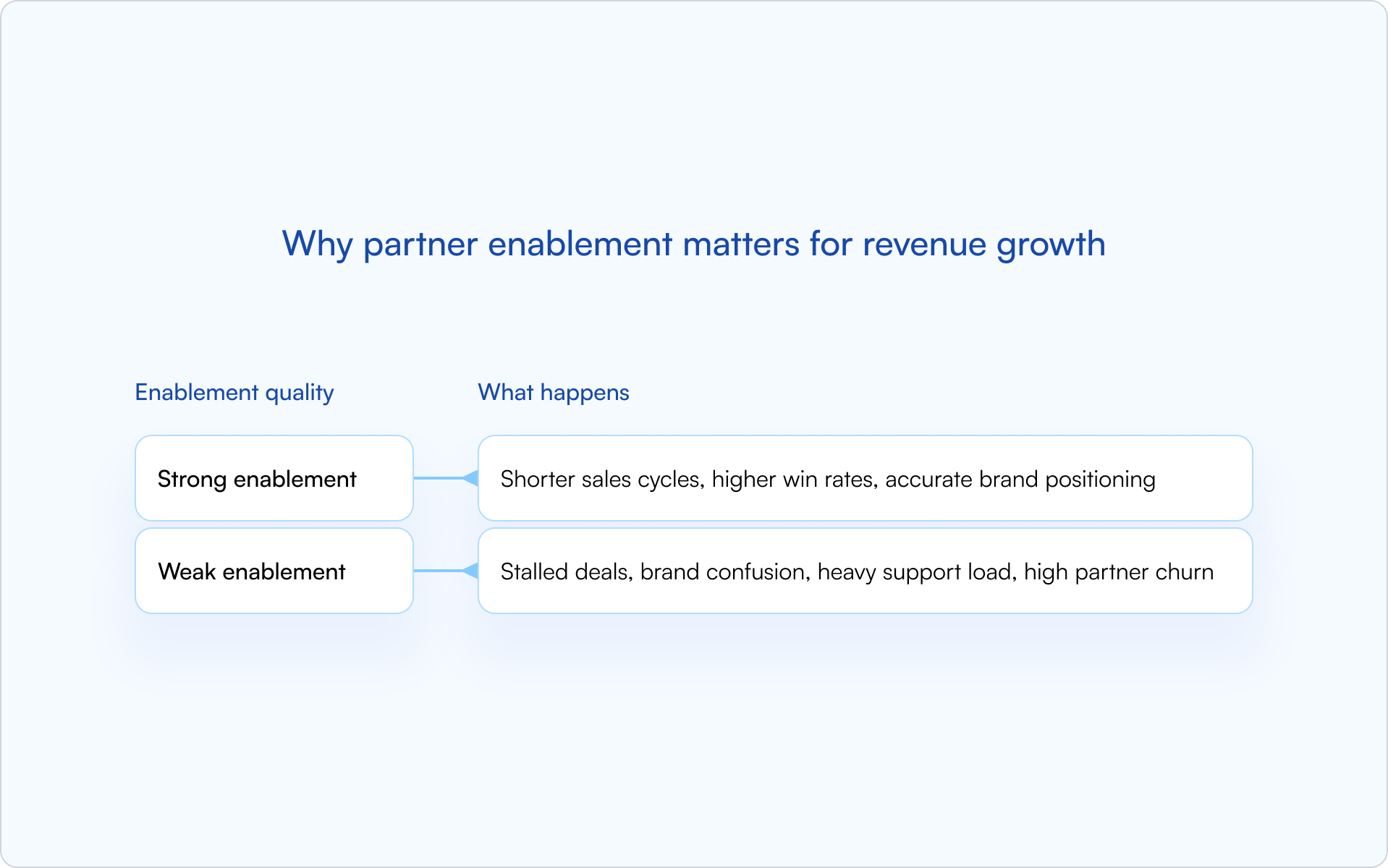
What a partner enablement program includes
A complete channel partner enablement program isn’t a portal full of PDFs. It’s a structured system that helps partners learn, launch, and improve — with clear ownership and measurable outcomes.
Partnerschulung und -zertifizierung
Training forms the foundation: product knowledge, competitive positioning, and your sales methodology. Certification acts as a gate, ensuring partners meet a minimum quality bar before they’re authorized to sell on your behalf.
Partner sales enablement
Partner sales enablement means giving partners the same caliber of sales tools your direct team uses, adapted to their role. Think: battle cards, demo scripts, objection-handling guides, and pricing documentation.
Marketing support and co-marketing
Effective enablement helps partners generate demand, not just close it. Co-branded assets, “campaign-in-a-box” kits, and structured lead-sharing programs all increase partner-sourced pipeline.
Partner portals (and why login friction kills adoption)
A partner portal should be a self-service hub for training, collateral, deal registration, and updates. But there’s a common failure mode: partners avoid portals that require a separate, inconvenient login.
CRM-first portals reduce that friction by connecting directly to HubSpot or Salesforce, so partners can work inside the flow of real deals instead of “checking another system.”
Performance tracking and ongoing communication
Enablement is ongoing, not a one-time launch. A strong program includes visibility into partner activity, a consistent communication cadence, and mechanisms for gathering feedback and improving the experience.
11 partner enablement best practices that drive results
If you’re building a partner program inside a startup, your constraint is almost never “ideas.” It’s focus and execution. These partner enablement best practices move from strategy through rollout and iteration — with an emphasis on what actually shows up in pipeline.
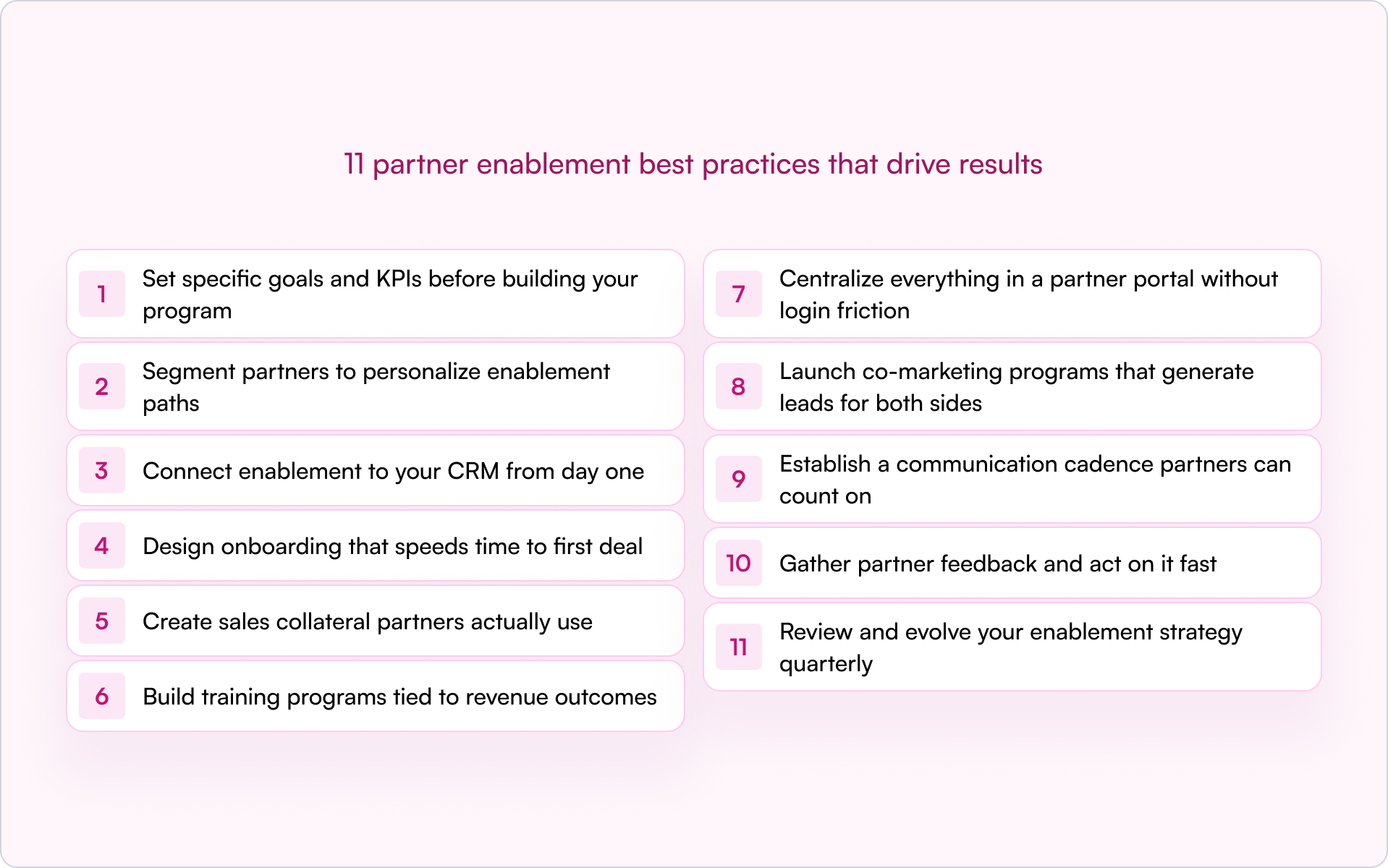
1. Set specific goals and KPIs before building your program
Before you create a single asset, define what success looks like. Start with outcomes — partner-sourced revenue targets, certification completion rates, and a target time-to-first-deal — then work backward into the program.
- Partner-sourced pipeline value
- Certification completion rate
- Average time from onboarding to first registered deal
- Content engagement (downloads, video views)
2. Segment partners to personalize enablement paths
Not all partners need the same materials. Segment by partner type (reseller, referral, systems integrator), vertical focus, or performance tier, then tailor training and content accordingly.
3. Connect enablement to your CRM from day one
For true visibility and attribution, all your enablement data — certifications, content consumption, deal registrations — lives best in your CRM, not in a disconnected system.
A CRM-first approach provides a single source of truth. When partner activity syncs directly to HubSpot or Salesforce, your sales team and RevOps see the same reality. No more chasing updates or reconciling spreadsheets. (If deal attribution is a pain point today, it’s worth tightening up your workflow around partner deal registration specifically.)
4. Design onboarding that speeds time to first deal
Partner onboarding works best as a structured, time-bound journey — not a massive content dump. The goal is to get partners to their first real opportunity quickly, then reinforce with deeper training once momentum is real.
A strong onboarding checklist includes:
- Welcome and program overview
- Product and Ideal Customer Profile (ICP) training
- Competitive positioning
- Deal registration process walkthrough
- First co-sell or shadow opportunity
5. Create sales collateral partners actually use
Don’t reinvent the wheel. Audit the sales collateral your direct team uses most effectively and adapt it for your partners. Prioritize assets that accelerate live deals: one-pagers, battle cards, ROI calculators, and customer stories.
The fastest way to avoid producing content no one opens is simple: ask partners what they need to win the deals they already have, then build for that.
6. Build training programs tied to revenue outcomes
Training works best when it’s modular, role-based, and tied to certification. Use certification as a gate — for example, require a partner to complete key modules before they can register deals or request MDF.
On-demand training offers flexibility; live sessions drive engagement for complex topics. Most teams land on a hybrid model.
7. Centralize everything in a partner portal without login friction
A partner portal should be the single place to find enablement content, register deals, and get program updates. But portals fail when they add friction — especially separate logins, stale content, and unclear navigation.
If you want adoption, reduce steps. Portals built directly on the CRM (with SSO or no-login options) make access feel seamless, which is often the difference between “partners love it” and “partners ignore it.”
8. Launch co-marketing programs that generate leads for both sides
Co-marketing goes beyond providing partners with your logo. Joint webinars, co-branded content like eBooks or case studies, and Market Development Funds (MDF) programs actively help partners generate demand.
If you’re a founder, this is one of the highest-leverage shifts you can make: partners often need help creating pipeline, not just closing it.
9. Establish a communication cadence partners can count on
Define a predictable rhythm. Partners shouldn’t have to guess where to find updates or whether deal registration is working. Use channels like email and Slack to reach partners where they already operate — don’t rely solely on them logging into a portal.
10. Gather partner feedback and act on it fast
Enablement is a two-way street. Collect feedback through surveys, QBR conversations, and portal analytics — then close the loop by making changes and telling partners what you changed.
Partners keep investing when they feel momentum. Small, fast improvements create that signal.
11. Review and evolve your enablement strategy quarterly
Partner enablement isn’t set-and-forget. Quarterly, review what’s working and what isn’t by analyzing content engagement, certification rates, and revenue impact. Then adjust your program like you’d adjust product — based on usage and outcomes.
Partner enablement training metrics to track
To understand if your partner enablement process is working, track metrics that connect enablement activities directly to revenue outcomes — not just vanity activities.
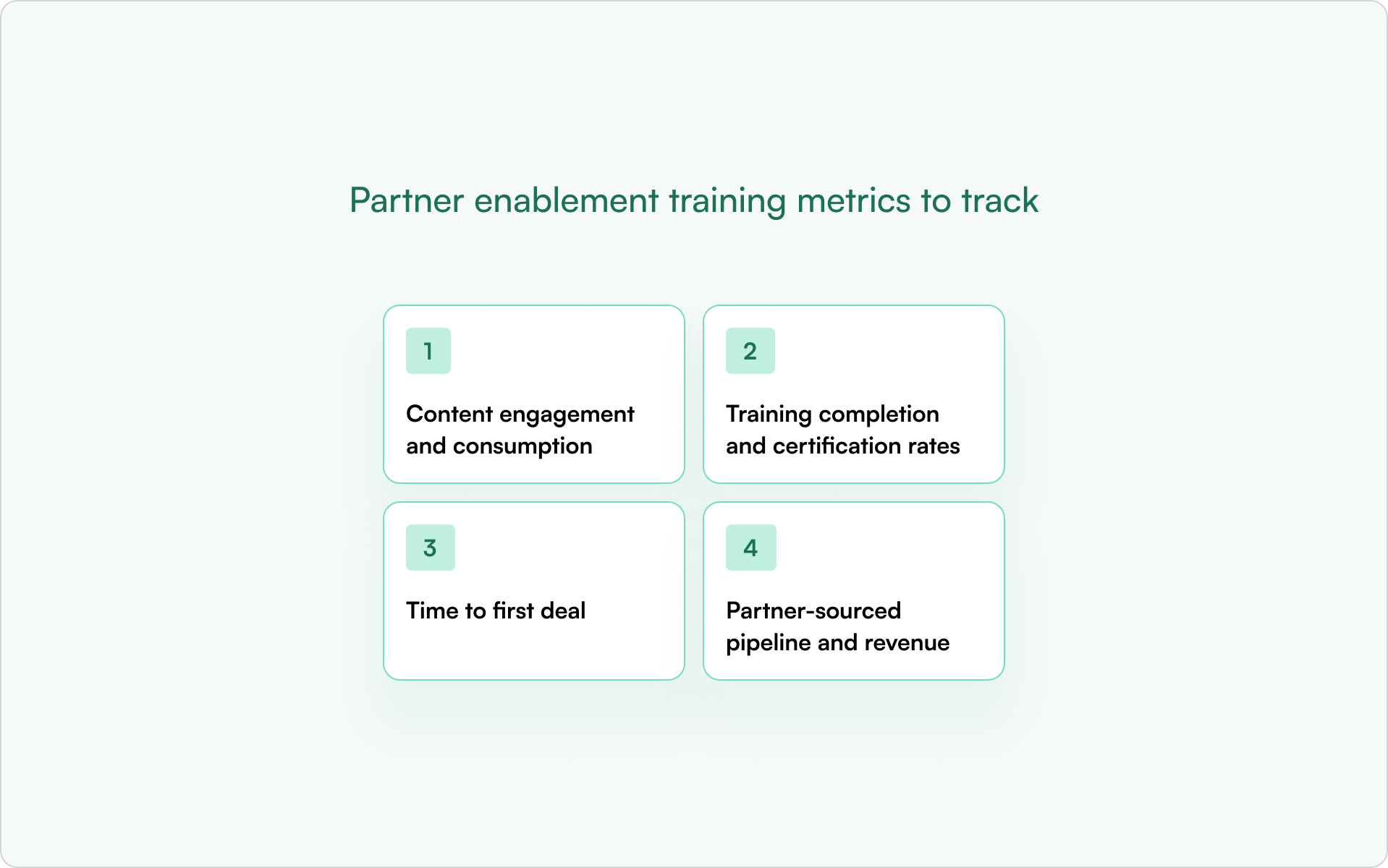
Content engagement and consumption
Track which resources partners actually use: downloads, video completion rates, and page views. Low engagement can signal the content isn’t relevant, is hard to find, or doesn’t match what partners need in active deals.
Training completion and certification rates
Measure how many partners complete onboarding and earn certifications. Completion rates help you pinpoint drop-off points so you can shorten, reorder, or redesign modules.
Zeit bis zum ersten Geschäft
Track the time between partner activation and their first registered deal. This is one of the cleanest indicators that onboarding is working — or that partners are stuck.
Partner-sourced pipeline and revenue
This is the ultimate scoreboard. Track pipeline and closed-won revenue generated by partners. To do it well, you need tight CRM attribution so enablement activity can be tied to financial results without manual cleanup.
How to automate your partner enablement process
Automation lets you scale partner enablement without scaling headcount. The goal isn’t to make the experience robotic — it’s to make it consistent, timely, and measurable.
CRM-based automation is ideal because it keeps data and workflows in one system. That’s how you avoid the “portal says one thing, CRM says another” problem.
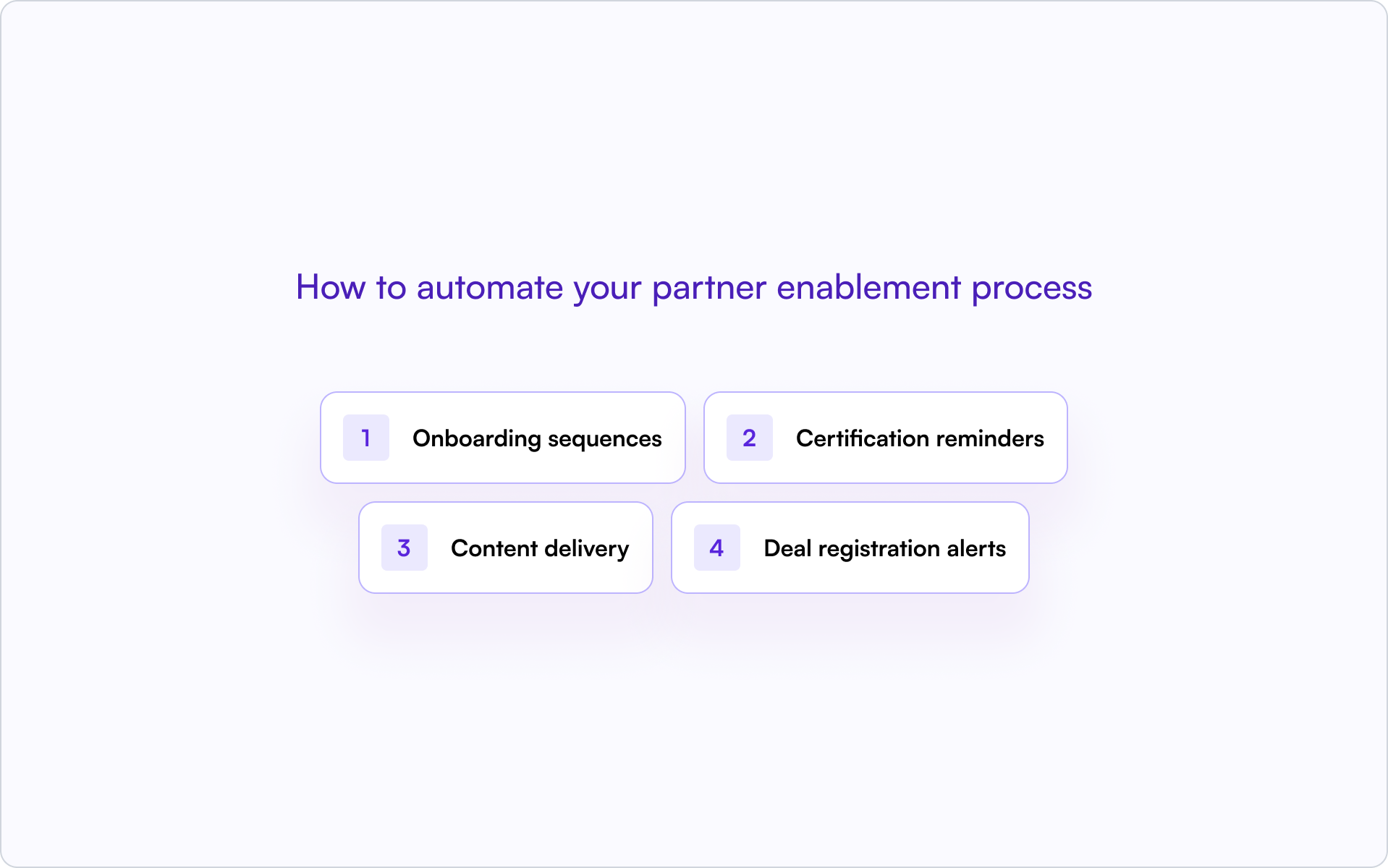
- Onboarding sequences: Automatically enroll new partners in training modules and send welcome materials as soon as they sign up.
- Certification reminders: Trigger automated alerts to partners and partner managers before certifications expire.
- Content delivery: Push relevant collateral to partners based on their segment, tier, or deal stage.
- Deal registration alerts: Automatically notify partners of the status of their registered deals.
Turn partner enablement into a revenue engine with Introw
Introw is the CRM-first PRM that makes best-practice partner enablement practical and scalable. Because it’s built on HubSpot and Salesforce, Introw centralizes your entire partner program where you already work.
It includes a partner portal for centralizing enablement content without login friction, deal registration with real-time visibility, and off-portal collaboration so partners can reply via email while data syncs automatically to your CRM.
If you’re trying to get out of spreadsheet chaos and into measurable partner-sourced revenue, get a demo.
Fazit
The best partner enablement programs aren’t built on more content — they’re built on clarity. Clear goals, segmented paths, CRM-connected workflows, and a focus on speed-to-first-deal turn “partners we signed” into “partners who ship revenue.”
Use these partner enablement best practices as a blueprint, then iterate quarterly based on what your data (and your partners) tell you.
12 Channeltivity Competitors to Choose From in 2026
What is Channeltivity (and why teams look for competitors)
Channeltivity is a partner relationship management platform that covers the basics well: deal registration, partner marketing, MDF, content management, and reporting.
But many teams now want AI, deeper CRM workflows, and more flexibility across the partner ecosystem. That’s why buyers evaluating Channeltivity alternatives are looking elsewhere.
.png)
1. No AI capabilities
Channeltivity does not offer AI-powered workflows for onboarding, training, support, or deals.
Many newer platforms now provide AI deal coaching, AI-generated content, AI training creation, and conversational support through an AI agent.
2. No off-portal collaboration
Channeltivity relies heavily on its portal experience. Partners typically need to log in to access content, submit leads, or track progress.
Many newer platforms focus on partner engagement through email workflows, embedded forms, notifications, and automated updates outside the portal.
3. No native Slack integration
Slack is now a common workspace for many channel teams.
Channeltivity does not provide native Slack workflows for notifications, collaboration, support, or deal updates. Teams that use Slack heavily often look for alternatives that bring partnership activity into the channels they already use.
4. Limited CRM depth
Channeltivity supports Salesforce and HubSpot, but it is not a CRM-native platform.
Organizations that run revenue operations inside the CRM often prefer custom objects, workflow triggers, and deeper integrations such as a native Salesforce integration or HubSpot integration.
5. Product innovation has slowed
Channeltivity still covers the core feature set expected from partner management software. But many newer solutions now include account mapping, partner LMS capabilities, AI-powered training, and advanced automation.
For many teams, the question is not whether Channeltivity works. It’s whether it still offers the capabilities they need to grow.
To find the best Channeltivity alternative available, what should you be looking for?
What to look for in a Channeltivity competitor
Not every Channeltivity PRM alternative solves the same problems. Focus on these six areas before you switch.
.png)
1. AI that does more than answer questions
Many tools now offer AI, but not all AI is useful. Look for AI that can automate workflows, generate content, build training, assist with support, and help move deals forward without manual effort.
2. Off-portal engagement
Your users shouldn’t have to log in every time they need an update. The best platforms let channel partners collaborate through email, notifications, and other channels while keeping data synced automatically.
3. Deep CRM integration
A CRM should remain your system of record. Look for bi-directional sync, custom object support, workflow triggers, and the ability to work directly inside Salesforce. Our guide to how to choose a PRM covers the key evaluation criteria.
4. A modern partner portal
The portal should be easy to configure without developers. Look for white-label branding, segmented experiences for different partner types, and enough flexibility to support your organization as it grows. A modern partner portal should adapt to your program, not the other way around.
5. Full lifecycle coverage
Many tools handle onboarding and deal registration but stop there. Stronger solutions also include partner marketing, referral programs, incentives, account mapping, training, performance tracking, and revenue visibility across the entire partner lifecycle.
6. Fast time to value
Some enterprise platforms take months to deploy. Others can integrate with existing systems and start delivering results in days. Faster implementation means less disruption and a quicker path to value.
With those criteria in mind, let’s compare the best Channeltivity alternatives available today.
Channeltivity competitors at a glance
Use this table to compare the best Channeltivity alternatives before you review each tool in detail.
This quick view shows where each platform fits. Next, let’s look at the tools in more detail.
12 Best Channeltivity Competitors in 2026
If you’ve decided Channeltivity is no longer the right fit, these are the platforms worth evaluating next.
#1 Introw - Best overall Channeltivity competitor for modern partner management
What it does
Introw is an AI-first platform designed for companies running partner programs in HubSpot or Salesforce.
It combines partner onboarding, deal registration, MDF, partner marketing, training, account mapping, revenue tracking, and partner engagement in a single CRM-native system.
Unlike traditional PRMs, Introw extends beyond the portal. Partners can collaborate through email and Slack while CRM data remains the system of record.
Why someone might choose it over Channeltivity
Introw covers everything Channeltivity offers, then adds agentic AI, off-portal collaboration, deal coaching, CPQ, AI-powered training, and deeper CRM integration.
The biggest difference is architectural. Channeltivity connects to the CRM. Introw operates from within it. That reduces duplicate data, eliminates spreadsheets, and gives teams better visibility across the entire partner ecosystem.
Teams also gain:
- AI-powered deal coaching for channel partners and resellers
- AI-generated training through a built-in partner LMS
- Agentic workflows through the AI agent
- Native deal and lead registration
- White-label portal experiences for different partner types
- Shared Slack and email collaboration without forcing portal logins
Where it stands out
- Agentic AI instead of manual workflows
- Off-portal engagement instead of portal-only collaboration
- AI-powered LMS instead of static training resources
- Built-in deal coaching
- Native CPQ
- Custom-object CRM architecture
- Typical deployment in 2–4 days
CRM integrations
Native, bi-directional Salesforce and HubSpot integrations with custom object support.
Preise
Custom pricing.
Am besten geeignet für
Mid-market SaaS companies that want a modern partner management platform built around CRM workflows and indirect revenue growth.
For a deeper look at partner management software, see our guide to partner management systems.
Ready to see why teams switch from Channeltivity to Introw? Book a demo.
#2 Impartner - Best for enterprise teams that need broad PRM coverage
What it does
Impartner combines partner portals, partner lifecycle management, TCMA, MDF, training, and ecosystem management in a large enterprise package.
Why someone might choose it over Channeltivity
It offers broader capabilities for large organizations that need extensive governance, customization, and administration controls.
Where it falls short
- Implementation often takes months
- Complex administration
- Heavier CRM architecture
- User experience feels dated in some areas
CRM integrations
Salesforce and other CRM systems through integration layers.
Preise
Custom pricing.
Am besten geeignet für
Large enterprise organizations with dedicated channel operations teams.
Our guide to Impartner competitors explores additional options.
#3 PartnerStack - Best for affiliate and referral programs
What it does
PartnerStack helps companies manage affiliates, referral programs, payouts, and partner recruitment through a large marketplace.
Why someone might choose it over Channeltivity
Built-in payment infrastructure and partner discovery make it attractive for growth-focused startups and SaaS companies.
Where it falls short
- Limited support for co-selling motions
- Less suitable for distributor programs
- CRM synchronization relies on middleware
- Less flexibility than dedicated PRMs
CRM integrations
Salesforce and HubSpot through Workato.
Preise
Marketing plans start at $1000/month. Growth plans start at $1520/month. Enterprise pricing is custom.
Am besten geeignet für
Companies focused on affiliates and referral programs.
See our full roundup of PartnerStack alternatives.
#4 Kiflo - Best for small partner programs
What it does
Kiflo is a lightweight PRM designed for simple onboarding, content sharing, and lead management.
Why someone might choose it over Channeltivity
It offers a cleaner interface, faster setup, and lower costs for smaller businesses.
Where it falls short
- No AI capabilities
- No LMS
- No CPQ
- Limited automation
- Limited flexibility as programs grow
CRM integrations
Basic HubSpot and Salesforce integrations.
Preise
Core starts at $399/month billed annually. Plus pricing is custom.
Am besten geeignet für
Small businesses with fewer than 20 active partners.
Explore more options in our guide to Kiflo alternatives.
#5 Euler - Best for teams that want a modern PRM experience
What it does
Euler provides partner onboarding, pipeline management, advisory AI assistants, and collaboration tools in a modern interface.
Why someone might choose it over Channeltivity
The experience feels newer and more intuitive, with AI assistance and stronger usability.
Where it falls short
- No MDF
- No LMS
- No advanced onboarding paths
- Limited CRM depth
CRM integrations
HubSpot and Salesforce.
Preise
Custom pricing.
Am besten geeignet für
Early-stage programs looking for modern design and simplicity.
See our comparison of Euler PRM alternatives.
#6 Salesforce Experience Cloud - Best for Salesforce-native control
What it does
Salesforce Experience Cloud lets organizations build highly customized partner portals directly on Salesforce infrastructure.
Why someone might choose it over Channeltivity
Nothing offers deeper Salesforce integration or reporting access.
Where it falls short
- Requires development resources
- Long implementation cycles
- No embedded LMS
- No off-portal collaboration
- Limited out-of-the-box functionality
CRM integrations
Native Salesforce.
Preise
Partner Community starts at $20/login/month or $50/member/month billed annually.
Am besten geeignet für
Large Salesforce organizations with internal development teams.
If Salesforce is central to your evaluation, review these Salesforce PRM alternatives.
#7 Mindmatrix - Best for through-channel marketing automation
What it does
Mindmatrix combines partner marketing, content distribution, training, onboarding, and PRM functionality.
Why someone might choose it over Channeltivity
It delivers stronger marketing automation and broader enablement capabilities.
Where it falls short
- Steep learning curve
- Complex setup
- Enterprise-focused administration
- Some workflows require vendor assistance
CRM integrations
Salesforce and HubSpot.
Preise
No pricing available.
Am besten geeignet für
Organizations heavily invested in partner marketing and enablement.
Read our breakdown of Mindmatrix alternatives.
#8 ZINFI - Best for large multi-tier channel programs
What it does
ZINFI offers unified channel management covering onboarding, MDF, marketing, incentives, and partner lifecycle management.
Why someone might choose it over Channeltivity
It supports highly complex multi-tier channel structures and global programs.
Where it falls short
- Heavy implementation effort
- Significant configuration requirements
- Data often sits primarily in the platform
- Less CRM-centric approach
CRM integrations
Salesforce, Microsoft Dynamics, and others.
Preise
ZINFI does not publish public PRM pricing.
Am besten geeignet für
Large enterprise channel organizations.
You can compare other options in our guide to ZINFI alternatives.
#9 Magentrix - Best for Salesforce-based partner portals
What it does
Magentrix focuses on customer and partner portals built on Salesforce.
Why someone might choose it over Channeltivity
It provides a clean portal experience with stronger Salesforce alignment.
Where it falls short
- Portal-centric approach
- Limited AI
- Limited lifecycle coverage
- No meaningful off-portal engagement
CRM integrations
Native Salesforce.
Preise
Essential starts at $1500/month. Advanced starts at $3000/month. Unlimited pricing is custom.
Am besten geeignet für
Organizations primarily looking for a Salesforce-powered portal.
Our guide to Magentrix alternatives covers comparable solutions.
#10 ChannelScaler - Best for rebates and incentives
What it does
ChannelScaler combines PRM, MDF, rebate management, incentives, and channel operations functionality.
Why someone might choose it over Channeltivity
It offers stronger rebate and incentive management for mature programs.
Where it falls short
- Admin-heavy workflows
- No AI
- No Slack-based collaboration
- CRM changes often require support involvement
CRM integrations
Salesforce and HubSpot through middleware.
Preise
Custom pricing.
Am besten geeignet für
Organizations running complex incentive and rebate programs.
See our guide to ChannelScaler alternatives for a deeper comparison.
#11 Partner.io - Best for pipeline collaboration
.png)
What it does
Partner.io focuses on pipeline visibility, co-selling, and deal collaboration.
Why someone might choose it over Channeltivity
It offers a more modern experience for teams centered on shared opportunities and sales collaboration.
Where it falls short
- Narrower feature set
- Smaller ecosystem
- Less mature than larger competitors
CRM integrations
Salesforce and HubSpot.
Preise
Solo starts at $79/month. Growing starts at $299/month. Enterprise pricing is custom.
Am besten geeignet für
Organizations focused on pipeline collaboration and visibility.
Take a look at our roundup of Partner.io alternatives if you’re comparing pipeline-focused partner platforms. We also have a Partner.io comparison page so you can see how it stacks up against Introw.
#12 Impact - Best for affiliate and influencer partnerships
What it does
Impact helps businesses manage affiliates, creators, influencers, and referral relationships through automated tracking and payments.
Why someone might choose it over Channeltivity
It excels at performance-based partnership programs and attribution.
Where it falls short
- Not a traditional PRM
- No partner onboarding workflows
- No deal registration
- No channel sales management
CRM integrations
Limited CRM support compared to dedicated PRMs.
Preise
Starter starts at $30/month. Essentials starts at $500/month. Pro starts at $2500/month.
Am besten geeignet für
Companies focused on affiliate, creator, and influencer partnerships.
Now that you’ve seen the options, the best choice comes down to how you want to support your partners, manage deals, and scale your program over the next few years.
Das Fazit
Channeltivity covers the fundamentals of partner relationship management, including deal registration, partner onboarding, content management, training, and reporting. If those features meet your company’s needs, it remains a solid option.
But the industry has moved on. Today’s partner management systems help organizations automate more work, support customers more effectively, manage partner services at scale, and create more sales opportunities.
AI, CRM-native workflows, embedded training, and collaboration beyond the portal are quickly becoming standard.
If you’re evaluating partner relationship management software, Introw is a strong Channeltivity alternative. It combines mid-market simplicity with the products, resources, and automation growing partner programs need to drive better revenue results.
Why teams choose Introw when looking for Channeltivity competitors
Teams often start looking at Channeltivity competitors when they need more than a portal and basic partner management. They need a platform that helps partners sell, supports more services, and creates measurable revenue growth.
+70% more partner pipeline
Partners register more deals, faster, with deal flow synced directly into your CRM. Off-portal collaboration increases engagement, while AI helps identify duplicate opportunities before they affect results.
+75% faster partner onboarding
Go live in 2–4 days with no custom development. AI-driven onboarding, training, resources, and content help new partners start selling faster.
+60% more partner-influenced revenue
Track every partner-sourced and partner-influenced opportunity inside your CRM. Deal coaching, automation, and ongoing support help partners stay active and generate more revenue over time.
Ready to see how Introw compares to Channeltivity? Book a demo.
What Are Marketing Development Funds (MDF)? A Complete Guide for Partner Teams
What are marketing development funds?
Marketing development funds (MDF) are budgets vendors allocate to channel partners to run approved marketing activities that promote the vendor’s products and generate pipeline.
A simple marketing development funds definition: MDF is vendor-funded support that helps partners execute campaigns like events, webinars, digital ads, and localized marketing programs that drive demand and expand market reach.
Here’s how MDF programs typically work:
- The vendor sets aside development funds for partners
- Partners submit requests for MDF-funded marketing efforts
- The vendor approves the activity and releases marketing dollars
- Both teams track results such as leads, pipeline, and revenue impact
You’ll also see MDF called market development funds, which refers to the same concept in most channel marketing programs.
It’s important not to confuse MDF with co-op funds. MDF is discretionary and approved in advance, while co-op programs are usually earned after past sales performance and reimbursed later.
Why MDF matters for partner programs
Most channel partners don’t have extra marketing dollars to promote your product. Marketing development funds close that gap so partners can run campaigns that create pipeline instead of waiting for inbound demand.
When partners get MDF support, they can:
- Launch localized marketing campaigns faster
- Generate leads in their own regions
- Increase brand visibility with potential customers
- Expand your market presence without adding headcount
That’s why strong MDF programs are a core part of a modern channel partner marketing strategy. They help both the vendor and the partner invest in shared growth instead of working in silos.
MDF also creates accountability. You fund the activity. Partners execute the marketing initiatives. Both teams track progress and measure sales opportunities together.
Yet many teams still struggle to use the budget they already have. Up to 60% of development funds go unused because the approval process is slow and results aren’t visible across systems.
When the MDF process works, the impact is real. It’s common to see about $8K in MDF-funded activity influence more than $130K in pipeline. That kind of return turns MDF from a cost line into a predictable lever inside your broader partnership marketing strategy.
8 common MDF-eligible activities
Marketing development funds help channel partners run targeted marketing activities that generate pipeline and expand market reach. Most MDF programs support digital campaigns, events, and co-branded assets that increase brand visibility and help generate leads.
Here are the most common MDF-funded activities across SaaS partner ecosystems.
1. Co-branded webinars and virtual events
Partners often use development funds MDF budgets for hosting webinars that introduce your vendor’s products to new audiences. These sessions support lead generation programs and strengthen partner engagement through structured co-marketing initiatives.
2. Digital advertising campaigns
Paid LinkedIn campaigns, search engine marketing, and digital ads help local partners reach potential customers faster. These MDF-funded marketing efforts are a reliable way to drive demand generation and generate leads.
3. Trade show and conference sponsorships
Trade shows increase brand awareness and create sales opportunities in new markets. Many MDF programs allocate MDF for booth presence, speaking slots, or regional sponsorships alongside broader channel partner incentive programs.
4. Co-branded content creation
Partners often invest MDF support into case studies, whitepapers, and promotional materials that highlight joint solutions. These assets strengthen brand recognition and support marketing goals, especially when teams enable partners with content that’s ready to deploy.
5. Email marketing campaigns
Email marketing campaigns help partners nurture sales leads and stay visible with existing accounts. They’re a simple way to support marketing and improve partner performance.
6. Local demand generation campaigns
Geo-targeted outreach helps increase local awareness and expand market reach in priority regions. These localized marketing campaigns are especially valuable for smaller partners building market presence.
7. Partner-hosted workshops and roundtables
Workshops and executive roundtables help educate potential customers and improve sales performance through direct engagement. They also support the work of a modern partner marketing manager running joint marketing activities across channel partners.
8. Product demo environments and trial programs
Some MDF activities support hands-on demo environments that help partners showcase real use cases and drive sales through practical product experiences.
Eligible MDF activities vary by vendor, but strong MDF programs make eligibility clear upfront. That clarity speeds the approval process and helps partners move faster on marketing initiatives that support market development.
How MDF programs typically work (the MDF lifecycle)
What MDF is in marketing becomes easier when you start looking at the lifecycle. Most MDF programs follow a predictable structure from fund allocation to ROI tracking. The difference between average programs and high-performing ones is how well teams manage each step.
Here’s how the MDF process usually works.
Step 1: Fund allocation
The vendor sets aside development funds budgets by partner tier, region, or strategic priority. Many teams allocate MDF based on partner performance, planned market development goals, or expected pipeline contribution.
Step 2: Partner request submission
The partner apply step starts when channel partners submit a proposal describing the MDF-funded activity, expected outcomes, target audience, and marketing initiatives they plan to run. This stage often answers questions like what does MDF mean in marketing for new partners entering the program.
Step 3: Review and approval
Your team evaluates the request based on marketing goals, eligibility rules, and available marketing dollars. This approval process is where many MDF programs slow down due to email chains and limited visibility into fund management.
Step 4: Campaign execution
Once approved, partners launch marketing campaigns such as digital ads, trade shows, or lead generation programs designed to support marketing and expand market reach.
Step 5: Proof of performance
Partners submit results from the MDF-funded activity, including receipts, campaign metrics, and sales leads. This helps both the vendor and partner track progress and confirm expected outcomes.
Step 6: ROI measurement
The final step connects spend to pipeline and revenue growth. Strong teams link market development funds (MDF) activity directly to sales opportunities and partner performance. Weak programs rely on spreadsheets and guesswork instead of real attribution.
Most breakdowns happen during request approvals and ROI measurement. Without structured workflows and CRM visibility, teams struggle to allocate MDF efficiently or prove impact.
This gap explains why the MDF meaning in marketing (and the broader meaning of MDF in channel marketing) often gets reduced to spend tracking instead of driving growth.
MDF allocation models: how to decide who gets what
Your allocation model determines how fairly and effectively you distribute development funds across channel partners. If partners don’t understand how budgets are assigned - or can’t see what’s available - MDF programs quickly lose momentum.
Here are the three most common approaches.
Flat allocation
Every partner receives the same amount of development funds support.
This model is simple to manage and easy to explain, especially for newer programs where teams are still clarifying the MDF definition marketing teams use internally. The downside: it ignores partner performance and strategic impact.
Tier-based allocation
Partners receive budgets based on program level. Gold partners get more. Silver partners get less. Bronze partners receive the smallest share.
This structure aligns MDF usage with partner capabilities and expected contribution. It also reinforces program incentives and improves partner engagement across your ecosystem.
Performance-based allocation
Partners earn market development funds based on past revenue, deal volume, or pipeline contribution.
This is the most efficient model for driving growth because it ties marketing dollars directly to results. It also helps reinforce the MDF meaning marketing leaders care about most – measurable pipeline influence and increased sales.
Hybrid allocation models
Many teams combine approaches. For example:
- A base allocation for all partners
- A bonus pool tied to partner performance
This balances fairness with accountability and reflects the practical MDF marketing meaning inside mature partner programs.
Whatever model you choose, partners should always see their available budget in real time. If they have to ask a channel manager over email, the MDF in marketing meaning shifts from a growth lever to an administrative bottleneck.
Why most MDF programs fail (and how to fix it)
Many teams understand the MDF meaning marketing leaders expect: pipeline growth, stronger partner engagement, and measurable revenue impact. But execution often breaks down long before those results appear.
Here’s where most MDF programs fail and how to fix each issue.
When these gaps are removed, MDF programs shift from reactive fund tracking to structured demand generation engines that support marketing goals, improve partner engagement, and drive measurable revenue growth.
How modern PRM tools manage MDF
Modern PRM tools turn MDF from a tracking exercise into a system your team can actually use to support marketing initiatives and prove impact.
Instead of chasing approvals, reconciling spreadsheets, or guessing which MDF-funded campaigns influenced pipeline, your team gets a clear structure for managing development funds across partners and programs.
A strong MDF setup should include:
- Fund creation with budget caps and partner-level allocation
- No-code request forms that auto-map to CRM objects
- Approval workflows with status tracking and audit trails
- Partner-facing budget visibility across available, consumed, and pending funds
- Campaign-to-deal linking for revenue attribution
- Automated ROI calculation tied to pipeline and more sales opportunities
The best PRM platforms keep development funds MDF activity synced with Salesforce or HubSpot, so finance, RevOps, and partnership teams trust the same numbers. That makes it easier to track progress, justify future budget decisions, and improve partner performance over time.
When this structure is in place, the MDF meaning marketing teams care about becomes practical: clearer attribution, faster approvals, better partner engagement, and more predictable revenue growth.
Curious how this works in practice? Learn how modern teams like yours manage marketing development funds.
MDF vs. co-op funds vs. SPIFF: what is the difference?
Partner programs often combine multiple incentive types. Understanding the difference helps your team choose the right structure for supporting marketing activities, improving sales performance, and driving revenue growth across channel partners.
Most mature partner programs use all three together. MDF supports planned demand generation, co-op programs reward past results, and SPIFs accelerate short-term pipeline activity. If you’re designing a broader incentive structure across your ecosystem, this overview of channel partner incentive programs shows how these models work together.
Where Introw comes in
Most MDF programs don’t fail because the budget is too small. They fail because the process around market development funds is fragmented across spreadsheets, inboxes, and disconnected systems.
That friction shows up in daily work quickly. Channel managers chase approvals. Partners ask about balances. RevOps can’t connect spend to pipeline. Leadership sees the cost but not the outcomes. Over time, MDF usage drops and marketing initiatives lose momentum.
Introw brings the entire MDF lifecycle into one CRM-connected workflow so your team can manage development funds with clear structure and visibility.
What changes for your team in practice
Channel managers stop tracking requests manually and instead see budgets, approvals, and campaign activity in one place. Partner marketing managers move faster because requests follow structured workflows instead of email threads. RevOps gains reliable attribution by linking MDF-funded activity directly to deals in HubSpot or Salesforce. Leadership gets a clearer view of how marketing dollars support pipeline and revenue growth.
Instead of treating MDF as a quarterly coordination task, your team can track progress continuously across partners, campaigns, and sales opportunities.
If you want to know where to go next, here’s where to start:
- Review how your team currently allocates and tracks marketing development funds
- Identify where approvals slow down campaign execution or reduce MDF usage
- Explore how structured workflows improve attribution inside modern marketing development funds programs
When your MDF process becomes measurable and easy to manage, it becomes easier to support partners, improve partner performance, and plan future budget decisions with confidence.
Request a demo today to chat with us about how to turn your marketing development funds into a measurable source of partner-driven pipeline.
13 Mindmatrix PRM Alternatives for Growing Partner Teams in 2026
What Is Mindmatrix (And Why Teams Look for Alternatives)
Mindmatrix is an established partner management and sales enablement platform combining PRM, marketing automation, partner training, and TCMA in one platform. For large channel sales teams, that breadth can be useful.
But many teams now want faster onboarding, simpler admin controls, and deeper CRM execution.
.png)
1. Steep learning curve
Mindmatrix has no separate admin experience. Partnership managers work inside the same interface as partners, which increases complexity and slows onboarding.
2. LMS updates require support
Mindmatrix includes partner training and LMS features, but many updates require support involvement.
Tools like Introw’s partner LMS give your team direct control instead.
3. Long implementation timelines
Mindmatrix covers a wide range of features, but setup can take months.
Teams wanting faster rollout often move toward tools built natively for HubSpot or Salesforce.
4. Limited role-based access
Granular visibility controls are limited.
That becomes difficult when different partner tiers need different dashboards, deals, content, or onboarding paths.
5. Portal-heavy workflows
Mindmatrix is still largely portal-centric.
There’s no native CPQ, no Slack-based collaboration, and no off-portal workflows tied directly into tools like deal and lead registration.
6. AI focused more on content than execution
BridgeAI is strong for content generation, email marketing, and social selling.
But it does not execute actions across live deals through tools like the AI agent.
If you want faster onboarding, simpler admin, and CRM-native execution, a Mindmatrix alternative may be a better fit.
Mindmatrix alternatives at a glance
Here’s a quick comparison of the top Mindmatrix alternatives before we break each platform down in more depth.
While it might be tempting to focus on a tool with all the features, the right fit depends on how your teams engage partners, manage opportunities, and scale channel sales over time.
13 Best Mindmatrix Alternatives in 2026
#1 Introw - Best overall Mindmatrix alternative for CRM-native partner management
.png)
What it does
Introw is an AI-first partner management platform for teams running on HubSpot or Salesforce. It combines onboarding, deal registration, sales enablement, CPQ, MDF, dashboards, training, and partner engagement in one platform.
Unlike Mindmatrix PRM, Introw is built directly around the CRM. Partner data, opportunities, onboarding, and reporting sync bi-directionally with Salesforce and HubSpot.
Partners can collaborate through Slack and email without relying on portal logins. The partner portal is fully white-labeled, no-code, and supports granular role-based access.
Why teams choose Introw over Mindmatrix
Most teams leaving Mindmatrix want:
- Faster onboarding
- Less admin overhead
- Better CRM execution
Introw gives partnership managers direct control over training, LMS updates, onboarding, access, automations, and partner programs without support tickets or developer work.
It also goes much deeper on execution AI. While Mindmatrix focuses heavily on content generation and marketing automation, Introw’s AI acts across live partner workflows and deals instead.

Examples include:
- Deal registration from Slack or email
- AI deal coaching tied to live CRM opportunities
- CRM-triggered partner engagement
- AI-generated QBR insights
- AI-built onboarding and training flows
If your team wants faster onboarding, simpler workflows, and AI that reduces manual work, Introw is one of the strongest top Mindmatrix alternatives available today.
Where Introw stands out
- Native Salesforce and HubSpot integrations
- Full custom object support
- Agentic AI workflows
- Self-service LMS with AI course creation
- Granular role-based access
- Native CPQ
- Zusammenarbeit außerhalb des Partnerportals
- Native Claude MCP integration
- 2–4 day onboarding
- No-code admin experience
CRM integrations
Native Salesforce and HubSpot integrations with deep bi-directional sync.
Preise
Custom pricing. Request a free demo for current pricing and onboarding details.
Am besten geeignet für
SaaS teams with multiple partner managers that want a modern PRM they can run themselves.
If you’re still comparing tools, our guides on partner relationship management software and partner management systems are also useful starting points.
#2 Impartner - Best for enterprise-scale PRM with broad module coverage
What it does
Impartner is an enterprise PRM platform covering partner portals, lifecycle management, marketplaces, and marketing automation.
Why someone might choose it
It offers broad enterprise functionality and strong marketplace capabilities for large channel sales programs.
Where it falls short
- 3–12 month onboarding timelines
- Middleware CRM architecture
- Dated admin experience
- Heavy operational overhead
Teams moving from Mindmatrix may still face similar complexity.
CRM integrations
Salesforce integrations through middleware.
Preise
Individuelle Preisgestaltung für Unternehmen.
Am besten geeignet für
Large enterprises committed to broad PRM deployments.
Our guide to the best Impartner competitors covers additional options.
#3 Zinfi - Best for large-scale unified channel management
.png)
What it does
Zinfi combines partner management, marketing automation, onboarding, analytics, and partner marketing in one platform.
Why someone might choose it
It works well for large multi-tier partnerships and complex global channel sales structures.
Where it falls short
- Complex setup
- Dated interface
- Heavy configuration needs
- High admin overhead
CRM integrations
Salesforce and Microsoft Dynamics.
Preise
Individuelle Preisgestaltung für Unternehmen.
Am besten geeignet für
Large enterprises managing complex partner ecosystems.
See how it compares in our guide to the best Zinfi alternatives.
#4 PartnerStack - Best for affiliate and referral program automation
.png)
What it does
PartnerStack focuses on affiliate, referral, and payout automation with a built-in marketplace.
Why someone might choose it
It’s easier to start, easy to use, and built for referral-driven growth.
Where it falls short
- Workato middleware sync
- Transaction fees
- Rigid portal experience
- Limited co-sell support
- No two-tier workflows
CRM integrations
HubSpot and Salesforce through Workato.
Preise
Plans start at $1000/month for marketing programs and $1250/month for co-sell programs. Enterprise pricing is custom.
Am besten geeignet für
Businesses focused mainly on affiliate and referral programs.
Explore our guide to the best PartnerStack alternatives.
#5 Salesforce Experience Cloud (Partner Cloud) - Best for Salesforce-first businesses
What it does
Salesforce Experience Cloud is Salesforce’s portal framework for building partner experiences directly inside Salesforce.
Why someone might choose it
It keeps customer data, reporting, security, and workflows entirely inside Salesforce.
Where it falls short
- Heavy developer dependency
- No self-service admin layer
- Long implementation time
- No built-in LMS
- No AI partner workflows
CRM integrations
Native Salesforce integration.
Preise
Partner Community pricing starts at $20/login/month or $50/member/month billed annually.
Am besten geeignet für
Large Salesforce businesses with internal development resources.
If Salesforce depth matters most, review these best Salesforce PRM alternatives.
#6 ChannelScaler - Best for incentive and rebate management
.png)
What it does
ChannelScaler combines PRM, MDF, rebates, incentives, and partner workflows after the Allbound and Channel Mechanics merger.
Why someone might choose it
It offers stronger rebate and incentive management than many competitors.
Where it falls short
- Admin-heavy workflows
- No AI capabilities
- No Slack workflows
- CRM maintenance overhead
- Limited automated partner engagement
CRM integrations
Salesforce and HubSpot through middleware.
Preise
Custom pricing.
Am besten geeignet für
Teams focused heavily on rebates, incentives, and MDF workflows.
Our guide to the best ChannelScaler alternatives will give you more context.
#7 Kiflo - Best for SMBs launching a first partner program
.png)
What it does
Kiflo is lightweight partner management software designed for smaller teams starting their first PRM.
Why someone might choose it
It’s simpler, faster, and easier to manage than Mindmatrix.
Where it falls short
- No AI
- No LMS
- No CPQ
- No two-tier support
- Limited CRM depth
CRM integrations
Basic Salesforce and HubSpot integrations.
Preise
Core plans start at $399/month billed annually. Plus plans are custom priced.
Am besten geeignet für
Small teams with straightforward partner programs.
Explore our roundup of top Kiflo alternatives.
#8 Euler - Best for modern PRM with advisory AI
What it does
Euler is a newer PRM platform focused on onboarding, partner engagement, and advisory AI assistants.
Why someone might choose it
It offers a cleaner experience and lighter setup than traditional enterprise platforms.
Where it falls short
- No LMS
- No MDF
- No custom object support
- Limited onboarding depth
- No white-label portal
CRM integrations
Basic Salesforce and HubSpot integrations.
Preise
Custom pricing.
Am besten geeignet für
Early-stage teams wanting a modern interface without enterprise complexity.
Our guide on the best Euler PRM alternatives compares more options.
#9 Magentrix - Best for Salesforce-native portal management
What it does
Magentrix is a Salesforce-native portal platform for partner and customer collaboration.
Why someone might choose it
It offers a more focused portal experience without the broader TCMA depth of Mindmatrix.
Where it falls short
- Salesforce-only
- Portal-centric workflows
- Limited AI features
- Less automation depth
CRM integrations
Native Salesforce integration.
Preise
Custom pricing.
Am besten geeignet für
Salesforce-only businesses focused on partner portals.
See how it compares in our guide to the best Magentrix alternatives.
#10 Channeltivity - Best for mid-market partner programs
.png)
What it does
Channeltivity is mid-market PRM software covering deal registration, onboarding, MDF, and reporting dashboards.
Why someone might choose it
It’s easier to deploy and easier to manage than larger enterprise platforms.
Where it falls short
- Limited AI
- No off-portal collaboration
- Limited CRM depth
- Less flexible workflows
CRM integrations
Salesforce integration.
Preise
Custom mid-market pricing.
Am besten geeignet für
Mid-market teams wanting straightforward partner management.
Our guide on the best Channeltivity competitors covers similar tools.
#11 Partner.io - Best for pipeline-focused partner collaboration
What it does
Partner.io focuses on partner collaboration, pipeline visibility, and co-selling workflows.
Why someone might choose it
It offers a lighter and more modern approach to shared sales workflows.
Where it falls short
- Smaller customer base
- Narrower feature depth
- Less mature ecosystem
CRM integrations
Salesforce and HubSpot integrations.
Preise
Custom pricing.
Am besten geeignet für
Teams prioritizing pipeline visibility and co-sell collaboration.
Take a closer look at our guide to Partner.io alternatives for another overview or our Introw vs. Partner.io page to see a direct comparison.
#12 Impact - Best for affiliate and influencer partnerships
What it does
Impact focuses on affiliate, influencer, and referral partnerships with automated payouts and tracking.
Why someone might choose it
It’s much stronger than Mindmatrix for influencer and performance marketing workflows.
Where it falls short
- Not traditional PRM software
- Limited reseller support
- Limited co-sell workflows
- Limited CRM depth
CRM integrations
Basic CRM integrations with limited depth.
Preise
Custom pricing with transaction fees.
Am besten geeignet für
Marketing teams focused on affiliate and influencer partnerships.
#13 Everflow - Best for high-volume affiliate tracking
What it does
Everflow is performance marketing software focused on affiliate, referral, and influencer tracking.
Why someone might choose it
It delivers strong analytics, fraud prevention, and real-time tracking for high-volume programs.
Where it falls short
- No PRM workflows
- No LMS
- No onboarding
- No deal registration
- No partner portal
CRM integrations
Limited CRM integrations.
Preise
Starts around $750/month.
Am besten geeignet für
Teams focused on affiliate tracking rather than full partner management.
If you still need help comparing categories, this 2025 guide to choosing your next PRM can help you narrow down the right fit.
Das Fazit
Mindmatrix PRM still works well for large enterprise marketing and channel sales programs.
But many teams now want faster onboarding, simpler admin, deeper CRM integration, and AI that helps move deals forward instead of just generating content.
That’s where newer alternatives stand out.
Introw combines CRM depth, agentic AI, CPQ, partner portals, dashboards, and partner engagement in one platform without long implementation projects.
Its AI helps teams route leads, surface opportunities, automate approvals, and engage partners across the full lifecycle.
You also get:
- Self-service admin controls
- Granular security and partner access
- Native Salesforce and HubSpot integrations
- AI-powered dashboards and reporting
- Faster onboarding and time to value
- Easy ways to integrate sales and marketing data
- Flexible solutions for co-sell, reseller, referral, and affiliate partnerships
If your business wants a modern PRM platform your team can actually run themselves, Introw is one of the top alternatives to compare.
Why teams choose Introw when looking for Mindmatrix alternatives
Here’s what happens when businesses move from Mindmatrix to Introw.
+70% more partner pipeline
Introw helps partners register more leads and opportunities without adding admin work.
Deal registration syncs directly into your CRM, AI conflict detection improves channel sales visibility, and partners can engage through Slack or email instead of relying on portal logins. That creates a more efficient experience for both sales and marketing teams.
+75% faster partner onboarding
Go live in days, not months.
Introw gives you one platform for onboarding, sales enablement, training, dashboards, certifications, partner engagement, and partner communication. No custom coding. No support dependency. No waiting to update products, courses, or onboarding flows.
+60% more partner-influenced revenue
Get clear partner attribution tied directly to CRM data.
AI deal coaching helps partners move deals forward at the right time, while automated engagement and email marketing help keep customers, resellers, referral partners, and co-sell partnerships active long term.
You also get the flexibility to integrate your existing sales and marketing software, leverage live customer data, and create scalable partner programs without rebuilding your entire service model.
Interested to see how Mindmatrix compares to Introw?
Book a demo and get started on a faster, easier partner management experience.
15 Zinfi PRM Alternatives to Manage and Grow Your Partner Channel in 2026
What Is Zinfi (And Why Teams Look for Alternatives)
Many teams evaluating Zinfi PRM want one platform for partner management, onboarding, MDF, analytics, deal registration, and partner portals. Zinfi positions itself as a Unified Channel Management platform built for large partner ecosystems with distributors, resellers, MSPs, and referral partners.
If your business needs deep customization and broad module coverage, Zinfi can fit well. But many teams start evaluating other partner relationship management software once implementation speed, CRM alignment, and partner adoption become concerns.
.png)
1. Complex and lengthy implementations
Zinfi’s broad module set requires significant setup before your team can fully use the platform. Many businesses spend weeks or months configuring workflows, branding, forms, automations, and integrations.
For teams that need to move quickly, long implementation timelines slow onboarding and revenue generation.
2. Partner data lives in Zinfi, not the CRM
Zinfi operates as its data layer instead of a deeply CRM-native platform.
Partner data, leads, deals, and engagement activity often need ongoing syncing between Zinfi and Salesforce, HubSpot, or Dynamics. That creates extra admin work and weaker real-time visibility for sales teams.
For CRM-first organizations, this can become a major limitation.
3. Dated UI and steep admin learning curve
Verified reviews regularly mention a dated interface and complex admin experience.
Partners may struggle with navigation, while internal teams typically require extensive training before managing workflows confidently. An intuitive interface matters because low adoption hurts partner performance.
4. Heavy configuration and ongoing maintenance
Zinfi offers extensive customization across workflows, automations, portal pages, and partner program structures.
The tradeoff is ongoing maintenance. Simple changes may require support involvement, dedicated admin users, or additional setup work.
This is one reason many buyers start comparing modern partner management systems with simpler admin experiences.
5. No off-portal collaboration or agentic AI
Zinfi remains heavily portal-centric.
Your partners typically need to log in to manage deals, collaboration, training, and updates. Native Slack collaboration, email-based co-selling, and agentic AI workflows are limited compared to newer tools built around automation and real time engagement.
6. Enterprise pricing for enterprise complexity
Zinfi’s pricing reflects its enterprise positioning.
If your team only uses part of the platform, the cost-to-value ratio can feel difficult to justify. This is especially true for growing programs that want faster setup and lower operational overhead.
You should review our guide on choosing the right PRM before committing to a long-term platform.
Zinfi alternatives at a glance
Use this table to compare the main categories before you review each tool in detail.
The right Zinfi alternative depends on how much complexity your team actually needs and how quickly you need your partner program live.
15 Best Zinfi Alternatives in 2026
If your team is frustrated by slow implementations, heavy admin work, or partner data living outside your CRM, these are the Zinfi alternatives worth looking at first.
#1 Introw - Best overall Zinfi alternative for CRM-native partner management
What it does: Introw is an AI-first PRM built directly on HubSpot and Salesforce. It includes AI-powered partner management, MDF workflows, CPQ, account mapping, role-based permissions, and a no-code partner portal builder.
Why someone might choose it over Zinfi: Partner data stays inside your CRM instead of a separate platform. Your sales and partner teams work from the same source of truth with deep native integrations for Salesforce and HubSpot. Setup typically takes 2 to 4 days.
Introw also includes AI-powered deal registration, Slack collaboration, email-based co-selling, and real-time pipeline visibility without forcing partners into the portal for every workflow.
The platform’s AI agent can automate onboarding, QBR preparation, announcements, coaching, and partner support.
Introw also includes a native Claude integration for AI-powered partner workflows and deal guidance.
For onboarding and enablement, Introw includes a self-service partner LMS with AI-generated courses, certifications, training, and partner documents tied directly to CRM data.
Where it falls short:
- Built primarily for Salesforce and HubSpot users
- Less TCMA depth than some enterprise suites
- Best fit for SaaS and modern revenue teams
CRM integrations: Native bi-directional integrations for Salesforce and HubSpot.
Pricing: Custom pricing.
Best for: SaaS teams with 2+ channel managers that want CRM-native partner relationship management without enterprise complexity.
If your team is tired of waiting months for implementation or relying on support for simple workflow changes, compare Introw directly against Zinfi or request a demo to see the workflows live.
#2 Partner.io - Best for pipeline-focused partner collaboration
.png)
What it does: Partner.io focuses on co-selling, shared pipeline visibility, partner collaboration, and partner engagement for revenue teams.
Why someone might choose it over Zinfi: Faster setup, lighter onboarding, and a more modern approach to partner collaboration and deals.
Where it falls short:
- Smaller feature set
- Limited TCMA
- Limited LMS functionality
- Smaller customer base
CRM integrations: Salesforce and HubSpot.
Pricing: Solo starts at $79/month, Growing at $299/month, with custom enterprise pricing.
Best for: Teams prioritizing co-sell workflows and pipeline collaboration.
You can compare additional Partner.io alternatives before making a final decision. We also have a comparison page so you can evaluate Partner.io against Introw.
#3 Salesforce Experience Cloud - Best for Salesforce-only organizations wanting full native control
What it does: Salesforce Experience Cloud is Salesforce’s native portal framework for customers, partners, onboarding, support, and collaboration.
Why someone might choose it over Zinfi: All partner data stays fully inside Salesforce with maximum security, customization, and control.
Where it falls short:
- Requires developer resources
- Long implementation cycles
- No built-in LMS
- No off-portal collaboration
- No agentic AI
- Difficult for non-technical users to manage
CRM integrations: Salesforce native.
Pricing: $20/login/month or $50/member/month billed annually
Best for: Large Salesforce organizations with dedicated development teams.
Before committing to a custom build, review other Salesforce PRM alternatives.
#4 Impartner - Best for broad enterprise PRM with marketplace capabilities
What it does: Impartner is an enterprise partner relationship management platform covering portals, TCMA, onboarding, marketplaces, partner engagement, and channel automation.
Why someone might choose it over Zinfi: Strong marketplace functionality, broader PRM lifecycle coverage, and enterprise-scale partner management features.
Where it falls short:
- Long implementation timelines
- Middleware CRM synchronization
- Dated UI
- Heavy admin overhead
- Config-heavy setup
CRM integrations: Salesforce and HubSpot via middleware.
Pricing: By request.
Best for: Enterprise teams wanting broad PRM coverage with marketplace capabilities.
Our guide to Impartner competitors compares additional enterprise tools.
#5 PartnerStack - Best for affiliate and referral automation with payouts
What it does: PartnerStack focuses on affiliate management, referral automation, payouts, and partner recruitment through a built in marketplace.
Why someone might choose it over Zinfi: Simpler onboarding, automated payouts, lower operational overhead, and easier affiliate management.
Where it falls short:
- Limited co-sell workflows
- No distributor support
- Rigid portal experience
- Middleware CRM sync
- Limited support for complex partner ecosystems
CRM integrations: Salesforce and HubSpot via Workato.
Pricing: Marketing plans start at $1000/month billed annually, with enterprise pricing available.
Best for: Teams running affiliate programs and referral partnerships.
See how it compares in our guide to PartnerStack alternatives.
#6 Kiflo - Best for SMBs launching their first partner program
.png)
What it does: Kiflo is a lightweight PRM focused on onboarding, partner portals, deal registration, and partner management for SMBs.
Why someone might choose it over Zinfi: Faster setup, lower cost, intuitive interface, and much simpler onboarding for new partners.
Where it falls short:
- Limited automation
- No AI capabilities
- No LMS
- Limited scalability
- No white-label flexibility
CRM integrations: Basic HubSpot and Salesforce integrations.
Pricing: Core starts at $399/month billed annually, with custom Plus plans.
Best for: SMBs with smaller partner ecosystems and simple workflows.
Take a look at our in-depth guide to Kiflo alternatives.
#7 Euler - Best for newer programs wanting a modern PRM
What it does: Euler is a newer PRM focused on onboarding, partner management, automation, and advisory AI assistants.
Why someone might choose it over Zinfi: Modern UI, lighter setup, and simpler workflows for growing partner programs.
Where it falls short:
- No LMS
- No MDF
- Limited CRM depth
- Limited white-label customization
- Limited enterprise functionality
CRM integrations: Basic Salesforce and HubSpot integrations.
Pricing: Contact for pricing.
Best for: Early-stage teams wanting modern partner management without enterprise overhead.
Explore more in our guide to Euler PRM alternatives.
#8 Mindmatrix - Best for through-channel marketing automation at enterprise scale
What it does: Mindmatrix combines PRM, TCMA, onboarding, LMS functionality, content automation, and partner recruitment tools inside one enterprise platform.
Why someone might choose it over Zinfi: Stronger TCMA workflows, AI-assisted content generation, and broader tools for recruiting and enabling new partners.
Where it falls short:
- Complex implementation
- Heavy admin experience
- Ongoing support dependency
- Slower onboarding
- Difficult to maintain consistent workflows across modules
CRM integrations: Salesforce and HubSpot.
Pricing: No pricing information available from Mindmatrix directly.
Best for: Enterprise organizations focused heavily on through-channel marketing automation.
Our roundup of Mindmatrix alternatives compares simpler options.
#9 Magentrix - Best for Salesforce-native portal-first partner management
What it does: Magentrix is a Salesforce-native portal platform for partner management, onboarding, collaboration, support, and content sharing.
Why someone might choose it over Zinfi: Partner data stays inside Salesforce with simpler portal management and less enterprise complexity.
Where it falls short:
- Salesforce-only
- Portal-centric workflows
- Limited AI
- No off-portal collaboration
- Limited automation
CRM integrations: Salesforce native.
Pricing: Essential starts at $1500/month, Advanced at $3000/month, with custom enterprise pricing.
Best for: Salesforce organizations wanting focused partner portals without broader TCMA overhead.
Our review of Magentrix alternatives compares newer tools.
#10 Channeltivity - Best for mid-market teams wanting straightforward channel management
.png)
What it does: Channeltivity provides PRM functionality for deal registration, onboarding, partner portals, analytics, and MDF management.
Why someone might choose it over Zinfi: Simpler onboarding, lower operational overhead, and more straightforward partner management for mid-market businesses.
Where it falls short:
- Limited AI
- Limited CRM flexibility
- No off-portal collaboration
- Fewer advanced automation workflows
CRM integrations: Salesforce.
Pricing: Standard starts at $1899/month annually, with CRM Edition at $2199/month.
Best for: Mid-market teams wanting proven PRM software without enterprise complexity.
Our breakdown of Channeltivity competitors covers similar tools.
#11 ChannelScaler - Best for incentive, rebate, and MDF management
What it does: ChannelScaler combines PRM, rebates, incentives, MDF, analytics, onboarding, and automation after the Allbound and Channel Mechanics merger.
Why someone might choose it over Zinfi: Stronger rebate management, incentive automation, and MDF workflows.
Where it falls short:
- Admin-heavy setup
- Support-dependent CRM sync
- Limited AI
- No Slack collaboration
- Steeper learning curve
CRM integrations: Salesforce and HubSpot via middleware.
Pricing: Custom pricing.
Best for: Teams with complex rebate and incentive workflows.
Our comparison of ChannelScaler alternatives explores simpler options.
#12 Unifyr (previously ZiftSolutions) - Best for enterprise channel marketing programs
.png)
What it does: Unifyr combines PRM, TCMA, onboarding, partner marketing automation, and content syndication for enterprise channel programs.
Why someone might choose it over Zinfi: Strong content syndication, campaign automation, and partner marketing support for large organizations.
Where it falls short:
- Heavy implementation requirements
- Support-dependent workflows
- Dated admin experience
- Slower setup
CRM integrations: Salesforce and Microsoft Dynamics.
Pricing: No pricing available
Best for: Large enterprise channel marketing organizations with complex campaign requirements.
#13 Crossbeam - Best for account mapping and ecosystem intelligence
What it does: Crossbeam helps teams identify account overlap, shared customers, ecosystem opportunities, and partner insights across CRM data.
Why someone might choose it over Zinfi: Stronger ecosystem intelligence, account mapping, and partner overlap analysis.
Where it falls short:
- Not a PRM
- No onboarding
- No deal registration
- No partner portals
- No LMS
CRM integrations: Salesforce and HubSpot.
Pricing: Free plan available, with Starter at $4800/year and custom Supernode pricing for larger GTM teams.
Best for: Teams that need ecosystem intelligence alongside a PRM.
#14 PartnerPortal.io - Best for simple portal deployment
What it does: PartnerPortal.io focuses on lightweight partner portals, onboarding, content sharing, and communication.
Why someone might choose it over Zinfi: Faster setup, lower cost, and simpler portal deployment for smaller teams.
Where it falls short:
- Limited automation
- No AI
- No TCMA
- Limited CRM depth
- Limited scalability
CRM integrations: Limited.
Pricing: Free plan available, with Professional starting at $249/month and custom enterprise pricing.
Best for: Smaller businesses wanting simple partner portals without enterprise functionality.
#15 360insights - Best for enterprise rebate and incentive management
.png)
What it does: 360insights focuses on rebates, channel incentives, claims processing, and channel revenue management for enterprise partner ecosystems.
Why someone might choose it over Zinfi: Strong rebate workflows, channel claims automation, and incentive management at enterprise scale.
Where it falls short:
- Complex implementation
- Heavy enterprise focus
- Limited partner engagement functionality
- Limited portal flexibility
CRM integrations: Salesforce and enterprise ERP integrations.
Pricing: Contact for pricing
Best for: Enterprise organizations focused heavily on rebates, claims, and incentive programs.
If your team is tired of waiting months for implementation or relying on support for simple workflow changes, focus on tools that keep partner data inside your CRM and reduce admin overhead instead of adding more of it
Das Fazit
Zinfi PRM still makes sense for large enterprise organizations running complex partner ecosystems with heavy TCMA, onboarding, MDF, and distributor management requirements.
But many teams evaluating Zinfi competitors now want something very different:
- CRM-native partner relationship management
- Faster setup and implementation
- Better partner engagement
- Real-time collaboration outside the portal
- AI that helps manage deals and onboarding
- Less admin overhead for channel managers
That shift is why newer Zinfi alternatives like Introw are gaining traction.
Instead of moving partner data into another platform, Introw keeps everything inside Salesforce or HubSpot while helping your teams automate onboarding, deal registration, training, announcements, and partner management workflows with far less operational complexity.
Choosing a platform is really about reducing daily friction for your team and your partners.
Why teams choose Introw when looking for Zinfi alternatives
+70% more partner pipeline
Introw helps teams turn inactive partner ecosystems into real revenue growth. Partners register more deals directly inside the CRM, while real-time conflict detection helps protect data quality and reduce duplicate leads.
Because partners can collaborate through Slack, email, embedded forms, and partner portals, your teams spend less time waiting for users to log in just to track progress or manage deals.
+75% faster partner onboarding
Most Zinfi competitors still require long implementation cycles, admin training, and heavy setup before new partners can start selling.
Introw goes live in 2 to 4 days with AI-powered onboarding, certifications, training, automation, and partner documents built directly into the platform. Your channel managers can manage workflows themselves without technical support or enterprise consulting overhead.
+60% more partner-influenced revenue
Introw keeps partner management, onboarding, attribution, and partner engagement tied directly to Salesforce or HubSpot instead of a separate data layer.
That gives your organizations the ability to automate partner workflows, compare partner performance, recruit new partners faster, and maintain more consistent sales execution across your partner program.
If your team is evaluating Zinfi PRM because the operational cost, setup time, or admin overhead has become too high, Introw is one of the strongest CRM-native alternatives available today.
Ready to compare Introw against Zinfi? Book a demo and see how quickly your team can go live.
The 13 Best AI Sales Coaching Software Tools for Partner and Channel Sales in 2026
What is AI sales coaching software?
AI sales coaching software helps your team improve how they handle deals, sales calls, and buyer conversations by providing guidance while work is happening, not just after the fact. It uses sales coaching AI to surface next steps, suggest responses to objections, and highlight what’s most likely to move a deal forward.
The category has expanded quickly since 2024, and today, an AI sales coach isn't just one type of tool. It covers several different approaches to coaching sales reps across the full sales cycle.
Here are the five main categories you need to know before choosing a solution:
Most “best sales coaching software” lists only compare conversation intelligence and roleplay tools. But teams working in indirect revenue models or partner sales need visibility into partner and channel deal coaching as well. Understanding all five categories makes it easier to choose the right sales coaching platform for your business.
AI sales coaching software comparison table
This table compares leading tools across the five coaching categories so you can quickly see where each one fits and whether it supports internal reps, external partners, or both.
Most tools support internal sales teams only, so if your partners help close deals, you’ll need software built to coach them inside real pipeline activity, not just review calls after the fact.
The 13 best AI sales coaching software tools in 2026
Here’s how the leading AI sales coaching tools compare across the five main categories buyers should evaluate today.
Category 1: partner and channel deal coaching
This is the newest and fastest-growing category of AI-powered sales coaching. These tools guide external partners on live opportunities inside the environments they already use, including partner portals, Slack, and email, so coaching happens while deals are moving instead of after they stall. They’re best for companies that sell through resellers, referral partners, distributors, or ecosystem programs and want to improve partner close rates without adding more partner managers.
#1 Introw – Best for AI deal coaching in partner and channel sales
What it does:
Introw is the only PRM with built-in AI deal coaching that creates a dedicated AI sales coach for each pipeline, such as reseller, referral, or co-sell. That means every partner deal gets stage guidance, objection handling, asset recommendations, and rules of engagement automatically inside the deal itself through deal coaching.
Who it’s best for:
B2B companies that rely on partners, resellers, or ecosystem motions and want partner-sourced pipeline to close more like direct pipeline without hiring more partner managers.
Wichtigste Features:
- Dedicated AI coach per partner segment with templates for reseller, co-sell, and referral motions
- Stage guidance that tells partners what to do next at each deal step
- Context-aware objection handling based on deal stage and engagement signals
- Asset recommendations surfaced inside the opportunity when partners need them
- Rules of engagement that clarify when to involve your internal team
CRM integrations:
Works with HubSpot and Salesforce.
Pricing:
Custom pricing from Starter to Enterprise based on the number of seats and configuration, and you can start for free.
Category 2: conversation intelligence and call coaching
These sales coaching tools record and analyze sales calls, then turn those conversations into coaching insights your sales managers can use to coach sales reps more consistently. They’re best for internal sales teams that want better visibility into sales conversations, rep performance, and patterns across customer interactions.
#2 Gong – Best for revenue intelligence and call pattern analysis
What it does:
Gong records and analyzes customer calls, meetings, and emails to surface patterns that affect deal outcomes. It helps sales leaders understand what top performers do differently and uses conversation intelligence to highlight risks, competitor mentions, and coaching opportunities across the sales cycle.
Who it’s best for:
Mid-market and enterprise sales teams that run high volumes of sales calls and want data-driven insights to improve team performance.
Wichtigste Features:
- Call recordings with speech and sentiment analysis
- Pipeline risk alerts and deal insights based on conversation patterns
- Manager dashboards that support structured coaching feedback
CRM integrations:
Works with Salesforce, HubSpot, and other major sales cloud environments.
Pricing:
Custom pricing, typically reported between $100 and $150 per user per month depending on contract size and feature access.
Partner/channel gap:
Gong is designed for internal sales professionals using company-managed meeting tools. Partners usually sell independently, which limits how often they appear in recorded workflows that support channel partner sales enablement or structured co-selling.
#3 Chorus by ZoomInfo – Best for call coaching inside the ZoomInfo ecosystem
What it does:
Chorus by ZoomInfo captures sales conversations and turns them into coaching cues using artificial intelligence. It highlights talk ratios, objection-handling moments, and deal risks so sales managers can deliver more consistent coaching across customer calls.
Who it’s best for:
Sales teams already using ZoomInfo that want AI coaching tools connected to prospecting intelligence and enrichment data.
Wichtigste Features:
- Call recording with AI-generated summaries and coaching cues
- Conversation analytics tied to ZoomInfo contact and company data
- Performance analytics that help identify skill gaps across teams
CRM integrations:
Integrates with Salesforce and HubSpot for pipeline visibility and activity capture.
Pricing:
Bundled within ZoomInfo platform subscriptions with custom pricing based on package level.
Partner/channel gap:
Like most AI sales coaching tools in this category, Chorus depends on recorded meetings inside your stack. That makes it harder to support distributed partner ecosystems where deals often happen outside internal call tracking environments.
#4 Clari – Best for pipeline forecasting with coaching signals
What it does:
Clari is a revenue platform that combines forecasting, pipeline inspection, and activity capture to generate coaching signals from sales data rather than only analyzing call recordings. It helps sales leaders identify deal risks earlier and supports more accurate planning across enterprise sales teams.
Who it’s best for:
Revenue leaders and sales managers focused on forecast accuracy, pipeline health, and predictable revenue growth.
Wichtigste Features:
- Forecast modeling based on pipeline movement and activity capture
- Deal inspection workflows that highlight performance improvement opportunities
- AI-driven insights connected to pipeline coverage and execution
CRM integrations:
Primarily integrates with Salesforce and related revenue infrastructure tools.
Pricing:
Custom enterprise pricing based on deployment scope and forecasting modules.
Partner/channel gap:
Clari focuses on internal pipeline visibility rather than external partner execution. It doesn’t provide coaching inside partner workflows such as shared deal registration processes supported by deal registration or distributed partner deal collaboration.
Category 3: AI roleplay and practice
These AI coaching tools simulate sales conversations so reps can practice objection handling, discovery calls, and positioning in a safe environment. They’re best for onboarding new reps and reinforcing consistent messaging before live customer interactions.
#5 Second Nature – Best for AI-powered sales roleplay simulations
What it does:
Second Nature creates AI-powered sales roleplay simulations where reps practice conversations with a virtual buyer that responds in real time. The platform scores performance and highlights areas for improvement so teams can run targeted training at scale.
Who it’s best for:
Sales enablement teams running onboarding programs, product launches, or messaging rollouts that require consistent training across distributed teams.
Wichtigste Features:
- AI conversational roleplay simulations with adaptive buyer responses
- Performance scoring tied to predefined sales coaching techniques
- Custom scenario builder for product positioning and objection handling
CRM integrations:
Limited CRM integrations. Primarily used as a standalone sales training platform.
Pricing:
Custom enterprise pricing based on deployment scope and team size.
Partner/channel gap:
Can support partner training if partners log into the system, but it isn’t embedded in the deal flow or partner portal environments typically used for channel partner sales enablement.
#6 Hyperbound – Best for AI cold call and discovery practice
What it does:
Hyperbound simulates realistic cold call and discovery conversations using AI buyer personas that react dynamically during practice sessions. Reps receive instant feedback and scoring to help refine talk tracks and improve early-stage pipeline conversations.
Who it’s best for:
SDR and BDR teams focused on improving outbound performance and discovery call execution.
Wichtigste Features:
- AI buyer personas designed for cold call and discovery practice
- Instant feedback with scoring across coaching moments
- Leaderboards that help managers track rep performance improvement
CRM integrations:
Minimal CRM connectivity. Designed primarily as a standalone AI sales training environment.
Pricing:
Typically starts around $40 to $60 per user per month depending on configuration.
Partner/channel gap:
Built for internal outbound teams rather than partner programs. It doesn’t support ongoing deal review workflows or structured partner enablement.
#7 Quantified – Best for AI avatar-based sales simulations
What it does:
Quantified uses AI-generated video avatars to simulate realistic buyer presentations so reps can practice delivery, positioning, and messaging before live meetings. The platform evaluates performance using AI feedback and benchmarking across teams.
Who it’s best for:
Enterprise sales teams focused on presentation readiness and improving messaging consistency across complex sales cycles.
Wichtigste Features:
- AI video avatars that simulate live buyer presentation scenarios
- Messaging analysis aligned with your sales methodology
- Benchmarking dashboards that compare results across teams
CRM integrations:
Limited CRM integrations. Primarily deployed as a structured sales training software layer.
Pricing:
Custom enterprise pricing based on rollout scope.
Partner/channel gap:
Designed for structured training rather than live pipeline execution. It doesn’t support deal-level coaching or workflows connected to partner ecosystems such as those covered in this partner enablement guide.
Category 4: sales enablement with coaching features
These platforms manage sales content such as decks, battle cards, and playbooks, then add guided selling and coaching layers on top. They’re best for teams that want content control and contextual support in one system instead of separate sales coaching solutions.
#8 Highspot – Best for content management with guided selling
What it does:
Highspot is a sales enablement platform that manages content, training, and buyer engagement while adding AI-powered sales coaching tools like guided selling and content recommendations that support reps during live opportunities.
Who it’s best for:
Enterprise sales and enablement teams managing large content libraries that need structured guidance on what to send and when.
Wichtigste Features:
- Centralized content management with usage tracking
- Guided selling plays aligned to a specific sales methodology
- AI content recommendations based on deal context
CRM integrations:
Integrates with Salesforce and Microsoft Dynamics.
Pricing:
Custom enterprise pricing based on deployment scope and content volume.
Partner/channel gap:
Includes some partner content sharing workflows, but coaching is primarily designed for internal sales teams rather than embedded channel sales enablement across partner-managed deals.
#9 Showpad – Best for sales content and coaching in one platform
What it does:
Showpad combines sales content management with interactive training and coaching layers so teams can align messaging, improve onboarding, and support consistent execution across the sales cycle.
Who it’s best for:
Mid-market sales teams that want sales training software and content management in a single platform.
Wichtigste Features:
- Content management with version control and engagement tracking
- Interactive training modules that support targeted training programs
- Coaching dashboards that highlight skill gaps across teams
CRM integrations:
Integrates with Salesforce, HubSpot, and Microsoft Dynamics.
Pricing:
Custom pricing based on team size and feature configuration.
Partner/channel gap:
Supports partner content distribution, but coaching features are designed mainly for internal rep workflows rather than structured channel partner sales enablement.
#10 Seismic – Best for enterprise-scale sales enablement and coaching
What it does:
Seismic is an enterprise sales enablement platform that combines content automation, training, coaching scorecards, and analytics with AI-powered sales guidance to help organizations improve execution consistency at scale.
Who it’s best for:
Large enterprise sales organizations managing complex content ecosystems and structured training programs.
Wichtigste Features:
- Content automation with governance controls
- AI content recommendations aligned to buyer stage
- Seismic Learning for structured training and coaching programs
CRM integrations:
Integrates with Salesforce and Microsoft Dynamics.
Pricing:
Custom enterprise pricing based on rollout scope.
Partner/channel gap:
Includes partner-facing capabilities, but coaching layers are designed primarily for internal seller workflows rather than ongoing partner deal execution.
Category 5: sales training and LMS with coaching layers
These platforms focus on structured learning paths, certifications, and readiness tracking, then add coaching layers like scorecards and manager feedback. They’re best for teams that want consistent training tied to performance improvement across sales teams.
#11 Mindtickle – Best for sales readiness and coaching scorecards
What it does:
Mindtickle is a sales readiness platform that combines structured learning paths, call analysis, and AI-powered coaching scorecards so enablement teams can track how training affects rep performance over time.
Who it’s best for:
Sales enablement leaders who want to measure readiness across teams and connect training programs to coaching outcomes.
Wichtigste Features:
- Role-based learning paths with certification tracking
- AI coaching scorecards tied to readiness indexes
- Call recordings analysis connected to sales training progress
CRM integrations:
Integrates with Salesforce and HubSpot.
Pricing:
Custom enterprise pricing based on deployment scope and enablement modules.
Partner/channel gap:
Primarily designed for internal sales professionals. Partners typically require separate onboarding to access training environments.
#12 Allego – Best for video coaching and peer-to-peer learning
What it does:
Allego is a sales learning platform centered on video-based practice, peer-to-peer coaching, and conversation intelligence so teams can reinforce messaging through recorded examples and feedback loops.
Who it’s best for:
Organizations that want collaborative coaching environments where reps learn from shared recordings and structured video practice.
Wichtigste Features:
- Video-based coaching workflows with manager feedback
- Conversation intelligence tied to recorded customer calls
- Peer-to-peer learning supported by shared practice libraries
CRM integrations:
Integrates with Salesforce.
Pricing:
Custom pricing based on rollout scope and learning configuration.
Partner/channel gap:
Built for internal rep coaching and structured learning rather than ongoing partner deal execution.
#13 Brainshark by Bigtincan – Best for sales readiness and onboarding
What it does:
Brainshark by Bigtincan delivers structured onboarding, certification paths, and readiness scorecards with video coaching features that help teams standardize early-stage training and onboarding outcomes.
Who it’s best for:
Sales teams focused on onboarding consistency and certification-driven readiness programs.
Wichtigste Features:
- Training content authoring with certification tracking
- Video coaching workflows tied to readiness scorecards
- Mobile learning access for distributed sales representatives
CRM integrations:
Integrates with Salesforce.
Pricing:
Custom enterprise pricing based on deployment scope and certification needs.
Partner/channel gap:
Focused on structured training rather than deal-level coaching. It does not support partner pipeline execution or external partner coaching workflows.
There are many strong tools in this space, and they solve very different problems. That can make the decision feel harder than it should be.
The key is to match the type of coaching to how your team actually sells, especially if partners are part of your pipeline.
How to evaluate AI sales coaching software (buyer checklist)
Use this checklist to compare AI sales coaching software capabilities across vendors before you decide.
Teams that sell through partners should also confirm whether the platform supports partner workflows alongside internal sales processes.
Which type of AI sales coaching software do you need?
Start with where coaching needs to happen in your workflow.
- If partners, resellers, or referral teams help close deals, you’ll get the most impact from tools that guide external sellers inside active opportunities. That matters even more once you see how partner-sourced opportunities typically perform compared to direct deals. You can evaluate that difference using these partner deal stats.
- If most revenue comes from direct sellers, conversation intelligence platforms help improve call quality and pipeline visibility.
- If your priority is onboarding or messaging consistency, roleplay tools help new reps practice before speaking with customers.
- If your challenge is keeping partner training aligned with how deals actually move, a structured partner LMS helps reinforce learning inside your partner motion.
When both direct and partner pipeline matter, coaching works best when guidance appears automatically at the right moment inside each deal.
That’s where support from an embedded AI agent helps teams deliver consistent next steps without adding manual coaching overhead.
Why Introw is the best choice for partner teams
By now, you’ve probably noticed most AI sales coaching tools are built for internal reps. That works if your pipeline lives inside your team. It’s harder when partners are responsible for part of your revenue and you don’t always see what’s happening inside their deals.
Introw supports execution inside the deal itself. Partners see what to do next at each stage, which reduces stalled opportunities and removes the need for constant partner manager involvement.
As partner programs scale, execution naturally becomes less consistent across resellers, referral partners, and co-selling motions. Introw helps standardize how deals move forward by adapting guidance to deal stage, partner role, and engagement signals.
What you'll see:
- Fewer deals going quiet
- Clearer collaboration between partners and internal teams
- More predictable partner pipeline.
This is especially valuable in organizations where partner-led and direct pipeline often run side by side.
If partner deals are already part of your revenue motion, you can Request a demo to see what deal-level coaching looks like inside an active partner workflow.