Partner-Management

10 Best Practices für das Channel-Management: Bewährte Strategien zur Steigerung der Partnerumsätze

Entdecken Sie die 10 effektivsten Methoden für das Channel-Management – von der Festlegung klarer Ziele und der Einbindung von Partnern bis hin zur Automatisierung von Prozessen und der Förderung des Erfolgs von Co-Marketing-Maßnahmen.

5min Lesezeit
07. Januar 2025
⚡ TL;DR

Channel-Management ist der Schlüssel zur Steigerung der SaaS-Umsätze durch indirekten Vertrieb – aber nur, wenn es strategisch und nicht reaktiv erfolgt. Dieser Leitfaden beschreibt 10 Best Practices, die SaaS-Teams dabei helfen, sich mit leistungsstarken Partnern zusammenzuschließen, Arbeitsabläufe zu automatisieren, Channel-Konflikte zu reduzieren und die Leistung der Partner zu verbessern. Mit CRM-nativen Tools wie Introw können moderne Channel-Manager schneller einsteigen, die Auswirkungen der Partner in Echtzeit verfolgen und skalierbare Multi-Channel-Programme durchführen, die echtes Wachstum fördern.

Beim Channel-Management geht es nicht darum, härter zu arbeiten, sondern smarter zu managen. Ob Sie nun indirekte Vertriebskanäle ausbauen, Ihre Channel-Partner stärken oder Ihr Partnernetzwerk optimieren – die richtige Strategie macht den Unterschied.

Eine starke Channel-Management-Strategie hilft Ihnen dabei, Ihre Geschäftsziele mit den Partnern in Einklang zu bringen, die Ihr Produkt vertreiben, Ihre Reichweite vergrößern und Ihren Gewinn steigern können. Ohne Klarheit und Konsistenz kommt es jedoch zu Channel-Konflikten, schlechter Sichtbarkeit und unmotivierten Partnern – allesamt Faktoren, die das Wachstum hemmen.

Dieser Leitfaden beschreibt 10 bewährte Best Practices, mit denen Sie Ihr Channel-Management optimieren, die Leistung Ihrer Partner verbessern und eine effizientere, skalierbare Umsatzquelle aufbauen können.

Von der Festlegung klarer Ziele und der Automatisierung von Arbeitsabläufen bis hin zur Verbesserung der Kommunikation und der Analyse der Kanalleistung – diese Strategien sind für Channel-Manager konzipiert, die bereit sind, in der komplexen, von vielen Partnern geprägten Landschaft von heute erfolgreich zu sein.

Was ist Channel Management?
Bevor Sie Ihre Partnerstrategie optimieren können, müssen Sie genau verstehen, was Channel-Management wirklich bedeutet – und warum es für ein nachhaltiges Geschäftswachstum unerlässlich ist.

Die meisten Unternehmen nutzen eine Kombination aus Direktvertrieb und indirekten Vertriebskanälen, um ihre Zielkunden zu erreichen. Wenn Ihr Unternehmen jedoch wächst, führt die gleichzeitige Nutzung mehrerer Vertriebskanäle ohne ein klares System zu Verwirrung, Unstimmigkeiten und Umsatzverlusten.

Hier kommt ein effektives Channel-Management ins Spiel – die Grundlage für den Aufbau, die Pflege und den Ausbau starker Partnerbeziehungen.

Lassen Sie uns das einmal genauer betrachten.

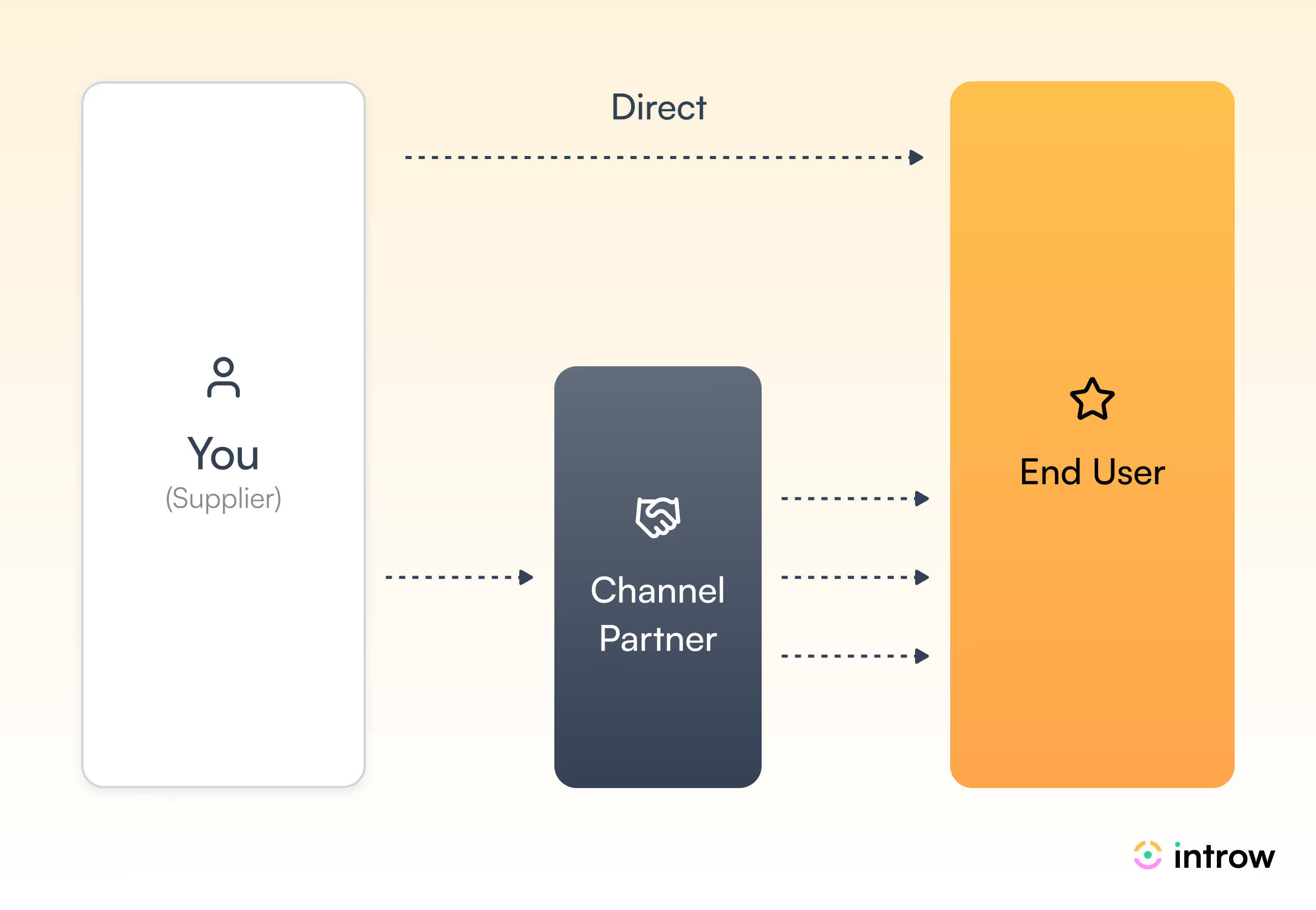
Ein Kanal ist mehr als nur ein System – er ist Ihr Tor zur Bereitstellung von Produkten und Dienstleistungen für den Endkunden.

Der Direktvertrieb bedeutet, dass Ihr Vertriebsteam jeden Kontaktpunkt selbst abwickelt: Akquise, Verkauf, Service und Support. Das ist persönlich – aber schwer zu skalieren.

Im Gegensatz dazu erweitern Vertriebspartner – wie Wiederverkäufer, Distributoren, Partnerunternehmen und sogar E-Commerce-Plattformen – Ihre Reichweite durch Vertriebskanäle, zu denen Sie alleine keinen Zugang hätten.

Stellen Sie sich das so vor: Anstatt Zahnpasta tube für tube zu verkaufen, verkaufen Sie eine ganze Palette an einen Einzelhändler, der sich um den Rest kümmert. In der SaaS-Welt führen Channel-Partner Ihr Produkt in Netzwerke und Kundensegmente ein, die Sie noch nicht erschlossen haben.

Channel Management bezieht sich auf die Systeme und Prozesse, die Sie zur Verwaltung der Beziehungen zu den Partnern einsetzen, die Ihre Produkte verkaufen, unterstützen oder auf dem Markt bewerben.

Eine solide Channel-Management-Strategie stellt sicher, dass diese Beziehungen mit Ihren Geschäftszielen in Einklang stehen, durch die richtigen Tools und Schulungen unterstützt und für eine langfristige Performance optimiert werden. Kurz gesagt: Sie ist der Entwurf für skalierbares, profitables Wachstum durch Partner.

Häufige Herausforderungen im Channel-Management

Selbst die vielversprechendste Vertriebsstrategie kann ohne eine solide Grundlage scheitern. Viele Unternehmen gehen mit den besten Absichten Partnerschaften ein, sehen sich dann jedoch mit Hindernissen konfrontiert, die die Vertriebsleistung beeinträchtigen und das Geschäftswachstum beeinträchtigen.

Unabhängig davon, ob Sie gerade erst anfangen oder ein ausgereiftes Partnernetzwerk verwalten, ist es wichtig, die häufigsten Reibungspunkte zu verstehen und zu wissen, wie sie sich auf Ihre Ergebnisse auswirken.

Hier sind vier Herausforderungen, die ein effektives Channel-Management oft behindern:

1. Mangelnde Abstimmung

Ein SaaS-Unternehmen arbeitet mit Wiederverkäufern zusammen, stimmt jedoch keine Verkaufsziele oder Zielkundenprofile ab. Das Ergebnis? Widersprüchliche Prioritäten, sich überschneidende Bemühungen und verpasste Umsatzchancen.

2. Inkonsistente Kommunikation

Ein SaaS-Anbieter bringt ein umfangreiches Produkt-Update auf den Markt, informiert jedoch nur einige wenige Partner darüber. Die anderen bleiben im Unklaren, können ihre Marketingmaterialien nicht aktualisieren und Endkunden nicht unterstützen, was zu Verwirrung und Verzögerungen führt.

3. Schlechte Rückkopplungsschleife

Neue Funktionen werden eingeführt, aber das Feedback der Partner wird nie eingeholt. Wertvolle Erkenntnisse aus der Praxis gehen verloren, was zu einer geringeren Akzeptanz und zu Funktionen führt, die bei den Benutzern keinen Anklang finden.

4. Unzureichende Ausbildung

Partner werden schnell eingebunden, jedoch ohne angemessene Unterstützung. Ohne ein klares Verständnis des Produkts, der Wertversprechen und der Vertriebsinstrumente haben sie Schwierigkeiten, Leads zu konvertieren und Kunden zu unterstützen.

Jedes dieser Probleme hat eine Ursache: schlechtes Beziehungsmanagement. Und die Auswirkungen sind real – Fehlausrichtungen, Ineffizienzen und Kanalkonflikte, die das Vertrauen untergraben und die Dynamik bremsen.

Die gute Nachricht? Jede dieser Herausforderungen ist lösbar.

Die richtigen Channel-Management-Tools können Ineffizienzen beseitigen, die Leistung Ihrer Partner steigern und sicherstellen, dass Ihre Channel-Management-Maßnahmen auf Ihre wichtigsten Geschäftsziele abgestimmt sind.

Tools wie Introw bieten Ihnen vollständige Transparenz über Ihr Partner-Ökosystem – vom Onboarding über die Befähigung bis hin zur Verfolgung von Geschäften. Durch die Verringerung von Wissenslücken und die Erhöhung der Verantwortlichkeit versetzen Sie Ihre Partner in die Lage, erfolgreich zu sein und schneller zu wachsen.

Wie gelangt man also von reaktiv zu strategisch?

Sie beginnen damit, jede Phase des Channel-Management-Prozesses zu optimieren – von der Rekrutierung bis zur Kundenbindung.

Im nächsten Abschnitt werden wir die 10 Best Practices aufschlüsseln, die eine leistungsstarke Channel-Management-Strategie ausmachen.

Optimieren Sie jede Phase des Channel-Managements mit modernen PRM-Tools

Um das Channel-Management zu meistern, müssen Sie einen Lebenszyklusansatz für Ihr Partnerprogramm verfolgen – von der Rekrutierung und Einarbeitung bis hin zum gemeinsamen Vertrieb und zur Expansion. Jede Phase spielt eine entscheidende Rolle bei der Abstimmung, der Verbesserung der Partnerleistung und der Steigerung des Umsatzes.

Moderne Channel-Management-Software wie Introw ermöglicht diese durchgängige Koordination. Dank nahtloser CRM-Integration, Echtzeit-Deal-Tracking und partnerfreundlichen Tools für die Zusammenarbeit können Sie Ihr gesamtes Partnernetzwerk reibungslos unterstützen.

Im Gegensatz zu veralteten Tools oder Tabellenkalkulationen vereint Introw Ihre Channel-Manager, Ihr Direktvertriebsteam und Ihre indirekten Vertriebskanäle auf einer einheitlichen Plattform – so können Sie die Leistung Ihrer Vertriebskanäle analysieren, Ihre Vertriebspartner verwalten und Ihren Umsatz schneller steigern.

Lassen Sie uns die 10 wichtigsten Praktiken durchgehen, die eine leistungsstarke Channel-Management-Strategie ausmachen, und wie Tools wie Introw Ihnen dabei helfen, diese über mehrere Vertriebskanäle hinweg umzusetzen:

1. Klare Kanalziele definieren

Wenn Sie möchten, dass Ihre Channel-Programme erfolgreich sind, ist Klarheit unverzichtbar. Ihre Channel-Partner müssen genau verstehen, was Sie mit der Zusammenarbeit erreichen möchten – und Sie sollten sich darüber im Klaren sein, welchen Gegenwert Sie dafür bieten.

Die Unterstützung, die Sie leisten Was es tut Was Sie erhalten Der Vorteil
Produktschulung Die Partner werden Kundenfragen souverän beantworten und so mehr Verkäufe abschließen. Gesteigertes Umsatzvolumen Zugang zu einem breiteren Kundenstamm und mehr Umsatz über ihre Netzwerke.
Vertriebsinstrumente und -materialien Es gibt ihnen alles, was sie zum Verkaufen brauchen, und macht sie effizienter und effektiver. Verbesserte Marktdurchdringung Erhöhte Zufriedenheit mit Partnern und Kontrolle über die Registrierung von Geschäften.
Unterstützung bei der Lead-Generierung Unterstützt Partner dabei, aktiv nach potenziellen Kunden zu suchen, und erhöht so den Lead-Flow. Erhöhte Markenbekanntheit Nutzen Sie deren Marketingmaßnahmen, um die Präsenz Ihrer Marke zu maximieren.
Preisnachlässe und Anreize Erleichtert den Verkauf mit unwiderstehlichen Angeboten, die den Umsatz steigern. Erschwinglicher Vertrieb Sparen Sie Direktvertriebskosten, indem Sie deren Netzwerke nutzen, um Ihr Produkt zu vertreiben.
Marketing-Kooperationsfonds Fördert gemeinsame Marketingmaßnahmen und macht Kampagnen wirkungsvoller und kosteneffizienter. Kundeninformationen Erhalten Sie hilfreiches Feedback von Kunden, das nur Ihre Partner sehen können.

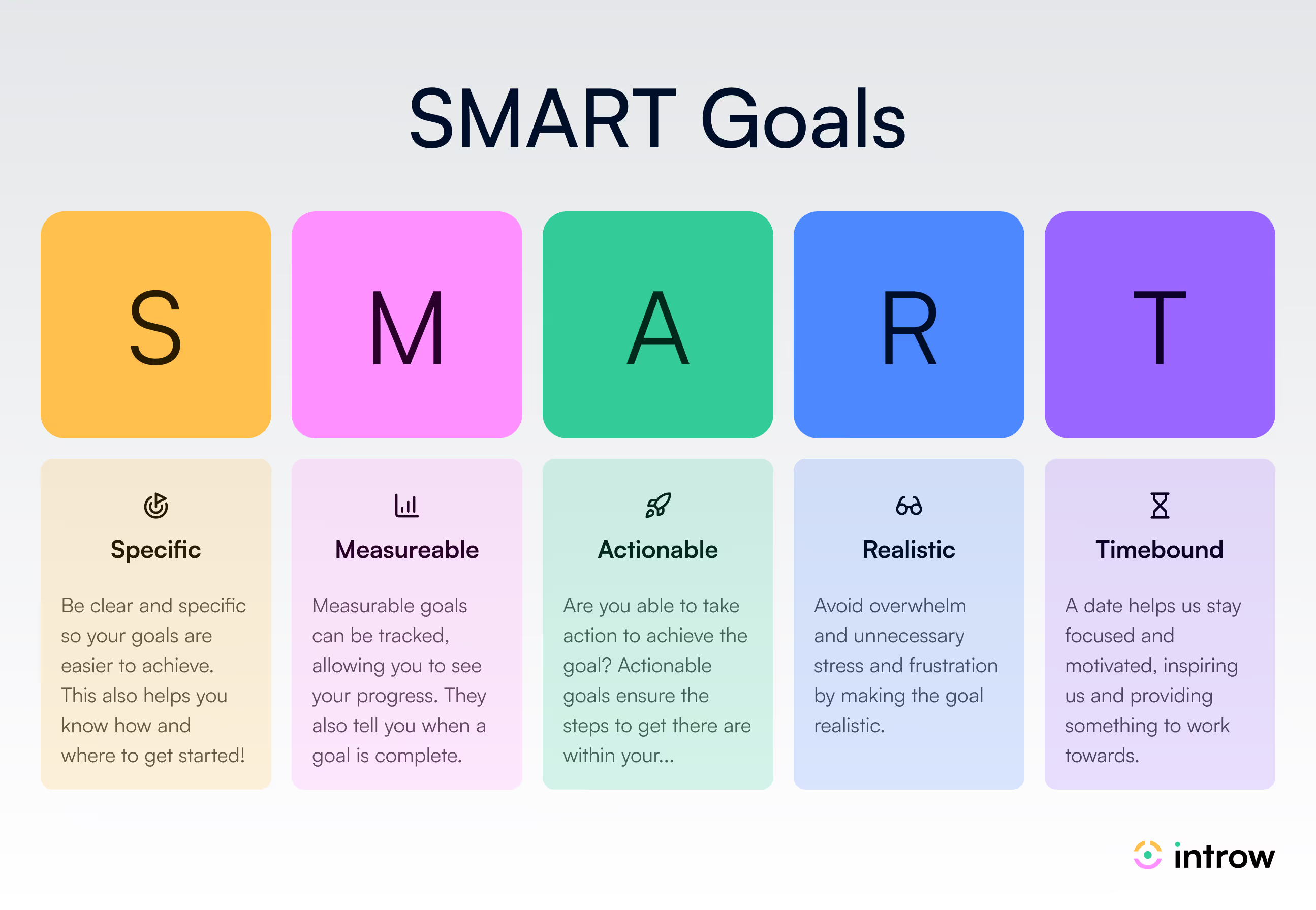
Um einen erfolgreichen Kanal zu betreiben, beginnen Sie mit messbaren Zielen, die mit Ihren Geschäftszielen verknüpft sind – beispielsweise das Wachstum eines bestimmten Kundensegments, die Erschließung eines neuen Marktes oder die Verbesserung der Kundenzufriedenheit.
Hier kommen PRM-Plattformen wie Introw ins Spiel.

Introw wandelt SMART-Ziele in nachverfolgbare Kennzahlen um – wie Weiterempfehlungsraten, Effizienz des Vertriebsprozesses und Wirkung von Kampagnen – und visualisiert diese in Echtzeit-Dashboards. So können Channel-Manager den Fortschritt leicht nachverfolgen und schneller optimieren.

Dank automatisierter KPIs und klarer Transparenz bleibt Ihre Channel-Strategie team- und partnerübergreifend aufeinander abgestimmt.

2. Wählen Sie die richtigen Partner

Wenn es darum geht, ein leistungsstarkes Partnernetzwerk aufzubauen, ist Qualität immer wichtiger als Quantität.

Zu viele Unternehmen verfolgen einen „Mehr ist besser“-Ansatz und schließen Dutzende von Vertriebspartnerschaften ab, ohne eine klare Ausrichtung zu haben. Das Ergebnis? Uneinheitliche Prioritäten, entgangene Einnahmen und ständige Konflikte zwischen den Vertriebskanälen.

Konzentrieren Sie Ihre Channel-Management-Bemühungen stattdessen auf eine ausgewählte Gruppe von Partnern mit hoher Wirkung:

  • Partner, die zu Ihren Geschäftszielen und Zielkunden passen
  • Organisationen, die ergänzende Reichweite, Technologie oder Fachwissen einbringen
  • Teams, die mit Ihrem Wachstum in mehreren Kanälen mitwachsen können

Introw hilft Channel-Managern dabei, diese vielversprechenden Kandidaten durch Partnerprofiling, CRM-Überlappungsanalysen und Einblicke in die bisherige Zusammenarbeit zu identifizieren.

Profi-Tipp: Nutzen Sie die native Crossbeam-Integration von Introw, um Überschneidungen bei Partnern, gemeinsame Konten und vielversprechende Kontaktwege zu entdecken – so investieren Sie in Partner, die tatsächlich etwas bewegen können.

Und vergessen Sie nicht, zu bewerten:

  • Investitionsbereitschaft: Sind sie an der gemeinsamen Planung, Marketingstrategie oder dem gemeinsamen Vertrieb beteiligt?
  • Skalierbarkeit: Können sie mit Ihnen gemeinsam neue Märkte und Vertriebskanäle erschließen?
  • Komplementäre Stärken: Erschließen sie den Zugang zu unterversorgten Kundensegmenten oder schließen sie eine technische Lücke?

Ein Partner mit einer nachgewiesenen Erfolgsbilanz, starken internen Fähigkeiten und Begeisterung für Zusammenarbeit ist wertvoller als zehn, die nur Zugang zum Portal wollen.

3. Investieren Sie in die Einarbeitung von Partnern

Die anfängliche Einarbeitung ist nicht nur eine Checkliste – sie ist die Grundlage für langfristige Partnerbeziehungen und Umsatzwachstum.

Wenn das Channel-Management eine ordnungsgemäße Einarbeitung umfasst, können Partner:

  • Verstehen Sie Ihre Produktpositionierung
  • Lassen Sie sich in Ihren Verkaufstools und ICP schulen.
  • Erfahren Sie, wie Sie Ihre Marke auf dem Markt effektiv präsentieren können.

Die Onboarding-Tools für Partner von Introw eliminieren manuellen Aufwand durch:

  • Optimierte Genehmigungsabläufe und digitale Vereinbarungen
  • Automatisch ausgelöste Begrüßungssequenzen und Schulungs-Checklisten
  • CRM-integrierte Nachverfolgung des Trainingsfortschritts

Ihre Channel-Management-Software sollte die Zeit bis zur Produktivität verkürzen und schnelle Erfolge ermöglichen.

Mit Introw können Sie:

  • Liefern Sie benutzerdefinierte Inhalte je nach Partnerstufe oder -typ
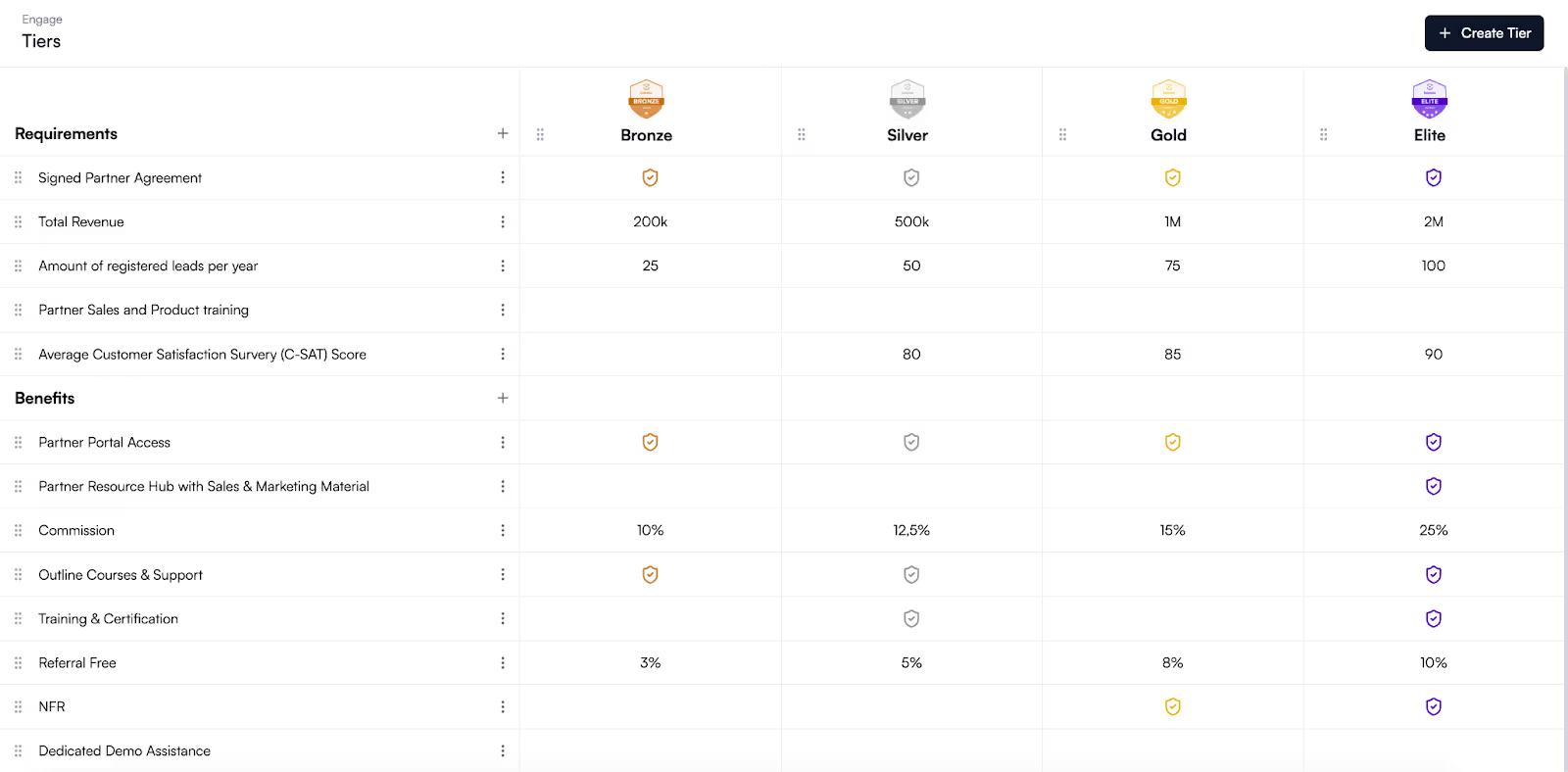
  • Zertifikate für abgeschlossene Kurse ausstellen
  • Verfolgen Sie den Abschluss des Onboardings direkt aus Ihrem CRM-System heraus.

Denn ein effektives Channel-Management stellt sicher, dass jeder Partner die Unterstützung erhält, die er benötigt – ohne Ihre internen Teams zu überlasten.

4. Meisterhaftes Channel-Management mit einem PRM-Tool

Sobald Ihre Onboarding-Grundlage geschaffen ist, besteht der nächste Schritt darin, Ihr Ökosystem zu vereinheitlichen. Hierfür ist ein speziell entwickeltes PRM-Tool für jeden Aspekt Ihrer Channel-Management-Strategie unverzichtbar.

Während herkömmliche Systeme Schwierigkeiten haben, Ihre Vertriebskanäle, Partnerbeziehungen und Echtzeit-Kennzahlen miteinander zu verbinden, vereint eine moderne Lösung wie Introw all diese Elemente in einer einzigen Benutzeroberfläche.

Mit Introw können Sie:

  • Beseitigen Sie Datensilos in CRM-Systemen, Tabellenkalkulationen und E-Mail-Verläufen.
  • Verfolgen Sie Geschäfte, Konten und Partneraktivitäten an einem Ort.
  • Ermöglichen Sie funktionsübergreifende Transparenz zwischen Ihren Direktvertriebskanälen und indirekten Vertriebsteams.

Der CRM-native Ansatz von Introw bedeutet, dass Sie nicht zwischen Registerkarten wechseln oder Partner in neue Software einweisen müssen. Stattdessen erhalten Sie eine schlanke Lösung, die mit den Tools funktioniert, die Ihre Teams bereits verwenden – wie beispielsweise Slack, Gmail, Salesforceund HubSpot.

Diese Integration ermöglicht:

  • Echtzeit-Benachrichtigungen, wenn ein Geschäft berührt wird
  • Gemeinsam genutzte Dashboards zur Überwachung der Kanalleistung
  • Verwertbare Erkenntnisse zur Analyse der Kanalleistung und zur Behebung von Lücken

Indem Sie sowohl internen Teams als auch Vertriebspartnern Zugriff auf zentralisierte Echtzeitdaten gewähren, reduzieren Sie Reibungsverluste, verbessern die Verantwortlichkeit und ermöglichen ein einheitlicheres Kundenerlebnis.

Introw ist nicht nur das richtige Tool – es ist die richtige Channel-Management-Software für moderne B2B-Teams, die eine schnellere Umsetzung, intelligentere Zusammenarbeit und messbares Umsatzwachstum anstreben.

Lassen Sie uns nun untersuchen, wie Automatisierung dazu beiträgt, diese Ergebnisse noch weiter zu skalieren – und gleichzeitig einen der größten Schwachpunkte zu beseitigen: den Konflikt zwischen den Vertriebskanälen.

5. Automatisieren Sie manuelle Prozesse, um Konflikte zwischen Vertriebskanälen zu vermeiden.

Selbst die am besten abgestimmten Partner-Ökosysteme sind mit operativen Reibungsverlusten konfrontiert. Manuelle Prozesse – wie die Registrierung von Geschäften, E-Mail-Nachfassaktionen oder die Zuweisung von Leads – führen häufig zu Missverständnissen, Doppelarbeit und Konflikten zwischen den Vertriebskanälen.

Ohne Automatisierung verschwenden Channel-Manager Stunden damit, Updates zu verfolgen oder Streitigkeiten zwischen Vertriebspartnern zu lösen. Und schlimmer noch – Geschäfte gehen verloren.

Introw automatisiert komplexe Abläufe, damit sich Ihr Team ganz auf die Erzielung von Ergebnissen konzentrieren kann. Und so funktioniert es:

  • Automatisierung der Deal-Registrierung: Verhindern Sie doppelte Einträge, indem Sie Überschneidungen in Echtzeit in Ihren CRM-Systemen kennzeichnen.
  • Automatisch synchronisierte Workflows: Auslösen von Follow-ups, Zuweisen von Aufgaben oder automatisches Eskalieren von Konflikten – ohne manuelle Koordination.
  • Echtzeit-Benachrichtigungen: Benachrichtigen Sie Vertriebsmitarbeiter oder Vertriebspartner sofort, wenn ein Geschäft voranschreitet oder eine Aufgabe abgeschlossen ist.

Durch die Optimierung dieser zentralen Arbeitsabläufe reduzieren Sie Fehler, verbessern die Vertriebsleistung und erhalten das Vertrauen innerhalb Ihres Partnernetzwerks.

6. Verbesserung der Kommunikation mit Partnern

Starke Partnerbeziehungen basieren auf klarer, konsistenter Kommunikation. Allzu oft jedoch sind die Partnerkommunikationen über E-Mails, Slack und veraltete Dashboards verstreut.

Ein einheitliches System – wie Introw – bringt alles zusammen.

Mit Introw können Sie:

  • Synchronisieren Sie Nachrichten zwischen Ihrem CRM-System, Slack und E-Mail.
  • Teilen Sie Updates zu Kampagnen, Produktänderungen oder Marketingmaterialien in Echtzeit.
  • Erstellen Sie kontospezifische Kanäle für eine nahtlose Zusammenarbeit zwischen internen und externen Teams.

Diese zentralisierte Transparenz sorgt dafür, dass Ihre Vertriebskanäle aufeinander abgestimmt bleiben und Ihre Kanalstrategie voranschreitet.

Darüber hinaus verpassen Ihre Vertriebspartner dank integrierter Kundendaten und Deal-Zeitpläne keinen einzigen Schritt – und Ihre Endkunden profitieren von einem reibungsloseren, besser informierten Einkaufserlebnis.

7. Regelmäßige Schulungsprogramme erstellen

Gute Partner findet man nicht – man entwickelt sie. Kontinuierliche Unterstützung ist ein wichtiger Pfeiler für ein effektives Channel-Management.

Unabhängig davon, ob Sie neue MSPs, Wiederverkäufer oder VARs einarbeiten, sollte Ihre Schulung folgende Themen abdecken:

  • Produktaktualisierungen und Positionierung
  • Wettbewerbsumfeld und Markttrends
  • Anwendungsfälle nach Kundensegment und Branche
  • Verkaufstaktiken, Preisstrategien und Umgang mit Einwänden

Mit Introw:

  • Zertifizierungsprogramme nach Partnerstufe starten und verwalten
  • Verfolgen Sie den Fortschritt mithilfe von integrierten Quizfragen und Fortschrittsanzeigen.
  • Liefern Sie Inhalte in verschiedenen Formaten – PDFs, Videos, Google Docs – alles innerhalb eines Markenpartnerportals.

Dadurch bleiben Ihre Kanalprogramme skalierbar und die Leistung Ihrer Partner über verschiedene Vertriebskanäle hinweg konsistent.

8. Anreize und Belohnungen für hohe Leistung

Nichts beschleunigt den Vertrieb über Vertriebskanäle so sehr wie die richtigen Anreize. Und nichts bringt ihn schneller zum Erliegen als unklare oder verspätete Auszahlungen.

Leistungsstarke Vertriebspartner wünschen sich Transparenz und Vertrauen – und Vertriebsmanager benötigen ein skalierbares System, um all dies zu verfolgen.

Mit Introw:

  • Einstufige Provisionsstrukturen oder SPIFs einrichten
  • Verfolgen Sie die Umsatzzuordnung nach Partner, Gebiet oder Kampagne.
  • Automatisieren Sie Auszahlungsberichte und Erinnerungen zur Anspruchsberechtigung

Sie können sogar die Leistungsdaten Ihrer Partner in Ihr CRM-System oder Ihr Finanztool integrieren, um manuelle Berechnungen zu vermeiden und sicherzustellen, dass jede Prämie auf Echtzeitdaten basiert.
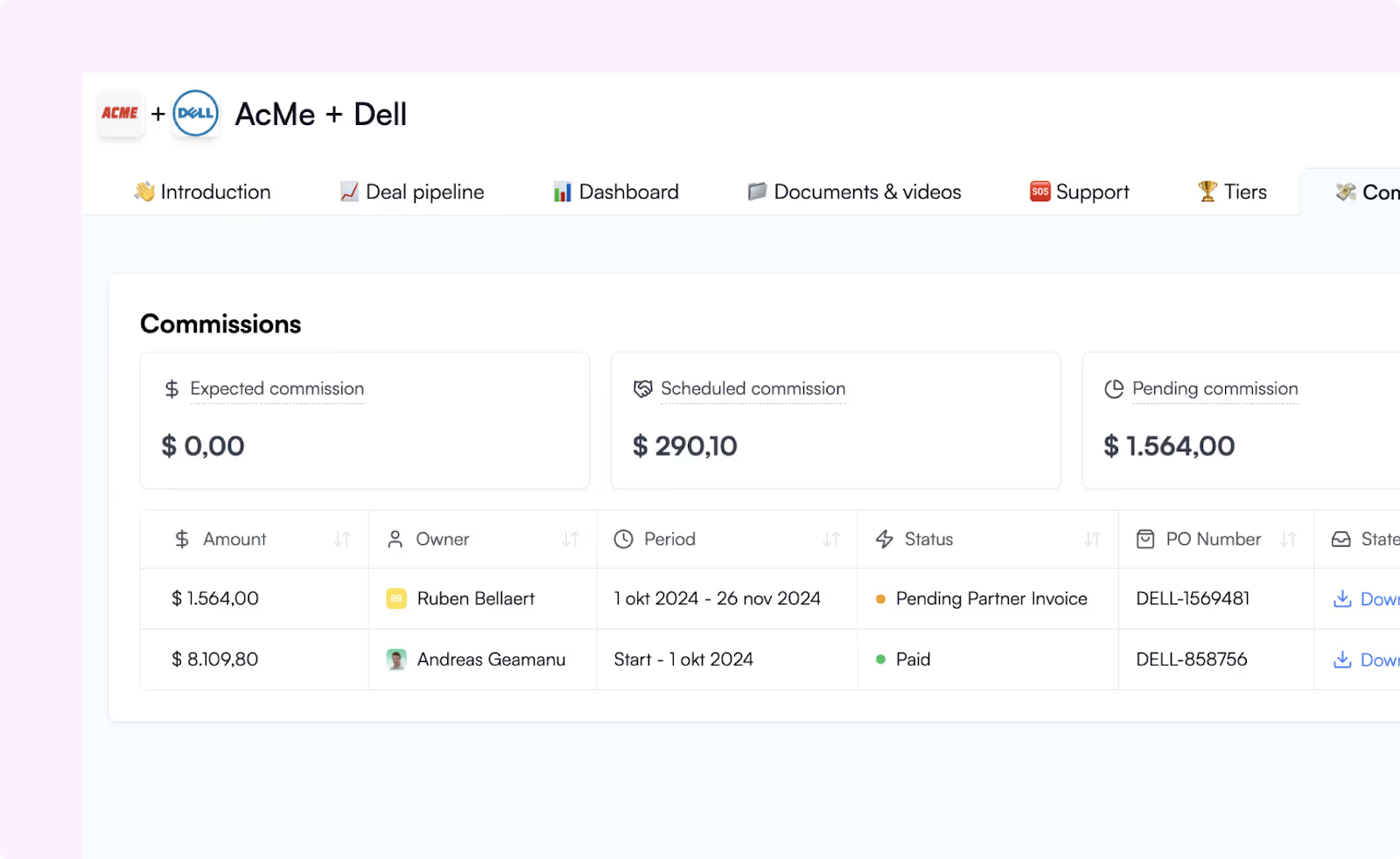
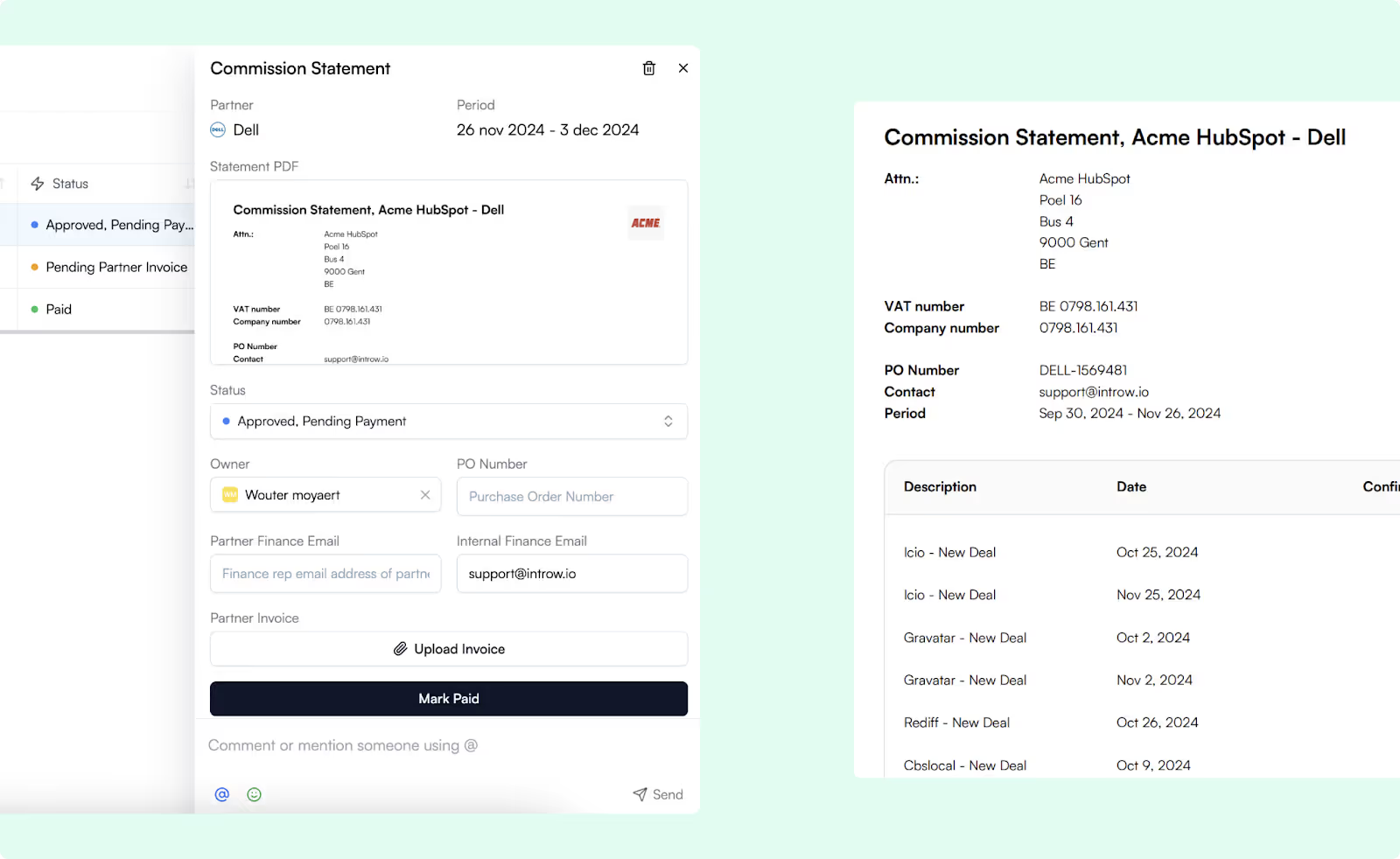
Dies sorgt für eine hohe Motivation, reduziert Streitigkeiten und macht Ihr Partnerprogramm zu einem leistungsstarken Vertriebsmotor.

9. Leistung überwachen und Feedback geben

Um Ihre Channel-Management-Strategie kontinuierlich zu verbessern, benötigen Sie Transparenz. Nicht nur in Bezug auf den Umsatz, sondern auch in Bezug auf die Geschwindigkeit der Geschäftsabschlüsse, das Engagement für Kampagnen und die Gesundheit der Partner.

Die Reporting-Engine von Introw macht es einfach, Folgendes zu tun:

  • Legen Sie Leistungskennzahlen (KPIs) nach Partnertyp fest.
  • Beitrag zur Pipeline und Abschlussquote analysieren
  • Identifizieren Sie Regionen oder Partner mit unterdurchschnittlicher Leistung, die einem Risiko ausgesetzt sind.
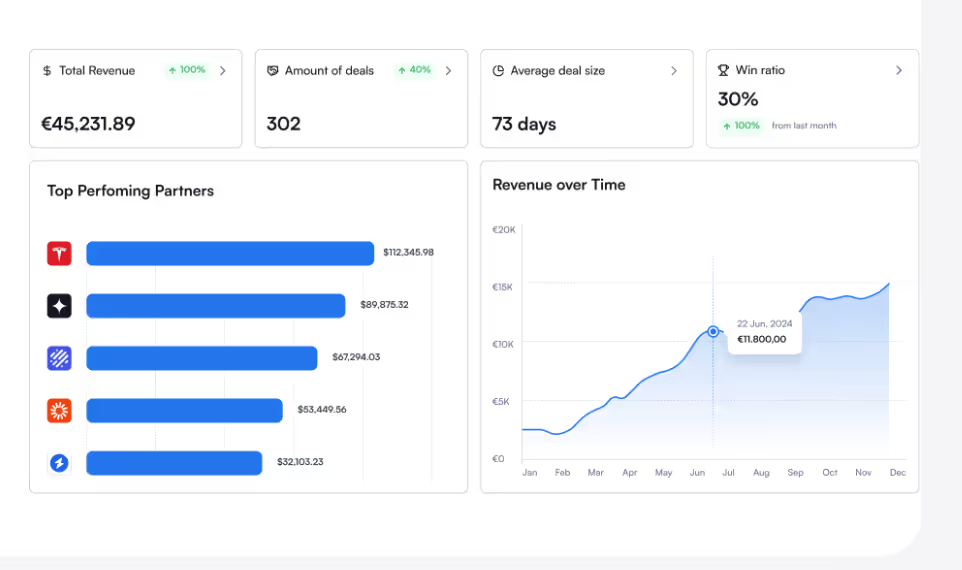
Noch wichtiger ist, dass es eine kontinuierliche Unterstützung ermöglicht – durch automatisierte Feedback-Schleifen, QBRs und personalisierte Coaching-Pläne.

Denn beim Channel-Management geht es um mehr als nur Kennzahlen – es geht darum, Beziehungen zu pflegen, die das langfristige Geschäftswachstum fördern.

10. Erfolg durch Channel-Marketing und Co-Marketing steigern

Schließlich können selbst die besten Partnerschaften ohne Marketingunterstützung ins Stocken geraten. Ihre Partner benötigen Ressourcen, Anleitung und Budget, um die Nachfrage anzukurbeln – und Sie benötigen Transparenz darüber, was funktioniert.

Ein moderner Ansatz für das Channel-Kampagnenmanagement umfasst:

  • E-Mail- und Anzeigenvorlagen mit Co-Branding
  • Auf Kundenpräferenzen zugeschnittene soziale Inhalte
  • Kampagnen-Tracking in Verbindung mit Lead-Generierung oder Umsatz

Mit Introw:

  • Teilen Sie genehmigte Nachrichten und Ressourcen in Ihrem Partnerportal.
  • Verfolgen Sie die Akzeptanz und Ergebnisse der Kampagne nach Region oder Partner.
  • Sammeln Sie Erkenntnisse, die Ihnen helfen, Ihre Marketingstrategie im gesamten Ökosystem zu optimieren.

Co-Marketing ist kein nettes Extra – es ist ein Wachstumsmultiplikator. Mit Introw können Sie Co-Marketing von einer Ad-hoc-Maßnahme zu einer permanenten Aktivität machen.

Fazit

Ohne effektives Channel-Management kommen selbst die besten Partnerprogramme zum Stillstand. Wenn Ihre Strategie nicht abgestimmt, automatisiert und datengesteuert ist, verschenken Sie Umsatzpotenzial.

Eine moderne Channel-Management-Strategie erfordert klare Ziele, die richtigen Partner, eine reibungslose Onboarding-Erfahrung sowie konsistente Schulungen und Kommunikation. Vor allem aber braucht sie ein skalierbares System.

Hier kommt Introw ins Spiel.

Mit Introw können Channel-Manager:

  • Manuelle Arbeitsabläufe eliminieren und Kanalkonflikte reduzieren
  • Verbessern Sie die Sichtbarkeit über mehrere Vertriebskanäle und Partnertypen hinweg.
  • Automatisieren Sie Onboarding, Schulungen, Deal-Tracking und Leistungsberichte.
  • Unterstützen Sie bessere Partnerbeziehungen mit Echtzeit-CRM-Einblicken
  • Verfolgen und analysieren Sie die Kanalleistung und steigern Sie das Umsatzwachstum.

Ganz gleich, ob Sie eine ausgereifte Channel-Vertriebsstrategie verfolgen oder gerade erst damit beginnen, indirekte Vertriebskanäle zu skalieren – Introw bietet Ihnen die richtige Channel-Management-Software, mit der Sie schneller vorankommen, auf Kurs bleiben und zuversichtlich wachsen können.

Sind Sie bereit, Ihr Partner-Ökosystem in eine leistungsstarke Umsatzmaschine zu verwandeln?

Buchen Sie noch heute Ihre Introw-Demo.

FAQs

Noch Fragen? Hier findest du die häufigsten Fragen und Antworten.

Kontaktiere uns

Warum ist Channel-Management für SaaS-Unternehmen wichtig?

Das Channel-Management stellt sicher, dass Ihr Partner-Ökosystem mit Ihren Geschäftszielen übereinstimmt. Es hilft Ihnen, über den Direktvertrieb hinaus zu skalieren, indem es indirekte Vertriebskanäle nutzt, um neue Kundensegmente zu erreichen und den Umsatz mit weniger Gemeinkosten zu steigern.

Wie unterstützt Channel-Management-Software die Beziehungen zu Partnern?

Channel-Management-Software wie Introw automatisiert und zentralisiert wichtige Aufgaben wie Onboarding, Deal-Tracking und Co-Marketing. Dies verbessert die Transparenz, optimiert die Zusammenarbeit und stärkt das Engagement der Partner in Ihrem gesamten Netzwerk.

Welche Kennzahlen werden zur Analyse der Kanalleistung verwendet?

Sie sollten KPIs wie Deal-Geschwindigkeit, Umsatzbeitrag pro Partner, Abschluss von Schulungen und Kampagnenengagement verfolgen. Die Analyse der Channel-Performance hilft Ihnen dabei, besonders einflussreiche Partner zu identifizieren und Ihre Channel-Strategie zu optimieren.

Wie wähle ich die richtige Channel-Management-Software aus?

Die besten Channel-Management-Tools lassen sich nahtlos in deine CRM-Systeme integrieren, unterstützen anpassbare Workflows und bieten Echtzeit-Einblick in Vertriebsaktivitäten, Partnerleistung und Kundenfeedback – all das bietet Introw sofort nach der Installation.

Wie können Channel-Manager Partner auf den Zielmarkt des Unternehmens ausrichten?

Beginnen Sie damit, Ihr ideales Kundenprofil und Ihren Zielmarkt klar zu definieren. Nutzen Sie dann Tools wie Introw, um die Fähigkeiten, den Kundenstamm und die vertikale Expertise Ihrer Partner zu erfassen. So stellen Sie sicher, dass alle Partnermaßnahmen auf die richtige Zielgruppe ausgerichtet sind und maximale Wirkung erzielen.


Launch your partner portal
in minutes!

Vielen Dank! Wir haben deine Anfrage erhalten!
Hoppla! Beim Absenden des Formulars ist ein Fehler aufgetreten.

Verwandte Blog-Artikel

Partner-Management

14 Partner.io Alternatives for Stronger Partner Collaboration in 2026

Adèle Coolens
Marketing & Partnerschaften
5min Lesezeit
19 May 2026
⚡ TL;DR

Partner.io is a newer PRM focused on partner collaboration and portal experiences. This guide compares 14 Partner.io alternatives for teams that need deeper CRM integration, stronger automation, and broader partner management capabilities. For most growing SaaS companies, Introw is the strongest overall alternative thanks to its CRM-native approach, AI-powered workflows, and full-lifecycle partner management.

Why teams compare Partner.io with other PRMs

Partner.io is a newer partner management platform focused on partner collaboration and pipeline visibility. As programs grow, many teams evaluate Partner.io alternatives with deeper CRM integration, stronger automation, and broader partner management capabilities.

Key evaluation criteria

Before choosing a platform, consider:

  • Platform maturity: Customer base, reviews, case studies, and long-term product stability
  • Partner lifecycle coverage: Support for partner onboarding, partner training, deal registration, MDF, incentives, and partner engagement
  • CRM integration: How deeply the platform connects with Salesforce or HubSpot, including partner data synchronization and workflow automation
  • AI capabilities: Whether AI reduces manual work through coaching, automation, insights, or content creation
  • Partner collaboration: How easily partners can work with your team through a partner portal and other engagement channels
  • Scalability: Whether the platform can support more partners, additional partner types, and a growing partner motion without adding complexity

The best choice is the platform that fits both your current program and where you expect partner revenue to grow over the coming years.

Partner.io alternatives at a glance

Use this table to compare each Partner.io comp by maturity, CRM fit, AI depth, and how much of the partner lifecycle each tool supports.

Tool Established since CRM-Integration AI capability Zusammenarbeit außerhalb des Partnerportals Partner lifecycle Embedded LMS
Introw 2023 Native Agentic Yes Full AI-powered
Kiflo 2019 Basic None No Partial None
Euler 2023 Basic Advisory Yes Partial None
PartnerStack 2015 Middleware None No Partial Basic
Impartner 1997 Middleware Advisory No Full Basic
Salesforce Experience Cloud / Partner Cloud 2013 Native Agentic No Full, build-heavy None
ChannelScaler 2025 Middleware Advisory No Full Basic
Gedankenmatrix 1998 Basic Content No Full Basic
ZINFI 2007 Basic Advisory No Full Basic
Magentrix 2012 Native None No Partial None
Channeltivity 2007 Basic None No Partial Basic
impact.com 2008 Basic Advisory No Partial None
Crossbeam 2018 Native Advisory No Partial None
Everflow 2016 Basic Advisory No Partial None

When comparing tools, focus on CRM integration, partner onboarding, partner training, reporting, and how well the platform supports growth over time.

For a broader view, compare these options with other partner management systems and the best PRM software.

14 best Partner.io alternatives in 2026

If you’re looking for a Partner.io alternative, these are the PRM platforms most commonly evaluated by SaaS companies that need stronger partner collaboration, better CRM integration, and support for the entire partner program.

#1 Introw - Best overall Partner.io alternative for CRM-native partner management

What it does

Introw is an AI-first PRM platform built directly around Salesforce and HubSpot. Instead of creating another database, it keeps CRM data as the system of record and extends it to partners through a white-label partner portal, email, Slack, AI-powered workflows, and automated collaboration.

The platform supports the full partner lifecycle, including partner onboarding, partner training, MDF, partner engagement, partner agreements, commissions, partner events, account mapping, co-selling, and partner-sourced revenue reporting.

Notable capabilities include:

  • Deep CRM integration with Salesforce and HubSpot
  • White-label no-code partner portal builder
  • AI-powered deal coaching and recommendations
  • Embedded partner LMS with AI-generated training modules
  • Native MDF management and attribution reporting
  • Automated deal and lead registration
  • AI-generated announcements and enablement content
  • Native Crossbeam integration for account mapping
  • Real-time partner data synchronization
  • Granular permissions by partner type and role

Most teams can go live in 2 to 4 days without custom development.

Why it’s the best Partner.io alternative

Introw supports the entire partner program, from partner onboarding and partner training to MDF, partner engagement, deal coaching, and partner-influenced revenue reporting.

Instead of stitching together multiple tools, Introw combines partner management, account mapping, channel conflict detection, and reporting in one platform.

Its built-in AI agent helps automate content creation, training, analysis, and partner communications.

Unlike portal-first platforms, Introw also supports collaboration through email and Slack, helping reseller partners, referral partners, and channel managers stay engaged without extra logins.

CRM integrations

  • Salesforce (native, bi-directional)
  • HubSpot (native, bi-directional)
  • Full custom object support
  • Real-time sync
  • CRM event triggers
  • In-CRM experiences for internal teams

Preise

Custom pricing based on program requirements. A 14-day free trial is available.

Am besten geeignet für

SaaS companies with 2+ partner managers that want a modern PRM platform with deep CRM integration, AI-powered workflows, a centralized hub for partner management, and support for the entire partner program.

If you’d like a side-by-side breakdown, see our full Partner.io comparison or request a demo.

#2 Kiflo - Best for SMBs wanting a simple, affordable starting point

What it does

Kiflo is a lightweight PRM platform focused on partner onboarding, deal registration, referral partners, reseller partners, commission management, and basic partner management workflows. It offers a clean partner portal and a quick setup process for smaller teams.

Why someone might choose it over Partner.io

Kiflo has more customer reviews, and provides a straightforward way to launch a partner program without significant complexity. It supports Salesforce and HubSpot and covers the core needs of many SaaS startups.

Where it falls short

  • No AI capabilities
  • No off-portal collaboration
  • No embedded LMS or partner training
  • Limited performance tracking and engagement metrics
  • No support for MDF or advanced channel conflict workflows
  • Less suitable for partnership teams managing more partners or complex partner motions

CRM integrations

  • HubSpot
  • Salesforce

Preise

Low-entry pricing with plans based on partner volume.

Am besten geeignet für

Small SaaS companies launching a new partner program that need an affordable partner management system with basic CRM integration and a simple partner experience.

Take a look at our in-depth guide of Kiflo alternatives to learn more.

#3 Euler - Best for newer programs wanting modern PRM with AI assistants

What it does

Euler is a modern PRM platform built for partner management, partner onboarding, and distributor relationships. Its AI assistants, PAM and POPS, help automate common partner management tasks and support a growing partner network.

Why someone might choose it over Partner.io

Euler shares Partner.io’s modern approach but adds advisory AI capabilities. It also has traction in distribution-heavy environments and offers a polished experience for new partners.

Where it falls short

  • No embedded LMS
  • No MDF management
  • No white-label flexibility
  • Limited support for complex partner agreements
  • No deep CRM integration with custom objects

CRM integrations

  • HubSpot
  • Salesforce

Preise

Custom pricing.

Am besten geeignet für

Growing SaaS companies that want a modern partner platform with AI assistance and a relatively simple setup.

We break down the strengths and limitations in our guide to Euler PRM alternatives.

#4 PartnerStack - Best for affiliate and referral programs with automated payouts

What it does

PartnerStack is a partnership platform focused on affiliate programs, referral partners, automated payouts, tracking links, and partner recruitment through its marketplace.

Why someone might choose it over Partner.io

It offers a large partner network, built-in payout infrastructure, and proven processes for SaaS companies running affiliate-driven partnerships at scale.

Where it falls short

  • Limited support for reseller partners
  • CRM integration relies on middleware
  • Rigid portal experience
  • No co-selling workflows
  • Limited support for partner-sourced revenue management

CRM integrations

  • Salesforce (via Workato)
  • HubSpot (via Workato)

Preise

Marketing plans start at $1000/mo. Growth plans start at $1520/mo. Enterprise pricing is custom.

Am besten geeignet für

Companies focused on affiliate and referral growth rather than complex channel partnerships.

For a deeper comparison, see our guide to PartnerStack alternatives.

#5 Impartner - Best for enterprise-scale PRM with broad module coverage

What it does

Impartner is a long-established PRM platform covering partner onboarding, TCMA, MDF, partner portals, partner performance management, and large-scale channel operations.

Why someone might choose it over Partner.io

It has a long track record, extensive functionality, and broad support for large companies running mature partner programs.

Where it falls short

  • Lengthy implementations
  • Enterprise complexity
  • Dated user experience
  • Middleware-based CRM integration
  • Significant administrative overhead

CRM integrations

  • Salesforce
  • Other CRMs via middleware

Preise

Enterprise pricing only.

Am besten geeignet für

Large organizations with dedicated channel operations resources and complex partnerships.

See how it stacks up against similar platforms in our best Impartner competitors guide.

#6 Salesforce Experience Cloud (Partner Cloud) - Best for Salesforce-only teams wanting maximum native control

What it does

Salesforce Experience Cloud lets businesses build a highly customized partner portal directly on Salesforce. It provides complete control over CRM data, workflows, and partner experiences.

Why someone might choose it over Partner.io

Organizations already standardized on Salesforce get native access to CRM data, reporting, and customization options without relying on a third-party PRM platform.

Where it falls short

  • Requires development resources
  • Long deployment timelines
  • No built-in partner LMS
  • No off-portal collaboration
  • Higher ownership costs than most partner management tools

CRM integrations

  • Salesforce (native)

Preise

Partner Community pricing starts at $20/login or $50/member billed annually.

Am besten geeignet für

Salesforce-centric enterprises with internal development teams.

Teams comparing this approach often also evaluate other Salesforce PRM alternatives.

#7 ChannelScaler - Best for incentive and rebate management alongside PRM

What it does

ChannelScaler combines PRM functionality with rebate management, incentive programs, MDF administration, and partner performance reporting.

Why someone might choose it over Partner.io

It provides broader functionality for channel managers who need to manage incentives, rebates, and partner revenue from a single dashboard.

Where it falls short

  • No AI-powered workflows
  • No Slack collaboration
  • Admin-heavy setup
  • CRM integration often requires support involvement
  • Limited innovation compared with newer platforms

CRM integrations

  • Salesforce
  • HubSpot

Preise

No public pricing available.

Am besten geeignet für

Teams managing incentive-heavy channel programs.

For a closer look at the platform, explore our guide to ChannelScaler alternatives.

#8 Mindmatrix - Best for through-channel marketing automation at enterprise scale

What it does

Mindmatrix combines PRM, TCMA, partner training, marketing assets, partner events, and content automation into a unified platform.

Why someone might choose it over Partner.io

It offers significantly broader marketing functionality and helps empower partners with content distribution and enablement tools.

Where it falls short

  • Steep learning curve
  • Long implementations
  • Heavy configuration requirements
  • Older interface
  • Complex administration

CRM integrations

  • Salesforce
  • HubSpot

Preise

Enterprise pricing.

Am besten geeignet für

Organizations investing heavily in through-channel marketing programs.

You can explore additional options in our roundup of Mindmatrix alternatives.

#9 ZINFI - Best for large-scale unified channel management

What it does

ZINFI offers unified channel management across partner onboarding, MDF, marketing automation, partner training, and performance tracking.

Why someone might choose it over Partner.io

It supports complex multi-tier partnerships and provides extensive functionality for managing large partner ecosystems.

Where it falls short

  • Complex implementation
  • Heavy configuration
  • Data primarily lives inside the platform
  • Dated interface
  • Higher administrative burden

CRM integrations

  • Salesforce
  • Microsoft Dynamics

Preise

Enterprise pricing.

Am besten geeignet für

Large enterprises with extensive reseller programs and global partner operations.

Our guide to ZINFI alternatives explores similar options.

#10 Magentrix - Best for Salesforce-native portal experience

What it does

Magentrix is a Salesforce-focused partner management system built around partner portals, collaboration, and secure access to CRM data.

Why someone might choose it over Partner.io

It provides a more established Salesforce-native experience and gives organizations full visibility into Salesforce-based partner workflows.

Where it falls short

  • Salesforce-only
  • Limited AI capabilities
  • Portal-centric approach
  • No off-portal engagement
  • Narrower feature set than full PRM platforms

CRM integrations

  • Salesforce (native)

Preise

Essential: $1500/mo. Advanced: $3000/mo. Enterprise pricing available on request.

Am besten geeignet für

Salesforce customers primarily focused on portal-based collaboration.

For a broader comparison, see our guide to Magentrix alternatives.

#11 Channeltivity - Best for mid-market teams wanting proven, straightforward PRM

What it does

Channeltivity provides deal registration, MDF management, partner portals, real-time analytics, and partner performance reporting for mid-market channel teams.

Why someone might choose it over Partner.io

It has a longer track record, established customers, and covers the core needs of many channel programs without excessive complexity.

Where it falls short

  • No AI functionality
  • No off-portal collaboration
  • Limited innovation in recent years
  • No advanced automation for partner engagement

CRM integrations

  • Salesforce
  • HubSpot

Preise

Standard: $1899/mo annually. CRM Edition: $2199/mo annually. Enterprise pricing available on request.

Am besten geeignet für

Mid-market teams looking for a stable and proven PRM platform.

Take a closer look at alternative options in our guide to Channeltivity competitors.

#12 impact.com - Best for affiliate, influencer, and performance marketing

What it does

impact.com helps businesses manage affiliate, influencer, referral, and ecommerce partnerships with automated payouts and large-scale tracking capabilities.

Why someone might choose it over Partner.io

It excels at performance marketing and supports high-volume partnership programs with strong reporting and automation.

Where it falls short

  • Not a traditional PRM platform
  • No partner onboarding workflows
  • No deal registration
  • No partner portal for channel relationships

CRM integrations

  • Limited compared with dedicated PRMs

Preise

Custom pricing with transaction-related costs.

Am besten geeignet für

Organizations focused on affiliate and influencer revenue programs.

#13 Crossbeam (Reveal) - Best for ecosystem data and account mapping

What it does

Crossbeam helps teams identify overlap between customers, prospects, and partners through account mapping and ecosystem intelligence.

Why someone might choose it alongside Partner.io

It helps track partner opportunities, identify co-selling opportunities, and improve partner-influenced revenue through shared data insights.

Where it falls short

  • Not a PRM platform
  • No partner portal
  • No onboarding workflows
  • No engagement tools
  • No deal registration

CRM integrations

  • Salesforce
  • HubSpot

Preise

Free plan available. Starter: $4800/year. Enterprise pricing available on request.

Am besten geeignet für

Organizations that want ecosystem intelligence alongside a PRM platform.

#14 Everflow - Best for high-volume performance marketing tracking

What it does

Everflow provides performance tracking, fraud detection, automated payouts, and analytics for affiliate, referral, and influencer partnerships.

Why someone might choose it over Partner.io

It offers strong tracking capabilities, real-time visibility, and detailed reporting for organizations managing large volumes of partnership activity.

Where it falls short

  • Not a PRM platform
  • No partner onboarding
  • No LMS
  • No partner portal
  • No channel collaboration workflows

CRM integrations

  • Limited

Preise

Custom pricing based on program scale and payout requirements.

Am besten geeignet für

Companies managing large-scale affiliate and referral programs where tracking and attribution are the primary priorities.

Now that you’ve seen the options, the goal is finding a platform that fits your teams today and can scale with your partner program tomorrow.

Das Fazit

Partner.io may be a good fit if you’re launching your first partner program and want a straightforward way to manage collaboration.

Before you choose a platform, ask whether it can support:

  • New partners as your program grows
  • Referral partners, reseller partners, and tech partners
  • Automated onboarding and partner agreements
  • Multiple pipeline stages and evolving partner motions
  • Accurate partner-sourced revenue and partner-influenced revenue reporting
  • Full visibility into partner data, engagement metrics, and account mapping

The best partner management tools do more than provide a portal. They help partnership teams empower partners, improve the partner experience, reduce manual work, and generate more value from existing partnerships.

Introw combines AI, automation, and reporting in one hub instead of multiple systems.

It gives channel managers and heads of partnerships a centralized hub for partner engagement, marketing assets, and performance insights, all built around your CRM.

Still deciding? Our guide on choosing your next PRM covers the questions worth asking before investing in any partner management system.

Why teams choose Introw when looking for Partner.io alternatives

The right PRM should help you grow partner revenue without creating more work.

+70% more partner pipeline

Introw helps partnership teams attract more partners and move opportunities through pipeline stages faster. Deal flow stays connected to your CRM, while channel conflict detection helps prevent duplicate registrations.

+75% faster partner onboarding

Get started in days, not months. Automated onboarding, AI-generated training content, certification paths, and marketing assets help new partners become productive faster. More than 200 SaaS companies use Introw to support their entire partner program.

+60% more partner-influenced revenue

See how partnerships contribute to total revenue. Full visibility into partner-sourced revenue, partner-influenced revenue, engagement metrics, and performance tracking makes it easier to scale what’s working.

For referral partners, reseller partners, and tech partners, Introw provides one hub for collaboration, enablement, and growth.

Ready to see how Introw compares to Partner.io? Compare the platforms side by side and request a demo.

Partner-Management

From Strategy to Results: 11 Partner Enablement Best Practices That Work in 2026

Sara De Meurichy
Growth
5min Lesezeit
19 May 2026
⚡ TL;DR

Partner enablement gives partners the training, content, tools, and support they need to sell independently rather than relying on constant hand-holding from your team. The most effective programmes are structured, segmented by partner type, and connected to the CRM so you can measure readiness, track activation, and attribute revenue accurately. Strong enablement focuses on reducing time to first deal, delivering role-based training, and giving partners collateral they will actually use in live opportunities. To understand whether the programme is working, teams should track outcome-based metrics such as pipeline, revenue, certifications, and activation speed rather than vanity portal activity.

Partner enablement looks simple on paper: give partners the right resources, and they’ll sell your product. In practice, most programs stall because content is scattered, training is generic, and no one can tell which partners are actually ready to close deals.

The difference between a partner program that generates attributable revenue and one that drains resources usually comes down to structure — clear goals, the right content at the right time, and data that lives in your CRM instead of a forgotten portal. This guide breaks down partner enablement best practices from strategy through execution, plus the metrics that tell you if it’s working.

Was ist Partner-Enablement?

Partner enablement is the system you build to help external partners sell (and often implement) your product effectively. That system typically includes structured onboarding, tailored training, and easy access to the right resources so partners can move deals forward without waiting on your team.

When partner enablement is done well, partners don’t just understand what you do. They can position it, handle objections, run a clean handoff, and create repeatable wins — the same way a high-performing internal sales team would.

What partner enablement typically includes

  • Training and certification: Product knowledge, positioning, and selling motions (with a quality bar partners must meet).
  • Sales and marketing resources: Collateral, templates, and campaigns partners can use with prospects.
  • Tools and portal access: Systems that streamline deal registration, content access, and communication.
  • Ongoing communication: A predictable cadence for updates, feedback, and performance reviews.

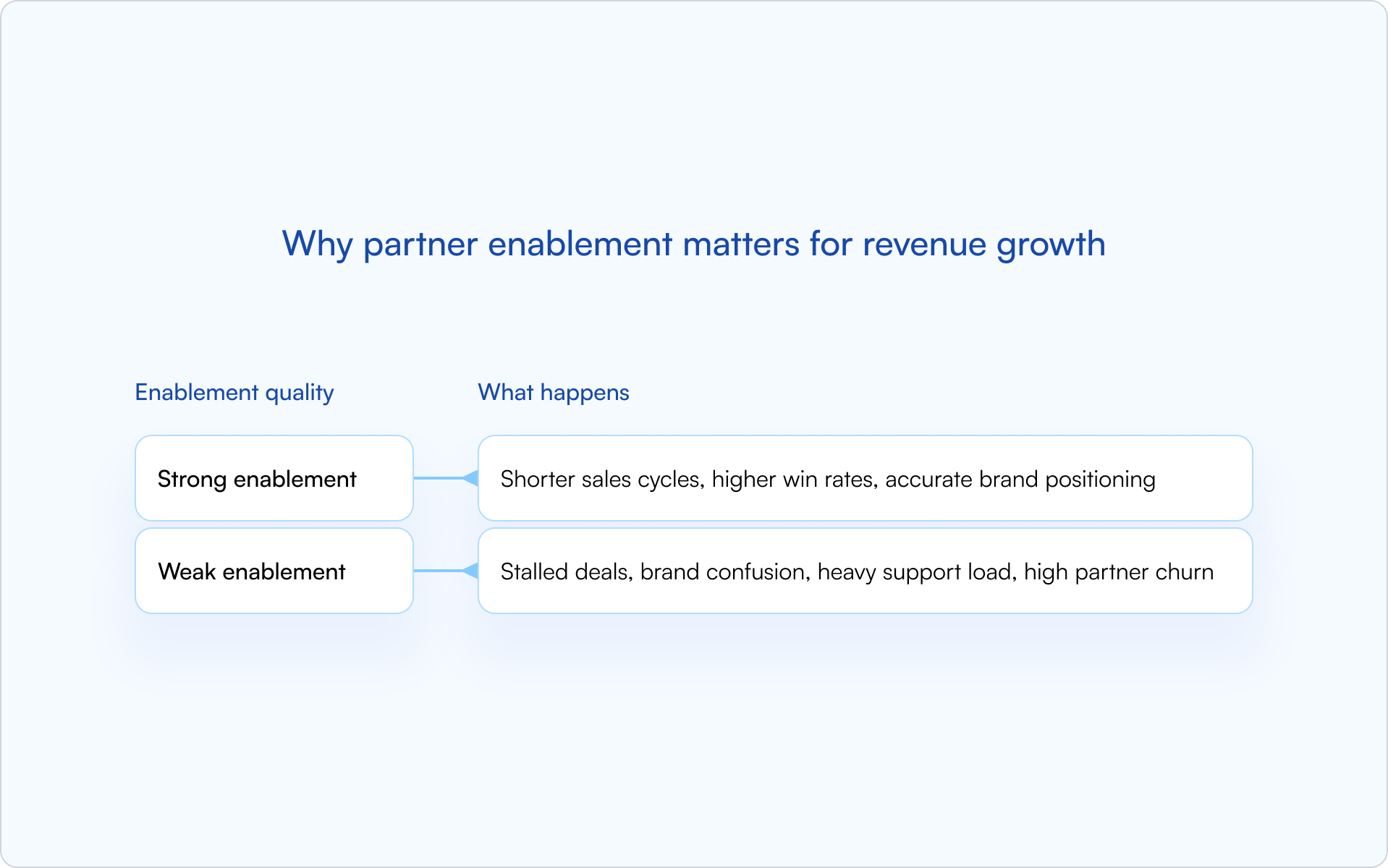
Why partner enablement matters for revenue growth

Enabled partners drive revenue because they can execute without friction. They close deals faster, represent your brand accurately, and generate pipeline you can actually attribute.

Weak enablement is expensive in quieter ways: partners misposition the product, opportunities stall, your team becomes the bottleneck, and high-potential partners churn because “it’s too hard to work with you.”

Enablement quality What happens
Strong enablement Shorter sales cycles, higher win rates, accurate brand positioning
Weak enablement Stalled deals, brand confusion, heavy support load, high partner churn

What a partner enablement program includes

A complete channel partner enablement program isn’t a portal full of PDFs. It’s a structured system that helps partners learn, launch, and improve — with clear ownership and measurable outcomes.

Partnerschulung und -zertifizierung

Training forms the foundation: product knowledge, competitive positioning, and your sales methodology. Certification acts as a gate, ensuring partners meet a minimum quality bar before they’re authorized to sell on your behalf.

Partner sales enablement

Partner sales enablement means giving partners the same caliber of sales tools your direct team uses, adapted to their role. Think: battle cards, demo scripts, objection-handling guides, and pricing documentation.

Marketing support and co-marketing

Effective enablement helps partners generate demand, not just close it. Co-branded assets, “campaign-in-a-box” kits, and structured lead-sharing programs all increase partner-sourced pipeline.

Partner portals (and why login friction kills adoption)

A partner portal should be a self-service hub for training, collateral, deal registration, and updates. But there’s a common failure mode: partners avoid portals that require a separate, inconvenient login.

CRM-first portals reduce that friction by connecting directly to HubSpot or Salesforce, so partners can work inside the flow of real deals instead of “checking another system.”

Performance tracking and ongoing communication

Enablement is ongoing, not a one-time launch. A strong program includes visibility into partner activity, a consistent communication cadence, and mechanisms for gathering feedback and improving the experience.

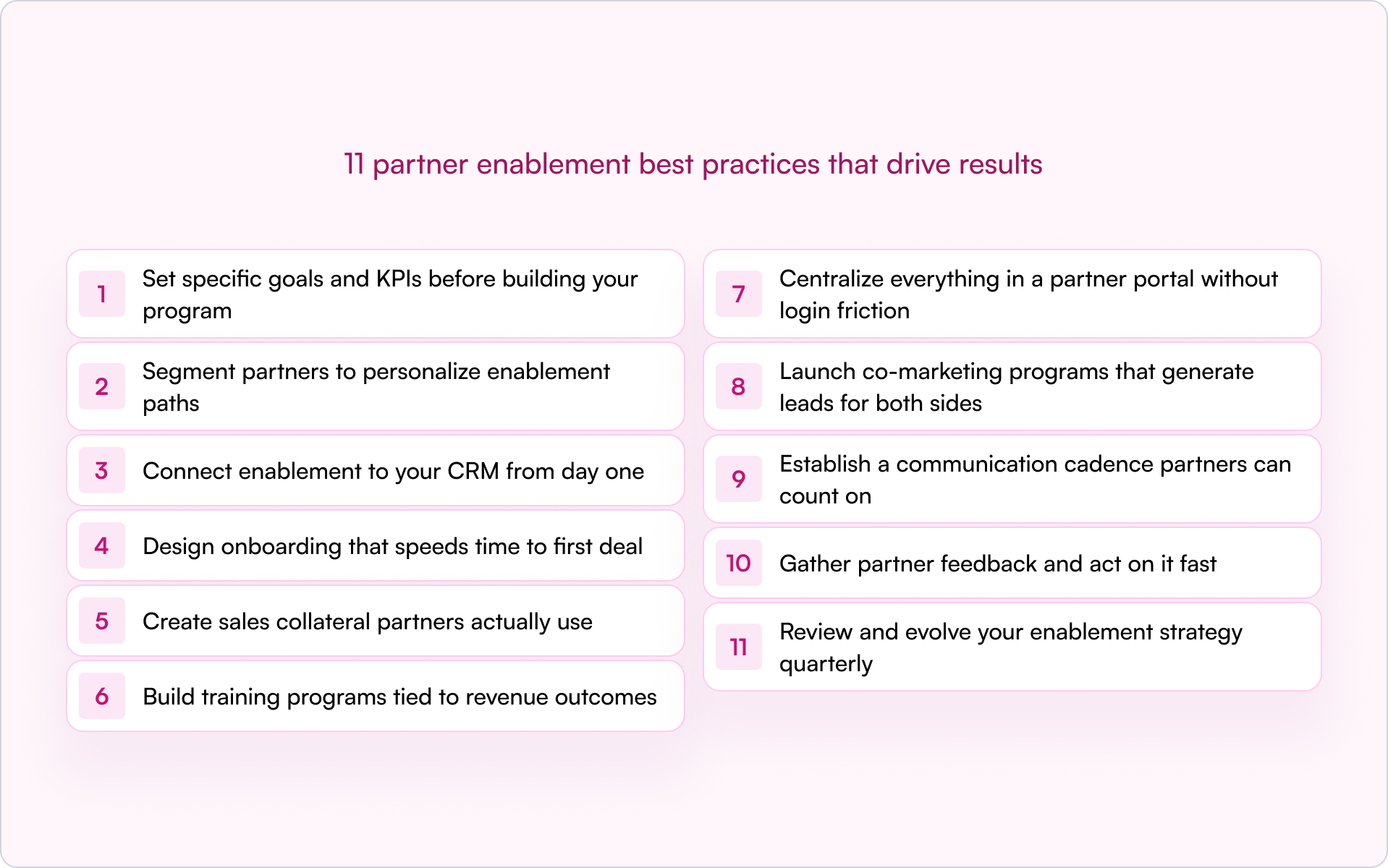
11 partner enablement best practices that drive results

If you’re building a partner program inside a startup, your constraint is almost never “ideas.” It’s focus and execution. These partner enablement best practices move from strategy through rollout and iteration — with an emphasis on what actually shows up in pipeline.

1. Set specific goals and KPIs before building your program

Before you create a single asset, define what success looks like. Start with outcomes — partner-sourced revenue targets, certification completion rates, and a target time-to-first-deal — then work backward into the program.

  • Partner-sourced pipeline value
  • Certification completion rate
  • Average time from onboarding to first registered deal
  • Content engagement (downloads, video views)

2. Segment partners to personalize enablement paths

Not all partners need the same materials. Segment by partner type (reseller, referral, systems integrator), vertical focus, or performance tier, then tailor training and content accordingly.

Segment Enablement focus
Reseller Deep product training, pricing, deal registration
Referral-Partner Lightweight pitch training, lead handoff process
SIs/MSPs Technical implementation guides, certification

3. Connect enablement to your CRM from day one

For true visibility and attribution, all your enablement data — certifications, content consumption, deal registrations — lives best in your CRM, not in a disconnected system.

A CRM-first approach provides a single source of truth. When partner activity syncs directly to HubSpot or Salesforce, your sales team and RevOps see the same reality. No more chasing updates or reconciling spreadsheets. (If deal attribution is a pain point today, it’s worth tightening up your workflow around partner deal registration specifically.)

4. Design onboarding that speeds time to first deal

Partner onboarding works best as a structured, time-bound journey — not a massive content dump. The goal is to get partners to their first real opportunity quickly, then reinforce with deeper training once momentum is real.

A strong onboarding checklist includes:

  • Welcome and program overview
  • Product and Ideal Customer Profile (ICP) training
  • Competitive positioning
  • Deal registration process walkthrough
  • First co-sell or shadow opportunity

5. Create sales collateral partners actually use

Don’t reinvent the wheel. Audit the sales collateral your direct team uses most effectively and adapt it for your partners. Prioritize assets that accelerate live deals: one-pagers, battle cards, ROI calculators, and customer stories.

The fastest way to avoid producing content no one opens is simple: ask partners what they need to win the deals they already have, then build for that.

6. Build training programs tied to revenue outcomes

Training works best when it’s modular, role-based, and tied to certification. Use certification as a gate — for example, require a partner to complete key modules before they can register deals or request MDF.

On-demand training offers flexibility; live sessions drive engagement for complex topics. Most teams land on a hybrid model.

7. Centralize everything in a partner portal without login friction

A partner portal should be the single place to find enablement content, register deals, and get program updates. But portals fail when they add friction — especially separate logins, stale content, and unclear navigation.

If you want adoption, reduce steps. Portals built directly on the CRM (with SSO or no-login options) make access feel seamless, which is often the difference between “partners love it” and “partners ignore it.”

8. Launch co-marketing programs that generate leads for both sides

Co-marketing goes beyond providing partners with your logo. Joint webinars, co-branded content like eBooks or case studies, and Market Development Funds (MDF) programs actively help partners generate demand.

If you’re a founder, this is one of the highest-leverage shifts you can make: partners often need help creating pipeline, not just closing it.

9. Establish a communication cadence partners can count on

Define a predictable rhythm. Partners shouldn’t have to guess where to find updates or whether deal registration is working. Use channels like email and Slack to reach partners where they already operate — don’t rely solely on them logging into a portal.

Häufigkeit What to communicate
Wöchentlich Deal registration status updates
Monatlich Product updates, new content announcements
vierteljährlich QBRs, performance reviews, program changes

10. Gather partner feedback and act on it fast

Enablement is a two-way street. Collect feedback through surveys, QBR conversations, and portal analytics — then close the loop by making changes and telling partners what you changed.

Partners keep investing when they feel momentum. Small, fast improvements create that signal.

11. Review and evolve your enablement strategy quarterly

Partner enablement isn’t set-and-forget. Quarterly, review what’s working and what isn’t by analyzing content engagement, certification rates, and revenue impact. Then adjust your program like you’d adjust product — based on usage and outcomes.

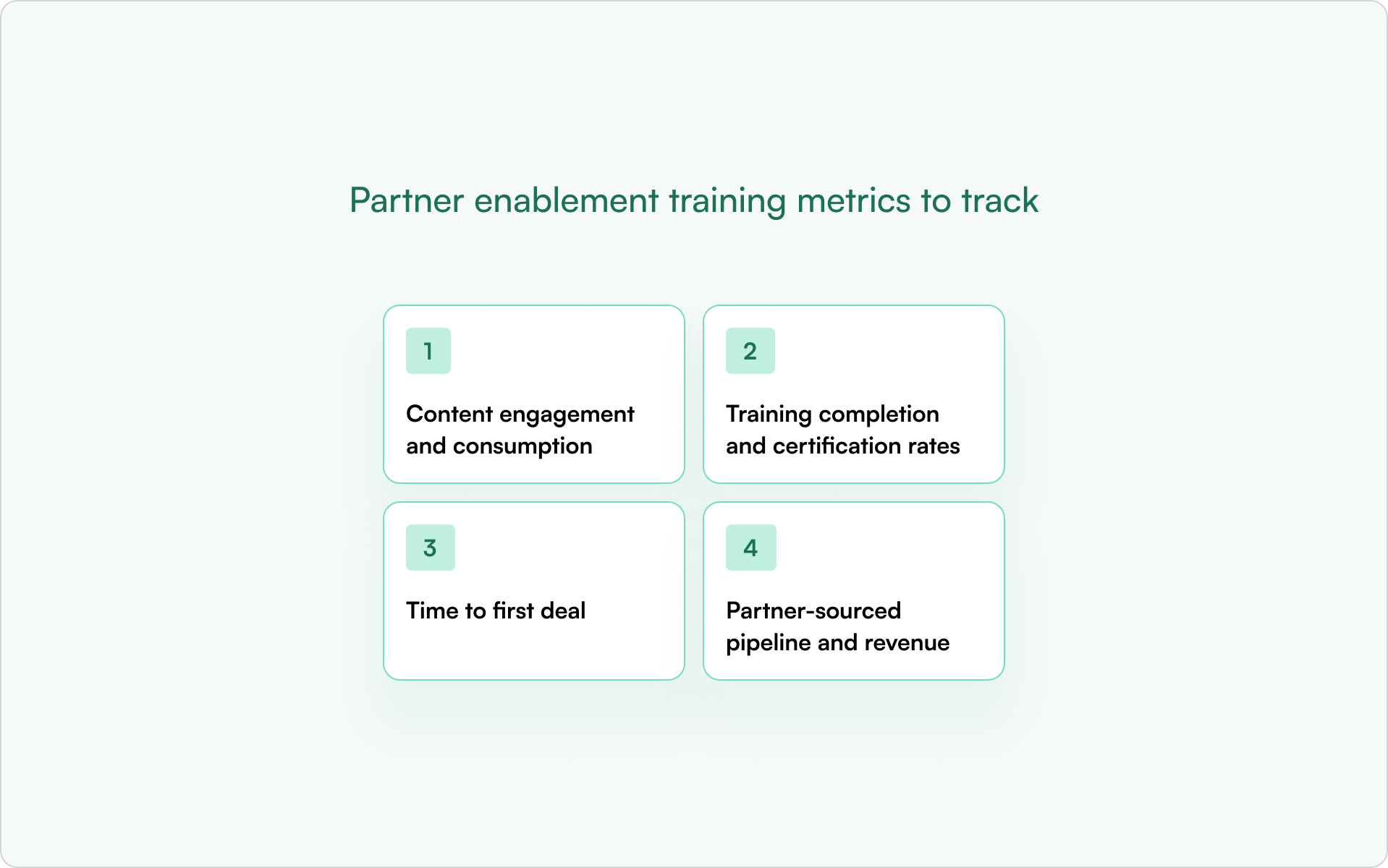
Partner enablement training metrics to track

To understand if your partner enablement process is working, track metrics that connect enablement activities directly to revenue outcomes — not just vanity activities.

Content engagement and consumption

Track which resources partners actually use: downloads, video completion rates, and page views. Low engagement can signal the content isn’t relevant, is hard to find, or doesn’t match what partners need in active deals.

Training completion and certification rates

Measure how many partners complete onboarding and earn certifications. Completion rates help you pinpoint drop-off points so you can shorten, reorder, or redesign modules.

Zeit bis zum ersten Geschäft

Track the time between partner activation and their first registered deal. This is one of the cleanest indicators that onboarding is working — or that partners are stuck.

Partner-sourced pipeline and revenue

This is the ultimate scoreboard. Track pipeline and closed-won revenue generated by partners. To do it well, you need tight CRM attribution so enablement activity can be tied to financial results without manual cleanup.

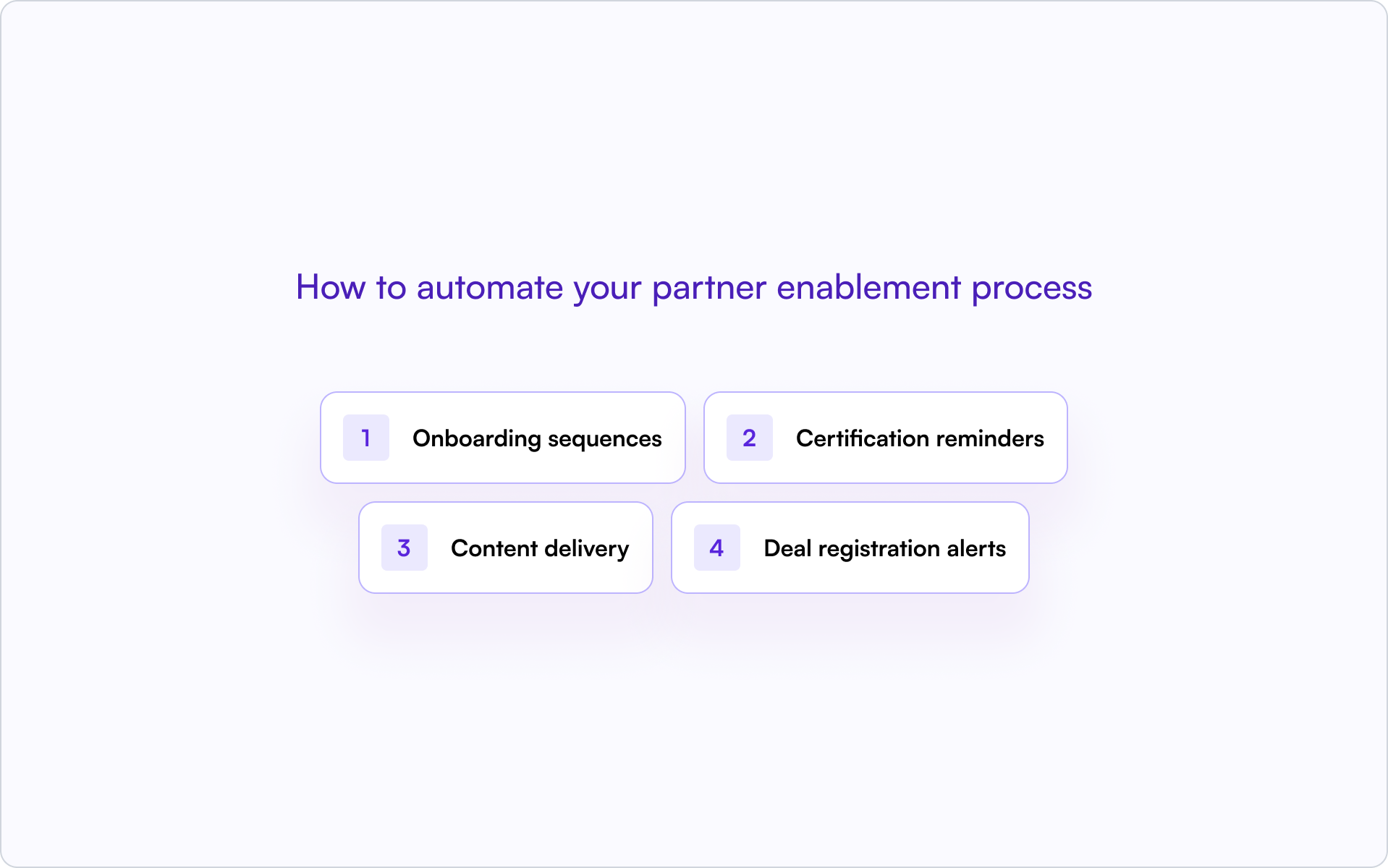
How to automate your partner enablement process

Automation lets you scale partner enablement without scaling headcount. The goal isn’t to make the experience robotic — it’s to make it consistent, timely, and measurable.

CRM-based automation is ideal because it keeps data and workflows in one system. That’s how you avoid the “portal says one thing, CRM says another” problem.

  • Onboarding sequences: Automatically enroll new partners in training modules and send welcome materials as soon as they sign up.
  • Certification reminders: Trigger automated alerts to partners and partner managers before certifications expire.
  • Content delivery: Push relevant collateral to partners based on their segment, tier, or deal stage.
  • Deal registration alerts: Automatically notify partners of the status of their registered deals.

Turn partner enablement into a revenue engine with Introw

Introw is the CRM-first PRM that makes best-practice partner enablement practical and scalable. Because it’s built on HubSpot and Salesforce, Introw centralizes your entire partner program where you already work.

It includes a partner portal for centralizing enablement content without login friction, deal registration with real-time visibility, and off-portal collaboration so partners can reply via email while data syncs automatically to your CRM.

If you’re trying to get out of spreadsheet chaos and into measurable partner-sourced revenue, get a demo.

Fazit

The best partner enablement programs aren’t built on more content — they’re built on clarity. Clear goals, segmented paths, CRM-connected workflows, and a focus on speed-to-first-deal turn “partners we signed” into “partners who ship revenue.”

Use these partner enablement best practices as a blueprint, then iterate quarterly based on what your data (and your partners) tell you.

Partner-Management

12 Channeltivity Competitors to Choose From in 2026

Laurens Lavaert
Co-founder & CTO
5min Lesezeit
17 May 2026
⚡ TL;DR

Channeltivity is a long-standing partner relationship management platform with features like deal registration, partner onboarding, and channel analytics. But many teams now need deeper CRM integration, AI, and more flexible partner engagement. If you’re evaluating Channeltivity competitors or comparing the best Channeltivity alternatives, this guide reviews 12 options for growing partner programs in 2026.

What is Channeltivity (and why teams look for competitors)

Channeltivity is a partner relationship management platform that covers the basics well: deal registration, partner marketing, MDF, content management, and reporting.

But many teams now want AI, deeper CRM workflows, and more flexibility across the partner ecosystem. That’s why buyers evaluating Channeltivity alternatives are looking elsewhere.

1. No AI capabilities

Channeltivity does not offer AI-powered workflows for onboarding, training, support, or deals.

Many newer platforms now provide AI deal coaching, AI-generated content, AI training creation, and conversational support through an AI agent.

2. No off-portal collaboration

Channeltivity relies heavily on its portal experience. Partners typically need to log in to access content, submit leads, or track progress.

Many newer platforms focus on partner engagement through email workflows, embedded forms, notifications, and automated updates outside the portal.

3. No native Slack integration

Slack is now a common workspace for many channel teams.

Channeltivity does not provide native Slack workflows for notifications, collaboration, support, or deal updates. Teams that use Slack heavily often look for alternatives that bring partnership activity into the channels they already use.

4. Limited CRM depth

Channeltivity supports Salesforce and HubSpot, but it is not a CRM-native platform.

Organizations that run revenue operations inside the CRM often prefer custom objects, workflow triggers, and deeper integrations such as a native Salesforce integration or HubSpot integration.

5. Product innovation has slowed

Channeltivity still covers the core feature set expected from partner management software. But many newer solutions now include account mapping, partner LMS capabilities, AI-powered training, and advanced automation.

For many teams, the question is not whether Channeltivity works. It’s whether it still offers the capabilities they need to grow.

To find the best Channeltivity alternative available, what should you be looking for?

What to look for in a Channeltivity competitor

Not every Channeltivity PRM alternative solves the same problems. Focus on these six areas before you switch.

1. AI that does more than answer questions

Many tools now offer AI, but not all AI is useful. Look for AI that can automate workflows, generate content, build training, assist with support, and help move deals forward without manual effort.

2. Off-portal engagement

Your users shouldn’t have to log in every time they need an update. The best platforms let channel partners collaborate through email, notifications, and other channels while keeping data synced automatically.

3. Deep CRM integration

A CRM should remain your system of record. Look for bi-directional sync, custom object support, workflow triggers, and the ability to work directly inside Salesforce. Our guide to how to choose a PRM covers the key evaluation criteria.

4. A modern partner portal

The portal should be easy to configure without developers. Look for white-label branding, segmented experiences for different partner types, and enough flexibility to support your organization as it grows. A modern partner portal should adapt to your program, not the other way around.

5. Full lifecycle coverage

Many tools handle onboarding and deal registration but stop there. Stronger solutions also include partner marketing, referral programs, incentives, account mapping, training, performance tracking, and revenue visibility across the entire partner lifecycle.

6. Fast time to value

Some enterprise platforms take months to deploy. Others can integrate with existing systems and start delivering results in days. Faster implementation means less disruption and a quicker path to value.

With those criteria in mind, let’s compare the best Channeltivity alternatives available today.

Channeltivity competitors at a glance

Use this table to compare the best Channeltivity alternatives before you review each tool in detail.

Tool CRM-Integration AI capability Zusammenarbeit außerhalb des Partnerportals Slack integration MDF module Embedded LMS Time to live
Introw Native Agentic Yes Agentic Yes AI-powered Days
Channelscaler Integrated Content/advisory Limited None Yes Basic Months
Impartner Integrated Advisory Limited Basic Yes Basic Months
Salesforce Native Salesforce Agentic/advisory Limited Basic Yes Basic Months
PartnerStack Integrated None Yes Basic No Basic Weeks
Kiflo Integrated None Limited None No Basic Tage bis Wochen
ZINFI Integrated Advisory Limited Basic Yes Basic Months
Gedankenmatrix Integrated Advisory Limited None Yes Basic Months
Magentrix Integrated Limited Limited Basic Yes Basic Wochen bis Monate
PartnerPortal.io Integrated None Limited None No Basic Minutes to days
Euler Native Agentic Yes Basic No None Days
Partner.io Basic None Limited None No Basic Tage bis Wochen

This quick view shows where each platform fits. Next, let’s look at the tools in more detail.

12 Best Channeltivity Competitors in 2026

If you’ve decided Channeltivity is no longer the right fit, these are the platforms worth evaluating next.

#1 Introw - Best overall Channeltivity competitor for modern partner management

What it does

Introw is an AI-first platform designed for companies running partner programs in HubSpot or Salesforce.

It combines partner onboarding, deal registration, MDF, partner marketing, training, account mapping, revenue tracking, and partner engagement in a single CRM-native system.

Unlike traditional PRMs, Introw extends beyond the portal. Partners can collaborate through email and Slack while CRM data remains the system of record.

Why someone might choose it over Channeltivity

Introw covers everything Channeltivity offers, then adds agentic AI, off-portal collaboration, deal coaching, CPQ, AI-powered training, and deeper CRM integration.

The biggest difference is architectural. Channeltivity connects to the CRM. Introw operates from within it. That reduces duplicate data, eliminates spreadsheets, and gives teams better visibility across the entire partner ecosystem.

Teams also gain:

  • AI-powered deal coaching for channel partners and resellers
  • AI-generated training through a built-in partner LMS
  • Agentic workflows through the AI agent
  • Native deal and lead registration
  • White-label portal experiences for different partner types
  • Shared Slack and email collaboration without forcing portal logins

Where it stands out

  • Agentic AI instead of manual workflows
  • Off-portal engagement instead of portal-only collaboration
  • AI-powered LMS instead of static training resources
  • Built-in deal coaching
  • Native CPQ
  • Custom-object CRM architecture
  • Typical deployment in 2–4 days

CRM integrations

Native, bi-directional Salesforce and HubSpot integrations with custom object support.

Preise

Custom pricing.

Am besten geeignet für

Mid-market SaaS companies that want a modern partner management platform built around CRM workflows and indirect revenue growth.

For a deeper look at partner management software, see our guide to partner management systems.

Ready to see why teams switch from Channeltivity to Introw? Book a demo.

#2 Impartner - Best for enterprise teams that need broad PRM coverage

What it does

Impartner combines partner portals, partner lifecycle management, TCMA, MDF, training, and ecosystem management in a large enterprise package.

Why someone might choose it over Channeltivity

It offers broader capabilities for large organizations that need extensive governance, customization, and administration controls.

Where it falls short

  • Implementation often takes months
  • Complex administration
  • Heavier CRM architecture
  • User experience feels dated in some areas

CRM integrations

Salesforce and other CRM systems through integration layers.

Preise

Custom pricing.

Am besten geeignet für

Large enterprise organizations with dedicated channel operations teams.

Our guide to Impartner competitors explores additional options.

#3 PartnerStack - Best for affiliate and referral programs

What it does

PartnerStack helps companies manage affiliates, referral programs, payouts, and partner recruitment through a large marketplace.

Why someone might choose it over Channeltivity

Built-in payment infrastructure and partner discovery make it attractive for growth-focused startups and SaaS companies.

Where it falls short

  • Limited support for co-selling motions
  • Less suitable for distributor programs
  • CRM synchronization relies on middleware
  • Less flexibility than dedicated PRMs

CRM integrations

Salesforce and HubSpot through Workato.

Preise

Marketing plans start at $1000/month. Growth plans start at $1520/month. Enterprise pricing is custom.

Am besten geeignet für

Companies focused on affiliates and referral programs.

See our full roundup of PartnerStack alternatives.

#4 Kiflo - Best for small partner programs

What it does

Kiflo is a lightweight PRM designed for simple onboarding, content sharing, and lead management.

Why someone might choose it over Channeltivity

It offers a cleaner interface, faster setup, and lower costs for smaller businesses.

Where it falls short

  • No AI capabilities
  • No LMS
  • No CPQ
  • Limited automation
  • Limited flexibility as programs grow

CRM integrations

Basic HubSpot and Salesforce integrations.

Preise

Core starts at $399/month billed annually. Plus pricing is custom.

Am besten geeignet für

Small businesses with fewer than 20 active partners.

Explore more options in our guide to Kiflo alternatives.

#5 Euler - Best for teams that want a modern PRM experience

What it does

Euler provides partner onboarding, pipeline management, advisory AI assistants, and collaboration tools in a modern interface.

Why someone might choose it over Channeltivity

The experience feels newer and more intuitive, with AI assistance and stronger usability.

Where it falls short

  • No MDF
  • No LMS
  • No advanced onboarding paths
  • Limited CRM depth

CRM integrations

HubSpot and Salesforce.

Preise

Custom pricing.

Am besten geeignet für

Early-stage programs looking for modern design and simplicity.

See our comparison of Euler PRM alternatives.

#6 Salesforce Experience Cloud - Best for Salesforce-native control

What it does

Salesforce Experience Cloud lets organizations build highly customized partner portals directly on Salesforce infrastructure.

Why someone might choose it over Channeltivity

Nothing offers deeper Salesforce integration or reporting access.

Where it falls short

  • Requires development resources
  • Long implementation cycles
  • No embedded LMS
  • No off-portal collaboration
  • Limited out-of-the-box functionality

CRM integrations

Native Salesforce.

Preise

Partner Community starts at $20/login/month or $50/member/month billed annually.

Am besten geeignet für

Large Salesforce organizations with internal development teams.

If Salesforce is central to your evaluation, review these Salesforce PRM alternatives.

#7 Mindmatrix - Best for through-channel marketing automation

What it does

Mindmatrix combines partner marketing, content distribution, training, onboarding, and PRM functionality.

Why someone might choose it over Channeltivity

It delivers stronger marketing automation and broader enablement capabilities.

Where it falls short

  • Steep learning curve
  • Complex setup
  • Enterprise-focused administration
  • Some workflows require vendor assistance

CRM integrations

Salesforce and HubSpot.

Preise

No pricing available.

Am besten geeignet für

Organizations heavily invested in partner marketing and enablement.

Read our breakdown of Mindmatrix alternatives.

#8 ZINFI - Best for large multi-tier channel programs

What it does

ZINFI offers unified channel management covering onboarding, MDF, marketing, incentives, and partner lifecycle management.

Why someone might choose it over Channeltivity

It supports highly complex multi-tier channel structures and global programs.

Where it falls short

  • Heavy implementation effort
  • Significant configuration requirements
  • Data often sits primarily in the platform
  • Less CRM-centric approach

CRM integrations

Salesforce, Microsoft Dynamics, and others.

Preise

ZINFI does not publish public PRM pricing.

Am besten geeignet für

Large enterprise channel organizations.

You can compare other options in our guide to ZINFI alternatives.

#9 Magentrix - Best for Salesforce-based partner portals

What it does

Magentrix focuses on customer and partner portals built on Salesforce.

Why someone might choose it over Channeltivity

It provides a clean portal experience with stronger Salesforce alignment.

Where it falls short

  • Portal-centric approach
  • Limited AI
  • Limited lifecycle coverage
  • No meaningful off-portal engagement

CRM integrations

Native Salesforce.

Preise

Essential starts at $1500/month. Advanced starts at $3000/month. Unlimited pricing is custom.

Am besten geeignet für

Organizations primarily looking for a Salesforce-powered portal.

Our guide to Magentrix alternatives covers comparable solutions.

#10 ChannelScaler - Best for rebates and incentives

What it does

ChannelScaler combines PRM, MDF, rebate management, incentives, and channel operations functionality.

Why someone might choose it over Channeltivity

It offers stronger rebate and incentive management for mature programs.

Where it falls short

  • Admin-heavy workflows
  • No AI
  • No Slack-based collaboration
  • CRM changes often require support involvement

CRM integrations

Salesforce and HubSpot through middleware.

Preise

Custom pricing.

Am besten geeignet für

Organizations running complex incentive and rebate programs.

See our guide to ChannelScaler alternatives for a deeper comparison.

#11 Partner.io - Best for pipeline collaboration

What it does

Partner.io focuses on pipeline visibility, co-selling, and deal collaboration.

Why someone might choose it over Channeltivity

It offers a more modern experience for teams centered on shared opportunities and sales collaboration.

Where it falls short

  • Narrower feature set
  • Smaller ecosystem
  • Less mature than larger competitors

CRM integrations

Salesforce and HubSpot.

Preise

Solo starts at $79/month. Growing starts at $299/month. Enterprise pricing is custom.

Am besten geeignet für

Organizations focused on pipeline collaboration and visibility.

Take a look at our roundup of Partner.io alternatives if you’re comparing pipeline-focused partner platforms. We also have a Partner.io comparison page so you can see how it stacks up against Introw.

#12 Impact - Best for affiliate and influencer partnerships

What it does

Impact helps businesses manage affiliates, creators, influencers, and referral relationships through automated tracking and payments.

Why someone might choose it over Channeltivity

It excels at performance-based partnership programs and attribution.

Where it falls short

  • Not a traditional PRM
  • No partner onboarding workflows
  • No deal registration
  • No channel sales management

CRM integrations

Limited CRM support compared to dedicated PRMs.

Preise

Starter starts at $30/month. Essentials starts at $500/month. Pro starts at $2500/month.

Am besten geeignet für

Companies focused on affiliate, creator, and influencer partnerships.

Now that you’ve seen the options, the best choice comes down to how you want to support your partners, manage deals, and scale your program over the next few years.

Das Fazit

Channeltivity covers the fundamentals of partner relationship management, including deal registration, partner onboarding, content management, training, and reporting. If those features meet your company’s needs, it remains a solid option.

But the industry has moved on. Today’s partner management systems help organizations automate more work, support customers more effectively, manage partner services at scale, and create more sales opportunities.

AI, CRM-native workflows, embedded training, and collaboration beyond the portal are quickly becoming standard.

If you’re evaluating partner relationship management software, Introw is a strong Channeltivity alternative. It combines mid-market simplicity with the products, resources, and automation growing partner programs need to drive better revenue results.

Why teams choose Introw when looking for Channeltivity competitors

Teams often start looking at Channeltivity competitors when they need more than a portal and basic partner management. They need a platform that helps partners sell, supports more services, and creates measurable revenue growth.

+70% more partner pipeline

Partners register more deals, faster, with deal flow synced directly into your CRM. Off-portal collaboration increases engagement, while AI helps identify duplicate opportunities before they affect results.

+75% faster partner onboarding

Go live in 2–4 days with no custom development. AI-driven onboarding, training, resources, and content help new partners start selling faster.

+60% more partner-influenced revenue

Track every partner-sourced and partner-influenced opportunity inside your CRM. Deal coaching, automation, and ongoing support help partners stay active and generate more revenue over time.

Ready to see how Introw compares to Channeltivity? Book a demo.