Partner-Marketing

Channel-Partner-Marketing-Leitfaden 2026: Strategien und Taktiken

Holen Sie sich die Channel-Partner-Marketingstrategie für 2026, die wirklich funktioniert. Erfahren Sie, wie Sie Partner aktivieren, wiederholbare Kampagnen durchführen und die tatsächlichen Auswirkungen auf den Umsatz verfolgen können.

5min Lesezeit
14. Dezember 2025
⚡ TL;DR

Eine starke Channel-Partner-Marketingstrategie hilft Ihnen dabei, Partner zu segmentieren, wiederholbare Kampagnen über Partner zu starten und jeden Kontakt direkt in Salesforce HubSpot zu verfolgen. Erfolgreiche Teams halten ihre Channel-Partner-Marketingaktivitäten einfach, automatisieren Updates mit Tools wie Introw und nutzen Daten, um Partneraktionen mit der Pipeline und dem Umsatz zu verknüpfen.

Was würde sich ändern, wenn jede Partnerkampagne einfach zu starten, einfach zu beitreten und einfach zu messen wäre?

Die meisten Teams jonglieren immer noch mit verstreuten Inhalten und manuellen Nachfassaktionen, was selbst die besten Channel-Partner-Marketingprogramme verlangsamt.

Eine fokussierte Channel-Partner-Marketingstrategie beseitigt diese Reibungspunkte, indem sie die Partner dort abholt, wo sie arbeiten, wiederverwendbare Ressourcen nutzt und alles in Ihrem CRM aufeinander abstimmt.

Mit CRM-nativen Tools wie Introw lassen sich Partner-Channel-Marketingprogramme einfacher durchführen und für Partner sowohl bei To-Partner- als auch bei Through-Partner-Aktivitäten leichter umsetzen.

Wenn vorhersehbare Einnahmen das Ziel sind, sind Klarheit und Automatisierung der Ausgangspunkt.

Was bedeutet Channel-Partner-Marketing im Jahr 2026 eigentlich?

Was ist Channel-Partner-Marketing? (Definition von SaaS 2026)

Channel-Partner-Marketing ist die Arbeit, die Sie mit und für Partner leisten, um Nachfrage zu schaffen, die Akzeptanz zu fördern und gemeinsam den Umsatz zu steigern.

Im Jahr 2026 wird es eine Mischung aus Partner-Enablement- und Through-Partner-Kampagnen geben, die alle mit Ihrem CRM verknüpft sind, damit nichts verloren geht.

To-Partner vs. Through-Partner

Hier ist eine kurze Zusammenfassung der beiden Anträge:

Bewegung Was es bedeutet Beispiele
To-Partner Geben Sie Ihren Partnern die Tools und den Kontext, die sie benötigen. Onboarding-Kits, Playbooks, Produkt-Updates, Kampagnenmaterialien
Durch-Partner Run Demand spielt zusammen mit Partnern Co-Marketing-Webinare, ABM-Pakete, Veranstaltungen vor Ort, Integrationsinitiativen

Die meisten starken Partnerprogramme führen beide Vorgänge gleichzeitig aus.

Channel-Marketing vs. Partner-Marketing

Die Menschen verwenden diese Begriffe synonym, aber sie sind nicht dasselbe.

  • Channel-Marketing ist Ihre Markteinführungsstrategie.
  • Partnermarketing umfasst die tatsächlichen Programme und Kampagnen, die Sie gemeinsam mit Partnern durchführen.

Ihre Channel-Partner-Marketingstrategie liegt genau in der Mitte zwischen diesen beiden Ansätzen.

Wer gilt als Vertriebspartner?

Ein Vertriebspartner kann ein Wiederverkäufer, Empfehlungspartner, MSP, SI, Technologieintegrationspartner, Agentur oder Berater sein.

Jeder hat unterschiedliche Stärken und befindet sich in einer anderen Phase der Marketingreise für Vertriebspartner, weshalb eine frühzeitige Segmentierung so wichtig ist.

Warum diese Definition wichtig ist

Um Channel-Partner-Marketingaktivitäten durchzuführen, die die Pipeline voranbringen, müssen Sie sich darüber im Klaren sein, wen Sie unterstützen und was Sie von diesen Personen erwarten.

Wenn alle dieselbe Definition verwenden, können Partnermanager und RevOps Ziele festlegen und den Erfolg direkt in Salesforce HubSpot messen.

Eine gemeinsame Grundlage erleichtert die Erstellung und Skalierung Ihres Marketingplans für Vertriebspartner. Alle weiteren Informationen in diesem Leitfaden basieren auf diesem Rahmenkonzept.

Das 4-teilige Rahmenwerk: Planen → Ermöglichen → Ausführen → Messen

Jede starke Marketingstrategie für Vertriebspartner folgt dem gleichen Rhythmus.

Diese vier Phasen helfen Ihnen dabei, Kampagnen zu planen, die Ihre Partner tatsächlich nutzen möchten, konsistente Partner-Aktivitäten durchzuführen und jedes Ergebnis direkt in Salesforce HubSpot zu messen.

Betrachten Sie dies als das Rückgrat Ihrer gesamten Marketingaktivitäten für Vertriebspartner.
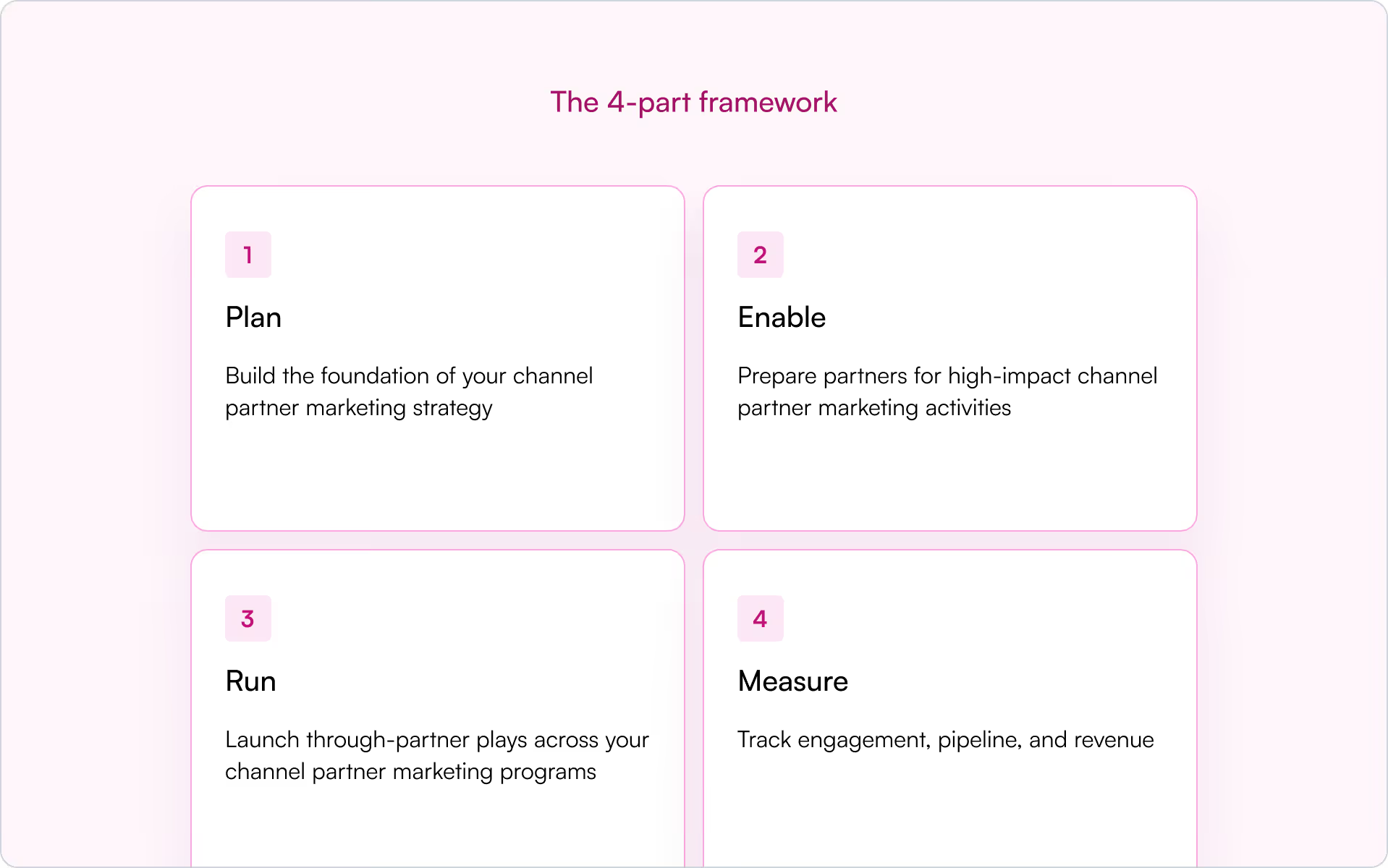
Plan: Schaffen Sie die Grundlage für Ihre Marketingstrategie für Vertriebspartner.

Bevor Sie eine Partnerkampagne starten, benötigen Sie einen schnellen, klaren Plan, der alle Beteiligten aufeinander abstimmt.

Diese Phase prägt die gesamte Marketingreise der Vertriebspartner. Außerdem bietet sie Partnermanagern und RevOps die Struktur, die sie benötigen, um die Ergebnisse im CRM zu messen.

Was ist zu definieren?

  • Ihr Partner-ICP für jedes Segment in Ihren Channel-Partner-Marketingprogrammen
  • Ein klares Angebot für Empfehlungs-, Wiederverkaufs-, SI-, MSP- oder Technologiepartner
  • Ziele in Verbindung mit registrierten Geschäften, qualifizierten Einführungen und Pipeline
  • Vierteljährliche Schwerpunkte, die Ihre umfassendere Markteinführungsstrategie für Vertriebspartner unterstützen
  • MDF-Richtlinien und ihre Verbindung zu den Marketingaktivitäten der Vertriebspartner
  • Ein Kampagnenkalender mit wiederkehrenden Terminen, auf die sich Partner verlassen können

Warum es wichtig ist

Dies ist eine der einfachsten Best Practices für das Channel-Partner-Marketing, die es zu beachten gilt. Wenn der Plan unklar ist, wissen die Partner nicht, wie sie sich beteiligen sollen, und Ihr Channel-Partner-Marketingplan lässt sich nur schwer skalieren.

Beispiel

Ein solider Plan könnte Partner nach Typ und Region segmentieren und dann jeder Gruppe ein oder zwei Durchlaufpartner zuordnen, damit Marketing- und Partnerteams aufeinander abgestimmt bleiben.

Für einen tieferen Einstiegspunkt, das Leitfaden „Wie man ein Channel-Partnerprogramm aufbaut“ ist eine hilfreiche Referenz.

Aktivieren: Partner auf wirkungsvolle Marketingaktivitäten für Vertriebspartner vorbereiten

Enablement ist der Punkt, an dem Ihre Strategie für Partner Realität wird. Wenn Partner wissen, was sie sagen, was sie weitergeben und wie die Kampagne funktioniert, wird die Umsetzung wesentlich einfacher.

Was ist bereitzustellen?

  • Kampagnen-Komplettpakete
  • Gesprächsleitfäden und Positionierung
  • Onboarding-Materialien, die auf jedes Marketing-Segment der Vertriebspartner abgestimmt sind
  • Lokalisierbare Inhalte und gemeinsam nutzbare Ressourcen
  • E-Mail- und Social-Media-Vorlagen, die Reibungsverluste reduzieren
  • Klare Anweisungen für die Ausführung durch Partner

Warum es wichtig ist

Enablement ist der Moment, in dem Partner entscheiden, ob sie Ihre Kampagne tatsächlich durchführen werden. Wenn die Assets einfach und zugänglich sind, werden Ihre Channel-Partner-Marketingprogramme sofort wiederholbarer.

Beispiel

Ein Partner könnte ein Kit öffnen, die E-Mail-Sequenz herausnehmen und noch am selben Tag mit der Kontaktaufnahme beginnen. Das ist die Art von Aktivierung, die jeder Marketingplan für Vertriebspartner anstrebt.

Weitere Ideen finden Sie im Leitfaden zum Partnerschaftsmarketing hilfreiche Beispiele.

Ausführen: Starten Sie Partner-Kampagnen über Ihre gesamten Channel-Partner-Marketingprogramme hinweg.

In dieser Phase wird die Planung in die Tat umgesetzt. Durchgängige Partnerkampagnen sollten für Partner und Ihre internen Teams einfach zu verwalten sein.

Wie die Ausführung aussieht

  • Multichannel-Kampagnen, die auf die Aktivitäten jedes Partners abgestimmt sind
  • Off-Portal-Updates per E-Mail oder Slack Partner sich nie extra anmelden müssen
  • Automatische Erinnerungen für Fristen, Veranstaltungen und die Nutzung von Vermögenswerten
  • Co-Selling-Übergabeschritte, die direkt in Salesforce HubSpot übernommen werden

Warum es wichtig ist

Wenn die Umsetzung schwerfällig erscheint, verlangsamen sich die Channel-Marketing-Bemühungen Ihres Partners schnell. Wenn Updates und Kommunikation außerhalb des Portals stattfinden, lassen sich die Marketingaktivitäten der Channel-Partner ohne manuelle Nachverfolgung skalieren.

Beispiel

Ein Partner kann Slack über eine neue Kampagne Slack werden und mit der Werbung dafür beginnen, ohne sich jemals in ein Portal einloggen zu müssen. So bleibt die Dynamik hoch und die Akzeptanz konstant.

Maßnahme: Engagement, Pipeline und Umsatz verfolgen

Messungen machen die Marketingstrategie für Vertriebspartner zu einem berechenbaren Motor. Sie beseitigen Spekulationen und zeigen genau, welche Partner und Kampagnen den Umsatz steigern.

Was soll verfolgt werden?

  • Engagement mit Assets und Kampagnen-Kits
  • Deal-Registrierungsvolumen und beeinflusste Pipeline
  • Co-Selling-Aktivitäten im Zusammenhang mit Partner-Channel-Marketing-Maßnahmen
  • Aktivierungsraten in jedem Segment
  • Konversionsraten und beeinflusster ARR
  • Beispiele für die Auswirkungen des Channel-Partner-Marketings im Laufe des Quartals

Wie Introw dies unterstützt

Mit Introw werden alle Klicks auf Partner-E-Mails, Downloads von Assets, Aktualisierungen von Geschäften und Kampagnen-Touchpoints direkt mit Salesforce oder HubSpotsynchronisiert.

RevOps, Partnermanager und CROs erhalten übersichtliche Dashboards, die die Marketingaktivitäten der Vertriebspartner mit der Pipeline und dem Umsatz verknüpfen. Keine Portale, keine manuelle Berichterstellung.

10 bewährte Partner-Marketingstrategien für 2026

Diese Maßnahmen tragen dazu bei, dass Ihr Partnerprogramm konsistent bleibt, ohne Ihr Marketingteam oder Ihre Partner zu überlasten.

Jedes davon lässt sich nahtlos in Ihre Channel-Partner-Marketingstrategie integrieren und kann sowohl die Lead-Generierung als auch das Umsatzwachstum unterstützen.

Betrachten Sie diese Liste als Ausgangspunkt und wählen Sie die Stücke aus, die am besten zu Ihren Channel-Partnerschaften passen.
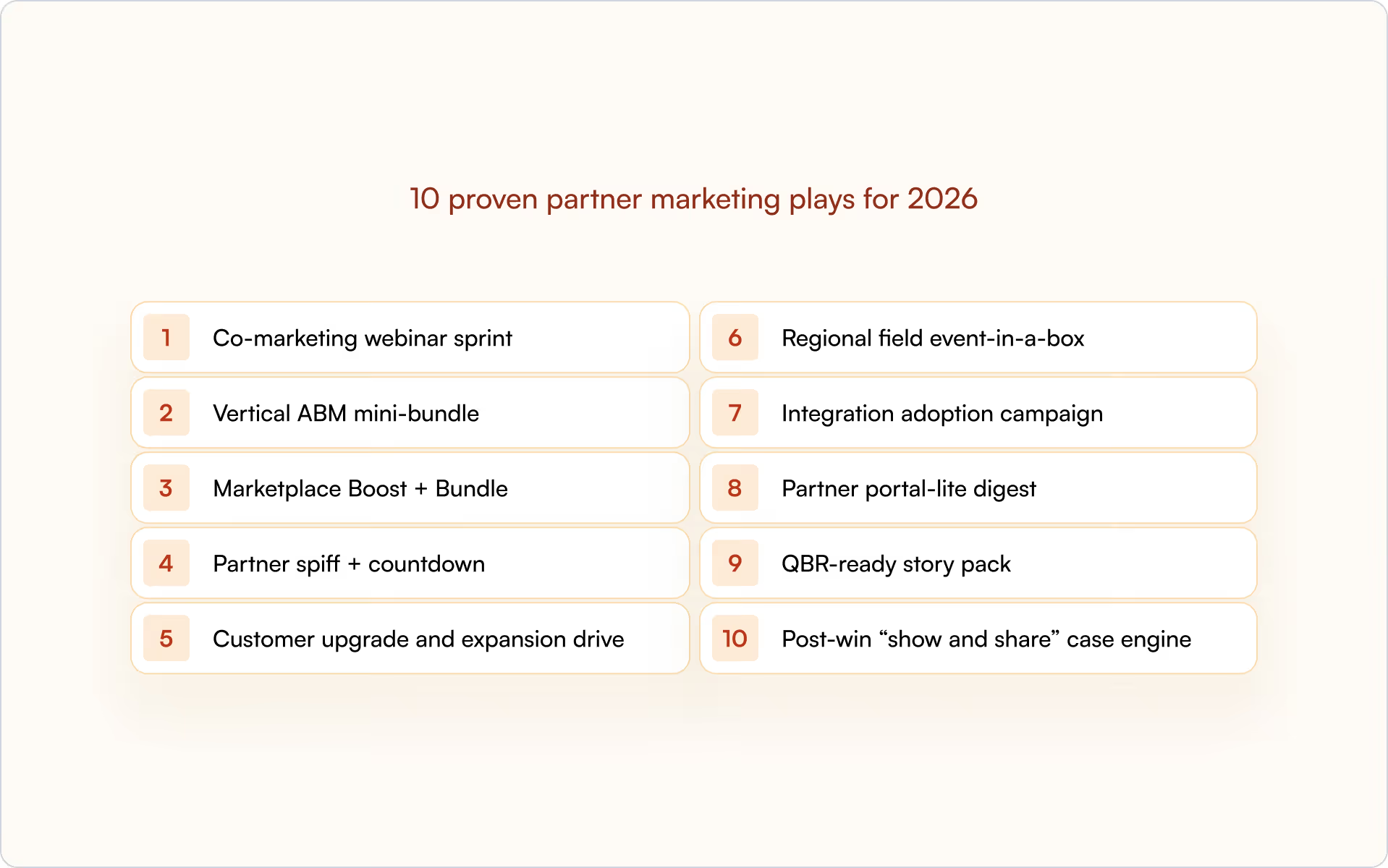
1. Co-Marketing-Webinar-Sprint

Was es ist: Eine kurze, fokussierte Webinar-Kampagne, die Partner gemeinsam mit Ihnen durchführen können.

Warum es funktioniert: Partner bringen ein interessiertes Publikum mit, und Ihr Vertriebsteam erhält qualifizierte Gespräche.

So starten Sie: Wählen Sie ein gemeinsames Thema, teilen Sie Ihre Kampagne in einer Box, führen Sie zwei Wochen lang eine Werbeaktion durch und kontaktieren Sie anschließend die Teilnehmer.

KPI: Anmeldungen, Teilnahme, gebuchte Besprechungen.

Introw-Tipp: Automatisierte Ankündigungen und Anwesenheitserfassung zeigen, welche Partner die Kampagne am stärksten verstärken.

2. Vertikales ABM-Minibündel

Was es ist: Ein vorgefertigtes, branchenspezifisches Paket, das Partner für gezielte Kundenansprache nutzen können.

Warum es funktioniert: Vertikale Relevanz erhöht die Konversionsrate und hilft Partnern dabei, ihre Botschaften individuell anzupassen.

So starten Sie: Stellen Sie Ihren Partnern eine Landingpage, eine Fallstudie und eine E-Mail-Vorlage für einen wichtigen vertikalen Markt zur Verfügung.

KPI: In Segmentkonten gebuchte Meetings.

Introw-Tipp: Segmentieren Sie Partner nach Branchen und planen Sie Updates, die zu ihrem Gebiet passen.

3. Marktplatz-Boost + Bundle

Was es ist: Eine kleine Kampagne, die Ihr Marktplatzangebot auffrischt und Partnern ein gebündeltes Angebot zur Werbung bietet.

Warum es funktioniert: Marktplätze sind Plattformen mit hoher Kaufabsicht, die zur Steigerung des Umsatzes beitragen.

So starten Sie: Aktualisieren Sie Ihren Eintrag, teilen Sie ein Co-Branding-Paket und bieten Sie Werbetexte an, die Partner verwenden können.

KPI: Listing-Traffic, Testversionen, beeinflusste Verkaufschancen.

Introw-Tipp: Verfolgen Sie, welche Partner Ihre Marketingmaterialien nutzen und welche Pakete die Aktivitäten vorantreiben.

4. Partner-Bonus + Countdown

Was es ist: Eine kurze, anreizbasierte Förderung für Einführungen oder registrierte Geschäfte.

Warum es funktioniert: Deadlines schaffen Energie innerhalb Ihres Partner-Ökosystems.

So starten Sie: Legen Sie einen Zeitplan fest, definieren Sie eine Belohnung und teilen Sie tägliche Erinnerungen.

KPI: Registrierte Geschäfte, Pipeline erstellt.

Introw-Tipp: Automatische Countdown-Erinnerungen halten Partner auf dem Laufenden, ohne dass Ihr Team ständig nach Updates fragen muss.

5. Kunden-Upgrade und Expansionsinitiative

Was es ist: Ein einfaches Spiel, bei dem Partner bestehenden Kunden dabei helfen, mehr Funktionen zu nutzen oder die Nutzung auszuweiten.

Warum es funktioniert: Die Partner kennen bereits gemeinsame Konten und können den Zeitpunkt beeinflussen.

So starten Sie: Geben Sie Ihren Partnern ein Expansionshandbuch an die Hand und vermitteln Sie ihnen geeignete Kunden.

KPI: Expansionsmöglichkeiten und ARR hinzugefügt.

Introw-Tipp: Signale innerhalb des CRM können Partnerbenachrichtigungen ohne manuellen Aufwand auslösen.

6. Regionale Feldveranstaltung-im-Karton

Was es ist: Eine kleine lokale Veranstaltung, die Ihr Partner mit Ihrer Unterstützung durchführen kann.

Warum es funktioniert: Persönliche Treffen verbessern die Kundenbindung und helfen Ihrem Vertriebsteam, Geschäfte voranzutreiben.

So starten Sie: Teilen Sie eine Checkliste, laden Sie Vorlagen ein und erstellen Sie Skripte für schnelle Nachfassaktionen.

KPI: Anzeigerate, nach der Veranstaltung gebuchte Termine.

Introw-Tipp: Nutzen Sie RSVPs und automatisierte Follow-ups, um die Dynamik aufrechtzuerhalten.

7. Kampagne zur Einführung der Integration

Was es ist: Eine gezielte Initiative zur Förderung einer gemeinsamen Integration.

Warum es funktioniert: Die Nutzung von Integrationen ist eng mit Kundenbindung und Expansion verbunden.

So starten Sie: Geben Sie Ihren Partnern Informationen darüber, warum dies wichtig ist, Produkt-Hinweise und versandfertige E-Mails.

KPI: Integrationsaktivierungen und damit verbundene Chancen.

Introw-Tipp: Verfolgen Sie die Nutzung aktivierungsbezogener Inhalte, um zu sehen, welche Partner die Akzeptanz fördern.

8. Partnerportal-Lite-Digest

Was es ist: Eine monatliche Zusammenfassung Slack E-Mail anstelle eines herkömmlichen Partnerportals.

Warum es funktioniert: Partner bleiben auf dem Laufenden, ohne sich in ein anderes Tool einloggen zu müssen.

So starten Sie: Versenden Sie einen einfachen Überblick mit den wichtigsten Ressourcen, Fristen, Erfolgen und nächsten Schritten.

KPI: Engagement-Score, Reaktivierung inaktiver Partner.

Introw-Tipp: Ankündigungen zeigen genau, welche Partner mit jedem Update interagieren.

9. QBR-fähiges Story-Paket

Was es ist: Eine übersichtliche Vorlage, mit der Partner die Maßnahmen für das nächste Quartal planen können.

Warum es funktioniert: Die Partner sehen ihre Erfolge klar und einigen sich schneller auf Prioritäten.

So starten Sie: Teilen Sie eine kurze Präsentation mit den wichtigsten Punkten, der Content-Performance und den nächsten Schritten.

KPI: Vierteljährliche Verpflichtung und Pipeline-Abstimmung.

Introw-Tipp: Mit CRM-gestützten Story-Paketen können sich Ihr Marketingteam und Ihre Partnermanager in wenigen Minuten vorbereiten.

10. „Show and Share”-Fallmaschine nach dem Gewinn

Was es ist: Ein schneller Prozess, um Partnergewinne in Fallbeispiele umzuwandeln.

Warum es funktioniert: Beweise helfen Partnern, selbstbewusster zu verkaufen.

So starten Sie: Bieten Sie eine einfache Vorlage an und teilen Sie die Geschichten über Ihre Channel-Partnerschaften.

KPI: Erstellte Fallressourcen, beeinflussten den Anstieg der Pipeline.

Introw-Tipp: Verfolgen Sie nachgelagerte Klicks, um zu sehen, welche Geschichten Ihre Partner-Marketingstrategie am besten unterstützen.

Diese Maßnahmen helfen Ihrem Partnerprogramm, sich auf Kampagnen zu konzentrieren, die Ihre Partner schnell starten können und die Ihr Marketingteam leicht messen kann.

Welche Tools unterstützen tatsächlich dieses Maß an Konsistenz, ohne Ihr Unternehmen zu überfordern?

Der Tech-Stack, den Sie tatsächlich benötigen (und nichts weiter)

Eine starke Marketingstrategie für Vertriebspartner erfordert nicht Dutzende von Marketing-Tools.

Ihr Marketingteam, Ihr Vertriebsteam und Ihre Partnermanager benötigen nur wenige Systeme, die Ihnen dabei helfen, mit den richtigen Partnern zusammenzuarbeiten, effektive Maßnahmen Ihrer Vertriebspartner zu unterstützen und alles mit Ihrer Customer Journey zu verknüpfen.

Kernwerkzeuge

  • CRM (Salesforce HubSpot): Ihre zentrale Informationsquelle für Pipeline, Attribution, vertriebsqualifizierte Leads und den gesamten Vertriebsprozess.
  • PRM und Partnermanagement: Ein CRM-natives Tool wie eine Partnermanagement-Software sorgt dafür, dass die Registrierung von Geschäften, die Einbindung von Partnern und die Channel-Marketing-Aktivitäten zwischen Drittanbietern und strategischen Partnern aufeinander abgestimmt sind.
  • Content Hub: Speichert die Marketingmaterialien, die Ihre Marketingabteilung für jede Kampagne verwendet, in einer Box.
  • Webinar- oder Event-Tool: Hilft Ihrem Team dabei, Partner-Kampagnen durchzuführen, die zu Ihrer Zielgruppe passen.
  • Light Design Tools: Unterstützen Sie schnelles Co-Branding und sparen Sie Marketingressourcen bei der Zusammenarbeit mit externen Partnern.

Warum dies für Ihr Partnerprogramm wichtig ist

Ein einfacher Tech-Stack hilft Channel-Partnerschaften, schneller voranzukommen, und reduziert den Arbeitsaufwand für Ihre Marketingabteilung.

Es sorgt für eine einheitliche Partner-Marketingstrategie und bietet Ihrem Team klare CRM-Berichte, Transparenz hinsichtlich der Partner und ein besser vorhersehbares Umsatzwachstum.

Ein einfacher Stapel bereitet die Bühne. Der letzte Schritt besteht darin, Ihre Strategie so zusammenzufassen, dass Partner ihr vertrauen und entsprechend handeln können.

Jetzt sind Sie dran: Setzen Sie Ihre Partnerstrategie in die Tat um

Eine starke Marketingstrategie für Vertriebspartner basiert auf Klarheit, einfachen Kampagnen und Tools, die es den Partnern leicht machen, Maßnahmen zu ergreifen.

Ihre nächsten Schritte

  • Wählen Sie zwei oder drei Channel-Partner-Marketingaktivitäten aus, die Ihre Partner schnell starten können.
  • Geben Sie ihnen eine Kampagne in einer Box mit klaren Botschaften und gebrauchsfertigen Materialien.
  • Messen Sie das Engagement und die Pipeline in Ihrem CRM, damit Sie wissen, was Sie wiederholen müssen.

Sind Sie bereit, leistungsstarke Partnerkampagnen durchzuführen, ohne ständig nach Updates suchen zu müssen? Fordern Sie eine Demo an!

FAQs

Noch Fragen? Hier findest du die häufigsten Fragen und Antworten.

Kontaktiere uns

Was macht eine Channel-Partner-Marketingstrategie effektiv?

Eine effektive Channel-Partner-Marketingstrategie bietet Partnern klare Marketingmaßnahmen, gemeinsame Ressourcen und einfache Co-Branding-Kampagnen, die sie reibungslos durchführen können. Außerdem sorgt sie dafür, dass die Partnerbeziehungen aufeinander abgestimmt sind, mit definierten Leistungskennzahlen und einer soliden Strategie, die den gemeinsamen Erfolg unterstützt.

Wie wähle ich die richtigen Partner für meinen Zielmarkt aus?

Wählen Sie Partner, die bereits an Ihren Zielmarkt oder Ihre Zielkunden verkaufen und Ihren Verkaufszyklus beeinflussen können. Starke strategische Partnerschaften teilen Branchenkenntnisse, Verkaufstools und Markenrichtlinien, wodurch beide Teams ihre Verkaufsziele schneller erreichen können.

Welche Rolle spielen Anerkennungsprogramme im Partnermarketing?

Anerkennungsprogramme tragen dazu bei, Partnerbeziehungen zu stärken, indem sie konstante Leistungen belohnen. Sie sorgen für ein gesünderes Channel-Ökosystem, indem sie kontinuierliche Unterstützung, Co-Branding-Kampagnen und die Abstimmung der Vertriebsmitarbeiter fördern.

Wie kann ich den Erfolg der Marketingmaßnahmen meiner Partner nachverfolgen?

Verwenden Sie Leistungskennzahlen, die mit Ihrem CRM verknüpft sind, wie beispielsweise die beeinflusste Pipeline, die Geschwindigkeit der Geschäftsabschlüsse und die Aktivitäten in jeder Phase des Verkaufszyklus. Dies hilft Ihrem Marketing- und Vertriebsteam zu verstehen, welche Partner den größten Beitrag leisten und wo kontinuierliche Unterstützung erforderlich ist.

Wie stelle ich sicher, dass externe Partner mit meiner Marke im Einklang bleiben?

Geben Sie externen Partnern einfache Markenrichtlinien, genehmigte Botschaften und gemeinsame Ressourcen an die Hand, die sie in Kampagnen verwenden können. So sind alle auf dem gleichen Stand und Ihre Marketingmaßnahmen bleiben in Ihrem gesamten Channel-Ökosystem konsistent.


Launch your partner portal
in minutes!

Vielen Dank! Wir haben deine Anfrage erhalten!
Hoppla! Beim Absenden des Formulars ist ein Fehler aufgetreten.

Verwandte Blog-Artikel

Partner-Marketing

15 Best ChannelScaler Alternatives for Partner Teams in 2026

Ruben Bellaert
Growth
5min Lesezeit
27 May 2026
⚡ TL;DR

Looking for a ChannelScaler alternative? ChannelScaler combines partner relationship management, MDF management, incentives, rebates, and channel marketing in one platform. But many SaaS companies want stronger CRM integration, simpler partner workflows, faster implementation, or better visibility into partner-sourced revenue. Platforms like Introw take a CRM-first approach, combining deal registration, attribution, AI-powered deal coaching, and partner collaboration in Salesforce and HubSpot.

What is ChannelScaler (and why do teams seek alternatives)?

ChannelScaler is a partner relationship management (PRM) platform created through the merger of Allbound and Channel Mechanics. It combines deal registration, MDF management, incentives, partner marketing, and through-channel marketing automation in one platform.

For many businesses, that’s exactly what they need.

Others look for deeper CRM integration, a simpler partner experience, stronger automation, or more flexibility as their partner program grows.

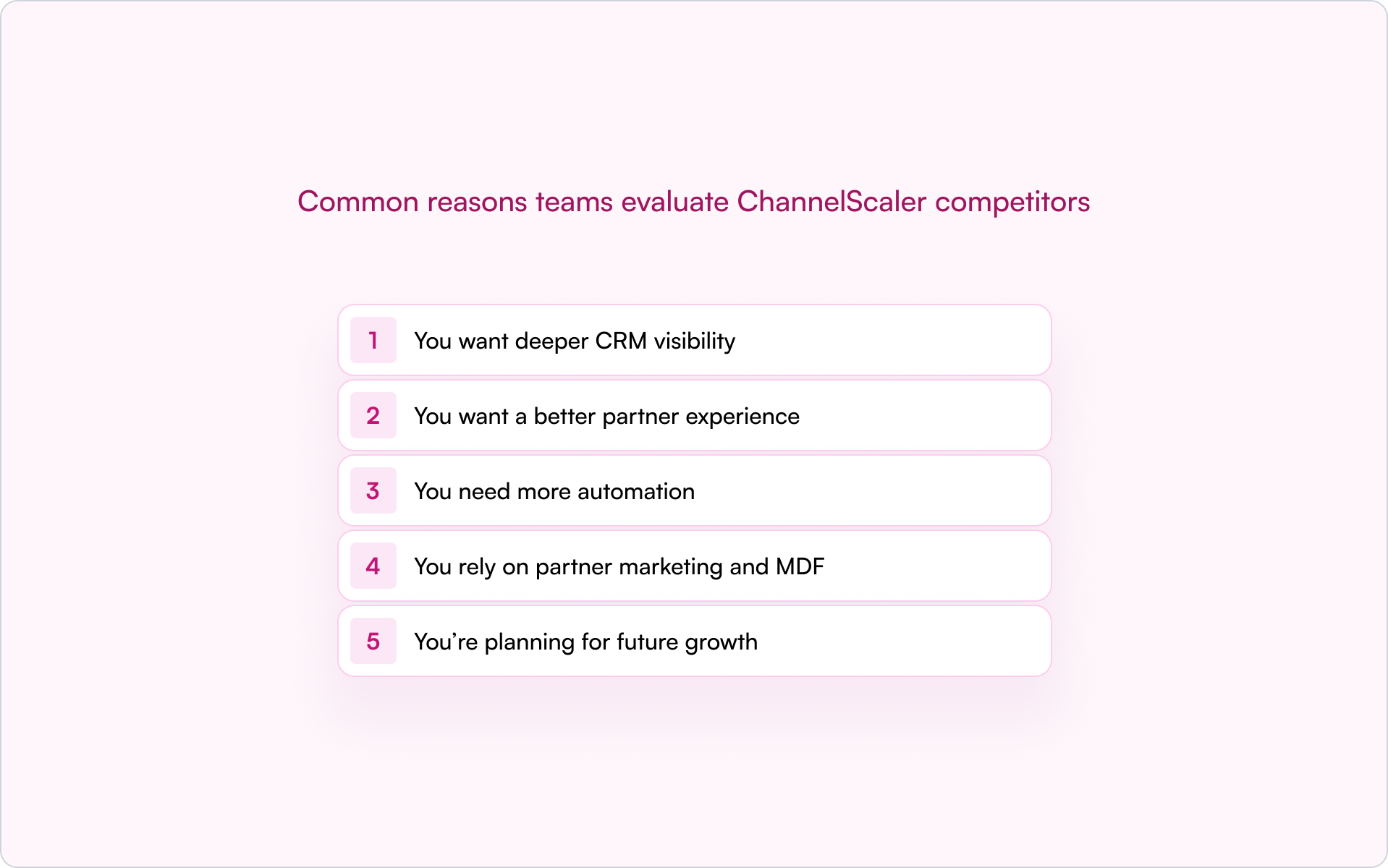
Common reasons teams evaluate ChannelScaler competitors include:

1. You want deeper CRM visibility

Many teams want deal registration, attribution, partner data, and reporting tied more closely to Salesforce or HubSpot.

2. You want a better partner experience

As partner ecosystems grow, adoption matters. Teams often look for ways to reduce friction and make it easier for partners to engage.

3. You need more automation

Automation can reduce manual work across onboarding, approvals, notifications, reporting, and partner operations.

4. You rely on partner marketing and MDF

If MDF management, partner marketing, and through-channel marketing automation are important, it’s worth comparing how each platform supports those workflows.

5. You’re planning for future growth

The right platform should support your partner ecosystem today and continue to scale with your business.

ChannelScaler alternatives at a glance

If you’re shortlisting ChannelScaler alternatives, this table gives you a quick overview of where each platform fits before diving into the detailed reviews.

Platform Am besten geeignet für CRM-Integration MDF management AI-powered capabilities Preise
Introw SaaS companies running referral, reseller, and co-sell programs Native Salesforce & HubSpot Yes AI-powered deal coaching Custom
Impartner Enterprise partner programs with advanced workflows Salesforce & Microsoft Dynamics Yes Yes Custom
ZINFI Large partner ecosystems and global channel programs CRM integrations available Yes Yes Custom
Unifyr (formerly Zift Solutions) Partner enablement, training, and channel marketing CRM integrations available Yes Yes Custom
Channeltivity Mid-market businesses seeking fast deployment Native Salesforce & HubSpot Yes No Standard: $1,899/mo
CRM: $2,199/mo
Magentrix Salesforce-centric partner programs Salesforce-native Limited No Essential: $1,500/mo
Advanced: $3,000/mo
Unlimited: Custom
PartnerStack Referral, reseller, and affiliate programs CRM integrations available No Limited Starts at ~$1,520/mo
Strukturiertes Web Partner-led demand generation and channel marketing CRM integrations available Yes Yes Custom
Ansira (formerly SproutLoud) Distributed marketing and local market activation CRM integrations available Yes Limited Custom
WorkSpan Strategic alliances and co-sell programs Salesforce, HubSpot & Microsoft No Yes Custom
Kiflo Small and growing partner programs Native Salesforce & HubSpot No No Core: $399/mo
Plus: Contact sales
Premier: Contact sales
Gedankenmatrix Partner enablement, training, and sales enablement HubSpot & Salesforce Yes Yes Contact vendor
PartnerPortal.io HubSpot partner portals Native HubSpot No No Free
Growth: $249/mo
Enterprise: $499/mo
impact.com Affiliate, influencer, and referral partnerships CRM integrations available No Yes Starter: $30/mo
Essentials: $500/mo
Pro: $2,500/mo
Enterprise: Custom
Everflow Affiliate and performance partnerships CRM integrations available No Yes Custom

The right choice depends on your partner program, growth goals, and how your team prefers to work.

The 15 best ChannelScaler alternatives in 2026

Choosing a PRM is often less about features and more about fit. The platforms below take very different approaches to partner relationship management, partner engagement, channel automation, and partner marketing.

1. Introw

What it does:

Introw is a CRM-first partner relationship management platform built for SaaS companies running referral, reseller, and co-sell programs. It keeps partner data, deal registration, attribution, forecasting, and partner operations directly inside Salesforce or HubSpot.

Partners can collaborate through email, Slack, forms, and lightweight portal experiences, helping teams scale partner revenue with less administrative overhead and a more frictionless channel experience.

Why it’s a good ChannelScaler alternative:

While ChannelScaler combines partner management, MDF management, incentives, and channel marketing in one platform, Introw takes a CRM-first approach. It’s a strong fit for teams that want deeper Salesforce or HubSpot integration, AI-powered workflows, faster implementation, and less reliance on a traditional partner portal.

Who it’s best for:

SaaS companies that want to manage their partner ecosystem from Salesforce or HubSpot and improve partner engagement, partner experience, pipeline visibility, and partner-sourced revenue without relying heavily on a traditional partner portal.

Wichtigste Features:

  • Native Salesforce and HubSpot integration with support for custom objects and partner data
  • AI-powered deal coaching that delivers guidance, content recommendations, and next steps inside active opportunities
  • Deal registration, attribution, forecasting, and reporting built directly around CRM workflows
  • Email and Slack-based partner collaboration that reduces portal dependency and improves partner engagement
  • MDF management, partner marketing workflows, and partner program automation within a single platform

Pricing:

Custom pricing. Contact Introw for a quote based on your partner program requirements.

2. Impartner

What it does:

Impartner is an enterprise partner relationship management platform focused on partner onboarding, deal registration, partner engagement, MDF management, and channel automation. It’s designed to help businesses manage complex partner programs from a single platform.

Why it’s a good ChannelScaler alternative:

Impartner offers enterprise-grade partner relationship management, MDF management, incentives, onboarding, and channel marketing capabilities with extensive customization and advanced workflow automation.

Who it’s best for:

Mid-market and enterprise businesses with mature channel sales motions that need advanced workflows, structured partner programs, and strong MDF management capabilities.

Wichtigste Features:

  • Partner onboarding, training, certification, and deal registration workflows
  • MDF management with approval processes, reimbursement tracking, and ROI tracking
  • Automated partner engagement, reporting, and channel program management

Pricing:

Custom pricing. Contact Impartner for a personalized quote.

3. ZINFI

What it does:

ZINFI is a partner relationship management and through-channel marketing automation platform designed to support the full partner lifecycle, from recruitment and onboarding to deal registration, partner marketing, incentives, and analytics.

Why it’s a good ChannelScaler alternative:

ZINFI offers broad channel automation capabilities across partner management, MDF management, partner engagement, and channel marketing. It’s a strong fit for businesses managing multiple partners across complex partner programs.

Who it’s best for:

Large partner ecosystems that need end-to-end partner program automation and global channel operations.

Wichtigste Features:

  • Partner onboarding, deal registration, and partner portal management
  • MDF management, incentives, and partner performance tracking
  • Through channel marketing automation and partner marketing tools

Pricing:

Custom pricing.

4. Unifyr (formerly Zift Solutions)

What it does:

Unifyr is a partner relationship management platform that evolved from Zift Solutions. It combines partner engagement, channel marketing, training, content management, and partner program automation in one platform.

Why it’s a good ChannelScaler alternative:

Unifyr focuses heavily on partner engagement and partner marketing while offering strong automation across the partner journey. Its AI-powered capabilities are designed to help teams scale partner revenue more efficiently.

Who it’s best for:

Businesses that want partner enablement, training, and channel marketing in a single platform.

Wichtigste Features:

  • Partner portal with onboarding, training, and certification
  • AI-powered content recommendations and partner engagement workflows
  • Through channel marketing automation and campaign management

Pricing:

Custom pricing.

5. Kanalaktivität

What it does:

Channeltivity is a partner relationship management platform focused on helping channel sales teams launch and manage partner programs without lengthy implementations.

Why it’s a good ChannelScaler alternative:

Channeltivity provides core PRM functionality without the complexity often associated with larger enterprise platforms. It focuses on partner experience, deal registration, and partner engagement while maintaining strong CRM connectivity.

Who it’s best for:

Mid-market businesses that want a dedicated PRM with fast deployment and straightforward administration.

Wichtigste Features:

  • Partner portal, onboarding, and deal registration
  • MDF management and training modules
  • Native Salesforce and HubSpot integrations

Pricing:

  • Standard Edition: $1,899/month
  • CRM Edition: $2,199/month

6. Magentrix

What it does:

Magentrix is a Salesforce-centric partner relationship management platform that helps businesses manage channel partners, partner engagement, and deal registration through customizable partner portals.

Why it’s a good ChannelScaler alternative:

Magentrix appeals to businesses that want a Salesforce-native partner portal and tighter control over partner-facing experiences without investing in a larger channel automation platform.

Who it’s best for:

Salesforce-centric organizations that want configurable partner portals and CRM-connected workflows.

Wichtigste Features:

  • Salesforce-native partner portal
  • Deal registration and partner onboarding workflows
  • Partner content management and reporting

Pricing:

  • Essential: $1,500/month
  • Advanced: $3,000/month
  • Unlimited: Custom pricing

7. PartnerStack

What it does:

PartnerStack helps SaaS companies recruit, manage, and reward referral, reseller, and affiliate partners. The platform is particularly known for automated payouts and partner recruitment through its marketplace.

Why it’s a good ChannelScaler alternative:

PartnerStack focuses more on growing partner-sourced revenue and managing partner payouts than traditional partner relationship management. It’s often chosen by SaaS companies looking to generate pipeline through referral and affiliate channels.

Who it’s best for:

SaaS companies building referral, affiliate, and reseller programs.

Wichtigste Features:

  • Partner recruitment marketplace
  • Automated payouts and commission management
  • Deal registration and partner tracking

Pricing:

Starts at approximately $1,520/month.

8. StructuredWeb

What it does:

StructuredWeb is a partner marketing platform focused on helping brands drive demand through channel partners using automated campaign execution, content distribution, and localized marketing campaigns.

Why it’s a good ChannelScaler alternative:

StructuredWeb is often selected when partner marketing is the primary objective. It offers strong support for campaign execution, content syndication, and through channel marketing automation.

Who it’s best for:

Businesses that rely heavily on channel marketing and partner-led demand generation.

Wichtigste Features:

  • Through channel marketing automation
  • Content management and campaign distribution
  • MDF management and ROI tracking

Pricing:

Custom pricing.

9. Ansira (formerly SproutLoud)

What it does:

Ansira helps brands manage distributed marketing programs across large partner networks. The platform focuses on channel marketing, localized marketing campaigns, incentives, and campaign execution while supporting brand consistency across local markets.

Why it’s a good ChannelScaler alternative:

Ansira is a strong choice for businesses that prioritize partner marketing, localized campaign execution, and demand generation across large partner networks.

Who it’s best for:

Businesses with large partner ecosystems that rely heavily on channel marketing and localized campaign execution.

Wichtigste Features:

  • Localized marketing campaigns and campaign execution tools
  • Incentives, MDF management, and partner marketing support
  • Brand compliance and distributed marketing workflows

Pricing:

Custom pricing.

10. WorkSpan

What it does:

WorkSpan helps businesses manage strategic alliances, cloud marketplace partnerships, and co-sell programs across major ecosystems such as AWS and Microsoft.

Why it’s a good ChannelScaler alternative:

WorkSpan specializes in ecosystem-led growth and co-sell execution rather than traditional partner portal workflows. It provides visibility into shared opportunities and partner revenue across alliance programs.

Who it’s best for:

Businesses running strategic alliance and co-sell motions with major technology partners.

Wichtigste Features:

  • Co-sell opportunity management
  • Marketplace and alliance automation
  • Shared pipeline visibility and reporting

Pricing:

Custom pricing.

11. Kiflo

What it does:

Kiflo is a lightweight partner relationship management platform designed to help businesses launch and manage partner programs with minimal complexity.

Why it’s a good ChannelScaler alternative:

Kiflo focuses on ease of use, partner onboarding, deal registration, and partner engagement rather than enterprise-scale channel operations. It offers a simpler entry point for growing partner teams.

Who it’s best for:

Businesses launching their first partner program or managing a smaller partner ecosystem.

Wichtigste Features:

  • Partner onboarding and deal registration
  • Partner portal and commission tracking
  • HubSpot and Salesforce integrations

Pricing:

  • Core: $399/month (annual billing)
  • Plus: Contact sales
  • Premier: Contact sales

12. Mindmatrix

What it does:

Mindmatrix combines partner relationship management, partner marketing, training, sales enablement, and channel automation within a single platform.

Why it’s a good ChannelScaler alternative:

Mindmatrix provides broad coverage across partner enablement, content distribution, training, MDF management, and partner engagement. It is often evaluated by organizations seeking one platform for multiple partner-facing functions.

Who it’s best for:

Businesses that want partner enablement, training, channel marketing, and partner management in one platform.

Wichtigste Features:

  • Partner onboarding, training, and certification
  • Content management and sales enablement
  • MDF management and partner marketing automation

Pricing:

Contact vendor.

13. PartnerPortal.io

What it does:

PartnerPortal.io is a HubSpot-focused partner portal platform that helps businesses manage partner onboarding, lead submission, deal registration, and partner communication.

Why it’s a good ChannelScaler alternative:

PartnerPortal.io prioritizes simplicity and fast deployment. It delivers core partner portal functionality without the complexity of larger partner program automation platforms.

Who it’s best for:

HubSpot users that need a simple partner portal and deal registration process.

Wichtigste Features:

  • Native HubSpot integration
  • Lead submission and deal registration
  • Partner portal and resource management

Pricing:

  • Free
  • Growth: $249/month
  • Enterprise: $499/month

14. impact.com

What it does:

impact.com is a partnership management platform focused on affiliate, influencer, referral, and creator partnerships. It helps businesses discover, manage, track, and reward partners at scale.

Why it’s a good ChannelScaler alternative:

impact is built around partnership growth and automated payouts rather than traditional channel sales workflows. It’s commonly used to expand partner reach and drive measurable growth through performance-based partnerships.

Who it’s best for:

Businesses investing in affiliate, influencer, referral, and creator programs.

Wichtigste Features:

  • Partner recruitment and discovery
  • Automated payouts and incentive management
  • Attribution and performance analytics

Pricing:

  • Starter: From $30/month
  • Essentials: From $500/month
  • Pro: From $2,500/month
  • Enterprise: Custom pricing

15. Everflow

What it does:

Everflow is a partnership management platform focused on tracking, attribution, and performance management for affiliate, referral, influencer, and media partnerships.

Why it’s a good ChannelScaler alternative:

Everflow provides deep reporting and attribution capabilities for businesses that prioritize performance tracking, partner revenue measurement, and optimization.

Who it’s best for:

Businesses running large-scale affiliate and performance partnership programs.

Wichtigste Features:

  • Partnership attribution and analytics
  • Automated partner management workflows
  • Fraud prevention and performance reporting

Pricing:

Custom pricing.

There’s a lot to choose from, and the right platform depends less on features and more on how your partner program works day to day.

To help narrow down your options, here are the key questions worth asking every vendor.

How to evaluate PRM platforms

A good demo can make every platform look similar. The real differences appear when you look at how the system fits your processes, your team, and your long-term goals.

1. Will it fit the way your team already works?

Some vendors expect everyone to work inside a portal. Others are built around Salesforce, HubSpot, email, or Slack.

Ask vendors:

  • Where do partner managers spend most of their time?
  • How much work happens outside the portal?
  • How much manual administration is required?
  • How quickly can new users get started?

2. How easy is onboarding for new partners?

Even the best technology won’t help if adoption is low.

As you review vendors, compare the experience against a practical partner onboarding checklist and ask how quickly new partners can start generating opportunities.

A strong onboarding process should help shorten time-to-value while reducing work for your internal team.

You can compare your process against this partner onboarding checklist when evaluating different approaches.

3. Can it support future growth?

Many teams buy for today’s requirements and discover limitations a year later.

Questions worth asking:

  • Can it support different partner types?
  • Can it support international expansion?
  • How easily can workflows be customized?
  • What happens as participation grows?

As your partner ecosystem expands, the platform should be able to support new processes and additional stakeholders without becoming harder to manage.

Look for evidence that the vendor can support revenue growth without adding unnecessary complexity.

4. Can you measure what’s working?

Good reporting should answer business questions, not just display activity metrics.

Ask vendors how they track:

  • Von Partnern generierte Einnahmen
  • Revenue growth
  • Performance trends
  • Quellenangabe
  • Real-time insights

If reporting requires spreadsheets and manual reconciliation, visibility usually suffers.

5. What does implementation actually involve?

Implementation timelines vary significantly between vendors.

Before making a decision, ask:

  • How long does deployment take?
  • Are implementation services required?
  • What ongoing administration is needed?
  • What level of customer support is included?

Reading independent reviews, customer feedback, and a detailed ChannelScaler review can help uncover issues that rarely appear in product demos.

A little extra evaluation now can save a lot of frustration later.

When ChannelScaler is a good choice

ChannelScaler is a strong fit for mature partner programs that need partner onboarding, deal registration, MDF management, incentives, rebates, and through-channel marketing automation in one platform.

ChannelScaler may be a good choice if you:

  • Manage a large network of channel partners
  • Run complex incentive, rebate, or MDF programs
  • Need stronger control over indirect revenue programs
  • Want channel marketing and partner management in one platform
  • Have the resources for a more comprehensive implementation

For businesses where incentives, partner marketing, and channel operations are central to the partner program, ChannelScaler offers a broad set of capabilities under one roof.

When it’s time to consider a ChannelScaler alternative

ChannelScaler offers a broad feature set, but it won’t be the right fit for every partner team.

Many businesses start exploring alternatives when they want simpler workflows, faster deployment, or a platform that works more closely with their CRM. Others are looking for a lighter partner experience with less reliance on a traditional portal.

Evaluate ChannelScaler competitors if you:

  • Want Salesforce or HubSpot to remain the primary system of record
  • Need a faster implementation and shorter time-to-value
  • Prefer partners to collaborate through email or Slack
  • Want simpler administration and fewer moving parts
  • Focus heavily on co-sell motions and partner-sourced revenue
  • Need more flexibility around how partners engage with your team

This can be particularly valuable for teams investing heavily in partner-led demand generation, MDF programs, and broader partnership marketing initiatives.

The best platform isn’t necessarily the one with the most features. It’s the one that helps your team and your partners work more effectively every day.

Why Introw is the best choice for modern partner teams

Most PRMs help you manage partners. Introw helps you improve how partner programs perform.

Because Introw is built around Salesforce and HubSpot, partner managers spend less time updating systems and more time helping partners close deals.

Deal registration, attribution, forecasting, MDF management, and partner collaboration stay connected to the CRM, creating better visibility across the entire program.

What makes Introw different?

  • CRM-first workflows that improve visibility and reduce manual administration
  • AI-powered deal coaching that helps partners move opportunities forward
  • AI integrations, including Claude, that support partner enablement and content workflows
  • Email and Slack collaboration that reduces dependence on portal logins
  • Attribution and forecasting tied directly to partner revenue

Ready to see how a modern PRM works in practice?

Learn more about Introw’s PRM software, and book a demo to see how Introw can help your team increase partner revenue with less complexity and better visibility.

Partner-Marketing

What Are Marketing Development Funds (MDF)? A Complete Guide for Partner Teams

Stijn Provoost
Marketing
5min Lesezeit
15 May 2026
⚡ TL;DR

Marketing development funds (MDF) are budgets vendors provide to channel partners to support co-marketing campaigns, events, and demand generation activities that help grow pipeline and revenue. When managed effectively, MDF programs can increase partner-sourced pipeline, improve brand visibility in target markets, support localized marketing initiatives, and drive measurable business growth. However, when teams rely on spreadsheets and email threads to manage MDF, a large portion of funds often goes unused, making it harder to track performance and maximize ROI. Modern PRM tools help streamline MDF management, turning it from an operational headache into a predictable growth lever.

What are marketing development funds?

Marketing development funds (MDF) are budgets vendors allocate to channel partners to run approved marketing activities that promote the vendor’s products and generate pipeline.

A simple marketing development funds definition: MDF is vendor-funded support that helps partners execute campaigns like events, webinars, digital ads, and localized marketing programs that drive demand and expand market reach.

Here’s how MDF programs typically work:

  • The vendor sets aside development funds for partners
  • Partners submit requests for MDF-funded marketing efforts
  • The vendor approves the activity and releases marketing dollars
  • Both teams track results such as leads, pipeline, and revenue impact

You’ll also see MDF called market development funds, which refers to the same concept in most channel marketing programs.

It’s important not to confuse MDF with co-op funds. MDF is discretionary and approved in advance, while co-op programs are usually earned after past sales performance and reimbursed later.

Why MDF matters for partner programs

Most channel partners don’t have extra marketing dollars to promote your product. Marketing development funds close that gap so partners can run campaigns that create pipeline instead of waiting for inbound demand.

When partners get MDF support, they can:

  • Launch localized marketing campaigns faster
  • Generate leads in their own regions
  • Increase brand visibility with potential customers
  • Expand your market presence without adding headcount

That’s why strong MDF programs are a core part of a modern channel partner marketing strategy. They help both the vendor and the partner invest in shared growth instead of working in silos.

MDF also creates accountability. You fund the activity. Partners execute the marketing initiatives. Both teams track progress and measure sales opportunities together.

Yet many teams still struggle to use the budget they already have. Up to 60% of development funds go unused because the approval process is slow and results aren’t visible across systems.

When the MDF process works, the impact is real. It’s common to see about $8K in MDF-funded activity influence more than $130K in pipeline. That kind of return turns MDF from a cost line into a predictable lever inside your broader partnership marketing strategy.

8 common MDF-eligible activities

Marketing development funds help channel partners run targeted marketing activities that generate pipeline and expand market reach. Most MDF programs support digital campaigns, events, and co-branded assets that increase brand visibility and help generate leads.

Here are the most common MDF-funded activities across SaaS partner ecosystems.

1. Co-branded webinars and virtual events

Partners often use development funds MDF budgets for hosting webinars that introduce your vendor’s products to new audiences. These sessions support lead generation programs and strengthen partner engagement through structured co-marketing initiatives.

2. Digital advertising campaigns

Paid LinkedIn campaigns, search engine marketing, and digital ads help local partners reach potential customers faster. These MDF-funded marketing efforts are a reliable way to drive demand generation and generate leads.

3. Trade show and conference sponsorships

Trade shows increase brand awareness and create sales opportunities in new markets. Many MDF programs allocate MDF for booth presence, speaking slots, or regional sponsorships alongside broader channel partner incentive programs.

4. Co-branded content creation

Partners often invest MDF support into case studies, whitepapers, and promotional materials that highlight joint solutions. These assets strengthen brand recognition and support marketing goals, especially when teams enable partners with content that’s ready to deploy.

5. Email marketing campaigns

Email marketing campaigns help partners nurture sales leads and stay visible with existing accounts. They’re a simple way to support marketing and improve partner performance.

6. Local demand generation campaigns

Geo-targeted outreach helps increase local awareness and expand market reach in priority regions. These localized marketing campaigns are especially valuable for smaller partners building market presence.

7. Partner-hosted workshops and roundtables

Workshops and executive roundtables help educate potential customers and improve sales performance through direct engagement. They also support the work of a modern partner marketing manager running joint marketing activities across channel partners.

8. Product demo environments and trial programs

Some MDF activities support hands-on demo environments that help partners showcase real use cases and drive sales through practical product experiences.

Eligible MDF activities vary by vendor, but strong MDF programs make eligibility clear upfront. That clarity speeds the approval process and helps partners move faster on marketing initiatives that support market development.

How MDF programs typically work (the MDF lifecycle)

What MDF is in marketing becomes easier when you start looking at the lifecycle. Most MDF programs follow a predictable structure from fund allocation to ROI tracking. The difference between average programs and high-performing ones is how well teams manage each step.

Here’s how the MDF process usually works.

Step 1: Fund allocation

The vendor sets aside development funds budgets by partner tier, region, or strategic priority. Many teams allocate MDF based on partner performance, planned market development goals, or expected pipeline contribution.

Step 2: Partner request submission

The partner apply step starts when channel partners submit a proposal describing the MDF-funded activity, expected outcomes, target audience, and marketing initiatives they plan to run. This stage often answers questions like what does MDF mean in marketing for new partners entering the program.

Step 3: Review and approval

Your team evaluates the request based on marketing goals, eligibility rules, and available marketing dollars. This approval process is where many MDF programs slow down due to email chains and limited visibility into fund management.

Step 4: Campaign execution

Once approved, partners launch marketing campaigns such as digital ads, trade shows, or lead generation programs designed to support marketing and expand market reach.

Step 5: Proof of performance

Partners submit results from the MDF-funded activity, including receipts, campaign metrics, and sales leads. This helps both the vendor and partner track progress and confirm expected outcomes.

Step 6: ROI measurement

The final step connects spend to pipeline and revenue growth. Strong teams link market development funds (MDF) activity directly to sales opportunities and partner performance. Weak programs rely on spreadsheets and guesswork instead of real attribution.

Most breakdowns happen during request approvals and ROI measurement. Without structured workflows and CRM visibility, teams struggle to allocate MDF efficiently or prove impact.

This gap explains why the MDF meaning in marketing (and the broader meaning of MDF in channel marketing) often gets reduced to spend tracking instead of driving growth.

MDF allocation models: how to decide who gets what

Your allocation model determines how fairly and effectively you distribute development funds across channel partners. If partners don’t understand how budgets are assigned - or can’t see what’s available - MDF programs quickly lose momentum.

Here are the three most common approaches.

Flat allocation

Every partner receives the same amount of development funds support.

This model is simple to manage and easy to explain, especially for newer programs where teams are still clarifying the MDF definition marketing teams use internally. The downside: it ignores partner performance and strategic impact.

Tier-based allocation

Partners receive budgets based on program level. Gold partners get more. Silver partners get less. Bronze partners receive the smallest share.

This structure aligns MDF usage with partner capabilities and expected contribution. It also reinforces program incentives and improves partner engagement across your ecosystem.

Performance-based allocation

Partners earn market development funds based on past revenue, deal volume, or pipeline contribution.

This is the most efficient model for driving growth because it ties marketing dollars directly to results. It also helps reinforce the MDF meaning marketing leaders care about most – measurable pipeline influence and increased sales.

Hybrid allocation models

Many teams combine approaches. For example:

  • A base allocation for all partners
  • A bonus pool tied to partner performance

This balances fairness with accountability and reflects the practical MDF marketing meaning inside mature partner programs.

Whatever model you choose, partners should always see their available budget in real time. If they have to ask a channel manager over email, the MDF in marketing meaning shifts from a growth lever to an administrative bottleneck.

Why most MDF programs fail (and how to fix it)

Many teams understand the MDF meaning marketing leaders expect: pipeline growth, stronger partner engagement, and measurable revenue impact. But execution often breaks down long before those results appear.

Here’s where most MDF programs fail and how to fix each issue.

Problem What happens in practice How to fix it
Spreadsheet-based tracking No audit trail, no real-time visibility, and constant version conflicts. Teams lose control of development funds and can’t track fund allocation accurately. Move fund management into a structured portal workflow with centralized tracking and live budget visibility.
Email-based approvals Requests get buried, status is unclear, and there’s no reliable approval process or SLA. Campaign timelines slip and partners disengage. Use automated approval workflows that route requests instantly and track status end-to-end.
No partner self-service Channel partners email your team to check balances, submit requests, or follow up on MDF usage. This slows marketing activities and increases admin overhead. Provide self-service dashboards so partners can view available development fund budgets and submit requests directly.
No connection between spend and revenue Teams know how much they spent but can’t tie MDF-funded activity to pipeline, partner performance, or revenue growth. This weakens reporting and limits strategic alignment. Connect MDF programs to CRM data so spend links directly to deals, attribution, and measurable sales opportunities.
Slow approval cycles Partners want to launch marketing campaigns quickly, but approval delays stall execution and reduce impact. Momentum drops, and fewer initiatives move forward. Shorten approval cycles with configurable workflows that support marketing efforts without manual back-and-forth.

When these gaps are removed, MDF programs shift from reactive fund tracking to structured demand generation engines that support marketing goals, improve partner engagement, and drive measurable revenue growth.

How modern PRM tools manage MDF

Modern PRM tools turn MDF from a tracking exercise into a system your team can actually use to support marketing initiatives and prove impact.

Instead of chasing approvals, reconciling spreadsheets, or guessing which MDF-funded campaigns influenced pipeline, your team gets a clear structure for managing development funds across partners and programs.

A strong MDF setup should include:

  • Fund creation with budget caps and partner-level allocation
  • No-code request forms that auto-map to CRM objects
  • Approval workflows with status tracking and audit trails
  • Partner-facing budget visibility across available, consumed, and pending funds
  • Campaign-to-deal linking for revenue attribution
  • Automated ROI calculation tied to pipeline and more sales opportunities

The best PRM platforms keep development funds MDF activity synced with Salesforce or HubSpot, so finance, RevOps, and partnership teams trust the same numbers. That makes it easier to track progress, justify future budget decisions, and improve partner performance over time.

When this structure is in place, the MDF meaning marketing teams care about becomes practical: clearer attribution, faster approvals, better partner engagement, and more predictable revenue growth.

Curious how this works in practice? Learn how modern teams like yours manage marketing development funds.

MDF vs. co-op funds vs. SPIFF: what is the difference?

Partner programs often combine multiple incentive types. Understanding the difference helps your team choose the right structure for supporting marketing activities, improving sales performance, and driving revenue growth across channel partners.

Anreiztyp How it works Best used for
MDF (marketing development funds) Development fund budgets are allocated upfront and approved before campaigns begin. Partners use them for future marketing efforts like events, digital ads, or co-branded content. This is the core MDF definition marketing teams rely on when planning pipeline-building activities. Supporting marketing campaigns that increase brand visibility, generate leads, increase pipeline and build revenue.
Co-op funds Co-op funds are earned after sales. A percentage of revenue (often 1–5%) goes into a shared co-op budget partners can later use for approved marketing programs. Rewarding partners who already drive revenue and expanding ongoing market development.
SPIFFs (sales performance incentive funds) Short-term bonuses paid to partner & sales reps for hitting specific targets such as closing deals, generating sales leads, or promoting priority vendor products. Driving fast action on priority offers and creating near-term sales opportunities.

Most mature partner programs use all three together. MDF supports planned demand generation, co-op programs reward past results, and SPIFs accelerate short-term pipeline activity. If you’re designing a broader incentive structure across your ecosystem, this overview of channel partner incentive programs shows how these models work together.

Where Introw comes in

Most MDF programs don’t fail because the budget is too small. They fail because the process around market development funds is fragmented across spreadsheets, inboxes, and disconnected systems.

That friction shows up in daily work quickly. Channel managers chase approvals. Partners ask about balances. RevOps can’t connect spend to pipeline. Leadership sees the cost but not the outcomes. Over time, MDF usage drops and marketing initiatives lose momentum.

Introw brings the entire MDF lifecycle into one CRM-connected workflow so your team can manage development funds with clear structure and visibility.

What changes for your team in practice

Channel managers stop tracking requests manually and instead see budgets, approvals, and campaign activity in one place. Partner marketing managers move faster because requests follow structured workflows instead of email threads. RevOps gains reliable attribution by linking MDF-funded activity directly to deals in HubSpot or Salesforce. Leadership gets a clearer view of how marketing dollars support pipeline and revenue growth.

Instead of treating MDF as a quarterly coordination task, your team can track progress continuously across partners, campaigns, and sales opportunities.

If you want to know where to go next, here’s where to start:

  1. Review how your team currently allocates and tracks marketing development funds
  2. Identify where approvals slow down campaign execution or reduce MDF usage
  3. Explore how structured workflows improve attribution inside modern marketing development funds programs

When your MDF process becomes measurable and easy to manage, it becomes easier to support partners, improve partner performance, and plan future budget decisions with confidence.

Request a demo today to chat with us about how to turn your marketing development funds into a measurable source of partner-driven pipeline.

Partner-Marketing

15 MDF Best Practices for High-Impact Partner Programs

Andreas Geamanu
Co-founder & CEO
5min Lesezeit
04 May 2026
⚡ TL;DR

Most market development funds (MDF) programs fail because they lack structure, visibility, and attribution to pipeline. The strongest partner teams treat market development funds as a revenue investment, not just extra marketing dollars. These MDF best practices will show you and your team how to improve MDF program management, support partners with targeted marketing activities, streamline approvals, and connect spend directly to measurable pipeline outcomes.

Why most MDF programs underperform

Most MDF programs don’t fail because the strategy is wrong. They fail because the operations around them are unclear, slow, or invisible to partners. Aligning early on expectations, ownership, and even the definition of MDF helps teams avoid the most common execution gaps.

The budget exists, but partners often don’t use it. In fact, roughly 60% of market development funds go unclaimed each year, not because partners aren’t interested, but because the process makes participation difficult.  

Across many partner ecosystems, the same issues show up repeatedly:

  • Channel partners don’t know funds are available
  • The approval process takes too long
  • Requests get lost in email or spreadsheets
  • Marketing activities run without measurable outcomes
  • Finance teams can’t track how marketing dollars were used
  • Partner marketing teams can’t connect MDF investments to pipeline

Without structure, market development funds rarely support partner engagement or revenue growth. When MDF programs are tied to clear execution plans and measurable partner marketing campaigns, they become a predictable lever for demand generation instead of unused budget.

15 MDF best practices for SaaS partner programs

If you want market development funds to drive pipeline instead of sitting unused, you need a repeatable system. The following market development funds best practices are the framework strong SaaS teams use to make MDF programs predictable, measurable, and aligned with revenue.

1. Design your fund structure before you launch

Start with the question most teams skip: how should we allocate MDF in the first place?

Decide early whether MDF allocation is:

  • Fixed per partner tier
  • Performance-based
  • Motion-based across reseller, referral, or integration channel partners

Also define:

  • Eligible marketing activities
  • Fiscal period (quarterly vs. annual)
  • Whether unused MDF funds expire or roll over

Without this structure, approvals become inconsistent, and partners lose confidence in the program.

This is the foundation of strong MDF program management and best practices.

2. Make budget visibility self-service

Ask yourself this: can partners see their available budget without emailing you?

If not, adoption drops immediately.

Partners should always see:

  • Total MDF allocation
  • Pending requests
  • Approved spend
  • Remaining marketing budget

Real-time visibility improves partner engagement and increases participation in MDF campaigns faster than almost any other change you can make.

3. Build a standardized request form, not email

Inbox-driven requests slow everything down.

Instead, create a structured marketing development funds template partners complete before submitting requests. At minimum, capture:

  • Campaign type
  • Target audience
  • Expected pipeline or qualified leads
  • Zeitachse
  • Budget requested
  • Success metrics

When requests attach directly to CRM records, your MDF process becomes measurable from day one. Platforms designed for managing marketing development funds handle this automatically.

4. Set approval SLAs and default statuses

Partners don’t stop submitting requests because budgets are small. They stop because responses are slow.

Set a clear approval process, such as:

Submitted → Under review → Approved or declined

Then define an internal SLA, for example, five business days.

Predictability increases participation and improves demand generation activities across your partner ecosystem. It is one of the simplest MDF program best practices to implement.

5. Require a campaign brief, not just a budget ask

If a partner asks for marketing budget without a plan, pause.

Strong MDF programs require a short campaign brief that explains:

  • What they want to run
  • Who they want to reach
  • What results they expect
  • How the activity supports your strategic objectives

This improves strategic alignment and makes it easier to compare performance across MDF campaigns later.

6. Enable collaboration, not just approval

Approval is not execution.

After funding is approved, partners still need shared visibility into assets, timelines, and next steps. Otherwise, marketing initiatives disappear into email threads.

A structured collaboration environment improves partner marketing outcomes and keeps joint marketing initiatives visible across teams. It also strengthens ongoing partner engagement during campaign execution.

7. Link campaigns to deals and leads

Here’s the question leadership eventually asks: what did this spend actually generate?

If MDF campaigns are not connected to deals or sales leads, you cannot answer it.

Linking MDF-funded activities directly to pipeline turns market development funds into a measurable growth lever. It also helps channel managers understand which partners consistently generate qualified leads.

This is where many MDF programs break, and where the biggest gains usually happen. Make sure to use modern PRM that links all these activities directly in you CRM. 

8. Track ROI automatically, not manually

If ROI lives in spreadsheets, you’re always reacting too late. 

Modern MDF programs are being tracked directly in your CRM where you can connect spend directly to pipeline contribution so you can see which partners, campaigns, and marketing efforts drive revenue growth in real time. 

That visibility helps you shift marketing investment toward activities that expand market reach and improve sales performance.

9. Gate future funds on proof of performance

A simple rule improves accountability quickly: show results before requesting more budget.

Ask partners to demonstrate:

  • Campaign reach
  • Lead generation
  • Pipeline-Beitrag

before approving additional MDF funds.

This ensures MDF investments support partners who execute and helps drive partner success across co-op programs and co-op funds.

10. Review and iterate quarterly

Treat MDF like a planning lever, not a reimbursement process.

Each quarter, review:

  • Which partners used their allocation
  • Which MDF campaigns generated pipeline
  • Which marketing activities underperformed

These reviews strengthen your channel partner marketing strategy and make future MDF allocation easier to justify.

11. Segment MDF by partner motion, not just partner tier

Many teams allocate development funds by partner tier alone. That’s rarely enough.

Referral partners, resellers, and integration partners contribute differently to market development. Segmenting MDF allocation by motion improves market presence and ensures shared marketing resources support the right expected outcomes.

This is one of the most overlooked market development fund best practices.

12. Pre-approve high-performing campaign templates

Instead of reviewing every request from scratch, give partners a shortlist of proven campaign options.

Examples include:

  • Co-branded campaigns
  • Digital ads
  • Local events
  • Vertical webinars

Pre-approved templates reduce approval time and increase the likelihood of generating qualified leads.

They also help partners understand how to obtain marketing development funds faster because expectations are clear.

13. Tie MDF allocation to pipeline coverage targets

Not every region needs the same level of funding.

If pipeline coverage is weak in a segment or geography, allocate MDF funds there first. If another area already performs well, shift marketing investment elsewhere.

This ensures MDF allocation supports strategic priorities instead of spreading budget evenly across the partner program.

14. Combine MDF with incentive programs to change partner behavior

Funding alone doesn’t change behavior. Incentives do.

Pair MDF campaigns with structured channel partner incentive programs to encourage participation in demand generation campaigns and improve execution quality across channel partners.

This combination helps generate leads faster and strengthens overall partner performance.

15. Reserve budget for strategic initiatives, not reactive requests

Leave part of your development funds unallocated at the start of the quarter.

Use that reserve to support:

  • New product launches
  • Expansion into new regions
  • Demand generation for priority segments
  • Initiatives that increase brand visibility

This ensures MDF investments stay aligned with long-term strategic priorities instead of being consumed by opportunistic requests.

MDF request form template and checklist

A strong MDF request form does two things at once.

It makes approvals faster for your team, and it makes it easier for partners to submit campaigns that actually generate pipeline.

Without a structured request format, MDF campaigns become hard to evaluate, hard to compare, and almost impossible to attribute later.

A standardized marketing development funds template fixes that by ensuring every request captures the information needed to support demand generation, track sales performance metrics, and align spend with strategic objectives.

Use the template below as a default structure inside your partner program.

MDF request form checklist

Use this checklist to confirm your MDF process captures everything required for attribution and execution:

In a CRM-connected workflow, this structure also gives both you and your partners real-time visibility into MDF campaigns from request through execution and attribution, which is what makes modern MDF programs scalable.

Where Introw comes in

If you follow the framework above, your MDF program becomes structured. What most teams still struggle with is proving what that structure actually produces.

Introw closes that gap by connecting MDF requests directly to the partners, campaigns, and deals they are meant to influence inside your CRM. Instead of tracking approvals separately from pipeline, everything lives in one workflow.

That changes how MDF programs operate day to day:

  • Partners submit structured requests without email back-and-forth
  • Every request attaches automatically to the right partner and campaign
  • Approvals follow a consistent approval process instead of ad-hoc routing
  • Both you and your channel partners see available MDF funds in real time
  • Marketing campaigns link directly to qualified leads and influenced deals
  • ROI updates automatically as pipeline moves

This is what makes market development funds (MDF) measurable.

When a deal is generated or closed, you can see whether MDF supported it. When planning next quarter’s MDF allocation, you can see which partners generated pipeline and which marketing initiatives did not.

It also changes adoption. Because partners can see their allocation, submit requests quickly, and stay aligned on campaign execution, MDF funds get used instead of sitting unused across the partner ecosystem.

For a partner marketing manager managing Market Development Funds, that means fewer spreadsheets, clearer attribution, and better conversations with leadership about where marketing investment should go next.

If you want to see how structured MDF programs work when requests, approvals, campaigns, and pipeline all stay connected in one place, request a demo today.