Partnermanagement

Partner Onboarding Guide 2026: 10 Strategies For Partner Managers

Partner onboarding is routinely underestimated. But get it right and you can lay the foundations for successful partner relationships for years to come.

5 Min. Lesezeit
31 Oct 2025
⚡ TL;DR

Valuable partner onboarding strategies for SaaS success in 2026 include starting pre-onboarding prep before the contract is signed, segmenting partners for personalized journeys, and automating welcome communications. Key components like setting clear onboarding goals, aligning internal and partner stakeholders, and delivering role-based product and sales training (including ICP, battlecards, and sales frameworks like SPICED or MEDDPICC) ensure partners are ramped quickly and effectively. Enablement continues with fast, frictionless deal registration, always-on access to resources, dedicated onboarding support, automated progress tracking, early win scheduling, and continuous optimization.

SaaS companies often overlook partner onboarding. 

Indeed, onboarding is often viewed as merely a list of tedious administrative tasks that must be completed before the real work can begin. 

Furthermore, siloed ownership of tasks within the onboarding process means that, in many cases, no-one really takes accountability for the performance of the whole process.

And finally, the revenue impact of onboarding is typically long-term and, in the past, was difficult to track. 

However, as we’ll explore in this guide, when done well, onboarding can be a powerful tool in your partnership arsenal. 

Read on to discover the ten essential strategies you need to make onboarding work for your business to lay the foundations for long-term partner success. 

Why Partner Onboarding Is a Make-or-Break Moment for SaaS

Once upon a time, onboarding was little more than an administrative checklist to get through. 

Contract signed? Check. Orientation? Check. Training? Check. 

But modern SaaS brands demand much more from their onboarding programs. 

Leaders need to frame onboarding as a revenue strategy in its own right. 

After all, a robust partner onboarding process can lay the groundwork for a thriving business with a healthy revenue pipeline. 

Develop a fast, seamless, and effective B2B partner onboarding program, and you can expect early wins, high adoption rates, and loyalty. 

However, if you fail to effectively harness the power of onboarding, you’re not only missing out on valuable opportunities to engage new partners, but you may also be actively harming your chances of future joint success.

Ultimately, poor onboarding leads to lost revenue, wasted investment, and partner churn. 

What Is Partner Onboarding? (2026 Definition & Key Stages)

In the B2B space, channel partner onboarding is a structured process in which a business equips its new partners with all the things they need to sell, market, and support its product or service. 

This means effectively and efficiently passing on knowledge, tools, resources, and support to your new partners, while also successfully engaging them with your business. 

It’s vital you don’t mix up the principles and goals of customer onboarding – which most B2B brands are very familiar with – with those of partner onboarding. 

While customer onboarding teaches buyers how to successfully adopt and gain value from your product, the goals of a new partner onboarding process include driving joint revenue, expanding market reach, and boosting ecosystem growth. 

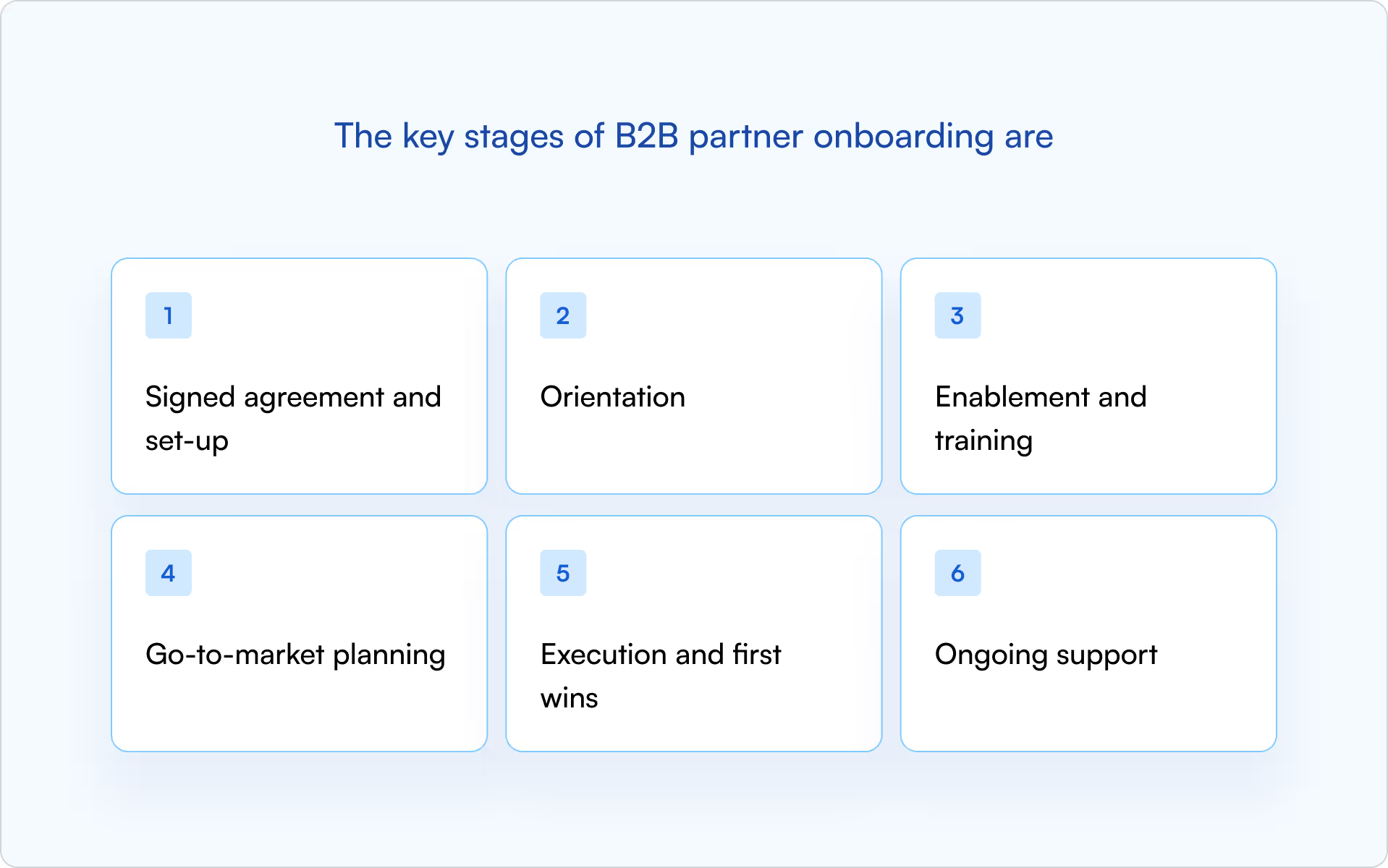
The key stages of B2B partner onboarding are:

  1. Signed agreement and set-up: This is when you finalise your contracts, provide access to relevant systems, and integrate the new partner into your CRM or PRM.
  2. Orientation: It’s time to properly introduce your company! Go in-depth on your brand, SaaS product ecosystem, value proposition, and partner program structure. 
  3. Enablement and training: Perhaps the longest stage of partner onboarding, during this phase you must deliver role-based training, certifications, and playbooks. 
  4. Go-to-market planning: Define your target customers, joint messaging, campaigns, and pipeline expectations. 
  5. Execution and first wins: Support your partners through their early milestones, from their first demos to their first implementations. 
  6. Ongoing support: Don’t abandon your partners after they’re up and running. Instead, perform regular check-ins and performance reviews, and roll out advanced training and attractive incentives. 

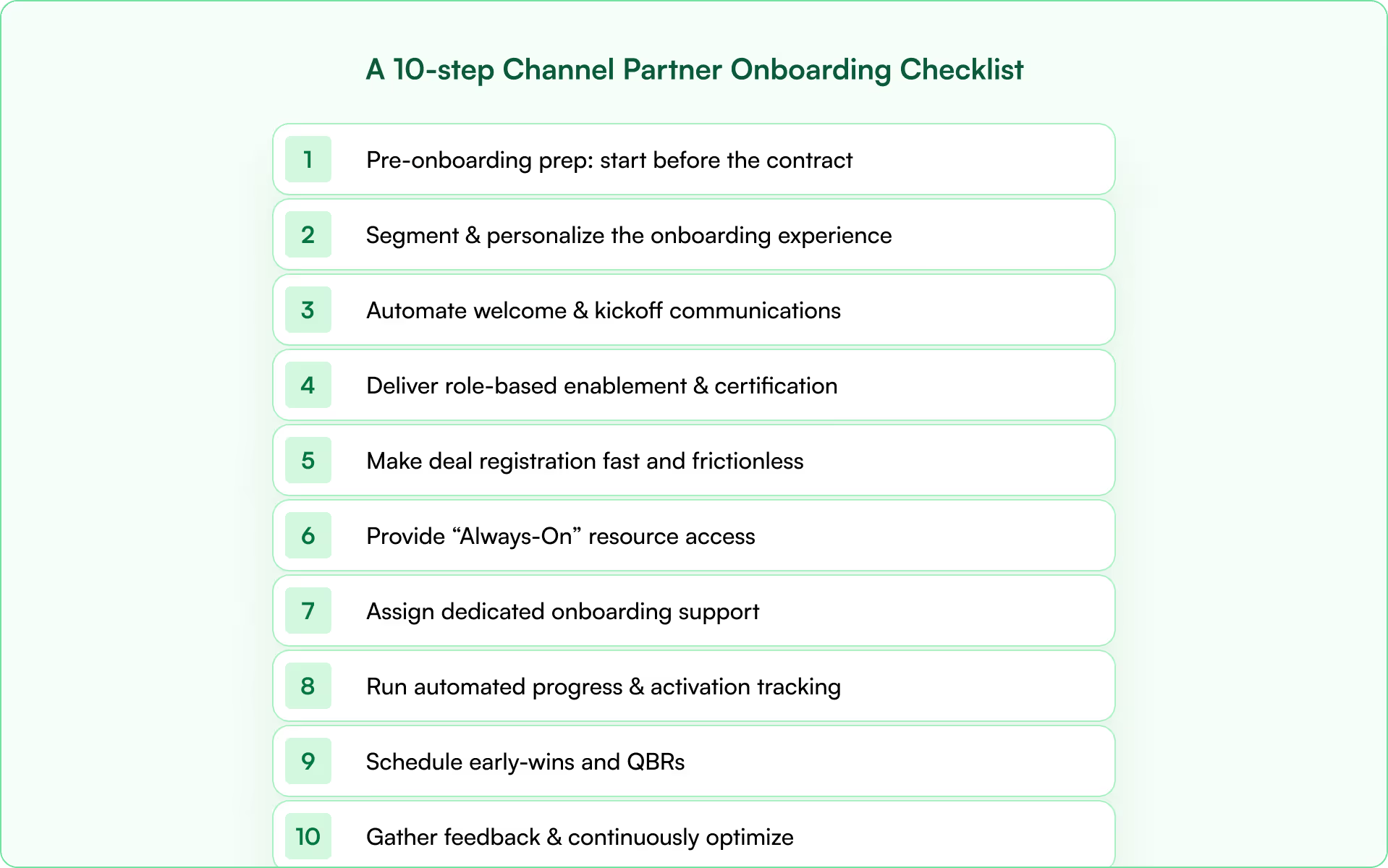
10 Essential Strategies for Modern Partner Onboarding in 2026

As outlined above, modern SaaS brands require modern partner onboarding programs. 

So how can you elevate your partner onboarding scheme to make it fit for 2026? 

Read on for our ten essential modern partner onboarding strategies. 

1. Pre-Onboarding Prep: Start Before the Contract

When it comes to effective partner onboarding programs, the prep starts before the contract is signed. 

So, what happens at this early stage? 

You’ll want to start with an internal team sync. 

Bring sales, operations, and enablement together to ensure each team is aligned on partner fit and to set goals and KPIs, ensuring all stakeholders understand what success looks like. 

Together, the teams also set realistic expectations, outlining what level of support and resources they can actually deliver and when, and identify any potential bottlenecks. 

Finally, it’s vital that by the end of this phase, the ops team understands precisely what is required in terms of setting up systems and processes for the new partner. 

Before the contract is signed, it’s also important to customize the onboarding plan for the new partner and gather all the necessary assets for the process. 

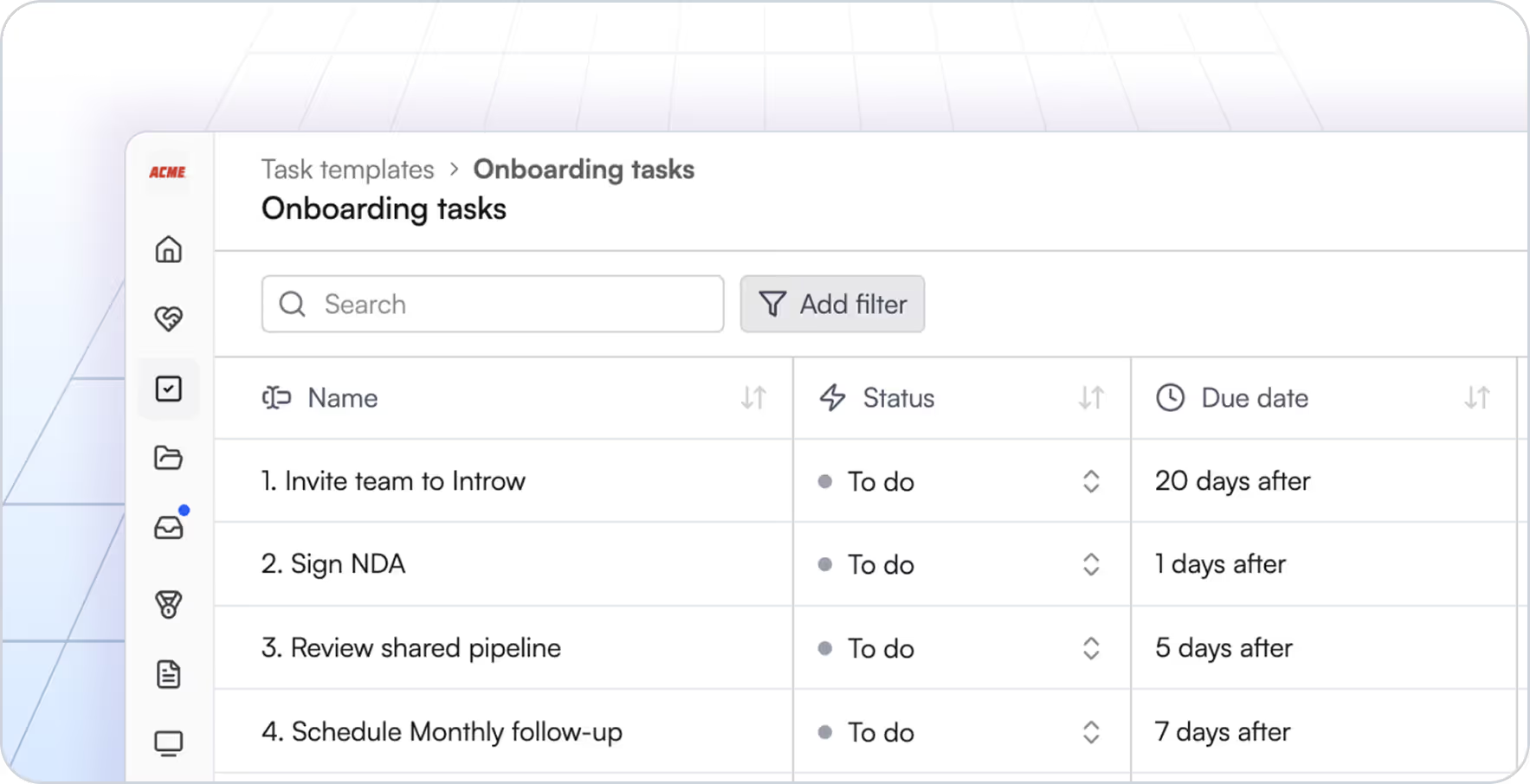
If you’re using Introw, this is when you’ll set up your onboarding checklist to track and automate the onboarding process.

Introw empowers users to create structured onboarding flows and mutual action plans, enabling them to track partner responsibilities easily. 

Set up and scale task templates, assign internal staff members or partner owners to tasks, and automate updates, which can be tracked via Slack or email. 

2. Segment & Personalize the Onboarding Experience

Not all partners have the same goals, capabilities, or needs – but they do all expect a personalized onboarding experience. 

Remember, this is your partner’s first real impression of your SaaS brand, so it’s essential to make a good impression. 

To achieve a personalized onboarding experience, first, you must segment your partners. 

Depending on your company and your goals, you may want to segment by:

  • Partner type (for example, reseller, referral, tech, MSP)
  • Location 
  • Partner tier 

By segmenting these groups, you can then develop personalized communications and enablement paths tailored to each segment. 

While personalization may seem time-consuming, Introw enables users to create structured onboarding flows and set up conditional content access, empowering you to segment and personalize at scale.  

3. Automate Welcome & Kickoff Communications

While more in-depth onboarding communications are best left to humans, automating your welcome and kickoff communications is a must. 

Why? 

Firstly, automating this vital early communication enables you to track, analyse, and optimise – and then standardize – your messaging. 

Of course, this messaging should be personalized. 

Introw’s built-in messaging tools enable you to keep your partners in the loop with branded email announcements, templates that are personalized by partner type or tier, and announcement pop-ups in the partner portal.

Remember that your welcome comms need to be multi-channel – for instance, across email and Slack.

In addition to ensuring that all your partners receive the same effective welcome and don’t miss out on any important information due to human error, it also saves your team time. 

Generally, welcome messaging includes assets like:

  • Welcome kits
  • Orientation content
  • “Who’s who” intros

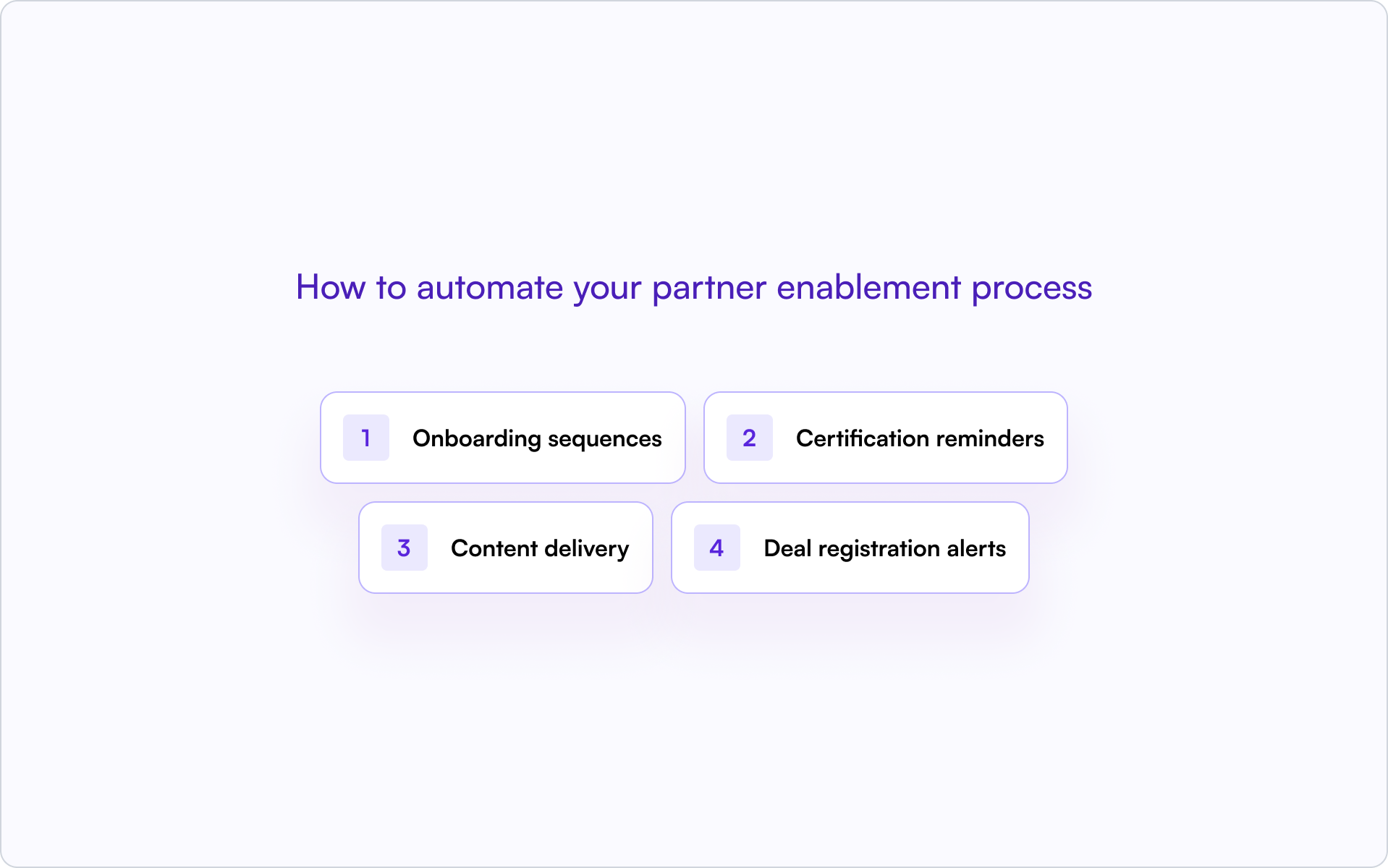
4. Deliver Role-Based Enablement & Certification

The best onboarding programs in 2026 don’t offer one-size-fits-all training. 

Instead, they empower partners with targeted, role-based training from a comprehensive learning management system, with course content tailored to specific roles within partner organizations. 

This is because not every partner, or every contact within a partner organization, requires the same level of knowledge.

For instance, sales reps require education around product positioning, objection handling, and competitive insights, while technical or implementation staff require deeper knowledge regarding product set-up, integration, and troubleshooting skills. 

Meanwhile, marketers should be targeted with co-branding guidelines, campaign playbooks, and messaging alignment. 

Modular training and interactive resources work well for partner onboarding as this breaks the learning into manageable chunks that partners can complete at their leisure. 

Once modular, interactive training is set up, there’s little left to do. 

You can simply assign modules by role, set up notifications of training completion, and it’s also easy to update training materials when necessary. 

5. Make Deal Registration Fast and Frictionless

When we talk about user experience in SaaS, we’re typically considering customer satisfaction.

But don’t underestimate the importance of providing your partners with a fast, frictionless experience too. 

With Introw, partners can register leads and deals on- or off-portal – whatever works best for them. 

You can build lead and deal registration forms with a no-code editor and sync them to your CRM, so there’s no need for manual data entry. 

From a partner’s perspective, no logins are needed – lead and deal registration forms can be accessed via a link, email, or Slack. 

And don’t forget to set up autosync with your CRM for instant pipeline visibility. 

6. Provide “Always-On” Resource Access

‘Always-on’ resources make the onboarding process more flexible and accessible for time-poor partners. 

Consider using a self-service portal or content hub to host FAQs, playbooks, and pitch decks that partners can access at their convenience. 

Introw provides analytics for every engagement metric, empowering you to track which items of content are regularly being used, and which aren’t. 

Indeed, with Introw, you can track asset views and downloads to see which documents, resources, and deals your partners are engaging with. 

You can then analyse this data to optimize your portal and its content accordingly. 

7. Assign Dedicated Onboarding Support

Assigning dedicated onboarding support for partners – as opposed to more general support – ensures a smoother and faster ramp-up. 

Depending on the scope of your program, the dedicated onboarding support could be a full-time partner success manager, an AI onboarding concierge who follows each partner throughout their onboarding journey, or even a peer mentor. 

Remember – when offering support, it’s essential to conduct proactive check-ins at key milestones, rather than asking broad, passive questions. 

✅ DO: “Now that you’ve completed the initial marketing training modules, how confident do you feel about positioning our product to your customers? Would you like additional guidance or resources in [X] area or [Y] area?”

❌DON’T: “Let us know if you have any questions”. 

Introw’s AI agent is built to power smarter partner support, empowering businesses to easily train, optimize, and deploy their bot, all from one place. 

The AI agent automatically converts existing content into actionable answers, and you can also create snippets to ensure important FAQs are answered with the correct information.

You can also give the AI agent a custom name, voice, and brand to ensure the support feels personal and on-brand. 

8. Run Automated Progress & Activation Tracking

Use real-time dashboards to track partners’ progress and activation automatically. 

Identify when training programs are completed and deals are registered in real time, and keep an eye on the number of portal visits by partners, too. 

This allows you to spot minor issues and take swift action before they snowball into disengagement by, for example, nudging those partners who stall or need extra help.

Introw’s extensive partner engagement tracking capabilities make it easy to see which partners are active, engaged, and delivering value.  

9. Schedule Early-Wins and QBRs

An important element of partner onboarding is building up momentum and getting your partners excited about working with you. 

Scheduling early wins is the most effective way to do this. 

Help your partners close their first deal fast, and you’ll help to build their confidence and motivation while implicitly demonstrating the value of your partnership. 

What’s more, this encourages their adoption of your processes, tools, and best practices by linking them to tangible wins. 

Establishing your quarterly business reviews (QBRs) early on in the partnership complements the early wins part of the strategy by ensuring your partners feel valued and heard. 

This establishes a regular feedback loop and strategy review, identifies challenges and bottlenecks (ideally before they arise), and reinforces your relationship-building efforts, showing partners that you’re genuinely invested in them. 

Perhaps most importantly, setting up your QBRs early on strengthens your strategic alignment. 

So what should this look like?

Set up 30-, 60-, and 90-day check-ins to ensure you always have a meeting in the calendar to look forward to. 

Introw PRM makes QBR prep easy thanks to its centralized partner activity, pipeline data, and performance metrics inside your CRM. 

This means no slide decks, scattered spreadsheets, or lengthy prep sessions trying to collate and interpret all the data. 

10. Gather Feedback & Continuously Optimize

As with any business process, it’s crucial to gather feedback on your B2B partner onboarding program and continuously optimize for success. 

What should this look like? 

  • Onboarding surveys
  • Offene Sprechstunden
  • A partner advisory board
  • One-on-one check-ins
  • Email feedback requests
  • In-portal feedback tools
  • Post-training quizzes with feedback prompts
  • Net promoter score

This partner feedback must then be used to refine your content, each stage of the onboarding process, and onboarding support.  

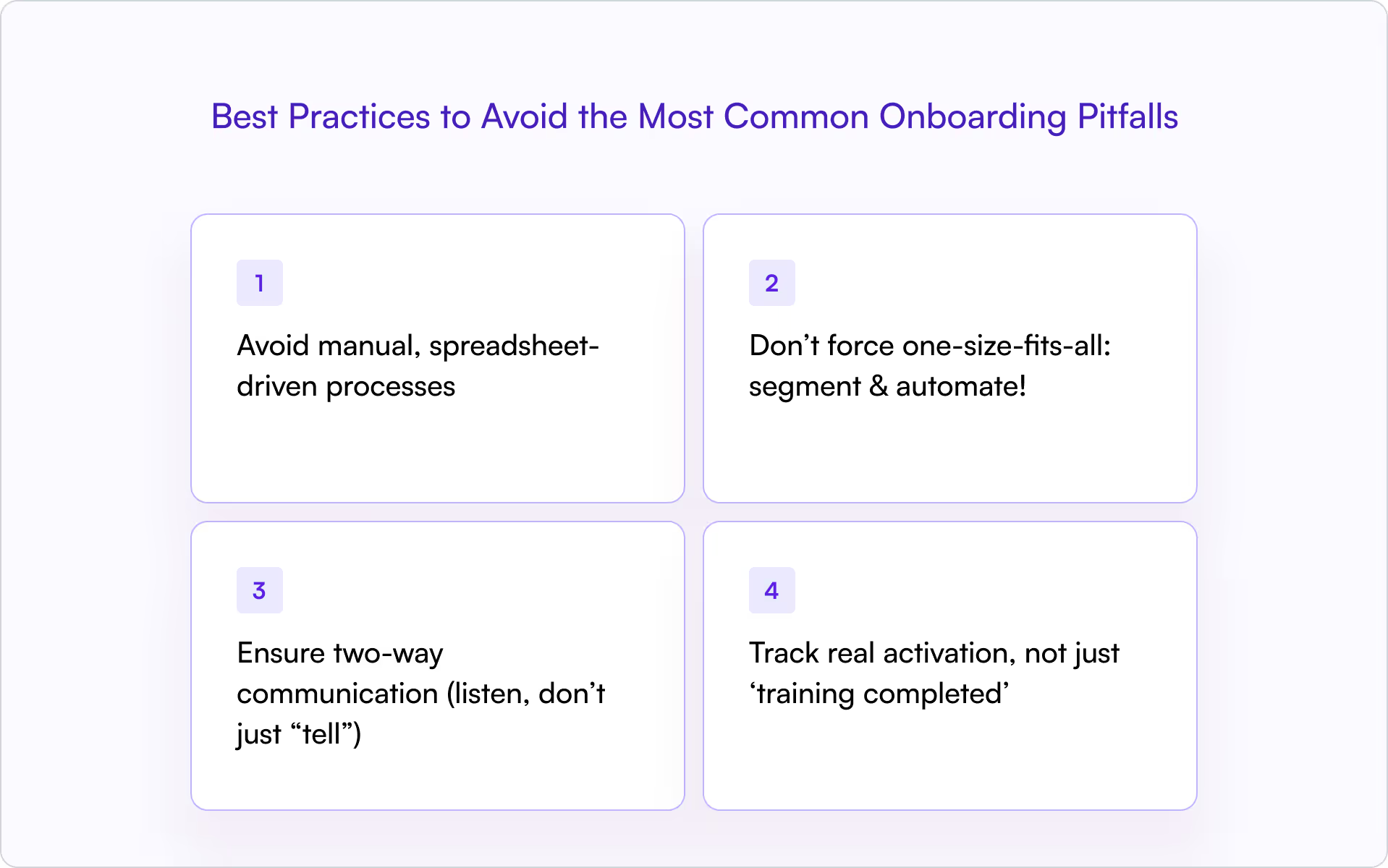
4 Best Practices to Avoid the Most Common Onboarding Pitfalls

Ready to build your onboarding process? There are several common pitfalls you’ll want to avoid. 

Here are our four partner onboarding best practices to follow.

  1. Avoid Manual, Spreadsheet-Driven Processes

Time-consuming, ineffective, and prone to human error, in 2026 there’s simply no need for manual, spreadsheet-driven onboarding processes. 

By replacing clunky spreadsheets with sophisticated PRM platforms fit for 2026, you can boost data accuracy, scale your program, and significantly increase your speed and efficiency. 

  1. Don’t Force One-Size-Fits-All: Segment And Automate!

When dealing with a diverse partner network, a one-size-fits-all approach can result in low engagement or even complete alienation. 

Fortunately, personalization has never been quicker or easier. 

Indeed, using a PRM platform, you can automatically segment your partners and automate much of their personalized communication. 

  1. Ensure Two-Way Communication (Listen, Don’t Just “Tell”)

Making feedback easy is crucial for optimizing your processes and for building strong partner relationships.

It’s crucial to give your partners a choice of channels in which they can engage in two-way communication with your brand.

This could be email, portal, and Slack, for example – just ensure you’re meeting your partners where they’re already working. 

Then, you need to encourage this open and transparent communication through prompts, questions, surveys, and rapid responses. 

  1. Track Real Activation, Not Just ‘Training Completed’

The breadth and depth of metrics that PRMs can track in 2026 empowers channel managers to track real activation.

While tracking ‘training completed’ gives you an indication of how ready your partners are to bring in business, tracking metrics like time to first deal, first revenue generated, and product usage paints a fuller picture. 

How to Measure Partner Onboarding Success in 2026

While we’re on the subject of metrics, which KPIs should be used when it comes to measuring success around partner onboarding?

While the exact combination of KPIs tracked will vary from business to business, depending on their specific circumstances, business objectives, and goals, the following metrics are always useful.

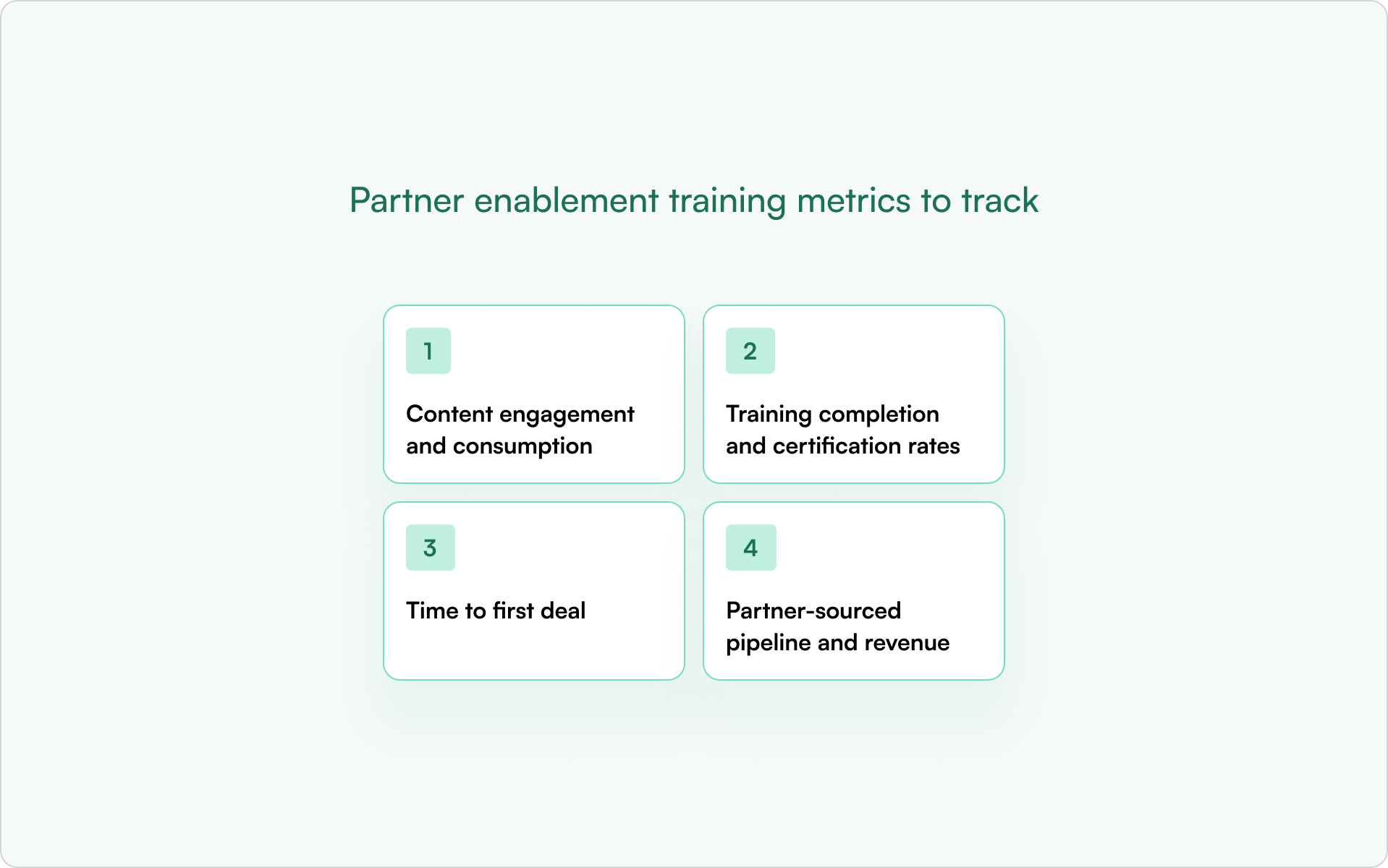
  • Time to first deal
  • Enablement completed
  • Nutzung von Inhalten
  • Partner NPS
  • Time to productivity
  • Onboarding completion rate
  • Assessment scores
  • Engagement levels
  • Pipeline contribution

You’ll also need to tie your onboarding success to downstream revenue to truly appreciate the impact of your program and measure ROI.

In order to achieve this, you need to first define ‘successful onboarding’ in measurable terms — for example, first lead or deal registered. Then, track onboarding speed (aka time to value).

Next, correlate onboarding with partner revenue performance by comparing the performance of partners who completed full onboarding with those who only partially completed onboarding. 

Segment partners by onboarding completion level (for example, fast vs slow, complete vs incomplete), and track their revenue across 3, 6, 9, and 12 months. Then analyse your results, and use your findings to optimize your onboarding program. 

For optimal results, utilize dashboards to track progress and identify at-risk partners early. 

Modern Onboarding Tech Stack: What to Look For

Building your onboarding tech stack?

Make sure your software incorporates: 

✅ CRM integration

✅ Automation

✅ Real-time tracking

✅ Self-serve resources 

Take a look at Introw. This CRM-native PRM comes complete with handy automation capabilities and is seamless for both partners and managers. 

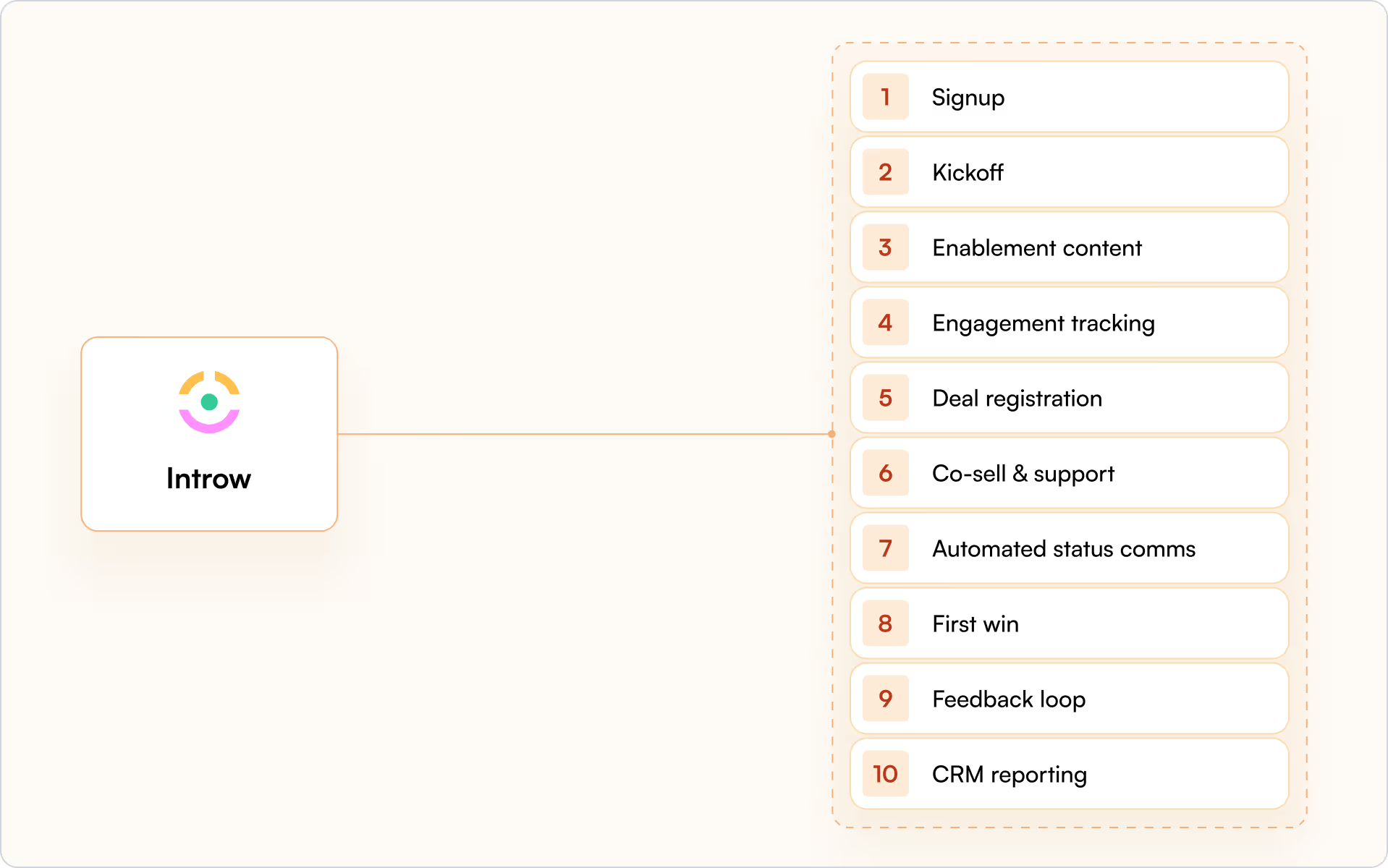
Example: The Introw Automated Partner Onboarding Flow

So what does a partner onboarding flow look like with Introw automating the journey? 

Step 1: Signup

A potential partner decides to sign up to your program via your portal or an embedded page. 

At this point, Introw creates and/or updates the CRM record, assigns them to the appropriate tier, and generates the relevant program benefits. 

Onboarding tasks are auto-generated from a template.

Step 2: Kickoff

The partner immediately receives a welcome pack and their onboarding checklist via email or Slack, with no portal login required. 

The same tasks are reflected inside the dedicated partner portal, allowing them to self-serve. 

Step 3: Enablement Content

Introw sends the partner the enablement content they need, such as sales tools and marketing materials, based on tier and partner type. 

When items are opened or downloaded, you (and the partner) receive alerts, and you can see which assets they are using. 

Step 4: Engagement Tracking

As the partner works their way through their tasks, Introw logs portal visits, content usage, and notification opens and clicks.

This data is then automatically sent back into your CRM for RevOps and forecasting.

Step 5: Deal Registration

The partner has identified an opportunity! 

They will now submit it from the portal, or directly from Slack or email via a form. 

This opportunity is then automatically mapped to your CRM, attributed to the relevant partner, and will be sent for any required approvals. 

Step 6: Co-sell & Support

Your sales rep and the partner collaborate in one shared space.

If a customer raises a question, either party can open a support ticket and communicate with the other about it in real-time. 

Step 7: Automated Status Comms

As the opportunity moves forward, Introw sends the partner automatic deal updates and keeps everyone aligned, again via email and/or Slack.

Step 8: First Win

Congratulations! The partner has brought in their first win. 

Introw will now fire over a win notification to the partner in question, and also attach attribution to the deal. 

If you’re using a commission structure to reward partners for hitting sales targets, the PRM will update commission workflows in light of the first win. 

Step 9: Feedback Loop

After the first win, Intow immediately switches into feedback mode.

It will encourage partners to fill in a brief survey to capture what has helped or hindered the partner on their journey to their first win. 

You can also see which content and touchpoints correlated with success in this instance, so your next partner can ramp up even faster!

Step 10: CRM Reporting

As Introw is a CRM-first platform, RevOps and leadership see everything directly in your CRM, from partner-sourced/influenced revenue to engagement scorecards and content impact. 

Forecast accuracy improves because the partner pipeline is live and attributed.

Schlussfolgerung

Onboarding is the partner revenue lever that many teams ignore. 

It’s easy to see why: onboarding is often viewed as little more than admin, ownership within the process is typically siloed, and any revenue impact is relatively long-term. 

However, dismissing the revenue potential of a strong partner onboarding program is a huge misstep. 

We know that building a top-notch structured partner onboarding process can lead to a lower time-to-first-revenue, boost retention and lifetime value, and set good engagement habits early. 

Furthermore, external partners who complete a structured onboarding are generally more likely to register a deal or make a sale.

In other words, mutual success!

Without onboarding, you end up with ‘signed but silent’ partners. 

With this in mind, is it time to audit your onboarding?

Consider where in the process you can add in more automation, personalization, and tracking to boost business growth. 

Next step: Explore how Introw helps SaaS teams activate partners, faster

Häufig gestellte Fragen

Noch neugierig? Hier sind einige kurze Antworten, die Ihnen helfen sollen, Klarheit zu gewinnen.

Kontaktieren Sie uns

What Is The Most Important Part Of Partner Onboarding in 2026?

Every stage of the partner onboarding process is important, but the beginning stage – where you lay the groundwork for a successful partnership – is paramount. This is all about ensuring partners fully understand your company’s value proposition, target market, processes, and support structure, and generally outlining how you intend to proceed. So how can you achieve this while bringing onboard partners? Structured training courses, granting partners’ access to strong resources, and working to establish clear communication channels.

How Long Should a SaaS Partner Onboarding Process Take?

The length of SaaS partner onboarding processes varies significantly, depending on the size of your company, the complexity of your product and/or service, and the type of partner program you’re operating. That said, generally you can expect to complete your channel partner onboarding checklist in 30 to 90 days. Simpler solutions or referral partnerships may only take a few weeks, however, while more technical reseller or implementation partners could be in this phase for up to three months.

Can Onboarding Be Automated Without Losing The Human Touch?

Yes, onboarding can absolutely be automated without losing the human touch. The key to getting automation right is utilizing these tools where they excel, while also recognizing that a human-led approach is optimal in other areas. For instance, when it comes to partner onboarding, automation can be used for initial training modules and certifications, like online courses and quizzes; resource distribution, in order to provide partners access to sales decks, playbooks, and product info; process management, such as onboarding checklists, progress tracking, and task reminders; and basic communication, including welcome emails, FAQs, and self-service support portals. Meanwhile, human-led tasks include things like relationship building, such as kick-off calls and email check-ins; strategic alignment around goal setting, joint business planning, collaborative projects, and co-marketing discussions; complex training – while automation can handle basic partner training tasks, you’ll want human experts to help partners understand product deep dives, demos, and hands-on workshops. Problem-solving should remain in human hands, with your team best placed to address unique partner challenges and provide bespoke guidance.

Which Metrics Should We Use To Measure Onboarding Success in 2026?

To gain a comprehensive picture of the success of your channel partner onboarding process, you’ll need to track a combination of metrics related to engagement, enablement, and partner performance. Your partner onboarding checklist for metrics should include time to first deal, enablement completed, content usage, time to productivity, onboarding completion rate, assessment scores, partner engagement levels, pipeline contribution, and partner satisfaction scores.

Starten Sie Ihr Partnerportal inwenigen Minuten!

Vielen Dank! Ihre Einsendung wurde erhalten!
Hoppla! Beim Absenden des Formulars ist ein Fehler aufgetreten.

Verwandte Blog-Artikel

Partnermanagement

Partner Lead Registration: Capture Leads Without Logins in 2026

Janis De Sutter
Software Engineer
5 Min. Lesezeit
16. Dezember 2025
⚡ TL;DR

Partner lead registration works best when it’s dead simple for partners, validated quickly by you, and synced to your CRM in real time. Replace portal logins with lightweight capture (email, form, or Slack), auto-create clean records, and use clear rules to prevent channel conflict. Track status from submitted to approved to won, and give partners visibility without new passwords. If you use HubSpot, you can run HubSpot partner lead registration by mapping a short registration form to your deals and workflows. Introw lets partners register leads from email or a shared page, routes them to Salesforce or HubSpot, shows status back to partners, and keeps your team focused on revenue instead of spreadsheets.

Great partner programs die on their first form. You want partners engaged, but the moment they hit a login wall, many stop. The good news: you can run partner lead registration without a portal login, keep data clean, and still resolve ownership fast. Below is a practical guide for teams that want more registered leads, fewer disputes, and a smoother sales process.

Why partner lead registration matters now

As your partner ecosystem grows, multiple partners find the same end customer, sales reps ask “who owns this account,” and leadership needs pipeline visibility. Lead registration (capturing a partner-sourced prospect early) protects the partner’s effort, reduces channel conflict, and lets you assign leads to the right team fast. It also creates a trail you can trust for commission payments and co-sell attribution.

When you make registration lightweight and fair, partners stay engaged, your sales team sees context, and operations keep a single source of truth for registered leads and registered deal records.

What “partner lead registration” is (and how it differs from deal registration)

Think of lead registration as the earliest claim: the partner flags a prospect with enough data for you to review and accept or decline. Deal registration comes later, once there’s a qualified opportunity with stage, amount, and next steps. Both fit inside modern partner programs, but they serve different moments:

  • Lead registration: fast intake to assign leads, mark a cooling-off period, and prevent multiple partners from colliding on the same company.
  • Deal registration: deeper validation to approve an existing deal with co-sell motions, attached resources, and clear SLAs.

Successful programs use both. Start with easy lead registration to capture more top-of-funnel, then elevate to deal reg when real pipeline appears.

The no-portal approach: five simple ways to capture partner leads

Logins are the biggest drop-off point. You can capture leads without a portal login and still keep control.

  1. Email-to-CRM

Give partners a single address (for example, partners@yourcompany.com). When they send a short “registration form” by email (company name, contact, problem, consent), an automated flow parses the message, creates the record, and returns a case number and status.

  1. Open web form with allowlisting

Host a short registration form that’s public but gated by reCAPTCHA and a partner email domain check. Submissions create a lead and kick off validation, while approved third parties (your partners) get instant confirmation and a “pending” badge.

  1. Slack (or Teams) app

If you co-sell in shared channels, let partners use a “/register” slash command. The bot collects company, contact, use case, and creates the registered deal or lead in your system, then posts back the record link.

  1. HubSpot meetings + hidden fields

For HubSpot partner lead registration, use a short form attached to a partner-facing “Book a discovery” page. Hidden fields tag partner ID and program. When the form is submitted, HubSpot creates the contact, company, and a deal stub, and your workflow moves it to “Submitted for review.”

  1. CSV drop for field teams

Some service partners prefer bulk. A controlled CSV upload (fields validated on import) lets them register a new deal list weekly. Your system dedupes by domain and company name, flags conflicts, and returns approved/declined with reasons.

All five methods can feed the same backend rules, the same partner portal views, and the same commission plan. The difference is friction: partners can register from wherever they already work.

Design a registration form partners will actually complete

Keep it under a minute. These fields usually give you enough to decide:

  • Company name and domain
  • Primary contact: name, email, role
  • Opportunity context: problem, solution fit, services needed
  • Stage guess: new intro, discovery scheduled, evaluation
  • Partner: who is submitting, plus reseller or referral type
  • Consent: partner confirms the prospect agrees to be contacted

Optional, when needed: geography, target revenue, product interest, and competing vendors.

Make validation fair: from “submitted” to “approved” without drama

A good lead reg process balances speed and fairness. Publish the rules, enforce them consistently, and give partners a clean status they can see.

  • SLA: respond inside two business days.
  • Checks: duplicate by domain, existing deal check, territory rules, blocked accounts.
  • Results: approved (with hold window), ask for more info, or declined (with reason).
  • Hold window: 60–90 days of protection when partners complete the next step (for example, first meeting or intro email logged).
  • Channel conflict: if two partners submit the same prospect, the one who got the first meeting within the window wins, or you split by segment/solution if that’s your policy.

Introw codifies these rules so operations doesn’t have to referee edge cases every week.

Map it to your CRM: HubSpot and Salesforce without side spreadsheets

Whether you run Salesforce or HubSpot, treat partner lead registration like any other intake you want to automate and audit.

  • Objects: create a “Partner Registration” object or use a custom property set on Deals to track registration, status, partner, and window end date.
  • De-dupe: auto-link to Company by domain; show “existing deal” if one is open.
  • Workflows:
    • Submitted → Validation queue → Approved/Declined
    • Approved → Notify AE/partner → Start sales process tasks
    • First meeting scheduled → Lock or extend hold window
  • Dashboards: real time dashboards for operations and partner managers: pending, aging, approvals, meeting rates, win rates.

For HubSpot partner lead registration, keep your registration form in HubSpot, route through workflows, and surface status to partners via automated emails or a lightweight shared page. On Salesforce, mirror the same flow with Process Builder or Flow.

Incentives and SLAs that keep partners engaged (without overpaying)

You don’t need to pay for every submission. Reward progress, not spam.

  • Tiered incentives: small flat fee when the first meeting is completed, larger percentage on new customers won, and accelerators for high margin products.
  • Partner tier alignment: higher tiers may get faster response, priority support, or co-sell resources.
  • SLAs: you respond within two days; the partner books a meeting within 14 days; your rep updates next steps after every call. Clear, mutual commitments build trust.

Seven metrics that prove the system works

Leaders care about outcomes. Measure what moves revenue and reduces friction.

  1. Registration-to-meeting rate within 14 days
  2. Approval rate by partner and segment
  3. Conflicts avoided vs. unresolved disputes
  4. Win rate and sales volume on approved registrations
  5. Time to first response and time to approval
  6. Active protection windows by region and product
  7. Commission payments accuracy and cycle time

When the numbers are visible, you can adjust commission structures, spot partner behavior trends, and focus enablement where it helps most.

A 30-day rollout you can actually ship

You don’t need a massive project to modernize lead reg. Keep it tight and iterative.

  • Week 1: Write your acceptance rules, conflict policy, and hold window. Draft the short form.
  • Week 2: Build the flow in your CRM. Stand up email-to-CRM and a public form. Test dedupe and routing.
  • Week 3: Pilot with 10 partners across motions (referral, services, reseller). Meet twice, gather feedback, refine fields and emails.
  • Week 4: Launch. Publish the rules and FAQs in your partner portal, start weekly status summaries, and open a short appeal path.

Where Introw fits

Introw is built to remove friction from partner lead registration and deal registration alike:

  • No-login capture: partners register via email, a shared page, or Slack; Introw creates the record and sends status.
  • Smart validation: automatic dedupe, account checks, and clear status transitions from submitted to approved to won.
  • CRM-first: bi-directional sync with Salesforce or HubSpot, so ops and reps work in systems they already know.
  • Visibility: partners see progress and next steps without asking you to “check the portal.”
  • Payments: clean attribution makes commission management straightforward and commission payments timely.

If you’re ready to move beyond “please log in and fill this long form,” Introw gives you a lightweight, auditable path to more revenue and fewer headaches.

Ready to simplify partner lead registration?

If you want partners engaged, fewer conflicts, and clean data, make registration effortless and visible. Introw lets you capture leads without logins, validate fairly, and sync everything to your CRM so your sales team and partners can focus on winning. Request a demo and see how it works in your environment.

Partnermanagement

A Guide to Choosing the Best CRM for Partner Management: 15 Top Tools For 2026

Janis De Sutter
Software Engineer
5 Min. Lesezeit
09 Dec 2025
⚡ TL;DR

A CRM-first approach is now essential for running high-performing partner programs. Traditional siloed PRM tools no longer cut it — modern SaaS teams need CRMs that offer native integrations, real-time deal tracking, partner engagement visibility, and forecasting capabilities. In this post, we break down the top 15 CRMs for partner management in 2026, from HubSpot and Salesforce to Creatio and Netsuite. Plus, we show how Introw — a CRM-native PRM — enhances your CRM with scalable workflows, co-sell automation, and clean, partner-attributed revenue tracking.

A strong CRM system should be the backbone of your partner programs. 

Embrace your CRM when it comes to partner management, and you can expect centralized relationships, seamless collaboration, full alignment with business operations, fewer channel conflicts, and improved revenue projections. 

What's more, by embedding partner management within a CRM, businesses gain a unified source of truth, improving efficiency, accountability, and long-term success in partner ecosystems.

Traditional, siloed partner tools simply can't keep up with the power of modern CRMs. 

It makes sense, then, that businesses are increasingly shifting to CRM-first workflows, integrating partner management into broader customer and revenue strategies. 

This transition eliminates inefficiencies caused by disconnected systems, enabling real-time visibility into partner performance.

When moving to a CRM-first workflow, businesses must understand the importance of native integrations, deal tracking, and forecasting. 

Look for CRM tools that offer native integrations with marketing automation, sales pipelines, and support tools to ensure that partner activities are fully aligned with business operations. 

Meanwhile, deal tracking within a CRM allows businesses to monitor partner-driven opportunities, assign leads effectively, and prevent channel conflicts. 

And forecasting capabilities provide data-driven insights into revenue projections, helping companies optimize their partner strategies.

To sum up, a CRM-first approach fosters stronger, data-backed partnerships that drive sustainable growth.

⬇️In this guide, we'll cover everything you need to know to make the best CRM decision for your business and your partners. 

What to Look for in a CRM for Partner Management

When considering which CRM to go for, you'll undoubtedly already have several 'must have' features in mind. 

But here are the most important features to look out for when it comes to partner management: 

  • Partner lead/deal registration
  • Custom fields and workflows for channel/reseller/referral types
  • Engagement tracking and collaboration tools
  • Reporting and forecasting across partner-attributed pipeline
  • Integration with PRM tools like Introw
  • Scalability and API access for custom automation

15 Best CRM Platforms for Partner Management in 2026

So, we know that a CRM-first approach has a wide variety of benefits for partner management. 

But choosing the right CRM can be daunting; after all, it's a pretty big decision. 

And not every CRM is fit for partner management. 

To help you out, we've compiled a list of the best 15 CRM for partner management, along with their pros and cons. 

#1 HubSpot

A giant of the CRM world, HubSpot's CRM is super popular among growing SaaS teams. 

​This comprehensive, AI-powered platform is designed to unify customer data, streamline business operations, and enhance customer experiences. 

It offers a suite of tools across marketing, sales, customer service, content management, and operations, all integrated into a single system to facilitate seamless collaboration and efficiency. ​

And when it comes to partner management, Hubspot's CRM boasts several key features, including:

For partner management, HubSpot CRM provides several key features:​

CRM partner relationship management (PRM) integrations: Access PRM software Introw through HubSpot's App Marketplace for partner engagement tracking, lead registration, and Slack-based collaboration.

✅ Association labels: Define and manage relationships with partners by labelling companies as "Partner" or "Distributor," clarifying roles and facilitating targeted communication. ​

✅ Partner services: Utilize Partner Services to track and manage services provided by partners, ensuring organized and efficient collaboration. ​

✅ Automation: Save time by automating workflows and repetitive processes 

These features enable businesses to effectively manage and nurture their partner relationships within HubSpot CRM.

🔗 Find out more about how Introw and Hubspot work together

#2 Salesforce

Salesforce remains the gold standard for enterprise partner programs. 

This comprehensive, cloud-based platform streamlines customer relationship management and partner relationship management by integrating sales, marketing, customer service, and more into a unified system. 

It empowers businesses to enhance customer interactions, improve satisfaction, and drive growth through data-driven insights and automation.

For partner management in CRM, Salesforce CRM offers several key features:​

Partner relationship management software integration: Seamlessly integrates with Introw to place PRM functionalities firmly within the CRM, enabling tracking of partner pipeline, engagement, and performance — all natively.

Powerful reporting and forecasting: Delivers key data insights to enable data-driven decisions, as well as accurate forecasting.

Personalized partner engagement: Provides personalized templates and data-driven enablement tools to engage partners effectively, enhancing communication and collaboration. ​

Automated processes: Automates marketing fund requests, discounting, and service case management, reducing manual tasks and increasing efficiency in partner interactions. ​

Real-time updates with partner connect: Facilitates secure deal tracking and real-time, automated updates on co-selling deals across different CRMs, ensuring transparency and reducing data duplication.

Scalability: Built on the Salesforce platform, it scales easily to accommodate growing partner ecosystems, adapting to evolving business needs. ​

🔗 Learn more here:  Introw + Salesforce Integration

#3 Zoho CRM

Zoho offers a flexible, cloud-based CRM that helps businesses manage sales, marketing, and customer relationships efficiently. 

It's also a good option for those looking for a CRM that will support partner relationship management for sustainable business growth. 

Territory management: Organize and manage partner territories effectively, aligning sales strategies with specific regions or market segments.

Workflow automation: Automate routine tasks and processes, enabling partners to focus on strategic activities and improving overall efficiency.

Advanced analytics: Gain insights into partner performance through detailed reports and dashboards, facilitating data-driven decision-making. ​

Customizable modules: Tailor CRM modules to fit specific partner management needs, ensuring a personalized and relevant experience. ​

Multi-channel communication: Engage with partners across various channels, including email, phone, and social media, ensuring seamless communication.

Pros: Affordable, customizable, partner portal add-on

Cons: Weaker reporting, fewer native integrations

Best For: SMEs or mid-market teams just starting their partner motion.

#4 Microsoft Dynamics 365

Microsoft Dynamics 365 is an AI-powered suite of business applications that combines CRM and ERP capabilities to enhance customer experiences and business operations. 

It integrates sales, marketing, service, and financial data to help organizations innovate, automate processes, and drive growth.

It encompasses several key features for partner management:

✅ Manage partner relationships with shared data insights

✅ Automate lead and opportunity tracking

✅ Integrate partner sales data for streamlined collaboration

✅ Enable partner performance monitoring through analytics

✅ Use AI to provide personalized partner support

Pros: Deep integrations, enterprise-friendly

Cons: Steep learning curve, dev-heavy

Best For: Enterprises already deep in Microsoft's stack or those with in-house CRM admins

#5 Pipedrive

Pipedrive offers a clean, simple CRM that's easy to use. 

It automates repetitive tasks, tracks communications, and provides actionable insights to help sales teams optimize performance.

Admittedly, this one isn't purpose-built for partners, but it can support small partner programs with the right tagging and workflows.

When it comes to partner management, Pipedrive allows you to:

✅ Organize and track partner interactions in one space

✅ Automate partner follow-ups and communications

✅ Visualize partner pipeline for better decision-making

✅ Use AI for personalized partner management insights

✅ Centralize partner data for easy collaboration and reporting

Pros: Visual pipeline, easy setup

Cons: Limited partner automation, no partner-specific fields

Best For: Early-stage teams experimenting with partnerships

#6 Close.com

Close CRM is a platform designed to streamline sales processes for small businesses, focusing on automation, communication, and deal management. 

It offers an intuitive, fast interface for managing leads and communications — and can also prove useful for partner relationship management. 

Here's how:

✅ Track partner interactions and pipeline progress

✅ Automate partner outreach and follow-ups

✅ Centralize partner data and activity

✅ Monitor partner performance with analytics

✅ Seamlessly integrate with other tools for collaboration

Pros: Simple, easy-to-use

Cons: Limited customization

Best For: Small businesses with big growth ambitions 

#7 Freshsales

Freshsales by Freshworks is an AI-powered sales CRM that enhances revenue growth with automation, lead scoring, and predictive analytics. 

It streamlines workflows and provides insights to improve sales efficiency.

Here's how it can boost partner management:

✅ Track and manage partner relationships efficiently

✅ Automate follow-ups and communication with partners

✅ Centralized data for seamless collaboration

✅ AI-powered insights to optimize partner engagement

✅ Customizable pipelines to monitor partner deals

Pros: Easy to use and excellent customer support

Cons: Limited features and a steep learning curve

Best For: Start-ups and SMEs that need a friendly, affordable CRM solution. 

#8 Copper

A relationship-focused CRM designed for Google Workspace users, Copper is all about streamlining contact management, deal tracking, and workflow automation. 

It also minimizes data entry and integrates seamlessly with Gmail.

Key features for partner management:

✅ Centralized partner contact and activity tracking

✅ Automated workflows for partner communications

✅ Custom pipelines to monitor partner deals

✅ Seamless integration with Google Workspace

✅ Real-time reporting and analytics for partner performance

Pros: Easy integration with Google properties, user-friendly 

Cons: Limited scalability

Best For: Businesses that depend on Google Workspace 

#9 Insightly

Insightly is a scalable CRM designed for businesses to manage customer relationships, sales, and marketing in one platform.

It offers automation, project tracking, and analytics to drive growth and efficiency.

Looking for a CRM to boost partner management?

Here's how Insightly can support PRM:

✅ Centralized partner relationship tracking

✅ Automated workflows for partner interactions

✅ Customizable pipelines for deal management

✅ Advanced analytics for partner performance monitoring

✅ Integration with third-party apps for collaboration 

Pros: Great customer support and deep customization  

Cons: Steep learning curve

Best For: SMEs and start-ups looking for a customizable and scalable CRM. 

#10 SugarCRM

A flexible, AI-driven CRM platform, SugarCRM is designed for B2B sales, marketing, and customer service. 

It automates data collection, provides predictive insights, and streamlines workflows for enhanced efficiency.

Key features for partner management include:

✅ Centralized partner relationship tracking

✅ AI-powered insights for partner engagement

✅ Automated workflows for seamless collaboration

✅ Custom dashboards for partner performance monitoring

✅ Integration with third-party tools for extended functionality

Pros: Lots of features, good customer support

Cons: Long implementation, steep learning curve

Best For: Large businesses and enterprises looking to commit to a CRM long-term

#11 Nutshell CRM

Nutshell is a user-friendly CRM that combines sales, marketing, and pipeline management into one intuitive platform. 

It simplifies lead tracking, automates workflows, and integrates with essential tools to enhance team collaboration and efficiency.

Here are Nutshell's most useful partner management features:

✅ Centralized partner contact and deal tracking

✅ Automated follow-ups and task reminders

✅ Customizable pipelines for partner relationship management

✅ Integration with marketing automation tools for outreach

✅ Real-time reporting and analytics for partner performance

Pros: Simple, easy to use, great customer support

Cons: Steep learning curve, limited integrations 

Best For: Smaller businesses looking for a simple, affordable CRM 

#12 Creatio

Creatio is an AI-powered, no-code CRM platform.

It automates workflows and customer relationship management for sales, marketing, and service teams, empowering businesses to streamline operations, optimize engagement, and enhance productivity.

It's pretty helpful when it comes to partner management, too. 

Here's how:

✅ Centralized partner relationship tracking

✅ AI-driven insights for partner engagement

✅ No-code automation for partner collaboration

✅ Custom dashboards for performance monitoring

✅ Seamless integrations for extended functionality

Pros: Great automation, customization, and usability 

Cons: Steep learning curve

Best For: Large businesses with multiple departments that require smooth company-wide adoption

#13 NetSuite CRM

NetSuite is a cloud-based business management suite that includes CRM, ERP, and financial tools to streamline operations, automate workflows, and improve decision-making. 

It provides robust partner management capabilities, such as:

✅ Partner relationship management with centralized data

✅ Automated workflows for seamless collaboration

✅ Real-time analytics for partner performance tracking

✅ Custom dashboards to monitor deal progress

✅ Integration with third-party applications

Pros: Great functionality and ease of use. 

Cons: Steep learning curve, expensive, complex implementation

Best For: Enterprises that need to streamline their processes. 

#14 Monday CRM

Monday CRM is a flexible, no-code customer relationship management platform that helps businesses manage sales, projects, and workflows.

It centralizes data, automates tasks, and enhances collaboration to improve efficiency.

Monday's key features for partner management include:

✅ Centralized partner tracking and collaboration

✅ Automated workflows for partner onboarding and engagement

✅ Customizable pipelines to manage partner deals

✅ Integration with third-party tools for seamless operations

✅ Real-time analytics for partner performance insights

Pros: Great range of features, scalable, easy to customize

Cons: Steep learning curve

Best For: SMEs and service businesses 

#15 Zendesk Sell

A modern sales CRM, Zendesk Sell enhances productivity, provides full pipeline visibility, and integrates automation to streamline deal management. 

It helps sales teams manage leads, track interactions, and optimize workflows.

However, its features can also be used for PRM, including:

✅ Centralized partner tracking and collaboration

✅ Automated workflows for partner engagement

✅ Customizable sales pipelines for partner deals

✅ Real-time analytics for partner performance insights

✅ Seamless integrations with external tools

Pros: Simple user interface, intuitive to use, good automation features

Cons: Complex setup

Best For: Businesses of any size that want to streamline their processes

How to Choose the Right CRM for Partner Management

Ready to decide on your new CRM?

Here are some handy guidelines.

Make sure your new CRM has:

  • Native or customizable deal reg
  • CRM alignment with partner program complexity
  • Integration with a PRM like Introw
  • Automation and reporting

And watch out for these common pitfalls:

  • No partner-specific fields or segmentation
  • Manual tracking outside the CRM
  • No integration between CRM and partner activities

Three final tips for choosing a CRM for partner channel management:

  1. Align with RevOps early
  2. Evaluate scalability and workflow compatibility
  3. Test integrations with tools like Introw

How Introw Supercharges CRM for Partner Management

Of course, when it comes to partner relationship management, a CRM alone won't do. 

Sure, investing in the right CRM can significantly boost your partner relationships, but if you aim to establish a profitable ecosystem, PRM software is crucial

And your PRM must integrate seamlessly with your CRM. 

This is where state-of-the-art PRM Introw comes in. 

Here's why Introw stands out among other PRMs:

  • CRM-first: your team works entirely within Salesforce or HubSpot — no extra logins, no tool-switching. Partners still collaborate via a dedicated portal, fully synced with your CRM.
  • Deal and lead registration are mapped directly to the CRM
  • Partner engagement tracking is synced with both the CRM and Slack
  • Forecasting and visibility operates across all partner-attributed revenue
  • No-code workflows for referrals, resellers, and MSPs

But don't just take our word for it — book your personalized demo today and see Introw in action.

Schlussfolgerung

The message is clear — choosing the right CRM is foundational to scaling partner revenue. 

The best CRMs support visibility, collaboration, and clean partner data.

They also integrate seamlessly with your PRM, empowering you to effectively manage your partners without leaving your CRM. 

To recap, here are the 15 best CRMs for partner management in 2026:

  1. HubSpot
  2. Vertriebsmannschaft
  3. Zoho CRM
  4. Microsoft Dynamics 365
  5. Pipedrive
  6. Close.com
  7. Freshsales
  8. Copper
  9. Insightly
  10. SugarCRM
  11. Nutshell CRM
  12. Creatio
  13. NetSuite CRM 
  14. Monday CRM
  15. Zendesk Sell

Want to manage your entire partner program from your CRM? Try Introw — the CRM-first PRM.

Partnermanagement

Channel Partner Gamification (How to Motivate Without Overpaying)

Andreas Geamanu
Mitbegründer und Geschäftsführer
5 Min. Lesezeit
08 Dec 2025
⚡ TL;DR

Channel partner gamification works when you reward specific behaviors, keep rules simple, and tie recognition to revenue outcomes. Start with one or two mechanics — levels, badges, or team challenges — linked to clear performance metrics like sourced pipeline, training completion, and first-meeting rates. Publish a short playbook in your partner portal, track progress in your CRM, and use light, real rewards only where they amplify momentum. Introw maps gamification elements to your CRM so partners see progress bars, earn recognition, and stay engaged without a heavy budget.

The moment a steady program stops feeling steady

Most channel partner programs start strong: a few champions engage early, sales teams celebrate quick wins, and the partner community feels energized. Then the pattern settles in. A small group stays active while others only show up at quarter-end. Traditional incentive programs and one-off sales contests give you brief spikes, not durable habits.

That is the point where a simple, thoughtful gamification strategy earns its place. Instead of chasing attention with bigger prizes, you clarify desired behaviors, make progress visible, and reward movement that matters. Done right, channel partner gamification becomes the connective tissue between your goals and partner engagement — not a gimmick, but a system that encourages healthy competition and lifts sales performance quarter after quarter.

What channel partner gamification actually means

Before you pick any game mechanics, align on meaning. Channel partner program gamification is the use of straightforward game design elements to motivate specific behaviors — completing training, registering qualified opportunities, advancing stages, running tactical promotions, and closing the loop with customer success. The goal is simple: boost channel partner engagement by making the path to success transparent and fair.

To keep it trustworthy, anchor to four guardrails and return to them often as you scale:

  1. Specific to business goals and sales targets — no vanity clicks.
  2. Visible in your PRM or partner portal — no folklore or screenshots.
  3. Fair across partner sizes — cohort logic keeps healthy competition intact.
  4. Measurable with clean performance metrics — every point maps to CRM data.

With those principles in place, you can move from concept to practice without confusing partners or creating side spreadsheets.

From strategy to practice: choose outcomes first, then mechanics

Great programs start with outcomes, not features. Decide what matters this quarter — higher training completion, more qualified deal registration, better first-meeting rates — and then choose the lightest game elements that reinforce those outcomes. This keeps focus on partner success and prevents your plan from turning into a “points for everything” distraction.

Three mechanics that move numbers

  1. Levels that mirror your tiers

When levels match your tiered structure (Registered, Select, Elite), partners always know what unlocks the next rung. They complete onboarding, validate a use-case pitch, meet a modest sourced-pipeline target, and keep renewals clean. In return, they unlock tier-specific benefits like priority support, co-marketing funds, and early access to features — real advantages that motivate partners without inventing a parallel system.

  1. Badges for skills and proof

Badges highlight skill development and credibility: certified individuals, solution validation, successful implementations. Link each badge to evidence (certification IDs, case studies, customer quotes) so sales reps route opportunities confidently and customers see the quality. This strengthens partner relationships and brand loyalty while encouraging partners to complete training modules quickly.

  1. Team challenges for joint outcomes

Short, time-boxed challenges create momentum and community. Run a 30-day sourced-pipeline sprint in a key vertical, a co-marketing push with shared UTMs, or an adoption wave for a new module. Publish standings weekly and recognize both absolute leaders and cohort winners so smaller firms compete fairly. This is encouraging healthy competition without skewing toward the biggest players.

With Introw, these gamification mechanics live where partners already work — email, Slack — so partners participate actively without extra tools and your channel partner programs avoid complexity.

Reward structure: behavior first, cash last

Picking mechanics is half the story. The other half is fuel. Recognition sustains habits; financial rewards should amplify outcomes. This balance motivates channel partners, keeps budgets sane, and avoids the pitfalls of traditional incentive programs.

  1. Immediate recognition

When partners complete training, register a qualified deal, or move a stage, trigger instant recognition: progress bars update, badges appear, and the partner community sees a shout-out. Immediate recognition creates motivation, reinforces desired behaviors, and costs nothing.

  1. Access that accelerates wins

For intermediate milestones, access beats cash. Offer priority support with named escalations, exclusive training and office hours with product, early access for ISVs, and simple MDF with quick approvals. These reward systems directly improve partner performance and help partners hit sales targets.

  1. Real rewards for real outcomes

Use financial rewards for outcome milestones — sourced-revenue bands, multi-logo wins, regional breakthroughs. Publish the rules, make them predictable, and time-box them. That way your gamification initiatives strengthen your channel strategy instead of distorting it.

These layers move naturally from learning to doing to achieving — the same arc a healthy sales process follows.

5 metrics that make the game fair and productive

Now tie each mechanic to one KPI you already trust. Keep the set short so everyone understands how points become progress and progress becomes revenue. Comparing like with like keeps the competitive spirit healthy and prevents gaming.

Five practical anchors:

  1. Training completion rates from your learning management system — onboarding, role-based certifications, product updates.
  2. Pipeline quality — qualified registrations, deal registration records, stage progression, next-step hygiene.
  3. Meeting momentum — first-meeting rate and discovery-to-proposal conversion to lift sales productivity.
  4. Delivery quality — on-time milestones, CSAT after go-live, low escalation rate to protect customer experience.
  5. Co-marketing impact — form-fills from partner audiences, event attendance, sourced opportunities.

Introw maps each signal to CRM fields and renders partner-visible progress tracking. Managers see one source of truth for performance metrics and partners see exactly how to earn rewards — no confusion, no duplicated data.

The quiet growth engine: onboarding and learning

Most teams jump to quarterly games, but the biggest lift often starts earlier. By incorporating simple game elements into enablement, you help partners complete training modules, adopt sales enablement content, and turn knowledge into action faster — shortening the sales cycle and improving buyer engagement.

Three quick plays:

  • Onboarding streak — five tasks in 14 days: portal setup, ICP training, demo pass, one use-case pitch, first registration. Outcome: Ramp-Ready badge plus a co-sell office hour.
  • Learning ladders — two tracks: Field-Ready for sales reps (discovery practical) and Deploy-Ready for delivery (sandbox build).
  • Enablement quests — watch a short play, send the snippet to three prospects, log outcomes for a micro-badge and a community callout.

If you already use sales enablement tools or an LMS, sync completion so badges and levels show up alongside open opportunities. That integration helps partners and your internal sales team keep energy on actions that move the funnel.

A rollout that respects day jobs

You do not need a big bang. A calm, six-week rollout gives partners a clear start line, removes ambiguity for sales teams, and sets up clean measurement from day one.

  • Week 1 — Pick three behaviors: training completion, qualified registrations, first-meeting rate.
  • Week 2 — Choose two or three mechanics: levels, badges, one 30-day team challenge.
  • Week 3 — Wire definitions to CRM and set cohorts for fairness.
  • Week 4 — Publish a one-page playbook in the partner portal with rules, examples, screenshots, and FAQs.
  • Week 5 — Pilot with ten partners, gather partner feedback, and tune scoring where needed.
  • Week 6 — Launch broadly, send weekly standings, highlight next steps, and support sales reps with talking points.

Introw compresses the middle weeks by turning CRM fields into progress bars, automating nudges, and letting partners engage from email or Slack, which keeps partners engaged without adding a new login.

Guardrails that keep trust high

Every fair game needs boundaries. These five keep your program credible and effective:

  • One source of truth — if it is not in CRM or PRM, it does not count.
  • No vanity metrics — score qualified actions and outcomes, not logins or clicks.
  • Cohort fairness — compare similar partner types so smaller firms can earn rewards on merit.
  • Expiring points — score within the current quarter so momentum matters.
  • Fast appeals — partners submit evidence, you respond with dates and thresholds.

These constraints keep gamification techniques aligned to business growth and partner satisfaction, not noise.

Where Introw fits when you are ready to operationalize

Introw brings partner relationship management gamification into the everyday flow of your channel strategy. Levels mirror your tiers, badges reflect real certifications and case evidence, and leaderboards run on live Salesforce or HubSpot data. Partners see their standings, immediate recognition, and next steps without extra portals. Because the gamification elements map to tier criteria and deal registration, recognition fuels mobility and partner programs stay coherent.

Ready to boost channel partner engagement without overpaying? Request an Introw demo and see how gamification initiatives, tiering, and co-selling come together in one CRM-first workflow.