

.svg)


.svg)
.svg)








14 Partner.io Alternatives for Stronger Partner Collaboration in 2026
Why teams compare Partner.io with other PRMs
Partner.io is a newer partner management platform focused on partner collaboration and pipeline visibility. As programs grow, many teams evaluate Partner.io alternatives with deeper CRM integration, stronger automation, and broader partner management capabilities.
Key evaluation criteria
Before choosing a platform, consider:
- Platform maturity: Customer base, reviews, case studies, and long-term product stability
- Partner lifecycle coverage: Support for partner onboarding, partner training, deal registration, MDF, incentives, and partner engagement
- CRM integration: How deeply the platform connects with Salesforce or HubSpot, including partner data synchronization and workflow automation
- AI capabilities: Whether AI reduces manual work through coaching, automation, insights, or content creation
- Partner collaboration: How easily partners can work with your team through a partner portal and other engagement channels
- Scalability: Whether the platform can support more partners, additional partner types, and a growing partner motion without adding complexity

The best choice is the platform that fits both your current program and where you expect partner revenue to grow over the coming years.
Partner.io alternatives at a glance
Use this table to compare each Partner.io comp by maturity, CRM fit, AI depth, and how much of the partner lifecycle each tool supports.
When comparing tools, focus on CRM integration, partner onboarding, partner training, reporting, and how well the platform supports growth over time.
For a broader view, compare these options with other partner management systems and the best PRM software.
14 best Partner.io alternatives in 2026
If you’re looking for a Partner.io alternative, these are the PRM platforms most commonly evaluated by SaaS companies that need stronger partner collaboration, better CRM integration, and support for the entire partner program.
#1 Introw - Best overall Partner.io alternative for CRM-native partner management

What it does
Introw is an AI-first PRM platform built directly around Salesforce and HubSpot. Instead of creating another database, it keeps CRM data as the system of record and extends it to partners through a white-label partner portal, email, Slack, AI-powered workflows, and automated collaboration.
The platform supports the full partner lifecycle, including partner onboarding, partner training, MDF, partner engagement, partner agreements, commissions, partner events, account mapping, co-selling, and partner-sourced revenue reporting.
Notable capabilities include:
- Deep CRM integration with Salesforce and HubSpot
- White-label no-code partner portal builder
- AI-powered deal coaching and recommendations
- Embedded partner LMS with AI-generated training modules
- Native MDF management and attribution reporting
- Automated deal and lead registration
- AI-generated announcements and enablement content
- Native Crossbeam integration for account mapping
- Real-time partner data synchronization
- Granular permissions by partner type and role
Most teams can go live in 2 to 4 days without custom development.
Why it’s the best Partner.io alternative
Introw supports the entire partner program, from partner onboarding and partner training to MDF, partner engagement, deal coaching, and partner-influenced revenue reporting.
Instead of stitching together multiple tools, Introw combines partner management, account mapping, channel conflict detection, and reporting in one platform.
Its built-in AI agent helps automate content creation, training, analysis, and partner communications.
Unlike portal-first platforms, Introw also supports collaboration through email and Slack, helping reseller partners, referral partners, and channel managers stay engaged without extra logins.
CRM integrations
- Salesforce (native, bi-directional)
- HubSpot (native, bi-directional)
- Full custom object support
- Real-time sync
- CRM event triggers
- In-CRM experiences for internal teams
Preise
Custom pricing based on program requirements. A 14-day free trial is available.
Am besten geeignet für
SaaS companies with 2+ partner managers that want a modern PRM platform with deep CRM integration, AI-powered workflows, a centralized hub for partner management, and support for the entire partner program.
If you’d like a side-by-side breakdown, see our full Partner.io comparison or request a demo.
#2 Kiflo - Best for SMBs wanting a simple, affordable starting point
.png)
What it does
Kiflo is a lightweight PRM platform focused on partner onboarding, deal registration, referral partners, reseller partners, commission management, and basic partner management workflows. It offers a clean partner portal and a quick setup process for smaller teams.
Why someone might choose it over Partner.io
Kiflo has more customer reviews, and provides a straightforward way to launch a partner program without significant complexity. It supports Salesforce and HubSpot and covers the core needs of many SaaS startups.
Where it falls short
- No AI capabilities
- No off-portal collaboration
- No embedded LMS or partner training
- Limited performance tracking and engagement metrics
- No support for MDF or advanced channel conflict workflows
- Less suitable for partnership teams managing more partners or complex partner motions
CRM integrations
- HubSpot
- Salesforce
Preise
Low-entry pricing with plans based on partner volume.
Am besten geeignet für
Small SaaS companies launching a new partner program that need an affordable partner management system with basic CRM integration and a simple partner experience.
Take a look at our in-depth guide of Kiflo alternatives to learn more.
#3 Euler - Best for newer programs wanting modern PRM with AI assistants

What it does
Euler is a modern PRM platform built for partner management, partner onboarding, and distributor relationships. Its AI assistants, PAM and POPS, help automate common partner management tasks and support a growing partner network.
Why someone might choose it over Partner.io
Euler shares Partner.io’s modern approach but adds advisory AI capabilities. It also has traction in distribution-heavy environments and offers a polished experience for new partners.
Where it falls short
- No embedded LMS
- No MDF management
- No white-label flexibility
- Limited support for complex partner agreements
- No deep CRM integration with custom objects
CRM integrations
- HubSpot
- Salesforce
Preise
Custom pricing.
Am besten geeignet für
Growing SaaS companies that want a modern partner platform with AI assistance and a relatively simple setup.
We break down the strengths and limitations in our guide to Euler PRM alternatives.
#4 PartnerStack - Best for affiliate and referral programs with automated payouts
.png)
What it does
PartnerStack is a partnership platform focused on affiliate programs, referral partners, automated payouts, tracking links, and partner recruitment through its marketplace.
Why someone might choose it over Partner.io
It offers a large partner network, built-in payout infrastructure, and proven processes for SaaS companies running affiliate-driven partnerships at scale.
Where it falls short
- Limited support for reseller partners
- CRM integration relies on middleware
- Rigid portal experience
- No co-selling workflows
- Limited support for partner-sourced revenue management
CRM integrations
- Salesforce (via Workato)
- HubSpot (via Workato)
Preise
Marketing plans start at $1000/mo. Growth plans start at $1520/mo. Enterprise pricing is custom.
Am besten geeignet für
Companies focused on affiliate and referral growth rather than complex channel partnerships.
For a deeper comparison, see our guide to PartnerStack alternatives.
#5 Impartner - Best for enterprise-scale PRM with broad module coverage
.png)
What it does
Impartner is a long-established PRM platform covering partner onboarding, TCMA, MDF, partner portals, partner performance management, and large-scale channel operations.
Why someone might choose it over Partner.io
It has a long track record, extensive functionality, and broad support for large companies running mature partner programs.
Where it falls short
- Lengthy implementations
- Enterprise complexity
- Dated user experience
- Middleware-based CRM integration
- Significant administrative overhead
CRM integrations
- Salesforce
- Other CRMs via middleware
Preise
Enterprise pricing only.
Am besten geeignet für
Large organizations with dedicated channel operations resources and complex partnerships.
See how it stacks up against similar platforms in our best Impartner competitors guide.
#6 Salesforce Experience Cloud (Partner Cloud) - Best for Salesforce-only teams wanting maximum native control
.png)
What it does
Salesforce Experience Cloud lets businesses build a highly customized partner portal directly on Salesforce. It provides complete control over CRM data, workflows, and partner experiences.
Why someone might choose it over Partner.io
Organizations already standardized on Salesforce get native access to CRM data, reporting, and customization options without relying on a third-party PRM platform.
Where it falls short
- Requires development resources
- Long deployment timelines
- No built-in partner LMS
- No off-portal collaboration
- Higher ownership costs than most partner management tools
CRM integrations
- Salesforce (native)
Preise
Partner Community pricing starts at $20/login or $50/member billed annually.
Am besten geeignet für
Salesforce-centric enterprises with internal development teams.
Teams comparing this approach often also evaluate other Salesforce PRM alternatives.
#7 ChannelScaler - Best for incentive and rebate management alongside PRM
.png)
What it does
ChannelScaler combines PRM functionality with rebate management, incentive programs, MDF administration, and partner performance reporting.
Why someone might choose it over Partner.io
It provides broader functionality for channel managers who need to manage incentives, rebates, and partner revenue from a single dashboard.
Where it falls short
- No AI-powered workflows
- No Slack collaboration
- Admin-heavy setup
- CRM integration often requires support involvement
- Limited innovation compared with newer platforms
CRM integrations
- Salesforce
- HubSpot
Preise
No public pricing available.
Am besten geeignet für
Teams managing incentive-heavy channel programs.
For a closer look at the platform, explore our guide to ChannelScaler alternatives.
#8 Mindmatrix - Best for through-channel marketing automation at enterprise scale
.png)
What it does
Mindmatrix combines PRM, TCMA, partner training, marketing assets, partner events, and content automation into a unified platform.
Why someone might choose it over Partner.io
It offers significantly broader marketing functionality and helps empower partners with content distribution and enablement tools.
Where it falls short
- Steep learning curve
- Long implementations
- Heavy configuration requirements
- Older interface
- Complex administration
CRM integrations
- Salesforce
- HubSpot
Preise
Enterprise pricing.
Am besten geeignet für
Organizations investing heavily in through-channel marketing programs.
You can explore additional options in our roundup of Mindmatrix alternatives.
#9 ZINFI - Best for large-scale unified channel management
.png)
What it does
ZINFI offers unified channel management across partner onboarding, MDF, marketing automation, partner training, and performance tracking.
Why someone might choose it over Partner.io
It supports complex multi-tier partnerships and provides extensive functionality for managing large partner ecosystems.
Where it falls short
- Complex implementation
- Heavy configuration
- Data primarily lives inside the platform
- Dated interface
- Higher administrative burden
CRM integrations
- Salesforce
- Microsoft Dynamics
Preise
Enterprise pricing.
Am besten geeignet für
Large enterprises with extensive reseller programs and global partner operations.
Our guide to ZINFI alternatives explores similar options.
#10 Magentrix - Best for Salesforce-native portal experience
.png)
What it does
Magentrix is a Salesforce-focused partner management system built around partner portals, collaboration, and secure access to CRM data.
Why someone might choose it over Partner.io
It provides a more established Salesforce-native experience and gives organizations full visibility into Salesforce-based partner workflows.
Where it falls short
- Salesforce-only
- Limited AI capabilities
- Portal-centric approach
- No off-portal engagement
- Narrower feature set than full PRM platforms
CRM integrations
- Salesforce (native)
Preise
Essential: $1500/mo. Advanced: $3000/mo. Enterprise pricing available on request.
Am besten geeignet für
Salesforce customers primarily focused on portal-based collaboration.
For a broader comparison, see our guide to Magentrix alternatives.
#11 Channeltivity - Best for mid-market teams wanting proven, straightforward PRM
.png)
What it does
Channeltivity provides deal registration, MDF management, partner portals, real-time analytics, and partner performance reporting for mid-market channel teams.
Why someone might choose it over Partner.io
It has a longer track record, established customers, and covers the core needs of many channel programs without excessive complexity.
Where it falls short
- No AI functionality
- No off-portal collaboration
- Limited innovation in recent years
- No advanced automation for partner engagement
CRM integrations
- Salesforce
- HubSpot
Preise
Standard: $1899/mo annually. CRM Edition: $2199/mo annually. Enterprise pricing available on request.
Am besten geeignet für
Mid-market teams looking for a stable and proven PRM platform.
Take a closer look at alternative options in our guide to Channeltivity competitors.
#12 impact.com - Best for affiliate, influencer, and performance marketing
.png)
What it does
impact.com helps businesses manage affiliate, influencer, referral, and ecommerce partnerships with automated payouts and large-scale tracking capabilities.
Why someone might choose it over Partner.io
It excels at performance marketing and supports high-volume partnership programs with strong reporting and automation.
Where it falls short
- Not a traditional PRM platform
- No partner onboarding workflows
- No deal registration
- No partner portal for channel relationships
CRM integrations
- Limited compared with dedicated PRMs
Preise
Custom pricing with transaction-related costs.
Am besten geeignet für
Organizations focused on affiliate and influencer revenue programs.
#13 Crossbeam (Reveal) - Best for ecosystem data and account mapping
.png)
What it does
Crossbeam helps teams identify overlap between customers, prospects, and partners through account mapping and ecosystem intelligence.
Why someone might choose it alongside Partner.io
It helps track partner opportunities, identify co-selling opportunities, and improve partner-influenced revenue through shared data insights.
Where it falls short
- Not a PRM platform
- No partner portal
- No onboarding workflows
- No engagement tools
- No deal registration
CRM integrations
- Salesforce
- HubSpot
Preise
Free plan available. Starter: $4800/year. Enterprise pricing available on request.
Am besten geeignet für
Organizations that want ecosystem intelligence alongside a PRM platform.
#14 Everflow - Best for high-volume performance marketing tracking
.png)
What it does
Everflow provides performance tracking, fraud detection, automated payouts, and analytics for affiliate, referral, and influencer partnerships.
Why someone might choose it over Partner.io
It offers strong tracking capabilities, real-time visibility, and detailed reporting for organizations managing large volumes of partnership activity.
Where it falls short
- Not a PRM platform
- No partner onboarding
- No LMS
- No partner portal
- No channel collaboration workflows
CRM integrations
- Limited
Preise
Custom pricing based on program scale and payout requirements.
Am besten geeignet für
Companies managing large-scale affiliate and referral programs where tracking and attribution are the primary priorities.
Now that you’ve seen the options, the goal is finding a platform that fits your teams today and can scale with your partner program tomorrow.
Das Fazit
Partner.io may be a good fit if you’re launching your first partner program and want a straightforward way to manage collaboration.
Before you choose a platform, ask whether it can support:
- New partners as your program grows
- Referral partners, reseller partners, and tech partners
- Automated onboarding and partner agreements
- Multiple pipeline stages and evolving partner motions
- Accurate partner-sourced revenue and partner-influenced revenue reporting
- Full visibility into partner data, engagement metrics, and account mapping
The best partner management tools do more than provide a portal. They help partnership teams empower partners, improve the partner experience, reduce manual work, and generate more value from existing partnerships.
Introw combines AI, automation, and reporting in one hub instead of multiple systems.
It gives channel managers and heads of partnerships a centralized hub for partner engagement, marketing assets, and performance insights, all built around your CRM.
Still deciding? Our guide on choosing your next PRM covers the questions worth asking before investing in any partner management system.
Why teams choose Introw when looking for Partner.io alternatives
The right PRM should help you grow partner revenue without creating more work.
+70% more partner pipeline
Introw helps partnership teams attract more partners and move opportunities through pipeline stages faster. Deal flow stays connected to your CRM, while channel conflict detection helps prevent duplicate registrations.
+75% faster partner onboarding
Get started in days, not months. Automated onboarding, AI-generated training content, certification paths, and marketing assets help new partners become productive faster. More than 200 SaaS companies use Introw to support their entire partner program.
+60% more partner-influenced revenue
See how partnerships contribute to total revenue. Full visibility into partner-sourced revenue, partner-influenced revenue, engagement metrics, and performance tracking makes it easier to scale what’s working.
For referral partners, reseller partners, and tech partners, Introw provides one hub for collaboration, enablement, and growth.
Ready to see how Introw compares to Partner.io? Compare the platforms side by side and request a demo.
How to Evaluate Partner Training Programs: KPIs, Benchmarks, and a Scorecard
Why most teams struggle to evaluate partner training programs
Most teams track what’s easy to measure:
- course completions
- certification progress
- attendance in training courses
- usage of training materials
.png)
These signals show activity. They don’t show partner performance or real business outcomes.
Partner training is harder to measure than internal training. Different channel partners have different partner roles, partner needs, and business goals. One KPI set rarely fits an entire partner ecosystem.
Visibility is another problem. Training data often stays inside a learning platform. Pipeline data sits somewhere else.
Without connecting training initiatives to CRM outcomes, teams struggle with measuring channel partner training ROI or understanding whether their partner training is creating knowledgeable partners.
As a result, many teams can’t tell if training efforts are creating knowledgeable partners or just more course completions.
So, before choosing the right key performance indicators, you first need a clear definition of what good partner training success actually looks like.
What “good” looks like in a partner training program (and why it depends on partner type)
A strong partner training program does more than help partners finish training courses. It helps them ramp faster, understand your positioning, and contribute to pipeline with confidence.
In practice, partner training success usually looks like this:
- partners gain essential product knowledge early
- new partner activation happens faster
- certified partners start registering opportunities sooner
- partner performance improves across the partner ecosystem
- training supports measurable business outcomes, not just activity
But “good” depends on the type of partner you’re working with. Different channel partners need different training content and different success signals.
Here are some examples:
.png)
Referral partners
Need light initial training and clear positioning so they can introduce opportunities quickly.
Resellers
Need deeper partner certification and structured enablement to support full sales cycles.
Services partners
Need technical training modules and delivery guidance to improve customer satisfaction after handoff.
Technology partners
Need integration readiness and shared learning objectives across both teams.
That’s why many organizations are moving toward role-based training inside dedicated partner LMS software instead of relying on a generic learning management system. This helps align training with partner roles and real business goals across the partner network.
Clear expectations also make it easier to design structured certification paths. Teams using modern LMS partner certification strategies can better connect training efforts to partner readiness and long-term partner success.
Once you define what success looks like for each partner type, the next step is identifying the metrics that show whether training is working.
The 3 metrics that actually prove partner training is working
Most partner training programs track activity. Leadership cares about impact.
If you want to understand whether training efforts support real business objectives, focus on three signals that connect learning to pipeline and revenue.
.png)
Partner-sourced pipeline and deal registration
The clearest sign of partner training effectiveness is simple: trained partners start bringing opportunities.
Suchen Sie nach:
- more deal registrations from trained cohorts
- higher partner participation across the partner network
- stronger contribution from channel partner training initiatives
When partners apply essential product knowledge in real conversations, they create pipeline. That’s when training starts supporting measurable business outcomes instead of just course completions.
Teams that follow structured partner training frameworks often see faster movement from learning to opportunity creation across their partner ecosystem.
This metric answers one question clearly: are trained partners actually selling?
Time to first deal after training
Speed matters more than most teams expect.
A strong partner training program helps a new partner move from initial training to their first opportunity quickly. Shorter ramp time usually means fewer knowledge gaps and stronger alignment with partner roles.
Track:
- time between training completion and first deal registration
- activation speed across different partner roles
- differences between trained and untrained channel partners
Faster activation is one of the most reliable indicators of training success across a partner ecosystem.
It also shows whether your training modules match real partner needs.
Win rate of certified vs. non-certified partners
Certification only matters if it improves partner performance.
Compare trained and certified partners with those who are not properly trained. Look for differences in:
- win rate
- deal progression
- customer satisfaction after handoff
When certification improves conversion, it proves your certification program supports partner success and helps empower partners to represent your solution confidently.
Programs that follow modern approaches to improve partner engagement with certification programs often see clearer links between readiness and revenue contribution.
Once you track these three metrics consistently, the next step is understanding which supporting indicators explain why those results improve.
Leading indicators vs. revenue metrics: What you should track (and what leadership cares about)
Not all metrics carry the same weight.
Some show whether partners are learning. Others show whether they are selling. Strong partner training strategies track both, but they don’t treat them the same.
Think of your metrics in three layers.
Learning engagement metrics
These metrics show whether partners are interacting with your training content.
Common examples:
- enrollment in training courses
- progress through training modules
- certification program participation
- completion of role-based training paths
These signals help you spot knowledge gaps early. They also show whether your delivery methods match different learning styles across your partner ecosystem.
Most teams track these inside a learning platform or a dedicated partner LMS. They are useful, but they don’t prove partner training effectiveness on their own.
Partner readiness and activation metrics
This layer shows whether partners are becoming usable in real situations.
Suchen Sie nach:
- time from initial training to first opportunity
- number of properly trained contacts per partner account
- activation rate across your partner network
- adoption of channel partner training paths
These indicators show whether training initiatives help empower partners and support ongoing development instead of staying theoretical.
They are often the missing link between learning activity and revenue contribution.
Business impact metrics
This is the layer leadership cares about most.
Focus on signals like:
- pipeline from trained partners
- conversion differences after certification
- contribution to customer satisfaction across shared deals
These metrics connect training efforts directly to business objectives and company-wide performance.
Teams that connect learning activity with CRM data through systems like a native Salesforce integration or HubSpot integration can track these outcomes far more reliably than teams relying on LMS reporting alone.
Once you separate engagement signals from revenue indicators, it becomes easier to compare results across partner types and choose the right KPIs for each program.
Which KPIs matter most by partner type
One mistake many organizations make is using the same scorecard for every partner. But different partner roles support different business goals. So the KPIs that signal progress should change too.
Here’s what to focus on for each group.
.png)
Referral-Partner
Referral partners don’t need deep training courses. They need clarity and speed.
What you should track:
- time from onboarding to first referral
- number of referrals submitted
- whether partners stay informed about positioning and use cases
Short, practical enablement usually drives better tangible results than comprehensive training here.
Vertriebs- und Channel-Partner
Resellers carry pipeline responsibility. Their KPIs should reflect that.
What you should track:
- certified reps per partner
- deal registrations
- win rate and average deal size
For this group, certification depth is often a key driver of revenue contribution. Teams using structured systems similar to those compared in our guide on best partner relationship management software typically get clearer visibility into these signals.
Services and implementation partners
Services partners influence delivery quality after the deal closes.
What you should track:
- technical onboarding completion
- implementation success indicators
- expansion opportunities after rollout
Here, strong training materials and ongoing training help ensure partners represent your solution consistently.
Technology and ISV partners
Technology partners succeed through alignment, not volume.
What you should track:
- integration readiness
- joint opportunities created
- shared adoption of key concepts across teams
These partners benefit most from structured collaboration supported by flexible learning environments like those discussed in top 360Learning alternatives.
Once KPIs match partner type, benchmarking results become far more useful and easier to trust.
Benchmarks that actually help you evaluate partner training effectiveness
Industry benchmarks sound helpful, but they rarely reflect your reality. The most useful comparisons come from your own partner ecosystem and the systems you already use to manage training.
Comparing trained vs. untrained partners
This is the fastest way to see whether training changes behavior.
Many teams start building these comparisons after moving away from siloed LMS reporting toward more connected setups like those discussed in top LearnUpon LMS alternatives.
Comparing certification cohorts over time
Track partners before and after certification.
Suchen Sie nach:
- faster opportunity creation
- stronger deal progression
- higher conversion rates
This helps confirm whether certification improves readiness or just adds another step in the process.
Benchmarking by tier, role, and region
Not all partners should perform the same way.
Compare results across:
- partner tier (for example: bronze vs. gold)
- role type (sales vs. technical)
- region or market maturity
Teams reviewing learning visibility across segments often explore options similar to those outlined in our overview of the best Talent LMS alternatives to support clearer benchmarking across partner groups.
Up next, we’ll turn these signals into a simple scorecard you can use internally.
A simple scorecard for evaluating partner training programs
Once your metrics are clear, the next step is putting them into one place. A scorecard helps you see quickly whether your partner training program supports partner success or just produces course completions.
Here’s a practical version you can copy into a spreadsheet.
.png)
Scorecard categories to include
Use five core areas:
- engagement
- certification and readiness
- activation
- pipeline contribution
- coverage across your partner network
Together, these reflect both learning progress and real business impact.
Example partner training scorecard
You don’t need perfect benchmarks at first. What matters is consistency over time.
Score key
Use a simple traffic-light model:
- 🔴 below baseline or declining
- 🟡 stable but needs improvement
- 🟢 improving and supporting business goals
This keeps reporting simple for both partner teams and leadership.
How to use the scorecard in practice
Review the scorecard monthly or quarterly. Compare trained vs untrained partners and adjust training content where activation slows down or pipeline impact drops.
Over time, this helps you continuously improve training coverage, strengthen readiness across your partner network, and make better decisions about where to invest next.
But what are some things you should be watching out for?
Common mistakes teams make when measuring partner training success
We often see teams struggle with partner training measurement not because they lack data, but because they track the wrong signals.
Here are the most common mistakes:
- treating completion rate as proof of training success
- using the same KPIs for every partner type
- measuring learning activity instead of partner contribution
- not comparing trained vs. untrained partners
- keeping training data separate from CRM pipeline data
- tracking too many metrics without a clear decision framework
Businesses rely regularly on LMS completion data as their main success signal. The problem is that course completion doesn’t show whether partners influence deals, support customers, or stay active in your ecosystem.
That’s why many partner teams move toward tracking training alongside CRM activity. When certification, engagement, and pipeline live in the same workflow, it becomes much easier to see what training actually changes.
With those signals in place, you can evaluate your partner training program much more systematically.
A 90-day plan to evaluate your current partner training program
Improving partner training measurement doesn’t require a full rebuild. You can get a clear picture of training impact in about 90 days with a simple structure like this.
.png)
Month 1: Define success and establish baselines
Start by agreeing on what partner training is supposed to change.
We typically see teams begin with three baseline comparisons:
- trained vs. untrained partners
- certified vs. non-certified partners
- active vs. inactive partners after onboarding
Capture where things stand today. Completion rates, certification numbers, deal registration activity, and influenced pipeline are enough to start.
This gives you a reference point for everything that follows.
Month 2: Segment partners and build your scorecard
Training rarely works the same way across your entire partner ecosystem.
Segment partners by:
- tier
- role (sales, technical, services)
- region or market focus
Then apply the scorecard you defined earlier across these segments to see where training is driving engagement and pipeline activity, and where it isn’t. This helps you prioritize where enablement investment will have the biggest impact.
Month 3: Connect training to pipeline and revenue impact
By month three, the goal is clarity, not perfection.
Compare:
- certification status and deal registration activity
- trained partners and pipeline contribution
- enablement participation and partner retention
Teams that discover that their most consistently enabled partners are also the ones influencing pipeline most reliably.
Once those patterns are visible, the next step is straightforward: expand the training paths that support real-deal activity and connect enablement data more directly to CRM workflows so partner contribution stays measurable over time.
This is where connecting training data to revenue outcomes becomes critical.
How to connect partner training data to revenue outcomes
Most partner training programs are measured inside the LMS. But completion data alone doesn’t explain whether training improves partner contribution to pipeline.
To understand revenue impact, partner teams need to connect learning activity directly to CRM behavior.
Start with one simple comparison: certified vs. non-certified partners.
If certification matters, you should see differences in deal registration, opportunity participation, or influenced pipeline.
Many teams discover the gap is larger than expected once they look at the numbers side by side, especially when certification tracking is structured inside systems like partner certification program software.
Then look at what happens inside the pipeline after training and ask these questions:
- Do trained partners show up earlier in opportunities?
- Do they stay involved longer?
- Do they participate more often in technical validation or expansion deals?
These signals show whether training changes execution, not just knowledge.
From there, identify which courses actually correlate with partner activity.
Most ecosystems follow the same pattern. A small number of certifications drive most pipeline contribution.
Connecting certification milestones to pipeline visibility makes those patterns easier to see, as explained in LMS benefits for channel partner certification.
The challenge is that this analysis is difficult when training data stays inside the LMS.
When certification and engagement signals are visible in Salesforce or HubSpot alongside deal activity, it becomes much easier to see which partners are ready, active, and influencing revenue.
That visibility is what turns partner training into a measurable growth lever. If you want that level of visibility, the next step is using a platform that connects training activity directly to partner contribution.
How Introw helps you evaluate partner training programs end to end
Many teams can deliver partner training. The harder part is understanding whether it changes partner behavior and pipeline outcomes.
Introw is designed to make that connection visible without adding extra systems or reporting layers.
Here’s how that works in practice:
- AI-built courses make it faster to launch training and update content as partner needs change
- one-click certifications make partner readiness easy to track across roles and tiers
- bulk enrollment helps structure programs by region, partner type, or ecosystem segment
- training activity stays visible inside Salesforce and HubSpot instead of staying trapped in an LMS
- RevOps teams can compare certification progress with deal activity and pipeline contribution
- engagement insights highlight partners who completed training but are not yet active
- training, certification, activation, and revenue signals appear together in one workflow
This makes it easier to see which programs support real partner contribution and where enablement needs adjustment.
Over to you
If you want a clearer view of how training influences partner activity and revenue, request a demo today to explore how this model works inside your CRM.
15 LearnUpon LMS Alternatives for Partner Teams in 2026 (Compared)
What is LearnUpon (and why teams look for alternatives)?
LearnUpon is a learning management system used for employee training, customer education, and external training. Many mid-market companies choose it because it's user-friendly and supports online courses, certification programs, and multiple training audiences.
A key strength is its multi-portal architecture, which lets teams run separate training environments for employees, partners, or customers.
For many organizations, that works well.
But partner teams often run into limitations when they try to connect training with pipeline activity and revenue visibility.
If the goal is simply to deliver online courses or compliance training, LearnUpon can be a strong fit.
However, if the goal is to turn partner training into measurable business outcomes, many teams begin exploring LearnUpon alternatives and modern partner training software built for partner ecosystems.
Here are the most common reasons partner teams start looking for a LearnUpon alternative.
1. Training data is separate from CRM
Training is only one part of partner enablement. Teams also need visibility into which partners complete certifications, submit deals, and influence pipeline.
Traditional learning management systems store course progress inside the LMS, while partner accounts and deal activity live in the CRM. When those systems are separate, reporting becomes difficult, and teams often rely on spreadsheets to understand whether training programs influence revenue.
2. Certification is not tied to revenue outcomes
Certification programs help partners build technical expertise and improve sales conversations. But most LMS platforms treat certifications as learning milestones rather than business signals.
You can see who completed training. It is harder to see whether certified partners generate more pipeline or close deals faster.
3. Engagement stays inside the portal
Most LMS platforms rely on a portal experience where partners log in, browse a course library, and complete training.
Employee training often works this way, but partner engagement typically happens in email, Slack, CRM workflows, and conversations with your team. When learning activity stays inside the portal, learner engagement can drop.
4. AI and automation are limited for scaling partner programs
As partner ecosystems grow, training programs become harder to manage. Teams must create courses for multiple partner tiers, maintain a growing content library, and manage certification programs across regions.
Many partner teams now want AI tools that help create courses faster and automation that supports engagement across large partner ecosystems.
None of this means LearnUpon is the wrong platform. It simply means the tool was designed primarily for employee and customer education.
If your goal is to connect partner training with certification programs, partner engagement, and revenue outcomes, it may be worth exploring LearnUpon LMS alternatives built specifically for partner teams.
The 15 Best LearnUpon LMS Alternatives for Partner Teams
If you’re evaluating LearnUpon LMS alternatives, you’re likely looking for a learning platform that supports partner training, certification programs, and external training that connects to real business outcomes.
We've curated 15 LearnUpon alternatives partner teams evaluate when they need stronger visibility, better learner engagement, and training programs that scale with their partner ecosystem.
1. Introw: Best CRM-native partner LMS for revenue teams
Am besten geeignet für
SaaS partner teams that want partner training, certifications, and partner collaboration connected directly to their CRM and pipeline.
Why it’s a LearnUpon LMS alternative
Most learning management systems treat training as a separate environment from sales activity. Introw connects partner training programs directly to CRM data, so partner managers can see how certifications, course completion, and partner engagement influence pipeline.
Instead of managing external training in isolation, teams can track training activity alongside partner deals and account data.
You can see how this works in Introw’s AI-powered LMS demo and learn how teams can create courses, launch certification programs, and manage training programs quickly.
Wichtigste Merkmale
- AI course builder for creating online courses faster
- One-click certification programs for partner enablement
- CRM-visible training tied to partner accounts and deals
- Bulk enrollment for onboarding large partner groups
- Off-portal engagement through email and Slack
- Deep integrations with Salesforce and HubSpot
- Revenue-linked analytics connecting training activity to pipeline
Ideal company size
Mid-market and enterprise SaaS companies with active partner programs, especially teams managing multiple partner tiers and CRM-driven partner revenue.
2. TalentLMS: Best for simple SMB training programs
Am besten geeignet für
Small and mid-sized companies that want a user friendly learning management system for employee training and simple external training.
Why it’s a LearnUpon LMS alternative
Teams compare TalentLMS with LearnUpon when they want a simpler LMS for managing online courses and employee training without the heavier multi-portal setup.
For more context, you can evaluate our list of Talent LMS alternatives.
Wichtigste Merkmale
- Tools to create courses and manage online courses
- Built-in course library for training content
- Support for instructor-led training and self-paced learning
- Basic reporting capabilities for tracking completion rates
Ideal company size
Small businesses and mid-sized companies that need a straightforward LMS for employee training or basic external training.
3. 360Learning: Best for collaborative internal learning

Am besten geeignet für
Companies that want collaborative learning and strong knowledge sharing across internal teams.
Why it’s a LearnUpon LMS alternative
360Learning appeals to companies that want collaborative learning and peer-driven course creation rather than the more structured training model used in traditional LMS platforms like LearnUpon.
Take a look at some 360Learning alternatives to evaluate what might work for your team.
Wichtigste Merkmale
- Collaborative course creation tools
- Social learning features that help engage learners
- Support for blended learning and virtual classroom training
- Built-in authoring tool for managing training content
Ideal company size
Mid-sized companies and large enterprises focused on employee training and internal knowledge sharing.
4. Absorb LMS: Best for enterprise compliance and scale
Am besten geeignet für
Large organizations running compliance training and large training programs across multiple audiences.
Why it’s a LearnUpon LMS alternative
Absorb LMS is often evaluated by large enterprises that need stronger compliance training, advanced reporting, and multi portal architecture for managing complex training environments.
Wichtigste Merkmale
- Multi-portal architecture for managing multiple branded portals
- Erweiterte Berichts- und Analyse-Dashboards
- Compliance and skills training tools
- Large content library for structured training programs
Ideal company size
Large enterprises running global employee training and compliance programs.
5. Docebo: Best for AI-driven enterprise learning
Am besten geeignet für
Large organizations that want AI-powered learning and adaptive learning paths.
Why it’s a LearnUpon LMS alternative
Docebo attracts organizations that want AI-driven automation, adaptive learning paths, and deeper analytics across large training programs.
Wichtigste Merkmale
- AI tools that help create courses and recommend training content
- Adaptive learning paths that personalize the learning process
- Assessment tools for evaluating learner progress
- Reporting and analytics dashboards for monitoring training programs
Ideal company size
Mid-market companies and large enterprises managing complex training programs.
6. Litmos: Best for multi-audience training
Am besten geeignet für
Organizations delivering employee training, partner training, and customer training from one platform.
Why it’s a LearnUpon LMS alternative
Litmos is commonly evaluated by teams delivering multi audience training, including employee training, partner training, and customer training from one platform.
Wichtigste Merkmale
- Tools to enroll learners across multiple audiences
- Virtual classroom and classroom-style training support
- Certification programs and compliance training workflows
- Prebuilt content library for common training topics
Ideal company size
Mid-sized organizations and enterprises delivering training to employees, partners, and customers.
7. LearnWorlds: Best for academy-style external training
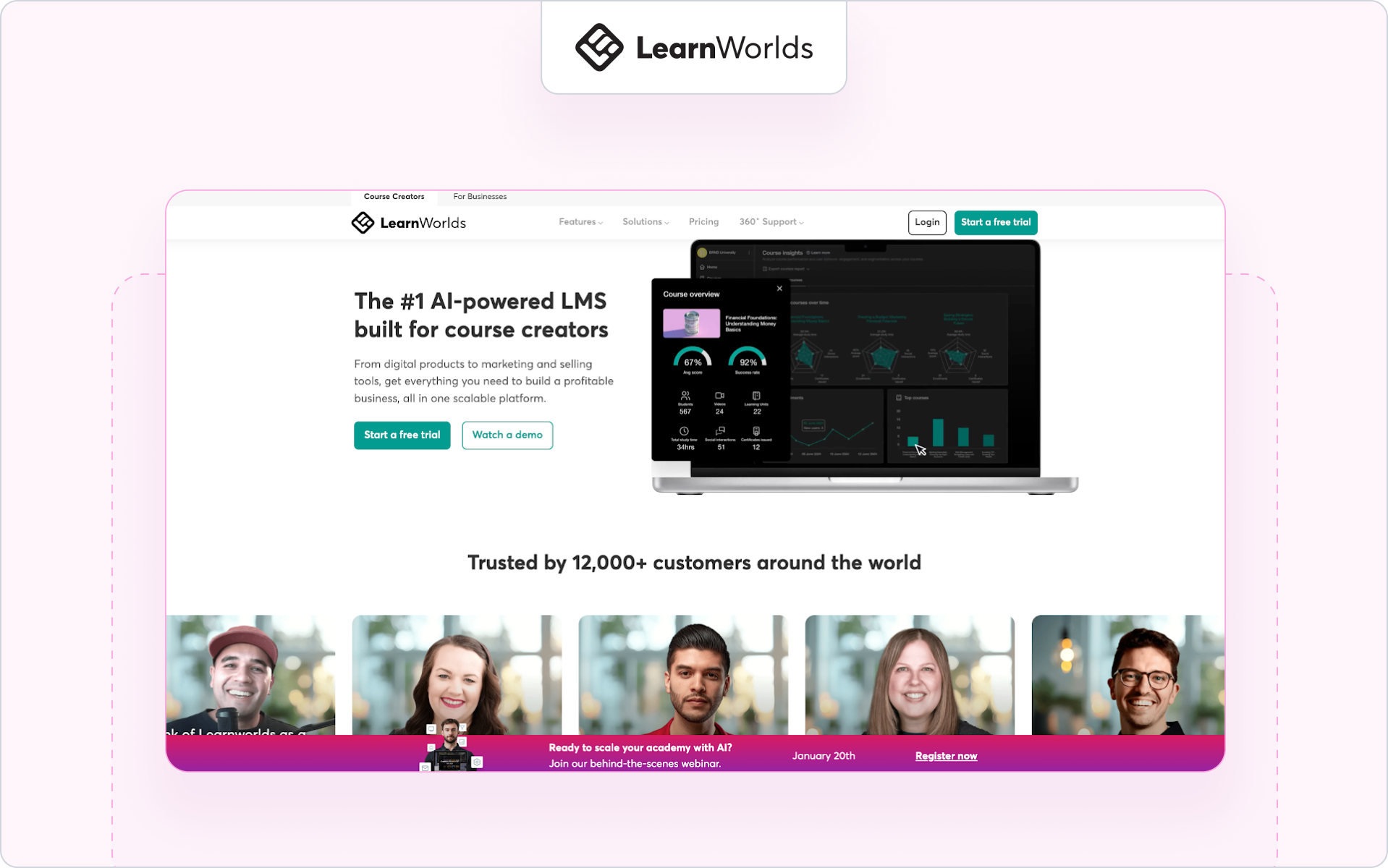
Am besten geeignet für
Companies building online academies for customer education or partner onboarding.
Why it’s a LearnUpon LMS alternative
LearnWorlds stands out for companies building external training academies or selling online courses, which differs from the internal training focus many LMS platforms prioritize.
Wichtigste Merkmale
- Tools for building academy-style online courses
- Ecommerce capabilities for selling training programs
- Interactive course creation tools
- Analytics dashboards for tracking completion rates
Ideal company size
Small businesses and mid-sized companies delivering customer education or partner onboarding programs.
8. Thought Industries: Best for customer education platforms
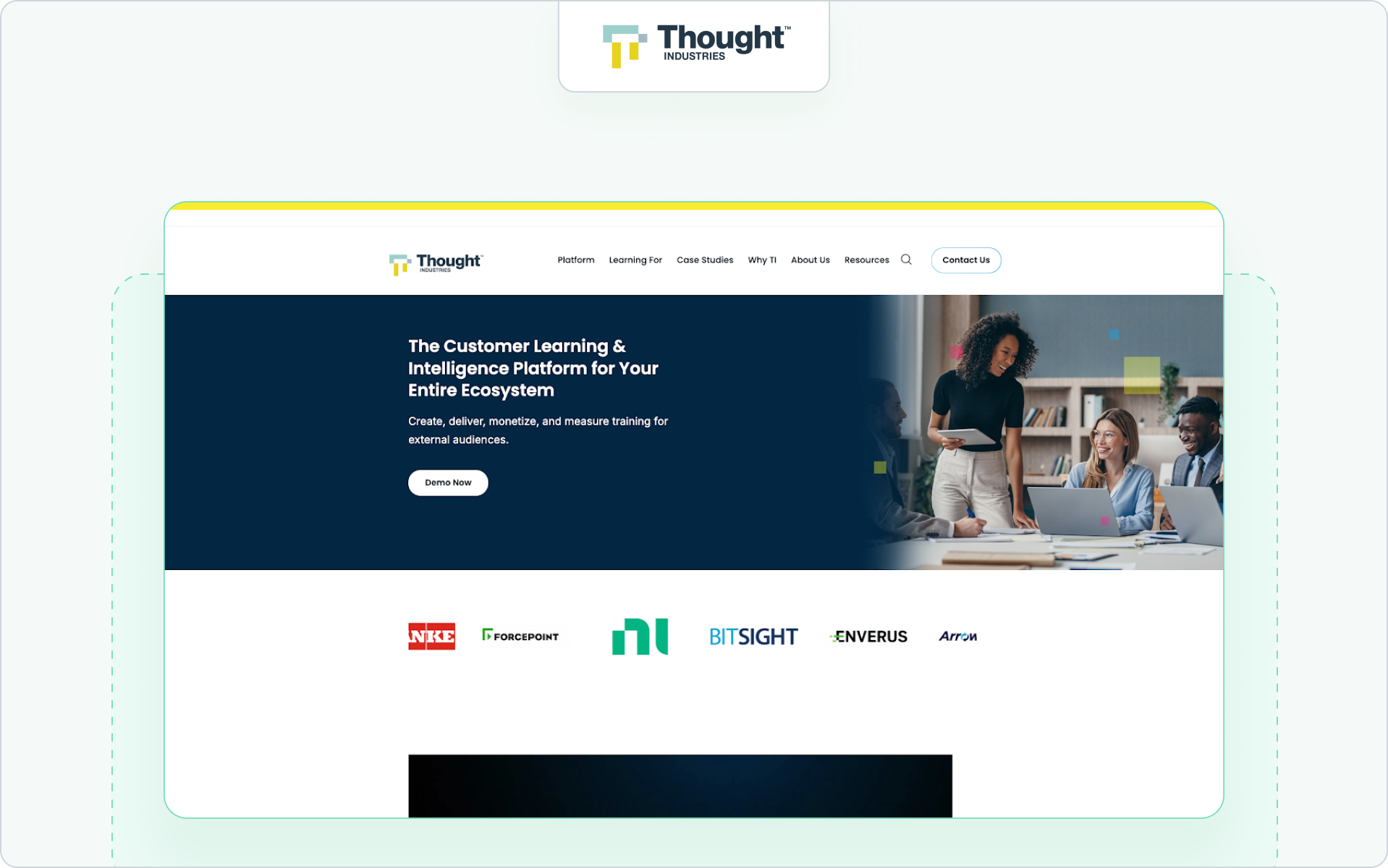
Am besten geeignet für
Companies delivering large customer education and external training programs.
Why it’s a LearnUpon LMS alternative
Thought Industries is designed for large customer education and external training programs, making it attractive to companies building scalable learning environments for external learners.
Wichtigste Merkmale
- Scalable customer education environments for external learners
- Tools for managing large training programs
- Ecommerce capabilities for monetizing course content
- Reporting and analytics dashboards for training activity
Ideal company size
Mid-market companies and large enterprises running global customer education or partner enablement programs.
9. WorkRamp: Best for revenue enablement training
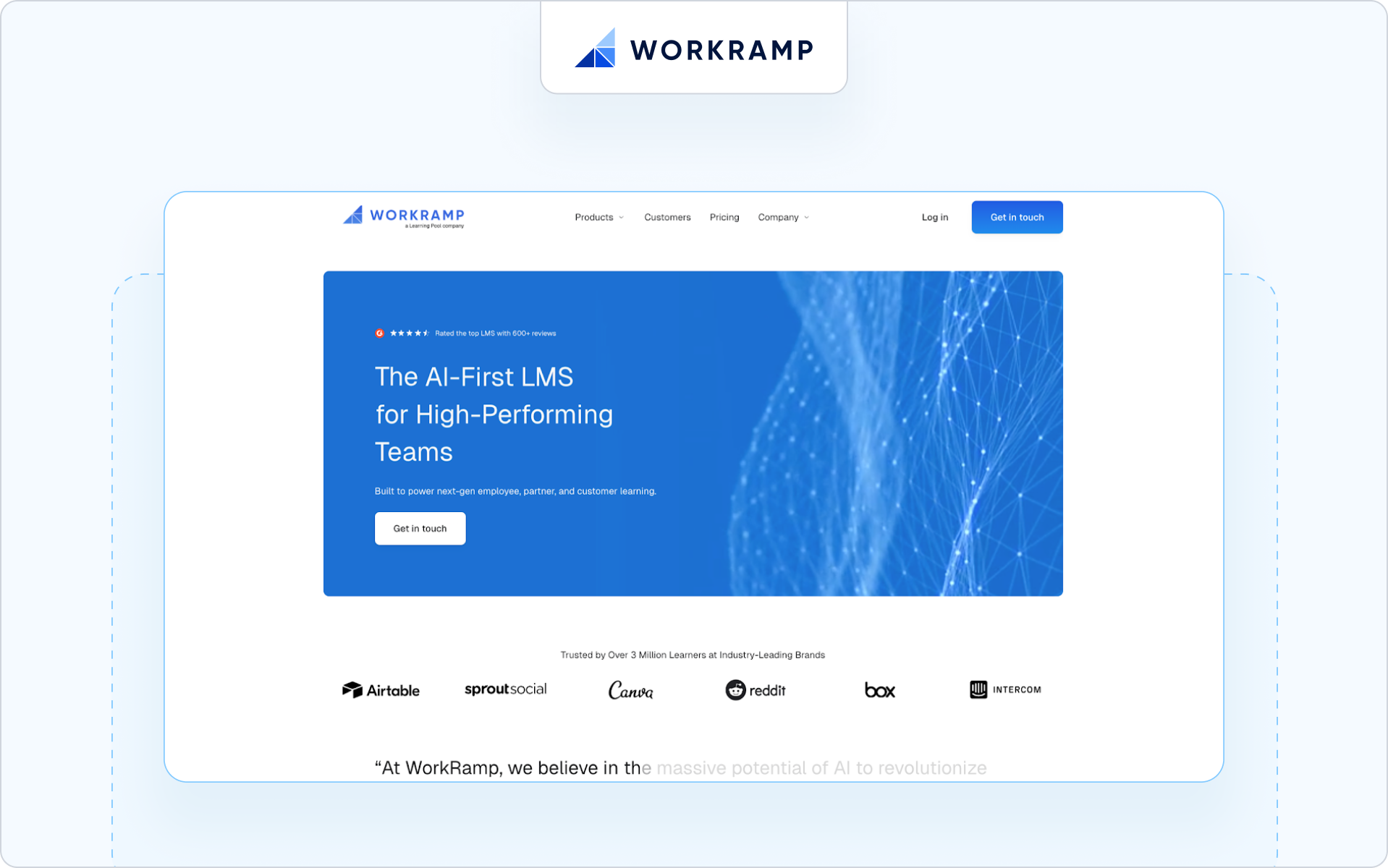
Am besten geeignet für
Revenue teams that want structured training for the sales team, customer success teams, and partner enablement.
Why it’s a LearnUpon LMS alternative
WorkRamp attracts revenue teams that want training programs aligned with sales enablement, onboarding, and partner readiness rather than traditional LMS course management.
Wichtigste Merkmale
- Sales enablement training programs for the sales team
- Certification programs for partner and customer training
- Course builder for onboarding and online training
- Reporting and analytics dashboards for tracking training activity
Ideal company size
Mid-sized SaaS companies and enterprises running sales enablement and partner training programs.
10. iSpring Learn: Best for affordable mid-market LMS/
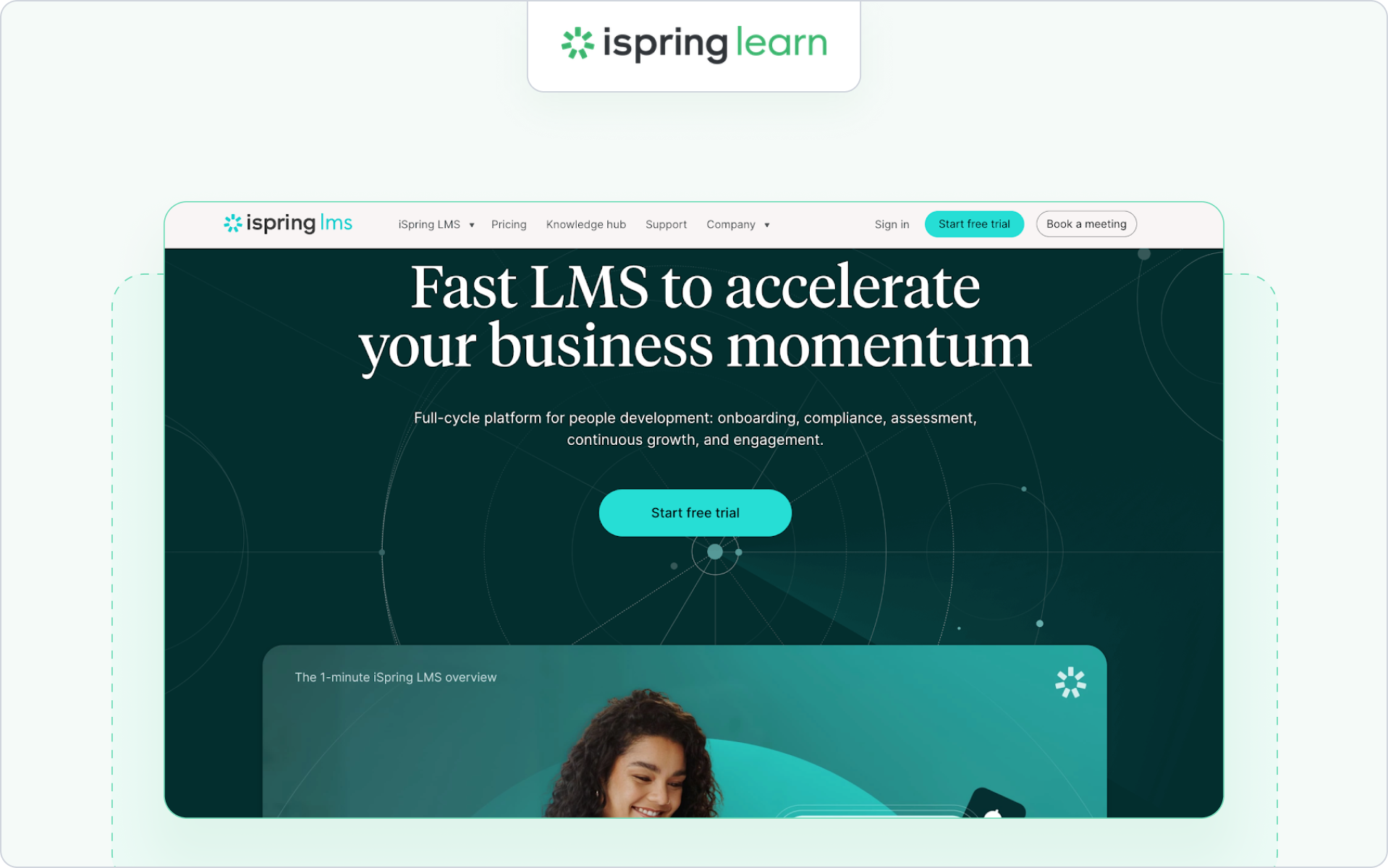
Am besten geeignet für
Organizations that want a user-friendly LMS with simple course creation and straightforward pricing.
Why it’s a LearnUpon LMS alternative
iSpring Learn appeals to mid-market companies that want a user friendly LMS with straightforward course creation and a lower learning curve.
Wichtigste Merkmale
- Authoring tool for creating online courses and training content
- Reporting capabilities for tracking learner progress
- Mobile learning with offline access
- Tools for employee training and external learners
Ideal company size
Small businesses and mid-sized companies running employee training and simple external training programs.
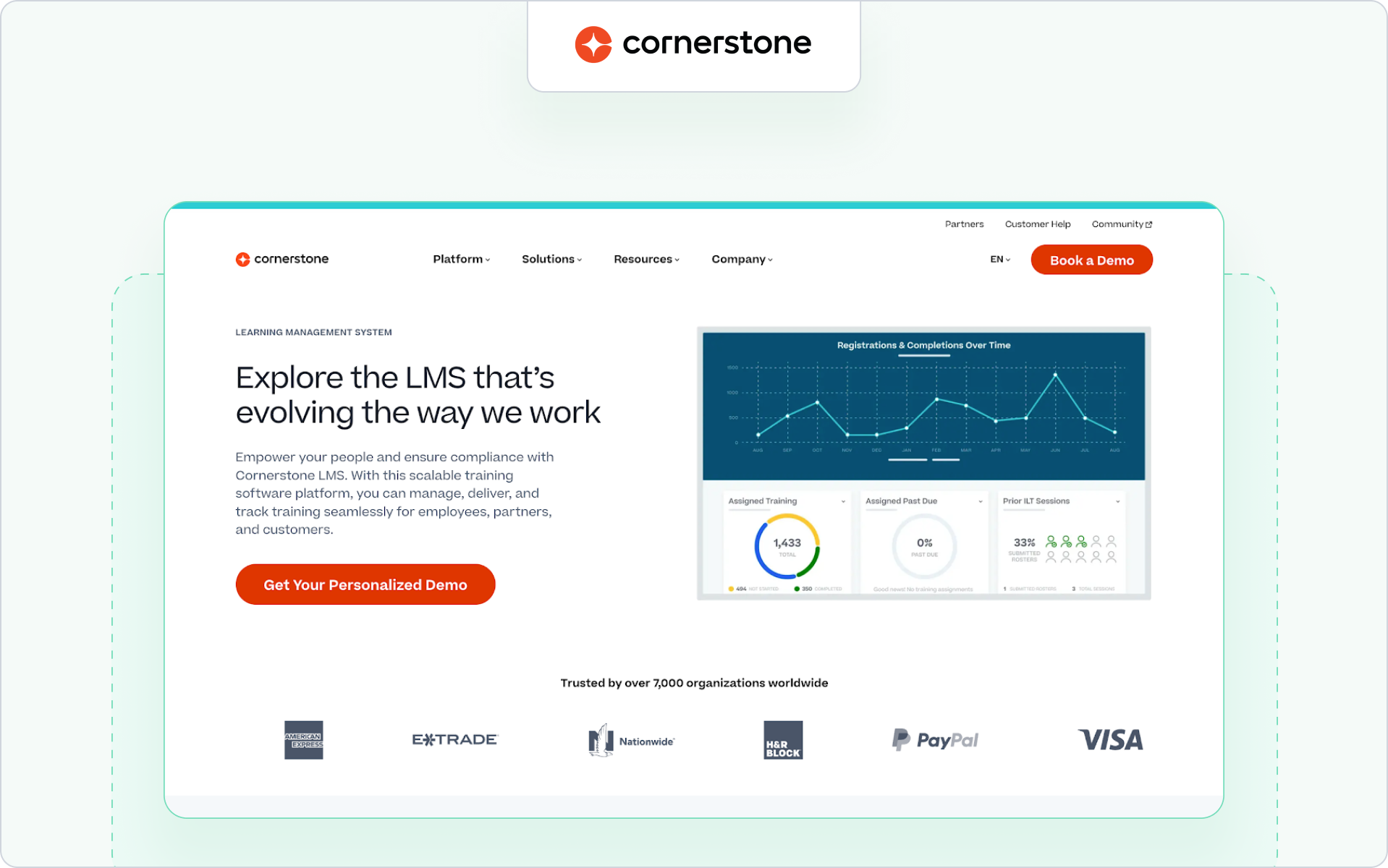
11. Cornerstone OnDemand: Best for global enterprise learning
Am besten geeignet für
Large enterprises running global employee development and compliance training programs.
Why it’s a LearnUpon LMS alternative
Cornerstone OnDemand is often chosen by large enterprises that need extensive customization, global compliance training, and advanced analytics for workforce development.
Wichtigste Merkmale
- Enterprise features for global learning management systems
- Advanced analytics for identifying skills gaps
- Compliance training and employee development tools
- Extensive customization for large training environments
Ideal company size
Large enterprises managing global employee training and compliance initiatives.
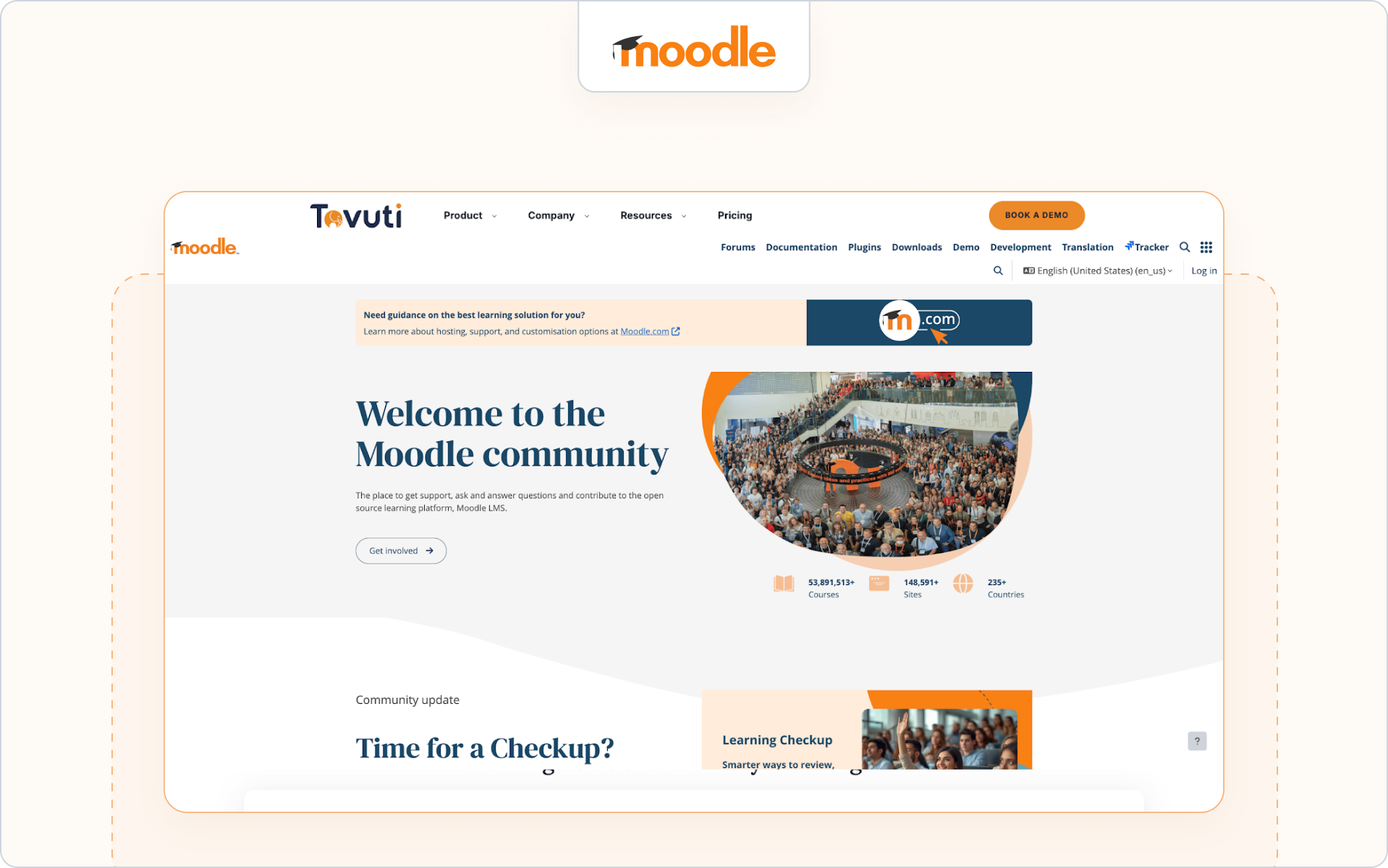
12. Moodle: Best for open-source flexibility
Am besten geeignet für
Organizations that want full control over their learning platform and have technical teams managing the system.
Why it’s a LearnUpon LMS alternative
Moodle appeals to organizations that want full control over their learning platform through open-source customization rather than a vendor-managed LMS.
Wichtigste Merkmale
- Open-source learning management system architecture
- Large ecosystem of plugins and integrations
- Support for blended learning and online training
- Flexible tools for managing course content
Ideal company size
Universities, training organizations, and companies with internal development resources.
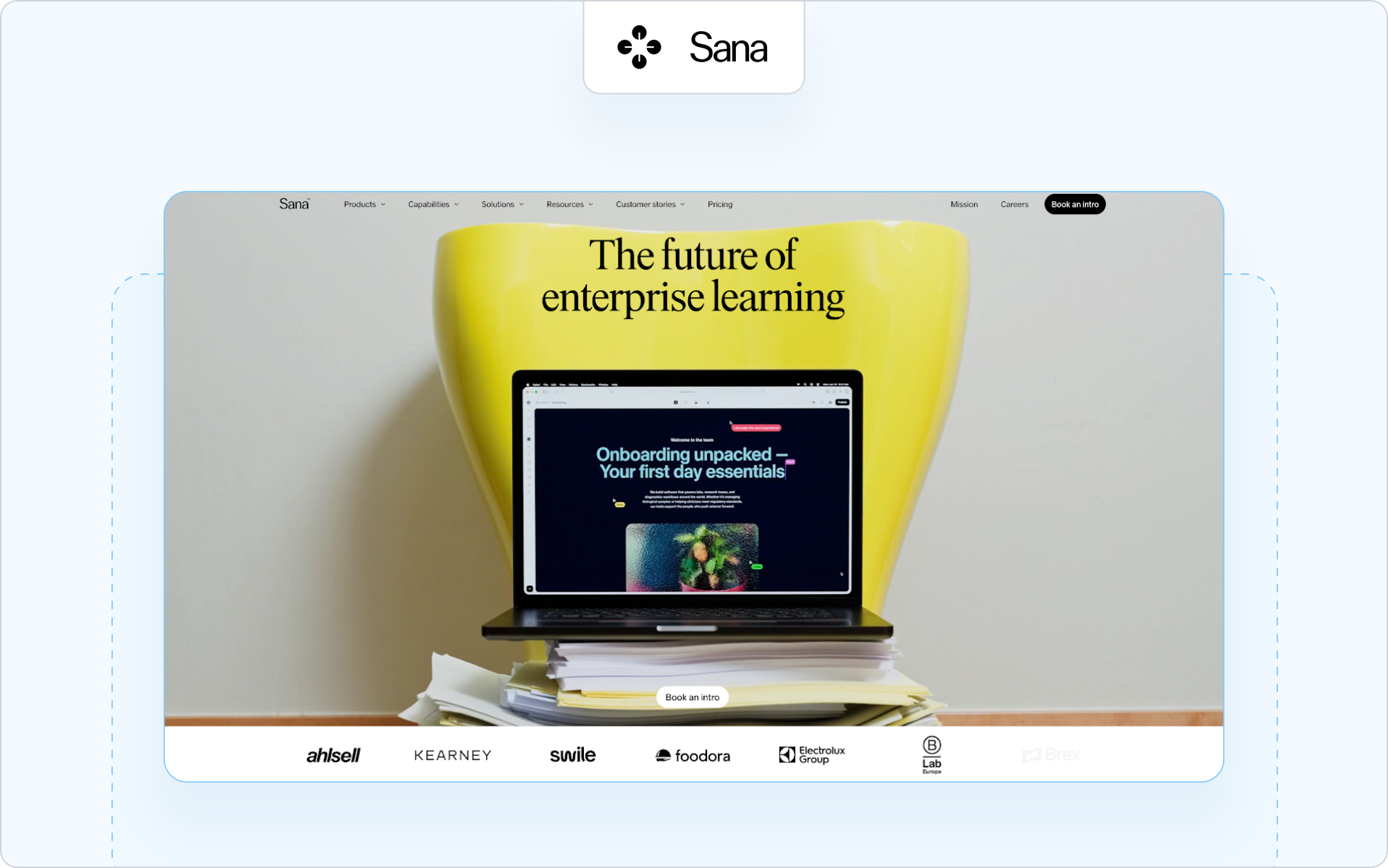
13. Sana Learn: Best for adaptive AI learning
Am besten geeignet für
Organizations that want AI-driven training experiences and adaptive learning paths.
Why it’s a LearnUpon LMS alternative
Sana Learn focuses on AI-driven training programs that personalize learning paths and improve knowledge retention based on learner progress.
Wichtigste Merkmale
- Adaptive learning paths that personalize training programs
- AI tools for recommending training content
- Analytics dashboards that help identify skills gaps
- Tools designed to improve knowledge retention
Ideal company size
Mid-market companies and enterprises exploring AI-driven employee development programs.
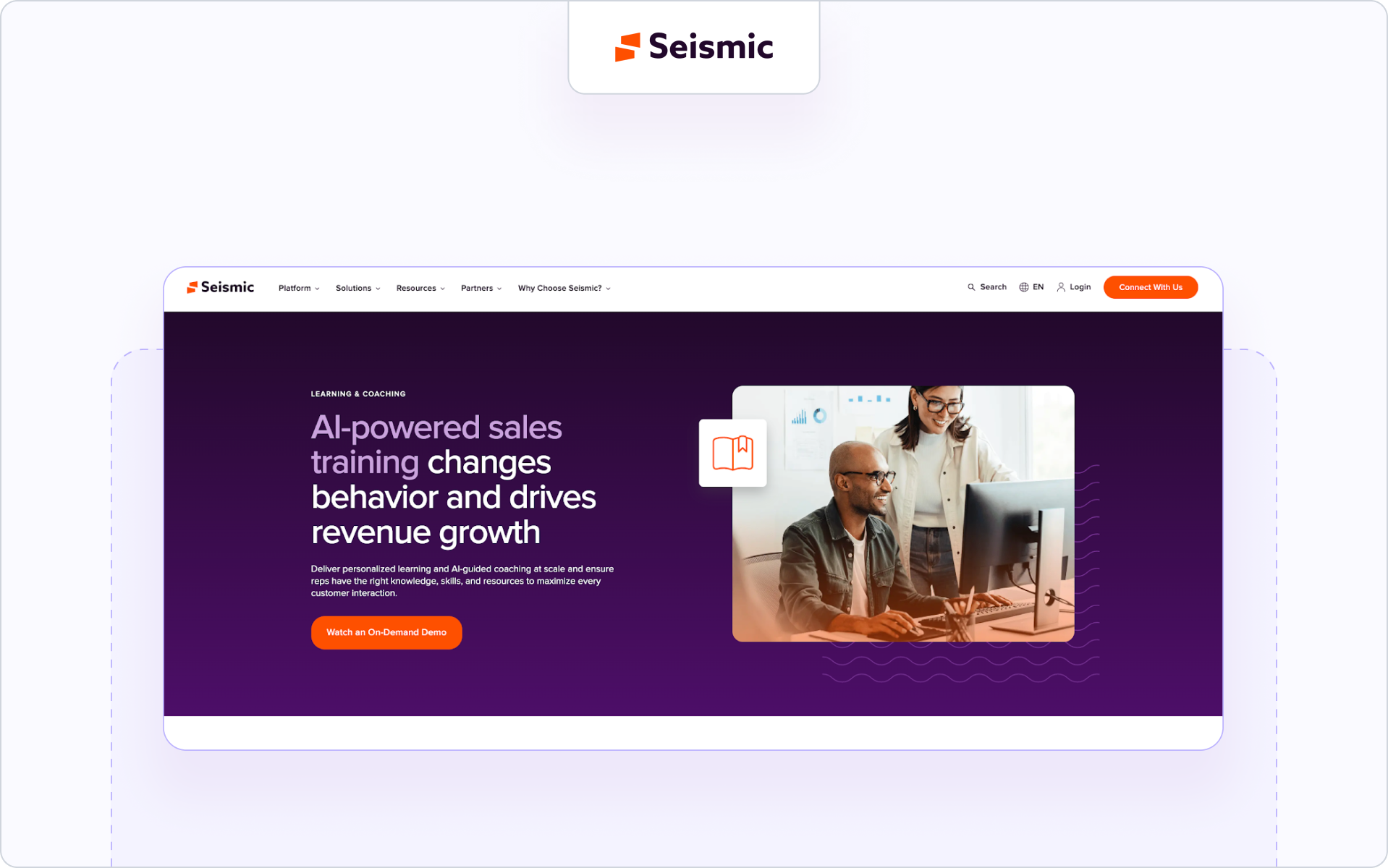
14. Seismic Learning (Lessonly): Best for sales enablement training
Am besten geeignet für
Organizations focused on onboarding and training the sales team.
Why it’s a LearnUpon LMS alternative
Seismic Learning is designed for revenue teams that need structured onboarding and training programs for the sales team.
Wichtigste Merkmale
- Sales enablement training for the sales team
- Coaching workflows for revenue teams
- Certification programs for onboarding
- Reporting dashboards for tracking learner progress
Ideal company size
Mid-sized companies and enterprises running sales enablement and onboarding programs.
15. CYPHER Learning: Best for modern AI-powered LMS platforms
Am besten geeignet für
Organizations that want a modern learning platform with AI-powered automation.
Why it’s a LearnUpon LMS alternative
CYPHER Learning attracts organizations looking for modern LMS platforms that combine AI-powered course creation with automated learner management.
Wichtigste Merkmale
- AI tools for creating and managing course content
- Automation for managing online courses and learners
- Personalized learning paths for training programs
- Reporting and analytics dashboards
Ideal company size
Mid-sized companies and enterprises exploring modern LMS platforms with AI-driven learning tools.
Before choosing between LearnUpon and other LMS platforms, it helps to look at how these tools compare across the capabilities partner teams care about most. The table below highlights where different platforms focus, and why some teams choose solutions built specifically for partner enablement.
Comparison table: LearnUpon vs. alternatives
For partner teams, the biggest difference usually comes down to visibility and engagement. In the next section, we’ll look at the specific criteria partner managers use when evaluating LearnUpon LMS alternatives.
What to compare when evaluating LearnUpon LMS alternatives
When evaluating LearnUpon LMS alternatives, partner teams usually focus on a few capabilities that influence partner adoption and revenue impact.
CRM & revenue visibility
Partner managers need to see training activity alongside partner deals and pipeline. If certification data lives outside the CRM, it’s difficult to understand which training programs influence revenue.
That’s why many teams prioritize platforms that help them measure partner training ROI.
AI course creation capabilities
As partner ecosystems grow, training programs expand quickly. AI tools help teams create courses faster, update training content, and reduce manual work.
This is especially helpful when managing large partner onboarding programs or frequent product updates.
Certification automation
Certification programs help standardize partner readiness, but manual management quickly becomes difficult.
Automated certification paths and recertification rules make it easier to scale programs and demonstrate the channel partner certification benefits across partner ecosystems.
Partner engagement & nudging
External training only works if partners actually complete courses. Platforms that support reminders, notifications, and off-platform nudges can improve completion rates and learner engagement.
These features help partner training programs maintain momentum.
Reporting that leadership cares about
Leadership teams want to see outcomes, not just course completions. They want visibility into how training influences partner pipeline and productivity.
That’s why many teams explore platforms designed specifically as partner LMS software when evaluating alternatives.
The right LMS depends on what you expect training to achieve. If partner training needs to influence pipeline, certifications, and partner productivity, those capabilities quickly become essential evaluation criteria.
But it’s also worth noting that LearnUpon still fits many organizations well. Here's why.
When LearnUpon is still the right choice
Despite the many LearnUpon LMS alternatives available, LearnUpon still works well for many organizations.
Primarily internal HR training
LearnUpon is a strong fit for companies focused on employee training, onboarding, and internal compliance training. HR and L&D teams can use it to manage structured training programs, deliver online courses, and support employee development across departments.
No CRM reporting requirement
If your training programs do not need to connect to sales data or partner pipeline, LearnUpon’s reporting capabilities are usually sufficient. Many companies only need to track completion rates, assessment scores, and general learner progress.
Limited partner enablement complexity
Some companies only run basic partner onboarding courses rather than full partner enablement programs. In those cases, a traditional learning management system like LearnUpon may be enough to deliver simple partner training without additional automation or integrations.
However, as your partner programs scale, your training needs often change.
When it’s time to switch to a LearnUpon LMS alternative
LearnUpon works well for many training environments. But partner teams sometimes need capabilities that traditional LMS platforms don’t provide.
Use this quick checklist to evaluate whether it may be time to consider a LearnUpon LMS alternative.
You need partner revenue visibility
☐ Training data needs to connect to partner pipeline or deals
☐ Certifications should be visible alongside CRM partner records
Certification must influence pipeline
☐ Certifications determine partner tiers or deal eligibility
☐ Your team needs automated certification paths and renewals
RevOps needs better reporting
☐ Leadership asks how partner training influences revenue
☐ Reporting must combine CRM and training data
You want AI-powered content scaling
☐ Your team regularly creates or updates course content
☐ AI tools could speed up course creation
You need engagement automation
☐ Partners enroll but often don’t finish courses
☐ Automated reminders or nudges would improve completion rates
If several of these apply to your program, it may be time to consider a partner LMS built specifically for partner ecosystems.
Why Introw is the best choice
For many SaaS partner teams, the challenge is not delivering training. It is connecting training to real partner outcomes.
Traditional learning platforms focus on managing courses, tracking completion, and delivering employee training. But partner teams often need more visibility and automation across their ecosystem.
With Introw, partner training becomes part of your partner operations instead of a separate LMS environment. Certifications, training activity, and partner engagement all connect directly to your partner program workflows.
What makes Introw different
- CRM-native visibility for partner certifications and training activity
- AI tools that help teams create and scale training content quickly
- Certification automation that supports partner tiers and onboarding
- Off-platform engagement to keep partners progressing through training
- Revenue reporting that shows how training supports partner performance
If you would like to explore how partner enablement works in practice, you can review Introw’s partner training and certification resources.
For teams that want partner training programs tied to pipeline, productivity, and partner success, Introw is built specifically for that purpose.
Ready to see how Introw works?
Request a demo and explore how Introw helps partner teams turn training into measurable partner revenue.
The Only Partner Marketing Campaigns Worth Copying in 2026
Most partner marketing campaigns look great in a recap deck and go nowhere in the pipeline. Two brands post about each other, share a webinar link, and call it a success — but nobody can trace a single deal back to the effort.
The partner marketing campaigns worth copying work differently. They’re built to scale across multiple partners, track back to revenue, and run again without a full rebuild. This guide breaks down the campaign types that actually drive pipeline, examples you can replicate, and a practical planning and measurement approach that connects to your CRM.
What is a partner marketing campaign?
A partner marketing campaign is a joint marketing effort between a vendor and one or more partners — resellers, referral partners, technology partners, or strategic alliances — designed to generate leads, build awareness, or drive pipeline together.
Both sides contribute resources, distribution, and credibility. The outcome you’re aiming for is mutual: expanded reach, higher trust, and pipeline neither party could generate as efficiently on their own.
Partner marketing campaigns typically live inside broader partner marketing programs. You’ll also hear these called partnership marketing examples or co-marketing initiatives. The mechanics vary, but the principle stays the same: two brands coordinating around a shared customer, shared narrative, and shared outcomes.
What makes partner marketing campaigns worth copying?
Some partner campaigns generate buzz but no pipeline. Others “work” once, then fall apart when you try to roll them out across ten partners and two quarters.
The partner marketing campaigns worth copying share a few operational qualities that make them repeatable, measurable, and scalable.
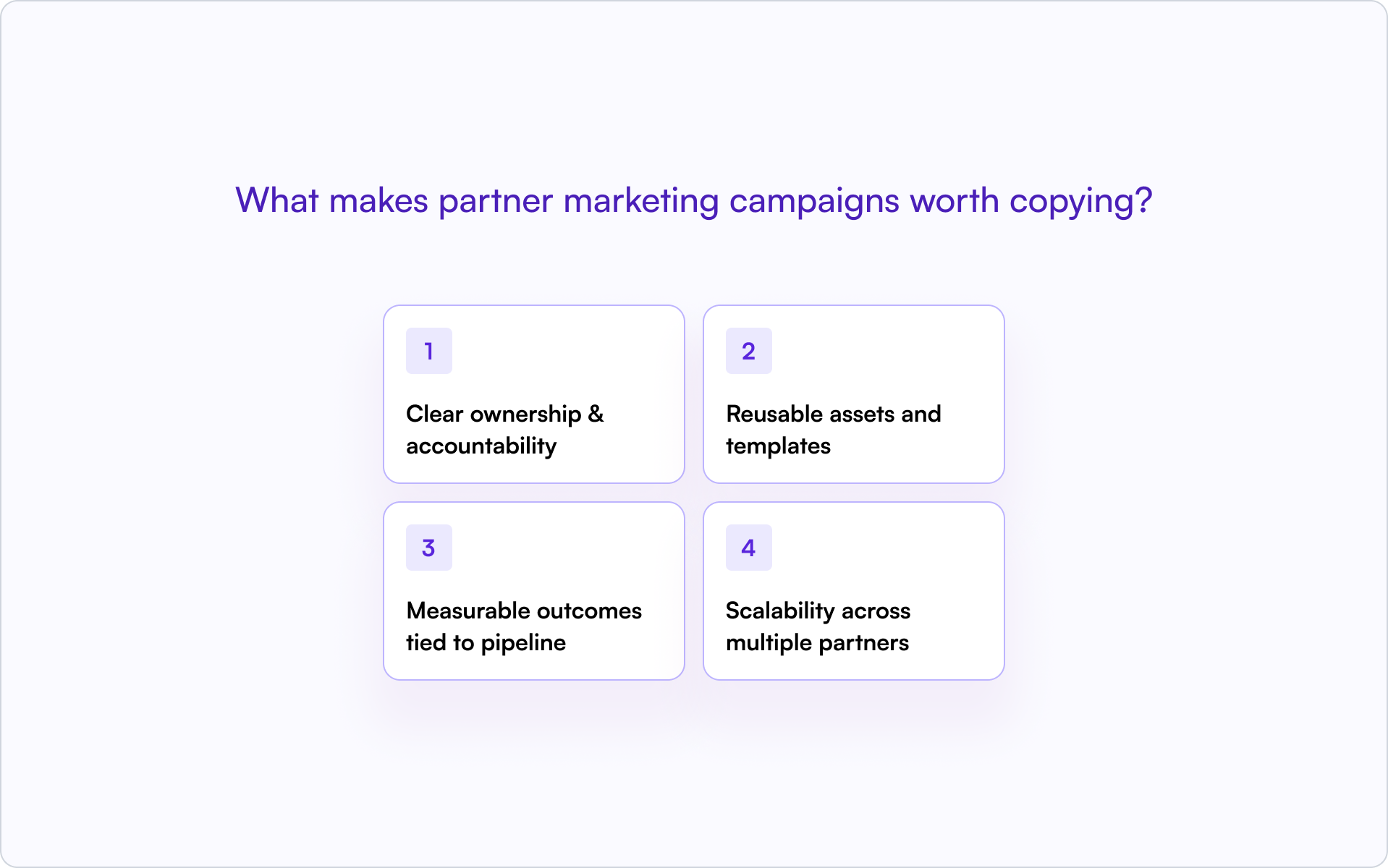
Klare Zuständigkeiten und Verantwortlichkeiten
Before anything goes live, the best teams define who owns what — the vendor, the partner, or both. When ownership is fuzzy, follow-up stalls, leads go cold, and the campaign gets remembered as “a nice collaboration” instead of a repeatable pipeline motion.
Reusable assets and templates
Scalable campaigns come with a “campaign-in-a-box”: pre-built emails, social posts, landing pages, and talking points partners can customize without starting from scratch. Reusable assets reduce partner friction and make opt-in easy.
Measurable outcomes tied to pipeline
Impressions and clicks are fine inputs, but the campaigns worth copying connect to revenue. If you can’t trace leads back to a partner and into opportunities, you’re running activity — not a growth channel.
Scalability across multiple partners
A great campaign can be rolled out to many partners without heavy customization each time. The goal is a library of repeatable motions partners can join — not one-off collaborations that require a rebuild every launch.
Types of partner marketing programs that drive pipeline
Before you pick tactics, anchor on program structure. Different partner marketing programs serve different jobs — and the best stacks combine several.
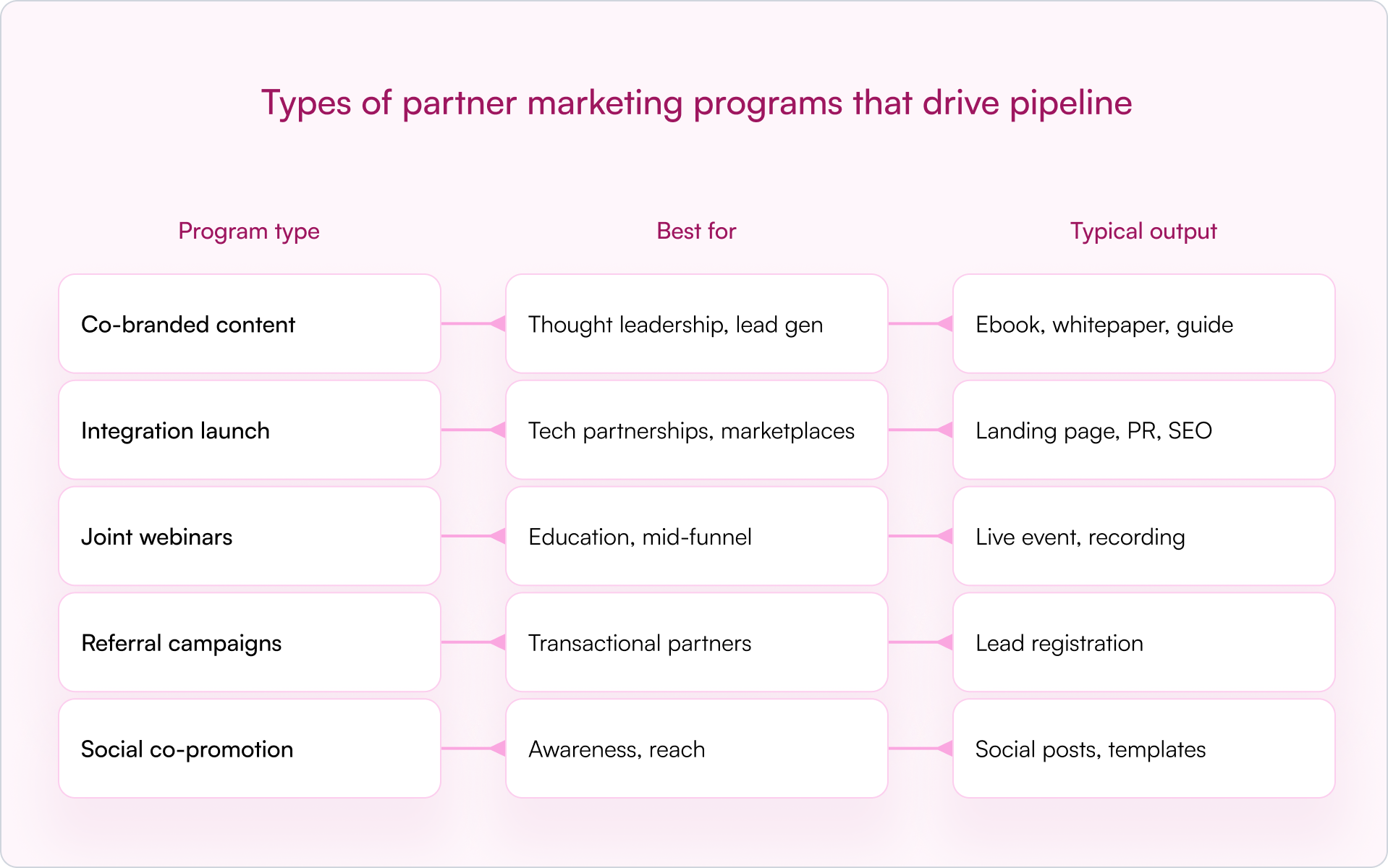
Co-branded content campaigns
Joint whitepapers, ebooks, or guides featuring both brands. Both parties co-create and co-distribute — which means shared audience, shared credibility, and shared leads. Co-branded content campaigns are classic partnership marketing examples in B2B because the content lives on long after the launch.
Integration and marketplace launch campaigns
Campaigns that announce a new tech integration or app marketplace listing often include landing pages, PR, and SEO-optimized content. Done right, these assets compound — a well-built integration page can drive organic traffic for years.
Joint webinars and virtual events
Co-hosted educational sessions where both parties promote and both capture leads. Joint webinars are one of the most repeatable joint marketing examples when you have clear audience overlap and a topic that matters to both ICPs.
Referral and incentive campaigns
A partner refers leads in exchange for rewards — SPIFFs (short-term incentive bonuses), commissions, or other incentives. Referral campaigns tie directly to partner-sourced revenue and work well for transactional partner motions.
Social media co-promotion campaigns
Coordinated posts across both brands’ channels, often with templates provided to partners. Social co-promotion is a lightweight way to test new partner marketing ideas before committing to bigger co-marketing investments.
B2B partner marketing campaign examples to replicate
Theory is cheap. The following partner marketing campaign structures are practical, repeatable, and designed to scale beyond a single partner.
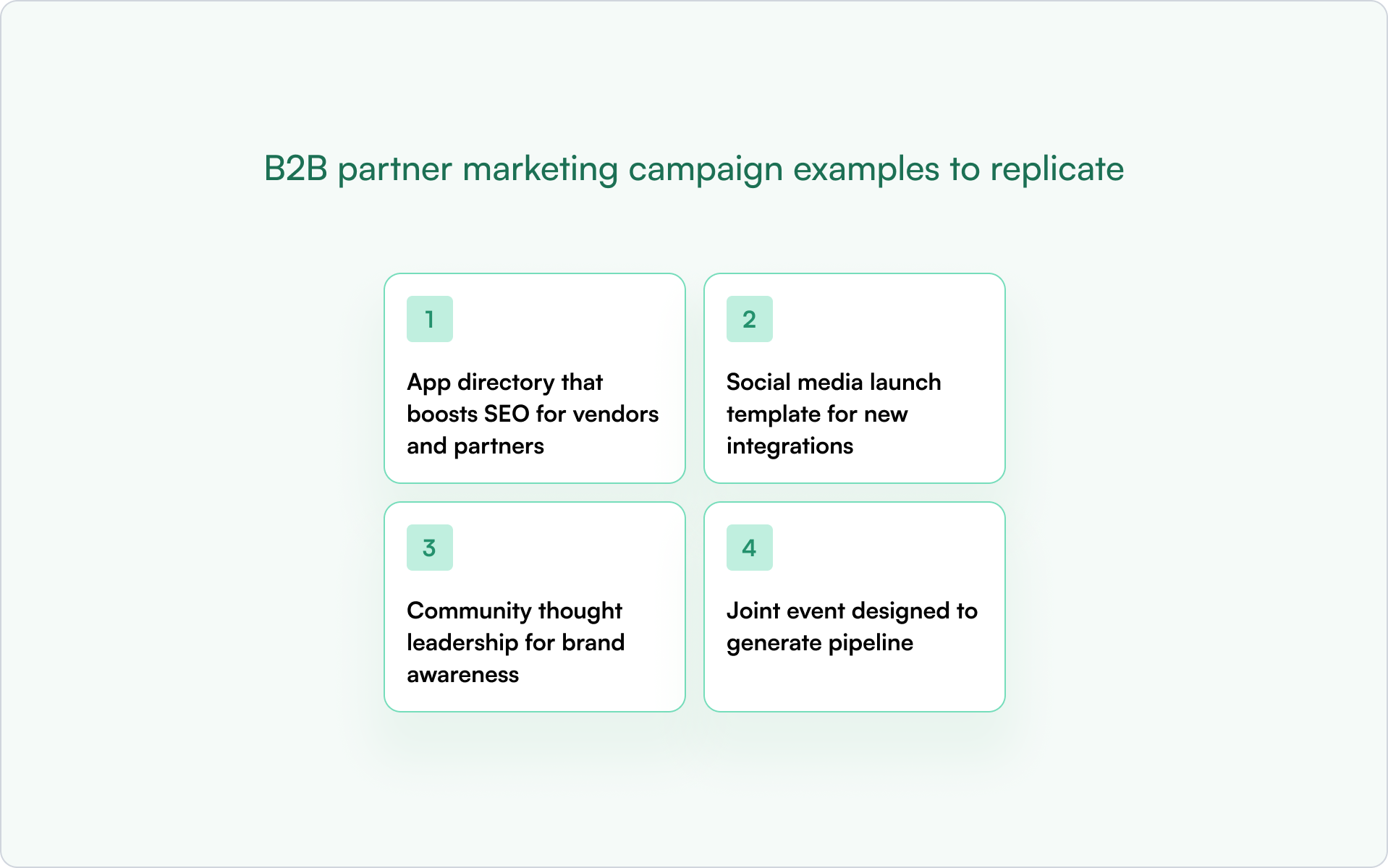
1) App directory that boosts SEO for vendors and partners
A searchable partner or integration directory drives organic traffic for both parties. Each listing becomes a landing page that can rank for relevant keywords. It’s one of the strongest long-term partner marketing campaigns because it creates always-on demand without ongoing campaign spend.
- What it is: A public directory of integrations or partners, optimized for search.
- Why it works: Compounds over time; drives inbound for both vendor and partner.
- How to replicate: Create a directory with unique content per partner, and optimize pages for “[your product] + [partner product] integration” search intent.
2) Social media launch template for new integrations
When a new integration goes live, give partners ready-to-post social templates — images, copy, and hashtags. This increases participation because partners don’t have to write anything from scratch, and you get coordinated reach across multiple audiences.
- What it is: Pre-built social assets partners can post on launch day.
- Why it works: Low lift for partners, high participation rates.
- How to replicate: Create a shared folder with 3–5 copy variations, images sized per channel, and posting guidelines. Send it 48 hours before launch.
3) Community thought leadership for brand awareness
Feature partner experts in blog posts, podcasts, or LinkedIn content. Both brands benefit from credibility transfer, and the content reads as more authentic than solo marketing.
- What it is: Vendor-hosted content featuring partner voices.
- Why it works: Builds trust when paid channels are saturated.
- How to replicate: Invite partners to contribute quotes, guest posts, or podcast episodes, then cross-promote to both audiences.
4) Joint event designed to generate pipeline
Co-hosted dinners, roundtables, or virtual events targeting a shared ICP. Both parties invite prospects and both capture leads. The key is to productize the format so it doesn’t become a one-off.
- What it is: A co-branded event with shared invite lists and coordinated follow-up.
- Why it works: High-intent leads, shared costs, mutual credibility.
- How to replicate: Build an event-in-a-box kit: agenda template, invite copy, registration page, day-of run-of-show, and follow-up sequences for both sales teams.
Partner marketing campaign ideas beyond the usual playbook
If you’ve already run webinars and co-branded content, the next step is to create partner marketing campaigns that feel native to how your buyers actually learn and decide.
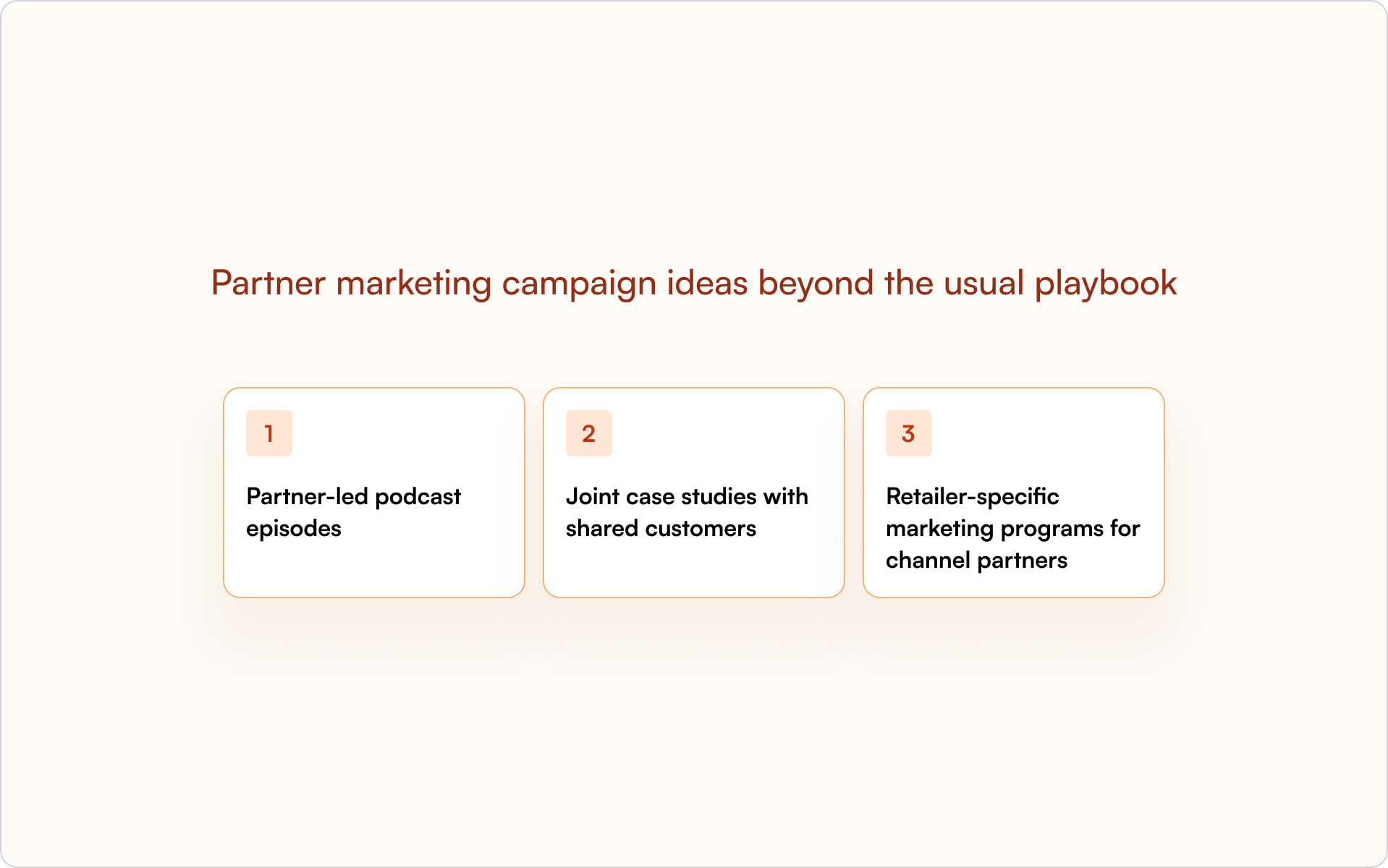
Partner-led podcast episodes
Invite partners as guests or let them host an episode. You get shared distribution, authentic content, and an evergreen backlog you can repurpose into clips, posts, and newsletters.
Joint case studies with shared customers
When a customer uses both vendor and partner, co-create the case study. Joint case studies often outperform generic partner marketing examples because they prove end-to-end outcomes for a shared ICP — with less “marketing speak.”
Retailer-specific marketing programs for channel partners
For companies selling through distributors or resellers, tailored campaigns by region, vertical, or partner tier can increase adoption. The key is to provide modular assets partners can localize without rewriting the offer.
How to plan and execute partner marketing campaigns
Planning is where most partner marketing campaigns succeed or fail. If you’re a founder, this is the part that turns “we should do something with partners” into a repeatable growth motion your team can run without heroics.

1) Define campaign goals and success metrics
Start with what you want: leads, pipeline, awareness, or something else. Whenever possible, tie goals to partner-attributed revenue. Consistent goal-setting lets you compare performance across partner marketing campaigns and double down on what actually converts.
2) Select the right partners for the campaign
Not every partner fits every campaign. Consider partner tier, audience overlap, and engagement level. The best joint marketing examples happen when there’s obvious ICP overlap and a believable shared story.
3) Build a campaign-in-a-box with ready assets
Reduce friction by providing everything partners need to participate:
- Email templates (customizable)
- Social media copy and images
- Co-branded landing page
- Tracking links for attribution
- Partner talking points or FAQ
Campaign-in-a-box is what turns good ideas into repeatable motions inside your partner marketing programs.
4) Set a communication and approval workflow
Define who approves what, how partners submit content for review, and timeline expectations. A simple workflow keeps multi-partner campaigns consistent and on-brand without slowing everything down.
5) Launch, monitor, and adjust in real time
Track engagement and leads as the campaign runs. Sync partner activity to your CRM so you can quickly see which partner marketing campaigns are generating meetings and opportunities — and which ones need a tweak to targeting, messaging, or follow-up.
How to measure partner marketing campaigns (without guessing)
Attribution is where most partner marketing programs struggle. Without clean data, you can’t tell which campaigns drive revenue and which ones just look good in a slide deck.
Leads and pipeline attributed to partners
Track which partners sourced or influenced which deals. Your CRM should be the source of truth. This is what separates “fun co-marketing” from partner marketing campaigns you can scale quarter after quarter.
Campaign engagement and conversion metrics
Measure opens, clicks, registrations, meetings booked, and conversion rates — and compare across formats. Over time, you’ll see patterns: which topics drive attendance, which partners consistently activate, and which campaigns convert into pipeline for your ICP.
Solving the attribution problem with CRM-first tracking
Attribution is hard because deals usually have multiple touches, and partner versus direct overlap is common. CRM-first tracking helps by syncing partner activity directly to deal records. Once your data is clean, it’s easier to invest in the partner marketing campaigns that influence revenue — and stop funding the ones that don’t.
Tip: If your partner activity lives outside your CRM — in spreadsheets, email threads, or a disconnected portal — attribution becomes guesswork. The teams that measure partner marketing well keep everything connected to HubSpot or Salesforce from day one.
Run partner marketing campaigns that actually scale
The partner marketing campaigns worth copying aren’t just creative — they’re structured, measurable, and repeatable. They come with clear ownership, reusable assets, and a direct line to pipeline.
Most teams run partner marketing campaigns that feel productive but don’t connect to revenue. The difference is infrastructure: clean CRM data, consistent attribution, and a process that works across many partners, not just one.
If you want partner marketing campaigns with real visibility into what’s working, consider tightening your workflow around CRM-first attribution and standardized campaign kits. When you’re ready to operationalize it, get a demo to see how Introw keeps partner activity connected to your CRM — so you can scale what works and stop guessing.
Incentive-Programme für Vertriebspartner: Wie man sie so gestaltet, dass sie wirklich Wirkung zeigen
Channel-Partner-Incentive-Programme sind strukturierte Belohnungen, die Ihre Channel-Partner dazu motivieren, bestimmte Maßnahmen zu ergreifen, die den Umsatz steigern und Ihre Geschäftsziele unterstützen.
Bei SaaS nutzen Sie Channel-Incentive-Programme, um die Ramp-up-Zeit zu verkürzen, die Vertriebsleistung zu steigern und den Marktanteil zu erhöhen, ohne die Kontrolle über die Kundenakquisitionskosten zu verlieren.
Ein gut strukturiertes Incentive-Programm richtet Anreize auf messbare Ergebnisse innerhalb Ihres Kundenbeziehungsmanagementsystems aus, nicht auf eitle Aktivitäten.
Es gibt zwei Hauptarten von Anreizen für Vertriebspartner:
- Finanzielle Anreize wie Anreize für die Registrierung von Geschäften, Empfehlungsprämien, wiederkehrende Provisionen und andere finanzielle Belohnungen sind an bestimmte Verkaufsziele geknüpft.
- Sachleistungen wie Marketingunterstützung, Marktentwicklungsfonds, exklusiver Zugang zu Schulungen oder stufenbasierte Vorteile in Ihrem Partnerportal.
Ein starkes Channel-Partner-Management verbindet Anreize mit dem, was tatsächlich die Pipeline vorantreibt. Wenn Ihr Channel-Partner-Anreizprogramm nicht an die Registrierung von Geschäften, den Fortschritt in den einzelnen Phasen, Verlängerungen oder abgeschlossene Umsätze gekoppelt ist, verändert es das Verhalten nicht.
Bevor Sie Incentive-Programme für Vertriebspartner starten, definieren Sie, was ein Vertriebspartner in Ihrem Ökosystem bedeutet. Verschiedene Arten von Partnern reagieren auf unterschiedliche Incentive-Strategien.
Wenn Ihre Anreize die tatsächlichen Bedürfnisse Ihrer Partner und die tatsächlichen Vertriebsaktivitäten widerspiegeln, motivieren Sie Ihre Partner, ermutigen sie, Ihrer Lösung Priorität einzuräumen, und bauen Sie für beide Seiten vorteilhafte, dauerhafte Beziehungen auf.
Aber Anreize sind ein Instrument, kein Standard.
Verwenden Sie die folgenden Fit-Tests, um zu entscheiden, wann sie tatsächlich Umsatz generieren werden.
Wann sollten Anreize (Fit-Tests) eingesetzt werden?
Nicht jede Situation erfordert Incentive-Programme für Vertriebspartner. Setzen Sie diese ein, wenn Sie Verhaltensweisen auf klare und messbare Weise ändern möchten.
Ein Incentive-Programm für Vertriebspartner ist sinnvoll, wenn:
- Sie erschließen neue Märkte und müssen schnell das Engagement Ihrer Partner steigern.
- Ihr Produkt ist komplex und erfordert eine Zertifizierung oder eine umfassendere Einweisung, bevor Partner es mit Zuversicht verkaufen können.
- Ihr Verkaufszyklus ist lang, und eine schnellere Registrierung von Geschäften kann die Pipeline und den Marktanteil schützen.
- Verlängerungen, Erweiterungen oder Kundenbindung sind gefährdet, und Sie benötigen Partner, die sich frühzeitig engagieren.
- Eine Markteinführung hängt von der Kundenbindung, dem Upselling oder bestimmten Verkaufszielen ab, um den Umsatz zu steigern und die Einnahmen zu erhöhen.
Dies sind Momente, in denen gut strukturierte Incentive-Programme Partner motivieren und Anreize mit Ihren Geschäftszielen in Einklang bringen können.
Vermeiden Sie dieses Anti-Muster. Wenn Sie Ihren Vertriebspartnern Prämien für Downloads, Logins oder oberflächliche Aktivitäten zahlen, die keinen Einfluss auf die Pipeline haben, führen Sie keine effektiven Prämienprogramme durch. Sie finanzieren nur Lärm.
Ihre Incentive-Strategie für Vertriebspartner sollte sich auf Maßnahmen konzentrieren, die den Umsatz steigern, die Vertriebsleistung verbessern und die Beziehungen während der gesamten Partnerreise stärken.
Lassen Sie uns nun die Strategie in die Tat umsetzen. Im Folgenden finden Sie Ideen für Anreize, die darauf abzielen, nicht nur die Aktivitäten, sondern auch die Pipeline voranzubringen.
Anreizideen, die tatsächlich den Umsatz steigern
Starke Incentive-Programme für Vertriebspartner belohnen Verhaltensweisen, die die Pipeline voranbringen, und nicht oberflächliche Aktivitäten. Die Schwierigkeit besteht darin, diese Incentives für Vertriebspartner in Ihrem CRM messbar zu machen.
Im Folgenden finden Sie praktische Anreizstrukturen mit eindeutigen Nachweisen, Auszahlungen und Sicherheitsvorkehrungen. Wir verwenden Introw als Referenzmodell, um zu zeigen, wie jeder Anreiz ohne manuellen Aufwand überprüft und gemeldet werden kann.
Erwerb und Beschleunigung
Wenn das Volumen oder die Geschwindigkeit der Pipeline das Problem ist, sollten Ihre Kanalanreize Geschwindigkeit und Qualifikation belohnen.
1. Bonus für die schnelle Registrierung von Geschäften
Am besten geeignet für völlig neue Chancen in wettbewerbsintensiven Märkten.
- Nachweis: Genehmigte Deal-Registrierung innerhalb von X Stunden und Stufe ≥ Discovery
- Belohnung: Pauschalbetrag von X $ bei Erfüllung der SLA
- Leitplanken: Keine Duplikate und definiertes Schutzfenster
Mit den in die Deal-Registrierung von Introw integrierten SLA-Timern und Konfliktkennzeichnungen erfolgt die Berechtigungsprüfung automatisch statt manuell. Über ein gemeinsames Dashboard bleiben Sie und Ihre Vertriebspartner hinsichtlich Zeitplanung und Schutzfristen stets auf dem gleichen Stand.
2. Prämie für qualifizierte Besprechungen
Am besten geeignet zur Verbesserung der Chancenqualität.
- Nachweis: Besprechung in CRM-Opportunity mit Kontaktrollensatz protokolliert
- Belohnung: $ pro SAL
- Leitplanken: Obergrenze pro Partner, um Meeting-Mühlen zu verhindern
Da Introw Gespräche außerhalb des Portals direkt in der CRM-Zeitleiste erfasst und Kontaktrollen validiert, können Sie echte Fortschritte im Verkaufsprozess belohnen, ohne die Aktivitätskennzahlen zu überhöhen.
3. Stufenweiser Beschleuniger
Am besten geeignet, um ins Stocken geratene Geschäfte zu reduzieren.
- Nachweis: Stufe 1 → Stufe 2 innerhalb von N Tagen
- Belohnung: Gestaffelte Auszahlung basierend auf ARR oder %
- Geländer: Mindest-ASP zur Verhinderung von Sandbagging
Die Zuordnung von Phasenwechseln innerhalb von Introw macht deutlich, welcher Partner die Beschleunigung vorangetrieben hat. Sie richten Anreize an der Dynamik aus, nicht nur an der Registrierung von Geschäften.
Anhängen, Upselling und Produktmix
Wenn das Ziel darin besteht, den durchschnittlichen Auftragswert oder die Gewinnmargen zu steigern, sollte Ihre Anreizstrategie einen intelligenteren Produktmix belohnen.
4. Befestigen Sie den Geschwindigkeitsverstärker.
Am besten geeignet, um die Akzeptanz von Add-ons zu steigern.
- Nachweis: Add-on A verkauft mit Kern B
- Belohnung: % Aufschlag auf die Prämie für die Registrierung von Geschäften
- Leitplanken: Validierungsregeln bündeln
Produktlinienfelder und Validierungsregeln innerhalb von Introw bestätigen die richtige Zusammensetzung, bevor finanzielle Anreize genehmigt werden. Dadurch bleiben die Auszahlungen an die tatsächlichen Auswirkungen auf den Umsatz gebunden.
5. Wettbewerbsfähiger Takeout-SPIFF
Der Beste gewinnt.
- Nachweis: Feld „Anbieter“ ausgefüllt und „abgeschlossen – gewonnen“
- Belohnung: Pauschalbonus plus PR-Spotlight
- Leitplanken: Erforderliche Nachweise
Beweismittelanhänge und Audit-Protokolle innerhalb von Introw schaffen vertretbare Aufzeichnungen. In wettbewerbsintensiven Märkten schützt dieses Dokumentationsniveau sowohl Sie als auch Ihr Partnernetzwerk.
6. Mehrjähriger Aufwärtspotenzial
Am besten geeignet zur Verbesserung der Umsatzvorhersagbarkeit.
- Nachweis: Laufzeit von 2–3 Jahren statt 1 Jahr
- Belohnung: % des TCV-Bonus
- Leitplanken: Rückforderung bei vorzeitiger Kündigung
Wenn Vertragsdauerfelder direkt mit Verlängerungsdatensätzen in Introw verknüpft sind, bleibt die Berechtigung während der gesamten Partnerbeziehung sichtbar. Dies stärkt das langfristige Umsatzwachstum und die Kundenbindung.
Befähigung und Kompetenz
Wenn Ihre Lösung komplex ist, verbessert die Schaffung von Anreizen für Partner, Fähigkeiten aufzubauen, bevor Einnahmen erzielt werden, die Erfahrung der Partner und die Akzeptanz des Programms.
7. Zertifizierungsbeschleuniger
Am besten geeignet für strukturierte Befähigung.
- Nachweis: Zertifizierung vor dem ersten Geschäft
- Belohnung: Einmaliger Bonus plus höhere Multiplikatoren
- Leitplanken: Ablauf der Zertifizierung und erneute Zertifizierung
Da die LMS-Zertifizierungen mit den Partnerstufen innerhalb von Introw verknüpft sind, werden Anreize durch verifiziertes Fachwissen gesteuert. Dies verbessert das Verständnis der Partner und stellt sicher, dass die beteiligten Partner wirklich qualifiziert sind.
8. Abschluss des Playbooks bis zum ersten Geschäft
Am besten geeignet für die Aktivierung neuer Partner.
- Nachweis: Absolvieren Sie den Lernpfad und reichen Sie die erste Gelegenheit ein.
- Belohnung: Gestapelte Mikro-Belohnungen
- Leitplanken: Beschränkt auf neue Partner
Da Introw Lernpfade direkt mit der Einreichung von Pipeline-Projekten verknüpft, verbindet dieser Anreiz für Vertriebspartner Schulungen mit messbaren Umsatzergebnissen.
Marketing und Nachfrage
Wenn Sie Mittel für die Marktentwicklung oder Verkaufsleistungsprämien zuweisen, binden Sie diese an eine qualifizierte Pipeline.
9. Co-Marketing-Kooperationsabgleich
Am besten geeignet, um Marketingunterstützung und Umsatz in Einklang zu bringen.
- Nachweis: Genehmigter Kampagnenplan und qualifizierte Leads, die mit dem CRM synchronisiert wurden
- Belohnung: % Übereinstimmung bei qualifizierten Leads
- Leitplanken: Keine doppelten Ansprüche
Segmentierte Ankündigungen, UTM-Tracking und Quellenzuordnung innerhalb von Introw verbinden Marketinginitiativen mit abgeschlossenen Geschäften. So wird sichergestellt, dass Entwicklungsgelder zu einem echten Umsatzwachstum beitragen.
10. Anreiz für die Syndizierung von Inhalten
Am besten geeignet für die Generierung einer verantwortungsvollen Nachfrage.
- Nachweis: Lokalisierte Seite veröffentlicht und MQLs generiert
- Vergütung: Pauschalbetrag plus leistungsabhängige Komponente
- Leitplanken: Qualitätsprüfungen für Bounce und Spam
Durch die geschützte gemeinsame Nutzung von Assets innerhalb des Partnerportals sorgt Introw für eine klare Zuordnung und trägt gleichzeitig dazu bei, das Engagement der Partner auf verantwortungsvolle Weise zu steigern.
Verlängerungen und Kundenerfahrung
Wenn Vertragsverlängerungen gefährdet sind, sollten Sie Ihre Anreizprogramme auf Kundenbindung und Zufriedenheit ausrichten.
11. Pünktliche Verlängerung sparen
Am besten zum Schutz von ARR geeignet.
- Nachweis: Verlängerung vor D-30 abgeschlossen
- Belohnung: % des ARR oder Pauschalbetrag
- Leitplanken: Automatische Verlängerung ausschließen
Verlängerungsmöglichkeiten und SLA-Benachrichtigungen innerhalb von Introw machen die Berechtigung im Voraus sichtbar, nicht erst im Nachhinein. Das fördert die Kundenzufriedenheit und stärkt die Kundenbeziehungen.
12. Bonus für die Verbesserung des NPS oder CSAT
Am besten geeignet für erfahrungsorientiertes Wachstum.
- Nachweis: NPS über dem definierten Schwellenwert
- Belohnung: Vierteljährlicher Bonus
- Leitplanken: Verifizierte Umfragequelle
In Introw können Umfrageexporte direkt an den Opportunity- oder Account-Datensatz angehängt werden. Dadurch bleibt Ihr Incentive-Programm für Vertriebspartner überprüfbar und die Zufriedenheitsziele der Partner werden gestärkt.
Empfehlungen und Wachstum des Ökosystems
Wenn Sie durch Allianzen in neue Märkte expandieren möchten, müssen Empfehlungsprämien einfach und überprüfbar sein.
13. Von einer Technologieallianz vermittelte Empfehlung
Am besten geeignet für die Zusammenarbeit zwischen Partnern.
- Nachweis: Dokumentierte Einführung im CRM protokolliert
- Vergütung: Pauschalbetrag plus Umsatzbeteiligung
- Leitplanken: Klare Anforderungen an die Quelle der Wahrheit
Wenn Off-Portal-Threads direkt in den Opportunity-Datensatz in Introw übernommen werden, bleibt die Zuordnung für Ihre externen Partner transparent.
14. Beschleuniger für Marktplatz-Listings
Am besten geeignet, um die Sichtbarkeit des Ökosystems zu erhöhen.
- Nachweis: Konforme Auflistung veröffentlicht
- Belohnung: Einmalig plus Pipeline-Meilenstein
- Leitplanken: Auflistung der Qualitätssicherung
Aufgaben-Checklisten und Genehmigungs-Workflows innerhalb von Introw reduzieren Unklarheiten und verhindern doppelte Anträge.
Operative Exzellenz
Wenn Lücken in der Berichterstattung das Vertrauen beeinträchtigen, belohnen Sie Disziplin innerhalb Ihres Vertriebsprozesses.
15. Belohnung für Datenhygiene
Am besten geeignet zur Verbesserung der Genauigkeit der Berichterstattung.
- Nachweis: Erforderliche Felder ausgefüllt und SLA für nächsten Schritt erfüllt
- Belohnung: Punkte werden in Geldprämien umgewandelt
- Leitplanken: Beispiel-Audits
Die Bewertung der Vollständigkeit der Felder innerhalb von Introw macht dies in großem Maßstab messbar. Saubere Daten verbessern das Anreizmanagement und den Erfolg des Programms.
16. Bonus für Prognosegenauigkeit
Am besten geeignet für Partnerprogramme für reife Menschen.
- Nachweis: Geschlossener Umsatz innerhalb von ±15 % der Prognose
- Belohnung: Vierteljährliche Auszahlung
- Leitplanken: Mindestanzahl an Transaktionen
Die Prognose- und Ist-Berichterstattung innerhalb von Introw unterstützt eine zuverlässige indirekte Vertriebsplanung und stärkt die Partnerbindung.
Strategisches Wachstum
Wenn Sie eine gezielte Expansion benötigen, richten Sie Anreize auf die wichtigsten Kunden und Regionen aus.
17. Neues Logo ICP-Prämie
Am besten geeignet für gezieltes Kundenwachstum.
- Nachweis: Konto entspricht ICP-Rubrik
- Belohnung: Höhere Prämie
- Leitplanken: ICP-Validierung
Die ICP-Tags innerhalb von Introw stellen sicher, dass nur qualifizierte Abschlüsse diesen Partner-Incentive auslösen. Dies trägt dazu bei, den Umsatz in Ihren wertvollsten Segmenten zu steigern.
18. Startschuss für die Region
Am besten geeignet für den Eintritt in neue Regionen.
- Nachweis: Die ersten fünf abgeschlossenen Geschäfte in neuen Regionen
- Belohnung: Meilenstein-Pool
- Leitplanken: Zeitlich begrenzte Berechtigung
Geografische Segmentierung und Ranglistenansichten innerhalb von Introw schaffen Transparenz und Dringlichkeit in Ihrem Partnernetzwerk und helfen Ihnen dabei, Marktanteile in wettbewerbsintensiven Märkten zu gewinnen.
Anreize existieren nicht isoliert. Wenn Sie verstehen, wie man ein Channel-Partnerprogramm aufbaut, können Sie besser erkennen, wo Channel-Partner-Anreizprogramme im Rahmen der Einarbeitung, Befähigung und langfristigen Partnerbindung angesiedelt sind.
Und wenn Sie Ihre Auszahlungslogik an einer klaren Provisionsstruktur für Partner ausrichten, stellen Sie sicher, dass Ihre finanziellen Anreize nicht nur die Aktivitäten, sondern auch den Umsatz steigern.
Sie denken vielleicht, das klingt alles theoretisch gut, aber wie kann ich das umsetzen, ohne Chaos zu verursachen?
Wie Introw Anreize operationalisiert
Ein Anreizprogramm für Vertriebspartner funktioniert nur, wenn es durchsetzbar, messbar und in Ihrem CRM sichtbar ist.
Introw verbindet Incentives direkt mit Geschäftsaktivitäten, Zertifizierungen und Umsatzauswirkungen, sodass Sie das Wachstum ohne zusätzlichen Verwaltungsaufwand steuern können.
Wenn Sie Geschwindigkeit und Schutzfenster wünschen
Deal- und Lead-Registrierung umfassen SLA-Timer, Duplikaterkennung und Konfliktkennzeichnungen. Fast-Track-Boni werden automatisch durchsetzbar, was den Marktanteil schützt und interne Streitigkeiten reduziert.
Wenn Sie einen Nachweis benötigen, ohne eine Anmeldung beim Portal zu erzwingen
E-Mails außerhalb des Portals und Slack werden mit dem CRM-Datensatz synchronisiert. Sie validieren Aktivitäten ohne Reibungsverluste, was das Engagement und die Akzeptanz der Partner verbessert.
Wenn Anreize von einer Zertifizierung oder einem Tier-Status abhängen
LMS-Zertifizierungen sind direkt mit Partnerstufen mit Gating-Logik verbunden. Nur qualifizierte Partner erhalten höhere Auszahlungen, was die Qualität der Geschäfte und die Partnererfahrung verbessert.
Wenn Sie SPIFFs nach Segment oder Region starten
Segmentierte Ankündigungen richten sich mit Lesebestätigungen an bestimmte Partnertypen. Sie reduzieren Störfaktoren und steigern das Engagement dort, wo es tatsächlich zu Umsatzsteigerungen führt.
Wenn Sie eine CRM-sichtbare Umsatzzuordnung benötigen
Salesforce HubSpot die Bewegung zwischen den Phasen, die Geschwindigkeit, die Gewinnrate und den ARR, die bestimmten Anreizen zugeordnet werden können. Das ermöglicht Ihnen eine fundierte Berichterstattung und klarere Gespräche über den ROI.
Wenn Compliance und Dokumentation wichtig sind
Beweismaterialien, zeitlich begrenzte Freigabelinks und Prüfprotokolle sorgen für transparente und prüfungsfähige Auszahlungen. Das senkt das Risiko und schafft Vertrauen in Ihrem Partnernetzwerk.
Wenn Anreize in Ihrem CRM statt in Tabellenkalkulationen verwaltet werden, wird das Anreizmanagement für Ihre Vertriebspartner vorhersehbar, skalierbar und auf die Geschäftsziele abgestimmt.
Sehen Sie, wie Incentives in Ihrem CRM durchgängig funktionieren, und fordern Sie eine Demo an.
Die Rolle von Inhalten im Channel-Partner-Marketing: Leitfaden für 2026
Die meisten Partnerinhalte folgen einem vorhersehbaren Weg: Sie werden erstellt, auf ein Portal hochgeladen und dann nie wieder angefasst. Die Partner wissen nicht, dass es sie gibt, können sie nicht finden, wenn sie sie brauchen, oder stellen fest, dass sie veraltet sind, sobald sie versuchen, sie zu verwenden.
Wenn das passiert, liegt das Problem in der Regel nicht an der Qualität der Inhalte, sondern am System, das sie umgibt. Wie Inhalte organisiert, verbreitet und nachverfolgt werden (oder häufiger, wie sie nicht organisiert, verbreitet und nachverfolgt werden), entscheidet darüber, ob Ihr Kanal wächst oder stagniert.
Dieser Leitfaden erläutert die Rolle von Inhalten im Channel-Partner-Marketing aus der Sicht eines Gründers: Was Partner tatsächlich nutzen, wie Sie Assets selbstständig nutzbar machen können (ohne die Kontrolle über Ihre Marke zu verlieren) und wie Sie die Leistung auf Partnerebene messen können, damit Sie die Unterstützung mit der Pipeline verknüpfen können.
Warum Inhalte den Erfolg des Channel-Partner-Marketings vorantreiben
Inhalte im Channel-Partner-Marketing fungieren als Brücke – sie informieren, befähigen und unterstützen Partner dabei, Ihr Produkt präzise zu vermarkten und zu verkaufen. Ohne gebrauchsfertige Ressourcen sind Partner gezwungen, Positionierung, Botschaften und Einwandbehandlung selbst zu entwickeln. Das wirkt sich selten positiv auf die Markenkonsistenz oder die Geschwindigkeit von Geschäftsabschlüssen aus.
Partner repräsentieren Ihre Marke gegenüber ihrem Publikum. Wenn Sie keine genehmigten, aktuellen Materialien bereitstellen, werden Partner entweder: (1) ihre eigenen Materialien erstellen (die oft nicht mit Ihrer Botschaft übereinstimmen) oder (2) schweigen, weil ihnen die Hürde zu hoch erscheint.
- Markenkonsistenz: Partner präsentieren sich mit aktuellen, genehmigten Botschaften und Bildmaterialien.
- Partneraktivierung: Neue Partner kommen schneller voran, wenn Onboarding-Inhalte ihre ersten Fragen beantworten.
- Vertrauen der Endkunden: Vordenkerrolle und Fallstudien schaffen Glaubwürdigkeit, von der Partner profitieren können.
- Engagement-Bindung: Neue Inhalte geben Partnern einen Grund, aktiv zu bleiben, anstatt sich zurückzuziehen.
Arten von Inhalten, die Vertriebspartner ansprechen
Nicht alle Inhalte erfüllen denselben Zweck. Einige Assets helfen Partnern dabei, Geschäfte abzuschließen. Andere helfen ihnen dabei, Leads zu generieren. Und wieder andere dienen dazu, Produktwissen aufzubauen, bevor Partner überhaupt mit einem potenziellen Kunden sprechen.
Der Unterschied zwischen einer Content-Bibliothek, die Umsatz generiert, und einer, die nur Staub ansammelt, lässt sich in der Regel auf eine einzige Frage reduzieren: Wann werden Partner diese nutzen – und was werden sie in diesem Moment damit erreichen wollen?
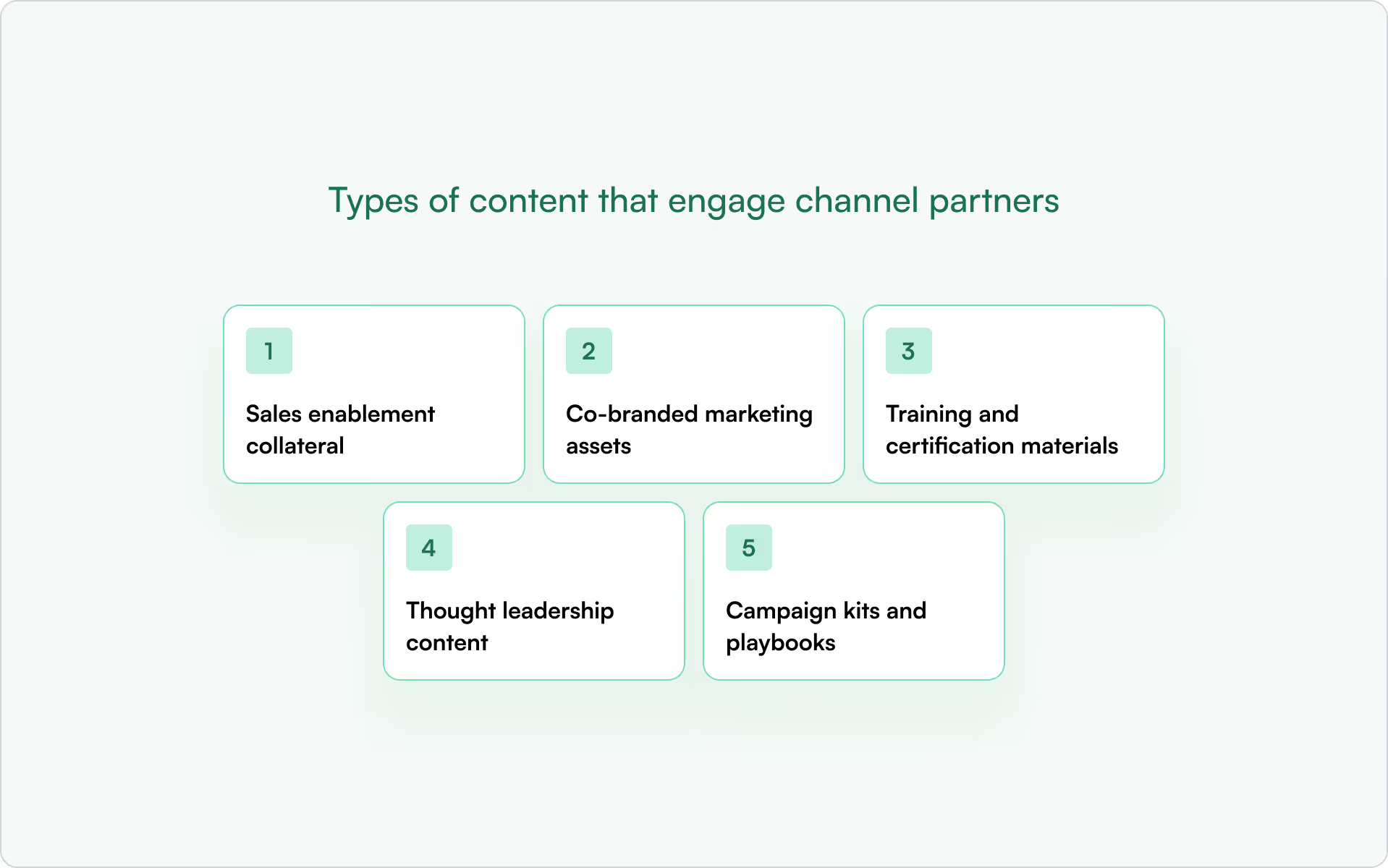
Vertriebsunterstützende Materialien
Zu den Sales-Enablement-Materialien gehören Battle Cards, One-Pager, Preisleitfäden und Wettbewerbsvergleiche. Partner nutzen diese Materialien, um Einwände von Käufern zu entkräften und Ihr Produkt in aktiven Verkaufsgesprächen zu positionieren.
Wenn Sie Prioritäten setzen, was zuerst entwickelt werden soll, beginnen Sie hier. Partner fragen frühzeitig nach Enablement-Inhalten, da diese die Geschäfte unterstützen, an denen sie bereits arbeiten.
Gemeinsame Marketingressourcen
Co-Branding-Inhalte umfassen Landing Pages, E-Mail-Vorlagen und Social-Media-Beiträge, die Partner mit ihrem Logo und Branding individuell anpassen können. Wenn dies gut gemacht wird, können Partner Leads generieren und gleichzeitig das Erscheinungsbild Ihrer Marke beibehalten.
Die Balance ist schwierig: Zu viel Kontrolle und die Partner werden es nicht nutzen; zu wenig und Ihre Marke wird verwässert. Bearbeitbare Vorlagen in Tools wie Canva oder Google Slides werden tendenziell häufiger genutzt als gesperrte PDFs.
Schulungs- und Zertifizierungsmaterialien
Die Schulungsinhalte umfassen Onboarding-Präsentationen, Produkt-Tutorials und Zertifizierungskurse. Partner können nicht verkaufen, was sie nicht verstehen, daher wirkt sich die Schulung direkt auf die Bereitschaft der Partner aus.
Zertifizierungsprogramme schaffen auch eine natürliche Zugangsbarriere zu exklusiven Produkten, höheren Stufen oder bestimmten Kundensegmenten.
Thought Leadership-Inhalte
Thought Leadership umfasst Blogs, Whitepaper und Webinare. Partner nutzen es, um bei ihrem Publikum Glaubwürdigkeit aufzubauen, ohne Inhalte von Grund auf neu erstellen zu müssen. In der Praxis können sie sich Ihr Fachwissen „ausleihen“.
Dies ist besonders wertvoll für Partner ohne interne Marketingressourcen, die sich dennoch als vertrauenswürdige Berater positionieren möchten.
Kampagnen-Kits und Spielbücher
Kampagnen-Kits enthalten alles, was ein Partner für die Durchführung einer Kampagne benötigt: E-Mail-Sequenzen, Social-Media-Texte, Landing Pages und manchmal auch Werbematerialien. Playbooks bieten eine Schritt-für-Schritt-Anleitung zur Verwendung dieser Kits.
Für Partner mit begrenzten Ressourcen beseitigen die Kits die Reibung, die entsteht, wenn man herausfinden muss, was als Nächstes zu tun ist. Sie führen einfach aus.
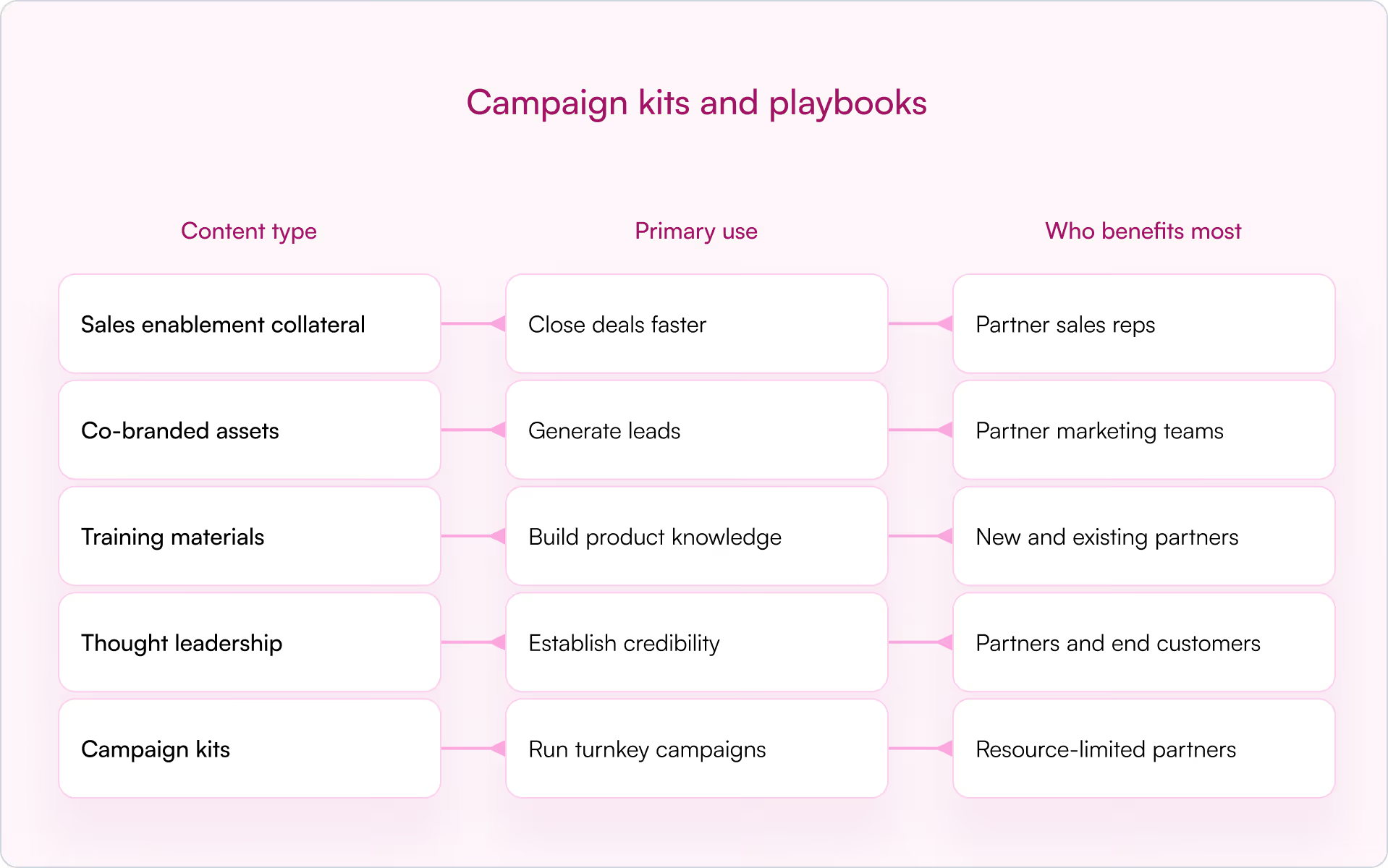
Wie man Inhalte auf verschiedene Partnertypen zuschneidet
Einheitslösungen funktionieren selten. Ein Wiederverkäufer, der Geschäfte direkt abschließt, hat andere Bedürfnisse als ein Empfehlungspartner, der Leads weiterleitet, und beide unterscheiden sich von einem SI, der maßgeschneiderte Implementierungen erstellt.
Wenn Sie eine höhere Akzeptanz erzielen möchten, passen Sie die Inhalte an den Partnertyp an – und machen Sie diese Segmentierung durch die Bezeichnung und Verteilung der Assets deutlich.
Vertriebspartner
Wiederverkäufer kaufen Ihr Produkt und verkaufen es weiter, wobei sie häufig den gesamten Verkaufszyklus abwickeln. In der Regel benötigen sie Preisleitfäden, Produktvergleiche und Verkaufspräsentationen, die sie den Käufern direkt vorlegen können.
Je selbstständiger Sie Ihre Wiederverkäufer machen, desto weniger wird Ihr Team zu einem Engpass bei jedem Geschäft.
Referral-Partner
Empfehlungspartner leiten Leads weiter, ohne Geschäfte abzuschließen. Ihre Anforderungen an Inhalte sind geringer: einfache Erklärmaterialien und E-Mail-Vorlagen, die Ihr Produkt vorstellen, ohne dass dafür tiefgreifende Produktkenntnisse erforderlich sind.
Halten Sie Empfehlungsinhalte kurz. Empfehlungspartner haben oft nur begrenzt Zeit und Aufmerksamkeit für einen einzelnen Anbieter.
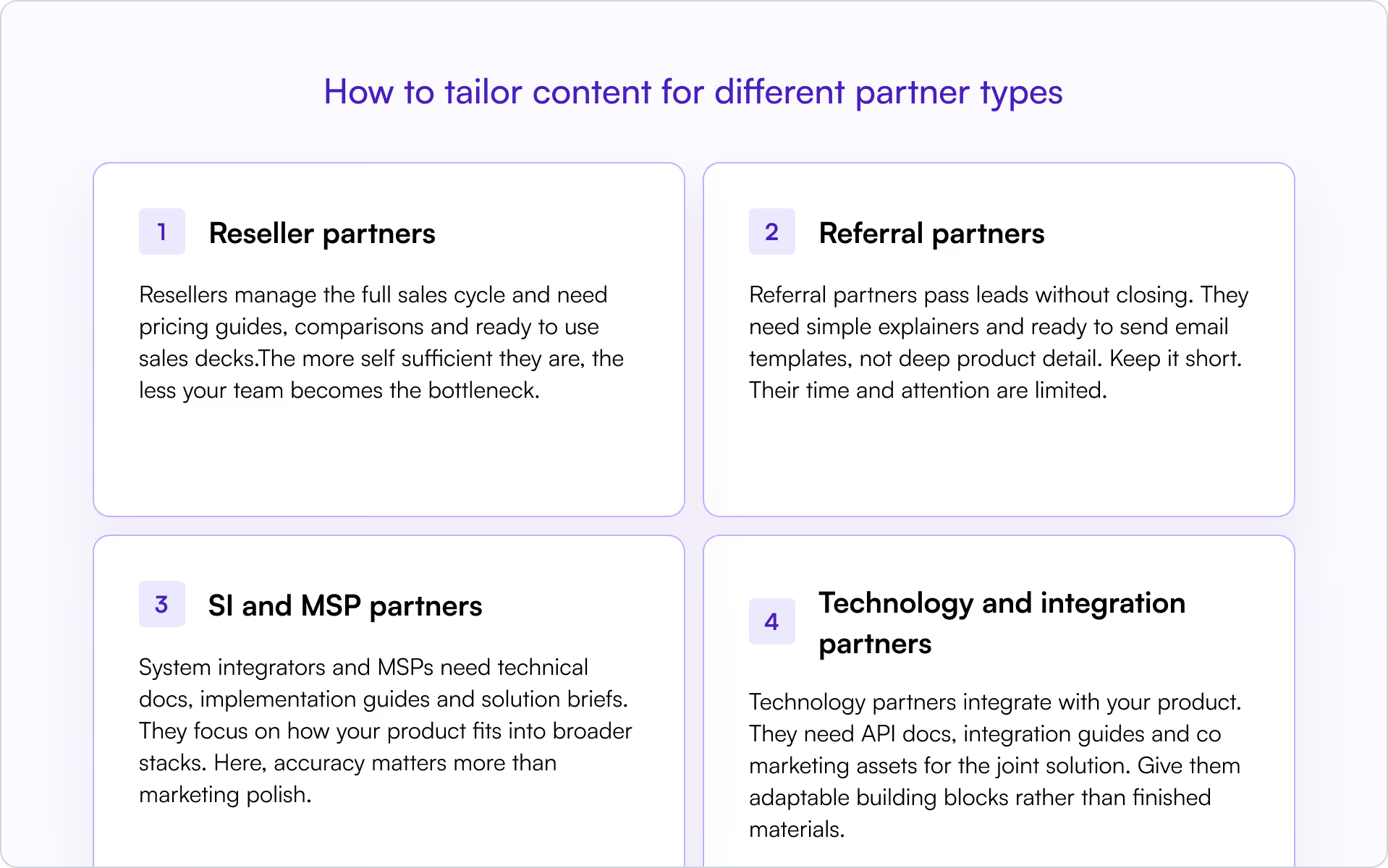
SI- und MSP-Partner
Systemintegratoren (SIs) und Managed Service Provider (MSPs) benötigen technische Dokumentationen, Implementierungsleitfäden und Lösungsbeschreibungen. Sie positionieren Ihr Produkt als Teil größerer Implementierungen und legen daher Wert darauf, dass Ihr Produkt in bestehende Stacks passt.
Technische Genauigkeit ist hier wichtiger als Marketing-Polish.
Technologie- und Integrationspartner
Technologiepartner integrieren sich in Ihr Produkt. Sie benötigen API-Dokumentation, Integrationsanleitungen und Co-Marketing-Materialien, die die gemeinsame Lösung hervorheben.
Viele Technologiepartner verfügen über eigene Marketingteams, daher ist die Bereitstellung anpassungsfähiger Bausteine oft besser geeignet als fertige Assets.
Bewährte Verfahren für die Erstellung von Partner-Marketinginhalten
Gute Partnerinhalte haben weniger mit Schreibfertigkeiten zu tun als vielmehr mit operativer Disziplin: Es geht darum, etwas zu entwickeln, das die Partner tatsächlich nutzen, das leicht anzupassen ist und das immer auf dem neuesten Stand ist.
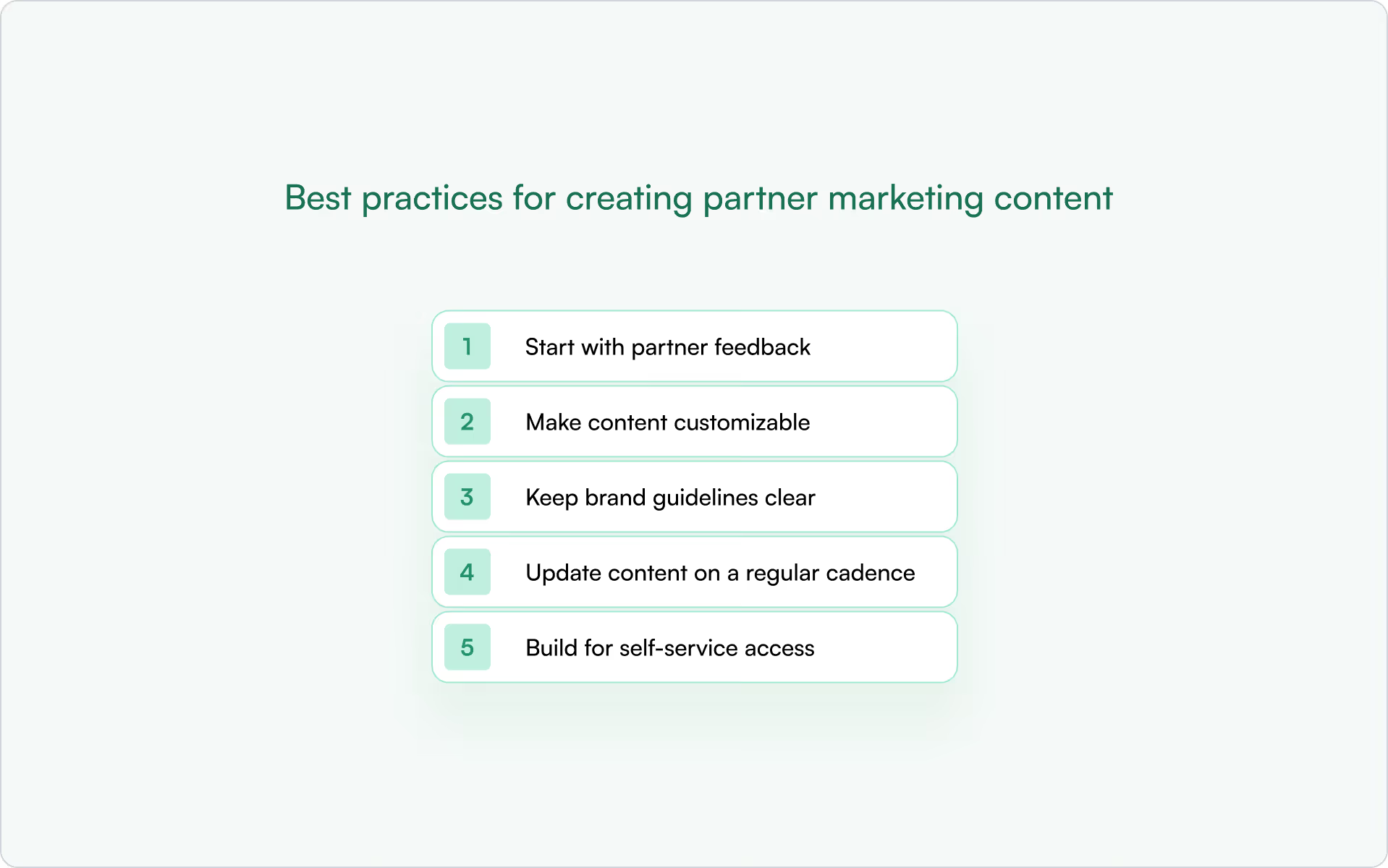
1. Beginnen Sie mit dem Feedback Ihres Partners.
Befragen Sie Ihre Partner, welche Inhalte sie benötigen und was fehlt. Inhalte, die ohne Input der Partner erstellt werden, bleiben oft ungenutzt, weil sie das falsche Problem lösen.
Selbst eine kurze Slack oder ein vierteljährlicher Check-in kann Lücken aufdecken, von denen Sie nichts wussten.
2. Inhalte anpassbar machen
Stellen Sie editierbare Vorlagen bereit, damit Partner ihr Branding hinzufügen können. Gesperrte PDF-Dateien frustrieren Partner und werden oft zugunsten von Dateien ignoriert, die sie tatsächlich bearbeiten können.
Canva-, Google Slides- und Figma-Vorlagen werden tendenziell häufiger verwendet als statische Dateien.
3. Halten Sie die Markenrichtlinien klar und deutlich
Teilen Sie einen einfachen Markenleitfaden mit Angaben zur Verwendung des Logos, zu Farben und zu den Dos and Don'ts bei der Kommunikation. Markenrichtlinien schützen Ihre Marke und geben Partnern gleichzeitig Spielraum, Inhalte individuell zu gestalten.
Das Ziel sind Leitplanken, keine Handschellen.
4. Inhalte regelmäßig aktualisieren
Veraltete Inhalte untergraben das Vertrauen der Partner. Wenn ein Partner veraltete Preise oder nicht mehr verfügbare Funktionen weitergibt, wirft das ein schlechtes Licht auf Sie beide.
Legen Sie einen vierteljährlichen Überprüfungszyklus fest und geben Sie Aktualisierungen bekannt, damit die Partner über den aktuellen Stand informiert sind. Plattformen wie Introw ermöglichen es Ihnen, Ankündigungen direkt per E-Mail und Slack an Partner zu senden, ohne dass eine Anmeldung im Portal erforderlich ist.
5. Für den Selbstbedienungszugang entwickeln
Organisieren Sie Inhalte in einem durchsuchbaren Partnerportal, damit Partner das Gesuchte finden, ohne Ihnen eine E-Mail senden zu müssen. Je weniger Hindernisse zwischen einem Partner und dem richtigen Asset bestehen, desto wahrscheinlicher ist es, dass er es nutzt.
CRM-First-Portale verknüpfen Inhalte mit Partnerdatensätzen, was wichtig ist, wenn Sie die Interaktion verfolgen und mit der Pipeline verknüpfen möchten.
Wie man Inhalte über ein Partnerportal verbreitet
Das Erstellen von Inhalten ist nur die halbe Miete. Die Verbreitung entscheidet darüber, ob Partner die Inhalte tatsächlich nutzen oder ob sorgfältig erstellte Assets in einem Ordner landen, den niemand öffnet.
Ein Partnerportal ist eine zentrale Anlaufstelle, über die Partner auf Ressourcen zugreifen, Geschäfte registrieren und mit Ihrem Team zusammenarbeiten können. Wie Sie Inhalte über dieses Portal organisieren und verbreiten, entscheidet darüber, ob es angenommen wird oder zu einem Friedhof für Inhalte wird.
Inhalte nach Partnerstufe und Typ organisieren
Strukturieren Sie Ihre Content-Bibliothek so, dass Partner zuerst relevante Assets sehen. Verwenden Sie Ordner oder Tags nach Partnerstufe (Gold, Silber) und Typ (Wiederverkäufer, Empfehlung, SI).
Wenn sich Partner einloggen und sofort Inhalte sehen, die zu ihrer Bewegung passen, engagieren sie sich. Wenn sie sich durch irrelevante Materialien wühlen müssen, geben sie oft auf.
Nutzen Sie Ankündigungen, um das Engagement zu fördern
Verlassen Sie sich nicht darauf, dass Partner das Portal überprüfen. Informieren Sie Ihre Partner per E-Mail und Slack über neue Inhalte, damit sie wissen, wenn etwas Relevantes veröffentlicht wird.
Die Ankündigungen von Introw schreiben Interaktionsdaten zurück an das CRM, sodass Sie ohne Spekulationen sehen können, welche Partner Ihre Updates geöffnet, angeklickt oder ignoriert haben.
Off-Portal-Zugriff per E-Mail aktivieren
Nicht alle Partner melden sich regelmäßig bei Portalen an. Einige bevorzugen E-Mails. Andere vergessen ihre Passwörter. So oder so führt das Erzwingen von Portal-Anmeldungen zu Reibungen.
Partner können Inhalte per E-Mail empfangen und beantworten, wobei die Antworten zur besseren Übersichtlichkeit mit Ihrem CRM synchronisiert werden. Durch den Zugriff außerhalb des Portals bleiben Inhalte zugänglich, ohne dass die Nachverfolgung beeinträchtigt wird.
Wie Inhalte Ihre Vertriebspartner-Strategie unterstützen
Content ist nicht nur eine Marketingfunktion. Content unterstützt direkt die Vertriebsstrategie Ihrer Vertriebspartner, indem er auf verschiedene Phasen des Partner-Lebenszyklus abgestimmt ist.
Die richtigen Inhalte zur richtigen Zeit beschleunigen die Leistung der Partner. Falsche Inhalte – oder gar keine Inhalte – führen zu Reibungsverlusten, die alles verlangsamen.
Inhalte für die Partnerakquise
Gewinnen Sie neue Partner mit Programmübersichten, Erfolgsgeschichten von Partnern und Zusammenfassungen der Vorteile. Die Inhalte zur Partnergewinnung beantworten die Frage, die sich jeder potenzielle Partner stellt: „Warum sollte ich diesem Programm beitreten?“
Überzeugende Rekrutierungsinhalte positionieren Ihr Programm als lohnenswert für die Zeit und Aufmerksamkeit des Partners, insbesondere wenn dieser mehrere Anbieter bewertet.
Inhalte für die Partneraktivierung
Schnellere Einbindung von Partnern durch Schnellstartanleitungen, Leitfäden für erste Geschäfte und Produktschulungen. Aktivierungsinhalte geben Antworten auf die Frage: „Wie fange ich an?“
Je schneller ein Partner seinen ersten Deal abschließt, desto wahrscheinlicher ist es, dass er engagiert bleibt. Aktivierungsinhalte verkürzen diesen Zeitrahmen.
Inhalt für den Fortschritt des Geschäfts
Helfen Sie Partnern mit Battle Cards, ROI-Rechnern und Kundenfallstudien dabei, Geschäfte abzuschließen. Inhalte zum Geschäftsfortschritt geben Antwort auf die Frage: „Wie schließe ich dieses Geschäft ab?“
Partner, die aktiv an Geschäftsmöglichkeiten arbeiten, benötigen oft kurzfristig bestimmte Ressourcen. Wenn Inhalte zum Fortschritt von Geschäften bereitstehen und leicht zu finden sind, kommen die Geschäfte voran.
- Rekrutierungsphase: Programmübersichten, Partner-Testimonials, Ein-Seiten-Übersichten zu den Vorteilen
- Aktivierungsphase: Onboarding-Checklisten, Produktschulungsvideos, Leitfäden für das erste Geschäft
- Deal-Fortschrittsphase: Battle Cards, Einwandbehandler, Kundenfallstudien
Wie man die Performance von Partnerinhalten misst
Inhalte ohne Messung sind reine Spekulation. Sie haben vielleicht das Gefühl, dass Sie Ihren Partnern helfen, aber ohne Daten können Sie nicht wissen, welche Ressourcen zu Ergebnissen führen und welche ignoriert werden.
Die Messung der Content-Performance auf Partnerebene und nicht nur auf Endkundenebene ist das, was strategische Content-Programme von Content-Friedhöfen unterscheidet.
Kennzahlen zum Content-Engagement
Verfolgen Sie Aufrufe, Downloads und die Verweildauer auf Inhalten. Metriken zum Content-Engagement zeigen, ob Partner Ihre Inhalte konsumieren.
Geringes Engagement deutet oft auf ein Vertriebsproblem, ein Relevanzproblem oder beides hin.
Partneraktivierungsmetriken
Messen Sie, wie viele Partner Onboarding-Inhalte oder Zertifizierungen abschließen. Partneraktivierungsmetriken zeigen an, ob Ihre Inhalte die Partner tatsächlich zu ihrem ersten Geschäftsabschluss führen.
Wenn Partner Schulungen absolvieren, aber nie Geschäfte abschließen, sind die Inhalte möglicherweise informativ, aber nicht umsetzbar.
Pipeline-Attributionsmetriken
Verbinden Sie die Nutzung von Inhalten mit registrierten Geschäften und abgeschlossenen Umsätzen. Durch die Pipeline-Attribution wird der ROI von Inhalten für die Unternehmensleitung sichtbar.
CRM-first-Plattformen wie Introw machen die Attribution innerhalb von Salesforce HubSpot sichtbar, sodass Sie bestimmte Content-Assets ohne manuelles Tracking mit bestimmten Pipeline-Ergebnissen verknüpfen können.
Partner-Marketingideen, die Sie im nächsten Quartal ausprobieren sollten
Wenn Sie nach Ideen für das Partnermarketing suchen, die Sie schnell umsetzen können, erzielen die folgenden Strategien in der Regel Ergebnisse, ohne dass dafür ein großer Aufwand erforderlich ist.
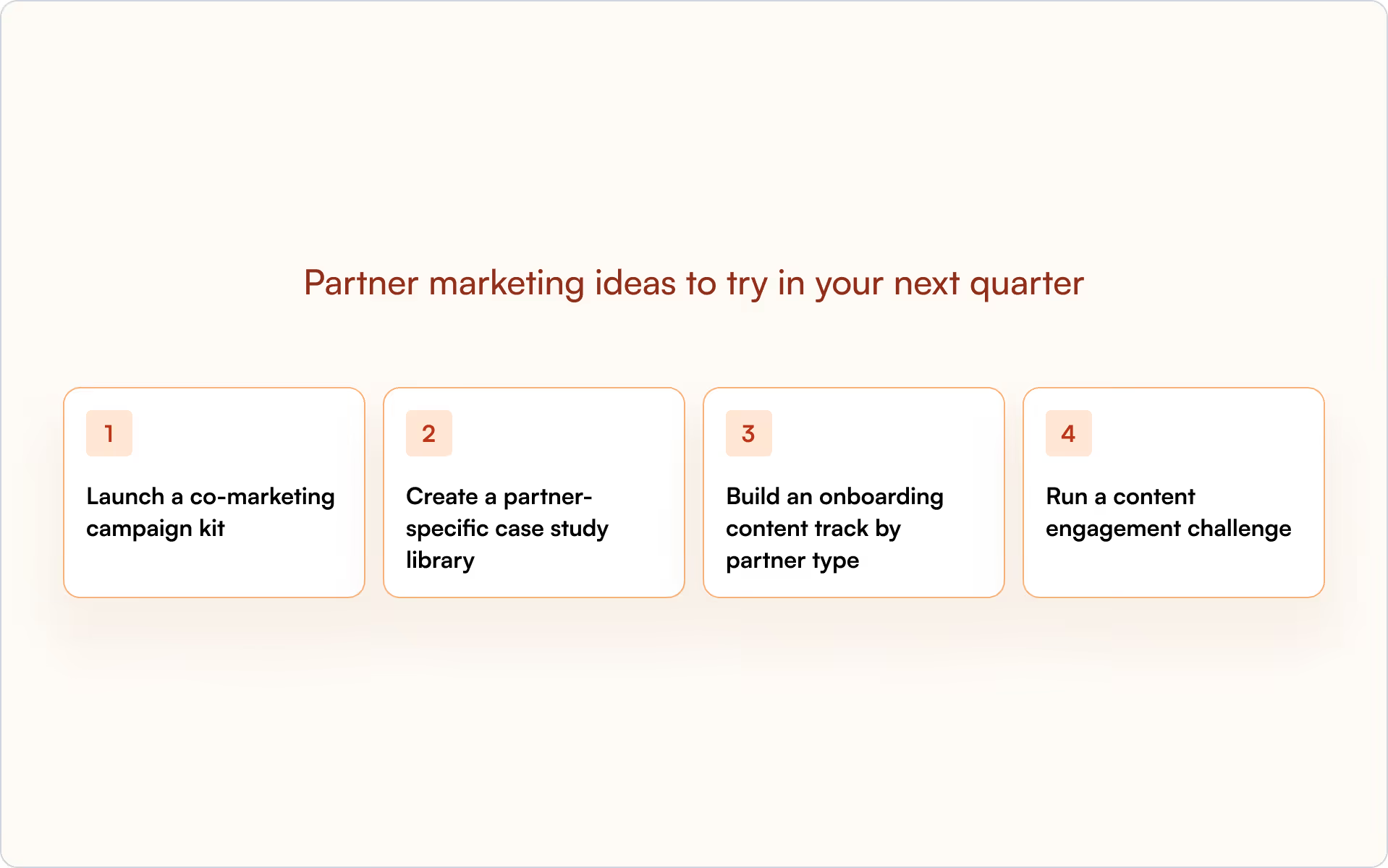
1. Starten Sie ein Co-Marketing-Kampagnen-Kit.
Bündeln Sie E-Mail-Vorlagen, Social-Media-Beiträge und eine Landingpage für einen bestimmten Anwendungsfall. Stellen Sie Ihren Partnern alles, was sie für die Durchführung einer Kampagne benötigen, in einem einzigen Download zur Verfügung.
Co-Marketing-Kampagnen-Kits eignen sich besonders gut für Produkteinführungen oder saisonale Werbeaktionen, bei denen das Timing eine wichtige Rolle spielt.
2. Erstellen Sie eine partnerspezifische Fallstudienbibliothek.
Entwickeln Sie Fallstudien zu Geschäften, die Partner zum Abschluss gebracht haben. Partnerspezifische Fallstudien liefern Partnern soziale Beweise, die sie mit potenziellen Kunden teilen können, und würdigen öffentlich die Beiträge der Partner.
Partner, deren Erfolge hervorgehoben werden, bleiben in der Regel engagierter.
3. Erstellen Sie einen Onboarding-Inhaltstrack nach Partnertyp.
Erstellen Sie separate Onboarding-Pfade für Wiederverkäufer, Empfehlungspartner und SIs. Maßgeschneiderte Onboarding-Inhalte beschleunigen die Zeit bis zum ersten Geschäftsabschluss, da Partner sich nicht durch irrelevante Materialien kämpfen müssen.
Selbst eine einfache Segmentierung – drei Spuren statt einer – kann die Aktivierungsraten deutlich verbessern.
4. Führen Sie eine Content-Engagement-Challenge durch.
Gamifizieren Sie den Konsum von Inhalten, indem Sie Partner belohnen, die Schulungen absolvieren oder Co-Branding-Assets teilen. Ranglisten und SPIFFs fördern die Teilnahme, insbesondere bei wettbewerbsorientierten Partnerteams.
Herausforderungen im Bereich Content Engagement funktionieren am besten, wenn die Belohnungen sinnvoll sind und die Nachverfolgung sichtbar ist.
Verwandeln Sie Partnerinhalte in Pipeline mit CRM-first-Distribution
Hier ist die unangenehme Wahrheit für Gründer: Inhalte generieren nur dann Umsatz, wenn sie zugänglich, nachverfolgbar und mit Ihrem CRM verknüpft sind. Andernfalls erstellen Sie Assets, die in einem Silo existieren – losgelöst von den Partnern und Geschäften, die sie eigentlich unterstützen sollen.
- Sichtbarkeit: Wenn Inhalte in einem CRM-First-Portal gespeichert sind, sehen Sie, welche Partner sich engagieren und welche nicht.
- Zuordnung: Mit Geschäftsabschlüssen verknüpfte Content-Downloads belegen die Marketingwirkung.
- Automatisierung: Ankündigungen werden per E-Mail und Slack an Partner weitergeleitet, Slack eine manuelle Nachverfolgung Slack .
Erfahren Sie, wie Introw Partnerteams dabei unterstützt, Inhalte zu verbreiten und die Interaktion innerhalb von HubSpot Salesforce zu verfolgen. Demo anfordern

