4 Wege, wie du deine B2B-Partner in Salesforce managst und Umsätze zuordnest
Bei der Zusammenarbeit mit B2B-Partnern ist es wichtig, genau nachverfolgen zu können, wer an Ihren Geschäften beteiligt ist und wie diese zum Umsatz beitragen.
Es gibt vier Möglichkeiten, B2B-Partner in Salesforcezu verwalten: Auswahlliste, Suchfeld, Beziehungstabelle oder benutzerdefiniertes Objekt. Jede davon eignet sich für unterschiedliche Komplexitätsgrade. Beginnen Sie einfach oder gehen Sie fortgeschritten vor, je nachdem, mit wie vielen Partnern Sie zusammenarbeiten und wie detailliert Ihre Zuordnung sein muss.
Bei der Zusammenarbeit mit B2B-Partnern ist es wichtig, genau nachverfolgen zu können, wer an Ihren Opportunities beteiligt ist und wie diese zum Umsatz beitragen. In Salesforce gibt es keine Einheitslösung – und genau das ist das Schöne daran. Je nach den Anforderungen Ihres Unternehmens, dem technischen Reifegrad und der Komplexität Ihres Partner-Ökosystems können Sie aus mehreren flexiblen Ansätzen wählen.
Im Folgenden stellen wir Ihnen vier gängige Methoden vor, wie Sie Partner in Salesforce verwalten Salesforce ihnen effektiv Umsätze zuordnen können.
1. Auswahl-Feld in einer Opportunity
Am besten geeignet für: Einfachere Programme mit einem Partner pro Opportunity
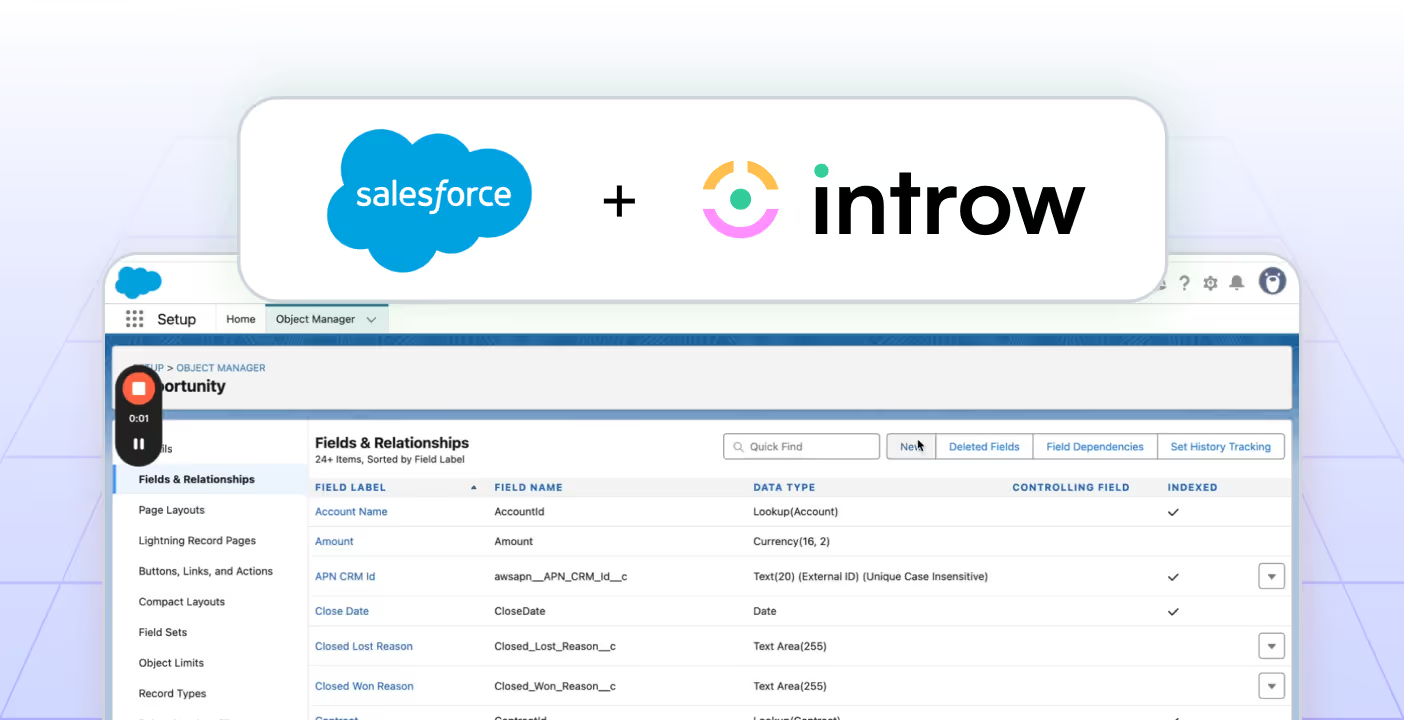
Die einfachste Methode ist, dem Opportunity-Objekt ein Picklist-Feld hinzuzufügen, — zum Beispiel ein Feld namens Partnername oder PartnerquelleDu definierst vorab eine Liste deiner Partner, und dein Sales-Team wählt beim Erstellen der Opportunity den richtigen Partner aus.
Wie funktioniert's?
Was sind die Vorteile?
✅ Einfach zu implementieren
✅ Keine komplexen Beziehungen erforderlich
✅ Gut für einfache Zuordnung zu einem einzelnen Partner
Was sind die Nachteile?
❌ Nicht ideal für Skalierung oder Multi-Touch-Attribution
2. Suchfeld für ein Account-Objekt Empfohlen
Am besten geeignet für: Eins-zu-eins-Attribution mit besserer Datenkontrolle
Ein Schritt weiter als eine Picklist ist die Verwendung eines Suchbeziehungsfelds, das eine Opportunity mit einem Account-Objekt verbindet. So kannst du auf einen vollständigen Account-Datensatz (deinen Partner) verweisen und relevante Details automatisch übernehmen.
Wie funktioniert's?
Was sind die Vorteile?
✅ Sauberer Verweis auf Partnerdaten, die in Ihren Konten gespeichert sind
✅ Kann Reporting und Automatisierung effektiver unterstützen
✅ Einfach zu aktualisieren, wenn sich der Account-Datensatz ändert
Was sind die Nachteile?
❌ Auf einen Partner-Account pro Opportunity beschränkt
3. Über eineBeziehungstabelle
Am besten geeignet für: Multi-Partner-Attribution oder geteilte Deals
Wenn du mehrere Partner pro Opportunity unterstützen musst, solltest du eine Beziehungstabelle verwenden, die zwischen Opportunities und Partner-Accounts angesiedelt ist. Dadurch entsteht eine Many-to-Many-Beziehung, die eine flexible Zusammenarbeit und eine erweiterte Umsatzbeteiligungslogik ermöglicht.
Wie funktioniert's?
Was sind die Vorteile?
✅ Ideal für Ökosysteme mit Resellern, Distributoren und Co-Marketing-Partnern
✅ Ermöglicht erweiterte Logik für Umsatzaufteilungen oder Co-Selling
✅ Ideal für Ökosysteme mit Resellern, Distributoren und Co-Marketing-Partnern
Was sind die Nachteile?
❌ Erfordert ein technisch anspruchsvolleres Setup und eine aufwendigere Konfiguration
❌ Komplexer für die Berichterstattung, sofern nicht standardisiert
4. Benutzerdefiniertes Objekt für Partner
Am besten geeignet für: Partnerprogramme im großen Maßstab mit Tiers, Statusmodellen und mehreren Partner-Touchpoints.
Für Unternehmen, die ihre Partner als zentralen Bestandteil des Salesforce behandeln möchten, ist die Erstellung eines dedizierten Partnerobjekts die robusteste Option. Sie können dieses Objekt mit Opportunities, Kontakten, Konten und mehr verknüpfen und benutzerdefinierte Partnerattribute wie Stufe, Region, Branchenschwerpunkt usw. verfolgen.
Wie funktioniert's?
Was sind die Vorteile?
✅ Vollständig flexibel und skalierbar
✅ Ermöglicht umfangreichere Partnerdaten und Automatisierung
✅ Besser geeignet für dPartner-Performance-Analysen und Programm-Insights
Was sind die Nachteile?
❌ Erfordert Vorausplanung und Schema-Design
❌ Erfordert die Zustimmung vom Operations- und möglicherweise dem Entwicklerteam
Fazit
Die Wahl der richtigen Methode zur Verwaltung und Zuordnung Ihrer B2B-Partner in Salesforce von der Komplexität Ihrer Partnerschaften und dem Umfang der von Ihnen benötigten Berichterstellung oder Automatisierung Salesforce . Während einfache Auswahllisten für Programme in der Anfangsphase geeignet sind, eignen sich Beziehungstabellen oder benutzerdefinierte Objekte besser für ausgereifte Ökosysteme.
Bei Introw helfen wir Kunden dabei, die Workflows ihrer Partner direkt in Salesforce zu integrieren Salesforce so wird es einfach, Partnern Aufgaben zuzuweisen, mit ihnen zusammenzuarbeiten und zu skalieren, unabhängig davon, welche Methode Sie verwenden.
Partner.io is a newer PRM focused on partner collaboration and portal experiences. This guide compares 14 Partner.io alternatives for teams that need deeper CRM integration, stronger automation, and broader partner management capabilities. For most growing SaaS companies, Introw is the strongest overall alternative thanks to its CRM-native approach, AI-powered workflows, and full-lifecycle partner management.
Why teams compare Partner.io with other PRMs
Partner.io is a newer partner management platform focused on partner collaboration and pipeline visibility. As programs grow, many teams evaluate Partner.io alternatives with deeper CRM integration, stronger automation, and broader partner management capabilities.
Key evaluation criteria
Before choosing a platform, consider:
Platform maturity: Customer base, reviews, case studies, and long-term product stability
Partner lifecycle coverage: Support for partner onboarding, partner training, deal registration, MDF, incentives, and partner engagement
CRM integration: How deeply the platform connects with Salesforce or HubSpot, including partner data synchronization and workflow automation
AI capabilities: Whether AI reduces manual work through coaching, automation, insights, or content creation
Partner collaboration: How easily partners can work with your team through a partner portal and other engagement channels
Scalability: Whether the platform can support more partners, additional partner types, and a growing partner motion without adding complexity
The best choice is the platform that fits both your current program and where you expect partner revenue to grow over the coming years.
Partner.io alternatives at a glance
Use this table to compare each Partner.io comp by maturity, CRM fit, AI depth, and how much of the partner lifecycle each tool supports.
Tool
Established since
CRM-Integration
AI capability
Zusammenarbeit außerhalb des Partnerportals
Partner lifecycle
Embedded LMS
Introw
2023
Native
Agentic
Yes
Full
AI-powered
Kiflo
2019
Basic
None
No
Partial
None
Euler
2023
Basic
Advisory
Yes
Partial
None
PartnerStack
2015
Middleware
None
No
Partial
Basic
Impartner
1997
Middleware
Advisory
No
Full
Basic
Salesforce Experience Cloud / Partner Cloud
2013
Native
Agentic
No
Full, build-heavy
None
ChannelScaler
2025
Middleware
Advisory
No
Full
Basic
Gedankenmatrix
1998
Basic
Content
No
Full
Basic
ZINFI
2007
Basic
Advisory
No
Full
Basic
Magentrix
2012
Native
None
No
Partial
None
Channeltivity
2007
Basic
None
No
Partial
Basic
impact.com
2008
Basic
Advisory
No
Partial
None
Crossbeam
2018
Native
Advisory
No
Partial
None
Everflow
2016
Basic
Advisory
No
Partial
None
When comparing tools, focus on CRM integration, partner onboarding, partner training, reporting, and how well the platform supports growth over time.
If you’re looking for a Partner.io alternative, these are the PRM platforms most commonly evaluated by SaaS companies that need stronger partner collaboration, better CRM integration, and support for the entire partner program.
#1 Introw - Best overall Partner.io alternative for CRM-native partner management
What it does
Introw is an AI-first PRM platform built directly around Salesforce and HubSpot. Instead of creating another database, it keeps CRM data as the system of record and extends it to partners through a white-label partner portal, email, Slack, AI-powered workflows, and automated collaboration.
The platform supports the full partner lifecycle, including partner onboarding, partner training, MDF, partner engagement, partner agreements, commissions, partner events, account mapping, co-selling, and partner-sourced revenue reporting.
Notable capabilities include:
Deep CRM integration with Salesforce and HubSpot
White-label no-code partner portal builder
AI-powered deal coaching and recommendations
Embedded partner LMS with AI-generated training modules
Most teams can go live in 2 to 4 days without custom development.
Why it’s the best Partner.io alternative
Introw supports the entire partner program, from partner onboarding and partner training to MDF, partner engagement, deal coaching, and partner-influenced revenue reporting.
Instead of stitching together multiple tools, Introw combines partner management, account mapping, channel conflict detection, and reporting in one platform.
Its built-in AI agent helps automate content creation, training, analysis, and partner communications.
Unlike portal-first platforms, Introw also supports collaboration through email and Slack, helping reseller partners, referral partners, and channel managers stay engaged without extra logins.
Custom pricing based on program requirements. A 14-day free trial is available.
Am besten geeignet für
SaaS companies with 2+ partner managers that want a modern PRM platform with deep CRM integration, AI-powered workflows, a centralized hub for partner management, and support for the entire partner program.
#2 Kiflo - Best for SMBs wanting a simple, affordable starting point
What it does
Kiflo is a lightweight PRM platform focused on partner onboarding, deal registration, referral partners, reseller partners, commission management, and basic partner management workflows. It offers a clean partner portal and a quick setup process for smaller teams.
Why someone might choose it over Partner.io
Kiflo has more customer reviews, and provides a straightforward way to launch a partner program without significant complexity. It supports Salesforce and HubSpot and covers the core needs of many SaaS startups.
Where it falls short
No AI capabilities
No off-portal collaboration
No embedded LMS or partner training
Limited performance tracking and engagement metrics
No support for MDF or advanced channel conflict workflows
Less suitable for partnership teams managing more partners or complex partner motions
CRM integrations
HubSpot
Salesforce
Preise
Low-entry pricing with plans based on partner volume.
Am besten geeignet für
Small SaaS companies launching a new partner program that need an affordable partner management system with basic CRM integration and a simple partner experience.
#3 Euler - Best for newer programs wanting modern PRM with AI assistants
What it does
Euler is a modern PRM platform built for partner management, partner onboarding, and distributor relationships. Its AI assistants, PAM and POPS, help automate common partner management tasks and support a growing partner network.
Why someone might choose it over Partner.io
Euler shares Partner.io’s modern approach but adds advisory AI capabilities. It also has traction in distribution-heavy environments and offers a polished experience for new partners.
Where it falls short
No embedded LMS
No MDF management
No white-label flexibility
Limited support for complex partner agreements
No deep CRM integration with custom objects
CRM integrations
HubSpot
Salesforce
Preise
Custom pricing.
Am besten geeignet für
Growing SaaS companies that want a modern partner platform with AI assistance and a relatively simple setup.
#4 PartnerStack - Best for affiliate and referral programs with automated payouts
What it does
PartnerStack is a partnership platform focused on affiliate programs, referral partners, automated payouts, tracking links, and partner recruitment through its marketplace.
Why someone might choose it over Partner.io
It offers a large partner network, built-in payout infrastructure, and proven processes for SaaS companies running affiliate-driven partnerships at scale.
Where it falls short
Limited support for reseller partners
CRM integration relies on middleware
Rigid portal experience
No co-selling workflows
Limited support for partner-sourced revenue management
CRM integrations
Salesforce (via Workato)
HubSpot (via Workato)
Preise
Marketing plans start at $1000/mo. Growth plans start at $1520/mo. Enterprise pricing is custom.
Am besten geeignet für
Companies focused on affiliate and referral growth rather than complex channel partnerships.
#6 Salesforce Experience Cloud (Partner Cloud) - Best for Salesforce-only teams wanting maximum native control
What it does
Salesforce Experience Cloud lets businesses build a highly customized partner portal directly on Salesforce. It provides complete control over CRM data, workflows, and partner experiences.
Why someone might choose it over Partner.io
Organizations already standardized on Salesforce get native access to CRM data, reporting, and customization options without relying on a third-party PRM platform.
Where it falls short
Requires development resources
Long deployment timelines
No built-in partner LMS
No off-portal collaboration
Higher ownership costs than most partner management tools
CRM integrations
Salesforce (native)
Preise
Partner Community pricing starts at $20/login or $50/member billed annually.
Am besten geeignet für
Salesforce-centric enterprises with internal development teams.
#12 impact.com - Best for affiliate, influencer, and performance marketing
What it does
impact.com helps businesses manage affiliate, influencer, referral, and ecommerce partnerships with automated payouts and large-scale tracking capabilities.
Why someone might choose it over Partner.io
It excels at performance marketing and supports high-volume partnership programs with strong reporting and automation.
Where it falls short
Not a traditional PRM platform
No partner onboarding workflows
No deal registration
No partner portal for channel relationships
CRM integrations
Limited compared with dedicated PRMs
Preise
Custom pricing with transaction-related costs.
Am besten geeignet für
Organizations focused on affiliate and influencer revenue programs.
#13 Crossbeam (Reveal) - Best for ecosystem data and account mapping
What it does
Crossbeam helps teams identify overlap between customers, prospects, and partners through account mapping and ecosystem intelligence.
Why someone might choose it alongside Partner.io
It helps track partner opportunities, identify co-selling opportunities, and improve partner-influenced revenue through shared data insights.
Where it falls short
Not a PRM platform
No partner portal
No onboarding workflows
No engagement tools
No deal registration
CRM integrations
Salesforce
HubSpot
Preise
Free plan available. Starter: $4800/year. Enterprise pricing available on request.
Am besten geeignet für
Organizations that want ecosystem intelligence alongside a PRM platform.
#14 Everflow - Best for high-volume performance marketing tracking
What it does
Everflow provides performance tracking, fraud detection, automated payouts, and analytics for affiliate, referral, and influencer partnerships.
Why someone might choose it over Partner.io
It offers strong tracking capabilities, real-time visibility, and detailed reporting for organizations managing large volumes of partnership activity.
Where it falls short
Not a PRM platform
No partner onboarding
No LMS
No partner portal
No channel collaboration workflows
CRM integrations
Limited
Preise
Custom pricing based on program scale and payout requirements.
Am besten geeignet für
Companies managing large-scale affiliate and referral programs where tracking and attribution are the primary priorities.
Now that you’ve seen the options, the goal is finding a platform that fits your teams today and can scale with your partner program tomorrow.
Das Fazit
Partner.io may be a good fit if you’re launching your first partner program and want a straightforward way to manage collaboration.
Before you choose a platform, ask whether it can support:
New partners as your program grows
Referral partners, reseller partners, and tech partners
Automated onboarding and partner agreements
Multiple pipeline stages and evolving partner motions
Accurate partner-sourced revenue and partner-influenced revenue reporting
Full visibility into partner data, engagement metrics, and account mapping
The best partner management tools do more than provide a portal. They help partnership teams empower partners, improve the partner experience, reduce manual work, and generate more value from existing partnerships.
Introw combines AI, automation, and reporting in one hub instead of multiple systems.
It gives channel managers and heads of partnerships a centralized hub for partner engagement, marketing assets, and performance insights, all built around your CRM.
Still deciding? Our guide on choosing your next PRM covers the questions worth asking before investing in any partner management system.
Why teams choose Introw when looking for Partner.io alternatives
The right PRM should help you grow partner revenue without creating more work.
+70% more partner pipeline
Introw helps partnership teams attract more partners and move opportunities through pipeline stages faster. Deal flow stays connected to your CRM, while channel conflict detection helps prevent duplicate registrations.
+75% faster partner onboarding
Get started in days, not months. Automated onboarding, AI-generated training content, certification paths, and marketing assets help new partners become productive faster. More than 200 SaaS companies use Introw to support their entire partner program.
+60% more partner-influenced revenue
See how partnerships contribute to total revenue. Full visibility into partner-sourced revenue, partner-influenced revenue, engagement metrics, and performance tracking makes it easier to scale what’s working.
For referral partners, reseller partners, and tech partners, Introw provides one hub for collaboration, enablement, and growth.
Partner enablement gives partners the training, content, tools, and support they need to sell independently rather than relying on constant hand-holding from your team. The most effective programmes are structured, segmented by partner type, and connected to the CRM so you can measure readiness, track activation, and attribute revenue accurately. Strong enablement focuses on reducing time to first deal, delivering role-based training, and giving partners collateral they will actually use in live opportunities. To understand whether the programme is working, teams should track outcome-based metrics such as pipeline, revenue, certifications, and activation speed rather than vanity portal activity.
Partner enablement looks simple on paper: give partners the right resources, and they’ll sell your product. In practice, most programs stall because content is scattered, training is generic, and no one can tell which partners are actually ready to close deals.
The difference between a partner program that generates attributable revenue and one that drains resources usually comes down to structure — clear goals, the right content at the right time, and data that lives in your CRM instead of a forgotten portal. This guide breaks down partner enablement best practices from strategy through execution, plus the metrics that tell you if it’s working.
Was ist Partner-Enablement?
Partner enablement is the system you build to help external partners sell (and often implement) your product effectively. That system typically includes structured onboarding, tailored training, and easy access to the right resources so partners can move deals forward without waiting on your team.
When partner enablement is done well, partners don’t just understand what you do. They can position it, handle objections, run a clean handoff, and create repeatable wins — the same way a high-performing internal sales team would.
What partner enablement typically includes
Training and certification: Product knowledge, positioning, and selling motions (with a quality bar partners must meet).
Sales and marketing resources: Collateral, templates, and campaigns partners can use with prospects.
Tools and portal access: Systems that streamline deal registration, content access, and communication.
Ongoing communication: A predictable cadence for updates, feedback, and performance reviews.
Why partner enablement matters for revenue growth
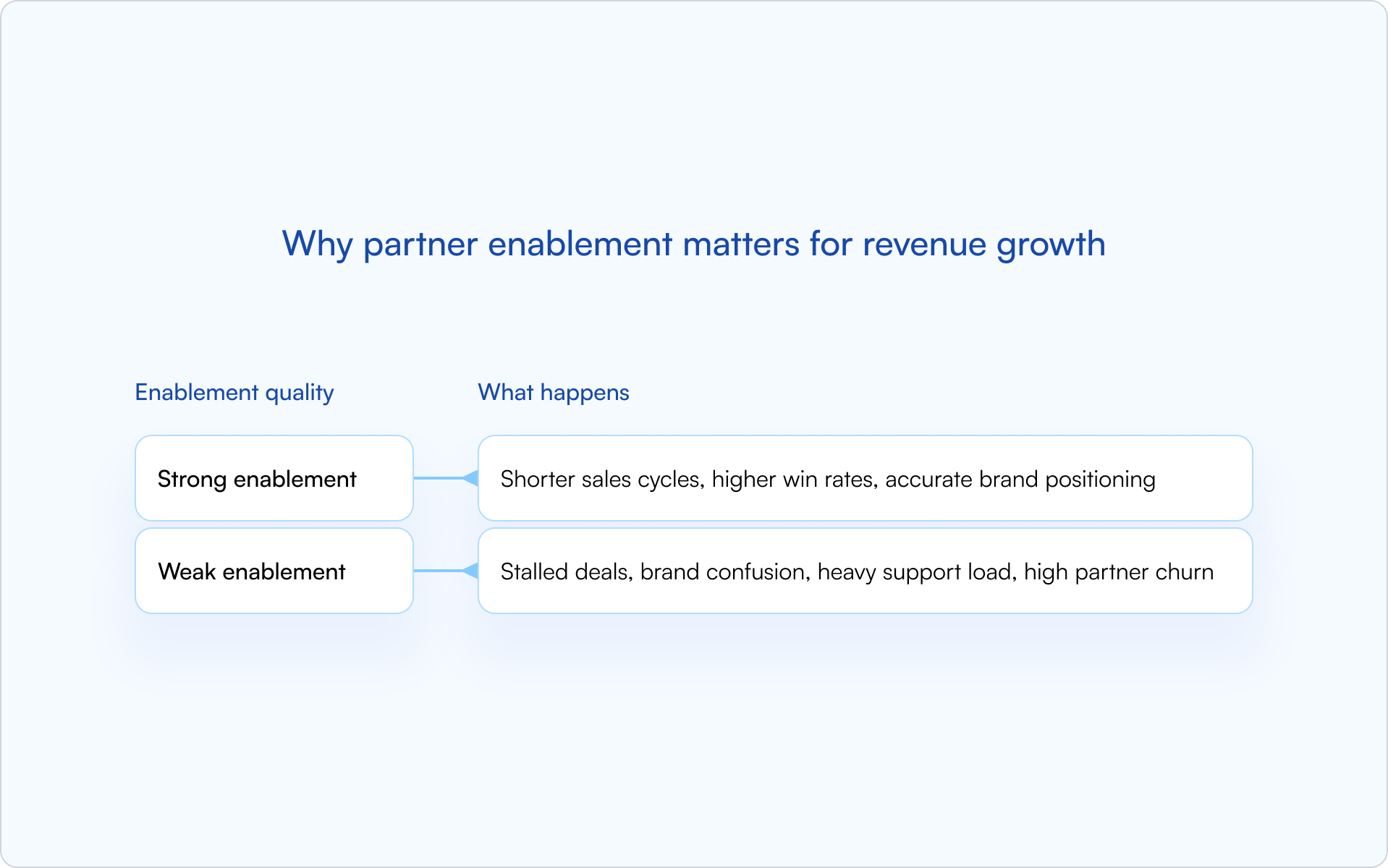
Enabled partners drive revenue because they can execute without friction. They close deals faster, represent your brand accurately, and generate pipeline you can actually attribute.
Weak enablement is expensive in quieter ways: partners misposition the product, opportunities stall, your team becomes the bottleneck, and high-potential partners churn because “it’s too hard to work with you.”
Enablement quality
What happens
Strong enablement
Shorter sales cycles, higher win rates, accurate brand positioning
Weak enablement
Stalled deals, brand confusion, heavy support load, high partner churn
What a partner enablement program includes
A complete channel partner enablement program isn’t a portal full of PDFs. It’s a structured system that helps partners learn, launch, and improve — with clear ownership and measurable outcomes.
Partnerschulung und -zertifizierung
Training forms the foundation: product knowledge, competitive positioning, and your sales methodology. Certification acts as a gate, ensuring partners meet a minimum quality bar before they’re authorized to sell on your behalf.
Partner sales enablement
Partner sales enablement means giving partners the same caliber of sales tools your direct team uses, adapted to their role. Think: battle cards, demo scripts, objection-handling guides, and pricing documentation.
Marketing support and co-marketing
Effective enablement helps partners generate demand, not just close it. Co-branded assets, “campaign-in-a-box” kits, and structured lead-sharing programs all increase partner-sourced pipeline.
A partner portal should be a self-service hub for training, collateral, deal registration, and updates. But there’s a common failure mode: partners avoid portals that require a separate, inconvenient login.
CRM-first portals reduce that friction by connecting directly to HubSpot or Salesforce, so partners can work inside the flow of real deals instead of “checking another system.”
Performance tracking and ongoing communication
Enablement is ongoing, not a one-time launch. A strong program includes visibility into partner activity, a consistent communication cadence, and mechanisms for gathering feedback and improving the experience.
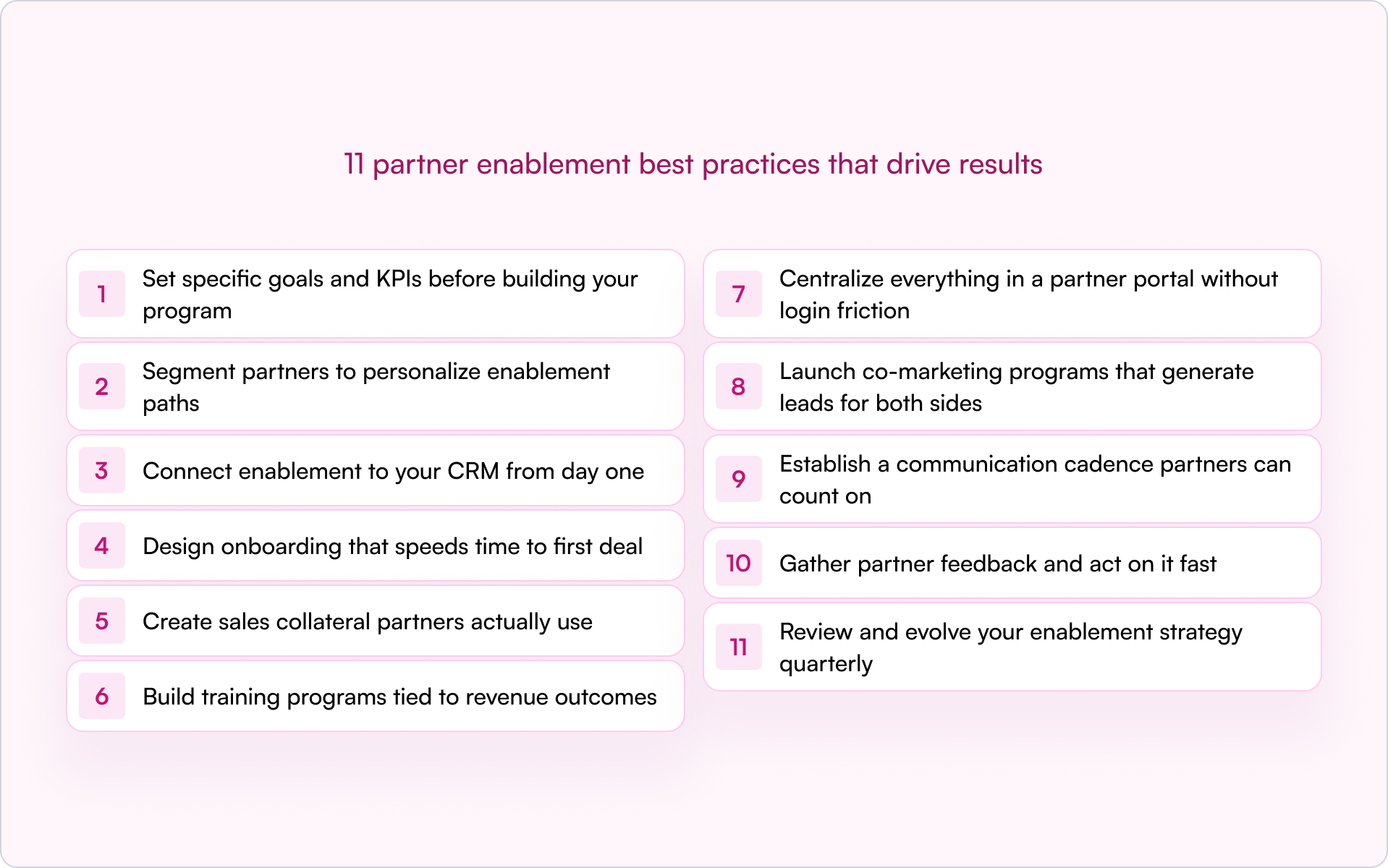
11 partner enablement best practices that drive results
If you’re building a partner program inside a startup, your constraint is almost never “ideas.” It’s focus and execution. These partner enablement best practices move from strategy through rollout and iteration — with an emphasis on what actually shows up in pipeline.
1. Set specific goals and KPIs before building your program
Before you create a single asset, define what success looks like. Start with outcomes — partner-sourced revenue targets, certification completion rates, and a target time-to-first-deal — then work backward into the program.
Partner-sourced pipeline value
Certification completion rate
Average time from onboarding to first registered deal
Content engagement (downloads, video views)
2. Segment partners to personalize enablement paths
Not all partners need the same materials. Segment by partner type (reseller, referral, systems integrator), vertical focus, or performance tier, then tailor training and content accordingly.
Segment
Enablement focus
Reseller
Deep product training, pricing, deal registration
Referral-Partner
Lightweight pitch training, lead handoff process
SIs/MSPs
Technical implementation guides, certification
3. Connect enablement to your CRM from day one
For true visibility and attribution, all your enablement data — certifications, content consumption, deal registrations — lives best in your CRM, not in a disconnected system.
A CRM-first approach provides a single source of truth. When partner activity syncs directly to HubSpot or Salesforce, your sales team and RevOps see the same reality. No more chasing updates or reconciling spreadsheets. (If deal attribution is a pain point today, it’s worth tightening up your workflow around partner deal registration specifically.)
4. Design onboarding that speeds time to first deal
Partner onboarding works best as a structured, time-bound journey — not a massive content dump. The goal is to get partners to their first real opportunity quickly, then reinforce with deeper training once momentum is real.
Don’t reinvent the wheel. Audit the sales collateral your direct team uses most effectively and adapt it for your partners. Prioritize assets that accelerate live deals: one-pagers, battle cards, ROI calculators, and customer stories.
The fastest way to avoid producing content no one opens is simple: ask partners what they need to win the deals they already have, then build for that.
6. Build training programs tied to revenue outcomes
Training works best when it’s modular, role-based, and tied to certification. Use certification as a gate — for example, require a partner to complete key modules before they can register deals or request MDF.
On-demand training offers flexibility; live sessions drive engagement for complex topics. Most teams land on a hybrid model.
7. Centralize everything in a partner portal without login friction
A partner portal should be the single place to find enablement content, register deals, and get program updates. But portals fail when they add friction — especially separate logins, stale content, and unclear navigation.
If you want adoption, reduce steps. Portals built directly on the CRM (with SSO or no-login options) make access feel seamless, which is often the difference between “partners love it” and “partners ignore it.”
8. Launch co-marketing programs that generate leads for both sides
Co-marketing goes beyond providing partners with your logo. Joint webinars, co-branded content like eBooks or case studies, and Market Development Funds (MDF) programs actively help partners generate demand.
If you’re a founder, this is one of the highest-leverage shifts you can make: partners often need help creating pipeline, not just closing it.
9. Establish a communication cadence partners can count on
Define a predictable rhythm. Partners shouldn’t have to guess where to find updates or whether deal registration is working. Use channels like email and Slack to reach partners where they already operate — don’t rely solely on them logging into a portal.
Häufigkeit
What to communicate
Wöchentlich
Deal registration status updates
Monatlich
Product updates, new content announcements
vierteljährlich
QBRs, performance reviews, program changes
10. Gather partner feedback and act on it fast
Enablement is a two-way street. Collect feedback through surveys, QBR conversations, and portal analytics — then close the loop by making changes and telling partners what you changed.
Partners keep investing when they feel momentum. Small, fast improvements create that signal.
11. Review and evolve your enablement strategy quarterly
Partner enablement isn’t set-and-forget. Quarterly, review what’s working and what isn’t by analyzing content engagement, certification rates, and revenue impact. Then adjust your program like you’d adjust product — based on usage and outcomes.
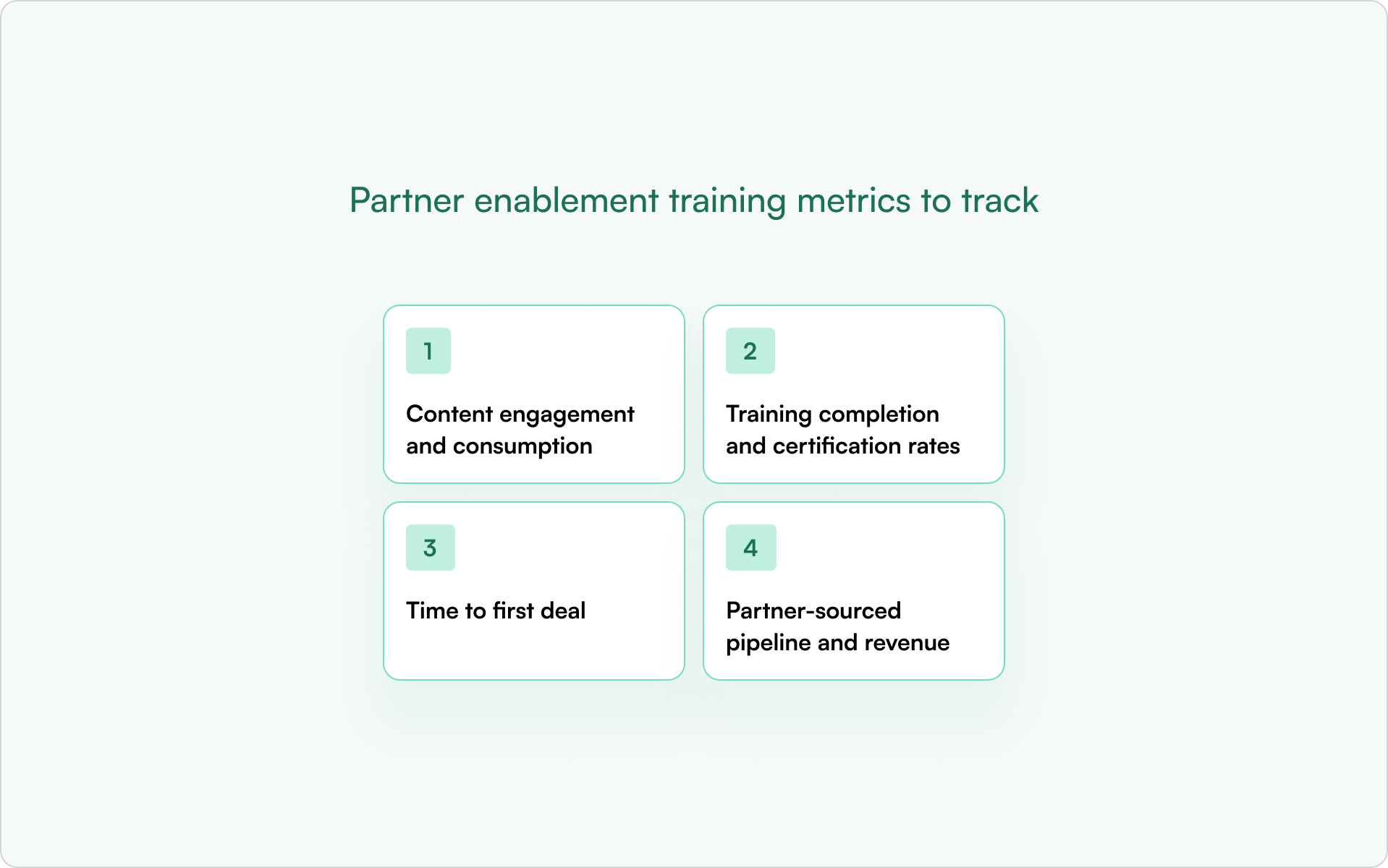
Track which resources partners actually use: downloads, video completion rates, and page views. Low engagement can signal the content isn’t relevant, is hard to find, or doesn’t match what partners need in active deals.
Training completion and certification rates
Measure how many partners complete onboarding and earn certifications. Completion rates help you pinpoint drop-off points so you can shorten, reorder, or redesign modules.
Zeit bis zum ersten Geschäft
Track the time between partner activation and their first registered deal. This is one of the cleanest indicators that onboarding is working — or that partners are stuck.
Partner-sourced pipeline and revenue
This is the ultimate scoreboard. Track pipeline and closed-won revenue generated by partners. To do it well, you need tight CRM attribution so enablement activity can be tied to financial results without manual cleanup.
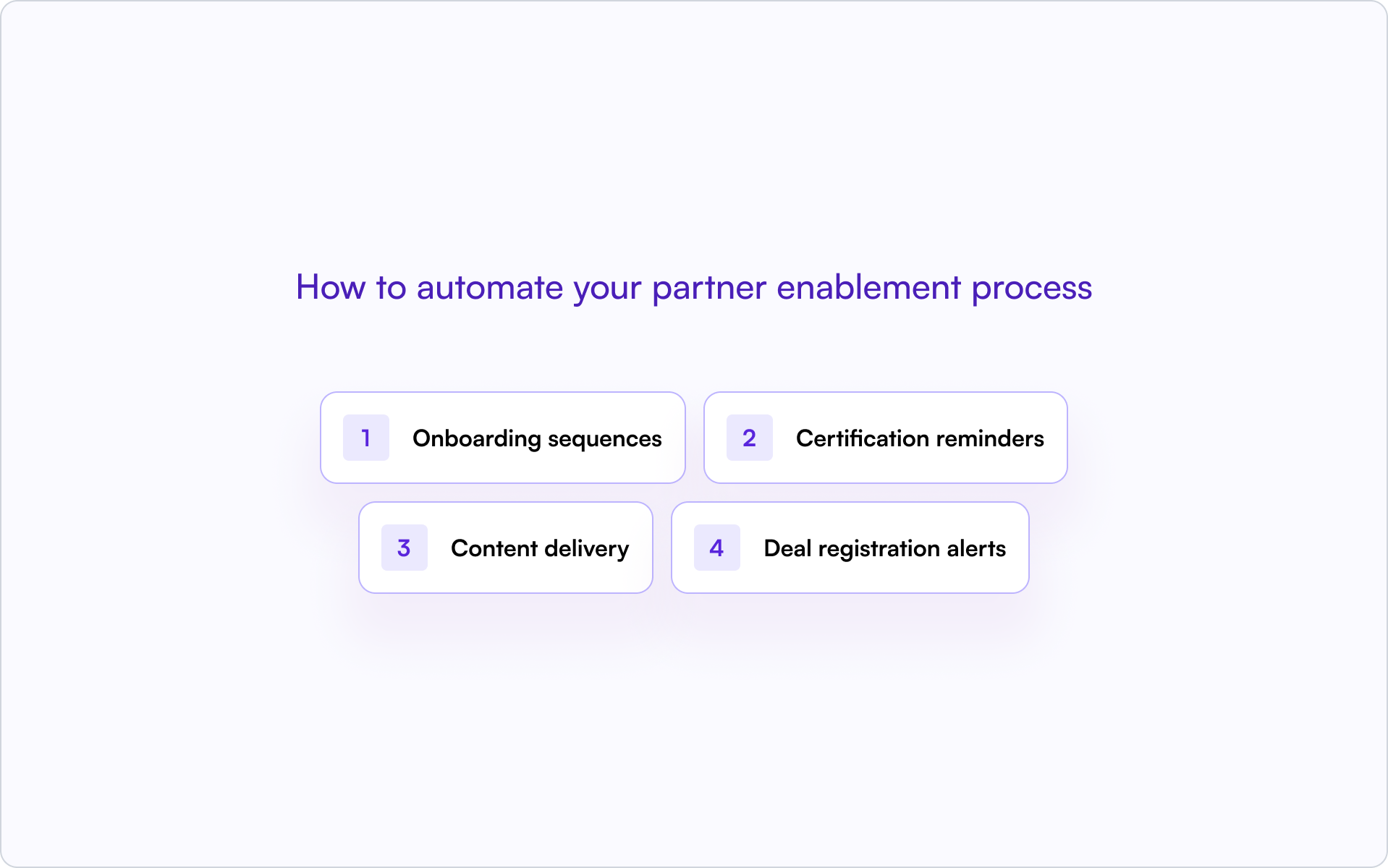
How to automate your partner enablement process
Automation lets you scale partner enablement without scaling headcount. The goal isn’t to make the experience robotic — it’s to make it consistent, timely, and measurable.
CRM-based automation is ideal because it keeps data and workflows in one system. That’s how you avoid the “portal says one thing, CRM says another” problem.
Onboarding sequences: Automatically enroll new partners in training modules and send welcome materials as soon as they sign up.
Certification reminders: Trigger automated alerts to partners and partner managers before certifications expire.
Content delivery: Push relevant collateral to partners based on their segment, tier, or deal stage.
Deal registration alerts: Automatically notify partners of the status of their registered deals.
Turn partner enablement into a revenue engine with Introw
Introw is the CRM-first PRM that makes best-practice partner enablement practical and scalable. Because it’s built on HubSpot and Salesforce, Introw centralizes your entire partner program where you already work.
It includes a partner portal for centralizing enablement content without login friction, deal registration with real-time visibility, and off-portal collaboration so partners can reply via email while data syncs automatically to your CRM.
If you’re trying to get out of spreadsheet chaos and into measurable partner-sourced revenue, get a demo.
Fazit
The best partner enablement programs aren’t built on more content — they’re built on clarity. Clear goals, segmented paths, CRM-connected workflows, and a focus on speed-to-first-deal turn “partners we signed” into “partners who ship revenue.”
Use these partner enablement best practices as a blueprint, then iterate quarterly based on what your data (and your partners) tell you.
Channeltivity is a long-standing partner relationship management platform with features like deal registration, partner onboarding, and channel analytics. But many teams now need deeper CRM integration, AI, and more flexible partner engagement.
If you’re evaluating Channeltivity competitors or comparing the best Channeltivity alternatives, this guide reviews 12 options for growing partner programs in 2026.
What is Channeltivity (and why teams look for competitors)
Channeltivity is a partner relationship management platform that covers the basics well: deal registration, partner marketing, MDF, content management, and reporting.
But many teams now want AI, deeper CRM workflows, and more flexibility across the partner ecosystem. That’s why buyers evaluating Channeltivity alternatives are looking elsewhere.
1. No AI capabilities
Channeltivity does not offer AI-powered workflows for onboarding, training, support, or deals.
Many newer platforms now provide AI deal coaching, AI-generated content, AI training creation, and conversational support through an AI agent.
2. No off-portal collaboration
Channeltivity relies heavily on its portal experience. Partners typically need to log in to access content, submit leads, or track progress.
Many newer platforms focus on partner engagement through email workflows, embedded forms, notifications, and automated updates outside the portal.
3. No native Slack integration
Slack is now a common workspace for many channel teams.
Channeltivity does not provide native Slack workflows for notifications, collaboration, support, or deal updates. Teams that use Slack heavily often look for alternatives that bring partnership activity into the channels they already use.
4. Limited CRM depth
Channeltivity supports Salesforce and HubSpot, but it is not a CRM-native platform.
Organizations that run revenue operations inside the CRM often prefer custom objects, workflow triggers, and deeper integrations such as a native Salesforce integration or HubSpot integration.
5. Product innovation has slowed
Channeltivity still covers the core feature set expected from partner management software. But many newer solutions now include account mapping, partner LMS capabilities, AI-powered training, and advanced automation.
For many teams, the question is not whether Channeltivity works. It’s whether it still offers the capabilities they need to grow.
To find the best Channeltivity alternative available, what should you be looking for?
What to look for in a Channeltivity competitor
Not every Channeltivity PRM alternative solves the same problems. Focus on these six areas before you switch.
1. AI that does more than answer questions
Many tools now offer AI, but not all AI is useful. Look for AI that can automate workflows, generate content, build training, assist with support, and help move deals forward without manual effort.
2. Off-portal engagement
Your users shouldn’t have to log in every time they need an update. The best platforms let channel partners collaborate through email, notifications, and other channels while keeping data synced automatically.
3. Deep CRM integration
A CRM should remain your system of record. Look for bi-directional sync, custom object support, workflow triggers, and the ability to work directly inside Salesforce. Our guide to how to choose a PRM covers the key evaluation criteria.
4. A modern partner portal
The portal should be easy to configure without developers. Look for white-label branding, segmented experiences for different partner types, and enough flexibility to support your organization as it grows. A modern partner portal should adapt to your program, not the other way around.
5. Full lifecycle coverage
Many tools handle onboarding and deal registration but stop there. Stronger solutions also include partner marketing, referral programs, incentives, account mapping, training, performance tracking, and revenue visibility across the entire partner lifecycle.
6. Fast time to value
Some enterprise platforms take months to deploy. Others can integrate with existing systems and start delivering results in days. Faster implementation means less disruption and a quicker path to value.
With those criteria in mind, let’s compare the best Channeltivity alternatives available today.
Channeltivity competitors at a glance
Use this table to compare the best Channeltivity alternatives before you review each tool in detail.
Tool
CRM-Integration
AI capability
Zusammenarbeit außerhalb des Partnerportals
Slack integration
MDF module
Embedded LMS
Time to live
Introw
Native
Agentic
Yes
Agentic
Yes
AI-powered
Days
Channelscaler
Integrated
Content/advisory
Limited
None
Yes
Basic
Months
Impartner
Integrated
Advisory
Limited
Basic
Yes
Basic
Months
Salesforce
Native Salesforce
Agentic/advisory
Limited
Basic
Yes
Basic
Months
PartnerStack
Integrated
None
Yes
Basic
No
Basic
Weeks
Kiflo
Integrated
None
Limited
None
No
Basic
Tage bis Wochen
ZINFI
Integrated
Advisory
Limited
Basic
Yes
Basic
Months
Gedankenmatrix
Integrated
Advisory
Limited
None
Yes
Basic
Months
Magentrix
Integrated
Limited
Limited
Basic
Yes
Basic
Wochen bis Monate
PartnerPortal.io
Integrated
None
Limited
None
No
Basic
Minutes to days
Euler
Native
Agentic
Yes
Basic
No
None
Days
Partner.io
Basic
None
Limited
None
No
Basic
Tage bis Wochen
This quick view shows where each platform fits. Next, let’s look at the tools in more detail.
12 Best Channeltivity Competitors in 2026
If you’ve decided Channeltivity is no longer the right fit, these are the platforms worth evaluating next.
#1 Introw - Best overall Channeltivity competitor for modern partner management
What it does
Introw is an AI-first platform designed for companies running partner programs in HubSpot or Salesforce.
It combines partner onboarding, deal registration, MDF, partner marketing, training, account mapping, revenue tracking, and partner engagement in a single CRM-native system.
Unlike traditional PRMs, Introw extends beyond the portal. Partners can collaborate through email and Slack while CRM data remains the system of record.
Why someone might choose it over Channeltivity
Introw covers everything Channeltivity offers, then adds agentic AI, off-portal collaboration, deal coaching, CPQ, AI-powered training, and deeper CRM integration.
The biggest difference is architectural. Channeltivity connects to the CRM. Introw operates from within it. That reduces duplicate data, eliminates spreadsheets, and gives teams better visibility across the entire partner ecosystem.
Teams also gain:
AI-powered deal coaching for channel partners and resellers
AI-generated training through a built-in partner LMS
#12 Impact - Best for affiliate and influencer partnerships
What it does
Impact helps businesses manage affiliates, creators, influencers, and referral relationships through automated tracking and payments.
Why someone might choose it over Channeltivity
It excels at performance-based partnership programs and attribution.
Where it falls short
Not a traditional PRM
No partner onboarding workflows
No deal registration
No channel sales management
CRM integrations
Limited CRM support compared to dedicated PRMs.
Preise
Starter starts at $30/month. Essentials starts at $500/month. Pro starts at $2500/month.
Am besten geeignet für
Companies focused on affiliate, creator, and influencer partnerships.
Now that you’ve seen the options, the best choice comes down to how you want to support your partners, manage deals, and scale your program over the next few years.
Das Fazit
Channeltivity covers the fundamentals of partner relationship management, including deal registration, partner onboarding, content management, training, and reporting. If those features meet your company’s needs, it remains a solid option.
But the industry has moved on. Today’s partner management systems help organizations automate more work, support customers more effectively, manage partner services at scale, and create more sales opportunities.
AI, CRM-native workflows, embedded training, and collaboration beyond the portal are quickly becoming standard.
If you’re evaluating partner relationship management software, Introw is a strong Channeltivity alternative. It combines mid-market simplicity with the products, resources, and automation growing partner programs need to drive better revenue results.
Why teams choose Introw when looking for Channeltivity competitors
Teams often start looking at Channeltivity competitors when they need more than a portal and basic partner management. They need a platform that helps partners sell, supports more services, and creates measurable revenue growth.
+70% more partner pipeline
Partners register more deals, faster, with deal flow synced directly into your CRM. Off-portal collaboration increases engagement, while AI helps identify duplicate opportunities before they affect results.
+75% faster partner onboarding
Go live in 2–4 days with no custom development. AI-driven onboarding, training, resources, and content help new partners start selling faster.
+60% more partner-influenced revenue
Track every partner-sourced and partner-influenced opportunity inside your CRM. Deal coaching, automation, and ongoing support help partners stay active and generate more revenue over time.
Ready to see how Introw compares to Channeltivity? Book a demo.


.svg)


.svg)
.svg)












.png)

.png)
.png)
.png)
.png)
.png)
.png)
.png)
.png)
.png)
.png)
.png)
.png)
.png)
.png)