
Partner-Management

How to Use AI for Partner Engagement Without Losing the Human Touch

Learn how to use AI for partner engagement to personalise communication, automate support, and streamline workflows while keeping partner relationships human and trust-led.

5min Lesezeit
06 Mar 2026
⚡ TL;DR

AI for partner engagement helps teams personalise communication, predict partner needs, and reduce operational drag without replacing the relationships that actually drive partner revenue. The highest-impact use cases are personalised communications, AI-powered partner support, and intelligent enablement content recommendations, especially when they are tied directly to your CRM. The smartest approach is to automate repetitive, low-judgment tasks such as follow-ups, content suggestions, and support triage, while keeping relationship-building, negotiation, and conflict resolution human-led. Teams that use AI as an enabler rather than a replacement can scale partner engagement more efficiently without losing authenticity or trust.

Partner programs don’t fail because of bad partners. They fail because partner managers run out of hours — chasing updates, answering the same questions, and manually personalizing outreach that never truly scales.

AI for partner engagement changes that equation. Not by replacing relationships (the thing that actually drives partner revenue), but by taking repetitive work off your team’s plate so they can spend more time in the conversations that matter.

Below is a practical playbook: what to automate, what to keep human, and how to implement AI without eroding the trust you’ve built.

Why AI for Partner Engagement Matters Now

AI for partner engagement means using artificial intelligence tools — automation, machine learning, and generative AI — to personalize communication, anticipate partner needs, and reduce operational drag. It sits under the broader umbrella of partner relationship management AI, where the goal is simple: keep partners enabled and responsive without adding headcount at the same rate as partner growth.

The underlying math has changed. Partner counts grow quickly, partner expectations rise even faster, and your team is left stitching together engagement across spreadsheets, portals, inboxes, and CRM notes. The result is predictable: slower responses, inconsistent follow-up, and partner managers spending their best hours on admin instead of revenue.

AI addresses that bottleneck by handling the repeatable parts of engagement — so your team can focus on building trust, driving pipeline, and solving real partner problems.

How AI Improves Partner Engagement Without Replacing Your Team

The highest-performing programs don’t automate everything. They automate the right things. AI works best when it amplifies what your team already does well — and removes the friction that prevents consistency.
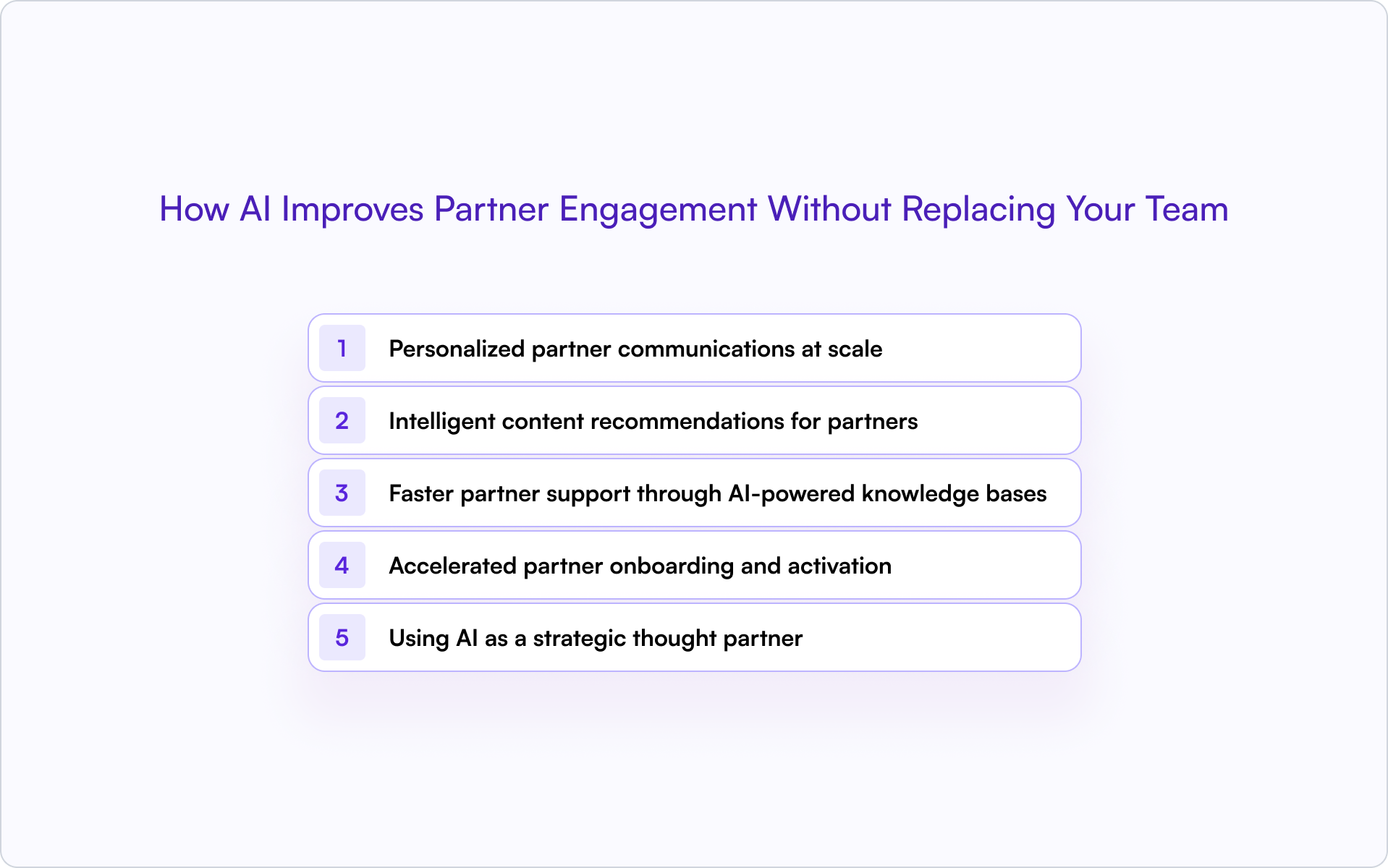
Personalized partner communications at scale

AI can analyze partner data — behavior, preferences, deal history, portal activity — and help tailor messaging without you writing from scratch each time. Done right, the voice stays “yours,” but the volume scales.

  • Behavior-based messaging: AI can detect who’s active vs. disengaged and tailor follow-ups accordingly. A partner who hasn’t logged in for 30 days should get a different nudge than one who just registered a deal.
  • Segment-specific campaigns: Generative AI can draft outreach by tier, region, or vertical. Your team reviews and sends — keeping quality control and the human touch.

Intelligent content recommendations for partners

Partners often struggle to find the right enablement content at the right time. AI helps by surfacing the most relevant case studies, battle cards, product docs, or training based on partner activity, segment, or deal stage.

This reduces the steady stream of “Where do I find X?” requests and improves time-to-first-deal because partners get what they need when they need it — without hunting.

Faster partner support through AI-powered knowledge bases

An AI-powered knowledge base is a self-serve library where partners ask a question and the AI returns the most relevant answer from your documentation. This works especially well for routine requests like pricing sheets, deal status questions, and portal navigation.

The win isn’t just speed. It’s consistency: partners get accurate answers instantly, while your team stays available for nuanced or sensitive situations.

Accelerated partner onboarding and activation

Partner onboarding AI guides new partners through onboarding steps, auto-assigns training content, and prompts next actions. Instead of manually tracking who completed what, your team gets visibility into progress and can step in only when a partner gets stuck.

Using AI as a strategic thought partner

Partnership leaders also use AI to brainstorm campaign ideas, draft program policies, and summarize what’s working across segments. Think of it as a strategy assistant that’s always available — while final decisions stay with your team.

AI can surface patterns your team might miss, but judgment calls that shape partner relationships should remain human-led.

Practical AI Use Cases for Partner Programs

If you’re building (or scaling) a partner motion, you don’t need “AI everywhere.” You need a few targeted workflows that reduce noise and increase partner responsiveness. These are the patterns that tend to deliver ROI quickly.

Drafting personalized partner outreach and updates

AI can generate email drafts, partner newsletters, and Slack messages tailored to partner segments. Your team reviews and sends — which keeps messages authentic, while eliminating blank-page work.

Tracking partner engagement signals in your CRM

AI can flag disengaged partners, highlight high-activity accounts, and detect patterns in deal registration behavior. The key is CRM-first visibility — data should live in HubSpot or Salesforce, not scattered across tools. That way, partner relationship management AI can operate on a reliable system of record.

Surfacing expansion and cross-sell opportunities

AI can identify partners with upsell or cross-sell potential based on customer fit, deal history, or product usage signals. The output should be a prioritized list for a human follow-up — not a fully automated “spray and pray” campaign.

Automating repetitive partner support queries

Common questions can be handled by AI chatbots, knowledge bases, or automated responses. This is often one of the highest-ROI forms of partner program automation — partners get instant answers, and your team spends less time on repeat tickets.

Delivering tailored partner enablement content

AI recommends relevant training, playbooks, or collateral based on partner type, certification level, or current deals as part of your partner enablement strategy. Partners see what’s relevant to them, rather than a generic content library that overwhelms them.

What to Automate vs. What to Keep Human in Partner Engagement

The easiest way to lose partner trust with AI is to automate moments that require judgment, empathy, or context. The goal is to automate the repeatable work — while protecting the high-stakes relationship moments.
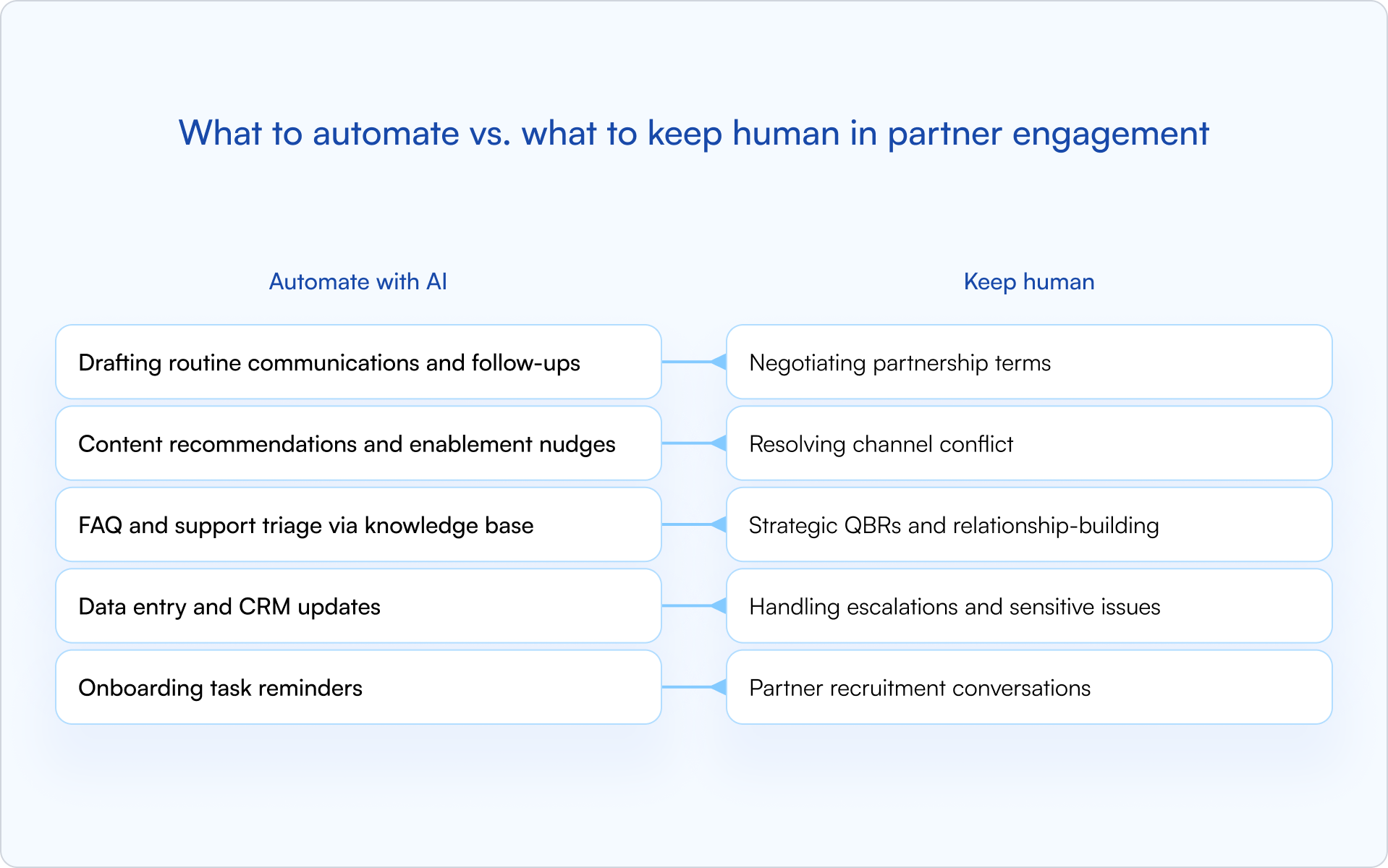
Automate with AI Keep human
Drafting routine communications and follow-ups Negotiating partnership terms
Content recommendations and enablement nudges Resolving channel conflict
FAQ and support triage via knowledge base Strategic QBRs and relationship-building
Data entry and CRM updates Handling escalations and sensitive issues
Onboarding task reminders Partner recruitment conversations

Tasks AI handles well

Repetitive, time-consuming, low-judgment work is ideal: status updates, content requests, FAQ replies, meeting summaries, and CRM hygiene. AI can also assist with partner recruitment by shortlisting candidates or scoring fit — but the qualification conversation should remain human-led.

Moments that require a human touch

Trust-building, conflict resolution, and strategic decision-making don’t automate well. Partners can tell when a program is “bot-led,” especially during escalations, sensitive program changes, and negotiation moments.

A simple rule for drawing the line

If the task requires judgment, empathy, negotiation, or deep relationship context, keep it human. If it’s repetitive and data-driven — especially CRM-based — automate it.

What You Need for AI to Work in Your Partner Program

AI doesn’t magically fix a messy program. It scales what’s already there. Before you roll out AI for partner engagement, make sure a few fundamentals are in place.

Clean partner data in your CRM

Clean data means fewer duplicates, consistent field definitions, and accurate partner records. AI insights are only as good as the data they’re built on. When your partner activity and engagement signals live in HubSpot or Salesforce, AI-driven support, recommendations, and scoring become practical — not theoretical.

Defined processes before implementing technology

Clarify workflows first: onboarding steps, deal registration rules, communication cadence, and support handoffs. AI amplifies your process — so if your process is inconsistent, AI will scale that inconsistency.

Partner buy-in and transparency about AI use

Partners should know when AI is used in communications or support. Transparency builds trust, and it lowers the risk of awkward moments when a partner assumes they’re speaking to a person.

Always provide a clear path to reach a human — and be explicit about what AI can (and can’t) do.

How to Get Started With AI for Partner Engagement

You don’t need a massive implementation to see results. The fastest path is to pick one high-volume pain point, pilot it, measure impact, and expand from there.
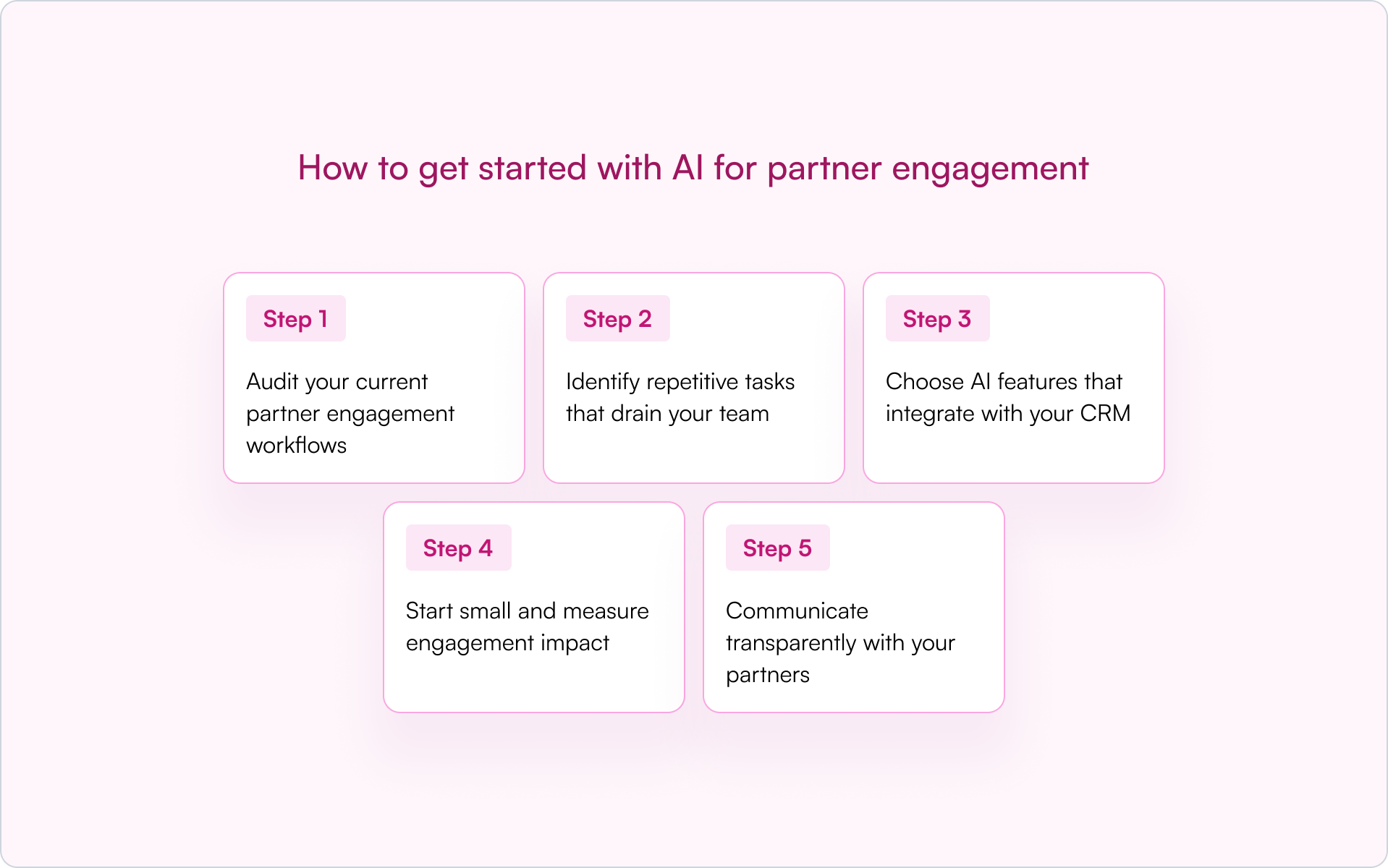
1) Audit your current partner engagement workflows

Map out how you communicate with partners today across their lifecycle stages. Where are the bottlenecks, manual tasks, and repetitive work across communications, enablement, and support?

2) Identify repetitive tasks that drain your team

List the recurring work that eats time but doesn’t require strategic thinking: status updates, content requests, meeting recaps, deal follow-ups, and FAQ replies. Prioritize tasks that can be reliably automated from CRM data.

3) Choose AI features that integrate with your CRM

CRM-first tools matter. AI that writes back to HubSpot or Salesforce keeps data clean, visible, and actionable. AI that creates a separate system becomes another silo your team has to manage.

Platforms like Introw offer AI-powered partner support and engagement features that integrate directly with your CRM — without creating a parallel universe of partner data.

4) Start small and measure engagement impact

Pilot one use case before scaling — onboarding emails and an AI-powered knowledge base are common “quick wins.” Track partner response rates, time saved, and engagement metrics like portal logins or content consumption.

5) Communicate transparently with your partners

Tell partners how AI is being used and where humans are still involved. Offer an escalation path to a person for complex issues. Trust comes from being upfront — not from hiding automation.

Build Stronger Partner Relationships With AI-Powered Engagement Tools

AI handles scale and speed across partner engagement, enablement, and support. Humans handle trust, strategy, and the moments that define long-term partnerships. That balance is where AI becomes a competitive advantage — not as a replacement, but as an enabler.

If you want to see what CRM-first AI for partner engagement looks like in practice, tools like Introw let you keep partner communications, support, and engagement history visible inside HubSpot or Salesforce — where your revenue team already works.

Book a demo to see how AI-powered partner engagement works inside your CRM.

FAQs

Noch Fragen? Hier findest du die häufigsten Fragen und Antworten.

Kontaktiere uns

Will partners know when they’re interacting with AI?

They should. Best practice is transparency: label AI-assisted support clearly, set expectations about what the AI can answer, and always provide an easy path to reach a human. In partner ecosystems, trust is an asset — don’t trade it for a slightly higher automation rate.

Can AI handle complex partner questions or only simple FAQs?

AI is strongest with questions that are already documented and repeatable (pricing sheets, process questions, enablement links, portal navigation). For nuanced technical issues, contract questions, escalations, and anything sensitive, route to a human. Many teams use AI for triage first — then escalate with full context.

How do I get partner buy-in for using AI in our program?

Lead with benefits partners actually feel: faster answers, clearer onboarding, and more relevant enablement content. Be explicit that AI is there to reduce friction, not to replace relationship access. Then back it up with a visible human escalation path and a consistent cadence of real check-ins.

Do I need a separate partner portal to use AI for partner engagement?

Not necessarily. What matters most is where your partner data lives and whether AI can use it safely and reliably. CRM-first approaches work well because engagement signals, account history, and partner communications remain in one system of record. If you do use a portal, prioritize tools that sync activity back to your CRM rather than creating new silos.


Starte dein Partnerportal
in wenigen Minuten!

Vielen Dank! Wir haben deine Anfrage erhalten!
Hoppla! Beim Absenden des Formulars ist ein Fehler aufgetreten.

Verwandte Blog-Artikel

Partner-Management

From Strategy to Results: 11 Partner Enablement Best Practices That Work in 2026

Sara De Meurichy
Growth
5min Lesezeit
14 Mar 2026
⚡ TL;DR

Partner enablement gives partners the training, content, tools, and support they need to sell independently rather than relying on constant hand-holding from your team. The most effective programmes are structured, segmented by partner type, and connected to the CRM so you can measure readiness, track activation, and attribute revenue accurately. Strong enablement focuses on reducing time to first deal, delivering role-based training, and giving partners collateral they will actually use in live opportunities. To understand whether the programme is working, teams should track outcome-based metrics such as pipeline, revenue, certifications, and activation speed rather than vanity portal activity.

Partner enablement looks simple on paper: give partners the right resources, and they’ll sell your product. In practice, most programs stall because content is scattered, training is generic, and no one can tell which partners are actually ready to close deals.

The difference between a partner program that generates attributable revenue and one that drains resources usually comes down to structure — clear goals, the right content at the right time, and data that lives in your CRM instead of a forgotten portal. This guide breaks down partner enablement best practices from strategy through execution, plus the metrics that tell you if it’s working.

Was ist Partner-Enablement?

Partner enablement is the system you build to help external partners sell (and often implement) your product effectively. That system typically includes structured onboarding, tailored training, and easy access to the right resources so partners can move deals forward without waiting on your team.

When partner enablement is done well, partners don’t just understand what you do. They can position it, handle objections, run a clean handoff, and create repeatable wins — the same way a high-performing internal sales team would.

What partner enablement typically includes

  • Training and certification: Product knowledge, positioning, and selling motions (with a quality bar partners must meet).
  • Sales and marketing resources: Collateral, templates, and campaigns partners can use with prospects.
  • Tools and portal access: Systems that streamline deal registration, content access, and communication.
  • Ongoing communication: A predictable cadence for updates, feedback, and performance reviews.

Why partner enablement matters for revenue growth

Enabled partners drive revenue because they can execute without friction. They close deals faster, represent your brand accurately, and generate pipeline you can actually attribute.

Weak enablement is expensive in quieter ways: partners misposition the product, opportunities stall, your team becomes the bottleneck, and high-potential partners churn because “it’s too hard to work with you.”

Enablement quality What happens
Strong enablement Shorter sales cycles, higher win rates, accurate brand positioning
Weak enablement Stalled deals, brand confusion, heavy support load, high partner churn

What a partner enablement program includes

A complete channel partner enablement program isn’t a portal full of PDFs. It’s a structured system that helps partners learn, launch, and improve — with clear ownership and measurable outcomes.

Partnerschulung und -zertifizierung

Training forms the foundation: product knowledge, competitive positioning, and your sales methodology. Certification acts as a gate, ensuring partners meet a minimum quality bar before they’re authorized to sell on your behalf.

Partner sales enablement

Partner sales enablement means giving partners the same caliber of sales tools your direct team uses, adapted to their role. Think: battle cards, demo scripts, objection-handling guides, and pricing documentation.

Marketing support and co-marketing

Effective enablement helps partners generate demand, not just close it. Co-branded assets, “campaign-in-a-box” kits, and structured lead-sharing programs all increase partner-sourced pipeline.

Partner portals (and why login friction kills adoption)

A partner portal should be a self-service hub for training, collateral, deal registration, and updates. But there’s a common failure mode: partners avoid portals that require a separate, inconvenient login.

CRM-first portals reduce that friction by connecting directly to HubSpot or Salesforce, so partners can work inside the flow of real deals instead of “checking another system.”

Performance tracking and ongoing communication

Enablement is ongoing, not a one-time launch. A strong program includes visibility into partner activity, a consistent communication cadence, and mechanisms for gathering feedback and improving the experience.

11 partner enablement best practices that drive results

If you’re building a partner program inside a startup, your constraint is almost never “ideas.” It’s focus and execution. These partner enablement best practices move from strategy through rollout and iteration — with an emphasis on what actually shows up in pipeline.

1. Set specific goals and KPIs before building your program

Before you create a single asset, define what success looks like. Start with outcomes — partner-sourced revenue targets, certification completion rates, and a target time-to-first-deal — then work backward into the program.

  • Partner-sourced pipeline value
  • Certification completion rate
  • Average time from onboarding to first registered deal
  • Content engagement (downloads, video views)

2. Segment partners to personalize enablement paths

Not all partners need the same materials. Segment by partner type (reseller, referral, systems integrator), vertical focus, or performance tier, then tailor training and content accordingly.

Segment Enablement focus
Reseller Deep product training, pricing, deal registration
Referral-Partner Lightweight pitch training, lead handoff process
SIs/MSPs Technical implementation guides, certification

3. Connect enablement to your CRM from day one

For true visibility and attribution, all your enablement data — certifications, content consumption, deal registrations — lives best in your CRM, not in a disconnected system.

A CRM-first approach provides a single source of truth. When partner activity syncs directly to HubSpot or Salesforce, your sales team and RevOps see the same reality. No more chasing updates or reconciling spreadsheets. (If deal attribution is a pain point today, it’s worth tightening up your workflow around partner deal registration specifically.)

4. Design onboarding that speeds time to first deal

Partner onboarding works best as a structured, time-bound journey — not a massive content dump. The goal is to get partners to their first real opportunity quickly, then reinforce with deeper training once momentum is real.

A strong onboarding checklist includes:

  • Welcome and program overview
  • Product and Ideal Customer Profile (ICP) training
  • Competitive positioning
  • Deal registration process walkthrough
  • First co-sell or shadow opportunity

5. Create sales collateral partners actually use

Don’t reinvent the wheel. Audit the sales collateral your direct team uses most effectively and adapt it for your partners. Prioritize assets that accelerate live deals: one-pagers, battle cards, ROI calculators, and customer stories.

The fastest way to avoid producing content no one opens is simple: ask partners what they need to win the deals they already have, then build for that.

6. Build training programs tied to revenue outcomes

Training works best when it’s modular, role-based, and tied to certification. Use certification as a gate — for example, require a partner to complete key modules before they can register deals or request MDF.

On-demand training offers flexibility; live sessions drive engagement for complex topics. Most teams land on a hybrid model.

7. Centralize everything in a partner portal without login friction

A partner portal should be the single place to find enablement content, register deals, and get program updates. But portals fail when they add friction — especially separate logins, stale content, and unclear navigation.

If you want adoption, reduce steps. Portals built directly on the CRM (with SSO or no-login options) make access feel seamless, which is often the difference between “partners love it” and “partners ignore it.”

8. Launch co-marketing programs that generate leads for both sides

Co-marketing goes beyond providing partners with your logo. Joint webinars, co-branded content like eBooks or case studies, and Market Development Funds (MDF) programs actively help partners generate demand.

If you’re a founder, this is one of the highest-leverage shifts you can make: partners often need help creating pipeline, not just closing it.

9. Establish a communication cadence partners can count on

Define a predictable rhythm. Partners shouldn’t have to guess where to find updates or whether deal registration is working. Use channels like email and Slack to reach partners where they already operate — don’t rely solely on them logging into a portal.

Häufigkeit What to communicate
Wöchentlich Deal registration status updates
Monatlich Product updates, new content announcements
vierteljährlich QBRs, performance reviews, program changes

10. Gather partner feedback and act on it fast

Enablement is a two-way street. Collect feedback through surveys, QBR conversations, and portal analytics — then close the loop by making changes and telling partners what you changed.

Partners keep investing when they feel momentum. Small, fast improvements create that signal.

11. Review and evolve your enablement strategy quarterly

Partner enablement isn’t set-and-forget. Quarterly, review what’s working and what isn’t by analyzing content engagement, certification rates, and revenue impact. Then adjust your program like you’d adjust product — based on usage and outcomes.

Partner enablement training metrics to track

To understand if your partner enablement process is working, track metrics that connect enablement activities directly to revenue outcomes — not just vanity activities.

Content engagement and consumption

Track which resources partners actually use: downloads, video completion rates, and page views. Low engagement can signal the content isn’t relevant, is hard to find, or doesn’t match what partners need in active deals.

Training completion and certification rates

Measure how many partners complete onboarding and earn certifications. Completion rates help you pinpoint drop-off points so you can shorten, reorder, or redesign modules.

Zeit bis zum ersten Geschäft

Track the time between partner activation and their first registered deal. This is one of the cleanest indicators that onboarding is working — or that partners are stuck.

Partner-sourced pipeline and revenue

This is the ultimate scoreboard. Track pipeline and closed-won revenue generated by partners. To do it well, you need tight CRM attribution so enablement activity can be tied to financial results without manual cleanup.

How to automate your partner enablement process

Automation lets you scale partner enablement without scaling headcount. The goal isn’t to make the experience robotic — it’s to make it consistent, timely, and measurable.

CRM-based automation is ideal because it keeps data and workflows in one system. That’s how you avoid the “portal says one thing, CRM says another” problem.

  • Onboarding sequences: Automatically enroll new partners in training modules and send welcome materials as soon as they sign up.
  • Certification reminders: Trigger automated alerts to partners and partner managers before certifications expire.
  • Content delivery: Push relevant collateral to partners based on their segment, tier, or deal stage.
  • Deal registration alerts: Automatically notify partners of the status of their registered deals.

Turn partner enablement into a revenue engine with Introw

Introw is the CRM-first PRM that makes best-practice partner enablement practical and scalable. Because it’s built on HubSpot and Salesforce, Introw centralizes your entire partner program where you already work.

It includes a partner portal for centralizing enablement content without login friction, deal registration with real-time visibility, and off-portal collaboration so partners can reply via email while data syncs automatically to your CRM.

If you’re trying to get out of spreadsheet chaos and into measurable partner-sourced revenue, get a demo.

Fazit

The best partner enablement programs aren’t built on more content — they’re built on clarity. Clear goals, segmented paths, CRM-connected workflows, and a focus on speed-to-first-deal turn “partners we signed” into “partners who ship revenue.”

Use these partner enablement best practices as a blueprint, then iterate quarterly based on what your data (and your partners) tell you.

Partner-Management

11 Best Partner Engagement Platforms for SaaS Partner Programs

Janis De Sutter
Software Engineer
5min Lesezeit
14 Mar 2026
⚡ TL;DR

The right partner engagement tools help your team activate partners faster, keep channel partner communication consistent, and turn partner activity into real pipeline. Modern partner engagement software goes beyond basic portals. It supports partner enablement, deal registration, and real-time collaboration with your sales team inside existing workflows. You'll get a shortlist of partner engagement platforms built for SaaS partner programs, plus what features actually matter when choosing one.

The 11 best partner engagement tools in 2026

The right partner engagement tools help your team activate partners, keep communication consistent, and connect partner activity to real pipeline.

Here is our shortlist of platforms used by SaaS companies to manage partner engagement, partner enablement, and channel partner collaboration.

1. Introw - Best CRM-native partner engagement platform

Introw is a CRM-first partner engagement platform built for SaaS companies that want partner engagement tied directly to pipeline activity.

Instead of forcing partners into a portal, Introw keeps partners up to date through email, Slack, and CRM-driven workflows while logging partner activities directly inside HubSpot or Salesforce.

Because engagement data connects to deals and revenue, your team can clearly see how partner engagement influences partner performance and sales performance. This is why many SaaS companies adopt a CRM-native approach to partner engagement rather than relying on standalone partner portals.

Teams often use Introw to manage partner communication, deal registration, partner onboarding, and channel partner enablement directly inside their CRM. Many of the workflows behind these processes are documented in Introw’s resources on partner engagement.

Am besten geeignet für

SaaS companies that want partner engagement tied directly to pipeline and CRM workflows.

Key engagement features

  • CRM-native collaboration inside HubSpot and Salesforce
  • Segmented announcements to keep partners up to date
  • Engagement tracking and performance analytics
  • Off-portal communication logging across email and Slack
  • Deal registration and deal-based partner activity visibility
  • Engagement metrics connected to partner performance and revenue
  • Integrated partner portal and partner training capabilities for channel partner enablement programs

Strength

Deep CRM integration allows partner engagement data to live alongside deals, accounts, and sales process activity, making it easier for RevOps and the sales team to monitor partner activities and optimize channel partner performance.

Limitation

Companies without Salesforce or HubSpot will not benefit from the platform’s CRM-native design.

Ideal company size

Mid-market and enterprise SaaS companies running structured partner programs with multiple partner managers and active partner ecosystems.

A strong partner engagement platform should make it easier to activate partners and track their impact on the pipeline. Now let’s look at other tools used across partner ecosystems and channel partner enablement programs.

2. Impartner – Enterprise partner management platform

Impartner is a partner management platform designed for companies running large channel partner ecosystems. It focuses on structured partner onboarding, partner marketing, and automation that helps partner programs scale while keeping partners up to date.

Am besten geeignet für

Enterprise companies managing complex channel partner ecosystems and structured channel partner enablement programs.

Key engagement features

  • Automated partner onboarding and partner training workflows
  • Campaign management and marketing materials for partner marketing
  • Performance analytics dashboards to monitor partner performance

Strength

Strong structure for large partner ecosystems that need standardized workflows across partner onboarding, partner enablement, and partner management.

Limitation

Engagement often depends on partners returning to a portal, which can slow down real-time partner activities and collaboration with the sales team.

Ideal company size

Enterprise organizations with global partner programs and large partner networks.

3. Channelscaler – Partner enablement and automation platform

Channelscaler is a partner platform designed to help companies scale partner revenue through PRM, partner program automation, and channel partner enablement. It focuses on partner onboarding, training, content delivery, and structured program management across partner ecosystems. 

Am besten geeignet für

Companies that want structured partner onboarding, partner enablement, and channel partner enablement tools in one platform.

Key engagement features

  • Partner onboarding, training, and personalized learning paths
  • Content delivery for marketing resources and marketing materials
  • Program automation and reporting to monitor partner performance

Strength

Strong fit for teams that need structured channel partner enablement and formal partner program workflows across a growing partner network. 

Limitation

The platform is more program- and portal-led than lightweight, CRM-native engagement, so it may feel heavier for teams that want faster off-platform collaboration. This is an inference from its public positioning and feature structure. 

Ideal company size

Mid-market and enterprise companies running structured partner programs. 

4. Channeltivity – Practical PRM for growing channel teams

Channeltivity is PRM software built for companies that want practical partner management without heavy enterprise complexity. It supports partner onboarding, partner marketing coordination, and deal registration workflows across growing partner ecosystems.

Teams often use the platform to monitor partner activities, track channel partner performance, and keep partners up to date on sales strategies and partner initiatives.

Am besten geeignet für

Mid-market companies building structured partner programs and growing channel partner ecosystems.

Key engagement features

  • Deal registration, referral tracking, and lead generation workflows
  • Built-in communication tools to keep partners up to date
  • Reporting dashboards that track partner performance and sales performance

Strength

Clear operational structure for partner activities and partner onboarding across growing partner networks.

Limitation

The platform focuses on partner management processes rather than deeper engagement analytics tied directly to pipeline.

Ideal company size

Mid-market organizations with developing partner ecosystems and growing channel partner programs.

5. PartnerStack – Ecosystem platform for affiliate and referral programs

PartnerStack is an ecosystem platform used by SaaS companies to recruit, manage, and reward partners across affiliate, referral, and reseller partner programs. It helps companies scale their market reach by managing partner incentives and partner performance at scale.

Many SaaS companies rely on PartnerStack to support lead generation and expand their partner network while rewarding partner productivity.

Am besten geeignet für

SaaS companies running affiliate, referral, or partner-led growth programs.

Key engagement features

  • Automated partner onboarding and partner incentives management
  • Commission tracking and reward partners workflows
  • Performance analytics dashboards that track partner productivity

Strength

Strong ecosystem platform for scaling partner programs and expanding market reach.

Limitation

The platform focuses primarily on affiliate-style programs rather than deep co-selling workflows tied to CRM sales process activity.

Ideal company size

Small to mid-market SaaS companies scaling partner ecosystems and referral programs.

6. Unifyr – Enterprise ecosystem management platform

Unifyr is an ecosystem management platform designed to help enterprise companies coordinate partner engagement, partner marketing, and partner enablement across complex partner ecosystems.

It supports structured partner programs with automation, analytics, and tools designed to optimize channel performance across large partner networks.

Companies running global channel programs often use the platform to strengthen relationships with partners and monitor channel partner performance across multiple regions.

Am besten geeignet für

Enterprise companies managing complex global partner ecosystems.

Key engagement features

  • Multi-portal partner engagement and partner management capabilities
  • Campaign management and marketing resources for partner marketing
  • Performance analytics that track channel partner performance

Strength

Enterprise-grade ecosystem management with strong reporting and partner marketing capabilities.

Limitation

The platform is designed for large enterprise ecosystems and may be too complex for smaller partner programs.

Ideal company size

Enterprise organizations managing large partner ecosystems and global channel partner networks.

7. Magentrix – Partner portal and collaboration platform

Magentrix is a partner portal platform built on Salesforce that helps companies manage partner onboarding, partner communication, and collaboration across partner ecosystems. It focuses on centralizing partner engagement, marketing resources, and communication tools inside a secure partner portal.

Am besten geeignet für

Companies running Salesforce that want structured partner portals to support channel partner enablement.

Key engagement features

  • Partner portal collaboration and communication tools
  • Content hubs for marketing materials and partner marketing
  • Activity tracking to monitor partner activities and partner performance

Strength

Tight Salesforce integration helps the sales team monitor partner activities and support channel partner performance across deals.

Limitation

Engagement often depends on partners logging into the portal rather than collaborating through external communication channels.

Ideal company size

Mid-market and enterprise companies managing partner ecosystems on Salesforce.

8. Kiflo PRM – Lightweight partner management platform

Kiflo PRM is a partner management platform designed for SaaS companies building structured partner programs. The platform focuses on partner onboarding, deal registration, and partner engagement across growing partner networks.

It helps partner managers monitor partner activities and coordinate partner enablement programs without the complexity of heavier enterprise PRM systems.

Am besten geeignet für

SaaS companies launching or scaling channel partner programs.

Key engagement features

  • Partner onboarding workflows and partner tiers management
  • Deal registration and pipeline collaboration with the sales team
  • Reporting dashboards to track partner productivity and partner performance

Strength

Lightweight partner management system that helps smaller teams organize partner activities and improve partner productivity.

Limitation

The platform is simpler than enterprise partner engagement tools and may lack deeper ecosystem automation for very large partner programs.

Ideal company size

Small to mid-market SaaS companies building early partner ecosystems.

9. WorkSpan – Ecosystem collaboration platform

WorkSpan is an ecosystem management platform designed to help companies coordinate partnerships, co-sell motions, and joint sales strategies across partner ecosystems. It focuses on collaboration between companies rather than traditional PRM portals.

The platform helps revenue teams monitor partner activities and connect partner engagement to shared business objectives.

Am besten geeignet für

Enterprise companies running strategic alliances, co-sell partnerships, and ecosystem programs.

Key engagement features

  • Joint pipeline tracking and opportunity collaboration
  • Ecosystem reporting and performance analytics
  • Shared workspaces to coordinate partner activities

Strength

Strong platform for companies that want to optimize channel performance across strategic alliances and joint sales initiatives.

Limitation

It focuses more on ecosystem collaboration than traditional partner onboarding or partner enablement workflows.

Ideal company size

Enterprise companies managing strategic partner ecosystems and alliances.

10. Mindmatrix – Partner enablement and marketing platform

Mindmatrix is a partner enablement platform designed to help companies manage partner marketing, partner training, and partner engagement across global partner networks.

The platform combines partner enablement tools with marketing automation and sales content management to help partners stay aligned with company sales strategies.

Am besten geeignet für

Companies that want to support partner marketing and channel partner enablement at scale.

Key engagement features

  • Marketing automation and marketing resources for partners
  • Training modules with tailored training programs
  • Incentive management and engagement analytics for partner performance

Strength

Strong support for partner marketing and marketing materials that help motivate partners and strengthen relationships.

Limitation

The platform focuses heavily on marketing automation rather than direct CRM collaboration with the sales process.

Ideal company size

Mid-market and enterprise companies managing global partner programs.

11. Salesforce PRM – Native partner management inside Salesforce

Salesforce PRM is Salesforce’s native partner relationship management solution built within Experience Cloud. It allows companies to manage partner onboarding, partner engagement, and deal collaboration directly inside the Salesforce ecosystem.

Because partner activities are connected to CRM data, revenue teams can monitor channel partner performance and track how partner engagement influences sales performance.

Am besten geeignet für

Organizations already running Salesforce that want partner management built directly into their CRM.

Key engagement features

  • Deal registration and pipeline collaboration with the sales team
  • Partner portals with content libraries and communication tools
  • Reporting dashboards that track partner performance and partner satisfaction

Strength

Native CRM integration allows partner activities to connect directly to pipeline and sales performance.

Limitation

Setup and customization can require significant Salesforce administration and technical resources.

Ideal company size

Mid-market and enterprise companies operating primarily within Salesforce ecosystems.

These platforms show the different ways companies approach partner engagement. Some focus on portals and partner management. Others focus on ecosystem collaboration or partner marketing automation.

The right choice depends on how your team activates partners, supports the sales process, and monitors partner performance across your partner network.

Next, let’s look at the specific capabilities that matter most when comparing partner engagement tools.

What to compare in partner engagement tools

Once you’ve shortlisted a few partner engagement tools, the next step is evaluating how they support real partner engagement across your partner network.

The right platform should help you monitor partner activities, keep partners up to date, and connect engagement to pipeline.

Most modern partner engagement tools also act as a centralized platform that aligns partner work with the sales process.

Here are the capabilities revenue teams compare when evaluating partner engagement platforms.

1. CRM-native collaboration

Many partner engagement tools still operate outside the CRM. That makes it harder for the sales team to see partner activities during the sales process.

Look for platforms that allow partner collaboration directly around deals.

Check whether the tool can:

  • Log partner activities inside Salesforce or HubSpot
  • Support deal registration and opportunity collaboration
  • Capture email or Slack conversations tied to deals
  • Give the sales team visibility into partner engagement

CRM visibility helps teams connect partner engagement to sales performance and optimize channel performance across partner ecosystems.

Teams building structured partner programs often pair CRM collaboration with clear partner lifecycle management so engagement aligns with pipeline development.

Next, let’s look at communication capabilities.

2. Segmented announcements and messaging

Generic announcements rarely motivate partners.

Modern partner engagement tools allow partner managers to target messages based on partner tiers, market reach, or product focus.

Look for platforms that support:

  • Segmentation by partner tiers or partner programs
  • Targeted updates that keep partners up to date
  • Communication tools that track responses and engagement

Clear messaging helps improve partner productivity and maintain alignment across B2B SaaS partnerships and partner ecosystems.

Once communication improves, the next step is measuring impact.

3. Engagement analytics and revenue visibility

Partner engagement should connect to measurable outcomes.

Strong platforms provide analytics that help teams monitor partner activities and understand how engagement affects revenue.

Look for reporting that shows:

  • Active partners across your partner network
  • Campaign participation and engagement trends
  • Partner productivity and sales performance
  • Revenue influenced by engaged partners

These insights help teams optimize channel performance and reward partners who contribute to the pipeline. Many programs support this with structured partner performance incentives.

Next, consider how tools support collaboration outside portals.

4. Off-portal engagement capabilities

Many partners stop logging into portals after partner onboarding.

Partner engagement tools should support collaboration outside the portal while still tracking engagement.

Look for tools that allow partners to:

  • Respond to messages via email
  • Collaborate through communication tools like Slack
  • Join deal discussions without logging into a portal
  • Sync conversations back to the CRM

This improves partner experience and helps partner managers maintain consistent engagement across partner ecosystems.

Finally, automation helps scale engagement.

5. Workflow automation

As partner ecosystems grow, manual partner management becomes difficult.

Partner engagement tools should automate repetitive partner activities so partner managers can focus on strategy.

Look for automation features such as:

  • Deal follow-ups tied to the sales process
  • Reactivation campaigns for inactive partners
  • Partner tier progression triggers
  • Incentive management to reward partners

Automation improves partner productivity and helps maintain consistent partner engagement across channel partner enablement programs.

Next, let’s look at how Introw approaches partner engagement at the execution layer.

How Introw powers partner engagement (execution layer)

Most partner engagement tools rely on portals.

But if engagement data never reaches the CRM, revenue teams lose visibility into how partners actually influence pipeline.

Introw is designed to solve partner engagement around deals, conversations, and partner activities that move the sales process forward.

Instead of managing partner engagement in a separate system, Introw connects partner communication, collaboration, and engagement insights directly to HubSpot and Salesforce.

Introw acts as a centralized platform where partner engagement, deal collaboration, and revenue visibility live together.

CRM-native collaboration

Partner engagement should happen where opportunities live.

Introw allows partner managers and the sales team to collaborate with partners directly around deals inside the CRM. Partner activities stay tied to accounts, opportunities, and the broader sales process.

Teams can:

  • Track partner engagement alongside deals and pipeline
  • Collaborate with partners during deal registration and opportunity development
  • Monitor partner productivity and partner performance across partner programs

Because engagement happens inside the CRM, revenue teams can finally connect partner engagement to sales performance.

Announcements and partner segmentation

Keeping partners up to date across partner ecosystems is harder than it sounds.

Introw allows partner managers to send segmented announcements based on partner tiers, region, or product specialization. This helps channel teams communicate relevant updates without overwhelming the partner network.

Announcements often support:

  • Product updates and sales strategies
  • Channel partner enablement program updates
  • Partner marketing initiatives and marketing resources
  • Partner training and tailored training programs

Targeted communication helps partner managers motivate partners and strengthen relationships across partner ecosystems.

Off-Portal-Engagement

Many partners stop logging into portals after partner onboarding.

Introw supports off-portal engagement so partners can respond through email or Slack while engagement data still syncs back to the CRM.

This allows teams to:

  • Monitor partner activities without forcing portal logins
  • Keep partners up to date through familiar communication tools
  • Capture conversations tied to opportunities and deal progress

If you would like to explore the feature set in more detail, the resources on partner engagement explain how announcements, engagement insights, and communication workflows work inside the platform.

Engagement insights and revenue visibility

Partner engagement should lead to measurable outcomes.

Introw gives revenue teams visibility into how partner engagement affects channel partner performance across the pipeline.

Teams can track:

  • Active partners across the partner network
  • Engagement trends across partner ecosystems
  • Partner productivity tied to deals and revenue
  • How engagement supports lead generation and market reach

This makes it easier to optimize channel performance and reward partners who contribute to real business outcomes.

If you’re evaluating partner engagement tools, start by asking a few practical questions:

  1. Can we see partner engagement directly inside our CRM and sales process?
  2. Do we have visibility into partner activities and partner performance across our partner network?
  3. Can we keep partners up to date without relying on a portal?
  4. Are we measuring engagement in ways that actually improve channel partner performance?

If the answer to those questions is unclear, it may be time to rethink how partner engagement works in your partner programs.

Over to you

You can request a demo to see how Introw connects partner engagement, CRM collaboration, and revenue visibility in one place.

Partner-Management

Partner Integration Strategy: A Complete Guide for B2B Teams

Joyce Wederholdt
Account Manager
5min Lesezeit
10 Mar 2026
⚡ TL;DR

A partner integration strategy is a deliberate plan for connecting products through APIs and shared data, supported by clear ownership, commercial agreements, and joint go-to-market execution. Unlike referral or reseller programmes, integration partnerships require a real technical connection that must be launched, maintained, and promoted over time. The strongest programmes prioritise partners based on customer demand, technical fit, and business alignment, then operationalise onboarding, maintenance, and adoption rather than treating the integration as a one-off build. To turn integrations into a repeatable growth channel, teams need CRM-based tracking for partner-sourced and partner-influenced pipeline, adoption, and revenue outcomes.

For most B2B startups, “we integrate with your stack” isn’t a nice-to-have — it’s table stakes. A lack of integrations between your product and the rest of a buyer’s tooling can be a dealbreaker, even when your core product is strong.

That’s where a partner integration strategy earns its keep. It’s not just building connectors — it’s creating the business and operating model that makes integrations sustainable, adoptable, and measurable over time.

This guide breaks down what a partner integration strategy actually includes, the major types of integration partnerships, and a practical playbook for building, managing, and tracking integrations in your CRM so you can double down on what’s working.

What is a partner integration strategy?

A partner integration strategy is a planned approach to aligning systems, data, and operations with external partners to create seamless, mutually beneficial workflows. In practice, it means leveraging APIs, cloud platforms, and shared data models to reduce manual work and improve the customer experience.

It’s also important to separate “integrations” from “partnerships.” You can build a connector unilaterally — but it won’t compound unless there’s a shared commitment to keeping it working, promoting it, supporting customers, and measuring results.

  • Partner integration strategy: How you identify, build, launch, and manage technical partnerships with other software providers.
  • Integration partnership: A formal collaboration where two companies connect products through APIs or shared data, backed by a business agreement.
  • Why it matters for B2B SaaS: Buyers expect tools to work together. Integrations help you fit into an existing workflow instead of forcing process change.

When you get this right, the practical outcome is simple: your product becomes easier to adopt, harder to replace, and more expandable across accounts.

Three types of integration partnerships

Not all integration partnerships are the same. The type you pursue should be driven by your product’s role in the stack, your ideal customer profile (ICP), and where you want distribution to come from over the next 6–18 months.

Technology integration partnerships

Technology integration partnerships connect two software products via API to share data or functionality — for example, a CRM syncing to a marketing automation platform. Here, the integration is effectively a product feature that becomes more valuable as adoption grows.

Horizontal integration partnerships

Horizontal integration partnerships happen between companies serving a similar ICP at the same “layer” of the value chain, but solving different jobs. If there’s strong customer overlap and clear complementarity, the integration tends to be an easy “yes” for both teams.

Vertical integration partnerships

Vertical integration partnerships span different levels of delivery — think implementation partners, data providers, infrastructure tools, or platforms that sit upstream/downstream of your product. These partnerships can unlock end-to-end solutions for shared customers with fewer handoffs.

Partnership Type Definition Am besten geeignet für
Technology API-based product connections Expanding product functionality
Horizontal Same-level, complementary partners Growing within a shared customer base
Vertikal Cross-level value chain partners Delivering an end-to-end solution

Why integration partnerships matter for B2B SaaS teams

A good partner integration strategy shows up in the metrics founders care about — pipeline, retention, and positioning. Here’s how.

Accelerate revenue growth

Integration partners can open new distribution channels and co-selling opportunities. When your product “just works” with tools prospects already rely on, you reduce perceived switching risk and shorten the path to internal buy-in.

Marketplace listings, co-marketing campaigns, and referral programs with integration partners can all drive pipeline without increasing your direct sales headcount.

Reduce churn and increase product stickiness

Customers using integrations are harder to rip out. Once you become part of a connected workflow, you’re no longer competing purely on features — you’re embedded in how the customer operates day to day.

Expand market reach through partner networks

Integrations can put you in front of an audience already searching for compatible tools. This is especially powerful when you’re entering a new vertical or ecosystem and need borrowed credibility.

Build deeper industry relationships

Being “in the ecosystem” matters. When you’re listed alongside established players, prospects assume you belong there — and partners are more likely to introduce you to adjacent vendors and joint opportunities.

When to consider an integration partnership

Integration partnerships require investment — engineering time, support, relationship management, and ongoing maintenance. The following signals are a good indication you’re ready to pursue (or prioritize) an integration partnership.

  • Your customers keep asking for a specific integration: Repeated requests are the clearest demand signal.
  • You’re losing deals to competitors with more integrations: If integrations are cited in win/loss, this is no longer optional.
  • You want to enter a new market or vertical: Partners can provide credibility and distribution where you lack brand presence.
  • Your product has a clear API or data-sharing capability: If data exchange is painful, everything else becomes harder.
  • You have bandwidth for long-term maintenance: Integrations aren’t one-time projects — they require monitoring, updates, and support.

How to build an integration partnership step by step

The process for building integration partnerships is usually predictable. The teams that win treat it as a repeatable system — not a one-off “integration project.”

Step 1: Identify and evaluate potential integration partners

Start where the signal is strongest: customer requests, competitor ecosystems, and the tools your best-fit accounts already use. Your best partners typically share your ICP but solve a different job.

  • Technical fit: API availability, data compatibility, documentation quality, security posture
  • Business alignment: ICP overlap, GTM synergy, a clear “why now” on both sides
  • Partner commitment: Dedicated resources, responsiveness, a named owner, and a plan for launch

Step 2: Reach out and pitch the partnership

Some vendors have an established partner program with an intake form; others require direct outreach to partnerships leaders or executives. Your pitch should be concrete: customer demand, proposed scope, and what each side stands to gain.

Step 3: Negotiate terms and structure the agreement

Align on support responsibilities, any revenue share, co-marketing expectations, data handling, and whether exclusivity is on the table. Most avoidable integration drama comes from fuzzy responsibilities — define them now.

Step 4: Complete legal review and sign contracts

Expect NDAs, licensing terms, privacy and security clauses, and liability language. This step can drag. If appropriate, a lightweight pilot or sandbox integration can help you validate value while legal catches up.

Step 5: Build and test the integration

Involve both engineering teams early. The most common delays come from unclear requirements, mismatched assumptions, and late-stage security surprises. Get sandbox access, define edge cases, and agree on ownership for failures and logging.

Step 6: Launch and go to market together

The technical release is the beginning, not the finish line. Many partner integrations succeed or fail based on GTM follow-through, not just the build.

  • Marketplace listing and listing optimization
  • Joint announcement and co-marketing assets
  • Sales enablement (demo scripts, talk tracks, objection handling)
  • Customer comms and in-app prompts to drive adoption

Best practices for managing integration partners at scale

One integration is manageable. A portfolio of integrations becomes a program — and programs need operating rhythm.

Appoint a dedicated partner owner

Someone needs to own the relationship end-to-end: roadmap alignment, escalation paths, joint planning, and performance tracking. On smaller teams, this might be a founder or BD lead. As the program grows, dedicated partner managers become a forcing function for consistency.

Create a structured partner onboarding process

Good onboarding includes technical documentation, sales training, and support escalation paths. A partner portal (or even a well-organized shared workspace) reduces friction and speeds up time-to-value.

Establish clear communication cadence

Put recurring check-ins on the calendar, create shared channels for day-to-day coordination, and run QBRs for strategic partners. Most partnerships fail from neglect — not conflict.

Define revenue opportunities and attribution models

Tracking partner-sourced versus partner-influenced deals prevents disputes over credit and revenue. This is one of the fastest ways to protect the relationship and give leadership clarity on what’s paying off.

When attribution lives in your CRM, RevOps and leadership get real-time visibility into what’s actually working. Platforms like Introw connect partner portals directly to HubSpot and Salesforce to keep partner activity and pipeline in one place.

Plan for long-term integration maintenance

API versioning, deprecations, ongoing QA, and incident response are part of the job. Agree upfront on how you’ll handle changes — and how quickly each side commits to fixing issues when something breaks.

Five common partner integration challenges (and how to solve them)

Lengthy negotiation and legal cycles

Contracts and commercial terms can stretch for weeks or months. If you need momentum, propose a phased approach — for example, a sandbox pilot with limited exposure while legal completes a full agreement.

Technical assessment and API complexity

Some APIs are great; others are brittle or under-documented. Ask for sandbox access early, bring engineering into discovery, and validate the “hard parts” (auth, rate limits, webhooks, error handling) before you commit to a timeline.

Resource constraints and hidden costs

Integrations require ongoing engineering and support. Start with a tight scope focused on the core workflow customers actually need, then expand based on adoption and revenue impact.

Difficulty scaling multiple integration partners

Every integration adds operational overhead. Standardize how you evaluate partners, document integrations, onboard partner teams, and measure success. Consistent internal tooling and processes are what make scale possible.

Misaligned partnership goals

What feels urgent to you may not be urgent to them. Align on success metrics before build starts, then revisit quarterly. If priorities drift, address it early — it’s easier to reset expectations than revive a neglected partnership.

How to track integration partnerships in your CRM

A partner integration strategy only compounds when you can see what’s working. Integrations generate data — partner-sourced deals, partner-influenced revenue, activation and adoption metrics — and if that data lives in spreadsheets, you’ll inevitably prioritize the loudest partner, not the most effective one.

At a minimum, track the following inside your CRM:

  • Partner type: Clearly label integration partners versus referral, reseller, or services partners.
  • Integration status: Active, in development, deprecated, or planned.
  • Attribution: Sourced vs influenced, tied to the specific integration partner.
  • Activity logging: Meetings, joint accounts, support escalations, and co-marketing initiatives.

The payoff is real: leadership gets accurate forecasting, RevOps can see pipeline health, and partnerships teams can make hard tradeoffs based on outcomes — not anecdotes.

Turn your partner integration strategy into repeatable revenue

A partner integration strategy takes real upfront investment: choosing the right partners, shipping the integration, aligning on terms, then maintaining and marketing it over time. But the returns compound — especially when integrations become part of customers’ daily workflows.

If you want this channel to be more than “a few integrations we launched,” treat it like a system: measure adoption, track partner-attributed pipeline in your CRM, and invest in the relationships that consistently drive outcomes.

What to do next

  1. List the top integration requests from customers and prospects — then identify the handful that map to your ICP and revenue goals.
  2. Evaluate potential partners on technical fit, business alignment, and willingness to co-invest in GTM.
  3. Set up CRM-based tracking so you can prove impact and prioritize the integrations that drive pipeline and retention.

If you’re building a CRM-first partner motion and want partner data to stay visible inside HubSpot or Salesforce, you can request a demo to see how Introw supports integration partnerships without relying on spreadsheets.