PRM-Ressourcen

17 Salesforce -Alternativen zur Auswahl im Jahr 2026 (Partner Cloud)

Vergleichen Sie die besten Salesforce für 2026 – von Introw bis Impartner –, um die Produktivität Ihrer Partner zu steigern und Partnerprogramme zu optimieren.

5min Lesezeit
12. Dezember 2025
⚡ TL;DR

Introw, Impartner, ZINFI, Unifyr (ehemals Zift Solutions) und andere sind Partner-Beziehungsmanagement-Plattformen, die Partnerprogrammen dabei helfen, zu skalieren, die Produktivität der Partner zu steigern und mehr Geschäfte abzuschließen – durch eine bessere Partnererfahrung und Zusammenarbeit in Echtzeit.

Mit dem nativen PRM Salesforce– jetzt als Partner Cloud in Experience Cloud verfügbar – können Sie ein Partnerportal erstellen, Deal-Registrierungen durchführen und Partneraktivitäten mit Sales Cloud und anderen Salesforce verknüpfen. Wenn Ihr Team bereits vollständig auf Salesforce setzt, kann dies überzeugend sein. Dennoch ziehen viele SaaS-Unternehmen im Jahr 2026 Alternativen in Betracht, um eine schnellere Einführung, niedrigere Gesamtkosten, HubSpot stärkere HubSpot oder eine umfassendere Unterstützung für Maßnahmen wie Hyperscaler-Co-Selling-Deals und Affiliate-Marketing zu erreichen. Die richtige Partner-Relationship-Management-Software sollte Vertriebsprozesse automatisieren, das Opportunity-Management unterstützen und Echtzeitdaten für die Pipeline-Überprüfung über Partner, Kunden und Vertriebskanäle hinweg bereitstellen.

Für wen dieser Leitfaden gedacht ist: B2B-SaaS-Teams mit aktiven Partnerprogrammen, mindestens zwei Channel-Managern und Salesforce HubSpot als Quelle der Wahrheit.

Unsere Bewertungskriterien: CRM-Ausrichtung (Salesforce HubSpot), Time-to-Value, Partnerleistung und Akzeptanz ohne Anmeldungen, Co-Selling-Fähigkeiten, Anforderungen von Partnern aus verschiedenen Branchen, Governance für RevOps und Berichterstellung im CRM. Außerdem haben wir uns die KI-Fähigkeiten, das Content-Management für die Enablement-Funktionen und die betriebliche Effizienz angesehen, um den langfristigen Erfolg sicherzustellen.

Was Sie statt Salesforce suchen sollten

Wenn Sie Experience Cloud für Partner ersetzen, sollten Sie CRM-First-Vorgänge priorisieren, damit Verkäufer Sales Cloud oder HubSpot nie verlassen müssen. Suchen Sie nach PRM-Workflows (Partner Relationship Management) für das Partnerbeziehungsmanagement, die Channel-Konflikte reduzieren, Partner mit In-App-Anleitungen unterstützen und eine Echtzeit-Zusammenarbeit per E-Mail oder Slack ermöglichen. Außerdem benötigen Sie eine klare Attribution und Prognose im CRM, eine ergebnisorientierte Unterstützung, die Partnern hilft, Fortschritte zu verfolgen und die Leistung zu überwachen, sowie einen rollenbasierten Zugriff, der RevOps bei der Skalierung zufriedenstellt. Tools, die Vertriebsprozesse automatisieren, benutzerdefinierte Objekte unterstützen und einen vollständigen Überblick über Kunden, Partner und Geschäfte auf einer einzigen Plattform bieten, helfen vielen Unternehmen, ihre Marktreichweite zu verbessern und Kosten zu senken.

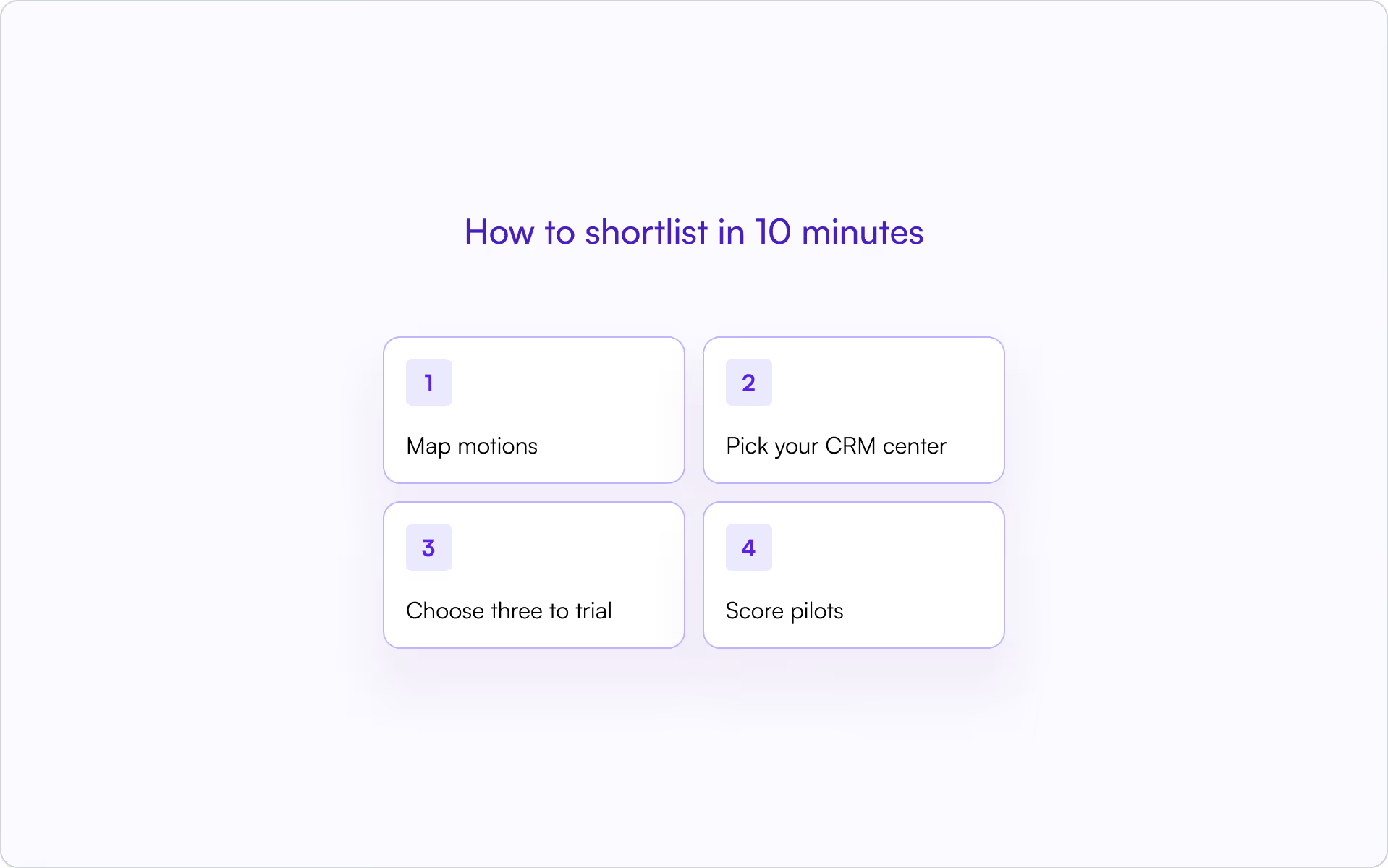
Wie man in 10 Minuten eine Vorauswahl trifft

  • Kartenbewegungen – Wiederverkäufer, Empfehlung, Co-Sell, Partner.
  • Wählen Sie Ihr CRM-Center – Salesforce oder Salesforce HubSpot.
  • Wählen Sie drei zur Testphase aus – z. B. Introw, Channeltivity und Magentrix für CRM-first PRM; Impartner, ZINFI, Unifyr für den Unternehmenskanal; impact.com oder Everflow für Affiliate-lastige Strategien; WorkSpan für Hyperscaler Co-Sell.
  • Bewerten Sie Piloten hinsichtlich der Zeit bis zur ersten Live-Deal-Registrierung, der Einbindung von Partnern ohne Anmeldung, der CRM-Transparenz, der Pipeline-Überprüfung und der Prognosegenauigkeit.
Die 17 besten Salesforce -Alternativen im Jahr 2026

Unabhängig davon, ob Sie sich auf Empfehlungen, Wiederverkäufer, Co-Selling oder Affiliates konzentrieren, umfassen die folgenden Optionen reine PRM-Software, Co-Selling-Orchestrierung und Performance-Partner-Tools. Für jede Option heben wir die wichtigsten Funktionen hervor, die sich auf die Produktivität der Partner, die Qualität der Kundendaten und die einfache Verwaltung von Leads und Opportunities durch Channel-Manager über Drittanbieter hinweg auswirken, während die vollständige Integration mit Ihrem KI-CRM und anderen Salesforce wie Service Cloud gewährleistet bleibt.

1) Introw
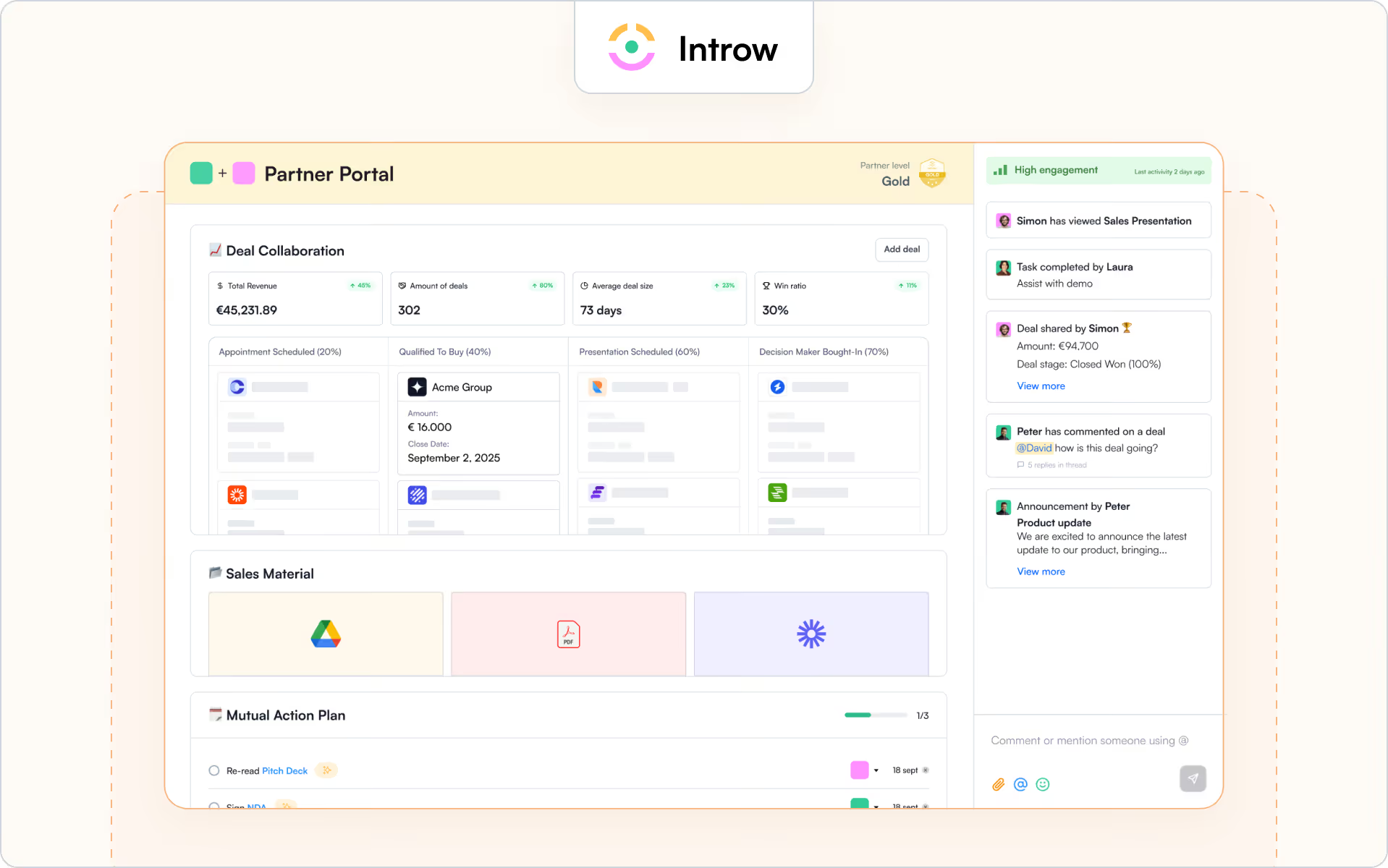
Am besten geeignet für: SaaS-Unternehmen , die Empfehlungs-, Wiederverkäufer- und Co-Selling-Aktivitäten durchführen und den gesamten Partner-Workflow in Salesforce HubSpot abwickeln möchten HubSpot wobei die Partner über E-Mail und Slack eingebunden bleiben, Slack sich niemand extra anmelden muss.

Warum es eine Alternative ist: Anstatt eine umfangreiche Experience Cloud-Website zu erstellen, behält Introw die Registrierung von Geschäften, die Zusammenarbeit und die Berichterstellung in Ihrem CRM bei und verwendet Benachrichtigungen außerhalb des Portals, sodass Partner per E-Mail auf Aktualisierungen antworten oder über Slack zusammenarbeiten können Slack alles synchronisiert mit Salesforce HubSpot. Dies ist eine praktische Möglichkeit, die Portalermüdung zu verringern, Geschäfte und Leads mit Echtzeitdaten zu verfolgen und die Amortisationszeit zu verkürzen.

Callouts: Native Integrationen für Slack, HubSpotund Salesforce helfen Ihnen dabei, Leads und Verkaufschancen schnell zu erfassen. Partner können Leads über öffentliche Formulare, E-Mail oder Slack übermitteln, und jede Übermittlung wird den richtigen CRM-Feldern zugeordnet, um eine klare Zuordnung zu gewährleisten. Wenn Sie eine gemischte Vertriebsstrategie verfolgen – Wiederverkäufer, Empfehlungen, MSP – erleichtern das no-code-Partnerportal, das Content-Management für die Aktivierung und die Analysen die Personalisierung der Erfahrungen nach Partnertyp und die Überwachung der Leistung.

2) Impartner
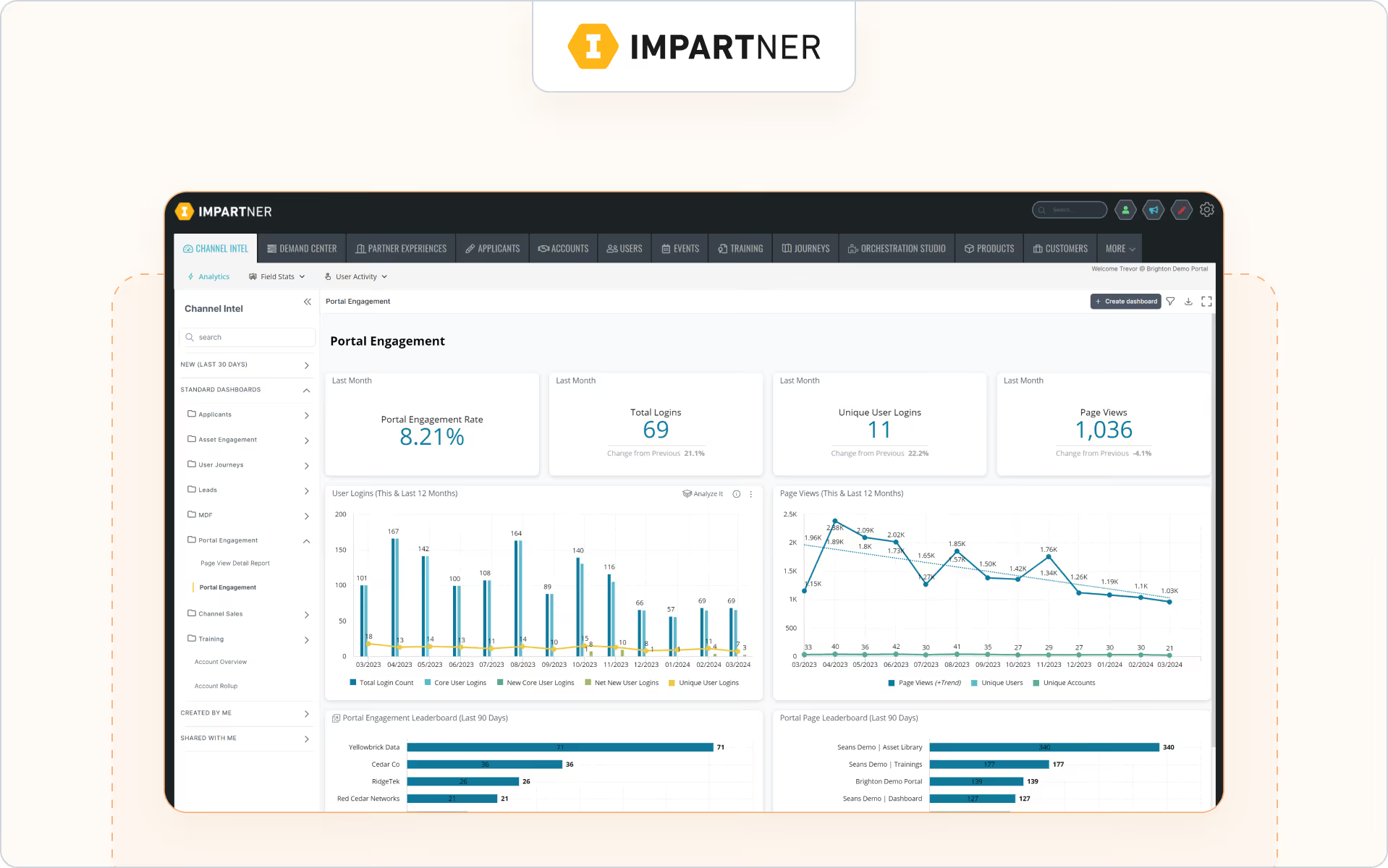
Am besten geeignet für: Unternehmen mit globalen Vertriebskanälen, die auf strukturierte Tiering-Modelle, Incentives und MDF setzen und eine bewährte Governance in großem Maßstab benötigen.

Warum es eine Alternative ist: Wenn die individuelle Entwicklung von PRM auf Experience Cloud zu langsam oder zu komplex ist, bietet Impartner ausgereifte Module – Rekrutierung, Enablement, Deal Reg und MDF – mit einer Erfolgsbilanz in großen Channel-Programmen.

Besondere Merkmale: Die MDF-Tools sind besonders hervorzuheben – Budgetierung, Genehmigungen, Erstattungen und Benachrichtigungen sind in das PRM integriert, was besonders dann von Vorteil ist, wenn das Wachstum durch Partnerfinanzierungen vorangetrieben wird. Verzeichnisse von Drittanbietern und Analysten-Websites zeigen ebenfalls umfangreiche Implementierungen und Vergleiche sowie KI-Funktionen, die in den Bereichen Enablement und Analytik zum Einsatz kommen.

3) ZINFI (Einheitliches Partnermanagement)
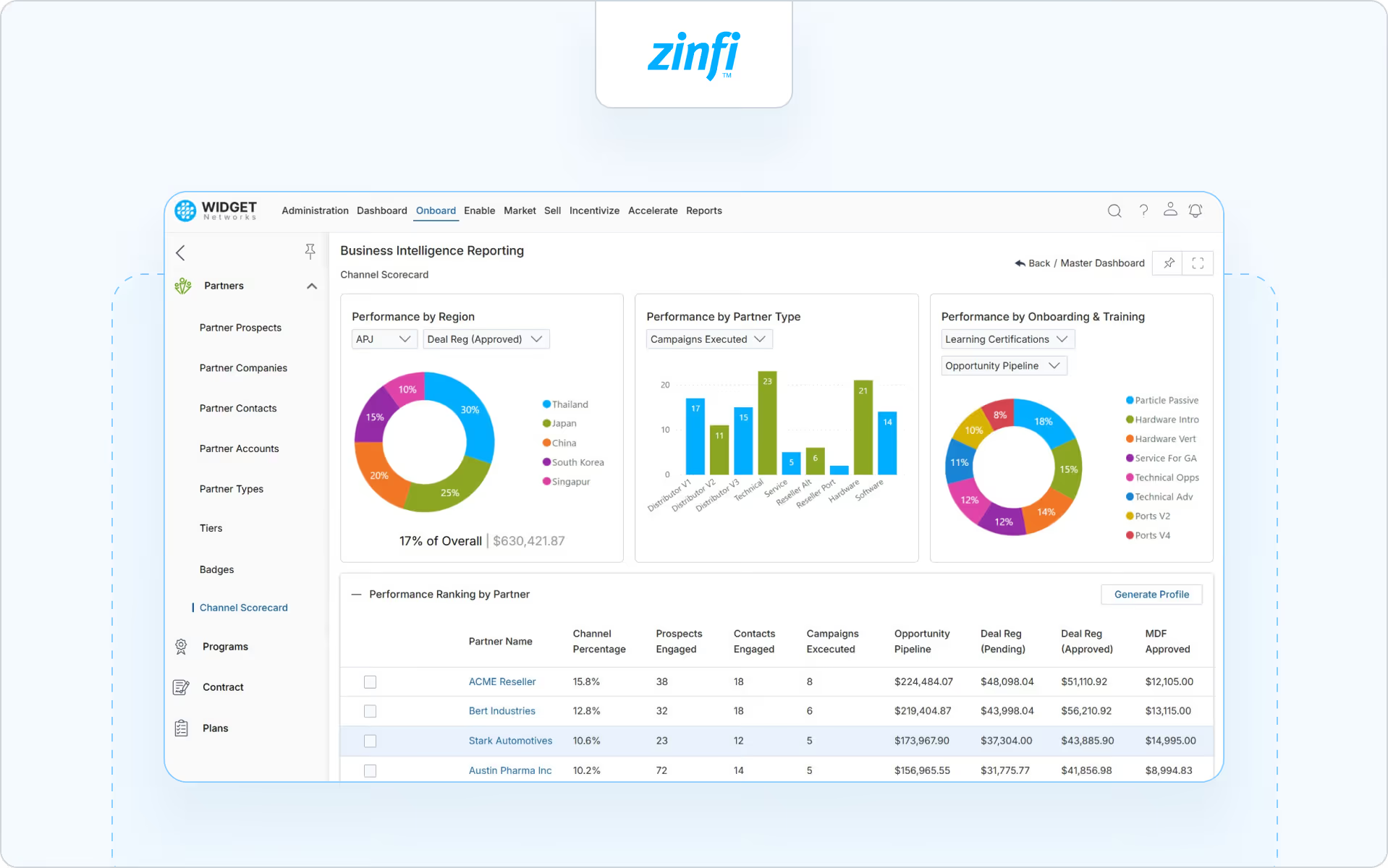
Am besten geeignet für: Teams, die eine umfassende PRM-Suite mit hoher Anerkennung durch Analysten und Kollegen sowie regelmäßigen Produktaktualisierungen suchen.

Warum es eine Alternative ist: Das Unified Partner Management von ZINFI umfasst die Bereiche Rekrutierung, Befähigung, Vermarktung, Verkauf und Incentivierung. Auch im Jahr 2026 setzt das Unternehmen weiterhin auf KI-gestützte Workflows – nützlich, wenn Sie Breite ohne die Zusammenstellung von Punkt-Tools wünschen.

Callouts: Das Unternehmen hebt die Benutzerfreundlichkeit und Modularität von UPM hervor. Wenn Sie mehrere Partnertypen haben und eine Plattform benötigen, die den gesamten Lebenszyklus-Workflow abdeckt, ist dies eine glaubwürdige Option für die Partneraktivierung und das Opportunity-Management.

4) Unifyr (ehemals Zift Solutions)
Am besten geeignet für: Unternehmen mit vielen Vertriebskanälen, die einen einzigen Anbieter für PRM, Channel-Marketing und Schulungen bevorzugen, anstatt separate Systeme miteinander zu verknüpfen.

Warum es eine Alternative ist: Zift Solutions wurde in Unifyr umbenannt und positioniert sich nun als KI-gestützte Partner-Ökosystem-Plattform. Wenn Ihre Experience Cloud zu einem Flickenteppich aus Apps geworden ist, kann das All-in-One-Paket von Unifyr die Abläufe vereinfachen.

Callouts: Messaging konzentriert sich auf Onboarding, Aktivierung und Leistungserkenntnisse über den gesamten Partnerlebenszyklus hinweg – und hilft dabei, Partner anzuleiten, Fortschritte zu verfolgen und Vertriebsprozesse mit dem Marketing abzustimmen.

5) Kanalskalierer (Allbound + Kanalmechanik)
Am besten geeignet für: Unternehmen, die eine moderne PRM-Benutzererfahrung in Kombination mit Preisen, Rabatten und automatisierten Anreizen auf Unternehmensebene wünschen – alles auf einer einzigen Plattform.

Warum es eine Alternative ist: Allbound und Channel Mechanics haben sich zusammengeschlossen und firmieren nun unter dem Namen Channelscaler. Für Teams, die sonst ein PRM-Frontend mit einer separaten Channel-Automatisierungs-Engine kombinieren würden, ist dieser einheitliche Ansatz attraktiv.

Callouts: Presse- und Analystenberichte heben die Skalierbarkeit und Intelligenz nach der Fusion hervor, wobei der Schwerpunkt auf der Beschleunigung indirekter Umsätze, der Erweiterung der Marktreichweite und der Verbesserung der betrieblichen Effizienz liegt.

6) Kanalaktivität
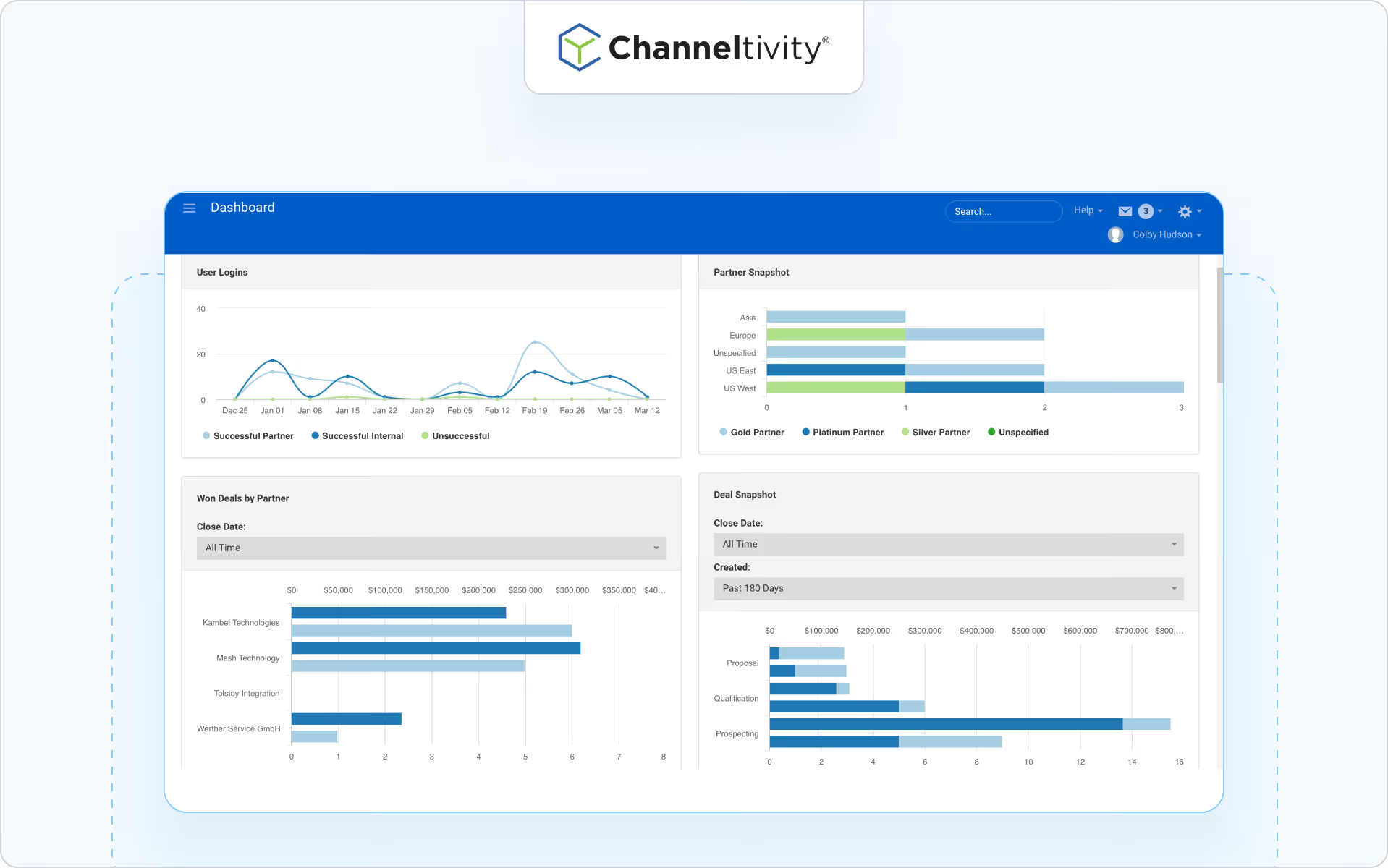
Am besten geeignet für: Mittelständische Teams, die eine schnelle Amortisierung und klickbasierte statt programmierbasierte Integrationen mit Sales Cloud oder HubSpot suchen.

Warum es eine Alternative ist: Die Plug-and-Play-CRM-Integrationen von Channeltivity minimieren das Implementierungsrisiko im Vergleich zu benutzerdefinierten Websites. Deal-Registrierungen und Empfehlungen werden mit dem CRM synchronisiert, sodass Vertrieb und RevOps ohne manuellen Aufwand Einblick in die Partner-Pipeline erhalten.

Hinweise: Der HubSpot und das Hilfe-Center bieten bidirektionale Synchronisierung, Feldzuordnung und Einrichtungsanleitungen – praktisch, wenn Sie ohne aufwendige IT schnell live gehen und dennoch die Leistung überwachen und Geschäfte verfolgen möchten.

7) Magentrix
Am besten geeignet für: Salesforce Programme, die ein konfigurierbares Partnerportal wünschen, das eng mit CRM-Objekten und -Daten verknüpft ist.

Warum es eine Alternative ist: Magentrix ist ein langjähriger AppExchange-PRM. Sein Ansatz konzentriert sich darauf, die CRM-Struktur widerzuspiegeln und fehleranfällige Synchronisierungen zu reduzieren, was reibungsloser sein kann als der Aufbau und die Pflege einer maßgeschneiderten Experience Cloud-Website.

Callouts: Zu den Funktionen gehören die Registrierung und Zuweisung von Geschäften mit automatisierten Benachrichtigungen. Das Unternehmen veröffentlicht außerdem Leitlinien zur Datenübertragung von CRM- zu PRM-Systemen – nützlich für Teams, die Kundendaten in großem Umfang verwalten.

8) PartnerStack
Am besten geeignet für: SaaS-Teams, die Affiliate-, Empfehlungs- und Reseller-Aktivitäten kombinieren und eine Marktplatzreichweite sowie automatisierte Auszahlungen wünschen.

Warum es eine Alternative ist: PartnerStack kombiniert PRM-ähnliche Workflows mit einer robusten Prämien-Engine und einem Partner-Marktplatz. Wenn die pünktliche Bezahlung vieler Partner Ihr Engpass ist, kann dies eine schlüsselfertigere Lösung sein als die Entwicklung entsprechender Funktionen in Salesforce.

Callouts: Flexible Provisionsauslöser und geplante Auszahlungen helfen Finanz- und Betriebsabteilungen dabei, das Vertrauen der Partner zu wahren, insbesondere bei der Skalierung von Long-Tail-Programmen über Partner und Kunden hinweg.

9) Kiflo
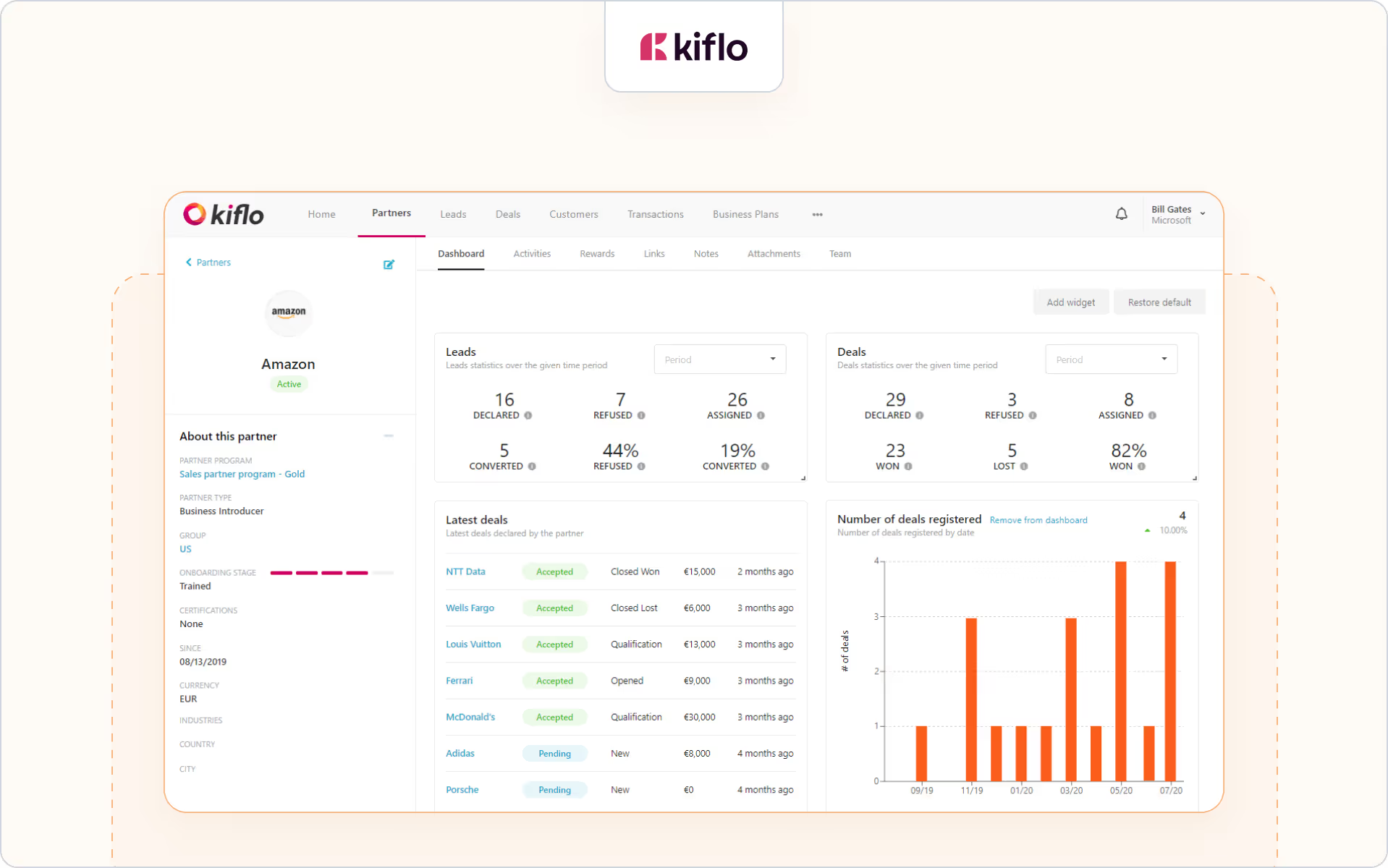
Am besten geeignet für: KMUs und Scale-ups, die ihr erstes Partnerprogramm mit einer unkomplizierten CRM-Synchronisierung formalisieren möchten.

Warum es eine Alternative ist: Kiflo konzentriert sich auf die Grundlagen des PRM – Empfehlungen, Wiederverkäufer, einfache Aktivierung – und lässt sich nativ in HubSpot integrieren, HubSpot Leads, Deals und Kontakte HubSpot synchronisieren. Wenn Ihnen Experience Cloud für Ihre Phase zu leistungsstark erscheint, ist dies ein pragmatischer Einstieg.

Callouts: Marktplatz-Einträge und Dokumente zeigen eine bidirektionale Synchronisierung und Zuordnung, was den Arbeitsaufwand für Partnermanager und RevOps reduziert.

10) WorkSpan
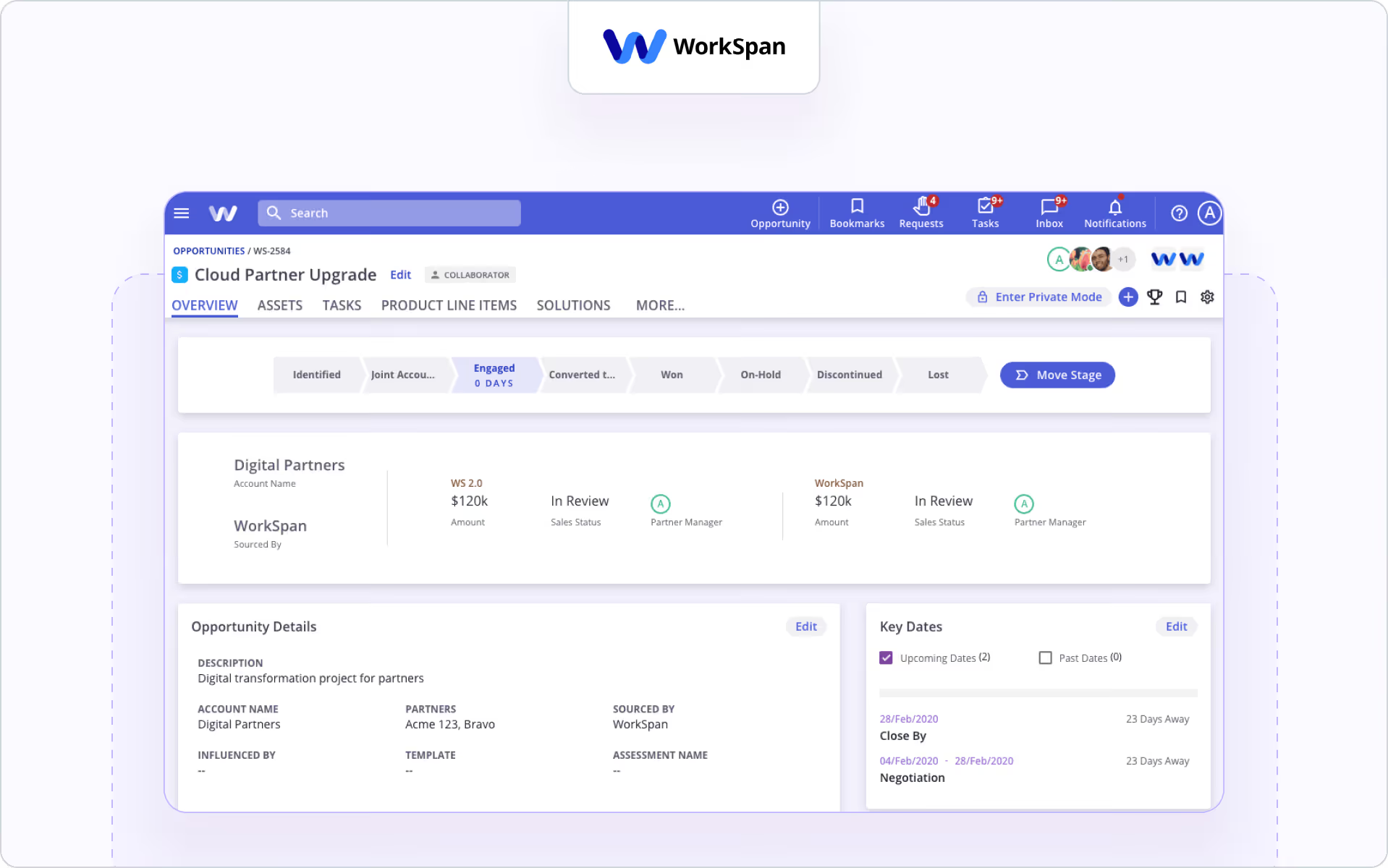
Am besten geeignet für: ISVs, die eine Zusammenarbeit mit AWS, Microsoft oder Google anstreben und private Angebote auf Marktplätzen anbieten, die diese Prozesse in Salesforce integrieren möchten.

Warum es eine Alternative ist: WorkSpan wurde speziell für Co-Selling- und Marktplatzaktivitäten entwickelt und enthält eine Salesforce zur Automatisierung der Weiterleitung von Empfehlungen an AWS ACE und Microsoft Partner Center. Wenn Ihre Lücke zu Salesforce im Bereich Hyperscaler liegt, ist dies eine gute Wahl.

Callouts: Die Hyperscaler Edition unterstützt Marktplatz-Listings und private Angebots-Workflows und lässt sich in Salesforce, HubSpot und Dynamics integrieren, sodass Allianz-Teams und AEs mit Echtzeitdaten aus dem CRM heraus arbeiten können.

11) impact.com
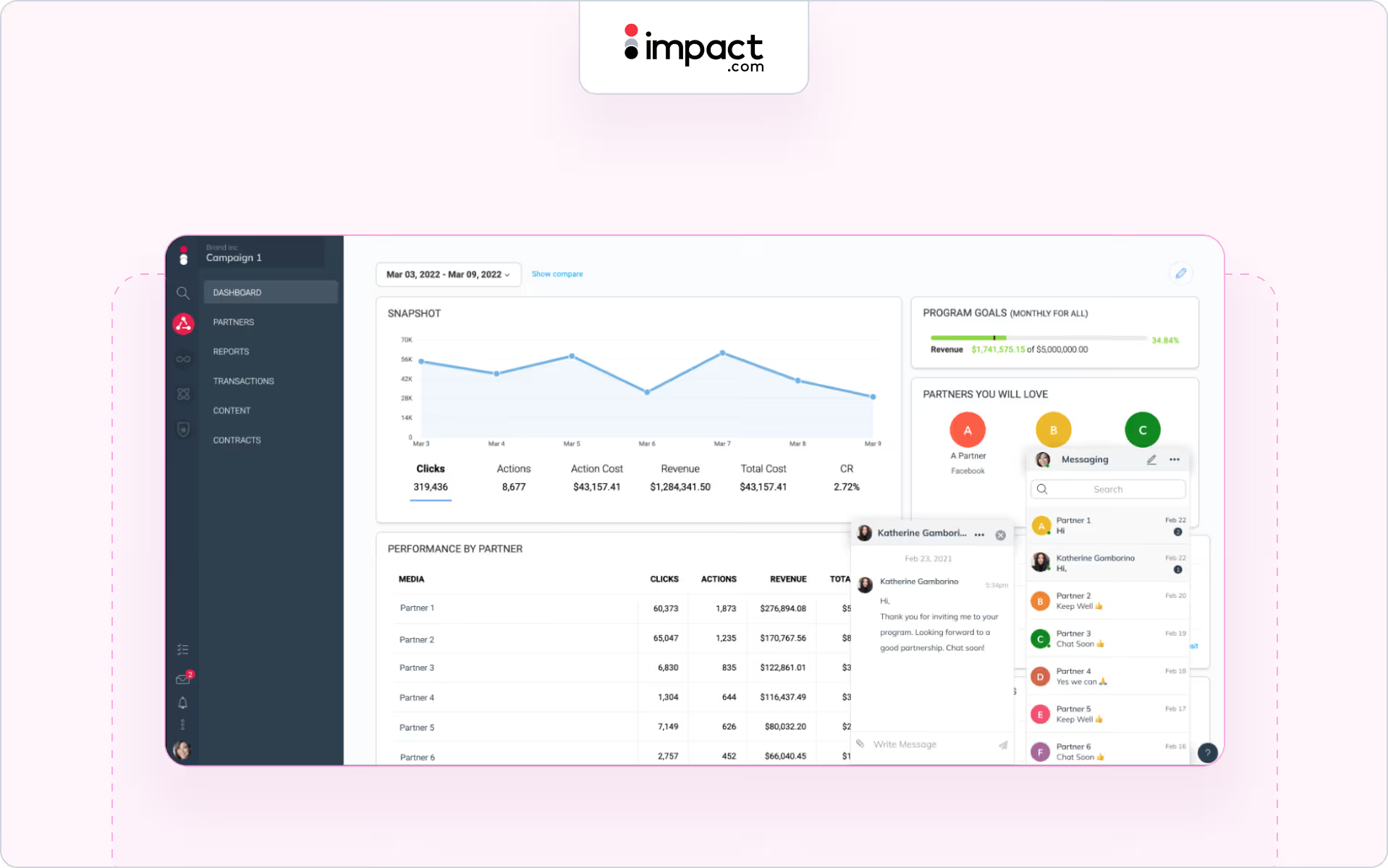
Am besten geeignet für: Partner-, Influencer- und Fürsprecherprogramme, bei denen Entdeckung, Vertragsabschluss, Nachverfolgung und Auszahlungen Hand in Hand gehen müssen.

Warum es eine Alternative ist: Anstatt Affiliate-Tools an ein PRM anzubinden, zentralisiert impact.com die Leistungsseite von Partnerschaften und automatisiert Verträge und Zahlungen. Viele B2B-Marken kombinieren es mit CRM-Berichten, um den beeinflussten Umsatz zu messen.

Callouts: Bewertungen und Zusammenfassungen von Drittanbietern heben wiederholt Automatisierung, Betrugskontrollen und Berichterstattung hervor – nützlich, wenn Partnermarketing Ihr Wachstumshebel ist.

12) Everflow
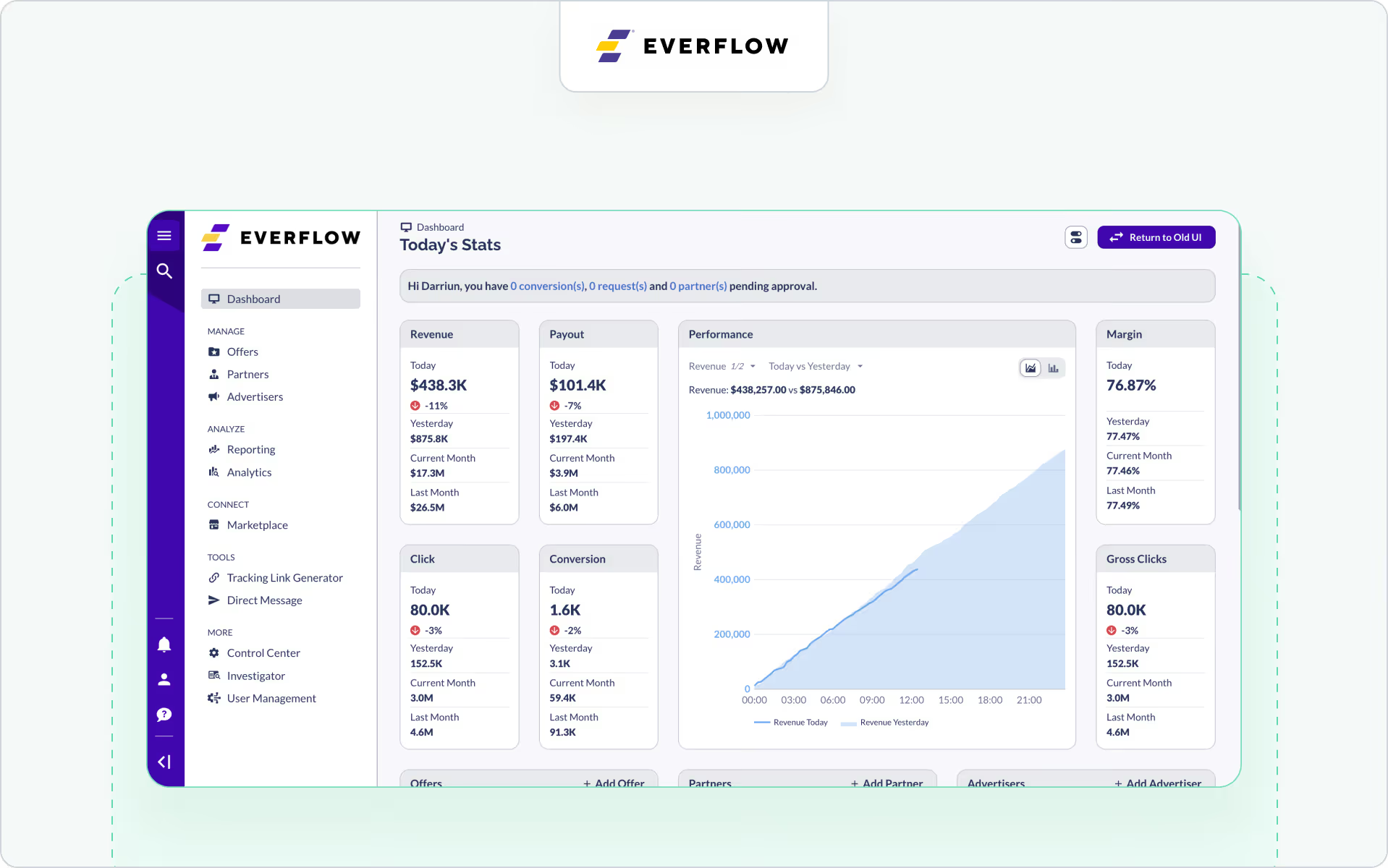
Am besten geeignet für: Fortgeschrittene Partner- und Affiliate-Programme, die detailliertes Tracking, Analysen und eine White-Label-Erfahrung für Agenturen oder Multi-Brand-Portfolios benötigen.

Warum es eine Alternative ist: Everflow legt den Schwerpunkt auf Messungen – kanalübergreifendes Tracking, detaillierte Attribution und Integrationen –, sodass Sie Pipeline und Umsatz quantifizieren können, ohne mehrere Tools miteinander verknüpfen zu müssen.

Callouts: Unabhängige Bewertungen weisen auf robuste Analysen, klickfreies Tracking und Marktplatzoptionen hin, die Teams dabei helfen, effizient zu skalieren und Leads aus verschiedenen Branchen zu verfolgen.

13) TUNE

Am besten geeignet für: Vermarkter, die eine hochgradig anpassbare Partner-Marketingplattform benötigen – flexible Provisionen, umfassendes Tracking und markenspezifische Partnererfahrungen.

Warum es eine Alternative ist: TUNE ist bekannt für seine Konfigurierbarkeit. Wenn Ihre Provisionslogik oder Partnertypen nicht in ein Standardmodell passen, kann die Plattform von TUNE einfacher sein, als diese Komplexität in ein generisches Affiliate-Add-on oder eine selbst erstellte Experience Cloud zu integrieren.

Callouts: Die Positionierung des Produkts hinsichtlich Flexibilität auf Mobilgeräten und im Web sowie die Preisoptionen machen es zu einer Option, wenn Sie mehr Kontrolle als Vorlagen wünschen.

14) Partnerisieren
Am besten geeignet für: Globale Marken, die ihre Affiliate- und Partnerschaftskanäle mit KI-gestützter Optimierung ausbauen möchten.

Warum es eine Alternative ist: Partnerize hat in KI-Funktionalität und Datenintelligenz investiert – hilfreich für vorausschauende Erkenntnisse bei der Partnergewinnung und -optimierung. Wenn Ihre Salesforce eine tiefgehende Performance-Marketing-Komponente benötigt, sollten Sie diese in die engere Wahl ziehen.

Callouts: Öffentliche Beiträge unterstreichen die Ambitionen für Wachstum in dieser Kategorie und eine KI-gestützte Roadmap, was auf eine anhaltende Dynamik hindeutet.

15) PartnerPortal.io
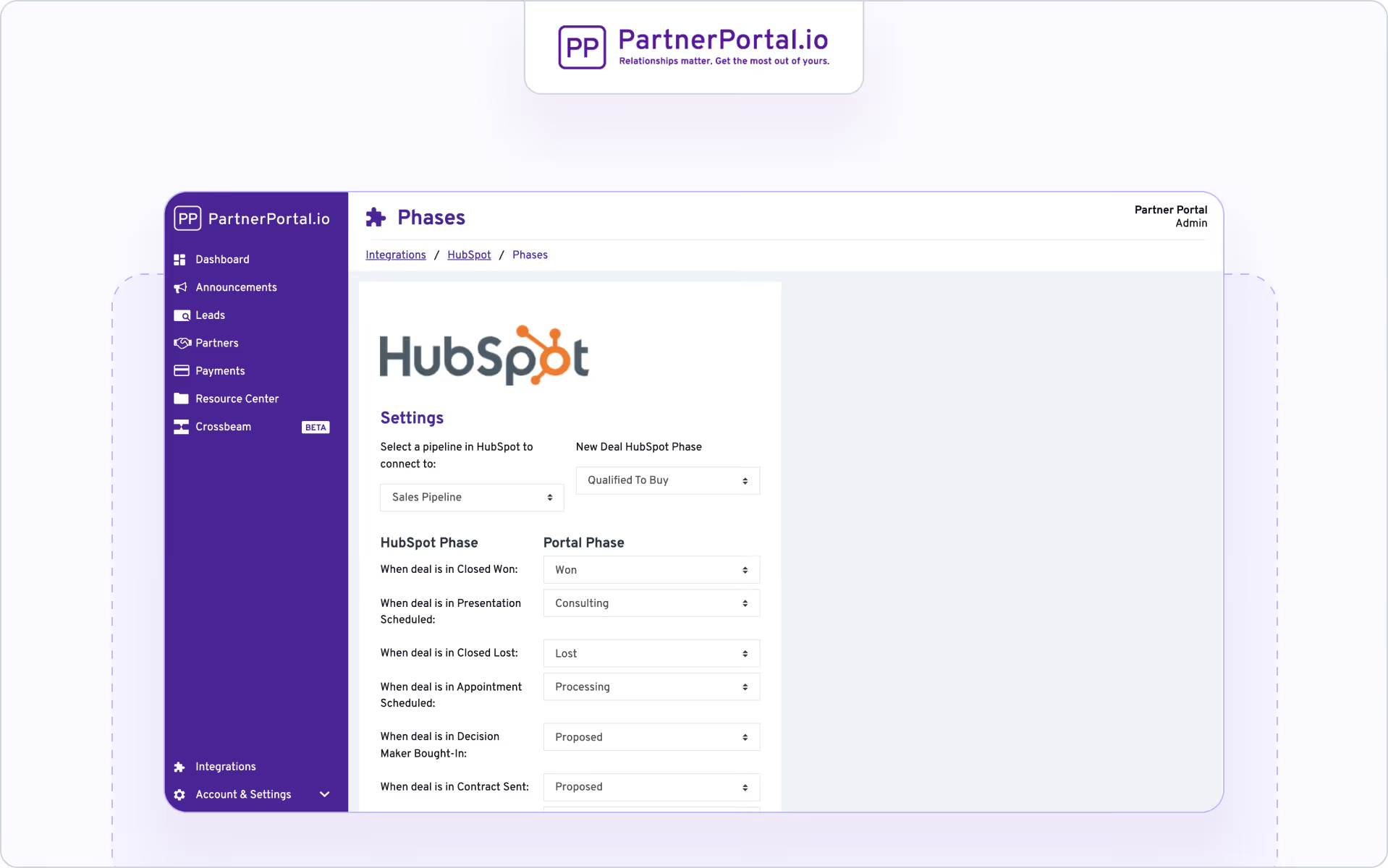
Am besten geeignet für: HubSpot Channel-Manager, die ein Portal suchen, um Leads und Deals zu erfassen, Ressourcen zu teilen und Updates zu veröffentlichen – ohne aufwendige Implementierung.

Warum es eine Alternative ist: Anstatt Ihre eigene Experience Cloud-Website zu erstellen, ist PartnerPortal.io für HubSpot sofort einsatzbereit. Von Partnern übermittelte Leads können Deals erstellen oder verknüpfen, und das Produkt bietet ein einfaches Ressourcenzentrum und Buchhaltungsintegrationen. Es gibt sogar native Crossbeam-Unterstützung für Attribution und Account-Mapping.

Callouts: Die Marktplatz-Seiten zeigen schnelle Bereitstellung, bidirektionale Synchronisierung und den Fokus darauf, alles innerhalb von HubSpot zu halten HubSpot praktisch für Teams, die keine völlig neuen Systeme einführen möchten.

16) Partnero

Am besten geeignet für: Schlanke Partnerteams, die eine reibungslose Lead-Übermittlung und einfache Affiliate- oder Empfehlungsabläufe benötigen, anstatt einer vollständigen PRM-Suite.

Warum es eine Alternative ist: Partnero erleichtert die Annahme von Partner- oder öffentlichen Lead-Einreichungen über eine anpassbare Seite und die Verwaltung des Workflows für die Annahme oder Ablehnung – eine einfache Möglichkeit, Empfehlungen ohne großen Aufwand zu operationalisieren.

Callouts: Produktaktualisierungen unterstreichen die kontinuierlichen Investitionen in Lead-Übermittlung, Attribution und Auszahlungen – nützlich, wenn Einfachheit und Geschwindigkeit am wichtigsten sind.

17) RocketPRM (Impulse Creative)
Am besten geeignet für: Unternehmen, die voll und ganz auf HubSpot setzen HubSpot ein schlüsselfertiges PRM-System wünschen, das vollständig auf HubSpot und CMS basiert – ohne separate Plattform, die verwaltet werden muss.

Warum es eine Alternative ist: RocketPRM ist in HubSpot integriert, sodass Sie Ihre bestehende Deal-Pipeline beibehalten und ein Partnerportal mit HubSpot und -Formularen verwalten können. Wenn Ihr Team den Einsatz eines weiteren Anbieters vermeiden und gleichzeitig bei HubSpot bleiben möchte, ist dies eine gute Option.

Callouts: Auf der Website des Anbieters und in Community-Beiträgen werden die Architektur und die Implementierung erläutert, wobei der Schwerpunkt auf einem HubSpot Ansatz liegt, bei dem Partnerdaten und Workflows an einem Ort zusammengefasst werden.

Wann sollte man bei Salesforce bleiben?

Bleiben Sie bei Salesforce Cloud, wenn Ihr GTM Salesforce basiert, Sie Ihre Daten und AI-CRM-Investitionen unter einem Dach zusammenfassen möchten und Ihr Team einen Experience Cloud-Aufbau unterstützen kann. Salesforce innerhalb dieses Ökosystems native Funktionen für die Registrierung von Geschäften, die Verteilung von Leads und Partnerportale. Dies kann der einfachste Weg sein, wenn Sie auf Sales Cloud, Service Cloud und verwandte Plattformdienste standardisiert sind, die mit anderen Salesforce auf einer einzigen Plattform zusammenarbeiten.

Wechseln Sie, wenn Sie HubSpot , eine schnellere Einführung, Engagement außerhalb des Portals oder Hyperscaler-Co-Selling benötigen. Genau bei diesen Anforderungen punkten die oben genannten Alternativen in der Regel in Bezug auf Time-to-Value, Partnerproduktivität und Akzeptanz.

Warum Introw Ihre Wahl im Jahr 2026 ist

Wenn Ihr Team ein Partnerbeziehungsmanagement wünscht, das vollständig in Ihr CRM integriert ist, vereint der CRM-First-Ansatz von Introw Partner, AE und RevOps in einem Workflow. Sie können Leads und Opportunities erstellen und verwalten, bei Bedarf benutzerdefinierte Objekte verwenden und sich auf Echtzeitdaten für die Nachverfolgung von Geschäften, die Zuordnung und die Prognose verlassen.

E-Mails außerhalb des Portals und Slack eine reibungslose Zusammenarbeit mit Drittpartnern. Ergebnisorientierte Unterstützung und eine schlanke Content-Management-Ebene helfen dabei, Partner anzuleiten, Ressourcen zu teilen und die Leistung zu überwachen. Das Ergebnis ist eine höhere Produktivität der Partner, weniger Synchronisierungsprobleme bei der Verwaltung von Kundendaten und messbare Auswirkungen auf den Umsatz in den Bereichen Vertrieb, Marketing und Service – ohne den Aufwand für die Erstellung einer benutzerdefinierten Experience Cloud. Für viele Unternehmen bedeutet diese Kombination aus Automatisierung, KI-Funktionen und betrieblicher Effizienz geringere Gesamtkosten und langfristigen Erfolg. Buchen Sie eine Demo und überzeugen Sie sich selbst.

FAQs

Noch Fragen? Hier findest du die häufigsten Fragen und Antworten.

Kontaktiere uns

IstSalesforce dasselbe wie „Partner Cloud“ und „Experience Cloud for Partners“?

Salesforce PRM unter Partner Cloud konsolidiert, das auf Experience Cloud läuft und mit Sales Cloud verbunden ist. In den Hilfe-Dokumenten und auf den Produktseiten werden diese Begriffe gemeinsam verwendet – im Wesentlichen handelt es sich um ein Salesforce Partnerportal mit Lead-Verteilung und Deal-Registrierung, das mit anderen Salesforce und Service Cloud für Service-Tools integriert ist.

Was ist die beste Salesforce -Alternative für HubSpot Teams?

Ziehen Sie Introw für einen CRM-orientierten Ansatz außerhalb des Portals in Betracht, PartnerPortal.io für ein 15-minütiges HubSpot und RocketPRM, wenn Sie ein PRM wünschen, das vollständig auf HubSpot und CMS basiert. Alle drei Lösungen sorgen für eine einheitliche Verwaltung von Kunden- und Partnerdaten, sodass Sie Leads und Geschäfte verfolgen und die Leistung von einem Ort aus überwachen können.

Wie steigert Introw die Produktivität von Partnern im Vergleich zu klassischen Salesforce ?

Introw läuft in Ihrem CRM mit In-App-Anleitungen, Slack E-Mail-Updates sowie Echtzeit-Zusammenarbeit, für die keine Portal-Anmeldungen erforderlich sind. Das erleichtert die Anleitung von Partnern, reduziert den Hin- und Her-Verkehr bei Vertriebsprozessen und ermöglicht die Zusammenarbeit an einer gemeinsamen Pipeline – wodurch die Leistung der Partner verbessert und gleichzeitig die Daten für die Pipeline-Prüfung und -Prognose sauber gehalten werden.

Unterstützt Introw sowohl Salesforce HubSpot benutzerdefinierten Objekten und Echtzeitdaten?

Ja. Introw wurde entwickelt, um benutzerdefinierte Objekte, Opportunity-Management und Attribution mit Ihrem CRM zu synchronisieren, sodass Channel-Manager ihre Partner auf einer einzigen Plattform verwalten können. Der KI-CRM-Kontext, die KI-Funktionen und die Automatisierung gewährleisten Echtzeitdaten für Berichte und Überprüfungen über alle Geschäftsfunktionen hinweg.


Launch your partner portal
in minutes!

Vielen Dank! Wir haben deine Anfrage erhalten!
Hoppla! Beim Absenden des Formulars ist ein Fehler aufgetreten.

Verwandte Blog-Artikel

PRM-Ressourcen

The 13 Best AI Sales Coaching Software Tools for Partner and Channel Sales in 2026

Stijn Provoost
Marketing
5min Lesezeit
07 May 2026
⚡ TL;DR

AI sales coaching software helps your reps and partners move deals forward with clear next steps, objection support, and the right content at the right time. But tools coach in different ways. Some analyze call recordings after meetings. Others simulate practice conversations. A smaller group delivers guidance directly inside active deals where progress actually happens. You'll compare the best AI sales coaching software across five categories: conversation intelligence, AI roleplay, sales enablement, sales training, and partner or channel deal coaching. Use the buyer checklist to choose the right fit for your team.

What is AI sales coaching software?

AI sales coaching software helps your team improve how they handle deals, sales calls, and buyer conversations by providing guidance while work is happening, not just after the fact. It uses sales coaching AI to surface next steps, suggest responses to objections, and highlight what’s most likely to move a deal forward.

The category has expanded quickly since 2024, and today, an AI sales coach isn't just one type of tool. It covers several different approaches to coaching sales reps across the full sales cycle.

Here are the five main categories you need to know before choosing a solution:

Kategorie What it does
Conversation intelligence and call coaching Analyzes call recordings and customer calls to improve future sales conversations and identify risks or missed opportunities.
AI roleplay and practice tools Simulates buyer scenarios so reps can practice responses and build confidence before real customer interactions.
Sales enablement with coaching features Surfaces relevant content and guidance during live deals to support better decisions in the moment, often alongside workflows that enable partners with content.
Sales training software and LMS tools Delivers structured learning, tracks skill gaps, and supports consistent training across sales teams.
Partner and channel deal coaching Guides external partners through active opportunities with stage-based support delivered directly inside deals through deal coaching.

Most “best sales coaching software” lists only compare conversation intelligence and roleplay tools. But teams working in indirect revenue models or partner sales need visibility into partner and channel deal coaching as well. Understanding all five categories makes it easier to choose the right sales coaching platform for your business.

AI sales coaching software comparison table

This table compares leading tools across the five coaching categories so you can quickly see where each one fits and whether it supports internal reps, external partners, or both.

ToolKategorieTimingCRM-IntegrationInternal repsExternal partnersPreise
IntrowPartner & channel deal coachingReal-timeSalesforce, HubSpotYesYesCustom SaaS subscription
GongConversation intelligence & call coachingPost-callSalesforce, HubSpot, othersYesNoPer-user enterprise
ChorusConversation intelligence & call coachingPost-callSalesforce, HubSpotYesNoPer-seat subscription
Clari CopilotConversation intelligence & deal inspectionPost-callSalesforceYesNoEnterprise subscription
AvomaConversation intelligence & call coachingReal-time + post-callSalesforce, HubSpotYesNoTiered per-user
Second NatureAI roleplay & practiceSimulationSalesforce, LMSYesNoPer-user subscription
QuantifiedAI roleplay & practiceSimulationLMS & CRM connectorsYesNoCustom enterprise
AllegoSales training & LMSPost-sessionSalesforce, MS DynamicsYesNoEnterprise subscription
MindtickleSales training & LMSPost-sessionSalesforce, Sales CloudYesNoEnterprise subscription
HighspotSales enablement with coachingReal-time contentSalesforce, HubSpotYesNoTiered subscription
SeismicSales enablement with coachingReal-time contentSalesforce, other CRMsYesNoEnterprise subscription

Most tools support internal sales teams only, so if your partners help close deals, you’ll need software built to coach them inside real pipeline activity, not just review calls after the fact.

The 13 best AI sales coaching software tools in 2026

Here’s how the leading AI sales coaching tools compare across the five main categories buyers should evaluate today.

Category 1: partner and channel deal coaching

This is the newest and fastest-growing category of AI-powered sales coaching. These tools guide external partners on live opportunities inside the environments they already use, including partner portals, Slack, and email, so coaching happens while deals are moving instead of after they stall. They’re best for companies that sell through resellers, referral partners, distributors, or ecosystem programs and want to improve partner close rates without adding more partner managers.

#1 Introw – Best for AI deal coaching in partner and channel sales

What it does:

Introw is the only PRM with built-in AI deal coaching that creates a dedicated AI sales coach for each pipeline, such as reseller, referral, or co-sell. That means every partner deal gets stage guidance, objection handling, asset recommendations, and rules of engagement automatically inside the deal itself through deal coaching.

Who it’s best for:
B2B companies that rely on partners, resellers, or ecosystem motions and want partner-sourced pipeline to close more like direct pipeline without hiring more partner managers.

Wichtigste Features:

  • Dedicated AI coach per partner segment with templates for reseller, co-sell, and referral motions
  • Stage guidance that tells partners what to do next at each deal step
  • Context-aware objection handling based on deal stage and engagement signals
  • Asset recommendations surfaced inside the opportunity when partners need them
  • Rules of engagement that clarify when to involve your internal team

CRM integrations:

Works with HubSpot and Salesforce.

Pricing:

Custom pricing from Starter to Enterprise based on the number of seats and configuration, and you can start for free.

Category 2: conversation intelligence and call coaching

These sales coaching tools record and analyze sales calls, then turn those conversations into coaching insights your sales managers can use to coach sales reps more consistently. They’re best for internal sales teams that want better visibility into sales conversations, rep performance, and patterns across customer interactions.

#2 Gong – Best for revenue intelligence and call pattern analysis

What it does:

Gong records and analyzes customer calls, meetings, and emails to surface patterns that affect deal outcomes. It helps sales leaders understand what top performers do differently and uses conversation intelligence to highlight risks, competitor mentions, and coaching opportunities across the sales cycle.

Who it’s best for:

Mid-market and enterprise sales teams that run high volumes of sales calls and want data-driven insights to improve team performance.

Wichtigste Features:

  • Call recordings with speech and sentiment analysis
  • Pipeline risk alerts and deal insights based on conversation patterns
  • Manager dashboards that support structured coaching feedback

CRM integrations:

Works with Salesforce, HubSpot, and other major sales cloud environments.

Pricing:

Custom pricing, typically reported between $100 and $150 per user per month depending on contract size and feature access.

Partner/channel gap:

Gong is designed for internal sales professionals using company-managed meeting tools. Partners usually sell independently, which limits how often they appear in recorded workflows that support channel partner sales enablement or structured co-selling.

#3 Chorus by ZoomInfo – Best for call coaching inside the ZoomInfo ecosystem

What it does:

Chorus by ZoomInfo captures sales conversations and turns them into coaching cues using artificial intelligence. It highlights talk ratios, objection-handling moments, and deal risks so sales managers can deliver more consistent coaching across customer calls.

Who it’s best for:
Sales teams already using ZoomInfo that want AI coaching tools connected to prospecting intelligence and enrichment data.

Wichtigste Features:

  • Call recording with AI-generated summaries and coaching cues
  • Conversation analytics tied to ZoomInfo contact and company data
  • Performance analytics that help identify skill gaps across teams

CRM integrations:

Integrates with Salesforce and HubSpot for pipeline visibility and activity capture.

Pricing:

Bundled within ZoomInfo platform subscriptions with custom pricing based on package level.

Partner/channel gap:

Like most AI sales coaching tools in this category, Chorus depends on recorded meetings inside your stack. That makes it harder to support distributed partner ecosystems where deals often happen outside internal call tracking environments.

#4 Clari – Best for pipeline forecasting with coaching signals

What it does:

Clari is a revenue platform that combines forecasting, pipeline inspection, and activity capture to generate coaching signals from sales data rather than only analyzing call recordings. It helps sales leaders identify deal risks earlier and supports more accurate planning across enterprise sales teams.

Who it’s best for:
Revenue leaders and sales managers focused on forecast accuracy, pipeline health, and predictable revenue growth.

Wichtigste Features:

  • Forecast modeling based on pipeline movement and activity capture
  • Deal inspection workflows that highlight performance improvement opportunities
  • AI-driven insights connected to pipeline coverage and execution

CRM integrations:

Primarily integrates with Salesforce and related revenue infrastructure tools.

Pricing:

Custom enterprise pricing based on deployment scope and forecasting modules.

Partner/channel gap:

Clari focuses on internal pipeline visibility rather than external partner execution. It doesn’t provide coaching inside partner workflows such as shared deal registration processes supported by deal registration or distributed partner deal collaboration.

Category 3: AI roleplay and practice

These AI coaching tools simulate sales conversations so reps can practice objection handling, discovery calls, and positioning in a safe environment. They’re best for onboarding new reps and reinforcing consistent messaging before live customer interactions.

#5 Second Nature – Best for AI-powered sales roleplay simulations

What it does:

Second Nature creates AI-powered sales roleplay simulations where reps practice conversations with a virtual buyer that responds in real time. The platform scores performance and highlights areas for improvement so teams can run targeted training at scale.

Who it’s best for:

Sales enablement teams running onboarding programs, product launches, or messaging rollouts that require consistent training across distributed teams.

Wichtigste Features:

  • AI conversational roleplay simulations with adaptive buyer responses
  • Performance scoring tied to predefined sales coaching techniques
  • Custom scenario builder for product positioning and objection handling

CRM integrations:

Limited CRM integrations. Primarily used as a standalone sales training platform.

Pricing:

Custom enterprise pricing based on deployment scope and team size.

Partner/channel gap:

Can support partner training if partners log into the system, but it isn’t embedded in the deal flow or partner portal environments typically used for channel partner sales enablement.

#6 Hyperbound – Best for AI cold call and discovery practice

What it does:

Hyperbound simulates realistic cold call and discovery conversations using AI buyer personas that react dynamically during practice sessions. Reps receive instant feedback and scoring to help refine talk tracks and improve early-stage pipeline conversations.

Who it’s best for:

SDR and BDR teams focused on improving outbound performance and discovery call execution.

Wichtigste Features:

  • AI buyer personas designed for cold call and discovery practice
  • Instant feedback with scoring across coaching moments
  • Leaderboards that help managers track rep performance improvement

CRM integrations:

Minimal CRM connectivity. Designed primarily as a standalone AI sales training environment.

Pricing:

Typically starts around $40 to $60 per user per month depending on configuration.

Partner/channel gap:

Built for internal outbound teams rather than partner programs. It doesn’t support ongoing deal review workflows or structured partner enablement.

#7 Quantified – Best for AI avatar-based sales simulations

What it does:

Quantified uses AI-generated video avatars to simulate realistic buyer presentations so reps can practice delivery, positioning, and messaging before live meetings. The platform evaluates performance using AI feedback and benchmarking across teams.

Who it’s best for:

Enterprise sales teams focused on presentation readiness and improving messaging consistency across complex sales cycles.

Wichtigste Features:

  • AI video avatars that simulate live buyer presentation scenarios
  • Messaging analysis aligned with your sales methodology
  • Benchmarking dashboards that compare results across teams

CRM integrations:

Limited CRM integrations. Primarily deployed as a structured sales training software layer.

Pricing:

Custom enterprise pricing based on rollout scope.

Partner/channel gap:

Designed for structured training rather than live pipeline execution. It doesn’t support deal-level coaching or workflows connected to partner ecosystems such as those covered in this partner enablement guide.

Category 4: sales enablement with coaching features

These platforms manage sales content such as decks, battle cards, and playbooks, then add guided selling and coaching layers on top. They’re best for teams that want content control and contextual support in one system instead of separate sales coaching solutions.

#8 Highspot – Best for content management with guided selling

What it does:

Highspot is a sales enablement platform that manages content, training, and buyer engagement while adding AI-powered sales coaching tools like guided selling and content recommendations that support reps during live opportunities.

Who it’s best for:

Enterprise sales and enablement teams managing large content libraries that need structured guidance on what to send and when.

Wichtigste Features:

  • Centralized content management with usage tracking
  • Guided selling plays aligned to a specific sales methodology
  • AI content recommendations based on deal context

CRM integrations:

Integrates with Salesforce and Microsoft Dynamics.

Pricing:

Custom enterprise pricing based on deployment scope and content volume.

Partner/channel gap:

Includes some partner content sharing workflows, but coaching is primarily designed for internal sales teams rather than embedded channel sales enablement across partner-managed deals.

#9 Showpad – Best for sales content and coaching in one platform

What it does:

Showpad combines sales content management with interactive training and coaching layers so teams can align messaging, improve onboarding, and support consistent execution across the sales cycle.

Who it’s best for:

Mid-market sales teams that want sales training software and content management in a single platform.

Wichtigste Features:

  • Content management with version control and engagement tracking
  • Interactive training modules that support targeted training programs
  • Coaching dashboards that highlight skill gaps across teams

CRM integrations:

Integrates with Salesforce, HubSpot, and Microsoft Dynamics.

Pricing:

Custom pricing based on team size and feature configuration.

Partner/channel gap:

Supports partner content distribution, but coaching features are designed mainly for internal rep workflows rather than structured channel partner sales enablement.

#10 Seismic – Best for enterprise-scale sales enablement and coaching

What it does:

Seismic is an enterprise sales enablement platform that combines content automation, training, coaching scorecards, and analytics with AI-powered sales guidance to help organizations improve execution consistency at scale.

Who it’s best for:

Large enterprise sales organizations managing complex content ecosystems and structured training programs.

Wichtigste Features:

  • Content automation with governance controls
  • AI content recommendations aligned to buyer stage
  • Seismic Learning for structured training and coaching programs

CRM integrations:

Integrates with Salesforce and Microsoft Dynamics.

Pricing:

Custom enterprise pricing based on rollout scope.

Partner/channel gap:

Includes partner-facing capabilities, but coaching layers are designed primarily for internal seller workflows rather than ongoing partner deal execution.

Category 5: sales training and LMS with coaching layers

These platforms focus on structured learning paths, certifications, and readiness tracking, then add coaching layers like scorecards and manager feedback. They’re best for teams that want consistent training tied to performance improvement across sales teams.

#11 Mindtickle – Best for sales readiness and coaching scorecards

What it does:

Mindtickle is a sales readiness platform that combines structured learning paths, call analysis, and AI-powered coaching scorecards so enablement teams can track how training affects rep performance over time.

Who it’s best for:

Sales enablement leaders who want to measure readiness across teams and connect training programs to coaching outcomes.

Wichtigste Features:

  • Role-based learning paths with certification tracking
  • AI coaching scorecards tied to readiness indexes
  • Call recordings analysis connected to sales training progress

CRM integrations:

Integrates with Salesforce and HubSpot.

Pricing:

Custom enterprise pricing based on deployment scope and enablement modules.

Partner/channel gap:

Primarily designed for internal sales professionals. Partners typically require separate onboarding to access training environments.

#12 Allego – Best for video coaching and peer-to-peer learning

What it does:

Allego is a sales learning platform centered on video-based practice, peer-to-peer coaching, and conversation intelligence so teams can reinforce messaging through recorded examples and feedback loops.

Who it’s best for:

Organizations that want collaborative coaching environments where reps learn from shared recordings and structured video practice.

Wichtigste Features:

  • Video-based coaching workflows with manager feedback
  • Conversation intelligence tied to recorded customer calls
  • Peer-to-peer learning supported by shared practice libraries

CRM integrations:

Integrates with Salesforce.

Pricing:

Custom pricing based on rollout scope and learning configuration.

Partner/channel gap:

Built for internal rep coaching and structured learning rather than ongoing partner deal execution.

#13 Brainshark by Bigtincan – Best for sales readiness and onboarding

What it does:

Brainshark by Bigtincan delivers structured onboarding, certification paths, and readiness scorecards with video coaching features that help teams standardize early-stage training and onboarding outcomes.

Who it’s best for:

Sales teams focused on onboarding consistency and certification-driven readiness programs.

Wichtigste Features:

  • Training content authoring with certification tracking
  • Video coaching workflows tied to readiness scorecards
  • Mobile learning access for distributed sales representatives

CRM integrations:

Integrates with Salesforce.

Pricing:

Custom enterprise pricing based on deployment scope and certification needs.

Partner/channel gap:

Focused on structured training rather than deal-level coaching. It does not support partner pipeline execution or external partner coaching workflows.

There are many strong tools in this space, and they solve very different problems. That can make the decision feel harder than it should be.

The key is to match the type of coaching to how your team actually sells, especially if partners are part of your pipeline.

How to evaluate AI sales coaching software (buyer checklist)

Use this checklist to compare AI sales coaching software capabilities across vendors before you decide.

Bewertungskriterien Was zu überprüfen ist
☐ Real-time vs. post-call coaching Does the platform provide real time coaching during active deals, or only insights after sales calls? The best tools support both.
☐ CRM integration depth Does it read deal stage, history, and customer data from Salesforce or HubSpot, or just log activity? Deep integrations unlock real time insights.
☐ Internal reps vs. external partners Can it coach people outside your internal systems, or only your sales reps? Partner teams need coaching in portals, Slack, or email.
☐ Content and asset surfacing Does the tool recommend the right pitch decks, case studies, or battle cards at the right moment, not just analyze past activity?
☐ Objection handling Does it generate contextual responses using deal stage and engagement signals, or rely on static libraries with traditional coaching methods?
☐ Scalability and configuration Can you configure once and apply coaching across teams with built in coaching capabilities, or does setup happen rep by rep?
☐ Pricing model Does pricing scale per seat, per partner, or per recorded interaction, and will that structure still work as you implement AI sales coaching across your organization?

Teams that sell through partners should also confirm whether the platform supports partner workflows alongside internal sales processes.

Which type of AI sales coaching software do you need?

Start with where coaching needs to happen in your workflow.

  • If partners, resellers, or referral teams help close deals, you’ll get the most impact from tools that guide external sellers inside active opportunities. That matters even more once you see how partner-sourced opportunities typically perform compared to direct deals. You can evaluate that difference using these partner deal stats.
  • If most revenue comes from direct sellers, conversation intelligence platforms help improve call quality and pipeline visibility.
  • If your priority is onboarding or messaging consistency, roleplay tools help new reps practice before speaking with customers.
  • If your challenge is keeping partner training aligned with how deals actually move, a structured partner LMS helps reinforce learning inside your partner motion.

When both direct and partner pipeline matter, coaching works best when guidance appears automatically at the right moment inside each deal.

That’s where support from an embedded AI agent helps teams deliver consistent next steps without adding manual coaching overhead.

Why Introw is the best choice for partner teams

By now, you’ve probably noticed most AI sales coaching tools are built for internal reps. That works if your pipeline lives inside your team. It’s harder when partners are responsible for part of your revenue and you don’t always see what’s happening inside their deals.

Introw supports execution inside the deal itself. Partners see what to do next at each stage, which reduces stalled opportunities and removes the need for constant partner manager involvement.

As partner programs scale, execution naturally becomes less consistent across resellers, referral partners, and co-selling motions. Introw helps standardize how deals move forward by adapting guidance to deal stage, partner role, and engagement signals.

What you'll see:

  • Fewer deals going quiet
  • Clearer collaboration between partners and internal teams
  • More predictable partner pipeline.

This is especially valuable in organizations where partner-led and direct pipeline often run side by side.

If partner deals are already part of your revenue motion, you can Request a demo to see what deal-level coaching looks like inside an active partner workflow.

PRM-Ressourcen

AI Sales Coaching for Partner Teams: The Missing Layer in Partner Revenue

Géraldine Vander Stichele
Growth
5min Lesezeit
06 May 2026
⚡ TL;DR

AI sales coaching helps your partner teams close more deals by guiding partners through each stage of the sales cycle with real-time support where they already work. Instead of relying on traditional coaching, content libraries, or delayed deal reviews, modern AI deal coaching delivers: stage guidance aligned to your pipeline. objection handling in real deal context, asset recommendations at the right moment, clear rules of engagement between partners and your sales teams. You’ll learn why partner deals underperform, how AI-powered deal coaching improves partner close rates, and how to roll it out across your partner program without adding headcount.

The real reason partner deals stall (and it is not your partners)

Partner-sourced opportunities are often your most valuable pipeline.

They tend to be larger, more strategic, and more likely to convert when they move forward. Introw’s own research shows partner deal stats that partner-sourced opportunities consistently outperform average direct deals when they reach the finish line.

So, the issue is the difference between how your partners vs. your sales teams are coached.

Think about how partners actually work:

  • They juggle multiple vendors at once
  • They do not live inside your product every day
  • They have not gone through your internal sales training
  • They rarely get real-time feedback during customer interactions

When partners hit objections they have not seen before or reach stages they do not fully understand, they usually do not escalate. They guess. They pause. Or they quietly move on.

Nearly 60% of forecasted deals never close. For partner deals, the number is worse because partners are operating without the same level of sales coaching as your internal sales reps.

Inside your business, your sales reps get deal reviews and support from sales managers across your revenue teams. Your partners typically get a content library, a quarterly QBR, and generic partner enablement that sits outside the deal instead of helping them move it forward.

Most AI sales coaching tools still focus on internal sales calls and call analysis. But partners do not work inside those environments. Without an AI sales coach built for partner teams, they do not get the targeted feedback needed to close more deals consistently.

Why traditional AI sales coaching does not work for partner teams

Most AI sales coaching tools were built to coach sales reps inside your organization.

They rely on call recordings, conversation intelligence, and deal review workflows that assume partners are part of your internal sales process. They are not.

This is where channel partner sales enablement breaks down.

Partners typically:

  • Do not join your coaching sessions
  • Do not receive real-time coaching during customer interactions
  • Do not get support when deals begin to stall

The result is predictable: slower deal progression, weaker sales performance, and fewer partner-sourced wins across your broader partner sales motion.

Instead of reviewing deals after they slip, an AI deal coach delivers personalized coaching during the sales cycle, helping partners respond to objections, take the right next step, and keep opportunities moving.

Modern deal coaching makes this possible by embedding AI assistance in deal coaching directly into partner workflows, so guidance appears where partners already collaborate.

Why traditional partner enablement does not fix this

Most teams see the coaching gap and try to solve it with traditional enablement.

They invest in content hubs, LMS programs, quarterly reviews, and more partner-manager time. All useful. None designed for coaching partners inside live deals.

Here is the pattern most partner teams run into:

Traditional partner training supports Traditional partner training does not support
Produktwissen Coaching inside live deals
Certification and onboarding Real time coaching during the sales cycle
Content access Instant feedback on deal execution
Strategic alignment in QBRs Personalized feedback per opportunity
Scalable documentation Coaching sales reps without adding headcount

Each of these gaps shows up differently across your partner motion.

Content libraries go unread

Content libraries solve access, not timing.

You built a strong asset hub with pitch decks, battle cards, and case studies. But partners do not stop mid–sales cycle to search for the right file. They need the right asset surfaced inside the deal.

This is the gap between documentation and real sales coaching solutions built around AI in deal coaching.

Structured partner content enablement improves access. It does not create coaching in the moment.

Training gets forgotten

Training builds a foundation. It does not support execution months later.

LMS programs help partners understand your product and process. But when a partner faces a difficult objection four months later, that knowledge is gone. Traditional sales training cannot provide personalized feedback during active opportunities.

Even with a strong partner LMS, partners still need guidance inside the deal itself.

QBRs review the past, not the present

Quarterly business reviews improve alignment. They do not improve deal movement.

By the time a stalled opportunity appears in a QBR deck, the coaching window has already closed. Traditional coaching works retrospectively. AI powered sales coaching works inside the deal while it is still active.

Partner managers cannot be in every deal

This is where most programs hit a scaling limit.

Even strong partner managers cannot coach every opportunity across dozens or hundreds of partners. They cannot review every deal, respond to every Slack question, or support every objection in time.

This is not a hiring problem. It is a structural constraint.

That is why teams are turning to AI sales coaching software and sales coaching AI approaches that support partners directly inside the sales cycle instead of relying only on humans to coach sales reps manually.

The use cases: where AI deal coaching lifts partner win rates, deal sizes, and sales cycles

AI deal coaching is not just a feature. It is the layer that lifts win rates, expands deal sizes, and shortens sales cycles across your partner pipeline. Not by replacing partner managers, and not by adding another training partners will forget. By coaching partners inside live deals, the moment they need it.

Stage guidance: Coaching partners through unfamiliar deal stages

Partners don't always know how to best sell in all these different scenarios. They hit stages they have only navigated a few times, prospects with unfamiliar buying patterns, deal types they rarely run. Without clear guidance in the moment, they default to what worked last time. Sometimes that translates. Often it does not.

AI deal coaching surfaces stage-specific guidance inside the deal: what needs to be true to advance, the actions to take, and ready-to-send email templates for that exact stage. Partners get clarity on how your sales process works, without sitting through another training they will forget by next Friday.

The result: shorter sales cycles, because partners stop stalling at stages they have not mastered.

Handling objections partners have not seen before

A partner gets "we already use a competitor" or a pricing pushback they have not encountered. They send a generic reply, the deal goes quiet, and three weeks later it is gone.

AI deal coaching pulls the right objection-handling response based on the objection itself, the deal stage, and the deal context. The partner gets the framework, the proof points, and the talk track inside the deal, before they reply. Newer partners get the institutional knowledge of your top sellers without scheduling a call.

The result: higher partner win rates, because partners stop losing deals to objections your top AEs would have closed.

Surfacing the right asset at the right stage

Content libraries fail because partners do not stop mid-deal to search a folder for the right battle card. They send what they remember, which is usually the wrong asset for the stage they are in.

AI deal coaching attaches an asset library to the coach itself: pitch decks, one-pagers, battle cards, case studies. The AI surfaces the right one at the right stage automatically. The partner does not search. The right asset just appears.

The result: larger deal sizes, because the right case study or ROI document shows up before the prospect asks for budget justification.

Keeping partners and your internal team aligned on escalations

Partners hesitate to escalate when they are unsure. They sit on pricing questions, hold off on involving an AE, or loop in technical support too late. By the time you find out, the deal has slipped.

AI deal coaching embeds rules of engagement directly into the coach: when pricing needs approval, when to bring in an AE, when to involve technical support, when a deal needs your team's attention. Partners know exactly what is in and out of bounds, and stop hesitating.

The result: faster deals and higher partner confidence, because partners stop sitting on questions and start moving.

Onboarding new partner reps without a multi-week ramp

A new rep starts at one of your partners. In the old model, you send them to a partner LMS, walk them through a deck, hand off a content folder, and hope it sticks. By the time they hit a real deal three weeks later, most of it is gone.

AI deal coaching collapses that timeline. The new rep gets dropped straight into a real opportunity, with stage guidance, objection responses, the right assets, and clear escalation rules surfaced inside the deal itself. They learn your sales process by running it, with an expert coach in the deal alongside them. No three-week ramp. No lengthy training they will forget. The first deal becomes the training.

The result: faster partner ramp, lower training overhead, and new reps contributing pipeline from week one instead of month three.

Catching stalled deals before the coaching window closes

The biggest gap in partner programs is timing. Coaching that arrives in next quarter's QBR is too late. Coaching that arrives when a deal stops moving is on time.

Because AI deal coaching reads stage, vertical, engagement signals, and full deal history, it surfaces guidance proactively the moment the deal needs it. Partners get the next best action while the opportunity is still active, not after it has been written off.

The result: fewer deals lost to silence, and a measurable lift in partner-sourced win rate.

Where AI coaching actually shows up for partners

Most AI sales coaching tools assume partners will log into a platform, review insights, and adjust how they run deals.

That rarely happens.

For AI coaching to improve real partner execution, it has to appear inside the places partners already work. Not in dashboards. Not in transcripts. Not in separate sales coaching platforms.

Here is where effective AI sales coaching actually shows up.

In the CRM

Most partners already live inside HubSpot or Salesforce. It is where they log activity, manage pipeline, and review what is happening across deals.

A modern AI sales coaching platform meets them there first. Guidance appears directly on the deal record, surfaced alongside the data partners are already looking at:

  • The next best action for that specific opportunity
  • Risk signals based on stage, activity, and recent changes
  • Suggested talk tracks for the next conversation
  • Context pulled from related deals and past interactions

Because the coaching lives inside the CRM, partners do not have to switch tools, learn a new workflow, or remember to check anything extra. The guidance shows up in the same view where they are already working the deal.

This is the most natural surface for AI coaching, and the one with the highest adoption, because it requires zero behavior change.

In the partner portal

Inside a modern AI sales coaching platform, guidance appears directly in the deal detail view.

Every time a partner opens an opportunity, they see:

  • The next best action
  • Relevant objection handling
  • Suggested assets
  • Stage-specific deal guidance

This creates real-time coaching tied to the exact opportunity they are working on. It improves sales conversations without requiring partners to search for help or revisit traditional sales training materials.

Over time, this kind of embedded AI coaching increases sales velocity because partners always know what to do next inside the sales cycle.

In Slack deal notifications

Partners already rely on notifications to track deal movement.

When a stage changes, AI coaching tools can surface guidance alongside the alert itself:

  • What changed in the deal
  • What action to take next
  • What risk signals to watch
  • When to involve your team

This turns activity alerts into coaching moments and gives partners instant feedback while deals are still moving.

Instead of waiting for a human sales manager to step in, partners get direction exactly when they need it.

In email deal updates

Some partners never log into portals consistently. That is normal.

AI-powered sales coaching solves this by embedding guidance directly into deal update emails. Even if a partner never opens your PRM, coaching still reaches them inside their inbox.

That means:

  • No new tools to learn
  • No passwords to remember
  • No extra workflows to adopt

Guidance simply follows the deal.

This is why AI sales coaching works differently from static enablement or content libraries. It delivers support inside active customer interactions, where partners actually make decisions that affect outcomes and sales velocity.

When coaching meets partners where they already work, adoption stops being the problem and execution starts improving.

What changes when every partner deal is coached

When AI sales coaching runs inside every opportunity, partner execution stops depending on memory, timing, or partner-manager availability. Coaching becomes consistent across your ecosystem and visible where deals actually move forward.

Here is what changes in practice.

Partner-sourced pipeline starts closing like direct pipeline

Your internal sales reps already benefit from structured sales coaching across every stage. Partners usually do not.

AI sales coaching closes that gap by delivering:

  • Stage-specific next steps
  • Objection handling guidance
  • Asset recommendations inside the deal
  • Real-time coaching during active sales conversations

This is where AI sales coaching solutions begin improving sales performance across partner pipeline without changing your existing sales strategy.

You improve execution without adding headcount

Traditional coaching depends on access to a human sales manager. That model does not scale.

With AI-powered sales coaching embedded directly into partner workflows:

  • Every deal receives consistent support
  • Guidance appears automatically
  • No manual coaching sessions are required
  • No additional partner-manager coverage is needed

Unlike most sales tools, this type of coaching runs continuously once configured.

Partners get guidance before deals stall

Most traditional coaching happens after something slips. AI coaching changes the timing.

Partners receive:

  • Instant feedback when deal stages change
  • Targeted feedback during customer interactions
  • Conversation insights before risks grow
  • Actionable insights while opportunities are still active

That shift from reactive support to proactive coaching is where artificial intelligence starts to boost performance across partner-led sales conversations.

Enablement finally gets used because it lives inside the deal

Enablement fails when partners have to go looking for it. It works when guidance appears exactly when it matters.

Instead of digging through folders or repeating old sales training, partners see:

  • The right battle card
  • The right objection response
  • The right next step
  • The right supporting asset

All surfaced inside the opportunity itself through a structured partner content enablement guide.

When coaching follows the deal instead of waiting in a library, adoption increases naturally, and partners close more deals with less friction.

How Introw brings coaching into every partner deal

If you manage partner pipeline, you’ve probably had this happen more than once.

A deal looks strong. The partner is engaged. The customer is interested. Then things slow down. No clear next step. No question from the partner. And by the time you notice, the deal is already stuck.

Not because the partner did something wrong. They just didn’t have the same support your internal team gets.

Introw changes that by adding coaching directly to the deal itself, so partners always know what to do next while the opportunity is still moving.

Here’s what that looks like in practice.

Stage guidance that shows partners what “good” looks like

At each deal stage, partners see what needs to happen before moving forward.

That might include:

  • What to confirm with the customer
  • What risks to check for early
  • What signals mean the deal is healthy
  • When to involve your team

Instead of guessing their way through your process, partners follow the same structure your internal sales reps already use.

Objection handling when partners actually need it

Partners do not remember every positioning detail from training.

So when a customer raises a pricing concern, mentions a competitor, or asks a technical question, Introw surfaces the response right inside the deal.

That keeps sales conversations moving instead of going quiet while partners wait for help.

The right assets appear at the right moment

Most content libraries fail because partners have to go looking for them.

Introw surfaces the exact case study, battle card, or message they need based on the deal stage they are in. The guidance shows up automatically instead of sitting in a folder somewhere else.

Clear rules about when to loop your team in

Partners often hesitate because they are unsure when to escalate.

Introw makes that visible. Partners know:

  • When pricing needs approval
  • When to bring in an AE
  • When to involve technical support
  • When a deal needs extra attention

That removes hesitation and keeps opportunities moving forward.

For your team, this usually means fewer deals drifting off track, fewer last-minute surprises in pipeline reviews, and more partner deals progressing with the same structure as your direct deals.

If that’s the kind of change you’re trying to make this year, you can request a demo and see how it would work with your partner deals.

PRM-Ressourcen

9 Best Practices for SaaS Partner Content Programs in 2026

Ruben Bellaert
Growth
5min Lesezeit
10 Mar 2026
⚡ TL;DR

The best SaaS partner content programs start by identifying content gaps and mapping assets to the partner-led sales cycle, then prioritising the materials that actually move deals forward. High-performing teams centralise content in a self-serve portal, but also distribute important assets through email, Slack, and direct links so partners can access them without friction. Content should be tailored by partner type — whether referral, reseller, or implementation partner — and co-branding should be enabled with clear guardrails to protect consistency. To prove ROI and improve the programme over time, teams need to track content engagement and connect it directly to deal registration, pipeline progression, and closed-won revenue.

Partners can’t sell what they don’t understand. Yet most SaaS partner programs still “enable” partners by handing over a few outdated PDFs, linking to a cluttered Google Drive, and hoping partner-sourced pipeline magically appears.

A strong partner content program changes the equation. It gives partners the materials they actually need — organized, accessible, and mapped to how they sell — so they can represent your product without constant hand-holding. In this guide, we’ll walk through the best practices for SaaS partner content programs in 2026, from identifying what’s missing to proving which assets drive revenue.

What is a SaaS partner content program?

A partner content program is the collection of enablement materials, sales collateral, co-marketing assets, and training resources you create specifically for partners to use when selling or implementing your product. The best programs go beyond “upload and hope” — they co-create tailored, high-value assets (case studies, webinars, whitepapers) that highlight joint solutions for shared target audiences.

Unlike internal sales content, partner content is built for an external audience. Your partners don’t have the same product context your AEs do, and they’re often juggling multiple vendors at once. That means your content has to be clearer, more findable, and easier to reuse.

  • Enablement content: Product training, battle cards, and objection handling guides
  • Sales collateral: Pitch decks, one-pagers, and ROI calculators partners can use with prospects
  • Co-marketing assets: Co-brandable templates, campaign kits, and joint webinar materials
  • Technical resources: Integration docs, implementation guides, and API references

Why partner content programs matter for SaaS growth

A signed partnership isn’t a growth channel by default. It becomes a growth channel when partners can confidently position, sell, and deliver your product without needing your team in every conversation.

Content is the link that turns a partner agreement into active, revenue-generating behavior — and it does it at scale.

  • Faster partner ramp: Partners close deals sooner when they have ready-to-use materials
  • Consistent messaging: Your value proposition stays intact across every partner conversation
  • Reduced support burden: Self-serve content means fewer questions hitting your partner team
  • Scalable co-selling: Content enables partners to act as an extension of your sales team

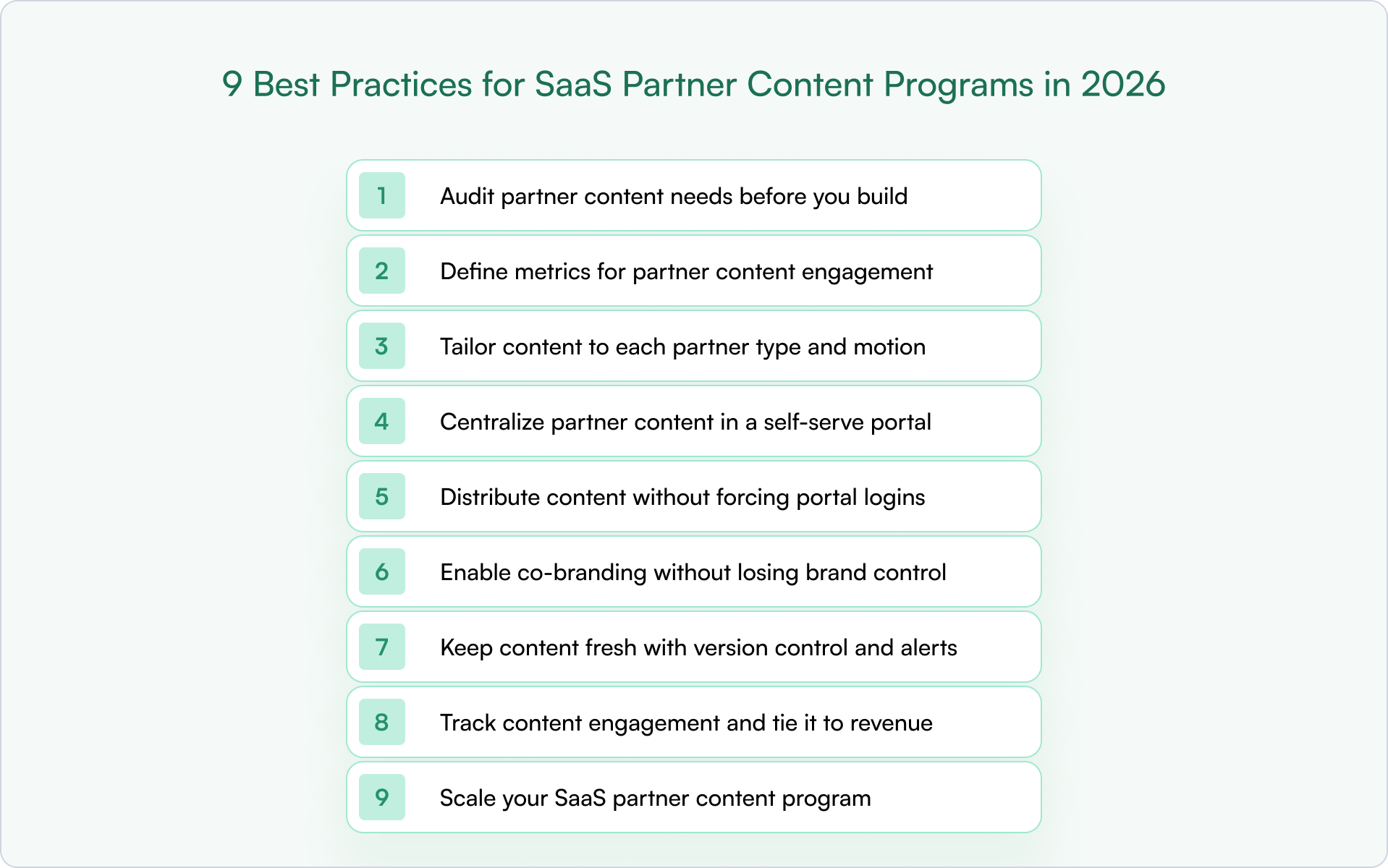
The 9 best practices for SaaS partner content programs

If you’re building this as a founder or early revenue leader, the goal isn’t “more content.” The goal is the smallest set of assets that helps partners create pipeline — and the operating system to keep those assets current, discoverable, and measurable.

1. Audit partner content needs before you build

Before you write a single new deck, validate what partners actually need. Many partner programs burn time creating content that never gets used because it doesn’t solve a real selling problem.

Interview partners about content gaps

Ask your existing partners what’s missing, what’s outdated, and what they wish they had. Keep the conversation grounded in real deals: what stops them from moving a prospect forward or answering questions with confidence?

Even five conversations usually reveal patterns. For example, partners might not want another product overview — they might need a competitive comparison they can forward when a prospect is evaluating alternatives.

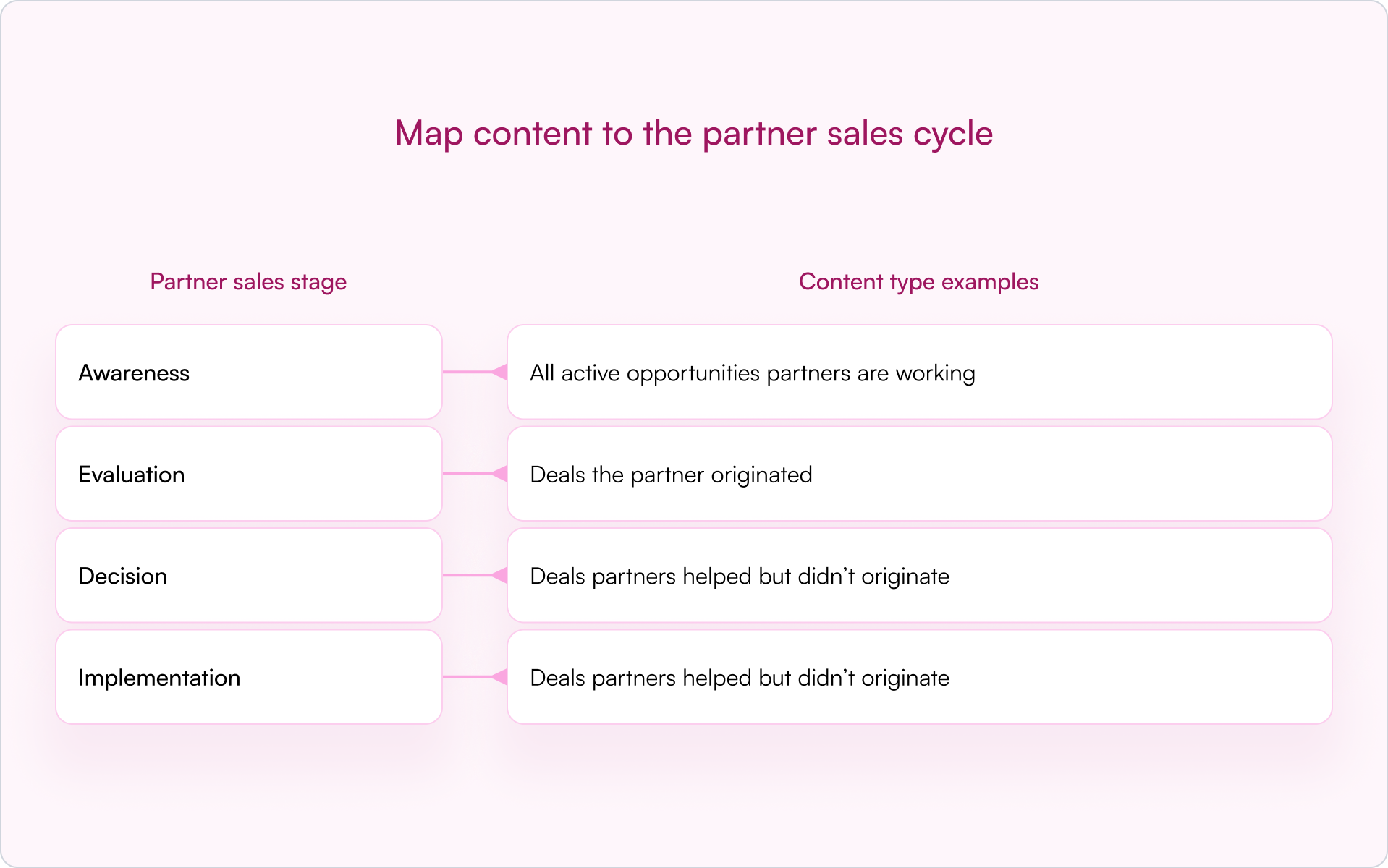
Map content to the partner sales cycle

Different stages of the partner-led sales cycle require different assets. Awareness-stage conversations benefit from solution briefs and intro decks. Evaluation calls for competitive comparisons and demo videos. Decision-stage deals often hinge on ROI calculators and customer stories. Implementation requires technical guides and onboarding checklists.

Also consider your partner model. Referral, reseller, and systems integrator motions typically need different content at each stage.

Partner sales stage Content type examples
Awareness Solution briefs, intro decks
Evaluation Competitive comparisons, demo videos
Decision ROI calculators, customer stories
Implementation Technical guides, onboarding checklists

Identify high-value assets vs. nice-to-haves

Prioritize ruthlessly. Start with content that directly impacts deal velocity — battle cards, pricing guidance, and objection handling. Save high-effort production (heavy video, glossy campaigns) until the essentials are working.

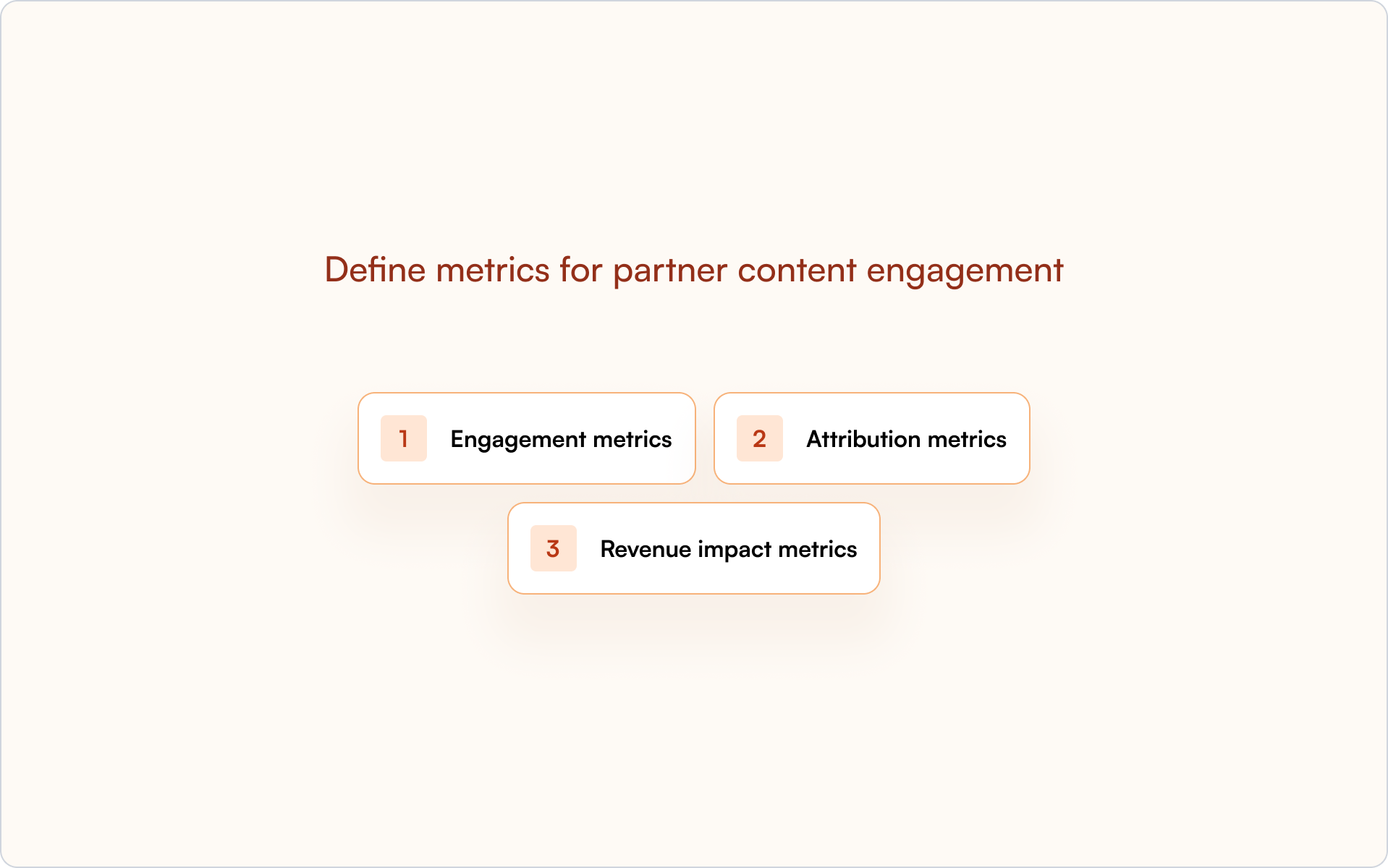
2. Define metrics for partner content engagement

You can’t improve what you don’t measure. If you want partner content to be treated like a growth lever (not a cost center), set up tracking from day one.

Engagement-Kennzahlen

Track views, downloads, shares, and time spent on each asset. This is your early signal for what’s useful versus what’s ignored.

Attribution metrics

Go beyond engagement by connecting content consumption to deal registration and pipeline generation. For example: did partners who used a specific battle card register more deals, or move deals to the next stage faster?

Revenue impact metrics

The gold standard is tying content engagement to closed-won revenue. Identify which assets consistently appear in the journey of deals that close — then reinvest in what’s working and prune what isn’t.

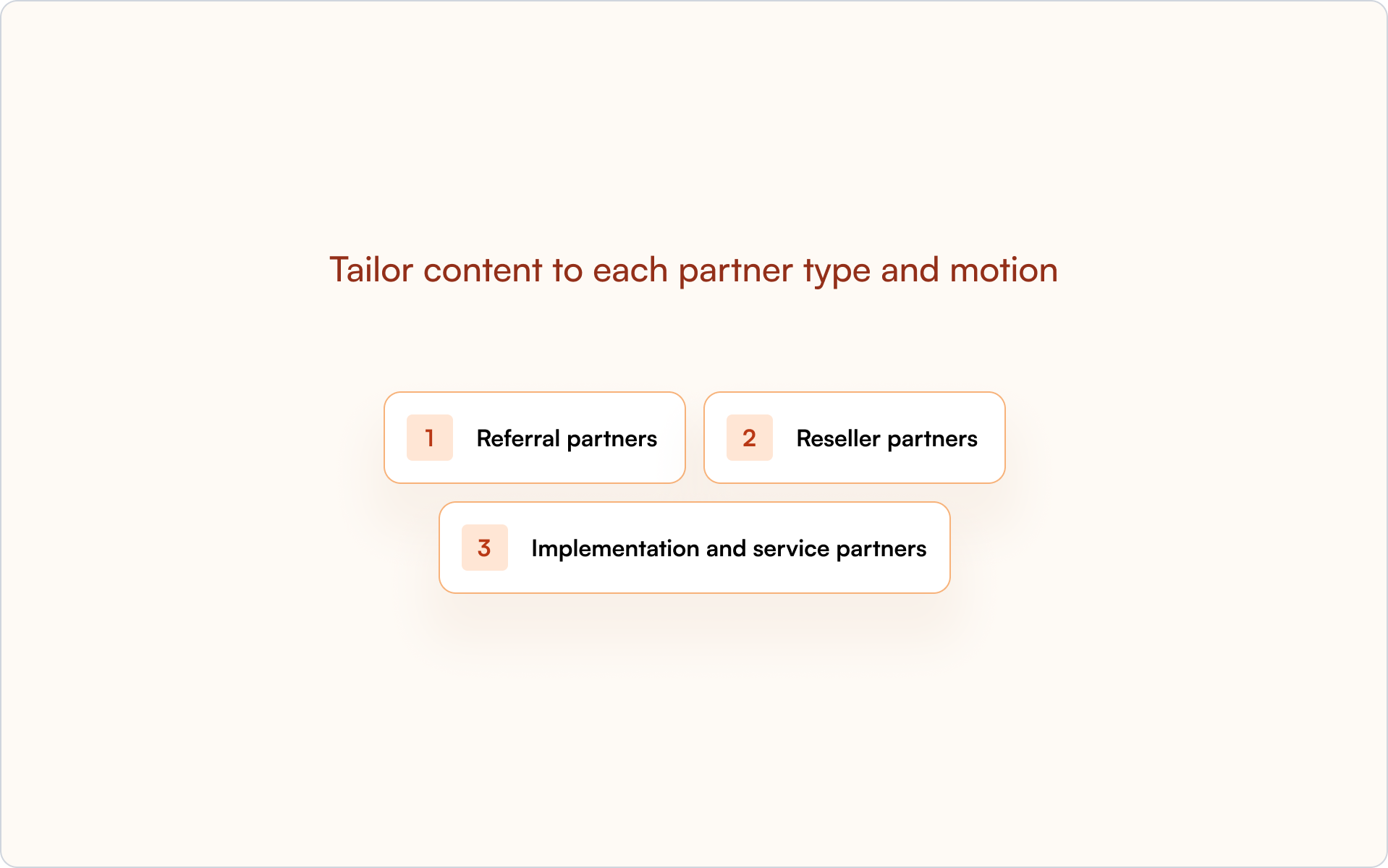
3. Tailor content to each partner type and motion

One of the most common reasons partner content programs underperform: every partner gets the same folder of assets. But a referral partner and a reseller are doing fundamentally different jobs — so they need different materials.

Referral-Partner

Optimize for speed and shareability: one-pagers, pre-written email templates, and landing pages they can forward to prospects. Referral partners typically don’t need deep product training — they need to qualify opportunities and hand them off cleanly.

Vertriebspartner

Resellers need full sales enablement: comprehensive pitch decks, demo scripts, pricing calculators, and objection handling guides. If they own the sales cycle, your program has to help them sound like experts quickly.

Implementation and service partners

Prioritize technical documentation, implementation playbooks, and certification materials. These partners deliver value post-sale, so your content should reduce delivery risk and improve time-to-value.

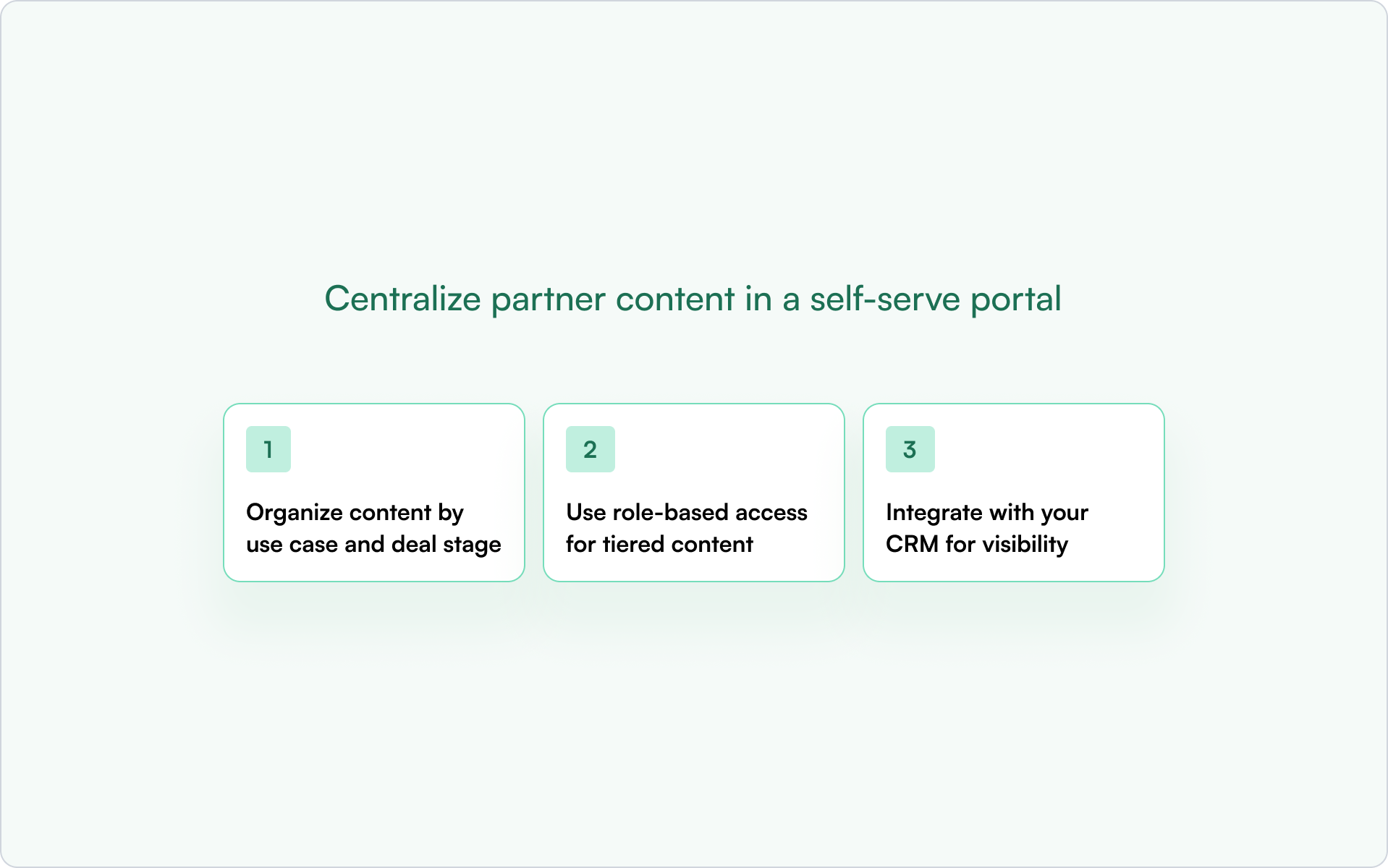
4. Centralize partner content in a self-serve portal

Partners won’t hunt through old email threads or shared drives. A centralized portal makes assets discoverable and ensures everyone is working from the same version.

Organize content by use case and deal stage

Structure the portal so partners can find what they need in seconds. Organize by “I’m trying to…” use cases — not your internal folders. A partner looking for a competitive comparison shouldn’t have to guess whether it lives under “Marketing > Collateral > Q3.”

Use role-based access for tiered content

Not every partner should see everything. Gate advanced content — pricing details, product roadmaps, competitive intelligence — behind certification or partner tier status. Done well, this also creates a healthy incentive for partners to level up.

Integrate with your CRM for visibility

When your portal connects to HubSpot or Salesforce, you can see which partners access which content and tie engagement back to pipeline. A CRM-first approach keeps this data visible to your revenue team — not trapped in a separate system.

5. Distribute content without forcing portal logins

Here’s the reality: many partners won’t log into your portal regularly. The best practices for SaaS partner content programs assume that, and they meet partners where they already work — inbox, Slack, and direct links.

Push content via email and Slack alerts

Don’t wait for partners to “check the portal.” Proactively send new or updated content through channels they use daily. A quick Slack message with a direct link to a new battle card beats hoping they stumble on it later.

Enable off-portal access for key assets

When possible, allow partners to access critical assets without authentication. Removing friction matters most in high-pressure moments — like five minutes before a discovery call.

Capture engagement without requiring authentication

Use trackable links or lightweight forms so you can still see what’s being used, by whom, and when — without adding password friction.

6. Enable co-branding without losing brand control

Partners want to put their logo on your materials. You want your messaging (and legal disclaimers) to stay accurate. The compromise is to design co-branding into the system — not bolt it on later.

Set co-branding templates and guardrails

Create templates with clearly defined editable zones (partner logo and contact info) and locked zones (product messaging, positioning, disclaimers). Make the rules obvious so partners can move fast without breaking your brand.

Automate partner logo insertion

Where possible, use dynamic templates that auto-populate a partner’s branding based on who’s logged in. This reduces manual edits and avoids “wrong-logo” mistakes.

Review and approve workflows

For high-stakes assets — customer-facing decks, public case studies, press releases — include an approval step. Automate what you can, but protect brand integrity where it matters.

7. Keep content fresh with version control and alerts

Outdated content is worse than no content. It creates confusion, slows deals, and erodes partner trust. Maintenance needs to be part of your operating rhythm — not a once-a-year cleanup.

Set refresh cadences by content type

Define review cycles and put them on a calendar. For example: review pricing quarterly, update product docs after each release, and refresh competitive intel monthly.

Sunset outdated assets automatically

Archive or hide assets past their expiration date. Partners shouldn’t accidentally pull last year’s pricing sheet the night before a proposal goes out.

Notify partners when content is updated

When you update an important asset, tell partners immediately. Email or Slack notifications keep everyone aligned on the latest version.

8. Track content engagement and tie it to revenue

If you want partner content to earn ongoing investment, you need to show how it impacts pipeline and revenue — not just downloads.

Measure views, downloads, and shares

Engagement metrics show what’s popular. Track at both the asset level and the partner level to identify high-performing content and your most engaged partners.

Connect engagement to deal progression

Look for patterns that correlate with movement: when a partner downloads an ROI calculator and then registers a new deal, you want that sequence visible. Build reporting that makes content a measurable part of deal velocity.

Report content ROI in partner QBRs

Bring content engagement data into quarterly business reviews. It’s one of the fastest ways to align on what’s working, what’s missing, and what you should build next together.

9. Scale your SaaS partner content program

What works with ten partners breaks at one hundred. Scaling a partner content program requires automation, personalization, and strong self-serve foundations — otherwise your partner team becomes a content concierge.

Automate content distribution workflows

Trigger content based on milestones: completing a certification, registering a first deal, entering a new tier, or launching a joint campaign. Automation keeps the partner experience consistent as volume grows.

Use AI for personalization at scale

AI can recommend the most relevant assets based on partner type, deal stage, and past engagement. Relevance drives usage — and usage drives revenue.

Reduce manual content requests with self-serve

Repeated partner requests for the same asset usually mean it’s not findable. Treat every manual request as product feedback on your portal’s organization, then close the gap.

Conclusion: make partner content a growth system, not a folder

The best practices for SaaS partner content programs aren’t about producing more collateral. They’re about building a repeatable system: the right assets for each partner motion, delivered where partners actually work, kept current with version control, and measured against pipeline and revenue.

If you get those fundamentals right, your partners stop feeling like a channel you have to manage — and start acting like a go-to-market multiplier.

Build your SaaS partner content program with Introw

Introw’s CRM-first partner portal helps teams centralize, distribute, and track partner content — all inside HubSpot or Salesforce.

  • Content hosting directly in the portal
  • Announcements to push updates via email and Slack
  • Engagement tracking that syncs to CRM records
  • Off-portal access so partners don’t always need logins

Get a demo to see how Introw helps SaaS partner programs deliver content partners actually use.