Partner-Management

Partner-Performance 101: Was jeder Channel-Leiter wissen sollte

Lernen Sie die wichtigen Leistungskennzahlen für Partner kennen – sowie eine CRM-orientierte Einrichtung für eine klare Zuordnung, Automatisierung und Berichterstattung, die die Einnahmen von Partnern vorhersehbar macht.

5min Lesezeit
18. Februar 2026
⚡ TL;DR

Die Partnerleistung ist das System, mit dem Sie messen, ob Partner Ihnen tatsächlich dabei helfen, Ihre Umsatzziele zu erreichen – nicht nur durch die Weiterleitung von Leads, sondern auch durch die Beeinflussung der Pipeline, den Abschluss von Geschäften, die Verbesserung der Kundenbindung und die Förderung von Geschäftsabschlüssen. Die stärksten Channel-Führungskräfte verfolgen eine Mischung aus Frühindikatoren (Enablement- und Engagement-Signale) und Spätindikatoren (Pipeline und abgeschlossene Umsätze), damit sie Partner frühzeitig coachen und Ergebnisse glaubwürdig prognostizieren können. Ein CRM-first-Ansatz sorgt dafür, dass Attribution und Berichterstattung für Vertrieb, Partnerschaften und RevOps in einer einzigen Quelle sichtbar bleiben – und wenn Sie saubere Felder, konsistente Definitionen und Automatisierung kombinieren, ist die Partnerleistung nicht mehr nur eine „Bauchentscheidung“, sondern wird zu einem vorhersehbaren Umsatztreiber.

Die Partnerleistung ist die Art und Weise, wie Sie den Beitrag eines Partners zu Ihren Umsatzzielen messen und bewerten – einschließlich Leads, Verkäufe, Kundenbindung und Einfluss auf Geschäftsabschlüsse. Wenn Sie ein Partnerprogramm in einem Start-up aufbauen, ist dies auch der Unterschied zwischen „Partner sind vielversprechend“ und „Partner sind ein vorhersehbarer Wachstumskanal“.

Die meisten Channel-Führungskräfte wissen, dass sie die Leistung ihrer Partner verfolgen sollten. Weniger wissen jedoch, was sie messen sollen, wo sie dies tun sollen und wie sie die Daten in Entscheidungen umsetzen können, die zu besseren Ergebnissen führen. Dieser Leitfaden führt Sie durch die Kennzahlen, die CRM-Einrichtung und die Betriebsabläufe, mit denen Sie die Leistung Ihrer Partner messen und verbessern können.

Was ist Partnerleistung?

Die Partnerleistung bezieht sich darauf, wie Sie den Beitrag eines Partners zu Ihren allgemeinen Markteinführungszielen messen und bewerten. Es geht nicht nur darum, „wie viele Leads sie geschickt haben“, sondern auch um ihre Auswirkungen auf die Verkaufsergebnisse (Pipeline und Umsatz), die Kundenbindung, die Konversionsraten und ihren tatsächlichen Einfluss auf Geschäfte.

Ein nützliches mentales Modell besteht darin, Partner wie eine Erweiterung Ihres Umsatzteams zu behandeln. Sie würden einen AE nicht ausschließlich anhand der „versendeten E-Mails“ bewerten, daher sollten Sie einen Partner auch nicht ausschließlich anhand der „eingereichten Leads“ bewerten.

  • Was gemessen wird: Leads, Verkäufe, Kundenbindung, Geschäftsabschlüsse, Engagement und Enablement-Aktivitäten
  • Warum es um mehr als nur Lead-Zahlen geht: Ein Partner, der zehn Leads registriert, die nie zu einem Abschluss führen, schneidet anders ab als einer, der drei Leads registriert, die alle zu einem Abschluss führen.
  • Wie dies in der Praxis gemessen wird: Kombinieren Sie Frühindikatoren (Abschluss von Schulungen, Portalaktivität) mit Spätindikatoren (Pipeline, abgeschlossene Umsätze), damit Sie sowohl Partner coachen als auch Ergebnisse prognostizieren können.

Diese Unterscheidung ist wichtig, da Programme, die nur Aktivitäten am Anfang des Trichters verfolgen, häufig zu viel in Partner investieren, die nur Lärm verursachen, und zu wenig in die Partner, die tatsächlich Umsatz generieren.

Warum die Analyse der Partnerleistung für Umsatzteams wichtig ist

Wenn Sie den Beitrag Ihrer Partner nicht messen können, können Sie ihn auch nicht steuern. Und wenn Sie ihn nicht steuern können, können Sie ihn erst recht nicht prognostizieren.

Die Analyse der Partnerleistung ist das, was ein Partnerprogramm von einer Kostenstelle zu einer Umsatzfunktion macht. Sie stimmt die Partner mit Ihren internen Teams ab, reduziert Diskussionen über die Zuordnung und gibt der Unternehmensleitung einen klaren Überblick darüber, was der Kanal leistet.

  • Ausrichtung: stellt sicher, dass Partner und interne Teams dieselben Ziele verfolgen
  • Wertnachweis: Belegt den Beitrag des Partners über das Lead-Volumen hinaus – entscheidend für Budgetgespräche
  • Optimierung: Identifiziert leistungsschwache Mitarbeiter und Leistungsträger, damit Sie Ressourcen intelligenter zuweisen können.
  • Prognosen: ermöglicht genaue Umsatzprognosen, wenn die Daten im CRM statt in Tabellenkalkulationen gespeichert sind

In der Praxis müssen Teams, die die Leistungsanalyse als optional betrachten, ständig Feuer löschen: Sie jagen Updates hinterher, diskutieren über Verdienste und versuchen, mit unübersichtlichen Daten zu skalieren. Teams, die sie als grundlegend betrachten, verbringen mehr Zeit damit, den Umsatz zu steigern, und weniger Zeit damit, Prozesse zu entwirren.

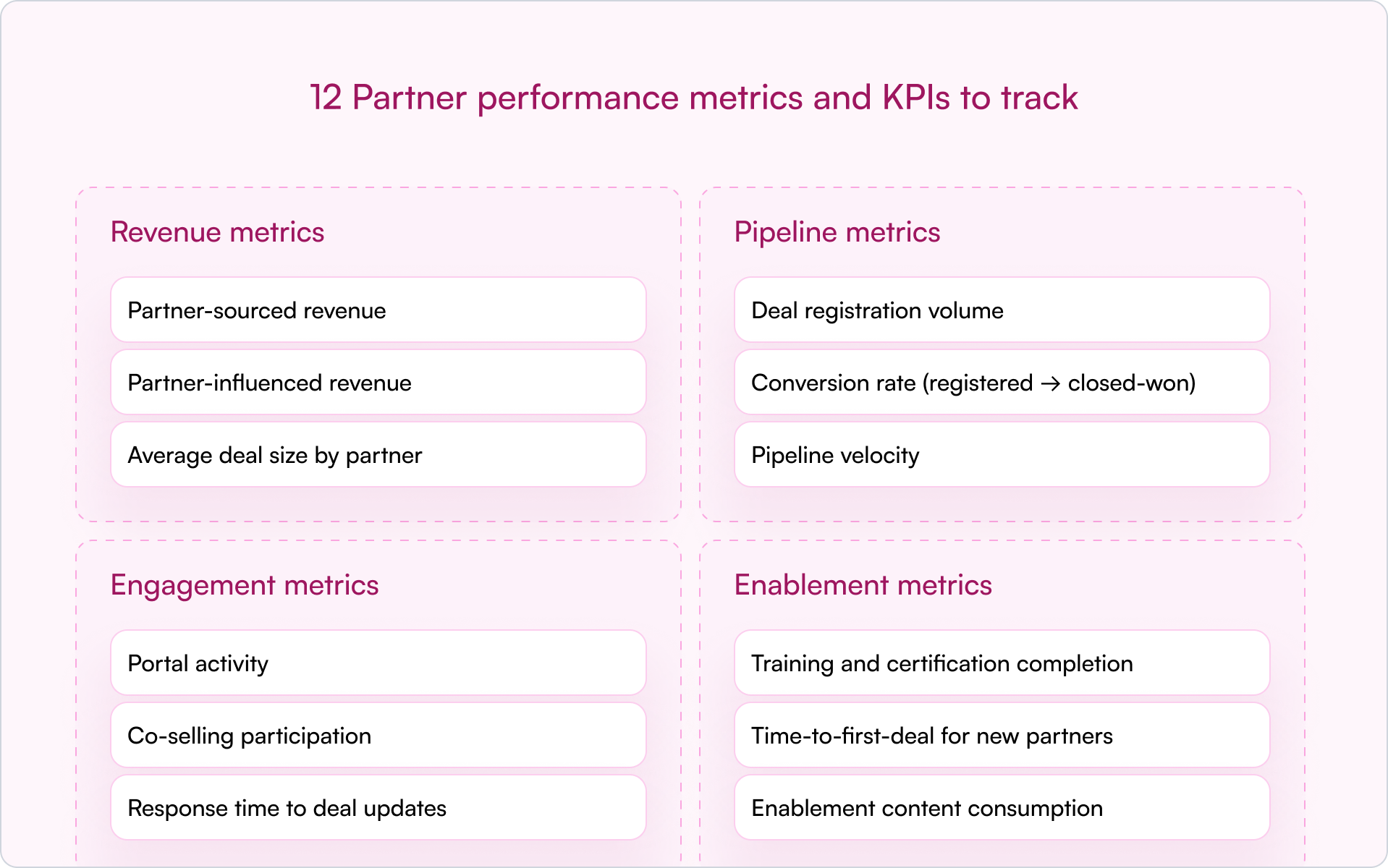
12 Leistungskennzahlen und KPIs für Partner zur Nachverfolgung

Um die Leistung Ihrer Partner effektiv zu messen, verfolgen Sie die richtigen Kennzahlen und Key Performance Indicators (KPIs).

Wenn Sie Ziele festlegen, verwenden Sie einen SMART-Ansatz (spezifisch, messbar, erreichbar, relevant, zeitgebunden). „Das Engagement verbessern“ ist zu vage. „Das Volumen der registrierten Geschäfte im zweiten Quartal um 20 % steigern“ ist messbar und umsetzbar.
Umsatzkennzahlen

Umsatzkennzahlen verbinden die Aktivitäten der Partner direkt mit den finanziellen Ergebnissen:

  • Partner-Umsatz: Umsatz aus Geschäften, die der Partner initiiert und an Sie vermittelt hat
  • Partnerbeeinflusster Umsatz: Umsatz aus Geschäften, die der Partner mit abgeschlossen hat, aber nicht selbst initiiert hat.
  • Durchschnittliche Geschäftsgröße pro Partner: Identifiziert, welche Partner größere, strategischere Chancen mit sich bringen.

In Unternehmen, die sich noch in der Anfangsphase befinden, kommt es häufig zu Unklarheiten hinsichtlich der Unterscheidung zwischen „sourced“ und „influenced“. Definieren Sie beide Begriffe im Voraus. Andernfalls verschwenden Sie Zeit mit Diskussionen über die Zuordnung von Verdiensten, anstatt Ihre Pipeline aufzubauen.

Pipeline-Kennzahlen

Pipeline-Kennzahlen zeigen den Zustand und die Geschwindigkeit Ihres Partner-Funnels:

  • Deal-Registrierungs volumen: Wie viele Deals reichen Partner ein?
  • Konversionsrate (registriert → abgeschlossen): ein Qualitätssignal hinter dem Volumen
  • Pipeline-Geschwindigkeit: Zeit von der Registrierung bis zum Abschluss – eine langsame Geschwindigkeit deutet oft auf Lücken in der Umsetzung oder auf die Komplexität des Geschäfts hin.

Engagement-Kennzahlen

Engagement-Kennzahlen helfen Ihnen dabei, zu erkennen, ob Partner wirklich aktiv sind:

  • Portalaktivität: Anmeldungen, Aufrufe von Inhalten, Downloads von Ressourcen
  • Beteiligung am gemeinsamen Vertrieb: gemeinsame Anrufe, gemeinsame Chancen, Häufigkeit der Zusammenarbeit
  • Reaktionszeit auf Deal-Updates: Wie schnell reagieren Partner auf aktive Deals?

Das Engagement ist oft das früheste Warnsignal. Wenn ein Partner nicht mehr präsent ist – weniger Logins, langsamere Antworten, kein Co-Selling – sinkt in der Regel als Nächstes die Leistung.

Befähigungsmetriken

Enablement-Kennzahlen sind Frühindikatoren für die zukünftige Leistung von Partnern:

  • Abschluss der Schulung und Zertifizierung: Sind die Partner für den Verkauf und die Implementierung gerüstet?
  • Zeit bis zum ersten Geschäftsabschluss für neue Partner: Wie lange dauert es, bis sie ihre erste echte Verkaufschance registrieren?
  • Nutzung von Enablement-Inhalten: Welche Materialien werden tatsächlich verwendet?

Wenn ein Partner hinter den Erwartungen zurückbleibt, sollte man oft zuerst die Unterstützung überprüfen. Geringe Leistung ist nicht immer gleichbedeutend mit geringem Einsatz – es kann auch an mangelnder Unterstützung liegen.

So verfolgen Sie die Leistung Ihrer Partner in Ihrem CRM

Die Leistung Ihrer Partner direkt in Ihrem CRM zu verfolgen, ist der effektivste Ansatz. Ein CRM-First-Modell speichert Partnerdaten an einem zentralen Ort, sodass Vertrieb, Partnerschaften und RevOps auf derselben Datenquelle basieren können.

Herkömmliche PRM-Software läuft oft auf einer separaten Plattform. Diese Trennung führt zu vorhersehbaren Problemen: isolierte Daten, unübersichtliche Zuordnungen und Berichte, die manuell bereinigt werden müssen. Ein CRM-first-Ansatz vermeidet dies, indem er die Workflows und Berichte der Partner dort belässt, wo Ihr Umsatzteam bereits arbeitet.

Essenzielle Felder für die Partnerzuordnung

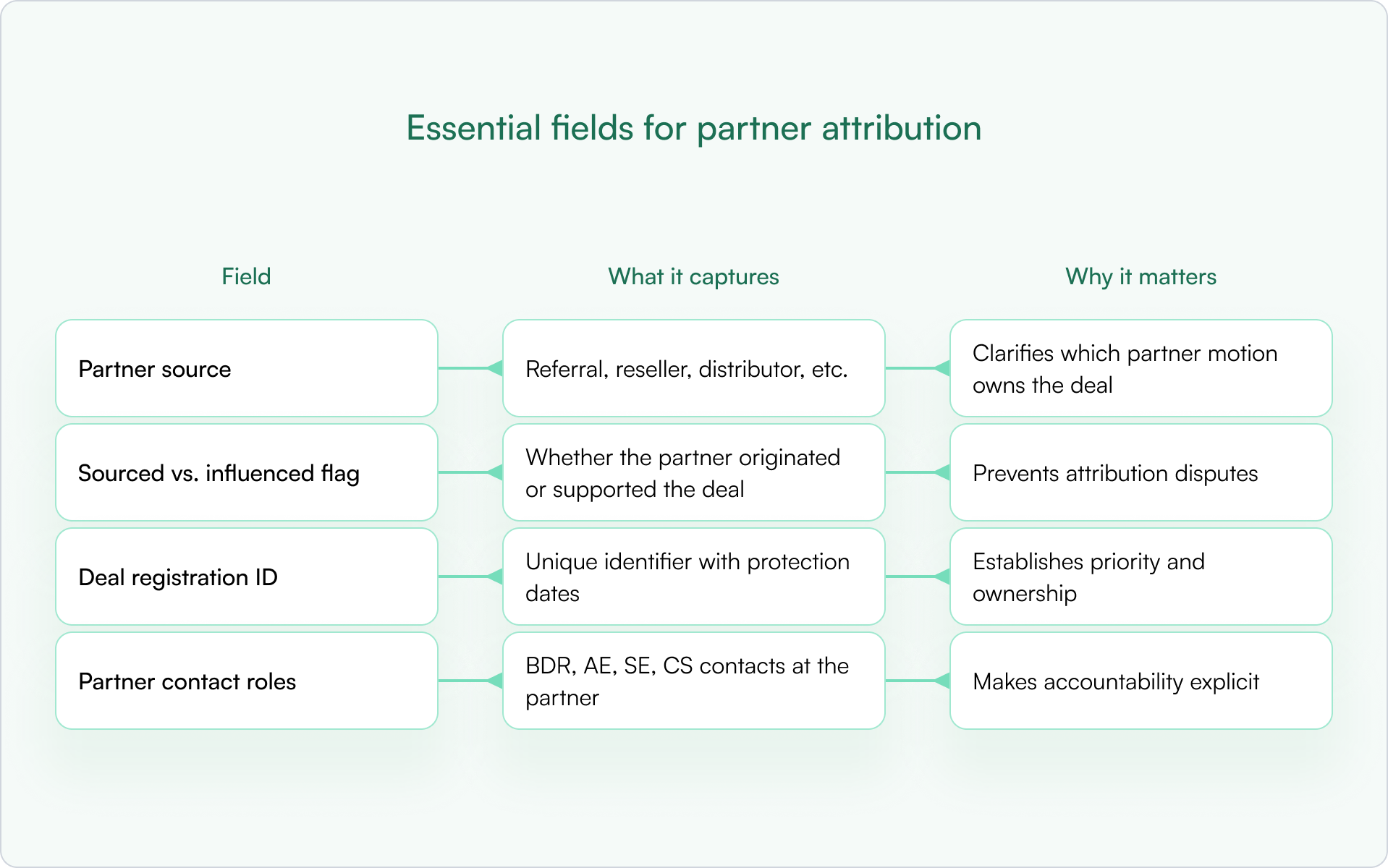
Eine genaue Nachverfolgung beginnt mit sauberen Daten. Um Geschäfte und Umsätze richtig zuzuordnen, benötigt Ihr CRM einheitliche Partnerfelder und Definitionen.
Feld Was es erfasst Warum es wichtig ist
Partnerquelle Empfehlung, Wiederverkäufer, Händler usw. Klarstellt, welcher Partner die Verantwortung für das Geschäft trägt
Quelle vs. beeinflusstes Kennzeichen Ob der Partner den Deal initiiert oder unterstützt hat Verhindert Streitigkeiten über die Urheberschaft
Deal-Registrierungs-ID Eindeutige Kennung mit Schutzdaten Legt Prioritäten und Zuständigkeiten fest
Partner-Kontaktrollen BDR-, AE-, SE- und CS-Ansprechpartner beim Partner Macht Verantwortlichkeit explizit

Ohne diese Grundlagen werden Sie mehr Zeit damit verbringen, über Eigentumsverhältnisse zu diskutieren, als Geschäfte abzuschließen – und Ihre Berichterstattung wird nicht vertrauenswürdig sein.

Dashboards und Berichte, die jeder Channel-Leiter benötigt

Sobald die Felder eingerichtet sind, erstellen Sie Dashboards, die in weniger als 60 Sekunden die Frage „Was passiert gerade?“ beantworten:

  • Umsatz nach Partnern (Quelle vs. Einfluss): Wer treibt die Ergebnisse tatsächlich voran?
  • Pipeline nach Partnerstufe: Schneiden Top-Partner besser ab?
  • Genehmigung von Geschäftsregistrierungen und Konversionsraten: Wo hängen Geschäfte fest?
  • Entwicklungen im Engagement im Zeitverlauf: Nimmt die Aktivität zu oder ab?

Automatisierung für Echtzeit-Transparenz der Partnerleistung

Automatisierung ist die Methode, mit der Sie die Leistungsüberwachung Ihrer Partner skalieren können, ohne zusätzliche Mitarbeiter einzustellen. Automatisierte Workflows können Deal-Updates synchronisieren, Sie über veraltete Deals informieren und leistungsschwache Partner frühzeitig aufdecken.

CRM-first-PRMs wie Introw unterstützen dies innerhalb von HubSpot Salesforce und halten die Partnerdaten auf dem neuesten Stand, ohne auf ein separates Portal angewiesen zu sein. Die Alternative – manuelle Aktualisierungen in Tabellenkalkulationen – versagt, sobald Sie mehr als eine Handvoll Partner haben.

Wie Sie die Leistung Ihrer Partner in 5 Schritten verbessern können

Die Verbesserung der Partnerleistung ist ein fortlaufender Betriebsrhythmus und keine einmalige Maßnahme. Das Ziel besteht darin, ein System aufzubauen, in dem die Erwartungen klar sind, Daten ausgetauscht werden und frühzeitig eingegriffen wird – bevor ein Quartal bereits verloren ist.
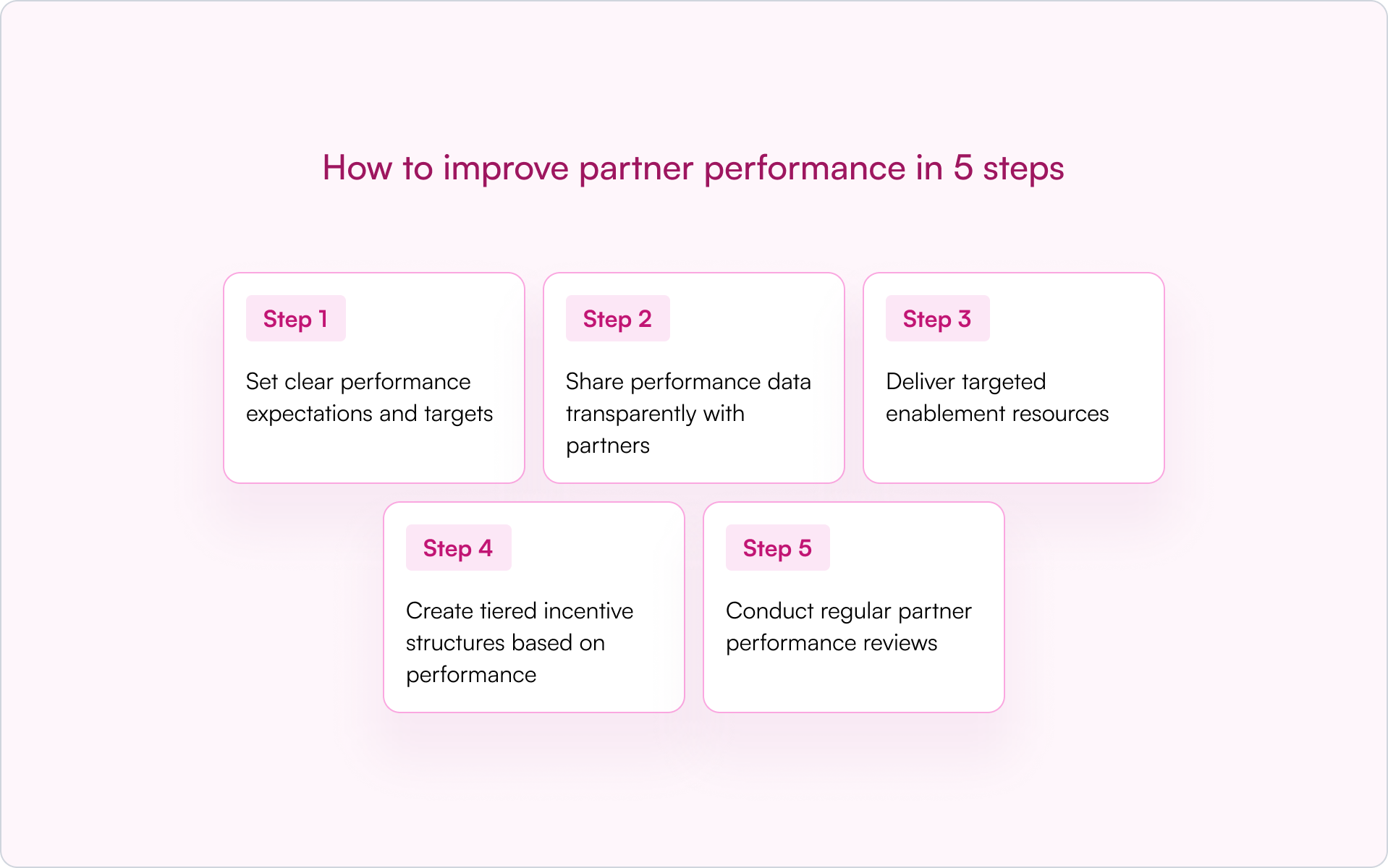
1) Klare Leistungserwartungen und -ziele festlegen

Partner erzielen bessere Leistungen, wenn „gut“ definiert ist. Verwenden Sie SMART-Ziele und halten Sie diese schriftlich fest – in Ihrer Partnervereinbarung, Ihrem Onboarding-Plan oder Ihrer QBR-Vorlage. Die Ziele können je nach Reifegrad des Partners umsatz-, pipeline- oder aktivitätsbasiert sein.

Unklarheit führt zu Reibungen. Klarheit schafft Verantwortlichkeit.

2) Leistungsdaten transparent mit Partnern teilen

Wenn Sie möchten, dass sich Ihre Partner wie ein Umsatzkanal verhalten, zeigen Sie ihnen die Ergebnisse. Geben Sie Ihren Partnern Einblick in ihre Pipeline, den Status ihrer Geschäfte und die nächsten Schritte, damit sie sich nicht auf Ad-hoc-Statusüberprüfungen verlassen müssen.

Moderne Tools wie Introw unterstützen gemeinsame Pipeline-Ansichten, sodass Partner die Auswirkungen sehen können, ohne sich bei einem Portal anmelden oder vollen CRM-Zugriff haben zu müssen.

3) Bereitstellung gezielter Ressourcen zur Befähigung

Leistungsschwächen sind oft auf mangelnde Fähigkeiten zurückzuführen, nicht auf mangelnde Motivation. Verwenden Sie Enablement-Kennzahlen, um genau zu ermitteln, was fehlt: Produktschulungen, Wettbewerbspositionierung, Fragen zur Entdeckung oder Implementierungsbereitschaft.

Gehen Sie nicht davon aus, dass geringe Leistung gleichbedeutend mit geringem Aufwand ist. Manchmal bedeutet es nur geringe Unterstützung.

4) Schaffen Sie leistungsbasierte, abgestufte Anreizstrukturen.

Stufenprogramme (Bronze, Silber, Gold) sind ein wirkungsvolles Mittel, um Partner zu motivieren. Sie belohnen Leistungsträger mit besseren Vorteilen und bieten anderen einen klaren Weg zum Aufstieg.

Partnerbewertung – eine systematische Methode zur Einstufung von Partnern auf der Grundlage einer Kombination von Leistungsdaten – kann die Einstufung in Stufen vorantreiben. Die Kriterien sollten transparent sein, damit die Partner genau wissen, wie sie vorankommen können.

5) Führen Sie regelmäßige Leistungsbewertungen Ihrer Partner durch.

Entwickeln Sie einen Rhythmus: QBRs für die strategische Ausrichtung und monatliche (oder zweiwöchentliche) Pipeline-Überprüfungen für aktive Partner. Überprüfungen funktionieren am besten, wenn sie sich an CRM-Daten orientieren und nicht am Bauchgefühl.

Bereiten Sie sich mit Trends, konkreten feststehenden Geschäften und einem kurzen Aktionsplan vor. So wird das Meeting von einer Statusaktualisierung zu einem Wachstumshebel.

4 Häufige Herausforderungen beim Leistungsmanagement von Partnern

Wenn Sie nach einer besseren Partnerleistung suchen, stoßen Sie in der Regel auf einige vorhersehbare Engpässe. Die gute Nachricht ist, dass es sich dabei meist um Prozess- und Datenprobleme handelt – und diese lassen sich beheben.
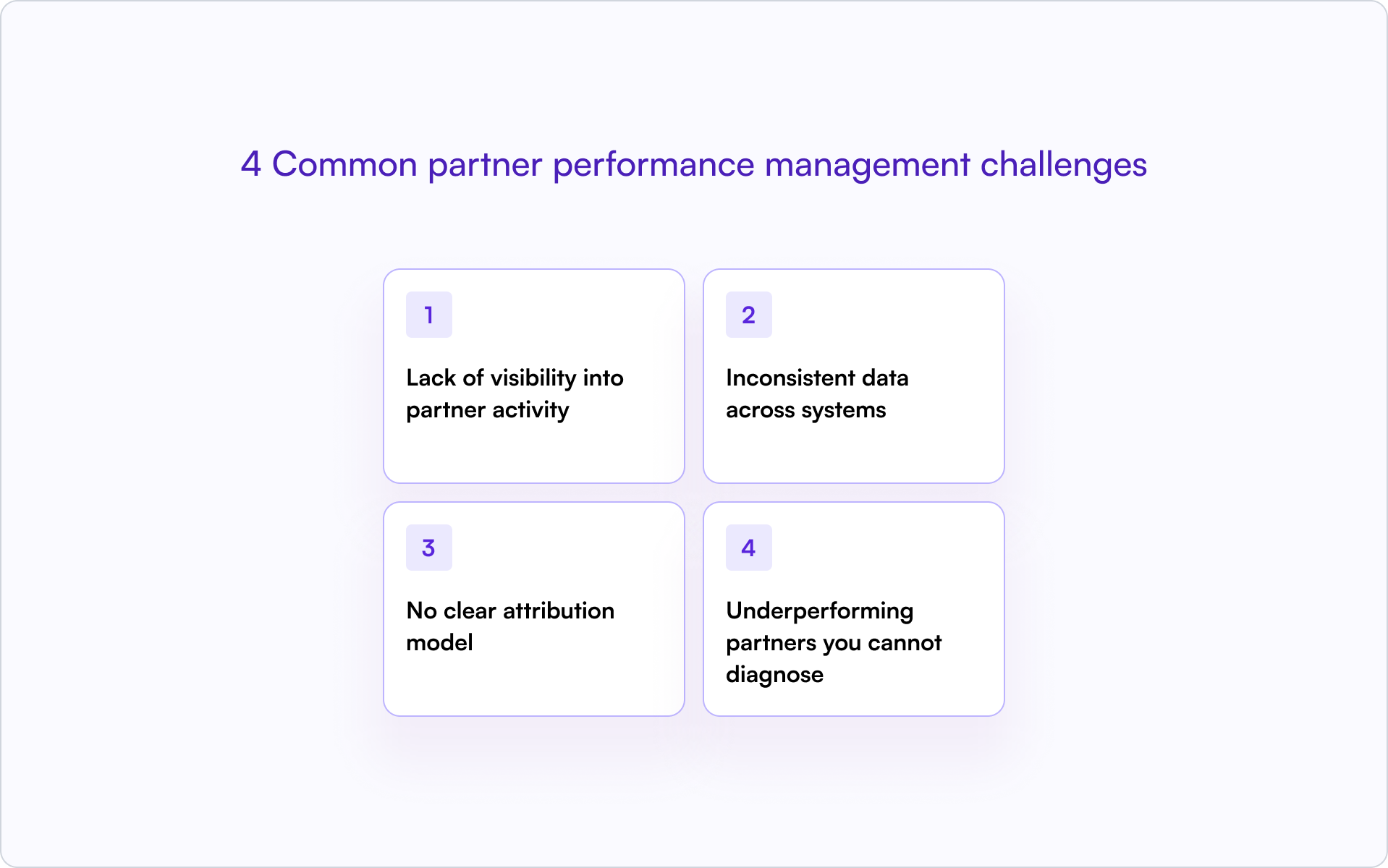
Mangelnde Transparenz hinsichtlich der Aktivitäten der Partner

Wenn Partnerdaten in Tabellenkalkulationen oder nicht miteinander verbundenen Portalen gespeichert sind, arbeiten Sie praktisch blind. Sie können den Fortschritt von Geschäften nicht in Echtzeit verfolgen, was Prognosen unzuverlässig macht und frühzeitiges Eingreifen verhindert.

Inkonsistente Daten über verschiedene Systeme hinweg

Doppelte Datensätze, fehlende Felder und nicht übereinstimmende Lebenszyklusphasen beeinträchtigen die Berichterstellung. Das größere Problem ist das Vertrauen: Sobald Teams den Daten nicht mehr vertrauen, verwenden sie diese nicht mehr – und Ihr Partnerprogramm wird wieder „gefühlsbasiert”.

Kein klares Attributionsmodell

Ohne ein dokumentiertes Attributionsmodell ist es schwierig, Partnern eine faire Anerkennung zukommen zu lassen – insbesondere bei beeinflussten Geschäften. Unklarheiten führen zu Streitigkeiten, die die Beziehungen zu Partnern beeinträchtigen und Geschäftszyklen verlangsamen.

Leistungsschwache Partner, die Sie nicht diagnostizieren können

Ohne Leistungskennzahlen wissen Sie zwar, dass ein Partner Probleme hat, aber nicht warum. Liegt es an mangelnder Schulung? Schlechter Lead-Qualität? Fehlen interner Fürsprecher? Geringer Aktivität? Daten verwandeln vage Bedenken in einen klaren Plan.

Wie Sie die Leistungsüberwachung Ihrer Partner ohne manuellen Aufwand mit Introw skalieren können

Wenn Ihr Programm wächst, versagt die manuelle Nachverfolgung. Tabellenkalkulationen werden zeitaufwändig, fehleranfällig und veraltet – genau dann, wenn Sie Echtzeit-Transparenz am dringendsten benötigen.

Die Lösung besteht darin, eine CRM-first-PRM-Software einzusetzen. Mit diesem Ansatz bleiben die Partnerdaten in Ihrem zentralen CRM (HubSpot Salesforce), können Partner ohne separate Anmeldungen zusammenarbeiten und werden die Leistungskennzahlen der Partner automatisch aktualisiert.

Damit erhalten Sie ein skalierbares Betriebssystem für die Leistung Ihrer Partner – eine einzige Quelle für verlässliche Daten, klare Zuordnungen und Berichte, denen Ihre Umsatzverantwortlichen wirklich vertrauen können.

Beispielsweise können Sie im Dashboard-Bereich von Introw die für Ihre Partner wichtigsten Kennzahlen definieren, indem Sie Daten direkt aus Ihrem CRM abrufen. Sie können auswählen, welche Pipeline Sie verwenden möchten (z. B. Vertriebspipeline oder Verlängerungspipeline), entscheiden, welche zugeordneten Geschäfte einbezogen werden sollen, z. B. von Partnern vermittelte Geschäfte oder Wiederverkäufergeschäfte, und auswählen, welche Eigenschaft für aggregierte Daten verwendet werden soll (z. B. Geschäftswert, MRR oder Vertragswert). Diese Flexibilität bietet klare Echtzeit-Einblicke in die Leistung Ihrer Partnerschaften.

Introw zeigt die folgenden Standardmetriken an.

  • Gesamtumsatz: Alle Geschäfte mit diesem Partner, die in Ihrem CRM als abgeschlossen markiert sind, gewonnen
    • Gewichtete Pipeline: Alle Geschäfte mit diesem Partner, die weder als gewonnen noch als verloren abgeschlossen wurden.
  • Anzahl der TransaktionenGesamtwert aller mit diesem Partner abgeschlossenen Geschäfte.
    • Gesamtzahl der Abschlüsse: Alle registrierten Abschlüsse, einschließlich abgeschlossener Abschlüsse.
  • Durchschnittliche Geschäftsgröße: Gesamtwert aller Geschäfte (einschließlich abgeschlossener verlorener Geschäfte) geteilt durch die Anzahl der Geschäfte.
  • Durchschnittlicher Verkaufszyklus: Die durchschnittliche Anzahl der Tage bis zum Abschluss für alle abgeschlossenen gewonnenen Geschäfte in Ihrem CRM, die die durchschnittliche Zeit zwischen Erstellungsdatum und Abschlussdatum angibt.
  • Einnahmen im Zeitverlauf
⚡ Introw-Tipp!

Sie können einem Partnerportal (über die Experience) beliebig viele Dashboard-Bereiche hinzufügen, sodass Sie Ihren Partnern ganz einfach mehrere Kennzahlen zur Verfügung stellen können.

Fazit: Die Leistung von Partnern ist ein System, keine Tabellenkalkulation.

Der schnellste Weg, die Partnerleistung zu verbessern, besteht darin, sie nicht mehr als vage Beziehungsmetrik zu betrachten, sondern als Umsatzdisziplin. Definieren Sie, was „Leistung“ bedeutet, verfolgen Sie sie in Ihrem CRM und entwickeln Sie einen Rhythmus, um sie zu überprüfen und zu verbessern.

Wenn Sie dies tun, sind Partner keine unvorhersehbare Nebenwette mehr, sondern werden zu einem Kanal, den Sie mit Zuversicht skalieren können.

Der nächste Schritt: Wenn Sie die Leistung Ihrer Partner ohne Tabellenkalkulationen oder ein isoliertes Portal überblicken möchten, erfahren Sie, wie Introw Channel-Führungskräften dabei hilft, die Leistung ihrer Partner innerhalb ihres CRM zu verfolgen. Buchen Sie eine Demo.

FAQs

Noch Fragen? Hier findest du die häufigsten Fragen und Antworten.

Kontaktiere uns

Wie oft sollten Channel-Leiter die Leistungsdaten ihrer Partner überprüfen?

Eine solide Grundlage bilden vierteljährliche Geschäftsbesprechungen (QBRs) zur Strategie und Abstimmung sowie monatliche Pipeline-Checks für aktive Partner. Die ideale Häufigkeit hängt von der Geschwindigkeit der Geschäftsabschlüsse und der Partnerstufe ab – Partner mit hohem Volumen rechtfertigen oft häufigere Kontaktpunkte.

Was ist der Unterschied zwischen partnergenerierten und partnerbeeinflussten Einnahmen?

Partner-generierte Umsätze stammen aus Geschäften, die der Partner initiiert und Ihnen vermittelt hat. Partner-beeinflusste Umsätze stammen aus Geschäften, die der Partner vorangetrieben oder abgeschlossen hat, ohne sie jedoch initiiert zu haben. Beide sind wichtig, erfordern jedoch klare Definitionen und einheitliche CRM-Felder, um Streitigkeiten hinsichtlich der Zuordnung zu vermeiden.

Welche KPI zur Partnerleistung sind für Start-ups in der Frühphase am wichtigsten?

Wenn Sie noch am Anfang stehen, sollten Sie KPIs priorisieren, die Bewegung belegen und zukünftige Einnahmen signalisieren: Volumen der registrierten Geschäfte, Konversionsrate von registriert zu abgeschlossen, Zeit bis zum ersten Geschäft und von Partnern generierte Pipeline. Sobald die Grundlagen zuverlässig sind, können Sie Berichte über tieferes Engagement und Einfluss hinzufügen.

Wie legen Channel-Teams faire Leistungsziele für neue Partner fest?

Für neue Partner sollten Sie mit aktivitätsbasierten Zielen beginnen, wie z. B. Abschluss einer Schulung, Registrierung eines ersten Geschäfts, gemeinsamer Verkauf einer festgelegten Anzahl von Verkaufschancen oder Erreichen von Meilensteinen im Bereich Engagement. Umsatzziele sind fairer, sobald Sie eine Ausgangsbasis haben und der Partner sich etabliert hat.

Können Partner auf ihre eigenen Partnerleistungsdaten im CRM zugreifen?

Ja. Moderne CRM-first-PRM-Plattformen können Partnern sicheren Zugriff auf gemeinsame Pipeline-Ansichten und Leistungs-Dashboards gewähren, ohne ihnen vollständige CRM-Lizenzen zu gewähren. Diese Transparenz verbessert die Zusammenarbeit, reduziert manuelle Statusaktualisierungen und hält Geschäfte am Laufen.


Launch your partner portal
in minutes!

Vielen Dank! Wir haben deine Anfrage erhalten!
Hoppla! Beim Absenden des Formulars ist ein Fehler aufgetreten.

Verwandte Blog-Artikel

Partner-Management

Best Partner Relationship Management (PRM) Software for B2B Teams in 2026

Andreas Geamanu
Co-founder & CEO
5min Lesezeit
17 Mar 2026
⚡ TL;DR

Partner relationship management (PRM) software helps you manage partner relationships, run partner programs, and track deal registration without losing visibility in your customer relationship management system.

If you’re comparing PRM software, this guide shows what actually works and how to choose the right fit.

Most PRM platforms still rely on a partner portal, which can slow down partner onboarding, partner activities, and adoption. Newer platforms focus on real-time collaboration, cleaner partner data, and better partner communication.

That makes it easier to manage partner relationships across the entire partner lifecycle, support channel partners, and improve partner performance.

If you’re looking for a faster, CRM-first approach to partner relationship management, Introw is built to help your sales team move quicker and stay aligned.

The best partner relationship management software (shortlist)

If you’re comparing PRM software, you don’t need a long list. You need tools that help you manage partner relationships, support co-selling, and drive partner revenue without slowing your team down. If you’re still deciding what matters, reviewing PRM best practices and learning how to choose a PRM will help you make a better call.

1. Introw

Introw is an AI-first partner relationship management software built for SaaS teams that want a modern partner experience directly inside their customer relationship management system.

It replaces the partner portal with real collaboration across email and Slack, so your sales team and channel partners stay aligned on deal registration, deal progression, and partner activities.

For co-selling and indirect sales channels, it gives you clear visibility into partner performance, partner revenue, and the sales pipeline without duplicating partner data.

Introw also combines execution with AI, helping you automate partner onboarding, track partner activities in real time, and keep deals moving across the sales cycle with built-in insights and communication support.

Am besten geeignet für

  • SaaS teams scaling partner programs and partner networks
  • Teams that want to manage partner relationships without a partner portal
  • Businesses focused on co-selling and partner growth

How Introw approaches partner relationship management differently

Most partner relationship management tools are built around structure. They rely on partner portals, manual updates, and separate workflows for partners and sales teams.

That works for some channel programs. But it can slow things down, especially if your team is focused on co-selling and real collaboration across the partner journey.

Introw takes a different approach.

Built inside your CRM, not around it

Introw works directly inside your customer relationship management system, including native integrations with Salesforce and HubSpot.

Your partner relationship manager, sales team, internal teams, and channel partners all stay aligned on deal registration, deal progression, and partner activities in one place.

This makes it easier to manage partner relationships without duplicating data or switching between systems.

Collaboration without the portal friction

Instead of forcing partners into a portal, Introw supports collaboration through email, Slack, and shared workflows.

That means business partners can stay engaged without changing how they already work.

It also reduces delays. Conversations, updates, and deal progress all happen in real time, which is critical for co-selling and keeping momentum across your partnership strategy.

Visibility into what partners are actually doing

Because everything happens inside your CRM, you get a clearer view of partner performance, partner revenue, and pipeline.

You can see which partners are active, where deals are progressing, and where support is needed without chasing updates.

This level of visibility helps teams reduce channel conflict and balance partner motions with direct sales.

AI support that fits into your workflow

Introw combines execution with AI to reduce manual work.

With the Introw + Claude integration, your team can generate summaries, surface insights, and keep partner communication moving without extra tools.

If you want to get started, you can install the Claude connector directly into your workflow.

If your team is building toward world class partner programs with faster execution and stronger visibility, this approach can feel much simpler than traditional partner management software.

In the end, the difference comes down to how your team actually works with partners.

If you’re looking for a simpler way to manage partner relationships and improve partner engagement across the entire partner lifecycle, Introw is a strong option to consider.

2. Salesforce PRM

Salesforce PRM is a partner relationship management software built into the broader customer relationship management platform, so it’s a natural fit if your business already runs on Salesforce. It helps you manage partner relationships, track deal registration, monitor partner activities, and support channel partners within a single system.

It works well for large partner ecosystems with complex partner programs, but it often depends on partner portals and custom setup across the partner lifecycle. That can slow partner onboarding and make partner experience harder to manage without strong partner operations and clear relationship management processes.

Am besten geeignet für

  • Enterprise teams already using Salesforce
  • Complex partner programs and channel sales
  • Businesses with strong internal ops resources
Pros Cons
Deep integration with customer relationship management data Heavy setup and customization required
Strong deal registration and lead distribution workflows Relies on partner portal workflows
Advanced reporting on partner performance Slower time to value for smaller teams

When it may not be the right fit

If your team needs fast setup, flexible collaboration, or wants to avoid heavy customization and portal-based workflows, this approach can feel limiting

If you’re exploring alternatives, many teams compare Salesforce PRM alternatives to see how modern PRM software supports co-selling and partner experience.

3. Impartner

Impartner is a well-known partner relationship management software designed to support structured partner programs across large partner networks. It focuses on partner onboarding, partner portals, and managing the partner lifecycle at scale.

It’s often used by companies with established reseller programs and formal partner operations. That said, it can feel heavy if your team wants faster setup or more flexible co selling workflows.

Am besten geeignet für

  • Mid-market to enterprise partner programs
  • Teams running structured reseller partners and referral partners
  • Businesses focused on long-term partner lifecycle management
Pros Cons
Strong partner onboarding experience Portal-heavy experience
Built-in marketing tools and co marketing support Less flexible for co-selling workflows
Detailed tracking of partner performance and partner activities Can feel complex for smaller teams

When it may not be the right fit

If your team prioritizes speed, simplicity, or real-time collaboration over structured partner programs, this setup can feel heavy and slow to adapt.

If you’re comparing tools in this category, reviewing the best Impartner competitors can help you see how newer PRM platforms approach partner management.

4. ZINFI

ZINFI is a partner relationship management software focused on channel partners, partner recruitment, and managing global partner ecosystems. It combines partner management, marketing activities, and sales enablement into one platform designed for indirect sales.

It’s a solid option for companies that need to manage reseller programs across regions, but the experience often centers around partner portals and structured workflows across the partner lifecycle.

Am besten geeignet für

  • Global partner ecosystems and channel sales teams
  • Businesses managing reseller programs at scale
  • Teams focused on partner recruitment and partner performance
Pros Cons
Strong support for partner onboarding and the partner lifecycle Relies on structured partner portal workflows
Tools for marketing campaigns and co-marketing Less flexible for fast-moving sales teams
Built-in performance metrics and reporting capabilities Can feel rigid for modern partner ecosystems

When it may not be the right fit

If your team needs flexible collaboration, faster execution, or wants to reduce reliance on partner portals, this approach may feel too rigid.

5. Magentrix

Magentrix is a partner relationship management software focused on customizable partner portals and controlled access to partner resources. It helps teams manage partner relationships, share marketing materials, and track deal registration and partner activities across the partner lifecycle.

It’s often chosen by teams that want flexibility without building a system from scratch, though most workflows still run through the partner portal.

Am besten geeignet für

  • Teams that want customizable partner portals
  • Businesses managing partner networks with structured access
  • Companies sharing marketing materials and partner resources
Pros Cons
Flexible partner portal setup with controlled access Portal-first experience
Integration with customer relationship management systems Less focus on real-time collaboration
Tools for managing partner activities and deal progression Can require setup to fit workflows

When it may not be the right fit

If your team prioritizes real-time collaboration, faster execution, or wants to reduce reliance on a partner portal, this setup may feel limiting.

6. Mindmatrix

Mindmatrix is a partner relationship management software that combines partner management, marketing automation, and partner enablement into one platform. It helps teams onboard partners, manage partner activities, and run marketing activities across the partner lifecycle.

It’s often used by companies that want to support partners beyond deal registration, especially with content, campaigns, and ongoing engagement.

Am besten geeignet für

  • Teams focused on partner onboarding and partner enablement
  • Businesses running content-driven partner programs
  • Companies supporting partners across the entire partner lifecycle
Pros Cons
Combines partner management with marketing automation Can feel complex to set up
Strong support for partner onboarding and partner training The interface can feel dated
Supports marketing activities and co-marketing campaigns Less focused on CRM-native workflows

When it may not be the right fit

If your team wants a lightweight tool or primarily needs CRM-native collaboration, this platform may feel too complex.

7. PartnerStack

PartnerStack is partner relationship management software built for SaaS companies running affiliate, referral, and reseller partner programs. It focuses on partner recruitment, incentive programs, and scaling partner networks.

It’s widely used for SaaS growth through partnerships, especially in marketing-led and indirect sales models.

Am besten geeignet für

  • SaaS companies running affiliate or referral partner programs
  • Teams focused on partner recruitment and partner growth
  • Businesses scaling partner ecosystems quickly
Pros Cons
Strong partner recruitment and partner discovery capabilities Less suited for complex B2B co selling
Automated payouts and incentive management Limited visibility into partner performance
Easy to scale partner programs quickly Not built for deep sales collaboration

When it may not be the right fit

If your focus is on complex sales processes, co-selling, or managing enterprise channel partners, this platform may not provide enough depth.

8. Crossbeam

Crossbeam is a partner ecosystem platform focused on account mapping, partner data sharing, and identifying opportunities across your partner network. It helps teams uncover overlap, support co-selling, and improve partner collaboration through shared insights.

It’s often used alongside partner relationship management software rather than as a full partner management solution.

Am besten geeignet für

  • Teams focused on co-selling and account mapping
  • Businesses running ecosystem-led growth strategies
  • Sales teams identifying shared opportunities with channel partners
Pros Cons
Strong partner data visibility and account mapping Not a full partner management software
Helps identify co-selling opportunities quickly No deal registration or partner onboarding workflows
Integrates with customer relationship management systems Requires additional tools for execution

When it may not be the right fit

If you need complete partner relationship management software to manage the entire partner lifecycle, this platform will need to be paired with other tools.

9. Kiflo PRM

Kiflo PRM is a lightweight partner relationship management software designed for small to mid-sized SaaS companies. It focuses on simplicity, helping teams manage partner onboarding, deal registration, and partner activities without heavy setup.

It’s positioned as an accessible option for teams building or scaling partner programs.

Am besten geeignet für

  • Small to mid-sized SaaS companies
  • Teams starting or growing partner programs
  • Businesses looking for simple partner management tools

10. Channeltivity

Channeltivity is a partner relationship management software focused on deal registration, partner communication, and performance tracking. It provides structured workflows through a partner portal to manage partner relationships and partner activities.

It’s often used by mid-market companies that want clear processes and visibility without enterprise-level complexity.

Am besten geeignet für

  • Mid-market B2B companies
  • Teams focused on deal registration and partner performance
  • Businesses managing structured partner programs
Pros Cons
Clear deal registration and lead distribution workflows Portal-based collaboration model
Centralized partner communication tools Limited flexibility for co-selling
Berichts-Dashboards für die Leistung von Partnern Less focus on real-time collaboration

When it may not be the right fit

If your team wants flexible collaboration or to move away from partner portal workflows, this setup may feel restrictive.

11. ChannelScaler

ChannelScaler is a partner relationship management software designed to help SaaS companies scale indirect sales and improve partner performance through better visibility and performance tracking.

It focuses on helping teams understand partner contribution to channel revenue, prioritize high-performing partners, and improve decision-making across their partner network.

Am besten geeignet für

  • SaaS companies scaling indirect sales channels
  • Teams focused on partner performance and channel revenue
  • Businesses needing better visibility into partner data
Pros Cons
Strong visibility into partner performance and sales pipeline Less focus on partner onboarding and enablement
Helps prioritize high-performing partners Not built for complex partner ecosystems
Focus on performance tracking and reporting capabilities Limited real-time collaboration features

When it may not be the right fit

If your team needs strong partner onboarding, enablement, or day-to-day collaboration features, this platform may not cover all needs.

PRM software: A side-by-side comparison

Tool Am besten geeignet für Key strengths Limitations
Introw SaaS teams prioritizing co-selling and CRM-native workflows CRM-first approach, real-time collaboration, fast time to value, no heavy portal reliance Newer platform compared to legacy tools
Salesforce Enterprise teams already using Salesforce Deep CRM integration, advanced reporting, strong deal registration workflows Heavy setup, portal-based workflows, slower time to value
Impartner Structured partner programs at scale Strong partner onboarding, marketing tools, lifecycle management Portal-heavy, less flexible for co selling
ZINFI Global partner ecosystems and channel sales Partner recruitment, lifecycle management, marketing, and enablement tools Rigid workflows, portal-centric experience
Magentrix Customizable partner portals Flexible portal setup, controlled access, CRM integrations Portal-first experience, limited real-time collaboration
Gedankenmatrix Partner enablement and marketing-driven programs Combines partner management and marketing automation, strong onboarding support Complex setup, less CRM-native collaboration
PartnerStack SaaS affiliate and referral programs Partner recruitment, automated payouts, easy scaling Limited for B2B co selling and complex sales workflows
Crossbeam Ecosystem-led growth and account mapping Partner data sharing, account mapping, co selling insights Not a full partner management solution
Kiflo Small to mid-sized SaaS teams Easy setup, simple workflows, lightweight tool Limited scalability and advanced features
Channeltivity Mid-market teams with structured workflows Clear deal registration, partner communication, and reporting Portal-based, less flexible collaboration
ChannelScaler Indirect sales performance tracking Strong partner performance visibility, revenue tracking Limited onboarding and collaboration features

We know there were plenty of options. And of course they don’t all solve the same problem.

Some are built for structured partner programs. Others focus on co-selling, partner engagement, or ecosystem visibility.

The right choice depends on how your team works today and where you want to take your partner strategy next.

Let’s look at how to evaluate these tools in a way that actually supports your goals.

How to evaluate partner engagement tools: 5 key questions

Choosing partner engagement tools isn’t about features. It’s about how well the platform supports your partner program and how your sales team works with partners day to day.

A quick way to assess this is to pressure-test how the tool supports the partner lifecycle. Many teams start by reviewing a broader partner lifecycle management strategy to see where tools need to support execution.

Here are five key questions to ask:

1. Does it match how your partners actually sell?

Start with your partner model.

If you’re running structured channel partner programs alongside direct sales, you may need tighter workflows. If you’re focused on co-selling, flexibility matters more.

Many teams choose partner relationship management software that looks powerful but doesn’t match how their sales team actually works.

2. Where does collaboration actually happen?

Some tools rely on a partner portal. Others support collaboration through email, Slack, and shared workflows.

Portals can create structure, but they also add friction. If partners don’t log in regularly, deal registration slows down.

The easier it is to work together, the easier it is to keep partners engaged.

3. Can you clearly see partner performance?

You should be able to track partner performance, pipeline, and revenue without digging through reports.

Strong visibility helps you understand what’s working and where deals are stuck. It also makes it easier to manage both partner and direct sales motions.

4. Does it help you enable partners or just track them?

There’s a big difference between managing partners and enabling them.

Strong tools support partner onboarding, share the right resources, and help partners move deals forward.

If your tool only tracks activity, it’s not doing enough.

5. How quickly will it deliver value?

Some tools take months to implement. Others start working in weeks.

If setup is slow, adoption drops. The best tools reduce manual work and help your team start supporting partners quickly.

This is where the gap between traditional PRM software and newer approaches starts to show. But how can you close that gap?

Final thoughts

The best partner relationship management tools don’t just help you manage partners. They help you build active partners, improve partner satisfaction, and drive consistent partner revenue.

Some platforms prioritize structure and control. Others focus on speed, collaboration, and visibility across your partner ecosystem.

The right software solution comes down to how your team works and what your partnership strategy needs to support.

Nächste Schritte

  1. Review your current setup and identify where partner engagement slows down
  2. Look at how easily your team can register deals and manage lead management across partners
  3. Prioritize platforms that help you enable partners, not just manage them

If you’re exploring a more flexible, CRM-native approach to partner management, book a demo to see how Introw works in practice.

Partner-Management

From Strategy to Results: 11 Partner Enablement Best Practices That Work in 2026

Sara De Meurichy
Growth
5min Lesezeit
14 Mar 2026
⚡ TL;DR

Partner enablement gives partners the training, content, tools, and support they need to sell independently rather than relying on constant hand-holding from your team. The most effective programmes are structured, segmented by partner type, and connected to the CRM so you can measure readiness, track activation, and attribute revenue accurately. Strong enablement focuses on reducing time to first deal, delivering role-based training, and giving partners collateral they will actually use in live opportunities. To understand whether the programme is working, teams should track outcome-based metrics such as pipeline, revenue, certifications, and activation speed rather than vanity portal activity.

Partner enablement looks simple on paper: give partners the right resources, and they’ll sell your product. In practice, most programs stall because content is scattered, training is generic, and no one can tell which partners are actually ready to close deals.

The difference between a partner program that generates attributable revenue and one that drains resources usually comes down to structure — clear goals, the right content at the right time, and data that lives in your CRM instead of a forgotten portal. This guide breaks down partner enablement best practices from strategy through execution, plus the metrics that tell you if it’s working.

Was ist Partner-Enablement?

Partner enablement is the system you build to help external partners sell (and often implement) your product effectively. That system typically includes structured onboarding, tailored training, and easy access to the right resources so partners can move deals forward without waiting on your team.

When partner enablement is done well, partners don’t just understand what you do. They can position it, handle objections, run a clean handoff, and create repeatable wins — the same way a high-performing internal sales team would.

What partner enablement typically includes

  • Training and certification: Product knowledge, positioning, and selling motions (with a quality bar partners must meet).
  • Sales and marketing resources: Collateral, templates, and campaigns partners can use with prospects.
  • Tools and portal access: Systems that streamline deal registration, content access, and communication.
  • Ongoing communication: A predictable cadence for updates, feedback, and performance reviews.

Why partner enablement matters for revenue growth

Enabled partners drive revenue because they can execute without friction. They close deals faster, represent your brand accurately, and generate pipeline you can actually attribute.

Weak enablement is expensive in quieter ways: partners misposition the product, opportunities stall, your team becomes the bottleneck, and high-potential partners churn because “it’s too hard to work with you.”

Enablement quality What happens
Strong enablement Shorter sales cycles, higher win rates, accurate brand positioning
Weak enablement Stalled deals, brand confusion, heavy support load, high partner churn

What a partner enablement program includes

A complete channel partner enablement program isn’t a portal full of PDFs. It’s a structured system that helps partners learn, launch, and improve — with clear ownership and measurable outcomes.

Partnerschulung und -zertifizierung

Training forms the foundation: product knowledge, competitive positioning, and your sales methodology. Certification acts as a gate, ensuring partners meet a minimum quality bar before they’re authorized to sell on your behalf.

Partner sales enablement

Partner sales enablement means giving partners the same caliber of sales tools your direct team uses, adapted to their role. Think: battle cards, demo scripts, objection-handling guides, and pricing documentation.

Marketing support and co-marketing

Effective enablement helps partners generate demand, not just close it. Co-branded assets, “campaign-in-a-box” kits, and structured lead-sharing programs all increase partner-sourced pipeline.

Partner portals (and why login friction kills adoption)

A partner portal should be a self-service hub for training, collateral, deal registration, and updates. But there’s a common failure mode: partners avoid portals that require a separate, inconvenient login.

CRM-first portals reduce that friction by connecting directly to HubSpot or Salesforce, so partners can work inside the flow of real deals instead of “checking another system.”

Performance tracking and ongoing communication

Enablement is ongoing, not a one-time launch. A strong program includes visibility into partner activity, a consistent communication cadence, and mechanisms for gathering feedback and improving the experience.

11 partner enablement best practices that drive results

If you’re building a partner program inside a startup, your constraint is almost never “ideas.” It’s focus and execution. These partner enablement best practices move from strategy through rollout and iteration — with an emphasis on what actually shows up in pipeline.

1. Set specific goals and KPIs before building your program

Before you create a single asset, define what success looks like. Start with outcomes — partner-sourced revenue targets, certification completion rates, and a target time-to-first-deal — then work backward into the program.

  • Partner-sourced pipeline value
  • Certification completion rate
  • Average time from onboarding to first registered deal
  • Content engagement (downloads, video views)

2. Segment partners to personalize enablement paths

Not all partners need the same materials. Segment by partner type (reseller, referral, systems integrator), vertical focus, or performance tier, then tailor training and content accordingly.

Segment Enablement focus
Reseller Deep product training, pricing, deal registration
Referral-Partner Lightweight pitch training, lead handoff process
SIs/MSPs Technical implementation guides, certification

3. Connect enablement to your CRM from day one

For true visibility and attribution, all your enablement data — certifications, content consumption, deal registrations — lives best in your CRM, not in a disconnected system.

A CRM-first approach provides a single source of truth. When partner activity syncs directly to HubSpot or Salesforce, your sales team and RevOps see the same reality. No more chasing updates or reconciling spreadsheets. (If deal attribution is a pain point today, it’s worth tightening up your workflow around partner deal registration specifically.)

4. Design onboarding that speeds time to first deal

Partner onboarding works best as a structured, time-bound journey — not a massive content dump. The goal is to get partners to their first real opportunity quickly, then reinforce with deeper training once momentum is real.

A strong onboarding checklist includes:

  • Welcome and program overview
  • Product and Ideal Customer Profile (ICP) training
  • Competitive positioning
  • Deal registration process walkthrough
  • First co-sell or shadow opportunity

5. Create sales collateral partners actually use

Don’t reinvent the wheel. Audit the sales collateral your direct team uses most effectively and adapt it for your partners. Prioritize assets that accelerate live deals: one-pagers, battle cards, ROI calculators, and customer stories.

The fastest way to avoid producing content no one opens is simple: ask partners what they need to win the deals they already have, then build for that.

6. Build training programs tied to revenue outcomes

Training works best when it’s modular, role-based, and tied to certification. Use certification as a gate — for example, require a partner to complete key modules before they can register deals or request MDF.

On-demand training offers flexibility; live sessions drive engagement for complex topics. Most teams land on a hybrid model.

7. Centralize everything in a partner portal without login friction

A partner portal should be the single place to find enablement content, register deals, and get program updates. But portals fail when they add friction — especially separate logins, stale content, and unclear navigation.

If you want adoption, reduce steps. Portals built directly on the CRM (with SSO or no-login options) make access feel seamless, which is often the difference between “partners love it” and “partners ignore it.”

8. Launch co-marketing programs that generate leads for both sides

Co-marketing goes beyond providing partners with your logo. Joint webinars, co-branded content like eBooks or case studies, and Market Development Funds (MDF) programs actively help partners generate demand.

If you’re a founder, this is one of the highest-leverage shifts you can make: partners often need help creating pipeline, not just closing it.

9. Establish a communication cadence partners can count on

Define a predictable rhythm. Partners shouldn’t have to guess where to find updates or whether deal registration is working. Use channels like email and Slack to reach partners where they already operate — don’t rely solely on them logging into a portal.

Häufigkeit What to communicate
Wöchentlich Deal registration status updates
Monatlich Product updates, new content announcements
vierteljährlich QBRs, performance reviews, program changes

10. Gather partner feedback and act on it fast

Enablement is a two-way street. Collect feedback through surveys, QBR conversations, and portal analytics — then close the loop by making changes and telling partners what you changed.

Partners keep investing when they feel momentum. Small, fast improvements create that signal.

11. Review and evolve your enablement strategy quarterly

Partner enablement isn’t set-and-forget. Quarterly, review what’s working and what isn’t by analyzing content engagement, certification rates, and revenue impact. Then adjust your program like you’d adjust product — based on usage and outcomes.

Partner enablement training metrics to track

To understand if your partner enablement process is working, track metrics that connect enablement activities directly to revenue outcomes — not just vanity activities.

Content engagement and consumption

Track which resources partners actually use: downloads, video completion rates, and page views. Low engagement can signal the content isn’t relevant, is hard to find, or doesn’t match what partners need in active deals.

Training completion and certification rates

Measure how many partners complete onboarding and earn certifications. Completion rates help you pinpoint drop-off points so you can shorten, reorder, or redesign modules.

Zeit bis zum ersten Geschäft

Track the time between partner activation and their first registered deal. This is one of the cleanest indicators that onboarding is working — or that partners are stuck.

Partner-sourced pipeline and revenue

This is the ultimate scoreboard. Track pipeline and closed-won revenue generated by partners. To do it well, you need tight CRM attribution so enablement activity can be tied to financial results without manual cleanup.

How to automate your partner enablement process

Automation lets you scale partner enablement without scaling headcount. The goal isn’t to make the experience robotic — it’s to make it consistent, timely, and measurable.

CRM-based automation is ideal because it keeps data and workflows in one system. That’s how you avoid the “portal says one thing, CRM says another” problem.

  • Onboarding sequences: Automatically enroll new partners in training modules and send welcome materials as soon as they sign up.
  • Certification reminders: Trigger automated alerts to partners and partner managers before certifications expire.
  • Content delivery: Push relevant collateral to partners based on their segment, tier, or deal stage.
  • Deal registration alerts: Automatically notify partners of the status of their registered deals.

Turn partner enablement into a revenue engine with Introw

Introw is the CRM-first PRM that makes best-practice partner enablement practical and scalable. Because it’s built on HubSpot and Salesforce, Introw centralizes your entire partner program where you already work.

It includes a partner portal for centralizing enablement content without login friction, deal registration with real-time visibility, and off-portal collaboration so partners can reply via email while data syncs automatically to your CRM.

If you’re trying to get out of spreadsheet chaos and into measurable partner-sourced revenue, get a demo.

Fazit

The best partner enablement programs aren’t built on more content — they’re built on clarity. Clear goals, segmented paths, CRM-connected workflows, and a focus on speed-to-first-deal turn “partners we signed” into “partners who ship revenue.”

Use these partner enablement best practices as a blueprint, then iterate quarterly based on what your data (and your partners) tell you.

Partner-Management

11 Best Partner Engagement Platforms for SaaS Partner Programs

Janis De Sutter
Software Engineer
5min Lesezeit
14 Mar 2026
⚡ TL;DR

The right partner engagement tools help your team activate partners faster, keep channel partner communication consistent, and turn partner activity into real pipeline. Modern partner engagement software goes beyond basic portals. It supports partner enablement, deal registration, and real-time collaboration with your sales team inside existing workflows. You'll get a shortlist of partner engagement platforms built for SaaS partner programs, plus what features actually matter when choosing one.

The 11 best partner engagement tools in 2026

The right partner engagement tools help your team activate partners, keep communication consistent, and connect partner activity to real pipeline.

Here is our shortlist of platforms used by SaaS companies to manage partner engagement, partner enablement, and channel partner collaboration.

1. Introw - Best CRM-native partner engagement platform

Introw is a CRM-first partner engagement platform built for SaaS companies that want partner engagement tied directly to pipeline activity.

Instead of forcing partners into a portal, Introw keeps partners up to date through email, Slack, and CRM-driven workflows while logging partner activities directly inside HubSpot or Salesforce.

Because engagement data connects to deals and revenue, your team can clearly see how partner engagement influences partner performance and sales performance. This is why many SaaS companies adopt a CRM-native approach to partner engagement rather than relying on standalone partner portals.

Teams often use Introw to manage partner communication, deal registration, partner onboarding, and channel partner enablement directly inside their CRM. Many of the workflows behind these processes are documented in Introw’s resources on partner engagement.

Am besten geeignet für

SaaS companies that want partner engagement tied directly to pipeline and CRM workflows.

Key engagement features

  • CRM-native collaboration inside HubSpot and Salesforce
  • Segmented announcements to keep partners up to date
  • Engagement tracking and performance analytics
  • Off-portal communication logging across email and Slack
  • Deal registration and deal-based partner activity visibility
  • Engagement metrics connected to partner performance and revenue
  • Integrated partner portal and partner training capabilities for channel partner enablement programs

Strength

Deep CRM integration allows partner engagement data to live alongside deals, accounts, and sales process activity, making it easier for RevOps and the sales team to monitor partner activities and optimize channel partner performance.

Limitation

Companies without Salesforce or HubSpot will not benefit from the platform’s CRM-native design.

Ideal company size

Mid-market and enterprise SaaS companies running structured partner programs with multiple partner managers and active partner ecosystems.

A strong partner engagement platform should make it easier to activate partners and track their impact on the pipeline. Now let’s look at other tools used across partner ecosystems and channel partner enablement programs.

2. Impartner – Enterprise partner management platform

Impartner is a partner management platform designed for companies running large channel partner ecosystems. It focuses on structured partner onboarding, partner marketing, and automation that helps partner programs scale while keeping partners up to date.

Am besten geeignet für

Enterprise companies managing complex channel partner ecosystems and structured channel partner enablement programs.

Key engagement features

  • Automated partner onboarding and partner training workflows
  • Campaign management and marketing materials for partner marketing
  • Performance analytics dashboards to monitor partner performance

Strength

Strong structure for large partner ecosystems that need standardized workflows across partner onboarding, partner enablement, and partner management.

Limitation

Engagement often depends on partners returning to a portal, which can slow down real-time partner activities and collaboration with the sales team.

Ideal company size

Enterprise organizations with global partner programs and large partner networks.

3. Channelscaler – Partner enablement and automation platform

Channelscaler is a partner platform designed to help companies scale partner revenue through PRM, partner program automation, and channel partner enablement. It focuses on partner onboarding, training, content delivery, and structured program management across partner ecosystems. 

Am besten geeignet für

Companies that want structured partner onboarding, partner enablement, and channel partner enablement tools in one platform.

Key engagement features

  • Partner onboarding, training, and personalized learning paths
  • Content delivery for marketing resources and marketing materials
  • Program automation and reporting to monitor partner performance

Strength

Strong fit for teams that need structured channel partner enablement and formal partner program workflows across a growing partner network. 

Limitation

The platform is more program- and portal-led than lightweight, CRM-native engagement, so it may feel heavier for teams that want faster off-platform collaboration. This is an inference from its public positioning and feature structure. 

Ideal company size

Mid-market and enterprise companies running structured partner programs. 

4. Channeltivity – Practical PRM for growing channel teams

Channeltivity is PRM software built for companies that want practical partner management without heavy enterprise complexity. It supports partner onboarding, partner marketing coordination, and deal registration workflows across growing partner ecosystems.

Teams often use the platform to monitor partner activities, track channel partner performance, and keep partners up to date on sales strategies and partner initiatives.

Am besten geeignet für

Mid-market companies building structured partner programs and growing channel partner ecosystems.

Key engagement features

  • Deal registration, referral tracking, and lead generation workflows
  • Built-in communication tools to keep partners up to date
  • Reporting dashboards that track partner performance and sales performance

Strength

Clear operational structure for partner activities and partner onboarding across growing partner networks.

Limitation

The platform focuses on partner management processes rather than deeper engagement analytics tied directly to pipeline.

Ideal company size

Mid-market organizations with developing partner ecosystems and growing channel partner programs.

5. PartnerStack – Ecosystem platform for affiliate and referral programs

PartnerStack is an ecosystem platform used by SaaS companies to recruit, manage, and reward partners across affiliate, referral, and reseller partner programs. It helps companies scale their market reach by managing partner incentives and partner performance at scale.

Many SaaS companies rely on PartnerStack to support lead generation and expand their partner network while rewarding partner productivity.

Am besten geeignet für

SaaS companies running affiliate, referral, or partner-led growth programs.

Key engagement features

  • Automated partner onboarding and partner incentives management
  • Commission tracking and reward partners workflows
  • Performance analytics dashboards that track partner productivity

Strength

Strong ecosystem platform for scaling partner programs and expanding market reach.

Limitation

The platform focuses primarily on affiliate-style programs rather than deep co-selling workflows tied to CRM sales process activity.

Ideal company size

Small to mid-market SaaS companies scaling partner ecosystems and referral programs.

6. Unifyr – Enterprise ecosystem management platform

Unifyr is an ecosystem management platform designed to help enterprise companies coordinate partner engagement, partner marketing, and partner enablement across complex partner ecosystems.

It supports structured partner programs with automation, analytics, and tools designed to optimize channel performance across large partner networks.

Companies running global channel programs often use the platform to strengthen relationships with partners and monitor channel partner performance across multiple regions.

Am besten geeignet für

Enterprise companies managing complex global partner ecosystems.

Key engagement features

  • Multi-portal partner engagement and partner management capabilities
  • Campaign management and marketing resources for partner marketing
  • Performance analytics that track channel partner performance

Strength

Enterprise-grade ecosystem management with strong reporting and partner marketing capabilities.

Limitation

The platform is designed for large enterprise ecosystems and may be too complex for smaller partner programs.

Ideal company size

Enterprise organizations managing large partner ecosystems and global channel partner networks.

7. Magentrix – Partner portal and collaboration platform

Magentrix is a partner portal platform built on Salesforce that helps companies manage partner onboarding, partner communication, and collaboration across partner ecosystems. It focuses on centralizing partner engagement, marketing resources, and communication tools inside a secure partner portal.

Am besten geeignet für

Companies running Salesforce that want structured partner portals to support channel partner enablement.

Key engagement features

  • Partner portal collaboration and communication tools
  • Content hubs for marketing materials and partner marketing
  • Activity tracking to monitor partner activities and partner performance

Strength

Tight Salesforce integration helps the sales team monitor partner activities and support channel partner performance across deals.

Limitation

Engagement often depends on partners logging into the portal rather than collaborating through external communication channels.

Ideal company size

Mid-market and enterprise companies managing partner ecosystems on Salesforce.

8. Kiflo PRM – Lightweight partner management platform

Kiflo PRM is a partner management platform designed for SaaS companies building structured partner programs. The platform focuses on partner onboarding, deal registration, and partner engagement across growing partner networks.

It helps partner managers monitor partner activities and coordinate partner enablement programs without the complexity of heavier enterprise PRM systems.

Am besten geeignet für

SaaS companies launching or scaling channel partner programs.

Key engagement features

  • Partner onboarding workflows and partner tiers management
  • Deal registration and pipeline collaboration with the sales team
  • Reporting dashboards to track partner productivity and partner performance

Strength

Lightweight partner management system that helps smaller teams organize partner activities and improve partner productivity.

Limitation

The platform is simpler than enterprise partner engagement tools and may lack deeper ecosystem automation for very large partner programs.

Ideal company size

Small to mid-market SaaS companies building early partner ecosystems.

9. WorkSpan – Ecosystem collaboration platform

WorkSpan is an ecosystem management platform designed to help companies coordinate partnerships, co-sell motions, and joint sales strategies across partner ecosystems. It focuses on collaboration between companies rather than traditional PRM portals.

The platform helps revenue teams monitor partner activities and connect partner engagement to shared business objectives.

Am besten geeignet für

Enterprise companies running strategic alliances, co-sell partnerships, and ecosystem programs.

Key engagement features

  • Joint pipeline tracking and opportunity collaboration
  • Ecosystem reporting and performance analytics
  • Shared workspaces to coordinate partner activities

Strength

Strong platform for companies that want to optimize channel performance across strategic alliances and joint sales initiatives.

Limitation

It focuses more on ecosystem collaboration than traditional partner onboarding or partner enablement workflows.

Ideal company size

Enterprise companies managing strategic partner ecosystems and alliances.

10. Mindmatrix – Partner enablement and marketing platform

Mindmatrix is a partner enablement platform designed to help companies manage partner marketing, partner training, and partner engagement across global partner networks.

The platform combines partner enablement tools with marketing automation and sales content management to help partners stay aligned with company sales strategies.

Am besten geeignet für

Companies that want to support partner marketing and channel partner enablement at scale.

Key engagement features

  • Marketing automation and marketing resources for partners
  • Training modules with tailored training programs
  • Incentive management and engagement analytics for partner performance

Strength

Strong support for partner marketing and marketing materials that help motivate partners and strengthen relationships.

Limitation

The platform focuses heavily on marketing automation rather than direct CRM collaboration with the sales process.

Ideal company size

Mid-market and enterprise companies managing global partner programs.

11. Salesforce PRM – Native partner management inside Salesforce

Salesforce PRM is Salesforce’s native partner relationship management solution built within Experience Cloud. It allows companies to manage partner onboarding, partner engagement, and deal collaboration directly inside the Salesforce ecosystem.

Because partner activities are connected to CRM data, revenue teams can monitor channel partner performance and track how partner engagement influences sales performance.

Am besten geeignet für

Organizations already running Salesforce that want partner management built directly into their CRM.

Key engagement features

  • Deal registration and pipeline collaboration with the sales team
  • Partner portals with content libraries and communication tools
  • Reporting dashboards that track partner performance and partner satisfaction

Strength

Native CRM integration allows partner activities to connect directly to pipeline and sales performance.

Limitation

Setup and customization can require significant Salesforce administration and technical resources.

Ideal company size

Mid-market and enterprise companies operating primarily within Salesforce ecosystems.

These platforms show the different ways companies approach partner engagement. Some focus on portals and partner management. Others focus on ecosystem collaboration or partner marketing automation.

The right choice depends on how your team activates partners, supports the sales process, and monitors partner performance across your partner network.

Next, let’s look at the specific capabilities that matter most when comparing partner engagement tools.

What to compare in partner engagement tools

Once you’ve shortlisted a few partner engagement tools, the next step is evaluating how they support real partner engagement across your partner network.

The right platform should help you monitor partner activities, keep partners up to date, and connect engagement to pipeline.

Most modern partner engagement tools also act as a centralized platform that aligns partner work with the sales process.

Here are the capabilities revenue teams compare when evaluating partner engagement platforms.

1. CRM-native collaboration

Many partner engagement tools still operate outside the CRM. That makes it harder for the sales team to see partner activities during the sales process.

Look for platforms that allow partner collaboration directly around deals.

Check whether the tool can:

  • Log partner activities inside Salesforce or HubSpot
  • Support deal registration and opportunity collaboration
  • Capture email or Slack conversations tied to deals
  • Give the sales team visibility into partner engagement

CRM visibility helps teams connect partner engagement to sales performance and optimize channel performance across partner ecosystems.

Teams building structured partner programs often pair CRM collaboration with clear partner lifecycle management so engagement aligns with pipeline development.

Next, let’s look at communication capabilities.

2. Segmented announcements and messaging

Generic announcements rarely motivate partners.

Modern partner engagement tools allow partner managers to target messages based on partner tiers, market reach, or product focus.

Look for platforms that support:

  • Segmentation by partner tiers or partner programs
  • Targeted updates that keep partners up to date
  • Communication tools that track responses and engagement

Clear messaging helps improve partner productivity and maintain alignment across B2B SaaS partnerships and partner ecosystems.

Once communication improves, the next step is measuring impact.

3. Engagement analytics and revenue visibility

Partner engagement should connect to measurable outcomes.

Strong platforms provide analytics that help teams monitor partner activities and understand how engagement affects revenue.

Look for reporting that shows:

  • Active partners across your partner network
  • Campaign participation and engagement trends
  • Partner productivity and sales performance
  • Revenue influenced by engaged partners

These insights help teams optimize channel performance and reward partners who contribute to the pipeline. Many programs support this with structured partner performance incentives.

Next, consider how tools support collaboration outside portals.

4. Off-portal engagement capabilities

Many partners stop logging into portals after partner onboarding.

Partner engagement tools should support collaboration outside the portal while still tracking engagement.

Look for tools that allow partners to:

  • Respond to messages via email
  • Collaborate through communication tools like Slack
  • Join deal discussions without logging into a portal
  • Sync conversations back to the CRM

This improves partner experience and helps partner managers maintain consistent engagement across partner ecosystems.

Finally, automation helps scale engagement.

5. Workflow automation

As partner ecosystems grow, manual partner management becomes difficult.

Partner engagement tools should automate repetitive partner activities so partner managers can focus on strategy.

Look for automation features such as:

  • Deal follow-ups tied to the sales process
  • Reactivation campaigns for inactive partners
  • Partner tier progression triggers
  • Incentive management to reward partners

Automation improves partner productivity and helps maintain consistent partner engagement across channel partner enablement programs.

Next, let’s look at how Introw approaches partner engagement at the execution layer.

How Introw powers partner engagement (execution layer)

Most partner engagement tools rely on portals.

But if engagement data never reaches the CRM, revenue teams lose visibility into how partners actually influence pipeline.

Introw is designed to solve partner engagement around deals, conversations, and partner activities that move the sales process forward.

Instead of managing partner engagement in a separate system, Introw connects partner communication, collaboration, and engagement insights directly to HubSpot and Salesforce.

Introw acts as a centralized platform where partner engagement, deal collaboration, and revenue visibility live together.

CRM-native collaboration

Partner engagement should happen where opportunities live.

Introw allows partner managers and the sales team to collaborate with partners directly around deals inside the CRM. Partner activities stay tied to accounts, opportunities, and the broader sales process.

Teams can:

  • Track partner engagement alongside deals and pipeline
  • Collaborate with partners during deal registration and opportunity development
  • Monitor partner productivity and partner performance across partner programs

Because engagement happens inside the CRM, revenue teams can finally connect partner engagement to sales performance.

Announcements and partner segmentation

Keeping partners up to date across partner ecosystems is harder than it sounds.

Introw allows partner managers to send segmented announcements based on partner tiers, region, or product specialization. This helps channel teams communicate relevant updates without overwhelming the partner network.

Announcements often support:

  • Product updates and sales strategies
  • Channel partner enablement program updates
  • Partner marketing initiatives and marketing resources
  • Partner training and tailored training programs

Targeted communication helps partner managers motivate partners and strengthen relationships across partner ecosystems.

Off-Portal-Engagement

Many partners stop logging into portals after partner onboarding.

Introw supports off-portal engagement so partners can respond through email or Slack while engagement data still syncs back to the CRM.

This allows teams to:

  • Monitor partner activities without forcing portal logins
  • Keep partners up to date through familiar communication tools
  • Capture conversations tied to opportunities and deal progress

If you would like to explore the feature set in more detail, the resources on partner engagement explain how announcements, engagement insights, and communication workflows work inside the platform.

Engagement insights and revenue visibility

Partner engagement should lead to measurable outcomes.

Introw gives revenue teams visibility into how partner engagement affects channel partner performance across the pipeline.

Teams can track:

  • Active partners across the partner network
  • Engagement trends across partner ecosystems
  • Partner productivity tied to deals and revenue
  • How engagement supports lead generation and market reach

This makes it easier to optimize channel performance and reward partners who contribute to real business outcomes.

If you’re evaluating partner engagement tools, start by asking a few practical questions:

  1. Can we see partner engagement directly inside our CRM and sales process?
  2. Do we have visibility into partner activities and partner performance across our partner network?
  3. Can we keep partners up to date without relying on a portal?
  4. Are we measuring engagement in ways that actually improve channel partner performance?

If the answer to those questions is unclear, it may be time to rethink how partner engagement works in your partner programs.

Over to you

You can request a demo to see how Introw connects partner engagement, CRM collaboration, and revenue visibility in one place.