Partner-Lernmanagement

Partner-LMS-Software: Die 15 besten Optionen und worauf Sie 2026 achten sollten

Partner-LMS-Software sollte Ihnen dabei helfen, Partner einzubinden, zu zertifizieren und zu befähigen, ohne Ihr Team zu verlangsamen. Erfahren Sie, worauf Sie achten sollten und welche Tools die gewünschten Ergebnisse liefern.

5min Lesezeit
18. Januar 2026
⚡ TL;DR

Die beste Partner-LMS-Software hilft Ihnen dabei, Kurse schnell zu starten, Partner in großem Umfang zu registrieren, Verkäufer zu zertifizieren und die Wirkung in Ihrem CRM nachzuweisen. Achten Sie im Jahr 2026 auf KI-gestützte Kurserstellung, unkomplizierte Registrierung, Engagement außerhalb des Portals (Slack), Zertifizierungen undHubSpot . Wir schlüsseln auf, was zu bewerten ist und welche Optionen am besten geeignet sind, beginnend mit Introw Partner LMS.

Stellen Sie sich vor, Ihr Lernsystem für Ihre externen Partner entwickelt wurde für Ihre externen Partner entwickelt wurde. Sie können die Einarbeitung von Partnern beschleunigen, das Engagement der Partner steigern und Schulungen klar mit der tatsächlichen Leistung der Partner verknüpfen.

Anstatt also viel in die Schulung von Partnern zu investieren, kannst du sehen, wer qualifiziert, zertifiziert oder tatsächlich bereit ist, zu verkaufen.

Um zu verstehen, was dies ermöglicht, ist es hilfreich, zunächst zu klären, was Partner-LMS-Software eigentlich ist und warum sie sich grundlegend von einem Mitarbeiter-LMS unterscheidet.

Partner-LMS-Software – Was sie ist (und warum sie anders ist)

Die Partner-LMS-Software ist ein Lernmanagementsystem, das speziell für die Schulung von Partnern entwickelt wurde.

Es hilft SaaS-Teams:

  • externe Partner schneller einbinden,
  • Partner-Schulungen in großem Umfang durchführen, Zertifizierungsprogramme durchführen,
  • und den Fortschritt der Partner auf eine Weise zu verfolgen, die die tatsächliche Leistung der Partner und das Geschäftswachstum unterstützt.

Im Gegensatz zur Mitarbeiterschulung muss die Partnerschulung in einem verteilten Partnernetzwerk mit unterschiedlichen Partnerebenen, Regionen und Zielen funktionieren.

Aus diesem Grund ist moderne LMS-Software für die Partnerschulung oft Teil einer umfassenderen Strategie zur Partnerförderung und arbeitet Hand in Hand mit Partner-Relationship-Management-Software , um die langfristige Leistung der Partner zu unterstützen.

Der Unterschied wird deutlicher, wenn man ihn direkt vergleicht:

Mitarbeiter-LMS Partner-LMS-Software
Entwickelt für interne Vertriebsteams und Mitarbeiter Entwickelt für externe Geschäftspartner und Vertriebspartner
Ein gemeinsamer Lernraum Getrennte Lernbereiche für Partnergruppen und Stufen
Fokus auf interne Schulungsprogramme und Compliance Fokus auf Partner-Onboarding, Partner-Schulung und Zertifizierungsmanagement
Begrenzter Einblick in die Produktivität oder Vertriebsleistung von Partnern Fortschrittsverfolgung und Leistungsanalyse in Verbindung mit der Leistung der Partner
Schulungen außerhalb der Umsatzsysteme Schulungen in Verbindung mit CRM, Partnerbindung und Geschäftszielen

Für Teams, die die beste LMS-Software für die Schulung von Partnern vergleichen, konzentriert sich diese Liste auf das, was bei einem Partner-LMS-Tool tatsächlich wichtig ist, und nicht auf allgemeine Funktionen für Mitarbeiterschulungen.

Die 15 besten LMS-Softwareoptionen für Partner (2026)

Bei der Auswahl einer LMS-Software für Ihr Unternehmen geht es nicht darum, möglichst viele Funktionen anzuhäufen. Was Sie wollen, ist ein System, das Ihre Partner auch tatsächlich nutzen werden.

Hier ist die Auswahl, die wir zusammengestellt haben, damit Sie die Optionen vergleichen und herausfinden können, welche zu Ihrer Teamarbeit passen könnten.

1. Introw Partner LMS (Am besten geeignet für CRM-orientierte SaaS-Partnerprogramme)
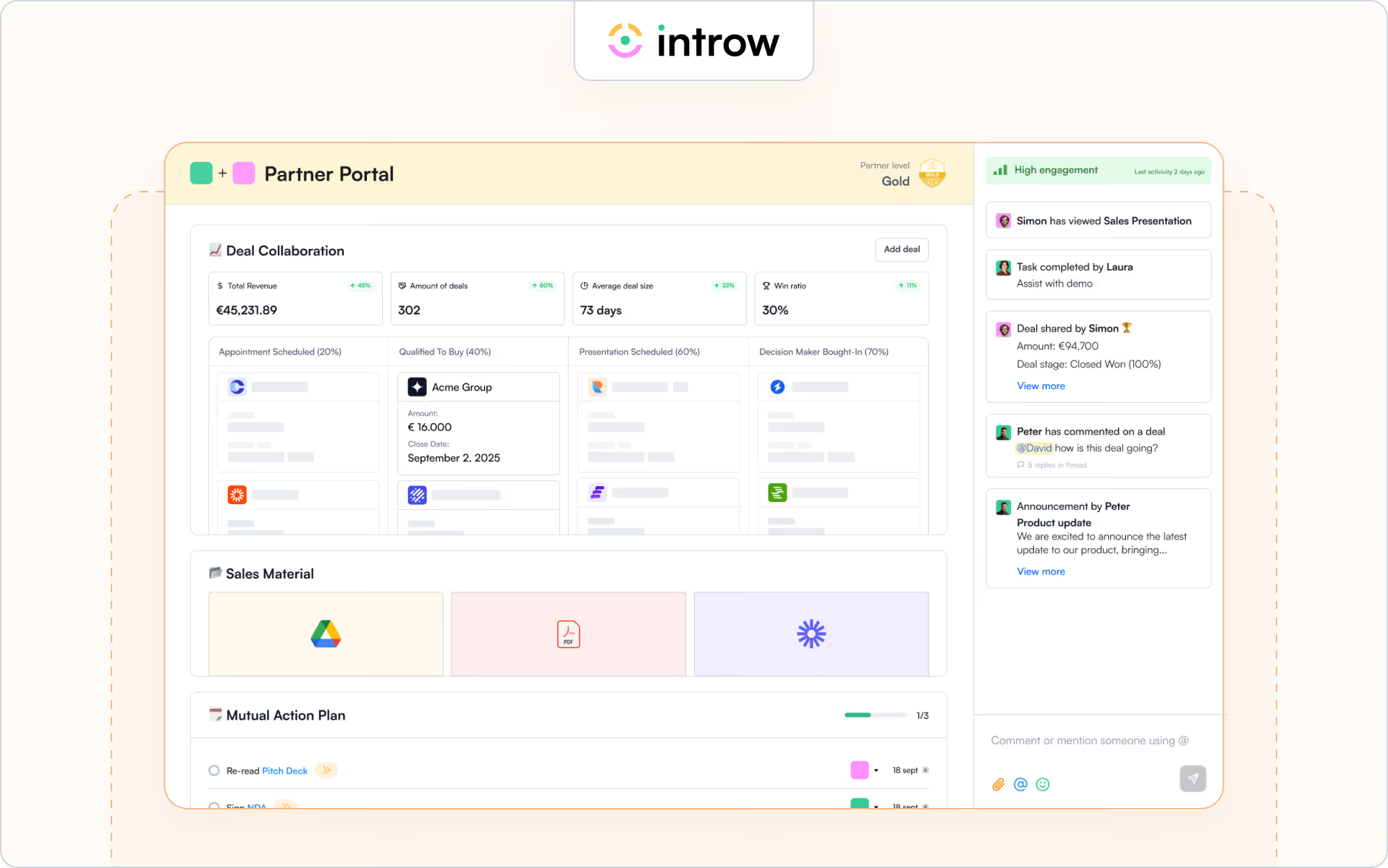
Das Partner-LMS von Introw wurde für B2B-Teams entwickelt, die Partnerschulungen, Zertifizierungsprogramme und Partnerengagement wünschen, um die Leistung und den Umsatz ihrer Partner direkt zu unterstützen, anstatt in einem isolierten Lernmanagementsystem zu arbeiten.

Am besten geeignet für:

Teams HubSpot Salesforce HubSpot verwenden und schnelle externe Schulungen, eine übersichtliche Zertifizierungsverwaltung und Einblick in den Fortschritt der Partner in Bezug auf die Pipeline benötigen.

Warum es heraussticht:

Introw konzentriert sich auf Geschwindigkeit, Relevanz und tatsächliche Akzeptanz. Anstatt Schulungsprogramme von Grund auf neu zu erstellen, wandelt ein KI-Agent Ihre vorhandenen Website-Inhalte, Partnerportal-Dokumente oder Vertriebsmaterialien innerhalb weniger Minuten in strukturierte Kurse um. Sie können diesen Ablauf in der Funktionsübersicht sehen.

Wichtigste Features:

  • KI-gestützte Kurserstellung mit Modulen, Quizfragen und Bewertungen
  • Ein-Klick-Zertifizierungstools, um sicherzustellen, dass nur zertifizierte Partner bestimmte Lösungen verkaufen
  • Massenregistrierung von Partnern nach Partnerstufe, Region oder Partnergruppe
  • Automatische Erinnerungen und Ankündigungen per E-Mail und Slack, zum Beispiel:„Das Unternehmen X hat Sie für die Fortgeschrittenen-Produktschulung 2026 angemeldet.“
  • Fortschrittsverfolgung und Engagement-Daten abgestimmt auf Geschäfte und Partnerleistung

Beachten Sie:

Introw funktioniert am besten, wenn Partnerschulungen, Partnerunterstützung und Partnerbindung Teil derselben CRM-First-Initiative sind.

Integrationen:

Native Integrationen mit Salesforce, HubSpotund Slack, wobei die Daten der Partner-LMS in die umfassendere Introw-Plattform einfließen.

Weitere Informationen: Entdecken Sie das Partner-LMS oder Fordern Sie eine Demo an.

2. TalentLMS
TalentLMS ist ein Lernmanagementsystem, das häufig als Partner-Schulungssoftware von Teams verwendet wird, die externe Schulungen ohne große Einarbeitungszeit anbieten möchten. Es wird in der Regel für die unkomplizierte Einarbeitung und Schulung von Partnern gewählt.

Am besten geeignet für:

Teams in KMU und mittelständischen Unternehmen, die eine einfache Möglichkeit benötigen, Partner-Schulungsprogramme, Vertriebsschulungen und grundlegende Zertifizierungsprogramme durchzuführen.

Warum es heraussticht:

TalentLMS ist einfach zu bedienen und schnell einzurichten. Teams können Kurse erstellen, Schulungsmaterialien organisieren und On-Demand-Schulungen mit minimalem Verwaltungsaufwand durchführen.

Partner-Schulungsfunktionen:

  • Getrennte Lernbereiche für verschiedene Partnergruppen
  • Kurserstellung für Produktwissen und Verkaufstraining
  • Zertifizierungen, Bewertungen und Fortschrittsverfolgung

Beachten Sie:

TalentLMS eignet sich gut für die Durchführung von Schulungen, aber eine tiefere CRM-Transparenz und erweiterte Analysen der Partnerleistung liegen in der Regel außerhalb der Plattform. An dieser Stelle beginnen Teams oft, sich mehr Gedanken über die Partnerbindung über die reine Schulung hinaus.

3. Thinkific

Thinkific ist eine Plattform, die häufig genutzt wird, um Partnerfortbildungen in Markenakademien und Zertifizierungszentren zu bündeln. Sie wird manchmal als Partner-Schulungssoftware ausgewählt, wenn der Schwerpunkt eher auf Präsentationen und strukturierten Lernerfahrungen als auf tiefgreifenden Partneraktivitäten liegt.

Am besten geeignet für:

Produktorientierte oder Marketing-Teams, die Partnerakademien, Zertifizierungsprogramme oder externe Schulungsportale aufbauen.

Warum es heraussticht:

Thinkific bietet ausgefeilte Kurs- und Landingpage-Erlebnisse mit integrierter Unterstützung für Kohorten, Quizze und Zertifikate.

Partner-Schulungsfunktionen:

  • Kurserstellung für Partnerfortbildungen und Produktwissen
  • Zertifikate und Bewertungen
  • Gemeinschafts- und kohortenbasiertes Lernen

Beachten Sie:

Thinkific ist auf externe Bildung ausgerichtet. Erweiterte Workflows für die Partner-Onboarding, CRM-Attribution und die Nachverfolgung der Partnerleistung erfordern in der Regel Add-ons oder Integrationen.

4. Intellum

Intellum ist eine Lernplattform für Unternehmen, die für groß angelegte Schulungsprogramme für Kunden und Partner genutzt wird. Sie wurde entwickelt, um komplexe Schulungen in einem breiten Partner-Ökosystem zu unterstützen.

Am besten geeignet für:

Unternehmensteams, die strukturierte Partner-Schulungsprogramme in großem Umfang durchführen.

Warum es heraussticht:

Intellum bietet solide Lernerfahrungen, fortschrittliche Analysen und Erweiterbarkeit für komplexe Schulungsumgebungen.

Partner-Schulungsfunktionen:

  • Externe Zielgruppen und Partnerportale
  • Zertifizierungsprogramme und Veranstaltungen
  • Berichterstattungsinstrumente für die Effektivität von Schulungen

Beachten Sie:

Intellum ist ein System für Unternehmen. Der Implementierungsaufwand und die CRM-Anpassung für die Leistung der Partner sollten frühzeitig bewertet werden.

5. 360Learning
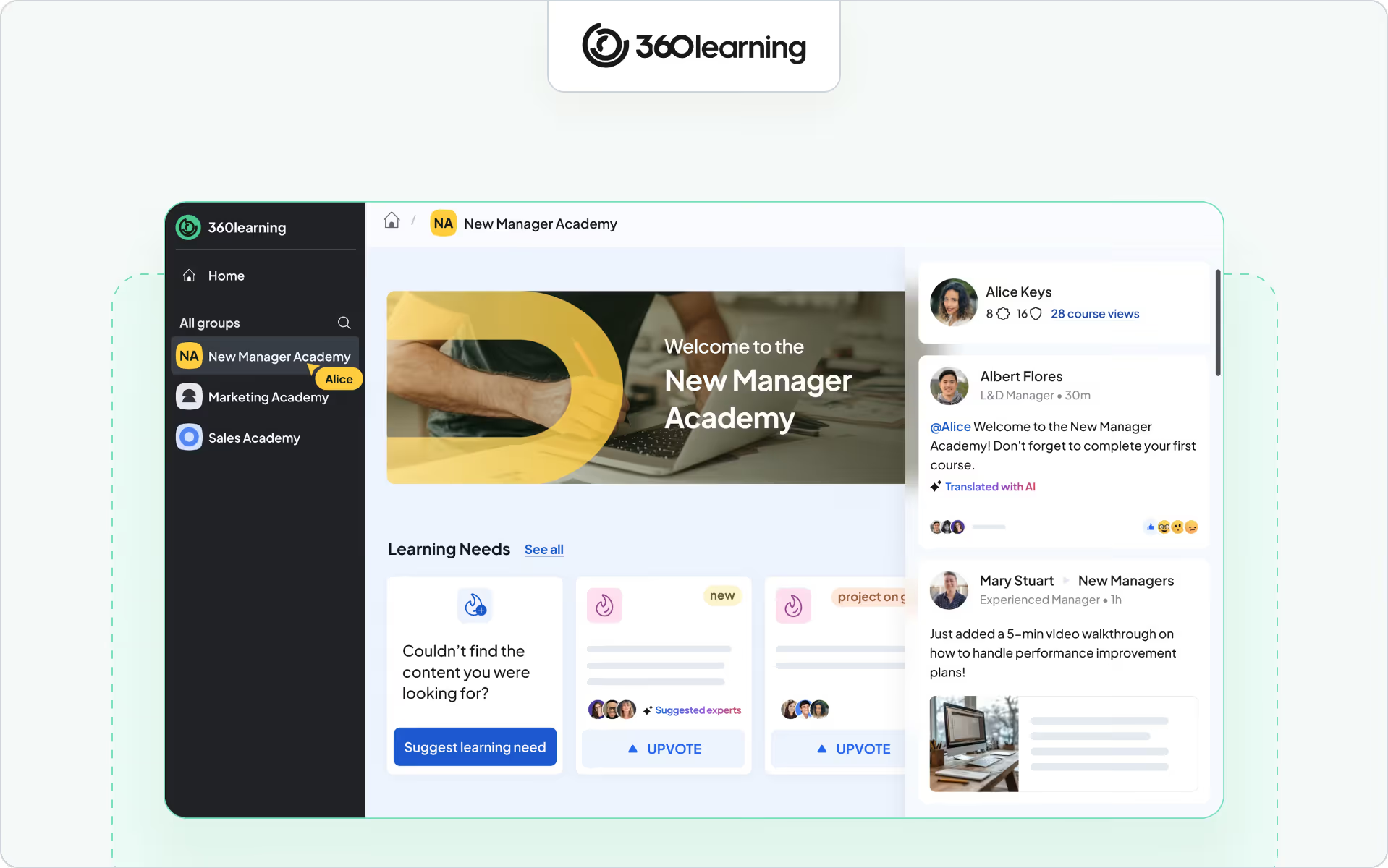
360Learning konzentriert sich auf kollaboratives und peer-gesteuertes Lernen. Es wird manchmal für Partner-Enablement-Schulungen verwendet, bei denen gemeinsames Wissen und soziales Lernen eine wichtige Rolle spielen.

Am besten geeignet für:

Teams, die Partner suchen, um gemeinsam Inhalte zu erstellen und voneinander zu lernen.

Warum es heraussticht:

360Learning legt den Schwerpunkt auf soziales Lernen, Peer Reviews und die gemeinsame Erstellung von Kursen.

Partner-Schulungsfunktionen:

  • Externe Partnergruppen
  • Zertifizierungen und Blended Learning
  • Soziale und von Nutzern generierte Inhalte

Beachten Sie:

Das kollaborationsorientierte Modell funktioniert am besten mit einer klaren Governance, insbesondere wenn es auf externe Partner angewendet wird.

6. Articulate 360

Articulate 360 ist eher eine Suite zur Erstellung von Inhalten als ein vollständiges Lernmanagementsystem. Es wird oft mit Schulungssoftware von Partnern kombiniert, um umfangreiche Kurse zu erstellen.

Am besten geeignet für:

Teams, die hochwertige SCORM- oder xAPI-Schulungsinhalte erstellen möchten.

Warum es heraussticht:

Die Tools von Articulate, wie Storyline und Rise, werden häufig zur Erstellung responsiver, interaktiver Schulungsmaterialien verwendet.

Partner-Schulungsfunktionen:

  • Erweiterte Kurserstellung für Produktwissen und Verkaufstraining
  • SCORM- und xAPI-Unterstützung

Beachten Sie:

Articulate befasst sich ausschließlich mit der Erstellung von Inhalten. Sie benötigen ein separates LMS, um Schulungen durchzuführen, Zertifizierungen zu verwalten und den Fortschritt Ihrer Partner zu verfolgen.

7. LearnUpon
LearnUpon ist ein LMS, das für den erweiterten Einsatz in Unternehmen entwickelt wurde, einschließlich Schulungen für Kunden und Partner. Es wird häufig verwendet, wenn Teams klare Verwaltungsfunktionen für verschiedene Zielgruppen benötigen.

Am besten geeignet für:

Teams schulen Kunden und Partner über strukturierte Portale.

Warum es heraussticht:

LearnUpon bietet eine übersichtliche Benutzeroberfläche und eine Multi-Portal-Konfiguration für verschiedene Zielgruppen.

Partner-Schulungsfunktionen:

  • Separate Lernportale für Partnergruppen
  • Lernpfade und Zertifizierungen
  • Berichterstattung über die Durchführung und den Fortschritt der Schulungen

Beachten Sie:

Für Teams, die sich auf die Vertriebsleistung der Vertriebskanäle oder die Analyse der Partner auf CRM-Ebene konzentrieren, sollte die Integrationsintensität überprüft werden.

8. Skilljar
Skilljar ist eine Plattform, die sich auf die Schulung von Kunden und Partnern konzentriert und häufig von Teams genutzt wird, die strukturierte Zertifizierungs- und Compliance-orientierte Schulungsprogramme durchführen.

Am besten geeignet für:

Teams, die Partnerfortbildungen in großem Umfang mit Schwerpunkt auf Zertifizierungen und Berichterstattung durchführen müssen.

Warum es heraussticht:

Skilljar wurde speziell für externe Schulungen entwickelt und bietet leistungsstarke APIs und Analysen für Bildungsprogramme.

Partner-Schulungsfunktionen:

  • Externe Partnerportale
  • Zertifizierungsprogramme und Abzeichen
  • Berichterstattungsinstrumente für die Effektivität von Schulungen

Beachten Sie:

Skilljar konzentriert sich auf die Bereitstellung von Bildungsangeboten. Für Partner-Engagement-Abläufe und die Nachverfolgung der Partnerleistung auf CRM-Ebene sind möglicherweise zusätzliche Integrationen erforderlich.

9. Docebo
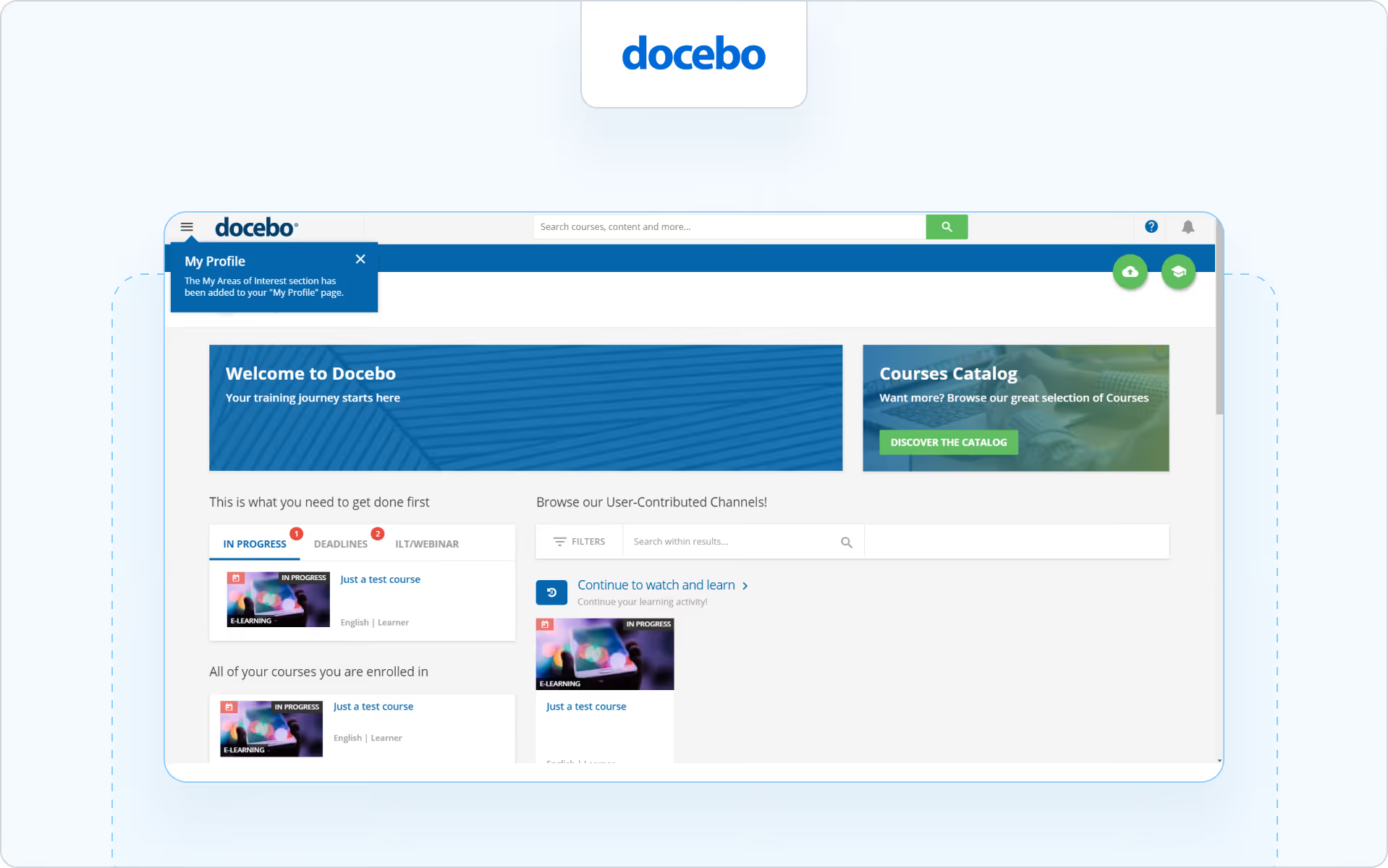
Docebo ist ein Lernmanagementsystem für Unternehmen, das für umfangreiche Unternehmensschulungen, einschließlich Kunden und Partner, verwendet wird. Es wird manchmal als Partner-Schulungssoftware für große, globale Programme ausgewählt.

Am besten geeignet für:

Unternehmen, die komplexe Schulungsprogramme für Partner in verschiedenen Regionen verwalten.

Warum es heraussticht:

Docebo bietet KI-gestützte Content-Kuration und ein breites Ökosystem an Integrationen.

Partner-Schulungsfunktionen:

  • Portale für externe Partner mit unterschiedlichen Zielgruppen
  • Zertifizierungsmanagement und Automatisierung
  • Erweiterte Analysen und Berichterstellung

Beachten Sie:

Die Umsetzung kann komplex sein. Teams sollten frühzeitig die CRM-Ausrichtung und die Sichtbarkeit der Partnerleistung überprüfen.

10. Litmos
Litmos ist ein LMS, das häufig in Umgebungen mit hohen Compliance-Anforderungen und großen Partnernetzwerken eingesetzt wird.

Am besten geeignet für:

Unternehmen, die eine konsistente Schulungsdurchführung und Compliance-Überwachung für globale Partner benötigen.

Warum es heraussticht:

Litmos bietet Compliance-Tools, Bewertungen und eine große Bibliothek mit vorgefertigten Inhalten.

Partner-Schulungsfunktionen:

  • Externe Lernende und Partnergruppen
  • Zertifizierungen und Bewertungen
  • Berichterstattung über den Abschluss der Schulung

Beachten Sie:

Die Benutzererfahrung kann sich eher traditionell anfühlen. Die Segmentierung der Partner und die Flexibilität der Interaktion sollten überprüft werden.

11. LMS absorbieren
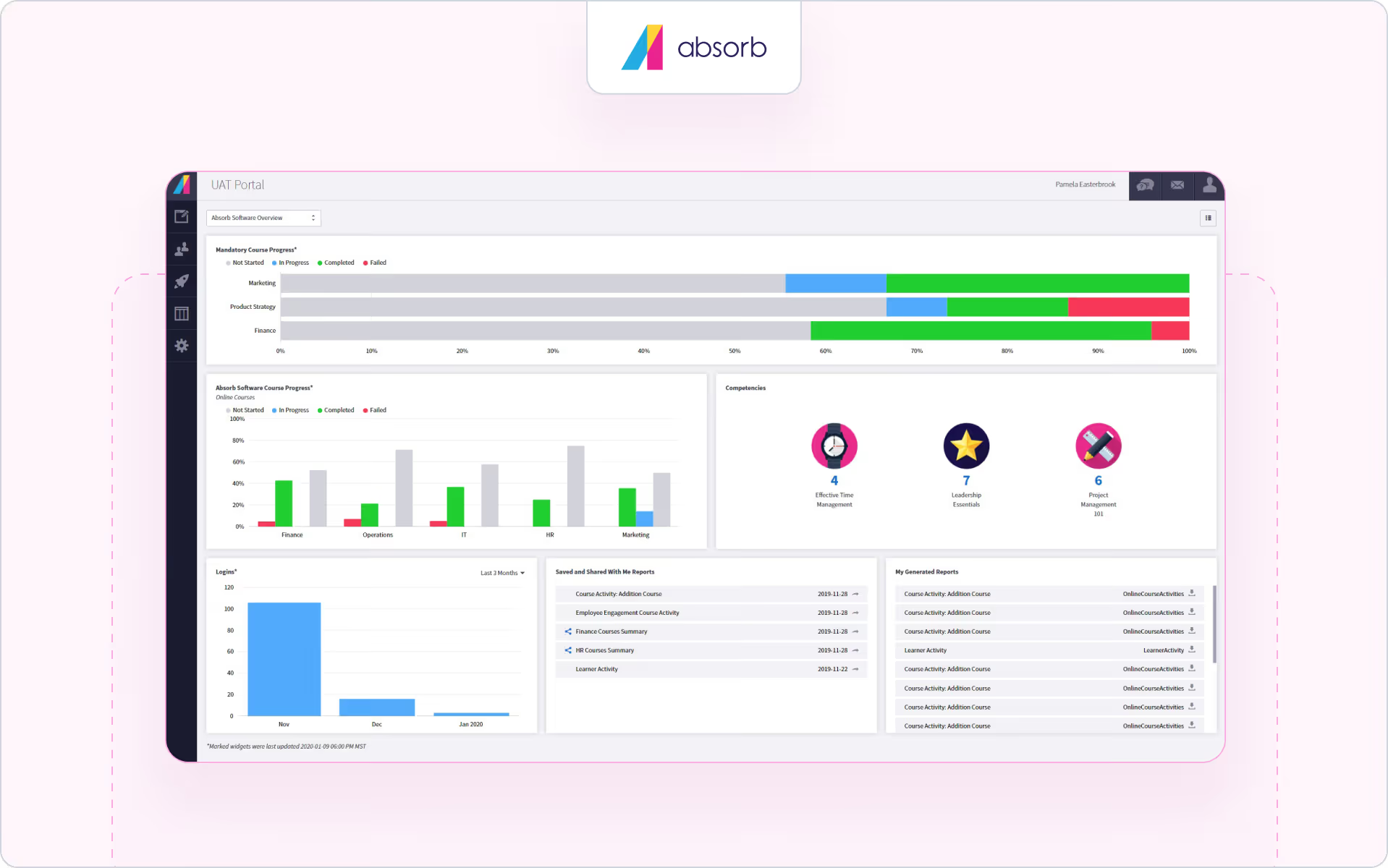
Absorb LMS ist ein LMS, das für erweiterte Unternehmensschulungen, einschließlich Partner- und Kundenschulungen, entwickelt wurde.

Am besten geeignet für:

Teams, die flexible Portale und leistungsstarke Berichterstellung für externe Zielgruppen wünschen.

Warum es heraussticht:

Absorb LMS kombiniert konfigurierbare Lernportale mit soliden Analyse- und Automatisierungsoptionen.

Partner-Schulungsfunktionen:

  • Multi-Tenant-Portale für Partnergruppen
  • Zertifizierungsprogramme und Automatisierung
  • Berichterstattung über Fortschrittsverfolgung und Schulungsdurchführung

Beachten Sie:

Für Interaktionen außerhalb des LMS, wie E-Mail- oder Slack Updates, sind möglicherweise Integrationen erforderlich.

12. Gedankenspielerei
Mindtickle ist eine Plattform zur Verkaufsvorbereitung, die manchmal für Schulungen zur Partnerunterstützung eingesetzt wird, insbesondere wenn der Schwerpunkt eher auf der Verkaufsabwicklung als auf einer umfassenden Partnerausbildung liegt.

Am besten geeignet für:

Die Teams konzentrierten sich auf die Verkaufsbereitschaft der Partner, das Pitching und die Zertifizierung im Zusammenhang mit Vertriebsaktivitäten.

Warum es heraussticht:

Mindtickle legt den Schwerpunkt auf Coaching, Rollenspiele und Bereitschaftsbewertung, um die Vertriebsleistung zu unterstützen.

Partner-Schulungsfunktionen:

  • Vertriebskanäle und Zertifizierungen von Partnern
  • Inhalt, Praxis und Bewertungen
  • Bereitschaftsbewertung und Coaching-Workflows

Beachten Sie:

Mindtickle ist bereitstellungsorientiert. Die meisten Teams kombinieren es mit einem PRM oder LMS, um ein breiteres Spektrum an Partner-Onboarding und -Operationen abzudecken.

13. Lernwelten
LearnWorlds ist eine Plattform für externe Bildungsangebote, die häufig zum Aufbau von Markenakademien und Zertifizierungszentren genutzt wird.

Am besten geeignet für:

Teams, die Partner-Schulungsprogramme mit starkem Branding und optionaler Monetarisierung starten möchten.

Warum es heraussticht:

LearnWorlds bietet flexible Kurserstellung, interaktive Inhalte und ausgefeilte Lernerfahrungen.

Partner-Schulungsfunktionen:

  • Kurserstellung für Partnerfortbildungen und Produktwissen
  • Zertifizierungen, Bewertungen und Lernpfade
  • Markenportale für externe Partner

Beachten Sie:

Partnerspezifische Governance, Segmentierung und CRM-Transparenz erfordern in der Regel zusätzliche Einstellungen oder Integrationen.

14. Eckpfeiler Kunde & Partner LMS
Cornerstone Customer & Partner LMS unterstützt die Schulung von Kunden und Partnern durch markenspezifische externe Lernerfahrungen, die auf verschiedene Regionen, Zielgruppen und Partner-Ökosysteme skalierbar sind.

Am besten geeignet für:

Große Unternehmen, die Cornerstone bereits nutzen und die Schulungen für Kunden und Partner durch markenspezifische externe Lernerfahrungen erweitern möchten.

Warum es heraussticht:

Cornerstone konzentriert sich auf skalierbares externes Lernen mit starker Governance, wodurch die Verwaltung von Schulungen in komplexen Partner-Ökosystemen und Regionen vereinfacht wird.

Partner-Schulungsfunktionen:

  • Markenspezifische externe Lernportale für Partner und Kunden
  • Zertifizierungen, Bewertungen und strukturierte Lernprozesse
  • Berichterstattung und Analysen über große Partnernetzwerke hinweg

Beachten Sie:

Cornerstone ist für Unternehmen ausgelegt. Die Einrichtung und Anpassung kann mehr Zeit in Anspruch nehmen, und Teams sollten die Benutzererfahrung der Partner während der Implementierung genau evaluieren.

15. Tovuti LMS

Tovuti LMS ist ein flexibles Lernmanagementsystem für Kunden- und Partnerschulungen, dessen Schwerpunkt eher auf konfigurierbaren Lernerfahrungen als auf starren Arbeitsabläufen liegt.

Am besten geeignet für:

Teams, die ein anpassbares LMS suchen, um Partner-Schulungsprogramme, Partner-Onboarding und externe Schulungen ohne die Komplexität auf Unternehmensebene zu unterstützen.

Warum es heraussticht:

Tovuti bietet eine Vielzahl von Konfigurationsoptionen für Kurse, Portale und Lernerfahrungen, wodurch es einfacher wird, Schulungen an verschiedene Partnergruppen und Anwendungsfälle anzupassen.

Partner-Schulungsfunktionen:

  • Markenbezogene Lernportale für externe Partner
  • Kurserstellung, Bewertungen und Zertifizierungen
  • Lernpfade und Interaktionsfunktionen

Beachten Sie:

Tovuti bietet Flexibilität, aber Teams sollten prüfen, inwieweit Berichterstattung, CRM-Transparenz und die Nachverfolgung der Partnerleistung mit ihren allgemeinen Partneraktivitäten übereinstimmen.

Es gibt keine LMS-Software, die für jedes Team gleichermaßen ideal ist. Wichtig ist, ein System zu wählen, das zu Ihrer tatsächlichen Arbeitsweise passt, und nicht nur zu den Funktionen, die auf dem Papier stehen.

Im nächsten Abschnitt werden die unverzichtbaren Bewertungskriterien aufgeführt, auf die sich SaaS-Teams beim Vergleich von LMS-Softwarepartnern konzentrieren sollten, von der Kurserstellung und Zertifizierungen bis hin zu Engagement und CRM-Transparenz.
Unverzichtbare Bewertungskriterien (SaaS-Channel-Perspektive)

Wenn Sie die Auswahl an LMS-Softwarepartnern eingrenzen, wird die Entscheidung in der Regel an dieser Stelle klarer.

Über die Liste der Funktionen hinaus ist es wichtig, dass ein System die Schulung von Partnern in großem Umfang unterstützt, sich in Ihre bestehende Struktur einfügt und auch dann weiter funktioniert, wenn Ihr Partner-Ökosystem wächst, insbesondere bei der Schulung von Vertriebspartnern.

Die folgende Tabelle zeigt, wie SaaS-Teams in der Regel LMS-Tools von Partnern bewerten, wenn sie Optionen wie ein LMS für Vertriebspartner oder die beste LMS-Software für Partnerschulungen für ihr Modell vergleichen.

Bewertungskriterien Was Sie bei einer Partner-LMS-Software beachten sollten
Geschwindigkeit der Kurserstellung KI-gestütztes Authoring, Vorlagen, Quizze, Zertifikate und intuitive Kurserstellung, die Reibungsverluste bei der Erstellung von Schulungsprogrammen reduzieren.
Anmeldung und Zugang Massen-Einladungen, SSO oder SAML, Partner-Tier-Targeting, die Möglichkeit zur Segmentierung von Partnerzielgruppen und einfache Selbstregistrierung für externe Partner
Zertifizierungen Rollen- oder lösungsbasierte Zertifizierungen, Ablaufregeln, Badges, Zertifizierungstools und übersichtliche Zertifizierungsverwaltung
Vertrieb und Engagement Benachrichtigungen außerhalb des Portals per E-Mail oder Slack, Erinnerungen, Aufforderungen innerhalb der Plattform und leichtes soziales Lernen, die das Engagement der Partner fördern
Analytik und CRM-Synchronisierung Fortschritt, Abschlussquoten, Bewertungsergebnisse und Leistungsanalysen, die mit Salesforce HubSpot kompatibel sind, insbesondere wenn Ihre Einrichtung von der Wahl des richtigen CRM für das Partnermanagement abhängt.
Branding und UX White-Label-Portale, Lokalisierung, mobilfreundliches Design, eine einheitliche Marke und personalisierte Lernpfade, die das gesamte Lernerlebnis verbessern
Sicherheit und Governance Rollenbasierter Zugriff, Prüfpfade, Kontrollen zur Datenresidenz und klare Zuständigkeiten für externe Schulungen
Eignung für das Ökosystem Anpassung an Ihre Partner-Relationship-Management-Software, Integrationen mit Tools wie SCORM oder xAPI und Kompatibilität mit Ihrem gesamten Partner-Enablement-Software-Stack

Zusammengenommen erleichtern diese Kriterien den Vergleich eines Partner-LMS, eines Schulungspartner-LMS oder des besten LMS für Partnerschulungen, ohne Funktionen überzubewerten, die langfristig keine Rolle spielen.

Wenn die Grundlage stimmt, fördert die Partnerschulung das Wissen der Partner, ihre Glaubwürdigkeit und das das Partnerschaftsmarketing statt isoliert zu agieren.

Nach Durchsicht der Kriterien wird leichter verständlich, warum manche Teams über ein eigenständiges Lernmanagementsystem hinausblicken und sich für eine Plattform entscheiden, die speziell für das Lernen von Partnern entwickelt wurde.

Warum Teams Introw für das Partner-Lernen wählen (in 90 Sekunden)
Schaffen Sie partnerschaftliches Lernen, ohne Teams zu verlangsamen

Die meisten Teams verfügen bereits über die richtigen Inhalte; diese sind lediglich über Websites, Dokumente und Partnerportale verteilt.

Teams wie Factorial haben sich vom manuellen Neuaufbau von Schulungen verabschiedet, indem sie vorhandene Materialien in strukturierte Kurse mit Modulen und Quizfragen umgewandelt haben. Dadurch lassen sich Schulungen für Partner leichter starten und aktualisieren, wenn sich das Unternehmen weiterentwickelt.

Nutzen Sie Zertifizierungen, um die Qualität zu schützen, nicht um Reibungsverluste zu verursachen.

Introw unterstützt Zertifikate, Ablaufdaten und geschützte Tracks, damit Fortbildungen und Verkaufsaktivitäten auf die Bereitschaft der Partner abgestimmt bleiben.

Die richtigen Partner zum richtigen Zeitpunkt gewinnen

Mit Introw können Teams Partner nach Typ, Stufe oder Region segmentieren und sie in großen Mengen registrieren, wodurch die Schulungen relevant bleiben, ohne dass zusätzlicher Betriebsaufwand entsteht.

Halten Sie Ihre Partner auf dem Laufenden, ohne dass sie ein weiteres Portal überprüfen müssen.

Eines der größten Hindernisse für das Lernen von Partnern ist die Abhängigkeit von Portalen, die Partner nicht regelmäßig besuchen.

Cubbit und Factorial wurden stärker angenommen, nachdem die Schulungskommunikation in die Kanäle verlagert wurde, die die Partner bereits nutzen, wobei Ankündigungen und Erinnerungen per E-Mail und Slack über einen weiteren Login versendet wurden.

Lernen mit dem verbinden, was wichtig ist

Schulungen sind viel nützlicher, wenn sie nicht isoliert stattfinden. Für Teams wie Coder war es unerlässlich zu wissen, welche Partner geschult und bereit für den gemeinsamen Vertrieb waren.

Durch die Abstimmung der Daten zu Kursabschlüssen und Zertifizierungen mit Salesforce HubSpot hilft Introw Teams dabei, die Bereitschaft ihrer Partner im Kontext der Pipeline und des Umsatzes zu verstehen.

Wenn Sie kurz vor einer Entscheidung stehen, können ein paar einfache nächste Schritte helfen, alles zusammenzufügen:

  • Erfassen Sie Ihre aktuellen Defizite
    Finden Sie heraus, wo das Lernen Ihrer Partner derzeit ins Stocken gerät, sei es bei der Kurserstellung, der Einarbeitung neuer Partner, der Einbindung oder der Transparenz hinsichtlich der Bereitschaft Ihrer Partner.
  • Überprüfen Sie Ihre Kriterien auf Herz und Nieren
    Sehen Sie sich die oben genannten Bewertungskriterien noch einmal an und erstellen Sie eine Auswahlliste mit den Fähigkeiten, die für Ihr Partner-Ökosystem am wichtigsten sind, und nicht nur mit denen, die auf einer Liste mit Funktionen gut aussehen.
  • Sehen Sie sich den gesamten Workflow an
    Bevor Sie sich festlegen, sollten Sie sich vergewissern, dass Sie verstehen, wie Partner Learning in Ihr bestehendes CRM, Ihre Partneraktivitäten und Ihre Umsatzentwicklung passt.

Jetzt ist es an der Zeit, dass Sie sehen, wie das in der Praxis funktioniert.

Fordern Sie eine Demo an und durchlaufen Sie den gesamten Lernprozess für Partner.

FAQs

Noch Fragen? Hier findest du die häufigsten Fragen und Antworten.

Kontaktiere uns

Was ist der Unterschied zwischen einem Partner-LMS und einem Standard-LMS?

Ein Partner-LMS ist für externe Partner und die Schulung von Vertriebspartnern konzipiert und unterstützt separate Lernbereiche, Zertifizierungsmanagement und Partner-Onboarding als Teil eines umfassenderen Partner-Enablement-Programms. Ein Standard-Lernmanagementsystem ist für interne Teams und HR-Anwendungsfälle konzipiert.

Was ist das beste Partner-LMS für 2026?

Das beste Partner-LMS für 2026 ist eines, das schnelle Kurserstellung, Partner-Schulungs-LMS-Softwarefunktionen, Zertifizierungen und adaptive Lernpfade kombiniert, die sich an die Rollen, Stufen oder Erfahrungsstufen der Partner anpassen.

Kann ich den Verkauf bestimmter Produkte auf zertifizierte Partner beschränken?

Ja. Die Partner-Schulungssoftware unterstützt Zertifizierungsprogramme, mit denen Sie den Verkauf durch Partner an erforderliche Zertifizierungen knüpfen können, sodass nur zertifizierte Partner bestimmte Produkte verkaufen dürfen.

Wie messe ich die Auswirkungen von Schulungen auf die Pipeline und den Umsatz?

Durch die Verwendung von Partner-LMS-Software, die Fortschrittsverfolgung, Zertifizierungen und Partnerleistungsdaten mit Salesforce HubSpot verknüpft, wird die Schulung zu einem Teil des kontinuierlichen Wissensaustauschs, der mit der Pipeline und dem Umsatz verbunden ist.

Können Partner auf Inhalte zugreifen, ohne sich jedes Mal bei einem Portal anzumelden?

Ja. Viele Partner-LMS-Plattformen bieten externe Schulungen per E-Mail oder Slack sowie On-Demand-Schulungen an, sodass Partner aktive Nutzer bleiben können, ohne sich für jede Interaktion in ein Portal einloggen zu müssen.


Launch your partner portal
in minutes!

Vielen Dank! Wir haben deine Anfrage erhalten!
Hoppla! Beim Absenden des Formulars ist ein Fehler aufgetreten.

Verwandte Blog-Artikel

Partner-Lernmanagement

How to Build a Partner Course Portal: Step-by-Step Guide

Ruben Bellaert
Growth
5min Lesezeit
06 May 2026
⚡ TL;DR

A partner course portal gives partners one place to learn how to work with your team, complete training, and prepare for real opportunities.

Instead of sharing courses across emails and webinars, everything lives in one secure portal with tracked progress and role-based visibility, so partners see what matters to them.

To make it effective, focus on clear course structure, persona-based access, and enrollment tied to milestones like certification or first deal activity.

What is a partner course portal?

A partner course portal is a secure place where partners sign in, access training, and complete structured courses at their own pace.

Instead of sharing files by email or running one-off webinars, your team keeps education in one portal with clear progress tracking and visibility aligned to each partner’s role.

Built for partners, not employees

Most learning systems support internal teams. A partner course portal is designed for external members like resellers, referral partners, and technical partners who need the right knowledge before working with customers.

Many teams set this up inside a dedicated partner LMS to manage course visibility, access rights, and member progress in one place while showing different learning paths to different partner personas.

More than a content library

A basic portal stores documents. A partner course portal guides partners through a learning journey that supports real partner activity over time.

That usually includes:

  • onboarding courses
  • product education
  • technical training
  • certifications
  • webinars and support material

With structured learning in place, it becomes much easier to track adoption and understand how to measure channel partner training ROI across your partner ecosystem.

A clear structure like this turns scattered education into something partners can actually follow without searching across multiple systems. Once that foundation is clear, it’s easier to see what your portal needs before you start building it.

What a good partner course portal needs

A partner course portal only works if partners can enter easily, find the right course fast, and know what to do next. When those pieces are missing, even strong education gets ignored.

Here are the core building blocks your portal should include from day one.

Secure partner access

Partners need a simple way to sign in without friction. If login feels complicated, members stop using the portal.

Most teams support access through:

  • email-based sign-in
  • password or passwordless login
  • SSO for larger partner organizations

This keeps training protected while making it easy for the right people to enter the portal when they need support or guidance.

Structured courses and learning paths

A strong partner course portal shouldn’t feel like file storage. It should guide partners toward their first meaningful activity.

That usually means organizing courses by:

  • partner role
  • onboarding phase
  • certification track
  • product knowledge level

When partners can see what to learn first and what comes next, they move faster toward readiness. Many teams use dedicated partner LMS software to keep course structure clear as their ecosystem grows.

Certifications that show readiness

Certifications give partners a clear signal that they’re prepared to support customers. They also help your team set expectations for selling rights, onboarding milestones, or solution delivery readiness.

Simple certification paths often work best when introduced gradually and tied to real partner activity. Partner certification strategies can help you design milestones that support adoption without slowing partners down early.

Segmented visibility by partner type

Not every partner should see the same education. A good portal lets you control course access based on:

  • partner tier
  • role
  • region
  • language
  • lifecycle phase

This keeps training relevant and reduces noise, so partners see what matters for their role and stage. It also supports different experiences across referral, reseller, and technical partner journeys.

Progress tracking and reminders

Partners should always know where they are in their learning journey.

Your team should be able to check:

  • who enrolled
  • who completed courses
  • who earned certifications
  • where members dropped off

That visibility makes it much easier to improve adoption and understand what’s working across your partner ecosystem.

Once these pieces are in place, building the portal becomes much more straightforward.

So before you create your first course, who exactly are you building the portal for, and what do you want them to achieve first?

Step 1: Define the audience and training goal

Before you build anything inside your partner course portal, take a step back and decide who the training is for and what they should be able to do after finishing it. This sounds simple, but it’s the step most teams skip.

When the audience isn’t clear, the portal turns into a mix of courses that nobody follows from start to finish.

Start with partner type

Different partners need different education. A reseller doesn’t need the same course as a referral partner. A technical partner doesn’t need the same journey as a marketing partner.

Most teams structure training around groups like:

Partnertyp What they usually need to learn
Referral-Partner How to identify opportunities and submit deals.
Reseller Sales positioning, pricing, and deal workflows.
Implementierungspartner Setup guidance and delivery readiness.
Technology partners Integration knowledge and product alignment.

Each group should see only the courses that help them move forward in their role.

Then define the partner role

Inside each partner type, roles matter just as much. Even within the same partner account, sales, technical, and leadership contacts should not see the same learning experience.

Rolle Training focus
Sales contacts Positioning, messaging, deal registration.
Technical contacts Setup, integrations, troubleshooting.
Customer-facing teams Support workflows and handoff steps.
Leadership contacts Program structure and expectations.

When role-based visibility is clear early, your portal stays simple as it grows and supports different experiences across partner personas.

Connect training to a real milestone

Every course should move partners toward something specific. Otherwise, completion rates stay low.

Common milestones include:

  • finishing onboarding
  • submitting the first deal
  • joining co-selling activity
  • earning certification
  • preparing to support customers

Structured learning improves adoption and makes certification progress easier to track across your ecosystem.

Aligning courses with a broader partner training journey also helps partners know what to do first and what comes next.

With the audience and goal defined, you can start shaping the learning experience partners see when they enter your portal.

Step 2: Design the portal structure around the partner journey

Once you know who your partners are and what they need to achieve, the next step is shaping what they see when they enter your partner course portal. A clear structure helps members find the right course quickly and keep moving forward.

Think of the portal like a guided path, not a storage space.

Start with the entry experience

The first screen partners see should answer one question right away: what should I do first? It should also answer what’s in it for them, so partners can enter the portal and immediately see the next step, the value of completing it, and what unlocks after that.

Most teams organize their homepage around:

  • onboarding courses
  • certification paths
  • product education
  • technical training
  • recorded webinars

This makes it easy for members to log in, check their next step, and continue learning without searching through folders. Many teams also organize technical docs, marketing assets, and battle cards into persona-specific asset hubs so partners can quickly find what they need without extra navigation.

Companies also manage this structure inside a dedicated partner LMS, where courses stay aligned with partner roles, personas, and lifecycle stages.

Organize training by journey stage

Partners don’t all start in the same place. Some are brand new. Others are ready to sell. Some are already supporting customers.

A simple structure usually follows stages like:

Journey stage What partners should see
Getting started Onboarding overview and program basics.
Learning the product Positioning and feature knowledge.
Selling with confidence Deal process and qualification steps.
Delivering value Implementation and support guidance.

This helps partners move forward step by step instead of guessing what comes next.

Keep training connected to real partner activity

Training works best when it sits close to the actions partners already take.

For example:

  • onboarding courses before submitting the first deal
  • certification before co-selling access
  • technical training before implementation work
  • product updates shared through webinars inside the portal

Some teams also structure their portal so course visibility adjusts automatically based on role, region, persona, or lifecycle stage using systems connected through a HubSpot integration. This keeps access simple as your partner ecosystem grows.

When the structure reflects how partners actually work, the portal feels easier to follow from the first login. With that foundation in place, it’s much simpler to decide which courses should come first.

Step 3: Build the first courses

Once your structure is clear, it’s time to add your first courses. Start small. A partner course portal works best when members can move through a few focused lessons instead of working through too much education at once.

Most teams begin with a simple core set.

Start with the essentials

Your first courses should help partners understand how to work with your team and start engaging in real opportunities quickly.

A strong starting set usually includes:

  • partner program overview
  • product basics
  • sales positioning
  • deal registration steps
  • certification path introduction

These courses give members the knowledge they need before moving into active deal collaboration.

Keep lessons short and modular

Short lessons are easier to complete and easier to update later. Instead of building one long course, break content into smaller modules partners can finish quickly.

For example:

Course Suggested lesson structure
Product overview Key features, use cases, customer fit.
Sales training Messaging, qualification, next steps.
Deal process Registration steps, approvals, timelines.

This makes it easier for partners to check progress, return later, and continue learning without friction.

Use quizzes where readiness matters

Quizzes help confirm that partners understand important steps before moving forward. They’re especially useful before certification milestones or selling access.

Many teams also connect quizzes to broader certification paths using structured approaches like these partner certification strategies, which help reinforce learning across the partner journey.

Starting with a small set of practical courses keeps your portal clear and usable from day one. Once those courses are in place, the next step is deciding which ones should lead to certification.

Step 4: Add certifications and completion logic

Certifications turn a partner course portal from simple education into something partners take seriously. When members know they’ll earn proof of completion, they’re more likely to log in, finish lessons, and move forward.

They also help your team confirm who’s ready to work with customers and participate in real partner activity.

Choose which courses should lead to certification

Not every course needs a certificate. Focus on the ones tied to real partner responsibilities.

Common examples include:

  • onboarding completion
  • product readiness
  • sales positioning
  • technical setup training

These checkpoints make it easier to see which members are prepared before they enter customer conversations or support projects.

Use certifications to control access and rights

Certifications aren’t just recognition. They help define what partners can do next.

For example, your team can connect completion to:

  • permission to register deals
  • access to advanced education tracks
  • eligibility for co-selling
  • expanded partner program rights

Many teams introduce certifications gradually so partners can move into real opportunities early and continue learning as they progress.

If you’re planning a structured rollout, tools with a built-in Salesforce integration make it easier to track completion across partner contacts without managing updates manually.

Make completion visible and easy to track

Partners should always know what they’ve finished and what comes next. A simple dashboard inside the portal helps members check progress after they sign in with their email, reset a password if needed, and return to continue learning.

Your team should also be able to see:

  • who enrolled
  • who completed courses
  • who still needs support
  • who is ready for the next stage

This keeps education aligned with real partner activity instead of guessing who’s prepared.

Once certifications are in place, the next step is deciding which partners should see which courses in the first place.

Step 5: Set visibility and enrollment rules

Once your courses and certifications are ready, the next step is deciding who can see what inside your partner course portal. This is what keeps education relevant instead of overwhelming.

When members log in, they should only enter the courses that match their role and responsibilities. That makes the learning journey feel clear from the start.

Control course access by partner attributes

Not every partner needs the same training. Visibility rules help your team give the right education to the right members at the right time.

Most portals segment access using:

  • partner type
  • partner tier
  • region or language
  • lifecycle phase
  • certification status

This keeps advanced courses hidden until partners are ready and reduces noise when new members enter the portal for the first time.

Clear visibility rules also help maintain program structure as your ecosystem grows alongside the rest of your partner relationship management software.

Choose the right enrollment method

Enrollment decides how members get access to courses after they sign in.

Common options include:

  • manual enrollment for small partner groups
  • bulk enrollment during rollout
  • automatic enrollment based on role or region
  • certification-triggered enrollment into advanced tracks

Automatic enrollment helps partners move between program stages without extra support and keeps learning aligned with real partner activity.

In more advanced portals, courses, assets, and program steps can also unlock automatically as partners complete milestones like onboarding tasks or deal registration, creating a guided journey without manual updates.

Some teams also connect enrollment to structured certification paths using modern partner certification software, which helps education stay aligned with readiness milestones.

With visibility and enrollment rules in place, your portal stays organized as more members join. The next step is rolling it out and making sure partners start using it.

Step 6: Launch, enroll partners, and track adoption

Once your partner course portal is ready, the goal is simple. Help members enter quickly, understand what to learn first, and start engaging without confusion.

A smooth launch makes a big difference in whether partners actually log in and complete their education.

Many teams start with a minimal portal that surfaces deal visibility, reports, and a small set of core courses first, then expand education as partners begin engaging in real opportunities.

Invite members with a clear first step

When partners receive their invitation, they should immediately know how to enter the portal and what to do next.

A strong rollout usually includes:

  • a welcome email with login instructions
  • a simple way to set or reset a password
  • one clearly recommended first course
  • a short explanation of why the training matters

This removes friction and makes it easier for members to return later without needing extra support.

Roll out training in small groups if needed

If your ecosystem is large, invite partners in stages instead of all at once. This helps your team answer questions faster and improve the experience before expanding access.

Many teams begin with:

  • new partners in onboarding
  • active resellers preparing for certification
  • technical contacts supporting customers

Structured certification rollouts like these often improve completion rates over time, especially when paired with guidance from programs designed to improve partner engagement with certification programs.

Track how members use the portal after launch

After partners enter the portal, tracking activity helps your team understand what’s working.

Start by checking:

  • who logged in
  • which courses members completed
  • where partners stopped learning
  • who earned certifications

This makes it easier to adjust course structure and strengthen adoption using proven approaches like the LMS benefits for channel partner certification.

A thoughtful rollout helps partners feel confident from their first login. Once the portal is live, it becomes much easier to avoid the common mistakes teams run into when building partner training environments.

Common mistakes when building a partner course portal

Most partner course portals don’t fail because of the platform. They fail because members can’t tell what to do first.

Here are the mistakes that slow adoption most.

Adding too much education too early

Uploading every webinar and document at once makes it harder for members to start.

Begin with:

  • onboarding basics
  • product overview
  • sales positioning
  • certification path entry points

You can expand later as partners move into real opportunities.

Building one experience for every partner

Referral partners, resellers, and technical teams need different education. Segmented visibility helps members enter the right learning path from the first login and supports different experiences across partner roles.

Skipping certifications

Without certifications, it’s harder to confirm readiness. Even simple certificates create structure and improve completion when they’re connected to real partner activity.

Treating the portal like a document library

A partner course portal should guide a journey, not store files.

That means:

  • clear course order
  • structured milestones
  • visible progress tracking
  • defined completion goals

Launching without enrollment logic

If members don’t know what to take first, they often stop early. Automatic enrollment based on role, region, or certification stage keeps learning clear without manual work.

Many teams moving away from standalone tools explore structured options like these LearnUpon LMS alternatives to simplify partner education as their ecosystem grows.

Avoiding these mistakes keeps your portal easier to manage and easier for partners to use from day one.

With the structure in place, it helps to see how teams build and manage a partner course portal faster inside a single environment.

How Introw helps teams build partner course portals faster

Many teams try to build a partner course portal by combining separate tools for courses, certifications, access control, and tracking. That setup works early on, but it gets harder to manage as partner programs expand across roles, personas, and regions.

Introw LMS brings portal structure, education, certifications, and partner access together in one place so your team can launch quickly without stitching systems together.

Instead of starting from scratch, your team can create structured learning experiences based on partner role, lifecycle stage, or persona, while keeping visibility aligned with real partner activity inside the CRM.

Many teams begin with CRM-based visibility and deal context first, then layer courses and certifications afterward so the portal can go live quickly using data they already have.

Members log in and immediately see what they should learn first, what they can access next, and when they’re ready to move forward without searching across tabs or tools.

Because courses, certificates, and visibility rules stay connected, your team can:

  • assign training by partner tier, role, or persona
  • enroll members automatically as they progress
  • issue certificates as milestones are completed
  • adjust access rights as partners move into new program stages

Visibility can also update automatically using CRM attributes like certification status, geography, pipeline access, or lifecycle stage.

Teams moving away from fragmented learning tools often explore structured platforms like these 360Learning alternatives to keep partner education aligned as their programs grow.

When training, access, and certifications live inside the same partner environment, your portal becomes easier to launch and far easier to maintain.

And once the system is simple for your team, it becomes much easier for partners to log in, learn what matters, and move into real opportunities with confidence.

Over to you

A strong partner course portal gives your partners a clear place to enter, learn what matters first, and move toward their first real opportunities with confidence.

When courses, access, and progress tracking are structured from the start, training stays aligned with partner roles and becomes much easier to manage as your program grows.

Three simple next steps to get started:

  • choose which partner roles need training first
  • build a small set of core onboarding and product courses
  • set visibility rules so members only see what applies to them

Starting small helps partners engage earlier and continue learning as they move into active deal collaboration.

If you want to see how teams set this up inside a single partner environment connected to their CRM, request a demo to get started.

Partner-Lernmanagement

How to Enable Distributors to Win Deals with Distributor Sales Training

Janis De Sutter
Software Engineer
5min Lesezeit
26 Apr 2026
⚡ TL;DR

Distributor sales training should help your distributors move deals forward, not just understand your product. If training does not connect to pipeline and reseller coordination, results stay limited. The strongest programs start with role-based onboarding, support early deal activity, and then add certifications as engagement grows. Tools like a structured partner LMS and scalable approaches to partner training help connect training directly to revenue outcomes.

Why distributor sales training is different from standard partner training

Distributor sales training is different because distributors do not sell the same way referral partners do. They support resellers, coordinate pipeline, and help move deals forward across multiple layers of the channel.

That changes what your training needs to cover.

Here’s where they differ:

Standard partner training Distributor sales training
Focuses on product knowledge Focuses on how deals move through the channel
Usually targets one partner contact Supports multi-contact distributor teams
Works well for simple referral motions Supports multi-tier reseller coordination
Rarely includes quotes or specs Often includes pricing context, specs, and workflow steps
Limited pipeline visibility needed Requires reseller-level pipeline visibility
Training ends after onboarding Training continues during active opportunities

Software distributors need visibility into reseller activity without full CRM access. Training should explain attribution, pipeline flow, and where distributors support deals.

Hardware distributors work across longer deal cycles with technical contacts and quotes. Their training should cover specs, territory rules, and installation readiness early.

Once training reflects how distributors actually support deals, it becomes easier to define what they need to perform effectively across software and hardware motions.

What software and hardware distributors actually need to win deals

Most distributors are not closing deals themselves. They help resellers move opportunities forward. So distributor sales training should focus on coordination, visibility, and readiness, not just product knowledge.

Here’s how software and hardware distributor needs compare:

Software distributors need Hardware distributors need
Visibility into reseller pipeline activity Visibility into deal status and territories
Attribution across distributor and reseller layers Quote collaboration and pricing alignment
Shared dashboards without CRM exposure Access to specs and technical documentation
Certifications tied to positioning and use cases Installation readiness and technical enablement
Structured collaboration across partner tiers Coordination across multi-contact deal teams

Many teams support these workflows through structured partner environments built for software distributors and hardware distributors, where visibility stays clear without opening the full CRM.

Across both motions, strong distributor sales training programs still rely on the same foundations:

  • current assets distributors can trust and reuse
  • clear rules for deal registration and ownership
  • onboarding tailored to the distribution sales team
  • visibility into downstream reseller activity
  • confidence that attribution supports revenue growth

When distributors understand how they support deals inside your distribution sales process, they engage earlier and help create more pipeline.

With those needs clear, the structure of an effective distributor sales training program becomes much easier to design.

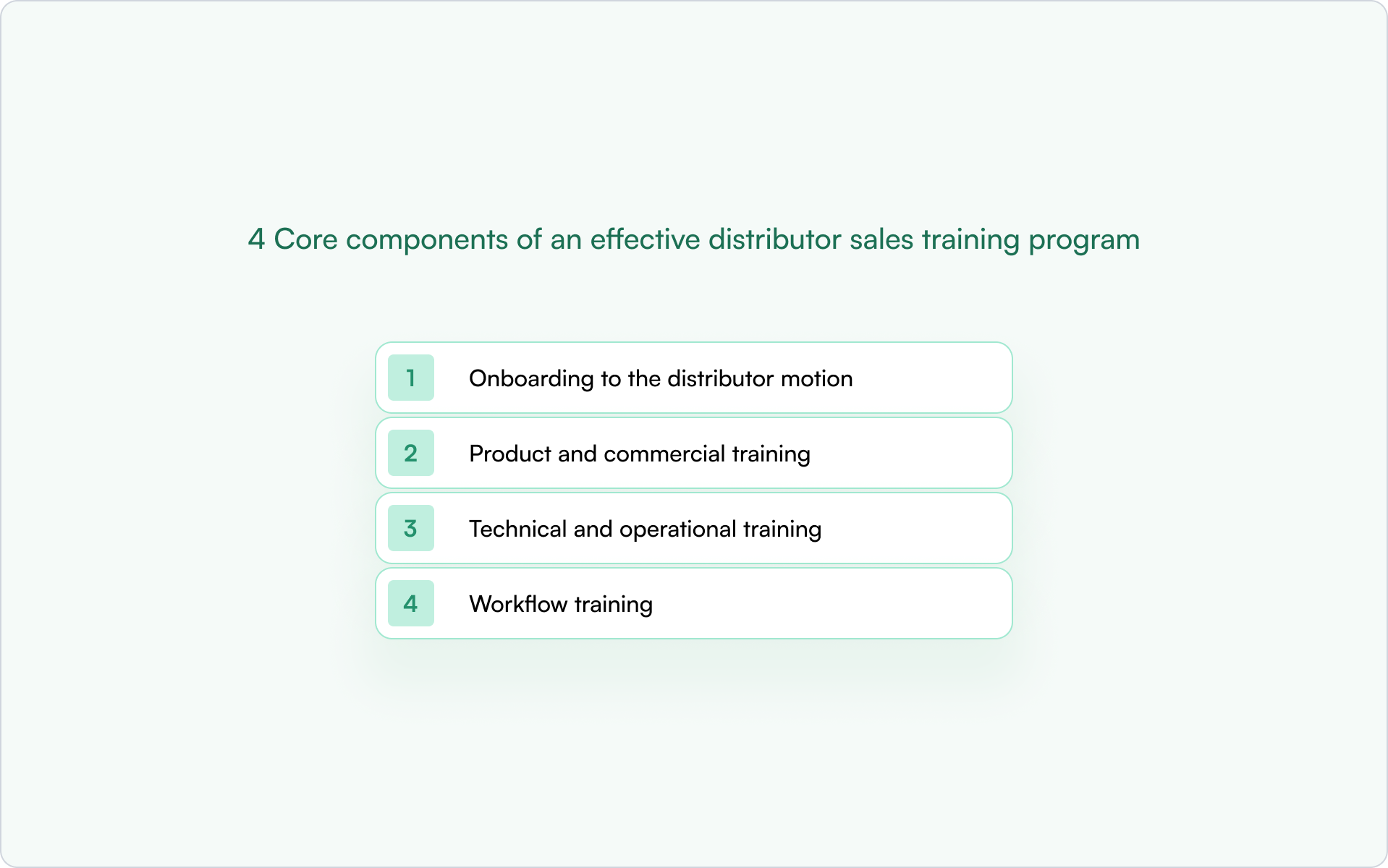
4 Core components of an effective distributor sales training program

Strong training works when it supports real deals, not just theory. Your goal is to help distributors understand how to act inside your motion and support resellers across indirect sales channels.

This applies whether you are running IT distributor sales training, building structured sales training for distributors, or improving how you are training the distributors sales team across regions.

Here are the components that make distribution sales training improve sales performance.

1. Onboarding to the distributor motion

Start by explaining how distributors fit into your distribution processes.

Your team should cover:

  • how distributors support external partners and resellers
  • how attribution works across the sales force
  • where distributors influence pipeline and follow-ups
  • what ownership rules affect daily operations

This helps sales reps and sales managers understand how they support customers earlier in the sales process.

Clear onboarding closes skill gaps fast and improves distributor performance. Next comes positioning and commercial readiness.

2. Product and commercial training

Generic sales training is not enough for distributors. They need positioning that fits your ecosystem and market.

Focus on:

  • buyer pain points and market trends
  • objection handling and consultative selling
  • competitor positioning
  • pricing context and sales conversation readiness
  • modern sales foundations that help distributors sell smarter

This strengthens customer relationships and helps distributors increase sales without adding friction to reseller coordination.

Commercial clarity improves selling confidence. Technical readiness comes next.

3. Technical and operational training

Distributors often support installation, implementation, quoting, or inventory management depending on your industry.

Training should include:

  • technical details needed during pre sales coordination
  • specs and documentation access
  • territory rules and stock levels awareness
  • onboarding tasks tied to training completion
  • short training videos that reinforce new skills

Structured training modules like these support stronger relationship building across multi-contact deal teams and create strong relationships with customers over time.

Operational readiness keeps deals moving. Workflow readiness makes them easier to close.

4. Workflow training

This is where many distributor training programs fall short.

Distributors need to know:

  • how deal registration works
  • how pipeline visibility supports more deals
  • how to collaborate without CRM access
  • how to support product launches
  • how to manage follow ups across partner layers

When training connects directly to workflows, your teams see better sales results and clearer performance tracking tied to business goals.

If you want certification paths that reinforce these workflows, structured guidance like LMS partner certification strategies and practical frameworks explaining the LMS benefits for channel partner certification can help you design programs that scale across markets.

But even well-designed programs can underperform if they introduce friction too early, which is where many teams run into avoidable mistakes.

Common mistakes in distributor sales training

Distributor sales training fails when it looks like generic partner enablement instead of support for real channel work.

Here are six mistakes to avoid.

1. Starting with too much training before showing value

Many teams launch long certification tracks before distributors support real opportunities. Start with positioning, deal registration basics, and early workflows. Add deeper skills later.

Structured paths help once partners are active. Guidance on how certification programs improve partner engagement shows how training supports pipeline instead of passive learning.

2. Using one training path for every role

Sales and technical contacts need different training. Commercial teams need positioning and sales techniques. Technical teams need specs and installation readiness.

Role-based training improves adoption and customer loyalty.

3. Treating distributors like referral partners

Distributors coordinate resellers, attribution, and shared pipeline visibility. Training should reflect these responsibilities, not generic partner programs.

4. Ignoring workflows like deal registration and quoting

If distributors cannot support quoting, territory rules, or reseller coordination, they cannot influence deal outcomes.

Training must match real distribution processes.

5. Overloading distributors with content instead of relevant content

Large learning libraries create friction. Start with the skills needed to support active deals, then expand later.

Resources comparing the best partner certification program software help structure certification without slowing adoption.

6. Not connecting training to pipeline visibility or performance

Distributor training should support measurable activity across resellers and deals. When it does, adoption improves quickly.

Avoiding these issues makes it much easier to build role-specific learning paths that distributors can actually use in active opportunities.

How to structure distributor sales training by role

Start by separating distributor training into role-based tracks. Most programs fail because they treat the entire distributor team the same, even though commercial, technical, and manager roles support different parts of the motion.

Step 1: Define the commercial track for distributor sales reps

Sales reps need to support resellers and move deals forward early. Focus training on positioning, ownership rules, territory clarity, and handling sales conversations during active opportunities.

The goal is simple: help reps contribute quickly instead of waiting for full certification paths.

Step 2: Build a technical track for pre-sales and implementation contacts

Technical contacts support evaluations, quoting, and delivery readiness. Their training should focus on specs, solution structure, and implementation coordination so they can answer questions without slowing deals.

Short certification paths work best here. Many teams structure these using systems like the best partner LMS software.

Step 3: Create a coordination track for distributor managers

Distributor managers oversee reseller alignment and pipeline visibility. They do not need deep product detail. They need clarity on partner progress, attribution, and shared dashboards.

A simple structure works well:

  • track reseller activity across regions
  • monitor partner goals and engagement
  • support opportunities as they move forward

Once roles are defined, the priority shifts to delivering training in a way that scales across partners and regions without adding overhead.

How to deliver distributor sales training at scale

Once your role tracks are clear, focus on delivery. Distributor sales training should be easy to launch, easy to update, and tied to real partner activity.

Start with short learning paths, not long programs. Distributors engage faster when training supports active opportunities.

Use modular learning paths

Break training into small modules by role. Commercial contacts need positioning first. Technical contacts need specs and implementation readiness. Managers need pipeline visibility and coordination guidance.

Short modules make training easier to adopt and apply immediately.

Add certifications at the right moment

Certifications work best after distributors begin supporting deals. At that stage, training reinforces confidence instead of creating friction.

Track completion by role so you know who is ready to support resellers.

Keep assets and updates in one place

Distributors should not search across emails, portals, and documents. A single workspace for materials and announcements keeps teams aligned as opportunities move forward.

Connect training to pipeline activity

Training should support deal registration, reseller coordination, and shared progress tracking. When learning connects to real channel workflows, adoption improves and programs scale naturally.

With delivery in place, the focus moves to understanding whether training is improving coordination, pipeline activity, and deal outcomes.

What to measure in distributor sales training

Distributor sales training should improve how partners support real opportunities. If your program is working, you should see changes in readiness, pipeline activity, deal quality, and revenue contribution.

Here are the metrics that matter most:

What to measure What it tells you
Onboarding completion by role Whether distributor contacts understand how they fit into your motion.
Zertifizierungsquote Which contacts are ready to support customers and resellers.
Time to first registered deal How quickly training turns into pipeline activity.
Time to first sourced opportunity Whether distributors are influencing early-stage deals.
Active distributor contacts by role Which parts of the distributor team are engaged.
Deal registration quality Whether attribution and ownership stay clean across partners.
Quote collaboration participation How often distributors support technical deal steps.
Sales cycle velocity Whether coordination across partners is improving.
Win rate by certified vs. non-certified contacts Whether training improves execution.
Attributed revenue by trained distributor cohorts How training contributes to measurable pipeline impact.

When these signals improve, your distributor sales training is supporting real-deal execution instead of passive learning.

Next, let’s look at how Introw helps teams run distributor training more effectively.

How Introw helps teams train distributors more effectively

Distributor sales training works best when it supports what your partners are already doing inside active deals. Introw connects training to pipeline activity so distributors learn in context, not in isolation.

In daily work, that changes a few important things.

  • Sales contacts can see where they support opportunities without needing full CRM access.
  • Technical teams get specs and coordination steps in one place.
  • Distributor managers gain visibility into reseller progress and attribution across regions.

With Salesforce and HubSpot integrations, training milestones appear alongside pipeline activity instead of in a separate portal. That makes it clear who is ready to support deals and where enablement is still needed.

If you want to connect distributor training to pipeline visibility, attribution, and partner collaboration, you can request a demo.

With the right structure and tools in place, rolling out distributor training can start delivering results within weeks rather than months.

A 30-day distributor training rollout plan

You do not need a full academy to start distributor sales training. A simple four-week rollout is enough to give your distributors clarity, confidence, and early pipeline impact.

Week 1: Define your motion and partner roles

Start by mapping how your distributors support deals.

Identify:

  • whether you work with software or hardware distributors
  • which contacts are commercial vs technical
  • how distributors interact with resellers
  • where deal registration and attribution happen

This ensures your training reflects real channel workflows from the beginning.

Week 2: Build the first training modules

Focus only on the training that helps distributors support opportunities early.

Create:

  • a short onboarding module explaining the distributor role
  • positioning guidance for commercial contacts
  • technical readiness content where needed
  • a simple workflow guide for deal registration and coordination

Keep this phase light so distributors can apply what they learn immediately.

Week 3: Launch with a small distributor group

Start with a pilot instead of rolling training out to everyone at once.

Enroll:

  • Distributor sales contacts
  • technical contacts supporting evaluations
  • distributor managers coordinating reseller activity

Collect feedback quickly and adjust modules before expanding further.

Week 4: Connect training to real partner activity

Now measure whether training supports execution.

Track:

  • onboarding completion by role
  • first deal registrations
  • early reseller coordination activity
  • participation in technical collaboration

At this point, you should already see distributors engaging earlier in opportunities. From here, you can expand certifications and scale the program across the broader distributor team.

Partner-Lernmanagement

8 LMS Partner Certification Strategies That Drive Revenue Growth

Wouter Moyaert
Produkt
5min Lesezeit
13 Mar 2026
⚡ TL;DR

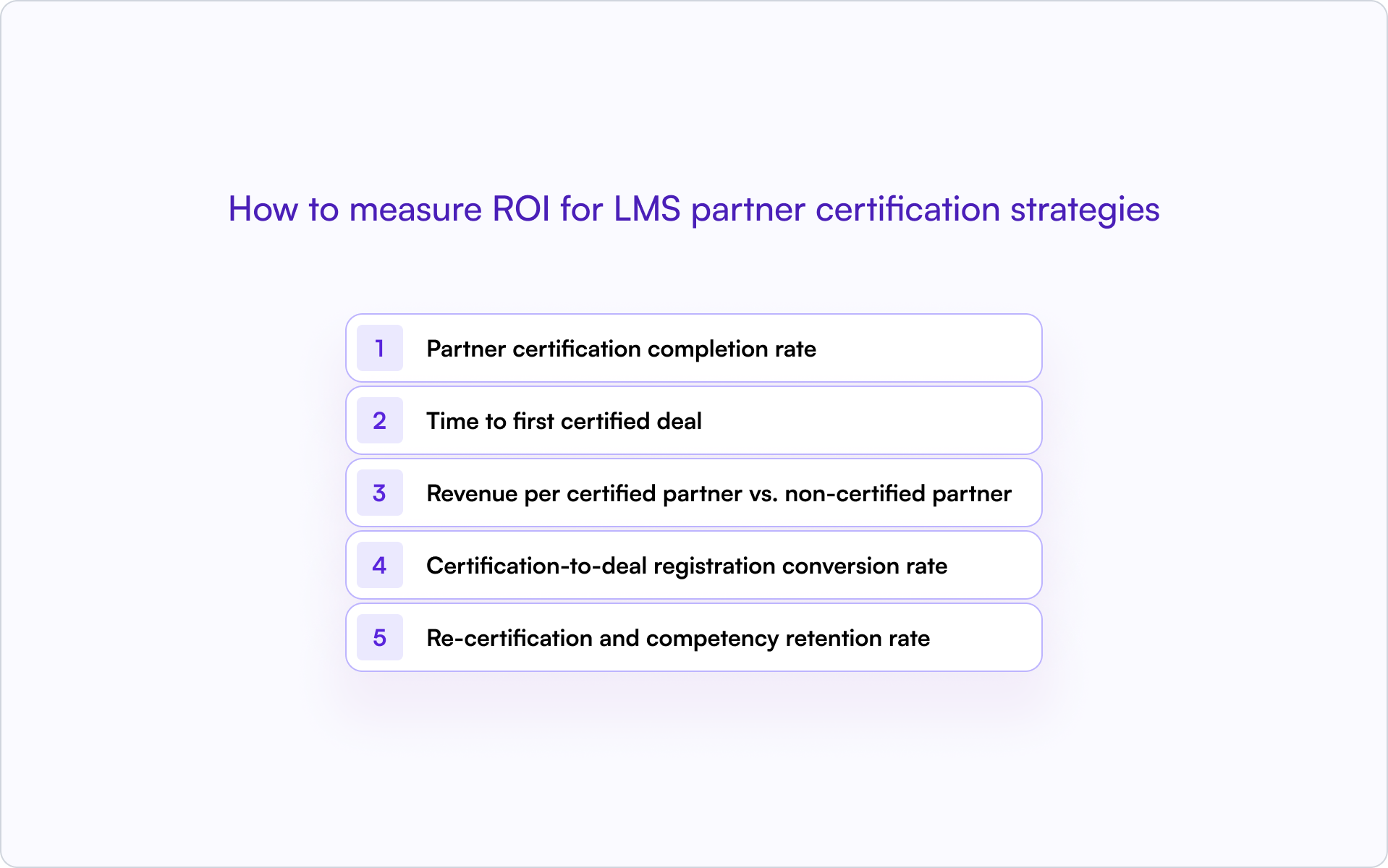
The most effective LMS partner certification strategies do not stop at course completion. They connect certification status directly to pipeline and revenue in your CRM, so training becomes a measurable go-to-market signal rather than isolated learning data. High-performing programmes gate important workflows such as deal registration based on certification, use tiered and role-based learning paths to keep training relevant for referral, reseller, and implementation partners, and treat certification as part of revenue operations rather than enablement alone. To prove ROI, teams should track metrics in the CRM such as revenue per certified partner, certification-to-deal conversion, and time to first certified deal.

Partner certification programs look great on paper. But if completion data stays trapped in your LMS while Sales and RevOps work from a CRM that knows nothing about partner competency, you’re running training theater — not a revenue program.

The difference between certification as a checkbox and certification as a growth lever comes down to one thing: whether the data connects to pipeline. Below are practical LMS partner certification strategies that tie training directly to deal registration, CRM visibility, and measurable revenue outcomes.

Why partner certification programs drive revenue growth

A partner certification program is a structured training and credentialing system, typically delivered through a learning management system, that validates whether partners actually understand your product, positioning, and sales process.

The moment certification data is visible in your CRM, it stops being “learning data” and becomes go-to-market signal: who’s qualified to sell, who should get leads, and which partners are likely to close.

In practice, certified partners tend to outperform non-certified ones because they:

  • Represent your product accurately, keeping messaging consistent across channels.
  • Handle objections independently, reducing escalations to your internal team.
  • Move deals forward faster, because they know the process and the pitfalls.

That shows up in a few common revenue levers:

  • Consistent messaging: Certified partners position your product the way you intend, protecting brand integrity across channels.
  • Faster sales cycles: Partners who understand the product don’t slow deals down asking for help mid-cycle.
  • Reduced channel conflict: Certification status can serve as a tiebreaker when two partners claim the same account.
  • Scalable enablement: An LMS lets you train hundreds of partners without adding headcount or running live sessions for every cohort.

The trap: many teams stop at completion rates. If you can’t connect certification outcomes to pipeline and revenue, it’s hard to justify investment — and impossible to know which certifications actually matter.

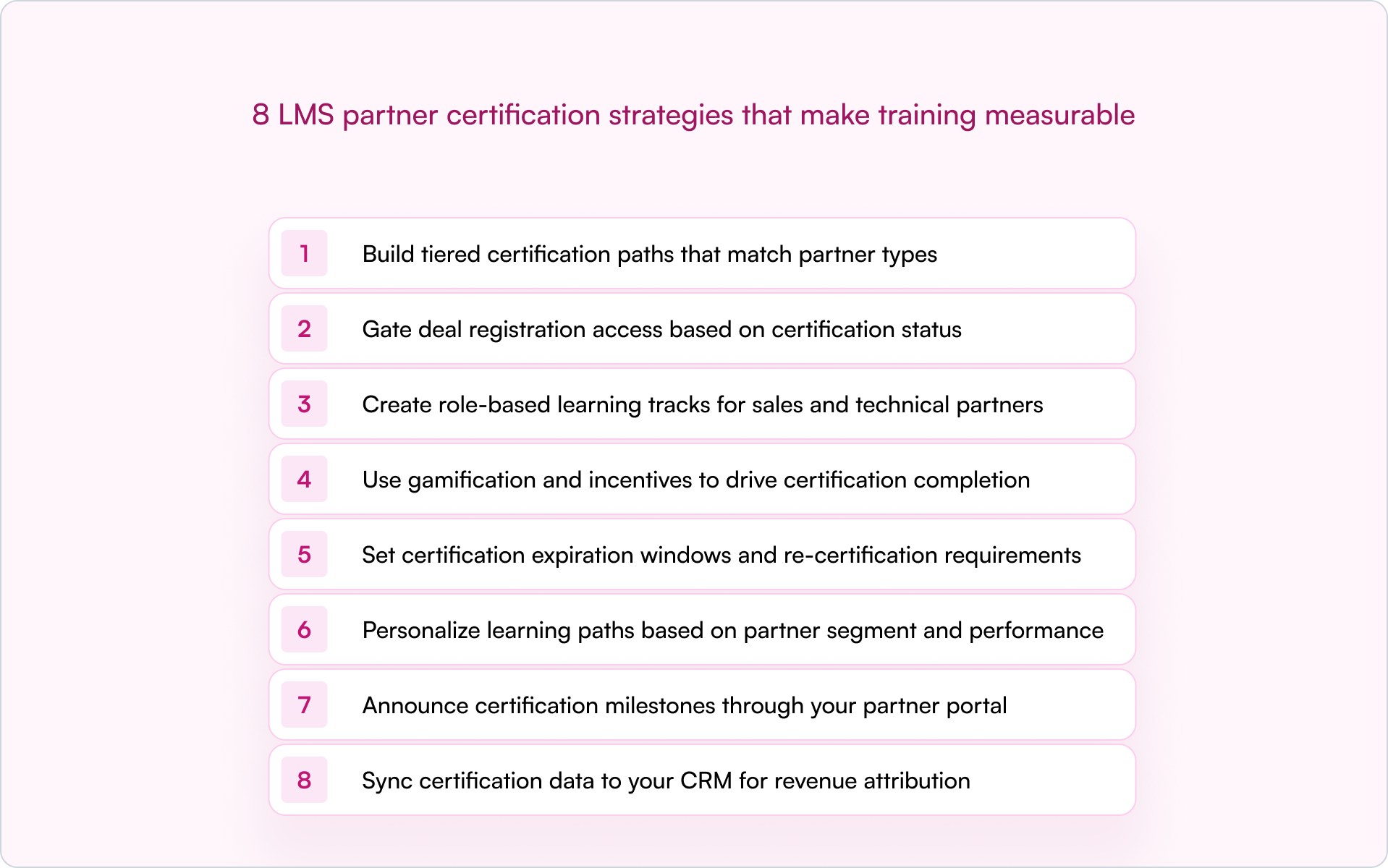
8 LMS partner certification strategies that make training measurable

If you’re building a partner motion inside a startup, you don’t have time for programs that “feel” helpful. You need a system that changes partner behavior and shows up in pipeline. These strategies are designed to do exactly that.

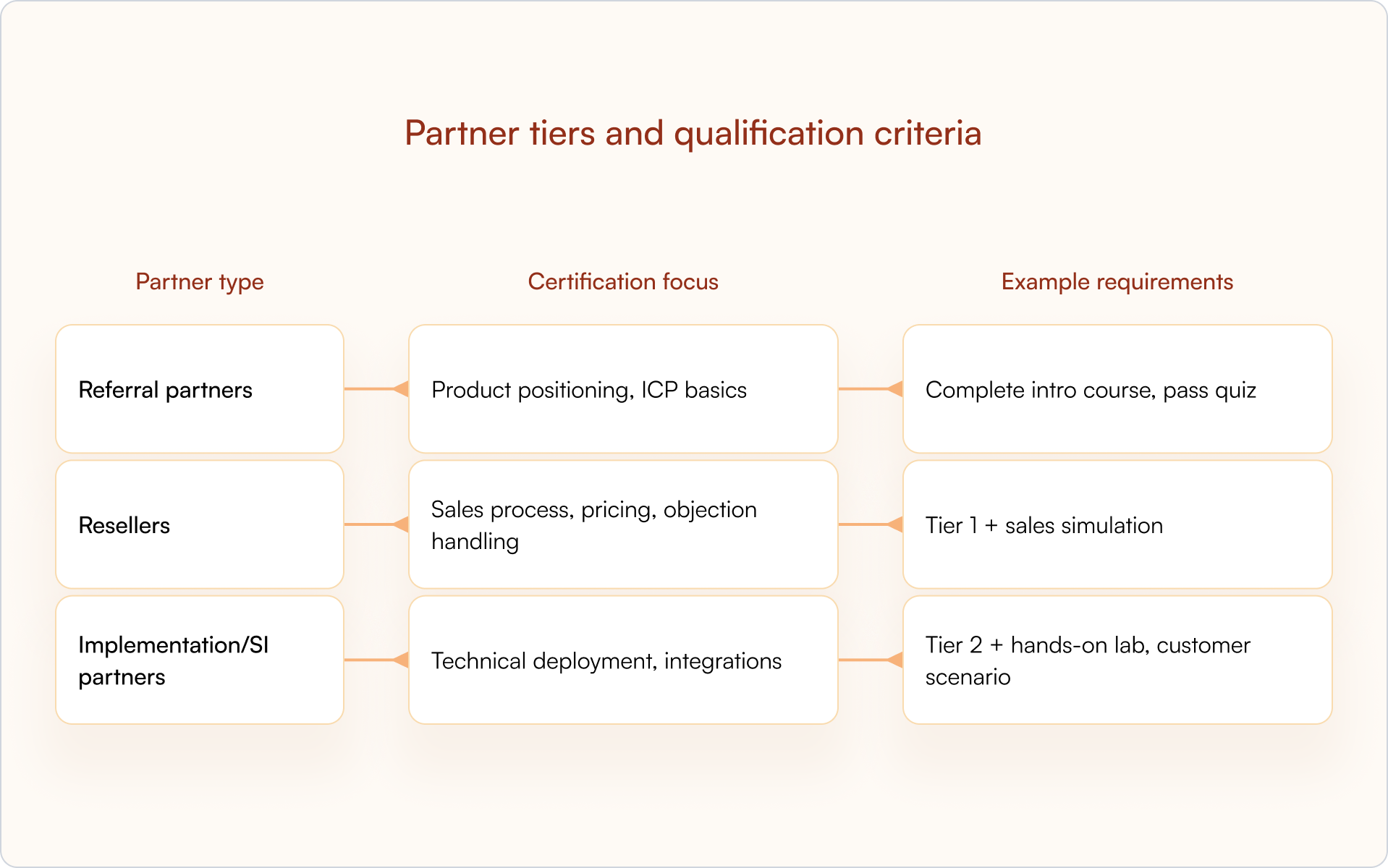
1. Build tiered certification paths that match partner types

Not every partner needs the same training. A referral partner introducing leads needs positioning basics. A reseller closing deals needs pricing, objection handling, and competitive differentiation. An implementation partner deploying your product needs technical depth.

Your certification tiers typically map to your partner program tiers, like Bronze, Silver, Gold or Authorized, Premier, Elite, with escalating requirements at each level.

Partnertyp Certification focus Example requirements
Referral-Partner Product positioning, ICP basics Complete intro course, pass quiz
Reseller Sales process, pricing, objection handling Tier 1 + sales simulation
Implementation/SI partners Technical deployment, integrations Tier 2 + hands-on lab, customer scenario

This structure keeps training relevant (which protects completion rates) and gives you a clean framework for gating access to deals, leads, or exclusive benefits based on demonstrated competency.

2. Gate deal registration access based on certification status

This is where certification becomes operational. Partners who haven’t completed the required training can’t register deals in your system, which protects deal quality and ensures only qualified partners are submitting pipeline.

The concept of “sell rights” is common in mature programs for a reason: it prevents untrained partners from creating friction in your sales process or misrepresenting your product to prospects.

A CRM-first PRM like Introw can enforce sell rights automatically by checking certification status before allowing deal registration — keeping the workflow aligned across your partner portal without manual verification.

3. Create role-based learning tracks for sales and technical partners

Within a single partner organization, different roles need different training. A partner’s sales rep needs competitive positioning and demo basics. Their solutions architect needs API documentation and implementation methodology. Their executive sponsor needs the business case for co-selling.

Role-based tracks keep training focused:

  • Sales track: Product positioning, competitive differentiation, demo basics, pricing and packaging
  • Technical track: Implementation methodology, API/integration training, troubleshooting
  • Executive track: Partnership value prop, co-selling motions, business case development

If you want higher completion and better outcomes, this is one of the highest-ROI LMS partner certification strategies you can implement. Relevance is what keeps partners moving.

4. Use gamification and incentives to drive certification completion

Partners are busy. They’re juggling multiple vendors, their own customers, and internal priorities. Without motivation, certification often drops to the bottom of the list — even if the content is genuinely good.

Gamification, which includes digital badges, leaderboards, points, and rewards, creates visible progress and recognition that keeps partners engaged:

  • Digital badges: Shareable credentials partners can display on LinkedIn
  • SPIFFs: Cash or gift card bonuses for completing certifications
  • Tiered benefits: Higher margins or exclusive leads for certified partners
  • Leaderboards: Public recognition in the partner portal

The goal is simple: make certification feel like an investment that pays off, not compliance work.

5. Set certification expiration windows and re-certification requirements

Products evolve. Messaging changes. Compliance requirements shift. A certification earned two years ago may no longer reflect current reality — and your customers will feel that gap quickly.

Expiration windows (often 12 months, shorter for fast-moving categories) prevent competency drift. Automated reminders before expiration give partners time to re-certify without losing access to deal registration or other benefits.

Tip: Announce re-certification deadlines through your partner portal and email or Slack notifications so partners aren’t surprised when access changes.

6. Personalize learning paths based on partner segment and performance

Not all partners start from the same place. A high-performing partner who’s been selling your product for two years doesn’t need the same onboarding content as a new partner getting started.

Personalization — serving different content based on region, vertical, role, or performance — keeps training relevant. High performers can skip basics. Struggling partners get targeted reinforcement. Everyone’s time is respected.

This is also how certification becomes more than “completion.” You can track whether partners improve and which interventions correlate with higher-quality pipeline.

7. Announce certification milestones through your partner portal

Recognition reinforces behavior. When a partner earns certification, celebrate it publicly (when appropriate). It signals that certification matters and creates social proof inside the ecosystem.

Partner portal announcements, email notifications, or Slack messages highlighting achievements can motivate other partners to complete training — without you adding more meetings to your calendar.

A CRM-first partner portal can automate announcements when certification status updates, so you’re not manually tracking who earned what and when.

8. Sync certification data to your CRM for revenue attribution

This is the strategy that makes everything else measurable. Certification status belongs in HubSpot or Salesforce as a partner property — not trapped in a separate LMS where Sales, RevOps, and leadership can’t see it.

When certification data lives in your CRM, you unlock:

  • Attribution: See whether certified partners close more revenue than non-certified partners
  • Deal routing: Auto-assign leads to certified partners only
  • Forecasting: Include certification status in pipeline reports
  • Conflict resolution: Use certification as a tiebreaker when two partners claim the same deal

Introw syncs partner data directly to the CRM, so certification status is always visible to Sales, Partnerships, and RevOps — making certification ROI measurable instead of assumed.

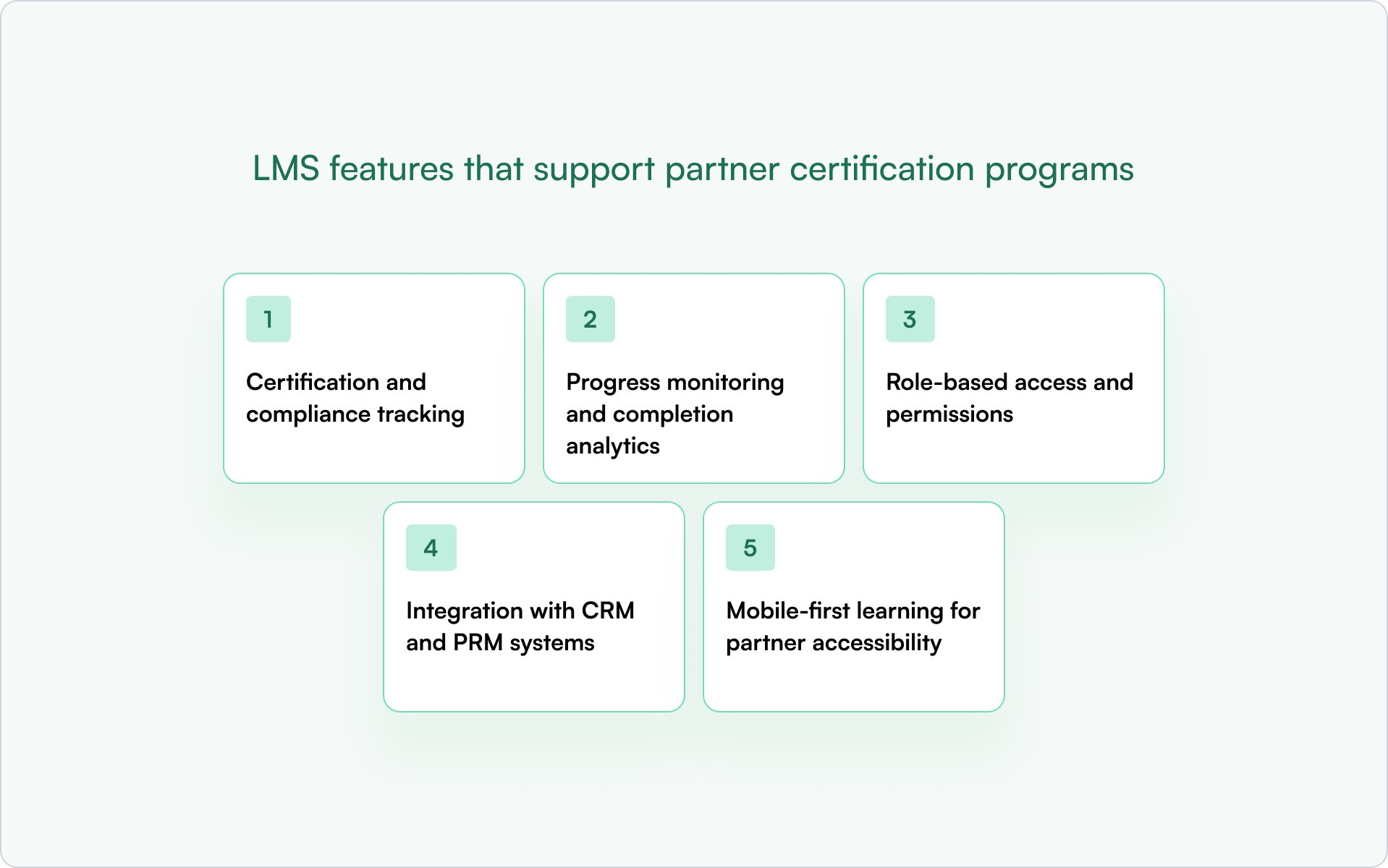
LMS features that support partner certification programs

Not every LMS is built for external partner enablement. Internal employee training platforms often lack the controls you need to manage certifications across dozens (or hundreds) of partner organizations.

Certification and compliance tracking

Your LMS should track who completed what, when, and whether they passed. That audit trail supports compliance requirements and enables expiration and re-certification workflows.

Progress monitoring and completion analytics

Partner managers need visibility into where partners are stuck, who’s falling behind, and which courses have low completion rates — especially at scale.

Rollenbasierter Zugriff und Berechtigungen

Different partner organizations should only see content relevant to them. Admins need full access; partner users should see only their assigned tracks.

Integration mit CRM- und PRM-Systemen

If certification data doesn’t sync to HubSpot or Salesforce, it’s invisible to the rest of the business. A CRM-first PRM like Introw connects partner data — including certification status — directly to your CRM.

Mobile-first learning for partner accessibility

Partners are often in the field or between meetings. Mobile-friendly delivery makes it easier to complete certification without being tied to a desk.

How to measure ROI for LMS partner certification strategies

Certification programs require investment in content creation, LMS licensing, and partner manager time. To keep momentum — and budget — you need proof.

Partner certification completion rate

What percentage of onboarded partners complete certification? Low rates usually mean friction (too long, too generic, too hard) or unclear incentives.

Time to first certified deal

How long after certification does a partner register their first deal? Shorter is better — it shows certification accelerates activation, not just learning.

Revenue per certified partner vs. non-certified partner

Compare average revenue contribution. This is the core ROI proof point most founders and operators care about.

Certification-to-deal registration conversion rate

What percentage of certified partners actually register deals? Certification without activation is wasted effort — and a signal your program may be rewarding “learning” more than “selling.”

Re-certification and competency retention rate

Are partners staying current? High lapse rates suggest the re-certification experience is too burdensome or the value is not clear enough.

How to connect LMS certification data to your CRM

The mechanics of syncing LMS data to HubSpot or Salesforce determine whether certification status becomes actionable or stays siloed.

  1. Custom properties: Create a “Certification Status” field on the Partner or Contact object with values like Certified, Expired, In Progress, Not Started.
  2. Certification date fields: Track when certification was earned and when it expires.
  3. Automation triggers: Use certification status changes to trigger workflows — for example, notifying partner managers when a partner becomes certified or alerting when certification is expiring.
  4. Reporting: Build dashboards that segment partner pipeline by certification status.

Introw’s Salesforce and HubSpot integrations enable this without custom development work. Certification status flows into the CRM automatically.

Scale partner certification with a CRM-first approach

Partner certification programs only drive revenue when the data is visible and actionable in your CRM. Otherwise, you’re running a training program with no connection to pipeline, attribution, or forecasting.

A CRM-first approach delivers:

  • Visibility: Sales, partnerships, and RevOps see certification status on every partner record.
  • Attribution: You can prove which certifications correlate with closed revenue.
  • Automation: Deal registration, lead routing, and conflict resolution can factor in certification status.

Teams that get this right spend less time chasing training completion and more time closing partner-sourced revenue.

If you’re ready to treat certification like a revenue system (not a content library), see how Introw connects partner certification data to your CRM — book a demo.