
Partner-Management

How to Launch an MSP Partner Program in 2026

Discover how to build an MSP partner program with the right margins, onboarding, deal registration, partner portal, and CRM-first workflows.

5min Lesezeit
08 Mar 2026
⚡ TL;DR

An MSP partner program is a structured way for vendors to work with Managed Service Providers that bundle vendor products into recurring client services. These partnerships can expand market reach, create predictable recurring revenue, and reduce customer acquisition costs because MSPs already own trusted customer relationships. The strongest MSP programs stay simple, with clear tiers, healthy margins, strong enablement, and deal registration that protects partner-led opportunities. To scale effectively, the program should run CRM-first in HubSpot or Salesforce, with a partner portal connected directly to your system of record rather than managed through a disconnected silo.

MSPs already have the clients you want to reach. They’ve built trust, signed contracts, and deliver services month after month — which means one strong partnership can open doors to dozens of accounts your direct team would spend quarters chasing.

The real question isn’t whether MSP partnerships make sense. It’s whether you can build an MSP partner program that actually attracts the right partners, gets them enabled fast, and turns signups into recurring revenue. This guide walks through what to include, how to launch it step by step, and the mistakes that quietly kill most programs before they gain traction.

What is an MSP partner program?

An MSP partner program is a structured partnership between a technology vendor and Managed Service Providers (MSPs). MSPs manage IT infrastructure, security, cloud services, and support for end customers on an ongoing basis. You provide the product plus training, resources, and program incentives. The MSP operationalizes your technology inside their managed services offering.

This differs from a classic reseller relationship in one crucial way: MSPs don’t sell your product once and move on. They bundle it into a recurring service they deliver month after month, meaning your success is tied to their ability to retain clients and standardize delivery.

How the relationship works

  • Technology vendor: the company (like yours) that builds the product
  • MSP partner: the managed service provider who bundles your product into their client offerings
  • End customer: the MSP’s client who benefits from the combined solution

MSP partnerships are especially common in cybersecurity, cloud services, backup, and remote monitoring — anywhere ongoing service delivery matters more than a one-time transaction.

Why launch a managed service provider partner program?

If you’re a founder building a B2B software company, an MSP channel can be one of the most capital-efficient paths to scale. Done right, it expands revenue without requiring a linear increase in direct sales headcount.
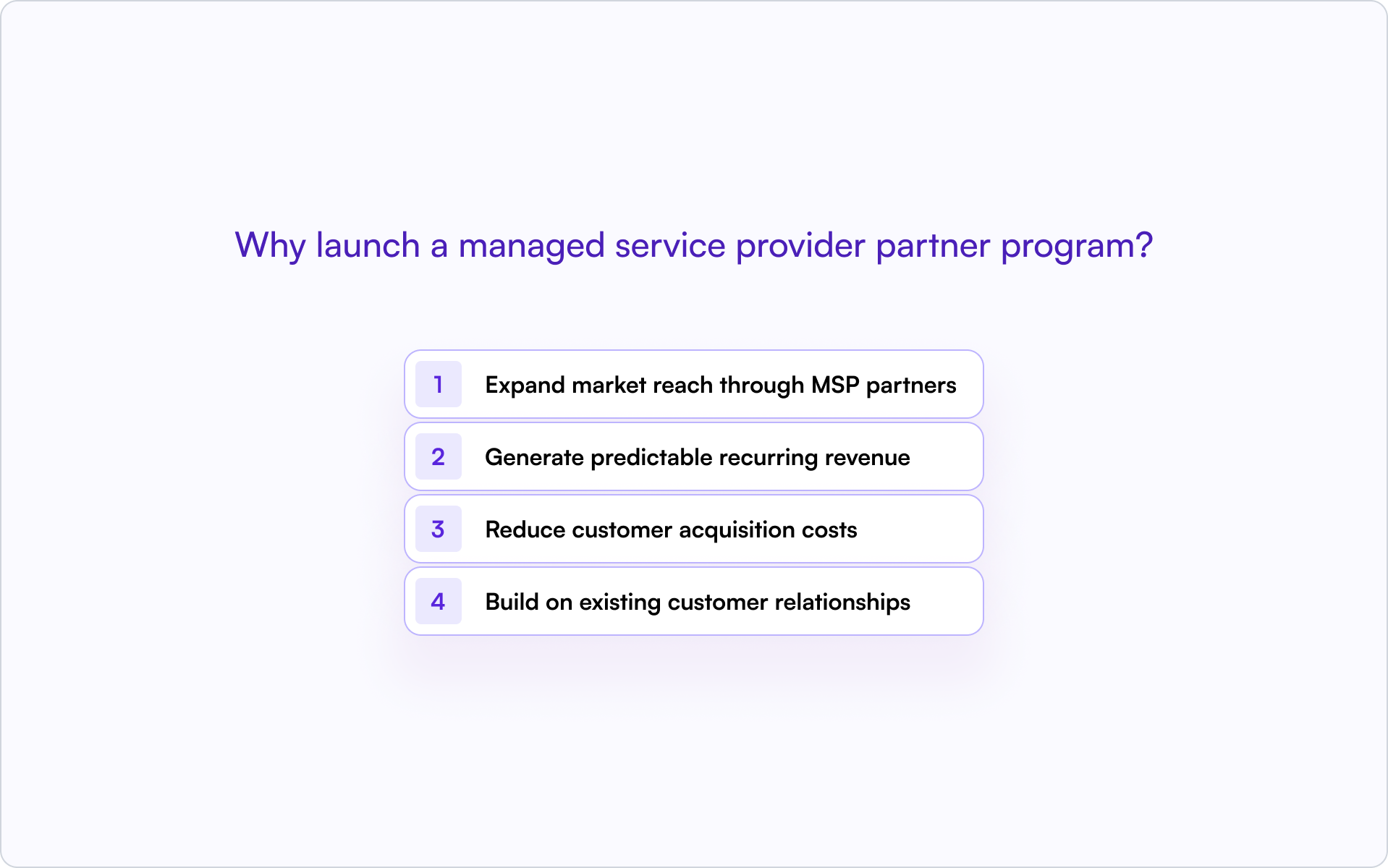
Expand market reach through MSP partners

MSPs already serve the SMB and mid-market accounts that are hardest to reach through cold outbound. They have contracts, renewal cycles, and ongoing service touchpoints — which gives them distribution you can’t replicate quickly.

One MSP partnership can unlock access to dozens (or hundreds) of end customers. Accounts your direct team would spend months identifying and closing become reachable through a single partner relationship.

Generate predictable recurring revenue

MSPs bill monthly, often on a per-user or per-device basis. When they bundle your product into their service, your revenue becomes recurring and correlated with their retention — incentives stay aligned.

Reduce customer acquisition costs

MSPs do the selling and often the implementation. You trade margin for distribution, which can be far cheaper than scaling AEs into every segment and region you want to win.

Build on existing customer relationships

MSPs are trusted advisors. Their recommendation carries more weight than vendor-led outreach — which typically shortens sales cycles and increases close rates.

What to include in your MSP partner program

Program design is where most teams accidentally lose. MSPs evaluate vendor programs constantly; if yours is confusing, under-incentivized, or operationally painful, they’ll simply prioritize someone else.

Partner tiers and qualification criteria

Define tiers based on commitment, volume, or certification status. Keep it simple — three tiers is usually enough.
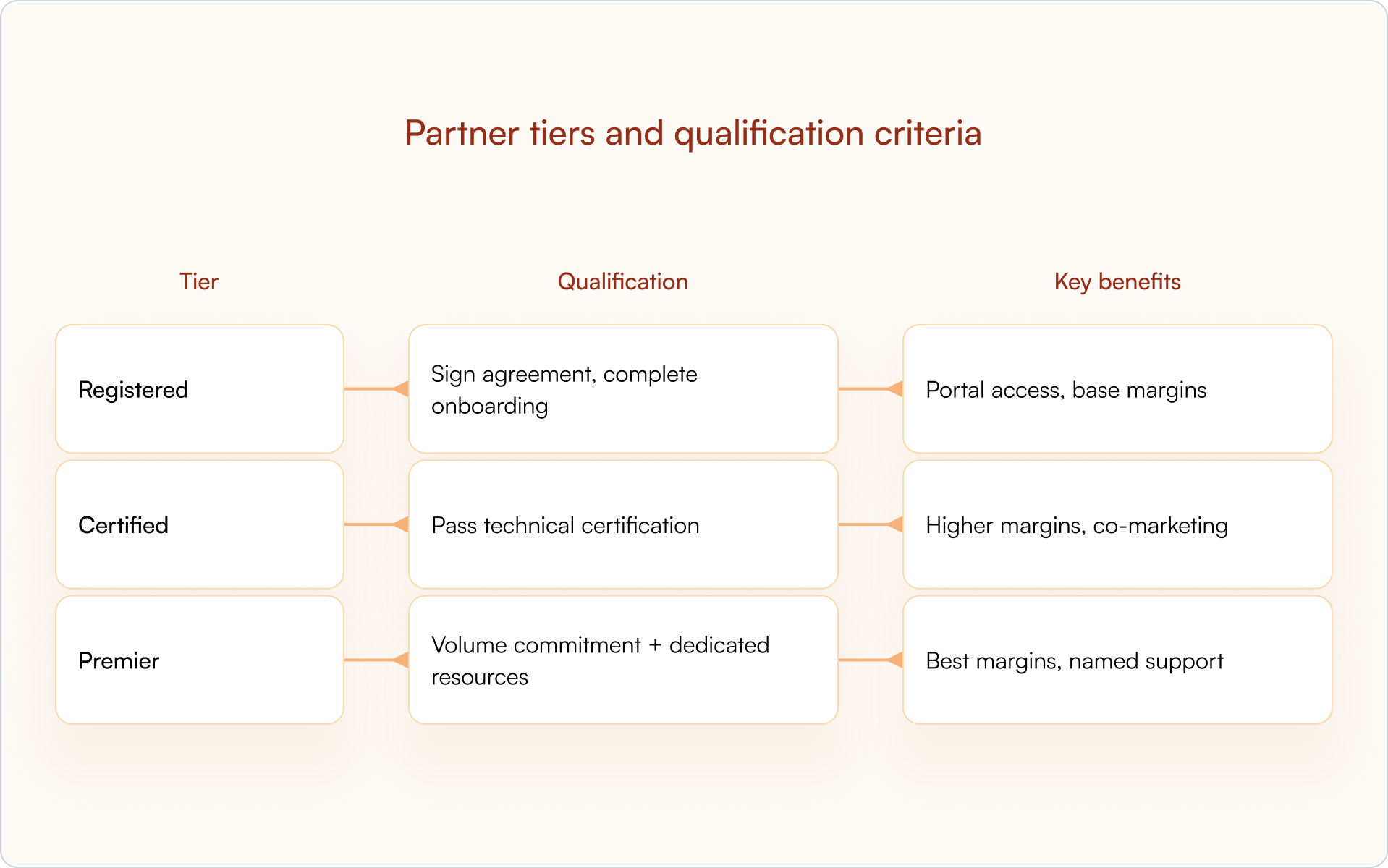
Stufe Qualification Key Benefits
Registriert Sign agreement, complete onboarding Portal access, base margins
Certified Pass technical certification Higher margins, co-marketing
Premier Volume commitment + dedicated resources Best margins, named support

A common failure mode: teams add too many tiers to “cover every case,” and partners can’t quickly understand where they fit or what to do next.

Margin and pricing structure

MSPs need healthy margins to justify bundling your product. Wholesale pricing, volume discounts, rebates, or consumption-based billing can all work — but the economics must match the MSP business model.

  • Align to monthly billing where possible (MSPs typically invoice monthly).
  • Reduce upfront friction (annual-only commitments can be a deal-killer for monthly service bundles).
  • Be explicit about what’s margin, what’s rebate, and what’s conditional on certification or volume.

Certification and enablement requirements

Certification protects your brand and reduces support load. Define what partners must complete before selling, implementing, or supporting your product.

Include technical training, sales enablement, and ongoing recertification. Partners who understand your product close more deals and create fewer escalations.

Deal registration and lead protection

Deal registration is how MSPs claim opportunities, earn protection windows, and avoid conflicts with your direct team or other partners.

Without clear rules, partners won’t invest in building pipeline for you. Define:

  • Registration workflow: what they submit and where
  • Approval SLA: 48 hours is a common standard
  • Protection duration: typically 60–90 days (with clear extension criteria)
  • Conflict resolution: what happens if two parties claim the same account

A structured deal registration process is one of the most effective tools for preventing channel conflict and keeping partners engaged.

Partner portal and self-service resources

MSPs expect a professional portal where they can self-serve pricing, training, marketing assets, deal registration, and support — without waiting on your team.

The portal should be connected to your CRM so data stays accurate and reporting stays real. If partners operate in one place and your revenue team operates in another, you’ll spend your time reconciling instead of scaling.

Co-marketing and sales support

Outline what support partners can expect: MDF (Market Development Funds), co-branded campaigns, lead sharing, joint webinars, and sales engineering help. Many MSPs don’t need “more collateral” — they need demand-generation support and a path to their first few wins.

How to launch an MSP partner program step by step

Strategy is the easy part. The program wins or loses in execution — especially in your first 90 days, when partners decide whether you’re worth their time.

1) Define your ideal MSP partner profile

Not all MSPs are a fit. Define your criteria the same way you define an ICP for direct sales:

  • Vertical focus (healthcare, legal, financial services, general SMB)
  • Client base size and maturity
  • Technical capabilities (security operations, cloud migrations, compliance)
  • Geographic footprint and service model
  • Existing vendor stack and overlaps

This prevents you from recruiting partners who will sign an agreement but never activate.

2) Structure program tiers and incentives

Build out the tier structure, margin tables, and incentive programs (SPIFFs, rebates, MDF). Put it in a partner-facing program guide that’s clear enough to forward internally.

MSPs compare programs constantly. Ambiguity loses to clarity every time.

3) Build certification and onboarding paths

Create the training curriculum: product training, sales certification, technical certification. Then design the onboarding journey from signup to first registered deal.

  • Set expectations for time-to-certification.
  • Provide a “first deal” playbook (ideal customer, pitch, implementation outline).
  • Make enablement easy to complete in the flow of work.

4) Set up deal registration and pipeline tracking

Implement deal registration workflows (submission, approval routing, protection windows, expiration reminders) and connect it to your CRM so partner pipeline is visible alongside direct pipeline.

If partner deals live in spreadsheets or disconnected tools, you’ll create invisible pipeline and messy attribution — and you’ll pay for that later in forecasting, comp plans, and board reporting.

5) Launch your MSP partner portal

Launch the portal with everything a partner needs on day one: program guide, pricing, training, deal registration, and support paths.

Reduce login friction. In the real world, partners abandon portals that feel like extra work.

6) Recruit and activate your first MSP partners

Start targeted recruitment: identify the right MSPs, run outreach, and pitch the program with concrete economics and a clear onboarding plan. Optimize for activation, not signups — a “signed” partner who never registers a deal is a rounding error.

Define activation milestones: completed training, first deal registered, first closed deal, and track them from day one.

Tools for managing MSP partnerships at scale

Most early MSP partner programs don’t fail because the idea is wrong. They fail because operations can’t keep up — approvals lag, data is missing, and partners stop engaging.
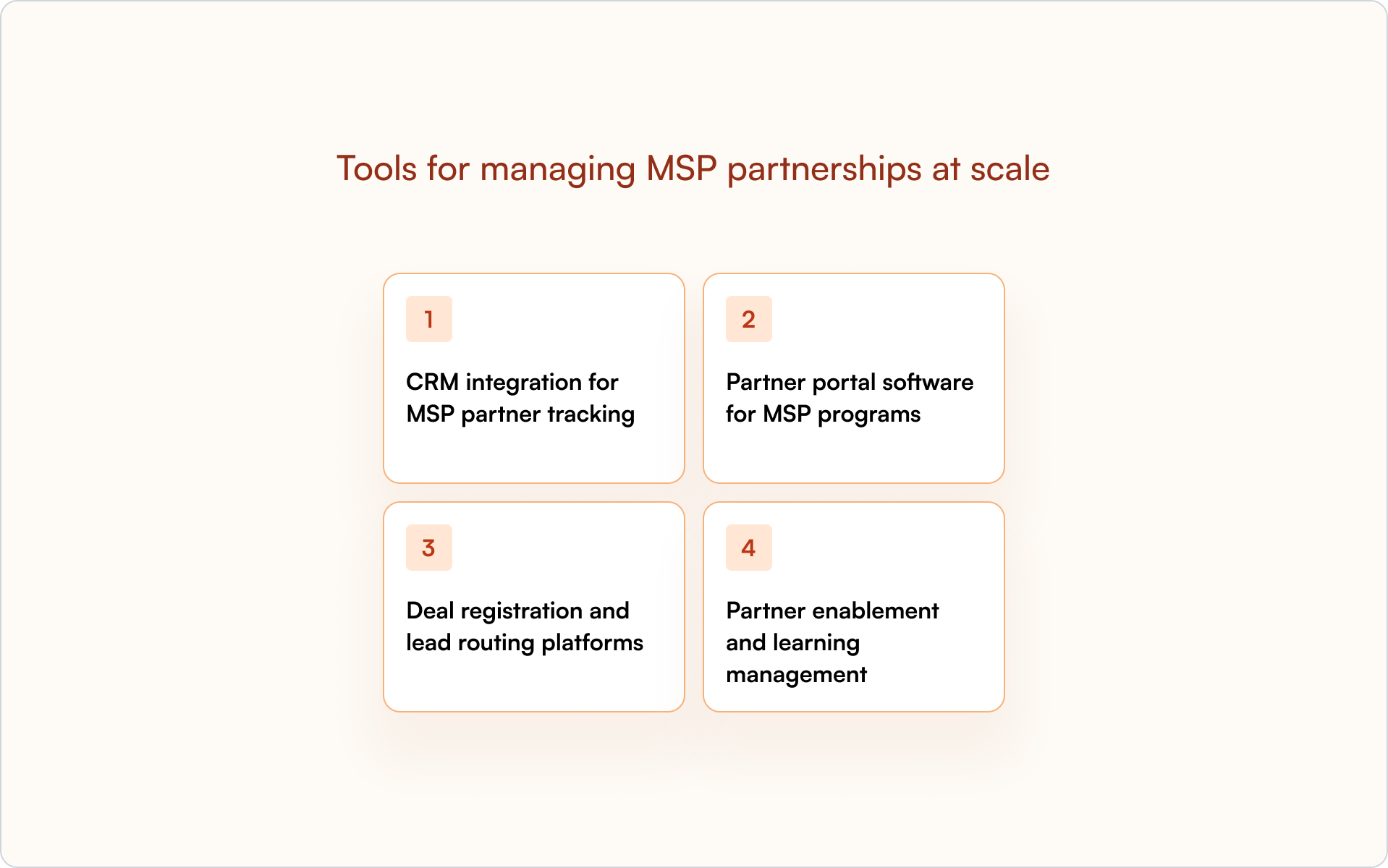
CRM integration for MSP partner tracking

Your CRM (HubSpot, Salesforce) is the system of record for partner deals. Track partner-sourced pipeline, deal registration status, and attribution inside the CRM — not in a separate system.

That’s how RevOps and sales leadership get real visibility without reconciling spreadsheets at the end of every month.

Partner portal software for MSP programs

A partner portal centralizes resources, deal registration, and communication. Prioritize portals that integrate with your CRM so data flows automatically.

Avoid portals that create data silos or require heavy partner logins. The best portals feel like an extension of your CRM — not a separate destination.

Deal registration and lead routing platforms

Deal registration needs workflow automation: submission → approval → protection → expiration alerts. Route registrations to the right approver, enforce required fields, and track protection windows automatically.

Partner enablement and learning management

Deliver training through an LMS or enablement platform. Track certification status, send recertification reminders, and gate key benefits behind completed training.

Trained partners close more deals. Your job is to make “getting trained” feel like momentum, not homework.

Common mistakes when building an MSP partner program

Most MSP partner programs stall for predictable reasons. If you’re building this in 2026, you can avoid months of rework by designing around these failure modes up front.
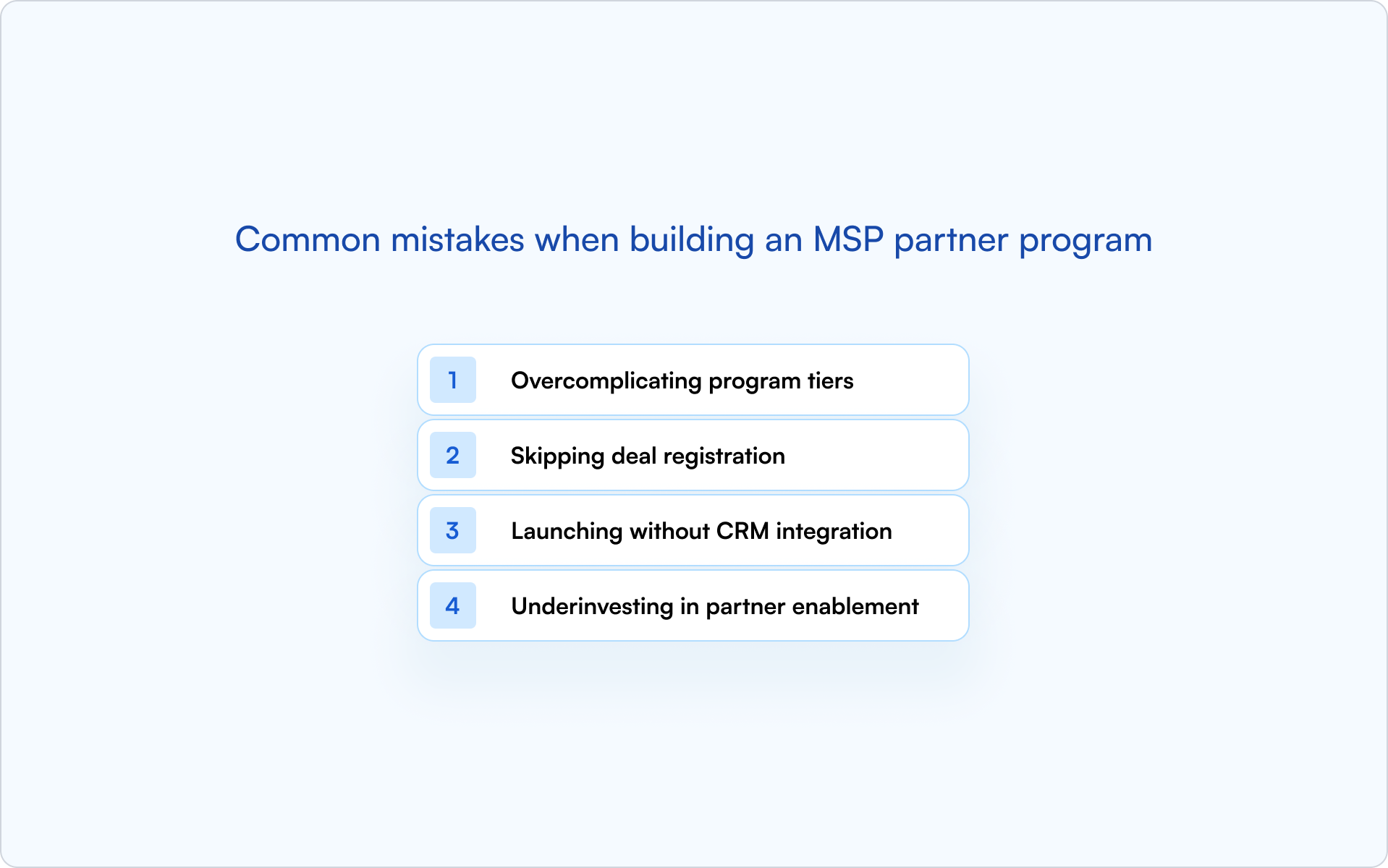
Overcomplicating program tiers

Too many tiers or unclear qualification criteria overwhelm partners. MSPs evaluate dozens of vendor programs — if yours is hard to understand, they’ll skip it. Start simple and add complexity only when real partners ask for it.

Skipping deal registration

Without deal registration, you can’t protect partner deals or prevent channel conflict. Partners won’t invest in selling if they risk losing deals to your direct team or another partner.

Treat deal registration as non-negotiable infrastructure, not a “phase two” feature.

Launching without CRM integration

If partner pipeline lives outside your CRM, you lose visibility, attribution, and forecasting accuracy. Your sales team can’t see partner deals. RevOps can’t reliably report on partner-sourced revenue. Leadership can’t trust the numbers.

Build CRM-first from the start. Retrofitting integration later is painful and expensive.

Underinvesting in partner enablement

MSPs can’t sell what they don’t understand. If training, documentation, and support are thin, partners won’t close — and they’ll blame the product. Enablement is an investment that shows up in activation rate, deal velocity, and retention.

Build your MSP partner program on your CRM with Introw

Launching an MSP partner program gets much easier when your tools work together. Introw connects your partner portal directly to HubSpot or Salesforce, so every MSP deal, lead, and activity lives in one system.

  • CRM-first architecture: Partner deals live in the same system as direct deals. No hidden pipeline, no attribution guesswork.
  • Deal registration: Partners register deals through the portal or email. Registrations sync to your CRM with protection windows and approval workflows — automatically.
  • Partner portal: Launch a branded portal in minutes with resources, deal registration, and pipeline visibility. Partners stay engaged without logging in constantly.
  • Real-time visibility: See partner pipeline alongside direct pipeline and forecast with confidence.

If you’re building an MSP channel and want it to scale without spreadsheets or disconnected systems, book a demo to see how Introw supports it.

Fazit

A successful MSP partner program is less about flashy perks and more about operational trust: clear economics, fast enablement, protected deals, and clean data in your CRM. If you get those foundations right, the channel can become one of the most efficient growth engines in your go-to-market.

FAQs

Noch Fragen? Hier findest du die häufigsten Fragen und Antworten.

Kontaktiere uns

What is the difference between an MSP partner and a reseller?

An MSP partner bundles your product into an ongoing managed service they deliver to clients. A reseller typically sells your product as a standalone transaction and may not provide continuous service delivery. MSP relationships are recurring by design; reseller relationships are often transactional.

How long does it take to launch an MSP partner program?

A basic MSP partner program can launch in a few weeks to a few months depending on how much you already have in place (pricing model, onboarding, training, deal registration, and portal). CRM-first platforms can accelerate the timeline by reducing manual setup and integration work.

What margins should vendors offer MSP partners?

Margins vary by category, competitive pressure, and your delivery requirements. Many vendors land in the 20–40% range, often with higher margins for more committed tiers. The key is whether an MSP can profitably bundle your product into monthly services while still covering their support, tooling, and account management costs.

Do I need deal registration in an MSP partner program?

Yes in almost every case. Deal registration gives partners confidence they can invest in creating pipeline without losing the opportunity to your direct team or another partner. It also gives you a clean audit trail for attribution, forecasting, and conflict resolution.

How do vendors recruit MSP partners for a new program?

Most vendors recruit MSP partners through targeted outreach, industry events, existing customer referrals, MSP directories, and distributor ecosystems. Prioritize partners who fit your ideal profile and who can realistically activate (complete training and register deals) within the first 30–60 days.


Launch your partner portal
in minutes!

Vielen Dank! Wir haben deine Anfrage erhalten!
Hoppla! Beim Absenden des Formulars ist ein Fehler aufgetreten.

Verwandte Blog-Artikel

Partner-Management

11 Euler PRM Alternatives for Smarter Partner Management in 2026

Janis De Sutter
Software Engineer
5min Lesezeit
02 Jun 2026
⚡ TL;DR

Euler PRM helps teams manage partner programs and distribution channels. But as partner ecosystems grow, many teams need deeper CRM integrations, more automation, stronger enablement, and greater flexibility. This guide compares 11 Euler alternatives to help you evaluate CRM connectivity, AI capabilities, onboarding, partner engagement, and overall time to value.

What is Euler PRM (and why teams look for alternatives)

Euler PRM helps businesses manage partners, track deals, and run partner programs. The platform became known through Starlink reseller programs and includes onboarding tools, CRM integrations, and AI assistants.

For many teams, that’s enough to get started. As partner programs grow, however, some businesses need deeper CRM integrations, more automation, and better ways to keep partners engaged.

That’s why many teams evaluating Euler also compare other partner management systems.

1. CRM integration without custom object support

Euler connects to HubSpot and Salesforce but does not support custom objects. Teams that rely on custom CRM data structures may run into limitations as programs grow.

2. No white-label portal

Euler’s portal uses Euler branding. There is no white-label option for businesses that want a fully branded partner experience.

3. No segmented onboarding

Euler does not support onboarding by partner type, tier, or stage. Every partner follows the same experience. Teams that want tailored journeys often look for stronger partner portal capabilities.

4. No embedded LMS or MDF management

Euler does not include a built-in LMS or MDF functionality. Teams that need partner training, certification, or co-marketing workflows must use additional tools.

5. AI that advises, not executes

Euler’s AI assistants provide guidance and surface data. They do not automate deal registration, partner engagement, or workflow execution. Teams looking to reduce manual work frequently evaluate platforms with dedicated AI agents.

6. Portal-first engagement

Euler keeps most activity inside the portal. There is no native email or Slack collaboration that syncs back to the CRM in real time. That’s why many teams prioritize stronger partner engagement capabilities.

These limitations won’t matter to every business. But as partner programs grow, many companies start comparing Euler competitors that offer deeper CRM connectivity and more automation.

Euler PRM alternatives at a glance

Not every Euler competitor solves the same problems. Some focus on affiliate programs, some on enterprise channel management, and others on partner enablement. This table gives you a quick way to compare the most important differences.

Tool CRM-Integration White-label portal AI capability Zusammenarbeit außerhalb des Partnerportals Embedded LMS MDF module Time to live
Introw Native Yes Agentic Yes Yes Yes 2 to 4 days
Impartner Middleware Yes Advisory Limited Yes Yes 3 to 12 months
PartnerStack Middleware Limited Advisory No No No Weeks
Kiflo Basic No None No No No Days
Salesforce Experience Cloud (Partner Cloud) Native Yes None No No No 3 to 12 months
ChannelScaler Middleware Yes None No Yes Yes Wochen bis Monate
Gedankenmatrix Integrated Yes TCMA No Yes No Wochen bis Monate
Zinfi Integrated Yes TCMA No Yes Yes Wochen bis Monate
Magentrix Native Yes Advisory No No No Wochen bis Monate
Channeltivity Integrated Yes None No No Yes Weeks
Partner.io Integrated Yes Advisory No No No Weeks

Next, you'll get a closer look at each platform, where it stands out, and where it may be a better fit than Euler.

11 best Euler PRM alternatives in 2026

If you’re looking for an Euler alternative, these are the platforms worth evaluating. Some focus on referral programs, some specialize in enterprise channel management, and others help partnership teams scale with less manual work.

#1 Introw - Best overall Euler alternative for CRM-native partner management

What it does

Introw is an AI-powered PRM built for revenue teams that want partner data, deal tracking, partner applications, and attribution inside the CRM. It combines agentic AI, off-portal collaboration, white-label portals, MDF, CPQ, and segmented onboarding in one system.

Why someone might choose it over Euler

Introw addresses the biggest gaps that push teams toward Euler software alternatives. It supports custom CRM objects, white-label branding, embedded learning, MDF workflows, and AI that can take action instead of only providing answers.

Partners can register deals, submit partner applications, collaborate on sales opportunities, and complete onboarding through email, Slack, embedded forms, or the portal. Everything syncs back automatically, reducing manual loading between systems.

For partnership leaders running multiple partner programs, that means less time spent updating spreadsheets and more focus on partner revenue, ROI, growth, and partner trust.

Teams evaluating modern PRMs often compare Introw with other solutions in guides covering partner relationship management software and the 2025 guide to choosing your next PRM.

Where it stands out

  • Native CRM architecture with full custom object support for deal tracking, attribution, partner applications, and partner revenue
  • Agentic AI across the full partner lifecycle management process
  • White-label portal builder
  • Embedded partner LMS
  • Native MDF management
  • Off-portal collaboration through email and Slack
  • Built-in deal and lead registration
  • Native MCP and Claude connectivity
  • Automated workflows that help partner teams scale without adding bandwidth

CRM integrations

Native, bi-directional integrations with Salesforce and HubSpot.

Preise

Custom pricing.

Am besten geeignet für

SaaS companies with multiple partner types that want to drive growth, increase partner revenue, and spend less time on admin work.

Explore the full Euler comparison or request a demo.

#2 Impartner - Best for enterprise-scale PRM with broad module coverage

What it does

Impartner is an enterprise PRM platform covering partner portals, TCMA, marketplaces, partner lifecycle management, and partner enablement services.

Why someone might choose it over Euler

  • Broad enterprise feature coverage
  • Established market presence
  • Strong support for large partner programs
  • Designed for complex partnerships

Where it falls short

  • 3–12 month implementation timelines
  • Middleware-based CRM integration
  • Reported field-mapping challenges
  • Dated user experience

CRM integrations

Salesforce via middleware.

Preise

Custom pricing.

Am besten geeignet für

Enterprise organizations with 50+ partners and dedicated PRM admin resources.

Our guide to best Impartner competitors covers additional options.

#3 PartnerStack - Best for affiliate and referral program automation

What it does

PartnerStack is a partner network platform focused on affiliate tracking, referral automation, recruiting partners, automated payments, and partner payouts.

Why someone might choose it over Euler

  • Large partner marketplace
  • Mature referral capabilities
  • Automated payments infrastructure
  • Strong partner recruitment engine

Where it falls short

  • Workato-based CRM middleware
  • Transaction fees on partner payments
  • Limited portal customization
  • No distributor or two-tier models

CRM integrations

Salesforce and HubSpot via Workato.

Preise

Custom pricing plus transaction fees.

Am besten geeignet für

Teams focused primarily on referral programs and automated partner payments.

See how it compares in our roundup of PartnerStack alternatives.

#4 Kiflo - Best for SMBs launching their first partner program

What it does

Kiflo is a lightweight PRM designed for onboarding partners, deal registration, commission tracking, and basic partner management.

Why someone might choose it over Euler

  • Easy to learn
  • Faster setup
  • Lower starting cost
  • Intuitive experience for smaller teams

Where it falls short

  • No AI
  • No off-portal collaboration
  • No white-label portal
  • No LMS
  • No CPQ
  • No custom object support

CRM integrations

Basic Salesforce and HubSpot integrations.

Preise

Lower-cost, partner-based pricing.

Am besten geeignet für

Small businesses launching their first partner program.

Take a look at our in-depth guide to Kiflo alternatives.

#5 Salesforce Experience Cloud (Partner Cloud) - Best for teams that want everything inside Salesforce

What it does

Salesforce Experience Cloud is Salesforce’s build-it-yourself partner portal framework. Because it sits directly inside Salesforce, companies can connect partner data, customers, sales processes, events, and reporting in one environment.

Why someone might choose it over Euler

  • Deepest Salesforce integration available
  • Highly customizable
  • Extensive reporting capabilities
  • Strong API ecosystem

Where it falls short

  • Heavy developer dependency
  • No built-in LMS
  • No AI agent
  • No off-portal collaboration
  • Long implementation cycles

CRM integrations

Native Salesforce.

Preise

Starts around $20/user/month plus implementation costs.

Am besten geeignet für

Large Salesforce-centric organizations with dedicated development resources.

Our guide to Salesforce PRM alternatives explores similar options.

#6 ChannelScaler - Best for incentive and rebate management alongside PRM

What it does

ChannelScaler combines PRM, MDF, rebates, incentive management, and partner revenue programs in one system. The platform helps partner teams manage payments, spiff payments, partner applications, partner contracting, and channel operations across larger partnerships.

Why someone might choose it over Euler

  • Strong incentive management and rebate capabilities
  • Built-in MDF functionality
  • Broad feature coverage
  • Helps partnership leaders manage complex channel programs

Where it falls short

  • Admin-heavy experience
  • No AI capabilities
  • No Slack support
  • No off-portal collaboration
  • CRM changes often require support involvement

CRM integrations

Salesforce and HubSpot via middleware.

Preise

Custom pricing.

Am besten geeignet für

Companies that need rebates, MDF, incentive management, and partner services from a single provider.

Explore our guide to ChannelScaler alternatives.

#7 Mindmatrix - Best for through-channel marketing automation (TCMA)

What it does

Mindmatrix combines PRM, LMS, TCMA, training, content creation, and marketing services. The platform helps partnership teams create campaigns, support partners, automate marketing activities, and drive growth across multiple markets.

Why someone might choose it over Euler

  • Strong TCMA capabilities
  • Built-in LMS and training tools
  • AI content generation
  • Social selling support

Where it falls short

  • Steep learning curve
  • LMS updates may require support
  • No dedicated admin experience
  • No CPQ
  • Long onboarding process

CRM integrations

Salesforce and HubSpot integrations.

Preise

Custom pricing.

Am besten geeignet für

Enterprise partner teams focused on marketing automation, partner enablement, and revenue growth.

See how it compares in our roundup of Mindmatrix alternatives.

#8 Zinfi - Best for large-scale channel management with broad module coverage

What it does

Zinfi provides channel management, partner onboarding, analytics, deal tracking, partner marketing, and TCMA capabilities in a single platform. It is designed for companies running large global partnerships across the world.

Why someone might choose it over Euler

  • Broad enterprise feature set
  • Strong analytics
  • Dedicated TCMA functionality
  • Support for complex partner programs
  • Helps partnership leaders manage growth at scale

Where it falls short

  • Complex implementation
  • Dated interface
  • Significant configuration requirements
  • Data primarily lives inside Zinfi

CRM integrations

Salesforce and Microsoft Dynamics integrations.

Preise

Custom pricing.

Am besten geeignet für

Large enterprises managing partnerships across multiple regions, partner types, and customer segments.

Our guide to Zinfi alternatives covers other options worth considering.

#9 Magentrix - Best for Salesforce-native teams wanting a portal-first approach

What it does

Magentrix is a Salesforce-native portal platform that helps companies connect partners, customers, resources, and data through a branded experience. It supports partner collaboration, self-service resources, and customer-facing services.

Why someone might choose it over Euler

  • Native Salesforce architecture
  • Flexible portal builder
  • Strong portal customization
  • Familiar experience for Salesforce users

Where it falls short

  • Salesforce-only
  • Limited AI capabilities
  • Portal-first workflow
  • Limited off-portal collaboration

CRM integrations

Native Salesforce integration.

Preise

Essential from $1,500/month. Advanced from $3,000/month. Unlimited pricing available by quote.

Am besten geeignet für

Salesforce customers who want a portal-centric system for partners, customers, and self-service resources.

Take a look at our guide to Magentrix alternatives.

#10 Channeltivity - Best for mid-market teams wanting a straightforward PRM

What it does

Channeltivity covers partner portals, deal registration, MDF management, analytics, and automated workflows. The platform helps companies create partner programs without the complexity of many enterprise tools.

Why someone might choose it over Euler

  • Dedicated MDF module
  • Proven market presence
  • Straightforward feature set
  • Less time spent managing the system

Where it falls short

  • Limited AI capabilities
  • No off-portal collaboration
  • CRM depth may not fit advanced use cases

CRM integrations

Salesforce integration.

Preise

Standard: $1,899/month annually. CRM Edition: $2,199/month annually.

Am besten geeignet für

Mid-market companies that want a proven PRM and spend less time managing partner operations.

Explore our review of Channeltivity competitors.

#11 Partner.io - Best for pipeline-focused partner collaboration

What it does

Partner.io focuses on pipeline visibility, attribution, deal collaboration, partner applications, and helping sales teams track opportunities across partnerships. The platform is built to improve visibility between internal teams and external partners while helping companies create stronger partner relationships.

Why someone might choose it over Euler

  • Strong pipeline visibility
  • Modern user experience
  • Focus on collaboration
  • Helps drive growth through better deal visibility
  • Good fit for partnership leaders focused on revenue

Where it falls short

  • Smaller customer base
  • Narrower feature set
  • No embedded LMS
  • No MDF management

CRM integrations

Salesforce and HubSpot.

Preise

Forever Free: $0. Professional: $249/month. Enterprise: custom pricing.

Am besten geeignet für

Partner teams that prioritize pipeline visibility, attribution, deal collaboration, and future revenue opportunities.

See how it compares in our roundup of Partner.io alternatives.

It’s easy to get caught up comparing features. But the best PRM is the one that fits your CRM, your partner model, and the way your team and partners actually work.

Das Fazit

Euler is a solid starting point for partner programs, especially in distribution-focused environments. But as programs grow, the gaps become harder to ignore.

  • If you need enterprise TCMA, look at Mindmatrix or Zinfi.
  • If affiliate payouts and partner recruitment are your priority, PartnerStack is a strong option.
  • If you want a Salesforce-native portal, Magentrix is worth considering.

But if you need a CRM-native PRM with agentic AI, off-portal collaboration, partner enablement, MDF management, and a faster path to value, Introw is the clearest upgrade.

See the full Introw vs Euler comparison for a side-by-side breakdown.

Why teams choose Introw when looking for Euler alternatives

+70% more partner pipeline

Many companies struggle to keep partners engaged after onboarding. Introw helps partners register deals, share data, and collaborate in real time, helping companies create more pipeline and uncover new revenue opportunities without adding manual work.

+75% faster partner onboarding

Most companies don’t want a long implementation process. Introw goes live in 2 to 4 days, helping partners access training, resources, and services from day one. Every partner gets the right experience based on their role, making it easier for one person or hundreds of users to get started.

+60% more partner-influenced revenue

Introw helps companies connect partner activity, attribution, and customer outcomes in one place. Better visibility into data makes it easier to identify what drives growth, improve ROI, and build stronger partnerships over time.

Ready to see how Introw compares to Euler and other competitors? Request a demo.

Partner-Management

10 Magentrix PRM Alternatives for Better Partner Engagement in 2026

Peter Vermeulen
Staff Engineer
5min Lesezeit
01 Jun 2026
⚡ TL;DR

Magentrix PRM is a popular Salesforce-based solution for partner portals, deal registration, and content sharing. But many teams evaluating Magentrix alternatives want broader CRM support, stronger partner engagement, AI-powered workflows, and a platform that helps manage the full partner lifecycle.

We'll show you 10 Magentrix PRM alternatives in 2026, including options built for Salesforce, HubSpot, and growing partner programs. We’ll compare features, pricing, AI capabilities, and overall partner experience to help you find the right fit.

What Is Magentrix (And Why Teams Look for Alternatives)

Magentrix PRM is a Salesforce-native partner portal platform. It gives Salesforce users a branded place to share content, register deals, and manage partner access.

For teams that only need a portal, Magentrix can work well. But many businesses evaluating Magentrix alternatives need broader CRM support, stronger partner experience capabilities, and more complete partner lifecycle management.

1. Salesforce-only, no HubSpot support

Magentrix is built for Salesforce. If you use HubSpot, it isn’t an option.

This is one reason buyers comparing the best partner relationship management software often look beyond Magentrix.

2. Portal-centric, no off-portal collaboration

Partners need to log in to access content, register deals, and view updates.

There are no CRM-synced email conversations or Slack-based collaboration workflows that keep partners engaged outside the portal.

3. Limited AI capabilities

Magentrix doesn’t offer AI-powered deal coaching, automated QBR generation, AI course creation, or agentic partner management capabilities.

For teams looking to reduce manual work, this is a common reason to review Magentrix competitors.

4. Partner portal, not full partner lifecycle management

Magentrix focuses on portal functionality, onboarding, and content sharing.

Many alternatives extend into MDF, partner engagement, CPQ, commissions, goals, and revenue tracking. That’s typically where differences appear when comparing the best partner management systems.

5. No embedded AI-powered LMS

Magentrix includes content sharing but not a built-in AI-powered LMS with certifications and structured training.

Teams with formal enablement programs often need additional software. If you’re planning to choose your next PRM, it’s worth evaluating training requirements early.

These gaps explain why many teams eventually start looking for a Magentrix alternative that can scale with their program.

Magentrix alternatives at a glance

Here’s a quick side-by-side comparison before we dive into each Magentrix alternative in more detail.

Tool CRM support Engagement model AI capability Partner lifecycle coverage Embedded LMS Time to live
Introw HubSpot + Salesforce Off-portal + portal hybrid Agentic AI Full lifecycle AI-powered Days
Salesforce Experience Cloud (Partner Cloud) Salesforce only Portal-centric Advisory AI (Salesforce AI) Partial None Wochen bis Monate
Impartner Salesforce + Microsoft Dynamics + other CRMs Hybrid Content and advisory AI Full lifecycle Basic Months
PartnerStack Native platform Portal-centric Limited AI Partial None Weeks
Kiflo HubSpot + Salesforce Hybrid None Partial Basic Days
Euler HubSpot + Salesforce Hybrid AI assistants Partial None Tage bis Wochen
Gedankenmatrix Salesforce + other CRMs Portal-centric Content AI Full lifecycle Basic Wochen bis Monate
ChannelScaler Salesforce + other CRMs Portal-centric Limited AI Full lifecycle None Months
Channeltivity Salesforce + HubSpot Hybrid None Partial Basic Tage bis Wochen
Partner.io HubSpot + Salesforce Hybrid Advisory AI Partial None Tage bis Wochen

Now, let’s look at where each platform stands out and where it may fall short depending on your partner program.

10 Best Magentrix Alternatives in 2026

#1 Introw - Best overall Magentrix alternative for CRM-native partner management

What it does

Introw is an AI-first PRM software for revenue teams using HubSpot and Salesforce. The platform combines partner engagement, deal registration, LMS, MDF, CPQ, and agentic AI in one system.

Unlike most alternatives, Introw syncs live CRM data bi-directionally, including custom objects, so your team can manage customers, data, and workflows without duplicate records or manual updates.

Why someone might choose it over Magentrix

Introw fills the biggest gaps that push teams away from Magentrix PRM.

You can connect HubSpot or Salesforce instead of being locked into a single CRM. Partners can collaborate through email, Slack, embedded forms, or a white-label partner portal, with information synced automatically to the CRM.

The AI agent helps automate repetitive tasks across the lifecycle by generating training content, building announcements, surfacing QBR insights, and coaching live deals. The platform also includes capabilities Magentrix doesn’t offer, including MDF, CPQ, goal tracking, and an AI-powered partner LMS.

Key differences from Magentrix

  • HubSpot and Salesforce vs. Salesforce-only
  • Off-portal collaboration vs. portal-only engagement
  • Agentic AI vs. no native AI capabilities
  • Full lifecycle management vs. portal-focused functionality
  • AI-powered LMS vs. knowledge base
  • Native MCP and Claude support vs. none

CRM integrations

See the Claude integration in action:

Preise

Introw offers custom pricing based on your partner program size, CRM setup, and required features.

Am besten geeignet für

SaaS businesses that want a complete partner management platform instead of just a partner portal.

For a deeper review, see our guide to choosing your next PRM or request a demo.

#2 Salesforce Experience Cloud (Partner Cloud) - Best for Salesforce teams wanting maximum native control

What it does

Salesforce Experience Cloud is Salesforce’s portal-building platform. It gives administrators complete control over how partner experiences are designed, displayed, and connected to Salesforce data.

Why someone might choose it over Magentrix

Teams that need maximum customization and direct access to Salesforce objects often choose Experience Cloud over Magentrix.

Where it falls short

  • Requires significant developer resources
  • No dedicated PRM admin layer
  • No embedded LMS
  • No AI deal coaching
  • No off-portal collaboration
  • Long implementation time
  • Can become expensive to upgrade and maintain

CRM integrations

  • Salesforce (native)

Preise

Customer Community Plus: $15/login or $35/member. Partner Community: $20/login or $50/member.

Am besten geeignet für

Large Salesforce organizations with dedicated developers and administrators.

See how it compares in our roundup of best Salesforce PRM alternatives.

#3 Impartner — Best for enterprise-scale PRM beyond just a portal

What it does

Impartner is an enterprise PRM platform covering partner portals, TCMA, marketplaces, and partner lifecycle management.

Why someone might choose it over Magentrix

Impartner offers a broader set of features than Magentrix, including TCMA, marketplace functionality, and enterprise partner programs.

Where it falls short

  • Long implementation cycles
  • Middleware-based CRM integrations
  • Dated user experience
  • Complex setup and maintenance
  • Difficult to migrate once heavily customized

CRM integrations

  • Salesforce (via middleware)

Preise

Individuelle Preisgestaltung für Unternehmen.

Am besten geeignet für

Enterprise businesses running mature partner ecosystems.

Our guide to the best Impartner competitors covers additional options.

#4 PartnerStack- Best for affiliate and referral programs with payouts

What it does

PartnerStack helps businesses manage affiliate, referral, and reseller programs with built-in payouts and marketplace access.

Why someone might choose it over Magentrix

PartnerStack includes payout automation, a free partner marketplace, and support for affiliate programs that Magentrix wasn’t designed to manage.

Where it falls short

  • Transaction fees on payouts
  • Limited co-sell functionality
  • Rigid portal experience
  • No distributor management
  • CRM integrations require middleware

CRM integrations

  • HubSpot (via Workato)
  • Salesforce (via Workato)

Preise

Launch: $1,000/month. Growth: $1,520/month. Enterprise: custom.

Am besten geeignet für

Businesses focused on affiliate and referral revenue.

Explore our guide to the best PartnerStack alternatives.

#5 Kiflo - Best for SMBs on HubSpot launching their first program

What it does

Kiflo is a lightweight PRM platform designed for small businesses that want an easy way to start managing partners.

Why someone might choose it over Magentrix

Kiflo supports HubSpot, offers simpler workflows, and is less expensive to get started with.

Where it falls short

  • No AI capabilities
  • No off-portal collaboration
  • No white-label portal options
  • No LMS
  • No CPQ
  • Limited scalability

CRM integrations

  • HubSpot
  • Salesforce

Preise

Core: $399/month (annual billing). Plus: custom.

Am besten geeignet für

Small businesses with fewer than 20 active partners.

Take a look at our in-depth guide to Kiflo alternatives.

#6 Euler - Best for modern PRM with AI assistants

What it does

Euler is a modern PRM platform with AI assistants, partner management workflows, and support for both Salesforce and HubSpot.

Why someone might choose it over Magentrix

Euler offers a more modern user experience, HubSpot support, and AI features that Magentrix lacks.

Where it falls short

  • No custom object support
  • No white-label portal builder
  • No LMS
  • No MDF management
  • Limited onboarding flexibility

CRM integrations

  • HubSpot
  • Salesforce

Preise

Custom pricing.

Am besten geeignet für

Growing partner programs that want a modern interface and advisory AI.

Explore our guide to the best Euler PRM alternatives.

#7 Mindmatrix - Best for through-channel marketing automation

What it does

Mindmatrix combines PRM software, TCMA, LMS, content management, and partner enablement in a single platform.

Why someone might choose it over Magentrix

Mindmatrix offers broader services, LMS capabilities, content automation, and support for both Salesforce and HubSpot.

Where it falls short

  • Steep learning curve
  • Long implementation cycles
  • Complex administration
  • LMS often requires support involvement

CRM integrations

  • HubSpot
  • Salesforce

Preise

Individuelle Preisgestaltung für Unternehmen.

Am besten geeignet für

Enterprise organizations focused on through-channel marketing.

See how it compares in our roundup of the best Mindmatrix alternatives.

#8 ChannelScaler - Best for incentive and rebate management

What it does

ChannelScaler combines PRM, MDF, incentives, rebates, and channel management into a single platform.

Why someone might choose it over Magentrix

ChannelScaler provides incentive management, rebate programs, budget controls, and MDF capabilities that extend beyond portal functionality.

Where it falls short

  • Admin-heavy workflows
  • No AI capabilities
  • No Slack collaboration
  • CRM changes often require support assistance
  • Some updates require additional waiting time

CRM integrations

  • Salesforce
  • HubSpot (middleware)

Preise

Custom pricing.

Am besten geeignet für

Businesses with complex rebate, incentive, and budget management requirements.

Explore our guide to the best ChannelScaler alternatives.

#9 Channeltivity - Best for mid-market Salesforce teams wanting MDF

What it does

Channeltivity is a mid-market PRM platform focused on portals, deal registration, MDF, and channel analytics.

Why someone might choose it over Magentrix

Channeltivity includes MDF management and analytics capabilities that go beyond standard portal features.

Where it falls short

  • Limited AI functionality
  • Salesforce-focused architecture
  • No off-portal collaboration

CRM integrations

  • Salesforce

Preise

Standard: $1,899/month annually. CRM Edition: $2,199/month annually.

Am besten geeignet für

Mid-market Salesforce customers looking for MDF and analytics.

Our guide to the best Channeltivity competitors covers additional options.

#10 Partner.io - Best for pipeline-focused partner collaboration

What it does

Partner.io is a partner management platform built around pipeline visibility, deal collaboration, and partner communication.

Why someone might choose it over Magentrix

Partner.io focuses on helping teams manage live deal collaboration rather than primarily serving as a portal.

Where it falls short

  • Smaller market presence
  • Narrower feature set
  • Fewer enterprise capabilities than some competitors
  • Less information available than many established vendors

CRM integrations

  • HubSpot
  • Salesforce

Preise

Solo starts at $79/month. Growing starts at $299/month. Enterprise pricing is custom.

Am besten geeignet für

Teams focused on pipeline visibility and collaborative selling.

See how it compares in our roundup of the best Partner.io alternatives.

The Bottom Line

Magentrix is a good choice if you’re a Salesforce team that wants a branded partner portal for deal registration, content sharing, and partner access.

Many teams start looking at the best alternatives when they adopt HubSpot, struggle with portal engagement, or need more than a portal can provide.

If that’s you, Introw stands out by combining partner management, AI, training, deal collaboration, and CRM connectivity in one place across both HubSpot and Salesforce. It offers one of the best alternatives for teams that have outgrown a portal-only approach.

As you compare options, focus on what helps your team work faster and keeps partners engaged. Features like security verification and protection from malicious bots matter, but so does day-to-day usability.

For a deeper side-by-side review, see the full Magentrix comparison.

Why Teams Choose Introw When Looking for Magentrix Alternatives

If you’ve reviewed this list, you’ve probably noticed a pattern. Most alternatives solve one or two Magentrix limitations. Introw is one of the few PRM software platforms designed to address all of them in one place.

+70% more partner pipeline

Introw helps teams turn dormant programs into revenue engines. Partners register more deals, faster, with deal flow synced directly into your CRM.

Off-portal collaboration means partners can work without logging in, while AI helps protect pipeline quality by identifying duplicate opportunities before they become problems.

+75% faster partner onboarding

Go live in 2 to 4 days with no custom coding.

Partners move from signup to selling with AI-driven onboarding, certification, and content in one intuitive platform. Integrated HubSpot and Salesforce support means you’re never locked into a single CRM if your business grows or your needs change.

+60% more partner-influenced revenue

Get full visibility into every partner-touched deal.

Attribution lives inside your CRM, making it easier to prove what’s working and expand successful programs. Deal coaching, engagement automation, and powerful reporting features help keep partners active without creating extra tasks for your team.

Ready to compare Introw to Magentrix?

If you still have questions after reviewing the most alternatives on this list, the best way to evaluate fit is to see the platform in action.

Request a demo and see how leading SaaS teams grow partner pipeline, speed up onboarding, and increase partner-influenced revenue with Introw.

Partner-Management

14 Partner.io Alternatives for Stronger Partner Collaboration in 2026

Adèle Coolens
Marketing & Partnerschaften
5min Lesezeit
19 May 2026
⚡ TL;DR

Partner.io is a newer PRM focused on partner collaboration and portal experiences. This guide compares 14 Partner.io alternatives for teams that need deeper CRM integration, stronger automation, and broader partner management capabilities. For most growing SaaS companies, Introw is the strongest overall alternative thanks to its CRM-native approach, AI-powered workflows, and full-lifecycle partner management.

Why teams compare Partner.io with other PRMs

Partner.io is a newer partner management platform focused on partner collaboration and pipeline visibility. As programs grow, many teams evaluate Partner.io alternatives with deeper CRM integration, stronger automation, and broader partner management capabilities.

Key evaluation criteria

Before choosing a platform, consider:

  • Platform maturity: Customer base, reviews, case studies, and long-term product stability
  • Partner lifecycle coverage: Support for partner onboarding, partner training, deal registration, MDF, incentives, and partner engagement
  • CRM integration: How deeply the platform connects with Salesforce or HubSpot, including partner data synchronization and workflow automation
  • AI capabilities: Whether AI reduces manual work through coaching, automation, insights, or content creation
  • Partner collaboration: How easily partners can work with your team through a partner portal and other engagement channels
  • Scalability: Whether the platform can support more partners, additional partner types, and a growing partner motion without adding complexity

The best choice is the platform that fits both your current program and where you expect partner revenue to grow over the coming years.

Partner.io alternatives at a glance

Use this table to compare each Partner.io comp by maturity, CRM fit, AI depth, and how much of the partner lifecycle each tool supports.

Tool Established since CRM-Integration AI capability Zusammenarbeit außerhalb des Partnerportals Partner lifecycle Embedded LMS
Introw 2023 Native Agentic Yes Full AI-powered
Kiflo 2019 Basic None No Partial None
Euler 2023 Basic Advisory Yes Partial None
PartnerStack 2015 Middleware None No Partial Basic
Impartner 1997 Middleware Advisory No Full Basic
Salesforce Experience Cloud / Partner Cloud 2013 Native Agentic No Full, build-heavy None
ChannelScaler 2025 Middleware Advisory No Full Basic
Gedankenmatrix 1998 Basic Content No Full Basic
ZINFI 2007 Basic Advisory No Full Basic
Magentrix 2012 Native None No Partial None
Channeltivity 2007 Basic None No Partial Basic
impact.com 2008 Basic Advisory No Partial None
Crossbeam 2018 Native Advisory No Partial None
Everflow 2016 Basic Advisory No Partial None

When comparing tools, focus on CRM integration, partner onboarding, partner training, reporting, and how well the platform supports growth over time.

For a broader view, compare these options with other partner management systems and the best PRM software.

14 best Partner.io alternatives in 2026

If you’re looking for a Partner.io alternative, these are the PRM platforms most commonly evaluated by SaaS companies that need stronger partner collaboration, better CRM integration, and support for the entire partner program.

#1 Introw - Best overall Partner.io alternative for CRM-native partner management

What it does

Introw is an AI-first PRM platform built directly around Salesforce and HubSpot. Instead of creating another database, it keeps CRM data as the system of record and extends it to partners through a white-label partner portal, email, Slack, AI-powered workflows, and automated collaboration.

The platform supports the full partner lifecycle, including partner onboarding, partner training, MDF, partner engagement, partner agreements, commissions, partner events, account mapping, co-selling, and partner-sourced revenue reporting.

Notable capabilities include:

  • Deep CRM integration with Salesforce and HubSpot
  • White-label no-code partner portal builder
  • AI-powered deal coaching and recommendations
  • Embedded partner LMS with AI-generated training modules
  • Native MDF management and attribution reporting
  • Automated deal and lead registration
  • AI-generated announcements and enablement content
  • Native Crossbeam integration for account mapping
  • Real-time partner data synchronization
  • Granular permissions by partner type and role

Most teams can go live in 2 to 4 days without custom development.

Why it’s the best Partner.io alternative

Introw supports the entire partner program, from partner onboarding and partner training to MDF, partner engagement, deal coaching, and partner-influenced revenue reporting.

Instead of stitching together multiple tools, Introw combines partner management, account mapping, channel conflict detection, and reporting in one platform.

Its built-in AI agent helps automate content creation, training, analysis, and partner communications.

Unlike portal-first platforms, Introw also supports collaboration through email and Slack, helping reseller partners, referral partners, and channel managers stay engaged without extra logins.

CRM integrations

  • Salesforce (native, bi-directional)
  • HubSpot (native, bi-directional)
  • Full custom object support
  • Real-time sync
  • CRM event triggers
  • In-CRM experiences for internal teams

Preise

Custom pricing based on program requirements. A 14-day free trial is available.

Am besten geeignet für

SaaS companies with 2+ partner managers that want a modern PRM platform with deep CRM integration, AI-powered workflows, a centralized hub for partner management, and support for the entire partner program.

If you’d like a side-by-side breakdown, see our full Partner.io comparison or request a demo.

#2 Kiflo - Best for SMBs wanting a simple, affordable starting point

What it does

Kiflo is a lightweight PRM platform focused on partner onboarding, deal registration, referral partners, reseller partners, commission management, and basic partner management workflows. It offers a clean partner portal and a quick setup process for smaller teams.

Why someone might choose it over Partner.io

Kiflo has more customer reviews, and provides a straightforward way to launch a partner program without significant complexity. It supports Salesforce and HubSpot and covers the core needs of many SaaS startups.

Where it falls short

  • No AI capabilities
  • No off-portal collaboration
  • No embedded LMS or partner training
  • Limited performance tracking and engagement metrics
  • No support for MDF or advanced channel conflict workflows
  • Less suitable for partnership teams managing more partners or complex partner motions

CRM integrations

  • HubSpot
  • Salesforce

Preise

Low-entry pricing with plans based on partner volume.

Am besten geeignet für

Small SaaS companies launching a new partner program that need an affordable partner management system with basic CRM integration and a simple partner experience.

Take a look at our in-depth guide of Kiflo alternatives to learn more.

#3 Euler - Best for newer programs wanting modern PRM with AI assistants

What it does

Euler is a modern PRM platform built for partner management, partner onboarding, and distributor relationships. Its AI assistants, PAM and POPS, help automate common partner management tasks and support a growing partner network.

Why someone might choose it over Partner.io

Euler shares Partner.io’s modern approach but adds advisory AI capabilities. It also has traction in distribution-heavy environments and offers a polished experience for new partners.

Where it falls short

  • No embedded LMS
  • No MDF management
  • No white-label flexibility
  • Limited support for complex partner agreements
  • No deep CRM integration with custom objects

CRM integrations

  • HubSpot
  • Salesforce

Preise

Custom pricing.

Am besten geeignet für

Growing SaaS companies that want a modern partner platform with AI assistance and a relatively simple setup.

We break down the strengths and limitations in our guide to Euler PRM alternatives.

#4 PartnerStack - Best for affiliate and referral programs with automated payouts

What it does

PartnerStack is a partnership platform focused on affiliate programs, referral partners, automated payouts, tracking links, and partner recruitment through its marketplace.

Why someone might choose it over Partner.io

It offers a large partner network, built-in payout infrastructure, and proven processes for SaaS companies running affiliate-driven partnerships at scale.

Where it falls short

  • Limited support for reseller partners
  • CRM integration relies on middleware
  • Rigid portal experience
  • No co-selling workflows
  • Limited support for partner-sourced revenue management

CRM integrations

  • Salesforce (via Workato)
  • HubSpot (via Workato)

Preise

Marketing plans start at $1000/mo. Growth plans start at $1520/mo. Enterprise pricing is custom.

Am besten geeignet für

Companies focused on affiliate and referral growth rather than complex channel partnerships.

For a deeper comparison, see our guide to PartnerStack alternatives.

#5 Impartner - Best for enterprise-scale PRM with broad module coverage

What it does

Impartner is a long-established PRM platform covering partner onboarding, TCMA, MDF, partner portals, partner performance management, and large-scale channel operations.

Why someone might choose it over Partner.io

It has a long track record, extensive functionality, and broad support for large companies running mature partner programs.

Where it falls short

  • Lengthy implementations
  • Enterprise complexity
  • Dated user experience
  • Middleware-based CRM integration
  • Significant administrative overhead

CRM integrations

  • Salesforce
  • Other CRMs via middleware

Preise

Enterprise pricing only.

Am besten geeignet für

Large organizations with dedicated channel operations resources and complex partnerships.

See how it stacks up against similar platforms in our best Impartner competitors guide.

#6 Salesforce Experience Cloud (Partner Cloud) - Best for Salesforce-only teams wanting maximum native control

What it does

Salesforce Experience Cloud lets businesses build a highly customized partner portal directly on Salesforce. It provides complete control over CRM data, workflows, and partner experiences.

Why someone might choose it over Partner.io

Organizations already standardized on Salesforce get native access to CRM data, reporting, and customization options without relying on a third-party PRM platform.

Where it falls short

  • Requires development resources
  • Long deployment timelines
  • No built-in partner LMS
  • No off-portal collaboration
  • Higher ownership costs than most partner management tools

CRM integrations

  • Salesforce (native)

Preise

Partner Community pricing starts at $20/login or $50/member billed annually.

Am besten geeignet für

Salesforce-centric enterprises with internal development teams.

Teams comparing this approach often also evaluate other Salesforce PRM alternatives.

#7 ChannelScaler - Best for incentive and rebate management alongside PRM

What it does

ChannelScaler combines PRM functionality with rebate management, incentive programs, MDF administration, and partner performance reporting.

Why someone might choose it over Partner.io

It provides broader functionality for channel managers who need to manage incentives, rebates, and partner revenue from a single dashboard.

Where it falls short

  • No AI-powered workflows
  • No Slack collaboration
  • Admin-heavy setup
  • CRM integration often requires support involvement
  • Limited innovation compared with newer platforms

CRM integrations

  • Salesforce
  • HubSpot

Preise

No public pricing available.

Am besten geeignet für

Teams managing incentive-heavy channel programs.

For a closer look at the platform, explore our guide to ChannelScaler alternatives.

#8 Mindmatrix - Best for through-channel marketing automation at enterprise scale

What it does

Mindmatrix combines PRM, TCMA, partner training, marketing assets, partner events, and content automation into a unified platform.

Why someone might choose it over Partner.io

It offers significantly broader marketing functionality and helps empower partners with content distribution and enablement tools.

Where it falls short

  • Steep learning curve
  • Long implementations
  • Heavy configuration requirements
  • Older interface
  • Complex administration

CRM integrations

  • Salesforce
  • HubSpot

Preise

Enterprise pricing.

Am besten geeignet für

Organizations investing heavily in through-channel marketing programs.

You can explore additional options in our roundup of Mindmatrix alternatives.

#9 ZINFI - Best for large-scale unified channel management

What it does

ZINFI offers unified channel management across partner onboarding, MDF, marketing automation, partner training, and performance tracking.

Why someone might choose it over Partner.io

It supports complex multi-tier partnerships and provides extensive functionality for managing large partner ecosystems.

Where it falls short

  • Complex implementation
  • Heavy configuration
  • Data primarily lives inside the platform
  • Dated interface
  • Higher administrative burden

CRM integrations

  • Salesforce
  • Microsoft Dynamics

Preise

Enterprise pricing.

Am besten geeignet für

Large enterprises with extensive reseller programs and global partner operations.

Our guide to ZINFI alternatives explores similar options.

#10 Magentrix - Best for Salesforce-native portal experience

What it does

Magentrix is a Salesforce-focused partner management system built around partner portals, collaboration, and secure access to CRM data.

Why someone might choose it over Partner.io

It provides a more established Salesforce-native experience and gives organizations full visibility into Salesforce-based partner workflows.

Where it falls short

  • Salesforce-only
  • Limited AI capabilities
  • Portal-centric approach
  • No off-portal engagement
  • Narrower feature set than full PRM platforms

CRM integrations

  • Salesforce (native)

Preise

Essential: $1500/mo. Advanced: $3000/mo. Enterprise pricing available on request.

Am besten geeignet für

Salesforce customers primarily focused on portal-based collaboration.

For a broader comparison, see our guide to Magentrix alternatives.

#11 Channeltivity - Best for mid-market teams wanting proven, straightforward PRM

What it does

Channeltivity provides deal registration, MDF management, partner portals, real-time analytics, and partner performance reporting for mid-market channel teams.

Why someone might choose it over Partner.io

It has a longer track record, established customers, and covers the core needs of many channel programs without excessive complexity.

Where it falls short

  • No AI functionality
  • No off-portal collaboration
  • Limited innovation in recent years
  • No advanced automation for partner engagement

CRM integrations

  • Salesforce
  • HubSpot

Preise

Standard: $1899/mo annually. CRM Edition: $2199/mo annually. Enterprise pricing available on request.

Am besten geeignet für

Mid-market teams looking for a stable and proven PRM platform.

Take a closer look at alternative options in our guide to Channeltivity competitors.

#12 impact.com - Best for affiliate, influencer, and performance marketing

What it does

impact.com helps businesses manage affiliate, influencer, referral, and ecommerce partnerships with automated payouts and large-scale tracking capabilities.

Why someone might choose it over Partner.io

It excels at performance marketing and supports high-volume partnership programs with strong reporting and automation.

Where it falls short

  • Not a traditional PRM platform
  • No partner onboarding workflows
  • No deal registration
  • No partner portal for channel relationships

CRM integrations

  • Limited compared with dedicated PRMs

Preise

Custom pricing with transaction-related costs.

Am besten geeignet für

Organizations focused on affiliate and influencer revenue programs.

#13 Crossbeam (Reveal) - Best for ecosystem data and account mapping

What it does

Crossbeam helps teams identify overlap between customers, prospects, and partners through account mapping and ecosystem intelligence.

Why someone might choose it alongside Partner.io

It helps track partner opportunities, identify co-selling opportunities, and improve partner-influenced revenue through shared data insights.

Where it falls short

  • Not a PRM platform
  • No partner portal
  • No onboarding workflows
  • No engagement tools
  • No deal registration

CRM integrations

  • Salesforce
  • HubSpot

Preise

Free plan available. Starter: $4800/year. Enterprise pricing available on request.

Am besten geeignet für

Organizations that want ecosystem intelligence alongside a PRM platform.

#14 Everflow - Best for high-volume performance marketing tracking

What it does

Everflow provides performance tracking, fraud detection, automated payouts, and analytics for affiliate, referral, and influencer partnerships.

Why someone might choose it over Partner.io

It offers strong tracking capabilities, real-time visibility, and detailed reporting for organizations managing large volumes of partnership activity.

Where it falls short

  • Not a PRM platform
  • No partner onboarding
  • No LMS
  • No partner portal
  • No channel collaboration workflows

CRM integrations

  • Limited

Preise

Custom pricing based on program scale and payout requirements.

Am besten geeignet für

Companies managing large-scale affiliate and referral programs where tracking and attribution are the primary priorities.

Now that you’ve seen the options, the goal is finding a platform that fits your teams today and can scale with your partner program tomorrow.

Das Fazit

Partner.io may be a good fit if you’re launching your first partner program and want a straightforward way to manage collaboration.

Before you choose a platform, ask whether it can support:

  • New partners as your program grows
  • Referral partners, reseller partners, and tech partners
  • Automated onboarding and partner agreements
  • Multiple pipeline stages and evolving partner motions
  • Accurate partner-sourced revenue and partner-influenced revenue reporting
  • Full visibility into partner data, engagement metrics, and account mapping

The best partner management tools do more than provide a portal. They help partnership teams empower partners, improve the partner experience, reduce manual work, and generate more value from existing partnerships.

Introw combines AI, automation, and reporting in one hub instead of multiple systems.

It gives channel managers and heads of partnerships a centralized hub for partner engagement, marketing assets, and performance insights, all built around your CRM.

Still deciding? Our guide on choosing your next PRM covers the questions worth asking before investing in any partner management system.

Why teams choose Introw when looking for Partner.io alternatives

The right PRM should help you grow partner revenue without creating more work.

+70% more partner pipeline

Introw helps partnership teams attract more partners and move opportunities through pipeline stages faster. Deal flow stays connected to your CRM, while channel conflict detection helps prevent duplicate registrations.

+75% faster partner onboarding

Get started in days, not months. Automated onboarding, AI-generated training content, certification paths, and marketing assets help new partners become productive faster. More than 200 SaaS companies use Introw to support their entire partner program.

+60% more partner-influenced revenue

See how partnerships contribute to total revenue. Full visibility into partner-sourced revenue, partner-influenced revenue, engagement metrics, and performance tracking makes it easier to scale what’s working.

For referral partners, reseller partners, and tech partners, Introw provides one hub for collaboration, enablement, and growth.

Ready to see how Introw compares to Partner.io? Compare the platforms side by side and request a demo.