
Partner-Management

11 Möglichkeiten, wie Sie mit Leistungsanreizen für Partner Ihre Vertriebspartner motivieren können

Discover 11 partner incentive ideas — tiering, deal protection, SPIFFs, MDF, and certifications — and how to track ROI with clean CRM attribution.

5min Lesezeit
12. Februar 2026
⚡ TL;DR

Partner-Leistungsanreize helfen Ihnen dabei, die Aufmerksamkeit Ihrer Partner zu gewinnen, indem sie es für Partner deutlich profitabler – und sicherer – machen, Ihrem Produkt gegenüber Konkurrenzprodukten den Vorzug zu geben. Die besten Programme verbinden Belohnungen mit messbaren Ergebnissen wie registrierten Geschäften, abgeschlossenen Umsätzen und Zertifizierungen und kombinieren finanzielle Anreize (Rabatte, SPIFFs, Margen) mit nicht-finanziellen Anreizen (Anerkennung, Befähigung, Zugang) in einer abgestuften Struktur, die Partner dazu ermutigt, im Laufe der Zeit „aufzusteigen”. Der Schutz der Geschäftsregistrierung ist oft der erste Schritt mit der größten Hebelwirkung, da er die Bemühungen der Partner schützt und Vertrauen aufbaut, wodurch mehr von Partnern generierte Pipeline in Ihren Trichter gelangt. Um den ROI nachzuweisen, benötigen Sie eine klare Zuordnung in Ihrem CRM – verfolgen Sie die Teilnahme, die Konversionsraten und die zusätzlichen Umsätze, nicht nur das, was Sie ausgezahlt haben.

Wenn Sie über Partner verkaufen, konkurrieren Sie nicht nur auf Ihrem Markt, sondern auch in den Posteingängen Ihrer Partner. Die meisten Partner verkaufen für mehrere Anbieter. Ohne einen klaren Grund, Ihrem Produkt Vorrang zu geben, entscheiden sie sich standardmäßig für den Anbieter, mit dem sie am einfachsten Geld verdienen und am einfachsten Geschäfte abschließen können.

Partner-Leistungsanreize lösen dieses Problem. Dabei handelt es sich um strukturierte Belohnungen – finanzielle Boni, Rabatte, Zugang zu Schulungen, exklusive Vergünstigungen –, die Vertriebspartner motivieren, sich auf Ihre Angebote statt auf die Ihrer Mitbewerber zu konzentrieren. Im Folgenden finden Sie 11 konkrete Strategien, mit denen Sie ein Anreizprogramm aufbauen können, das das Engagement, die Loyalität und die von Partnern generierten Umsätze fördert.

Was sind Leistungsanreize für Partner?

Partnerleistungsanreize sind Belohnungen, die Vertriebspartnern – Wiederverkäufern, Empfehlungspartnern, Distributoren – angeboten werden, um bestimmte Verhaltensweisen zu fördern, die gemeinsame Geschäftsziele vorantreiben. Die Belohnungen sind direkt an messbare Ergebnisse geknüpft, wie zum Beispiel:

  • Eingereichte und genehmigte Deal-Registrierungen
  • Geschlossene Einnahmen und Produktmix
  • Abgeschlossene Zertifizierungen und Meilensteine der Befähigung

In der Praxis geben Partneranreize den Partnern einen klaren Grund, Ihren Produkten Vorrang vor denen der Konkurrenz zu geben. Ohne Anreize verlassen Sie sich allein auf Goodwill – und Goodwill lässt sich nicht skalieren.

Warum Partner-Incentive-Programme den Vertrieb über Vertriebskanäle ankurbeln

Partner haben nur begrenzt Zeit, begrenzte Aufmerksamkeit und konkurrierende Prioritäten. Ein starkes Incentive-Programm macht Ihr Angebot klar und deutlich: „Wenn Sie hier investieren, werden Sie belohnt – und zwar vorhersehbar.“

Verstärktes Engagement und Bewusstsein der Partner

Wenn Partner schnell verstehen, wie sie Geld verdienen können – und den Fortschritt in Richtung Prämien sehen können –, widmen sie sich eher Ihren Angeboten als denen Ihrer Mitbewerber. Anreize sorgen dafür, dass Ihr Produkt im Gedächtnis bleibt und reduzieren „zufällige Anbieterwechsel“.

Höhere Einnahmen aus Partnerquellen

Anreize, die die Erstellung von Pipelines (und nicht nur abgeschlossene Umsätze) belohnen, ziehen mehr qualifizierte Opportunities in Ihren Trichter. Ein solider Deal-Registrierungsprozess schützt die Investition des Partners in die Beschaffung einer Opportunity und stellt sicher, dass er für seine Arbeit entschädigt wird.

Stärkere Partnerbindung und Loyalität

Konsistente, faire und transparente Incentive-Programme schaffen langfristige Beziehungen. Partner bleiben dort, wo sie sich geschätzt fühlen, ihr Verdienstpotenzial einschätzen können und darauf vertrauen, dass ihre Bemühungen belohnt werden, ohne dass es zu kurzfristigen Regeländerungen kommt.

Arten von Anreizen für Vertriebspartner

Die effektivsten Programme nutzen eine Mischung aus monetären und nicht-monetären Belohnungen. Verschiedene Partnermodelle und Partnerpersönlichkeiten reagieren auf unterschiedliche Hebel – und die Verwendung nur eines Hebels begrenzt das Potenzial Ihres Programms.

Finanzielle Anreize für Partner

Finanzielle Anreize sind direkte finanzielle Belohnungen, die an die Leistung geknüpft sind. Sie sind besonders wirksam, wenn Sie einen kurzfristigen Schub benötigen oder das Verhalten Ihrer Partner ändern möchten (neues Produkt, neues Segment, neue Bewegung).

  • Rabatte: Mengenabhängige Rabatte, die nach Erreichen bestimmter Umsatzschwellen zurückgezahlt werden.
  • SPIFFs: Kurzfristige Barprämien für bestimmte Verkaufsaktivitäten, wie den Verkauf eines neuen Produkts oder den Abschluss eines Geschäfts zum Quartalsende.
  • Margin-Rabatte: Bessere Preise für höherrangige oder leistungsstarke Partner, wodurch deren Gewinn bei jedem Verkauf steigt.

Nicht monetäre Partneranreize

Nicht-monetäre Anreize fördern Loyalität und Kompetenz, ohne dass dadurch zwangsläufig die Vertriebskosten steigen. Bei bestimmten Arten von Partnern (Boutique-Beratungsunternehmen, Agenturen, Implementierungspartner) können sie sogar besser funktionieren als Bargeld.

  • Anerkennungsprogramme: Ranglisten, Auszeichnungen für Partner des Jahres und öffentliche Würdigung bei Veranstaltungen.
  • Schulungen und Zertifizierungen: Kompetenzentwicklung, die Partnern hilft, effektiver zu verkaufen und zu liefern.
  • Exklusiver Zugang: Vorab-Produktvorschauen, Einblick in die Roadmap und Einladungen zur Beta-Version.

Hybride Partner-Incentive-Modelle

Die besten Programme kombinieren beides. Mehrstufige Programme sind das gängigste Hybridmodell – Partner erzielen bessere Margen (monetär) und mehr Anerkennung oder exklusiven Zugang (nicht monetär), wenn sie durch leistungsbasierte Stufen aufsteigen.
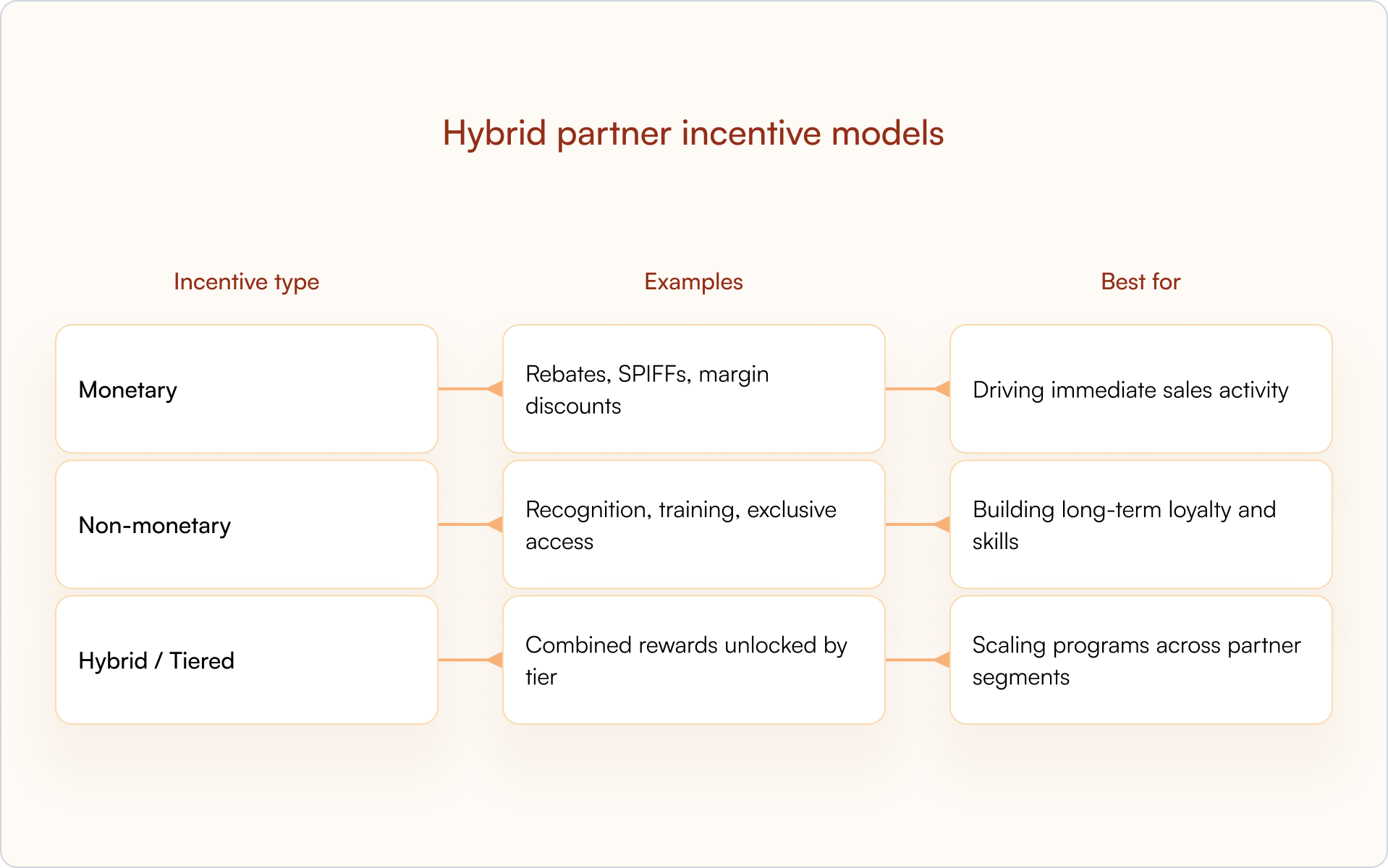
Anreizztyp Beispiele Am besten geeignet für
Monetär Rabatte, SPIFFs, Margenrabatte Sofortige Verkaufsaktivitäten vorantreiben
Nicht monetär Anerkennung, Schulung, exklusiver Zugang Aufbau langfristiger Loyalität und Kompetenzen
Hybrid / Gestaffelt Kombinierte Belohnungen, die je nach Stufe freigeschaltet werden Skalierung von Programmen über Partnersegmente hinweg

11 Strategien zur Leistungssteigerung von Partnern, um Wiederverkäufer und Vertriebspartner zu motivieren

Betrachten Sie die folgende Liste als Werkzeugkasten. Die meisten Startups erzielen bessere Ergebnisse, wenn sie 3–5 sich gegenseitig verstärkende Anreize kombinieren (z. B. Deal Protection + Tiering + Zertifizierungsvorteile), anstatt 11 auf einmal einzuführen.
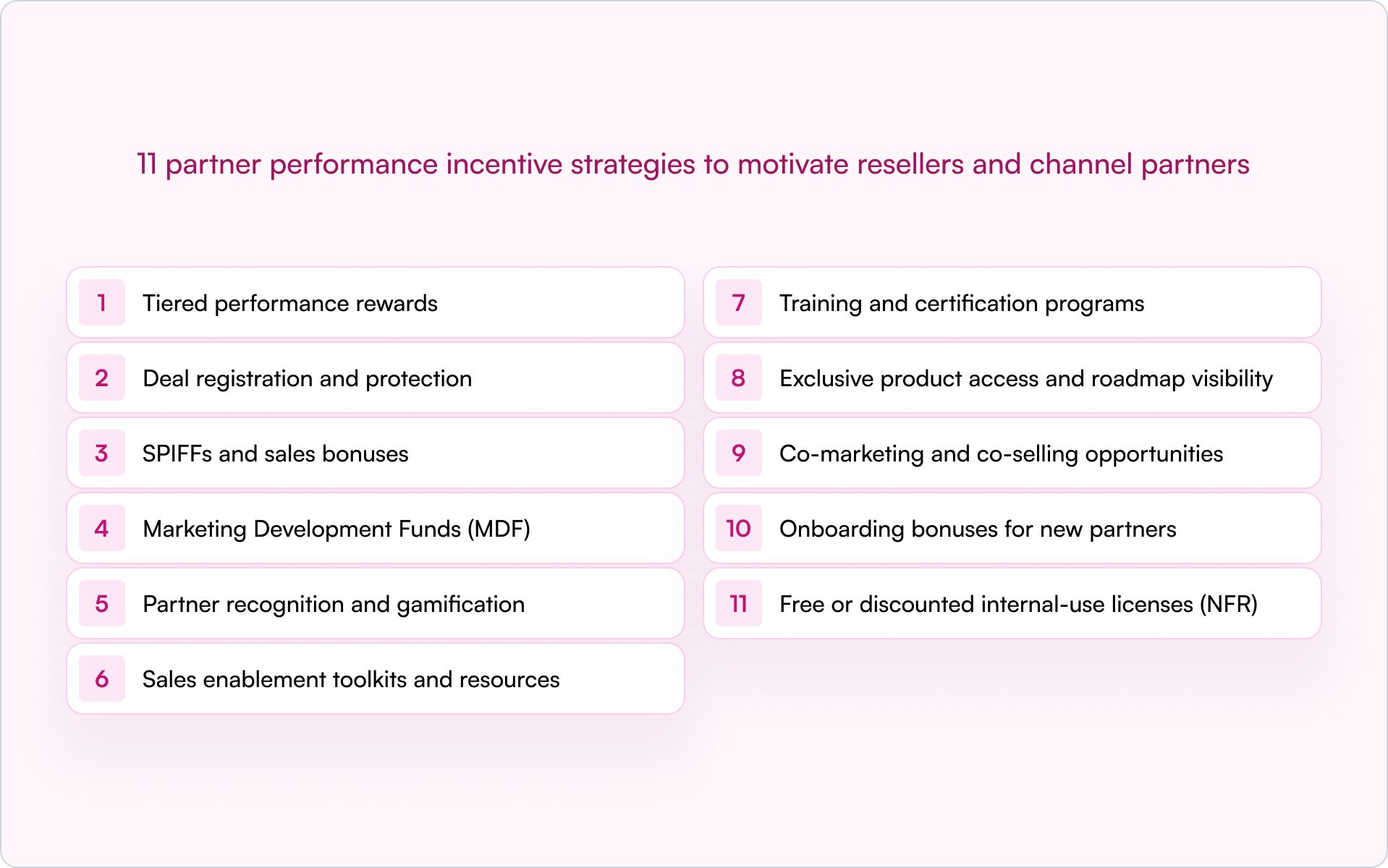
  1. Gestaffelte Leistungsprämien

Gestaffelte Programme schaffen einen klaren Weg für das Wachstum der Partner. Partner erhalten bessere Anreize – höhere Margen, mehr Unterstützung, Co-Marketing-Fonds –, wenn sie bestimmte Leistungsschwellen wie erzielte Umsätze oder abgeschlossene Geschäfte erreichen. Stufen funktionieren, weil sie Partner motivieren, sich zu verbessern und mehr in die Partnerschaft zu investieren.

Halten Sie die Stufen erreichbar, aber sinnvoll. Wenn die erste Stufe zu schwer zu erreichen ist, werden sich die Partner nicht darum bemühen. Wenn sie zu leicht zu erreichen ist, verliert die Belohnung ihren Wert und Sie „verschenken“ am Ende Vorteile für grundlegendes Verhalten.

  1. Deal-Registrierung und -Schutz

Bei der Deal-Registrierung registrieren Partner Opportunities, um Schutz zu beanspruchen und ihre Marge zu sichern. Dies verhindert Konflikte im Vertriebskanal und belohnt Partner, die proaktiv neue Deals akquirieren.

Partner werden sich nicht engagieren, wenn sie befürchten, einen Auftrag an Ihr direktes Team oder einen anderen Partner zu verlieren. Ein CRM-orientierter Ansatz sorgt für Transparenz im Prozess und reduziert Streitigkeiten – insbesondere, wenn Status und Schutzfristen für beide Seiten sichtbar sind.

  1. SPIFFs und Verkaufsprämien

Ein SPIFF (Sales Performance Incentive Fund) ist ein kurzfristiger Barbonus für bestimmte, zeitgebundene Maßnahmen. Er ist ein praktisches Mittel, um die Aufmerksamkeit der Partner auf unmittelbare Prioritäten zu lenken.

  • Verwenden Sie SPIFFs für: Neue Produkteinführungen, End-of-Quarter-Pushes oder den Abverkauf bestimmter Lagerbestände.
  • Verwendung der Marge für: Laufende, vorhersehbare Partnervergütung, die die Grundlage für ihr Verdienstpotenzial bildet.
  1. Marketingentwicklungsfonds (MDF)

Marketing Development Funds sind Mittel, die Sie Ihren Partnern für gemeinsame Marketingaktivitäten zur Verfügung stellen – Webinare, lokale Veranstaltungen, digitale Kampagnen. MDF motiviert Partner, ihre eigene Zeit in die Generierung von Nachfrage für Ihr Produkt zu investieren.

MDF funktioniert am besten, wenn es an die Leistung gekoppelt ist. Partner verdienen mehr Geld, wenn sie bessere Ergebnisse erzielen, was Ihren ROI schützt und die Ausgaben für „geschenktes Geld“ reduziert.

  1. Partneranerkennung und Gamifizierung

Anerkennungsprogramme wie Ranglisten, Partnerauszeichnungen und öffentliche Danksagungen sind wirkungsvolle nicht-monetäre Anreize. Gamification – Punkte, Abzeichen, Wettbewerbe – hält Partner zwischen den Geschäften bei Laune.

Die Darstellung der Leistung in einem gemeinsamen Partnerportal kann einen gesunden Wettbewerb fördern, ohne Reibungen zu verursachen – solange die Bewertungsregeln transparent sind.

  1. Toolkits und Ressourcen zur Vertriebsunterstützung

Partnern bessere Vertriebsinstrumente und Ressourcen zur Verfügung zu stellen, ist an sich schon ein Anreiz. Mit gebrauchsfertigen Pitch-Decks, Battle Cards, ROI-Rechnern und Demo-Umgebungen können Partner vor Kunden einen guten Eindruck hinterlassen und Geschäfte schneller abschließen.

Partner tendieren natürlich zu Anbietern, die sie für den Erfolg rüsten – insbesondere wenn Ihre Mitbewerber nur langsam Materialien aktualisieren oder ihre Botschaften nicht konsistent halten.

  1. Schulungs- und Zertifizierungsprogramme

Zertifizierungen stärken die Fähigkeiten Ihrer Partner und wirken als dauerhafter Anreiz. Verbinden Sie den Zertifizierungsstatus mit konkreten Vorteilen – Zugang zu besseren Leads, höheren Margen oder exklusiven Co-Selling-Möglichkeiten – und Ihre Partner werden in das Erlernen Ihres Produkts investieren.

Für Gründer ist dies auch ein Qualitätshebel: Ein zertifiziertes Ökosystem bedeutet in der Regel weniger fehlgeschlagene Implementierungen und weniger Eskalationen, die wieder bei Ihrem Team landen.

  1. Exklusiver Produktzugang und Transparenz der Roadmap

Wenn Sie Ihre Produkt-Roadmap teilen, Beta-Zugang anbieten oder frühzeitige Vorschauen gewähren, fühlen sich Ihre Partner wie echte Insider. Das stärkt die Loyalität und hilft ihnen, ihre eigenen Vertriebsaktivitäten rund um bevorstehende Releases zu planen.

Es handelt sich um einen kostengünstigen, wirkungsvollen Anreiz – und er zieht in der Regel Partner an, die etwas Langfristiges aufbauen wollen und nicht nur die einfachsten SKUs weiterverkaufen möchten.

  1. Möglichkeiten für gemeinsames Marketing und gemeinsamen Vertrieb

Co-Marketing umfasst gemeinsame Kampagnen und geteilte Inhalte. Co-Selling umfasst gemeinsame Verkaufsgespräche und eine geteilte Pipeline mit Ihrem Direktvertriebsteam.

Für viele Partner ist der Zugang zu Ihren internen Vertriebs- und Marketingressourcen äußerst wertvoll – insbesondere, wenn sie größere, komplexere Geschäfte abschließen oder in ein neues Segment vordringen möchten.

  1. Onboarding-Boni für neue Partner

Onboarding-Boni belohnen neue Partner für das Erreichen wichtiger Aktivierungsmeilensteine innerhalb eines bestimmten Zeitraums – die Registrierung ihres ersten Geschäfts, den Abschluss ihres ersten Verkaufs oder den Abschluss erster Zertifizierungen.

Richtig eingesetzt, beschleunigen Onboarding-Anreize die Zeit bis zum ersten Umsatz und reduzieren die Abwanderung in den ersten 60 bis 90 Tagen, in denen Partner am ehesten dazu neigen, Sie zugunsten einer „einfacheren Lösung” fallen zu lassen.

  1. Kostenlose oder vergünstigte Lizenzen für den internen Gebrauch (NFR)

Wenn Sie Ihren Partnern kostenlose oder stark vergünstigte Lizenzen für die interne Nutzung Ihres Produkts gewähren (oft als NFR-Lizenzen – „Not For Resale“ – bezeichnet), können diese zu Produktexperten und echten Fürsprechern werden.

Partner, die Ihr Produkt täglich nutzen, verstehen dessen Wertversprechen genau und verkaufen es authentischer – was besonders wichtig ist, wenn Ihre Kategorie überfüllt ist und alle Botschaften gleich klingen.

Sechs häufige Fehler bei Vertriebsanreizprogrammen für Vertriebskanäle

Anreize scheitern nicht, weil Partner „unmotiviert“ sind. Sie scheitern, weil das Programm verwirrend ist, als unfair empfunden wird oder zu langsam auszahlt, um eine Verhaltensänderung zu bewirken.

  • Das Programm zu kompliziert gestalten: Wenn Partner die Regeln nicht verstehen oder ihre Einnahmen nicht abschätzen können, werden sie nicht daran teilnehmen.
  • Unrealistische Ziele setzen: Wenn Schwellenwerte unerreichbar erscheinen, ziehen sich Partner zurück, anstatt sich „noch mehr anzustrengen“.
  • Inkonsistente Kommunikation: Partner können nicht auf Anreize reagieren, von denen sie nichts wissen. Kündigen Sie diese frühzeitig an und wiederholen Sie sie regelmäßig.
  • Das Feedback der Partner ignorieren: Programme, die ohne Einbeziehung der Partner entwickelt werden, verfehlen oft das, was den Vertrieb tatsächlich motiviert.
  • Verzögerte Auszahlungen oder Anerkennung: Eine langsame Belohnungsauszahlung bremst die Dynamik und untergräbt das Vertrauen.
  • Einheitsanreize: Verschiedene Partnertypen reagieren auf unterschiedliche Motivatoren. Segmentieren und maßschneidern.

Wie man einen effektiven Leistungsanreizplan für Partner entwirft
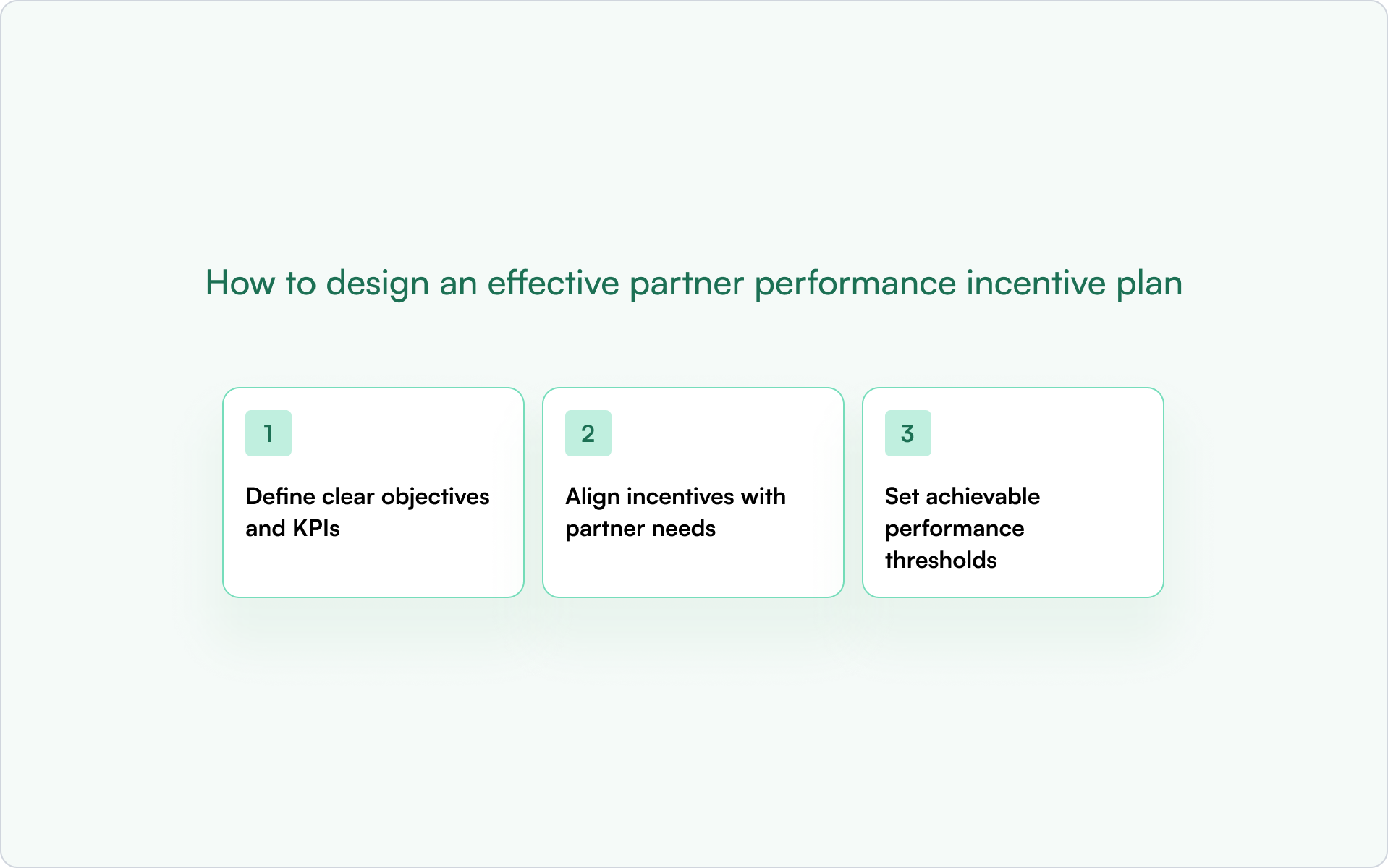
1) Klare Ziele und KPIs definieren

Jeder Anreiz sollte einem bestimmten, messbaren Geschäftsziel zugeordnet werden. Definieren Sie vor der Einführung, wie Erfolg aussieht, z. B.:

  • Steigern Sie die Deal-Registrierungen aus einem bestimmten Partnersegment um 20 %.
  • Beschleunigen Sie den Abschluss von Geschäften, die von Partnern vermittelt wurden, um 15 Tage.
  • Fördern Sie die Einführung einer neuen Produktlinie durch Partner auf 10 % des Gesamtumsatzes.

2) Anreize an die Bedürfnisse der Partner anpassen

Verschiedene Partner haben unterschiedliche Wünsche. Einige sind ausschließlich an Geld interessiert, andere legen Wert auf Leads, Anerkennung, Unterstützung oder Zugang. Befragen Sie Ihre Partner oder segmentieren Sie sie nach Typ (Empfehlung vs. Wiederverkäufer vs. Dienstleistungen), damit die Anreize ihren tatsächlichen Interessen entsprechen.

3) Festlegen erreichbarer Leistungsschwellenwerte

Die Ziele sollten die Partner herausfordern, aber realistisch bleiben. Sind die Schwellenwerte zu hoch, ziehen sich die Partner zurück. Sind sie zu niedrig, riskieren Sie, für Ergebnisse, die Sie ohnehin erzielt hätten, zu viel zu bezahlen.

Wie man den ROI eines Partner-Incentive-Programms misst

Leistungskennzahlen für Partner zur Nachverfolgung

  • Eingereichte Deal-Registrierungen: Sind Partner aktiv engagiert und bringen sie neue Geschäftsmöglichkeiten ein?
  • Konvertierte Deal-Registrierungen: Sind registrierte Deals qualitativ hochwertig und führen sie zu abgeschlossenen Umsätzen?
  • Von Partnern generierte vs. von Partnern beeinflusste Einnahmen: Wie hoch ist der tatsächliche finanzielle Beitrag Ihres Vertriebskanals?
  • Durchschnittliche Geschäftsgröße nach Partnerstufe: Schließen Partner höherer Stufen größere Geschäfte ab?

Engagement- und Beteiligungsquoten

Die Nachverfolgung der Teilnehmer ist ebenso wichtig wie die Nachverfolgung der Ergebnisse. Eine geringe Beteiligung ist in der Regel ein Problem des Designs oder der Kommunikation – und kein Problem der „Partnerqualität“. Verfolgen Sie die Anmeldungen im Partnerportal, den Abschluss von Zertifizierungen, die Nutzung von MDF und die Reaktionsfähigkeit auf Ankündigungen.

Umsatzzuordnung und ROI-Berechnung

Um den ROI von Incentives zu berechnen, vergleichen Sie die Gesamtkosten der ausgezahlten Incentives mit den zusätzlichen Einnahmen, die durch von Partnern generierte Geschäfte erzielt wurden. Eine genaue Zuordnung erfordert saubere CRM-Daten und eine einzige Quelle für alle Partneraktivitäten und Analysen.

Wie man Partnern Incentive-Programme vermittelt

Selbst das großzügigste Incentive-Programm scheitert, wenn die Partner nichts davon wissen – oder die Regeln nicht finden können, wenn sie sie brauchen.

  • Kündigen Sie dies über mehrere Kanäle an: E-Mail, Ihr Partnerportal, Slack und Partner-QBRs. Verlassen Sie sich nicht auf eine einzige Nachricht.
  • Regeln zugänglich machen: Veröffentlichen Sie klare Programmregeln, auf die Partner jederzeit zugreifen können.
  • Erinnerungen senden: Benachrichtigen Sie Partner, wenn sie sich einem Schwellenwert nähern oder wenn ein SPIFF bald abläuft.
  • Feiern Sie Erfolge öffentlich: Anerkennung hält die Dynamik aufrecht und signalisiert, dass das Programm echt ist.
  • Empfang bestätigen: Verwenden Sie bei wichtigen Updates Lesebestätigungen oder Empfangsbestätigungen. Tools wie die Ankündigungsfunktion von Introw versenden Updates per E-Mail und Slack Lesebestätigung.

Erstellen Sie mit Introw ein skalierbares Partner-Incentive-Programm.

Eine CRM-orientierte Plattform für das Partnerbeziehungsmanagement erleichtert die Verwaltung, Nachverfolgung und Skalierung von Leistungsanreizen für Partner – ohne dass dabei ein Chaos aus Tabellenkalkulationen entsteht.

  • Deal-Registrierung und -Schutz: Introw zentralisiert die Deal-Registrierung innerhalb von HubSpot oder Salesforce, sodass Partner Deals registrieren und den Schutzstatus einsehen können, ohne Ihr Team kontaktieren zu müssen.
  • Partnerportal für Programmtransparenz: Veröffentlichen Sie Incentive-Regeln, Stufenanforderungen und Ranglisten in einem einzigen Portal, auf das Partner problemlos zugreifen können.
  • Ankündigungen und Benachrichtigungen: Versenden Sie Push-Updates zu Incentives, SPIFF-Fristen und Anerkennungen per E-Mail und Slack und verfolgen Sie, wer sie gesehen hat.
  • Echtzeit-Transparenz der Pipeline: Partner sehen den Status von Geschäften in Echtzeit und können sich darauf verlassen, dass registrierte Geschäfte bearbeitet werden.
  • Saubere CRM-Daten für die Zuordnung: Da Introw auf Ihrem CRM basiert, werden die von Partnern erzielten Umsätze genau zugeordnet – es gibt keine Diskussionen mehr darüber, wer den Deal abgeschlossen hat.

Wenn Sie Ihren Kanal aufbauen und Anreize suchen, die ohne zusätzliche Mitarbeiter skalierbar sind, fordern Sie eine Demo an, um zu sehen, wie Introw funktioniert.

Fazit

Das Ziel von Leistungsanreizen für Partner besteht nicht darin, „Partnern mehr zu zahlen“. Es geht darum, ein System zu schaffen, in dem das richtige Verhalten von Partnern – Geschäfte akquirieren, Zertifizierungen erwerben, Pipelines aufbauen, Umsätze erzielen – klar belohnt, leicht verständlich und konsistent nachverfolgt wird.

Fangen Sie einfach an, schützen Sie frühzeitig die Bemühungen Ihrer Partner (die Registrierung von Geschäften ist oft der erste Schritt mit der größten Hebelwirkung) und wiederholen Sie dies vierteljährlich auf der Grundlage der Teilnahme und des ROI. Die besten Incentive-Programme steigern nicht nur den kurzfristigen Umsatz, sondern schaffen auch einen Vertriebskanal, in den Partner tatsächlich investieren möchten.

FAQs

Noch Fragen? Hier findest du die häufigsten Fragen und Antworten.

Kontaktiere uns

What does SPIFF mean in channel sales?

SPIFF stands for Sales Performance Incentive Fund. It’s a short-term cash bonus paid to salespeople or partners for completing a specific action — for example, closing a deal on a target product, registering a qualified opportunity, or hitting a deadline.

What is the difference between a SPIFF and a rebate in a partner incentive program?

A SPIFF is a one-time bonus for a specific, immediate action. A rebate is a volume-based discount paid back after a partner hits a cumulative sales threshold over a longer period (often monthly or quarterly). SPIFFs drive urgency; rebates reward sustained performance.

How often should partner performance incentives be updated?

Review your incentive plan quarterly to evaluate participation, payout efficiency, and ROI. Make major structural changes annually based on partner feedback and shifting business priorities. Avoid changing rules mid-program unless you communicate clearly and give partners time to adjust.

Can reseller incentive programs offer different rewards to different partner tiers?

Yes — tiered programs are a standard best practice. Higher-performing partners earn better margins, more MDF, and exclusive benefits. This motivates all partners to level up while allowing you to invest more in your most valuable performers.

How do you prevent channel conflict in a partner incentive program?

Deal registration with clear protection windows and first-to-register rules is the most effective approach to preventing channel conflict. When partners trust that the deals they register are protected, they’re more willing to bring new opportunities forward — and less likely to “hide” deals until late stage.


Launch your partner portal
in minutes!

Vielen Dank! Wir haben deine Anfrage erhalten!
Hoppla! Beim Absenden des Formulars ist ein Fehler aufgetreten.

Verwandte Blog-Artikel

Partner-Management

Best Partner Relationship Management (PRM) Software for B2B Teams in 2026

Andreas Geamanu
Co-founder & CEO
5min Lesezeit
17 Mar 2026
⚡ TL;DR

Partner relationship management (PRM) software helps you manage partner relationships, run partner programs, and track deal registration without losing visibility in your customer relationship management system.

If you’re comparing PRM software, this guide shows what actually works and how to choose the right fit.

Most PRM platforms still rely on a partner portal, which can slow down partner onboarding, partner activities, and adoption. Newer platforms focus on real-time collaboration, cleaner partner data, and better partner communication.

That makes it easier to manage partner relationships across the entire partner lifecycle, support channel partners, and improve partner performance.

If you’re looking for a faster, CRM-first approach to partner relationship management, Introw is built to help your sales team move quicker and stay aligned.

The best partner relationship management software (shortlist)

If you’re comparing PRM software, you don’t need a long list. You need tools that help you manage partner relationships, support co-selling, and drive partner revenue without slowing your team down. If you’re still deciding what matters, reviewing PRM best practices and learning how to choose a PRM will help you make a better call.

1. Introw

Introw is an AI-first partner relationship management software built for SaaS teams that want a modern partner experience directly inside their customer relationship management system.

It replaces the partner portal with real collaboration across email and Slack, so your sales team and channel partners stay aligned on deal registration, deal progression, and partner activities.

For co-selling and indirect sales channels, it gives you clear visibility into partner performance, partner revenue, and the sales pipeline without duplicating partner data.

Introw also combines execution with AI, helping you automate partner onboarding, track partner activities in real time, and keep deals moving across the sales cycle with built-in insights and communication support.

Am besten geeignet für

  • SaaS teams scaling partner programs and partner networks
  • Teams that want to manage partner relationships without a partner portal
  • Businesses focused on co-selling and partner growth

How Introw approaches partner relationship management differently

Most partner relationship management tools are built around structure. They rely on partner portals, manual updates, and separate workflows for partners and sales teams.

That works for some channel programs. But it can slow things down, especially if your team is focused on co-selling and real collaboration across the partner journey.

Introw takes a different approach.

Built inside your CRM, not around it

Introw works directly inside your customer relationship management system, including native integrations with Salesforce and HubSpot.

Your partner relationship manager, sales team, internal teams, and channel partners all stay aligned on deal registration, deal progression, and partner activities in one place.

This makes it easier to manage partner relationships without duplicating data or switching between systems.

Collaboration without the portal friction

Instead of forcing partners into a portal, Introw supports collaboration through email, Slack, and shared workflows.

That means business partners can stay engaged without changing how they already work.

It also reduces delays. Conversations, updates, and deal progress all happen in real time, which is critical for co-selling and keeping momentum across your partnership strategy.

Visibility into what partners are actually doing

Because everything happens inside your CRM, you get a clearer view of partner performance, partner revenue, and pipeline.

You can see which partners are active, where deals are progressing, and where support is needed without chasing updates.

This level of visibility helps teams reduce channel conflict and balance partner motions with direct sales.

AI support that fits into your workflow

Introw combines execution with AI to reduce manual work.

With the Introw + Claude integration, your team can generate summaries, surface insights, and keep partner communication moving without extra tools.

If you want to get started, you can install the Claude connector directly into your workflow.

If your team is building toward world class partner programs with faster execution and stronger visibility, this approach can feel much simpler than traditional partner management software.

In the end, the difference comes down to how your team actually works with partners.

If you’re looking for a simpler way to manage partner relationships and improve partner engagement across the entire partner lifecycle, Introw is a strong option to consider.

2. Salesforce PRM

Salesforce PRM is a partner relationship management software built into the broader customer relationship management platform, so it’s a natural fit if your business already runs on Salesforce. It helps you manage partner relationships, track deal registration, monitor partner activities, and support channel partners within a single system.

It works well for large partner ecosystems with complex partner programs, but it often depends on partner portals and custom setup across the partner lifecycle. That can slow partner onboarding and make partner experience harder to manage without strong partner operations and clear relationship management processes.

Am besten geeignet für

  • Enterprise teams already using Salesforce
  • Complex partner programs and channel sales
  • Businesses with strong internal ops resources
Pros Cons
Deep integration with customer relationship management data Heavy setup and customization required
Strong deal registration and lead distribution workflows Relies on partner portal workflows
Advanced reporting on partner performance Slower time to value for smaller teams

When it may not be the right fit

If your team needs fast setup, flexible collaboration, or wants to avoid heavy customization and portal-based workflows, this approach can feel limiting

If you’re exploring alternatives, many teams compare Salesforce PRM alternatives to see how modern PRM software supports co-selling and partner experience.

3. Impartner

Impartner is a well-known partner relationship management software designed to support structured partner programs across large partner networks. It focuses on partner onboarding, partner portals, and managing the partner lifecycle at scale.

It’s often used by companies with established reseller programs and formal partner operations. That said, it can feel heavy if your team wants faster setup or more flexible co selling workflows.

Am besten geeignet für

  • Mid-market to enterprise partner programs
  • Teams running structured reseller partners and referral partners
  • Businesses focused on long-term partner lifecycle management
Pros Cons
Strong partner onboarding experience Portal-heavy experience
Built-in marketing tools and co marketing support Less flexible for co-selling workflows
Detailed tracking of partner performance and partner activities Can feel complex for smaller teams

When it may not be the right fit

If your team prioritizes speed, simplicity, or real-time collaboration over structured partner programs, this setup can feel heavy and slow to adapt.

If you’re comparing tools in this category, reviewing the best Impartner competitors can help you see how newer PRM platforms approach partner management.

4. ZINFI

ZINFI is a partner relationship management software focused on channel partners, partner recruitment, and managing global partner ecosystems. It combines partner management, marketing activities, and sales enablement into one platform designed for indirect sales.

It’s a solid option for companies that need to manage reseller programs across regions, but the experience often centers around partner portals and structured workflows across the partner lifecycle.

Am besten geeignet für

  • Global partner ecosystems and channel sales teams
  • Businesses managing reseller programs at scale
  • Teams focused on partner recruitment and partner performance
Pros Cons
Strong support for partner onboarding and the partner lifecycle Relies on structured partner portal workflows
Tools for marketing campaigns and co-marketing Less flexible for fast-moving sales teams
Built-in performance metrics and reporting capabilities Can feel rigid for modern partner ecosystems

When it may not be the right fit

If your team needs flexible collaboration, faster execution, or wants to reduce reliance on partner portals, this approach may feel too rigid.

5. Magentrix

Magentrix is a partner relationship management software focused on customizable partner portals and controlled access to partner resources. It helps teams manage partner relationships, share marketing materials, and track deal registration and partner activities across the partner lifecycle.

It’s often chosen by teams that want flexibility without building a system from scratch, though most workflows still run through the partner portal.

Am besten geeignet für

  • Teams that want customizable partner portals
  • Businesses managing partner networks with structured access
  • Companies sharing marketing materials and partner resources
Pros Cons
Flexible partner portal setup with controlled access Portal-first experience
Integration with customer relationship management systems Less focus on real-time collaboration
Tools for managing partner activities and deal progression Can require setup to fit workflows

When it may not be the right fit

If your team prioritizes real-time collaboration, faster execution, or wants to reduce reliance on a partner portal, this setup may feel limiting.

6. Mindmatrix

Mindmatrix is a partner relationship management software that combines partner management, marketing automation, and partner enablement into one platform. It helps teams onboard partners, manage partner activities, and run marketing activities across the partner lifecycle.

It’s often used by companies that want to support partners beyond deal registration, especially with content, campaigns, and ongoing engagement.

Am besten geeignet für

  • Teams focused on partner onboarding and partner enablement
  • Businesses running content-driven partner programs
  • Companies supporting partners across the entire partner lifecycle
Pros Cons
Combines partner management with marketing automation Can feel complex to set up
Strong support for partner onboarding and partner training The interface can feel dated
Supports marketing activities and co-marketing campaigns Less focused on CRM-native workflows

When it may not be the right fit

If your team wants a lightweight tool or primarily needs CRM-native collaboration, this platform may feel too complex.

7. PartnerStack

PartnerStack is partner relationship management software built for SaaS companies running affiliate, referral, and reseller partner programs. It focuses on partner recruitment, incentive programs, and scaling partner networks.

It’s widely used for SaaS growth through partnerships, especially in marketing-led and indirect sales models.

Am besten geeignet für

  • SaaS companies running affiliate or referral partner programs
  • Teams focused on partner recruitment and partner growth
  • Businesses scaling partner ecosystems quickly
Pros Cons
Strong partner recruitment and partner discovery capabilities Less suited for complex B2B co selling
Automated payouts and incentive management Limited visibility into partner performance
Easy to scale partner programs quickly Not built for deep sales collaboration

When it may not be the right fit

If your focus is on complex sales processes, co-selling, or managing enterprise channel partners, this platform may not provide enough depth.

8. Crossbeam

Crossbeam is a partner ecosystem platform focused on account mapping, partner data sharing, and identifying opportunities across your partner network. It helps teams uncover overlap, support co-selling, and improve partner collaboration through shared insights.

It’s often used alongside partner relationship management software rather than as a full partner management solution.

Am besten geeignet für

  • Teams focused on co-selling and account mapping
  • Businesses running ecosystem-led growth strategies
  • Sales teams identifying shared opportunities with channel partners
Pros Cons
Strong partner data visibility and account mapping Not a full partner management software
Helps identify co-selling opportunities quickly No deal registration or partner onboarding workflows
Integrates with customer relationship management systems Requires additional tools for execution

When it may not be the right fit

If you need complete partner relationship management software to manage the entire partner lifecycle, this platform will need to be paired with other tools.

9. Kiflo PRM

Kiflo PRM is a lightweight partner relationship management software designed for small to mid-sized SaaS companies. It focuses on simplicity, helping teams manage partner onboarding, deal registration, and partner activities without heavy setup.

It’s positioned as an accessible option for teams building or scaling partner programs.

Am besten geeignet für

  • Small to mid-sized SaaS companies
  • Teams starting or growing partner programs
  • Businesses looking for simple partner management tools

10. Channeltivity

Channeltivity is a partner relationship management software focused on deal registration, partner communication, and performance tracking. It provides structured workflows through a partner portal to manage partner relationships and partner activities.

It’s often used by mid-market companies that want clear processes and visibility without enterprise-level complexity.

Am besten geeignet für

  • Mid-market B2B companies
  • Teams focused on deal registration and partner performance
  • Businesses managing structured partner programs
Pros Cons
Clear deal registration and lead distribution workflows Portal-based collaboration model
Centralized partner communication tools Limited flexibility for co-selling
Berichts-Dashboards für die Leistung von Partnern Less focus on real-time collaboration

When it may not be the right fit

If your team wants flexible collaboration or to move away from partner portal workflows, this setup may feel restrictive.

11. ChannelScaler

ChannelScaler is a partner relationship management software designed to help SaaS companies scale indirect sales and improve partner performance through better visibility and performance tracking.

It focuses on helping teams understand partner contribution to channel revenue, prioritize high-performing partners, and improve decision-making across their partner network.

Am besten geeignet für

  • SaaS companies scaling indirect sales channels
  • Teams focused on partner performance and channel revenue
  • Businesses needing better visibility into partner data
Pros Cons
Strong visibility into partner performance and sales pipeline Less focus on partner onboarding and enablement
Helps prioritize high-performing partners Not built for complex partner ecosystems
Focus on performance tracking and reporting capabilities Limited real-time collaboration features

When it may not be the right fit

If your team needs strong partner onboarding, enablement, or day-to-day collaboration features, this platform may not cover all needs.

PRM software: A side-by-side comparison

Tool Am besten geeignet für Key strengths Limitations
Introw SaaS teams prioritizing co-selling and CRM-native workflows CRM-first approach, real-time collaboration, fast time to value, no heavy portal reliance Newer platform compared to legacy tools
Salesforce Enterprise teams already using Salesforce Deep CRM integration, advanced reporting, strong deal registration workflows Heavy setup, portal-based workflows, slower time to value
Impartner Structured partner programs at scale Strong partner onboarding, marketing tools, lifecycle management Portal-heavy, less flexible for co selling
ZINFI Global partner ecosystems and channel sales Partner recruitment, lifecycle management, marketing, and enablement tools Rigid workflows, portal-centric experience
Magentrix Customizable partner portals Flexible portal setup, controlled access, CRM integrations Portal-first experience, limited real-time collaboration
Gedankenmatrix Partner enablement and marketing-driven programs Combines partner management and marketing automation, strong onboarding support Complex setup, less CRM-native collaboration
PartnerStack SaaS affiliate and referral programs Partner recruitment, automated payouts, easy scaling Limited for B2B co selling and complex sales workflows
Crossbeam Ecosystem-led growth and account mapping Partner data sharing, account mapping, co selling insights Not a full partner management solution
Kiflo Small to mid-sized SaaS teams Easy setup, simple workflows, lightweight tool Limited scalability and advanced features
Channeltivity Mid-market teams with structured workflows Clear deal registration, partner communication, and reporting Portal-based, less flexible collaboration
ChannelScaler Indirect sales performance tracking Strong partner performance visibility, revenue tracking Limited onboarding and collaboration features

We know there were plenty of options. And of course they don’t all solve the same problem.

Some are built for structured partner programs. Others focus on co-selling, partner engagement, or ecosystem visibility.

The right choice depends on how your team works today and where you want to take your partner strategy next.

Let’s look at how to evaluate these tools in a way that actually supports your goals.

How to evaluate partner engagement tools: 5 key questions

Choosing partner engagement tools isn’t about features. It’s about how well the platform supports your partner program and how your sales team works with partners day to day.

A quick way to assess this is to pressure-test how the tool supports the partner lifecycle. Many teams start by reviewing a broader partner lifecycle management strategy to see where tools need to support execution.

Here are five key questions to ask:

1. Does it match how your partners actually sell?

Start with your partner model.

If you’re running structured channel partner programs alongside direct sales, you may need tighter workflows. If you’re focused on co-selling, flexibility matters more.

Many teams choose partner relationship management software that looks powerful but doesn’t match how their sales team actually works.

2. Where does collaboration actually happen?

Some tools rely on a partner portal. Others support collaboration through email, Slack, and shared workflows.

Portals can create structure, but they also add friction. If partners don’t log in regularly, deal registration slows down.

The easier it is to work together, the easier it is to keep partners engaged.

3. Can you clearly see partner performance?

You should be able to track partner performance, pipeline, and revenue without digging through reports.

Strong visibility helps you understand what’s working and where deals are stuck. It also makes it easier to manage both partner and direct sales motions.

4. Does it help you enable partners or just track them?

There’s a big difference between managing partners and enabling them.

Strong tools support partner onboarding, share the right resources, and help partners move deals forward.

If your tool only tracks activity, it’s not doing enough.

5. How quickly will it deliver value?

Some tools take months to implement. Others start working in weeks.

If setup is slow, adoption drops. The best tools reduce manual work and help your team start supporting partners quickly.

This is where the gap between traditional PRM software and newer approaches starts to show. But how can you close that gap?

Final thoughts

The best partner relationship management tools don’t just help you manage partners. They help you build active partners, improve partner satisfaction, and drive consistent partner revenue.

Some platforms prioritize structure and control. Others focus on speed, collaboration, and visibility across your partner ecosystem.

The right software solution comes down to how your team works and what your partnership strategy needs to support.

Nächste Schritte

  1. Review your current setup and identify where partner engagement slows down
  2. Look at how easily your team can register deals and manage lead management across partners
  3. Prioritize platforms that help you enable partners, not just manage them

If you’re exploring a more flexible, CRM-native approach to partner management, book a demo to see how Introw works in practice.

Partner-Management

From Strategy to Results: 11 Partner Enablement Best Practices That Work in 2026

Sara De Meurichy
Growth
5min Lesezeit
14 Mar 2026
⚡ TL;DR

Partner enablement gives partners the training, content, tools, and support they need to sell independently rather than relying on constant hand-holding from your team. The most effective programmes are structured, segmented by partner type, and connected to the CRM so you can measure readiness, track activation, and attribute revenue accurately. Strong enablement focuses on reducing time to first deal, delivering role-based training, and giving partners collateral they will actually use in live opportunities. To understand whether the programme is working, teams should track outcome-based metrics such as pipeline, revenue, certifications, and activation speed rather than vanity portal activity.

Partner enablement looks simple on paper: give partners the right resources, and they’ll sell your product. In practice, most programs stall because content is scattered, training is generic, and no one can tell which partners are actually ready to close deals.

The difference between a partner program that generates attributable revenue and one that drains resources usually comes down to structure — clear goals, the right content at the right time, and data that lives in your CRM instead of a forgotten portal. This guide breaks down partner enablement best practices from strategy through execution, plus the metrics that tell you if it’s working.

Was ist Partner-Enablement?

Partner enablement is the system you build to help external partners sell (and often implement) your product effectively. That system typically includes structured onboarding, tailored training, and easy access to the right resources so partners can move deals forward without waiting on your team.

When partner enablement is done well, partners don’t just understand what you do. They can position it, handle objections, run a clean handoff, and create repeatable wins — the same way a high-performing internal sales team would.

What partner enablement typically includes

  • Training and certification: Product knowledge, positioning, and selling motions (with a quality bar partners must meet).
  • Sales and marketing resources: Collateral, templates, and campaigns partners can use with prospects.
  • Tools and portal access: Systems that streamline deal registration, content access, and communication.
  • Ongoing communication: A predictable cadence for updates, feedback, and performance reviews.

Why partner enablement matters for revenue growth

Enabled partners drive revenue because they can execute without friction. They close deals faster, represent your brand accurately, and generate pipeline you can actually attribute.

Weak enablement is expensive in quieter ways: partners misposition the product, opportunities stall, your team becomes the bottleneck, and high-potential partners churn because “it’s too hard to work with you.”

Enablement quality What happens
Strong enablement Shorter sales cycles, higher win rates, accurate brand positioning
Weak enablement Stalled deals, brand confusion, heavy support load, high partner churn

What a partner enablement program includes

A complete channel partner enablement program isn’t a portal full of PDFs. It’s a structured system that helps partners learn, launch, and improve — with clear ownership and measurable outcomes.

Partnerschulung und -zertifizierung

Training forms the foundation: product knowledge, competitive positioning, and your sales methodology. Certification acts as a gate, ensuring partners meet a minimum quality bar before they’re authorized to sell on your behalf.

Partner sales enablement

Partner sales enablement means giving partners the same caliber of sales tools your direct team uses, adapted to their role. Think: battle cards, demo scripts, objection-handling guides, and pricing documentation.

Marketing support and co-marketing

Effective enablement helps partners generate demand, not just close it. Co-branded assets, “campaign-in-a-box” kits, and structured lead-sharing programs all increase partner-sourced pipeline.

Partner portals (and why login friction kills adoption)

A partner portal should be a self-service hub for training, collateral, deal registration, and updates. But there’s a common failure mode: partners avoid portals that require a separate, inconvenient login.

CRM-first portals reduce that friction by connecting directly to HubSpot or Salesforce, so partners can work inside the flow of real deals instead of “checking another system.”

Performance tracking and ongoing communication

Enablement is ongoing, not a one-time launch. A strong program includes visibility into partner activity, a consistent communication cadence, and mechanisms for gathering feedback and improving the experience.

11 partner enablement best practices that drive results

If you’re building a partner program inside a startup, your constraint is almost never “ideas.” It’s focus and execution. These partner enablement best practices move from strategy through rollout and iteration — with an emphasis on what actually shows up in pipeline.

1. Set specific goals and KPIs before building your program

Before you create a single asset, define what success looks like. Start with outcomes — partner-sourced revenue targets, certification completion rates, and a target time-to-first-deal — then work backward into the program.

  • Partner-sourced pipeline value
  • Certification completion rate
  • Average time from onboarding to first registered deal
  • Content engagement (downloads, video views)

2. Segment partners to personalize enablement paths

Not all partners need the same materials. Segment by partner type (reseller, referral, systems integrator), vertical focus, or performance tier, then tailor training and content accordingly.

Segment Enablement focus
Reseller Deep product training, pricing, deal registration
Referral-Partner Lightweight pitch training, lead handoff process
SIs/MSPs Technical implementation guides, certification

3. Connect enablement to your CRM from day one

For true visibility and attribution, all your enablement data — certifications, content consumption, deal registrations — lives best in your CRM, not in a disconnected system.

A CRM-first approach provides a single source of truth. When partner activity syncs directly to HubSpot or Salesforce, your sales team and RevOps see the same reality. No more chasing updates or reconciling spreadsheets. (If deal attribution is a pain point today, it’s worth tightening up your workflow around partner deal registration specifically.)

4. Design onboarding that speeds time to first deal

Partner onboarding works best as a structured, time-bound journey — not a massive content dump. The goal is to get partners to their first real opportunity quickly, then reinforce with deeper training once momentum is real.

A strong onboarding checklist includes:

  • Welcome and program overview
  • Product and Ideal Customer Profile (ICP) training
  • Competitive positioning
  • Deal registration process walkthrough
  • First co-sell or shadow opportunity

5. Create sales collateral partners actually use

Don’t reinvent the wheel. Audit the sales collateral your direct team uses most effectively and adapt it for your partners. Prioritize assets that accelerate live deals: one-pagers, battle cards, ROI calculators, and customer stories.

The fastest way to avoid producing content no one opens is simple: ask partners what they need to win the deals they already have, then build for that.

6. Build training programs tied to revenue outcomes

Training works best when it’s modular, role-based, and tied to certification. Use certification as a gate — for example, require a partner to complete key modules before they can register deals or request MDF.

On-demand training offers flexibility; live sessions drive engagement for complex topics. Most teams land on a hybrid model.

7. Centralize everything in a partner portal without login friction

A partner portal should be the single place to find enablement content, register deals, and get program updates. But portals fail when they add friction — especially separate logins, stale content, and unclear navigation.

If you want adoption, reduce steps. Portals built directly on the CRM (with SSO or no-login options) make access feel seamless, which is often the difference between “partners love it” and “partners ignore it.”

8. Launch co-marketing programs that generate leads for both sides

Co-marketing goes beyond providing partners with your logo. Joint webinars, co-branded content like eBooks or case studies, and Market Development Funds (MDF) programs actively help partners generate demand.

If you’re a founder, this is one of the highest-leverage shifts you can make: partners often need help creating pipeline, not just closing it.

9. Establish a communication cadence partners can count on

Define a predictable rhythm. Partners shouldn’t have to guess where to find updates or whether deal registration is working. Use channels like email and Slack to reach partners where they already operate — don’t rely solely on them logging into a portal.

Häufigkeit What to communicate
Wöchentlich Deal registration status updates
Monatlich Product updates, new content announcements
vierteljährlich QBRs, performance reviews, program changes

10. Gather partner feedback and act on it fast

Enablement is a two-way street. Collect feedback through surveys, QBR conversations, and portal analytics — then close the loop by making changes and telling partners what you changed.

Partners keep investing when they feel momentum. Small, fast improvements create that signal.

11. Review and evolve your enablement strategy quarterly

Partner enablement isn’t set-and-forget. Quarterly, review what’s working and what isn’t by analyzing content engagement, certification rates, and revenue impact. Then adjust your program like you’d adjust product — based on usage and outcomes.

Partner enablement training metrics to track

To understand if your partner enablement process is working, track metrics that connect enablement activities directly to revenue outcomes — not just vanity activities.

Content engagement and consumption

Track which resources partners actually use: downloads, video completion rates, and page views. Low engagement can signal the content isn’t relevant, is hard to find, or doesn’t match what partners need in active deals.

Training completion and certification rates

Measure how many partners complete onboarding and earn certifications. Completion rates help you pinpoint drop-off points so you can shorten, reorder, or redesign modules.

Zeit bis zum ersten Geschäft

Track the time between partner activation and their first registered deal. This is one of the cleanest indicators that onboarding is working — or that partners are stuck.

Partner-sourced pipeline and revenue

This is the ultimate scoreboard. Track pipeline and closed-won revenue generated by partners. To do it well, you need tight CRM attribution so enablement activity can be tied to financial results without manual cleanup.

How to automate your partner enablement process

Automation lets you scale partner enablement without scaling headcount. The goal isn’t to make the experience robotic — it’s to make it consistent, timely, and measurable.

CRM-based automation is ideal because it keeps data and workflows in one system. That’s how you avoid the “portal says one thing, CRM says another” problem.

  • Onboarding sequences: Automatically enroll new partners in training modules and send welcome materials as soon as they sign up.
  • Certification reminders: Trigger automated alerts to partners and partner managers before certifications expire.
  • Content delivery: Push relevant collateral to partners based on their segment, tier, or deal stage.
  • Deal registration alerts: Automatically notify partners of the status of their registered deals.

Turn partner enablement into a revenue engine with Introw

Introw is the CRM-first PRM that makes best-practice partner enablement practical and scalable. Because it’s built on HubSpot and Salesforce, Introw centralizes your entire partner program where you already work.

It includes a partner portal for centralizing enablement content without login friction, deal registration with real-time visibility, and off-portal collaboration so partners can reply via email while data syncs automatically to your CRM.

If you’re trying to get out of spreadsheet chaos and into measurable partner-sourced revenue, get a demo.

Fazit

The best partner enablement programs aren’t built on more content — they’re built on clarity. Clear goals, segmented paths, CRM-connected workflows, and a focus on speed-to-first-deal turn “partners we signed” into “partners who ship revenue.”

Use these partner enablement best practices as a blueprint, then iterate quarterly based on what your data (and your partners) tell you.

Partner-Management

11 Best Partner Engagement Platforms for SaaS Partner Programs

Janis De Sutter
Software Engineer
5min Lesezeit
14 Mar 2026
⚡ TL;DR

The right partner engagement tools help your team activate partners faster, keep channel partner communication consistent, and turn partner activity into real pipeline. Modern partner engagement software goes beyond basic portals. It supports partner enablement, deal registration, and real-time collaboration with your sales team inside existing workflows. You'll get a shortlist of partner engagement platforms built for SaaS partner programs, plus what features actually matter when choosing one.

The 11 best partner engagement tools in 2026

The right partner engagement tools help your team activate partners, keep communication consistent, and connect partner activity to real pipeline.

Here is our shortlist of platforms used by SaaS companies to manage partner engagement, partner enablement, and channel partner collaboration.

1. Introw - Best CRM-native partner engagement platform

Introw is a CRM-first partner engagement platform built for SaaS companies that want partner engagement tied directly to pipeline activity.

Instead of forcing partners into a portal, Introw keeps partners up to date through email, Slack, and CRM-driven workflows while logging partner activities directly inside HubSpot or Salesforce.

Because engagement data connects to deals and revenue, your team can clearly see how partner engagement influences partner performance and sales performance. This is why many SaaS companies adopt a CRM-native approach to partner engagement rather than relying on standalone partner portals.

Teams often use Introw to manage partner communication, deal registration, partner onboarding, and channel partner enablement directly inside their CRM. Many of the workflows behind these processes are documented in Introw’s resources on partner engagement.

Am besten geeignet für

SaaS companies that want partner engagement tied directly to pipeline and CRM workflows.

Key engagement features

  • CRM-native collaboration inside HubSpot and Salesforce
  • Segmented announcements to keep partners up to date
  • Engagement tracking and performance analytics
  • Off-portal communication logging across email and Slack
  • Deal registration and deal-based partner activity visibility
  • Engagement metrics connected to partner performance and revenue
  • Integrated partner portal and partner training capabilities for channel partner enablement programs

Strength

Deep CRM integration allows partner engagement data to live alongside deals, accounts, and sales process activity, making it easier for RevOps and the sales team to monitor partner activities and optimize channel partner performance.

Limitation

Companies without Salesforce or HubSpot will not benefit from the platform’s CRM-native design.

Ideal company size

Mid-market and enterprise SaaS companies running structured partner programs with multiple partner managers and active partner ecosystems.

A strong partner engagement platform should make it easier to activate partners and track their impact on the pipeline. Now let’s look at other tools used across partner ecosystems and channel partner enablement programs.

2. Impartner – Enterprise partner management platform

Impartner is a partner management platform designed for companies running large channel partner ecosystems. It focuses on structured partner onboarding, partner marketing, and automation that helps partner programs scale while keeping partners up to date.

Am besten geeignet für

Enterprise companies managing complex channel partner ecosystems and structured channel partner enablement programs.

Key engagement features

  • Automated partner onboarding and partner training workflows
  • Campaign management and marketing materials for partner marketing
  • Performance analytics dashboards to monitor partner performance

Strength

Strong structure for large partner ecosystems that need standardized workflows across partner onboarding, partner enablement, and partner management.

Limitation

Engagement often depends on partners returning to a portal, which can slow down real-time partner activities and collaboration with the sales team.

Ideal company size

Enterprise organizations with global partner programs and large partner networks.

3. Channelscaler – Partner enablement and automation platform

Channelscaler is a partner platform designed to help companies scale partner revenue through PRM, partner program automation, and channel partner enablement. It focuses on partner onboarding, training, content delivery, and structured program management across partner ecosystems. 

Am besten geeignet für

Companies that want structured partner onboarding, partner enablement, and channel partner enablement tools in one platform.

Key engagement features

  • Partner onboarding, training, and personalized learning paths
  • Content delivery for marketing resources and marketing materials
  • Program automation and reporting to monitor partner performance

Strength

Strong fit for teams that need structured channel partner enablement and formal partner program workflows across a growing partner network. 

Limitation

The platform is more program- and portal-led than lightweight, CRM-native engagement, so it may feel heavier for teams that want faster off-platform collaboration. This is an inference from its public positioning and feature structure. 

Ideal company size

Mid-market and enterprise companies running structured partner programs. 

4. Channeltivity – Practical PRM for growing channel teams

Channeltivity is PRM software built for companies that want practical partner management without heavy enterprise complexity. It supports partner onboarding, partner marketing coordination, and deal registration workflows across growing partner ecosystems.

Teams often use the platform to monitor partner activities, track channel partner performance, and keep partners up to date on sales strategies and partner initiatives.

Am besten geeignet für

Mid-market companies building structured partner programs and growing channel partner ecosystems.

Key engagement features

  • Deal registration, referral tracking, and lead generation workflows
  • Built-in communication tools to keep partners up to date
  • Reporting dashboards that track partner performance and sales performance

Strength

Clear operational structure for partner activities and partner onboarding across growing partner networks.

Limitation

The platform focuses on partner management processes rather than deeper engagement analytics tied directly to pipeline.

Ideal company size

Mid-market organizations with developing partner ecosystems and growing channel partner programs.

5. PartnerStack – Ecosystem platform for affiliate and referral programs

PartnerStack is an ecosystem platform used by SaaS companies to recruit, manage, and reward partners across affiliate, referral, and reseller partner programs. It helps companies scale their market reach by managing partner incentives and partner performance at scale.

Many SaaS companies rely on PartnerStack to support lead generation and expand their partner network while rewarding partner productivity.

Am besten geeignet für

SaaS companies running affiliate, referral, or partner-led growth programs.

Key engagement features

  • Automated partner onboarding and partner incentives management
  • Commission tracking and reward partners workflows
  • Performance analytics dashboards that track partner productivity

Strength

Strong ecosystem platform for scaling partner programs and expanding market reach.

Limitation

The platform focuses primarily on affiliate-style programs rather than deep co-selling workflows tied to CRM sales process activity.

Ideal company size

Small to mid-market SaaS companies scaling partner ecosystems and referral programs.

6. Unifyr – Enterprise ecosystem management platform

Unifyr is an ecosystem management platform designed to help enterprise companies coordinate partner engagement, partner marketing, and partner enablement across complex partner ecosystems.

It supports structured partner programs with automation, analytics, and tools designed to optimize channel performance across large partner networks.

Companies running global channel programs often use the platform to strengthen relationships with partners and monitor channel partner performance across multiple regions.

Am besten geeignet für

Enterprise companies managing complex global partner ecosystems.

Key engagement features

  • Multi-portal partner engagement and partner management capabilities
  • Campaign management and marketing resources for partner marketing
  • Performance analytics that track channel partner performance

Strength

Enterprise-grade ecosystem management with strong reporting and partner marketing capabilities.

Limitation

The platform is designed for large enterprise ecosystems and may be too complex for smaller partner programs.

Ideal company size

Enterprise organizations managing large partner ecosystems and global channel partner networks.

7. Magentrix – Partner portal and collaboration platform

Magentrix is a partner portal platform built on Salesforce that helps companies manage partner onboarding, partner communication, and collaboration across partner ecosystems. It focuses on centralizing partner engagement, marketing resources, and communication tools inside a secure partner portal.

Am besten geeignet für

Companies running Salesforce that want structured partner portals to support channel partner enablement.

Key engagement features

  • Partner portal collaboration and communication tools
  • Content hubs for marketing materials and partner marketing
  • Activity tracking to monitor partner activities and partner performance

Strength

Tight Salesforce integration helps the sales team monitor partner activities and support channel partner performance across deals.

Limitation

Engagement often depends on partners logging into the portal rather than collaborating through external communication channels.

Ideal company size

Mid-market and enterprise companies managing partner ecosystems on Salesforce.

8. Kiflo PRM – Lightweight partner management platform

Kiflo PRM is a partner management platform designed for SaaS companies building structured partner programs. The platform focuses on partner onboarding, deal registration, and partner engagement across growing partner networks.

It helps partner managers monitor partner activities and coordinate partner enablement programs without the complexity of heavier enterprise PRM systems.

Am besten geeignet für

SaaS companies launching or scaling channel partner programs.

Key engagement features

  • Partner onboarding workflows and partner tiers management
  • Deal registration and pipeline collaboration with the sales team
  • Reporting dashboards to track partner productivity and partner performance

Strength

Lightweight partner management system that helps smaller teams organize partner activities and improve partner productivity.

Limitation

The platform is simpler than enterprise partner engagement tools and may lack deeper ecosystem automation for very large partner programs.

Ideal company size

Small to mid-market SaaS companies building early partner ecosystems.

9. WorkSpan – Ecosystem collaboration platform

WorkSpan is an ecosystem management platform designed to help companies coordinate partnerships, co-sell motions, and joint sales strategies across partner ecosystems. It focuses on collaboration between companies rather than traditional PRM portals.

The platform helps revenue teams monitor partner activities and connect partner engagement to shared business objectives.

Am besten geeignet für

Enterprise companies running strategic alliances, co-sell partnerships, and ecosystem programs.

Key engagement features

  • Joint pipeline tracking and opportunity collaboration
  • Ecosystem reporting and performance analytics
  • Shared workspaces to coordinate partner activities

Strength

Strong platform for companies that want to optimize channel performance across strategic alliances and joint sales initiatives.

Limitation

It focuses more on ecosystem collaboration than traditional partner onboarding or partner enablement workflows.

Ideal company size

Enterprise companies managing strategic partner ecosystems and alliances.

10. Mindmatrix – Partner enablement and marketing platform

Mindmatrix is a partner enablement platform designed to help companies manage partner marketing, partner training, and partner engagement across global partner networks.

The platform combines partner enablement tools with marketing automation and sales content management to help partners stay aligned with company sales strategies.

Am besten geeignet für

Companies that want to support partner marketing and channel partner enablement at scale.

Key engagement features

  • Marketing automation and marketing resources for partners
  • Training modules with tailored training programs
  • Incentive management and engagement analytics for partner performance

Strength

Strong support for partner marketing and marketing materials that help motivate partners and strengthen relationships.

Limitation

The platform focuses heavily on marketing automation rather than direct CRM collaboration with the sales process.

Ideal company size

Mid-market and enterprise companies managing global partner programs.

11. Salesforce PRM – Native partner management inside Salesforce

Salesforce PRM is Salesforce’s native partner relationship management solution built within Experience Cloud. It allows companies to manage partner onboarding, partner engagement, and deal collaboration directly inside the Salesforce ecosystem.

Because partner activities are connected to CRM data, revenue teams can monitor channel partner performance and track how partner engagement influences sales performance.

Am besten geeignet für

Organizations already running Salesforce that want partner management built directly into their CRM.

Key engagement features

  • Deal registration and pipeline collaboration with the sales team
  • Partner portals with content libraries and communication tools
  • Reporting dashboards that track partner performance and partner satisfaction

Strength

Native CRM integration allows partner activities to connect directly to pipeline and sales performance.

Limitation

Setup and customization can require significant Salesforce administration and technical resources.

Ideal company size

Mid-market and enterprise companies operating primarily within Salesforce ecosystems.

These platforms show the different ways companies approach partner engagement. Some focus on portals and partner management. Others focus on ecosystem collaboration or partner marketing automation.

The right choice depends on how your team activates partners, supports the sales process, and monitors partner performance across your partner network.

Next, let’s look at the specific capabilities that matter most when comparing partner engagement tools.

What to compare in partner engagement tools

Once you’ve shortlisted a few partner engagement tools, the next step is evaluating how they support real partner engagement across your partner network.

The right platform should help you monitor partner activities, keep partners up to date, and connect engagement to pipeline.

Most modern partner engagement tools also act as a centralized platform that aligns partner work with the sales process.

Here are the capabilities revenue teams compare when evaluating partner engagement platforms.

1. CRM-native collaboration

Many partner engagement tools still operate outside the CRM. That makes it harder for the sales team to see partner activities during the sales process.

Look for platforms that allow partner collaboration directly around deals.

Check whether the tool can:

  • Log partner activities inside Salesforce or HubSpot
  • Support deal registration and opportunity collaboration
  • Capture email or Slack conversations tied to deals
  • Give the sales team visibility into partner engagement

CRM visibility helps teams connect partner engagement to sales performance and optimize channel performance across partner ecosystems.

Teams building structured partner programs often pair CRM collaboration with clear partner lifecycle management so engagement aligns with pipeline development.

Next, let’s look at communication capabilities.

2. Segmented announcements and messaging

Generic announcements rarely motivate partners.

Modern partner engagement tools allow partner managers to target messages based on partner tiers, market reach, or product focus.

Look for platforms that support:

  • Segmentation by partner tiers or partner programs
  • Targeted updates that keep partners up to date
  • Communication tools that track responses and engagement

Clear messaging helps improve partner productivity and maintain alignment across B2B SaaS partnerships and partner ecosystems.

Once communication improves, the next step is measuring impact.

3. Engagement analytics and revenue visibility

Partner engagement should connect to measurable outcomes.

Strong platforms provide analytics that help teams monitor partner activities and understand how engagement affects revenue.

Look for reporting that shows:

  • Active partners across your partner network
  • Campaign participation and engagement trends
  • Partner productivity and sales performance
  • Revenue influenced by engaged partners

These insights help teams optimize channel performance and reward partners who contribute to the pipeline. Many programs support this with structured partner performance incentives.

Next, consider how tools support collaboration outside portals.

4. Off-portal engagement capabilities

Many partners stop logging into portals after partner onboarding.

Partner engagement tools should support collaboration outside the portal while still tracking engagement.

Look for tools that allow partners to:

  • Respond to messages via email
  • Collaborate through communication tools like Slack
  • Join deal discussions without logging into a portal
  • Sync conversations back to the CRM

This improves partner experience and helps partner managers maintain consistent engagement across partner ecosystems.

Finally, automation helps scale engagement.

5. Workflow automation

As partner ecosystems grow, manual partner management becomes difficult.

Partner engagement tools should automate repetitive partner activities so partner managers can focus on strategy.

Look for automation features such as:

  • Deal follow-ups tied to the sales process
  • Reactivation campaigns for inactive partners
  • Partner tier progression triggers
  • Incentive management to reward partners

Automation improves partner productivity and helps maintain consistent partner engagement across channel partner enablement programs.

Next, let’s look at how Introw approaches partner engagement at the execution layer.

How Introw powers partner engagement (execution layer)

Most partner engagement tools rely on portals.

But if engagement data never reaches the CRM, revenue teams lose visibility into how partners actually influence pipeline.

Introw is designed to solve partner engagement around deals, conversations, and partner activities that move the sales process forward.

Instead of managing partner engagement in a separate system, Introw connects partner communication, collaboration, and engagement insights directly to HubSpot and Salesforce.

Introw acts as a centralized platform where partner engagement, deal collaboration, and revenue visibility live together.

CRM-native collaboration

Partner engagement should happen where opportunities live.

Introw allows partner managers and the sales team to collaborate with partners directly around deals inside the CRM. Partner activities stay tied to accounts, opportunities, and the broader sales process.

Teams can:

  • Track partner engagement alongside deals and pipeline
  • Collaborate with partners during deal registration and opportunity development
  • Monitor partner productivity and partner performance across partner programs

Because engagement happens inside the CRM, revenue teams can finally connect partner engagement to sales performance.

Announcements and partner segmentation

Keeping partners up to date across partner ecosystems is harder than it sounds.

Introw allows partner managers to send segmented announcements based on partner tiers, region, or product specialization. This helps channel teams communicate relevant updates without overwhelming the partner network.

Announcements often support:

  • Product updates and sales strategies
  • Channel partner enablement program updates
  • Partner marketing initiatives and marketing resources
  • Partner training and tailored training programs

Targeted communication helps partner managers motivate partners and strengthen relationships across partner ecosystems.

Off-Portal-Engagement

Many partners stop logging into portals after partner onboarding.

Introw supports off-portal engagement so partners can respond through email or Slack while engagement data still syncs back to the CRM.

This allows teams to:

  • Monitor partner activities without forcing portal logins
  • Keep partners up to date through familiar communication tools
  • Capture conversations tied to opportunities and deal progress

If you would like to explore the feature set in more detail, the resources on partner engagement explain how announcements, engagement insights, and communication workflows work inside the platform.

Engagement insights and revenue visibility

Partner engagement should lead to measurable outcomes.

Introw gives revenue teams visibility into how partner engagement affects channel partner performance across the pipeline.

Teams can track:

  • Active partners across the partner network
  • Engagement trends across partner ecosystems
  • Partner productivity tied to deals and revenue
  • How engagement supports lead generation and market reach

This makes it easier to optimize channel performance and reward partners who contribute to real business outcomes.

If you’re evaluating partner engagement tools, start by asking a few practical questions:

  1. Can we see partner engagement directly inside our CRM and sales process?
  2. Do we have visibility into partner activities and partner performance across our partner network?
  3. Can we keep partners up to date without relying on a portal?
  4. Are we measuring engagement in ways that actually improve channel partner performance?

If the answer to those questions is unclear, it may be time to rethink how partner engagement works in your partner programs.

Over to you

You can request a demo to see how Introw connects partner engagement, CRM collaboration, and revenue visibility in one place.