
Partner-Management

Wie man eine vorhersehbare Umsatzquelle für Vertriebspartner aufbaut

Build predictable partner revenue with CRM-first attribution, enforceable deal registration, and real-time visibility. Track sourced vs influenced, velocity, and retention.

5min Lesezeit
14. Februar 2026
⚡ TL;DR

Eine vorhersehbare Umsatzquelle für Vertriebspartner entsteht, wenn die von Partnern generierten Pipeline-Daten in Ihrem CRM sichtbar, zuordenbar und wiederholbar sind – und nicht in Portalen, Posteingängen oder Tabellenkalkulationen verloren gehen. Das bedeutet klare Definitionen von „generiert“ und „beeinflusst“, durchsetzbare Deal-Registrierung und Governance (Schutzfristen, SLAs, Konfliktregeln) sowie Echtzeit-Berichte, denen Vertriebs-, Partnerschafts- und RevOps-Teams vertrauen. Fügen Sie Engagement-Praktiken hinzu, die Partner aktiv halten – schnelles Onboarding, gemeinsame Sichtbarkeit der Pipeline und Workflows außerhalb des Portals, die Probleme beim Anmelden beseitigen – und Sie können Partnerumsätze prognostizieren, in die Partner investieren, die konvertieren, und ohne ständige Eigentumsstreitigkeiten skalieren.

Die meisten Partnerprogramme generieren Einnahmen. Nur wenige können diese vorhersagen.

Der Unterschied liegt nicht im Glück oder in der Qualität der Partner – sondern darin, ob Ihre Systeme die Einnahmen der Vertriebspartner sichtbar, zuordenbar und wiederholbar machen. Wenn Geschäfte ohne Kontext erscheinen, die Zuständigkeit umstritten ist oder die Pipeline in Tabellenkalkulationen versteckt ist, wird die Prognose zu einer reine Spekulation.

Dieser Leitfaden erläutert die Geschäftsmodelle, Kennzahlen, Praktiken zur Einbindung von Partnern und die CRM-Architektur, mit denen Sie Ihre Partner zu einer zuverlässigen Einnahmequelle machen, auf die Sie sich bei Ihrer Planung verlassen können.

Was macht die Einnahmen von Vertriebspartnern vorhersehbar?

Channel-Partner-Umsätze sind Einnahmen, die über Drittanbieter – Wiederverkäufer, Distributoren, Empfehlungspartner oder Implementierungspartner – und nicht über Ihr direktes Vertriebsteam generiert werden. Partner erhöhen die Marktreichweite und steigern den Umsatz durch Provisionen, Margen und Co-Selling-Initiativen. Für viele Technologieanbieter machen indirekte Umsätze einen erheblichen Teil des Gesamtumsatzes aus, sind jedoch oft am schwierigsten zu prognostizieren.

Der Unterschied zwischen vorhersehbaren und unvorhersehbaren Partnerumsätzen lässt sich in der Regel auf drei Faktoren zurückführen:

  • Eindeutige Zuordnung: Sie wissen, welcher Partner den Auftrag eingebracht hat, und können dies in Berichten nachweisen.
  • Dokumentierte Prozesse: Die Registrierung von Geschäften, Preisregeln und Gebietszuweisungen folgen einheitlichen, festgelegten Arbeitsabläufen.
  • Echtzeit-Transparenz: Pipeline-Daten befinden sich in Ihrem CRM und nicht in den Posteingängen Ihrer Partner oder in isolierten Tabellenkalkulationen.

Wenn die Zuordnung unklar ist, erscheinen Geschäfte ohne Kontext. Wenn Prozesse informell sind, kommt es zu Streitigkeiten über die Zuständigkeit. Wenn die Pipeline in Portalen oder E-Mail-Threads versteckt ist, gehen Prognosen daneben.

Wenn Sie diese drei Grundlagen schaffen, können Sie die Einnahmen aus Partnerschaften planen – statt nur darauf zu hoffen.

Wachstumsfördernde Geschäftsmodelle für Vertriebspartner

Verschiedene Partnertypen generieren unterschiedliche Umsätze. Die von Ihnen gewählte Kombination bestimmt, wie vorhersehbar die Umsätze Ihrer Vertriebspartner sein können – und welche Systeme Sie zur Unterstützung benötigen.
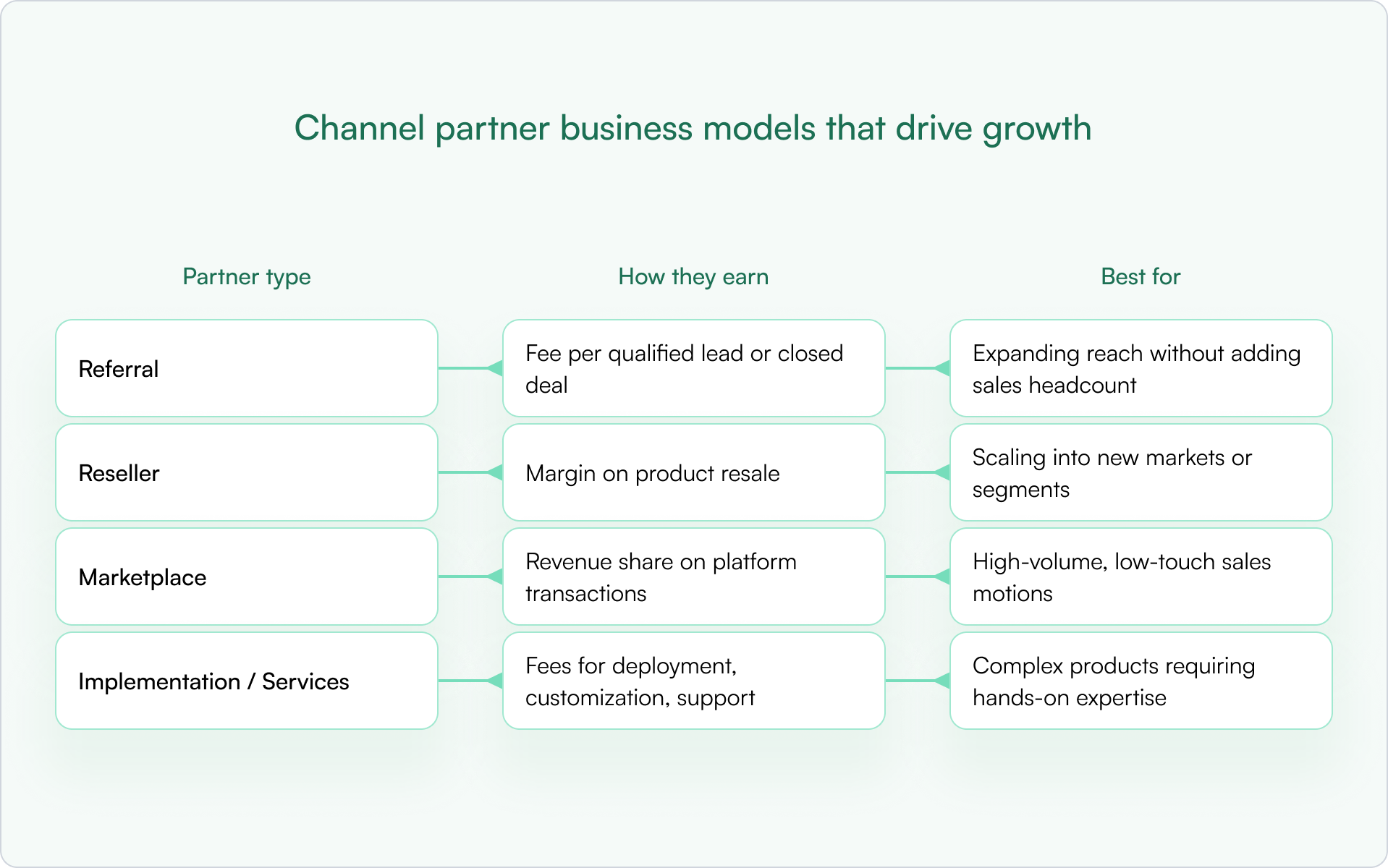
Partnertyp Wie sie verdienen Am besten geeignet für
Referral Gebühr pro qualifiziertem Lead oder abgeschlossenem Geschäft Erweiterung der Reichweite ohne Aufstockung des Vertriebspersonals
Wiederverkäufer Gewinnspanne beim Weiterverkauf von Produkten Erschließung neuer Märkte oder Segmente
Marktplatz Umsatzbeteiligung an Plattformtransaktionen Verkaufsaktivitäten mit hohem Volumen und geringem Aufwand
Implementierung / Dienstleistungen Gebühren für Bereitstellung, Anpassung, Support Komplexe Produkte, die praktische Fachkenntnisse erfordern

Die meisten Unternehmen entscheiden sich letztendlich für eine Mischform. Der Schlüssel liegt darin, das Modell an das Segment anzupassen und Regeln zu entwickeln, die Überschneidungen, Verwirrung und Kanalkonflikte verhindern.

Referral-Partner

Empfehlungspartner senden qualifizierte Leads gegen eine Gebühr. Sie besitzen keine Kundenbeziehung und wickeln den Verkauf nicht ab. Empfehlungsprogramme sind ein guter Einstieg, da das Engagement auf beiden Seiten gering ist und der operative Aufwand minimal ist.

Vertriebspartner

Wiederverkäufer kaufen Ihr Produkt ein und verkaufen es mit einer Marge weiter. Sie pflegen die Kundenbeziehungen und wickeln den Verkaufsprozess ab. Dieser Ansatz ermöglicht eine schnelle Expansion in neue Märkte, bleibt jedoch nur dann vorhersehbar, wenn Sie klare Preisrichtlinien und ein transparentes Eigentumsmodell haben.

Marktplatzpartner

Marktplatzpartner verkaufen über Plattformen wie AWS, Azure oder App-Marktplätze. Die Einnahmen werden gemäß den Plattformbedingungen aufgeteilt. Marktplatzaktivitäten eignen sich am besten für großvolumige, wenig personalisierte Verkäufe, bei denen Käufer eine selbstständige Suche, einen selbstständigen Kauf und eine selbstständige Bereitstellung erwarten.

Implementierungs- und Servicepartner

Systemintegratoren, Berater und MSPs verdienen mit Dienstleistungen rund um Ihr Produkt – Bereitstellung, Anpassung und fortlaufender Support. Diese Partner beeinflussen oft Geschäfte, auch wenn sie diese nicht direkt abschließen, was die Zuordnung und Prognose schwieriger macht. Wenn Sie „Einfluss“ in Ihrem CRM nicht modellieren, werden Sie deren Auswirkungen systematisch unterschätzen.

Wichtige Kennzahlen für die Umsatzanalyse von Vertriebspartnern

Wenn Sie versuchen, die Einnahmen Ihrer Vertriebspartner vorhersehbar zu machen, benötigen Sie Kennzahlen, die Entscheidungen unterstützen, und keine oberflächlichen Dashboards. Sie können keine vorhersehbare Einnahmequelle aufbauen, ohne zu wissen, was Sie messen müssen. Die richtigen Kennzahlen liefern Ihnen die Analysen, die Sie benötigen, um Entscheidungen zu treffen, Probleme frühzeitig zu erkennen und die Prognosegenauigkeit im Laufe der Zeit zu verbessern.

Partner- generierte Einnahmen und Attribution

Der Umsatz aus Partnerquellen ist der wichtigste Maßstab für den Erfolg eines Vertriebskanals: der direkt von Partnern generierte Umsatz. Dabei ist die Unterscheidung zwischen „aus Partnerquellen“ und „beeinflusst durch Partner“ von Bedeutung.

  • Quelle: Der Partner hat das Geschäft initiiert und Ihnen vorgelegt.
  • Beeinflusst: Der Partner hat wesentlich dazu beigetragen, ein Geschäft voranzubringen oder abzuschließen, das nicht von ihm initiiert wurde.

Beide sind von echtem Wert, erfordern jedoch unterschiedliche Regeln, Berichterstattungen und Anreize. Wenn Sie sie vermischen, werden Sie die Leistung falsch interpretieren und die Förderungsmaßnahmen falsch zuweisen.

Deal-Registrierungsvolumen und Konversion

Das Volumen der registrierten Geschäfte gibt an, wie viele Geschäfte Partner registrieren. Die Konversionsrate gibt an, wie viel Prozent der registrierten Geschäfte tatsächlich abgeschlossen werden.

  • Ein geringes Registrierungsvolumen deutet in der Regel auf ein Problem mit dem Engagement oder den Anreizen hin – die Partner sehen keinen Nutzen in der Registrierung.
  • Eine niedrige Konversionsrate deutet in der Regel auf Lücken in der Befähigung, schwache Qualifikationen oder langsame interne Nachverfolgung hin.

Partner-Engagement und Enablement-Raten

Zu den Engagement-Kennzahlen zählen Portal-Anmeldungen, abgeschlossene Schulungen, Downloads von Inhalten und Geschäftsaktivitäten. Ein hohes Engagement korreliert mit einem höheren Umsatzbeitrag. Ein geringes Engagement ist oft ein Frühwarnzeichen, das auftritt, bevor Ihre Pipeline ins Stocken gerät.

Vertriebszyklusdauer nach Partnertyp

Vergleichen Sie, wie lange es dauert, bis Geschäfte über Partner abgeschlossen werden, im Vergleich zu Direktgeschäften. Einige Arten von Partnern schließen Geschäfte schneller ab, weil sie bereits bestehende Beziehungen mitbringen. Andere brauchen aufgrund von Übergaben und der Koordination mehrerer Parteien länger. Das Wissen um diese Unterschiede macht Prognosen glaubwürdig.

Kundenbindung durch Partnergeschäfte

Die Kundenbindung zeigt die Qualität und Eignung der Partner. Wenn von Partnern gewonnene Kunden schneller abwandern als Direktkunden, benötigen Sie möglicherweise strengere Qualifikationskriterien, bessere Übergaben oder andere Anreize für Partner. Wenn sie weniger abwandern, ist es möglicherweise am besten, verstärkt auf die Partner (und Segmente) zu setzen, die dieses Ergebnis erzielen.

Wie man die Partnerbindung verbessert, um den Umsatz der Vertriebspartner zu steigern

Vorhersehbarkeit betrifft nicht nur Systeme und Richtlinien, sondern auch das Verhalten. Engagement steigert den Umsatz. Aktive, gut informierte Partner, denen die notwendigen Mittel zur Verfügung stehen, schließen mehr Geschäfte ab. Partner, die sich ignoriert oder verwirrt fühlen, werden still – und damit auch ihre Pipeline.
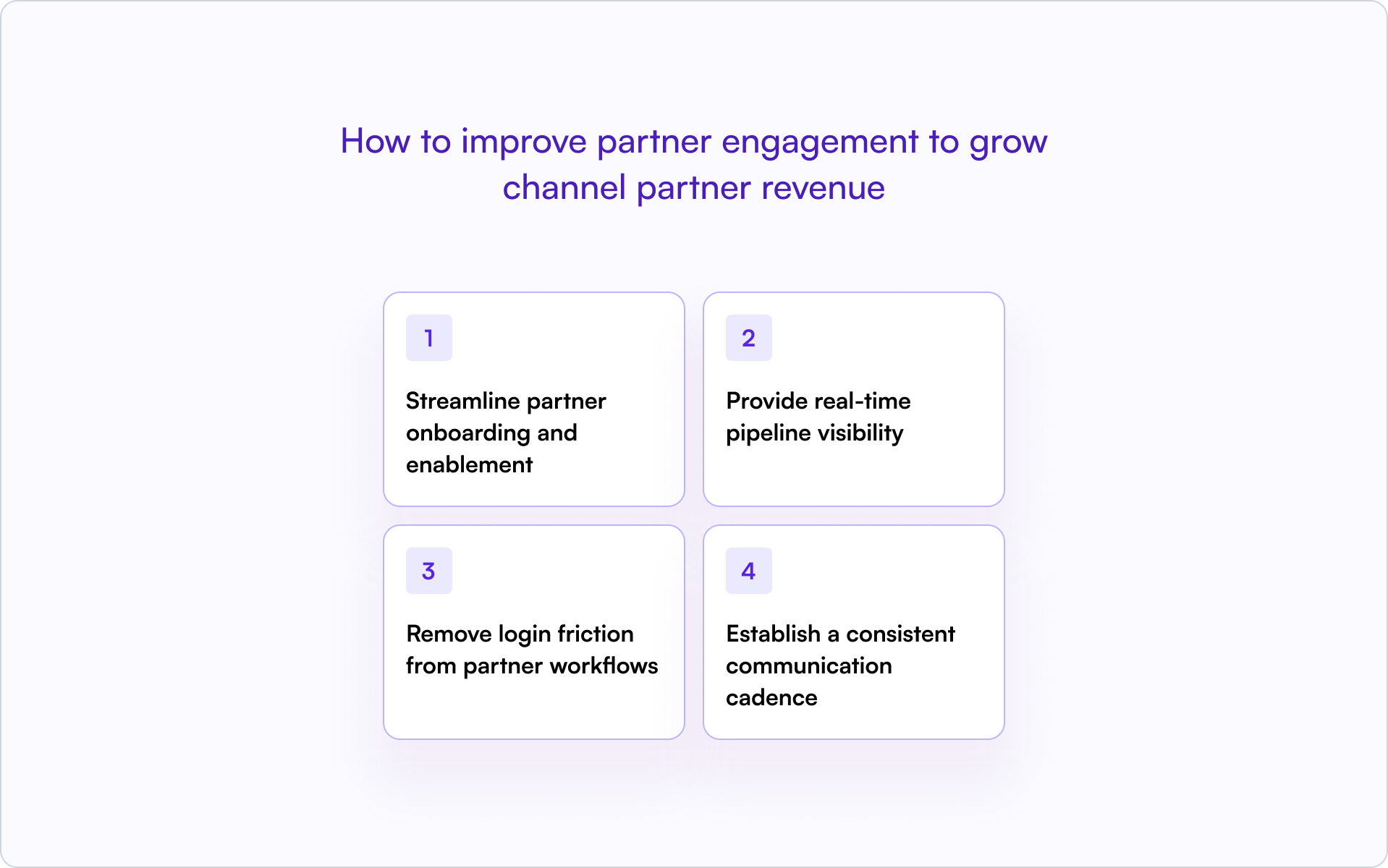
1) Optimierung der Einarbeitung und Einweisung von Partnern

Schnelles Onboarding bedeutet schnellere Umsätze. Partner, die bereits in der ersten Woche wissen, wie sie Ihr Produkt verkaufen und positionieren können, schließen mit weitaus höherer Wahrscheinlichkeit frühzeitig Geschäfte ab.

Bieten Sie Selbstschulungen, klare Leitfäden und Zertifizierungspfade an. Definieren Sie, was „aktiviert” für Ihr Programm bedeutet – erste Registrierung, erstes Co-Sell-Meeting, erster abgeschlossener Verkauf – und verfolgen Sie dies wie eine zentrale Trichterphase.

2) Bereitstellung von Echtzeit-Transparenz in der Pipeline

Partner möchten den Status von Geschäften einsehen können, ohne Ihr Team ständig nach Updates fragen zu müssen. Gemeinsame Pipeline-Ansichten – mit begrenzten, sicheren Feldern – sorgen dafür, dass sie engagiert bleiben und ihrer Verantwortung nachkommen.

Wenn Partner den Status, die nächsten Schritte und den Ablauf des Schutzes einsehen können, bleiben sie engagiert. Können sie das nicht, ziehen sie sich zurück oder eskalieren sie.

3) Beseitigen Sie Reibungsverluste beim Anmelden aus den Arbeitsabläufen Ihrer Partner.

Jede Login-Barriere mindert das Engagement. Sobald Partner auf eine Portal-Anmeldung stoßen, brechen viele ab – insbesondere bei „schnellen“ Aktionen wie der Registrierung eines Leads oder dem Teilen eines Updates.

Ermöglichen Sie Partnern, Geschäfte zu registrieren, Aktualisierungen einzureichen und per E-Mail zu antworten, ohne den Portalzugang zu erzwingen. Die Zusammenarbeit außerhalb des Portals hält Geschäfte am Laufen, ohne Reibungsverluste zu verursachen.

4) Etablieren Sie eine konsistente Kommunikationskadenz.

Regelmäßige Updates verhindern Überraschungen. Wöchentliche Pipeline-Überprüfungen für aktive Partner, zweiwöchentliche Ankündigungen und monatliche Policy-Updates sorgen dafür, dass alle über Preise, Programmänderungen und Erwartungen auf dem Laufenden sind.

Schweigen führt zu Verwirrung. Konsequente Kommunikation schafft Vertrauen – und Vertrauen ist es, was Partner dazu bewegt, Geschäfte abzuschließen, anstatt es „einfach mal zu versuchen“ und zu hoffen, dass Sie es später bemerken.

CRM-Datenmodell für die Umsatzzuordnung von Vertriebspartnern

Ihr CRM ist die Grundlage für die Nachverfolgung und Prognose der Einnahmen Ihrer Vertriebspartner. Ohne die richtigen Felder und Regeln wird die Zuordnung zu einem Ratespiel – und das hektische Durcheinander am Quartalsende zur Normalität.

Erforderliche Felder zu Opportunities und Deals

Die folgenden Felder machen die Einnahmen der Partner sichtbar und zuordenbar:

  • Partnertyp: Empfehlung, Wiederverkäufer, Marktplatz, SI/MSP
  • Partnerorganisation: Das jeweilige Partnerunternehmen
  • Quelle vs. Einfluss: Wer hat das Geschäft gefunden und wer hat dabei geholfen?
  • Deal-Registrierungs-ID: Verlinkt zurück zum Registrierungsdatensatz
  • Schutzbeginn/-ende: Wenn die Exklusivität abläuft
  • Amtierender Partner: Bei Verlängerungen, wer derzeit die Beziehung besitzt
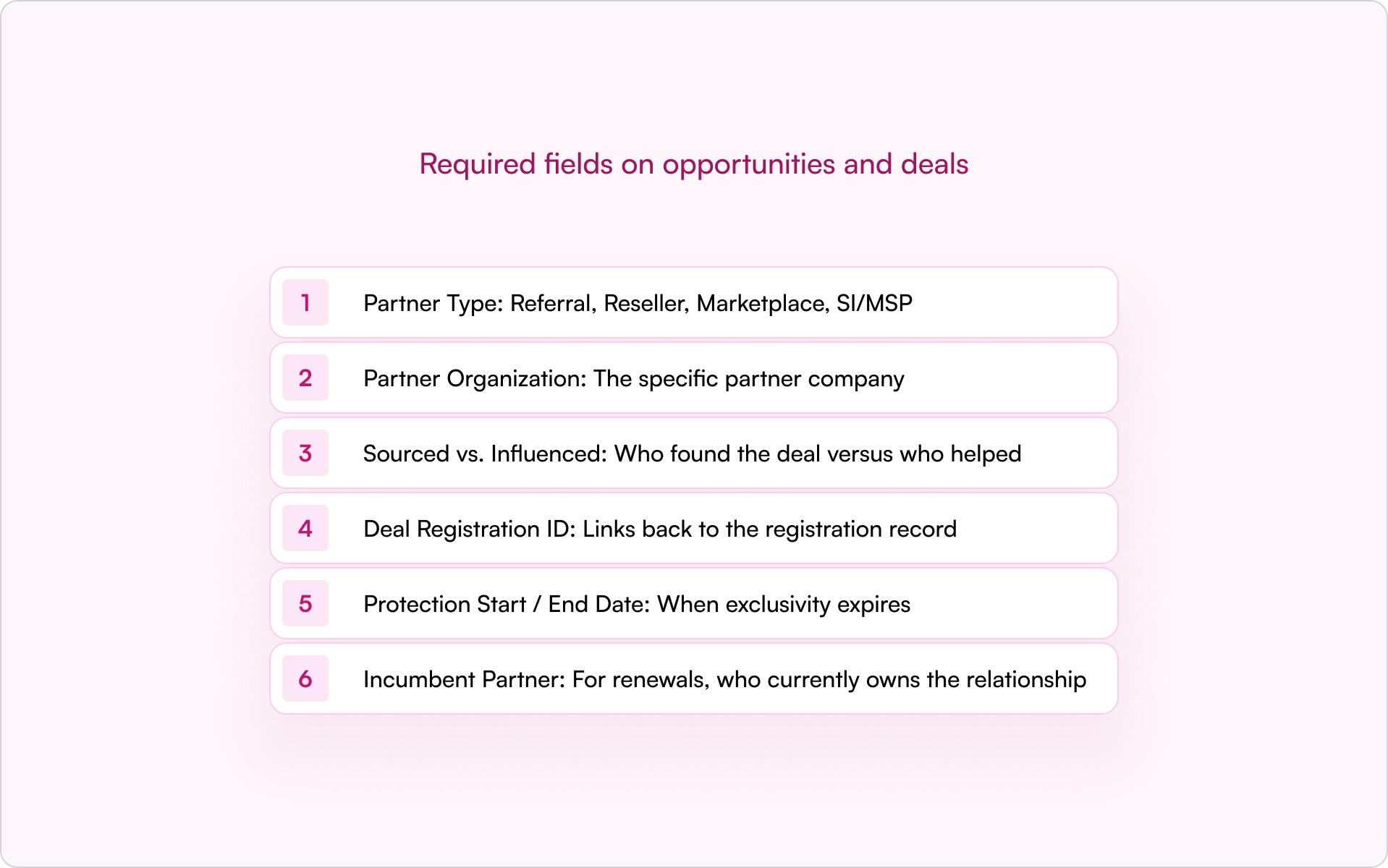
Ohne Partnerfelder zu Verkaufschancen können Sie grundlegende Fragen zum Beitrag der Partner nicht beantworten – und Streitigkeiten werden unvermeidlich, da sich alle auf ihr Gedächtnis und Screenshots verlassen.

Quellenbasierte vs. beeinflusste Attributionsmodelle

„Sourced“ bedeutet, dass der Partner die Verkaufschance generiert hat. „Influenced“ bedeutet, dass der Partner beteiligt war, die Verkaufschance jedoch nicht generiert hat.

Einige Unternehmen teilen die Gutschrift auf. Andere verwenden die primäre Zuordnung. Es gibt keine allgemeingültige richtige Antwort – aber Sie benötigen eine klare Regel, die vor Abschluss der Geschäfte konsequent angewendet wird. Andernfalls werden Sie am emotionalsten Punkt des Zyklus über die Gutschrift verhandeln müssen.

Governance-Regeln zur Sauberhaltung von Partnerdaten

Felder funktionieren nur, wenn sie durchgesetzt werden. Eine praktische Governance-Ebene umfasst in der Regel:

  • Validierungen für Phasenwechsel: Partnerfelder sind erforderlich, bevor Geschäfte fortgesetzt werden können.
  • Doppelte Regeln: Überschneidungen bei Konten und Opportunities frühzeitig erkennen
  • Logik der Erneuerung des Eigentums: Konflikte zwischen Partnern und Direktverkäufen verhindern
  • Dashboards: Segmentierung nach Bewegungs- und Konfliktstatus für schnelle Übersichtlichkeit

Saubere Daten bedeuten genaue Prognosen. Unordentliche Daten bedeuten Überraschungen am Quartalsende – und Überraschungen sind teuer.

Wie die Registrierung von Geschäften den Umsatz der Vertriebspartner steigert

Bei der Deal-Registrierung wird frühzeitig die Eigentümerschaft festgelegt – und die meisten Konflikte im Vertriebskanal können verhindert werden, anstatt später diskutiert zu werden.

Grundlagen der Deal-Registrierungsrichtlinie

Eine klare Richtlinie beseitigt Unklarheiten zwischen Partnern, Direktvertrieb und anderen Kanälen. Ihre Richtlinie sollte Folgendes definieren:

  1. Teilnahmebedingungen, Pflichtfelder und Nachweis der Teilnahme
  2. Regeln zur Einzigartigkeit von Kunden, um zu verhindern, dass mehrere Partner denselben Kunden betreuen
  3. Ein Schutzfenster – in der Regel 60–90 Tage – mit expliziten Verlängerungsregeln
  4. Erneuerung und Erweiterung der Eigentumsregeln
  5. Eine Konflikt-Hierarchie: Registrierte schlagen nicht registrierte, etablierte schlagen neue, Zertifizierungsstatus entscheidet bei Gleichstand.

Ohne klare Richtlinien verzögern Eigentumsstreitigkeiten Geschäfte und belasten die Beziehungen zwischen den Partnern. Schlimmer noch: Die Partner lernen, dass die Registrierung sie nicht schützt, und verzichten daher auf eine Registrierung.

Schutzfenster und SLAs

Das Schutzfenster ist der Zeitraum, in dem ein Partner exklusive Rechte an einem registrierten Geschäft hat. Die meisten Teams legen Schutzfenster zwischen 60 und 90 Tagen fest, je nach Länge des Verkaufszyklus.

Auch Genehmigungs-SLAs sind wichtig. Partner erwarten eine schnelle Entscheidung – 48 Stunden sind dabei ein gängiger Maßstab. Langsame Genehmigungen signalisieren, dass die Registrierung nicht wertgeschätzt wird, was die Akzeptanz verringert und die Prognose für Ihren Vertriebskanal erschwert.

Konfliktlösungshierarchie

Wenn zwei Partner denselben Deal beanspruchen, sind Schnelligkeit und Konsistenz wichtiger als Diskussionen.

Legen Sie Regeln fest, wie z. B.: Registrierte vor nicht registrierten, etablierte vor neuen, Zertifizierungsstatus als Entscheidungsfaktor. Dokumentieren Sie Eskalationswege und Nachweisanforderungen. Wenn die Regeln im Voraus klar sind, erfolgt die Lösung schneller und fairer – und Ihre internen Teams verbringen weniger Zeit mit der Aushandlung von Geschäften.

Aufbau Ihrer Technologieplattform für die Umsatzsteigerung Ihrer Vertriebspartner

Die richtigen Tools ermöglichen vorhersehbare Umsätze für Vertriebspartner. Die falschen Tools – oder zu viele Tools – verursachen Reibungsverluste und verbergen Daten.
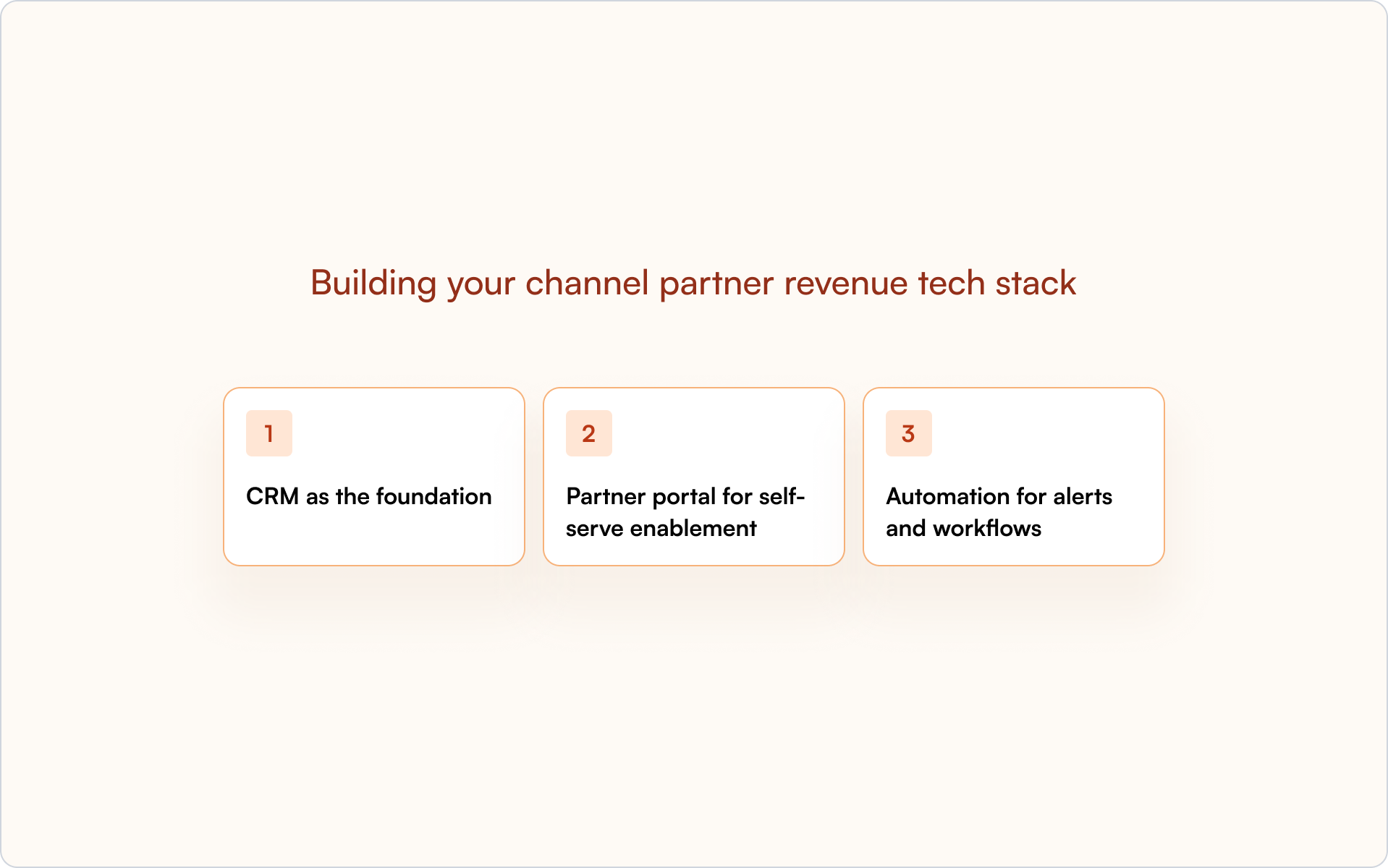
CRM als Grundlage

HubSpot Salesforce die einzige Quelle der Wahrheit sein. Partnerdaten gehören in das CRM und nicht in ein separates System.

Eine CRM-first-Architektur ermöglicht Prognosen, Attribution und die Abstimmung zwischen Vertrieb, Partnerschaften und RevOps. Wenn die Aktivitäten der Partner im CRM sichtbar sind, arbeiten alle auf derselben Grundlage.

Partnerportal für Self-Service-Aktivierung

Über ein Portal haben Partner Zugriff auf Schulungen, Inhalte, Deal-Registrierung und den Status der Pipeline. Die besten Portale sind mit dem CRM verbunden, sodass die Daten ohne manuelle Aktualisierungen synchronisiert bleiben.

Partner erhalten, was sie benötigen, ohne Ihr Team zu verfolgen. Ihr Team erhält saubere Daten, ohne Partner zu verfolgen.

Automatisierung für Benachrichtigungen und Workflows

Automatisieren Sie die Genehmigung von Geschäftsregistrierungen, Ablaufbenachrichtigungen, Benachrichtigungen über Phasenwechsel und Partnerankündigungen. Durch die Automatisierung wird der manuelle Aufwand reduziert und verhindert, dass Geschäfte übersehen werden.

Am wichtigsten ist, dass die Automatisierung für Konsistenz sorgt. Ihr Programm ist nicht mehr auf Stammeswissen und „denjenigen, der zufällig die E-Mail sieht“ angewiesen.

Bauen Sie eine Partner-Umsatzmaschine in Ihr CRM ein

Vorhersehbare Einnahmen für Vertriebspartner stammen aus CRM-First-Systemen, nicht aus unverbundenen Tools.

Wenn die Aktivitäten Ihrer Partner in Ihrem CRM erfasst werden, erhalten Sie Transparenz, Attribution und Prognosen an einem Ort. Vertrieb, Partnerschaften und RevOps sehen dieselbe Pipeline. Streitigkeiten nehmen ab, da die Zuständigkeiten klar sind. Prognosen verbessern sich, da Daten nicht in Portalen oder Tabellenkalkulationen gefangen sind.

Ein echter Partner-Umsatzmotor zeichnet sich durch konsistente Prozesse, saubere Daten und Echtzeit-Transparenz aus – und das alles innerhalb des Systems, das Ihr Team bereits nutzt.

Wenn Sie sehen möchten, wie ein CRM-First-Ansatz in der Praxis funktioniert, fordern Sie eine Demo an und erfahren Sie, wie Introw diesen Ansatz in Ihrem Partnerprogramm unterstützt.

FAQs

Noch Fragen? Hier findest du die häufigsten Fragen und Antworten.

Kontaktiere uns

What is channel partner revenue?

Channel partner revenue is revenue generated through third-party partners — such as referral partners, resellers, marketplaces, and implementation/services firms — instead of being closed exclusively by your direct sales team. A predictable program ties that revenue back to specific partners, motions, and processes inside your CRM.

How are channel partners typically compensated?

Partners earn through referral fees, resale margins, revenue share, or service fees — depending on their partner type and agreement terms. The compensation model usually aligns with how much of the sales process and customer relationship the partner owns.

What’s the difference between partner-sourced and partner-influenced revenue?

Partner-sourced revenue comes from deals the partner originated and brought to you. Partner-influenced revenue comes from deals where the partner helped move or close an opportunity they didn’t originate. Both matter, but they require different attribution rules, incentives, and reporting.

What percentage of total company revenue should come from channel partners?

There’s no universal benchmark. Some companies generate the majority of revenue through partners, while others use the channel as a supplement to direct sales. The right mix depends on your product complexity, ACV, market maturity, partner leverage (distribution or influence), and your ability to operationalize attribution and deal registration.

How long does it typically take to see ROI from a new channel partner program?

Most programs take several quarters to ramp. Partners need time to complete onboarding, find a repeatable pitch for your product, build pipeline, and close their first deals. Your sales cycle length and enablement quality are the biggest drivers of timeline.


Launch your partner portal
in minutes!

Vielen Dank! Wir haben deine Anfrage erhalten!
Hoppla! Beim Absenden des Formulars ist ein Fehler aufgetreten.

Verwandte Blog-Artikel

Partner-Management

11 Euler PRM Alternatives for Smarter Partner Management in 2026

Janis De Sutter
Software Engineer
5min Lesezeit
02 Jun 2026
⚡ TL;DR

Euler PRM helps teams manage partner programs and distribution channels. But as partner ecosystems grow, many teams need deeper CRM integrations, more automation, stronger enablement, and greater flexibility. This guide compares 11 Euler alternatives to help you evaluate CRM connectivity, AI capabilities, onboarding, partner engagement, and overall time to value.

What is Euler PRM (and why teams look for alternatives)

Euler PRM helps businesses manage partners, track deals, and run partner programs. The platform became known through Starlink reseller programs and includes onboarding tools, CRM integrations, and AI assistants.

For many teams, that’s enough to get started. As partner programs grow, however, some businesses need deeper CRM integrations, more automation, and better ways to keep partners engaged.

That’s why many teams evaluating Euler also compare other partner management systems.

1. CRM integration without custom object support

Euler connects to HubSpot and Salesforce but does not support custom objects. Teams that rely on custom CRM data structures may run into limitations as programs grow.

2. No white-label portal

Euler’s portal uses Euler branding. There is no white-label option for businesses that want a fully branded partner experience.

3. No segmented onboarding

Euler does not support onboarding by partner type, tier, or stage. Every partner follows the same experience. Teams that want tailored journeys often look for stronger partner portal capabilities.

4. No embedded LMS or MDF management

Euler does not include a built-in LMS or MDF functionality. Teams that need partner training, certification, or co-marketing workflows must use additional tools.

5. AI that advises, not executes

Euler’s AI assistants provide guidance and surface data. They do not automate deal registration, partner engagement, or workflow execution. Teams looking to reduce manual work frequently evaluate platforms with dedicated AI agents.

6. Portal-first engagement

Euler keeps most activity inside the portal. There is no native email or Slack collaboration that syncs back to the CRM in real time. That’s why many teams prioritize stronger partner engagement capabilities.

These limitations won’t matter to every business. But as partner programs grow, many companies start comparing Euler competitors that offer deeper CRM connectivity and more automation.

Euler PRM alternatives at a glance

Not every Euler competitor solves the same problems. Some focus on affiliate programs, some on enterprise channel management, and others on partner enablement. This table gives you a quick way to compare the most important differences.

Tool CRM-Integration White-label portal AI capability Zusammenarbeit außerhalb des Partnerportals Embedded LMS MDF module Time to live
Introw Native Yes Agentic Yes Yes Yes 2 to 4 days
Impartner Middleware Yes Advisory Limited Yes Yes 3 to 12 months
PartnerStack Middleware Limited Advisory No No No Weeks
Kiflo Basic No None No No No Days
Salesforce Experience Cloud (Partner Cloud) Native Yes None No No No 3 to 12 months
ChannelScaler Middleware Yes None No Yes Yes Wochen bis Monate
Gedankenmatrix Integrated Yes TCMA No Yes No Wochen bis Monate
Zinfi Integrated Yes TCMA No Yes Yes Wochen bis Monate
Magentrix Native Yes Advisory No No No Wochen bis Monate
Channeltivity Integrated Yes None No No Yes Weeks
Partner.io Integrated Yes Advisory No No No Weeks

Next, you'll get a closer look at each platform, where it stands out, and where it may be a better fit than Euler.

11 best Euler PRM alternatives in 2026

If you’re looking for an Euler alternative, these are the platforms worth evaluating. Some focus on referral programs, some specialize in enterprise channel management, and others help partnership teams scale with less manual work.

#1 Introw - Best overall Euler alternative for CRM-native partner management

What it does

Introw is an AI-powered PRM built for revenue teams that want partner data, deal tracking, partner applications, and attribution inside the CRM. It combines agentic AI, off-portal collaboration, white-label portals, MDF, CPQ, and segmented onboarding in one system.

Why someone might choose it over Euler

Introw addresses the biggest gaps that push teams toward Euler software alternatives. It supports custom CRM objects, white-label branding, embedded learning, MDF workflows, and AI that can take action instead of only providing answers.

Partners can register deals, submit partner applications, collaborate on sales opportunities, and complete onboarding through email, Slack, embedded forms, or the portal. Everything syncs back automatically, reducing manual loading between systems.

For partnership leaders running multiple partner programs, that means less time spent updating spreadsheets and more focus on partner revenue, ROI, growth, and partner trust.

Teams evaluating modern PRMs often compare Introw with other solutions in guides covering partner relationship management software and the 2025 guide to choosing your next PRM.

Where it stands out

  • Native CRM architecture with full custom object support for deal tracking, attribution, partner applications, and partner revenue
  • Agentic AI across the full partner lifecycle management process
  • White-label portal builder
  • Embedded partner LMS
  • Native MDF management
  • Off-portal collaboration through email and Slack
  • Built-in deal and lead registration
  • Native MCP and Claude connectivity
  • Automated workflows that help partner teams scale without adding bandwidth

CRM integrations

Native, bi-directional integrations with Salesforce and HubSpot.

Preise

Custom pricing.

Am besten geeignet für

SaaS companies with multiple partner types that want to drive growth, increase partner revenue, and spend less time on admin work.

Explore the full Euler comparison or request a demo.

#2 Impartner - Best for enterprise-scale PRM with broad module coverage

What it does

Impartner is an enterprise PRM platform covering partner portals, TCMA, marketplaces, partner lifecycle management, and partner enablement services.

Why someone might choose it over Euler

  • Broad enterprise feature coverage
  • Established market presence
  • Strong support for large partner programs
  • Designed for complex partnerships

Where it falls short

  • 3–12 month implementation timelines
  • Middleware-based CRM integration
  • Reported field-mapping challenges
  • Dated user experience

CRM integrations

Salesforce via middleware.

Preise

Custom pricing.

Am besten geeignet für

Enterprise organizations with 50+ partners and dedicated PRM admin resources.

Our guide to best Impartner competitors covers additional options.

#3 PartnerStack - Best for affiliate and referral program automation

What it does

PartnerStack is a partner network platform focused on affiliate tracking, referral automation, recruiting partners, automated payments, and partner payouts.

Why someone might choose it over Euler

  • Large partner marketplace
  • Mature referral capabilities
  • Automated payments infrastructure
  • Strong partner recruitment engine

Where it falls short

  • Workato-based CRM middleware
  • Transaction fees on partner payments
  • Limited portal customization
  • No distributor or two-tier models

CRM integrations

Salesforce and HubSpot via Workato.

Preise

Custom pricing plus transaction fees.

Am besten geeignet für

Teams focused primarily on referral programs and automated partner payments.

See how it compares in our roundup of PartnerStack alternatives.

#4 Kiflo - Best for SMBs launching their first partner program

What it does

Kiflo is a lightweight PRM designed for onboarding partners, deal registration, commission tracking, and basic partner management.

Why someone might choose it over Euler

  • Easy to learn
  • Faster setup
  • Lower starting cost
  • Intuitive experience for smaller teams

Where it falls short

  • No AI
  • No off-portal collaboration
  • No white-label portal
  • No LMS
  • No CPQ
  • No custom object support

CRM integrations

Basic Salesforce and HubSpot integrations.

Preise

Lower-cost, partner-based pricing.

Am besten geeignet für

Small businesses launching their first partner program.

Take a look at our in-depth guide to Kiflo alternatives.

#5 Salesforce Experience Cloud (Partner Cloud) - Best for teams that want everything inside Salesforce

What it does

Salesforce Experience Cloud is Salesforce’s build-it-yourself partner portal framework. Because it sits directly inside Salesforce, companies can connect partner data, customers, sales processes, events, and reporting in one environment.

Why someone might choose it over Euler

  • Deepest Salesforce integration available
  • Highly customizable
  • Extensive reporting capabilities
  • Strong API ecosystem

Where it falls short

  • Heavy developer dependency
  • No built-in LMS
  • No AI agent
  • No off-portal collaboration
  • Long implementation cycles

CRM integrations

Native Salesforce.

Preise

Starts around $20/user/month plus implementation costs.

Am besten geeignet für

Large Salesforce-centric organizations with dedicated development resources.

Our guide to Salesforce PRM alternatives explores similar options.

#6 ChannelScaler - Best for incentive and rebate management alongside PRM

What it does

ChannelScaler combines PRM, MDF, rebates, incentive management, and partner revenue programs in one system. The platform helps partner teams manage payments, spiff payments, partner applications, partner contracting, and channel operations across larger partnerships.

Why someone might choose it over Euler

  • Strong incentive management and rebate capabilities
  • Built-in MDF functionality
  • Broad feature coverage
  • Helps partnership leaders manage complex channel programs

Where it falls short

  • Admin-heavy experience
  • No AI capabilities
  • No Slack support
  • No off-portal collaboration
  • CRM changes often require support involvement

CRM integrations

Salesforce and HubSpot via middleware.

Preise

Custom pricing.

Am besten geeignet für

Companies that need rebates, MDF, incentive management, and partner services from a single provider.

Explore our guide to ChannelScaler alternatives.

#7 Mindmatrix - Best for through-channel marketing automation (TCMA)

What it does

Mindmatrix combines PRM, LMS, TCMA, training, content creation, and marketing services. The platform helps partnership teams create campaigns, support partners, automate marketing activities, and drive growth across multiple markets.

Why someone might choose it over Euler

  • Strong TCMA capabilities
  • Built-in LMS and training tools
  • AI content generation
  • Social selling support

Where it falls short

  • Steep learning curve
  • LMS updates may require support
  • No dedicated admin experience
  • No CPQ
  • Long onboarding process

CRM integrations

Salesforce and HubSpot integrations.

Preise

Custom pricing.

Am besten geeignet für

Enterprise partner teams focused on marketing automation, partner enablement, and revenue growth.

See how it compares in our roundup of Mindmatrix alternatives.

#8 Zinfi - Best for large-scale channel management with broad module coverage

What it does

Zinfi provides channel management, partner onboarding, analytics, deal tracking, partner marketing, and TCMA capabilities in a single platform. It is designed for companies running large global partnerships across the world.

Why someone might choose it over Euler

  • Broad enterprise feature set
  • Strong analytics
  • Dedicated TCMA functionality
  • Support for complex partner programs
  • Helps partnership leaders manage growth at scale

Where it falls short

  • Complex implementation
  • Dated interface
  • Significant configuration requirements
  • Data primarily lives inside Zinfi

CRM integrations

Salesforce and Microsoft Dynamics integrations.

Preise

Custom pricing.

Am besten geeignet für

Large enterprises managing partnerships across multiple regions, partner types, and customer segments.

Our guide to Zinfi alternatives covers other options worth considering.

#9 Magentrix - Best for Salesforce-native teams wanting a portal-first approach

What it does

Magentrix is a Salesforce-native portal platform that helps companies connect partners, customers, resources, and data through a branded experience. It supports partner collaboration, self-service resources, and customer-facing services.

Why someone might choose it over Euler

  • Native Salesforce architecture
  • Flexible portal builder
  • Strong portal customization
  • Familiar experience for Salesforce users

Where it falls short

  • Salesforce-only
  • Limited AI capabilities
  • Portal-first workflow
  • Limited off-portal collaboration

CRM integrations

Native Salesforce integration.

Preise

Essential from $1,500/month. Advanced from $3,000/month. Unlimited pricing available by quote.

Am besten geeignet für

Salesforce customers who want a portal-centric system for partners, customers, and self-service resources.

Take a look at our guide to Magentrix alternatives.

#10 Channeltivity - Best for mid-market teams wanting a straightforward PRM

What it does

Channeltivity covers partner portals, deal registration, MDF management, analytics, and automated workflows. The platform helps companies create partner programs without the complexity of many enterprise tools.

Why someone might choose it over Euler

  • Dedicated MDF module
  • Proven market presence
  • Straightforward feature set
  • Less time spent managing the system

Where it falls short

  • Limited AI capabilities
  • No off-portal collaboration
  • CRM depth may not fit advanced use cases

CRM integrations

Salesforce integration.

Preise

Standard: $1,899/month annually. CRM Edition: $2,199/month annually.

Am besten geeignet für

Mid-market companies that want a proven PRM and spend less time managing partner operations.

Explore our review of Channeltivity competitors.

#11 Partner.io - Best for pipeline-focused partner collaboration

What it does

Partner.io focuses on pipeline visibility, attribution, deal collaboration, partner applications, and helping sales teams track opportunities across partnerships. The platform is built to improve visibility between internal teams and external partners while helping companies create stronger partner relationships.

Why someone might choose it over Euler

  • Strong pipeline visibility
  • Modern user experience
  • Focus on collaboration
  • Helps drive growth through better deal visibility
  • Good fit for partnership leaders focused on revenue

Where it falls short

  • Smaller customer base
  • Narrower feature set
  • No embedded LMS
  • No MDF management

CRM integrations

Salesforce and HubSpot.

Preise

Forever Free: $0. Professional: $249/month. Enterprise: custom pricing.

Am besten geeignet für

Partner teams that prioritize pipeline visibility, attribution, deal collaboration, and future revenue opportunities.

See how it compares in our roundup of Partner.io alternatives.

It’s easy to get caught up comparing features. But the best PRM is the one that fits your CRM, your partner model, and the way your team and partners actually work.

Das Fazit

Euler is a solid starting point for partner programs, especially in distribution-focused environments. But as programs grow, the gaps become harder to ignore.

  • If you need enterprise TCMA, look at Mindmatrix or Zinfi.
  • If affiliate payouts and partner recruitment are your priority, PartnerStack is a strong option.
  • If you want a Salesforce-native portal, Magentrix is worth considering.

But if you need a CRM-native PRM with agentic AI, off-portal collaboration, partner enablement, MDF management, and a faster path to value, Introw is the clearest upgrade.

See the full Introw vs Euler comparison for a side-by-side breakdown.

Why teams choose Introw when looking for Euler alternatives

+70% more partner pipeline

Many companies struggle to keep partners engaged after onboarding. Introw helps partners register deals, share data, and collaborate in real time, helping companies create more pipeline and uncover new revenue opportunities without adding manual work.

+75% faster partner onboarding

Most companies don’t want a long implementation process. Introw goes live in 2 to 4 days, helping partners access training, resources, and services from day one. Every partner gets the right experience based on their role, making it easier for one person or hundreds of users to get started.

+60% more partner-influenced revenue

Introw helps companies connect partner activity, attribution, and customer outcomes in one place. Better visibility into data makes it easier to identify what drives growth, improve ROI, and build stronger partnerships over time.

Ready to see how Introw compares to Euler and other competitors? Request a demo.

Partner-Management

10 Magentrix PRM Alternatives for Better Partner Engagement in 2026

Peter Vermeulen
Staff Engineer
5min Lesezeit
01 Jun 2026
⚡ TL;DR

Magentrix PRM is a popular Salesforce-based solution for partner portals, deal registration, and content sharing. But many teams evaluating Magentrix alternatives want broader CRM support, stronger partner engagement, AI-powered workflows, and a platform that helps manage the full partner lifecycle.

We'll show you 10 Magentrix PRM alternatives in 2026, including options built for Salesforce, HubSpot, and growing partner programs. We’ll compare features, pricing, AI capabilities, and overall partner experience to help you find the right fit.

What Is Magentrix (And Why Teams Look for Alternatives)

Magentrix PRM is a Salesforce-native partner portal platform. It gives Salesforce users a branded place to share content, register deals, and manage partner access.

For teams that only need a portal, Magentrix can work well. But many businesses evaluating Magentrix alternatives need broader CRM support, stronger partner experience capabilities, and more complete partner lifecycle management.

1. Salesforce-only, no HubSpot support

Magentrix is built for Salesforce. If you use HubSpot, it isn’t an option.

This is one reason buyers comparing the best partner relationship management software often look beyond Magentrix.

2. Portal-centric, no off-portal collaboration

Partners need to log in to access content, register deals, and view updates.

There are no CRM-synced email conversations or Slack-based collaboration workflows that keep partners engaged outside the portal.

3. Limited AI capabilities

Magentrix doesn’t offer AI-powered deal coaching, automated QBR generation, AI course creation, or agentic partner management capabilities.

For teams looking to reduce manual work, this is a common reason to review Magentrix competitors.

4. Partner portal, not full partner lifecycle management

Magentrix focuses on portal functionality, onboarding, and content sharing.

Many alternatives extend into MDF, partner engagement, CPQ, commissions, goals, and revenue tracking. That’s typically where differences appear when comparing the best partner management systems.

5. No embedded AI-powered LMS

Magentrix includes content sharing but not a built-in AI-powered LMS with certifications and structured training.

Teams with formal enablement programs often need additional software. If you’re planning to choose your next PRM, it’s worth evaluating training requirements early.

These gaps explain why many teams eventually start looking for a Magentrix alternative that can scale with their program.

Magentrix alternatives at a glance

Here’s a quick side-by-side comparison before we dive into each Magentrix alternative in more detail.

Tool CRM support Engagement model AI capability Partner lifecycle coverage Embedded LMS Time to live
Introw HubSpot + Salesforce Off-portal + portal hybrid Agentic AI Full lifecycle AI-powered Days
Salesforce Experience Cloud (Partner Cloud) Salesforce only Portal-centric Advisory AI (Salesforce AI) Partial None Wochen bis Monate
Impartner Salesforce + Microsoft Dynamics + other CRMs Hybrid Content and advisory AI Full lifecycle Basic Months
PartnerStack Native platform Portal-centric Limited AI Partial None Weeks
Kiflo HubSpot + Salesforce Hybrid None Partial Basic Days
Euler HubSpot + Salesforce Hybrid AI assistants Partial None Tage bis Wochen
Gedankenmatrix Salesforce + other CRMs Portal-centric Content AI Full lifecycle Basic Wochen bis Monate
ChannelScaler Salesforce + other CRMs Portal-centric Limited AI Full lifecycle None Months
Channeltivity Salesforce + HubSpot Hybrid None Partial Basic Tage bis Wochen
Partner.io HubSpot + Salesforce Hybrid Advisory AI Partial None Tage bis Wochen

Now, let’s look at where each platform stands out and where it may fall short depending on your partner program.

10 Best Magentrix Alternatives in 2026

#1 Introw - Best overall Magentrix alternative for CRM-native partner management

What it does

Introw is an AI-first PRM software for revenue teams using HubSpot and Salesforce. The platform combines partner engagement, deal registration, LMS, MDF, CPQ, and agentic AI in one system.

Unlike most alternatives, Introw syncs live CRM data bi-directionally, including custom objects, so your team can manage customers, data, and workflows without duplicate records or manual updates.

Why someone might choose it over Magentrix

Introw fills the biggest gaps that push teams away from Magentrix PRM.

You can connect HubSpot or Salesforce instead of being locked into a single CRM. Partners can collaborate through email, Slack, embedded forms, or a white-label partner portal, with information synced automatically to the CRM.

The AI agent helps automate repetitive tasks across the lifecycle by generating training content, building announcements, surfacing QBR insights, and coaching live deals. The platform also includes capabilities Magentrix doesn’t offer, including MDF, CPQ, goal tracking, and an AI-powered partner LMS.

Key differences from Magentrix

  • HubSpot and Salesforce vs. Salesforce-only
  • Off-portal collaboration vs. portal-only engagement
  • Agentic AI vs. no native AI capabilities
  • Full lifecycle management vs. portal-focused functionality
  • AI-powered LMS vs. knowledge base
  • Native MCP and Claude support vs. none

CRM integrations

See the Claude integration in action:

Preise

Introw offers custom pricing based on your partner program size, CRM setup, and required features.

Am besten geeignet für

SaaS businesses that want a complete partner management platform instead of just a partner portal.

For a deeper review, see our guide to choosing your next PRM or request a demo.

#2 Salesforce Experience Cloud (Partner Cloud) - Best for Salesforce teams wanting maximum native control

What it does

Salesforce Experience Cloud is Salesforce’s portal-building platform. It gives administrators complete control over how partner experiences are designed, displayed, and connected to Salesforce data.

Why someone might choose it over Magentrix

Teams that need maximum customization and direct access to Salesforce objects often choose Experience Cloud over Magentrix.

Where it falls short

  • Requires significant developer resources
  • No dedicated PRM admin layer
  • No embedded LMS
  • No AI deal coaching
  • No off-portal collaboration
  • Long implementation time
  • Can become expensive to upgrade and maintain

CRM integrations

  • Salesforce (native)

Preise

Customer Community Plus: $15/login or $35/member. Partner Community: $20/login or $50/member.

Am besten geeignet für

Large Salesforce organizations with dedicated developers and administrators.

See how it compares in our roundup of best Salesforce PRM alternatives.

#3 Impartner — Best for enterprise-scale PRM beyond just a portal

What it does

Impartner is an enterprise PRM platform covering partner portals, TCMA, marketplaces, and partner lifecycle management.

Why someone might choose it over Magentrix

Impartner offers a broader set of features than Magentrix, including TCMA, marketplace functionality, and enterprise partner programs.

Where it falls short

  • Long implementation cycles
  • Middleware-based CRM integrations
  • Dated user experience
  • Complex setup and maintenance
  • Difficult to migrate once heavily customized

CRM integrations

  • Salesforce (via middleware)

Preise

Individuelle Preisgestaltung für Unternehmen.

Am besten geeignet für

Enterprise businesses running mature partner ecosystems.

Our guide to the best Impartner competitors covers additional options.

#4 PartnerStack- Best for affiliate and referral programs with payouts

What it does

PartnerStack helps businesses manage affiliate, referral, and reseller programs with built-in payouts and marketplace access.

Why someone might choose it over Magentrix

PartnerStack includes payout automation, a free partner marketplace, and support for affiliate programs that Magentrix wasn’t designed to manage.

Where it falls short

  • Transaction fees on payouts
  • Limited co-sell functionality
  • Rigid portal experience
  • No distributor management
  • CRM integrations require middleware

CRM integrations

  • HubSpot (via Workato)
  • Salesforce (via Workato)

Preise

Launch: $1,000/month. Growth: $1,520/month. Enterprise: custom.

Am besten geeignet für

Businesses focused on affiliate and referral revenue.

Explore our guide to the best PartnerStack alternatives.

#5 Kiflo - Best for SMBs on HubSpot launching their first program

What it does

Kiflo is a lightweight PRM platform designed for small businesses that want an easy way to start managing partners.

Why someone might choose it over Magentrix

Kiflo supports HubSpot, offers simpler workflows, and is less expensive to get started with.

Where it falls short

  • No AI capabilities
  • No off-portal collaboration
  • No white-label portal options
  • No LMS
  • No CPQ
  • Limited scalability

CRM integrations

  • HubSpot
  • Salesforce

Preise

Core: $399/month (annual billing). Plus: custom.

Am besten geeignet für

Small businesses with fewer than 20 active partners.

Take a look at our in-depth guide to Kiflo alternatives.

#6 Euler - Best for modern PRM with AI assistants

What it does

Euler is a modern PRM platform with AI assistants, partner management workflows, and support for both Salesforce and HubSpot.

Why someone might choose it over Magentrix

Euler offers a more modern user experience, HubSpot support, and AI features that Magentrix lacks.

Where it falls short

  • No custom object support
  • No white-label portal builder
  • No LMS
  • No MDF management
  • Limited onboarding flexibility

CRM integrations

  • HubSpot
  • Salesforce

Preise

Custom pricing.

Am besten geeignet für

Growing partner programs that want a modern interface and advisory AI.

Explore our guide to the best Euler PRM alternatives.

#7 Mindmatrix - Best for through-channel marketing automation

What it does

Mindmatrix combines PRM software, TCMA, LMS, content management, and partner enablement in a single platform.

Why someone might choose it over Magentrix

Mindmatrix offers broader services, LMS capabilities, content automation, and support for both Salesforce and HubSpot.

Where it falls short

  • Steep learning curve
  • Long implementation cycles
  • Complex administration
  • LMS often requires support involvement

CRM integrations

  • HubSpot
  • Salesforce

Preise

Individuelle Preisgestaltung für Unternehmen.

Am besten geeignet für

Enterprise organizations focused on through-channel marketing.

See how it compares in our roundup of the best Mindmatrix alternatives.

#8 ChannelScaler - Best for incentive and rebate management

What it does

ChannelScaler combines PRM, MDF, incentives, rebates, and channel management into a single platform.

Why someone might choose it over Magentrix

ChannelScaler provides incentive management, rebate programs, budget controls, and MDF capabilities that extend beyond portal functionality.

Where it falls short

  • Admin-heavy workflows
  • No AI capabilities
  • No Slack collaboration
  • CRM changes often require support assistance
  • Some updates require additional waiting time

CRM integrations

  • Salesforce
  • HubSpot (middleware)

Preise

Custom pricing.

Am besten geeignet für

Businesses with complex rebate, incentive, and budget management requirements.

Explore our guide to the best ChannelScaler alternatives.

#9 Channeltivity - Best for mid-market Salesforce teams wanting MDF

What it does

Channeltivity is a mid-market PRM platform focused on portals, deal registration, MDF, and channel analytics.

Why someone might choose it over Magentrix

Channeltivity includes MDF management and analytics capabilities that go beyond standard portal features.

Where it falls short

  • Limited AI functionality
  • Salesforce-focused architecture
  • No off-portal collaboration

CRM integrations

  • Salesforce

Preise

Standard: $1,899/month annually. CRM Edition: $2,199/month annually.

Am besten geeignet für

Mid-market Salesforce customers looking for MDF and analytics.

Our guide to the best Channeltivity competitors covers additional options.

#10 Partner.io - Best for pipeline-focused partner collaboration

What it does

Partner.io is a partner management platform built around pipeline visibility, deal collaboration, and partner communication.

Why someone might choose it over Magentrix

Partner.io focuses on helping teams manage live deal collaboration rather than primarily serving as a portal.

Where it falls short

  • Smaller market presence
  • Narrower feature set
  • Fewer enterprise capabilities than some competitors
  • Less information available than many established vendors

CRM integrations

  • HubSpot
  • Salesforce

Preise

Solo starts at $79/month. Growing starts at $299/month. Enterprise pricing is custom.

Am besten geeignet für

Teams focused on pipeline visibility and collaborative selling.

See how it compares in our roundup of the best Partner.io alternatives.

The Bottom Line

Magentrix is a good choice if you’re a Salesforce team that wants a branded partner portal for deal registration, content sharing, and partner access.

Many teams start looking at the best alternatives when they adopt HubSpot, struggle with portal engagement, or need more than a portal can provide.

If that’s you, Introw stands out by combining partner management, AI, training, deal collaboration, and CRM connectivity in one place across both HubSpot and Salesforce. It offers one of the best alternatives for teams that have outgrown a portal-only approach.

As you compare options, focus on what helps your team work faster and keeps partners engaged. Features like security verification and protection from malicious bots matter, but so does day-to-day usability.

For a deeper side-by-side review, see the full Magentrix comparison.

Why Teams Choose Introw When Looking for Magentrix Alternatives

If you’ve reviewed this list, you’ve probably noticed a pattern. Most alternatives solve one or two Magentrix limitations. Introw is one of the few PRM software platforms designed to address all of them in one place.

+70% more partner pipeline

Introw helps teams turn dormant programs into revenue engines. Partners register more deals, faster, with deal flow synced directly into your CRM.

Off-portal collaboration means partners can work without logging in, while AI helps protect pipeline quality by identifying duplicate opportunities before they become problems.

+75% faster partner onboarding

Go live in 2 to 4 days with no custom coding.

Partners move from signup to selling with AI-driven onboarding, certification, and content in one intuitive platform. Integrated HubSpot and Salesforce support means you’re never locked into a single CRM if your business grows or your needs change.

+60% more partner-influenced revenue

Get full visibility into every partner-touched deal.

Attribution lives inside your CRM, making it easier to prove what’s working and expand successful programs. Deal coaching, engagement automation, and powerful reporting features help keep partners active without creating extra tasks for your team.

Ready to compare Introw to Magentrix?

If you still have questions after reviewing the most alternatives on this list, the best way to evaluate fit is to see the platform in action.

Request a demo and see how leading SaaS teams grow partner pipeline, speed up onboarding, and increase partner-influenced revenue with Introw.

Partner-Management

14 Partner.io Alternatives for Stronger Partner Collaboration in 2026

Adèle Coolens
Marketing & Partnerschaften
5min Lesezeit
19 May 2026
⚡ TL;DR

Partner.io is a newer PRM focused on partner collaboration and portal experiences. This guide compares 14 Partner.io alternatives for teams that need deeper CRM integration, stronger automation, and broader partner management capabilities. For most growing SaaS companies, Introw is the strongest overall alternative thanks to its CRM-native approach, AI-powered workflows, and full-lifecycle partner management.

Why teams compare Partner.io with other PRMs

Partner.io is a newer partner management platform focused on partner collaboration and pipeline visibility. As programs grow, many teams evaluate Partner.io alternatives with deeper CRM integration, stronger automation, and broader partner management capabilities.

Key evaluation criteria

Before choosing a platform, consider:

  • Platform maturity: Customer base, reviews, case studies, and long-term product stability
  • Partner lifecycle coverage: Support for partner onboarding, partner training, deal registration, MDF, incentives, and partner engagement
  • CRM integration: How deeply the platform connects with Salesforce or HubSpot, including partner data synchronization and workflow automation
  • AI capabilities: Whether AI reduces manual work through coaching, automation, insights, or content creation
  • Partner collaboration: How easily partners can work with your team through a partner portal and other engagement channels
  • Scalability: Whether the platform can support more partners, additional partner types, and a growing partner motion without adding complexity

The best choice is the platform that fits both your current program and where you expect partner revenue to grow over the coming years.

Partner.io alternatives at a glance

Use this table to compare each Partner.io comp by maturity, CRM fit, AI depth, and how much of the partner lifecycle each tool supports.

Tool Established since CRM-Integration AI capability Zusammenarbeit außerhalb des Partnerportals Partner lifecycle Embedded LMS
Introw 2023 Native Agentic Yes Full AI-powered
Kiflo 2019 Basic None No Partial None
Euler 2023 Basic Advisory Yes Partial None
PartnerStack 2015 Middleware None No Partial Basic
Impartner 1997 Middleware Advisory No Full Basic
Salesforce Experience Cloud / Partner Cloud 2013 Native Agentic No Full, build-heavy None
ChannelScaler 2025 Middleware Advisory No Full Basic
Gedankenmatrix 1998 Basic Content No Full Basic
ZINFI 2007 Basic Advisory No Full Basic
Magentrix 2012 Native None No Partial None
Channeltivity 2007 Basic None No Partial Basic
impact.com 2008 Basic Advisory No Partial None
Crossbeam 2018 Native Advisory No Partial None
Everflow 2016 Basic Advisory No Partial None

When comparing tools, focus on CRM integration, partner onboarding, partner training, reporting, and how well the platform supports growth over time.

For a broader view, compare these options with other partner management systems and the best PRM software.

14 best Partner.io alternatives in 2026

If you’re looking for a Partner.io alternative, these are the PRM platforms most commonly evaluated by SaaS companies that need stronger partner collaboration, better CRM integration, and support for the entire partner program.

#1 Introw - Best overall Partner.io alternative for CRM-native partner management

What it does

Introw is an AI-first PRM platform built directly around Salesforce and HubSpot. Instead of creating another database, it keeps CRM data as the system of record and extends it to partners through a white-label partner portal, email, Slack, AI-powered workflows, and automated collaboration.

The platform supports the full partner lifecycle, including partner onboarding, partner training, MDF, partner engagement, partner agreements, commissions, partner events, account mapping, co-selling, and partner-sourced revenue reporting.

Notable capabilities include:

  • Deep CRM integration with Salesforce and HubSpot
  • White-label no-code partner portal builder
  • AI-powered deal coaching and recommendations
  • Embedded partner LMS with AI-generated training modules
  • Native MDF management and attribution reporting
  • Automated deal and lead registration
  • AI-generated announcements and enablement content
  • Native Crossbeam integration for account mapping
  • Real-time partner data synchronization
  • Granular permissions by partner type and role

Most teams can go live in 2 to 4 days without custom development.

Why it’s the best Partner.io alternative

Introw supports the entire partner program, from partner onboarding and partner training to MDF, partner engagement, deal coaching, and partner-influenced revenue reporting.

Instead of stitching together multiple tools, Introw combines partner management, account mapping, channel conflict detection, and reporting in one platform.

Its built-in AI agent helps automate content creation, training, analysis, and partner communications.

Unlike portal-first platforms, Introw also supports collaboration through email and Slack, helping reseller partners, referral partners, and channel managers stay engaged without extra logins.

CRM integrations

  • Salesforce (native, bi-directional)
  • HubSpot (native, bi-directional)
  • Full custom object support
  • Real-time sync
  • CRM event triggers
  • In-CRM experiences for internal teams

Preise

Custom pricing based on program requirements. A 14-day free trial is available.

Am besten geeignet für

SaaS companies with 2+ partner managers that want a modern PRM platform with deep CRM integration, AI-powered workflows, a centralized hub for partner management, and support for the entire partner program.

If you’d like a side-by-side breakdown, see our full Partner.io comparison or request a demo.

#2 Kiflo - Best for SMBs wanting a simple, affordable starting point

What it does

Kiflo is a lightweight PRM platform focused on partner onboarding, deal registration, referral partners, reseller partners, commission management, and basic partner management workflows. It offers a clean partner portal and a quick setup process for smaller teams.

Why someone might choose it over Partner.io

Kiflo has more customer reviews, and provides a straightforward way to launch a partner program without significant complexity. It supports Salesforce and HubSpot and covers the core needs of many SaaS startups.

Where it falls short

  • No AI capabilities
  • No off-portal collaboration
  • No embedded LMS or partner training
  • Limited performance tracking and engagement metrics
  • No support for MDF or advanced channel conflict workflows
  • Less suitable for partnership teams managing more partners or complex partner motions

CRM integrations

  • HubSpot
  • Salesforce

Preise

Low-entry pricing with plans based on partner volume.

Am besten geeignet für

Small SaaS companies launching a new partner program that need an affordable partner management system with basic CRM integration and a simple partner experience.

Take a look at our in-depth guide of Kiflo alternatives to learn more.

#3 Euler - Best for newer programs wanting modern PRM with AI assistants

What it does

Euler is a modern PRM platform built for partner management, partner onboarding, and distributor relationships. Its AI assistants, PAM and POPS, help automate common partner management tasks and support a growing partner network.

Why someone might choose it over Partner.io

Euler shares Partner.io’s modern approach but adds advisory AI capabilities. It also has traction in distribution-heavy environments and offers a polished experience for new partners.

Where it falls short

  • No embedded LMS
  • No MDF management
  • No white-label flexibility
  • Limited support for complex partner agreements
  • No deep CRM integration with custom objects

CRM integrations

  • HubSpot
  • Salesforce

Preise

Custom pricing.

Am besten geeignet für

Growing SaaS companies that want a modern partner platform with AI assistance and a relatively simple setup.

We break down the strengths and limitations in our guide to Euler PRM alternatives.

#4 PartnerStack - Best for affiliate and referral programs with automated payouts

What it does

PartnerStack is a partnership platform focused on affiliate programs, referral partners, automated payouts, tracking links, and partner recruitment through its marketplace.

Why someone might choose it over Partner.io

It offers a large partner network, built-in payout infrastructure, and proven processes for SaaS companies running affiliate-driven partnerships at scale.

Where it falls short

  • Limited support for reseller partners
  • CRM integration relies on middleware
  • Rigid portal experience
  • No co-selling workflows
  • Limited support for partner-sourced revenue management

CRM integrations

  • Salesforce (via Workato)
  • HubSpot (via Workato)

Preise

Marketing plans start at $1000/mo. Growth plans start at $1520/mo. Enterprise pricing is custom.

Am besten geeignet für

Companies focused on affiliate and referral growth rather than complex channel partnerships.

For a deeper comparison, see our guide to PartnerStack alternatives.

#5 Impartner - Best for enterprise-scale PRM with broad module coverage

What it does

Impartner is a long-established PRM platform covering partner onboarding, TCMA, MDF, partner portals, partner performance management, and large-scale channel operations.

Why someone might choose it over Partner.io

It has a long track record, extensive functionality, and broad support for large companies running mature partner programs.

Where it falls short

  • Lengthy implementations
  • Enterprise complexity
  • Dated user experience
  • Middleware-based CRM integration
  • Significant administrative overhead

CRM integrations

  • Salesforce
  • Other CRMs via middleware

Preise

Enterprise pricing only.

Am besten geeignet für

Large organizations with dedicated channel operations resources and complex partnerships.

See how it stacks up against similar platforms in our best Impartner competitors guide.

#6 Salesforce Experience Cloud (Partner Cloud) - Best for Salesforce-only teams wanting maximum native control

What it does

Salesforce Experience Cloud lets businesses build a highly customized partner portal directly on Salesforce. It provides complete control over CRM data, workflows, and partner experiences.

Why someone might choose it over Partner.io

Organizations already standardized on Salesforce get native access to CRM data, reporting, and customization options without relying on a third-party PRM platform.

Where it falls short

  • Requires development resources
  • Long deployment timelines
  • No built-in partner LMS
  • No off-portal collaboration
  • Higher ownership costs than most partner management tools

CRM integrations

  • Salesforce (native)

Preise

Partner Community pricing starts at $20/login or $50/member billed annually.

Am besten geeignet für

Salesforce-centric enterprises with internal development teams.

Teams comparing this approach often also evaluate other Salesforce PRM alternatives.

#7 ChannelScaler - Best for incentive and rebate management alongside PRM

What it does

ChannelScaler combines PRM functionality with rebate management, incentive programs, MDF administration, and partner performance reporting.

Why someone might choose it over Partner.io

It provides broader functionality for channel managers who need to manage incentives, rebates, and partner revenue from a single dashboard.

Where it falls short

  • No AI-powered workflows
  • No Slack collaboration
  • Admin-heavy setup
  • CRM integration often requires support involvement
  • Limited innovation compared with newer platforms

CRM integrations

  • Salesforce
  • HubSpot

Preise

No public pricing available.

Am besten geeignet für

Teams managing incentive-heavy channel programs.

For a closer look at the platform, explore our guide to ChannelScaler alternatives.

#8 Mindmatrix - Best for through-channel marketing automation at enterprise scale

What it does

Mindmatrix combines PRM, TCMA, partner training, marketing assets, partner events, and content automation into a unified platform.

Why someone might choose it over Partner.io

It offers significantly broader marketing functionality and helps empower partners with content distribution and enablement tools.

Where it falls short

  • Steep learning curve
  • Long implementations
  • Heavy configuration requirements
  • Older interface
  • Complex administration

CRM integrations

  • Salesforce
  • HubSpot

Preise

Enterprise pricing.

Am besten geeignet für

Organizations investing heavily in through-channel marketing programs.

You can explore additional options in our roundup of Mindmatrix alternatives.

#9 ZINFI - Best for large-scale unified channel management

What it does

ZINFI offers unified channel management across partner onboarding, MDF, marketing automation, partner training, and performance tracking.

Why someone might choose it over Partner.io

It supports complex multi-tier partnerships and provides extensive functionality for managing large partner ecosystems.

Where it falls short

  • Complex implementation
  • Heavy configuration
  • Data primarily lives inside the platform
  • Dated interface
  • Higher administrative burden

CRM integrations

  • Salesforce
  • Microsoft Dynamics

Preise

Enterprise pricing.

Am besten geeignet für

Large enterprises with extensive reseller programs and global partner operations.

Our guide to ZINFI alternatives explores similar options.

#10 Magentrix - Best for Salesforce-native portal experience

What it does

Magentrix is a Salesforce-focused partner management system built around partner portals, collaboration, and secure access to CRM data.

Why someone might choose it over Partner.io

It provides a more established Salesforce-native experience and gives organizations full visibility into Salesforce-based partner workflows.

Where it falls short

  • Salesforce-only
  • Limited AI capabilities
  • Portal-centric approach
  • No off-portal engagement
  • Narrower feature set than full PRM platforms

CRM integrations

  • Salesforce (native)

Preise

Essential: $1500/mo. Advanced: $3000/mo. Enterprise pricing available on request.

Am besten geeignet für

Salesforce customers primarily focused on portal-based collaboration.

For a broader comparison, see our guide to Magentrix alternatives.

#11 Channeltivity - Best for mid-market teams wanting proven, straightforward PRM

What it does

Channeltivity provides deal registration, MDF management, partner portals, real-time analytics, and partner performance reporting for mid-market channel teams.

Why someone might choose it over Partner.io

It has a longer track record, established customers, and covers the core needs of many channel programs without excessive complexity.

Where it falls short

  • No AI functionality
  • No off-portal collaboration
  • Limited innovation in recent years
  • No advanced automation for partner engagement

CRM integrations

  • Salesforce
  • HubSpot

Preise

Standard: $1899/mo annually. CRM Edition: $2199/mo annually. Enterprise pricing available on request.

Am besten geeignet für

Mid-market teams looking for a stable and proven PRM platform.

Take a closer look at alternative options in our guide to Channeltivity competitors.

#12 impact.com - Best for affiliate, influencer, and performance marketing

What it does

impact.com helps businesses manage affiliate, influencer, referral, and ecommerce partnerships with automated payouts and large-scale tracking capabilities.

Why someone might choose it over Partner.io

It excels at performance marketing and supports high-volume partnership programs with strong reporting and automation.

Where it falls short

  • Not a traditional PRM platform
  • No partner onboarding workflows
  • No deal registration
  • No partner portal for channel relationships

CRM integrations

  • Limited compared with dedicated PRMs

Preise

Custom pricing with transaction-related costs.

Am besten geeignet für

Organizations focused on affiliate and influencer revenue programs.

#13 Crossbeam (Reveal) - Best for ecosystem data and account mapping

What it does

Crossbeam helps teams identify overlap between customers, prospects, and partners through account mapping and ecosystem intelligence.

Why someone might choose it alongside Partner.io

It helps track partner opportunities, identify co-selling opportunities, and improve partner-influenced revenue through shared data insights.

Where it falls short

  • Not a PRM platform
  • No partner portal
  • No onboarding workflows
  • No engagement tools
  • No deal registration

CRM integrations

  • Salesforce
  • HubSpot

Preise

Free plan available. Starter: $4800/year. Enterprise pricing available on request.

Am besten geeignet für

Organizations that want ecosystem intelligence alongside a PRM platform.

#14 Everflow - Best for high-volume performance marketing tracking

What it does

Everflow provides performance tracking, fraud detection, automated payouts, and analytics for affiliate, referral, and influencer partnerships.

Why someone might choose it over Partner.io

It offers strong tracking capabilities, real-time visibility, and detailed reporting for organizations managing large volumes of partnership activity.

Where it falls short

  • Not a PRM platform
  • No partner onboarding
  • No LMS
  • No partner portal
  • No channel collaboration workflows

CRM integrations

  • Limited

Preise

Custom pricing based on program scale and payout requirements.

Am besten geeignet für

Companies managing large-scale affiliate and referral programs where tracking and attribution are the primary priorities.

Now that you’ve seen the options, the goal is finding a platform that fits your teams today and can scale with your partner program tomorrow.

Das Fazit

Partner.io may be a good fit if you’re launching your first partner program and want a straightforward way to manage collaboration.

Before you choose a platform, ask whether it can support:

  • New partners as your program grows
  • Referral partners, reseller partners, and tech partners
  • Automated onboarding and partner agreements
  • Multiple pipeline stages and evolving partner motions
  • Accurate partner-sourced revenue and partner-influenced revenue reporting
  • Full visibility into partner data, engagement metrics, and account mapping

The best partner management tools do more than provide a portal. They help partnership teams empower partners, improve the partner experience, reduce manual work, and generate more value from existing partnerships.

Introw combines AI, automation, and reporting in one hub instead of multiple systems.

It gives channel managers and heads of partnerships a centralized hub for partner engagement, marketing assets, and performance insights, all built around your CRM.

Still deciding? Our guide on choosing your next PRM covers the questions worth asking before investing in any partner management system.

Why teams choose Introw when looking for Partner.io alternatives

The right PRM should help you grow partner revenue without creating more work.

+70% more partner pipeline

Introw helps partnership teams attract more partners and move opportunities through pipeline stages faster. Deal flow stays connected to your CRM, while channel conflict detection helps prevent duplicate registrations.

+75% faster partner onboarding

Get started in days, not months. Automated onboarding, AI-generated training content, certification paths, and marketing assets help new partners become productive faster. More than 200 SaaS companies use Introw to support their entire partner program.

+60% more partner-influenced revenue

See how partnerships contribute to total revenue. Full visibility into partner-sourced revenue, partner-influenced revenue, engagement metrics, and performance tracking makes it easier to scale what’s working.

For referral partners, reseller partners, and tech partners, Introw provides one hub for collaboration, enablement, and growth.

Ready to see how Introw compares to Partner.io? Compare the platforms side by side and request a demo.