Partner-Management

Partnermanagement-Automatisierung im Jahr 2026: Wie man Partner-Workflows automatisiert

Learn how to automate partner workflows in 2026 — deal registration, updates, onboarding, and reporting — with a CRM-first setup in HubSpot or Salesforce.

5min Lesezeit
15. Februar 2026
⚡ TL;DR

Die Automatisierung des Partnermanagements hilft Ihnen dabei, ein Partnerprogramm zu skalieren, ohne die Mitarbeiterzahl zu erhöhen, indem repetitive Aufgaben – Deal-Registrierung, Status-Updates, Onboarding und Berichterstellung – entfallen und der Prozess vereinheitlicht wird. Die größten Vorteile ergeben sich aus einer CRM-first-Konfiguration, bei der die Partneraktivitäten innerhalb von HubSpot Salesforce bleiben, sodass Attribution und Prognosen ohne Tabellenkalkulationen oder Abstimmungen funktionieren. Beginnen Sie mit den Workflows mit der größten Wirkung (Deal-Registrierung + Benachrichtigungen) und erweitern Sie dann auf Onboarding, Schulungen und Auszahlungen, sobald die Daten zuverlässig sind. In vielen Programmen ist die Zusammenarbeit außerhalb des Portals (E-Mail-basierte Aktionen ohne Anmeldung) der schnellste Weg, um das Engagement der Partner zu steigern, da sie die Reibungspunkte beseitigt, die Partner von der Teilnahme abhalten.

Partnermanagement-Automatisierung ist der Einsatz von Software zur Abwicklung sich wiederholender Partnerschafts-Workflows – Deal-Registrierung, Partnerkommunikation, Onboarding und Berichterstattung – ohne manuelle Eingriffe. Im Jahr 2026 sind die Teams, die den Partnerumsatz am schnellsten steigern, nicht diejenigen mit den meisten Portal-Funktionen. Es sind diejenigen, die Reibungsverluste für Partner beseitigen und gleichzeitig alles für das Umsatzteam messbar halten.

Der effektivste Ansatz ist CRM-first: Automatisierung, die Ihr bestehendes HubSpot Salesforce verbessert, anstatt ein separates System zu schaffen, das die Aktivitäten der Partner verdeckt.

Die manuelle Partnerverwaltung funktioniert gut, wenn es nur wenige Partner gibt. Sie versagt jedoch schnell, wenn Sie Aktualisierungen bei fünfzig Partnern verfolgen, Daten zwischen Systemen kopieren und einen Rückgang der Interaktion beobachten müssen, weil sich niemand in ein anderes Portal einloggen möchte.

Dieser Leitfaden behandelt, was Sie automatisieren können, wie Sie dies Schritt für Schritt umsetzen und wie Sie eine Partnermanagement-Software auswählen, die alles in Ihrem CRM sichtbar hält.

Was ist Partnermanagement-Automatisierung?

Partnermanagement-Automatisierung bezeichnet den Einsatz von Software zur Bearbeitung sich wiederholender Partnerschaftsaufgaben ohne manuelles Eingreifen. Anstatt Partner um Updates zu bitten, Geschäfte in Tabellen zu verfolgen oder Genehmigungen manuell weiterzuleiten, läuft der Workflow dank Automatisierung innerhalb Ihrer bestehenden Systeme ab – mit klaren Zuständigkeiten, Zeitstempeln und Berichten.
In der Praxis umfasst die Automatisierung des Partnermanagements in der Regel vier Bereiche:

  • Deal- und Lead-Registrierung: Partner reichen Opportunities über Formulare oder E-Mail ein, und das System leitet sie automatisch zur Genehmigung weiter, versieht Entscheidungen mit einem Zeitstempel und synchronisiert alles mit Ihrem CRM.
  • Partnerkommunikation: Ausgelöste E-Mails, Slack und Ankündigungen werden automatisch versendet, wenn sich der Status von Geschäften ändert, Richtlinien aktualisiert werden oder Registrierungen ablaufen.
  • Transparenz der Pipeline: Dashboards werden in Echtzeit anhand von CRM-Daten aktualisiert, sodass Vertrieb, Partnerschaften und RevOps dieselbe Realität sehen.
  • Onboarding-Workflows: Begrüßungssequenzen, Aufgaben-Checklisten und das Sammeln von Dokumenten erfolgen ohne manuelle Koordination.

Der entscheidende Unterschied liegt darin, wo die Automatisierung stattfindet. Herkömmliche PRMs schaffen oft ein separates System, das die Aktivitäten der Partner vor Ihrem CRM verbirgt. Bei der CRM-First-Automatisierung bleibt alles innerhalb von HubSpot Salesforce sichtbar, sodass die von Partnern generierten Umsätze neben den Direktverkäufen nachverfolgt und prognostiziert werden können.

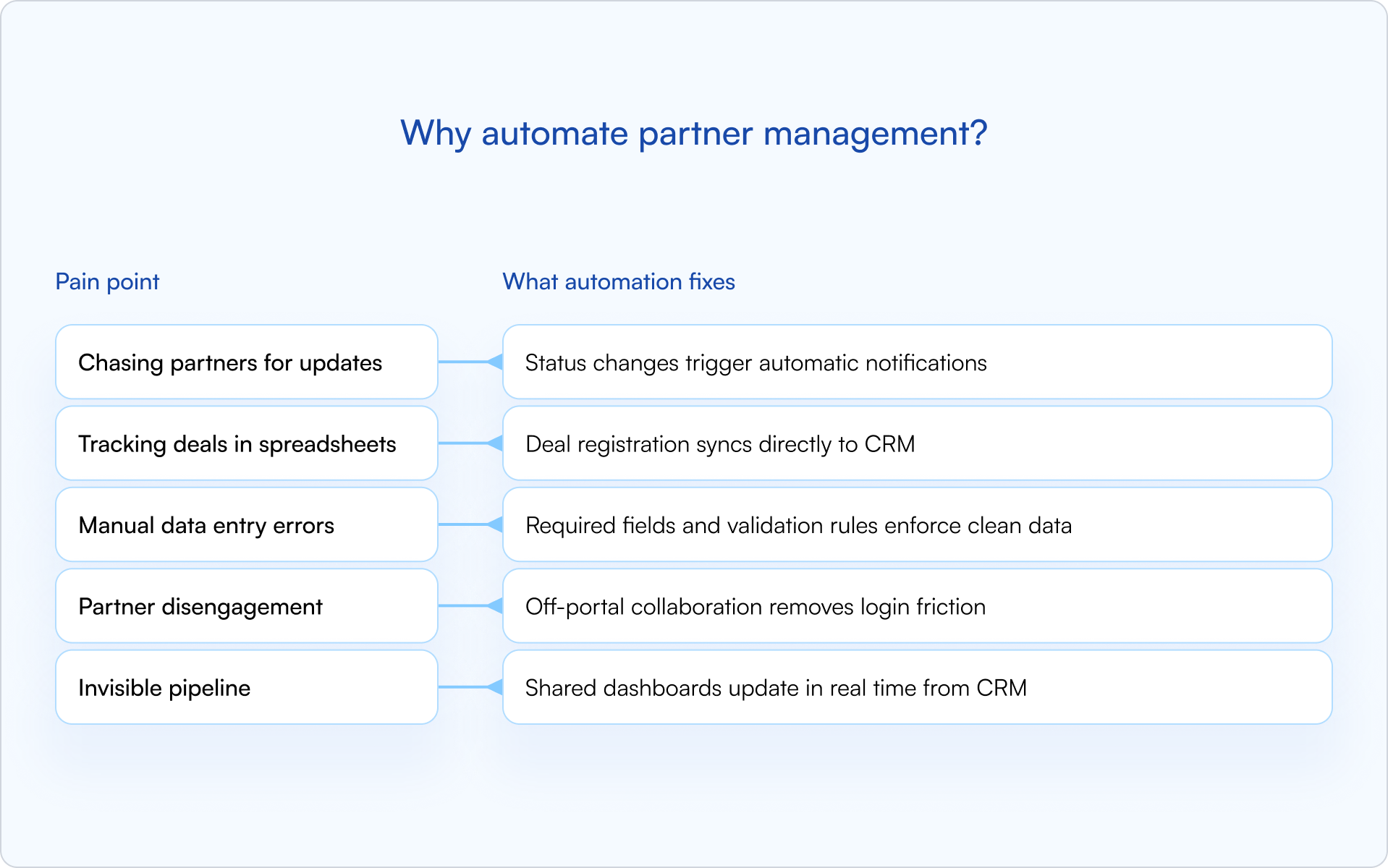
Warum das Partnermanagement automatisieren?

Die manuelle Partnerverwaltung funktioniert bei fünf Partnern gut. Bei fünfzig Partnern stößt sie jedoch schnell an ihre Grenzen – insbesondere, wenn es um Genehmigungen, Fragen zur Zuordnung und eine Pipeline geht, die die Unternehmensleitung prognostizieren möchte.

Die Schwachstellen sind vorhersehbar: Nachfragen bei Partnern nach aktuellen Informationen zu Geschäften, Kopieren von Daten zwischen Systemen, Korrigieren doppelter Datensätze und Beobachtung sinkender Interaktion, weil Partner sich nicht in ein weiteres Portal einloggen möchten. Gleichzeitig kann die Unternehmensleitung keine Prognosen zu den Partnerumsätzen erstellen, da die Pipeline nicht sichtbar ist.

Schmerzpunkt Was Automatisierung behebt
Partner für Updates suchen Statusänderungen lösen automatische Benachrichtigungen aus.
Verfolgen von Geschäften in Tabellenkalkulationen Deal-Registrierung wird direkt mit CRM synchronisiert
Fehler bei der manuellen Dateneingabe Pflichtfelder und Validierungsregeln sorgen für saubere Daten
Rückzug des Partners Die Zusammenarbeit außerhalb des Portals beseitigt Probleme beim Anmelden.
Unsichtbare Pipeline Gemeinsam genutzte Dashboards werden in Echtzeit aus dem CRM aktualisiert.

Das Ergebnis ist einfach: Durch Automatisierung werden Reibungsverluste beseitigt, die alles verlangsamen. Sie können von zwanzig Partnern auf dreihundert wachsen, ohne die Mitarbeiterzahl proportional zu erhöhen, da sich wiederholende Arbeiten automatisch und konsistent erledigt werden.

Partnermanagement-Aufgaben, die Sie automatisieren können

Nicht jede Aufgabe profitiert gleichermaßen von Automatisierung. Die Workflows mit der größten Wirkung sind diejenigen, die ein hohes Volumen aufweisen, sich wiederholen und anfällig für menschliche Fehler sind – genau die Bereiche, in denen eine von Gründern geleitete Partnerschaft mit zunehmender Größe an ihre Grenzen stößt.

Deal und Lead-Registrierung

Hier beginnen die meisten Teams, und das aus gutem Grund. Die manuelle Registrierung von Geschäften führt zu Verzögerungen, Streitigkeiten und fehlerhaften Daten.

Dank Automatisierung reichen Partner Angebote über ein Formular oder per E-Mail ein. Das System leitet die Einreichung automatisch zur Genehmigung weiter, versieht die Entscheidung mit einem Zeitstempel und synchronisiert das Angebot mit Ihrem CRM. Schutzfenster werden automatisch durchgesetzt, und ablaufende Registrierungen lösen vor ihrem Ablauf Erinnerungen aus.

Die Registrierung von Geschäften ist auch Ihre wichtigste Verteidigungsmaßnahme gegen Vertriebskonflikte. Wenn die Eigentumsverhältnisse frühzeitig festgelegt und für alle sichtbar sind, kommt es seltener zu Streitigkeiten.

Partnerkommunikation und Ankündigungen

Partner verpassen Updates, wenn die Kommunikation davon abhängt, dass jemand daran denkt, eine E-Mail zu senden. Durch Automatisierung wird „das richtige Update zur richtigen Zeit“ zum Standard.

Lösen Sie Benachrichtigungen für wichtige Ereignisse aus: Änderungen des Deal-Status, Aktualisierungen von Richtlinien, ablaufende Registrierungen und Genehmigungsentscheidungen. Benachrichtigungen können per E-Mail, Slack oder über Ankündigungen im Portal versendet werden – je nachdem, welchen Kanal Ihre Partner tatsächlich nutzen.

Die Zusammenarbeit außerhalb des Portals ist hier ein wichtiger Hebel: Partner können auf Benachrichtigungen per E-Mail antworten, und die Antworten werden mit der CRM-Zeitleiste synchronisiert. Eine Anmeldung ist nicht erforderlich.

Transparenz und Berichterstattung in der Pipeline

Gemeinsame Pipeline-Ansichten geben Partnern Einblick in ihre Geschäfte, ohne sensible Preise oder interne Notizen preiszugeben.

Mit Kontrollen auf Objektebene können Sie genau festlegen, was Partner sehen (Phase, nächster Schritt, Ablauf des Schutzes), während Rabattstufen und interne Kommentare verborgen bleiben. Dashboards werden automatisch anhand von CRM-Daten aktualisiert, sodass Sie keine Berichte manuell erstellen müssen.

Partner-Onboarding und -Registrierung

Onboarding ist ein wiederholbarer Prozess – und Wiederholbarkeit ist genau das, was Automatisierung so gut kann. Das Onboarding neuer Partner umfasst eine vorhersehbare Abfolge: Willkommens-E-Mails, Dokumentensammlung, Profilerstellung und Aufgabenverteilung.

Die Automatisierung führt diese Sequenz ohne manuelle Koordination aus. Partner erhalten Willkommensinhalte, führen die erforderlichen Schritte durch und werden in Ihrem CRM bereitgestellt – alles ausgelöst durch die Registrierung. SSO beseitigt Probleme mit Passwörtern, sodass Partner sofort auf das Portal zugreifen können.

Partner-Befähigung und -Schulung

Schulungsaufgaben können basierend auf der Partnerstufe, dem Zertifizierungsstatus oder dem Produktschwerpunkt automatisiert werden.

Die Inhalte befinden sich im Partnerportal, der Abschluss wird automatisch nachverfolgt und bei Ablauf der Zertifizierungen werden Erinnerungen versendet. Die Partner sind jederzeit verkaufsbereit, ohne dass Ihr Team jeden Kurs manuell zuweisen und nachverfolgen muss.

Auszahlungen und Provisionen

Bei Programmen mit Empfehlungs- oder Wiederverkäuferprovisionen kann die Automatisierung Auszahlungen basierend auf der Phase des Geschäfts berechnen, Berichte für die Finanzabteilung erstellen und Auszahlungen auslösen.

Die Automatisierung von Auszahlungen hängt stark von Ihrem Partnermodell ab. Nicht jedes Programm benötigt sie, aber bei Programmen, bei denen dies der Fall ist, eliminiert die Automatisierung den Hin- und Her-Verkehr zwischen Partnermanagern, Finanzabteilung und Partnern.

Wie man die Automatisierung des Partnermanagements implementiert

Die Automatisierung des Partnermanagements funktioniert am besten, wenn sie bewusst und nicht auf einmal eingeführt wird. Das Ziel besteht darin, sich wiederholende Vorgänge zu automatisieren, sensible Daten zu schützen und die Pipeline vertrauenswürdig zu halten.

1) Überprüfen Sie Ihre aktuellen Partner-Workflows.

Beginnen Sie damit, zu erfassen, wo heute manuelle Arbeit anfällt. Bei welchen Aufgaben müssen Daten zwischen Systemen kopiert werden? Wo geraten Partner ins Stocken? Was verursacht die größten Reibungsverluste für Ihr Team?

Häufige Ursachen sind die Registrierung von Geschäften, Statusaktualisierungen, Onboarding und Berichterstattung. Dokumentieren Sie die Schwachstellen, bevor Sie Tools auswählen oder Workflows erstellen.

2) Identifizieren Sie zuerst die Automatisierungen mit großer Wirkung.

Nicht alles muss vom ersten Tag an automatisiert werden. Konzentrieren Sie sich auf Arbeitsabläufe, die ein hohes Volumen aufweisen, sich wiederholen und fehleranfällig sind.

Deal-Registrierung und Statusbenachrichtigungen sind in der Regel die besten Ausgangspunkte. Beide kommen häufig vor, wirken sich direkt auf das Engagement der Partner aus und schaffen saubere CRM-Daten, von denen alle nachgelagerten Beteiligten profitieren.

3) Wählen Sie eine CRM-orientierte Partnermanagement-Plattform aus.

Die von Ihnen gewählte Plattform entscheidet darüber, ob die Automatisierung Ihr CRM verbessert oder ein paralleles System schafft, das Sie für immer abgleichen müssen.

Suchen Sie nach:

  • Native HubSpot Salesforce : Echtzeit-Synchronisierung statt Batch-Importe.
  • Zusammenarbeit außerhalb des Portals: Partner können per E-Mail Maßnahmen ergreifen, ohne sich anzumelden.
  • Freigabe auf Objektebene: Kontrollieren Sie genau, was Partner in freigegebenen Pipeline-Ansichten sehen.
  • Schnelle Implementierung: Tage bis Wochen, nicht Monate.
Kriterien CRM-First-Plattformen Standalone-PRMs
CRM-Synchronisierung Nativ, in Echtzeit Erfordert Integration
Datentransparenz Innerhalb des bestehenden CRM Separates System
Partner-Login erforderlich Optional Typischerweise erforderlich
Implementierungszeit Tage bis Wochen Wochen bis Monate

Ein CRM-First-Ansatz sorgt dafür, dass die Aktivitäten der Partner dort sichtbar bleiben, wo die Umsatzteams bereits arbeiten – wodurch Attribution und Prognosen realistisch statt nur Wunschvorstellungen sind.

4) Workflows konfigurieren und starten

Richten Sie Formulare für die Registrierung von Geschäften, Genehmigungswege, Benachrichtigungsauslöser und gemeinsame Pipeline-Ansichten ein. Testen Sie diese dann zunächst mit einer kleinen Gruppe von Partnern, bevor Sie sie flächendeckend einführen.

Fangen Sie einfach an. Sobald die Grundlagen funktionieren und Ihr Team den Daten vertraut, können Sie später komplexere Funktionen hinzufügen.

5) Ergebnisse messen und wiederholen

Verfolgen Sie das Engagement Ihrer Partner, das Registrierungsvolumen, die Genehmigungszeiten und die Genauigkeit der Pipeline. Anhand der Kennzahlen können Sie erkennen, ob die Automatisierung funktioniert und wo Verbesserungsbedarf besteht.

Das Ziel ist nicht eine perfekte Automatisierung vom ersten Tag an. Es geht um kontinuierliche Verbesserung auf der Grundlage dessen, was Sie lernen.

Bewährte Verfahren für die Automatisierung des Partnermanagements

Automatisierung kann nach hinten losgehen, wenn sie Reibungen verursacht, anstatt sie zu beseitigen. Diese Grundsätze tragen dazu bei, dass Ihr Partnerprogramm skalierbar bleibt, ohne dass es sich roboterhaft anfühlt.
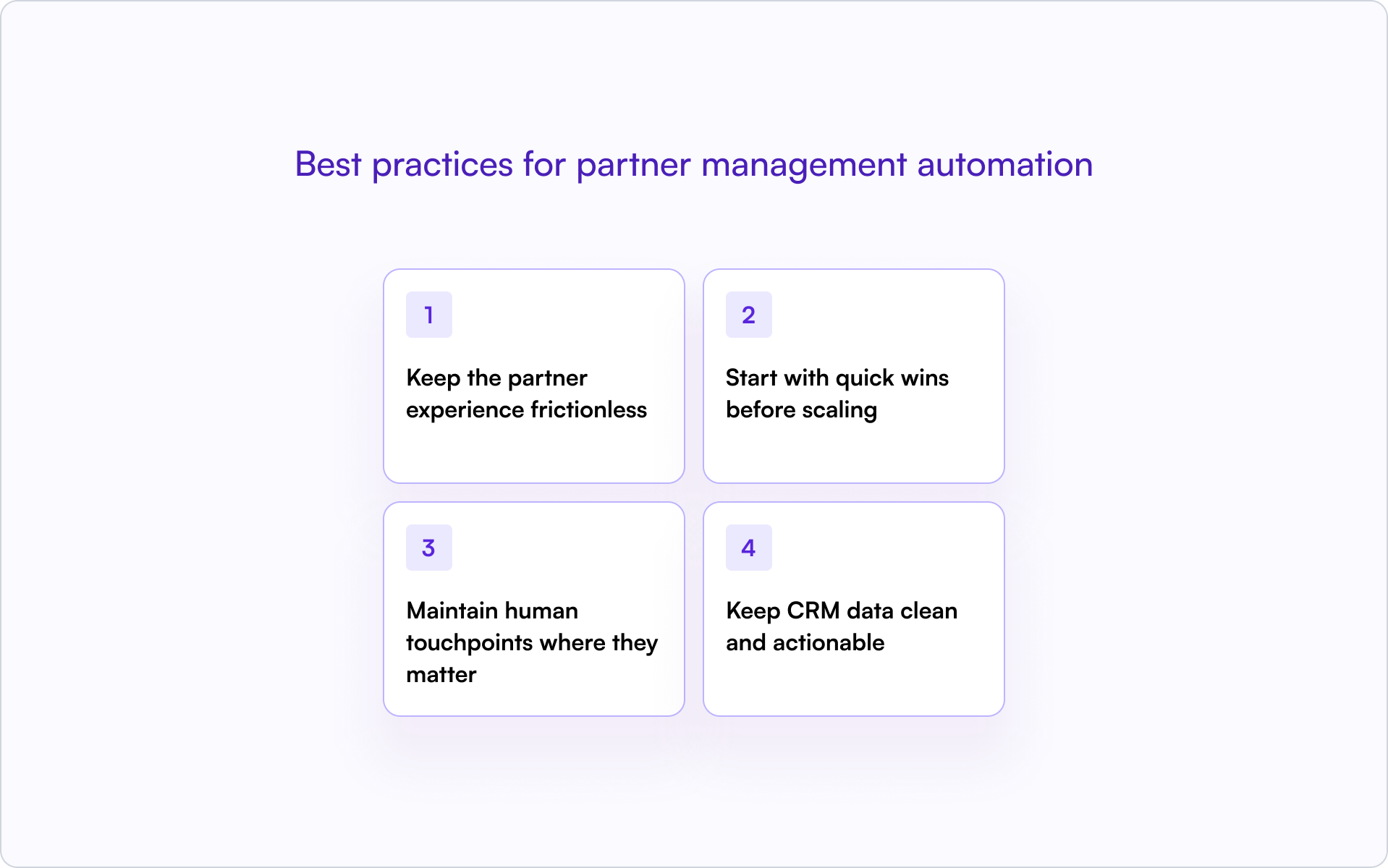
Sorgen Sie für eine reibungslose Partnererfahrung

Anmeldebildschirme auf Portalen zerstören das Engagement. Sobald Partner auf einen Anmeldebildschirm stoßen, brechen viele ab – insbesondere, wenn die Registrierung eines Geschäfts im Vergleich zum Betrieb ihrer eigenen Pipeline nur ein „nettes Extra“ ist.

  • Lassen Sie Partner Angebote per E-Mail oder über einfache Formulare einreichen.
  • Push-Benachrichtigungen über Kanäle, die sie bereits überprüfen.
  • Aktivieren Sie die Zusammenarbeit außerhalb des Portals, damit Partner ohne Anmeldung reagieren können.

Je weniger Klicks erforderlich sind, desto höher ist das Engagement.

Beginnen Sie mit schnellen Erfolgen, bevor Sie skalieren.

Beweisen Sie den Wert der Automatisierung des Partnermanagements mit ein oder zwei Workflows, bevor Sie expandieren. Frühe Erfolge schaffen internes Vertrauen und helfen den Partnern, das System als Vorteil und nicht als Bürokratie zu betrachten.

Die Registrierung von Geschäften ist in der Regel der beste Ausgangspunkt. Sie ist sichtbar, erfolgt häufig und schafft einen unmittelbaren Mehrwert für Partner und Ihr Team. Sobald die Registrierung von Geschäften funktioniert, erweitern Sie sie auf Schulungen, Auszahlungen oder komplexe Weiterleitungen.

Behalten Sie menschliche Kontaktpunkte dort bei, wo sie wichtig sind.

Die Automatisierung übernimmt repetitive Aufgaben. Strategische Beziehungen erfordern jedoch weiterhin persönliche Aufmerksamkeit.

Nutzen Sie Automatisierung, um Zeit für wichtige Gespräche wie QBRs, Konfliktlösung und Partnerentwicklung zu gewinnen. Das Ziel ist es, weniger Zeit mit der Dateneingabe und mehr Zeit mit dem Aufbau von Beziehungen zu verbringen.

CRM-Daten sauber und verwertbar halten

Die Automatisierung ist nur so gut wie die Daten, auf denen sie basiert.

Richten Sie Validierungsregeln, Duplikaterkennung und Pflichtfelder ein, um eine einzige zuverlässige Datenquelle zu gewährleisten. Wenn die Partnerdaten sauber sind, sind die Berichte genau, die Zuordnung klar und Prognosen möglich.

Partnermanagement-Software für die Automatisierung

Die Landschaft der Partnermanagement-Software umfasst mehrere Kategorien, die jeweils unterschiedliche Vor- und Nachteile haben. Wenn Sie als Gründer eine Entscheidung treffen müssen, lautet die eigentliche Frage: „Wird dies die Partnerumsätze in unserem CRM transparenter machen – oder weniger transparent?“

CRM-native Partnermanagement-Plattformen

CRM-native Plattformen basieren direkt auf HubSpot Salesforce. Partneraktivitäten werden in Echtzeit synchronisiert, die Attribution erfolgt im selben System wie der Direktvertrieb, und für Prognosen müssen keine Daten aus einem separaten Portal exportiert werden.

Introw ist ein Beispiel für einen CRM-First-Ansatz. Das Partnerportal, die Deal-Registrierung und die gemeinsame Pipeline basieren alle auf Ihrem bestehenden CRM, ohne separate Datenbank und ohne Datensilos.

Standalone-PRM-Plattformen

Herkömmliche PRMs wie PartnerStack, Impartner, Allbound, Zift Solutions und Kiflo funktionieren als separate Systeme.

Standalone-Plattformen sind oft reich an Funktionen, aber sie erstellen eine parallele Datenbank, die eine Integration erfordert, um mit Ihrem CRM synchronisiert zu werden. Die Aktivitäten Ihrer Partner können für den Vertrieb und RevOps unsichtbar werden, wenn Sie nicht in die Aufrechterhaltung der Integration investieren.

HubSpot - und Salesforce -Optionen

Bei der Bewertung der Optionen HubSpot oder Salesforce lautet die entscheidende Frage, ob die Plattform Ihr CRM verbessert oder nur ergänzend dazu eingesetzt wird.

Native CRM-Tools bieten grundlegende Funktionen zur Partnerverfolgung, jedoch fehlen ihnen häufig Funktionen zur Registrierung von Geschäften, gemeinsame Pipeline-Ansichten und die Möglichkeit zur Zusammenarbeit außerhalb des Portals. Die Synchronisierungsqualität und Komplexität der Implementierung von Integrationen von Drittanbietern variieren stark. CRM-first-Plattformen wie Introw bieten eine engere Integration als eigenständige Lösungen, mit Echtzeit-Synchronisierung, Sichtbarkeitskontrollen auf Objektebene und Zusammenarbeit mit Partnern ohne erforderliche Anmeldungen.

Entwickeln Sie ein Partnerprogramm, das (fast) automatisch läuft.

Die Automatisierung des Partnermanagements hält ein klares Versprechen: weniger manuelle Arbeit, sauberere Daten, engagierte Partner und skalierbares Wachstum.

Die Teams, die es richtig machen, automatisieren nicht alles auf einmal. Sie beginnen mit Workflows mit hoher Wirkung, wählen CRM-first-Tools und iterieren auf der Grundlage ihrer Erfahrungen. Ein CRM-first-Ansatz sorgt dafür, dass die Aktivitäten der Partner dort sichtbar bleiben, wo die Umsatzteams bereits arbeiten – was eine genaue Zuordnung, zuverlässige Prognosen und ein Partnerprogramm bedeutet, das ohne proportionale Aufstockung des Personalbestands skaliert werden kann.

Wenn Sie sich ein Bild davon machen möchten, wie „CRM-first“ in der Praxis aussieht, können Sie sich eine Demo ansehen und erfahren, wie Introw das Partnermanagement in Ihrem CRM automatisiert.

Autor

Ruben Bellaert

Growth

Hallo, ich bin Ruben. Bei Introw bin ich darauf spezialisiert, authentische Beziehungen aufzubauen, die partnergestütztes Wachstum vorantreiben. Ich bin von Natur aus gesellig und liebe es, mit Menschen in Kontakt zu treten – sei es durch eine herzliche Vorstellung, ein spontanes Gespräch oder die Zusammenarbeit in unseren gemeinsamen digitalen Räumen. Meine kreative Denkweise und mein People-First-Ansatz helfen mir, mich mühelos in der dynamischen Welt der B2B-Partnerschaften zurechtzufinden. Bei Introw transformieren wir die Art und Weise, wie Unternehmen mit Partnern zusammenarbeiten, indem wir Reibung eliminieren und das Engagement verbessern. Ich bin stolz darauf, dazu beizutragen, indem ich Verbindungen fördere, die zu bedeutsamem Wachstum führen.

Hallo, ich bin Ruben. Bei Introw bin ich darauf spezialisiert, authentische Beziehungen aufzubauen, die partnergestütztes Wachstum vorantreiben. Ich bin von Natur aus gesellig und liebe es, mit Menschen in Kontakt zu treten – sei es durch eine herzliche Vorstellung, ein spontanes Gespräch oder die Zusammenarbeit in unseren gemeinsamen digitalen Räumen. Meine kreative Denkweise und mein People-First-Ansatz helfen mir, mich mühelos in der dynamischen Welt der B2B-Partnerschaften zurechtzufinden. Bei Introw transformieren wir die Art und Weise, wie Unternehmen mit Partnern zusammenarbeiten, indem wir Reibung eliminieren und das Engagement verbessern. Ich bin stolz darauf, dazu beizutragen, indem ich Verbindungen fördere, die zu bedeutsamem Wachstum führen.

FAQs

Noch Fragen? Hier findest du die häufigsten Fragen und Antworten.

Kontaktiere uns

Was ist Partnermanagement-Automatisierung?

Partner management automation is the use of software to run repeatable partner workflows — like deal registration, approvals, onboarding, partner updates, and reporting — with minimal manual effort. The best implementations keep partner activity logged and measurable in your CRM so revenue teams can forecast and attribute partner-sourced pipeline.

What is the difference between PRM software and partner management automation?

PRM (Partner Relationship Management) is the category of software. Partner management automation refers to the specific workflows you automate within PRM software, such as deal registration, onboarding, and communication. You can have PRM software without much automation, or you can have highly automated workflows inside a CRM-first platform.

Can partner management be automated without a dedicated partner portal?

Yes. CRM-first platforms allow partners to register deals, receive updates, and collaborate via email or forms without requiring a portal login. Off-portal collaboration often increases engagement because it removes friction.

How long does it take to implement partner management automation?

Implementation time varies by platform. CRM-native solutions can launch in days to weeks. Standalone PRMs with complex integrations may take weeks to months, especially if custom development is required.

Which partner management tasks should not be fully automated?

Strategic relationship building, conflict resolution, and high-value partner negotiations benefit from human involvement. Automation should handle repetitive coordination so you have more time for conversations that require judgment and nuance.


Launch your partner portal
in minutes!

Vielen Dank! Wir haben deine Anfrage erhalten!
Hoppla! Beim Absenden des Formulars ist ein Fehler aufgetreten.

Verwandte Blog-Artikel

Partner-Management

11 Euler PRM Alternatives for Smarter Partner Management in 2026

Janis De Sutter
Software Engineer
5min Lesezeit
02 Jun 2026
⚡ TL;DR

Euler PRM helps teams manage partner programs and distribution channels. But as partner ecosystems grow, many teams need deeper CRM integrations, more automation, stronger enablement, and greater flexibility. This guide compares 11 Euler alternatives to help you evaluate CRM connectivity, AI capabilities, onboarding, partner engagement, and overall time to value.

What is Euler PRM (and why teams look for alternatives)

Euler PRM helps businesses manage partners, track deals, and run partner programs. The platform became known through Starlink reseller programs and includes onboarding tools, CRM integrations, and AI assistants.

For many teams, that’s enough to get started. As partner programs grow, however, some businesses need deeper CRM integrations, more automation, and better ways to keep partners engaged.

That’s why many teams evaluating Euler also compare other partner management systems.

1. CRM integration without custom object support

Euler connects to HubSpot and Salesforce but does not support custom objects. Teams that rely on custom CRM data structures may run into limitations as programs grow.

2. No white-label portal

Euler’s portal uses Euler branding. There is no white-label option for businesses that want a fully branded partner experience.

3. No segmented onboarding

Euler does not support onboarding by partner type, tier, or stage. Every partner follows the same experience. Teams that want tailored journeys often look for stronger partner portal capabilities.

4. No embedded LMS or MDF management

Euler does not include a built-in LMS or MDF functionality. Teams that need partner training, certification, or co-marketing workflows must use additional tools.

5. AI that advises, not executes

Euler’s AI assistants provide guidance and surface data. They do not automate deal registration, partner engagement, or workflow execution. Teams looking to reduce manual work frequently evaluate platforms with dedicated AI agents.

6. Portal-first engagement

Euler keeps most activity inside the portal. There is no native email or Slack collaboration that syncs back to the CRM in real time. That’s why many teams prioritize stronger partner engagement capabilities.

These limitations won’t matter to every business. But as partner programs grow, many companies start comparing Euler competitors that offer deeper CRM connectivity and more automation.

Euler PRM alternatives at a glance

Not every Euler competitor solves the same problems. Some focus on affiliate programs, some on enterprise channel management, and others on partner enablement. This table gives you a quick way to compare the most important differences.

Tool CRM-Integration White-label portal AI capability Zusammenarbeit außerhalb des Partnerportals Embedded LMS MDF module Time to live
Introw Native Yes Agentic Yes Yes Yes 2 to 4 days
Impartner Middleware Yes Advisory Limited Yes Yes 3 to 12 months
PartnerStack Middleware Limited Advisory No No No Weeks
Kiflo Basic No None No No No Days
Salesforce Experience Cloud (Partner Cloud) Native Yes None No No No 3 to 12 months
ChannelScaler Middleware Yes None No Yes Yes Wochen bis Monate
Gedankenmatrix Integrated Yes TCMA No Yes No Wochen bis Monate
Zinfi Integrated Yes TCMA No Yes Yes Wochen bis Monate
Magentrix Native Yes Advisory No No No Wochen bis Monate
Channeltivity Integrated Yes None No No Yes Weeks
Partner.io Integrated Yes Advisory No No No Weeks

Next, you'll get a closer look at each platform, where it stands out, and where it may be a better fit than Euler.

11 best Euler PRM alternatives in 2026

If you’re looking for an Euler alternative, these are the platforms worth evaluating. Some focus on referral programs, some specialize in enterprise channel management, and others help partnership teams scale with less manual work.

#1 Introw - Best overall Euler alternative for CRM-native partner management

What it does

Introw is an AI-powered PRM built for revenue teams that want partner data, deal tracking, partner applications, and attribution inside the CRM. It combines agentic AI, off-portal collaboration, white-label portals, MDF, CPQ, and segmented onboarding in one system.

Why someone might choose it over Euler

Introw addresses the biggest gaps that push teams toward Euler software alternatives. It supports custom CRM objects, white-label branding, embedded learning, MDF workflows, and AI that can take action instead of only providing answers.

Partners can register deals, submit partner applications, collaborate on sales opportunities, and complete onboarding through email, Slack, embedded forms, or the portal. Everything syncs back automatically, reducing manual loading between systems.

For partnership leaders running multiple partner programs, that means less time spent updating spreadsheets and more focus on partner revenue, ROI, growth, and partner trust.

Teams evaluating modern PRMs often compare Introw with other solutions in guides covering partner relationship management software and the 2025 guide to choosing your next PRM.

Where it stands out

  • Native CRM architecture with full custom object support for deal tracking, attribution, partner applications, and partner revenue
  • Agentic AI across the full partner lifecycle management process
  • White-label portal builder
  • Embedded partner LMS
  • Native MDF management
  • Off-portal collaboration through email and Slack
  • Built-in deal and lead registration
  • Native MCP and Claude connectivity
  • Automated workflows that help partner teams scale without adding bandwidth

CRM integrations

Native, bi-directional integrations with Salesforce and HubSpot.

Preise

Custom pricing.

Am besten geeignet für

SaaS companies with multiple partner types that want to drive growth, increase partner revenue, and spend less time on admin work.

Explore the full Euler comparison or request a demo.

#2 Impartner - Best for enterprise-scale PRM with broad module coverage

What it does

Impartner is an enterprise PRM platform covering partner portals, TCMA, marketplaces, partner lifecycle management, and partner enablement services.

Why someone might choose it over Euler

  • Broad enterprise feature coverage
  • Established market presence
  • Strong support for large partner programs
  • Designed for complex partnerships

Where it falls short

  • 3–12 month implementation timelines
  • Middleware-based CRM integration
  • Reported field-mapping challenges
  • Dated user experience

CRM integrations

Salesforce via middleware.

Preise

Custom pricing.

Am besten geeignet für

Enterprise organizations with 50+ partners and dedicated PRM admin resources.

Our guide to best Impartner competitors covers additional options.

#3 PartnerStack - Best for affiliate and referral program automation

What it does

PartnerStack is a partner network platform focused on affiliate tracking, referral automation, recruiting partners, automated payments, and partner payouts.

Why someone might choose it over Euler

  • Large partner marketplace
  • Mature referral capabilities
  • Automated payments infrastructure
  • Strong partner recruitment engine

Where it falls short

  • Workato-based CRM middleware
  • Transaction fees on partner payments
  • Limited portal customization
  • No distributor or two-tier models

CRM integrations

Salesforce and HubSpot via Workato.

Preise

Custom pricing plus transaction fees.

Am besten geeignet für

Teams focused primarily on referral programs and automated partner payments.

See how it compares in our roundup of PartnerStack alternatives.

#4 Kiflo - Best for SMBs launching their first partner program

What it does

Kiflo is a lightweight PRM designed for onboarding partners, deal registration, commission tracking, and basic partner management.

Why someone might choose it over Euler

  • Easy to learn
  • Faster setup
  • Lower starting cost
  • Intuitive experience for smaller teams

Where it falls short

  • No AI
  • No off-portal collaboration
  • No white-label portal
  • No LMS
  • No CPQ
  • No custom object support

CRM integrations

Basic Salesforce and HubSpot integrations.

Preise

Lower-cost, partner-based pricing.

Am besten geeignet für

Small businesses launching their first partner program.

Take a look at our in-depth guide to Kiflo alternatives.

#5 Salesforce Experience Cloud (Partner Cloud) - Best for teams that want everything inside Salesforce

What it does

Salesforce Experience Cloud is Salesforce’s build-it-yourself partner portal framework. Because it sits directly inside Salesforce, companies can connect partner data, customers, sales processes, events, and reporting in one environment.

Why someone might choose it over Euler

  • Deepest Salesforce integration available
  • Highly customizable
  • Extensive reporting capabilities
  • Strong API ecosystem

Where it falls short

  • Heavy developer dependency
  • No built-in LMS
  • No AI agent
  • No off-portal collaboration
  • Long implementation cycles

CRM integrations

Native Salesforce.

Preise

Starts around $20/user/month plus implementation costs.

Am besten geeignet für

Large Salesforce-centric organizations with dedicated development resources.

Our guide to Salesforce PRM alternatives explores similar options.

#6 ChannelScaler - Best for incentive and rebate management alongside PRM

What it does

ChannelScaler combines PRM, MDF, rebates, incentive management, and partner revenue programs in one system. The platform helps partner teams manage payments, spiff payments, partner applications, partner contracting, and channel operations across larger partnerships.

Why someone might choose it over Euler

  • Strong incentive management and rebate capabilities
  • Built-in MDF functionality
  • Broad feature coverage
  • Helps partnership leaders manage complex channel programs

Where it falls short

  • Admin-heavy experience
  • No AI capabilities
  • No Slack support
  • No off-portal collaboration
  • CRM changes often require support involvement

CRM integrations

Salesforce and HubSpot via middleware.

Preise

Custom pricing.

Am besten geeignet für

Companies that need rebates, MDF, incentive management, and partner services from a single provider.

Explore our guide to ChannelScaler alternatives.

#7 Mindmatrix - Best for through-channel marketing automation (TCMA)

What it does

Mindmatrix combines PRM, LMS, TCMA, training, content creation, and marketing services. The platform helps partnership teams create campaigns, support partners, automate marketing activities, and drive growth across multiple markets.

Why someone might choose it over Euler

  • Strong TCMA capabilities
  • Built-in LMS and training tools
  • AI content generation
  • Social selling support

Where it falls short

  • Steep learning curve
  • LMS updates may require support
  • No dedicated admin experience
  • No CPQ
  • Long onboarding process

CRM integrations

Salesforce and HubSpot integrations.

Preise

Custom pricing.

Am besten geeignet für

Enterprise partner teams focused on marketing automation, partner enablement, and revenue growth.

See how it compares in our roundup of Mindmatrix alternatives.

#8 Zinfi - Best for large-scale channel management with broad module coverage

What it does

Zinfi provides channel management, partner onboarding, analytics, deal tracking, partner marketing, and TCMA capabilities in a single platform. It is designed for companies running large global partnerships across the world.

Why someone might choose it over Euler

  • Broad enterprise feature set
  • Strong analytics
  • Dedicated TCMA functionality
  • Support for complex partner programs
  • Helps partnership leaders manage growth at scale

Where it falls short

  • Complex implementation
  • Dated interface
  • Significant configuration requirements
  • Data primarily lives inside Zinfi

CRM integrations

Salesforce and Microsoft Dynamics integrations.

Preise

Custom pricing.

Am besten geeignet für

Large enterprises managing partnerships across multiple regions, partner types, and customer segments.

Our guide to Zinfi alternatives covers other options worth considering.

#9 Magentrix - Best for Salesforce-native teams wanting a portal-first approach

What it does

Magentrix is a Salesforce-native portal platform that helps companies connect partners, customers, resources, and data through a branded experience. It supports partner collaboration, self-service resources, and customer-facing services.

Why someone might choose it over Euler

  • Native Salesforce architecture
  • Flexible portal builder
  • Strong portal customization
  • Familiar experience for Salesforce users

Where it falls short

  • Salesforce-only
  • Limited AI capabilities
  • Portal-first workflow
  • Limited off-portal collaboration

CRM integrations

Native Salesforce integration.

Preise

Essential from $1,500/month. Advanced from $3,000/month. Unlimited pricing available by quote.

Am besten geeignet für

Salesforce customers who want a portal-centric system for partners, customers, and self-service resources.

Take a look at our guide to Magentrix alternatives.

#10 Channeltivity - Best for mid-market teams wanting a straightforward PRM

What it does

Channeltivity covers partner portals, deal registration, MDF management, analytics, and automated workflows. The platform helps companies create partner programs without the complexity of many enterprise tools.

Why someone might choose it over Euler

  • Dedicated MDF module
  • Proven market presence
  • Straightforward feature set
  • Less time spent managing the system

Where it falls short

  • Limited AI capabilities
  • No off-portal collaboration
  • CRM depth may not fit advanced use cases

CRM integrations

Salesforce integration.

Preise

Standard: $1,899/month annually. CRM Edition: $2,199/month annually.

Am besten geeignet für

Mid-market companies that want a proven PRM and spend less time managing partner operations.

Explore our review of Channeltivity competitors.

#11 Partner.io - Best for pipeline-focused partner collaboration

What it does

Partner.io focuses on pipeline visibility, attribution, deal collaboration, partner applications, and helping sales teams track opportunities across partnerships. The platform is built to improve visibility between internal teams and external partners while helping companies create stronger partner relationships.

Why someone might choose it over Euler

  • Strong pipeline visibility
  • Modern user experience
  • Focus on collaboration
  • Helps drive growth through better deal visibility
  • Good fit for partnership leaders focused on revenue

Where it falls short

  • Smaller customer base
  • Narrower feature set
  • No embedded LMS
  • No MDF management

CRM integrations

Salesforce and HubSpot.

Preise

Forever Free: $0. Professional: $249/month. Enterprise: custom pricing.

Am besten geeignet für

Partner teams that prioritize pipeline visibility, attribution, deal collaboration, and future revenue opportunities.

See how it compares in our roundup of Partner.io alternatives.

It’s easy to get caught up comparing features. But the best PRM is the one that fits your CRM, your partner model, and the way your team and partners actually work.

Das Fazit

Euler is a solid starting point for partner programs, especially in distribution-focused environments. But as programs grow, the gaps become harder to ignore.

  • If you need enterprise TCMA, look at Mindmatrix or Zinfi.
  • If affiliate payouts and partner recruitment are your priority, PartnerStack is a strong option.
  • If you want a Salesforce-native portal, Magentrix is worth considering.

But if you need a CRM-native PRM with agentic AI, off-portal collaboration, partner enablement, MDF management, and a faster path to value, Introw is the clearest upgrade.

See the full Introw vs Euler comparison for a side-by-side breakdown.

Why teams choose Introw when looking for Euler alternatives

+70% more partner pipeline

Many companies struggle to keep partners engaged after onboarding. Introw helps partners register deals, share data, and collaborate in real time, helping companies create more pipeline and uncover new revenue opportunities without adding manual work.

+75% faster partner onboarding

Most companies don’t want a long implementation process. Introw goes live in 2 to 4 days, helping partners access training, resources, and services from day one. Every partner gets the right experience based on their role, making it easier for one person or hundreds of users to get started.

+60% more partner-influenced revenue

Introw helps companies connect partner activity, attribution, and customer outcomes in one place. Better visibility into data makes it easier to identify what drives growth, improve ROI, and build stronger partnerships over time.

Ready to see how Introw compares to Euler and other competitors? Request a demo.

Partner-Management

10 Magentrix PRM Alternatives for Better Partner Engagement in 2026

Peter Vermeulen
Staff Engineer
5min Lesezeit
01 Jun 2026
⚡ TL;DR

Magentrix PRM is a popular Salesforce-based solution for partner portals, deal registration, and content sharing. But many teams evaluating Magentrix alternatives want broader CRM support, stronger partner engagement, AI-powered workflows, and a platform that helps manage the full partner lifecycle.

We'll show you 10 Magentrix PRM alternatives in 2026, including options built for Salesforce, HubSpot, and growing partner programs. We’ll compare features, pricing, AI capabilities, and overall partner experience to help you find the right fit.

What Is Magentrix (And Why Teams Look for Alternatives)

Magentrix PRM is a Salesforce-native partner portal platform. It gives Salesforce users a branded place to share content, register deals, and manage partner access.

For teams that only need a portal, Magentrix can work well. But many businesses evaluating Magentrix alternatives need broader CRM support, stronger partner experience capabilities, and more complete partner lifecycle management.

1. Salesforce-only, no HubSpot support

Magentrix is built for Salesforce. If you use HubSpot, it isn’t an option.

This is one reason buyers comparing the best partner relationship management software often look beyond Magentrix.

2. Portal-centric, no off-portal collaboration

Partners need to log in to access content, register deals, and view updates.

There are no CRM-synced email conversations or Slack-based collaboration workflows that keep partners engaged outside the portal.

3. Limited AI capabilities

Magentrix doesn’t offer AI-powered deal coaching, automated QBR generation, AI course creation, or agentic partner management capabilities.

For teams looking to reduce manual work, this is a common reason to review Magentrix competitors.

4. Partner portal, not full partner lifecycle management

Magentrix focuses on portal functionality, onboarding, and content sharing.

Many alternatives extend into MDF, partner engagement, CPQ, commissions, goals, and revenue tracking. That’s typically where differences appear when comparing the best partner management systems.

5. No embedded AI-powered LMS

Magentrix includes content sharing but not a built-in AI-powered LMS with certifications and structured training.

Teams with formal enablement programs often need additional software. If you’re planning to choose your next PRM, it’s worth evaluating training requirements early.

These gaps explain why many teams eventually start looking for a Magentrix alternative that can scale with their program.

Magentrix alternatives at a glance

Here’s a quick side-by-side comparison before we dive into each Magentrix alternative in more detail.

Tool CRM support Engagement model AI capability Partner lifecycle coverage Embedded LMS Time to live
Introw HubSpot + Salesforce Off-portal + portal hybrid Agentic AI Full lifecycle AI-powered Days
Salesforce Experience Cloud (Partner Cloud) Salesforce only Portal-centric Advisory AI (Salesforce AI) Partial None Wochen bis Monate
Impartner Salesforce + Microsoft Dynamics + other CRMs Hybrid Content and advisory AI Full lifecycle Basic Months
PartnerStack Native platform Portal-centric Limited AI Partial None Weeks
Kiflo HubSpot + Salesforce Hybrid None Partial Basic Days
Euler HubSpot + Salesforce Hybrid AI assistants Partial None Tage bis Wochen
Gedankenmatrix Salesforce + other CRMs Portal-centric Content AI Full lifecycle Basic Wochen bis Monate
ChannelScaler Salesforce + other CRMs Portal-centric Limited AI Full lifecycle None Months
Channeltivity Salesforce + HubSpot Hybrid None Partial Basic Tage bis Wochen
Partner.io HubSpot + Salesforce Hybrid Advisory AI Partial None Tage bis Wochen

Now, let’s look at where each platform stands out and where it may fall short depending on your partner program.

10 Best Magentrix Alternatives in 2026

#1 Introw - Best overall Magentrix alternative for CRM-native partner management

What it does

Introw is an AI-first PRM software for revenue teams using HubSpot and Salesforce. The platform combines partner engagement, deal registration, LMS, MDF, CPQ, and agentic AI in one system.

Unlike most alternatives, Introw syncs live CRM data bi-directionally, including custom objects, so your team can manage customers, data, and workflows without duplicate records or manual updates.

Why someone might choose it over Magentrix

Introw fills the biggest gaps that push teams away from Magentrix PRM.

You can connect HubSpot or Salesforce instead of being locked into a single CRM. Partners can collaborate through email, Slack, embedded forms, or a white-label partner portal, with information synced automatically to the CRM.

The AI agent helps automate repetitive tasks across the lifecycle by generating training content, building announcements, surfacing QBR insights, and coaching live deals. The platform also includes capabilities Magentrix doesn’t offer, including MDF, CPQ, goal tracking, and an AI-powered partner LMS.

Key differences from Magentrix

  • HubSpot and Salesforce vs. Salesforce-only
  • Off-portal collaboration vs. portal-only engagement
  • Agentic AI vs. no native AI capabilities
  • Full lifecycle management vs. portal-focused functionality
  • AI-powered LMS vs. knowledge base
  • Native MCP and Claude support vs. none

CRM integrations

See the Claude integration in action:

Preise

Introw offers custom pricing based on your partner program size, CRM setup, and required features.

Am besten geeignet für

SaaS businesses that want a complete partner management platform instead of just a partner portal.

For a deeper review, see our guide to choosing your next PRM or request a demo.

#2 Salesforce Experience Cloud (Partner Cloud) - Best for Salesforce teams wanting maximum native control

What it does

Salesforce Experience Cloud is Salesforce’s portal-building platform. It gives administrators complete control over how partner experiences are designed, displayed, and connected to Salesforce data.

Why someone might choose it over Magentrix

Teams that need maximum customization and direct access to Salesforce objects often choose Experience Cloud over Magentrix.

Where it falls short

  • Requires significant developer resources
  • No dedicated PRM admin layer
  • No embedded LMS
  • No AI deal coaching
  • No off-portal collaboration
  • Long implementation time
  • Can become expensive to upgrade and maintain

CRM integrations

  • Salesforce (native)

Preise

Customer Community Plus: $15/login or $35/member. Partner Community: $20/login or $50/member.

Am besten geeignet für

Large Salesforce organizations with dedicated developers and administrators.

See how it compares in our roundup of best Salesforce PRM alternatives.

#3 Impartner — Best for enterprise-scale PRM beyond just a portal

What it does

Impartner is an enterprise PRM platform covering partner portals, TCMA, marketplaces, and partner lifecycle management.

Why someone might choose it over Magentrix

Impartner offers a broader set of features than Magentrix, including TCMA, marketplace functionality, and enterprise partner programs.

Where it falls short

  • Long implementation cycles
  • Middleware-based CRM integrations
  • Dated user experience
  • Complex setup and maintenance
  • Difficult to migrate once heavily customized

CRM integrations

  • Salesforce (via middleware)

Preise

Individuelle Preisgestaltung für Unternehmen.

Am besten geeignet für

Enterprise businesses running mature partner ecosystems.

Our guide to the best Impartner competitors covers additional options.

#4 PartnerStack- Best for affiliate and referral programs with payouts

What it does

PartnerStack helps businesses manage affiliate, referral, and reseller programs with built-in payouts and marketplace access.

Why someone might choose it over Magentrix

PartnerStack includes payout automation, a free partner marketplace, and support for affiliate programs that Magentrix wasn’t designed to manage.

Where it falls short

  • Transaction fees on payouts
  • Limited co-sell functionality
  • Rigid portal experience
  • No distributor management
  • CRM integrations require middleware

CRM integrations

  • HubSpot (via Workato)
  • Salesforce (via Workato)

Preise

Launch: $1,000/month. Growth: $1,520/month. Enterprise: custom.

Am besten geeignet für

Businesses focused on affiliate and referral revenue.

Explore our guide to the best PartnerStack alternatives.

#5 Kiflo - Best for SMBs on HubSpot launching their first program

What it does

Kiflo is a lightweight PRM platform designed for small businesses that want an easy way to start managing partners.

Why someone might choose it over Magentrix

Kiflo supports HubSpot, offers simpler workflows, and is less expensive to get started with.

Where it falls short

  • No AI capabilities
  • No off-portal collaboration
  • No white-label portal options
  • No LMS
  • No CPQ
  • Limited scalability

CRM integrations

  • HubSpot
  • Salesforce

Preise

Core: $399/month (annual billing). Plus: custom.

Am besten geeignet für

Small businesses with fewer than 20 active partners.

Take a look at our in-depth guide to Kiflo alternatives.

#6 Euler - Best for modern PRM with AI assistants

What it does

Euler is a modern PRM platform with AI assistants, partner management workflows, and support for both Salesforce and HubSpot.

Why someone might choose it over Magentrix

Euler offers a more modern user experience, HubSpot support, and AI features that Magentrix lacks.

Where it falls short

  • No custom object support
  • No white-label portal builder
  • No LMS
  • No MDF management
  • Limited onboarding flexibility

CRM integrations

  • HubSpot
  • Salesforce

Preise

Custom pricing.

Am besten geeignet für

Growing partner programs that want a modern interface and advisory AI.

Explore our guide to the best Euler PRM alternatives.

#7 Mindmatrix - Best for through-channel marketing automation

What it does

Mindmatrix combines PRM software, TCMA, LMS, content management, and partner enablement in a single platform.

Why someone might choose it over Magentrix

Mindmatrix offers broader services, LMS capabilities, content automation, and support for both Salesforce and HubSpot.

Where it falls short

  • Steep learning curve
  • Long implementation cycles
  • Complex administration
  • LMS often requires support involvement

CRM integrations

  • HubSpot
  • Salesforce

Preise

Individuelle Preisgestaltung für Unternehmen.

Am besten geeignet für

Enterprise organizations focused on through-channel marketing.

See how it compares in our roundup of the best Mindmatrix alternatives.

#8 ChannelScaler - Best for incentive and rebate management

What it does

ChannelScaler combines PRM, MDF, incentives, rebates, and channel management into a single platform.

Why someone might choose it over Magentrix

ChannelScaler provides incentive management, rebate programs, budget controls, and MDF capabilities that extend beyond portal functionality.

Where it falls short

  • Admin-heavy workflows
  • No AI capabilities
  • No Slack collaboration
  • CRM changes often require support assistance
  • Some updates require additional waiting time

CRM integrations

  • Salesforce
  • HubSpot (middleware)

Preise

Custom pricing.

Am besten geeignet für

Businesses with complex rebate, incentive, and budget management requirements.

Explore our guide to the best ChannelScaler alternatives.

#9 Channeltivity - Best for mid-market Salesforce teams wanting MDF

What it does

Channeltivity is a mid-market PRM platform focused on portals, deal registration, MDF, and channel analytics.

Why someone might choose it over Magentrix

Channeltivity includes MDF management and analytics capabilities that go beyond standard portal features.

Where it falls short

  • Limited AI functionality
  • Salesforce-focused architecture
  • No off-portal collaboration

CRM integrations

  • Salesforce

Preise

Standard: $1,899/month annually. CRM Edition: $2,199/month annually.

Am besten geeignet für

Mid-market Salesforce customers looking for MDF and analytics.

Our guide to the best Channeltivity competitors covers additional options.

#10 Partner.io - Best for pipeline-focused partner collaboration

What it does

Partner.io is a partner management platform built around pipeline visibility, deal collaboration, and partner communication.

Why someone might choose it over Magentrix

Partner.io focuses on helping teams manage live deal collaboration rather than primarily serving as a portal.

Where it falls short

  • Smaller market presence
  • Narrower feature set
  • Fewer enterprise capabilities than some competitors
  • Less information available than many established vendors

CRM integrations

  • HubSpot
  • Salesforce

Preise

Solo starts at $79/month. Growing starts at $299/month. Enterprise pricing is custom.

Am besten geeignet für

Teams focused on pipeline visibility and collaborative selling.

See how it compares in our roundup of the best Partner.io alternatives.

The Bottom Line

Magentrix is a good choice if you’re a Salesforce team that wants a branded partner portal for deal registration, content sharing, and partner access.

Many teams start looking at the best alternatives when they adopt HubSpot, struggle with portal engagement, or need more than a portal can provide.

If that’s you, Introw stands out by combining partner management, AI, training, deal collaboration, and CRM connectivity in one place across both HubSpot and Salesforce. It offers one of the best alternatives for teams that have outgrown a portal-only approach.

As you compare options, focus on what helps your team work faster and keeps partners engaged. Features like security verification and protection from malicious bots matter, but so does day-to-day usability.

For a deeper side-by-side review, see the full Magentrix comparison.

Why Teams Choose Introw When Looking for Magentrix Alternatives

If you’ve reviewed this list, you’ve probably noticed a pattern. Most alternatives solve one or two Magentrix limitations. Introw is one of the few PRM software platforms designed to address all of them in one place.

+70% more partner pipeline

Introw helps teams turn dormant programs into revenue engines. Partners register more deals, faster, with deal flow synced directly into your CRM.

Off-portal collaboration means partners can work without logging in, while AI helps protect pipeline quality by identifying duplicate opportunities before they become problems.

+75% faster partner onboarding

Go live in 2 to 4 days with no custom coding.

Partners move from signup to selling with AI-driven onboarding, certification, and content in one intuitive platform. Integrated HubSpot and Salesforce support means you’re never locked into a single CRM if your business grows or your needs change.

+60% more partner-influenced revenue

Get full visibility into every partner-touched deal.

Attribution lives inside your CRM, making it easier to prove what’s working and expand successful programs. Deal coaching, engagement automation, and powerful reporting features help keep partners active without creating extra tasks for your team.

Ready to compare Introw to Magentrix?

If you still have questions after reviewing the most alternatives on this list, the best way to evaluate fit is to see the platform in action.

Request a demo and see how leading SaaS teams grow partner pipeline, speed up onboarding, and increase partner-influenced revenue with Introw.

Partner-Management

14 Partner.io Alternatives for Stronger Partner Collaboration in 2026

Adèle Coolens
Marketing & Partnerschaften
5min Lesezeit
19 May 2026
⚡ TL;DR

Partner.io is a newer PRM focused on partner collaboration and portal experiences. This guide compares 14 Partner.io alternatives for teams that need deeper CRM integration, stronger automation, and broader partner management capabilities. For most growing SaaS companies, Introw is the strongest overall alternative thanks to its CRM-native approach, AI-powered workflows, and full-lifecycle partner management.

Why teams compare Partner.io with other PRMs

Partner.io is a newer partner management platform focused on partner collaboration and pipeline visibility. As programs grow, many teams evaluate Partner.io alternatives with deeper CRM integration, stronger automation, and broader partner management capabilities.

Key evaluation criteria

Before choosing a platform, consider:

  • Platform maturity: Customer base, reviews, case studies, and long-term product stability
  • Partner lifecycle coverage: Support for partner onboarding, partner training, deal registration, MDF, incentives, and partner engagement
  • CRM integration: How deeply the platform connects with Salesforce or HubSpot, including partner data synchronization and workflow automation
  • AI capabilities: Whether AI reduces manual work through coaching, automation, insights, or content creation
  • Partner collaboration: How easily partners can work with your team through a partner portal and other engagement channels
  • Scalability: Whether the platform can support more partners, additional partner types, and a growing partner motion without adding complexity

The best choice is the platform that fits both your current program and where you expect partner revenue to grow over the coming years.

Partner.io alternatives at a glance

Use this table to compare each Partner.io comp by maturity, CRM fit, AI depth, and how much of the partner lifecycle each tool supports.

Tool Established since CRM-Integration AI capability Zusammenarbeit außerhalb des Partnerportals Partner lifecycle Embedded LMS
Introw 2023 Native Agentic Yes Full AI-powered
Kiflo 2019 Basic None No Partial None
Euler 2023 Basic Advisory Yes Partial None
PartnerStack 2015 Middleware None No Partial Basic
Impartner 1997 Middleware Advisory No Full Basic
Salesforce Experience Cloud / Partner Cloud 2013 Native Agentic No Full, build-heavy None
ChannelScaler 2025 Middleware Advisory No Full Basic
Gedankenmatrix 1998 Basic Content No Full Basic
ZINFI 2007 Basic Advisory No Full Basic
Magentrix 2012 Native None No Partial None
Channeltivity 2007 Basic None No Partial Basic
impact.com 2008 Basic Advisory No Partial None
Crossbeam 2018 Native Advisory No Partial None
Everflow 2016 Basic Advisory No Partial None

When comparing tools, focus on CRM integration, partner onboarding, partner training, reporting, and how well the platform supports growth over time.

For a broader view, compare these options with other partner management systems and the best PRM software.

14 best Partner.io alternatives in 2026

If you’re looking for a Partner.io alternative, these are the PRM platforms most commonly evaluated by SaaS companies that need stronger partner collaboration, better CRM integration, and support for the entire partner program.

#1 Introw - Best overall Partner.io alternative for CRM-native partner management

What it does

Introw is an AI-first PRM platform built directly around Salesforce and HubSpot. Instead of creating another database, it keeps CRM data as the system of record and extends it to partners through a white-label partner portal, email, Slack, AI-powered workflows, and automated collaboration.

The platform supports the full partner lifecycle, including partner onboarding, partner training, MDF, partner engagement, partner agreements, commissions, partner events, account mapping, co-selling, and partner-sourced revenue reporting.

Notable capabilities include:

  • Deep CRM integration with Salesforce and HubSpot
  • White-label no-code partner portal builder
  • AI-powered deal coaching and recommendations
  • Embedded partner LMS with AI-generated training modules
  • Native MDF management and attribution reporting
  • Automated deal and lead registration
  • AI-generated announcements and enablement content
  • Native Crossbeam integration for account mapping
  • Real-time partner data synchronization
  • Granular permissions by partner type and role

Most teams can go live in 2 to 4 days without custom development.

Why it’s the best Partner.io alternative

Introw supports the entire partner program, from partner onboarding and partner training to MDF, partner engagement, deal coaching, and partner-influenced revenue reporting.

Instead of stitching together multiple tools, Introw combines partner management, account mapping, channel conflict detection, and reporting in one platform.

Its built-in AI agent helps automate content creation, training, analysis, and partner communications.

Unlike portal-first platforms, Introw also supports collaboration through email and Slack, helping reseller partners, referral partners, and channel managers stay engaged without extra logins.

CRM integrations

  • Salesforce (native, bi-directional)
  • HubSpot (native, bi-directional)
  • Full custom object support
  • Real-time sync
  • CRM event triggers
  • In-CRM experiences for internal teams

Preise

Custom pricing based on program requirements. A 14-day free trial is available.

Am besten geeignet für

SaaS companies with 2+ partner managers that want a modern PRM platform with deep CRM integration, AI-powered workflows, a centralized hub for partner management, and support for the entire partner program.

If you’d like a side-by-side breakdown, see our full Partner.io comparison or request a demo.

#2 Kiflo - Best for SMBs wanting a simple, affordable starting point

What it does

Kiflo is a lightweight PRM platform focused on partner onboarding, deal registration, referral partners, reseller partners, commission management, and basic partner management workflows. It offers a clean partner portal and a quick setup process for smaller teams.

Why someone might choose it over Partner.io

Kiflo has more customer reviews, and provides a straightforward way to launch a partner program without significant complexity. It supports Salesforce and HubSpot and covers the core needs of many SaaS startups.

Where it falls short

  • No AI capabilities
  • No off-portal collaboration
  • No embedded LMS or partner training
  • Limited performance tracking and engagement metrics
  • No support for MDF or advanced channel conflict workflows
  • Less suitable for partnership teams managing more partners or complex partner motions

CRM integrations

  • HubSpot
  • Salesforce

Preise

Low-entry pricing with plans based on partner volume.

Am besten geeignet für

Small SaaS companies launching a new partner program that need an affordable partner management system with basic CRM integration and a simple partner experience.

Take a look at our in-depth guide of Kiflo alternatives to learn more.

#3 Euler - Best for newer programs wanting modern PRM with AI assistants

What it does

Euler is a modern PRM platform built for partner management, partner onboarding, and distributor relationships. Its AI assistants, PAM and POPS, help automate common partner management tasks and support a growing partner network.

Why someone might choose it over Partner.io

Euler shares Partner.io’s modern approach but adds advisory AI capabilities. It also has traction in distribution-heavy environments and offers a polished experience for new partners.

Where it falls short

  • No embedded LMS
  • No MDF management
  • No white-label flexibility
  • Limited support for complex partner agreements
  • No deep CRM integration with custom objects

CRM integrations

  • HubSpot
  • Salesforce

Preise

Custom pricing.

Am besten geeignet für

Growing SaaS companies that want a modern partner platform with AI assistance and a relatively simple setup.

We break down the strengths and limitations in our guide to Euler PRM alternatives.

#4 PartnerStack - Best for affiliate and referral programs with automated payouts

What it does

PartnerStack is a partnership platform focused on affiliate programs, referral partners, automated payouts, tracking links, and partner recruitment through its marketplace.

Why someone might choose it over Partner.io

It offers a large partner network, built-in payout infrastructure, and proven processes for SaaS companies running affiliate-driven partnerships at scale.

Where it falls short

  • Limited support for reseller partners
  • CRM integration relies on middleware
  • Rigid portal experience
  • No co-selling workflows
  • Limited support for partner-sourced revenue management

CRM integrations

  • Salesforce (via Workato)
  • HubSpot (via Workato)

Preise

Marketing plans start at $1000/mo. Growth plans start at $1520/mo. Enterprise pricing is custom.

Am besten geeignet für

Companies focused on affiliate and referral growth rather than complex channel partnerships.

For a deeper comparison, see our guide to PartnerStack alternatives.

#5 Impartner - Best for enterprise-scale PRM with broad module coverage

What it does

Impartner is a long-established PRM platform covering partner onboarding, TCMA, MDF, partner portals, partner performance management, and large-scale channel operations.

Why someone might choose it over Partner.io

It has a long track record, extensive functionality, and broad support for large companies running mature partner programs.

Where it falls short

  • Lengthy implementations
  • Enterprise complexity
  • Dated user experience
  • Middleware-based CRM integration
  • Significant administrative overhead

CRM integrations

  • Salesforce
  • Other CRMs via middleware

Preise

Enterprise pricing only.

Am besten geeignet für

Large organizations with dedicated channel operations resources and complex partnerships.

See how it stacks up against similar platforms in our best Impartner competitors guide.

#6 Salesforce Experience Cloud (Partner Cloud) - Best for Salesforce-only teams wanting maximum native control

What it does

Salesforce Experience Cloud lets businesses build a highly customized partner portal directly on Salesforce. It provides complete control over CRM data, workflows, and partner experiences.

Why someone might choose it over Partner.io

Organizations already standardized on Salesforce get native access to CRM data, reporting, and customization options without relying on a third-party PRM platform.

Where it falls short

  • Requires development resources
  • Long deployment timelines
  • No built-in partner LMS
  • No off-portal collaboration
  • Higher ownership costs than most partner management tools

CRM integrations

  • Salesforce (native)

Preise

Partner Community pricing starts at $20/login or $50/member billed annually.

Am besten geeignet für

Salesforce-centric enterprises with internal development teams.

Teams comparing this approach often also evaluate other Salesforce PRM alternatives.

#7 ChannelScaler - Best for incentive and rebate management alongside PRM

What it does

ChannelScaler combines PRM functionality with rebate management, incentive programs, MDF administration, and partner performance reporting.

Why someone might choose it over Partner.io

It provides broader functionality for channel managers who need to manage incentives, rebates, and partner revenue from a single dashboard.

Where it falls short

  • No AI-powered workflows
  • No Slack collaboration
  • Admin-heavy setup
  • CRM integration often requires support involvement
  • Limited innovation compared with newer platforms

CRM integrations

  • Salesforce
  • HubSpot

Preise

No public pricing available.

Am besten geeignet für

Teams managing incentive-heavy channel programs.

For a closer look at the platform, explore our guide to ChannelScaler alternatives.

#8 Mindmatrix - Best for through-channel marketing automation at enterprise scale

What it does

Mindmatrix combines PRM, TCMA, partner training, marketing assets, partner events, and content automation into a unified platform.

Why someone might choose it over Partner.io

It offers significantly broader marketing functionality and helps empower partners with content distribution and enablement tools.

Where it falls short

  • Steep learning curve
  • Long implementations
  • Heavy configuration requirements
  • Older interface
  • Complex administration

CRM integrations

  • Salesforce
  • HubSpot

Preise

Enterprise pricing.

Am besten geeignet für

Organizations investing heavily in through-channel marketing programs.

You can explore additional options in our roundup of Mindmatrix alternatives.

#9 ZINFI - Best for large-scale unified channel management

What it does

ZINFI offers unified channel management across partner onboarding, MDF, marketing automation, partner training, and performance tracking.

Why someone might choose it over Partner.io

It supports complex multi-tier partnerships and provides extensive functionality for managing large partner ecosystems.

Where it falls short

  • Complex implementation
  • Heavy configuration
  • Data primarily lives inside the platform
  • Dated interface
  • Higher administrative burden

CRM integrations

  • Salesforce
  • Microsoft Dynamics

Preise

Enterprise pricing.

Am besten geeignet für

Large enterprises with extensive reseller programs and global partner operations.

Our guide to ZINFI alternatives explores similar options.

#10 Magentrix - Best for Salesforce-native portal experience

What it does

Magentrix is a Salesforce-focused partner management system built around partner portals, collaboration, and secure access to CRM data.

Why someone might choose it over Partner.io

It provides a more established Salesforce-native experience and gives organizations full visibility into Salesforce-based partner workflows.

Where it falls short

  • Salesforce-only
  • Limited AI capabilities
  • Portal-centric approach
  • No off-portal engagement
  • Narrower feature set than full PRM platforms

CRM integrations

  • Salesforce (native)

Preise

Essential: $1500/mo. Advanced: $3000/mo. Enterprise pricing available on request.

Am besten geeignet für

Salesforce customers primarily focused on portal-based collaboration.

For a broader comparison, see our guide to Magentrix alternatives.

#11 Channeltivity - Best for mid-market teams wanting proven, straightforward PRM

What it does

Channeltivity provides deal registration, MDF management, partner portals, real-time analytics, and partner performance reporting for mid-market channel teams.

Why someone might choose it over Partner.io

It has a longer track record, established customers, and covers the core needs of many channel programs without excessive complexity.

Where it falls short

  • No AI functionality
  • No off-portal collaboration
  • Limited innovation in recent years
  • No advanced automation for partner engagement

CRM integrations

  • Salesforce
  • HubSpot

Preise

Standard: $1899/mo annually. CRM Edition: $2199/mo annually. Enterprise pricing available on request.

Am besten geeignet für

Mid-market teams looking for a stable and proven PRM platform.

Take a closer look at alternative options in our guide to Channeltivity competitors.

#12 impact.com - Best for affiliate, influencer, and performance marketing

What it does

impact.com helps businesses manage affiliate, influencer, referral, and ecommerce partnerships with automated payouts and large-scale tracking capabilities.

Why someone might choose it over Partner.io

It excels at performance marketing and supports high-volume partnership programs with strong reporting and automation.

Where it falls short

  • Not a traditional PRM platform
  • No partner onboarding workflows
  • No deal registration
  • No partner portal for channel relationships

CRM integrations

  • Limited compared with dedicated PRMs

Preise

Custom pricing with transaction-related costs.

Am besten geeignet für

Organizations focused on affiliate and influencer revenue programs.

#13 Crossbeam (Reveal) - Best for ecosystem data and account mapping

What it does

Crossbeam helps teams identify overlap between customers, prospects, and partners through account mapping and ecosystem intelligence.

Why someone might choose it alongside Partner.io

It helps track partner opportunities, identify co-selling opportunities, and improve partner-influenced revenue through shared data insights.

Where it falls short

  • Not a PRM platform
  • No partner portal
  • No onboarding workflows
  • No engagement tools
  • No deal registration

CRM integrations

  • Salesforce
  • HubSpot

Preise

Free plan available. Starter: $4800/year. Enterprise pricing available on request.

Am besten geeignet für

Organizations that want ecosystem intelligence alongside a PRM platform.

#14 Everflow - Best for high-volume performance marketing tracking

What it does

Everflow provides performance tracking, fraud detection, automated payouts, and analytics for affiliate, referral, and influencer partnerships.

Why someone might choose it over Partner.io

It offers strong tracking capabilities, real-time visibility, and detailed reporting for organizations managing large volumes of partnership activity.

Where it falls short

  • Not a PRM platform
  • No partner onboarding
  • No LMS
  • No partner portal
  • No channel collaboration workflows

CRM integrations

  • Limited

Preise

Custom pricing based on program scale and payout requirements.

Am besten geeignet für

Companies managing large-scale affiliate and referral programs where tracking and attribution are the primary priorities.

Now that you’ve seen the options, the goal is finding a platform that fits your teams today and can scale with your partner program tomorrow.

Das Fazit

Partner.io may be a good fit if you’re launching your first partner program and want a straightforward way to manage collaboration.

Before you choose a platform, ask whether it can support:

  • New partners as your program grows
  • Referral partners, reseller partners, and tech partners
  • Automated onboarding and partner agreements
  • Multiple pipeline stages and evolving partner motions
  • Accurate partner-sourced revenue and partner-influenced revenue reporting
  • Full visibility into partner data, engagement metrics, and account mapping

The best partner management tools do more than provide a portal. They help partnership teams empower partners, improve the partner experience, reduce manual work, and generate more value from existing partnerships.

Introw combines AI, automation, and reporting in one hub instead of multiple systems.

It gives channel managers and heads of partnerships a centralized hub for partner engagement, marketing assets, and performance insights, all built around your CRM.

Still deciding? Our guide on choosing your next PRM covers the questions worth asking before investing in any partner management system.

Why teams choose Introw when looking for Partner.io alternatives

The right PRM should help you grow partner revenue without creating more work.

+70% more partner pipeline

Introw helps partnership teams attract more partners and move opportunities through pipeline stages faster. Deal flow stays connected to your CRM, while channel conflict detection helps prevent duplicate registrations.

+75% faster partner onboarding

Get started in days, not months. Automated onboarding, AI-generated training content, certification paths, and marketing assets help new partners become productive faster. More than 200 SaaS companies use Introw to support their entire partner program.

+60% more partner-influenced revenue

See how partnerships contribute to total revenue. Full visibility into partner-sourced revenue, partner-influenced revenue, engagement metrics, and performance tracking makes it easier to scale what’s working.

For referral partners, reseller partners, and tech partners, Introw provides one hub for collaboration, enablement, and growth.

Ready to see how Introw compares to Partner.io? Compare the platforms side by side and request a demo.