
.svg)


.svg)
.svg)









Partner certification programs look great on paper. But if completion data stays trapped in your LMS while Sales and RevOps work from a CRM that knows nothing about partner competency, you’re running training theater — not a revenue program.
The difference between certification as a checkbox and certification as a growth lever comes down to one thing: whether the data connects to pipeline. Below are practical LMS partner certification strategies that tie training directly to deal registration, CRM visibility, and measurable revenue outcomes.
Why partner certification programs drive revenue growth
A partner certification program is a structured training and credentialing system, typically delivered through a learning management system, that validates whether partners actually understand your product, positioning, and sales process.
The moment certification data is visible in your CRM, it stops being “learning data” and becomes go-to-market signal: who’s qualified to sell, who should get leads, and which partners are likely to close.
In practice, certified partners tend to outperform non-certified ones because they:
- Represent your product accurately, keeping messaging consistent across channels.
- Handle objections independently, reducing escalations to your internal team.
- Move deals forward faster, because they know the process and the pitfalls.
That shows up in a few common revenue levers:
- Consistent messaging: Certified partners position your product the way you intend, protecting brand integrity across channels.
- Faster sales cycles: Partners who understand the product don’t slow deals down asking for help mid-cycle.
- Reduced channel conflict: Certification status can serve as a tiebreaker when two partners claim the same account.
- Scalable enablement: An LMS lets you train hundreds of partners without adding headcount or running live sessions for every cohort.
The trap: many teams stop at completion rates. If you can’t connect certification outcomes to pipeline and revenue, it’s hard to justify investment — and impossible to know which certifications actually matter.
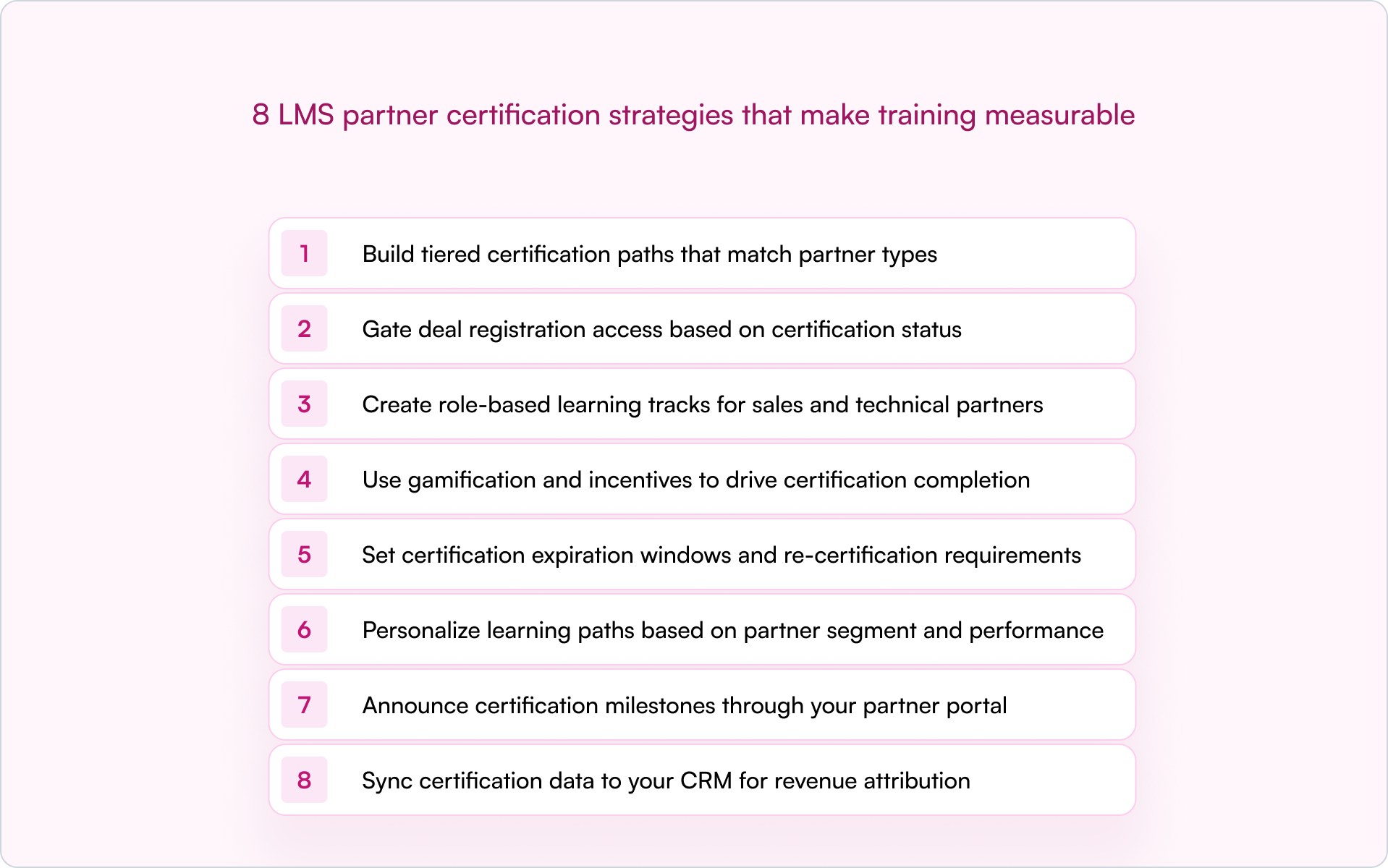
8 LMS partner certification strategies that make training measurable
If you’re building a partner motion inside a startup, you don’t have time for programs that “feel” helpful. You need a system that changes partner behavior and shows up in pipeline. These strategies are designed to do exactly that.
1. Build tiered certification paths that match partner types
Not every partner needs the same training. A referral partner introducing leads needs positioning basics. A reseller closing deals needs pricing, objection handling, and competitive differentiation. An implementation partner deploying your product needs technical depth.
Your certification tiers typically map to your partner program tiers, like Bronze, Silver, Gold or Authorized, Premier, Elite, with escalating requirements at each level.
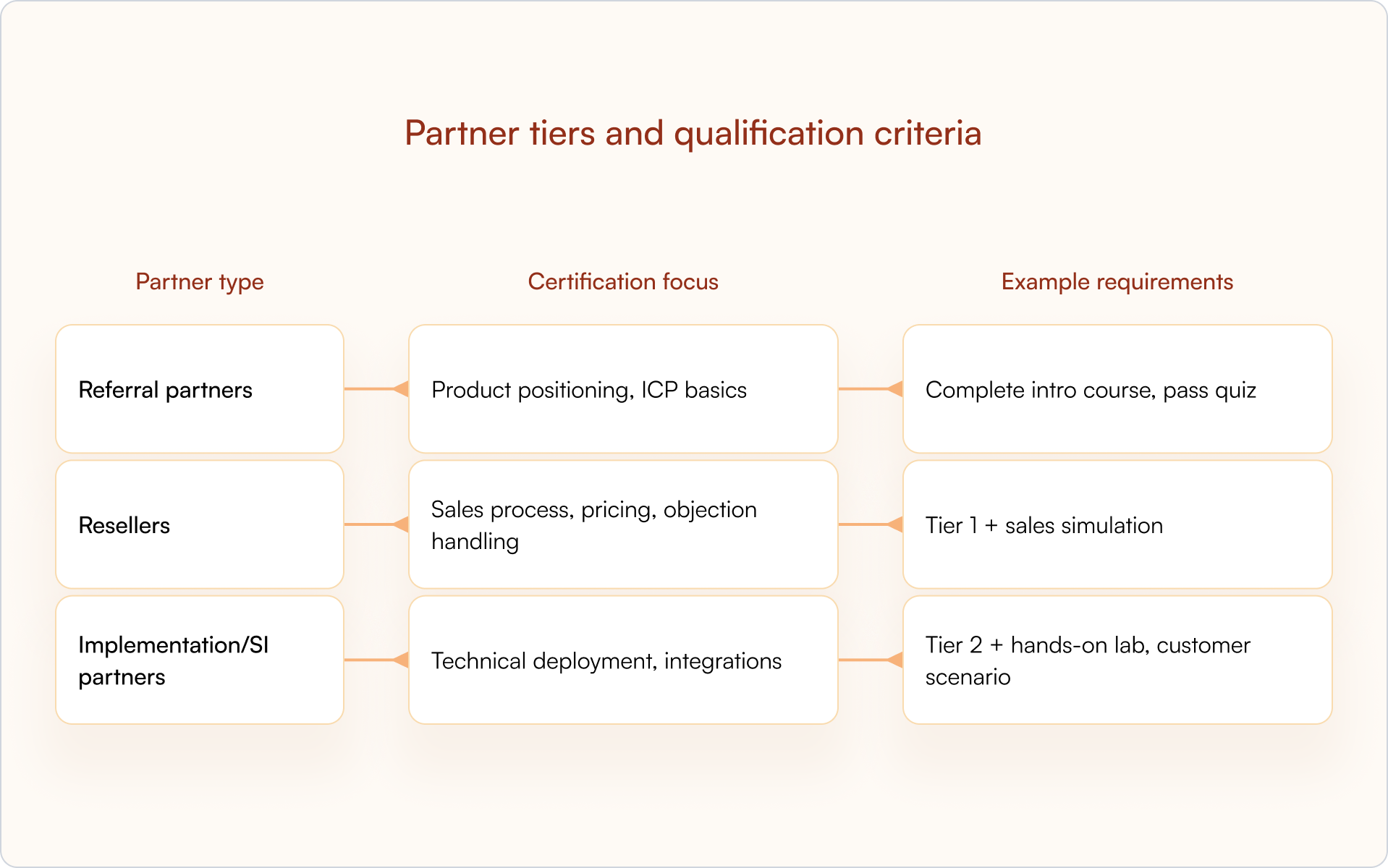
This structure keeps training relevant (which protects completion rates) and gives you a clean framework for gating access to deals, leads, or exclusive benefits based on demonstrated competency.
2. Gate deal registration access based on certification status
This is where certification becomes operational. Partners who haven’t completed the required training can’t register deals in your system, which protects deal quality and ensures only qualified partners are submitting pipeline.
The concept of “sell rights” is common in mature programs for a reason: it prevents untrained partners from creating friction in your sales process or misrepresenting your product to prospects.
A CRM-first PRM like Introw can enforce sell rights automatically by checking certification status before allowing deal registration — keeping the workflow aligned across your partner portal without manual verification.
3. Create role-based learning tracks for sales and technical partners
Within a single partner organization, different roles need different training. A partner’s sales rep needs competitive positioning and demo basics. Their solutions architect needs API documentation and implementation methodology. Their executive sponsor needs the business case for co-selling.
Role-based tracks keep training focused:
- Sales track: Product positioning, competitive differentiation, demo basics, pricing and packaging
- Technical track: Implementation methodology, API/integration training, troubleshooting
- Executive track: Partnership value prop, co-selling motions, business case development
If you want higher completion and better outcomes, this is one of the highest-ROI LMS partner certification strategies you can implement. Relevance is what keeps partners moving.
4. Use gamification and incentives to drive certification completion
Partners are busy. They’re juggling multiple vendors, their own customers, and internal priorities. Without motivation, certification often drops to the bottom of the list — even if the content is genuinely good.
Gamification, which includes digital badges, leaderboards, points, and rewards, creates visible progress and recognition that keeps partners engaged:
- Digital badges: Shareable credentials partners can display on LinkedIn
- SPIFFs: Cash or gift card bonuses for completing certifications
- Tiered benefits: Higher margins or exclusive leads for certified partners
- Leaderboards: Public recognition in the partner portal
The goal is simple: make certification feel like an investment that pays off, not compliance work.
5. Set certification expiration windows and re-certification requirements
Products evolve. Messaging changes. Compliance requirements shift. A certification earned two years ago may no longer reflect current reality — and your customers will feel that gap quickly.
Expiration windows (often 12 months, shorter for fast-moving categories) prevent competency drift. Automated reminders before expiration give partners time to re-certify without losing access to deal registration or other benefits.
Tip: Announce re-certification deadlines through your partner portal and email or Slack notifications so partners aren’t surprised when access changes.
6. Personalize learning paths based on partner segment and performance
Not all partners start from the same place. A high-performing partner who’s been selling your product for two years doesn’t need the same onboarding content as a new partner getting started.
Personalization — serving different content based on region, vertical, role, or performance — keeps training relevant. High performers can skip basics. Struggling partners get targeted reinforcement. Everyone’s time is respected.
This is also how certification becomes more than “completion.” You can track whether partners improve and which interventions correlate with higher-quality pipeline.
7. Announce certification milestones through your partner portal
Recognition reinforces behavior. When a partner earns certification, celebrate it publicly (when appropriate). It signals that certification matters and creates social proof inside the ecosystem.
Partner portal announcements, email notifications, or Slack messages highlighting achievements can motivate other partners to complete training — without you adding more meetings to your calendar.
A CRM-first partner portal can automate announcements when certification status updates, so you’re not manually tracking who earned what and when.
8. Sync certification data to your CRM for revenue attribution
This is the strategy that makes everything else measurable. Certification status belongs in HubSpot or Salesforce as a partner property — not trapped in a separate LMS where Sales, RevOps, and leadership can’t see it.
When certification data lives in your CRM, you unlock:
- Attribution: See whether certified partners close more revenue than non-certified partners
- Deal routing: Auto-assign leads to certified partners only
- Forecasting: Include certification status in pipeline reports
- Conflict resolution: Use certification as a tiebreaker when two partners claim the same deal
Introw syncs partner data directly to the CRM, so certification status is always visible to Sales, Partnerships, and RevOps — making certification ROI measurable instead of assumed.
LMS features that support partner certification programs
Not every LMS is built for external partner enablement. Internal employee training platforms often lack the controls you need to manage certifications across dozens (or hundreds) of partner organizations.
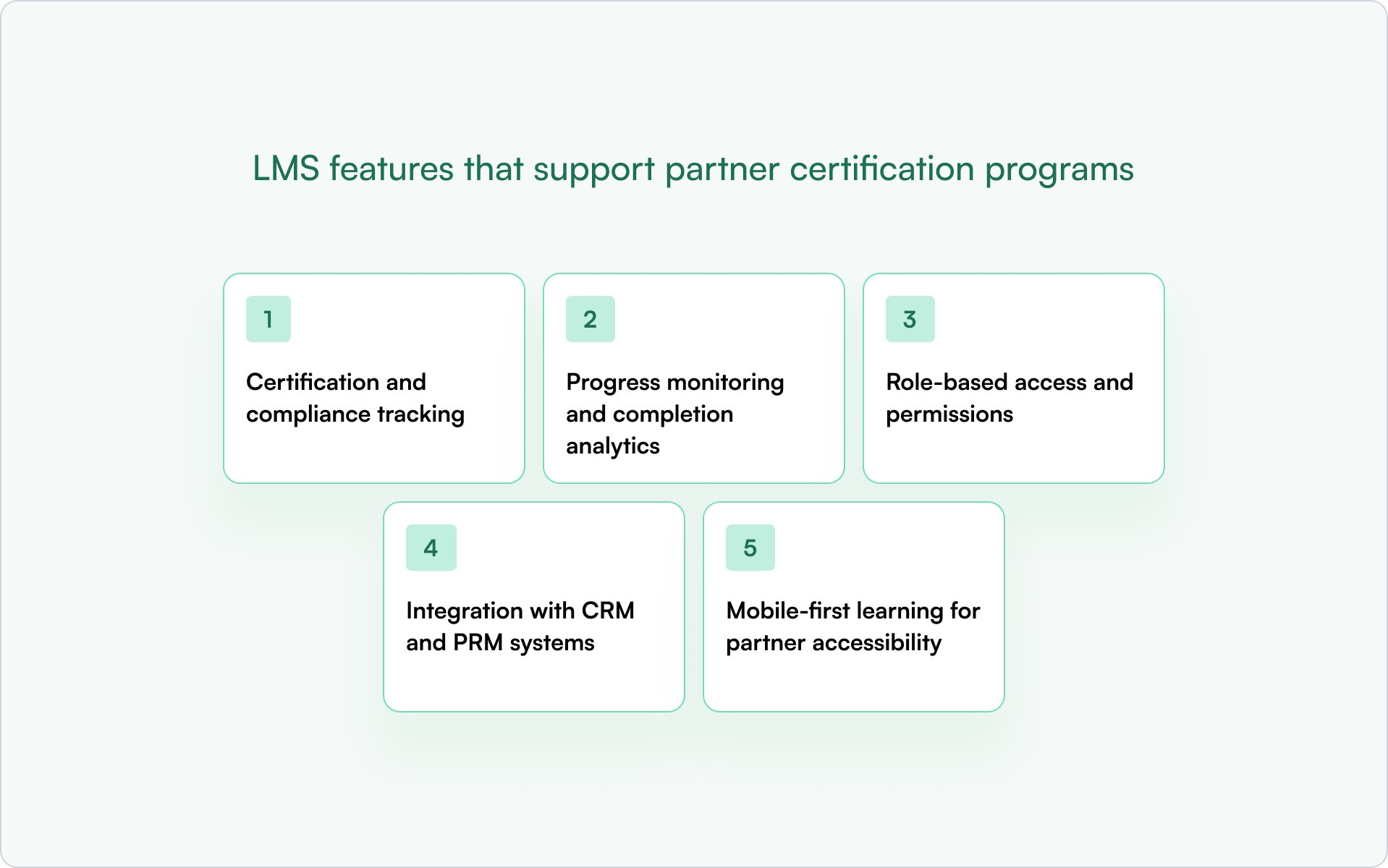
Certification and compliance tracking
Your LMS should track who completed what, when, and whether they passed. That audit trail supports compliance requirements and enables expiration and re-certification workflows.
Progress monitoring and completion analytics
Partner managers need visibility into where partners are stuck, who’s falling behind, and which courses have low completion rates — especially at scale.
Rollenbasierter Zugriff und Berechtigungen
Different partner organizations should only see content relevant to them. Admins need full access; partner users should see only their assigned tracks.
Integration mit CRM- und PRM-Systemen
If certification data doesn’t sync to HubSpot or Salesforce, it’s invisible to the rest of the business. A CRM-first PRM like Introw connects partner data — including certification status — directly to your CRM.
Mobile-first learning for partner accessibility
Partners are often in the field or between meetings. Mobile-friendly delivery makes it easier to complete certification without being tied to a desk.
How to measure ROI for LMS partner certification strategies
Certification programs require investment in content creation, LMS licensing, and partner manager time. To keep momentum — and budget — you need proof.
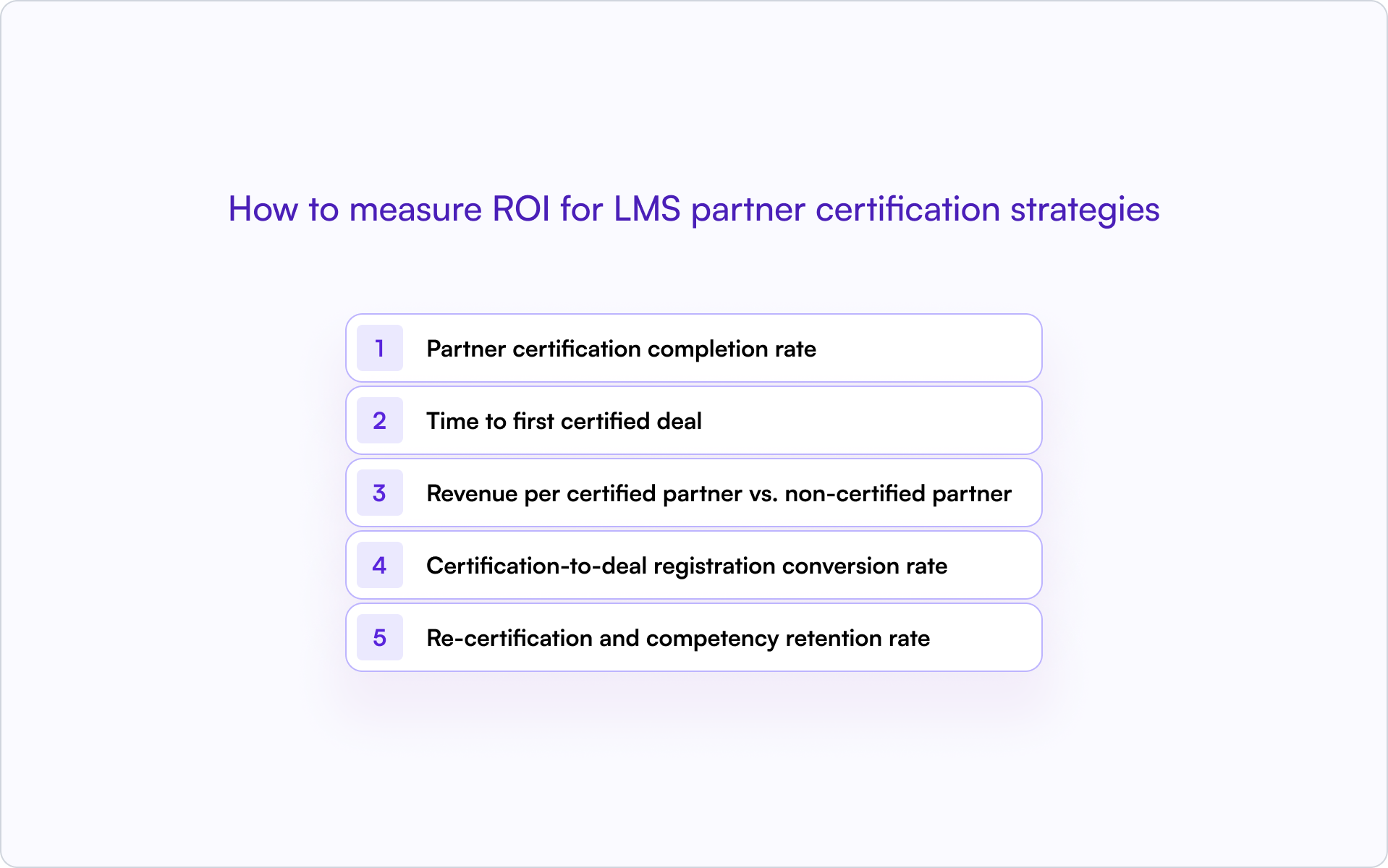
Partner certification completion rate
What percentage of onboarded partners complete certification? Low rates usually mean friction (too long, too generic, too hard) or unclear incentives.
Time to first certified deal
How long after certification does a partner register their first deal? Shorter is better — it shows certification accelerates activation, not just learning.
Revenue per certified partner vs. non-certified partner
Compare average revenue contribution. This is the core ROI proof point most founders and operators care about.
Certification-to-deal registration conversion rate
What percentage of certified partners actually register deals? Certification without activation is wasted effort — and a signal your program may be rewarding “learning” more than “selling.”
Re-certification and competency retention rate
Are partners staying current? High lapse rates suggest the re-certification experience is too burdensome or the value is not clear enough.
How to connect LMS certification data to your CRM
The mechanics of syncing LMS data to HubSpot or Salesforce determine whether certification status becomes actionable or stays siloed.
- Custom properties: Create a “Certification Status” field on the Partner or Contact object with values like Certified, Expired, In Progress, Not Started.
- Certification date fields: Track when certification was earned and when it expires.
- Automation triggers: Use certification status changes to trigger workflows — for example, notifying partner managers when a partner becomes certified or alerting when certification is expiring.
- Reporting: Build dashboards that segment partner pipeline by certification status.
Introw’s Salesforce and HubSpot integrations enable this without custom development work. Certification status flows into the CRM automatically.
Scale partner certification with a CRM-first approach
Partner certification programs only drive revenue when the data is visible and actionable in your CRM. Otherwise, you’re running a training program with no connection to pipeline, attribution, or forecasting.
A CRM-first approach delivers:
- Visibility: Sales, partnerships, and RevOps see certification status on every partner record.
- Attribution: You can prove which certifications correlate with closed revenue.
- Automation: Deal registration, lead routing, and conflict resolution can factor in certification status.
Teams that get this right spend less time chasing training completion and more time closing partner-sourced revenue.
If you’re ready to treat certification like a revenue system (not a content library), see how Introw connects partner certification data to your CRM — book a demo.

What are LMS partner certification strategies, in plain terms?
LMS partner certification strategies are the tactics you use to design, deliver, and enforce partner training in a way that validates competency (via tests, practical exercises, and credentials) and influences go-to-market outcomes. The best strategies go beyond “course completion” by tying certification status to real workflows like deal registration, lead routing, and partner tier benefits.
Should I require certification before partners can register deals?
Often, yes. Gating deal registration behind certification improves deal quality and ensures partners understand your positioning, qualification standards, and sales process before they introduce risk into your pipeline. If you’re worried about slowing down new partners, a common compromise is a short grace period during onboarding — then certification becomes required for net-new registrations.
What is the ideal certification expiration window for partner programs?
Expiration windows typically align with product release cycles or annual refresh requirements. Most programs use a 12-month window, while fast-moving products (or compliance-heavy categories) may require shorter cycles. The key is consistency: partners should know exactly when credentials expire, what changes, and what they need to do to regain access to sell or service rights.
How do I handle partners who let certifications lapse mid-deal?
Most programs honor existing deal registrations to avoid creating customer friction, but require re-certification before new registrations or before the partner can access higher-tier benefits. Document this clearly in your rules of engagement so expectations are predictable and enforceable.
Can certification status serve as a tiebreaker for channel conflict?
Yes. Many teams use certification level as one factor in resolving channel conflict. When two partners claim the same account, certification can be a neutral, behavior-based tiebreaker that encourages partners to invest in enablement.


.png)
.png)
.png)
.png)