

.svg)


.svg)
.svg)







Blog

The 13 Best AI Sales Coaching Software Tools for Partner and Channel Sales in 2026
What is AI sales coaching software?
AI sales coaching software helps your team improve how they handle deals, sales calls, and buyer conversations by providing guidance while work is happening, not just after the fact. It uses sales coaching AI to surface next steps, suggest responses to objections, and highlight what’s most likely to move a deal forward.
The category has expanded quickly since 2024, and today, an AI sales coach isn't just one type of tool. It covers several different approaches to coaching sales reps across the full sales cycle.
Here are the five main categories you need to know before choosing a solution:
Most “best sales coaching software” lists only compare conversation intelligence and roleplay tools. But teams working in indirect revenue models or partner sales need visibility into partner and channel deal coaching as well. Understanding all five categories makes it easier to choose the right sales coaching platform for your business.
AI sales coaching software comparison table
This table compares leading tools across the five coaching categories so you can quickly see where each one fits and whether it supports internal reps, external partners, or both.
Most tools support internal sales teams only, so if your partners help close deals, you’ll need software built to coach them inside real pipeline activity, not just review calls after the fact.
The 13 best AI sales coaching software tools in 2026
Here’s how the leading AI sales coaching tools compare across the five main categories buyers should evaluate today.
Category 1: partner and channel deal coaching
This is the newest and fastest-growing category of AI-powered sales coaching. These tools guide external partners on live opportunities inside the environments they already use, including partner portals, Slack, and email, so coaching happens while deals are moving instead of after they stall. They’re best for companies that sell through resellers, referral partners, distributors, or ecosystem programs and want to improve partner close rates without adding more partner managers.
#1 Introw – Best for AI deal coaching in partner and channel sales

What it does:
Introw is the only PRM with built-in AI deal coaching that creates a dedicated AI sales coach for each pipeline, such as reseller, referral, or co-sell. That means every partner deal gets stage guidance, objection handling, asset recommendations, and rules of engagement automatically inside the deal itself through deal coaching.
Who it’s best for:
B2B companies that rely on partners, resellers, or ecosystem motions and want partner-sourced pipeline to close more like direct pipeline without hiring more partner managers.
Wichtigste Features:
- Dedicated AI coach per partner segment with templates for reseller, co-sell, and referral motions
- Stage guidance that tells partners what to do next at each deal step
- Context-aware objection handling based on deal stage and engagement signals
- Asset recommendations surfaced inside the opportunity when partners need them
- Rules of engagement that clarify when to involve your internal team
CRM integrations:
Works with HubSpot and Salesforce.
Pricing:
Custom pricing from Starter to Enterprise based on the number of seats and configuration, and you can start for free.
Category 2: conversation intelligence and call coaching
These sales coaching tools record and analyze sales calls, then turn those conversations into coaching insights your sales managers can use to coach sales reps more consistently. They’re best for internal sales teams that want better visibility into sales conversations, rep performance, and patterns across customer interactions.
#2 Gong – Best for revenue intelligence and call pattern analysis

What it does:
Gong records and analyzes customer calls, meetings, and emails to surface patterns that affect deal outcomes. It helps sales leaders understand what top performers do differently and uses conversation intelligence to highlight risks, competitor mentions, and coaching opportunities across the sales cycle.
Who it’s best for:
Mid-market and enterprise sales teams that run high volumes of sales calls and want data-driven insights to improve team performance.
Wichtigste Features:
- Call recordings with speech and sentiment analysis
- Pipeline risk alerts and deal insights based on conversation patterns
- Manager dashboards that support structured coaching feedback
CRM integrations:
Works with Salesforce, HubSpot, and other major sales cloud environments.
Pricing:
Custom pricing, typically reported between $100 and $150 per user per month depending on contract size and feature access.
Partner/channel gap:
Gong is designed for internal sales professionals using company-managed meeting tools. Partners usually sell independently, which limits how often they appear in recorded workflows that support channel partner sales enablement or structured co-selling.
#3 Chorus by ZoomInfo – Best for call coaching inside the ZoomInfo ecosystem

What it does:
Chorus by ZoomInfo captures sales conversations and turns them into coaching cues using artificial intelligence. It highlights talk ratios, objection-handling moments, and deal risks so sales managers can deliver more consistent coaching across customer calls.
Who it’s best for:
Sales teams already using ZoomInfo that want AI coaching tools connected to prospecting intelligence and enrichment data.
Wichtigste Features:
- Call recording with AI-generated summaries and coaching cues
- Conversation analytics tied to ZoomInfo contact and company data
- Performance analytics that help identify skill gaps across teams
CRM integrations:
Integrates with Salesforce and HubSpot for pipeline visibility and activity capture.
Pricing:
Bundled within ZoomInfo platform subscriptions with custom pricing based on package level.
Partner/channel gap:
Like most AI sales coaching tools in this category, Chorus depends on recorded meetings inside your stack. That makes it harder to support distributed partner ecosystems where deals often happen outside internal call tracking environments.
#4 Clari – Best for pipeline forecasting with coaching signals
.png)
What it does:
Clari is a revenue platform that combines forecasting, pipeline inspection, and activity capture to generate coaching signals from sales data rather than only analyzing call recordings. It helps sales leaders identify deal risks earlier and supports more accurate planning across enterprise sales teams.
Who it’s best for:
Revenue leaders and sales managers focused on forecast accuracy, pipeline health, and predictable revenue growth.
Wichtigste Features:
- Forecast modeling based on pipeline movement and activity capture
- Deal inspection workflows that highlight performance improvement opportunities
- AI-driven insights connected to pipeline coverage and execution
CRM integrations:
Primarily integrates with Salesforce and related revenue infrastructure tools.
Pricing:
Custom enterprise pricing based on deployment scope and forecasting modules.
Partner/channel gap:
Clari focuses on internal pipeline visibility rather than external partner execution. It doesn’t provide coaching inside partner workflows such as shared deal registration processes supported by deal registration or distributed partner deal collaboration.
Category 3: AI roleplay and practice
These AI coaching tools simulate sales conversations so reps can practice objection handling, discovery calls, and positioning in a safe environment. They’re best for onboarding new reps and reinforcing consistent messaging before live customer interactions.
#5 Second Nature – Best for AI-powered sales roleplay simulations
.png)
What it does:
Second Nature creates AI-powered sales roleplay simulations where reps practice conversations with a virtual buyer that responds in real time. The platform scores performance and highlights areas for improvement so teams can run targeted training at scale.
Who it’s best for:
Sales enablement teams running onboarding programs, product launches, or messaging rollouts that require consistent training across distributed teams.
Wichtigste Features:
- AI conversational roleplay simulations with adaptive buyer responses
- Performance scoring tied to predefined sales coaching techniques
- Custom scenario builder for product positioning and objection handling
CRM integrations:
Limited CRM integrations. Primarily used as a standalone sales training platform.
Pricing:
Custom enterprise pricing based on deployment scope and team size.
Partner/channel gap:
Can support partner training if partners log into the system, but it isn’t embedded in the deal flow or partner portal environments typically used for channel partner sales enablement.
#6 Hyperbound – Best for AI cold call and discovery practice
.png)
What it does:
Hyperbound simulates realistic cold call and discovery conversations using AI buyer personas that react dynamically during practice sessions. Reps receive instant feedback and scoring to help refine talk tracks and improve early-stage pipeline conversations.
Who it’s best for:
SDR and BDR teams focused on improving outbound performance and discovery call execution.
Wichtigste Features:
- AI buyer personas designed for cold call and discovery practice
- Instant feedback with scoring across coaching moments
- Leaderboards that help managers track rep performance improvement
CRM integrations:
Minimal CRM connectivity. Designed primarily as a standalone AI sales training environment.
Pricing:
Typically starts around $40 to $60 per user per month depending on configuration.
Partner/channel gap:
Built for internal outbound teams rather than partner programs. It doesn’t support ongoing deal review workflows or structured partner enablement.
#7 Quantified – Best for AI avatar-based sales simulations
.png)
What it does:
Quantified uses AI-generated video avatars to simulate realistic buyer presentations so reps can practice delivery, positioning, and messaging before live meetings. The platform evaluates performance using AI feedback and benchmarking across teams.
Who it’s best for:
Enterprise sales teams focused on presentation readiness and improving messaging consistency across complex sales cycles.
Wichtigste Features:
- AI video avatars that simulate live buyer presentation scenarios
- Messaging analysis aligned with your sales methodology
- Benchmarking dashboards that compare results across teams
CRM integrations:
Limited CRM integrations. Primarily deployed as a structured sales training software layer.
Pricing:
Custom enterprise pricing based on rollout scope.
Partner/channel gap:
Designed for structured training rather than live pipeline execution. It doesn’t support deal-level coaching or workflows connected to partner ecosystems such as those covered in this partner enablement guide.
Category 4: sales enablement with coaching features
These platforms manage sales content such as decks, battle cards, and playbooks, then add guided selling and coaching layers on top. They’re best for teams that want content control and contextual support in one system instead of separate sales coaching solutions.
#8 Highspot – Best for content management with guided selling
.png)
What it does:
Highspot is a sales enablement platform that manages content, training, and buyer engagement while adding AI-powered sales coaching tools like guided selling and content recommendations that support reps during live opportunities.
Who it’s best for:
Enterprise sales and enablement teams managing large content libraries that need structured guidance on what to send and when.
Wichtigste Features:
- Centralized content management with usage tracking
- Guided selling plays aligned to a specific sales methodology
- AI content recommendations based on deal context
CRM integrations:
Integrates with Salesforce and Microsoft Dynamics.
Pricing:
Custom enterprise pricing based on deployment scope and content volume.
Partner/channel gap:
Includes some partner content sharing workflows, but coaching is primarily designed for internal sales teams rather than embedded channel sales enablement across partner-managed deals.
#9 Showpad – Best for sales content and coaching in one platform
.png)
What it does:
Showpad combines sales content management with interactive training and coaching layers so teams can align messaging, improve onboarding, and support consistent execution across the sales cycle.
Who it’s best for:
Mid-market sales teams that want sales training software and content management in a single platform.
Wichtigste Features:
- Content management with version control and engagement tracking
- Interactive training modules that support targeted training programs
- Coaching dashboards that highlight skill gaps across teams
CRM integrations:
Integrates with Salesforce, HubSpot, and Microsoft Dynamics.
Pricing:
Custom pricing based on team size and feature configuration.
Partner/channel gap:
Supports partner content distribution, but coaching features are designed mainly for internal rep workflows rather than structured channel partner sales enablement.
#10 Seismic – Best for enterprise-scale sales enablement and coaching
.png)
What it does:
Seismic is an enterprise sales enablement platform that combines content automation, training, coaching scorecards, and analytics with AI-powered sales guidance to help organizations improve execution consistency at scale.
Who it’s best for:
Large enterprise sales organizations managing complex content ecosystems and structured training programs.
Wichtigste Features:
- Content automation with governance controls
- AI content recommendations aligned to buyer stage
- Seismic Learning for structured training and coaching programs
CRM integrations:
Integrates with Salesforce and Microsoft Dynamics.
Pricing:
Custom enterprise pricing based on rollout scope.
Partner/channel gap:
Includes partner-facing capabilities, but coaching layers are designed primarily for internal seller workflows rather than ongoing partner deal execution.
Category 5: sales training and LMS with coaching layers
These platforms focus on structured learning paths, certifications, and readiness tracking, then add coaching layers like scorecards and manager feedback. They’re best for teams that want consistent training tied to performance improvement across sales teams.
#11 Mindtickle – Best for sales readiness and coaching scorecards
.png)
What it does:
Mindtickle is a sales readiness platform that combines structured learning paths, call analysis, and AI-powered coaching scorecards so enablement teams can track how training affects rep performance over time.
Who it’s best for:
Sales enablement leaders who want to measure readiness across teams and connect training programs to coaching outcomes.
Wichtigste Features:
- Role-based learning paths with certification tracking
- AI coaching scorecards tied to readiness indexes
- Call recordings analysis connected to sales training progress
CRM integrations:
Integrates with Salesforce and HubSpot.
Pricing:
Custom enterprise pricing based on deployment scope and enablement modules.
Partner/channel gap:
Primarily designed for internal sales professionals. Partners typically require separate onboarding to access training environments.
#12 Allego – Best for video coaching and peer-to-peer learning
.png)
What it does:
Allego is a sales learning platform centered on video-based practice, peer-to-peer coaching, and conversation intelligence so teams can reinforce messaging through recorded examples and feedback loops.
Who it’s best for:
Organizations that want collaborative coaching environments where reps learn from shared recordings and structured video practice.
Wichtigste Features:
- Video-based coaching workflows with manager feedback
- Conversation intelligence tied to recorded customer calls
- Peer-to-peer learning supported by shared practice libraries
CRM integrations:
Integrates with Salesforce.
Pricing:
Custom pricing based on rollout scope and learning configuration.
Partner/channel gap:
Built for internal rep coaching and structured learning rather than ongoing partner deal execution.
#13 Brainshark by Bigtincan – Best for sales readiness and onboarding
.png)
What it does:
Brainshark by Bigtincan delivers structured onboarding, certification paths, and readiness scorecards with video coaching features that help teams standardize early-stage training and onboarding outcomes.
Who it’s best for:
Sales teams focused on onboarding consistency and certification-driven readiness programs.
Wichtigste Features:
- Training content authoring with certification tracking
- Video coaching workflows tied to readiness scorecards
- Mobile learning access for distributed sales representatives
CRM integrations:
Integrates with Salesforce.
Pricing:
Custom enterprise pricing based on deployment scope and certification needs.
Partner/channel gap:
Focused on structured training rather than deal-level coaching. It does not support partner pipeline execution or external partner coaching workflows.
There are many strong tools in this space, and they solve very different problems. That can make the decision feel harder than it should be.
The key is to match the type of coaching to how your team actually sells, especially if partners are part of your pipeline.
How to evaluate AI sales coaching software (buyer checklist)
Use this checklist to compare AI sales coaching software capabilities across vendors before you decide.
Teams that sell through partners should also confirm whether the platform supports partner workflows alongside internal sales processes.
Which type of AI sales coaching software do you need?
Start with where coaching needs to happen in your workflow.
- If partners, resellers, or referral teams help close deals, you’ll get the most impact from tools that guide external sellers inside active opportunities. That matters even more once you see how partner-sourced opportunities typically perform compared to direct deals. You can evaluate that difference using these partner deal stats.
- If most revenue comes from direct sellers, conversation intelligence platforms help improve call quality and pipeline visibility.
- If your priority is onboarding or messaging consistency, roleplay tools help new reps practice before speaking with customers.
- If your challenge is keeping partner training aligned with how deals actually move, a structured partner LMS helps reinforce learning inside your partner motion.
When both direct and partner pipeline matter, coaching works best when guidance appears automatically at the right moment inside each deal.
That’s where support from an embedded AI agent helps teams deliver consistent next steps without adding manual coaching overhead.
Why Introw is the best choice for partner teams
By now, you’ve probably noticed most AI sales coaching tools are built for internal reps. That works if your pipeline lives inside your team. It’s harder when partners are responsible for part of your revenue and you don’t always see what’s happening inside their deals.
Introw supports execution inside the deal itself. Partners see what to do next at each stage, which reduces stalled opportunities and removes the need for constant partner manager involvement.
As partner programs scale, execution naturally becomes less consistent across resellers, referral partners, and co-selling motions. Introw helps standardize how deals move forward by adapting guidance to deal stage, partner role, and engagement signals.
What you'll see:
- Fewer deals going quiet
- Clearer collaboration between partners and internal teams
- More predictable partner pipeline.
This is especially valuable in organizations where partner-led and direct pipeline often run side by side.
If partner deals are already part of your revenue motion, you can Request a demo to see what deal-level coaching looks like inside an active partner workflow.
15 MDF Best Practices for High-Impact Partner Programs
Why most MDF programs underperform
Most MDF programs don’t fail because the strategy is wrong. They fail because the operations around them are unclear, slow, or invisible to partners. Aligning early on expectations, ownership, and even the definition of MDF helps teams avoid the most common execution gaps.
The budget exists, but partners often don’t use it. In fact, roughly 60% of market development funds go unclaimed each year, not because partners aren’t interested, but because the process makes participation difficult.
.png)
Across many partner ecosystems, the same issues show up repeatedly:
- Channel partners don’t know funds are available
- The approval process takes too long
- Requests get lost in email or spreadsheets
- Marketing activities run without measurable outcomes
- Finance teams can’t track how marketing dollars were used
- Partner marketing teams can’t connect MDF investments to pipeline
Without structure, market development funds rarely support partner engagement or revenue growth. When MDF programs are tied to clear execution plans and measurable partner marketing campaigns, they become a predictable lever for demand generation instead of unused budget.
15 MDF best practices for SaaS partner programs
If you want market development funds to drive pipeline instead of sitting unused, you need a repeatable system. The following market development funds best practices are the framework strong SaaS teams use to make MDF programs predictable, measurable, and aligned with revenue.
.png)
1. Design your fund structure before you launch
Start with the question most teams skip: how should we allocate MDF in the first place?
Decide early whether MDF allocation is:
- Fixed per partner tier
- Performance-based
- Motion-based across reseller, referral, or integration channel partners
Also define:
- Eligible marketing activities
- Fiscal period (quarterly vs. annual)
- Whether unused MDF funds expire or roll over
Without this structure, approvals become inconsistent, and partners lose confidence in the program.
This is the foundation of strong MDF program management and best practices.
2. Make budget visibility self-service
Ask yourself this: can partners see their available budget without emailing you?
If not, adoption drops immediately.
Partners should always see:
- Total MDF allocation
- Pending requests
- Approved spend
- Remaining marketing budget
Real-time visibility improves partner engagement and increases participation in MDF campaigns faster than almost any other change you can make.
3. Build a standardized request form, not email
Inbox-driven requests slow everything down.
Instead, create a structured marketing development funds template partners complete before submitting requests. At minimum, capture:
- Campaign type
- Target audience
- Expected pipeline or qualified leads
- Zeitachse
- Budget requested
- Success metrics
When requests attach directly to CRM records, your MDF process becomes measurable from day one. Platforms designed for managing marketing development funds handle this automatically.
4. Set approval SLAs and default statuses
Partners don’t stop submitting requests because budgets are small. They stop because responses are slow.
Set a clear approval process, such as:
Submitted → Under review → Approved or declined
Then define an internal SLA, for example, five business days.
Predictability increases participation and improves demand generation activities across your partner ecosystem. It is one of the simplest MDF program best practices to implement.
5. Require a campaign brief, not just a budget ask
If a partner asks for marketing budget without a plan, pause.
Strong MDF programs require a short campaign brief that explains:
- What they want to run
- Who they want to reach
- What results they expect
- How the activity supports your strategic objectives
This improves strategic alignment and makes it easier to compare performance across MDF campaigns later.
6. Enable collaboration, not just approval
Approval is not execution.
After funding is approved, partners still need shared visibility into assets, timelines, and next steps. Otherwise, marketing initiatives disappear into email threads.
A structured collaboration environment improves partner marketing outcomes and keeps joint marketing initiatives visible across teams. It also strengthens ongoing partner engagement during campaign execution.
7. Link campaigns to deals and leads
Here’s the question leadership eventually asks: what did this spend actually generate?
If MDF campaigns are not connected to deals or sales leads, you cannot answer it.
Linking MDF-funded activities directly to pipeline turns market development funds into a measurable growth lever. It also helps channel managers understand which partners consistently generate qualified leads.
This is where many MDF programs break, and where the biggest gains usually happen. Make sure to use modern PRM that links all these activities directly in you CRM.
8. Track ROI automatically, not manually
If ROI lives in spreadsheets, you’re always reacting too late.
Modern MDF programs are being tracked directly in your CRM where you can connect spend directly to pipeline contribution so you can see which partners, campaigns, and marketing efforts drive revenue growth in real time.
That visibility helps you shift marketing investment toward activities that expand market reach and improve sales performance.
9. Gate future funds on proof of performance
A simple rule improves accountability quickly: show results before requesting more budget.
Ask partners to demonstrate:
- Campaign reach
- Lead generation
- Pipeline-Beitrag
before approving additional MDF funds.
This ensures MDF investments support partners who execute and helps drive partner success across co-op programs and co-op funds.
10. Review and iterate quarterly
Treat MDF like a planning lever, not a reimbursement process.
Each quarter, review:
- Which partners used their allocation
- Which MDF campaigns generated pipeline
- Which marketing activities underperformed
These reviews strengthen your channel partner marketing strategy and make future MDF allocation easier to justify.
11. Segment MDF by partner motion, not just partner tier
Many teams allocate development funds by partner tier alone. That’s rarely enough.
Referral partners, resellers, and integration partners contribute differently to market development. Segmenting MDF allocation by motion improves market presence and ensures shared marketing resources support the right expected outcomes.
This is one of the most overlooked market development fund best practices.
12. Pre-approve high-performing campaign templates
Instead of reviewing every request from scratch, give partners a shortlist of proven campaign options.
Examples include:
- Co-branded campaigns
- Digital ads
- Local events
- Vertical webinars
Pre-approved templates reduce approval time and increase the likelihood of generating qualified leads.
They also help partners understand how to obtain marketing development funds faster because expectations are clear.
13. Tie MDF allocation to pipeline coverage targets
Not every region needs the same level of funding.
If pipeline coverage is weak in a segment or geography, allocate MDF funds there first. If another area already performs well, shift marketing investment elsewhere.
This ensures MDF allocation supports strategic priorities instead of spreading budget evenly across the partner program.
14. Combine MDF with incentive programs to change partner behavior
Funding alone doesn’t change behavior. Incentives do.
Pair MDF campaigns with structured channel partner incentive programs to encourage participation in demand generation campaigns and improve execution quality across channel partners.
This combination helps generate leads faster and strengthens overall partner performance.
15. Reserve budget for strategic initiatives, not reactive requests
Leave part of your development funds unallocated at the start of the quarter.
Use that reserve to support:
- New product launches
- Expansion into new regions
- Demand generation for priority segments
- Initiatives that increase brand visibility
This ensures MDF investments stay aligned with long-term strategic priorities instead of being consumed by opportunistic requests.
MDF request form template and checklist
A strong MDF request form does two things at once.
It makes approvals faster for your team, and it makes it easier for partners to submit campaigns that actually generate pipeline.
Without a structured request format, MDF campaigns become hard to evaluate, hard to compare, and almost impossible to attribute later.
A standardized marketing development funds template fixes that by ensuring every request captures the information needed to support demand generation, track sales performance metrics, and align spend with strategic objectives.
Use the template below as a default structure inside your partner program.
.png)
MDF request form checklist
Use this checklist to confirm your MDF process captures everything required for attribution and execution:
.png)
In a CRM-connected workflow, this structure also gives both you and your partners real-time visibility into MDF campaigns from request through execution and attribution, which is what makes modern MDF programs scalable.
Where Introw comes in
If you follow the framework above, your MDF program becomes structured. What most teams still struggle with is proving what that structure actually produces.
Introw closes that gap by connecting MDF requests directly to the partners, campaigns, and deals they are meant to influence inside your CRM. Instead of tracking approvals separately from pipeline, everything lives in one workflow.
That changes how MDF programs operate day to day:
- Partners submit structured requests without email back-and-forth
- Every request attaches automatically to the right partner and campaign
- Approvals follow a consistent approval process instead of ad-hoc routing
- Both you and your channel partners see available MDF funds in real time
- Marketing campaigns link directly to qualified leads and influenced deals
- ROI updates automatically as pipeline moves
This is what makes market development funds (MDF) measurable.
When a deal is generated or closed, you can see whether MDF supported it. When planning next quarter’s MDF allocation, you can see which partners generated pipeline and which marketing initiatives did not.
It also changes adoption. Because partners can see their allocation, submit requests quickly, and stay aligned on campaign execution, MDF funds get used instead of sitting unused across the partner ecosystem.
For a partner marketing manager managing Market Development Funds, that means fewer spreadsheets, clearer attribution, and better conversations with leadership about where marketing investment should go next.
If you want to see how structured MDF programs work when requests, approvals, campaigns, and pipeline all stay connected in one place, request a demo today.
Neueste Artikel
15 LearnUpon LMS Alternatives for Partner Teams in 2026 (Compared)
What is LearnUpon (and why teams look for alternatives)?
LearnUpon is a learning management system used for employee training, customer education, and external training. Many mid-market companies choose it because it's user-friendly and supports online courses, certification programs, and multiple training audiences.
A key strength is its multi-portal architecture, which lets teams run separate training environments for employees, partners, or customers.
For many organizations, that works well.
But partner teams often run into limitations when they try to connect training with pipeline activity and revenue visibility.
If the goal is simply to deliver online courses or compliance training, LearnUpon can be a strong fit.
However, if the goal is to turn partner training into measurable business outcomes, many teams begin exploring LearnUpon alternatives and modern partner training software built for partner ecosystems.
Here are the most common reasons partner teams start looking for a LearnUpon alternative.
1. Training data is separate from CRM
Training is only one part of partner enablement. Teams also need visibility into which partners complete certifications, submit deals, and influence pipeline.
Traditional learning management systems store course progress inside the LMS, while partner accounts and deal activity live in the CRM. When those systems are separate, reporting becomes difficult, and teams often rely on spreadsheets to understand whether training programs influence revenue.
2. Certification is not tied to revenue outcomes
Certification programs help partners build technical expertise and improve sales conversations. But most LMS platforms treat certifications as learning milestones rather than business signals.
You can see who completed training. It is harder to see whether certified partners generate more pipeline or close deals faster.
3. Engagement stays inside the portal
Most LMS platforms rely on a portal experience where partners log in, browse a course library, and complete training.
Employee training often works this way, but partner engagement typically happens in email, Slack, CRM workflows, and conversations with your team. When learning activity stays inside the portal, learner engagement can drop.
4. AI and automation are limited for scaling partner programs
As partner ecosystems grow, training programs become harder to manage. Teams must create courses for multiple partner tiers, maintain a growing content library, and manage certification programs across regions.
Many partner teams now want AI tools that help create courses faster and automation that supports engagement across large partner ecosystems.
None of this means LearnUpon is the wrong platform. It simply means the tool was designed primarily for employee and customer education.
If your goal is to connect partner training with certification programs, partner engagement, and revenue outcomes, it may be worth exploring LearnUpon LMS alternatives built specifically for partner teams.
The 15 Best LearnUpon LMS Alternatives for Partner Teams
If you’re evaluating LearnUpon LMS alternatives, you’re likely looking for a learning platform that supports partner training, certification programs, and external training that connects to real business outcomes.
We've curated 15 LearnUpon alternatives partner teams evaluate when they need stronger visibility, better learner engagement, and training programs that scale with their partner ecosystem.
1. Introw: Best CRM-native partner LMS for revenue teams
Am besten geeignet für
SaaS partner teams that want partner training, certifications, and partner collaboration connected directly to their CRM and pipeline.
Why it’s a LearnUpon LMS alternative
Most learning management systems treat training as a separate environment from sales activity. Introw connects partner training programs directly to CRM data, so partner managers can see how certifications, course completion, and partner engagement influence pipeline.
Instead of managing external training in isolation, teams can track training activity alongside partner deals and account data.
You can see how this works in Introw’s AI-powered LMS demo and learn how teams can create courses, launch certification programs, and manage training programs quickly.
Wichtigste Merkmale
- AI course builder for creating online courses faster
- One-click certification programs for partner enablement
- CRM-visible training tied to partner accounts and deals
- Bulk enrollment for onboarding large partner groups
- Off-portal engagement through email and Slack
- Deep integrations with Salesforce and HubSpot
- Revenue-linked analytics connecting training activity to pipeline
Ideal company size
Mid-market and enterprise SaaS companies with active partner programs, especially teams managing multiple partner tiers and CRM-driven partner revenue.
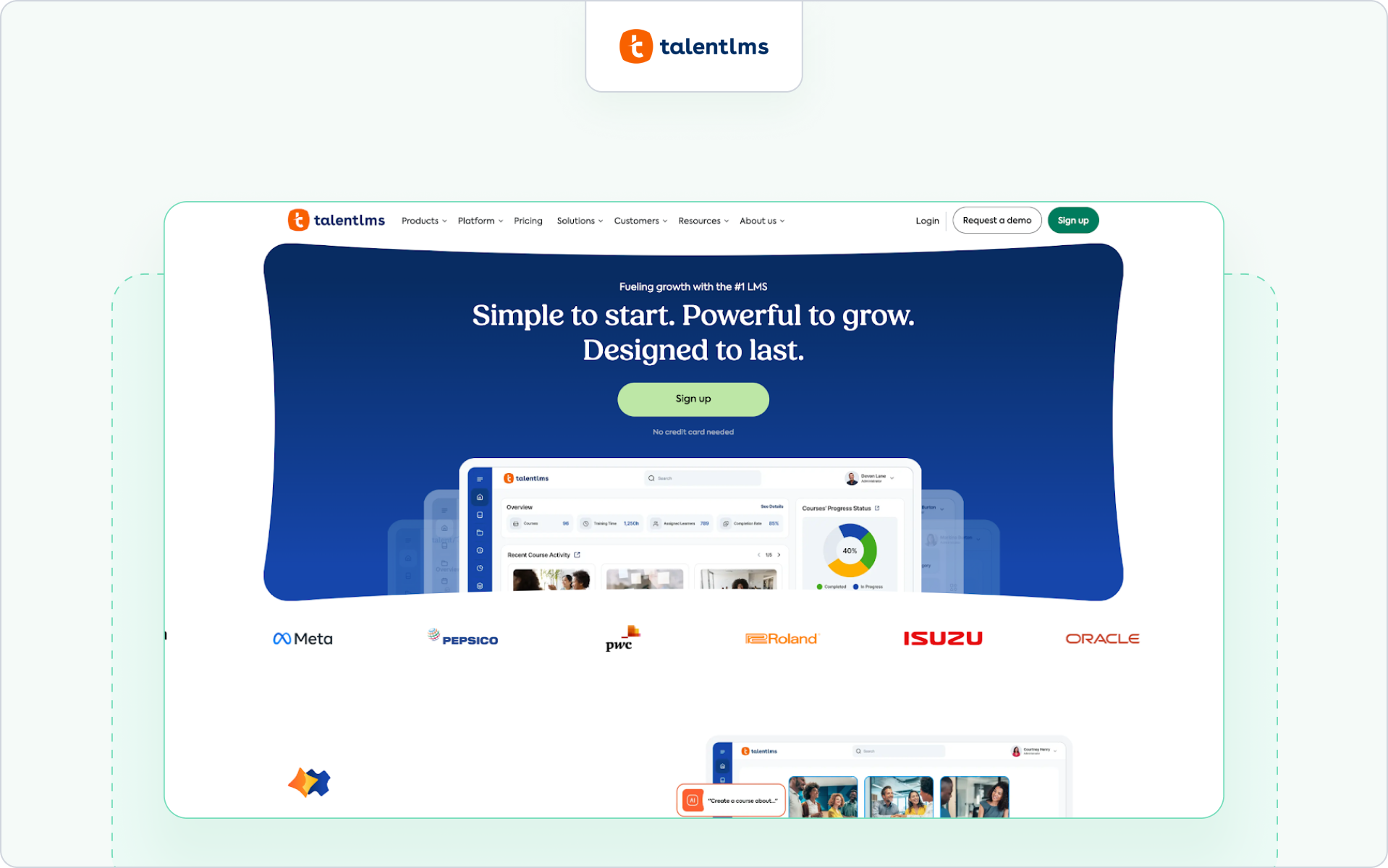
2. TalentLMS: Best for simple SMB training programs
Am besten geeignet für
Small and mid-sized companies that want a user friendly learning management system for employee training and simple external training.
Why it’s a LearnUpon LMS alternative
Teams compare TalentLMS with LearnUpon when they want a simpler LMS for managing online courses and employee training without the heavier multi-portal setup.
For more context, you can evaluate our list of Talent LMS alternatives.
Wichtigste Merkmale
- Tools to create courses and manage online courses
- Built-in course library for training content
- Support for instructor-led training and self-paced learning
- Basic reporting capabilities for tracking completion rates
Ideal company size
Small businesses and mid-sized companies that need a straightforward LMS for employee training or basic external training.
3. 360Learning: Best for collaborative internal learning

Am besten geeignet für
Companies that want collaborative learning and strong knowledge sharing across internal teams.
Why it’s a LearnUpon LMS alternative
360Learning appeals to companies that want collaborative learning and peer-driven course creation rather than the more structured training model used in traditional LMS platforms like LearnUpon.
Take a look at some 360Learning alternatives to evaluate what might work for your team.
Wichtigste Merkmale
- Collaborative course creation tools
- Social learning features that help engage learners
- Support for blended learning and virtual classroom training
- Built-in authoring tool for managing training content
Ideal company size
Mid-sized companies and large enterprises focused on employee training and internal knowledge sharing.
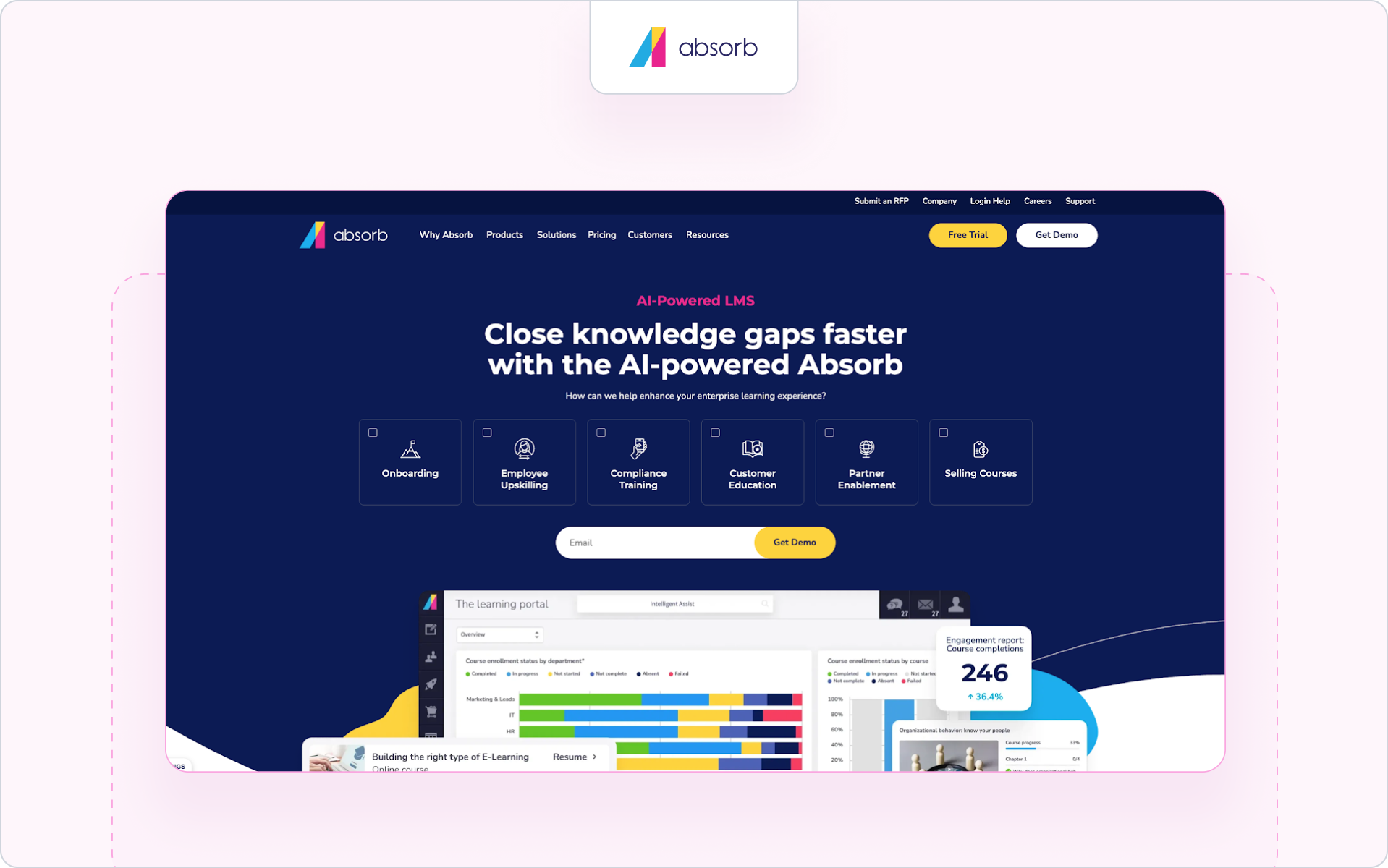
4. Absorb LMS: Best for enterprise compliance and scale
Am besten geeignet für
Large organizations running compliance training and large training programs across multiple audiences.
Why it’s a LearnUpon LMS alternative
Absorb LMS is often evaluated by large enterprises that need stronger compliance training, advanced reporting, and multi portal architecture for managing complex training environments.
Wichtigste Merkmale
- Multi-portal architecture for managing multiple branded portals
- Erweiterte Berichts- und Analyse-Dashboards
- Compliance and skills training tools
- Large content library for structured training programs
Ideal company size
Large enterprises running global employee training and compliance programs.
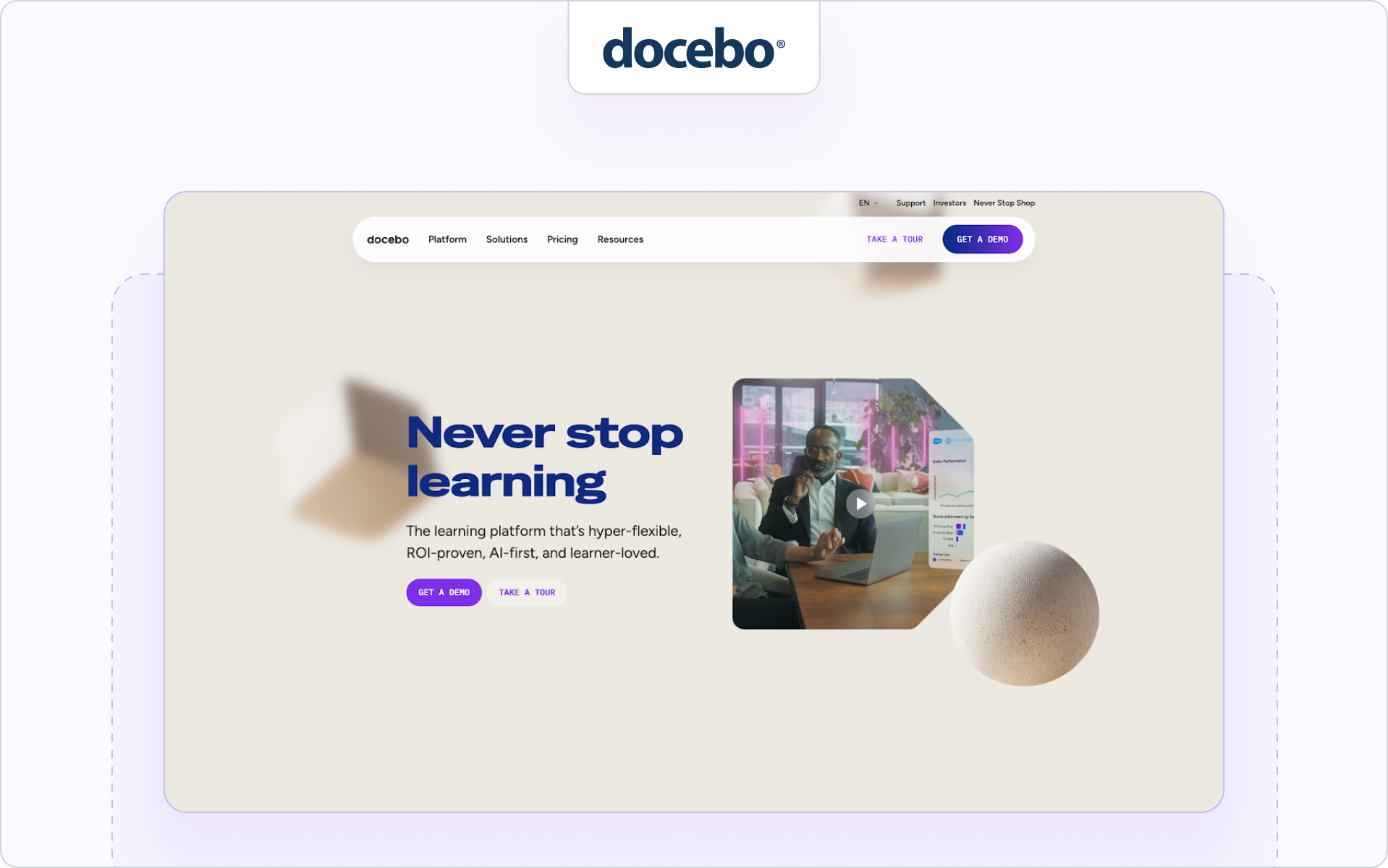
5. Docebo: Best for AI-driven enterprise learning
Am besten geeignet für
Large organizations that want AI-powered learning and adaptive learning paths.
Why it’s a LearnUpon LMS alternative
Docebo attracts organizations that want AI-driven automation, adaptive learning paths, and deeper analytics across large training programs.
Wichtigste Merkmale
- AI tools that help create courses and recommend training content
- Adaptive learning paths that personalize the learning process
- Assessment tools for evaluating learner progress
- Reporting and analytics dashboards for monitoring training programs
Ideal company size
Mid-market companies and large enterprises managing complex training programs.
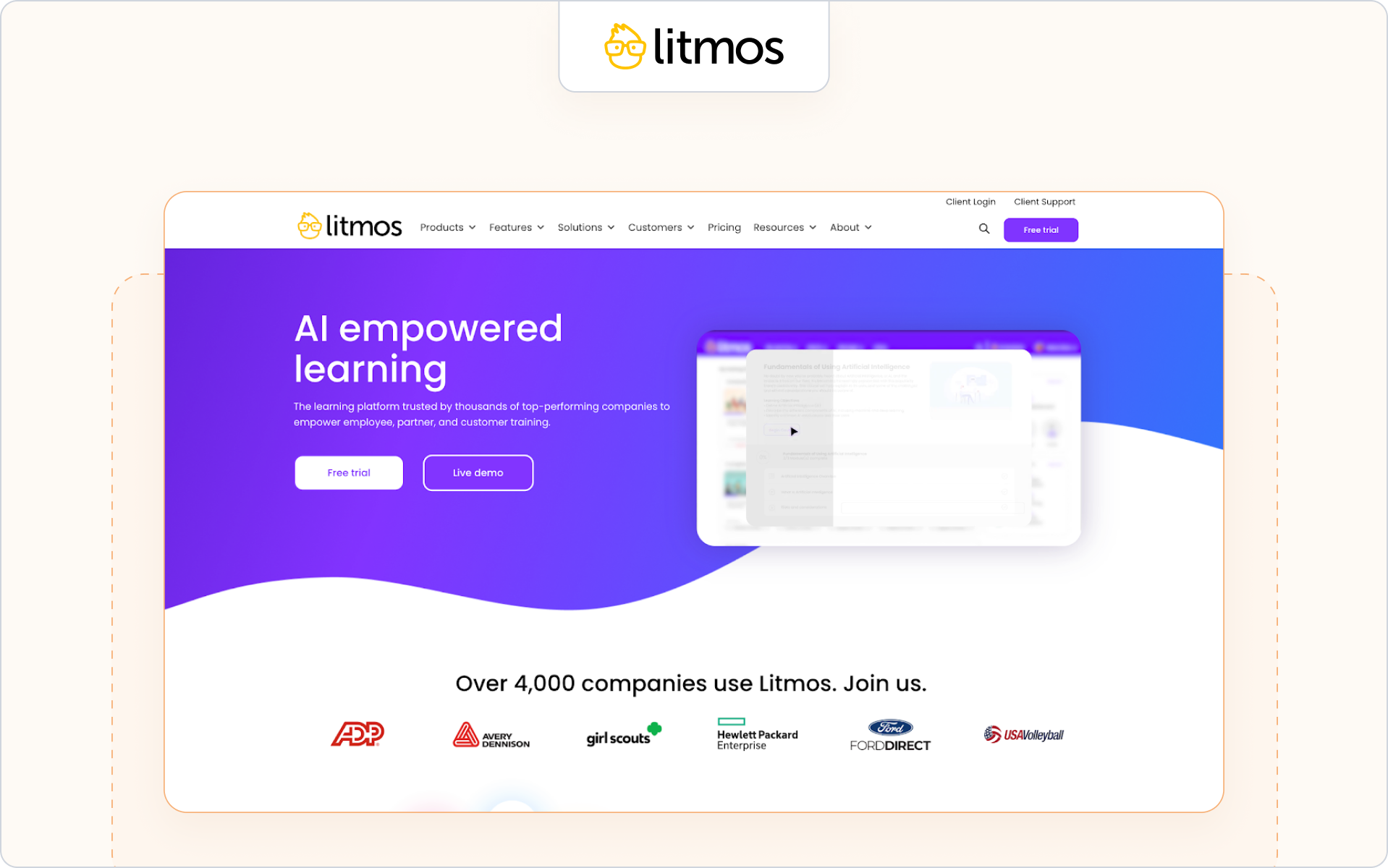
6. Litmos: Best for multi-audience training
Am besten geeignet für
Organizations delivering employee training, partner training, and customer training from one platform.
Why it’s a LearnUpon LMS alternative
Litmos is commonly evaluated by teams delivering multi audience training, including employee training, partner training, and customer training from one platform.
Wichtigste Merkmale
- Tools to enroll learners across multiple audiences
- Virtual classroom and classroom-style training support
- Certification programs and compliance training workflows
- Prebuilt content library for common training topics
Ideal company size
Mid-sized organizations and enterprises delivering training to employees, partners, and customers.
7. LearnWorlds: Best for academy-style external training
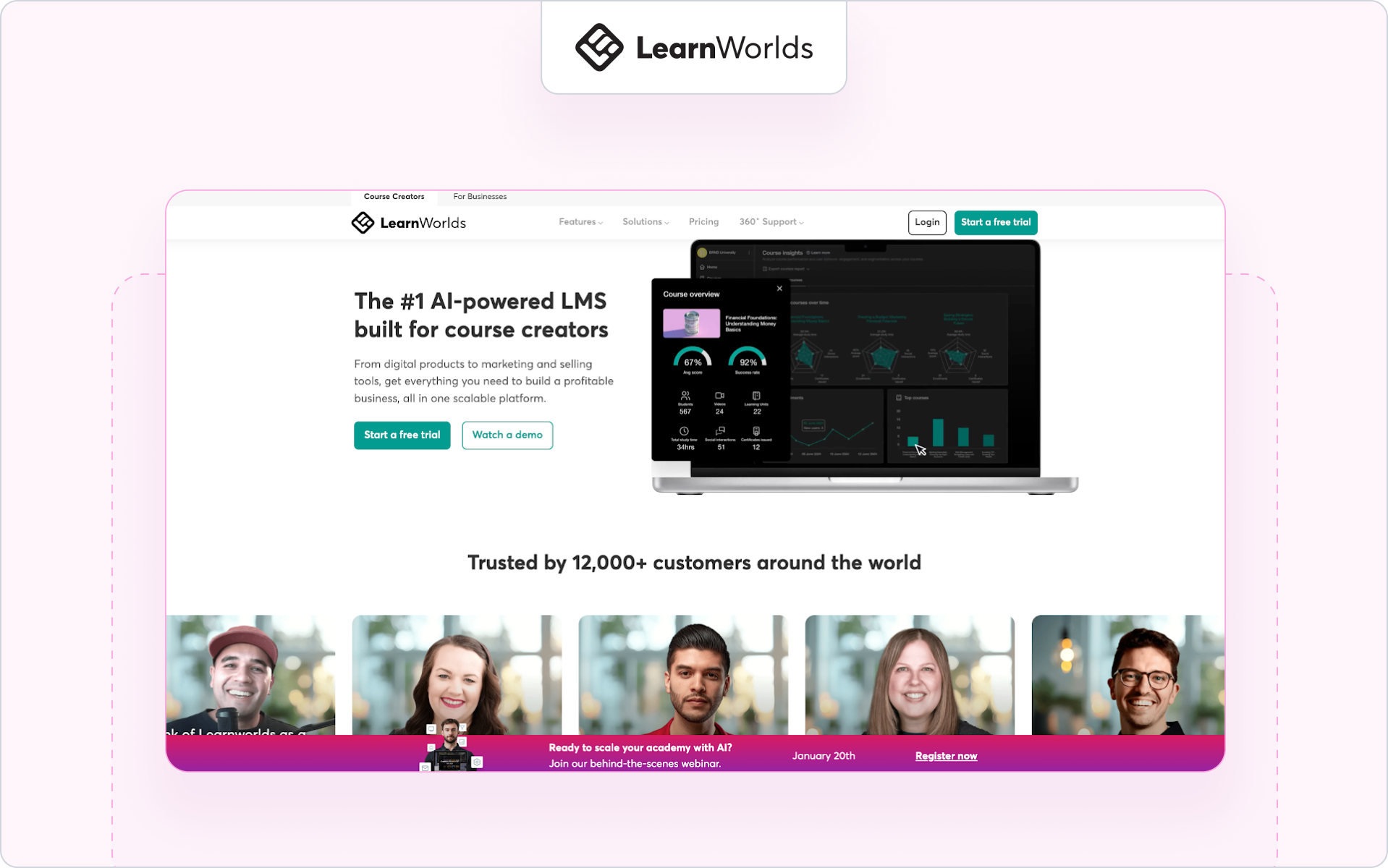
Am besten geeignet für
Companies building online academies for customer education or partner onboarding.
Why it’s a LearnUpon LMS alternative
LearnWorlds stands out for companies building external training academies or selling online courses, which differs from the internal training focus many LMS platforms prioritize.
Wichtigste Merkmale
- Tools for building academy-style online courses
- Ecommerce capabilities for selling training programs
- Interactive course creation tools
- Analytics dashboards for tracking completion rates
Ideal company size
Small businesses and mid-sized companies delivering customer education or partner onboarding programs.
8. Thought Industries: Best for customer education platforms
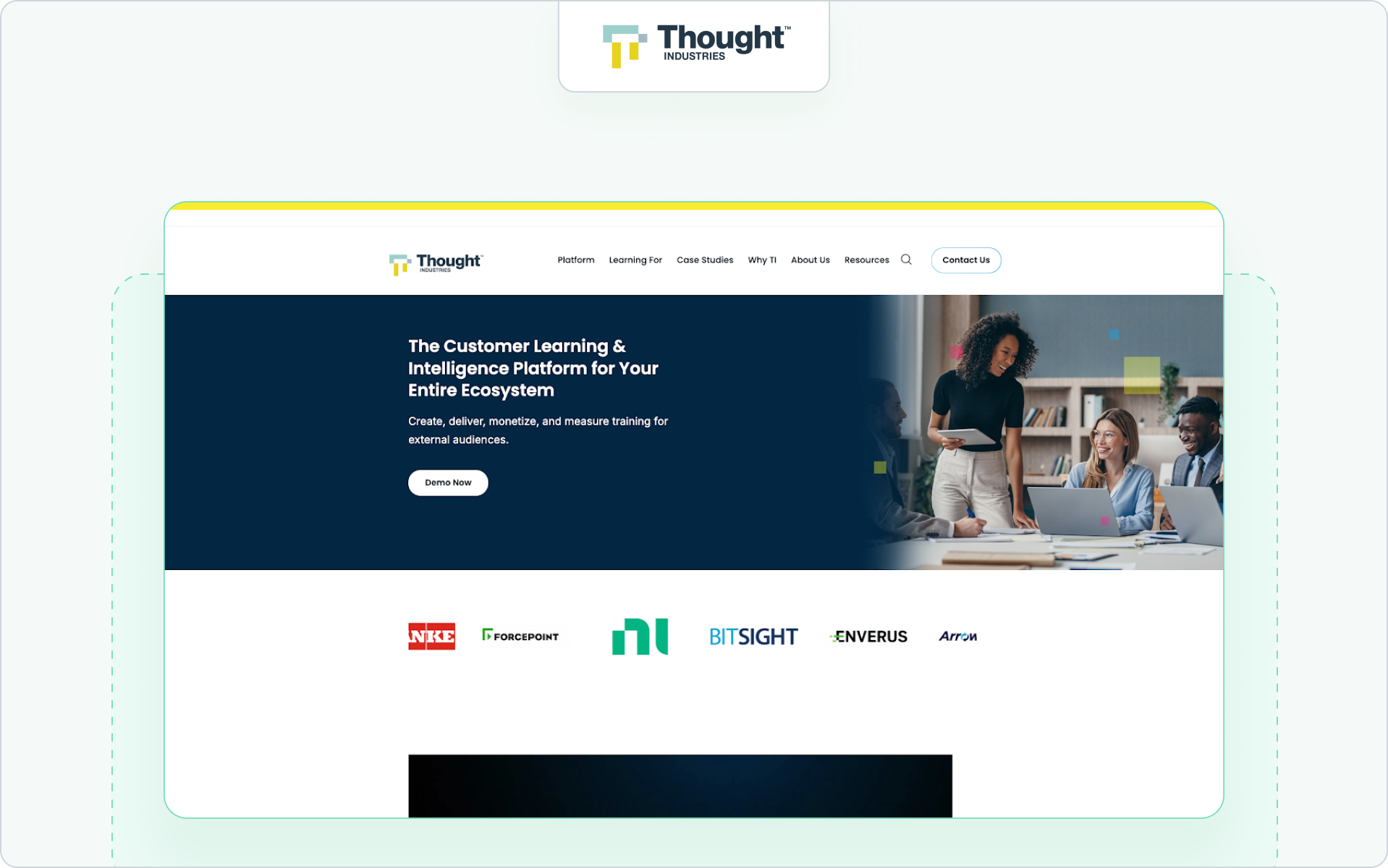
Am besten geeignet für
Companies delivering large customer education and external training programs.
Why it’s a LearnUpon LMS alternative
Thought Industries is designed for large customer education and external training programs, making it attractive to companies building scalable learning environments for external learners.
Wichtigste Merkmale
- Scalable customer education environments for external learners
- Tools for managing large training programs
- Ecommerce capabilities for monetizing course content
- Reporting and analytics dashboards for training activity
Ideal company size
Mid-market companies and large enterprises running global customer education or partner enablement programs.
9. WorkRamp: Best for revenue enablement training
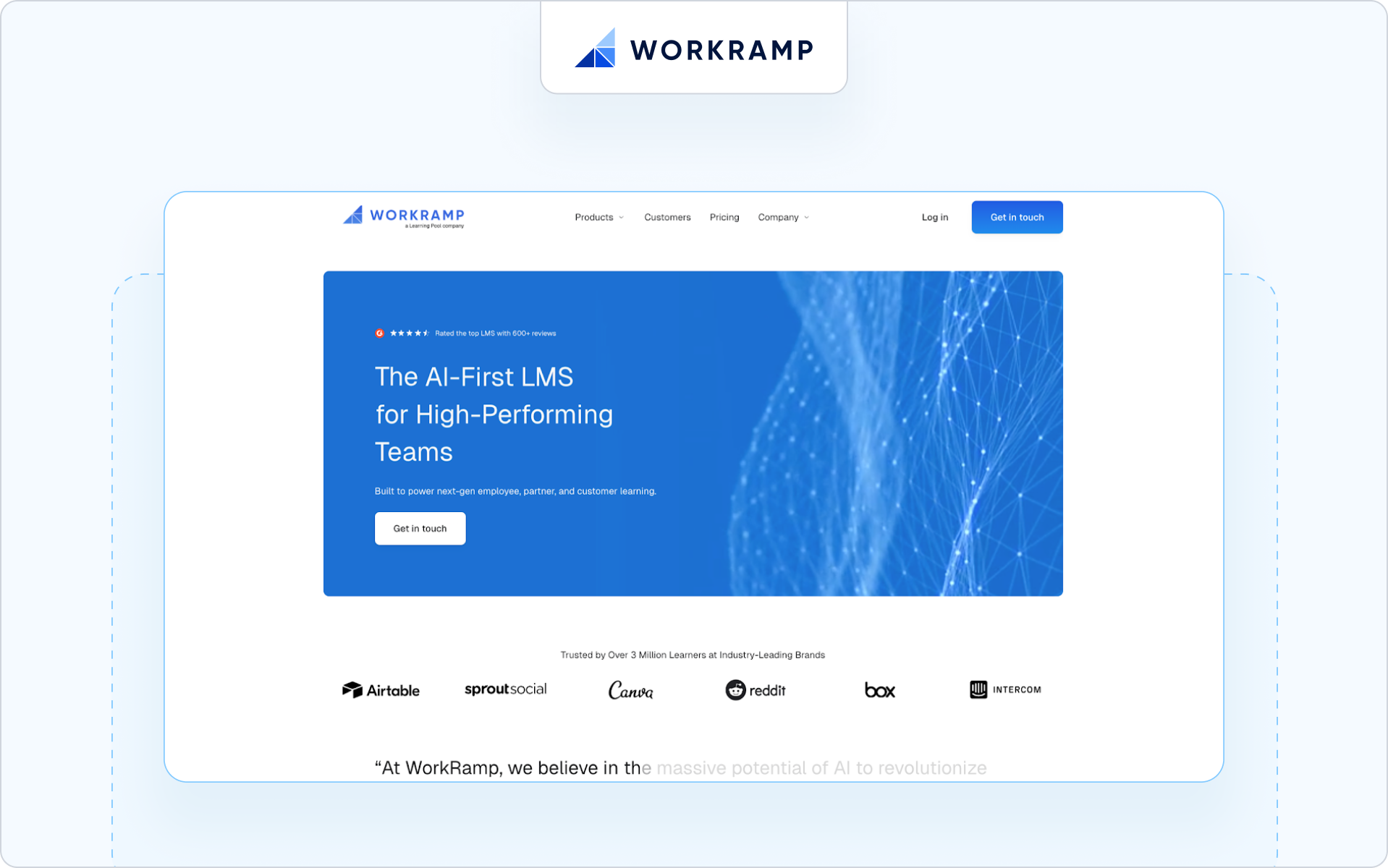
Am besten geeignet für
Revenue teams that want structured training for the sales team, customer success teams, and partner enablement.
Why it’s a LearnUpon LMS alternative
WorkRamp attracts revenue teams that want training programs aligned with sales enablement, onboarding, and partner readiness rather than traditional LMS course management.
Wichtigste Merkmale
- Sales enablement training programs for the sales team
- Certification programs for partner and customer training
- Course builder for onboarding and online training
- Reporting and analytics dashboards for tracking training activity
Ideal company size
Mid-sized SaaS companies and enterprises running sales enablement and partner training programs.
10. iSpring Learn: Best for affordable mid-market LMS/
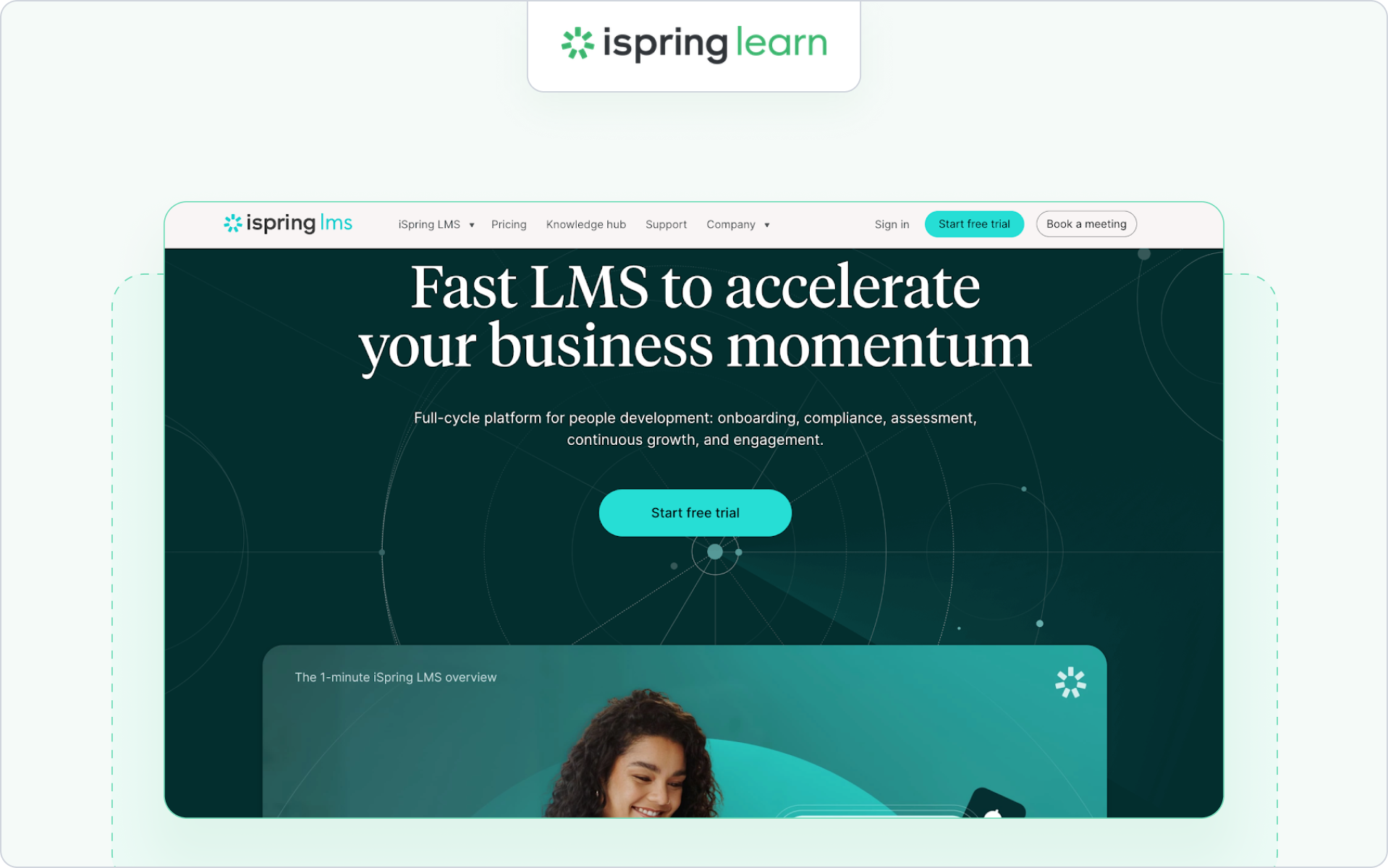
Am besten geeignet für
Organizations that want a user-friendly LMS with simple course creation and straightforward pricing.
Why it’s a LearnUpon LMS alternative
iSpring Learn appeals to mid-market companies that want a user friendly LMS with straightforward course creation and a lower learning curve.
Wichtigste Merkmale
- Authoring tool for creating online courses and training content
- Reporting capabilities for tracking learner progress
- Mobile learning with offline access
- Tools for employee training and external learners
Ideal company size
Small businesses and mid-sized companies running employee training and simple external training programs.
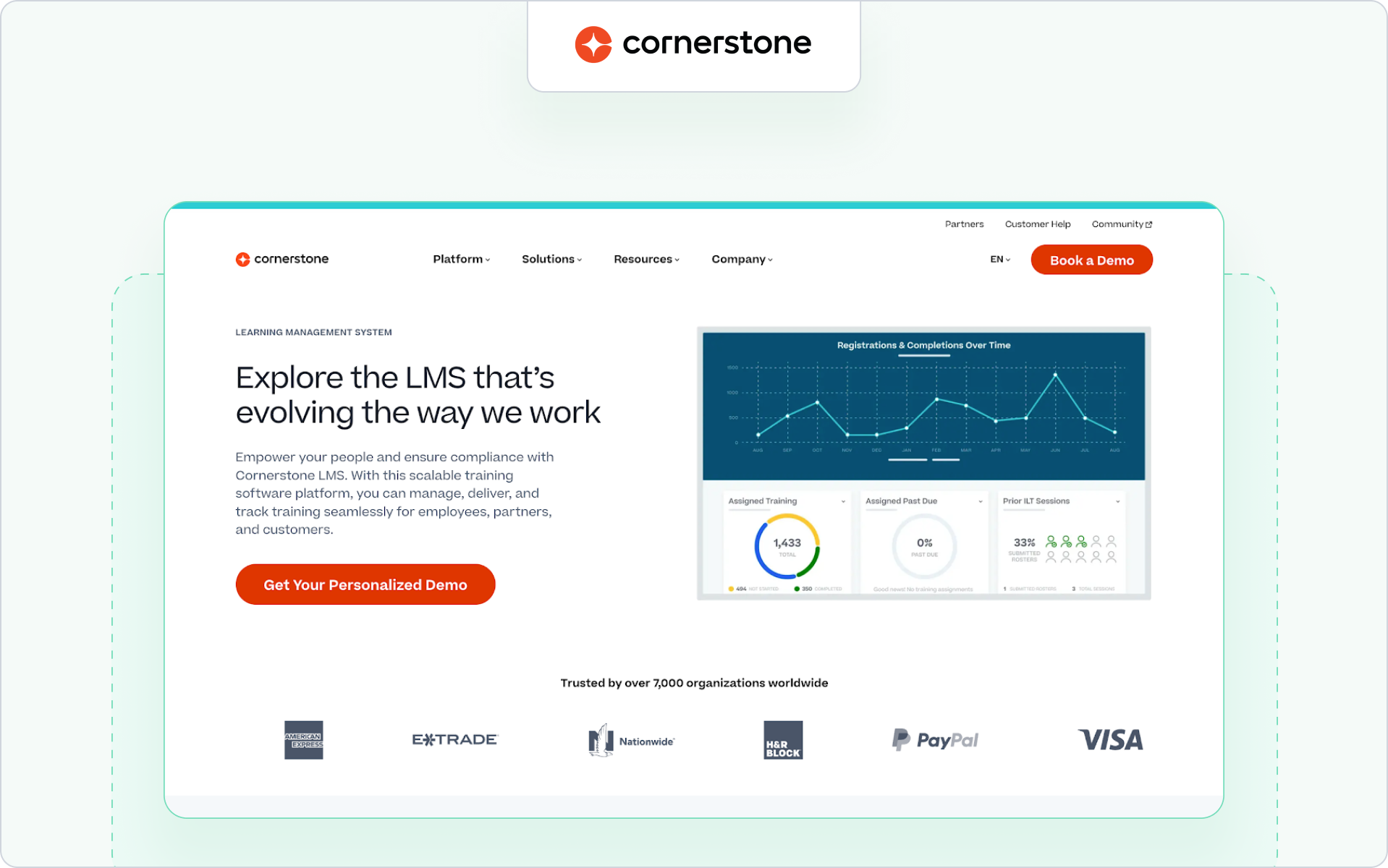
11. Cornerstone OnDemand: Best for global enterprise learning
Am besten geeignet für
Large enterprises running global employee development and compliance training programs.
Why it’s a LearnUpon LMS alternative
Cornerstone OnDemand is often chosen by large enterprises that need extensive customization, global compliance training, and advanced analytics for workforce development.
Wichtigste Merkmale
- Enterprise features for global learning management systems
- Advanced analytics for identifying skills gaps
- Compliance training and employee development tools
- Extensive customization for large training environments
Ideal company size
Large enterprises managing global employee training and compliance initiatives.
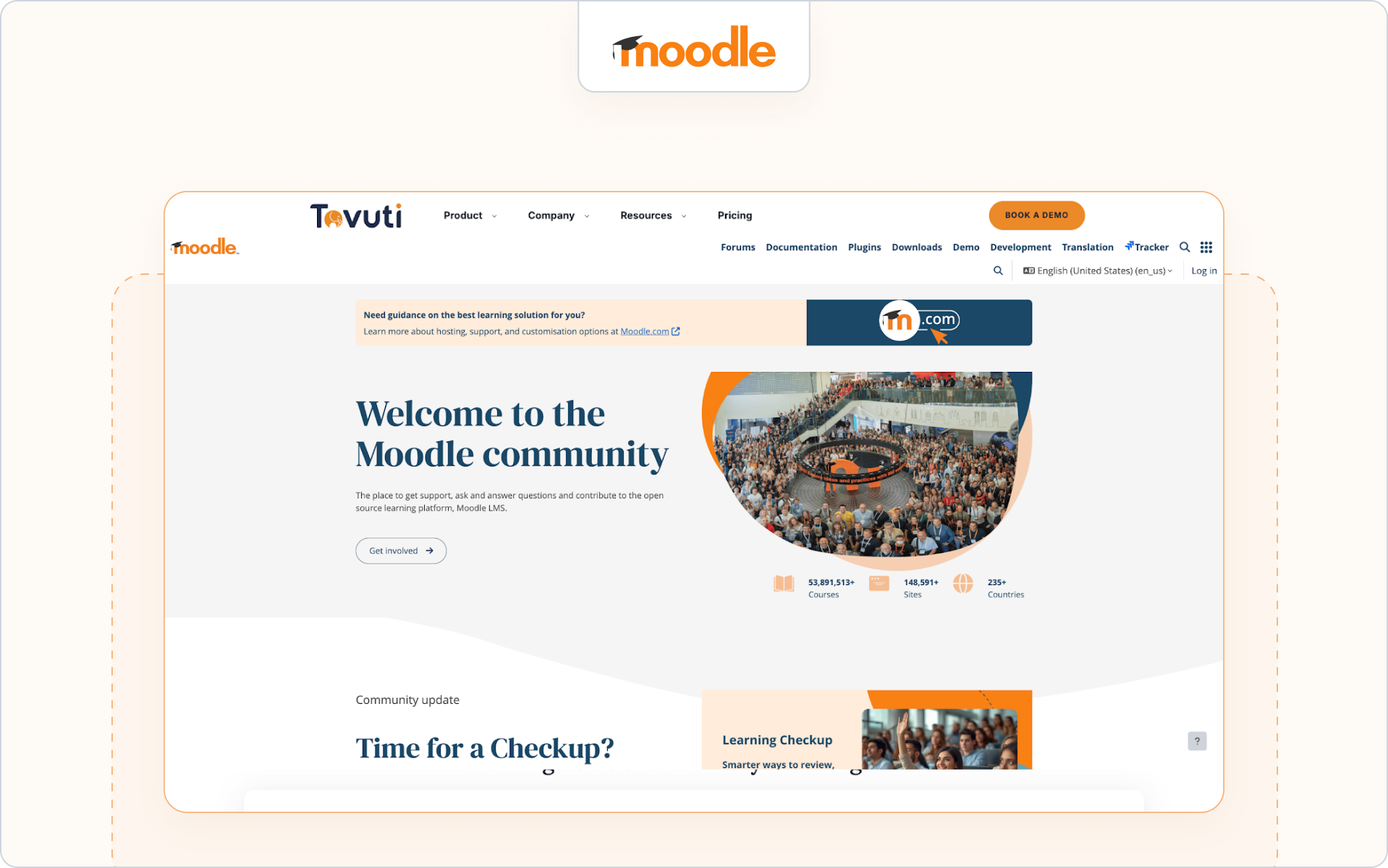
12. Moodle: Best for open-source flexibility
Am besten geeignet für
Organizations that want full control over their learning platform and have technical teams managing the system.
Why it’s a LearnUpon LMS alternative
Moodle appeals to organizations that want full control over their learning platform through open-source customization rather than a vendor-managed LMS.
Wichtigste Merkmale
- Open-source learning management system architecture
- Large ecosystem of plugins and integrations
- Support for blended learning and online training
- Flexible tools for managing course content
Ideal company size
Universities, training organizations, and companies with internal development resources.
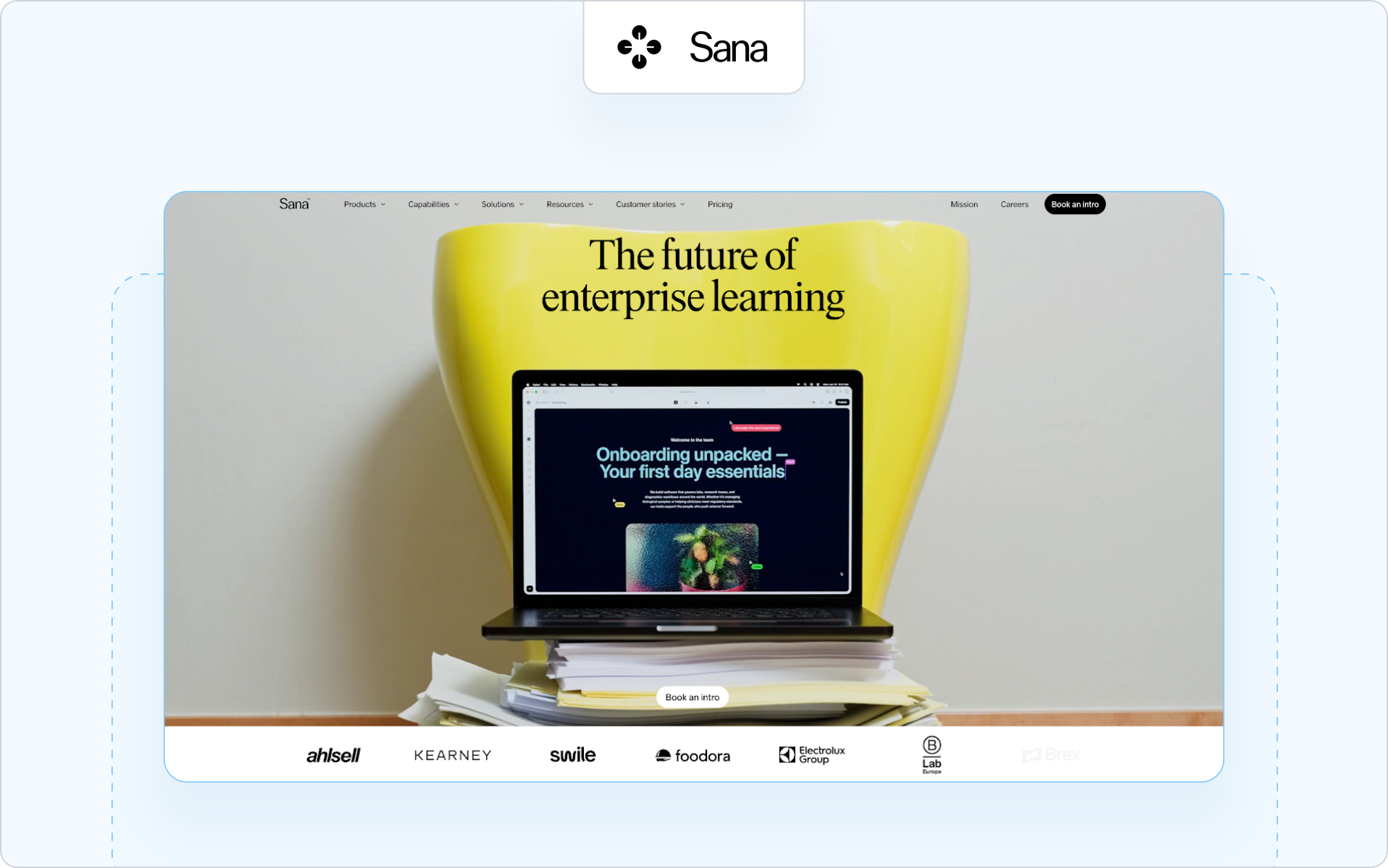
13. Sana Learn: Best for adaptive AI learning
Am besten geeignet für
Organizations that want AI-driven training experiences and adaptive learning paths.
Why it’s a LearnUpon LMS alternative
Sana Learn focuses on AI-driven training programs that personalize learning paths and improve knowledge retention based on learner progress.
Wichtigste Merkmale
- Adaptive learning paths that personalize training programs
- AI tools for recommending training content
- Analytics dashboards that help identify skills gaps
- Tools designed to improve knowledge retention
Ideal company size
Mid-market companies and enterprises exploring AI-driven employee development programs.
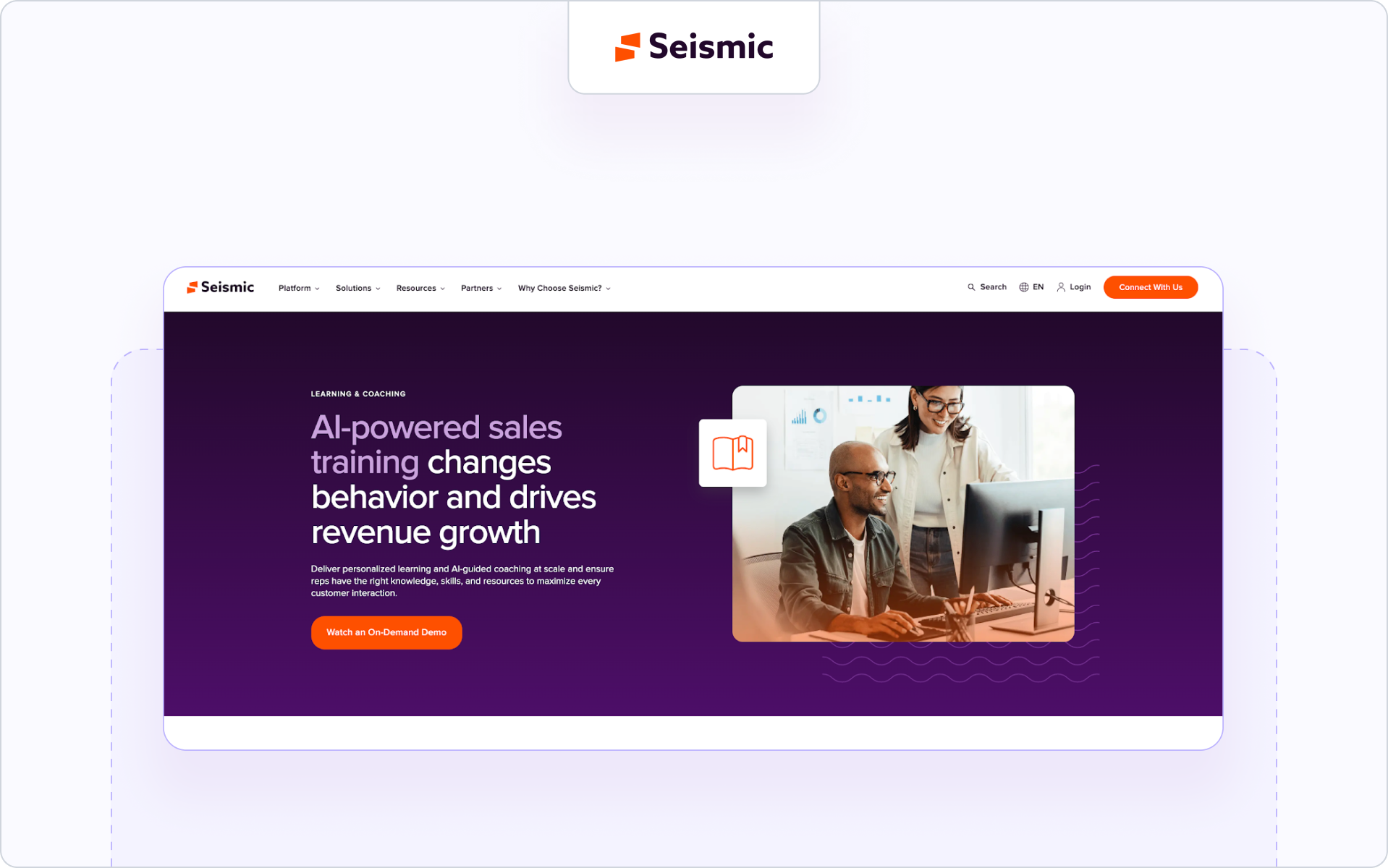
14. Seismic Learning (Lessonly): Best for sales enablement training
Am besten geeignet für
Organizations focused on onboarding and training the sales team.
Why it’s a LearnUpon LMS alternative
Seismic Learning is designed for revenue teams that need structured onboarding and training programs for the sales team.
Wichtigste Merkmale
- Sales enablement training for the sales team
- Coaching workflows for revenue teams
- Certification programs for onboarding
- Reporting dashboards for tracking learner progress
Ideal company size
Mid-sized companies and enterprises running sales enablement and onboarding programs.
15. CYPHER Learning: Best for modern AI-powered LMS platforms
Am besten geeignet für
Organizations that want a modern learning platform with AI-powered automation.
Why it’s a LearnUpon LMS alternative
CYPHER Learning attracts organizations looking for modern LMS platforms that combine AI-powered course creation with automated learner management.
Wichtigste Merkmale
- AI tools for creating and managing course content
- Automation for managing online courses and learners
- Personalized learning paths for training programs
- Reporting and analytics dashboards
Ideal company size
Mid-sized companies and enterprises exploring modern LMS platforms with AI-driven learning tools.
Before choosing between LearnUpon and other LMS platforms, it helps to look at how these tools compare across the capabilities partner teams care about most. The table below highlights where different platforms focus, and why some teams choose solutions built specifically for partner enablement.
Comparison table: LearnUpon vs. alternatives
For partner teams, the biggest difference usually comes down to visibility and engagement. In the next section, we’ll look at the specific criteria partner managers use when evaluating LearnUpon LMS alternatives.
What to compare when evaluating LearnUpon LMS alternatives
When evaluating LearnUpon LMS alternatives, partner teams usually focus on a few capabilities that influence partner adoption and revenue impact.
CRM & revenue visibility
Partner managers need to see training activity alongside partner deals and pipeline. If certification data lives outside the CRM, it’s difficult to understand which training programs influence revenue.
That’s why many teams prioritize platforms that help them measure partner training ROI.
AI course creation capabilities
As partner ecosystems grow, training programs expand quickly. AI tools help teams create courses faster, update training content, and reduce manual work.
This is especially helpful when managing large partner onboarding programs or frequent product updates.
Certification automation
Certification programs help standardize partner readiness, but manual management quickly becomes difficult.
Automated certification paths and recertification rules make it easier to scale programs and demonstrate the channel partner certification benefits across partner ecosystems.
Partner engagement & nudging
External training only works if partners actually complete courses. Platforms that support reminders, notifications, and off-platform nudges can improve completion rates and learner engagement.
These features help partner training programs maintain momentum.
Reporting that leadership cares about
Leadership teams want to see outcomes, not just course completions. They want visibility into how training influences partner pipeline and productivity.
That’s why many teams explore platforms designed specifically as partner LMS software when evaluating alternatives.
The right LMS depends on what you expect training to achieve. If partner training needs to influence pipeline, certifications, and partner productivity, those capabilities quickly become essential evaluation criteria.
But it’s also worth noting that LearnUpon still fits many organizations well. Here's why.
When LearnUpon is still the right choice
Despite the many LearnUpon LMS alternatives available, LearnUpon still works well for many organizations.
Primarily internal HR training
LearnUpon is a strong fit for companies focused on employee training, onboarding, and internal compliance training. HR and L&D teams can use it to manage structured training programs, deliver online courses, and support employee development across departments.
No CRM reporting requirement
If your training programs do not need to connect to sales data or partner pipeline, LearnUpon’s reporting capabilities are usually sufficient. Many companies only need to track completion rates, assessment scores, and general learner progress.
Limited partner enablement complexity
Some companies only run basic partner onboarding courses rather than full partner enablement programs. In those cases, a traditional learning management system like LearnUpon may be enough to deliver simple partner training without additional automation or integrations.
However, as your partner programs scale, your training needs often change.
When it’s time to switch to a LearnUpon LMS alternative
LearnUpon works well for many training environments. But partner teams sometimes need capabilities that traditional LMS platforms don’t provide.
Use this quick checklist to evaluate whether it may be time to consider a LearnUpon LMS alternative.
You need partner revenue visibility
☐ Training data needs to connect to partner pipeline or deals
☐ Certifications should be visible alongside CRM partner records
Certification must influence pipeline
☐ Certifications determine partner tiers or deal eligibility
☐ Your team needs automated certification paths and renewals
RevOps needs better reporting
☐ Leadership asks how partner training influences revenue
☐ Reporting must combine CRM and training data
You want AI-powered content scaling
☐ Your team regularly creates or updates course content
☐ AI tools could speed up course creation
You need engagement automation
☐ Partners enroll but often don’t finish courses
☐ Automated reminders or nudges would improve completion rates
If several of these apply to your program, it may be time to consider a partner LMS built specifically for partner ecosystems.
Why Introw is the best choice
For many SaaS partner teams, the challenge is not delivering training. It is connecting training to real partner outcomes.
Traditional learning platforms focus on managing courses, tracking completion, and delivering employee training. But partner teams often need more visibility and automation across their ecosystem.
With Introw, partner training becomes part of your partner operations instead of a separate LMS environment. Certifications, training activity, and partner engagement all connect directly to your partner program workflows.
What makes Introw different
- CRM-native visibility for partner certifications and training activity
- AI tools that help teams create and scale training content quickly
- Certification automation that supports partner tiers and onboarding
- Off-platform engagement to keep partners progressing through training
- Revenue reporting that shows how training supports partner performance
If you would like to explore how partner enablement works in practice, you can review Introw’s partner training and certification resources.
For teams that want partner training programs tied to pipeline, productivity, and partner success, Introw is built specifically for that purpose.
Ready to see how Introw works?
Request a demo and explore how Introw helps partner teams turn training into measurable partner revenue.
9 Best Practices for SaaS Partner Content Programs in 2026
Partners can’t sell what they don’t understand. Yet most SaaS partner programs still “enable” partners by handing over a few outdated PDFs, linking to a cluttered Google Drive, and hoping partner-sourced pipeline magically appears.
A strong partner content program changes the equation. It gives partners the materials they actually need — organized, accessible, and mapped to how they sell — so they can represent your product without constant hand-holding. In this guide, we’ll walk through the best practices for SaaS partner content programs in 2026, from identifying what’s missing to proving which assets drive revenue.
What is a SaaS partner content program?
A partner content program is the collection of enablement materials, sales collateral, co-marketing assets, and training resources you create specifically for partners to use when selling or implementing your product. The best programs go beyond “upload and hope” — they co-create tailored, high-value assets (case studies, webinars, whitepapers) that highlight joint solutions for shared target audiences.
Unlike internal sales content, partner content is built for an external audience. Your partners don’t have the same product context your AEs do, and they’re often juggling multiple vendors at once. That means your content has to be clearer, more findable, and easier to reuse.
- Enablement content: Product training, battle cards, and objection handling guides
- Sales collateral: Pitch decks, one-pagers, and ROI calculators partners can use with prospects
- Co-marketing assets: Co-brandable templates, campaign kits, and joint webinar materials
- Technical resources: Integration docs, implementation guides, and API references
Why partner content programs matter for SaaS growth
A signed partnership isn’t a growth channel by default. It becomes a growth channel when partners can confidently position, sell, and deliver your product without needing your team in every conversation.
Content is the link that turns a partner agreement into active, revenue-generating behavior — and it does it at scale.
- Faster partner ramp: Partners close deals sooner when they have ready-to-use materials
- Consistent messaging: Your value proposition stays intact across every partner conversation
- Reduced support burden: Self-serve content means fewer questions hitting your partner team
- Scalable co-selling: Content enables partners to act as an extension of your sales team
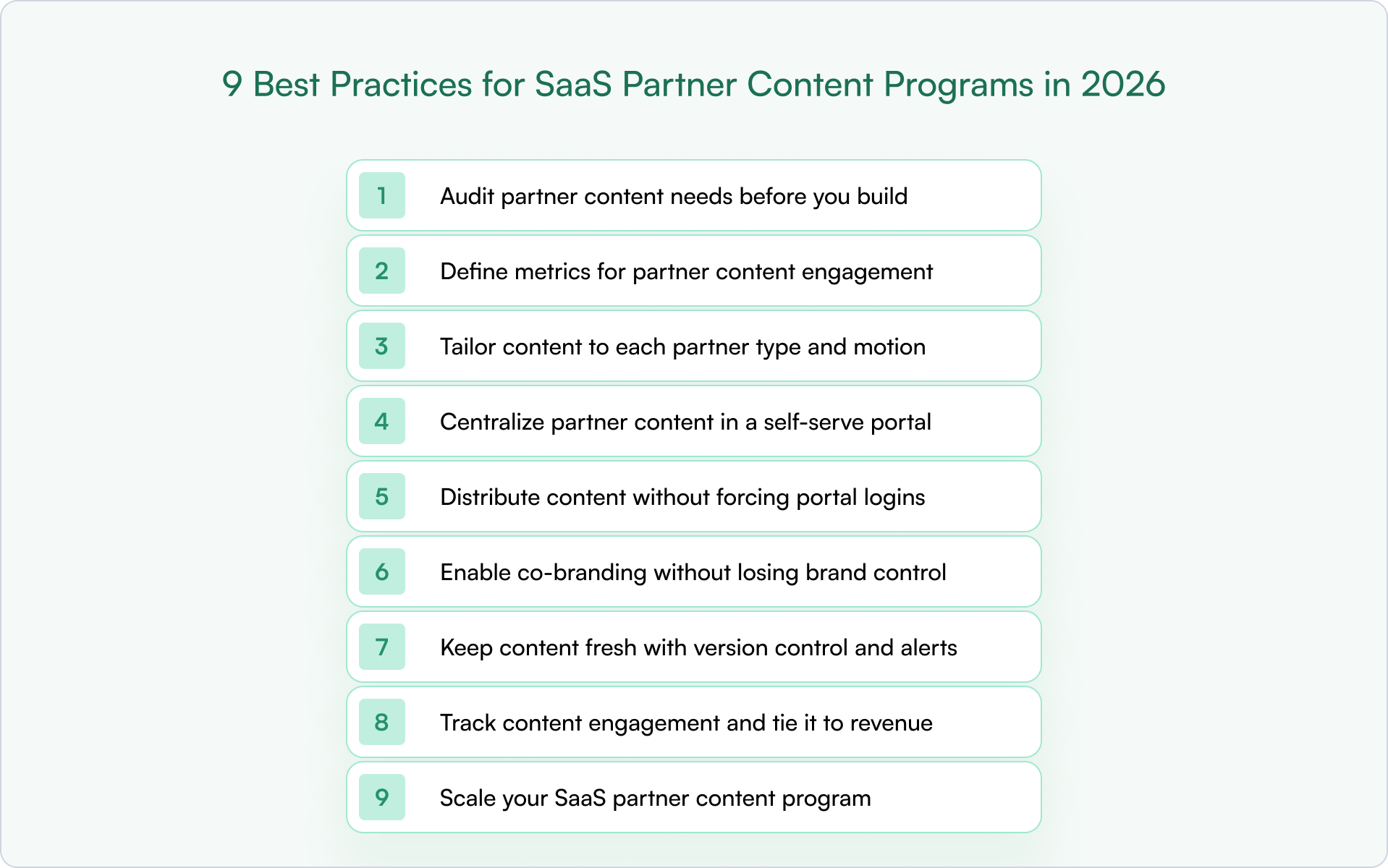
The 9 best practices for SaaS partner content programs
If you’re building this as a founder or early revenue leader, the goal isn’t “more content.” The goal is the smallest set of assets that helps partners create pipeline — and the operating system to keep those assets current, discoverable, and measurable.
1. Audit partner content needs before you build
Before you write a single new deck, validate what partners actually need. Many partner programs burn time creating content that never gets used because it doesn’t solve a real selling problem.
Interview partners about content gaps
Ask your existing partners what’s missing, what’s outdated, and what they wish they had. Keep the conversation grounded in real deals: what stops them from moving a prospect forward or answering questions with confidence?
Even five conversations usually reveal patterns. For example, partners might not want another product overview — they might need a competitive comparison they can forward when a prospect is evaluating alternatives.
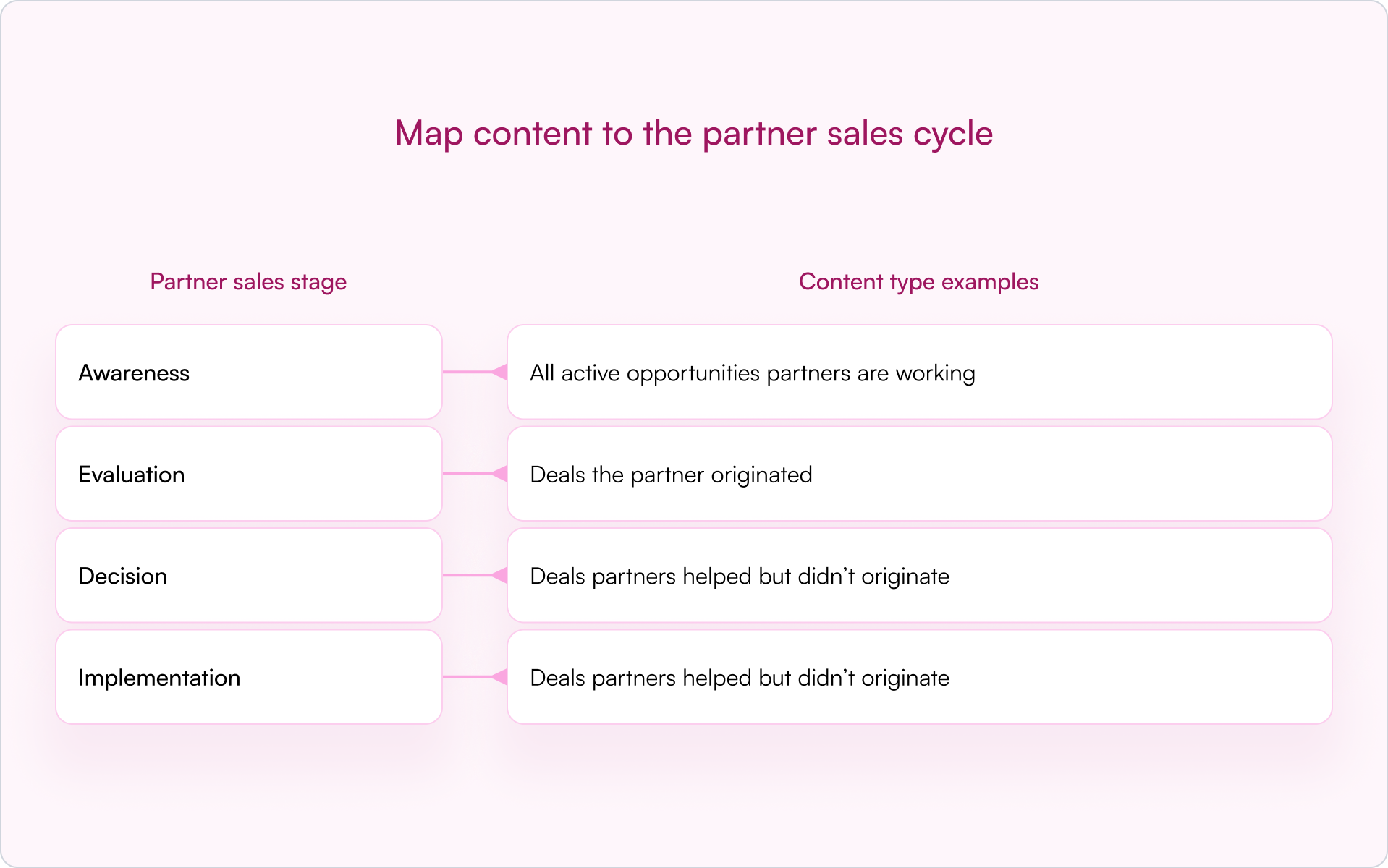
Map content to the partner sales cycle
Different stages of the partner-led sales cycle require different assets. Awareness-stage conversations benefit from solution briefs and intro decks. Evaluation calls for competitive comparisons and demo videos. Decision-stage deals often hinge on ROI calculators and customer stories. Implementation requires technical guides and onboarding checklists.
Also consider your partner model. Referral, reseller, and systems integrator motions typically need different content at each stage.
Identify high-value assets vs. nice-to-haves
Prioritize ruthlessly. Start with content that directly impacts deal velocity — battle cards, pricing guidance, and objection handling. Save high-effort production (heavy video, glossy campaigns) until the essentials are working.
2. Define metrics for partner content engagement
You can’t improve what you don’t measure. If you want partner content to be treated like a growth lever (not a cost center), set up tracking from day one.
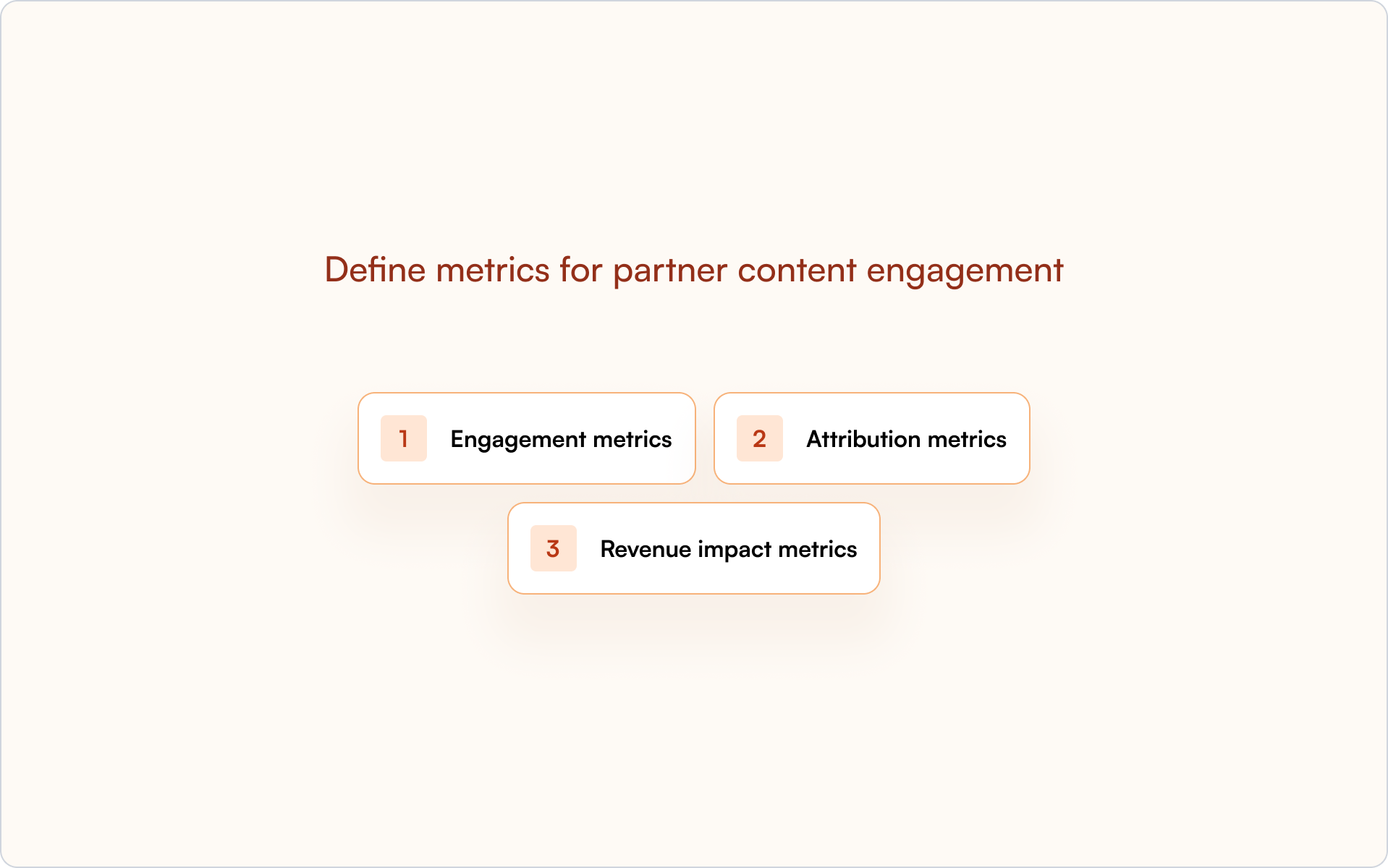
Engagement-Kennzahlen
Track views, downloads, shares, and time spent on each asset. This is your early signal for what’s useful versus what’s ignored.
Attribution metrics
Go beyond engagement by connecting content consumption to deal registration and pipeline generation. For example: did partners who used a specific battle card register more deals, or move deals to the next stage faster?
Revenue impact metrics
The gold standard is tying content engagement to closed-won revenue. Identify which assets consistently appear in the journey of deals that close — then reinvest in what’s working and prune what isn’t.
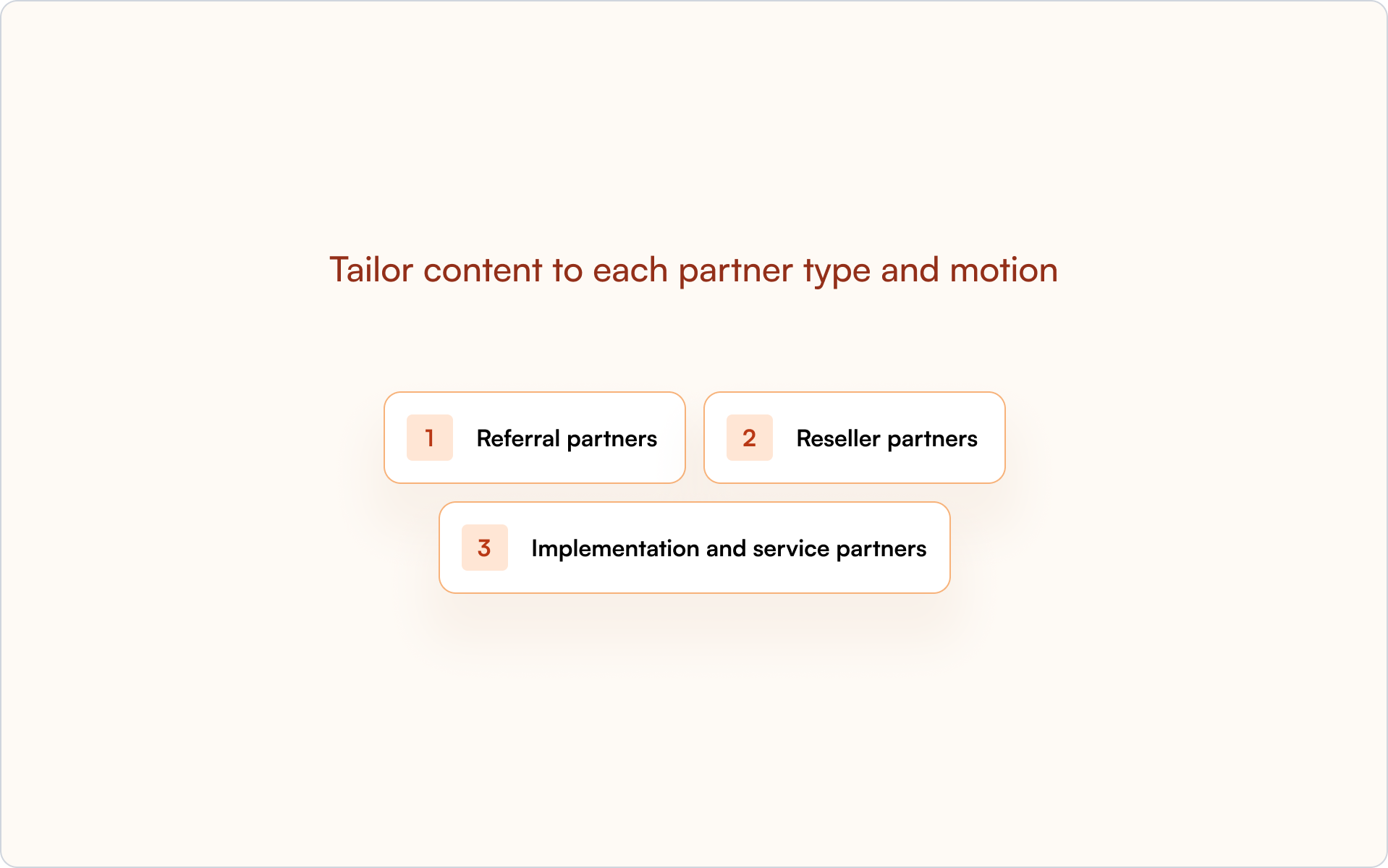
3. Tailor content to each partner type and motion
One of the most common reasons partner content programs underperform: every partner gets the same folder of assets. But a referral partner and a reseller are doing fundamentally different jobs — so they need different materials.
Referral-Partner
Optimize for speed and shareability: one-pagers, pre-written email templates, and landing pages they can forward to prospects. Referral partners typically don’t need deep product training — they need to qualify opportunities and hand them off cleanly.
Vertriebspartner
Resellers need full sales enablement: comprehensive pitch decks, demo scripts, pricing calculators, and objection handling guides. If they own the sales cycle, your program has to help them sound like experts quickly.
Implementation and service partners
Prioritize technical documentation, implementation playbooks, and certification materials. These partners deliver value post-sale, so your content should reduce delivery risk and improve time-to-value.
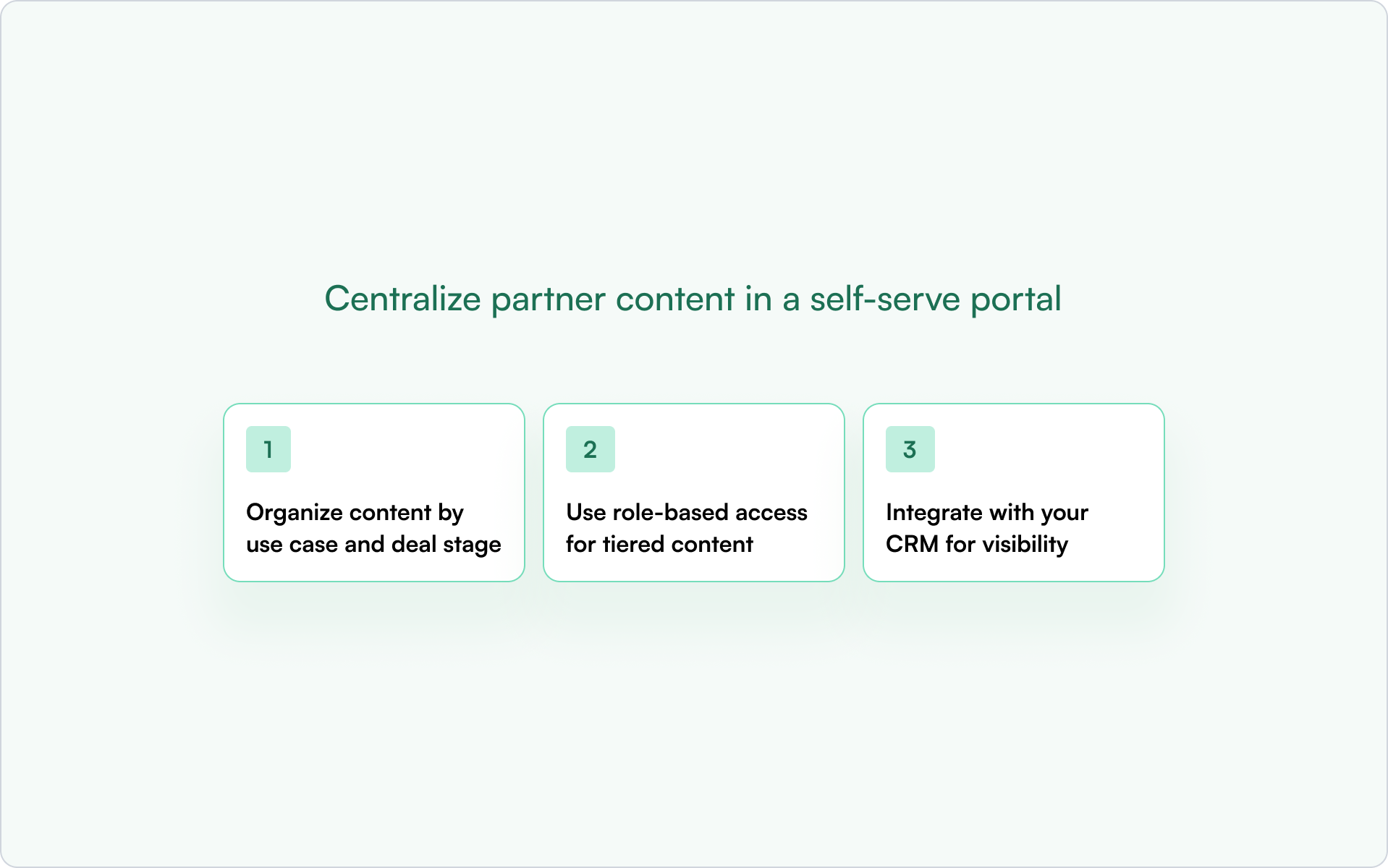
4. Centralize partner content in a self-serve portal
Partners won’t hunt through old email threads or shared drives. A centralized portal makes assets discoverable and ensures everyone is working from the same version.
Organize content by use case and deal stage
Structure the portal so partners can find what they need in seconds. Organize by “I’m trying to…” use cases — not your internal folders. A partner looking for a competitive comparison shouldn’t have to guess whether it lives under “Marketing > Collateral > Q3.”
Use role-based access for tiered content
Not every partner should see everything. Gate advanced content — pricing details, product roadmaps, competitive intelligence — behind certification or partner tier status. Done well, this also creates a healthy incentive for partners to level up.
Integrate with your CRM for visibility
When your portal connects to HubSpot or Salesforce, you can see which partners access which content and tie engagement back to pipeline. A CRM-first approach keeps this data visible to your revenue team — not trapped in a separate system.
5. Distribute content without forcing portal logins
Here’s the reality: many partners won’t log into your portal regularly. The best practices for SaaS partner content programs assume that, and they meet partners where they already work — inbox, Slack, and direct links.
Push content via email and Slack alerts
Don’t wait for partners to “check the portal.” Proactively send new or updated content through channels they use daily. A quick Slack message with a direct link to a new battle card beats hoping they stumble on it later.
Enable off-portal access for key assets
When possible, allow partners to access critical assets without authentication. Removing friction matters most in high-pressure moments — like five minutes before a discovery call.
Capture engagement without requiring authentication
Use trackable links or lightweight forms so you can still see what’s being used, by whom, and when — without adding password friction.
6. Enable co-branding without losing brand control
Partners want to put their logo on your materials. You want your messaging (and legal disclaimers) to stay accurate. The compromise is to design co-branding into the system — not bolt it on later.
Set co-branding templates and guardrails
Create templates with clearly defined editable zones (partner logo and contact info) and locked zones (product messaging, positioning, disclaimers). Make the rules obvious so partners can move fast without breaking your brand.
Automate partner logo insertion
Where possible, use dynamic templates that auto-populate a partner’s branding based on who’s logged in. This reduces manual edits and avoids “wrong-logo” mistakes.
Review and approve workflows
For high-stakes assets — customer-facing decks, public case studies, press releases — include an approval step. Automate what you can, but protect brand integrity where it matters.
7. Keep content fresh with version control and alerts
Outdated content is worse than no content. It creates confusion, slows deals, and erodes partner trust. Maintenance needs to be part of your operating rhythm — not a once-a-year cleanup.
Set refresh cadences by content type
Define review cycles and put them on a calendar. For example: review pricing quarterly, update product docs after each release, and refresh competitive intel monthly.
Sunset outdated assets automatically
Archive or hide assets past their expiration date. Partners shouldn’t accidentally pull last year’s pricing sheet the night before a proposal goes out.
Notify partners when content is updated
When you update an important asset, tell partners immediately. Email or Slack notifications keep everyone aligned on the latest version.
8. Track content engagement and tie it to revenue
If you want partner content to earn ongoing investment, you need to show how it impacts pipeline and revenue — not just downloads.
Measure views, downloads, and shares
Engagement metrics show what’s popular. Track at both the asset level and the partner level to identify high-performing content and your most engaged partners.
Connect engagement to deal progression
Look for patterns that correlate with movement: when a partner downloads an ROI calculator and then registers a new deal, you want that sequence visible. Build reporting that makes content a measurable part of deal velocity.
Report content ROI in partner QBRs
Bring content engagement data into quarterly business reviews. It’s one of the fastest ways to align on what’s working, what’s missing, and what you should build next together.
9. Scale your SaaS partner content program
What works with ten partners breaks at one hundred. Scaling a partner content program requires automation, personalization, and strong self-serve foundations — otherwise your partner team becomes a content concierge.
Automate content distribution workflows
Trigger content based on milestones: completing a certification, registering a first deal, entering a new tier, or launching a joint campaign. Automation keeps the partner experience consistent as volume grows.
Use AI for personalization at scale
AI can recommend the most relevant assets based on partner type, deal stage, and past engagement. Relevance drives usage — and usage drives revenue.
Reduce manual content requests with self-serve
Repeated partner requests for the same asset usually mean it’s not findable. Treat every manual request as product feedback on your portal’s organization, then close the gap.
Conclusion: make partner content a growth system, not a folder
The best practices for SaaS partner content programs aren’t about producing more collateral. They’re about building a repeatable system: the right assets for each partner motion, delivered where partners actually work, kept current with version control, and measured against pipeline and revenue.
If you get those fundamentals right, your partners stop feeling like a channel you have to manage — and start acting like a go-to-market multiplier.
Build your SaaS partner content program with Introw
Introw’s CRM-first partner portal helps teams centralize, distribute, and track partner content — all inside HubSpot or Salesforce.
- Content hosting directly in the portal
- Announcements to push updates via email and Slack
- Engagement tracking that syncs to CRM records
- Off-portal access so partners don’t always need logins
Get a demo to see how Introw helps SaaS partner programs deliver content partners actually use.
How to Launch an MSP Partner Program in 2026
MSPs already have the clients you want to reach. They’ve built trust, signed contracts, and deliver services month after month — which means one strong partnership can open doors to dozens of accounts your direct team would spend quarters chasing.
The real question isn’t whether MSP partnerships make sense. It’s whether you can build an MSP partner program that actually attracts the right partners, gets them enabled fast, and turns signups into recurring revenue. This guide walks through what to include, how to launch it step by step, and the mistakes that quietly kill most programs before they gain traction.
What is an MSP partner program?
An MSP partner program is a structured partnership between a technology vendor and Managed Service Providers (MSPs). MSPs manage IT infrastructure, security, cloud services, and support for end customers on an ongoing basis. You provide the product plus training, resources, and program incentives. The MSP operationalizes your technology inside their managed services offering.
This differs from a classic reseller relationship in one crucial way: MSPs don’t sell your product once and move on. They bundle it into a recurring service they deliver month after month, meaning your success is tied to their ability to retain clients and standardize delivery.
How the relationship works
- Technology vendor: the company (like yours) that builds the product
- MSP partner: the managed service provider who bundles your product into their client offerings
- End customer: the MSP’s client who benefits from the combined solution
MSP partnerships are especially common in cybersecurity, cloud services, backup, and remote monitoring — anywhere ongoing service delivery matters more than a one-time transaction.
Why launch a managed service provider partner program?
If you’re a founder building a B2B software company, an MSP channel can be one of the most capital-efficient paths to scale. Done right, it expands revenue without requiring a linear increase in direct sales headcount.
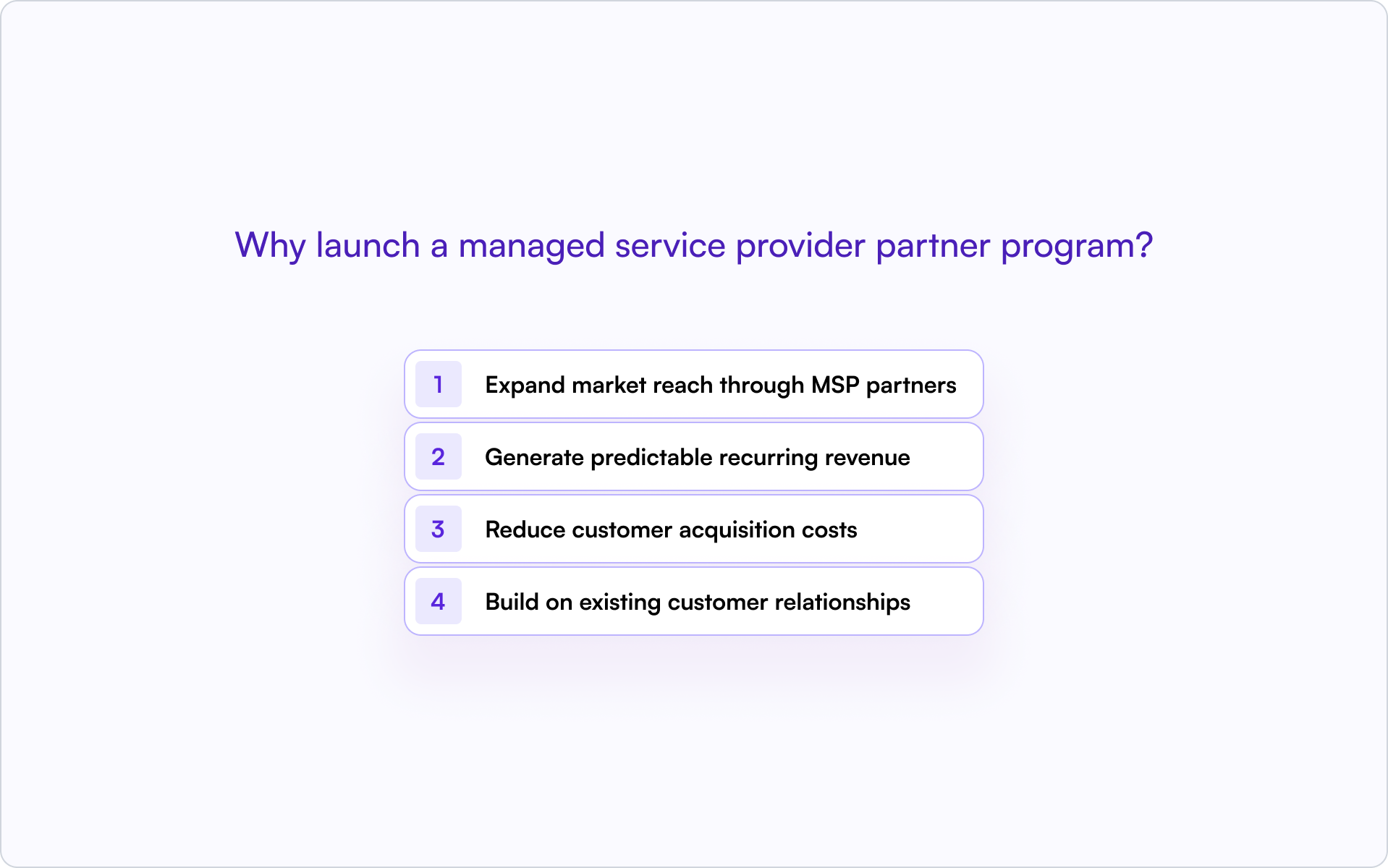
Expand market reach through MSP partners
MSPs already serve the SMB and mid-market accounts that are hardest to reach through cold outbound. They have contracts, renewal cycles, and ongoing service touchpoints — which gives them distribution you can’t replicate quickly.
One MSP partnership can unlock access to dozens (or hundreds) of end customers. Accounts your direct team would spend months identifying and closing become reachable through a single partner relationship.
Generate predictable recurring revenue
MSPs bill monthly, often on a per-user or per-device basis. When they bundle your product into their service, your revenue becomes recurring and correlated with their retention — incentives stay aligned.
Reduce customer acquisition costs
MSPs do the selling and often the implementation. You trade margin for distribution, which can be far cheaper than scaling AEs into every segment and region you want to win.
Build on existing customer relationships
MSPs are trusted advisors. Their recommendation carries more weight than vendor-led outreach — which typically shortens sales cycles and increases close rates.
What to include in your MSP partner program
Program design is where most teams accidentally lose. MSPs evaluate vendor programs constantly; if yours is confusing, under-incentivized, or operationally painful, they’ll simply prioritize someone else.
Partner tiers and qualification criteria
Define tiers based on commitment, volume, or certification status. Keep it simple — three tiers is usually enough.
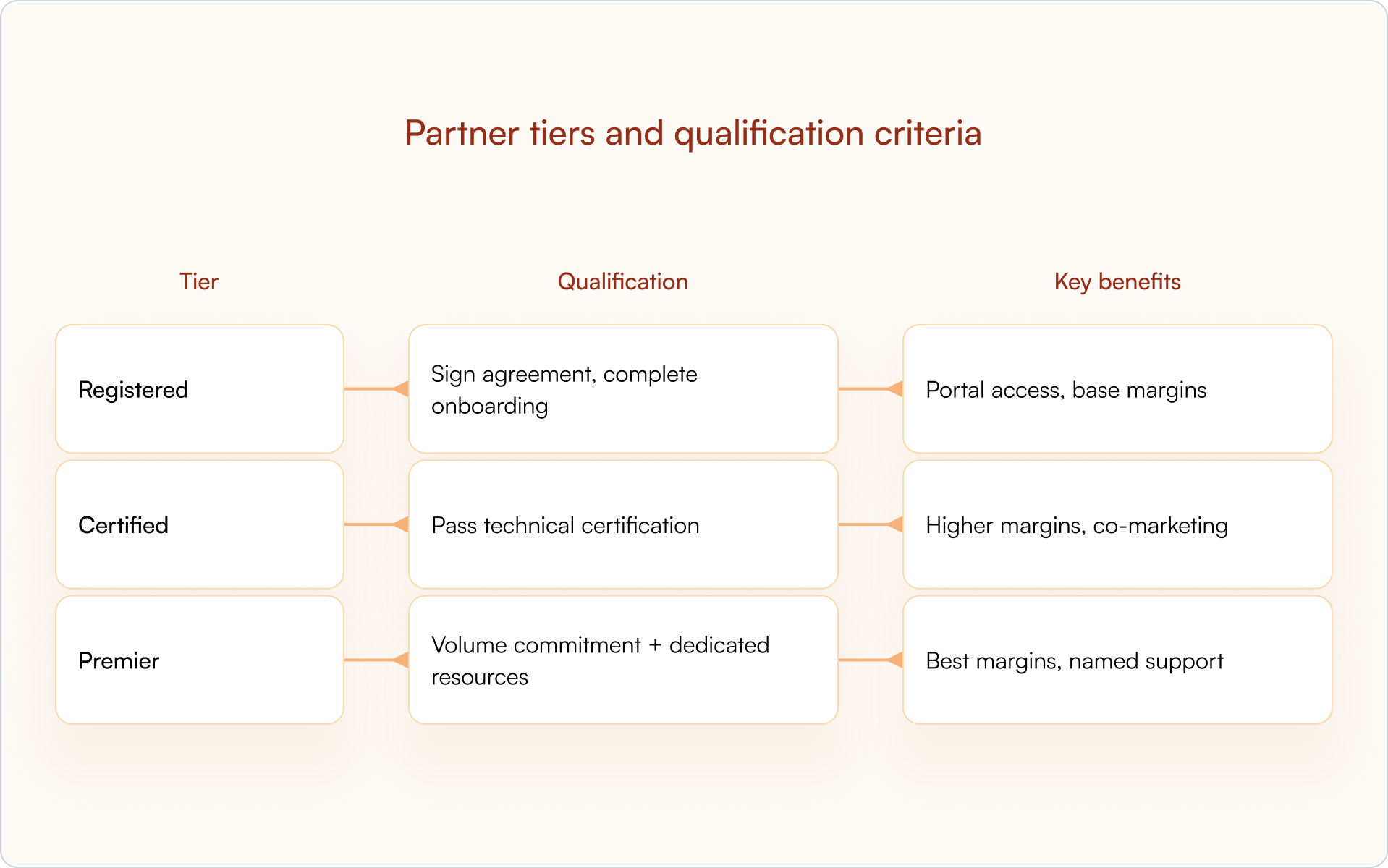
A common failure mode: teams add too many tiers to “cover every case,” and partners can’t quickly understand where they fit or what to do next.
Margin and pricing structure
MSPs need healthy margins to justify bundling your product. Wholesale pricing, volume discounts, rebates, or consumption-based billing can all work — but the economics must match the MSP business model.
- Align to monthly billing where possible (MSPs typically invoice monthly).
- Reduce upfront friction (annual-only commitments can be a deal-killer for monthly service bundles).
- Be explicit about what’s margin, what’s rebate, and what’s conditional on certification or volume.
Certification and enablement requirements
Certification protects your brand and reduces support load. Define what partners must complete before selling, implementing, or supporting your product.
Include technical training, sales enablement, and ongoing recertification. Partners who understand your product close more deals and create fewer escalations.
Deal registration and lead protection
Deal registration is how MSPs claim opportunities, earn protection windows, and avoid conflicts with your direct team or other partners.
Without clear rules, partners won’t invest in building pipeline for you. Define:
- Registration workflow: what they submit and where
- Approval SLA: 48 hours is a common standard
- Protection duration: typically 60–90 days (with clear extension criteria)
- Conflict resolution: what happens if two parties claim the same account
A structured deal registration process is one of the most effective tools for preventing channel conflict and keeping partners engaged.
Partner portal and self-service resources
MSPs expect a professional portal where they can self-serve pricing, training, marketing assets, deal registration, and support — without waiting on your team.
The portal should be connected to your CRM so data stays accurate and reporting stays real. If partners operate in one place and your revenue team operates in another, you’ll spend your time reconciling instead of scaling.
Co-marketing and sales support
Outline what support partners can expect: MDF (Market Development Funds), co-branded campaigns, lead sharing, joint webinars, and sales engineering help. Many MSPs don’t need “more collateral” — they need demand-generation support and a path to their first few wins.
How to launch an MSP partner program step by step
Strategy is the easy part. The program wins or loses in execution — especially in your first 90 days, when partners decide whether you’re worth their time.

1) Define your ideal MSP partner profile
Not all MSPs are a fit. Define your criteria the same way you define an ICP for direct sales:
- Vertical focus (healthcare, legal, financial services, general SMB)
- Client base size and maturity
- Technical capabilities (security operations, cloud migrations, compliance)
- Geographic footprint and service model
- Existing vendor stack and overlaps
This prevents you from recruiting partners who will sign an agreement but never activate.
2) Structure program tiers and incentives
Build out the tier structure, margin tables, and incentive programs (SPIFFs, rebates, MDF). Put it in a partner-facing program guide that’s clear enough to forward internally.
MSPs compare programs constantly. Ambiguity loses to clarity every time.
3) Build certification and onboarding paths
Create the training curriculum: product training, sales certification, technical certification. Then design the onboarding journey from signup to first registered deal.
- Set expectations for time-to-certification.
- Provide a “first deal” playbook (ideal customer, pitch, implementation outline).
- Make enablement easy to complete in the flow of work.
4) Set up deal registration and pipeline tracking
Implement deal registration workflows (submission, approval routing, protection windows, expiration reminders) and connect it to your CRM so partner pipeline is visible alongside direct pipeline.
If partner deals live in spreadsheets or disconnected tools, you’ll create invisible pipeline and messy attribution — and you’ll pay for that later in forecasting, comp plans, and board reporting.
5) Launch your MSP partner portal
Launch the portal with everything a partner needs on day one: program guide, pricing, training, deal registration, and support paths.
Reduce login friction. In the real world, partners abandon portals that feel like extra work.
6) Recruit and activate your first MSP partners
Start targeted recruitment: identify the right MSPs, run outreach, and pitch the program with concrete economics and a clear onboarding plan. Optimize for activation, not signups — a “signed” partner who never registers a deal is a rounding error.
Define activation milestones: completed training, first deal registered, first closed deal, and track them from day one.
Tools for managing MSP partnerships at scale
Most early MSP partner programs don’t fail because the idea is wrong. They fail because operations can’t keep up — approvals lag, data is missing, and partners stop engaging.
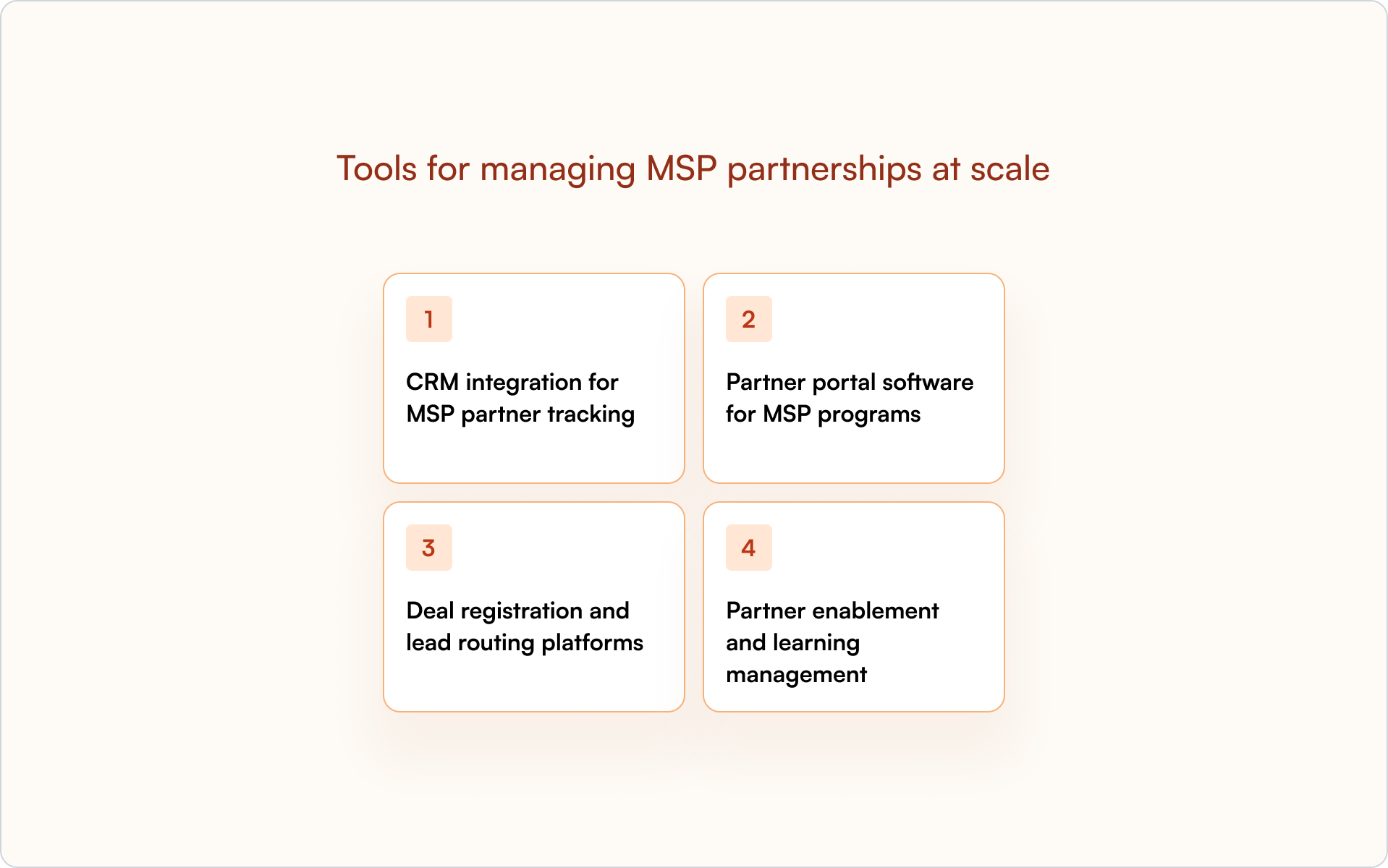
CRM integration for MSP partner tracking
Your CRM (HubSpot, Salesforce) is the system of record for partner deals. Track partner-sourced pipeline, deal registration status, and attribution inside the CRM — not in a separate system.
That’s how RevOps and sales leadership get real visibility without reconciling spreadsheets at the end of every month.
Partner portal software for MSP programs
A partner portal centralizes resources, deal registration, and communication. Prioritize portals that integrate with your CRM so data flows automatically.
Avoid portals that create data silos or require heavy partner logins. The best portals feel like an extension of your CRM — not a separate destination.
Deal registration and lead routing platforms
Deal registration needs workflow automation: submission → approval → protection → expiration alerts. Route registrations to the right approver, enforce required fields, and track protection windows automatically.
Partner enablement and learning management
Deliver training through an LMS or enablement platform. Track certification status, send recertification reminders, and gate key benefits behind completed training.
Trained partners close more deals. Your job is to make “getting trained” feel like momentum, not homework.
Common mistakes when building an MSP partner program
Most MSP partner programs stall for predictable reasons. If you’re building this in 2026, you can avoid months of rework by designing around these failure modes up front.
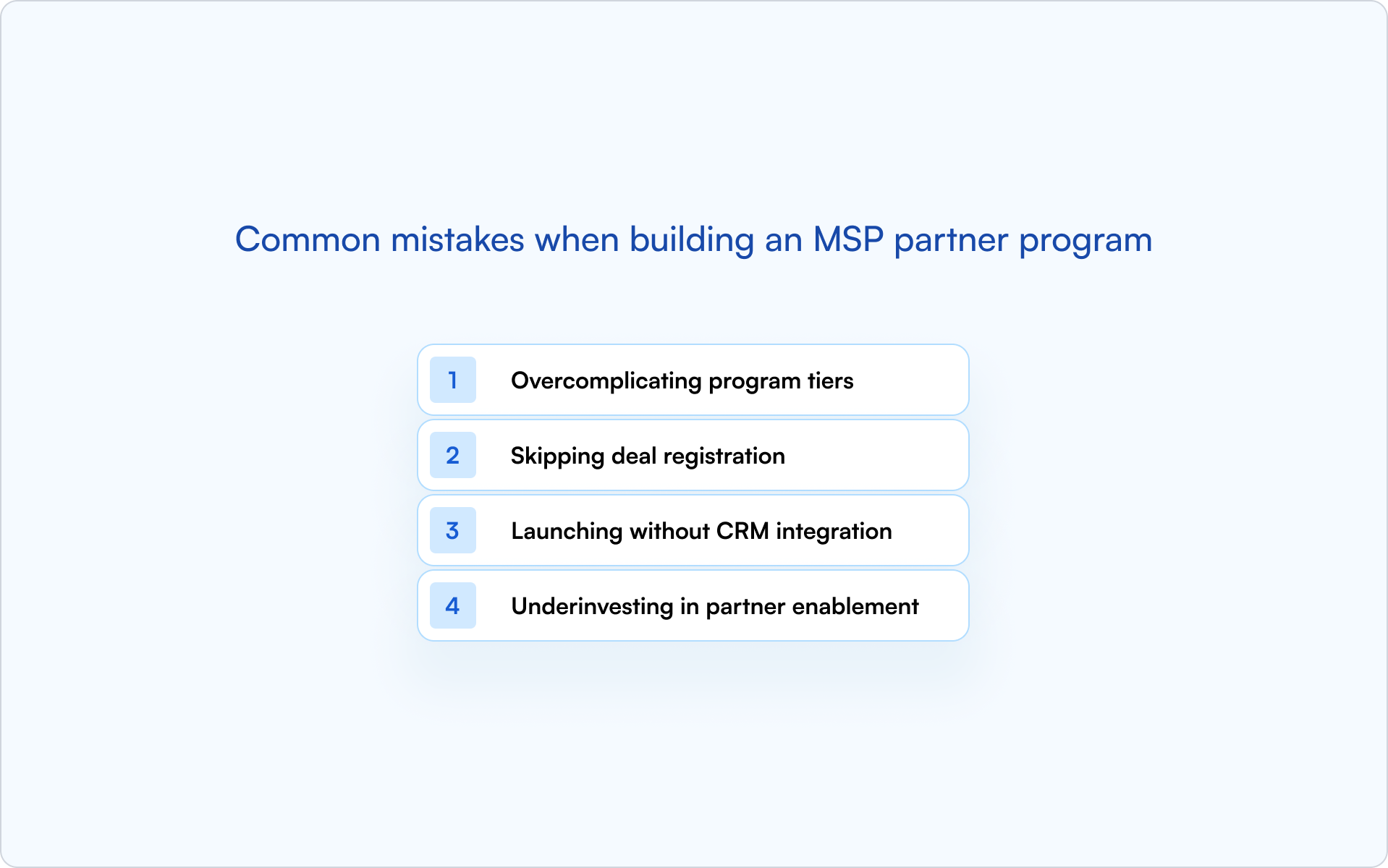
Overcomplicating program tiers
Too many tiers or unclear qualification criteria overwhelm partners. MSPs evaluate dozens of vendor programs — if yours is hard to understand, they’ll skip it. Start simple and add complexity only when real partners ask for it.
Skipping deal registration
Without deal registration, you can’t protect partner deals or prevent channel conflict. Partners won’t invest in selling if they risk losing deals to your direct team or another partner.
Treat deal registration as non-negotiable infrastructure, not a “phase two” feature.
Launching without CRM integration
If partner pipeline lives outside your CRM, you lose visibility, attribution, and forecasting accuracy. Your sales team can’t see partner deals. RevOps can’t reliably report on partner-sourced revenue. Leadership can’t trust the numbers.
Build CRM-first from the start. Retrofitting integration later is painful and expensive.
Underinvesting in partner enablement
MSPs can’t sell what they don’t understand. If training, documentation, and support are thin, partners won’t close — and they’ll blame the product. Enablement is an investment that shows up in activation rate, deal velocity, and retention.
Build your MSP partner program on your CRM with Introw
Launching an MSP partner program gets much easier when your tools work together. Introw connects your partner portal directly to HubSpot or Salesforce, so every MSP deal, lead, and activity lives in one system.
- CRM-first architecture: Partner deals live in the same system as direct deals. No hidden pipeline, no attribution guesswork.
- Deal registration: Partners register deals through the portal or email. Registrations sync to your CRM with protection windows and approval workflows — automatically.
- Partner portal: Launch a branded portal in minutes with resources, deal registration, and pipeline visibility. Partners stay engaged without logging in constantly.
- Real-time visibility: See partner pipeline alongside direct pipeline and forecast with confidence.
If you’re building an MSP channel and want it to scale without spreadsheets or disconnected systems, book a demo to see how Introw supports it.
Fazit
A successful MSP partner program is less about flashy perks and more about operational trust: clear economics, fast enablement, protected deals, and clean data in your CRM. If you get those foundations right, the channel can become one of the most efficient growth engines in your go-to-market.
How to Use AI for Partner Engagement Without Losing the Human Touch
Partner programs don’t fail because of bad partners. They fail because partner managers run out of hours — chasing updates, answering the same questions, and manually personalizing outreach that never truly scales.
AI for partner engagement changes that equation. Not by replacing relationships (the thing that actually drives partner revenue), but by taking repetitive work off your team’s plate so they can spend more time in the conversations that matter.
Below is a practical playbook: what to automate, what to keep human, and how to implement AI without eroding the trust you’ve built.
Why AI for Partner Engagement Matters Now
AI for partner engagement means using artificial intelligence tools — automation, machine learning, and generative AI — to personalize communication, anticipate partner needs, and reduce operational drag. It sits under the broader umbrella of partner relationship management AI, where the goal is simple: keep partners enabled and responsive without adding headcount at the same rate as partner growth.
The underlying math has changed. Partner counts grow quickly, partner expectations rise even faster, and your team is left stitching together engagement across spreadsheets, portals, inboxes, and CRM notes. The result is predictable: slower responses, inconsistent follow-up, and partner managers spending their best hours on admin instead of revenue.
AI addresses that bottleneck by handling the repeatable parts of engagement — so your team can focus on building trust, driving pipeline, and solving real partner problems.
How AI Improves Partner Engagement Without Replacing Your Team
The highest-performing programs don’t automate everything. They automate the right things. AI works best when it amplifies what your team already does well — and removes the friction that prevents consistency.
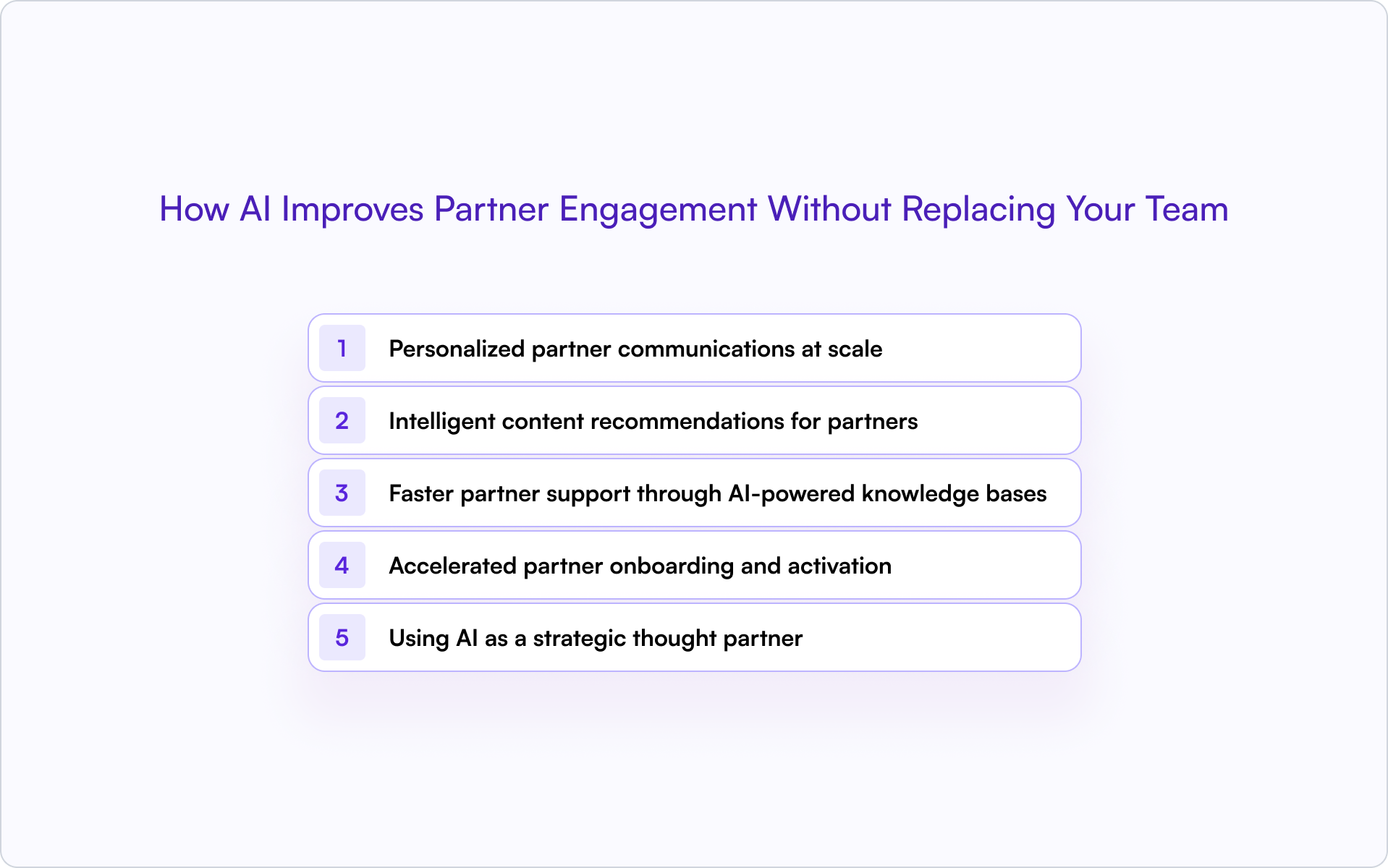
Personalized partner communications at scale
AI can analyze partner data — behavior, preferences, deal history, portal activity — and help tailor messaging without you writing from scratch each time. Done right, the voice stays “yours,” but the volume scales.
- Behavior-based messaging: AI can detect who’s active vs. disengaged and tailor follow-ups accordingly. A partner who hasn’t logged in for 30 days should get a different nudge than one who just registered a deal.
- Segment-specific campaigns: Generative AI can draft outreach by tier, region, or vertical. Your team reviews and sends — keeping quality control and the human touch.
Intelligent content recommendations for partners
Partners often struggle to find the right enablement content at the right time. AI helps by surfacing the most relevant case studies, battle cards, product docs, or training based on partner activity, segment, or deal stage.
This reduces the steady stream of “Where do I find X?” requests and improves time-to-first-deal because partners get what they need when they need it — without hunting.
Faster partner support through AI-powered knowledge bases
An AI-powered knowledge base is a self-serve library where partners ask a question and the AI returns the most relevant answer from your documentation. This works especially well for routine requests like pricing sheets, deal status questions, and portal navigation.
The win isn’t just speed. It’s consistency: partners get accurate answers instantly, while your team stays available for nuanced or sensitive situations.
Accelerated partner onboarding and activation
Partner onboarding AI guides new partners through onboarding steps, auto-assigns training content, and prompts next actions. Instead of manually tracking who completed what, your team gets visibility into progress and can step in only when a partner gets stuck.
Using AI as a strategic thought partner
Partnership leaders also use AI to brainstorm campaign ideas, draft program policies, and summarize what’s working across segments. Think of it as a strategy assistant that’s always available — while final decisions stay with your team.
AI can surface patterns your team might miss, but judgment calls that shape partner relationships should remain human-led.
Practical AI Use Cases for Partner Programs
If you’re building (or scaling) a partner motion, you don’t need “AI everywhere.” You need a few targeted workflows that reduce noise and increase partner responsiveness. These are the patterns that tend to deliver ROI quickly.
Drafting personalized partner outreach and updates
AI can generate email drafts, partner newsletters, and Slack messages tailored to partner segments. Your team reviews and sends — which keeps messages authentic, while eliminating blank-page work.
Tracking partner engagement signals in your CRM
AI can flag disengaged partners, highlight high-activity accounts, and detect patterns in deal registration behavior. The key is CRM-first visibility — data should live in HubSpot or Salesforce, not scattered across tools. That way, partner relationship management AI can operate on a reliable system of record.
Surfacing expansion and cross-sell opportunities
AI can identify partners with upsell or cross-sell potential based on customer fit, deal history, or product usage signals. The output should be a prioritized list for a human follow-up — not a fully automated “spray and pray” campaign.
Automating repetitive partner support queries
Common questions can be handled by AI chatbots, knowledge bases, or automated responses. This is often one of the highest-ROI forms of partner program automation — partners get instant answers, and your team spends less time on repeat tickets.
Delivering tailored partner enablement content
AI recommends relevant training, playbooks, or collateral based on partner type, certification level, or current deals as part of your partner enablement strategy. Partners see what’s relevant to them, rather than a generic content library that overwhelms them.
What to Automate vs. What to Keep Human in Partner Engagement
The easiest way to lose partner trust with AI is to automate moments that require judgment, empathy, or context. The goal is to automate the repeatable work — while protecting the high-stakes relationship moments.
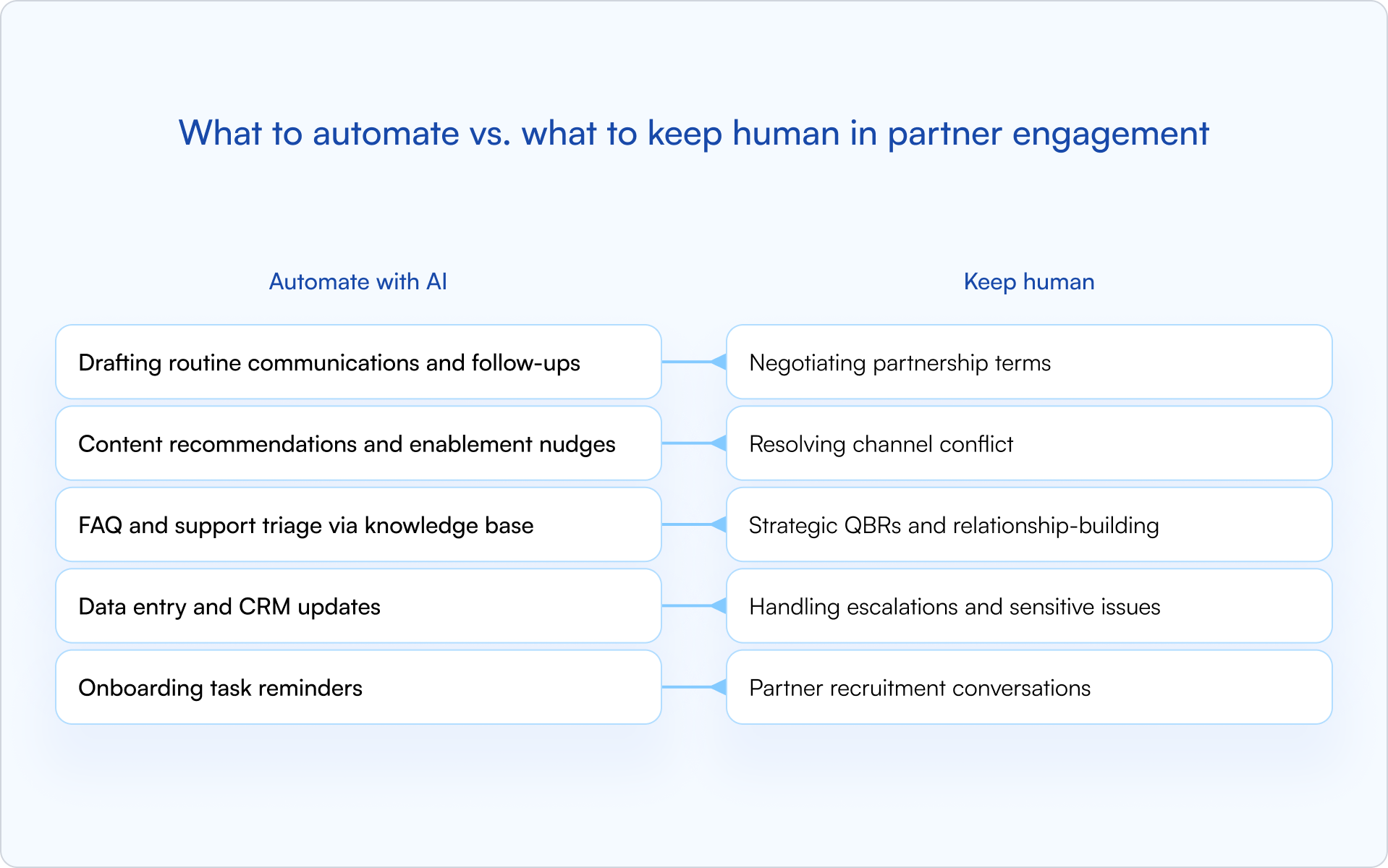
Tasks AI handles well
Repetitive, time-consuming, low-judgment work is ideal: status updates, content requests, FAQ replies, meeting summaries, and CRM hygiene. AI can also assist with partner recruitment by shortlisting candidates or scoring fit — but the qualification conversation should remain human-led.
Moments that require a human touch
Trust-building, conflict resolution, and strategic decision-making don’t automate well. Partners can tell when a program is “bot-led,” especially during escalations, sensitive program changes, and negotiation moments.
A simple rule for drawing the line
If the task requires judgment, empathy, negotiation, or deep relationship context, keep it human. If it’s repetitive and data-driven — especially CRM-based — automate it.
What You Need for AI to Work in Your Partner Program
AI doesn’t magically fix a messy program. It scales what’s already there. Before you roll out AI for partner engagement, make sure a few fundamentals are in place.
Clean partner data in your CRM
Clean data means fewer duplicates, consistent field definitions, and accurate partner records. AI insights are only as good as the data they’re built on. When your partner activity and engagement signals live in HubSpot or Salesforce, AI-driven support, recommendations, and scoring become practical — not theoretical.
Defined processes before implementing technology
Clarify workflows first: onboarding steps, deal registration rules, communication cadence, and support handoffs. AI amplifies your process — so if your process is inconsistent, AI will scale that inconsistency.
Partner buy-in and transparency about AI use
Partners should know when AI is used in communications or support. Transparency builds trust, and it lowers the risk of awkward moments when a partner assumes they’re speaking to a person.
Always provide a clear path to reach a human — and be explicit about what AI can (and can’t) do.
How to Get Started With AI for Partner Engagement
You don’t need a massive implementation to see results. The fastest path is to pick one high-volume pain point, pilot it, measure impact, and expand from there.
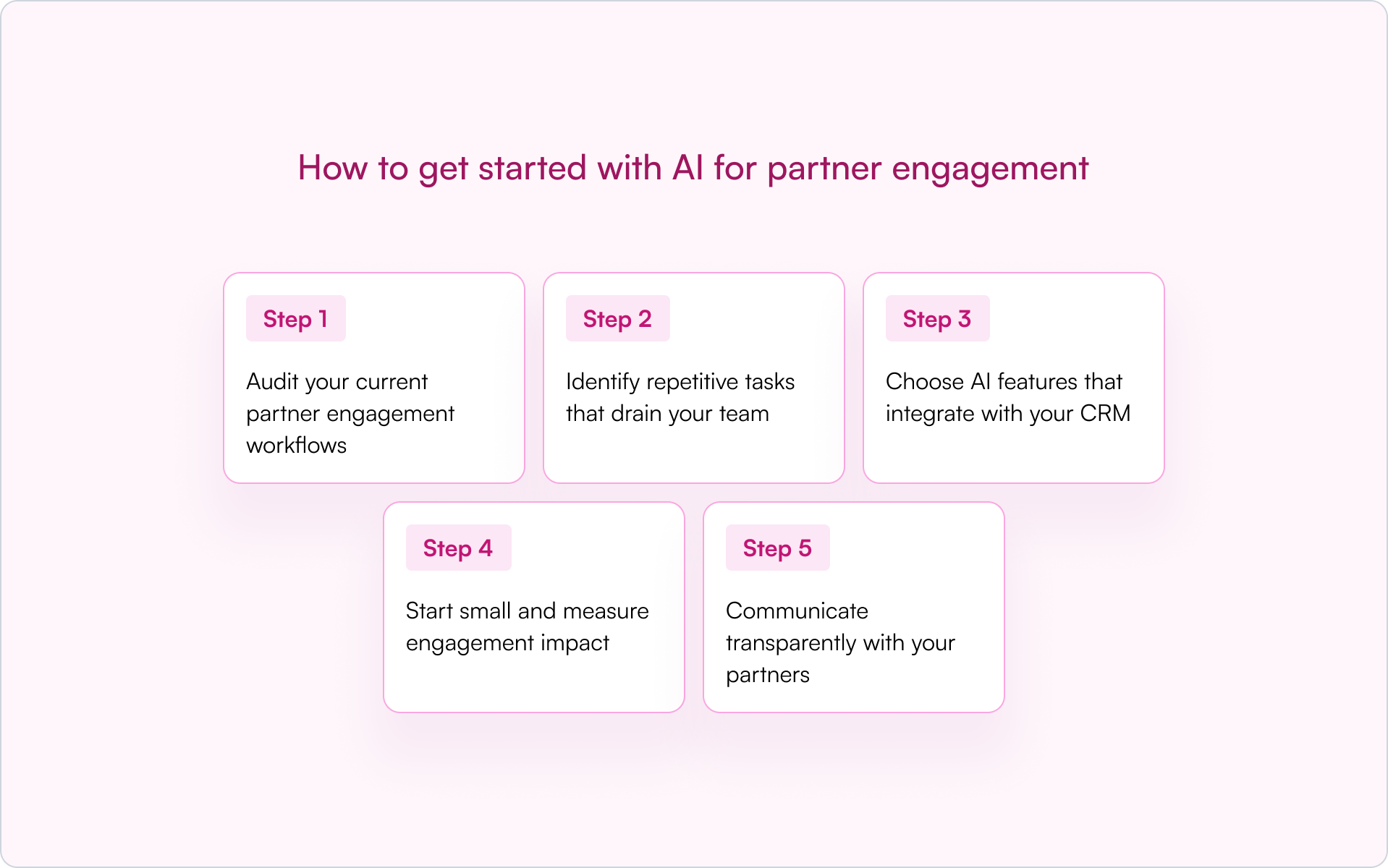
1) Audit your current partner engagement workflows
Map out how you communicate with partners today across their lifecycle stages. Where are the bottlenecks, manual tasks, and repetitive work across communications, enablement, and support?
2) Identify repetitive tasks that drain your team
List the recurring work that eats time but doesn’t require strategic thinking: status updates, content requests, meeting recaps, deal follow-ups, and FAQ replies. Prioritize tasks that can be reliably automated from CRM data.
3) Choose AI features that integrate with your CRM
CRM-first tools matter. AI that writes back to HubSpot or Salesforce keeps data clean, visible, and actionable. AI that creates a separate system becomes another silo your team has to manage.
Platforms like Introw offer AI-powered partner support and engagement features that integrate directly with your CRM — without creating a parallel universe of partner data.
4) Start small and measure engagement impact
Pilot one use case before scaling — onboarding emails and an AI-powered knowledge base are common “quick wins.” Track partner response rates, time saved, and engagement metrics like portal logins or content consumption.
5) Communicate transparently with your partners
Tell partners how AI is being used and where humans are still involved. Offer an escalation path to a person for complex issues. Trust comes from being upfront — not from hiding automation.
Build Stronger Partner Relationships With AI-Powered Engagement Tools
AI handles scale and speed across partner engagement, enablement, and support. Humans handle trust, strategy, and the moments that define long-term partnerships. That balance is where AI becomes a competitive advantage — not as a replacement, but as an enabler.
If you want to see what CRM-first AI for partner engagement looks like in practice, tools like Introw let you keep partner communications, support, and engagement history visible inside HubSpot or Salesforce — where your revenue team already works.
Book a demo to see how AI-powered partner engagement works inside your CRM.
The Only Partner Marketing Campaigns Worth Copying in 2026
Most partner marketing campaigns look great in a recap deck and go nowhere in the pipeline. Two brands post about each other, share a webinar link, and call it a success — but nobody can trace a single deal back to the effort.
The partner marketing campaigns worth copying work differently. They’re built to scale across multiple partners, track back to revenue, and run again without a full rebuild. This guide breaks down the campaign types that actually drive pipeline, examples you can replicate, and a practical planning and measurement approach that connects to your CRM.
What is a partner marketing campaign?
A partner marketing campaign is a joint marketing effort between a vendor and one or more partners — resellers, referral partners, technology partners, or strategic alliances — designed to generate leads, build awareness, or drive pipeline together.
Both sides contribute resources, distribution, and credibility. The outcome you’re aiming for is mutual: expanded reach, higher trust, and pipeline neither party could generate as efficiently on their own.
Partner marketing campaigns typically live inside broader partner marketing programs. You’ll also hear these called partnership marketing examples or co-marketing initiatives. The mechanics vary, but the principle stays the same: two brands coordinating around a shared customer, shared narrative, and shared outcomes.
What makes partner marketing campaigns worth copying?
Some partner campaigns generate buzz but no pipeline. Others “work” once, then fall apart when you try to roll them out across ten partners and two quarters.
The partner marketing campaigns worth copying share a few operational qualities that make them repeatable, measurable, and scalable.
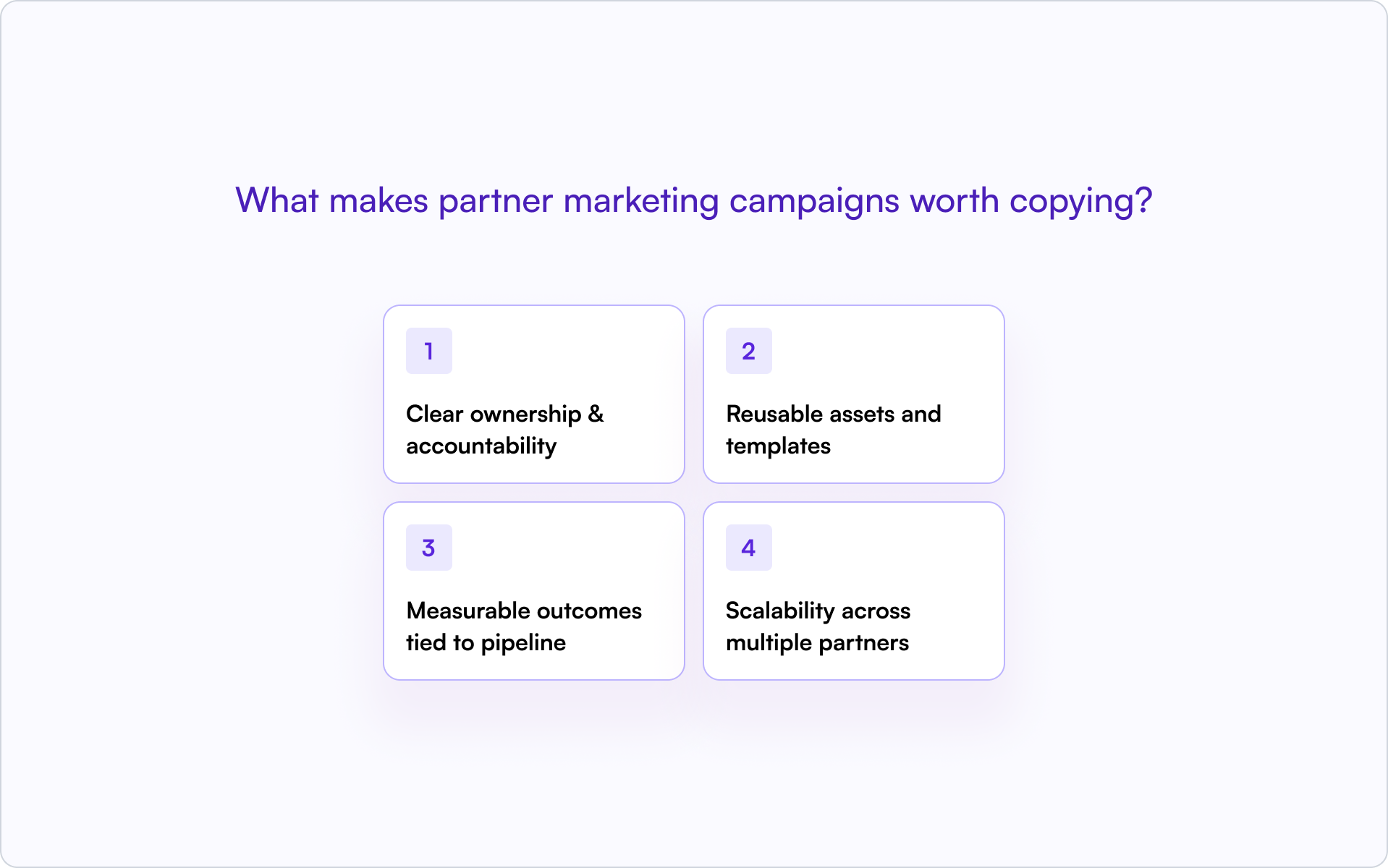
Klare Zuständigkeiten und Verantwortlichkeiten
Before anything goes live, the best teams define who owns what — the vendor, the partner, or both. When ownership is fuzzy, follow-up stalls, leads go cold, and the campaign gets remembered as “a nice collaboration” instead of a repeatable pipeline motion.
Reusable assets and templates
Scalable campaigns come with a “campaign-in-a-box”: pre-built emails, social posts, landing pages, and talking points partners can customize without starting from scratch. Reusable assets reduce partner friction and make opt-in easy.
Measurable outcomes tied to pipeline
Impressions and clicks are fine inputs, but the campaigns worth copying connect to revenue. If you can’t trace leads back to a partner and into opportunities, you’re running activity — not a growth channel.
Scalability across multiple partners
A great campaign can be rolled out to many partners without heavy customization each time. The goal is a library of repeatable motions partners can join — not one-off collaborations that require a rebuild every launch.
Types of partner marketing programs that drive pipeline
Before you pick tactics, anchor on program structure. Different partner marketing programs serve different jobs — and the best stacks combine several.
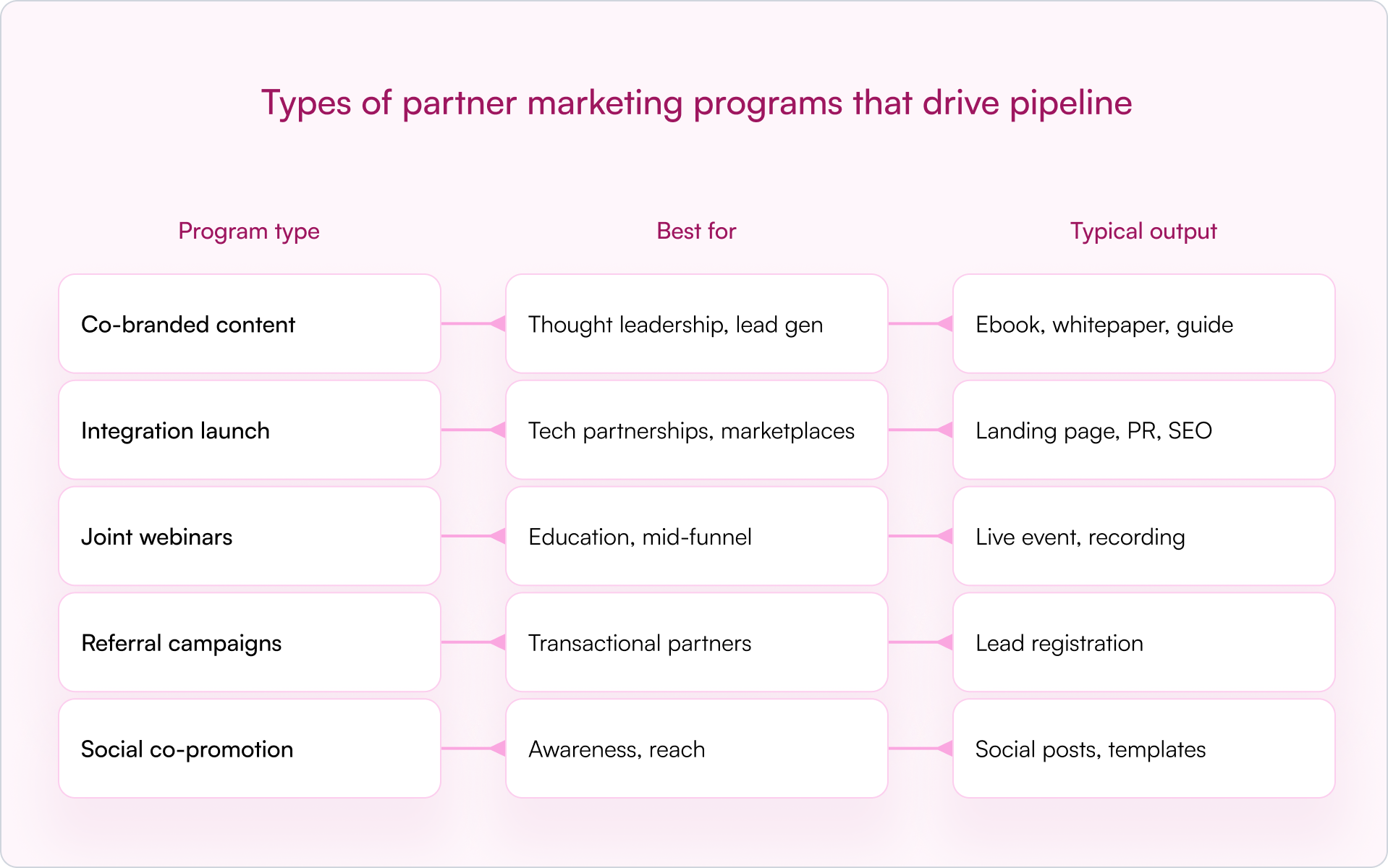
Co-branded content campaigns
Joint whitepapers, ebooks, or guides featuring both brands. Both parties co-create and co-distribute — which means shared audience, shared credibility, and shared leads. Co-branded content campaigns are classic partnership marketing examples in B2B because the content lives on long after the launch.
Integration and marketplace launch campaigns
Campaigns that announce a new tech integration or app marketplace listing often include landing pages, PR, and SEO-optimized content. Done right, these assets compound — a well-built integration page can drive organic traffic for years.
Joint webinars and virtual events
Co-hosted educational sessions where both parties promote and both capture leads. Joint webinars are one of the most repeatable joint marketing examples when you have clear audience overlap and a topic that matters to both ICPs.
Referral and incentive campaigns
A partner refers leads in exchange for rewards — SPIFFs (short-term incentive bonuses), commissions, or other incentives. Referral campaigns tie directly to partner-sourced revenue and work well for transactional partner motions.
Social media co-promotion campaigns
Coordinated posts across both brands’ channels, often with templates provided to partners. Social co-promotion is a lightweight way to test new partner marketing ideas before committing to bigger co-marketing investments.
B2B partner marketing campaign examples to replicate
Theory is cheap. The following partner marketing campaign structures are practical, repeatable, and designed to scale beyond a single partner.
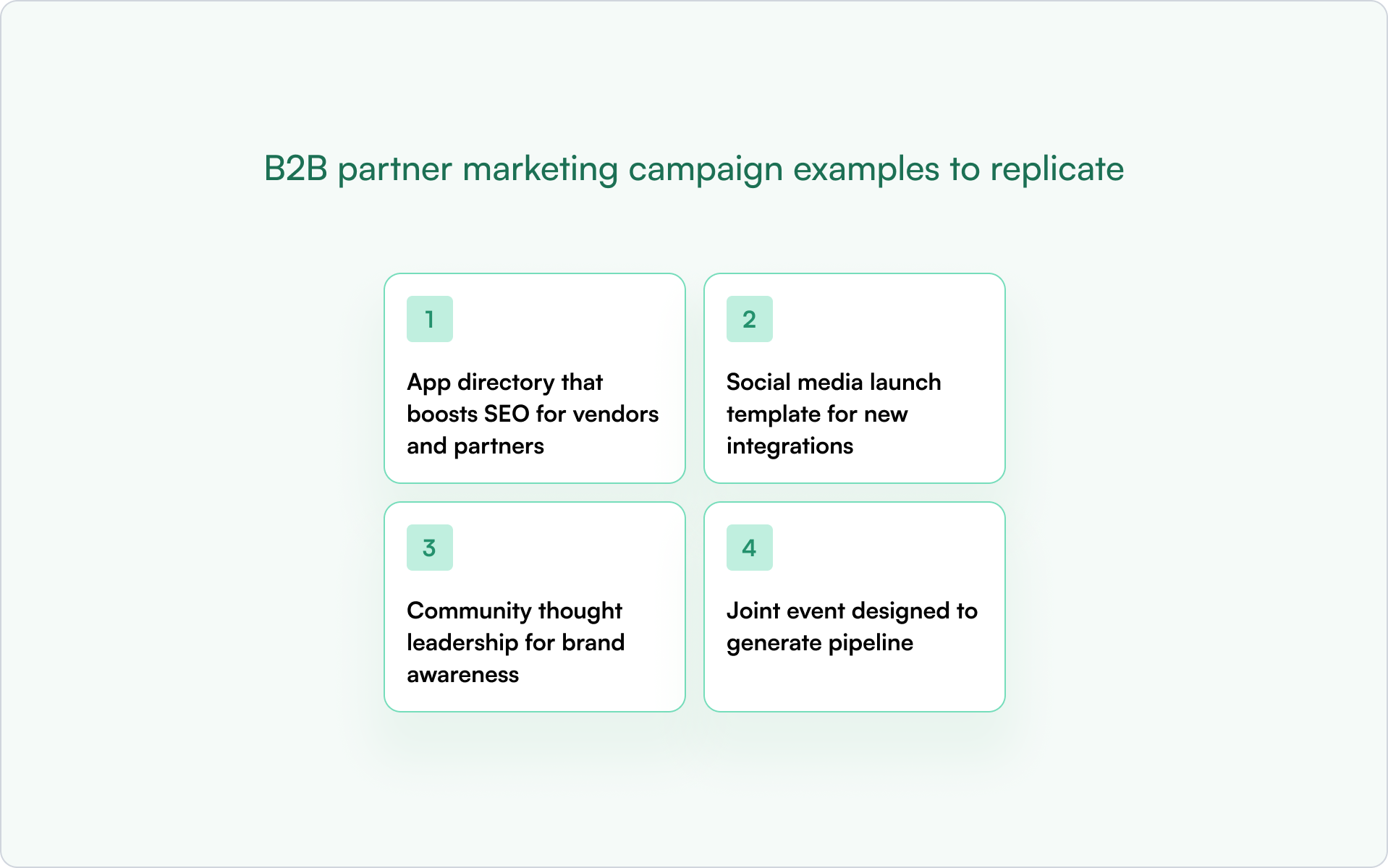
1) App directory that boosts SEO for vendors and partners
A searchable partner or integration directory drives organic traffic for both parties. Each listing becomes a landing page that can rank for relevant keywords. It’s one of the strongest long-term partner marketing campaigns because it creates always-on demand without ongoing campaign spend.
- What it is: A public directory of integrations or partners, optimized for search.
- Why it works: Compounds over time; drives inbound for both vendor and partner.
- How to replicate: Create a directory with unique content per partner, and optimize pages for “[your product] + [partner product] integration” search intent.
2) Social media launch template for new integrations
When a new integration goes live, give partners ready-to-post social templates — images, copy, and hashtags. This increases participation because partners don’t have to write anything from scratch, and you get coordinated reach across multiple audiences.
- What it is: Pre-built social assets partners can post on launch day.
- Why it works: Low lift for partners, high participation rates.
- How to replicate: Create a shared folder with 3–5 copy variations, images sized per channel, and posting guidelines. Send it 48 hours before launch.
3) Community thought leadership for brand awareness
Feature partner experts in blog posts, podcasts, or LinkedIn content. Both brands benefit from credibility transfer, and the content reads as more authentic than solo marketing.
- What it is: Vendor-hosted content featuring partner voices.
- Why it works: Builds trust when paid channels are saturated.
- How to replicate: Invite partners to contribute quotes, guest posts, or podcast episodes, then cross-promote to both audiences.
4) Joint event designed to generate pipeline
Co-hosted dinners, roundtables, or virtual events targeting a shared ICP. Both parties invite prospects and both capture leads. The key is to productize the format so it doesn’t become a one-off.
- What it is: A co-branded event with shared invite lists and coordinated follow-up.
- Why it works: High-intent leads, shared costs, mutual credibility.
- How to replicate: Build an event-in-a-box kit: agenda template, invite copy, registration page, day-of run-of-show, and follow-up sequences for both sales teams.
Partner marketing campaign ideas beyond the usual playbook
If you’ve already run webinars and co-branded content, the next step is to create partner marketing campaigns that feel native to how your buyers actually learn and decide.
Partner-led podcast episodes
Invite partners as guests or let them host an episode. You get shared distribution, authentic content, and an evergreen backlog you can repurpose into clips, posts, and newsletters.
Joint case studies with shared customers
When a customer uses both vendor and partner, co-create the case study. Joint case studies often outperform generic partner marketing examples because they prove end-to-end outcomes for a shared ICP — with less “marketing speak.”
Retailer-specific marketing programs for channel partners
For companies selling through distributors or resellers, tailored campaigns by region, vertical, or partner tier can increase adoption. The key is to provide modular assets partners can localize without rewriting the offer.
How to plan and execute partner marketing campaigns
Planning is where most partner marketing campaigns succeed or fail. If you’re a founder, this is the part that turns “we should do something with partners” into a repeatable growth motion your team can run without heroics.

1) Define campaign goals and success metrics
Start with what you want: leads, pipeline, awareness, or something else. Whenever possible, tie goals to partner-attributed revenue. Consistent goal-setting lets you compare performance across partner marketing campaigns and double down on what actually converts.
2) Select the right partners for the campaign
Not every partner fits every campaign. Consider partner tier, audience overlap, and engagement level. The best joint marketing examples happen when there’s obvious ICP overlap and a believable shared story.
3) Build a campaign-in-a-box with ready assets
Reduce friction by providing everything partners need to participate:
- Email templates (customizable)
- Social media copy and images
- Co-branded landing page
- Tracking links for attribution
- Partner talking points or FAQ
Campaign-in-a-box is what turns good ideas into repeatable motions inside your partner marketing programs.
4) Set a communication and approval workflow
Define who approves what, how partners submit content for review, and timeline expectations. A simple workflow keeps multi-partner campaigns consistent and on-brand without slowing everything down.
5) Launch, monitor, and adjust in real time
Track engagement and leads as the campaign runs. Sync partner activity to your CRM so you can quickly see which partner marketing campaigns are generating meetings and opportunities — and which ones need a tweak to targeting, messaging, or follow-up.
How to measure partner marketing campaigns (without guessing)
Attribution is where most partner marketing programs struggle. Without clean data, you can’t tell which campaigns drive revenue and which ones just look good in a slide deck.
Leads and pipeline attributed to partners
Track which partners sourced or influenced which deals. Your CRM should be the source of truth. This is what separates “fun co-marketing” from partner marketing campaigns you can scale quarter after quarter.
Campaign engagement and conversion metrics
Measure opens, clicks, registrations, meetings booked, and conversion rates — and compare across formats. Over time, you’ll see patterns: which topics drive attendance, which partners consistently activate, and which campaigns convert into pipeline for your ICP.
Solving the attribution problem with CRM-first tracking
Attribution is hard because deals usually have multiple touches, and partner versus direct overlap is common. CRM-first tracking helps by syncing partner activity directly to deal records. Once your data is clean, it’s easier to invest in the partner marketing campaigns that influence revenue — and stop funding the ones that don’t.
Tip: If your partner activity lives outside your CRM — in spreadsheets, email threads, or a disconnected portal — attribution becomes guesswork. The teams that measure partner marketing well keep everything connected to HubSpot or Salesforce from day one.
Run partner marketing campaigns that actually scale
The partner marketing campaigns worth copying aren’t just creative — they’re structured, measurable, and repeatable. They come with clear ownership, reusable assets, and a direct line to pipeline.
Most teams run partner marketing campaigns that feel productive but don’t connect to revenue. The difference is infrastructure: clean CRM data, consistent attribution, and a process that works across many partners, not just one.
If you want partner marketing campaigns with real visibility into what’s working, consider tightening your workflow around CRM-first attribution and standardized campaign kits. When you’re ready to operationalize it, get a demo to see how Introw keeps partner activity connected to your CRM — so you can scale what works and stop guessing.
How to Launch and Manage a High-Performing Referral Partner Program
Referral partner programs sound simple: partners send you leads, you close them, everyone gets paid. But most programs stall before they generate meaningful revenue — not because the incentives are wrong, but because the infrastructure isn’t there.
The difference between a program that produces sporadic leads and one that drives predictable pipeline comes down to how you design registration, tracking, and communication from day one. This guide breaks down what a referral partner program actually is, how to launch one, and how to manage it as you scale.
What is a referral partner program?
A referral partner program is a mutually beneficial arrangement where you incentivize individuals or third-party companies to recommend your product or service in exchange for a reward — typically a commission on closed revenue.
Unlike affiliate programs that rely on tracking links and high-volume marketing, referral partnerships are built for high-consideration B2B sales. Partners identify strong-fit prospects and make warm introductions, then your sales team runs the sales cycle.
Common referral partners include:
- Consultants and fractional operators
- Agencies serving your target ICP
- Complementary SaaS or service providers
- Happy customers who want to refer peers
The best programs are formal: they define what counts as a qualified referral, how attribution works, when payouts happen, and how conflicts get resolved.
How referral partners differ from affiliates and resellers
Founders often lump “partners” into one bucket. That’s where misaligned expectations start — and where programs get designed incorrectly. Here’s the clean way to think about it:
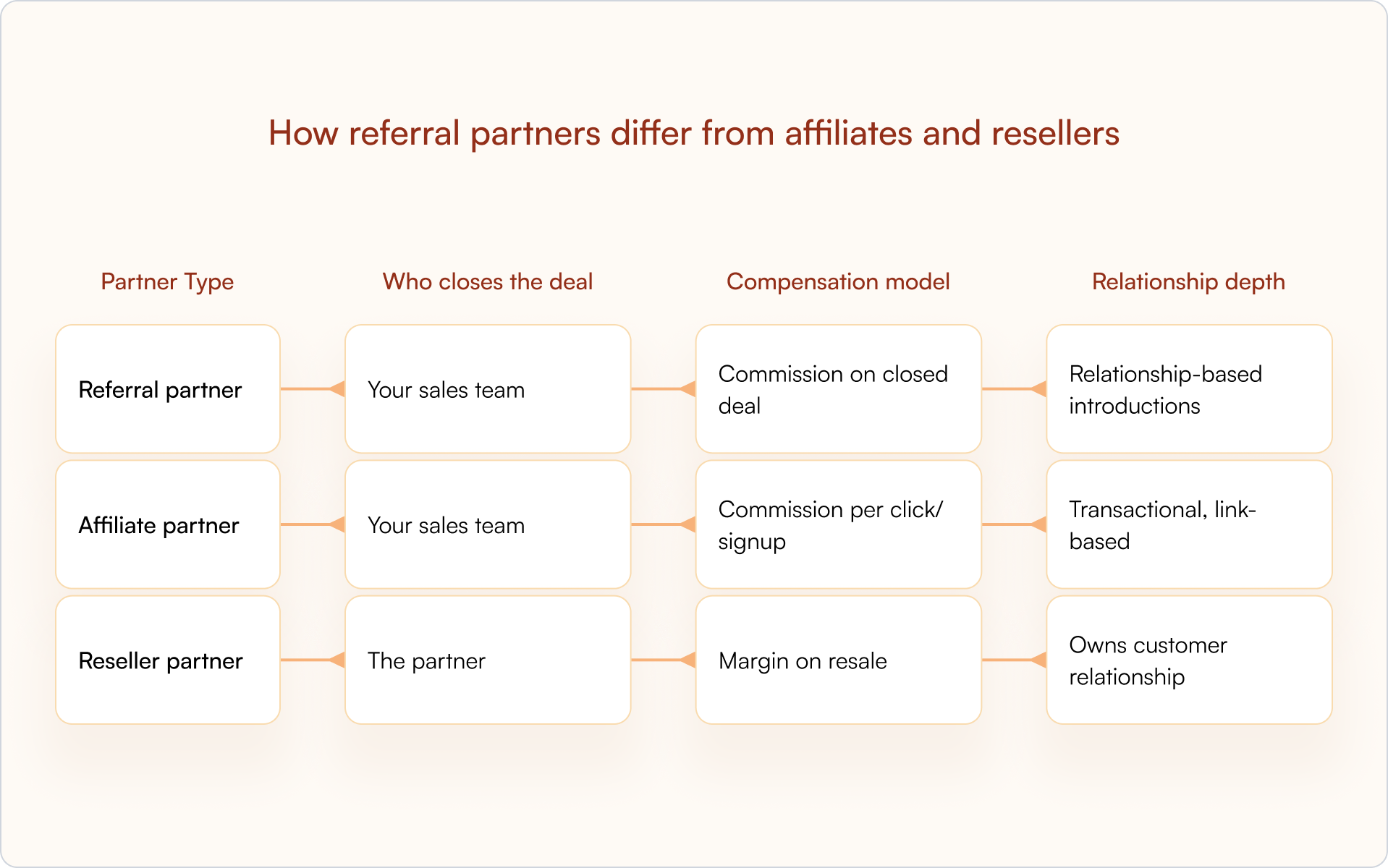
Referral partners vs affiliate partners
Affiliates drive traffic through content, ads, and tracking links. Referral partners make personal introductions based on existing relationships. The trust transfer is different — and so is the lead quality.
Referral partners vs reseller partners
Resellers purchase or license your product and sell it themselves. They own the customer relationship, often handle support, and earn margin on resale. Referral partners hand off qualified leads to you and step back, which changes everything: revenue share, enablement needs, and who owns the pipeline.
Referral partners vs technology partners
Technology partners integrate products or build on your platform. Referral partners recommend without any integration requirement. They’re endorsing, not embedding.
Why B2B companies launch a referral partner program
A referral partner program works when you operationalize it like any other revenue motion — with systems, rules, and accountability. Done right, it becomes a durable acquisition channel.
Lower customer acquisition costs
Partners bring leads through their existing networks, reducing reliance on paid advertising and outbound prospecting. You pay only when deals close, which helps keep unit economics predictable.
Higher quality leads from trusted introductions
Warm referrals carry built-in credibility. Prospects already trust the person making the introduction, which translates to better-qualified pipeline and higher conversion rates.
Expanded market reach without adding headcount
Referral partners help you reach new verticals, geographies, or segments without hiring dedicated sales reps for each. Your partners already have the relationships you’d otherwise spend months building.
Faster sales cycles through warm referrals
Referred prospects skip a chunk of the trust-building phase. In many B2B motions, that means fewer early-stage calls and a faster path to “real” evaluation.
What every referral partner program needs
If you want your referral partner program to be more than a slide deck and a promise, you need the basics in place first. This is the infrastructure that prevents deals from getting lost and partners from going dark.
Commission and incentive structure
Define how partners get paid. The most common options:
- Percentage of deal: Partner earns a cut of closed revenue, typically 10–20%
- Flat fee: Fixed payout per qualified referral that closes
- Tiered rewards: Increasing commission rates based on referral volume
Keep it simple. Complicated partners commission structures create confusion and slow payouts, both of which kill partner motivation.
CRM integration for tracking and attribution
Your CRM for partner management tracks every referral from submission to close. Accurate attribution, forecasting, and commission calculations all depend on clean data.
Referral data belongs inside Salesforce or HubSpot, not in a disconnected spreadsheet or portal. When partner activity lives in your CRM, sales and partnerships operate from the same source of truth.
Deal registration workflow
Partners need a clear way to submit leads, ideally without logging into a portal. Your workflow should capture the essentials (contact, company, context), route for approval, and set a protection window so partners feel safe investing their reputation.
A structured deal registration process is where ownership gets established early and where most conflicts can be prevented.
Rules of engagement documentation
Write down how conflicts are resolved, which accounts are off-limits (if any), what happens if multiple partners refer the same lead, and what “qualified” actually means. A clear policy prevents messy debates later.
Partner communication channels
Decide how you’ll keep partners informed: email updates, Slack notifications, or lightweight portal announcements. The point is consistency — not adding another tool your partners will ignore.
Onboarding and enablement resources
Provide pitch decks, one-pagers, competitive notes, and simple messaging that helps partners explain who you’re for (and who you’re not for). Partners refer more confidently when they can position your product clearly.
How to launch a referral partner program in six steps

1) Define your ideal referral partner profile
Start by getting specific about who is likely to refer your best customers. In most startups, that’s consultants and agencies serving your ICP, complementary providers, and a handful of power users who love your product.
Create simple qualification criteria (audience overlap, deal size alignment, credibility, responsiveness) so you recruit strategically, not randomly.
2) Design your commission structure and tiers
Set compensation that motivates without turning your program into a math problem. Choose percentage vs flat fee, and consider adding tiers (Standard, Silver, Gold) once you have baseline performance data.
Start simple. You can add complexity later, but you can’t easily walk back a confusing structure.
3) Build a deal registration process in your CRM
Create a submission workflow using deal registration software inside Salesforce or HubSpot with required fields, automatic routing for approval, and timestamped records. Set protection windows so partners feel secure that their referrals won’t be claimed by direct sales.
4) Create onboarding materials and partner resources
Build a partner welcome kit with product training, FAQs, email templates, and co-brandable collateral following a structured partner onboarding checklist. The faster partners can start referring, the more likely they will.
5) Set up referral tracking and pipeline visibility
Configure your CRM to tag partner-sourced deals and make deal status visible to partners without constant back-and-forth. Visibility keeps partners engaged and builds trust.
Partners who can see what’s happening with their referrals stay active. Partners who have to email for updates eventually stop referring.
6) Recruit and activate your first referral partners
Start with warm relationships: existing customers, consultants who already mention you, and industry contacts. Reach out personally, explain the program benefits, and make it easy to join.
How to manage and scale your referral partner program
Launching is the easy part. Sustained performance comes from tight operations — and from removing every ounce of friction between a partner thinking “I should introduce you” and that introduction turning into pipeline.
Establish a communication cadence with referral partners
Set regular touchpoints: monthly newsletters, quarterly check-ins, and short program updates when something changes. Silence kills referral partnerships. Consistent partner engagement keeps partners active and informed.
Automate status updates without requiring logins
Partners drop off when they have to log into portals for updates. Use email notifications tied to deal stage changes so partners stay informed automatically.
If you can let partners reply to notifications via email, with responses syncing back to your CRM timeline, you’ll remove the “chase you for updates” loop that quietly destroys many programs.
Tier partners based on referral performance
As you get data, create partner tiers (Bronze, Silver, Gold) with escalating benefits:
- Higher commissions: Reward volume and consistency
- Priority support: Faster response times for top performers
- Co-marketing opportunities: Joint campaigns and content
Tiering motivates top performers and gives newer partners something to work toward.
Prevent channel conflict between partners and direct sales
Define clear rules: who gets credit if a lead is already in your pipeline, how deal protection works, and how disputes are resolved. Document everything in your rules of engagement and enforce consistently.
Channel conflict rarely starts with bad intent. It starts with unclear rules.
Referral partner program metrics you should track
If you want partner-sourced revenue to become predictable, you need a handful of KPIs that tell you what’s actually happening — not just who “seems engaged.”
Partner activation rate
What percentage of recruited partners submit their first referral? Low activation usually signals onboarding friction, unclear positioning, or a muddled ask.
Referral-to-Closed Won conversion rate
How many partner referrals become paying customers? This is a direct read on lead quality and how reliably your sales team follows up.
Von Partnern generierte Einnahmen
The total revenue attributed to partner referrals. This is your north star for program ROI.
Average deal size from partner referrals
Compare this to direct sales. Partner referrals often yield larger deals due to trust and fit.
Time to first referral
How quickly do new partners submit their first lead? Faster activation correlates with long-term partner success because it proves the workflow works.
Common mistakes that kill referral partnerships
Most referral partner programs don’t fail because of bad incentives. They fail because of friction and silence.

- Making registration too complicated: If partners have to jump through hoops or log into clunky portals, they won’t bother.
- Slow response times on deal status: Partners lose trust when they don’t know what’s happening with their referrals.
- Unclear or unfair commission structures: Ambiguity breeds resentment. Partners disengage when they can’t predict payouts.
- Inconsistent communication: Going silent for months then suddenly asking for referrals doesn’t work.
- Ignoring channel conflict: Letting direct sales claim partner deals destroys relationships fast.
Turn referral partners into a predictable revenue channel
A referral partner program works when it’s built on clear structure, CRM-first tracking, and a consistent partner experience. Teams that scale partner-sourced revenue don’t rely on spreadsheets or manual follow-up — they rely on systems that enforce rules and surface visibility automatically.
Introw helps teams launch partner portals connected to Salesforce or HubSpot, automate deal registration, and keep partners engaged without forcing logins. Partners register leads, see status updates, and stay active, all without creating another system to manage.
Book a demo to see how it works.
Messung des ROI von Schulungen für Vertriebspartner: Rahmenbedingungen, Kennzahlen
Warum es so schwierig ist, den ROI von Schulungen für Vertriebspartner zu messen
Auf dem Papier klingt die Messung des ROI von Schulungen für Vertriebspartner einfach. Partner schulen. Ergebnisse verfolgen. Umsatz nachweisen.
In Wirklichkeit ist es chaotisch.
1. Getrennte Systeme
Ihr Lernmanagementsystem verfolgt den Abschluss von Schulungen. Ihr CRM verfolgt die Pipeline. Ihre Tabellenkalkulationen verfolgen alles andere.
Wenn Ihr LMS und Ihr CRM nicht miteinander kommunizieren, wird die Messung des ROI von Partnerschulungen zu einer reinen Spekulation. Sie können zwar sehen, wer die Schulungskurse abgeschlossen hat, aber nicht, ob diese Schulungsmaßnahmen zu einer Verbesserung der Verkaufszahlen oder des Umsatzwachstums Ihrer Partner geführt haben.
2. Lange Verkaufszyklen
Channel-Partnerschaften beinhalten oft komplexe Geschäfte. Ein Partner absolviert vielleicht heute eine Channel-Partner-Schulung, aber das durch diese Schulung beeinflusste Geschäft wird möglicherweise erst sechs Monate später abgeschlossen.
Diese Verzögerung erschwert die Berechnung des ROI, insbesondere wenn Sie Schulungsinitiativen nicht direkt mit CRM-Daten verknüpfen.
3. Indirekte Umsatzzuordnung
Wurde dieser 250.000-Dollar-Deal aufgrund der Schulung der Partner abgeschlossen? Dank besserer Marketingmaterialien? Dank einer stärkeren Marketingstrategie für Vertriebspartner?
Ohne klare Leistungskennzahlen und Finanzdaten in Ihrem CRM ist es schwierig, die Auswirkungen von Schulungen von anderen Enablement-Maßnahmen zu trennen.
4. Kanalkonflikt und Überschneidung von Geschäften
Wenn mehrere Vertriebspartnerbeziehungen denselben Kunden betreffen, wird die Zuordnung unklar. Probleme wie Vertriebskonflikte können dazu führen, dass unklar ist, wer den Abschluss beeinflusst hat und welche Schulungsinvestitionen tatsächlich zur Leistung beigetragen haben.
5. Verwirrung aufgrund von Partnern oder durch Partner beeinflusst
Viele Teams verfolgen die von Partnern generierten Umsätze, ignorieren jedoch die von Partnern beeinflusste Pipeline. Ein Partner registriert das Geschäft möglicherweise nicht, aber seine Partnerschulungen und Kundenaufklärung haben dennoch das Ergebnis beeinflusst.
Die meisten Unternehmen messen letztendlich nur den Abschluss von Schulungen und die Teilnahme an Schulungssitzungen. Sie messen den ROI nicht genau, weil sie niemals eine Verbindung zwischen Schulung → Pipeline → Umsatz herstellen.
Um dieses Problem zu beheben, benötigen Sie einen klaren Rahmen, der Frühindikatoren von Spätindikatoren trennt und beide mit realen Geschäftszielen verknüpft.
Das 3-stufige Rahmenwerk zur Messung des ROI von Schulungen für Vertriebspartner
Bei der Messung des ROI von Schulungen für Vertriebspartner geht es nicht darum, eine einzige magische Kennzahl zu finden.
Es geht darum, den Fortschritt zu verstehen.
Schulungen wirken sich in mehreren Ebenen auf den Umsatz aus. Wenn Sie nur die endgültige Zahl betrachten, übersehen Sie die Signale, die erklären, warum sich diese Zahl verändert hat.
Hier ist das Modell:
- Ebene 1: Engagement für Schulungen (Frühindikatoren)
Melden sich die Partner für Schulungen an, schließen sie diese ab und beschäftigen sie sich mit den Schulungsmaterialien? - Ebene 2: Leistungsverschiebungs
für PartnerVerhalten sich geschulte Gruppen von Vertriebspartnern in der Pipeline anders? - Ebene 3: Umsatz und finanzielle Auswirkungen (nachlaufende Indikatoren)
Beeinflusst die Partnerschulung die Pipeline, den abgeschlossenen Umsatz und die Bruttomarge?
Der ROI ist kein einzelner Datenpunkt. Er ist eine zusammenhängende Kette, die von den Schulungsmaßnahmen bis zu messbaren Geschäftsergebnissen reicht.
Lassen Sie uns das Schicht für Schicht aufschlüsseln.
Ebene 1 – Engagement-Kennzahlen (Frühindikatoren)
Frühindikatoren geben Aufschluss darüber, ob Ihre Partner-Schulungsprogramme den Umsatz steigern könnten. Sie belegen jedoch noch nicht die finanziellen Auswirkungen, sondern sagen diese lediglich voraus.
In dieser Phase geht es um die Effektivität des Trainings und die frühzeitige Einbindung von Partnern.
Zu den wichtigsten Kennzahlen gehören:
- Kursanmeldequote
- Ausbildungsabschlussquote
- Zertifizierungsquote
- Zeit bis zur Zertifizierung
- Abgabe auf Modulebene
- Wissensbewertungsergebnisse
- Verwendung von Schulungsmaterialien und Verkaufsleitfäden
- Zeit zwischen Ausbildung und erster Beschäftigungsmöglichkeit
Wenn Partner sich nicht für Schulungen anmelden, diese nicht abschließen oder nicht bestehen, wird sich das Umsatzwachstum nicht wie von Zauberhand einstellen. Diese Schulungskennzahlen zeigen, ob Ihre Schulungsinitiativen stark genug sind, um die zukünftige Leistung zu beeinflussen.
Hier kommt es auf Ihre Technologieplattform an. Ein mit CRM verbundenes Partner-LMS hilft Ihnen, den Abschluss von Schulungen parallel zu den tatsächlichen Pipeline-Aktivitäten zu verfolgen.
Und wenn Sie Software für Partner-Zertifizierungsprogramme, sollten Sie sich eine Frage stellen: Verbindet sie Zertifizierungsdaten mit der tatsächlichen Leistung der Partner?
Frühindikatoren beweisen nicht den ROI. Sie zeigen lediglich, ob ein ROI überhaupt möglich ist.
Ebene 2 – Leistungskennzahlen (Verhaltensänderung)
In Schicht 2 wird der ROI der Schulung der Messpartner sichtbar.
Jetzt verfolgen Sie nicht mehr das Lernen, sondern das Verhalten. Der wichtigste Aspekt hierbei ist der Kohortenvergleich.
Anstatt zu fragen: „Hat das Training funktioniert?“, fragen Sie:
„Wie schneiden geschulte Partner im Vergleich zu ungeschulten Partnern ab?“
Hier ist ein einfaches Kohortenmodell:
Das Ziel ist es, zu vergleichen:
- Vor dem Training vs. nach dem Training
- Zertifiziert vs. nicht zertifiziert
- Kontrollgruppe vs. trainierte Gruppe (wenn möglich)
Hier kommen wichtige Leistungsindikatoren zum Tragen. Sie können Veränderungen in der Leistung Ihrer Partner anhand der Fortschrittsrate, der Partneraktivierungsrate, der Upselling-Rate und der Vertriebsleistung messen.
Wenn geschulte Channel-Partner-Gruppen Geschäfte konsequent schneller vorantreiben, mehr Opportunities registrieren und höhere Abschlussquoten erzielen, beginnt sich der ROI Ihrer Partner-Schulungen in konkreten Geschäftsergebnissen niederzuschlagen.
Der ROI wird sichtbar, wenn geschulte Partner sich anders verhalten als ungeschulte.
Ebene 3 – Auswirkungen auf den Umsatz (nachlaufende Indikatoren)
Führungskräfte interessieren sich für nachlaufende Indikatoren.
Hier müssen Investitionen in die Ausbildung direkt mit dem finanziellen Wert verbunden sein.
Jetzt messen Sie:
- Von Partnern bereitgestellte Pipeline
- Partnerbeeinflusste Pipeline
- Geschlossene Einnahmen
- Umsatz pro aktivem Vertriebspartner
- Auswirkungen auf die Bruttomarge
- Kundenbindung und Expansion
Hier kommt es auch häufig zu Verwirrung. Von Partnern generierte und von Partnern beeinflusste Umsätze können sich überschneiden. Lange Verkaufszyklen erschweren die Zuordnung. Vertriebspartner können denselben Kunden betreuen.
Ohne klare Sichtbarkeit wird die Messung des ROI zu einer Debatte.
Deshalb ist eine starke Partneranalysen unverzichtbar. Wenn Ihr CRM Trainingsdaten, Pipeline-Daten und Umsatzdaten in einem System miteinander verbindet, wird die Messung des ROI objektiv statt politisch.
Sie können den ROI für Schulungen mit einer einfachen ROI-Formel berechnen:
(Auswirkungen auf den Umsatz – Gesamtkosten für Schulungen) ÷ Gesamtkosten für Schulungen
Die Formel funktioniert jedoch nur, wenn Ihre Finanzdaten und Trainingsdaten in derselben Umgebung gespeichert sind. Andernfalls muss die Berechnung des ROI manuell erfolgen und ist unzuverlässig.
Auf dieser Ebene beantworten Sie die Frage, die Ihr CRO tatsächlich stellt:
„Wie viel Umsatz hat dieses Schulungsbudget generiert?“
Und sobald Sie diese Frage klar beantworten können, ist die Messung des ROI von Schulungen für Vertriebspartner nicht mehr nur Theorie, sondern wird zu einem strategischen Vorteil.
Im nächsten Abschnitt werden wir Schritt für Schritt genau erklären, wie Sie den ROI Ihrer Schulungen berechnen können, indem Sie dieses dreistufige Modell als Grundlage verwenden.
Die Kernformel für den ROI von Partnerschulungen
Lassen Sie uns das einfach halten.
Wenn Führungskräfte nach dem ROI von Partnerschulungen fragen, wollen sie vor allem eines wissen:
„Hat diese Schulung mehr Einnahmen generiert, als sie gekostet hat?“
Hier ist die klassische ROI-Formel:
Bei der Schulung von Vertriebspartnern ist der „finanzielle Gewinn“ jedoch nicht vage. Er ergibt sich in der Regel aus drei Bereichen:
- Umsatzsteigerung durch geschulte Partner
- Margenverbesserung
- Wert der Verkürzung des Verkaufszyklus
Wenn Sie diese klar messen können, wird die Messung des ROI zu einer einfachen Angelegenheit.
Schritt 1 – Berechnen Sie die Schulungskosten
Bevor Sie den ROI Ihrer Schulungen berechnen, benötigen Sie einen vollständigen Überblick über Ihre gesamten Schulungskosten.
Und ja, genau hier unterschätzen die meisten Teams.
Direkte Kosten
- Abonnement für Lernmanagementsystem
- Entwicklung von Inhalten und Schulungsmaterialien
- Verwaltung des Zertifizierungsprogramms
- Anreize und Gamification
- MDF im Zusammenhang mit Förderinitiativen
Wenn Sie die beste LMS-Software für Ihre Partner evaluieren, sollten Sie Ihre Entscheidung nicht allein von den Kosten abhängig machen. Die eigentliche Frage ist, ob Sie damit Ihren ROI genau messen können.
Die Vorteile von Vorteile des LMS für die Zertifizierung von Vertriebspartnern klärt auch, ob Ihre Investitionen in Schulungen so positioniert sind, dass sie zu Geschäftsergebnissen führen.
Indirekte Kosten
- Zeit, die Partner in Schulungen verbracht haben
- Interne Teamzeit
- Verwaltungsaufwand
- Laufende Zertifizierungsüberwachung
Bei der Berechnung des ROI ist der Nenner die Gesamtsumme der Schulungskosten – nicht nur die Rechnung für Ihr LMS.
Wenn Sie dies nicht klar berechnen, wird jedes Gespräch über den ROI zu einer Debatte.
Schritt 2 – Umsatzsteigerung quantifizieren
Kommen wir nun zum interessanten Teil. Hier beginnt die Messung des ROI von Partnerschulungen realistisch zu werden.
Anstatt zu fragen „Hat das Training funktioniert?“, vergleichen Sie trainierte mit untrainierten Partnerkohorten.
Stellen Sie sich zwei Gruppen von Vertriebspartnern vor:
Wenden Sie dies nun auf 100 Gelegenheiten an.
Umsatzsteigerung: 270.000 Dollar
Das ist keine Theorie. Das ist messbarer finanzieller Wert.
Hier steht die Schulung der Partner in direktem Zusammenhang mit deren Vertriebsleistung. Fundierte Schulungsunterlagen und abgestimmte Botschaften beeinflussen die Art und Weise, wie Partner Ihre Lösung positionieren. Die Die Rolle von Inhalten im Channel-Partner-Marketing wird messbar, wenn zertifizierte Partner größere Geschäfte zu höheren Preisen abschließen.
So berechnen Sie den ROI von Schulungen auf eine Weise, die Führungskräfte verstehen.
Schritt 3 – Auswirkungen der Zykluszeit hinzufügen
Die Umsatzsteigerung ist nur ein Teil der Geschichte.
Wenn Schulungen Ihren durchschnittlichen Verkaufszyklus um 15 Tage verkürzen, werden Umsätze schneller realisiert. Das verbessert den Cashflow und ermöglicht es Vertriebsmitarbeitern, mehr Geschäfte pro Quartal abzuschließen.
Hier ist die Formel für die Rohrleitungsgeschwindigkeit:
Pipeline-Geschwindigkeit =
(Geschäfte × Gewinnquote × durchschnittliche Geschäftsgröße) ÷ Länge des Verkaufszyklus
Wenn sich der Verkaufszyklus verkürzt, steigt die Geschwindigkeit. Das bedeutet mehr Umsatz pro Vertriebspartner im gleichen Zeitraum.
Hier kommt es auf ein starkes Channel-Partner-Management Systeme wichtig. Wenn Schulungsdaten, Geschäftsdaten und Umsatzdaten in derselben CRM-Umgebung gespeichert sind, können Sie den ROI genau messen, anstatt Berichte manuell zusammenzustellen.
Wenn Sie Umsatzsteigerung, Margenverbesserung und Zyklusbeschleunigung kombinieren (und die gesamten Schulungskosten abziehen), erhalten Sie eine vertretbare Kapitalrendite.
Und wenn Ihre Systeme die Zertifizierungsdaten nicht mit den Pipeline- und Umsatzdaten in Ihrem CRM verknüpfen können, können Sie den ROI nicht genau messen.
Aber wie baut man eine Feedbackschleife auf, damit die Messung des ROI von Partnerschulungen kontinuierlich erfolgt und nicht nur einmal im Jahr berechnet wird?
Ein einfacher ROI-Rechner für Channel-Partner-Schulungen
Lassen Sie uns das praktisch umsetzen.
Hier ist ein vereinfachtes Beispiel für die Messung des ROI von Schulungen für Vertriebspartner anhand realer Eingaben.
Beispiel-Eingaben
Jetzt rechnen wir mal.
Hier beginnen: Umsatzsteigerung berechnen
Umsatzsteigerung = Geschäfte × Steigerung pro Geschäft
60 × 6.000 $
= 360.000 $
Gesamtsteigerung des Jahresumsatzes: 360.000 US-Dollar
Dann: Wenden Sie die ROI-Formel an.
ROI =
((Umsatzsteigerung – Schulungskosten) ÷ Schulungskosten) × 100
(360.000 $ – 120.000 $) ÷ 120.000 $
= 2.0
2,0 × 100
= 200 % Kapitalrendite
(Das bedeutet, dass das Programm für jeden in die Schulung der Partner investierten Dollar einen Ertrag von 2 Dollar erzielte.)
Wenn Sie den ROI anhand von Uplift und Zykluszeit berechnen können, sind Sie den meisten Teams bereits einen Schritt voraus.
Ausgereifte Channel-Programme erfordern jedoch oft mehr Präzision. Insbesondere wenn mehrere Partner denselben Deal beeinflussen.
Hier kommen fortschrittliche Attributionsmodelle ins Spiel.
Fortgeschrittene Attributionsmodelle (für ausgereifte Programme)
Sobald Ihr Channel-Partnerprogramm wächst, wird die Attribution kompliziert.
Mehrere Partner beeinflussen denselben Deal. Marketingkampagnen überschneiden sich. Die Zertifizierung wirkt sich Monate vor Abschluss des Geschäfts auf die Positionierung aus.
An diesem Punkt reicht einfache Uplift-Mathematik nicht mehr aus. Sie benötigen leistungsfähigere Attributionsmodelle, die auf Ihre Geschäftsziele abgestimmt sind.
Hier sind die gängigsten Ansätze und wann sie tatsächlich sinnvoll sind.
First-Touch-Attribution
First-Touch schreibt dem Partner, der die Opportunity erstellt hat, 100 % der Einnahmen gut.
Es ist klar und einfach zu erklären. Für Programme, die sich stark auf die Lead-Generierung konzentrieren, kann dies gut funktionieren.
Es wird jedoch außer Acht gelassen, was nach der Registrierung des Geschäfts geschieht. Wenn ein anderer Partner die Positionierung verbessert, zur Kundenaufklärung beiträgt oder die Kundenzufriedenheit während des Verkaufszyklus erhöht, geht dieser Wert in der Berichterstattung verloren.
First-Touch eignet sich am besten für einfache Empfehlungsprogramme. Bei ausgereiften Channel-Partnerschaften hat es jedoch Schwierigkeiten.
Multi-Touch-Attribution
Multi-Touch verteilt die Umsatzgutschrift auf mehrere Interaktionen.
Dieses Modell spiegelt wider, wie moderne Partner-Enablement tatsächlich funktioniert. Ein Partner könnte:
- Wecken Sie erstes Interesse
- Unterstützung bei der Produktschulung
- An Verkaufsgesprächen teilnehmen
- Helfen Sie mit, den Deal abzuschließen
Wenn Ihr Marketingstrategie für Vertriebspartner Co-Marketing und gemeinsame Kampagnen umfasst, erhalten Sie durch Multi-Touch-Attribution wertvollere Einblicke, wie Schulungsergebnisse den Umsatz beeinflussen.
Außerdem spiegelt es die tatsächliche Kundenerfahrung über alle Kontaktpunkte hinweg besser wider.
Kohortenbasierte und zertifizierungsbasierte Segmentierung
Für viele SaaS-Teams ist die Kohortenanalyse praktischer als komplexe Attributionsberechnungen.
Anstatt zu fragen, wer einen einzelnen Deal beeinflusst hat, vergleichen Sie Gruppen über einen längeren Zeitraum hinweg:
- Zertifizierte vs. nicht zertifizierte Partner
- Kohorten vor dem Training vs. Kohorten nach dem Training
- Gamifizierte vs. nicht gamifizierte Engagement-Gruppen
Wenn Partner, die die Zertifizierung abgeschlossen haben, durchweg eine stärkere Partnerleistung, eine höhere Kundenzufriedenheit und bessere Partnerzufriedenheitswerte aufweisen, haben Sie einen messbaren Return on Investment ermittelt.
Hier kommt die zertifizierungsbasierte Segmentierung zum Tragen. Sie verbindet die Partnerausbildung direkt mit den Geschäftsergebnissen.
Strukturierte Programme, die in einem starken Leitfaden für Channel-Partnerschaften , basieren häufig auf diesem Modell, da es politische Debatten rund um die Attribution reduziert.
Zeitgebundene Hebungsmodellierung
Ein weiterer ausgereifter Ansatz ist die zeitgebundene Analyse.
Anstatt ein ganzes Jahr zu warten, um die Wirksamkeit der Schulung zu bewerten, messen Sie die Wirkung innerhalb eines festgelegten Zeitraums – 60, 90 oder 120 Tage nach der Zertifizierung.
- Haben sich die Gewinnquoten verbessert?
- Haben sich die Verkaufszyklen verkürzt?
- Haben sich die Trends beim Kundenfeedback verändert?
Zeitgebundene Modellierung hilft Ihnen, Fortschritte schneller zu bewerten und zukünftige Initiativen vor der Budgetplanung anzupassen.
Die eigentliche Erkenntnis
Die Abschlussquote der Schulungen ist nicht gleichbedeutend mit dem ROI.
Es ist ein Frühindikator. Er gibt Auskunft darüber, dass die Partner ihre Schulungen abgeschlossen haben. Er sagt jedoch nichts darüber aus, ob der Umsatz gestiegen ist oder ob die Bedürfnisse der Partner effektiver erfüllt wurden.
Ausgereifte Attributionsmodelle verbinden Trainingsdaten, Pipeline-Daten und Finanzdaten in einem System.
Wenn Sie das tun, ist die Messung des ROI von Partnerschulungen keine reine Eitelkeitsübung mehr, sondern wird zu einem strategischen Vorteil.
Sie sind sich nicht sicher, worauf Sie achten sollen? Hier sind ein paar Dinge, die Sie im Auge behalten sollten.
Häufige Fehler bei der Messung des ROI von Partnertrainings
Selbst starke Partnerprogramme untergraben ihre eigene ROI-Geschichte.
Hier sind die Fehler, die Ihre Zahlen unbemerkt verfälschen.
1. Messung des Vanity Engagements
Hohe Einschreibungs- und Ausbildungsabschlussquoten machen sich gut auf einem Dashboard.
Wenn sie jedoch nicht mit der Leistung der Partner, der Vertriebsleistung oder dem Umsatzwachstum in Verbindung stehen, belegen sie nicht die Rentabilität der Investition. Das Engagement ist ein Frühindikator – nicht das Ergebnis.
2. Ignorieren von Basisvergleichen
Wenn Sie nicht vor und nach dem Training messen, können Sie den Uplift nicht berechnen.
Ohne Basisdaten wird die Messung des ROI eher subjektiv als finanziell.
3. Versäumnis, geschulte Kohorten zu isolieren
Die Vermischung von Daten zu geschulten und ungeschulten Vertriebspartnern verschleiert das Signal.
Der Vergleich zwischen zertifizierten und nicht zertifizierten Mitarbeitern ist eine der aussagekräftigsten Leistungskennzahlen im Bereich Partner-Enablement. Ohne Kohortenisolierung gehen die Schulungsergebnisse in den Durchschnittswerten unter.
4. Keine CRM-Integration
Wenn Ihr Lernmanagementsystem außerhalb Ihres CRM-Systems angesiedelt ist, muss der ROI der Partnerschulungen manuell gemessen werden.
Tabellenkalkulationen versagen. Die Zuordnung wird angefochten. Und die Führungskräfte verlieren das Vertrauen in die Zahlen.
Ein echter ROI erfordert Pipeline-, Finanz- und Trainingsdaten im selben System.
5. Nichtberücksichtigung von Vertriebskonflikten
Wenn mehrere Partner Einfluss auf denselben Deal haben, wird die Zuordnung zu einer politischen Angelegenheit.
Wenn Sie den Konflikt nicht aktiv bewältigen Konflikte zwischen Vertriebskanälen, riskieren Sie, einen Partner überzubewerten und die Auswirkungen von Schulungen auf das gesamte Ökosystem zu unterschätzen.
6. Überbewertung der beeinflussten Einnahmen
Nicht jedes beeinflusste Geschäft ist ein Trainingserfolg.
Wenn ein Partner an einem Webinar teilgenommen und später einen Deal abgeschlossen hat, bedeutet das nicht automatisch einen ROI. Ausgereifte Programme verbinden den beeinflussten Umsatz mit messbaren Veränderungen in der Partnerausbildung und dokumentierten Verhaltensänderungen.
Das Fazit
Die meisten Probleme bei der ROI-Berichterstattung sind nicht mathematischer Natur. Sie sind struktureller Art.
Wenn Sie die Struktur festlegen, wird der ROI der Schulung von Messpartnern klar, nachvollziehbar und auf Ihre Geschäftsziele abgestimmt.
Wie Introw die Messung des ROI von Schulungen für Vertriebspartner praktikabel macht
An dieser Stelle ist der Rahmen klar. Die Formel ist klar. Die Attributionsmodelle sind klar.
Aber nichts davon funktioniert, wenn Ihre Trainingsdaten und CRM-Daten in unterschiedlichen Systemen gespeichert sind. Das ist der Punkt, an dem es in der Regel zu Problemen kommt.
Wenn die Schulung der Partner in einem Tool und die Pipeline in einem anderen Tool stattfindet, muss der ROI der Schulung der Vertriebspartner manuell gemessen werden. Berichte werden zusammengestellt. Zahlen werden in Frage gestellt. Das Vertrauen sinkt.
Genau das ist die Lücke Introw .
Training ohne Verzögerung einführen
Wenn Sie Partner schnell schulen möchten, kommt es auf die Geschwindigkeit an.
Mit den KI-Kurserstellungstools von Introw können Sie vorhandene Inhalte schnell in strukturierte Schulungskurse umwandeln. Das bedeutet eine schnellere Partneraktivierung und schneller messbare Schulungsergebnisse.
Wenn die Rollout-Zeit kürzer wird, verkürzt sich auch die Zeit bis zur Wirkung.
Zertifizierungsverfolgung mit einem Klick
Eine Zertifizierung steigert nur dann den ROI, wenn sie sichtbar ist.
Innerhalb des Partner-LMSist der Zertifizierungsstatus direkt mit den CRM-Daten verknüpft. Sie können sofort zwischen zertifizierten und nicht zertifizierten Kohorten unterscheiden und die Leistung der Partner vergleichen.
Keine Exporte. Keine manuelle Abstimmung.
Wenn Sie sehen möchten, wie das in der Praxis funktioniert, erklärt Andreas dies anschaulich in unserem Partner-LMS-Übersichtsvideo.
CRM-sichtbare Partneraktivität
Die Messung des ROI von Mitarbeiterschulungen erfordert mehr als nur den Abschluss eines Kurses.
Sie müssen sehen:
- Welche Partner registrieren Geschäfte?
- Welche Partner beeinflussen die Chancen?
- Welche Partner treiben Geschäfte voran?
- Welche Partner treiben das Umsatzwachstum voran?
Da Introw CRM-first ist, werden Partneraktivitäten, Deal-Registrierungen und Zertifizierungsstatus Salesforce Echtzeit in HubSpot Salesforce angezeigt.
Das bedeutet, dass die Messung des ROI zu einer Berichterstattungsaufgabe wird und nicht zu einem Datenprojekt.
Sinnvolle Kohortensegmentierung
Möchten Sie vergleichen:
- Zertifizierte vs. nicht zertifizierte Partner?
- Leistung vor dem Training vs. Leistung nach dem Training?
- Gamifizierte vs. nicht gamifizierte Engagement-Gruppen?
Die Kohortensegmentierung ist in die Berichts-Dashboards integriert.
Hier wird die Messung des ROI von Mitarbeiterschulungen von einer theoretischen zu einer belegbaren Größe. Sie können geschulte Kohorten isolieren und Schulungsinitiativen direkt mit den Geschäftsergebnissen verknüpfen.
Partnerbasiertes Tracking vs. beeinflusstes Tracking
Einer der größten blinden Flecken beim ROI ist die Verwirrung hinsichtlich der Attribution.
Introw verfolgt sowohl von Partnern bereitgestellte als auch von Partnern beeinflusste Pipelines innerhalb des CRM. Das bedeutet, dass Sie zwischen den Auswirkungen der Lead-Generierung und den Auswirkungen der Zusammenarbeit auf den Umsatz unterscheiden können.
Fügen Sie einen Deal-Registrierungsschutz hinzu, um Vertriebskonflikte zu reduzieren und gleichzeitig das Vertrauen Ihrer Partner zu schützen.
Wenn die Zuordnung eindeutig ist, lässt sich die Kapitalrendite messen.
Führungskräfte verstehen Reporting-Dashboards
Führungskräfte wollen keine Abschlussquoten für Schulungen. Sie wollen finanziellen Wert.
Die Dashboards von Introw verbinden:
- Trainingsdaten
- Pipeline-Kennzahlen
- Umsatzentwicklung
- Zertifizierungssegmentierung
Wenn alles in einem System zusammengefasst ist, wird die Messung des ROI von Partnerschulungen konsistent, wiederholbar und auf die Geschäftsziele abgestimmt.
Nicht einmal im Jahr. Kontinuierlich.
Der echte Wandel
Wenn Trainingsdaten und CRM-Daten im selben System gespeichert sind, ist der ROI nicht mehr nur Theorie. Er wird messbar, nachvollziehbar und skalierbar.
Wenn Sie sehen möchten, wie dies in Ihrem eigenen HubSpot oder Salesforce Umgebung funktioniert, können Sie eine Demo anfordern anfordern und die ROI-Logik anhand Ihrer eigenen Zahlen durchgehen.
Incentive-Programme für Vertriebspartner: Wie man sie so gestaltet, dass sie wirklich Wirkung zeigen
Channel-Partner-Incentive-Programme sind strukturierte Belohnungen, die Ihre Channel-Partner dazu motivieren, bestimmte Maßnahmen zu ergreifen, die den Umsatz steigern und Ihre Geschäftsziele unterstützen.
Bei SaaS nutzen Sie Channel-Incentive-Programme, um die Ramp-up-Zeit zu verkürzen, die Vertriebsleistung zu steigern und den Marktanteil zu erhöhen, ohne die Kontrolle über die Kundenakquisitionskosten zu verlieren.
Ein gut strukturiertes Incentive-Programm richtet Anreize auf messbare Ergebnisse innerhalb Ihres Kundenbeziehungsmanagementsystems aus, nicht auf eitle Aktivitäten.
Es gibt zwei Hauptarten von Anreizen für Vertriebspartner:
- Finanzielle Anreize wie Anreize für die Registrierung von Geschäften, Empfehlungsprämien, wiederkehrende Provisionen und andere finanzielle Belohnungen sind an bestimmte Verkaufsziele geknüpft.
- Sachleistungen wie Marketingunterstützung, Marktentwicklungsfonds, exklusiver Zugang zu Schulungen oder stufenbasierte Vorteile in Ihrem Partnerportal.
Ein starkes Channel-Partner-Management verbindet Anreize mit dem, was tatsächlich die Pipeline vorantreibt. Wenn Ihr Channel-Partner-Anreizprogramm nicht an die Registrierung von Geschäften, den Fortschritt in den einzelnen Phasen, Verlängerungen oder abgeschlossene Umsätze gekoppelt ist, verändert es das Verhalten nicht.
Bevor Sie Incentive-Programme für Vertriebspartner starten, definieren Sie, was ein Vertriebspartner in Ihrem Ökosystem bedeutet. Verschiedene Arten von Partnern reagieren auf unterschiedliche Incentive-Strategien.
Wenn Ihre Anreize die tatsächlichen Bedürfnisse Ihrer Partner und die tatsächlichen Vertriebsaktivitäten widerspiegeln, motivieren Sie Ihre Partner, ermutigen sie, Ihrer Lösung Priorität einzuräumen, und bauen Sie für beide Seiten vorteilhafte, dauerhafte Beziehungen auf.
Aber Anreize sind ein Instrument, kein Standard.
Verwenden Sie die folgenden Fit-Tests, um zu entscheiden, wann sie tatsächlich Umsatz generieren werden.
Wann sollten Anreize (Fit-Tests) eingesetzt werden?
Nicht jede Situation erfordert Incentive-Programme für Vertriebspartner. Setzen Sie diese ein, wenn Sie Verhaltensweisen auf klare und messbare Weise ändern möchten.
Ein Incentive-Programm für Vertriebspartner ist sinnvoll, wenn:
- Sie erschließen neue Märkte und müssen schnell das Engagement Ihrer Partner steigern.
- Ihr Produkt ist komplex und erfordert eine Zertifizierung oder eine umfassendere Einweisung, bevor Partner es mit Zuversicht verkaufen können.
- Ihr Verkaufszyklus ist lang, und eine schnellere Registrierung von Geschäften kann die Pipeline und den Marktanteil schützen.
- Verlängerungen, Erweiterungen oder Kundenbindung sind gefährdet, und Sie benötigen Partner, die sich frühzeitig engagieren.
- Eine Markteinführung hängt von der Kundenbindung, dem Upselling oder bestimmten Verkaufszielen ab, um den Umsatz zu steigern und die Einnahmen zu erhöhen.
Dies sind Momente, in denen gut strukturierte Incentive-Programme Partner motivieren und Anreize mit Ihren Geschäftszielen in Einklang bringen können.
Vermeiden Sie dieses Anti-Muster. Wenn Sie Ihren Vertriebspartnern Prämien für Downloads, Logins oder oberflächliche Aktivitäten zahlen, die keinen Einfluss auf die Pipeline haben, führen Sie keine effektiven Prämienprogramme durch. Sie finanzieren nur Lärm.
Ihre Incentive-Strategie für Vertriebspartner sollte sich auf Maßnahmen konzentrieren, die den Umsatz steigern, die Vertriebsleistung verbessern und die Beziehungen während der gesamten Partnerreise stärken.
Lassen Sie uns nun die Strategie in die Tat umsetzen. Im Folgenden finden Sie Ideen für Anreize, die darauf abzielen, nicht nur die Aktivitäten, sondern auch die Pipeline voranzubringen.
Anreizideen, die tatsächlich den Umsatz steigern
Starke Incentive-Programme für Vertriebspartner belohnen Verhaltensweisen, die die Pipeline voranbringen, und nicht oberflächliche Aktivitäten. Die Schwierigkeit besteht darin, diese Incentives für Vertriebspartner in Ihrem CRM messbar zu machen.
Im Folgenden finden Sie praktische Anreizstrukturen mit eindeutigen Nachweisen, Auszahlungen und Sicherheitsvorkehrungen. Wir verwenden Introw als Referenzmodell, um zu zeigen, wie jeder Anreiz ohne manuellen Aufwand überprüft und gemeldet werden kann.
Erwerb und Beschleunigung
Wenn das Volumen oder die Geschwindigkeit der Pipeline das Problem ist, sollten Ihre Kanalanreize Geschwindigkeit und Qualifikation belohnen.
1. Bonus für die schnelle Registrierung von Geschäften
Am besten geeignet für völlig neue Chancen in wettbewerbsintensiven Märkten.
- Nachweis: Genehmigte Deal-Registrierung innerhalb von X Stunden und Stufe ≥ Discovery
- Belohnung: Pauschalbetrag von X $ bei Erfüllung der SLA
- Leitplanken: Keine Duplikate und definiertes Schutzfenster
Mit den in die Deal-Registrierung von Introw integrierten SLA-Timern und Konfliktkennzeichnungen erfolgt die Berechtigungsprüfung automatisch statt manuell. Über ein gemeinsames Dashboard bleiben Sie und Ihre Vertriebspartner hinsichtlich Zeitplanung und Schutzfristen stets auf dem gleichen Stand.
2. Prämie für qualifizierte Besprechungen
Am besten geeignet zur Verbesserung der Chancenqualität.
- Nachweis: Besprechung in CRM-Opportunity mit Kontaktrollensatz protokolliert
- Belohnung: $ pro SAL
- Leitplanken: Obergrenze pro Partner, um Meeting-Mühlen zu verhindern
Da Introw Gespräche außerhalb des Portals direkt in der CRM-Zeitleiste erfasst und Kontaktrollen validiert, können Sie echte Fortschritte im Verkaufsprozess belohnen, ohne die Aktivitätskennzahlen zu überhöhen.
3. Stufenweiser Beschleuniger
Am besten geeignet, um ins Stocken geratene Geschäfte zu reduzieren.
- Nachweis: Stufe 1 → Stufe 2 innerhalb von N Tagen
- Belohnung: Gestaffelte Auszahlung basierend auf ARR oder %
- Geländer: Mindest-ASP zur Verhinderung von Sandbagging
Die Zuordnung von Phasenwechseln innerhalb von Introw macht deutlich, welcher Partner die Beschleunigung vorangetrieben hat. Sie richten Anreize an der Dynamik aus, nicht nur an der Registrierung von Geschäften.
Anhängen, Upselling und Produktmix
Wenn das Ziel darin besteht, den durchschnittlichen Auftragswert oder die Gewinnmargen zu steigern, sollte Ihre Anreizstrategie einen intelligenteren Produktmix belohnen.
4. Befestigen Sie den Geschwindigkeitsverstärker.
Am besten geeignet, um die Akzeptanz von Add-ons zu steigern.
- Nachweis: Add-on A verkauft mit Kern B
- Belohnung: % Aufschlag auf die Prämie für die Registrierung von Geschäften
- Leitplanken: Validierungsregeln bündeln
Produktlinienfelder und Validierungsregeln innerhalb von Introw bestätigen die richtige Zusammensetzung, bevor finanzielle Anreize genehmigt werden. Dadurch bleiben die Auszahlungen an die tatsächlichen Auswirkungen auf den Umsatz gebunden.
5. Wettbewerbsfähiger Takeout-SPIFF
Der Beste gewinnt.
- Nachweis: Feld „Anbieter“ ausgefüllt und „abgeschlossen – gewonnen“
- Belohnung: Pauschalbonus plus PR-Spotlight
- Leitplanken: Erforderliche Nachweise
Beweismittelanhänge und Audit-Protokolle innerhalb von Introw schaffen vertretbare Aufzeichnungen. In wettbewerbsintensiven Märkten schützt dieses Dokumentationsniveau sowohl Sie als auch Ihr Partnernetzwerk.
6. Mehrjähriger Aufwärtspotenzial
Am besten geeignet zur Verbesserung der Umsatzvorhersagbarkeit.
- Nachweis: Laufzeit von 2–3 Jahren statt 1 Jahr
- Belohnung: % des TCV-Bonus
- Leitplanken: Rückforderung bei vorzeitiger Kündigung
Wenn Vertragsdauerfelder direkt mit Verlängerungsdatensätzen in Introw verknüpft sind, bleibt die Berechtigung während der gesamten Partnerbeziehung sichtbar. Dies stärkt das langfristige Umsatzwachstum und die Kundenbindung.
Befähigung und Kompetenz
Wenn Ihre Lösung komplex ist, verbessert die Schaffung von Anreizen für Partner, Fähigkeiten aufzubauen, bevor Einnahmen erzielt werden, die Erfahrung der Partner und die Akzeptanz des Programms.
7. Zertifizierungsbeschleuniger
Am besten geeignet für strukturierte Befähigung.
- Nachweis: Zertifizierung vor dem ersten Geschäft
- Belohnung: Einmaliger Bonus plus höhere Multiplikatoren
- Leitplanken: Ablauf der Zertifizierung und erneute Zertifizierung
Da die LMS-Zertifizierungen mit den Partnerstufen innerhalb von Introw verknüpft sind, werden Anreize durch verifiziertes Fachwissen gesteuert. Dies verbessert das Verständnis der Partner und stellt sicher, dass die beteiligten Partner wirklich qualifiziert sind.
8. Abschluss des Playbooks bis zum ersten Geschäft
Am besten geeignet für die Aktivierung neuer Partner.
- Nachweis: Absolvieren Sie den Lernpfad und reichen Sie die erste Gelegenheit ein.
- Belohnung: Gestapelte Mikro-Belohnungen
- Leitplanken: Beschränkt auf neue Partner
Da Introw Lernpfade direkt mit der Einreichung von Pipeline-Projekten verknüpft, verbindet dieser Anreiz für Vertriebspartner Schulungen mit messbaren Umsatzergebnissen.
Marketing und Nachfrage
Wenn Sie Mittel für die Marktentwicklung oder Verkaufsleistungsprämien zuweisen, binden Sie diese an eine qualifizierte Pipeline.
9. Co-Marketing-Kooperationsabgleich
Am besten geeignet, um Marketingunterstützung und Umsatz in Einklang zu bringen.
- Nachweis: Genehmigter Kampagnenplan und qualifizierte Leads, die mit dem CRM synchronisiert wurden
- Belohnung: % Übereinstimmung bei qualifizierten Leads
- Leitplanken: Keine doppelten Ansprüche
Segmentierte Ankündigungen, UTM-Tracking und Quellenzuordnung innerhalb von Introw verbinden Marketinginitiativen mit abgeschlossenen Geschäften. So wird sichergestellt, dass Entwicklungsgelder zu einem echten Umsatzwachstum beitragen.
10. Anreiz für die Syndizierung von Inhalten
Am besten geeignet für die Generierung einer verantwortungsvollen Nachfrage.
- Nachweis: Lokalisierte Seite veröffentlicht und MQLs generiert
- Vergütung: Pauschalbetrag plus leistungsabhängige Komponente
- Leitplanken: Qualitätsprüfungen für Bounce und Spam
Durch die geschützte gemeinsame Nutzung von Assets innerhalb des Partnerportals sorgt Introw für eine klare Zuordnung und trägt gleichzeitig dazu bei, das Engagement der Partner auf verantwortungsvolle Weise zu steigern.
Verlängerungen und Kundenerfahrung
Wenn Vertragsverlängerungen gefährdet sind, sollten Sie Ihre Anreizprogramme auf Kundenbindung und Zufriedenheit ausrichten.
11. Pünktliche Verlängerung sparen
Am besten zum Schutz von ARR geeignet.
- Nachweis: Verlängerung vor D-30 abgeschlossen
- Belohnung: % des ARR oder Pauschalbetrag
- Leitplanken: Automatische Verlängerung ausschließen
Verlängerungsmöglichkeiten und SLA-Benachrichtigungen innerhalb von Introw machen die Berechtigung im Voraus sichtbar, nicht erst im Nachhinein. Das fördert die Kundenzufriedenheit und stärkt die Kundenbeziehungen.
12. Bonus für die Verbesserung des NPS oder CSAT
Am besten geeignet für erfahrungsorientiertes Wachstum.
- Nachweis: NPS über dem definierten Schwellenwert
- Belohnung: Vierteljährlicher Bonus
- Leitplanken: Verifizierte Umfragequelle
In Introw können Umfrageexporte direkt an den Opportunity- oder Account-Datensatz angehängt werden. Dadurch bleibt Ihr Incentive-Programm für Vertriebspartner überprüfbar und die Zufriedenheitsziele der Partner werden gestärkt.
Empfehlungen und Wachstum des Ökosystems
Wenn Sie durch Allianzen in neue Märkte expandieren möchten, müssen Empfehlungsprämien einfach und überprüfbar sein.
13. Von einer Technologieallianz vermittelte Empfehlung
Am besten geeignet für die Zusammenarbeit zwischen Partnern.
- Nachweis: Dokumentierte Einführung im CRM protokolliert
- Vergütung: Pauschalbetrag plus Umsatzbeteiligung
- Leitplanken: Klare Anforderungen an die Quelle der Wahrheit
Wenn Off-Portal-Threads direkt in den Opportunity-Datensatz in Introw übernommen werden, bleibt die Zuordnung für Ihre externen Partner transparent.
14. Beschleuniger für Marktplatz-Listings
Am besten geeignet, um die Sichtbarkeit des Ökosystems zu erhöhen.
- Nachweis: Konforme Auflistung veröffentlicht
- Belohnung: Einmalig plus Pipeline-Meilenstein
- Leitplanken: Auflistung der Qualitätssicherung
Aufgaben-Checklisten und Genehmigungs-Workflows innerhalb von Introw reduzieren Unklarheiten und verhindern doppelte Anträge.
Operative Exzellenz
Wenn Lücken in der Berichterstattung das Vertrauen beeinträchtigen, belohnen Sie Disziplin innerhalb Ihres Vertriebsprozesses.
15. Belohnung für Datenhygiene
Am besten geeignet zur Verbesserung der Genauigkeit der Berichterstattung.
- Nachweis: Erforderliche Felder ausgefüllt und SLA für nächsten Schritt erfüllt
- Belohnung: Punkte werden in Geldprämien umgewandelt
- Leitplanken: Beispiel-Audits
Die Bewertung der Vollständigkeit der Felder innerhalb von Introw macht dies in großem Maßstab messbar. Saubere Daten verbessern das Anreizmanagement und den Erfolg des Programms.
16. Bonus für Prognosegenauigkeit
Am besten geeignet für Partnerprogramme für reife Menschen.
- Nachweis: Geschlossener Umsatz innerhalb von ±15 % der Prognose
- Belohnung: Vierteljährliche Auszahlung
- Leitplanken: Mindestanzahl an Transaktionen
Die Prognose- und Ist-Berichterstattung innerhalb von Introw unterstützt eine zuverlässige indirekte Vertriebsplanung und stärkt die Partnerbindung.
Strategisches Wachstum
Wenn Sie eine gezielte Expansion benötigen, richten Sie Anreize auf die wichtigsten Kunden und Regionen aus.
17. Neues Logo ICP-Prämie
Am besten geeignet für gezieltes Kundenwachstum.
- Nachweis: Konto entspricht ICP-Rubrik
- Belohnung: Höhere Prämie
- Leitplanken: ICP-Validierung
Die ICP-Tags innerhalb von Introw stellen sicher, dass nur qualifizierte Abschlüsse diesen Partner-Incentive auslösen. Dies trägt dazu bei, den Umsatz in Ihren wertvollsten Segmenten zu steigern.
18. Startschuss für die Region
Am besten geeignet für den Eintritt in neue Regionen.
- Nachweis: Die ersten fünf abgeschlossenen Geschäfte in neuen Regionen
- Belohnung: Meilenstein-Pool
- Leitplanken: Zeitlich begrenzte Berechtigung
Geografische Segmentierung und Ranglistenansichten innerhalb von Introw schaffen Transparenz und Dringlichkeit in Ihrem Partnernetzwerk und helfen Ihnen dabei, Marktanteile in wettbewerbsintensiven Märkten zu gewinnen.
Anreize existieren nicht isoliert. Wenn Sie verstehen, wie man ein Channel-Partnerprogramm aufbaut, können Sie besser erkennen, wo Channel-Partner-Anreizprogramme im Rahmen der Einarbeitung, Befähigung und langfristigen Partnerbindung angesiedelt sind.
Und wenn Sie Ihre Auszahlungslogik an einer klaren Provisionsstruktur für Partner ausrichten, stellen Sie sicher, dass Ihre finanziellen Anreize nicht nur die Aktivitäten, sondern auch den Umsatz steigern.
Sie denken vielleicht, das klingt alles theoretisch gut, aber wie kann ich das umsetzen, ohne Chaos zu verursachen?
Wie Introw Anreize operationalisiert
Ein Anreizprogramm für Vertriebspartner funktioniert nur, wenn es durchsetzbar, messbar und in Ihrem CRM sichtbar ist.
Introw verbindet Incentives direkt mit Geschäftsaktivitäten, Zertifizierungen und Umsatzauswirkungen, sodass Sie das Wachstum ohne zusätzlichen Verwaltungsaufwand steuern können.
Wenn Sie Geschwindigkeit und Schutzfenster wünschen
Deal- und Lead-Registrierung umfassen SLA-Timer, Duplikaterkennung und Konfliktkennzeichnungen. Fast-Track-Boni werden automatisch durchsetzbar, was den Marktanteil schützt und interne Streitigkeiten reduziert.
Wenn Sie einen Nachweis benötigen, ohne eine Anmeldung beim Portal zu erzwingen
E-Mails außerhalb des Portals und Slack werden mit dem CRM-Datensatz synchronisiert. Sie validieren Aktivitäten ohne Reibungsverluste, was das Engagement und die Akzeptanz der Partner verbessert.
Wenn Anreize von einer Zertifizierung oder einem Tier-Status abhängen
LMS-Zertifizierungen sind direkt mit Partnerstufen mit Gating-Logik verbunden. Nur qualifizierte Partner erhalten höhere Auszahlungen, was die Qualität der Geschäfte und die Partnererfahrung verbessert.
Wenn Sie SPIFFs nach Segment oder Region starten
Segmentierte Ankündigungen richten sich mit Lesebestätigungen an bestimmte Partnertypen. Sie reduzieren Störfaktoren und steigern das Engagement dort, wo es tatsächlich zu Umsatzsteigerungen führt.
Wenn Sie eine CRM-sichtbare Umsatzzuordnung benötigen
Salesforce HubSpot die Bewegung zwischen den Phasen, die Geschwindigkeit, die Gewinnrate und den ARR, die bestimmten Anreizen zugeordnet werden können. Das ermöglicht Ihnen eine fundierte Berichterstattung und klarere Gespräche über den ROI.
Wenn Compliance und Dokumentation wichtig sind
Beweismaterialien, zeitlich begrenzte Freigabelinks und Prüfprotokolle sorgen für transparente und prüfungsfähige Auszahlungen. Das senkt das Risiko und schafft Vertrauen in Ihrem Partnernetzwerk.
Wenn Anreize in Ihrem CRM statt in Tabellenkalkulationen verwaltet werden, wird das Anreizmanagement für Ihre Vertriebspartner vorhersehbar, skalierbar und auf die Geschäftsziele abgestimmt.
Sehen Sie, wie Incentives in Ihrem CRM durchgängig funktionieren, und fordern Sie eine Demo an.
Was macht B2B-Partnerschulungen im Jahr 2026 erfolgreich?
Partnerschulungen sind ein Prozess, bei dem Ihre Vertriebspartner – Wiederverkäufer, Empfehlungspartner, Distributoren und Implementierungspartner – mit dem nötigen Wissen ausgestattet werden, um Ihr Produkt zu verkaufen, zu unterstützen und zu liefern. Für Gründer ist dies einer der wichtigsten Bestandteile eines Partnerprogramms: Wenn es gut gemacht ist, verbessert es den Umsatz, die Markenkonsistenz und die Kundenergebnisse, ohne dass Sie linear mehr Personal einstellen müssen.
Die meisten Partner-Schulungsprogramme scheitern nicht, weil ihre Inhalte „schlecht“ sind, sondern weil sie mit hohen Reibungsverlusten verbunden sind und sich nur schwer mit den Geschäftsergebnissen in Verbindung bringen lassen – zu viele Anmeldungen, unzusammenhängende Tools, veraltete Materialien und keine klare Verbindung zwischen Abschluss und Pipeline. Dieser Leitfaden erläutert, was Partner-Schulungen sind, warum sie wichtig sind, wie man ein skalierbares Programm aufbaut und wie man misst, ob es tatsächlich funktioniert.
Was ist eine Partnerausbildung?
Partnerschulungen sind ein strukturierter Ansatz, um Ihren Vertriebspartnern das Wissen und die Fähigkeiten zu vermitteln, die sie für den erfolgreichen Verkauf, die Implementierung und den Support Ihrer Produkte benötigen. Sie unterscheiden sich von internen Schulungen, da Partner außerhalb Ihres Unternehmens tätig sind, mehrere Anbieter vertreten und stets das priorisieren, was in diesem Quartal am einfachsten und profitabelsten ist.
Diese Realität prägt die Gestaltung Ihres Programms: Ihre Schulungen müssen schnell zugänglich, sofort nutzbar und klar mit den Ergebnissen Ihrer Partner verknüpft sein (mehr abgeschlossene Geschäfte, weniger Eskalationen, höhere Margen).
Für wen ist das Partner-Training gedacht?
- Wiederverkäufer: Kaufen Sie Ihr Produkt und verkaufen Sie es an Endkunden weiter.
- Empfehlungspartner: Senden Sie qualifizierte Leads im Austausch gegen eine Provision.
- Implementierungspartner: Bereitstellung, Integration oder Anpassung Ihres Produkts für Kunden
- Vertriebspartner: Verkauf über ihr eigenes Netzwerk von Unterpartnern
In der Praxis schließt die Partnerschulung die Lücke zwischen „Wir haben einen Partner unter Vertrag genommen“ und „Dieser Partner sorgt zuverlässig für Umsatz und bietet ein hervorragendes Kundenerlebnis“.
Warum Partnerschulungen für den B2B-Umsatz wichtig sind
Wenn Sie eine partnerorientierte Strategie verfolgen, ist die Schulung Ihrer Partner kein Nebenprojekt, sondern ein Hebel für Ihren Umsatz. Partner, die Ihre Positionierung, Ihr Produkt und Ihre Vertriebsstrategie verstehen, schließen mehr Geschäfte ab und verursachen weniger Probleme im weiteren Verlauf.
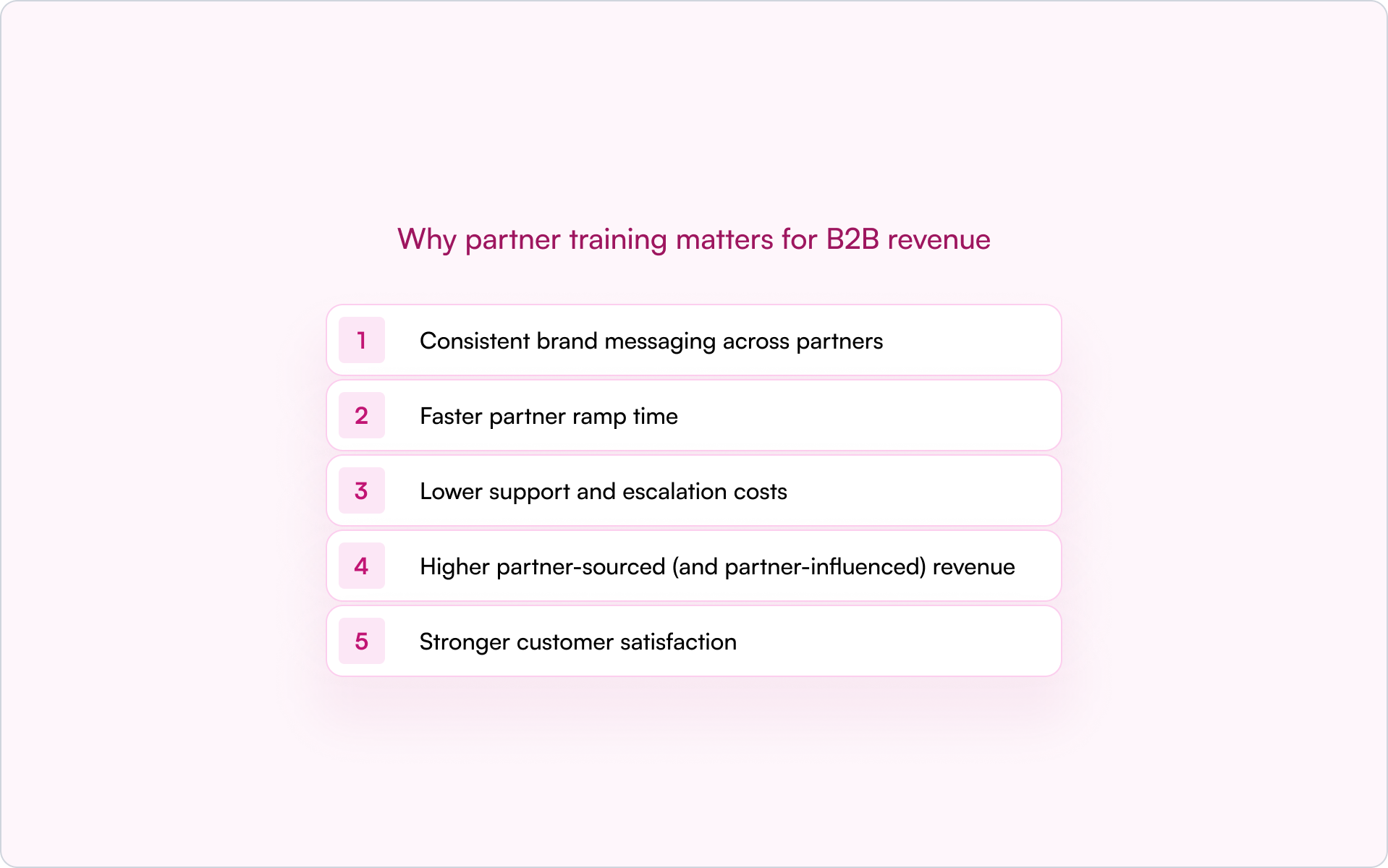
Einheitliche Markenbotschaft bei allen Partnern
Ungeschulte Partner stellen Produkte ständig falsch dar – nicht aus Boshaftigkeit, sondern weil sie raten müssen. Das Ergebnis ist vorhersehbar: falsche Preisvorstellungen, falsche Annahmen zu Funktionen und verlangsamte Geschäftszyklen aufgrund von Nachschulungen.
Schulungen bringen die Partner auf einen Nenner, was sie sagen sollen, was sie nicht sagen sollen und wie sie Sie in einem umkämpften Markt positionieren sollen.
Schnellere Partner-Ramp-Zeit
Die Ramp-up-Zeit ist der Zeitraum zwischen dem Onboarding und dem ersten abgeschlossenen Geschäft. Je kürzer dieser Zeitraum ist, desto mehr Vertrauen hat ein Partner in Ihr Programm – und desto wahrscheinlicher ist es, dass er weiterhin investiert.
Das Ziel ist nicht, „alles zu lehren“. Es geht darum, das zu vermitteln, was erforderlich ist, um eine glaubwürdige Demo, eine saubere Übergabe und einen ersten Erfolg zu erzielen.
Geringere Support- und Eskalationskosten
Wenn Partner wissen, wie sie mit häufig gestellten Fragen und der ersten Fehlerbehebung umgehen müssen, eskalieren sie weniger. Das schont die Zeit Ihres internen Teams und sorgt dafür, dass sich der Support auf komplexe Probleme konzentrieren kann und nicht auf sich wiederholende Grundlagen.
Höhere Einnahmen aus Partnerquellen (und durch Partner beeinflusste Einnahmen)
Durch Schulungen können Partner besser geeignete Anwendungsfälle identifizieren, Chancen bewerten und Einwände ausräumen. In Verbindung mit der Transparenz des CRM-Systems können Sie direkt die Frage beantworten: „Schließen zertifizierte Partner mehr Geschäfte ab?“ Und dann können Sie verstärkt auf das setzen, was funktioniert.
Höhere Kundenzufriedenheit
Kunden, die von geschulten Partnern betreut werden, profitieren von genaueren Erwartungen, reibungsloseren Implementierungen und einem besseren Support – was sich in einer geringeren Abwanderungsrate und mehr Expansion niederschlägt.
Arten von Partner-Schulungsprogrammen
Das beste Partner-Schulungsprogramm besteht selten aus nur einem Format. Die meisten Teams kombinieren Module, Live-Sitzungen, Zertifizierungen und Referenzdokumente und passen diese dann an den Partnertyp und die Rolle an.
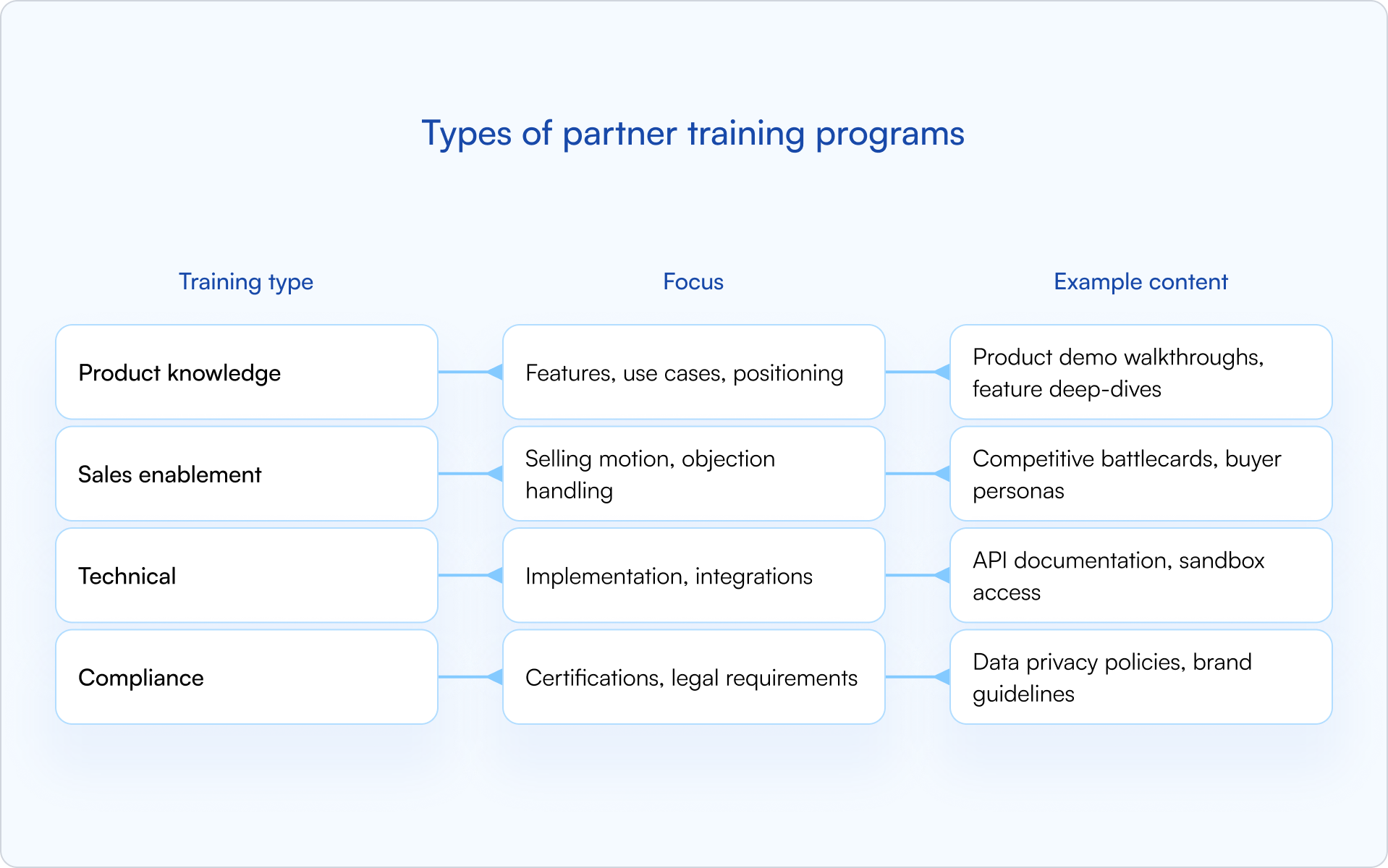
Produktschulung
Produktwissen ist die Grundlage. Partner müssen verstehen, was Ihr Produkt leistet, welche Anwendungsfälle es hauptsächlich gibt und wo Ihre Stärken liegen. Ohne dieses Wissen sind Demos unsicher und Geschäfte kommen schon in der ersten Phase der Produktfindung zum Stillstand.
Vertriebsunterstützungstraining
Im Verkaufstraining lernen Sie, wie Sie „Funktionen“ in „Umsatz“ umwandeln. Es umfasst Käuferprofile, Qualifizierung, Preisverhandlungen, Wettbewerbspositionierung und den Umgang mit Einwänden. Dies ist besonders wichtig für Wiederverkäufer und Empfehlungspartner, die Geschäfte akquirieren und gestalten.
Technische Schulung und Implementierungsschulung
Für SIs und Implementierungspartner ist technische Schulung unverzichtbar. Zu den leistungsstarken Programmen gehören praktische Übungen, Sandbox-Umgebungen und praktische Szenarien, die reale Kundenimplementierungen widerspiegeln.
Viele Unternehmen knüpfen Lieferrechte an technische Zertifizierungen – Partner können erst dann implementieren, wenn sie ihre Kompetenz unter Beweis gestellt haben.
Compliance- und Zertifizierungsschulungen
Compliance-Schulungen schützen das Unternehmen. Sie können Datenschutz, Sicherheitsanforderungen, Beschaffungsstandards und Richtlinien zur Markennutzung umfassen. Zertifizierungen hingegen bieten Ihnen einen skalierbaren „Qualitätsmaßstab“ für ein gesamtes Ökosystem.
Wie man ein Partner-Schulungsprogramm aufbaut (Schritt für Schritt)
Wenn Sie als Gründer oder kleines GTM-Team eine Partnerschulung aufbauen, ist Ihr Vorteil die Geschwindigkeit. Beginnen Sie mit den Ergebnissen, liefern Sie einen minimalen Lehrplan und iterieren Sie auf der Grundlage dessen, was die Pipeline vorantreibt.
a
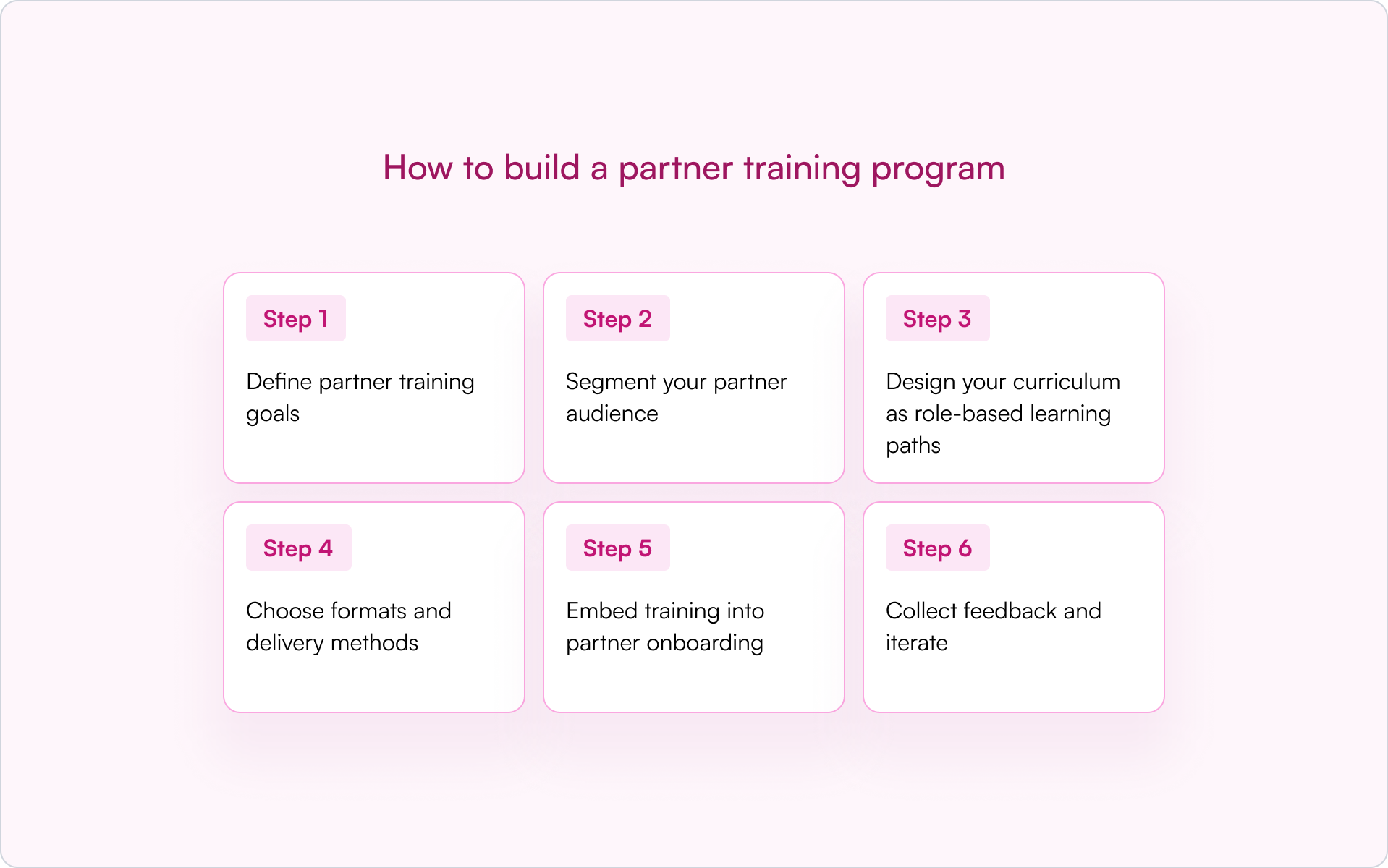
1) Ziele für die Partnerschulung definieren
Beginnen Sie mit den Ergebnissen, nicht mit den Inhalten. Was sollte ein geschulter Partner können?
- Führen Sie eigenständig eine glaubwürdige Demo durch.
- Erste Hilfe leisten und allgemeine Fehlerbehebung durchführen
- Abschlüsse ohne ständige Einbindung von Vertriebsingenieuren
Ziele, die an messbare Geschäftskennzahlen geknüpft sind – wie die Zeit bis zum ersten Geschäftsabschluss, die Gewinnquote oder das Ticketvolumen – lassen sich intern leichter priorisieren und verteidigen.
2) Segmentieren Sie Ihre Partnerzielgruppe
Nicht alle Partner benötigen die gleiche Schulung. Ein Empfehlungspartner benötigt Informationen und Qualifikationen, während ein SI eine umfassende Implementierung benötigt. Segmentieren Sie nach Partnertyp, Ebene und Rolle (Vertrieb, Technik, Support).
3) Gestalten Sie Ihren Lehrplan als rollenbasierte Lernpfade.
Ordnen Sie die Schulungsinhalte den einzelnen Segmenten und Zielen zu und fassen Sie sie dann in klaren Pfaden zusammen, wie zum Beispiel:
- Verkaufszertifizierungspfad (Positionierung, Entdeckung, Einwände, Demo)
- Technischer Zertifizierungspfad (Einrichtung, Integrationen, Fehlerbehebung)
- Support-Bereitschaftspfad (FAQs, Eskalationsregeln, SLAs)
Fangen Sie klein an. Ihre erste Version sollte „der kürzeste Weg zur Kompetenz“ sein, keine umfassende Enzyklopädie.
4) Formate und Liefermethoden auswählen
Verwenden Sie das Format, das der auszuführenden Aufgabe entspricht:
- Module zum Selbststudium: zeitlich skalierbar; ideal für grundlegende Kenntnisse
- Live-Webinare: interaktive Frage-Antwort-Runde; am besten geeignet für Produkteinführungen und komplexe Themen
- On-Demand-Video: einfach zu konsumieren; ideal für Demo-Walkthroughs
- Präsenzworkshops: hohes Maß an Vertrauen und persönlichem Kontakt; am besten geeignet für strategische Partner
- Dokumentation und Anleitungen: dauerhafte Referenz; am besten geeignet für technische Details
5) Schulungen in die Einarbeitung neuer Partner integrieren
Schulungen funktionieren am besten, wenn sie in den Onboarding -Prozess für Partner eingebettet sind – und nicht als separate Initiative behandelt werden.
Die besten Partnerportale bieten Schulungsinhalte neben der Registrierung von Geschäften, Ressourcen und Support. Wenn Schulungen dort stattfinden, wo Partner bereits arbeiten, steigen die Abschlussquoten ganz natürlich.
6) Feedback sammeln und iterieren
Produkte ändern sich, Wettbewerber positionieren sich neu und Partner vergessen. Behandeln Sie die Schulung Ihrer Partner wie ein Produkt: Überprüfen Sie, was genutzt wird, was übersprungen wird und was mit den Umsatzergebnissen korreliert.
- Kurze Umfragen nach den Modulen
- Vierteljährliche Besprechungen mit Partnermanagern
- Regelmäßige Updates im Zusammenhang mit Veröffentlichungen und Änderungen im Wettbewerbsumfeld
Best Practices für die Schulung von Partnern für 2026
Sobald die Grundlagen geschaffen sind, lassen sich die größten Verbesserungen durch die Beseitigung von Reibungsverlusten, die Angleichung von Anreizen und die Messbarkeit von Schulungen erzielen.
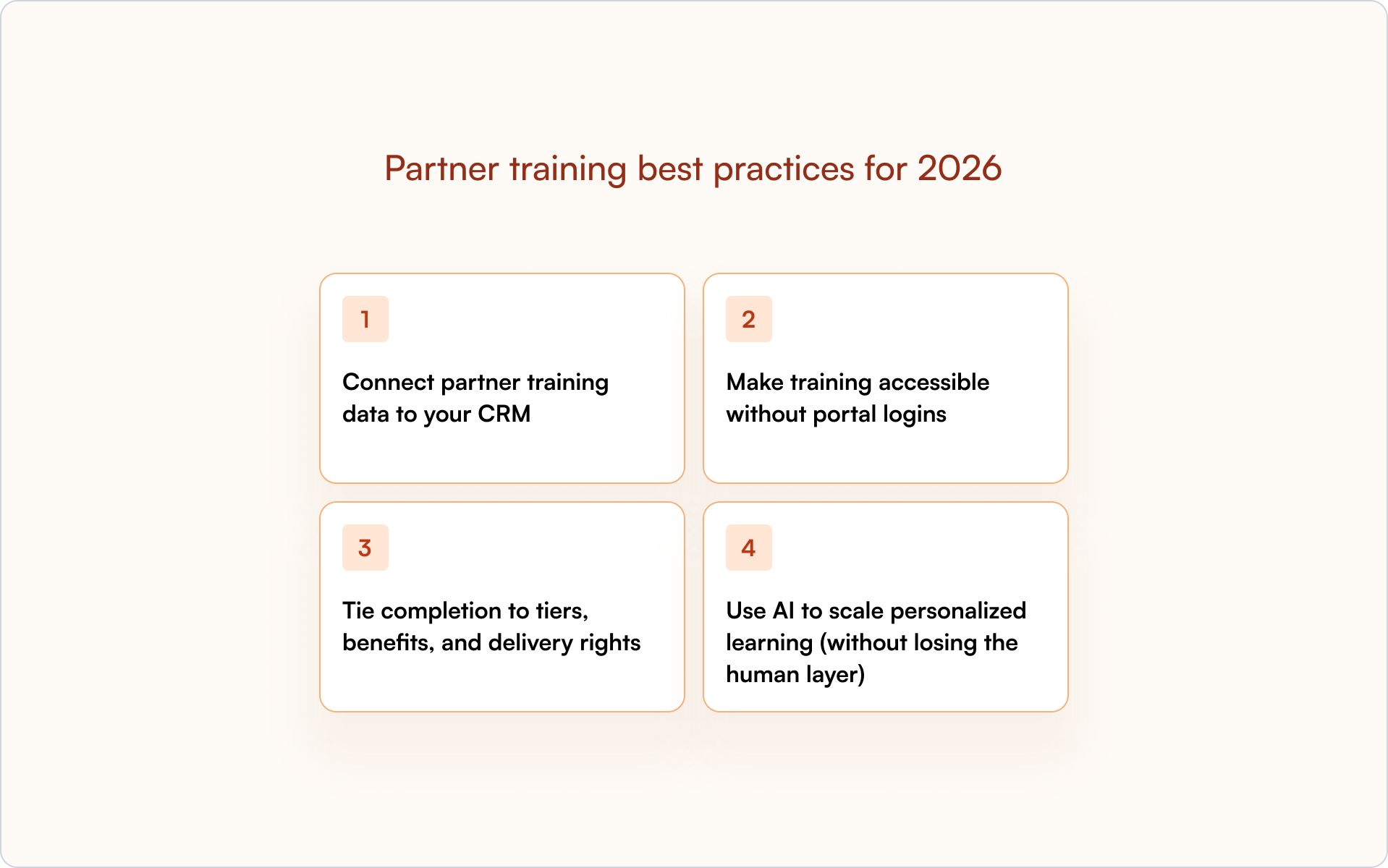
Verbinden Sie die Schulungsdaten Ihrer Partner mit Ihrem CRM-System.
Der Abschluss einer Schulung ist nur dann strategisch sinnvoll, wenn er mit den Partnerdaten in Ihrem CRM verknüpft ist. Mit der CRM-Integration können Sie Workflows basierend auf dem Schulungsstatus auslösen und Zertifizierungen mit der Geschäftsleistung korrelieren.
Ohne sie werden Sie weiterhin mit Meinungen statt mit Antworten über die Auswirkungen des Trainings diskutieren.
Machen Sie Schulungen ohne Portal-Anmeldung zugänglich
Anmeldeprobleme sind ein stiller Killer. Partner jonglieren mit mehreren Anbieterportalen und Anmeldedaten, und jeder zusätzliche Schritt verringert die Abschlussquote.
Ziehen Sie SSO, in E-Mails integrierte Schulungen oder leichtgewichtige Portal-Erfahrungen in Betracht. Der Off-Portal-Zugang – bei dem Partner ohne Anmeldung interagieren können – erhöht durchweg die Abschlussquoten.
Die Fertigstellung an Stufen, Vorteile und Lieferrechte knüpfen
Anreize beeinflussen das Verhalten. Wenn die Zertifizierung den Aufstieg in eine höhere Stufe, höhere Margen, Zugang zu MDF oder Lead-Verteilung ermöglicht, wird die Schulung zu einer geschäftlichen Entscheidung für den Partner.
Dies schützt auch Ihre Kunden: Partner, die nicht geschult sind, sollten keine komplexen Implementierungen unter Ihrem Markennamen durchführen.
Nutzen Sie KI, um personalisiertes Lernen zu skalieren (ohne die menschliche Komponente zu verlieren).
KI kann basierend auf der Rolle und Leistung des Partners die richtigen Module empfehlen und häufig gestellte Fragen in Echtzeit beantworten. Das Ziel ist nicht, die Unterstützung zu ersetzen, sondern das, was Ihre besten Partnermanager bereits manuell tun, zu skalieren.
Wie man eine Partner-Schulungssoftware auswählt
Wenn Sie eine Schulungssoftware für Partner oder eine Schulungsplattform für Vertriebspartner evaluieren, sollten Sie Funktionen priorisieren, die das partnerorientierte Wachstum unterstützen – und nicht allgemeine LMS-Checklisten.
CRM-Integration und Datensynchronisation
Die von Ihnen gewählte Plattform sollte idealerweise Schulungsdaten – Zertifizierungen, Abschlussdaten, Lernpfade – zurück an HubSpot Salesforce übertragen. Ohne CRM-Integration werden Schulungsdaten zu einem Silo, und Sie verlieren den Überblick darüber, wie sich das Lernen auf den Umsatz auswirkt.
Funktionen des Selbstbedienungs-Partnerportals
Die Akzeptanz von Schulungen verbessert sich, wenn sie neben den übrigen Partnererfahrungen angeboten werden: Angebote, Inhalte, Updates und Support. Suchen Sie nach Plattformen, die die Anzahl der Tools reduzieren, anstatt einen weiteren Login hinzuzufügen.
Hosting von Inhalten und Zertifizierungsmanagement
Die Plattform wird idealerweise verschiedene Arten von Inhalten (Videos, Dokumente, Quizfragen) hosten, Zertifizierungen ausstellen und den Abschluss verfolgen. Die Nachverfolgung von Ablaufdaten und Workflows für die Rezertifizierung sind besonders nützlich, sobald Ihr Programm skaliert wird.
Funktionen und Benachrichtigungen zur Interaktion
Partner vergessen Dinge – und sie sind beschäftigt. Automatische Erinnerungen an erforderliche Schulungen, ablaufende Zertifizierungen und neue Module tragen dazu bei, die Abschlussquoten hoch zu halten. Bonuspunkte gibt es, wenn Partner sich ohne Anmeldung beteiligen können.
Wie man Partner-Schulungsprogramme bewertet
Ein Partner-Schulungsprogramm ist dann „erfolgreich“, wenn es die Leistung der Partner messbar verbessert – und nicht, wenn es viele Inhalte umfasst. Verwenden Sie Kennzahlen, die die Lernaktivitäten mit den Ergebnissen verknüpfen.
Ausbildungsabschlussquoten (nach Segment)
Verfolgen Sie den Abschluss der erforderlichen Module und Zertifizierungen und segmentieren Sie diese dann nach Partnertyp und Stufe. Eine geringe Abschlussquote deutet in der Regel auf Reibungsverluste, irrelevante Inhalte oder unklare Anreize hin.
Zeit bis zum ersten Geschäft
Messen Sie die Zeit vom Onboarding bis zum ersten abgeschlossenen Geschäft. Wenn die Schulung effektiv ist, sollte sich die Einarbeitungszeit verkürzen. Ist dies nicht der Fall, ist Ihr Lehrplan wahrscheinlich nicht auf die tatsächlichen Bedürfnisse Ihrer Partner im Verkaufsprozess abgestimmt.
Umsatzzuordnung durch Partner
Die schwierigste Kennzahl ist gleichzeitig auch die wichtigste: Generieren zertifizierte Partner mehr Pipeline und erzielen sie mehr Umsatz? Um diese Frage zu beantworten, sind eine klare CRM-Attribution und konsistente Partnerdaten erforderlich.
Partnerzufriedenheit und Nützlichkeit
Befragen Sie Ihre Partner zur Relevanz und Qualität der Schulungen und fragen Sie sie, was ihnen fehlt. Die Zufriedenheit hebt oft Probleme hervor, die sich nicht aus den Abschlussquoten ableiten lassen – zum Beispiel Module, die „abgeschlossen“ sind, aber nicht umsetzbar sind.
Wie ein CRM-First-Partnerportal die Schulung von Partnern vereinfacht
Schulungen funktionieren am besten, wenn sie in die Partnererfahrung integriert sind – und nicht isoliert in einem separaten LMS. Ein CRM-first-Ansatz bedeutet, dass Schulungsdaten, Geschäftsdaten und Partnerdaten in einem einzigen System gespeichert sind.
Wie „CRM-first“ in der Praxis aussieht
- Einzige Quelle der Wahrheit: Der Abschluss der Schulung wird zusammen mit Deals und Partnerinformationen in HubSpot Salesforce angezeigt.
- Automatisierte Arbeitsabläufe: Auslösen von Zertifizierungen, Stufen-Upgrades und Erinnerungen basierend auf dem Schulungsstatus
- Weniger Anmeldungen: Partner greifen an derselben Stelle auf Schulungen zu, an der sie auch Geschäfte registrieren und Updates erhalten.
- Echtzeit-Transparenz: Partnermanager sehen, wer geschult ist und wer nicht, ohne Berichte nachverfolgen zu müssen.
Für Gründer ist dies der eigentliche Gewinn: weniger Betriebsaufwand, klarere Verantwortlichkeiten und bessere Antworten auf die Frage „Was treibt den Umsatz an?“
Fazit: Behandeln Sie das Partnertraining wie ein Wachstumssystem.
Im Jahr 2026 wird eine erfolgreiche Partnerschulung nicht daran gemessen, wie viele Inhalte Sie bereitstellen. Sie wird daran gemessen, ob Partner schnell darauf zugreifen und sie sofort anwenden können und ob Sie den Abschluss der Schulung mit tatsächlichen Ergebnissen in Ihrem CRM verknüpfen können.
Wenn Sie einen Partnerkanal von Grund auf neu aufbauen, beginnen Sie mit dem kürzesten Weg zur Kompetenz, beseitigen Sie Reibungsverluste (insbesondere bei der Anmeldung) und verbinden Sie Anreize mit den gewünschten Verhaltensweisen. Wiederholen Sie diesen Vorgang dann unermüdlich auf der Grundlage von Leistungsdaten.
Wenn Sie Schulungen zu einem Teil der Partnererfahrung machen möchten – neben Onboarding, Deal-Registrierung und Leistungsberichten –, sehen Sie sich an, wie das Partnerportal von Introw diesen Workflow unterstützt: Fordern Sie eine Demo an.