

.svg)


.svg)
.svg)








SPIFF Programs: What They Are, How to Design Them, and Examples That Drive Partner Sales
A well-designed SPIFF program can turn a slow quarter, product launch, or stalled partner pipeline into a surge of sales activity. Used well, SPIFFs can change behavior fast. Used poorly, they can create expensive distractions. If you’ve heard the term before but never really knew what it meant, you’re not alone.
What is a SPIFF program?
A SPIFF program is a short-term sales incentive used to reward a specific action. SPIFF stands for sales performance incentive fund, though you may also see it written as “spiff” or “spiv.”
The SPIFF program's meaning is simple: you offer an extra reward when someone does the thing you want more of.
.png)
That could mean a direct cash bonus for closing deals above a set value, selling a new product, registering qualified leads, or reaching specific sales targets during a promotion period.
Unlike standard sales commissions, a sales SPIFF is temporary and focused. Commission usually runs in the background as part of your long-term compensation plans. A SPIFF is used when you want immediate motivation around one goal.
A well-structured SPIFF program usually has five traits:
- Short-term: It runs for a month, a quarter, or a campaign window.
- Targeted: It focuses on one product, region, deal size, or behavior.
- Simple: The program rules are easy to understand.
- Stackable: It can run alongside regular commission.
- Trackable: Every qualifying sale is tied to clear eligibility criteria.
.png)
SPIFFs can motivate sales teams, individual salesperson performance, and external channel partners. This guide focuses on partner SPIFFs because they’re harder to manage. Your channel partners don’t live in your CRM, and they can’t always see what they’ve earned.
That’s why a strong channel partner incentive program needs more than a good reward. It also requires clear tracking, fast communication, and a simple way for partners to see progress.
If your goal is to improve partner sales, a SPIFF can help. But only when the reward, rules, and payout process are easy to trust.
Why companies run SPIFF programs
The best SPIFF programs don’t just offer extra money. They encourage specific sales behaviors when they matter most.
Here’s why they work.
.png)
#1 Urgency creates action
Most sales commissions become part of the background. Sales reps and channel partners expect them, so they rarely change behavior on their own.
A short-term incentive creates a reason to act now.
For example, a channel SPIFF program might offer:
- $500 for every new logo deal closed this quarter
- A bonus for selling a newly launched product
- Extra rewards for deals above a specific value
The deadline matters as much as the reward. When partners know the opportunity disappears after a promotion period, they’re more likely to prioritize that deal over competing opportunities.
This is why SPIFFs are often used during product launches, pipeline pushes, and other strategic initiatives where timing matters. Teams running incentives alongside their existing HubSpot integration can track participation and revenue generated without creating separate workflows.
#2 Clarity drives participation
A successful SPIFF program should be easy to explain.
If partners need a spreadsheet and three meetings to understand the reward, participation drops. If the rules fit in one sentence, participation rises.
For example:
“Close a new logo deal above $10,000 this quarter and earn $500.”
That’s clear. Partners know the sales goals, the reward, and the eligibility criteria immediately.
The most effective SPIFF program ideas focus on simplicity. Partners should spend time selling, not interpreting program rules.
#3 Visibility keeps partners engaged
A sales SPIFF only works when people can see it.
Many sales SPIFF programs fail because the incentive is announced once and then forgotten. The reward lives in an email or PDF while partners focus on daily sales activity.
Visibility creates immediate motivation.
For example, when incentives appear directly inside a partner portal, partners can see pending and confirmed SPIFF rewards alongside active deals. Seeing the reward attached to a live opportunity keeps the incentive top of mind.
This is especially important for channel partners who may be managing opportunities across multiple sales channels at the same time.
#4 Low friction means more claims
Even strong cash SPIFFs lose impact when the payout process is complicated.
If partners have to chase approvals, fill out forms, or wait months for reward distribution, participation drops. Friction creates doubt, and doubt reduces engagement.
The best incentive program experiences make claiming rewards almost automatic.
With tools such as deal and lead registration, partner activity can be tracked from the original opportunity through payout. Add automation, notifications, and approval workflows, and salespeople spend less time on admin and more time closing deals.
When earning a reward feels easy, more partners participate. When rewards are visible, simple, and easy to claim, SPIFFs consistently boost sales and increase sales activity.
How to design a SPIFF program that actually changes behavior
A successful SPIFF program starts with a clear goal. The reward matters, but the behavior matters more.
.png)
Step 1: Define the behavior you want to change
Start with the outcome, not the incentive.
Ask yourself:
- Do you want more deals registered?
- Do you want to shorten the sales cycle?
- Do you want bigger deals?
- Do you want more certified partners?
- Do you want to increase sales in a specific market?
Pick one.
The best sales incentive programs focus on a single objective. If you try to change too many sales behaviors at once, partners won’t know what matters most.
Step 2: Set clear, simple rules
Partners should understand the SPIFF in seconds.
Every SPIFF program should answer four questions:
- What triggers the bonus?
- How much is the reward?
- Who is eligible?
- When does it expire?
For example:
“Register and close a new logo deal above $10,000 before September 30 and earn a $500 bonus.”
Simple rules lead to more participation. Complex rules lead to salespeople guessing.
Step 3: Make the incentive meaningful
A bigger reward isn’t always a better reward.
The goal is to offer meaningful rewards that justify the extra effort. For many SaaS programs, cash bonuses between $250 and $1,000 are enough to change behavior. Enterprise-focused SPIFF campaigns may require larger payouts.
You can also experiment with:
- Cash SPIFFs
- Non-cash rewards
- Non-cash SPIFFs
- Tech gadgets
- Prepaid debit cards
The best reward is the one that motivates channel partners to take action.
Step 4: Use CRM-based conditions
Manual tracking breaks quickly.
The most effective SPIFF programs use CRM data as the source of truth.
For example:
- Deal stage = Closed Won
- Deal value > $10,000
- Close date falls within Q3
When all conditions are met, the reward is triggered automatically.
In Introw, SPIFFs are configured using CRM filters, so qualifying deals are identified automatically based on your existing CRM data.
Here's an example of Introw’s commission plan builder showing CRM-based SPIFF conditions and a live preview of qualifying deals:
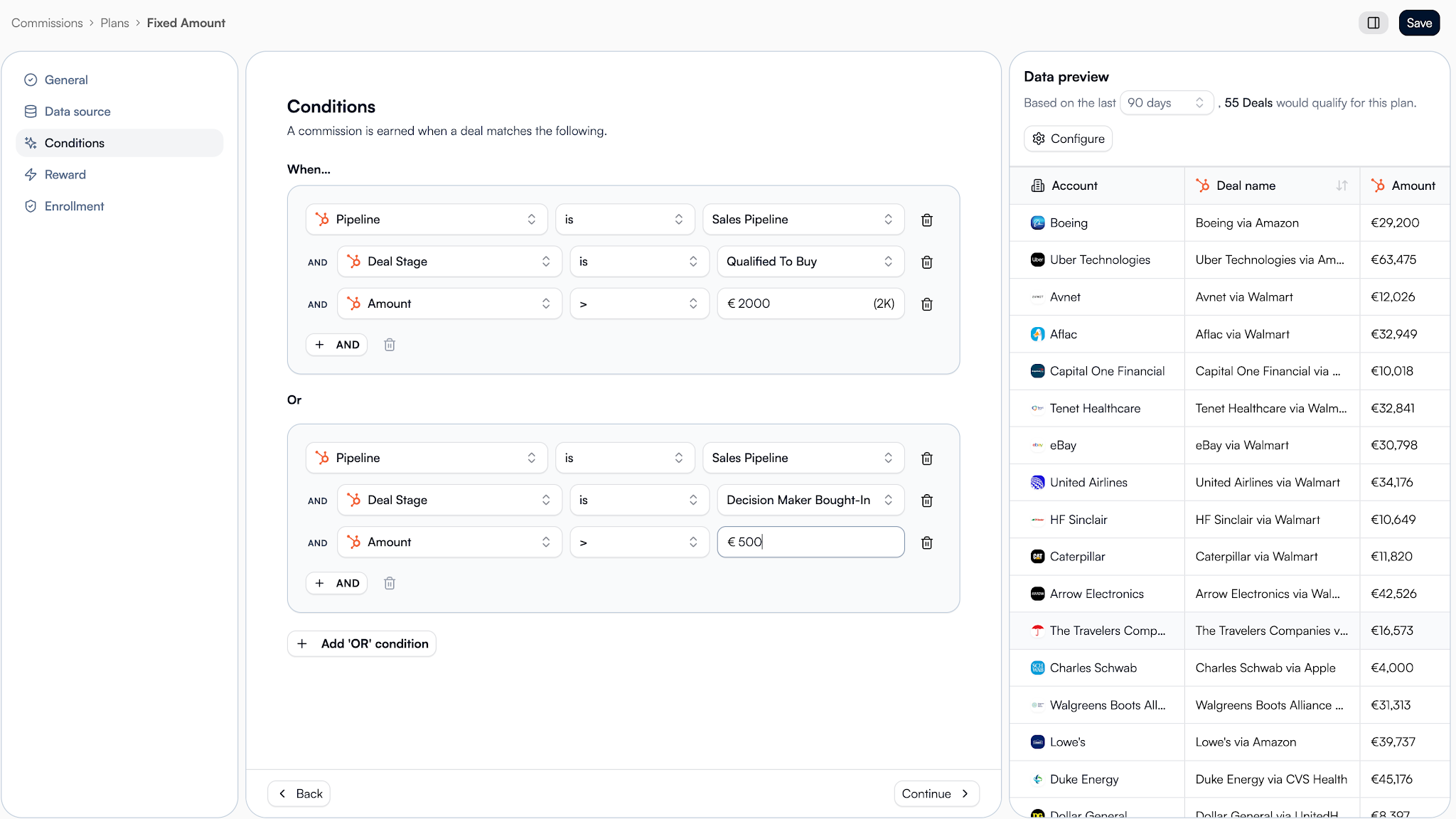
Good SPIFF program management starts with reliable data.
Step 5: Make the reward visible
Partners shouldn’t have to remember a SPIFF.
They should see it where they already work.
For example, Introw displays expected earnings directly on deal cards and inside the partner experience. Partners can see whether rewards are pending or confirmed without digging through old emails.
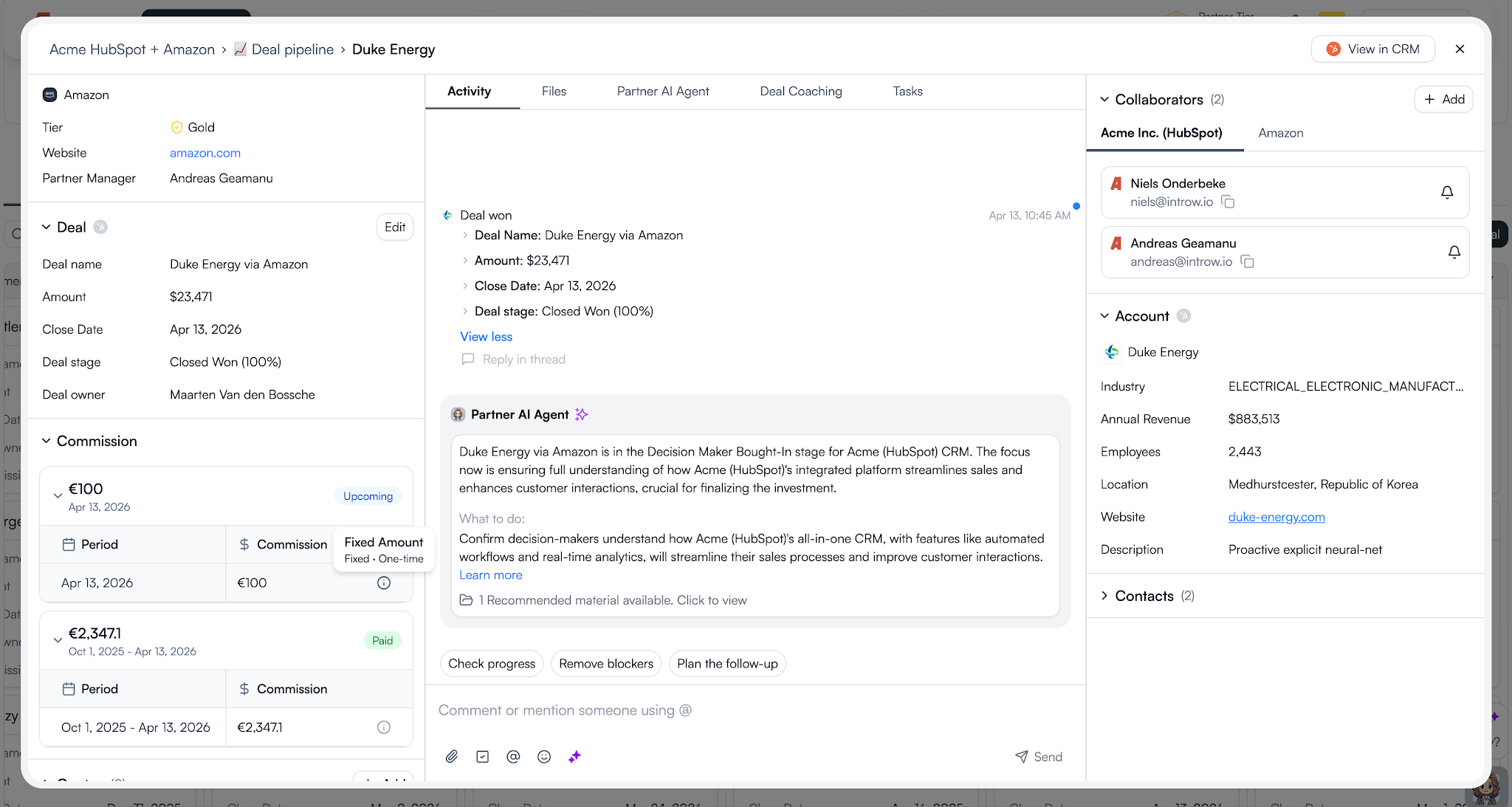
Visibility keeps sales teams driven and helps motivate channel partners throughout the entire campaign.
Step 6: Automate the payout process
A reward loses power when the payout process becomes a project.
A simple flow looks like this:
- The deal closes.
- The SPIFF calculates automatically.
- Eligible rewards are added to a statement.
- The partner uploads an invoice.
- Finance approves the payment.
- The reward is marked as paid.
Introw’s AI Agent can also help surface information and reduce admin work, making it easier to manage larger incentive programs without creating extra overhead.
The easier the process, the more likely partners are to participate.
Here's what this all looks like in action:
Step 7: Review and improve
Every SPIFF should teach you something.
After the campaign ends, review:
- How many partners earned the reward?
- How much sales revenue was generated?
- Which partner segments responded best?
- Did sales activity increase?
- Did you achieve the original sales goals?
Use those insights to improve future iterations.
The best partner programs don’t rely on one successful SPIFF. They run targeted incentives throughout the year as part of a broader incentive strategy.
A few well-designed SPIFFs will usually outperform one giant annual campaign.
The best way to see these principles in action is through real SPIFF program examples.
7 SPIFF program examples you can steal
Not every SPIFF needs to be complicated. Here are seven proven SPIFF program examples you can adapt for your partner program.
1. The activation accelerator
Use this SPIFF when you want new partners to take action quickly instead of waiting months to engage.
Rule: Earn $750 on your first closed-won deal as a new partner.
Trigger: First deal where deal stage = Closed Won.
Bonus: $750 flat fee.
Best for: New partners in their first 90 days.
Why it works: Early sales success builds confidence. Partners who close their first deal quickly are more likely to stay active and become a team motivated by results.
2. The Q3 pipeline push
This is one of the simplest sales SPIFF programs for accelerating pipeline movement before a deadline.
Rule: Earn $500 for every deal above $25,000 closed this quarter.
Trigger: Deal amount > $25K AND deal stage = Closed Won.
Bonus: $500 flat fee.
Best for: Active reseller partners.
Why it works: Short-term incentives and cash SPIFFs create urgency. Partners focus on closing deals before the deadline instead of letting opportunities sit in the pipeline.
3. The EMEA expansion bonus
Geographic incentives work well when you’re trying to grow partner activity in a specific market.
Rule: Earn an extra 5% on every DACH deal closed this quarter.
Trigger: Deal country = Germany, Austria, or Switzerland AND deal stage = Closed Won.
Bonus: 5% of deal value.
Best for: Reseller and referral partners expanding into new markets.
Why it works: Supports broader sales strategies without changing existing sales compensation plans. The bonus stacks on top of normal sales commissions.
4. The product launch SPIFF
When product launches need momentum, a targeted SPIFF can help direct attention where you want it.
Rule: Earn $300 for every deal that includes the new product.
Trigger: Deal contains the new product SKU AND deal stage = Closed Won.
Bonus: $300 flat fee.
Best for: New product launches.
Why it works: Partners sell what they’re rewarded to sell. This type of sales incentive helps boost sales of new offerings and improves product adoption.
5. The speed-to-close SPIFF
If deals are moving slowly through the pipeline, this type of SPIFF encourages faster action.
Rule: Earn $400 for any deal closed within 45 days of registration.
Trigger: Deal registration date to close date < 45 days.
Bonus: $400 flat fee.
Best for: Programs with a slow sales cycle.
Why it works: It encourages faster sales activity and helps prevent deals from becoming stale. The goal is to stop partners from letting opportunities delay closing deals.
6. The certification reward
Not every incentive program needs to be tied directly to revenue.
Rule: Earn $200 for completing an advanced certification.
Trigger: Certification completed with a passing score.
Bonus: $200 flat fee.
Best for: Individual salesperson development.
Why it works: Better-trained sales professionals often deliver stronger sales performance. It can also boost morale, improve job satisfaction, and increase long-term sales performance.
7. The stacked deal bonus
This example shows how SPIFFs and recurring commissions can work together.
Rule: Earn your standard commission plus a $1,000 bonus on deals above $100,000.
Trigger: Deal amount > $100K AND deal stage = Closed Won.
Bonus: $1,000 flat fee plus existing commission.
Best for: Gold and Platinum partners.
Why it works: SPIFFs don’t replace long-term compensation plans. They complement them. In Introw, partners can be enrolled in multiple plans at the same time, including recurring commissions, tiered SPIFFs, and one-time bonuses. Both rewards are calculated independently and rolled into the same statement.
Notice the pattern
Every example focuses on one behavior, one reward, and one clear trigger. That’s usually all you need to create a successful sales performance incentive fund that partners actually remember and act on.
So, what are things you should watch out for to make things go smoothly?
Common SPIFF mistakes to avoid
Even a good SPIFF program can fail if the execution is poor. Here are the most common mistakes to avoid.
.png)
Making the rules too complicated
If sales reps, channel partners, or an individual salesperson need a guide to understand the reward, participation drops.
Keep the program rules simple. A well structured SPIFF program should be easy to explain in one sentence.
Trying to reward too many behaviors
Some sales SPIFF programs try to influence multiple sales behaviors at once.
For example:
- Sell a new product
- Increase deal size
- Enter a new market
- Complete training
Pick one goal per campaign. The most effective SPIFF programs focus on a single outcome.
Offering rewards that don’t motivate action
A $25 reward on a six-month deal won’t motivate salespeople.
The reward should match the effort required. Whether you use cash SPIFFs, non cash rewards, prepaid debit cards, annual bonuses, or instant rewards, the incentive needs to feel worthwhile.
Making rewards hard to track
Partners should never wonder whether they’ve earned a reward.
Poor visibility hurts a program’s effectiveness and can damage team morale. Clear tracking helps motivate channel partners and supports healthy competition.
Ignoring payouts and compliance
Rewarding participants is only half the process.
You also need clear reward distribution, payment records, and tax compliance processes. This becomes even more important when managing channel partners across different regions.
Forgetting to measure results
After every SPIFF campaign, ask:
- Did sales targets improve?
- Was more sales activity generated?
- Did revenue increase?
- Did the SPIFF help move old inventory?
- Was the behavior change worth the cost?
The answers will help improve future SPIFF campaigns and strengthen your overall sales performance management approach.
Here is how partner teams run SPIFFs with Introw
Designing a SPIFF is only half the job. You also need a reliable way to track earnings, manage payouts, and keep channel partners informed.
Here’s what that looks like in Introw.
.png)
1. Create a SPIFF plan from CRM conditions
SPIFFs are created as commission plans using CRM data.
Set your date range, define the qualifying conditions, and choose the reward amount. Introw supports flat-fee and percentage-based rewards, and you can preview matching deals before the plan goes live.
2. Assign the plan to partners
Assign the SPIFF to individual partners or entire partner groups.
Partners can participate in multiple plans at the same time, including recurring commissions, certification rewards, and short-term incentive programs.
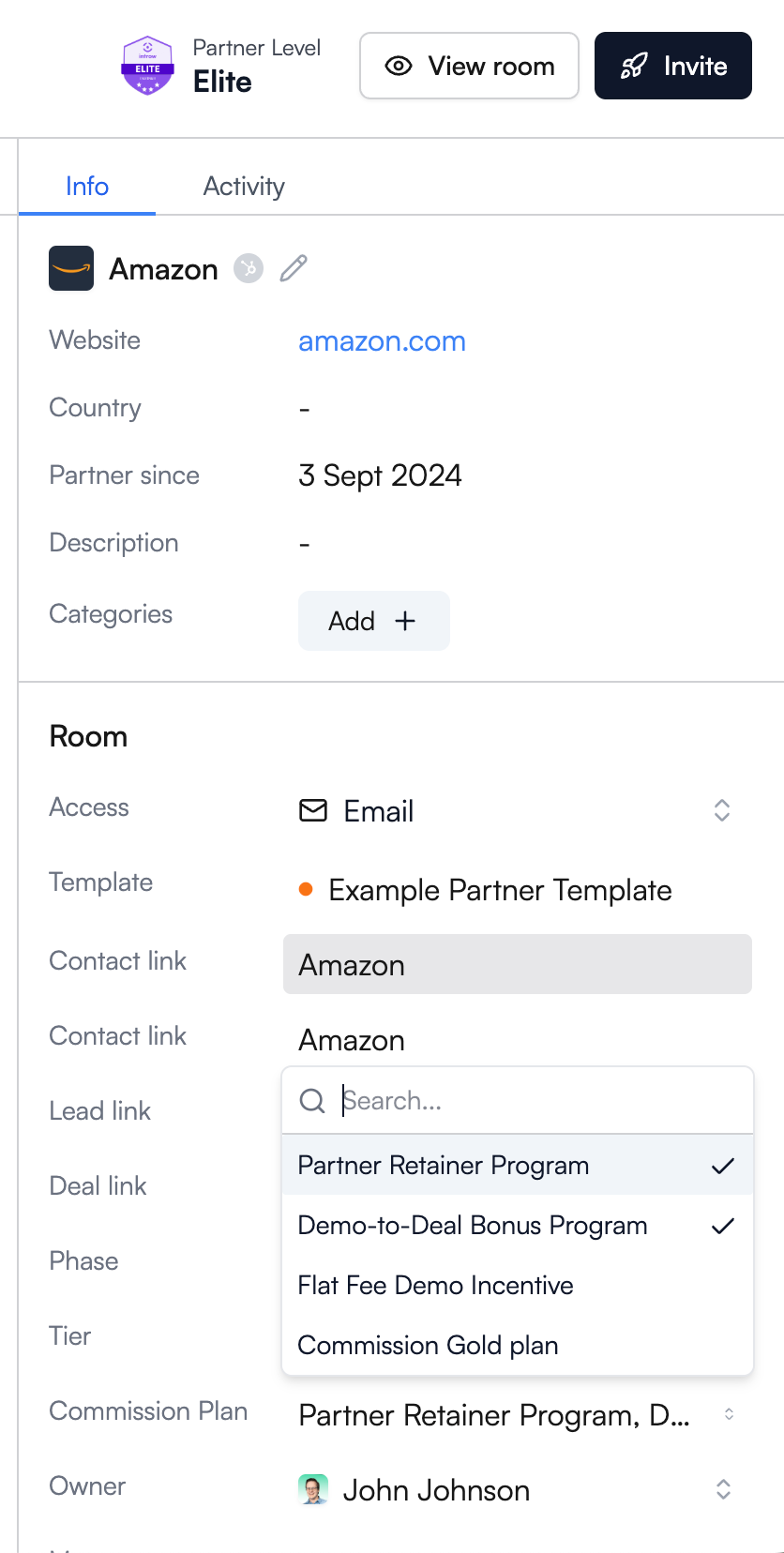
3. Partners see earnings in real time
Once the plan is active, partners can see expected earnings directly inside Introw.
Pending and confirmed rewards appear alongside deal information, helping partners stay focused on the opportunities that matter most.
4. Generate statements and collect invoices
When it’s time to pay, generate a statement with a few clicks.
Introw bundles eligible SPIFF rewards, sales commissions, and other payouts into a single statement. Partners can then upload invoices through the portal or simply reply to the notification email.
5. Approve payments and track everything
Every action is logged.
Partner managers and finance teams can review invoices, approve payments, and trace every reward back to the original CRM record. This creates a clear audit trail and simplifies reward distribution.
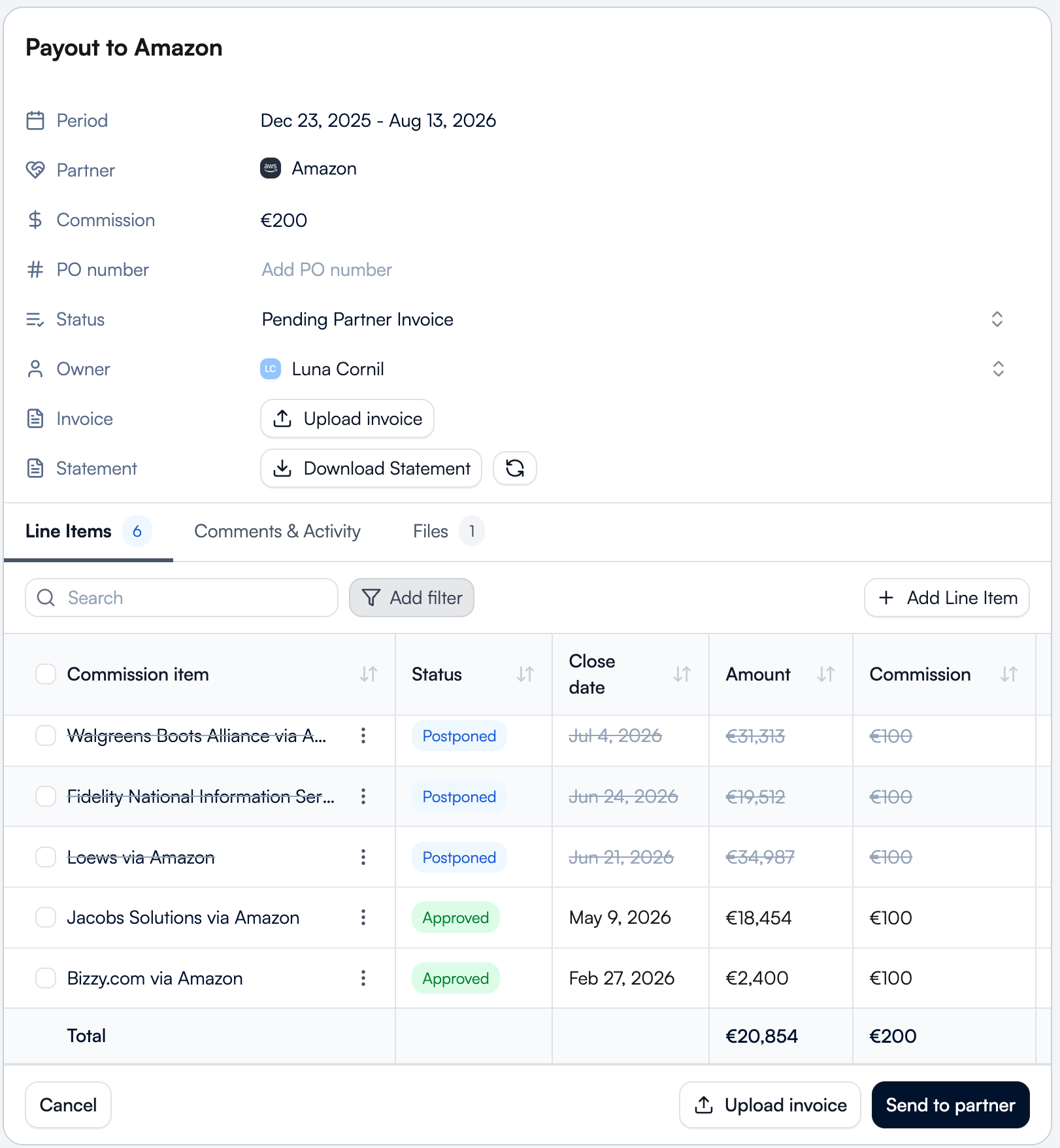
The commission overview ties it all together
The commission overview gives you one place to track SPIFF rewards, upcoming payments, and payout history.
Instead of managing spreadsheets, email chains, and separate systems, partner teams get a single source of truth for commissions, incentives, and partner earnings.
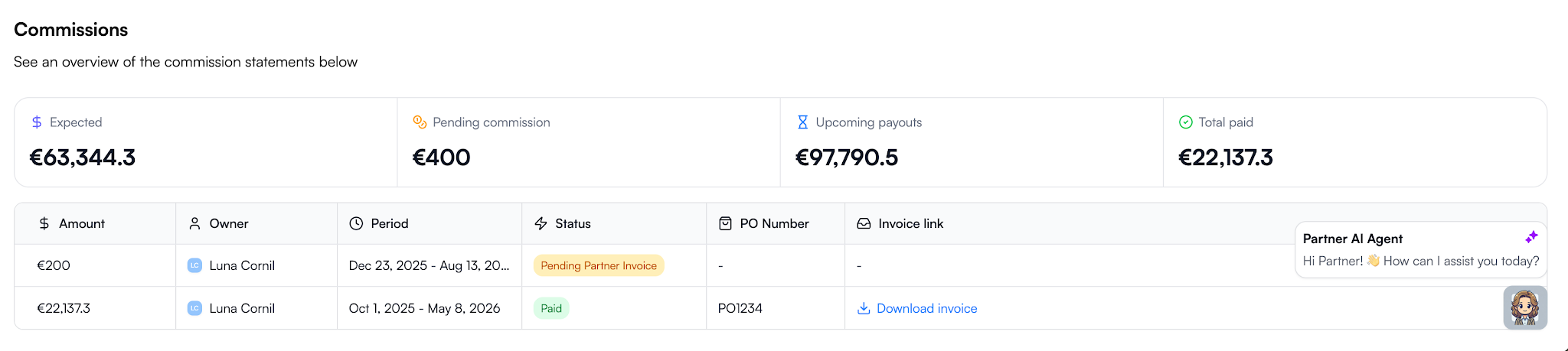
The result is a SPIFF program that’s visible to partners, tied directly to CRM data, and easy for finance teams to manage. Instead of tracking rewards across spreadsheets, email threads, and disconnected systems, everything lives in one workflow from deal registration to payout.
Ready to stop managing SPIFFs in spreadsheets? Request a demo and see how Introw automates partner incentives, commission tracking, invoicing, approvals, and payouts in one place.
What Are Marketing Development Funds (MDF)? A Complete Guide for Partner Teams
What are marketing development funds?
Marketing development funds (MDF) are budgets vendors allocate to channel partners to run approved marketing activities that promote the vendor’s products and generate pipeline.
A simple marketing development funds definition: MDF is vendor-funded support that helps partners execute campaigns like events, webinars, digital ads, and localized marketing programs that drive demand and expand market reach.
Here’s how MDF programs typically work:
- The vendor sets aside development funds for partners
- Partners submit requests for MDF-funded marketing efforts
- The vendor approves the activity and releases marketing dollars
- Both teams track results such as leads, pipeline, and revenue impact
You’ll also see MDF called market development funds, which refers to the same concept in most channel marketing programs.
It’s important not to confuse MDF with co-op funds. MDF is discretionary and approved in advance, while co-op programs are usually earned after past sales performance and reimbursed later.
Why MDF matters for partner programs
Most channel partners don’t have extra marketing dollars to promote your product. Marketing development funds close that gap so partners can run campaigns that create pipeline instead of waiting for inbound demand.
When partners get MDF support, they can:
- Launch localized marketing campaigns faster
- Generate leads in their own regions
- Increase brand visibility with potential customers
- Expand your market presence without adding headcount
That’s why strong MDF programs are a core part of a modern channel partner marketing strategy. They help both the vendor and the partner invest in shared growth instead of working in silos.
MDF also creates accountability. You fund the activity. Partners execute the marketing initiatives. Both teams track progress and measure sales opportunities together.
Yet many teams still struggle to use the budget they already have. Up to 60% of development funds go unused because the approval process is slow and results aren’t visible across systems.
When the MDF process works, the impact is real. It’s common to see about $8K in MDF-funded activity influence more than $130K in pipeline. That kind of return turns MDF from a cost line into a predictable lever inside your broader partnership marketing strategy.
8 common MDF-eligible activities
Marketing development funds help channel partners run targeted marketing activities that generate pipeline and expand market reach. Most MDF programs support digital campaigns, events, and co-branded assets that increase brand visibility and help generate leads.
Here are the most common MDF-funded activities across SaaS partner ecosystems.
1. Co-branded webinars and virtual events
Partners often use development funds MDF budgets for hosting webinars that introduce your vendor’s products to new audiences. These sessions support lead generation programs and strengthen partner engagement through structured co-marketing initiatives.
2. Digital advertising campaigns
Paid LinkedIn campaigns, search engine marketing, and digital ads help local partners reach potential customers faster. These MDF-funded marketing efforts are a reliable way to drive demand generation and generate leads.
3. Trade show and conference sponsorships
Trade shows increase brand awareness and create sales opportunities in new markets. Many MDF programs allocate MDF for booth presence, speaking slots, or regional sponsorships alongside broader channel partner incentive programs.
4. Co-branded content creation
Partners often invest MDF support into case studies, whitepapers, and promotional materials that highlight joint solutions. These assets strengthen brand recognition and support marketing goals, especially when teams enable partners with content that’s ready to deploy.
5. Email marketing campaigns
Email marketing campaigns help partners nurture sales leads and stay visible with existing accounts. They’re a simple way to support marketing and improve partner performance.
6. Local demand generation campaigns
Geo-targeted outreach helps increase local awareness and expand market reach in priority regions. These localized marketing campaigns are especially valuable for smaller partners building market presence.
7. Partner-hosted workshops and roundtables
Workshops and executive roundtables help educate potential customers and improve sales performance through direct engagement. They also support the work of a modern partner marketing manager running joint marketing activities across channel partners.
8. Product demo environments and trial programs
Some MDF activities support hands-on demo environments that help partners showcase real use cases and drive sales through practical product experiences.
Eligible MDF activities vary by vendor, but strong MDF programs make eligibility clear upfront. That clarity speeds the approval process and helps partners move faster on marketing initiatives that support market development.
How MDF programs typically work (the MDF lifecycle)
What MDF is in marketing becomes easier when you start looking at the lifecycle. Most MDF programs follow a predictable structure from fund allocation to ROI tracking. The difference between average programs and high-performing ones is how well teams manage each step.
Here’s how the MDF process usually works.
Step 1: Fund allocation
The vendor sets aside development funds budgets by partner tier, region, or strategic priority. Many teams allocate MDF based on partner performance, planned market development goals, or expected pipeline contribution.
Step 2: Partner request submission
The partner apply step starts when channel partners submit a proposal describing the MDF-funded activity, expected outcomes, target audience, and marketing initiatives they plan to run. This stage often answers questions like what does MDF mean in marketing for new partners entering the program.
Step 3: Review and approval
Your team evaluates the request based on marketing goals, eligibility rules, and available marketing dollars. This approval process is where many MDF programs slow down due to email chains and limited visibility into fund management.
Step 4: Campaign execution
Once approved, partners launch marketing campaigns such as digital ads, trade shows, or lead generation programs designed to support marketing and expand market reach.
Step 5: Proof of performance
Partners submit results from the MDF-funded activity, including receipts, campaign metrics, and sales leads. This helps both the vendor and partner track progress and confirm expected outcomes.
Step 6: ROI measurement
The final step connects spend to pipeline and revenue growth. Strong teams link market development funds (MDF) activity directly to sales opportunities and partner performance. Weak programs rely on spreadsheets and guesswork instead of real attribution.
Most breakdowns happen during request approvals and ROI measurement. Without structured workflows and CRM visibility, teams struggle to allocate MDF efficiently or prove impact.
This gap explains why the MDF meaning in marketing (and the broader meaning of MDF in channel marketing) often gets reduced to spend tracking instead of driving growth.
MDF allocation models: how to decide who gets what
Your allocation model determines how fairly and effectively you distribute development funds across channel partners. If partners don’t understand how budgets are assigned - or can’t see what’s available - MDF programs quickly lose momentum.
Here are the three most common approaches.
Flat allocation
Every partner receives the same amount of development funds support.
This model is simple to manage and easy to explain, especially for newer programs where teams are still clarifying the MDF definition marketing teams use internally. The downside: it ignores partner performance and strategic impact.
Tier-based allocation
Partners receive budgets based on program level. Gold partners get more. Silver partners get less. Bronze partners receive the smallest share.
This structure aligns MDF usage with partner capabilities and expected contribution. It also reinforces program incentives and improves partner engagement across your ecosystem.
Performance-based allocation
Partners earn market development funds based on past revenue, deal volume, or pipeline contribution.
This is the most efficient model for driving growth because it ties marketing dollars directly to results. It also helps reinforce the MDF meaning marketing leaders care about most – measurable pipeline influence and increased sales.
Hybrid allocation models
Many teams combine approaches. For example:
- A base allocation for all partners
- A bonus pool tied to partner performance
This balances fairness with accountability and reflects the practical MDF marketing meaning inside mature partner programs.
Whatever model you choose, partners should always see their available budget in real time. If they have to ask a channel manager over email, the MDF in marketing meaning shifts from a growth lever to an administrative bottleneck.
Why most MDF programs fail (and how to fix it)
Many teams understand the MDF meaning marketing leaders expect: pipeline growth, stronger partner engagement, and measurable revenue impact. But execution often breaks down long before those results appear.
Here’s where most MDF programs fail and how to fix each issue.
When these gaps are removed, MDF programs shift from reactive fund tracking to structured demand generation engines that support marketing goals, improve partner engagement, and drive measurable revenue growth.
How modern PRM tools manage MDF
Modern PRM tools turn MDF from a tracking exercise into a system your team can actually use to support marketing initiatives and prove impact.
Instead of chasing approvals, reconciling spreadsheets, or guessing which MDF-funded campaigns influenced pipeline, your team gets a clear structure for managing development funds across partners and programs.
A strong MDF setup should include:
- Fund creation with budget caps and partner-level allocation
- No-code request forms that auto-map to CRM objects
- Approval workflows with status tracking and audit trails
- Partner-facing budget visibility across available, consumed, and pending funds
- Campaign-to-deal linking for revenue attribution
- Automated ROI calculation tied to pipeline and more sales opportunities
The best PRM platforms keep development funds MDF activity synced with Salesforce or HubSpot, so finance, RevOps, and partnership teams trust the same numbers. That makes it easier to track progress, justify future budget decisions, and improve partner performance over time.
When this structure is in place, the MDF meaning marketing teams care about becomes practical: clearer attribution, faster approvals, better partner engagement, and more predictable revenue growth.
Curious how this works in practice? Learn how modern teams like yours manage marketing development funds.
MDF vs. co-op funds vs. SPIFF: what is the difference?
Partner programs often combine multiple incentive types. Understanding the difference helps your team choose the right structure for supporting marketing activities, improving sales performance, and driving revenue growth across channel partners.
Most mature partner programs use all three together. MDF supports planned demand generation, co-op programs reward past results, and SPIFs accelerate short-term pipeline activity. If you’re designing a broader incentive structure across your ecosystem, this overview of channel partner incentive programs shows how these models work together.
Where Introw comes in
Most MDF programs don’t fail because the budget is too small. They fail because the process around market development funds is fragmented across spreadsheets, inboxes, and disconnected systems.
That friction shows up in daily work quickly. Channel managers chase approvals. Partners ask about balances. RevOps can’t connect spend to pipeline. Leadership sees the cost but not the outcomes. Over time, MDF usage drops and marketing initiatives lose momentum.
Introw brings the entire MDF lifecycle into one CRM-connected workflow so your team can manage development funds with clear structure and visibility.
What changes for your team in practice
Channel managers stop tracking requests manually and instead see budgets, approvals, and campaign activity in one place. Partner marketing managers move faster because requests follow structured workflows instead of email threads. RevOps gains reliable attribution by linking MDF-funded activity directly to deals in HubSpot or Salesforce. Leadership gets a clearer view of how marketing dollars support pipeline and revenue growth.
Instead of treating MDF as a quarterly coordination task, your team can track progress continuously across partners, campaigns, and sales opportunities.
If you want to know where to go next, here’s where to start:
- Review how your team currently allocates and tracks marketing development funds
- Identify where approvals slow down campaign execution or reduce MDF usage
- Explore how structured workflows improve attribution inside modern marketing development funds programs
When your MDF process becomes measurable and easy to manage, it becomes easier to support partners, improve partner performance, and plan future budget decisions with confidence.
Request a demo today to chat with us about how to turn your marketing development funds into a measurable source of partner-driven pipeline.
The 13 Best AI Sales Coaching Software Tools for Partner and Channel Sales in 2026
What is AI sales coaching software?
AI sales coaching software helps your team improve how they handle deals, sales calls, and buyer conversations by providing guidance while work is happening, not just after the fact. It uses sales coaching AI to surface next steps, suggest responses to objections, and highlight what’s most likely to move a deal forward.
The category has expanded quickly since 2024, and today, an AI sales coach isn't just one type of tool. It covers several different approaches to coaching sales reps across the full sales cycle.
Here are the five main categories you need to know before choosing a solution:
Most “best sales coaching software” lists only compare conversation intelligence and roleplay tools. But teams working in indirect revenue models or partner sales need visibility into partner and channel deal coaching as well. Understanding all five categories makes it easier to choose the right sales coaching platform for your business.
AI sales coaching software comparison table
This table compares leading tools across the five coaching categories so you can quickly see where each one fits and whether it supports internal reps, external partners, or both.
Most tools support internal sales teams only, so if your partners help close deals, you’ll need software built to coach them inside real pipeline activity, not just review calls after the fact.
The 13 best AI sales coaching software tools in 2026
Here’s how the leading AI sales coaching tools compare across the five main categories buyers should evaluate today.
Category 1: partner and channel deal coaching
This is the newest and fastest-growing category of AI-powered sales coaching. These tools guide external partners on live opportunities inside the environments they already use, including partner portals, Slack, and email, so coaching happens while deals are moving instead of after they stall. They’re best for companies that sell through resellers, referral partners, distributors, or ecosystem programs and want to improve partner close rates without adding more partner managers.
#1 Introw – Best for AI deal coaching in partner and channel sales

What it does:
Introw is the only PRM with built-in AI deal coaching that creates a dedicated AI sales coach for each pipeline, such as reseller, referral, or co-sell. That means every partner deal gets stage guidance, objection handling, asset recommendations, and rules of engagement automatically inside the deal itself through deal coaching.
Who it’s best for:
B2B companies that rely on partners, resellers, or ecosystem motions and want partner-sourced pipeline to close more like direct pipeline without hiring more partner managers.
Key features:
- Dedicated AI coach per partner segment with templates for reseller, co-sell, and referral motions
- Stage guidance that tells partners what to do next at each deal step
- Context-aware objection handling based on deal stage and engagement signals
- Asset recommendations surfaced inside the opportunity when partners need them
- Rules of engagement that clarify when to involve your internal team
CRM integrations:
Works with HubSpot and Salesforce.
Pricing:
Custom pricing from Starter to Enterprise based on the number of seats and configuration, and you can start for free.
Category 2: conversation intelligence and call coaching
These sales coaching tools record and analyze sales calls, then turn those conversations into coaching insights your sales managers can use to coach sales reps more consistently. They’re best for internal sales teams that want better visibility into sales conversations, rep performance, and patterns across customer interactions.
#2 Gong – Best for revenue intelligence and call pattern analysis

What it does:
Gong records and analyzes customer calls, meetings, and emails to surface patterns that affect deal outcomes. It helps sales leaders understand what top performers do differently and uses conversation intelligence to highlight risks, competitor mentions, and coaching opportunities across the sales cycle.
Who it’s best for:
Mid-market and enterprise sales teams that run high volumes of sales calls and want data-driven insights to improve team performance.
Key features:
- Call recordings with speech and sentiment analysis
- Pipeline risk alerts and deal insights based on conversation patterns
- Manager dashboards that support structured coaching feedback
CRM integrations:
Works with Salesforce, HubSpot, and other major sales cloud environments.
Pricing:
Custom pricing, typically reported between $100 and $150 per user per month depending on contract size and feature access.
Partner/channel gap:
Gong is designed for internal sales professionals using company-managed meeting tools. Partners usually sell independently, which limits how often they appear in recorded workflows that support channel partner sales enablement or structured co-selling.
#3 Chorus by ZoomInfo – Best for call coaching inside the ZoomInfo ecosystem

What it does:
Chorus by ZoomInfo captures sales conversations and turns them into coaching cues using artificial intelligence. It highlights talk ratios, objection-handling moments, and deal risks so sales managers can deliver more consistent coaching across customer calls.
Who it’s best for:
Sales teams already using ZoomInfo that want AI coaching tools connected to prospecting intelligence and enrichment data.
Key features:
- Call recording with AI-generated summaries and coaching cues
- Conversation analytics tied to ZoomInfo contact and company data
- Performance analytics that help identify skill gaps across teams
CRM integrations:
Integrates with Salesforce and HubSpot for pipeline visibility and activity capture.
Pricing:
Bundled within ZoomInfo platform subscriptions with custom pricing based on package level.
Partner/channel gap:
Like most AI sales coaching tools in this category, Chorus depends on recorded meetings inside your stack. That makes it harder to support distributed partner ecosystems where deals often happen outside internal call tracking environments.
#4 Clari – Best for pipeline forecasting with coaching signals
.png)
What it does:
Clari is a revenue platform that combines forecasting, pipeline inspection, and activity capture to generate coaching signals from sales data rather than only analyzing call recordings. It helps sales leaders identify deal risks earlier and supports more accurate planning across enterprise sales teams.
Who it’s best for:
Revenue leaders and sales managers focused on forecast accuracy, pipeline health, and predictable revenue growth.
Key features:
- Forecast modeling based on pipeline movement and activity capture
- Deal inspection workflows that highlight performance improvement opportunities
- AI-driven insights connected to pipeline coverage and execution
CRM integrations:
Primarily integrates with Salesforce and related revenue infrastructure tools.
Pricing:
Custom enterprise pricing based on deployment scope and forecasting modules.
Partner/channel gap:
Clari focuses on internal pipeline visibility rather than external partner execution. It doesn’t provide coaching inside partner workflows such as shared deal registration processes supported by deal registration or distributed partner deal collaboration.
Category 3: AI roleplay and practice
These AI coaching tools simulate sales conversations so reps can practice objection handling, discovery calls, and positioning in a safe environment. They’re best for onboarding new reps and reinforcing consistent messaging before live customer interactions.
#5 Second Nature – Best for AI-powered sales roleplay simulations
.png)
What it does:
Second Nature creates AI-powered sales roleplay simulations where reps practice conversations with a virtual buyer that responds in real time. The platform scores performance and highlights areas for improvement so teams can run targeted training at scale.
Who it’s best for:
Sales enablement teams running onboarding programs, product launches, or messaging rollouts that require consistent training across distributed teams.
Key features:
- AI conversational roleplay simulations with adaptive buyer responses
- Performance scoring tied to predefined sales coaching techniques
- Custom scenario builder for product positioning and objection handling
CRM integrations:
Limited CRM integrations. Primarily used as a standalone sales training platform.
Pricing:
Custom enterprise pricing based on deployment scope and team size.
Partner/channel gap:
Can support partner training if partners log into the system, but it isn’t embedded in the deal flow or partner portal environments typically used for channel partner sales enablement.
#6 Hyperbound – Best for AI cold call and discovery practice
.png)
What it does:
Hyperbound simulates realistic cold call and discovery conversations using AI buyer personas that react dynamically during practice sessions. Reps receive instant feedback and scoring to help refine talk tracks and improve early-stage pipeline conversations.
Who it’s best for:
SDR and BDR teams focused on improving outbound performance and discovery call execution.
Key features:
- AI buyer personas designed for cold call and discovery practice
- Instant feedback with scoring across coaching moments
- Leaderboards that help managers track rep performance improvement
CRM integrations:
Minimal CRM connectivity. Designed primarily as a standalone AI sales training environment.
Pricing:
Typically starts around $40 to $60 per user per month depending on configuration.
Partner/channel gap:
Built for internal outbound teams rather than partner programs. It doesn’t support ongoing deal review workflows or structured partner enablement.
#7 Quantified – Best for AI avatar-based sales simulations
.png)
What it does:
Quantified uses AI-generated video avatars to simulate realistic buyer presentations so reps can practice delivery, positioning, and messaging before live meetings. The platform evaluates performance using AI feedback and benchmarking across teams.
Who it’s best for:
Enterprise sales teams focused on presentation readiness and improving messaging consistency across complex sales cycles.
Key features:
- AI video avatars that simulate live buyer presentation scenarios
- Messaging analysis aligned with your sales methodology
- Benchmarking dashboards that compare results across teams
CRM integrations:
Limited CRM integrations. Primarily deployed as a structured sales training software layer.
Pricing:
Custom enterprise pricing based on rollout scope.
Partner/channel gap:
Designed for structured training rather than live pipeline execution. It doesn’t support deal-level coaching or workflows connected to partner ecosystems such as those covered in this partner enablement guide.
Category 4: sales enablement with coaching features
These platforms manage sales content such as decks, battle cards, and playbooks, then add guided selling and coaching layers on top. They’re best for teams that want content control and contextual support in one system instead of separate sales coaching solutions.
#8 Highspot – Best for content management with guided selling
.png)
What it does:
Highspot is a sales enablement platform that manages content, training, and buyer engagement while adding AI-powered sales coaching tools like guided selling and content recommendations that support reps during live opportunities.
Who it’s best for:
Enterprise sales and enablement teams managing large content libraries that need structured guidance on what to send and when.
Key features:
- Centralized content management with usage tracking
- Guided selling plays aligned to a specific sales methodology
- AI content recommendations based on deal context
CRM integrations:
Integrates with Salesforce and Microsoft Dynamics.
Pricing:
Custom enterprise pricing based on deployment scope and content volume.
Partner/channel gap:
Includes some partner content sharing workflows, but coaching is primarily designed for internal sales teams rather than embedded channel sales enablement across partner-managed deals.
#9 Showpad – Best for sales content and coaching in one platform
.png)
What it does:
Showpad combines sales content management with interactive training and coaching layers so teams can align messaging, improve onboarding, and support consistent execution across the sales cycle.
Who it’s best for:
Mid-market sales teams that want sales training software and content management in a single platform.
Key features:
- Content management with version control and engagement tracking
- Interactive training modules that support targeted training programs
- Coaching dashboards that highlight skill gaps across teams
CRM integrations:
Integrates with Salesforce, HubSpot, and Microsoft Dynamics.
Pricing:
Custom pricing based on team size and feature configuration.
Partner/channel gap:
Supports partner content distribution, but coaching features are designed mainly for internal rep workflows rather than structured channel partner sales enablement.
#10 Seismic – Best for enterprise-scale sales enablement and coaching
.png)
What it does:
Seismic is an enterprise sales enablement platform that combines content automation, training, coaching scorecards, and analytics with AI-powered sales guidance to help organizations improve execution consistency at scale.
Who it’s best for:
Large enterprise sales organizations managing complex content ecosystems and structured training programs.
Key features:
- Content automation with governance controls
- AI content recommendations aligned to buyer stage
- Seismic Learning for structured training and coaching programs
CRM integrations:
Integrates with Salesforce and Microsoft Dynamics.
Pricing:
Custom enterprise pricing based on rollout scope.
Partner/channel gap:
Includes partner-facing capabilities, but coaching layers are designed primarily for internal seller workflows rather than ongoing partner deal execution.
Category 5: sales training and LMS with coaching layers
These platforms focus on structured learning paths, certifications, and readiness tracking, then add coaching layers like scorecards and manager feedback. They’re best for teams that want consistent training tied to performance improvement across sales teams.
#11 Mindtickle – Best for sales readiness and coaching scorecards
.png)
What it does:
Mindtickle is a sales readiness platform that combines structured learning paths, call analysis, and AI-powered coaching scorecards so enablement teams can track how training affects rep performance over time.
Who it’s best for:
Sales enablement leaders who want to measure readiness across teams and connect training programs to coaching outcomes.
Key features:
- Role-based learning paths with certification tracking
- AI coaching scorecards tied to readiness indexes
- Call recordings analysis connected to sales training progress
CRM integrations:
Integrates with Salesforce and HubSpot.
Pricing:
Custom enterprise pricing based on deployment scope and enablement modules.
Partner/channel gap:
Primarily designed for internal sales professionals. Partners typically require separate onboarding to access training environments.
#12 Allego – Best for video coaching and peer-to-peer learning
.png)
What it does:
Allego is a sales learning platform centered on video-based practice, peer-to-peer coaching, and conversation intelligence so teams can reinforce messaging through recorded examples and feedback loops.
Who it’s best for:
Organizations that want collaborative coaching environments where reps learn from shared recordings and structured video practice.
Key features:
- Video-based coaching workflows with manager feedback
- Conversation intelligence tied to recorded customer calls
- Peer-to-peer learning supported by shared practice libraries
CRM integrations:
Integrates with Salesforce.
Pricing:
Custom pricing based on rollout scope and learning configuration.
Partner/channel gap:
Built for internal rep coaching and structured learning rather than ongoing partner deal execution.
#13 Brainshark by Bigtincan – Best for sales readiness and onboarding
.png)
What it does:
Brainshark by Bigtincan delivers structured onboarding, certification paths, and readiness scorecards with video coaching features that help teams standardize early-stage training and onboarding outcomes.
Who it’s best for:
Sales teams focused on onboarding consistency and certification-driven readiness programs.
Key features:
- Training content authoring with certification tracking
- Video coaching workflows tied to readiness scorecards
- Mobile learning access for distributed sales representatives
CRM integrations:
Integrates with Salesforce.
Pricing:
Custom enterprise pricing based on deployment scope and certification needs.
Partner/channel gap:
Focused on structured training rather than deal-level coaching. It does not support partner pipeline execution or external partner coaching workflows.
There are many strong tools in this space, and they solve very different problems. That can make the decision feel harder than it should be.
The key is to match the type of coaching to how your team actually sells, especially if partners are part of your pipeline.
How to evaluate AI sales coaching software (buyer checklist)
Use this checklist to compare AI sales coaching software capabilities across vendors before you decide.
Teams that sell through partners should also confirm whether the platform supports partner workflows alongside internal sales processes.
Which type of AI sales coaching software do you need?
Start with where coaching needs to happen in your workflow.
- If partners, resellers, or referral teams help close deals, you’ll get the most impact from tools that guide external sellers inside active opportunities. That matters even more once you see how partner-sourced opportunities typically perform compared to direct deals. You can evaluate that difference using these partner deal stats.
- If most revenue comes from direct sellers, conversation intelligence platforms help improve call quality and pipeline visibility.
- If your priority is onboarding or messaging consistency, roleplay tools help new reps practice before speaking with customers.
- If your challenge is keeping partner training aligned with how deals actually move, a structured partner LMS helps reinforce learning inside your partner motion.
When both direct and partner pipeline matter, coaching works best when guidance appears automatically at the right moment inside each deal.
That’s where support from an embedded AI agent helps teams deliver consistent next steps without adding manual coaching overhead.
Why Introw is the best choice for partner teams
By now, you’ve probably noticed most AI sales coaching tools are built for internal reps. That works if your pipeline lives inside your team. It’s harder when partners are responsible for part of your revenue and you don’t always see what’s happening inside their deals.
Introw supports execution inside the deal itself. Partners see what to do next at each stage, which reduces stalled opportunities and removes the need for constant partner manager involvement.
As partner programs scale, execution naturally becomes less consistent across resellers, referral partners, and co-selling motions. Introw helps standardize how deals move forward by adapting guidance to deal stage, partner role, and engagement signals.
What you'll see:
- Fewer deals going quiet
- Clearer collaboration between partners and internal teams
- More predictable partner pipeline.
This is especially valuable in organizations where partner-led and direct pipeline often run side by side.
If partner deals are already part of your revenue motion, you can Request a demo to see what deal-level coaching looks like inside an active partner workflow.
Measuring Channel Partner Training ROI: Framework, Metrics
Why measuring channel partner training ROI is so difficult
On paper, measuring channel partner training ROI sounds simple. Train partners. Track results. Show revenue.
In reality, it’s messy.
1. Disconnected systems
Your learning management system tracks training completion. Your CRM tracks pipeline. Your spreadsheets track everything else.
When your LMS and CRM don’t talk to each other, measuring partner training ROI becomes guesswork. You can see who finished training courses, but not whether those training efforts improved partner sales or revenue growth.
2. Long sales cycles
Channel partnerships often involve complex deals. A partner might complete channel partner training today, but the deal influenced by that training might close six months later.
That delay makes calculating ROI harder, especially if you’re not tying training initiatives directly to CRM data.
3. Indirect revenue attribution
Was that $250K deal closed because of partner education? Better marketing materials? A stronger channel partner marketing strategy?
Without clear key performance indicators and financial data inside your CRM, it’s hard to isolate training’s impact from other enablement efforts.
4. Channel conflict and deal overlap
When multiple channel partner relationships touch the same account, attribution gets blurry. Issues like channel conflict can make it unclear who influenced the deal and which training investments actually drove performance.
5. Partner-sourced vs. partner-influenced confusion
Many teams track partner-sourced revenue but ignore partner-influenced pipeline. A partner may not register the deal, but their partner training and customer education still shaped the outcome.
Most companies end up measuring training completion and attendance at training sessions. They don’t measure ROI accurately because they never connect training → pipeline → revenue.
To fix this, you need a clear framework that separates leading indicators from lagging indicators and ties both back to real business goals.
The 3-layer framework for measuring channel partner training ROI
Measuring channel partner training ROI isn’t about finding one magic metric.
It’s about understanding progression.
Training impacts revenue in layers. If you only look at the final number, you miss the signals that explain why that number moved.
Here’s the model:
- Layer 1: Training engagement (Leading indicators)
Are partners enrolling, completing, and engaging with training materials? - Layer 2: Partner performance shift
Do trained channel partner cohorts behave differently in the pipeline? - Layer 3: Revenue and financial impact (Lagging indicators)
Is partner training influencing pipeline, closed-won revenue, and gross margin?
ROI isn’t a single data point. It’s a connected chain from training efforts to measurable business outcomes.
Let’s break it down layer by layer.
Layer 1 - Engagement metrics (Leading indicators)
Leading indicators tell you whether your partner training programs could drive revenue. They don’t prove the financial impact yet. They predict it.
At this stage, you’re looking at training effectiveness and early partner engagement.
Key metrics include:
- Course enrollment rate
- Training completion rate
- Certification rate
- Time to certification
- Module-level drop-off
- Knowledge assessment scores
- Usage of training materials and sales playbooks
- Training-to-first-opportunity time
If partners aren’t enrolling, finishing, or passing training courses, revenue growth won’t magically follow. These training metrics show whether your training initiatives are strong enough to influence future performance.
This is where your tech stack matters. A CRM-connected partner LMS helps you track training completion alongside real pipeline activity.
And if you’re evaluating partner certification program software, you should ask one question: Does it connect certification data to actual partner performance?
Leading indicators don’t prove ROI. They show whether ROI is even possible.
Layer 2 - Performance metrics (Behavior change)
Layer 2 is where measuring partner training ROI starts becoming visible.
Now you’re no longer tracking learning. You’re tracking behavior. The most important insight here is cohort comparison.
Instead of asking, “Did training work?” ask:
“How do trained partners perform compared to untrained partners?”
Here’s a simple cohort model:
The goal is to compare:
- Pre-training vs post-training
- Certified vs non-certified
- Control group vs trained group (if possible)
This is where key performance indicators become powerful. You can measure partner performance shifts in stage progression rate, partner activation rate, upsell rate, and sales performance.
If trained channel partner cohorts consistently move deals faster, register more opportunities, and close at higher rates, your partner training ROI is starting to show real business outcomes.
ROI becomes visible when trained partners behave differently from untrained ones.
Layer 3 - Revenue impact (Lagging indicators)
Lagging indicators are what executives care about.
This is where training investments must connect directly to financial value.
Now you’re measuring:
- Partner-sourced pipeline
- Partner-influenced pipeline
- Closed-won revenue
- Revenue per active channel partner
- Gross margin impact
- Retention and expansion uplift
This is also where confusion often creeps in. Partner-sourced vs partner-influenced revenue can overlap. Long sales cycles blur attribution. Channel partnerships may touch the same account.
Without clear visibility, measuring ROI turns into a debate.
That’s why strong partner analytics are essential. When your CRM connects training data, pipeline data, and revenue data in one system, measuring ROI becomes objective instead of political.
You can calculate training ROI using a simple ROI formula:
(Revenue impact – total training costs) ÷ total training costs
But the formula only works if your financial data and training data live in the same environment. Otherwise, calculating ROI becomes manual and unreliable.
At this layer, you’re answering the question your CRO actually asks:
“How much revenue did this training budget generate?”
And once you can answer that clearly, measuring channel partner training ROI stops being theoretical and becomes a strategic advantage.
In the next section, we’ll break down exactly how to calculate training ROI step by step by using this three-layer model as your foundation.
The core formula for partner training ROI
Let’s keep this simple.
When leadership asks about partner training ROI, they’re asking one thing:
“Did this training generate more revenue than it cost?”
Here’s the classic ROI formula:
But for channel partner training, “financial gain” isn’t vague. It usually comes from three areas:
- Revenue uplift from trained partners
- Margin improvement
- Sales cycle reduction value
If you can measure those clearly, measuring ROI becomes straightforward.
Step 1 - Calculate training costs
Before you calculate training ROI, you need a full view of your total training costs.
And yes, this is where most teams underestimate.
Direct costs
- Learning management system subscription
- Content development and training materials
- Certification program administration
- Incentives and gamification
- MDF tied to enablement initiatives
If you’re evaluating the best partner LMS software, cost alone shouldn’t drive the decision. The real question is whether it helps you measure ROI accurately.
Understanding the LMS benefits for channel partner certification also clarifies whether your training investments are positioned to drive business outcomes.
Indirect costs
- Partner time spent in training sessions
- Internal team time
- Admin overhead
- Ongoing certification tracking
When calculating ROI, your denominator is total training costs — not just your LMS invoice.
If you don’t calculate this clearly, every ROI conversation becomes a debate.
Step 2 - Quantify revenue uplift
Now let’s get to the interesting part. This is where measuring partner training ROI starts feeling real.
Instead of asking “Did training work?”, compare trained vs untrained partner cohorts.
Imagine two groups of channel partners:
Now apply this to 100 opportunities.
Revenue uplift: $270,000
That’s not theoretical. That’s measurable financial value.
This is where partner education connects directly to partner sales performance. Strong training materials and aligned messaging influence how partners position your solution. The role of content in channel partner marketing becomes measurable when certified partners close larger deals at higher rates.
This is how you calculate training ROI in a way leadership understands.
Step 3 - Add cycle time impact
Revenue uplift is only part of the story.
If training reduces your average sales cycle by 15 days, revenue is recognized faster. That improves cash flow and allows reps to close more deals per quarter.
Here’s the pipeline velocity formula:
Pipeline Velocity =
(Deals × Win Rate × Avg Deal Size) ÷ Sales Cycle Length
When the sales cycle shortens, velocity increases. That means more revenue per channel partner in the same timeframe.
This is where strong channel partner management systems matter. When training data, deal data, and revenue data live in the same CRM environment, you can measure ROI accurately instead of stitching reports together manually.
Once you combine revenue uplift, margin improvement, and cycle acceleration (and subtract total training costs), you have a defensible return on investment.
And if your systems can’t connect certification data to pipeline and revenue inside your CRM, you can’t measure ROI accurately.
But, how do you build a feedback loop so measuring partner training ROI becomes continuous, not a once-a-year calculation?
A simple channel partner training ROI calculator
Let’s make this practical.
Here’s a simplified example of measuring channel partner training ROI using real inputs.
Example inputs
Now let’s calculate.
Start here: Calculate revenue uplift
Revenue uplift = Deals × Uplift per deal
60 × $6,000
= $360,000
Total annual revenue uplift: $360,000
Then: Apply the ROI formula
ROI =
((Revenue Uplift – Training Cost) ÷ Training Cost) × 100
($360,000 – $120,000) ÷ $120,000
= 2.0
2.0 × 100
= 200% ROI
(That means for every $1 invested in partner training, the program generated $2 in return.)
If you can calculate ROI using uplift and cycle time, you’re already ahead of most teams.
But mature channel programs often need more precision. Especially when multiple partners influence the same deal.
That’s where advanced attribution models come in.
Advanced attribution models (For mature programs)
Once your channel partner program scales, attribution gets complicated.
Multiple partners influence the same deal. Marketing campaigns overlap. Certification impacts positioning months before revenue closes.
At that point, simple uplift math isn’t enough. You need stronger attribution models that align with your business objectives.
Here are the most common approaches and when they actually make sense.
First-touch attribution
First-touch gives 100% revenue credit to the partner who created the opportunity.
It’s clean and easy to explain. For programs heavily focused on lead generation, this can work well.
But it ignores what happens after the deal is registered. If another partner improves positioning, helps with customer education, or increases customer satisfaction during the sales cycle, that value disappears in reporting.
First-touch works best for simple referral programs. It struggles in mature channel partnerships.
Multi-touch attribution
Multi-touch spreads revenue credit across multiple interactions.
This model reflects how modern partner enablement actually works. A partner might:
- Drive initial interest
- Support product education
- Join sales calls
- Help close the deal
If your channel partner marketing strategy includes co-marketing and shared campaigns, multi-touch attribution gives you more valuable insights into how training outcomes influence revenue.
It also better reflects the real customer experience across touchpoints.
Cohort-based and certification segmentation
For many SaaS teams, cohort analysis is more practical than complex attribution math.
Instead of asking who influenced a single deal, compare groups over time:
- Certified vs non-certified partners
- Pre-training vs post-training cohorts
- Gamified vs non-gamified engagement groups
If partners who completed certification consistently show stronger partner performance, higher customer satisfaction, and better partner satisfaction scores, you’ve isolated a measurable return on investment.
This is where certification-based segmentation becomes powerful. It connects partner education directly to business outcomes.
Structured programs outlined in a strong channel partnership guide often rely on this model because it reduces political debates around attribution.
Time-bound uplift modeling
Another mature approach is time-bound analysis.
Instead of waiting a full year to evaluate training effectiveness, you measure impact within a defined window - 60, 90, or 120 days after certification.
- Did win rates improve?
- Did sales cycles shorten?
- Did customer feedback trends shift?
Time-bound modeling helps you evaluate progress faster and adjust future initiatives before budget season.
The real takeaway
Training completion rate is not ROI.
It’s a leading indicator. It tells you partners finished training sessions. It does not tell you whether revenue grew or whether partner needs were met more effectively.
Mature attribution models connect training data, pipeline data, and financial data in one system.
When you do that, measuring partner training ROI stops being a vanity metric exercise and becomes a strategic advantage.
Not sure what to look out for? Here are a few things you need to keep an eye on.
Common mistakes when measuring partner training ROI
Even strong partner programs undermine their own ROI story.
Here are the mistakes that quietly distort your numbers.
1. Measuring vanity engagement
High enrollment and training completion rates look good on a dashboard.
But if they don’t connect to partner performance, sales performance, or revenue growth, they don’t prove return on investment. Engagement is a leading indicator — not the outcome.
2. Ignoring baseline comparisons
If you don’t measure pre-training vs post-training, you can’t calculate uplift.
Without baseline data, measuring ROI becomes opinion-based instead of financial.
3. Failing to isolate trained cohorts
Blending trained and untrained channel partner data hides the signal.
Certified vs non-certified comparisons are one of the most powerful key performance metrics in partner enablement. Without cohort isolation, training outcomes disappear inside averages.
4. No CRM integration
If your learning management system lives outside your CRM, measuring partner training ROI becomes manual.
Spreadsheets break. Attribution gets disputed. And leadership loses confidence in the numbers.
Real ROI requires pipeline, financial data, and training data in the same system.
5. Not accounting for channel conflict
When multiple partners influence the same deal, attribution becomes political.
If you don’t actively manage channel conflict, you risk over-crediting one partner and underestimating training’s impact across the ecosystem.
6. Over-attributing influenced revenue
Not every influenced deal is a training success.
If a partner attended one webinar and later touched a deal, that doesn’t automatically equal ROI. Mature programs tie influenced revenue back to measurable partner education shifts and documented behavior change.
The bottom line
Most ROI reporting problems aren’t mathematical. They’re structural.
Fix the structure, and measuring partner training ROI becomes clear, defensible, and aligned with your business objectives.
How Introw makes measuring channel partner training ROI practical
At this point, the framework is clear. The formula is clear. The attribution models are clear.
But none of it works if your training data and CRM data live in different systems. That’s where things usually break.
When partner training lives in one tool and pipeline lives in another, measuring channel partner training ROI becomes manual. Reports get stitched together. Numbers get questioned. Confidence drops.
This is exactly the gap Introw closes.
Training rollout without delay
If you want to train partners quickly, speed matters.
Introw’s AI course creation helps you turn existing content into structured training courses fast. That means faster partner enablement and faster measurable training outcomes.
When rollout time shrinks, time-to-impact shrinks with it.
One-click certification tracking
Certification only drives ROI if it’s visible.
Inside the partner LMS, certification status is tied directly to CRM data. You can instantly segment certified vs non-certified cohorts and compare partner performance.
No exports. No manual reconciliation.
If you want to see how that works in practice, Andreas walks through it clearly in our partner LMS overview video.
CRM-visible partner activity
Measuring partner training ROI requires more than course completion.
You need to see:
- Which partners register deals
- Which partners influence opportunities
- Which partners move deals forward
- Which partners drive revenue growth
Because Introw is CRM-first, partner activity, deal registration, and certification status live in HubSpot or Salesforce in real time.
That means measuring ROI becomes a reporting exercise, not a data project.
Cohort segmentation that makes sense
Want to compare:
- Certified vs non-certified partners?
- Pre-training vs post-training performance?
- Gamified vs non-gamified engagement groups?
Cohort segmentation is built into reporting dashboards.
This is where measuring partner training ROI shifts from theoretical to defensible. You can isolate trained cohorts and tie training initiatives directly to business outcomes.
Partner-sourced vs influenced tracking
One of the biggest ROI blind spots is attribution confusion.
Introw tracks both partner-sourced and partner-influenced pipeline inside the CRM. That means you can distinguish between lead generation impact and collaborative revenue impact.
Add deal registration protection, and you reduce channel conflict while protecting partner trust.
When attribution is clean, return on investment becomes measurable.
Reporting dashboards leadership understands
Executives don’t want training completion rates. They want financial value.
Introw’s dashboards connect:
- Training data
- Pipeline metrics
- Revenue performance
- Certification segmentation
When everything lives in one system, measuring partner training ROI becomes consistent, repeatable, and aligned with business objectives.
Not once a year. Continuously.
The real shift
When training data and CRM data live in the same system, ROI stops being theoretical. It becomes measurable, defensible, and scalable.
If you want to see how this works inside your own HubSpot or Salesforce environment, you can request a demo and walk through the ROI logic with your own numbers.
Top 12 Partner Collaboration Platform Options: What to Compare (Plus a Shortlist)
Partner Collaboration ≠ “Another PRM Tab”
Most partner relationship management software promises better partner relationship management, but your real goal isn’t to manage tabs or dashboards. You want deals to move faster, protect partner revenue, and catch channel conflict before it hits your CRM.
The friction shows up in small ways.
Your sales team works inside Salesforce or HubSpot, while channel partner updates sit in separate partner portals. Then, someone ends up reconciling partner data just to understand deal flow.
Where collaboration breaks down
- Deal registration doesn’t write back cleanly to your CRM
- Lead distribution lacks visibility for your sales team
- Manual data entry keeps systems loosely aligned
- Email and Slack updates never connect to partner performance
- Channel conflict surfaces too late
Across reseller programs, referral programs, and tech partners, these gaps make partner onboarding heavier than it should be.
What real collaboration looks like
A true partner collaboration platform keeps everything anchored in your CRM integration. Shared records update in real time. Conversations write back automatically. You can see deal flow and partner performance without exporting data.
If collaboration lives inside your CRM, you need a clear way to test whether a platform actually supports that. Not in theory. In practice.
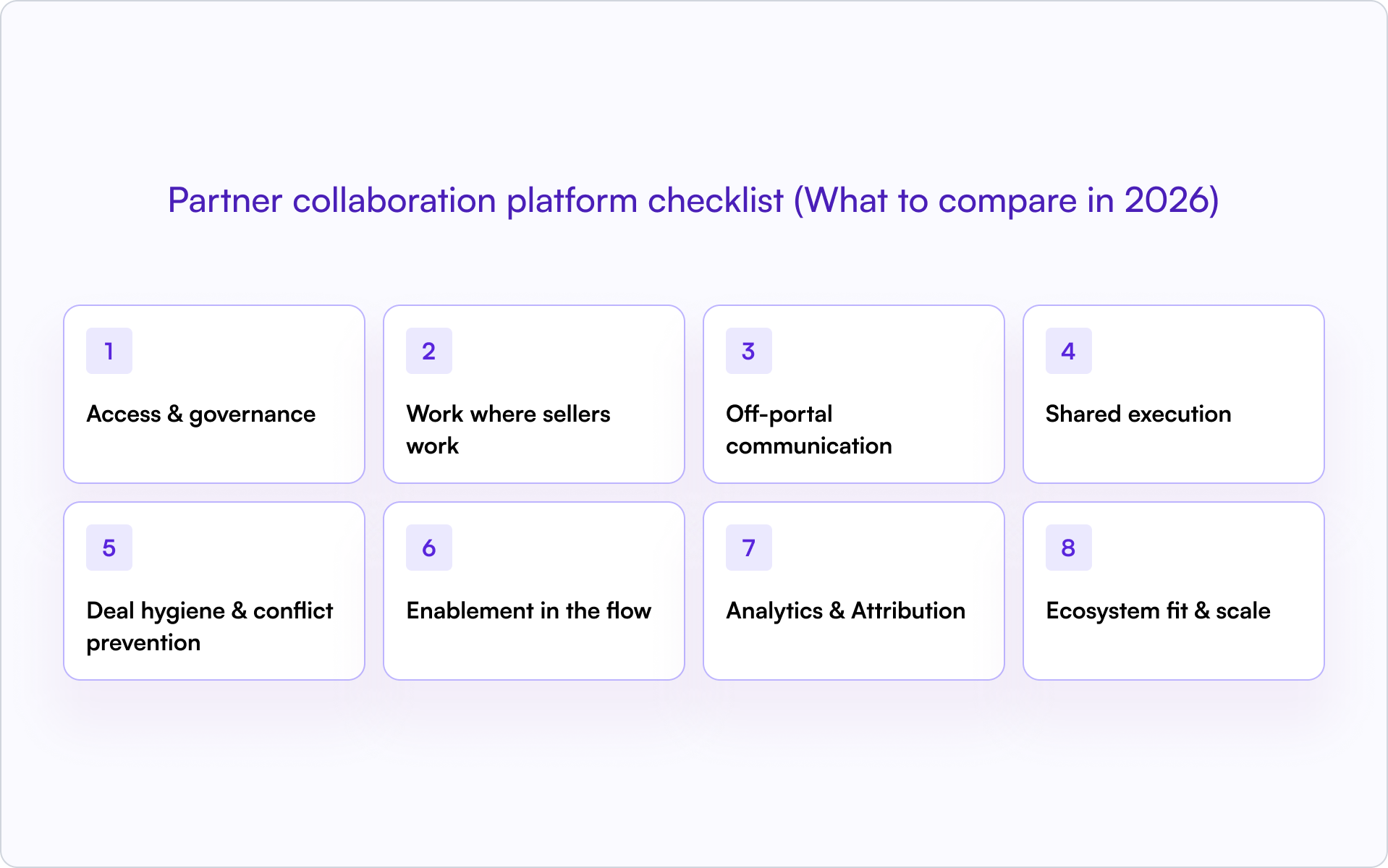
Partner collaboration platform checklist (What to compare in 2026)
When evaluating a partner collaboration platform, don’t get distracted by feature lists. Focus on what protects your CRM, improves deal flow, and keeps partner relationships aligned across the entire partner lifecycle.
Use this checklist to compare partner collaboration tools and the top PRM platforms for partner collaboration in 2026.
Strong partner management depends on choosing PRM software that keeps collaboration inside your CRM instead of pushing it into disconnected partner portals.
If you’re evaluating partner relationship management software or comparing CRM alignment, the right CRM for partner management should make collaboration visible inside your existing systems, not outside them.
Once you’ve pressure-tested the criteria, the real question is simple: which partner collaboration platforms can actually check these boxes?
Partner collaboration platform shortlist
Not every PRM platform is built for real collaboration. This shortlist focuses on partner collaboration platforms that keep deal flow visible, reduce channel conflict, and support structured execution across the entire partner lifecycle.
1) Introw – CRM-native collaboration for modern partner programs
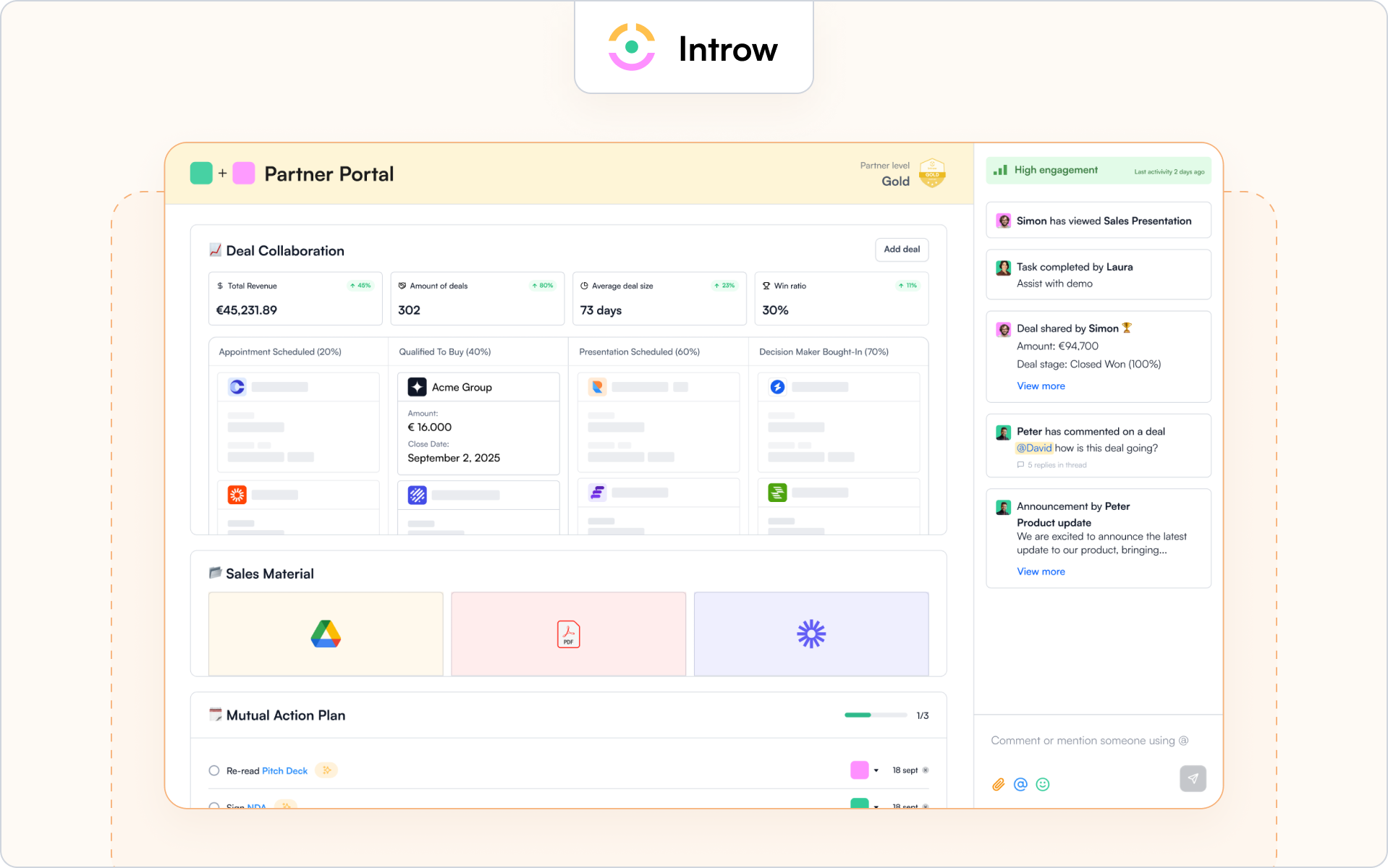
Who it’s for
Introw is built for SaaS companies running reseller programs, referral programs, and strategic partnerships that need collaboration tied directly to pipeline. It’s a strong fit for revenue teams that live inside CRM and don’t want another disconnected PRM software layer.
If your sales team works in Salesforce or HubSpot and your partner management motion depends on shared deal context, this is designed for you.
Why it stands out
Introw is a partner collaboration platform that keeps shared work anchored inside your CRM instead of pushing it into isolated partner portals. Collaboration happens where sellers already work, with native Salesforce integration and HubSpot integration.
That means partner engagement, deal registration, and shared execution stay connected to real deal flow. No duplicate systems. No manual data entry just to understand what your channel partner is doing.
It also gives you governed visibility. Different partner types see only what they should, which helps prevent channel conflict before it escalates.
Key collaboration features
- CRM-first collaboration with field-level visibility controls and full audit logs.
- Off-portal email and Slack threads that attach to opportunities and write back automatically.
- Partner-safe pipeline views and structured deal registration workflows to reduce channel conflict.
- Shared execution tools, such as assigned next steps and action tracking tied directly to the opportunity.
- A configurable partner portal that supports dynamic partner portals without breaking CRM alignment.
Where it may not fit
If you’re only looking for basic partner portals to host marketing materials or need a lightweight free plan for simple referral programs, this may feel more robust than you need.
Introw is built for teams that want collaboration, governance, and CRM integration working together as a unified system.
Request a demo to see how collaboration works directly inside your CRM.
2) Impartner: PRM suite with collaboration spaces at enterprise scale
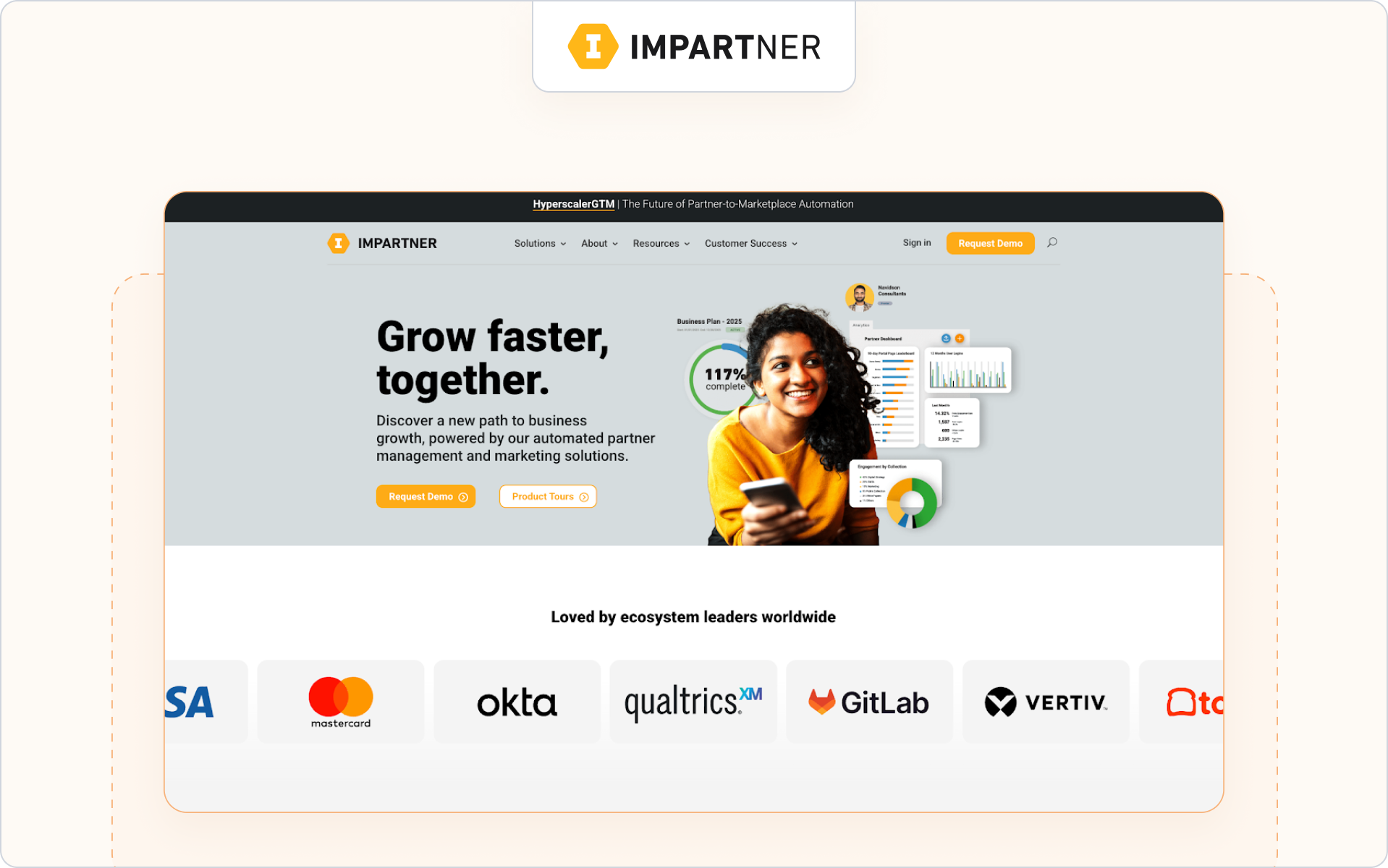
Who it’s for
Teams evaluating Impartner are typically enterprise brands and SaaS companies running structured partner programs across multiple partner types and regions.
Why it stands out
Impartner is a full partner relationship management PRM suite built for governance-heavy environments. It combines partner portals, deal registration, lead distribution, and marketing automation across the entire partner lifecycle.
Key collaboration features
- Configurable partner portals with workflow-based deal registration.
- Structured collaboration spaces and task tracking.
- Performance tracking and reporting across channel programs.
Where it may not fit
For teams prioritizing CRM-first collaboration embedded directly in deal flow, it can feel portal-centric and introduce a steep learning curve.
3) Channelscaler: enterprise partner operations and enablement platform
Who it’s for
Teams evaluating Channelscaler are typically enterprise SaaS companies running structured partner programs across reseller programs and channel partnerships.
Why it stands out
Channelscaler combines partner relationship management, partner onboarding, and marketing execution inside a governance-focused PRM software environment built for complex partner ecosystems.
Key collaboration features
- Configurable partner portals with structured deal registration and lead distribution.
- Partner onboarding workflows tied to channel programs.
- Performance tracking dashboards across the entire partner lifecycle.
Where it may not fit
If your priority is CRM-native collaboration embedded directly inside opportunity records, it may feel portal-driven rather than collaboration-first.
4) Channeltivity: lightweight collaboration for mid-market
Who it’s for
Teams exploring Channeltivity are often mid-market SaaS companies running structured reseller programs without enterprise complexity.
Why it stands out
Channeltivity focuses on practical partner management, clean deal registration, and accessible partner portals that support day-to-day collaboration.
Key collaboration features
- Structured deal registration and lead distribution workflows.
- Task management and communication inside partner portals.
- Reporting dashboards for partner performance and revenue contribution.
Where it may not fit
For complex partner ecosystems or layered strategic partnerships, collaboration depth and governance controls may be limited.
5) PartnerStack: marketplace-driven collaboration for affiliates and resellers
Who it’s for
Companies evaluating PartnerStack are typically SaaS companies scaling referral programs and reseller programs through marketplace-based partner discovery.
Why it stands out
PartnerStack combines partner management with marketplace infrastructure. It supports automated onboarding, automated marketing campaigns, and partner revenue tracking.
Key collaboration features
- Marketplace-based partner discovery and onboarding.
- Deal tracking and attribution for referral programs.
- Performance tracking tied to revenue contribution.
Where it may not fit
If your priority is structured co-sell collaboration embedded inside CRM deal flow, it may feel acquisition-focused rather than collaboration-first.
6) Crossbeam: account mapping plus partner rooms
Who it’s for
Teams considering Crossbeam are SaaS companies focused on account mapping and strategic partnerships with tech partners.
Why it stands out
Crossbeam strengthens partner discovery by securely comparing partner data. It’s strong at the discovery → collaboration transition before formal deal registration.
Key collaboration features
- Secure account mapping between business partners.
- Partner rooms for shared visibility and early-stage coordination.
- CRM integration to push insights back to the sales team.
Where it may not fit
It is not full partner relationship management software. It complements PRM platforms rather than replacing deal registration or partner portals.
7) PartnerTap: account mapping and co-sell collaboration
Who it’s for
Companies considering PartnerTap are typically SaaS companies and tech partners focused on account mapping and co-sell collaboration across strategic partnerships.
Why it stands out
PartnerTap centers collaboration around secure partner data sharing and shared visibility into deal flow before formal deal registration.
Key collaboration features
- Secure account mapping across business partners.
- Shared pipeline visibility for co-sell motions.
- CRM integration to sync collaboration insights to the sales team.
Where it may not fit
It complements PRM platforms but does not replace full partner relationship management software for channel management or partner portals.
8) Unifyr: channel marketing and partner operations platform
Who it’s for
Companies evaluating Unifyr are typically enterprise SaaS companies and tech companies running distributed channel programs with strong marketing execution requirements.
Why it stands out
Unifyr, formerly Zift Solutions, combines partner relationship management, through channel marketing automation, and campaign execution inside a unified platform. It is built for organizations managing structured reseller programs and large partner ecosystems.
Key collaboration features
- Through channel marketing automation and campaign distribution across partner portals.
- Structured deal registration and lead distribution workflows.
- Performance tracking dashboards tied to partner engagement and revenue contribution.
Where it may not fit
If your priority is CRM-first collaboration embedded directly inside deal objects, it may feel more marketing-centric than collaboration-native.
9) Slack with Salesforce or HubSpot apps: flexible “bring your own” collaboration
Who it’s for
Teams combining Slack with Salesforce PRM or HubSpot are usually SaaS companies wanting flexible collaboration tools tied loosely to CRM integration.
Why it stands out
This approach keeps conversations in Slack while pinning threads or notifications to CRM records. It can reduce manual data entry if configured well.
Key collaboration features
- Channel-based collaboration across internal and external teams.
- CRM notifications and updates pushed into Slack.
- Flexible routing across partner types and territories.
Where it may not fit
It requires strong governance to prevent channel conflict and data drift. It is not a unified platform or full PRM software solution.
10) Notion with CRM sync: mutual plans and shared hubs
Who it’s for
Teams using Notion with CRM sync are typically modern SaaS companies wanting lightweight collaboration for mutual action plans.
Why it stands out
Notion can serve as a shared workspace for file hubs, execution plans, and documentation across partner relationships.
Key collaboration features
- Mutual action plan templates.
- Shared file and documentation hubs.
- CRM sync for visibility into deal flow.
Where it may not fit
It requires governance wrappers to prevent channel conflict and lacks built-in deal registration or structured partner management.
11) Monday.com with PRM templates: task-based partner workspaces
Who it’s for
Teams adapting Monday.com for partner programs are usually mid-market SaaS companies needing task tracking and dashboards.
Why it stands out
Monday.com offers flexible boards that support partner onboarding, shared tasks, and light partner management.
Key collaboration features
- Task boards for deal flow and partner onboarding.
- Dashboards for performance metrics.
- Integrations with CRM systems.
Where it may not fit
It is not purpose-built PRM software and may require manual data entry to maintain partner data alignment.
12) Gainsight Customer Communities: external community-led collaboration
Who it’s for
Organizations using Gainsight Customer Communities are typically enterprise brands focused on post-sale collaboration with active partners.
Why it stands out
It supports structured communities for partner engagement and shared resources across complex partner ecosystems.
Key collaboration features
- Community-based collaboration for active partners.
- Content sharing and discussion threads.
- Reporting dashboards for engagement metrics.
Where it may not fit
It is less sales-centric and does not replace PRM platforms for deal registration, lead distribution, or CRM-native co-sell execution.
If you want, next we can trim further by tightening repetitive phrasing across tools while preserving keyword density.Summary
A long feature list doesn’t guarantee better collaboration.
The question now isn’t which platform has the most features. It’s which one actually improves how your sales team and your channel partner work together.
How to implement partner collaboration in 30–45 days
You don’t need a six-month rollout. You need structure, ownership, and clear guardrails. Here’s a practical way to stand up partner collaboration across your partner programs in 30–45 days.
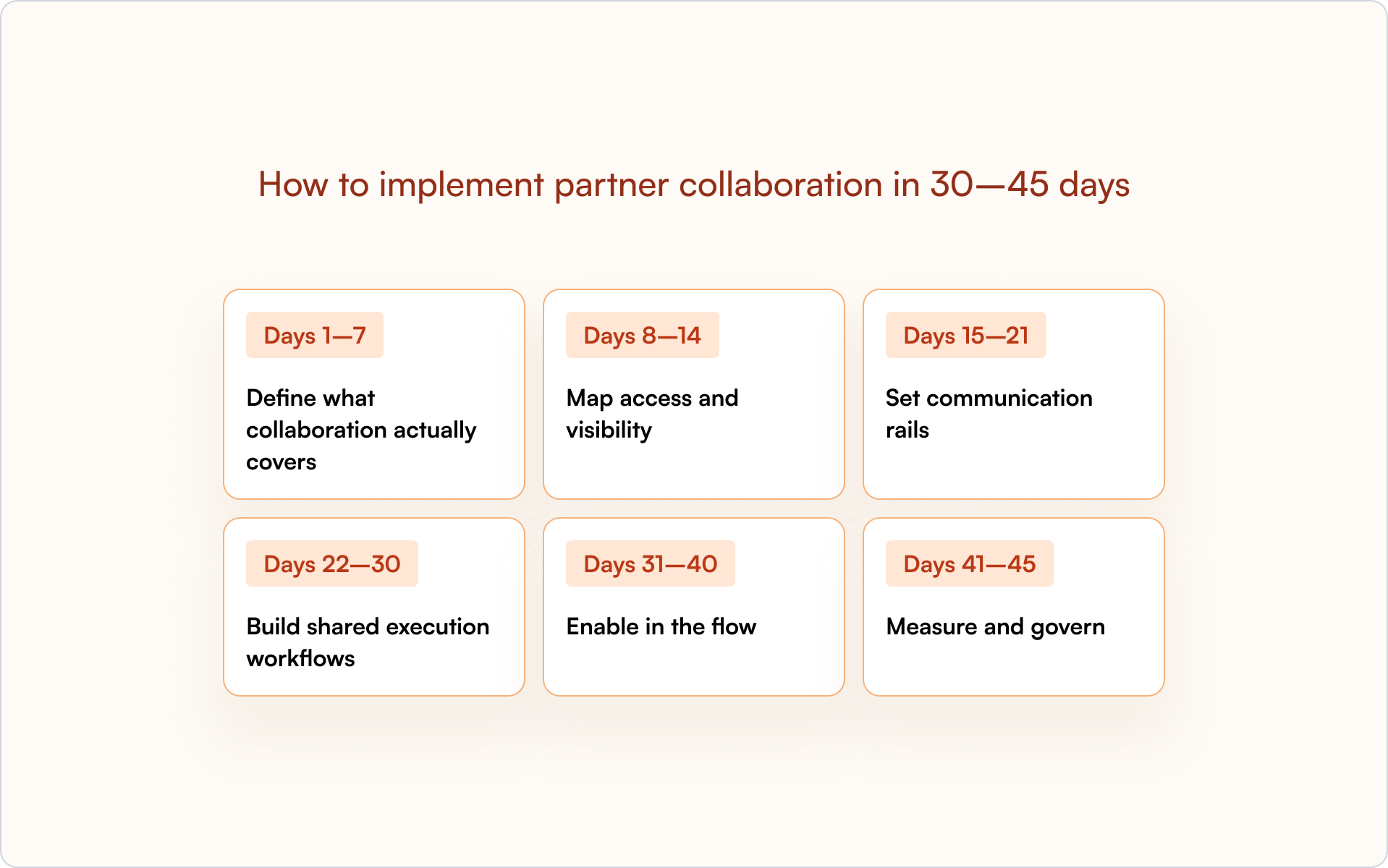
Days 1–7: define what collaboration actually covers
Start by defining the collaboration objects inside your CRM.
- Decide which objects partners can collaborate on: opportunities, accounts, renewals, and expansions.
- Clarify how deal registration connects to those objects.
- Align on how this supports the entire partner lifecycle, not just new deals.
If this step is vague, partner relationships will stay vague.
Days 8–14: map access and visibility
Next, design access before inviting partners in.
- Map fields, sections, and roles by partner type.
- Define what each channel partner, tech partner, or reseller can see and edit.
- Set time-bound links and expiration rules to protect partner data.
The goal is simple: prevent channel conflict before it happens.
Days 15–21: set communication rails
Now decide how communication works.
- Define Slack and email collaboration channels tied to opportunities.
- Enable reply-by-email so off-portal updates write back to your CRM.
- Set routing rules by territory or role so the right partners are looped in.
This removes manual data entry and keeps deal flow visible to your sales team.
Days 22–30: build shared execution workflows
Collaboration without structure creates noise. Add shared execution.
- Create mutual action plan templates for source, co-sell, and renewal motions.
- Assign next steps with owners and due dates.
- Align SLAs across partner programs and reseller programs.
This is where collaboration turns into measurable partner performance.
Days 31–40: enable in the flow
Support partners without pushing them into separate portals.
- Surface certification status inside the deal context.
- Recommend content and marketing materials by stage.
- Make it easy for new partners to complete onboarding without leaving the workflow.
This increases partner engagement and partner adoption.
Days 41–45: measure and govern
Finally, make collaboration measurable and auditable.
- Build dashboards for touches, time-to-stage movement, and win rate.
- Track channel conflict rate and revenue contribution across partner types.
- Review audit logs and refresh safelists quarterly.
When collaboration is visible, governed, and tied to performance tracking, it becomes part of your partner management discipline, not just another tool.
Remember: Structure first. Tools second.
That’s exactly the kind of collaboration Introw was built to support.
Why Introw for partner collaboration
Most PRM platforms add structure. Introw focuses on how work actually moves between your sales team and your channel partner.
It is built around one idea: a partner collaboration platform should live inside your CRM, not around it. That’s what separates partner relationship management PRM in theory from collaboration in practice.
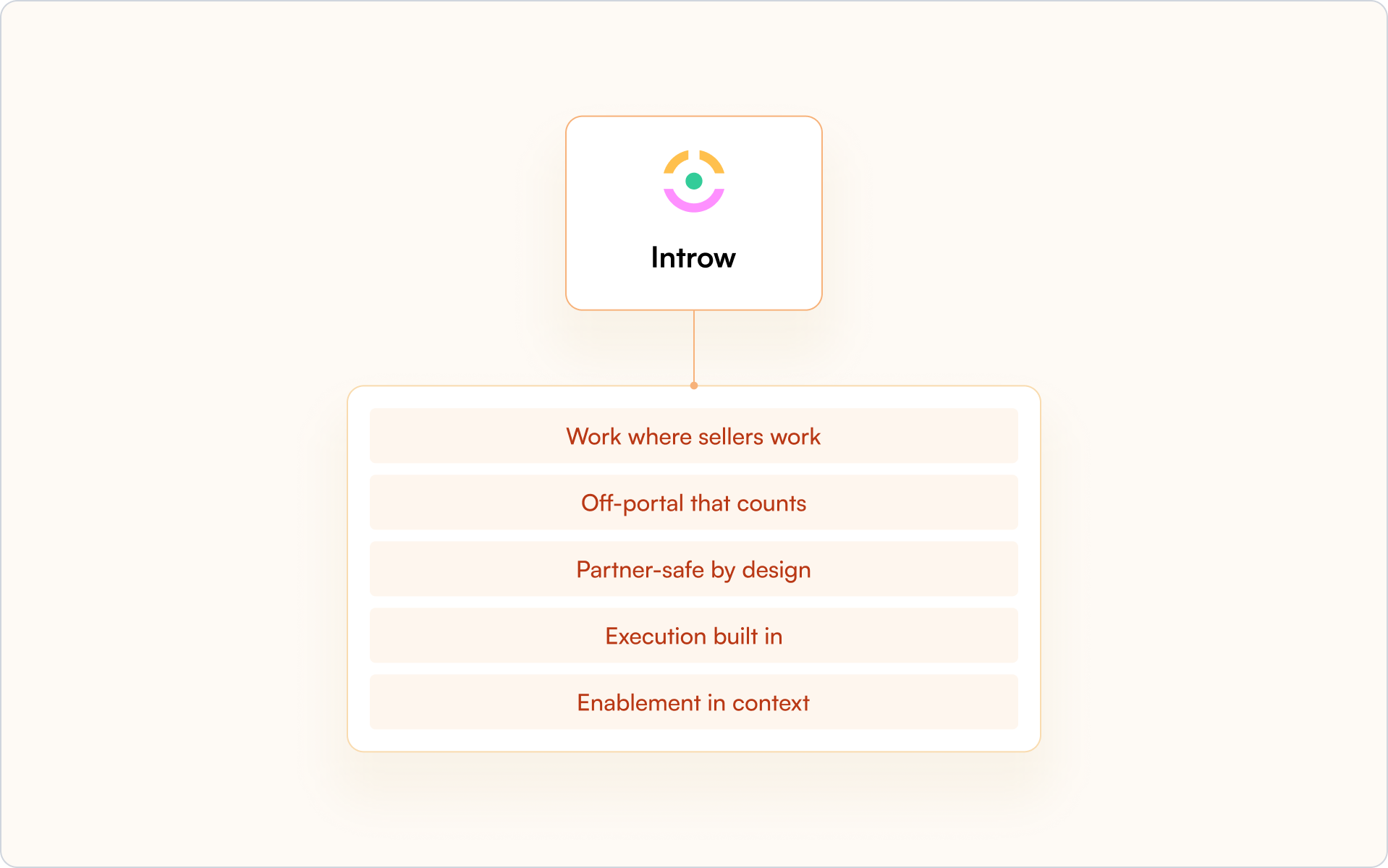
Work where sellers work
Introw runs natively inside Salesforce and HubSpot through its Salesforce and HubSpot integration. Collaboration lives in the side panel of the opportunity or account, not in a separate portal.
Your sales team does not switch tools. Your tech partners do not lose context. Deal flow stays visible across the entire partner lifecycle.
Off-portal that counts
Partners reply by email or Slack, and the conversation attaches directly to the right opportunity. No copy-paste. No manual data entry.
Every update writes back to your CRM, so partner data, deal registration activity, and shared execution stay connected.
Partner-safe by design
Introw uses field-level safelists, role mapping, time-bound links, and full audit trails. Each partner type sees only what they should.
That protects partner relationships and helps prevent channel conflict across complex partner ecosystems.
Execution built in
Collaboration is not just conversation. Introw supports assigned tasks, mutual action plans, conflict flags, and surfaced deal and lead registration context inside the thread.
Instead of adding another feature-rich platform to manage, collaboration becomes part of your channel programs and partnership programs.
Enablement in context
Training and certification status from your partner LMS can surface directly in the deal view. Content recommendations appear based on the stage.
Partner onboarding and partner engagement happen inside the flow of work, not in disconnected partner portals.
Your next steps
- Map where collaboration currently breaks down between your sales team and your partners.
- Identify which partner types need governed visibility and which fields must stay protected.
- Decide whether your current PRM software truly supports collaboration inside your CRM.
If not, you are likely evaluating the best PRM software based on features instead of execution.
Request a demo to see a 10-minute collaboration flow inside Salesforce or HubSpot.
Further reading
If you are refining your broader partner strategy, explore some of our other guides:
- Practical guidance on scaling partner engagement
- A structured approach to partner enablement
- How to align collaboration with your overall partnership marketing

