

.svg)


.svg)
.svg)







Partner-Management
Tipps, Taktiken und Tools für Partnermanager, die ihren Umsatz steigern, das Engagement fördern und skalierbare, CRM-orientierte Partnerprogramme durchführen möchten.
Neueste Artikel
13 Mindmatrix PRM Alternatives for Growing Partner Teams in 2026
What Is Mindmatrix (And Why Teams Look for Alternatives)
Mindmatrix is an established partner management and sales enablement platform combining PRM, marketing automation, partner training, and TCMA in one platform. For large channel sales teams, that breadth can be useful.
But many teams now want faster onboarding, simpler admin controls, and deeper CRM execution.
.png)
1. Steep learning curve
Mindmatrix has no separate admin experience. Partnership managers work inside the same interface as partners, which increases complexity and slows onboarding.
2. LMS updates require support
Mindmatrix includes partner training and LMS features, but many updates require support involvement.
Tools like Introw’s partner LMS give your team direct control instead.
3. Long implementation timelines
Mindmatrix covers a wide range of features, but setup can take months.
Teams wanting faster rollout often move toward tools built natively for HubSpot or Salesforce.
4. Limited role-based access
Granular visibility controls are limited.
That becomes difficult when different partner tiers need different dashboards, deals, content, or onboarding paths.
5. Portal-heavy workflows
Mindmatrix is still largely portal-centric.
There’s no native CPQ, no Slack-based collaboration, and no off-portal workflows tied directly into tools like deal and lead registration.
6. AI focused more on content than execution
BridgeAI is strong for content generation, email marketing, and social selling.
But it does not execute actions across live deals through tools like the AI agent.
If you want faster onboarding, simpler admin, and CRM-native execution, a Mindmatrix alternative may be a better fit.
Mindmatrix alternatives at a glance
Here’s a quick comparison of the top Mindmatrix alternatives before we break each platform down in more depth.
While it might be tempting to focus on a tool with all the features, the right fit depends on how your teams engage partners, manage opportunities, and scale channel sales over time.
13 Best Mindmatrix Alternatives in 2026
#1 Introw - Best overall Mindmatrix alternative for CRM-native partner management
.png)
What it does
Introw is an AI-first partner management platform for teams running on HubSpot or Salesforce. It combines onboarding, deal registration, sales enablement, CPQ, MDF, dashboards, training, and partner engagement in one platform.
Unlike Mindmatrix PRM, Introw is built directly around the CRM. Partner data, opportunities, onboarding, and reporting sync bi-directionally with Salesforce and HubSpot.
Partners can collaborate through Slack and email without relying on portal logins. The partner portal is fully white-labeled, no-code, and supports granular role-based access.
Why teams choose Introw over Mindmatrix
Most teams leaving Mindmatrix want:
- Faster onboarding
- Less admin overhead
- Better CRM execution
Introw gives partnership managers direct control over training, LMS updates, onboarding, access, automations, and partner programs without support tickets or developer work.
It also goes much deeper on execution AI. While Mindmatrix focuses heavily on content generation and marketing automation, Introw’s AI acts across live partner workflows and deals instead.

Examples include:
- Deal registration from Slack or email
- AI deal coaching tied to live CRM opportunities
- CRM-triggered partner engagement
- AI-generated QBR insights
- AI-built onboarding and training flows
If your team wants faster onboarding, simpler workflows, and AI that reduces manual work, Introw is one of the strongest top Mindmatrix alternatives available today.
Where Introw stands out
- Native Salesforce and HubSpot integrations
- Full custom object support
- Agentic AI workflows
- Self-service LMS with AI course creation
- Granular role-based access
- Native CPQ
- Zusammenarbeit außerhalb des Partnerportals
- Native Claude MCP integration
- 2–4 day onboarding
- No-code admin experience
CRM integrations
Native Salesforce and HubSpot integrations with deep bi-directional sync.
Preise
Custom pricing. Request a free demo for current pricing and onboarding details.
Am besten geeignet für
SaaS teams with multiple partner managers that want a modern PRM they can run themselves.
If you’re still comparing tools, our guides on partner relationship management software and partner management systems are also useful starting points.
#2 Impartner - Best for enterprise-scale PRM with broad module coverage
.png)
What it does
Impartner is an enterprise PRM platform covering partner portals, lifecycle management, marketplaces, and marketing automation.
Why someone might choose it
It offers broad enterprise functionality and strong marketplace capabilities for large channel sales programs.
Where it falls short
- 3–12 month onboarding timelines
- Middleware CRM architecture
- Dated admin experience
- Heavy operational overhead
Teams moving from Mindmatrix may still face similar complexity.
CRM integrations
Salesforce integrations through middleware.
Preise
Individuelle Preisgestaltung für Unternehmen.
Am besten geeignet für
Large enterprises committed to broad PRM deployments.
Our guide to the best Impartner competitors covers additional options.
#3 Zinfi - Best for large-scale unified channel management
.png)
What it does
Zinfi combines partner management, marketing automation, onboarding, analytics, and partner marketing in one platform.
Why someone might choose it
It works well for large multi-tier partnerships and complex global channel sales structures.
Where it falls short
- Complex setup
- Dated interface
- Heavy configuration needs
- High admin overhead
CRM integrations
Salesforce and Microsoft Dynamics.
Preise
Individuelle Preisgestaltung für Unternehmen.
Am besten geeignet für
Large enterprises managing complex partner ecosystems.
See how it compares in our guide to the best Zinfi alternatives.
#4 PartnerStack - Best for affiliate and referral program automation
.png)
What it does
PartnerStack focuses on affiliate, referral, and payout automation with a built-in marketplace.
Why someone might choose it
It’s easier to start, easy to use, and built for referral-driven growth.
Where it falls short
- Workato middleware sync
- Transaction fees
- Rigid portal experience
- Limited co-sell support
- No two-tier workflows
CRM integrations
HubSpot and Salesforce through Workato.
Preise
Plans start at $1000/month for marketing programs and $1250/month for co-sell programs. Enterprise pricing is custom.
Am besten geeignet für
Businesses focused mainly on affiliate and referral programs.
Explore our guide to the best PartnerStack alternatives.
#5 Salesforce Experience Cloud (Partner Cloud) - Best for Salesforce-first businesses
.png)
What it does
Salesforce Experience Cloud is Salesforce’s portal framework for building partner experiences directly inside Salesforce.
Why someone might choose it
It keeps customer data, reporting, security, and workflows entirely inside Salesforce.
Where it falls short
- Heavy developer dependency
- No self-service admin layer
- Long implementation time
- No built-in LMS
- No AI partner workflows
CRM integrations
Native Salesforce integration.
Preise
Partner Community pricing starts at $20/login/month or $50/member/month billed annually.
Am besten geeignet für
Large Salesforce businesses with internal development resources.
If Salesforce depth matters most, review these best Salesforce PRM alternatives.
#6 ChannelScaler - Best for incentive and rebate management
.png)
What it does
ChannelScaler combines PRM, MDF, rebates, incentives, and partner workflows after the Allbound and Channel Mechanics merger.
Why someone might choose it
It offers stronger rebate and incentive management than many competitors.
Where it falls short
- Admin-heavy workflows
- No AI capabilities
- No Slack workflows
- CRM maintenance overhead
- Limited automated partner engagement
CRM integrations
Salesforce and HubSpot through middleware.
Preise
Custom pricing.
Am besten geeignet für
Teams focused heavily on rebates, incentives, and MDF workflows.
Our guide to the best ChannelScaler alternatives will give you more context.
#7 Kiflo - Best for SMBs launching a first partner program
.png)
What it does
Kiflo is lightweight partner management software designed for smaller teams starting their first PRM.
Why someone might choose it
It’s simpler, faster, and easier to manage than Mindmatrix.
Where it falls short
- No AI
- No LMS
- No CPQ
- No two-tier support
- Limited CRM depth
CRM integrations
Basic Salesforce and HubSpot integrations.
Preise
Core plans start at $399/month billed annually. Plus plans are custom priced.
Am besten geeignet für
Small teams with straightforward partner programs.
Explore our roundup of top Kiflo alternatives.
#8 Euler - Best for modern PRM with advisory AI

What it does
Euler is a newer PRM platform focused on onboarding, partner engagement, and advisory AI assistants.
Why someone might choose it
It offers a cleaner experience and lighter setup than traditional enterprise platforms.
Where it falls short
- No LMS
- No MDF
- No custom object support
- Limited onboarding depth
- No white-label portal
CRM integrations
Basic Salesforce and HubSpot integrations.
Preise
Custom pricing.
Am besten geeignet für
Early-stage teams wanting a modern interface without enterprise complexity.
Our guide on the best Euler PRM alternatives compares more options.
#9 Magentrix - Best for Salesforce-native portal management
.png)
What it does
Magentrix is a Salesforce-native portal platform for partner and customer collaboration.
Why someone might choose it
It offers a more focused portal experience without the broader TCMA depth of Mindmatrix.
Where it falls short
- Salesforce-only
- Portal-centric workflows
- Limited AI features
- Less automation depth
CRM integrations
Native Salesforce integration.
Preise
Custom pricing.
Am besten geeignet für
Salesforce-only businesses focused on partner portals.
See how it compares in our guide to the best Magentrix alternatives.
#10 Channeltivity - Best for mid-market partner programs
.png)
What it does
Channeltivity is mid-market PRM software covering deal registration, onboarding, MDF, and reporting dashboards.
Why someone might choose it
It’s easier to deploy and easier to manage than larger enterprise platforms.
Where it falls short
- Limited AI
- No off-portal collaboration
- Limited CRM depth
- Less flexible workflows
CRM integrations
Salesforce integration.
Preise
Custom mid-market pricing.
Am besten geeignet für
Mid-market teams wanting straightforward partner management.
Our guide on the best Channeltivity competitors covers similar tools.
#11 Partner.io - Best for pipeline-focused partner collaboration
.png)
What it does
Partner.io focuses on partner collaboration, pipeline visibility, and co-selling workflows.
Why someone might choose it
It offers a lighter and more modern approach to shared sales workflows.
Where it falls short
- Smaller customer base
- Narrower feature depth
- Less mature ecosystem
CRM integrations
Salesforce and HubSpot integrations.
Preise
Custom pricing.
Am besten geeignet für
Teams prioritizing pipeline visibility and co-sell collaboration.
Take a closer look at our guide to Partner.io alternatives for another overview or our Introw vs. Partner.io page to see a direct comparison.
#12 Impact - Best for affiliate and influencer partnerships
.png)
What it does
Impact focuses on affiliate, influencer, and referral partnerships with automated payouts and tracking.
Why someone might choose it
It’s much stronger than Mindmatrix for influencer and performance marketing workflows.
Where it falls short
- Not traditional PRM software
- Limited reseller support
- Limited co-sell workflows
- Limited CRM depth
CRM integrations
Basic CRM integrations with limited depth.
Preise
Custom pricing with transaction fees.
Am besten geeignet für
Marketing teams focused on affiliate and influencer partnerships.
#13 Everflow - Best for high-volume affiliate tracking
.png)
What it does
Everflow is performance marketing software focused on affiliate, referral, and influencer tracking.
Why someone might choose it
It delivers strong analytics, fraud prevention, and real-time tracking for high-volume programs.
Where it falls short
- No PRM workflows
- No LMS
- No onboarding
- No deal registration
- No partner portal
CRM integrations
Limited CRM integrations.
Preise
Starts around $750/month.
Am besten geeignet für
Teams focused on affiliate tracking rather than full partner management.
If you still need help comparing categories, this 2025 guide to choosing your next PRM can help you narrow down the right fit.
Das Fazit
Mindmatrix PRM still works well for large enterprise marketing and channel sales programs.
But many teams now want faster onboarding, simpler admin, deeper CRM integration, and AI that helps move deals forward instead of just generating content.
That’s where newer alternatives stand out.
Introw combines CRM depth, agentic AI, CPQ, partner portals, dashboards, and partner engagement in one platform without long implementation projects.
Its AI helps teams route leads, surface opportunities, automate approvals, and engage partners across the full lifecycle.
You also get:
- Self-service admin controls
- Granular security and partner access
- Native Salesforce and HubSpot integrations
- AI-powered dashboards and reporting
- Faster onboarding and time to value
- Easy ways to integrate sales and marketing data
- Flexible solutions for co-sell, reseller, referral, and affiliate partnerships
If your business wants a modern PRM platform your team can actually run themselves, Introw is one of the top alternatives to compare.
Why teams choose Introw when looking for Mindmatrix alternatives
Here’s what happens when businesses move from Mindmatrix to Introw.
+70% more partner pipeline
Introw helps partners register more leads and opportunities without adding admin work.
Deal registration syncs directly into your CRM, AI conflict detection improves channel sales visibility, and partners can engage through Slack or email instead of relying on portal logins. That creates a more efficient experience for both sales and marketing teams.
+75% faster partner onboarding
Go live in days, not months.
Introw gives you one platform for onboarding, sales enablement, training, dashboards, certifications, partner engagement, and partner communication. No custom coding. No support dependency. No waiting to update products, courses, or onboarding flows.
+60% more partner-influenced revenue
Get clear partner attribution tied directly to CRM data.
AI deal coaching helps partners move deals forward at the right time, while automated engagement and email marketing help keep customers, resellers, referral partners, and co-sell partnerships active long term.
You also get the flexibility to integrate your existing sales and marketing software, leverage live customer data, and create scalable partner programs without rebuilding your entire service model.
Interested to see how Mindmatrix compares to Introw?
Book a demo and get started on a faster, easier partner management experience.
15 Zinfi PRM Alternatives to Manage and Grow Your Partner Channel in 2026
What Is Zinfi (And Why Teams Look for Alternatives)
Many teams evaluating Zinfi PRM want one platform for partner management, onboarding, MDF, analytics, deal registration, and partner portals. Zinfi positions itself as a Unified Channel Management platform built for large partner ecosystems with distributors, resellers, MSPs, and referral partners.
If your business needs deep customization and broad module coverage, Zinfi can fit well. But many teams start evaluating other partner relationship management software once implementation speed, CRM alignment, and partner adoption become concerns.
.png)
1. Complex and lengthy implementations
Zinfi’s broad module set requires significant setup before your team can fully use the platform. Many businesses spend weeks or months configuring workflows, branding, forms, automations, and integrations.
For teams that need to move quickly, long implementation timelines slow onboarding and revenue generation.
2. Partner data lives in Zinfi, not the CRM
Zinfi operates as its data layer instead of a deeply CRM-native platform.
Partner data, leads, deals, and engagement activity often need ongoing syncing between Zinfi and Salesforce, HubSpot, or Dynamics. That creates extra admin work and weaker real-time visibility for sales teams.
For CRM-first organizations, this can become a major limitation.
3. Dated UI and steep admin learning curve
Verified reviews regularly mention a dated interface and complex admin experience.
Partners may struggle with navigation, while internal teams typically require extensive training before managing workflows confidently. An intuitive interface matters because low adoption hurts partner performance.
4. Heavy configuration and ongoing maintenance
Zinfi offers extensive customization across workflows, automations, portal pages, and partner program structures.
The tradeoff is ongoing maintenance. Simple changes may require support involvement, dedicated admin users, or additional setup work.
This is one reason many buyers start comparing modern partner management systems with simpler admin experiences.
5. No off-portal collaboration or agentic AI
Zinfi remains heavily portal-centric.
Your partners typically need to log in to manage deals, collaboration, training, and updates. Native Slack collaboration, email-based co-selling, and agentic AI workflows are limited compared to newer tools built around automation and real time engagement.
6. Enterprise pricing for enterprise complexity
Zinfi’s pricing reflects its enterprise positioning.
If your team only uses part of the platform, the cost-to-value ratio can feel difficult to justify. This is especially true for growing programs that want faster setup and lower operational overhead.
You should review our guide on choosing the right PRM before committing to a long-term platform.
Zinfi alternatives at a glance
Use this table to compare the main categories before you review each tool in detail.
The right Zinfi alternative depends on how much complexity your team actually needs and how quickly you need your partner program live.
15 Best Zinfi Alternatives in 2026
If your team is frustrated by slow implementations, heavy admin work, or partner data living outside your CRM, these are the Zinfi alternatives worth looking at first.
#1 Introw - Best overall Zinfi alternative for CRM-native partner management
What it does: Introw is an AI-first PRM built directly on HubSpot and Salesforce. It includes AI-powered partner management, MDF workflows, CPQ, account mapping, role-based permissions, and a no-code partner portal builder.
Why someone might choose it over Zinfi: Partner data stays inside your CRM instead of a separate platform. Your sales and partner teams work from the same source of truth with deep native integrations for Salesforce and HubSpot. Setup typically takes 2 to 4 days.
Introw also includes AI-powered deal registration, Slack collaboration, email-based co-selling, and real-time pipeline visibility without forcing partners into the portal for every workflow.
The platform’s AI agent can automate onboarding, QBR preparation, announcements, coaching, and partner support.
Introw also includes a native Claude integration for AI-powered partner workflows and deal guidance.
For onboarding and enablement, Introw includes a self-service partner LMS with AI-generated courses, certifications, training, and partner documents tied directly to CRM data.
Where it falls short:
- Built primarily for Salesforce and HubSpot users
- Less TCMA depth than some enterprise suites
- Best fit for SaaS and modern revenue teams
CRM integrations: Native bi-directional integrations for Salesforce and HubSpot.
Pricing: Custom pricing.
Best for: SaaS teams with 2+ channel managers that want CRM-native partner relationship management without enterprise complexity.
If your team is tired of waiting months for implementation or relying on support for simple workflow changes, compare Introw directly against Zinfi or request a demo to see the workflows live.
#2 Partner.io - Best for pipeline-focused partner collaboration
.png)
What it does: Partner.io focuses on co-selling, shared pipeline visibility, partner collaboration, and partner engagement for revenue teams.
Why someone might choose it over Zinfi: Faster setup, lighter onboarding, and a more modern approach to partner collaboration and deals.
Where it falls short:
- Smaller feature set
- Limited TCMA
- Limited LMS functionality
- Smaller customer base
CRM integrations: Salesforce and HubSpot.
Pricing: Solo starts at $79/month, Growing at $299/month, with custom enterprise pricing.
Best for: Teams prioritizing co-sell workflows and pipeline collaboration.
You can compare additional Partner.io alternatives before making a final decision. We also have a comparison page so you can evaluate Partner.io against Introw.
#3 Salesforce Experience Cloud - Best for Salesforce-only organizations wanting full native control
What it does: Salesforce Experience Cloud is Salesforce’s native portal framework for customers, partners, onboarding, support, and collaboration.
Why someone might choose it over Zinfi: All partner data stays fully inside Salesforce with maximum security, customization, and control.
Where it falls short:
- Requires developer resources
- Long implementation cycles
- No built-in LMS
- No off-portal collaboration
- No agentic AI
- Difficult for non-technical users to manage
CRM integrations: Salesforce native.
Pricing: $20/login/month or $50/member/month billed annually
Best for: Large Salesforce organizations with dedicated development teams.
Before committing to a custom build, review other Salesforce PRM alternatives.
#4 Impartner - Best for broad enterprise PRM with marketplace capabilities
What it does: Impartner is an enterprise partner relationship management platform covering portals, TCMA, onboarding, marketplaces, partner engagement, and channel automation.
Why someone might choose it over Zinfi: Strong marketplace functionality, broader PRM lifecycle coverage, and enterprise-scale partner management features.
Where it falls short:
- Long implementation timelines
- Middleware CRM synchronization
- Dated UI
- Heavy admin overhead
- Config-heavy setup
CRM integrations: Salesforce and HubSpot via middleware.
Pricing: By request.
Best for: Enterprise teams wanting broad PRM coverage with marketplace capabilities.
Our guide to Impartner competitors compares additional enterprise tools.
#5 PartnerStack - Best for affiliate and referral automation with payouts
.png)
What it does: PartnerStack focuses on affiliate management, referral automation, payouts, and partner recruitment through a built in marketplace.
Why someone might choose it over Zinfi: Simpler onboarding, automated payouts, lower operational overhead, and easier affiliate management.
Where it falls short:
- Limited co-sell workflows
- No distributor support
- Rigid portal experience
- Middleware CRM sync
- Limited support for complex partner ecosystems
CRM integrations: Salesforce and HubSpot via Workato.
Pricing: Marketing plans start at $1000/month billed annually, with enterprise pricing available.
Best for: Teams running affiliate programs and referral partnerships.
See how it compares in our guide to PartnerStack alternatives.
#6 Kiflo - Best for SMBs launching their first partner program
.png)
What it does: Kiflo is a lightweight PRM focused on onboarding, partner portals, deal registration, and partner management for SMBs.
Why someone might choose it over Zinfi: Faster setup, lower cost, intuitive interface, and much simpler onboarding for new partners.
Where it falls short:
- Limited automation
- No AI capabilities
- No LMS
- Limited scalability
- No white-label flexibility
CRM integrations: Basic HubSpot and Salesforce integrations.
Pricing: Core starts at $399/month billed annually, with custom Plus plans.
Best for: SMBs with smaller partner ecosystems and simple workflows.
Take a look at our in-depth guide to Kiflo alternatives.
#7 Euler - Best for newer programs wanting a modern PRM
What it does: Euler is a newer PRM focused on onboarding, partner management, automation, and advisory AI assistants.
Why someone might choose it over Zinfi: Modern UI, lighter setup, and simpler workflows for growing partner programs.
Where it falls short:
- No LMS
- No MDF
- Limited CRM depth
- Limited white-label customization
- Limited enterprise functionality
CRM integrations: Basic Salesforce and HubSpot integrations.
Pricing: Contact for pricing.
Best for: Early-stage teams wanting modern partner management without enterprise overhead.
Explore more in our guide to Euler PRM alternatives.
#8 Mindmatrix - Best for through-channel marketing automation at enterprise scale
.png)
What it does: Mindmatrix combines PRM, TCMA, onboarding, LMS functionality, content automation, and partner recruitment tools inside one enterprise platform.
Why someone might choose it over Zinfi: Stronger TCMA workflows, AI-assisted content generation, and broader tools for recruiting and enabling new partners.
Where it falls short:
- Complex implementation
- Heavy admin experience
- Ongoing support dependency
- Slower onboarding
- Difficult to maintain consistent workflows across modules
CRM integrations: Salesforce and HubSpot.
Pricing: No pricing information available from Mindmatrix directly.
Best for: Enterprise organizations focused heavily on through-channel marketing automation.
Our roundup of Mindmatrix alternatives compares simpler options.
#9 Magentrix - Best for Salesforce-native portal-first partner management
What it does: Magentrix is a Salesforce-native portal platform for partner management, onboarding, collaboration, support, and content sharing.
Why someone might choose it over Zinfi: Partner data stays inside Salesforce with simpler portal management and less enterprise complexity.
Where it falls short:
- Salesforce-only
- Portal-centric workflows
- Limited AI
- No off-portal collaboration
- Limited automation
CRM integrations: Salesforce native.
Pricing: Essential starts at $1500/month, Advanced at $3000/month, with custom enterprise pricing.
Best for: Salesforce organizations wanting focused partner portals without broader TCMA overhead.
Our review of Magentrix alternatives compares newer tools.
#10 Channeltivity - Best for mid-market teams wanting straightforward channel management
.png)
What it does: Channeltivity provides PRM functionality for deal registration, onboarding, partner portals, analytics, and MDF management.
Why someone might choose it over Zinfi: Simpler onboarding, lower operational overhead, and more straightforward partner management for mid-market businesses.
Where it falls short:
- Limited AI
- Limited CRM flexibility
- No off-portal collaboration
- Fewer advanced automation workflows
CRM integrations: Salesforce.
Pricing: Standard starts at $1899/month annually, with CRM Edition at $2199/month.
Best for: Mid-market teams wanting proven PRM software without enterprise complexity.
Our breakdown of Channeltivity competitors covers similar tools.
#11 ChannelScaler - Best for incentive, rebate, and MDF management
What it does: ChannelScaler combines PRM, rebates, incentives, MDF, analytics, onboarding, and automation after the Allbound and Channel Mechanics merger.
Why someone might choose it over Zinfi: Stronger rebate management, incentive automation, and MDF workflows.
Where it falls short:
- Admin-heavy setup
- Support-dependent CRM sync
- Limited AI
- No Slack collaboration
- Steeper learning curve
CRM integrations: Salesforce and HubSpot via middleware.
Pricing: Custom pricing.
Best for: Teams with complex rebate and incentive workflows.
Our comparison of ChannelScaler alternatives explores simpler options.
#12 Unifyr (previously ZiftSolutions) - Best for enterprise channel marketing programs
.png)
What it does: Unifyr combines PRM, TCMA, onboarding, partner marketing automation, and content syndication for enterprise channel programs.
Why someone might choose it over Zinfi: Strong content syndication, campaign automation, and partner marketing support for large organizations.
Where it falls short:
- Heavy implementation requirements
- Support-dependent workflows
- Dated admin experience
- Slower setup
CRM integrations: Salesforce and Microsoft Dynamics.
Pricing: No pricing available
Best for: Large enterprise channel marketing organizations with complex campaign requirements.
#13 Crossbeam - Best for account mapping and ecosystem intelligence
.png)
What it does: Crossbeam helps teams identify account overlap, shared customers, ecosystem opportunities, and partner insights across CRM data.
Why someone might choose it over Zinfi: Stronger ecosystem intelligence, account mapping, and partner overlap analysis.
Where it falls short:
- Not a PRM
- No onboarding
- No deal registration
- No partner portals
- No LMS
CRM integrations: Salesforce and HubSpot.
Pricing: Free plan available, with Starter at $4800/year and custom Supernode pricing for larger GTM teams.
Best for: Teams that need ecosystem intelligence alongside a PRM.
#14 PartnerPortal.io - Best for simple portal deployment
.png)
What it does: PartnerPortal.io focuses on lightweight partner portals, onboarding, content sharing, and communication.
Why someone might choose it over Zinfi: Faster setup, lower cost, and simpler portal deployment for smaller teams.
Where it falls short:
- Limited automation
- No AI
- No TCMA
- Limited CRM depth
- Limited scalability
CRM integrations: Limited.
Pricing: Free plan available, with Professional starting at $249/month and custom enterprise pricing.
Best for: Smaller businesses wanting simple partner portals without enterprise functionality.
#15 360insights - Best for enterprise rebate and incentive management
.png)
What it does: 360insights focuses on rebates, channel incentives, claims processing, and channel revenue management for enterprise partner ecosystems.
Why someone might choose it over Zinfi: Strong rebate workflows, channel claims automation, and incentive management at enterprise scale.
Where it falls short:
- Complex implementation
- Heavy enterprise focus
- Limited partner engagement functionality
- Limited portal flexibility
CRM integrations: Salesforce and enterprise ERP integrations.
Pricing: Contact for pricing
Best for: Enterprise organizations focused heavily on rebates, claims, and incentive programs.
If your team is tired of waiting months for implementation or relying on support for simple workflow changes, focus on tools that keep partner data inside your CRM and reduce admin overhead instead of adding more of it
Das Fazit
Zinfi PRM still makes sense for large enterprise organizations running complex partner ecosystems with heavy TCMA, onboarding, MDF, and distributor management requirements.
But many teams evaluating Zinfi competitors now want something very different:
- CRM-native partner relationship management
- Faster setup and implementation
- Better partner engagement
- Real-time collaboration outside the portal
- AI that helps manage deals and onboarding
- Less admin overhead for channel managers
That shift is why newer Zinfi alternatives like Introw are gaining traction.
Instead of moving partner data into another platform, Introw keeps everything inside Salesforce or HubSpot while helping your teams automate onboarding, deal registration, training, announcements, and partner management workflows with far less operational complexity.
Choosing a platform is really about reducing daily friction for your team and your partners.
Why teams choose Introw when looking for Zinfi alternatives
+70% more partner pipeline
Introw helps teams turn inactive partner ecosystems into real revenue growth. Partners register more deals directly inside the CRM, while real-time conflict detection helps protect data quality and reduce duplicate leads.
Because partners can collaborate through Slack, email, embedded forms, and partner portals, your teams spend less time waiting for users to log in just to track progress or manage deals.
+75% faster partner onboarding
Most Zinfi competitors still require long implementation cycles, admin training, and heavy setup before new partners can start selling.
Introw goes live in 2 to 4 days with AI-powered onboarding, certifications, training, automation, and partner documents built directly into the platform. Your channel managers can manage workflows themselves without technical support or enterprise consulting overhead.
+60% more partner-influenced revenue
Introw keeps partner management, onboarding, attribution, and partner engagement tied directly to Salesforce or HubSpot instead of a separate data layer.
That gives your organizations the ability to automate partner workflows, compare partner performance, recruit new partners faster, and maintain more consistent sales execution across your partner program.
If your team is evaluating Zinfi PRM because the operational cost, setup time, or admin overhead has become too high, Introw is one of the strongest CRM-native alternatives available today.
Ready to compare Introw against Zinfi? Book a demo and see how quickly your team can go live.
12 Channeltivity Competitors to Choose From in 2026
What is Channeltivity (and why teams look for competitors)
Channeltivity is a partner relationship management platform that covers the basics well: deal registration, partner marketing, MDF, content management, and reporting.
But many teams now want AI, deeper CRM workflows, and more flexibility across the partner ecosystem. That’s why buyers evaluating Channeltivity alternatives are looking elsewhere.
.png)
1. No AI capabilities
Channeltivity does not offer AI-powered workflows for onboarding, training, support, or deals.
Many newer platforms now provide AI deal coaching, AI-generated content, AI training creation, and conversational support through an AI agent.
2. No off-portal collaboration
Channeltivity relies heavily on its portal experience. Partners typically need to log in to access content, submit leads, or track progress.
Many newer platforms focus on partner engagement through email workflows, embedded forms, notifications, and automated updates outside the portal.
3. No native Slack integration
Slack is now a common workspace for many channel teams.
Channeltivity does not provide native Slack workflows for notifications, collaboration, support, or deal updates. Teams that use Slack heavily often look for alternatives that bring partnership activity into the channels they already use.
4. Limited CRM depth
Channeltivity supports Salesforce and HubSpot, but it is not a CRM-native platform.
Organizations that run revenue operations inside the CRM often prefer custom objects, workflow triggers, and deeper integrations such as a native Salesforce integration or HubSpot integration.
5. Product innovation has slowed
Channeltivity still covers the core feature set expected from partner management software. But many newer solutions now include account mapping, partner LMS capabilities, AI-powered training, and advanced automation.
For many teams, the question is not whether Channeltivity works. It’s whether it still offers the capabilities they need to grow.
To find the best Channeltivity alternative available, what should you be looking for?
What to look for in a Channeltivity competitor
Not every Channeltivity PRM alternative solves the same problems. Focus on these six areas before you switch.
.png)
1. AI that does more than answer questions
Many tools now offer AI, but not all AI is useful. Look for AI that can automate workflows, generate content, build training, assist with support, and help move deals forward without manual effort.
2. Off-portal engagement
Your users shouldn’t have to log in every time they need an update. The best platforms let channel partners collaborate through email, notifications, and other channels while keeping data synced automatically.
3. Deep CRM integration
A CRM should remain your system of record. Look for bi-directional sync, custom object support, workflow triggers, and the ability to work directly inside Salesforce. Our guide to how to choose a PRM covers the key evaluation criteria.
4. A modern partner portal
The portal should be easy to configure without developers. Look for white-label branding, segmented experiences for different partner types, and enough flexibility to support your organization as it grows. A modern partner portal should adapt to your program, not the other way around.
5. Full lifecycle coverage
Many tools handle onboarding and deal registration but stop there. Stronger solutions also include partner marketing, referral programs, incentives, account mapping, training, performance tracking, and revenue visibility across the entire partner lifecycle.
6. Fast time to value
Some enterprise platforms take months to deploy. Others can integrate with existing systems and start delivering results in days. Faster implementation means less disruption and a quicker path to value.
With those criteria in mind, let’s compare the best Channeltivity alternatives available today.
Channeltivity competitors at a glance
Use this table to compare the best Channeltivity alternatives before you review each tool in detail.
This quick view shows where each platform fits. Next, let’s look at the tools in more detail.
12 Best Channeltivity Competitors in 2026
If you’ve decided Channeltivity is no longer the right fit, these are the platforms worth evaluating next.
#1 Introw - Best overall Channeltivity competitor for modern partner management

What it does
Introw is an AI-first platform designed for companies running partner programs in HubSpot or Salesforce.
It combines partner onboarding, deal registration, MDF, partner marketing, training, account mapping, revenue tracking, and partner engagement in a single CRM-native system.
Unlike traditional PRMs, Introw extends beyond the portal. Partners can collaborate through email and Slack while CRM data remains the system of record.
Why someone might choose it over Channeltivity
Introw covers everything Channeltivity offers, then adds agentic AI, off-portal collaboration, deal coaching, CPQ, AI-powered training, and deeper CRM integration.
The biggest difference is architectural. Channeltivity connects to the CRM. Introw operates from within it. That reduces duplicate data, eliminates spreadsheets, and gives teams better visibility across the entire partner ecosystem.
Teams also gain:
- AI-powered deal coaching for channel partners and resellers
- AI-generated training through a built-in partner LMS
- Agentic workflows through the AI agent
- Native deal and lead registration
- White-label portal experiences for different partner types
- Shared Slack and email collaboration without forcing portal logins
Where it stands out
- Agentic AI instead of manual workflows
- Off-portal engagement instead of portal-only collaboration
- AI-powered LMS instead of static training resources
- Built-in deal coaching
- Native CPQ
- Custom-object CRM architecture
- Typical deployment in 2–4 days
CRM integrations
Native, bi-directional Salesforce and HubSpot integrations with custom object support.
Preise
Custom pricing.
Am besten geeignet für
Mid-market SaaS companies that want a modern partner management platform built around CRM workflows and indirect revenue growth.
For a deeper look at partner management software, see our guide to partner management systems.
Ready to see why teams switch from Channeltivity to Introw? Book a demo.
#2 Impartner - Best for enterprise teams that need broad PRM coverage
What it does
Impartner combines partner portals, partner lifecycle management, TCMA, MDF, training, and ecosystem management in a large enterprise package.
Why someone might choose it over Channeltivity
It offers broader capabilities for large organizations that need extensive governance, customization, and administration controls.
Where it falls short
- Implementation often takes months
- Complex administration
- Heavier CRM architecture
- User experience feels dated in some areas
CRM integrations
Salesforce and other CRM systems through integration layers.
Preise
Custom pricing.
Am besten geeignet für
Large enterprise organizations with dedicated channel operations teams.
Our guide to Impartner competitors explores additional options.
#3 PartnerStack - Best for affiliate and referral programs
What it does
PartnerStack helps companies manage affiliates, referral programs, payouts, and partner recruitment through a large marketplace.
Why someone might choose it over Channeltivity
Built-in payment infrastructure and partner discovery make it attractive for growth-focused startups and SaaS companies.
Where it falls short
- Limited support for co-selling motions
- Less suitable for distributor programs
- CRM synchronization relies on middleware
- Less flexibility than dedicated PRMs
CRM integrations
Salesforce and HubSpot through Workato.
Preise
Marketing plans start at $1000/month. Growth plans start at $1520/month. Enterprise pricing is custom.
Am besten geeignet für
Companies focused on affiliates and referral programs.
See our full roundup of PartnerStack alternatives.
#4 Kiflo - Best for small partner programs
.png)
What it does
Kiflo is a lightweight PRM designed for simple onboarding, content sharing, and lead management.
Why someone might choose it over Channeltivity
It offers a cleaner interface, faster setup, and lower costs for smaller businesses.
Where it falls short
- No AI capabilities
- No LMS
- No CPQ
- Limited automation
- Limited flexibility as programs grow
CRM integrations
Basic HubSpot and Salesforce integrations.
Preise
Core starts at $399/month billed annually. Plus pricing is custom.
Am besten geeignet für
Small businesses with fewer than 20 active partners.
Explore more options in our guide to Kiflo alternatives.
#5 Euler - Best for teams that want a modern PRM experience
What it does
Euler provides partner onboarding, pipeline management, advisory AI assistants, and collaboration tools in a modern interface.
Why someone might choose it over Channeltivity
The experience feels newer and more intuitive, with AI assistance and stronger usability.
Where it falls short
- No MDF
- No LMS
- No advanced onboarding paths
- Limited CRM depth
CRM integrations
HubSpot and Salesforce.
Preise
Custom pricing.
Am besten geeignet für
Early-stage programs looking for modern design and simplicity.
See our comparison of Euler PRM alternatives.
#6 Salesforce Experience Cloud - Best for Salesforce-native control
What it does
Salesforce Experience Cloud lets organizations build highly customized partner portals directly on Salesforce infrastructure.
Why someone might choose it over Channeltivity
Nothing offers deeper Salesforce integration or reporting access.
Where it falls short
- Requires development resources
- Long implementation cycles
- No embedded LMS
- No off-portal collaboration
- Limited out-of-the-box functionality
CRM integrations
Native Salesforce.
Preise
Partner Community starts at $20/login/month or $50/member/month billed annually.
Am besten geeignet für
Large Salesforce organizations with internal development teams.
If Salesforce is central to your evaluation, review these Salesforce PRM alternatives.
#7 Mindmatrix - Best for through-channel marketing automation
What it does
Mindmatrix combines partner marketing, content distribution, training, onboarding, and PRM functionality.
Why someone might choose it over Channeltivity
It delivers stronger marketing automation and broader enablement capabilities.
Where it falls short
- Steep learning curve
- Complex setup
- Enterprise-focused administration
- Some workflows require vendor assistance
CRM integrations
Salesforce and HubSpot.
Preise
No pricing available.
Am besten geeignet für
Organizations heavily invested in partner marketing and enablement.
Read our breakdown of Mindmatrix alternatives.
#8 ZINFI - Best for large multi-tier channel programs
.png)
What it does
ZINFI offers unified channel management covering onboarding, MDF, marketing, incentives, and partner lifecycle management.
Why someone might choose it over Channeltivity
It supports highly complex multi-tier channel structures and global programs.
Where it falls short
- Heavy implementation effort
- Significant configuration requirements
- Data often sits primarily in the platform
- Less CRM-centric approach
CRM integrations
Salesforce, Microsoft Dynamics, and others.
Preise
ZINFI does not publish public PRM pricing.
Am besten geeignet für
Large enterprise channel organizations.
You can compare other options in our guide to ZINFI alternatives.
#9 Magentrix - Best for Salesforce-based partner portals
What it does
Magentrix focuses on customer and partner portals built on Salesforce.
Why someone might choose it over Channeltivity
It provides a clean portal experience with stronger Salesforce alignment.
Where it falls short
- Portal-centric approach
- Limited AI
- Limited lifecycle coverage
- No meaningful off-portal engagement
CRM integrations
Native Salesforce.
Preise
Essential starts at $1500/month. Advanced starts at $3000/month. Unlimited pricing is custom.
Am besten geeignet für
Organizations primarily looking for a Salesforce-powered portal.
Our guide to Magentrix alternatives covers comparable solutions.
#10 ChannelScaler - Best for rebates and incentives
.png)
What it does
ChannelScaler combines PRM, MDF, rebate management, incentives, and channel operations functionality.
Why someone might choose it over Channeltivity
It offers stronger rebate and incentive management for mature programs.
Where it falls short
- Admin-heavy workflows
- No AI
- No Slack-based collaboration
- CRM changes often require support involvement
CRM integrations
Salesforce and HubSpot through middleware.
Preise
Custom pricing.
Am besten geeignet für
Organizations running complex incentive and rebate programs.
See our guide to ChannelScaler alternatives for a deeper comparison.
#11 Partner.io - Best for pipeline collaboration
What it does
Partner.io focuses on pipeline visibility, co-selling, and deal collaboration.
Why someone might choose it over Channeltivity
It offers a more modern experience for teams centered on shared opportunities and sales collaboration.
Where it falls short
- Narrower feature set
- Smaller ecosystem
- Less mature than larger competitors
CRM integrations
Salesforce and HubSpot.
Preise
Solo starts at $79/month. Growing starts at $299/month. Enterprise pricing is custom.
Am besten geeignet für
Organizations focused on pipeline collaboration and visibility.
Take a look at our roundup of Partner.io alternatives if you’re comparing pipeline-focused partner platforms. We also have a Partner.io comparison page so you can see how it stacks up against Introw.
#12 Impact - Best for affiliate and influencer partnerships
What it does
Impact helps businesses manage affiliates, creators, influencers, and referral relationships through automated tracking and payments.
Why someone might choose it over Channeltivity
It excels at performance-based partnership programs and attribution.
Where it falls short
- Not a traditional PRM
- No partner onboarding workflows
- No deal registration
- No channel sales management
CRM integrations
Limited CRM support compared to dedicated PRMs.
Preise
Starter starts at $30/month. Essentials starts at $500/month. Pro starts at $2500/month.
Am besten geeignet für
Companies focused on affiliate, creator, and influencer partnerships.
Now that you’ve seen the options, the best choice comes down to how you want to support your partners, manage deals, and scale your program over the next few years.
Das Fazit
Channeltivity covers the fundamentals of partner relationship management, including deal registration, partner onboarding, content management, training, and reporting. If those features meet your company’s needs, it remains a solid option.
But the industry has moved on. Today’s partner management systems help organizations automate more work, support customers more effectively, manage partner services at scale, and create more sales opportunities.
AI, CRM-native workflows, embedded training, and collaboration beyond the portal are quickly becoming standard.
If you’re evaluating partner relationship management software, Introw is a strong Channeltivity alternative. It combines mid-market simplicity with the products, resources, and automation growing partner programs need to drive better revenue results.
Why teams choose Introw when looking for Channeltivity competitors
Teams often start looking at Channeltivity competitors when they need more than a portal and basic partner management. They need a platform that helps partners sell, supports more services, and creates measurable revenue growth.
+70% more partner pipeline
Partners register more deals, faster, with deal flow synced directly into your CRM. Off-portal collaboration increases engagement, while AI helps identify duplicate opportunities before they affect results.
+75% faster partner onboarding
Go live in 2–4 days with no custom development. AI-driven onboarding, training, resources, and content help new partners start selling faster.
+60% more partner-influenced revenue
Track every partner-sourced and partner-influenced opportunity inside your CRM. Deal coaching, automation, and ongoing support help partners stay active and generate more revenue over time.
Ready to see how Introw compares to Channeltivity? Book a demo.
14 Partner.io Alternatives for Stronger Partner Collaboration in 2026
Why teams compare Partner.io with other PRMs
Partner.io is a newer partner management platform focused on partner collaboration and pipeline visibility. As programs grow, many teams evaluate Partner.io alternatives with deeper CRM integration, stronger automation, and broader partner management capabilities.
Key evaluation criteria
Before choosing a platform, consider:
- Platform maturity: Customer base, reviews, case studies, and long-term product stability
- Partner lifecycle coverage: Support for partner onboarding, partner training, deal registration, MDF, incentives, and partner engagement
- CRM integration: How deeply the platform connects with Salesforce or HubSpot, including partner data synchronization and workflow automation
- AI capabilities: Whether AI reduces manual work through coaching, automation, insights, or content creation
- Partner collaboration: How easily partners can work with your team through a partner portal and other engagement channels
- Scalability: Whether the platform can support more partners, additional partner types, and a growing partner motion without adding complexity

The best choice is the platform that fits both your current program and where you expect partner revenue to grow over the coming years.
Partner.io alternatives at a glance
Use this table to compare each Partner.io comp by maturity, CRM fit, AI depth, and how much of the partner lifecycle each tool supports.
When comparing tools, focus on CRM integration, partner onboarding, partner training, reporting, and how well the platform supports growth over time.
For a broader view, compare these options with other partner management systems and the best PRM software.
14 best Partner.io alternatives in 2026
If you’re looking for a Partner.io alternative, these are the PRM platforms most commonly evaluated by SaaS companies that need stronger partner collaboration, better CRM integration, and support for the entire partner program.
#1 Introw - Best overall Partner.io alternative for CRM-native partner management
What it does
Introw is an AI-first PRM platform built directly around Salesforce and HubSpot. Instead of creating another database, it keeps CRM data as the system of record and extends it to partners through a white-label partner portal, email, Slack, AI-powered workflows, and automated collaboration.
The platform supports the full partner lifecycle, including partner onboarding, partner training, MDF, partner engagement, partner agreements, commissions, partner events, account mapping, co-selling, and partner-sourced revenue reporting.
Notable capabilities include:
- Deep CRM integration with Salesforce and HubSpot
- White-label no-code partner portal builder
- AI-powered deal coaching and recommendations
- Embedded partner LMS with AI-generated training modules
- Native MDF management and attribution reporting
- Automated deal and lead registration
- AI-generated announcements and enablement content
- Native Crossbeam integration for account mapping
- Real-time partner data synchronization
- Granular permissions by partner type and role
Most teams can go live in 2 to 4 days without custom development.
Why it’s the best Partner.io alternative
Introw supports the entire partner program, from partner onboarding and partner training to MDF, partner engagement, deal coaching, and partner-influenced revenue reporting.
Instead of stitching together multiple tools, Introw combines partner management, account mapping, channel conflict detection, and reporting in one platform.
Its built-in AI agent helps automate content creation, training, analysis, and partner communications.
Unlike portal-first platforms, Introw also supports collaboration through email and Slack, helping reseller partners, referral partners, and channel managers stay engaged without extra logins.
CRM integrations
- Salesforce (native, bi-directional)
- HubSpot (native, bi-directional)
- Full custom object support
- Real-time sync
- CRM event triggers
- In-CRM experiences for internal teams
Preise
Custom pricing based on program requirements. A 14-day free trial is available.
Am besten geeignet für
SaaS companies with 2+ partner managers that want a modern PRM platform with deep CRM integration, AI-powered workflows, a centralized hub for partner management, and support for the entire partner program.
If you’d like a side-by-side breakdown, see our full Partner.io comparison or request a demo.
#2 Kiflo - Best for SMBs wanting a simple, affordable starting point
What it does
Kiflo is a lightweight PRM platform focused on partner onboarding, deal registration, referral partners, reseller partners, commission management, and basic partner management workflows. It offers a clean partner portal and a quick setup process for smaller teams.
Why someone might choose it over Partner.io
Kiflo has more customer reviews, and provides a straightforward way to launch a partner program without significant complexity. It supports Salesforce and HubSpot and covers the core needs of many SaaS startups.
Where it falls short
- No AI capabilities
- No off-portal collaboration
- No embedded LMS or partner training
- Limited performance tracking and engagement metrics
- No support for MDF or advanced channel conflict workflows
- Less suitable for partnership teams managing more partners or complex partner motions
CRM integrations
- HubSpot
- Salesforce
Preise
Low-entry pricing with plans based on partner volume.
Am besten geeignet für
Small SaaS companies launching a new partner program that need an affordable partner management system with basic CRM integration and a simple partner experience.
Take a look at our in-depth guide of Kiflo alternatives to learn more.
#3 Euler - Best for newer programs wanting modern PRM with AI assistants
What it does
Euler is a modern PRM platform built for partner management, partner onboarding, and distributor relationships. Its AI assistants, PAM and POPS, help automate common partner management tasks and support a growing partner network.
Why someone might choose it over Partner.io
Euler shares Partner.io’s modern approach but adds advisory AI capabilities. It also has traction in distribution-heavy environments and offers a polished experience for new partners.
Where it falls short
- No embedded LMS
- No MDF management
- No white-label flexibility
- Limited support for complex partner agreements
- No deep CRM integration with custom objects
CRM integrations
- HubSpot
- Salesforce
Preise
Custom pricing.
Am besten geeignet für
Growing SaaS companies that want a modern partner platform with AI assistance and a relatively simple setup.
We break down the strengths and limitations in our guide to Euler PRM alternatives.
#4 PartnerStack - Best for affiliate and referral programs with automated payouts
What it does
PartnerStack is a partnership platform focused on affiliate programs, referral partners, automated payouts, tracking links, and partner recruitment through its marketplace.
Why someone might choose it over Partner.io
It offers a large partner network, built-in payout infrastructure, and proven processes for SaaS companies running affiliate-driven partnerships at scale.
Where it falls short
- Limited support for reseller partners
- CRM integration relies on middleware
- Rigid portal experience
- No co-selling workflows
- Limited support for partner-sourced revenue management
CRM integrations
- Salesforce (via Workato)
- HubSpot (via Workato)
Preise
Marketing plans start at $1000/mo. Growth plans start at $1520/mo. Enterprise pricing is custom.
Am besten geeignet für
Companies focused on affiliate and referral growth rather than complex channel partnerships.
For a deeper comparison, see our guide to PartnerStack alternatives.
#5 Impartner - Best for enterprise-scale PRM with broad module coverage
What it does
Impartner is a long-established PRM platform covering partner onboarding, TCMA, MDF, partner portals, partner performance management, and large-scale channel operations.
Why someone might choose it over Partner.io
It has a long track record, extensive functionality, and broad support for large companies running mature partner programs.
Where it falls short
- Lengthy implementations
- Enterprise complexity
- Dated user experience
- Middleware-based CRM integration
- Significant administrative overhead
CRM integrations
- Salesforce
- Other CRMs via middleware
Preise
Enterprise pricing only.
Am besten geeignet für
Large organizations with dedicated channel operations resources and complex partnerships.
See how it stacks up against similar platforms in our best Impartner competitors guide.
#6 Salesforce Experience Cloud (Partner Cloud) - Best for Salesforce-only teams wanting maximum native control
What it does
Salesforce Experience Cloud lets businesses build a highly customized partner portal directly on Salesforce. It provides complete control over CRM data, workflows, and partner experiences.
Why someone might choose it over Partner.io
Organizations already standardized on Salesforce get native access to CRM data, reporting, and customization options without relying on a third-party PRM platform.
Where it falls short
- Requires development resources
- Long deployment timelines
- No built-in partner LMS
- No off-portal collaboration
- Higher ownership costs than most partner management tools
CRM integrations
- Salesforce (native)
Preise
Partner Community pricing starts at $20/login or $50/member billed annually.
Am besten geeignet für
Salesforce-centric enterprises with internal development teams.
Teams comparing this approach often also evaluate other Salesforce PRM alternatives.
#7 ChannelScaler - Best for incentive and rebate management alongside PRM
What it does
ChannelScaler combines PRM functionality with rebate management, incentive programs, MDF administration, and partner performance reporting.
Why someone might choose it over Partner.io
It provides broader functionality for channel managers who need to manage incentives, rebates, and partner revenue from a single dashboard.
Where it falls short
- No AI-powered workflows
- No Slack collaboration
- Admin-heavy setup
- CRM integration often requires support involvement
- Limited innovation compared with newer platforms
CRM integrations
- Salesforce
- HubSpot
Preise
No public pricing available.
Am besten geeignet für
Teams managing incentive-heavy channel programs.
For a closer look at the platform, explore our guide to ChannelScaler alternatives.
#8 Mindmatrix - Best for through-channel marketing automation at enterprise scale
What it does
Mindmatrix combines PRM, TCMA, partner training, marketing assets, partner events, and content automation into a unified platform.
Why someone might choose it over Partner.io
It offers significantly broader marketing functionality and helps empower partners with content distribution and enablement tools.
Where it falls short
- Steep learning curve
- Long implementations
- Heavy configuration requirements
- Older interface
- Complex administration
CRM integrations
- Salesforce
- HubSpot
Preise
Enterprise pricing.
Am besten geeignet für
Organizations investing heavily in through-channel marketing programs.
You can explore additional options in our roundup of Mindmatrix alternatives.
#9 ZINFI - Best for large-scale unified channel management
What it does
ZINFI offers unified channel management across partner onboarding, MDF, marketing automation, partner training, and performance tracking.
Why someone might choose it over Partner.io
It supports complex multi-tier partnerships and provides extensive functionality for managing large partner ecosystems.
Where it falls short
- Complex implementation
- Heavy configuration
- Data primarily lives inside the platform
- Dated interface
- Higher administrative burden
CRM integrations
- Salesforce
- Microsoft Dynamics
Preise
Enterprise pricing.
Am besten geeignet für
Large enterprises with extensive reseller programs and global partner operations.
Our guide to ZINFI alternatives explores similar options.
#10 Magentrix - Best for Salesforce-native portal experience
What it does
Magentrix is a Salesforce-focused partner management system built around partner portals, collaboration, and secure access to CRM data.
Why someone might choose it over Partner.io
It provides a more established Salesforce-native experience and gives organizations full visibility into Salesforce-based partner workflows.
Where it falls short
- Salesforce-only
- Limited AI capabilities
- Portal-centric approach
- No off-portal engagement
- Narrower feature set than full PRM platforms
CRM integrations
- Salesforce (native)
Preise
Essential: $1500/mo. Advanced: $3000/mo. Enterprise pricing available on request.
Am besten geeignet für
Salesforce customers primarily focused on portal-based collaboration.
For a broader comparison, see our guide to Magentrix alternatives.
#11 Channeltivity - Best for mid-market teams wanting proven, straightforward PRM
.png)
What it does
Channeltivity provides deal registration, MDF management, partner portals, real-time analytics, and partner performance reporting for mid-market channel teams.
Why someone might choose it over Partner.io
It has a longer track record, established customers, and covers the core needs of many channel programs without excessive complexity.
Where it falls short
- No AI functionality
- No off-portal collaboration
- Limited innovation in recent years
- No advanced automation for partner engagement
CRM integrations
- Salesforce
- HubSpot
Preise
Standard: $1899/mo annually. CRM Edition: $2199/mo annually. Enterprise pricing available on request.
Am besten geeignet für
Mid-market teams looking for a stable and proven PRM platform.
Take a closer look at alternative options in our guide to Channeltivity competitors.
#12 impact.com - Best for affiliate, influencer, and performance marketing
What it does
impact.com helps businesses manage affiliate, influencer, referral, and ecommerce partnerships with automated payouts and large-scale tracking capabilities.
Why someone might choose it over Partner.io
It excels at performance marketing and supports high-volume partnership programs with strong reporting and automation.
Where it falls short
- Not a traditional PRM platform
- No partner onboarding workflows
- No deal registration
- No partner portal for channel relationships
CRM integrations
- Limited compared with dedicated PRMs
Preise
Custom pricing with transaction-related costs.
Am besten geeignet für
Organizations focused on affiliate and influencer revenue programs.
#13 Crossbeam (Reveal) - Best for ecosystem data and account mapping
What it does
Crossbeam helps teams identify overlap between customers, prospects, and partners through account mapping and ecosystem intelligence.
Why someone might choose it alongside Partner.io
It helps track partner opportunities, identify co-selling opportunities, and improve partner-influenced revenue through shared data insights.
Where it falls short
- Not a PRM platform
- No partner portal
- No onboarding workflows
- No engagement tools
- No deal registration
CRM integrations
- Salesforce
- HubSpot
Preise
Free plan available. Starter: $4800/year. Enterprise pricing available on request.
Am besten geeignet für
Organizations that want ecosystem intelligence alongside a PRM platform.
#14 Everflow - Best for high-volume performance marketing tracking
What it does
Everflow provides performance tracking, fraud detection, automated payouts, and analytics for affiliate, referral, and influencer partnerships.
Why someone might choose it over Partner.io
It offers strong tracking capabilities, real-time visibility, and detailed reporting for organizations managing large volumes of partnership activity.
Where it falls short
- Not a PRM platform
- No partner onboarding
- No LMS
- No partner portal
- No channel collaboration workflows
CRM integrations
- Limited
Preise
Custom pricing based on program scale and payout requirements.
Am besten geeignet für
Companies managing large-scale affiliate and referral programs where tracking and attribution are the primary priorities.
Now that you’ve seen the options, the goal is finding a platform that fits your teams today and can scale with your partner program tomorrow.
Das Fazit
Partner.io may be a good fit if you’re launching your first partner program and want a straightforward way to manage collaboration.
Before you choose a platform, ask whether it can support:
- New partners as your program grows
- Referral partners, reseller partners, and tech partners
- Automated onboarding and partner agreements
- Multiple pipeline stages and evolving partner motions
- Accurate partner-sourced revenue and partner-influenced revenue reporting
- Full visibility into partner data, engagement metrics, and account mapping
The best partner management tools do more than provide a portal. They help partnership teams empower partners, improve the partner experience, reduce manual work, and generate more value from existing partnerships.
Introw combines AI, automation, and reporting in one hub instead of multiple systems.
It gives channel managers and heads of partnerships a centralized hub for partner engagement, marketing assets, and performance insights, all built around your CRM.
Still deciding? Our guide on choosing your next PRM covers the questions worth asking before investing in any partner management system.
Why teams choose Introw when looking for Partner.io alternatives
The right PRM should help you grow partner revenue without creating more work.
+70% more partner pipeline
Introw helps partnership teams attract more partners and move opportunities through pipeline stages faster. Deal flow stays connected to your CRM, while channel conflict detection helps prevent duplicate registrations.
+75% faster partner onboarding
Get started in days, not months. Automated onboarding, AI-generated training content, certification paths, and marketing assets help new partners become productive faster. More than 200 SaaS companies use Introw to support their entire partner program.
+60% more partner-influenced revenue
See how partnerships contribute to total revenue. Full visibility into partner-sourced revenue, partner-influenced revenue, engagement metrics, and performance tracking makes it easier to scale what’s working.
For referral partners, reseller partners, and tech partners, Introw provides one hub for collaboration, enablement, and growth.
Ready to see how Introw compares to Partner.io? Compare the platforms side by side and request a demo.
How to Evaluate Partner Training Programs: KPIs, Benchmarks, and a Scorecard
Why most teams struggle to evaluate partner training programs
Most teams track what’s easy to measure:
- course completions
- certification progress
- attendance in training courses
- usage of training materials
.png)
These signals show activity. They don’t show partner performance or real business outcomes.
Partner training is harder to measure than internal training. Different channel partners have different partner roles, partner needs, and business goals. One KPI set rarely fits an entire partner ecosystem.
Visibility is another problem. Training data often stays inside a learning platform. Pipeline data sits somewhere else.
Without connecting training initiatives to CRM outcomes, teams struggle with measuring channel partner training ROI or understanding whether their partner training is creating knowledgeable partners.
As a result, many teams can’t tell if training efforts are creating knowledgeable partners or just more course completions.
So, before choosing the right key performance indicators, you first need a clear definition of what good partner training success actually looks like.
What “good” looks like in a partner training program (and why it depends on partner type)
A strong partner training program does more than help partners finish training courses. It helps them ramp faster, understand your positioning, and contribute to pipeline with confidence.
In practice, partner training success usually looks like this:
- partners gain essential product knowledge early
- new partner activation happens faster
- certified partners start registering opportunities sooner
- partner performance improves across the partner ecosystem
- training supports measurable business outcomes, not just activity
But “good” depends on the type of partner you’re working with. Different channel partners need different training content and different success signals.
Here are some examples:
.png)
Referral partners
Need light initial training and clear positioning so they can introduce opportunities quickly.
Resellers
Need deeper partner certification and structured enablement to support full sales cycles.
Services partners
Need technical training modules and delivery guidance to improve customer satisfaction after handoff.
Technology partners
Need integration readiness and shared learning objectives across both teams.
That’s why many organizations are moving toward role-based training inside dedicated partner LMS software instead of relying on a generic learning management system. This helps align training with partner roles and real business goals across the partner network.
Clear expectations also make it easier to design structured certification paths. Teams using modern LMS partner certification strategies can better connect training efforts to partner readiness and long-term partner success.
Once you define what success looks like for each partner type, the next step is identifying the metrics that show whether training is working.
The 3 metrics that actually prove partner training is working
Most partner training programs track activity. Leadership cares about impact.
If you want to understand whether training efforts support real business objectives, focus on three signals that connect learning to pipeline and revenue.
.png)
Partner-sourced pipeline and deal registration
The clearest sign of partner training effectiveness is simple: trained partners start bringing opportunities.
Suchen Sie nach:
- more deal registrations from trained cohorts
- higher partner participation across the partner network
- stronger contribution from channel partner training initiatives
When partners apply essential product knowledge in real conversations, they create pipeline. That’s when training starts supporting measurable business outcomes instead of just course completions.
Teams that follow structured partner training frameworks often see faster movement from learning to opportunity creation across their partner ecosystem.
This metric answers one question clearly: are trained partners actually selling?
Time to first deal after training
Speed matters more than most teams expect.
A strong partner training program helps a new partner move from initial training to their first opportunity quickly. Shorter ramp time usually means fewer knowledge gaps and stronger alignment with partner roles.
Track:
- time between training completion and first deal registration
- activation speed across different partner roles
- differences between trained and untrained channel partners
Faster activation is one of the most reliable indicators of training success across a partner ecosystem.
It also shows whether your training modules match real partner needs.
Win rate of certified vs. non-certified partners
Certification only matters if it improves partner performance.
Compare trained and certified partners with those who are not properly trained. Look for differences in:
- win rate
- deal progression
- customer satisfaction after handoff
When certification improves conversion, it proves your certification program supports partner success and helps empower partners to represent your solution confidently.
Programs that follow modern approaches to improve partner engagement with certification programs often see clearer links between readiness and revenue contribution.
Once you track these three metrics consistently, the next step is understanding which supporting indicators explain why those results improve.
Leading indicators vs. revenue metrics: What you should track (and what leadership cares about)
Not all metrics carry the same weight.
Some show whether partners are learning. Others show whether they are selling. Strong partner training strategies track both, but they don’t treat them the same.
Think of your metrics in three layers.
Learning engagement metrics
These metrics show whether partners are interacting with your training content.
Common examples:
- enrollment in training courses
- progress through training modules
- certification program participation
- completion of role-based training paths
These signals help you spot knowledge gaps early. They also show whether your delivery methods match different learning styles across your partner ecosystem.
Most teams track these inside a learning platform or a dedicated partner LMS. They are useful, but they don’t prove partner training effectiveness on their own.
Partner readiness and activation metrics
This layer shows whether partners are becoming usable in real situations.
Suchen Sie nach:
- time from initial training to first opportunity
- number of properly trained contacts per partner account
- activation rate across your partner network
- adoption of channel partner training paths
These indicators show whether training initiatives help empower partners and support ongoing development instead of staying theoretical.
They are often the missing link between learning activity and revenue contribution.
Business impact metrics
This is the layer leadership cares about most.
Focus on signals like:
- pipeline from trained partners
- conversion differences after certification
- contribution to customer satisfaction across shared deals
These metrics connect training efforts directly to business objectives and company-wide performance.
Teams that connect learning activity with CRM data through systems like a native Salesforce integration or HubSpot integration can track these outcomes far more reliably than teams relying on LMS reporting alone.
Once you separate engagement signals from revenue indicators, it becomes easier to compare results across partner types and choose the right KPIs for each program.
Which KPIs matter most by partner type
One mistake many organizations make is using the same scorecard for every partner. But different partner roles support different business goals. So the KPIs that signal progress should change too.
Here’s what to focus on for each group.
.png)
Referral-Partner
Referral partners don’t need deep training courses. They need clarity and speed.
What you should track:
- time from onboarding to first referral
- number of referrals submitted
- whether partners stay informed about positioning and use cases
Short, practical enablement usually drives better tangible results than comprehensive training here.
Vertriebs- und Channel-Partner
Resellers carry pipeline responsibility. Their KPIs should reflect that.
What you should track:
- certified reps per partner
- deal registrations
- win rate and average deal size
For this group, certification depth is often a key driver of revenue contribution. Teams using structured systems similar to those compared in our guide on best partner relationship management software typically get clearer visibility into these signals.
Services and implementation partners
Services partners influence delivery quality after the deal closes.
What you should track:
- technical onboarding completion
- implementation success indicators
- expansion opportunities after rollout
Here, strong training materials and ongoing training help ensure partners represent your solution consistently.
Technology and ISV partners
Technology partners succeed through alignment, not volume.
What you should track:
- integration readiness
- joint opportunities created
- shared adoption of key concepts across teams
These partners benefit most from structured collaboration supported by flexible learning environments like those discussed in top 360Learning alternatives.
Once KPIs match partner type, benchmarking results become far more useful and easier to trust.
Benchmarks that actually help you evaluate partner training effectiveness
Industry benchmarks sound helpful, but they rarely reflect your reality. The most useful comparisons come from your own partner ecosystem and the systems you already use to manage training.
Comparing trained vs. untrained partners
This is the fastest way to see whether training changes behavior.
Many teams start building these comparisons after moving away from siloed LMS reporting toward more connected setups like those discussed in top LearnUpon LMS alternatives.
Comparing certification cohorts over time
Track partners before and after certification.
Suchen Sie nach:
- faster opportunity creation
- stronger deal progression
- higher conversion rates
This helps confirm whether certification improves readiness or just adds another step in the process.
Benchmarking by tier, role, and region
Not all partners should perform the same way.
Compare results across:
- partner tier (for example: bronze vs. gold)
- role type (sales vs. technical)
- region or market maturity
Teams reviewing learning visibility across segments often explore options similar to those outlined in our overview of the best Talent LMS alternatives to support clearer benchmarking across partner groups.
Up next, we’ll turn these signals into a simple scorecard you can use internally.
A simple scorecard for evaluating partner training programs
Once your metrics are clear, the next step is putting them into one place. A scorecard helps you see quickly whether your partner training program supports partner success or just produces course completions.
Here’s a practical version you can copy into a spreadsheet.
.png)
Scorecard categories to include
Use five core areas:
- engagement
- certification and readiness
- activation
- pipeline contribution
- coverage across your partner network
Together, these reflect both learning progress and real business impact.
Example partner training scorecard
You don’t need perfect benchmarks at first. What matters is consistency over time.
Score key
Use a simple traffic-light model:
- 🔴 below baseline or declining
- 🟡 stable but needs improvement
- 🟢 improving and supporting business goals
This keeps reporting simple for both partner teams and leadership.
How to use the scorecard in practice
Review the scorecard monthly or quarterly. Compare trained vs untrained partners and adjust training content where activation slows down or pipeline impact drops.
Over time, this helps you continuously improve training coverage, strengthen readiness across your partner network, and make better decisions about where to invest next.
But what are some things you should be watching out for?
Common mistakes teams make when measuring partner training success
We often see teams struggle with partner training measurement not because they lack data, but because they track the wrong signals.
Here are the most common mistakes:
- treating completion rate as proof of training success
- using the same KPIs for every partner type
- measuring learning activity instead of partner contribution
- not comparing trained vs. untrained partners
- keeping training data separate from CRM pipeline data
- tracking too many metrics without a clear decision framework
Businesses rely regularly on LMS completion data as their main success signal. The problem is that course completion doesn’t show whether partners influence deals, support customers, or stay active in your ecosystem.
That’s why many partner teams move toward tracking training alongside CRM activity. When certification, engagement, and pipeline live in the same workflow, it becomes much easier to see what training actually changes.
With those signals in place, you can evaluate your partner training program much more systematically.
A 90-day plan to evaluate your current partner training program
Improving partner training measurement doesn’t require a full rebuild. You can get a clear picture of training impact in about 90 days with a simple structure like this.
.png)
Month 1: Define success and establish baselines
Start by agreeing on what partner training is supposed to change.
We typically see teams begin with three baseline comparisons:
- trained vs. untrained partners
- certified vs. non-certified partners
- active vs. inactive partners after onboarding
Capture where things stand today. Completion rates, certification numbers, deal registration activity, and influenced pipeline are enough to start.
This gives you a reference point for everything that follows.
Month 2: Segment partners and build your scorecard
Training rarely works the same way across your entire partner ecosystem.
Segment partners by:
- tier
- role (sales, technical, services)
- region or market focus
Then apply the scorecard you defined earlier across these segments to see where training is driving engagement and pipeline activity, and where it isn’t. This helps you prioritize where enablement investment will have the biggest impact.
Month 3: Connect training to pipeline and revenue impact
By month three, the goal is clarity, not perfection.
Compare:
- certification status and deal registration activity
- trained partners and pipeline contribution
- enablement participation and partner retention
Teams that discover that their most consistently enabled partners are also the ones influencing pipeline most reliably.
Once those patterns are visible, the next step is straightforward: expand the training paths that support real-deal activity and connect enablement data more directly to CRM workflows so partner contribution stays measurable over time.
This is where connecting training data to revenue outcomes becomes critical.
How to connect partner training data to revenue outcomes
Most partner training programs are measured inside the LMS. But completion data alone doesn’t explain whether training improves partner contribution to pipeline.
To understand revenue impact, partner teams need to connect learning activity directly to CRM behavior.
Start with one simple comparison: certified vs. non-certified partners.
If certification matters, you should see differences in deal registration, opportunity participation, or influenced pipeline.
Many teams discover the gap is larger than expected once they look at the numbers side by side, especially when certification tracking is structured inside systems like partner certification program software.
Then look at what happens inside the pipeline after training and ask these questions:
- Do trained partners show up earlier in opportunities?
- Do they stay involved longer?
- Do they participate more often in technical validation or expansion deals?
These signals show whether training changes execution, not just knowledge.
From there, identify which courses actually correlate with partner activity.
Most ecosystems follow the same pattern. A small number of certifications drive most pipeline contribution.
Connecting certification milestones to pipeline visibility makes those patterns easier to see, as explained in LMS benefits for channel partner certification.
The challenge is that this analysis is difficult when training data stays inside the LMS.
When certification and engagement signals are visible in Salesforce or HubSpot alongside deal activity, it becomes much easier to see which partners are ready, active, and influencing revenue.
That visibility is what turns partner training into a measurable growth lever. If you want that level of visibility, the next step is using a platform that connects training activity directly to partner contribution.
How Introw helps you evaluate partner training programs end to end
Many teams can deliver partner training. The harder part is understanding whether it changes partner behavior and pipeline outcomes.
Introw is designed to make that connection visible without adding extra systems or reporting layers.
Here’s how that works in practice:
- AI-built courses make it faster to launch training and update content as partner needs change
- one-click certifications make partner readiness easy to track across roles and tiers
- bulk enrollment helps structure programs by region, partner type, or ecosystem segment
- training activity stays visible inside Salesforce and HubSpot instead of staying trapped in an LMS
- RevOps teams can compare certification progress with deal activity and pipeline contribution
- engagement insights highlight partners who completed training but are not yet active
- training, certification, activation, and revenue signals appear together in one workflow
This makes it easier to see which programs support real partner contribution and where enablement needs adjustment.
Over to you
If you want a clearer view of how training influences partner activity and revenue, request a demo today to explore how this model works inside your CRM.
How to Evaluate PRM Platforms for Security and Scalability: Buyer’s Checklist
Before choosing a vendor, compare how each partner platform handles real-world complexity across the entire partner lifecycle, not just what the partner portal looks like in a demo.
Why security and scalability now define PRM success
A PRM used to be mostly a partner portal. Today, it exposes deal registration, lead distribution, certifications, content, and partner-facing collaboration across your entire partner lifecycle.
That creates more value. It also creates more risk.
More external users now interact with partner data, customer data, and revenue workflows. Your PRM may support multiple partner programs, regions, and channel sales motions at once. That adds real complexity your team has to manage.
What this changes for security
Security is no longer just infrastructure. It’s about role-based visibility, field-level permissions, secure data sharing, and protecting sensitive data across partner relationships.
What this changes for scalability
Scalability is not user count. It’s whether your system can support multiple partner ecosystems, automated workflows, and structured deal and lead registration without creating manual work for internal teams.
Many platforms look strong in a demo but struggle once real partner management begins at scale. That’s why security and scalability directly shape partner trust, adoption, and revenue operations.
Next, let’s look at what security actually means when evaluating a PRM platform.
How to evaluate PRM security (beyond certifications)
Security certifications matter. They confirm a vendor follows strong security protocols and supports regulatory compliance.
But real PRM security shows up in daily partner management.
It affects how partner data is shared, how access works across partner programs, and how your team handles direct customer interactions inside connected systems. Strong controls help reduce vendor risks, support third-party risk management, and improve risk mitigation across your entire vendor ecosystem.
Here’s what to evaluate first.
.png)
Identity and access controls
Access control is where most security gaps start.
You should be able to control who enters the platform, what they see, and how quickly access can be removed across partner onboarding and channel programs involving multiple partner types.
Suchen Sie nach:
- SSO and SAML support
- MFA for internal teams and partners
- role-based access by partner tier or region
- fast provisioning and removal of users
- secure authentication without manual passwords
These controls reduce cyber risk and strengthen your organization’s security across the vendor lifecycle while supporting consistent third-party risk assessments.
Strong identity controls only work if visibility inside the platform is equally precise.
Granular permissions and data visibility
Most PRM security issues come from oversharing partner data, not infrastructure failures.
A strong permission model lets you control field-level visibility, object-level access, and partner-safe CRM views across different partner journeys. Referral partners rarely need pipeline access, while resellers often do.
Sie sollten in der Lage sein:
- segment access by partner type, role, or region
- control visibility across deals, contacts, and marketing funds
- protect sensitive data across partner ecosystems
- support structured revenue tracking without exposing unnecessary fields
These controls support vendor risk management and help mitigate risks across the entire supply chain as partners interact with shared workflows.
Platforms built for structured partner management make these controls easier to apply consistently across partner relationships.
Security visibility also depends on whether activity is traceable across the system.
Auditability and governance
If something changes in your partner ecosystem, you should be able to see who did it and when.
Auditability supports risk assessment, compliance risk monitoring, and stronger third-party risk management across the entire partner lifecycle. It also helps teams respond faster to security questionnaires and internal reviews.
Suchen Sie nach:
- activity logs across deals and approvals
- change tracking for shared records
- visibility into deal registration approvals
- traceable partner onboarding updates
- reporting capabilities for compliance reviews
These controls improve risk posture and support ongoing monitoring across your vendor lifecycle, especially when working with high-risk vendors or regulated industries such as a healthcare provider environment.
Content sharing is another place where security gaps often appear.
Content and asset access controls
Modern partner ecosystems depend on shared marketing assets, certifications, and training. That makes content governance part of everyday risk management.
You should be able to control who can access resources, limit visibility by role or region, and track engagement across partner programs. This matters even more when running through channel marketing automation, co-branded email campaigns, or social media syndication.
Platforms with a built-in partner LMS and tools to enable partners with content make it easier to manage content securely without adding manual approval steps.
Strong content controls reduce compliance risks and support consistent security across your entire partner ecosystem.
From here, the focus shifts to whether your PRM can handle growing complexity across partner programs, workflows, and systems.
What “scalable” really means in a PRM platform
PRM scalability isn’t about user limits. It’s about supporting more partner programs, partner types, and workflows without adding manual work for your team.
As your ecosystem grows, complexity increases across partner onboarding, approvals, and reporting.
A scalable platform keeps partner engagement steady, supports partner adoption, and maintains revenue visibility across the entire vendor ecosystem.
Here’s what scalability should look like in practice.
Scaling across partner programs and ecosystems
Many PRMs work well with one partner motion. Problems appear when programs expand.
As your ecosystem grows, distributors, resellers, and referral partners often need different pipelines, permissions, and incentive management structures. A scalable platform supports multiple partner journeys inside one unified platform without duplicating setup.
This reduces vendor risks and makes managing risks across the entire supply chain easier across the vendor lifecycle.
Scaling deal registration and engagement workflows
Deal workflows are often the first place scalability breaks.
As your ecosystem grows, distributors, resellers, and referral partners need different pipelines, permissions, and incentive management structures. A scalable platform supports multiple partner journeys in one unified platform without duplication.
Platforms designed for structured partner engagement make it easier to scale collaboration without adding operational risk factors.
Supporting cross-functional internal teams
A scalable PRM should support more than channel managers.
As programs mature, RevOps, marketing, enablement, and leadership rely on the same partner data. Without shared access and real-time visibility, coordination breaks across existing systems.
A dedicated system to manage contacts, track partner onboarding, and support direct customer interactions becomes the central nervous system of your ecosystem.
This improves performance metrics and strengthens the partner experience across programs.
CRM integration and systems scale
CRM integration defines whether a PRM can scale long term.
Your PRM should support deep synchronization with existing systems so partners can collaborate across pipelines, objects, and workflows without creating data handling risks or exposure to data breaches.
Comparing vendors across modern PRM software helps teams maintain data security while scaling workflows across critical phases of partner management.
With that foundation in place, the checklist below helps you evaluate whether a PRM can support both security and complexity as your partner programs grow.
PRM security and scalability checklist for buyers
Use this checklist during vendor selection, demos, and internal risk assessment reviews. It helps your team compare platforms based on real security controls, scalability limits, and how well each system supports long-term partner management.
.png)
1. Identity and access controls
Identity controls determine who can enter your partner portal and what they can see once inside. Weak access rules increase third-party risk quickly, especially as partner programs expand across regions and partner types.
Strong identity controls protect the rest of your partner management environment from avoidable access risks.
2. Permission model and data governance
Permissions decide how safely partner data moves across your ecosystem. Without granular controls, even well-designed partner programs can introduce channel conflict, compliance gaps, and vendor risks.
Flexible permissions help maintain secure collaboration as partner relationships evolve.
3. CRM integration and data visibility controls
CRM integration affects how safely your PRM connects with existing systems and how reliably partner data flows between teams. Weak integrations often create hidden exposure across pipelines and reporting workflows.
Reliable CRM governance supports both scalability and secure long-term partner management.
4. Secure deal registration and approval workflows
Deal workflows directly affect revenue tracking, attribution, and partner trust. If approvals are unclear or inconsistent, they increase financial risk and create friction across partner programs.
Structured deal workflows support predictable collaboration across the entire partner lifecycle.
5. Secure partner collaboration and communication
Partners interact with your systems daily. Those interactions should remain visible, traceable, and controlled across the ongoing process of partner engagement.
Secure collaboration controls protect both partner relationships and internal workflows.
6. Content and enablement access controls
Content sharing is part of everyday partner engagement. Without structure, marketing assets and certifications can become a source of compliance risks across partner programs.
Controlled enablement ensures partners access the right resources without increasing exposure.
7. Scaling across partner types and motions
Most ecosystems include multiple partner motions. A scalable platform should support distributors, resellers, and referral partners without duplicating workflows or creating structural limits.
Support for multiple partner motions keeps programs flexible as ecosystems grow.
8. Admin and reporting at scale
Reporting determines whether teams can actually manage risks across large partner ecosystems. Without structured analytics, partner management quickly becomes manual and fragmented.
Strong reporting capabilities make it easier to compare vendors and choose a platform that scales with your partner programs.
Taken together, these checks help you evaluate how well a PRM supports security, scalability, and day-to-day partner management across your entire vendor ecosystem.
They also make it easier to compare vendors objectively during vendor selection instead of relying on surface-level demos.
If a platform cannot meet these criteria, the limitations usually appear later as channel conflict, reporting gaps, or manual approval work that slows partner engagement and reduces partner adoption.
Before moving forward with a shortlist, it helps to recognize the warning signs teams often overlook during evaluation.
PRM evaluation red flags most buyers miss
Some PRM platforms look strong in a demo but show limits once partner programs expand. These gaps often appear during partner onboarding, reporting, or deal collaboration across multiple partner types.
Watch for these common red flags during vendor selection:
- Permissions are role-based but not field-level, which increases exposure to sensitive data
- CRM sync is one-way, creating gaps across revenue tracking and partner data handling
- Deal registration approvals cannot adapt across regions or partner tiers
- The partner portal supports access, but not partner-safe visibility into shared records
- Reporting lacks comprehensive analytics across partner segments
- Collaboration happens outside the system without audit visibility
- Scaling requires services work instead of configuration inside a unified platform
These limitations increase vendor risks over time and weaken your ability to manage risks across the entire supply chain.
Spotting these issues early helps you ask sharper questions during vendor evaluation meetings.
How to evaluate PRM vendors in demos and internal reviews
You’re probably thinking, 'This might be helpful, but what should I actually ask during a demo?'
This is the stage where vendor selection becomes practical.
Security and scalability claims sound convincing on slides, but what matters is how a platform behaves across your CRM, your partner workflows, and your ongoing process for managing partner programs.
The questions and scorecard below help you evaluate whether a third-party vendor can support automated deal registration, reduce channel conflict, and scale without introducing financial risk later.
16 Questions to ask during a PRM vendor demo
Security and scalability rarely appear in feature lists. They show up in how a platform handles partner visibility, approvals, reporting, and collaboration across real workflows.
Use these questions with every vendor on your shortlist, including Introw.
CRM and data control
- How does partner activity write back to the CRM in real time?
- Can we control which fields partners see at record level?
- How do you prevent duplicate pipelines across partner programs?
- What visibility controls exist beyond a standard partner portal?
Deal registration and conflict prevention
- Does the platform support automated deal registration workflows?
- How are approvals adapted by region, role, or partner tier?
- How does the system detect or reduce channel conflict?
- Can we track deal ownership changes across lifecycle stages?
Security and regulatory requirements
- How does the platform support GDPR and regional regulatory requirements?
- What permissions exist for restricting access to sensitive records?
- How are external partner actions logged for audit visibility?
- Can access be revoked instantly across partner environments?
Reporting and scalability
- What comprehensive analytics exist across partner segments?
- Can reporting track performance across multiple partner tiers?
- How does the system scale across regions and partner types?
- What workflows require services support instead of configuration?
Strong vendors demonstrate these answers directly inside the product instead of describing them in theory.
These responses also make internal comparisons much easier once evaluation moves beyond the demo stage.
A simple internal scorecard for comparing PRM platforms
After vendor demos, most teams rely on notes and impressions. A structured scorecard turns those observations into a consistent vendor selection process.
Score each area from 1 to 5:
- 1 = missing or high risk
- 3 = partially supported with limitations
- 5 = strong native capability
.png)
Platforms that score consistently high across these areas are more likely to support partner programs as they expand across regions, partner types, and revenue motions.
Using a structured scorecard also helps align partnerships, RevOps, and leadership teams around a shared evaluation framework instead of feature-by-feature comparisons alone.
With that foundation in place, it becomes easier to see how a CRM-native platform like Introw approaches security, visibility, and scalable partner collaboration differently from traditional partner portal systems.
How Introw supports security and scalability in PRM
Security and scalability become much clearer when you look at how a platform supports real partner workflows, not just permission settings.
Introw focuses on structured collaboration inside Salesforce and HubSpot while supporting controlled external partner experiences through a partner portal.
This helps SaaS teams scale partner programs without losing visibility across deals, approvals, and enablement activity.
.png)
CRM-native visibility without duplicate partner data
Introw connects directly to Salesforce and HubSpot so partner collaboration stays inside your existing revenue workflows.
Teams can:
- control partner-safe record visibility
- track partner engagement alongside pipeline activity
- maintain audit-friendly interaction history
- avoid syncing partner data across separate systems
This makes it easier to expand partner programs without creating parallel infrastructure.
Deal registration and governance across partner tiers
As ecosystems grow, manual approvals increase channel conflict and operational risk.
Introw supports automated deal registration and lead routing workflows that adapt across regions, lifecycle stages, and partner roles. This keeps ownership clearer while maintaining structured governance across partner-submitted opportunities.
Enablement, certifications, and partner content in one environment
Partner readiness depends on timely access to training and sales resources.
Introw includes partner LMS capabilities, certification paths, and partner-facing asset hubs within the same environment. Access can be segmented by role, region, or partner tier so enablement stays aligned with how partners support active opportunities.
This reduces the need for separate training systems or disconnected content portals.
Built to support multiple partner motions as programs grow
Most SaaS ecosystems combine referrals, co-selling, and reseller collaboration.
Introw supports these partner motions inside one shared system while keeping visibility structured across teams and lifecycle stages. Programs can launch quickly using existing CRM data and expand over time without over-engineering early setup.
Integrations also play a role here. For example, teams using the Claude integration can extend partner workflows with AI-assisted coordination and content support without moving collaboration outside their existing environment.
That makes it easier to introduce structure early and scale partner engagement as ecosystems mature.
Over to you
If you're evaluating tools in this category, here are some useful next steps:
- review your current partner workflows and note where visibility or approvals break down
- shortlist the vendors that best match your CRM, partner motions, and governance needs
- bring your checklist into the demo so you can test real workflows, not just UI
If you want to see how Introw fits with your business and teams inside a CRM-native partner environment, request a demo today.
Partner Integration Strategy: A Complete Guide for B2B Teams
For most B2B startups, “we integrate with your stack” isn’t a nice-to-have — it’s table stakes. A lack of integrations between your product and the rest of a buyer’s tooling can be a dealbreaker, even when your core product is strong.
That’s where a partner integration strategy earns its keep. It’s not just building connectors — it’s creating the business and operating model that makes integrations sustainable, adoptable, and measurable over time.
This guide breaks down what a partner integration strategy actually includes, the major types of integration partnerships, and a practical playbook for building, managing, and tracking integrations in your CRM so you can double down on what’s working.
What is a partner integration strategy?
A partner integration strategy is a planned approach to aligning systems, data, and operations with external partners to create seamless, mutually beneficial workflows. In practice, it means leveraging APIs, cloud platforms, and shared data models to reduce manual work and improve the customer experience.
It’s also important to separate “integrations” from “partnerships.” You can build a connector unilaterally — but it won’t compound unless there’s a shared commitment to keeping it working, promoting it, supporting customers, and measuring results.
- Partner integration strategy: How you identify, build, launch, and manage technical partnerships with other software providers.
- Integration partnership: A formal collaboration where two companies connect products through APIs or shared data, backed by a business agreement.
- Why it matters for B2B SaaS: Buyers expect tools to work together. Integrations help you fit into an existing workflow instead of forcing process change.
When you get this right, the practical outcome is simple: your product becomes easier to adopt, harder to replace, and more expandable across accounts.
Three types of integration partnerships
Not all integration partnerships are the same. The type you pursue should be driven by your product’s role in the stack, your ideal customer profile (ICP), and where you want distribution to come from over the next 6–18 months.
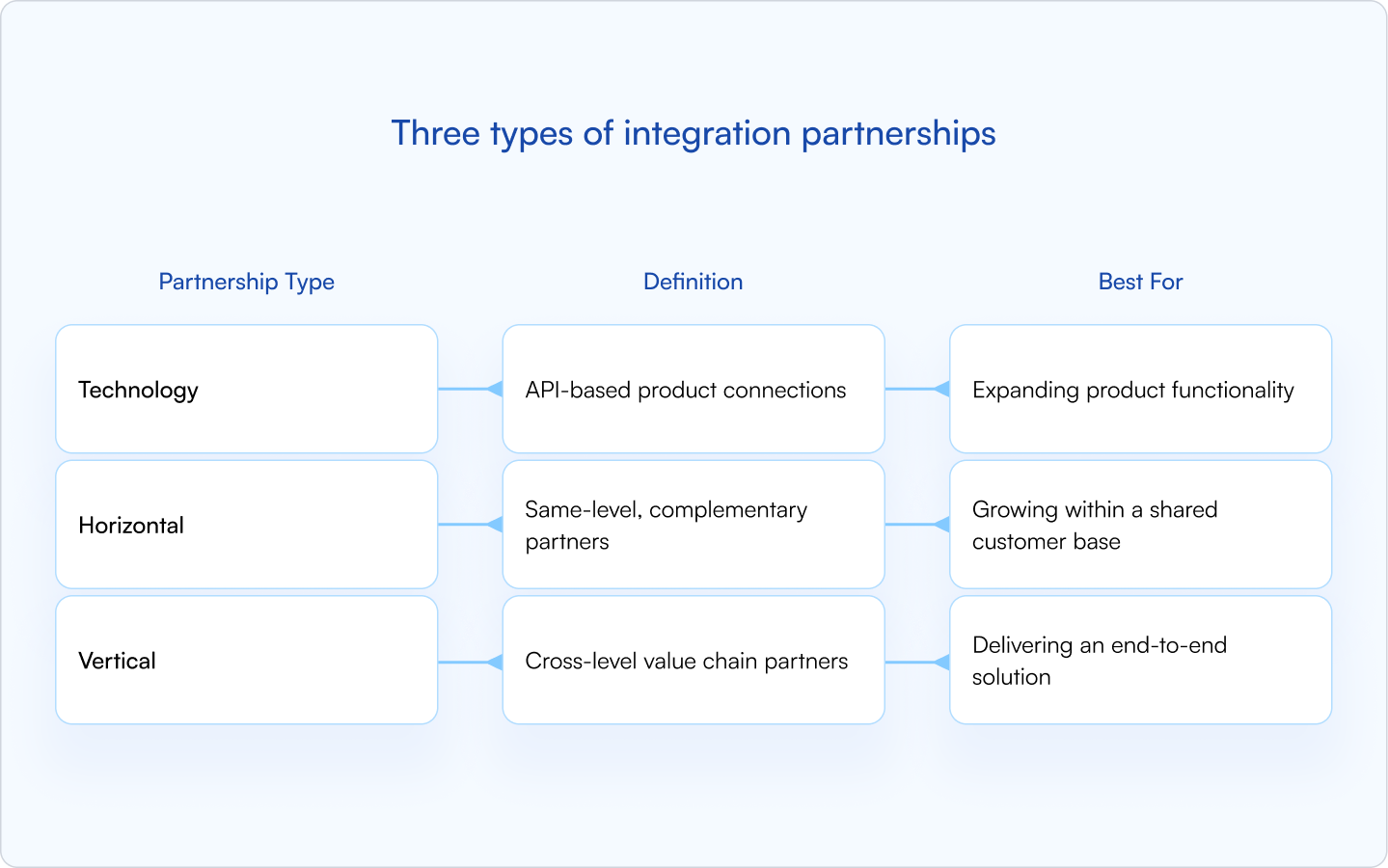
Technology integration partnerships
Technology integration partnerships connect two software products via API to share data or functionality — for example, a CRM syncing to a marketing automation platform. Here, the integration is effectively a product feature that becomes more valuable as adoption grows.
Horizontal integration partnerships
Horizontal integration partnerships happen between companies serving a similar ICP at the same “layer” of the value chain, but solving different jobs. If there’s strong customer overlap and clear complementarity, the integration tends to be an easy “yes” for both teams.
Vertical integration partnerships
Vertical integration partnerships span different levels of delivery — think implementation partners, data providers, infrastructure tools, or platforms that sit upstream/downstream of your product. These partnerships can unlock end-to-end solutions for shared customers with fewer handoffs.
Why integration partnerships matter for B2B SaaS teams
A good partner integration strategy shows up in the metrics founders care about — pipeline, retention, and positioning. Here’s how.
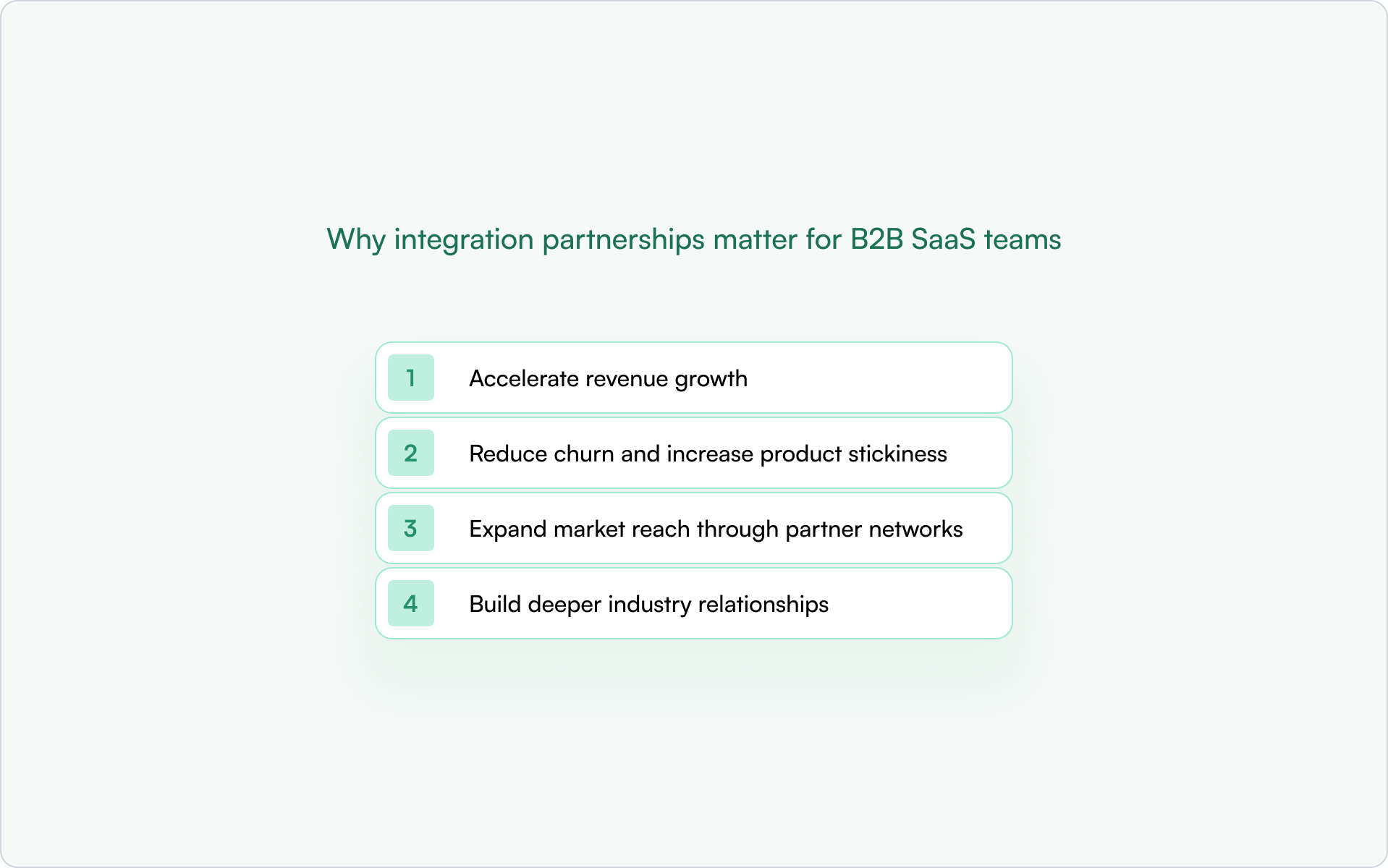
Accelerate revenue growth
Integration partners can open new distribution channels and co-selling opportunities. When your product “just works” with tools prospects already rely on, you reduce perceived switching risk and shorten the path to internal buy-in.
Marketplace listings, co-marketing campaigns, and referral programs with integration partners can all drive pipeline without increasing your direct sales headcount.
Reduce churn and increase product stickiness
Customers using integrations are harder to rip out. Once you become part of a connected workflow, you’re no longer competing purely on features — you’re embedded in how the customer operates day to day.
Expand market reach through partner networks
Integrations can put you in front of an audience already searching for compatible tools. This is especially powerful when you’re entering a new vertical or ecosystem and need borrowed credibility.
Build deeper industry relationships
Being “in the ecosystem” matters. When you’re listed alongside established players, prospects assume you belong there — and partners are more likely to introduce you to adjacent vendors and joint opportunities.
When to consider an integration partnership
Integration partnerships require investment — engineering time, support, relationship management, and ongoing maintenance. The following signals are a good indication you’re ready to pursue (or prioritize) an integration partnership.
- Your customers keep asking for a specific integration: Repeated requests are the clearest demand signal.
- You’re losing deals to competitors with more integrations: If integrations are cited in win/loss, this is no longer optional.
- You want to enter a new market or vertical: Partners can provide credibility and distribution where you lack brand presence.
- Your product has a clear API or data-sharing capability: If data exchange is painful, everything else becomes harder.
- You have bandwidth for long-term maintenance: Integrations aren’t one-time projects — they require monitoring, updates, and support.
How to build an integration partnership step by step
The process for building integration partnerships is usually predictable. The teams that win treat it as a repeatable system — not a one-off “integration project.”
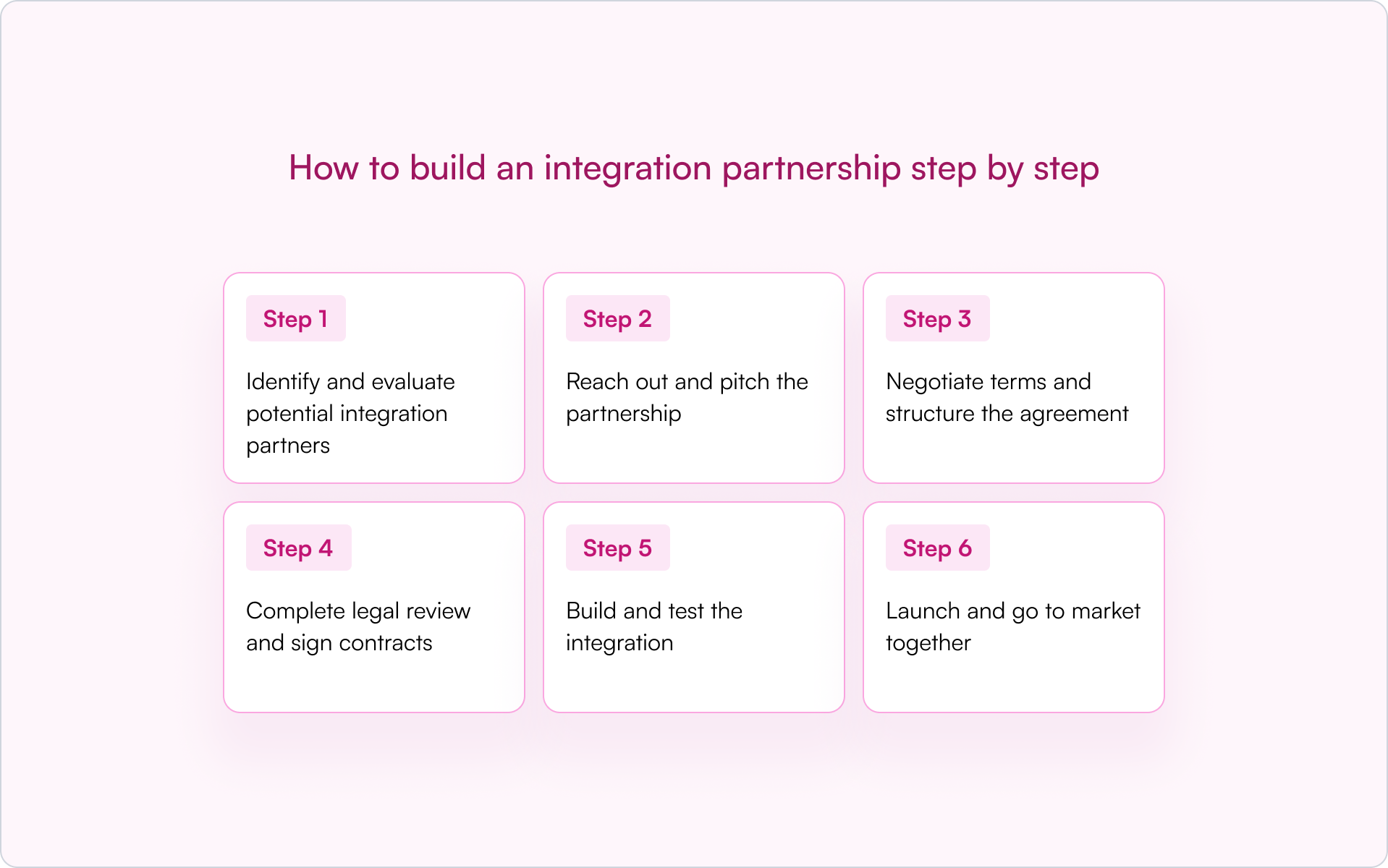
Step 1: Identify and evaluate potential integration partners
Start where the signal is strongest: customer requests, competitor ecosystems, and the tools your best-fit accounts already use. Your best partners typically share your ICP but solve a different job.
- Technical fit: API availability, data compatibility, documentation quality, security posture
- Business alignment: ICP overlap, GTM synergy, a clear “why now” on both sides
- Partner commitment: Dedicated resources, responsiveness, a named owner, and a plan for launch
Step 2: Reach out and pitch the partnership
Some vendors have an established partner program with an intake form; others require direct outreach to partnerships leaders or executives. Your pitch should be concrete: customer demand, proposed scope, and what each side stands to gain.
Step 3: Negotiate terms and structure the agreement
Align on support responsibilities, any revenue share, co-marketing expectations, data handling, and whether exclusivity is on the table. Most avoidable integration drama comes from fuzzy responsibilities — define them now.
Step 4: Complete legal review and sign contracts
Expect NDAs, licensing terms, privacy and security clauses, and liability language. This step can drag. If appropriate, a lightweight pilot or sandbox integration can help you validate value while legal catches up.
Step 5: Build and test the integration
Involve both engineering teams early. The most common delays come from unclear requirements, mismatched assumptions, and late-stage security surprises. Get sandbox access, define edge cases, and agree on ownership for failures and logging.
Step 6: Launch and go to market together
The technical release is the beginning, not the finish line. Many partner integrations succeed or fail based on GTM follow-through, not just the build.
- Marketplace listing and listing optimization
- Joint announcement and co-marketing assets
- Sales enablement (demo scripts, talk tracks, objection handling)
- Customer comms and in-app prompts to drive adoption
Best practices for managing integration partners at scale
One integration is manageable. A portfolio of integrations becomes a program — and programs need operating rhythm.
Appoint a dedicated partner owner
Someone needs to own the relationship end-to-end: roadmap alignment, escalation paths, joint planning, and performance tracking. On smaller teams, this might be a founder or BD lead. As the program grows, dedicated partner managers become a forcing function for consistency.
Create a structured partner onboarding process
Good onboarding includes technical documentation, sales training, and support escalation paths. A partner portal (or even a well-organized shared workspace) reduces friction and speeds up time-to-value.
Establish clear communication cadence
Put recurring check-ins on the calendar, create shared channels for day-to-day coordination, and run QBRs for strategic partners. Most partnerships fail from neglect — not conflict.
Define revenue opportunities and attribution models
Tracking partner-sourced versus partner-influenced deals prevents disputes over credit and revenue. This is one of the fastest ways to protect the relationship and give leadership clarity on what’s paying off.
When attribution lives in your CRM, RevOps and leadership get real-time visibility into what’s actually working. Platforms like Introw connect partner portals directly to HubSpot and Salesforce to keep partner activity and pipeline in one place.
Plan for long-term integration maintenance
API versioning, deprecations, ongoing QA, and incident response are part of the job. Agree upfront on how you’ll handle changes — and how quickly each side commits to fixing issues when something breaks.
Five common partner integration challenges (and how to solve them)
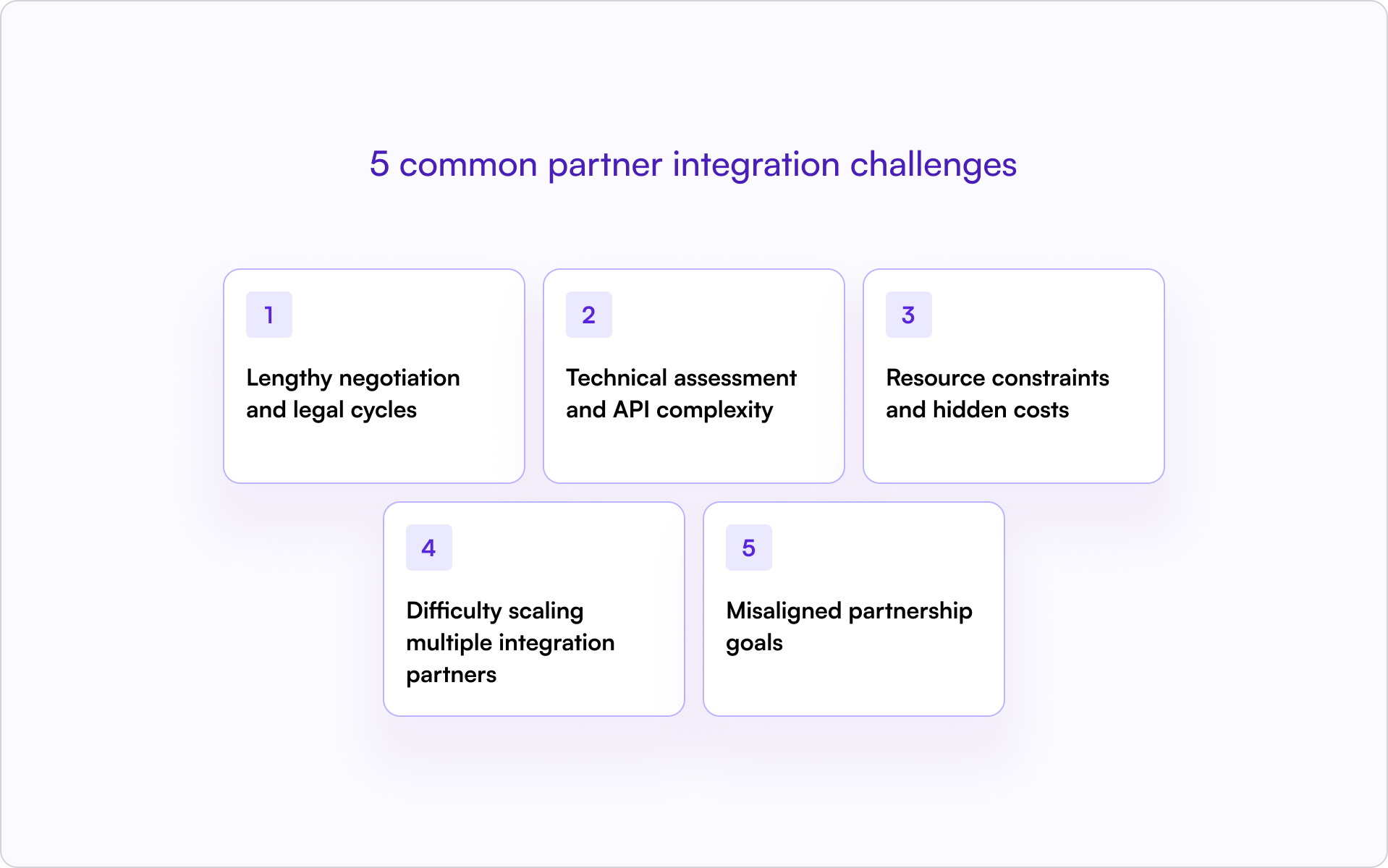
Lengthy negotiation and legal cycles
Contracts and commercial terms can stretch for weeks or months. If you need momentum, propose a phased approach — for example, a sandbox pilot with limited exposure while legal completes a full agreement.
Technical assessment and API complexity
Some APIs are great; others are brittle or under-documented. Ask for sandbox access early, bring engineering into discovery, and validate the “hard parts” (auth, rate limits, webhooks, error handling) before you commit to a timeline.
Resource constraints and hidden costs
Integrations require ongoing engineering and support. Start with a tight scope focused on the core workflow customers actually need, then expand based on adoption and revenue impact.
Difficulty scaling multiple integration partners
Every integration adds operational overhead. Standardize how you evaluate partners, document integrations, onboard partner teams, and measure success. Consistent internal tooling and processes are what make scale possible.
Misaligned partnership goals
What feels urgent to you may not be urgent to them. Align on success metrics before build starts, then revisit quarterly. If priorities drift, address it early — it’s easier to reset expectations than revive a neglected partnership.
How to track integration partnerships in your CRM
A partner integration strategy only compounds when you can see what’s working. Integrations generate data — partner-sourced deals, partner-influenced revenue, activation and adoption metrics — and if that data lives in spreadsheets, you’ll inevitably prioritize the loudest partner, not the most effective one.
At a minimum, track the following inside your CRM:
- Partner type: Clearly label integration partners versus referral, reseller, or services partners.
- Integration status: Active, in development, deprecated, or planned.
- Attribution: Sourced vs influenced, tied to the specific integration partner.
- Activity logging: Meetings, joint accounts, support escalations, and co-marketing initiatives.
The payoff is real: leadership gets accurate forecasting, RevOps can see pipeline health, and partnerships teams can make hard tradeoffs based on outcomes — not anecdotes.
Turn your partner integration strategy into repeatable revenue
A partner integration strategy takes real upfront investment: choosing the right partners, shipping the integration, aligning on terms, then maintaining and marketing it over time. But the returns compound — especially when integrations become part of customers’ daily workflows.
If you want this channel to be more than “a few integrations we launched,” treat it like a system: measure adoption, track partner-attributed pipeline in your CRM, and invest in the relationships that consistently drive outcomes.
What to do next
- List the top integration requests from customers and prospects — then identify the handful that map to your ICP and revenue goals.
- Evaluate potential partners on technical fit, business alignment, and willingness to co-invest in GTM.
- Set up CRM-based tracking so you can prove impact and prioritize the integrations that drive pipeline and retention.
If you’re building a CRM-first partner motion and want partner data to stay visible inside HubSpot or Salesforce, you can request a demo to see how Introw supports integration partnerships without relying on spreadsheets.
From Strategy to Results: 11 Partner Enablement Best Practices That Work in 2026
Partner enablement looks simple on paper: give partners the right resources, and they’ll sell your product. In practice, most programs stall because content is scattered, training is generic, and no one can tell which partners are actually ready to close deals.
The difference between a partner program that generates attributable revenue and one that drains resources usually comes down to structure — clear goals, the right content at the right time, and data that lives in your CRM instead of a forgotten portal. This guide breaks down partner enablement best practices from strategy through execution, plus the metrics that tell you if it’s working.
Was ist Partner-Enablement?
Partner enablement is the system you build to help external partners sell (and often implement) your product effectively. That system typically includes structured onboarding, tailored training, and easy access to the right resources so partners can move deals forward without waiting on your team.
When partner enablement is done well, partners don’t just understand what you do. They can position it, handle objections, run a clean handoff, and create repeatable wins — the same way a high-performing internal sales team would.
What partner enablement typically includes
- Training and certification: Product knowledge, positioning, and selling motions (with a quality bar partners must meet).
- Sales and marketing resources: Collateral, templates, and campaigns partners can use with prospects.
- Tools and portal access: Systems that streamline deal registration, content access, and communication.
- Ongoing communication: A predictable cadence for updates, feedback, and performance reviews.
Why partner enablement matters for revenue growth
Enabled partners drive revenue because they can execute without friction. They close deals faster, represent your brand accurately, and generate pipeline you can actually attribute.
Weak enablement is expensive in quieter ways: partners misposition the product, opportunities stall, your team becomes the bottleneck, and high-potential partners churn because “it’s too hard to work with you.”
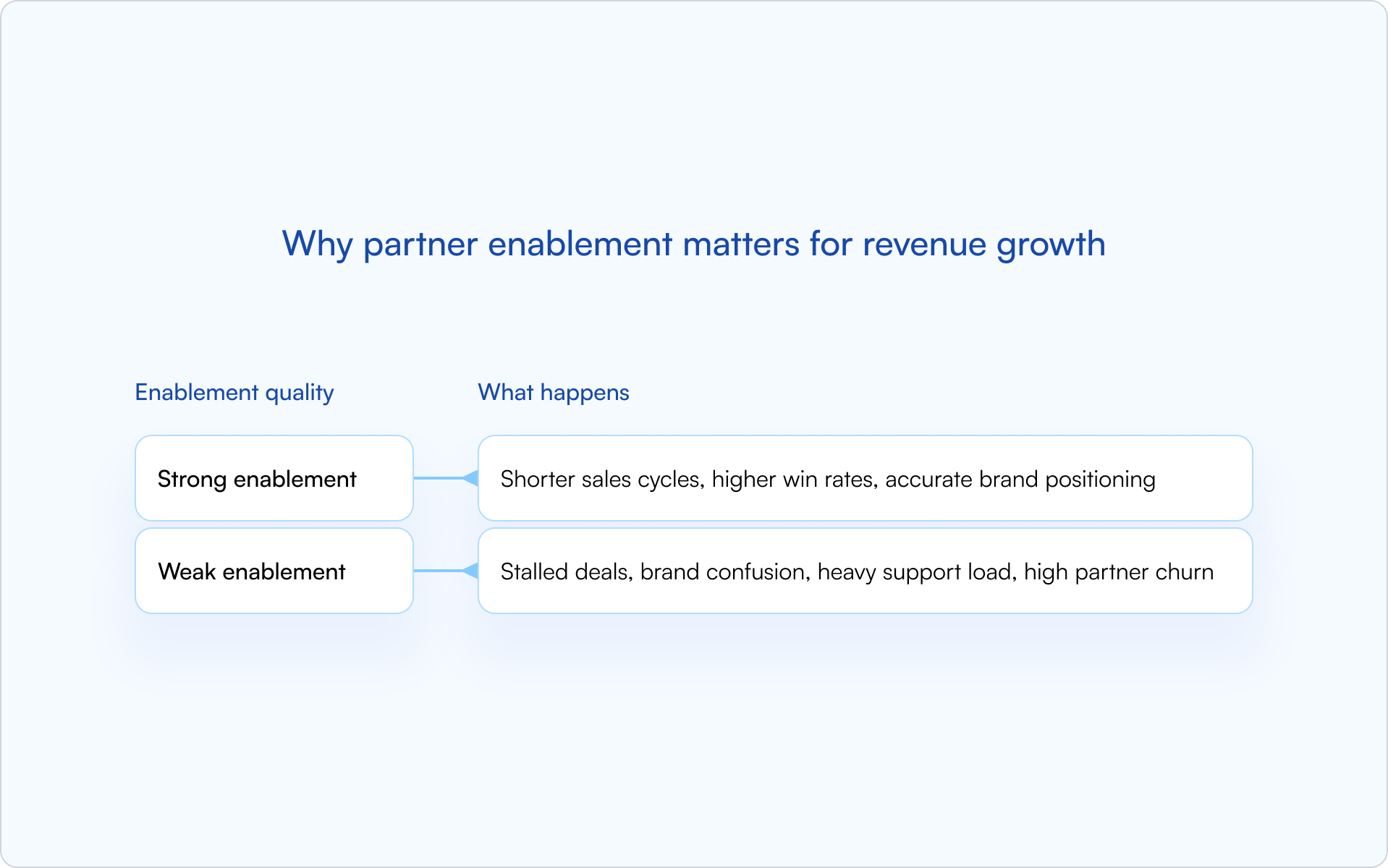
What a partner enablement program includes
A complete channel partner enablement program isn’t a portal full of PDFs. It’s a structured system that helps partners learn, launch, and improve — with clear ownership and measurable outcomes.
Partnerschulung und -zertifizierung
Training forms the foundation: product knowledge, competitive positioning, and your sales methodology. Certification acts as a gate, ensuring partners meet a minimum quality bar before they’re authorized to sell on your behalf.
Partner sales enablement
Partner sales enablement means giving partners the same caliber of sales tools your direct team uses, adapted to their role. Think: battle cards, demo scripts, objection-handling guides, and pricing documentation.
Marketing support and co-marketing
Effective enablement helps partners generate demand, not just close it. Co-branded assets, “campaign-in-a-box” kits, and structured lead-sharing programs all increase partner-sourced pipeline.
Partner portals (and why login friction kills adoption)
A partner portal should be a self-service hub for training, collateral, deal registration, and updates. But there’s a common failure mode: partners avoid portals that require a separate, inconvenient login.
CRM-first portals reduce that friction by connecting directly to HubSpot or Salesforce, so partners can work inside the flow of real deals instead of “checking another system.”
Performance tracking and ongoing communication
Enablement is ongoing, not a one-time launch. A strong program includes visibility into partner activity, a consistent communication cadence, and mechanisms for gathering feedback and improving the experience.
11 partner enablement best practices that drive results
If you’re building a partner program inside a startup, your constraint is almost never “ideas.” It’s focus and execution. These partner enablement best practices move from strategy through rollout and iteration — with an emphasis on what actually shows up in pipeline.
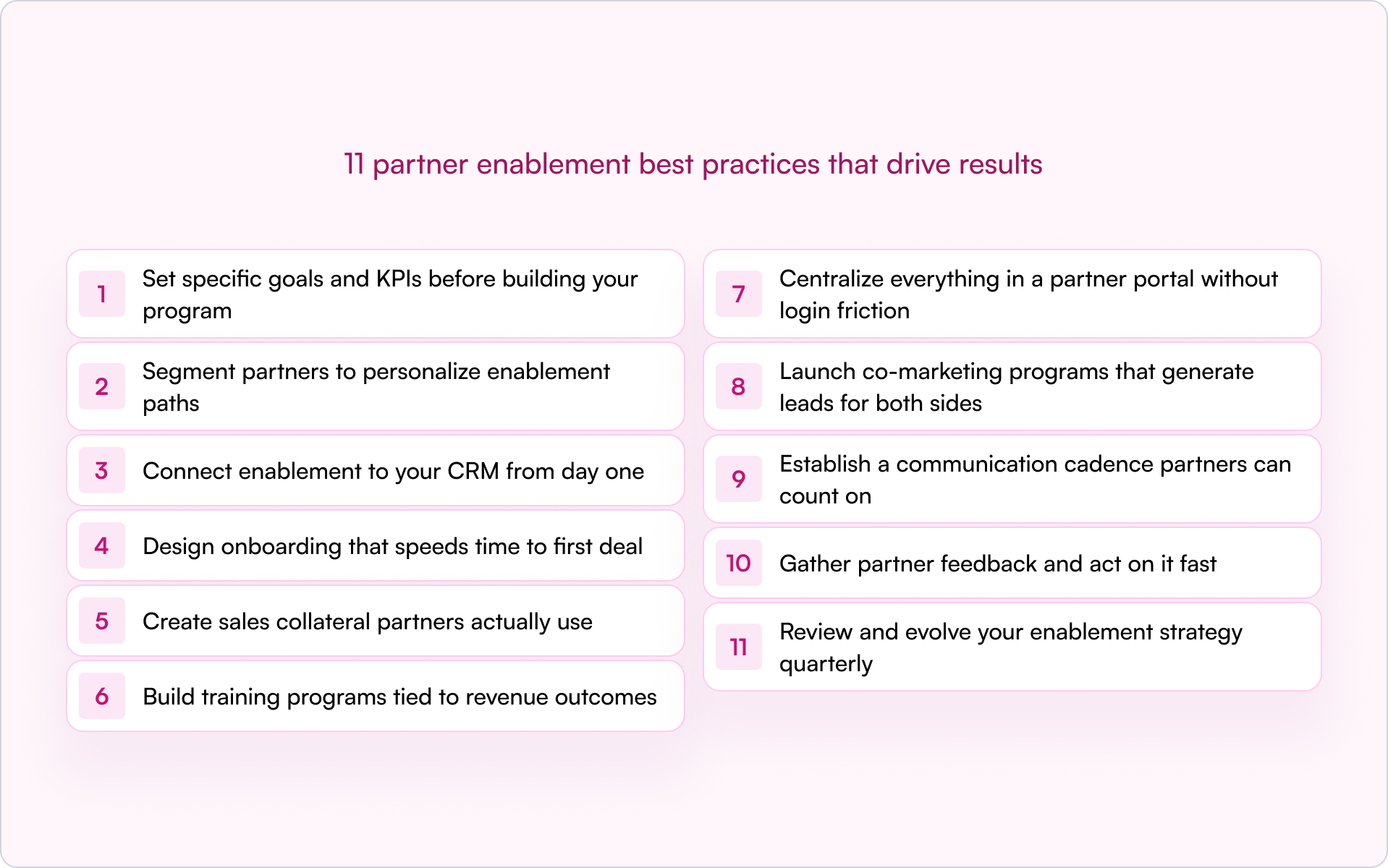
1. Set specific goals and KPIs before building your program
Before you create a single asset, define what success looks like. Start with outcomes — partner-sourced revenue targets, certification completion rates, and a target time-to-first-deal — then work backward into the program.
- Partner-sourced pipeline value
- Certification completion rate
- Average time from onboarding to first registered deal
- Content engagement (downloads, video views)
2. Segment partners to personalize enablement paths
Not all partners need the same materials. Segment by partner type (reseller, referral, systems integrator), vertical focus, or performance tier, then tailor training and content accordingly.
3. Connect enablement to your CRM from day one
For true visibility and attribution, all your enablement data — certifications, content consumption, deal registrations — lives best in your CRM, not in a disconnected system.
A CRM-first approach provides a single source of truth. When partner activity syncs directly to HubSpot or Salesforce, your sales team and RevOps see the same reality. No more chasing updates or reconciling spreadsheets. (If deal attribution is a pain point today, it’s worth tightening up your workflow around partner deal registration specifically.)
4. Design onboarding that speeds time to first deal
Partner onboarding works best as a structured, time-bound journey — not a massive content dump. The goal is to get partners to their first real opportunity quickly, then reinforce with deeper training once momentum is real.
A strong onboarding checklist includes:
- Welcome and program overview
- Product and Ideal Customer Profile (ICP) training
- Competitive positioning
- Deal registration process walkthrough
- First co-sell or shadow opportunity
5. Create sales collateral partners actually use
Don’t reinvent the wheel. Audit the sales collateral your direct team uses most effectively and adapt it for your partners. Prioritize assets that accelerate live deals: one-pagers, battle cards, ROI calculators, and customer stories.
The fastest way to avoid producing content no one opens is simple: ask partners what they need to win the deals they already have, then build for that.
6. Build training programs tied to revenue outcomes
Training works best when it’s modular, role-based, and tied to certification. Use certification as a gate — for example, require a partner to complete key modules before they can register deals or request MDF.
On-demand training offers flexibility; live sessions drive engagement for complex topics. Most teams land on a hybrid model.
7. Centralize everything in a partner portal without login friction
A partner portal should be the single place to find enablement content, register deals, and get program updates. But portals fail when they add friction — especially separate logins, stale content, and unclear navigation.
If you want adoption, reduce steps. Portals built directly on the CRM (with SSO or no-login options) make access feel seamless, which is often the difference between “partners love it” and “partners ignore it.”
8. Launch co-marketing programs that generate leads for both sides
Co-marketing goes beyond providing partners with your logo. Joint webinars, co-branded content like eBooks or case studies, and Market Development Funds (MDF) programs actively help partners generate demand.
If you’re a founder, this is one of the highest-leverage shifts you can make: partners often need help creating pipeline, not just closing it.
9. Establish a communication cadence partners can count on
Define a predictable rhythm. Partners shouldn’t have to guess where to find updates or whether deal registration is working. Use channels like email and Slack to reach partners where they already operate — don’t rely solely on them logging into a portal.
10. Gather partner feedback and act on it fast
Enablement is a two-way street. Collect feedback through surveys, QBR conversations, and portal analytics — then close the loop by making changes and telling partners what you changed.
Partners keep investing when they feel momentum. Small, fast improvements create that signal.
11. Review and evolve your enablement strategy quarterly
Partner enablement isn’t set-and-forget. Quarterly, review what’s working and what isn’t by analyzing content engagement, certification rates, and revenue impact. Then adjust your program like you’d adjust product — based on usage and outcomes.
Partner enablement training metrics to track
To understand if your partner enablement process is working, track metrics that connect enablement activities directly to revenue outcomes — not just vanity activities.
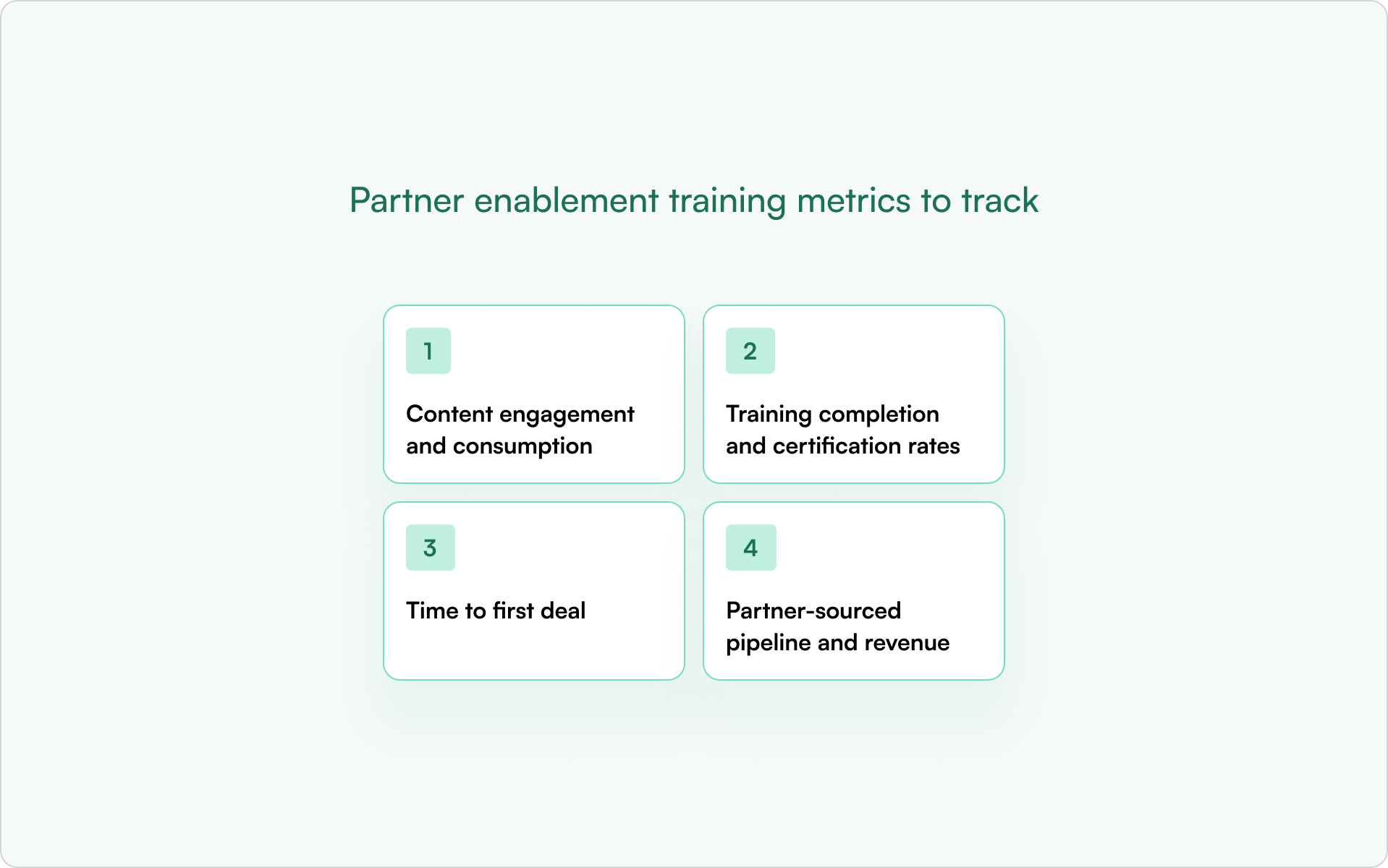
Content engagement and consumption
Track which resources partners actually use: downloads, video completion rates, and page views. Low engagement can signal the content isn’t relevant, is hard to find, or doesn’t match what partners need in active deals.
Training completion and certification rates
Measure how many partners complete onboarding and earn certifications. Completion rates help you pinpoint drop-off points so you can shorten, reorder, or redesign modules.
Zeit bis zum ersten Geschäft
Track the time between partner activation and their first registered deal. This is one of the cleanest indicators that onboarding is working — or that partners are stuck.
Partner-sourced pipeline and revenue
This is the ultimate scoreboard. Track pipeline and closed-won revenue generated by partners. To do it well, you need tight CRM attribution so enablement activity can be tied to financial results without manual cleanup.
How to automate your partner enablement process
Automation lets you scale partner enablement without scaling headcount. The goal isn’t to make the experience robotic — it’s to make it consistent, timely, and measurable.
CRM-based automation is ideal because it keeps data and workflows in one system. That’s how you avoid the “portal says one thing, CRM says another” problem.
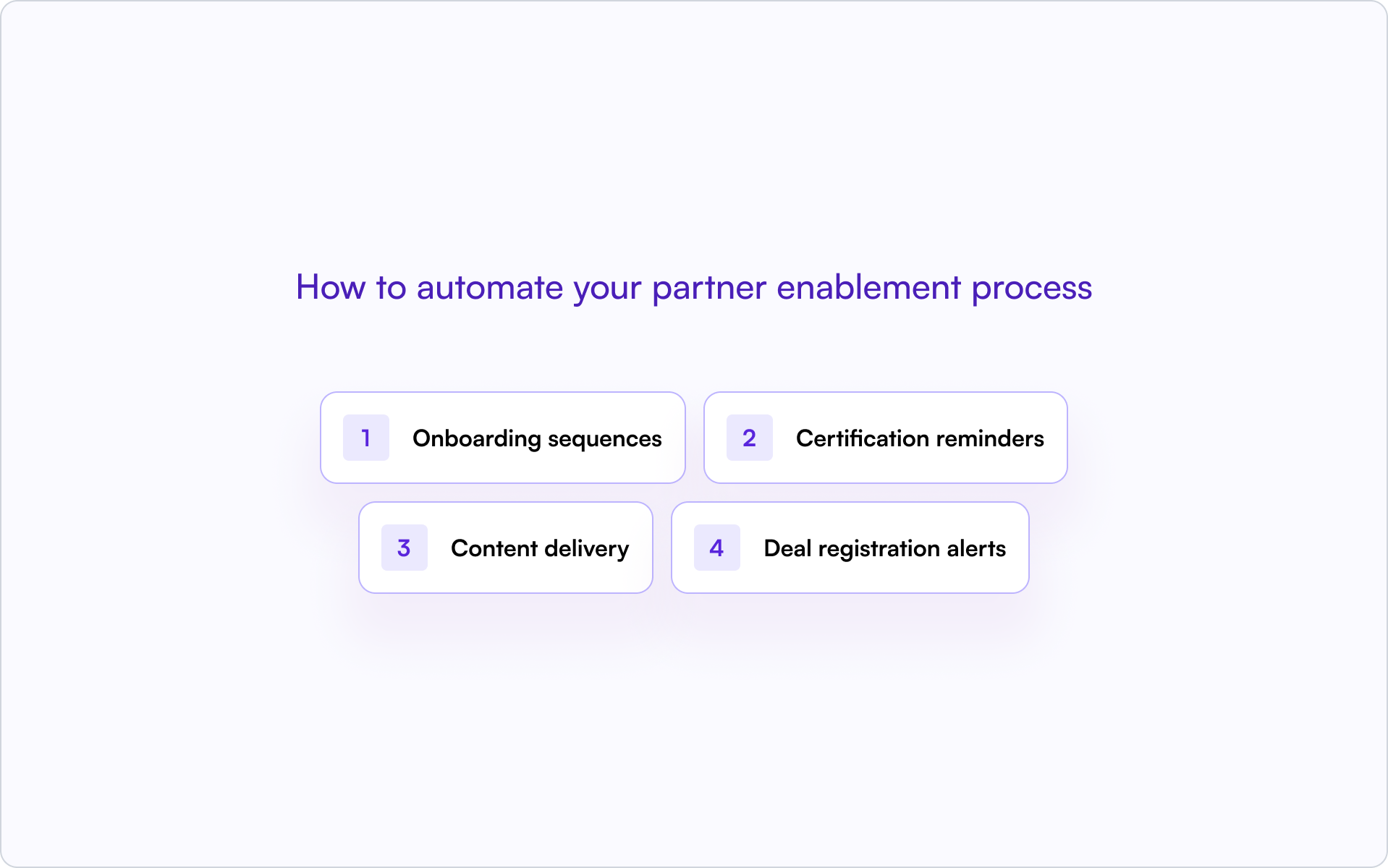
- Onboarding sequences: Automatically enroll new partners in training modules and send welcome materials as soon as they sign up.
- Certification reminders: Trigger automated alerts to partners and partner managers before certifications expire.
- Content delivery: Push relevant collateral to partners based on their segment, tier, or deal stage.
- Deal registration alerts: Automatically notify partners of the status of their registered deals.
Turn partner enablement into a revenue engine with Introw
Introw is the CRM-first PRM that makes best-practice partner enablement practical and scalable. Because it’s built on HubSpot and Salesforce, Introw centralizes your entire partner program where you already work.
It includes a partner portal for centralizing enablement content without login friction, deal registration with real-time visibility, and off-portal collaboration so partners can reply via email while data syncs automatically to your CRM.
If you’re trying to get out of spreadsheet chaos and into measurable partner-sourced revenue, get a demo.
Fazit
The best partner enablement programs aren’t built on more content — they’re built on clarity. Clear goals, segmented paths, CRM-connected workflows, and a focus on speed-to-first-deal turn “partners we signed” into “partners who ship revenue.”
Use these partner enablement best practices as a blueprint, then iterate quarterly based on what your data (and your partners) tell you.
How to Use AI for Partner Engagement Without Losing the Human Touch
Partner programs don’t fail because of bad partners. They fail because partner managers run out of hours — chasing updates, answering the same questions, and manually personalizing outreach that never truly scales.
AI for partner engagement changes that equation. Not by replacing relationships (the thing that actually drives partner revenue), but by taking repetitive work off your team’s plate so they can spend more time in the conversations that matter.
Below is a practical playbook: what to automate, what to keep human, and how to implement AI without eroding the trust you’ve built.
Why AI for Partner Engagement Matters Now
AI for partner engagement means using artificial intelligence tools — automation, machine learning, and generative AI — to personalize communication, anticipate partner needs, and reduce operational drag. It sits under the broader umbrella of partner relationship management AI, where the goal is simple: keep partners enabled and responsive without adding headcount at the same rate as partner growth.
The underlying math has changed. Partner counts grow quickly, partner expectations rise even faster, and your team is left stitching together engagement across spreadsheets, portals, inboxes, and CRM notes. The result is predictable: slower responses, inconsistent follow-up, and partner managers spending their best hours on admin instead of revenue.
AI addresses that bottleneck by handling the repeatable parts of engagement — so your team can focus on building trust, driving pipeline, and solving real partner problems.
How AI Improves Partner Engagement Without Replacing Your Team
The highest-performing programs don’t automate everything. They automate the right things. AI works best when it amplifies what your team already does well — and removes the friction that prevents consistency.
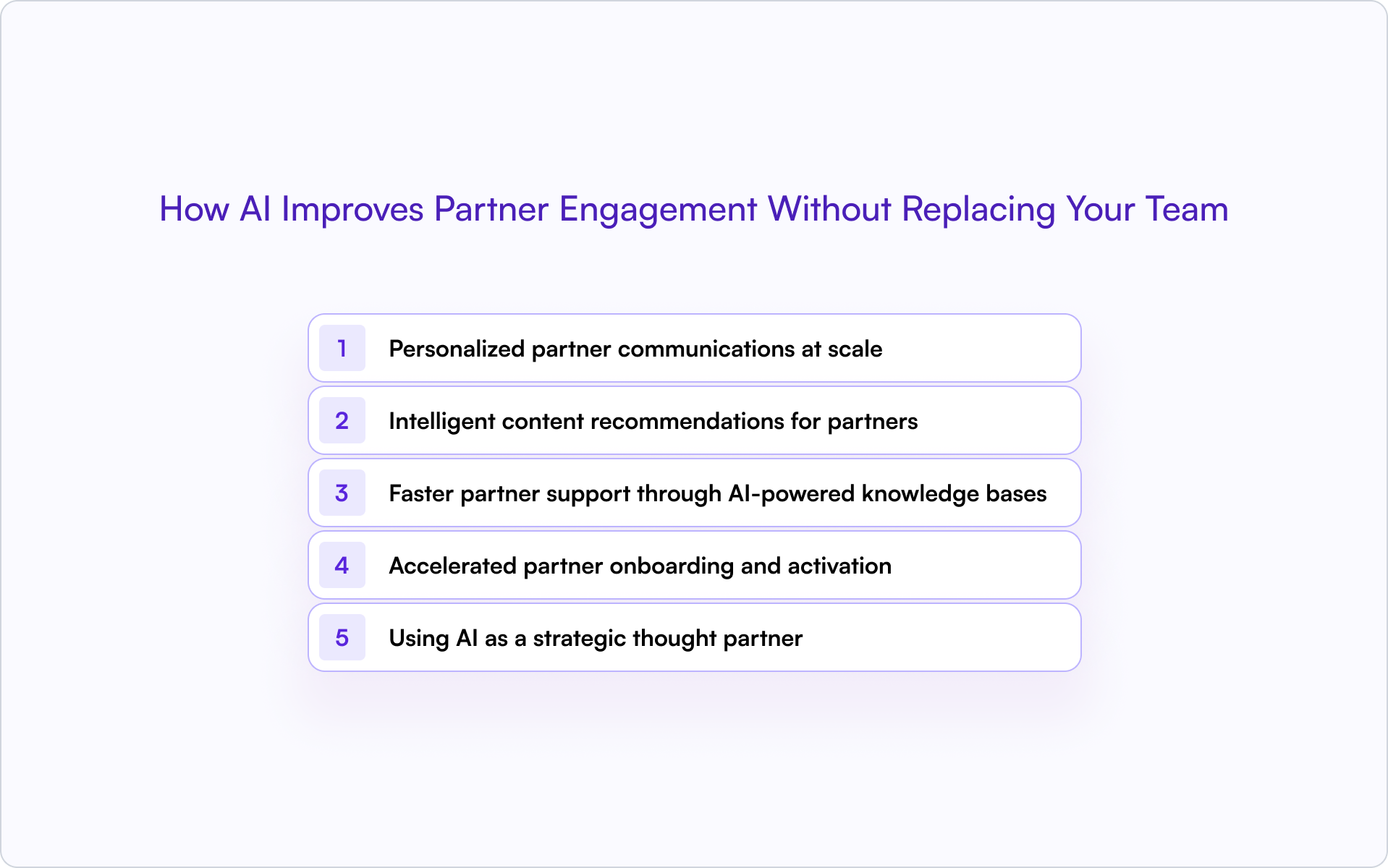
Personalized partner communications at scale
AI can analyze partner data — behavior, preferences, deal history, portal activity — and help tailor messaging without you writing from scratch each time. Done right, the voice stays “yours,” but the volume scales.
- Behavior-based messaging: AI can detect who’s active vs. disengaged and tailor follow-ups accordingly. A partner who hasn’t logged in for 30 days should get a different nudge than one who just registered a deal.
- Segment-specific campaigns: Generative AI can draft outreach by tier, region, or vertical. Your team reviews and sends — keeping quality control and the human touch.
Intelligent content recommendations for partners
Partners often struggle to find the right enablement content at the right time. AI helps by surfacing the most relevant case studies, battle cards, product docs, or training based on partner activity, segment, or deal stage.
This reduces the steady stream of “Where do I find X?” requests and improves time-to-first-deal because partners get what they need when they need it — without hunting.
Faster partner support through AI-powered knowledge bases
An AI-powered knowledge base is a self-serve library where partners ask a question and the AI returns the most relevant answer from your documentation. This works especially well for routine requests like pricing sheets, deal status questions, and portal navigation.
The win isn’t just speed. It’s consistency: partners get accurate answers instantly, while your team stays available for nuanced or sensitive situations.
Accelerated partner onboarding and activation
Partner onboarding AI guides new partners through onboarding steps, auto-assigns training content, and prompts next actions. Instead of manually tracking who completed what, your team gets visibility into progress and can step in only when a partner gets stuck.
Using AI as a strategic thought partner
Partnership leaders also use AI to brainstorm campaign ideas, draft program policies, and summarize what’s working across segments. Think of it as a strategy assistant that’s always available — while final decisions stay with your team.
AI can surface patterns your team might miss, but judgment calls that shape partner relationships should remain human-led.
Practical AI Use Cases for Partner Programs
If you’re building (or scaling) a partner motion, you don’t need “AI everywhere.” You need a few targeted workflows that reduce noise and increase partner responsiveness. These are the patterns that tend to deliver ROI quickly.
Drafting personalized partner outreach and updates
AI can generate email drafts, partner newsletters, and Slack messages tailored to partner segments. Your team reviews and sends — which keeps messages authentic, while eliminating blank-page work.
Tracking partner engagement signals in your CRM
AI can flag disengaged partners, highlight high-activity accounts, and detect patterns in deal registration behavior. The key is CRM-first visibility — data should live in HubSpot or Salesforce, not scattered across tools. That way, partner relationship management AI can operate on a reliable system of record.
Surfacing expansion and cross-sell opportunities
AI can identify partners with upsell or cross-sell potential based on customer fit, deal history, or product usage signals. The output should be a prioritized list for a human follow-up — not a fully automated “spray and pray” campaign.
Automating repetitive partner support queries
Common questions can be handled by AI chatbots, knowledge bases, or automated responses. This is often one of the highest-ROI forms of partner program automation — partners get instant answers, and your team spends less time on repeat tickets.
Delivering tailored partner enablement content
AI recommends relevant training, playbooks, or collateral based on partner type, certification level, or current deals as part of your partner enablement strategy. Partners see what’s relevant to them, rather than a generic content library that overwhelms them.
What to Automate vs. What to Keep Human in Partner Engagement
The easiest way to lose partner trust with AI is to automate moments that require judgment, empathy, or context. The goal is to automate the repeatable work — while protecting the high-stakes relationship moments.
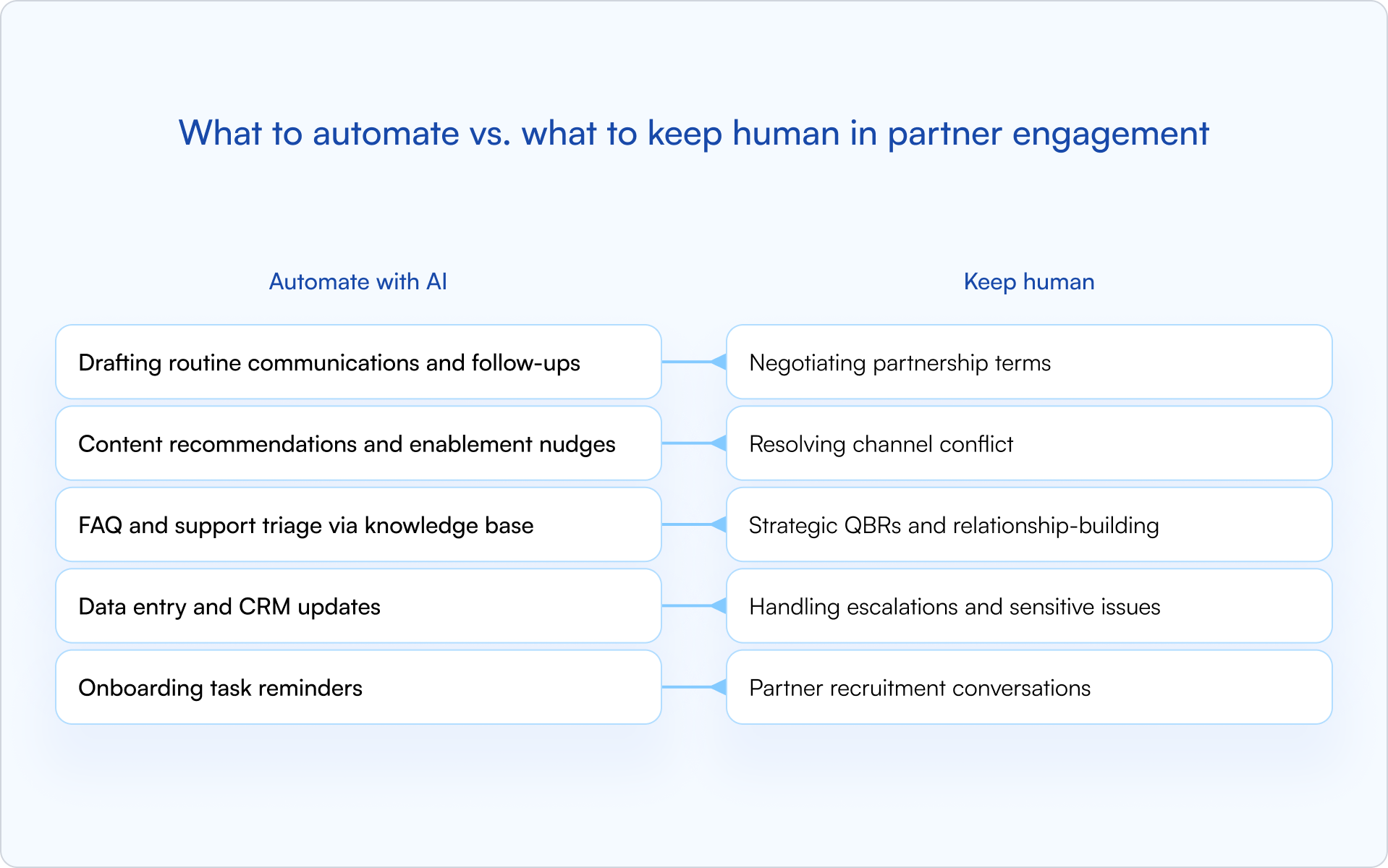
Tasks AI handles well
Repetitive, time-consuming, low-judgment work is ideal: status updates, content requests, FAQ replies, meeting summaries, and CRM hygiene. AI can also assist with partner recruitment by shortlisting candidates or scoring fit — but the qualification conversation should remain human-led.
Moments that require a human touch
Trust-building, conflict resolution, and strategic decision-making don’t automate well. Partners can tell when a program is “bot-led,” especially during escalations, sensitive program changes, and negotiation moments.
A simple rule for drawing the line
If the task requires judgment, empathy, negotiation, or deep relationship context, keep it human. If it’s repetitive and data-driven — especially CRM-based — automate it.
What You Need for AI to Work in Your Partner Program
AI doesn’t magically fix a messy program. It scales what’s already there. Before you roll out AI for partner engagement, make sure a few fundamentals are in place.
Clean partner data in your CRM
Clean data means fewer duplicates, consistent field definitions, and accurate partner records. AI insights are only as good as the data they’re built on. When your partner activity and engagement signals live in HubSpot or Salesforce, AI-driven support, recommendations, and scoring become practical — not theoretical.
Defined processes before implementing technology
Clarify workflows first: onboarding steps, deal registration rules, communication cadence, and support handoffs. AI amplifies your process — so if your process is inconsistent, AI will scale that inconsistency.
Partner buy-in and transparency about AI use
Partners should know when AI is used in communications or support. Transparency builds trust, and it lowers the risk of awkward moments when a partner assumes they’re speaking to a person.
Always provide a clear path to reach a human — and be explicit about what AI can (and can’t) do.
How to Get Started With AI for Partner Engagement
You don’t need a massive implementation to see results. The fastest path is to pick one high-volume pain point, pilot it, measure impact, and expand from there.
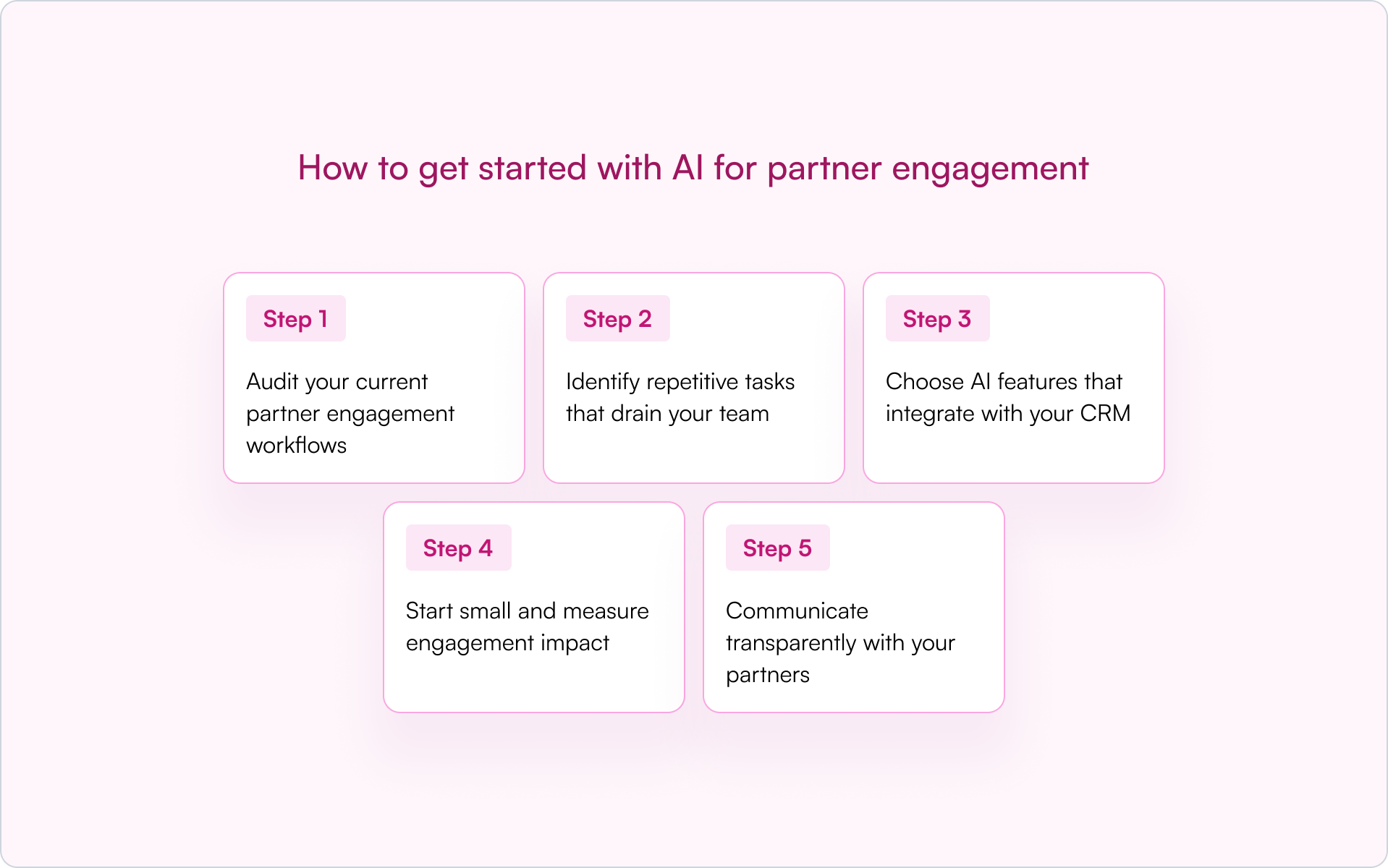
1) Audit your current partner engagement workflows
Map out how you communicate with partners today across their lifecycle stages. Where are the bottlenecks, manual tasks, and repetitive work across communications, enablement, and support?
2) Identify repetitive tasks that drain your team
List the recurring work that eats time but doesn’t require strategic thinking: status updates, content requests, meeting recaps, deal follow-ups, and FAQ replies. Prioritize tasks that can be reliably automated from CRM data.
3) Choose AI features that integrate with your CRM
CRM-first tools matter. AI that writes back to HubSpot or Salesforce keeps data clean, visible, and actionable. AI that creates a separate system becomes another silo your team has to manage.
Platforms like Introw offer AI-powered partner support and engagement features that integrate directly with your CRM — without creating a parallel universe of partner data.
4) Start small and measure engagement impact
Pilot one use case before scaling — onboarding emails and an AI-powered knowledge base are common “quick wins.” Track partner response rates, time saved, and engagement metrics like portal logins or content consumption.
5) Communicate transparently with your partners
Tell partners how AI is being used and where humans are still involved. Offer an escalation path to a person for complex issues. Trust comes from being upfront — not from hiding automation.
Build Stronger Partner Relationships With AI-Powered Engagement Tools
AI handles scale and speed across partner engagement, enablement, and support. Humans handle trust, strategy, and the moments that define long-term partnerships. That balance is where AI becomes a competitive advantage — not as a replacement, but as an enabler.
If you want to see what CRM-first AI for partner engagement looks like in practice, tools like Introw let you keep partner communications, support, and engagement history visible inside HubSpot or Salesforce — where your revenue team already works.
Book a demo to see how AI-powered partner engagement works inside your CRM.

