

.svg)





15 Best Partner Certification Program Software: A Buyer’s Guide and Feature Checklist
Imagine knowing exactly which partners are ready to sell today.
No chasing updates or guessing certification status across your partner ecosystem.
With the right partner certification program software, certification becomes real leverage. You get cleaner sales motions, fewer surprises, and better partner performance.
Let's first breakdown what partner certification program software is.
What is Partner Certification Program Software?
Partner certification program software is built for external partners, not internal employees. It supports training programs, certification status, and partner tier rules tied to revenue.
Where generic LMS tracks courses and training completion, partner certification software focuses on readiness, partner performance, and sales performance.
That difference becomes obvious as partner ecosystems grow.
Partners need access to training that reflects real knowledge, practical skills, and selling ability.
Partner Certification Software vs. Employee LMS
Strong certification programs reduce escalations and improve win rates. They make it clear which certified partners can sell specific solutions.
Modern teams also expect certification to connect to their CRM. When certification status syncs with Salesforce or HubSpot, assessment scores and progress tracking map directly to pipeline.
This is why certification rarely lives in isolation. So, when teams evaluate how certification fits alongside PRM and engagement, they usually also look into partner enablement to round it out.
Now it's time to take a look at the platforms that teams like yours are evaluating or using.
1. Introw Partner LMS (Best overall for CRM-first certifications and sales gating)
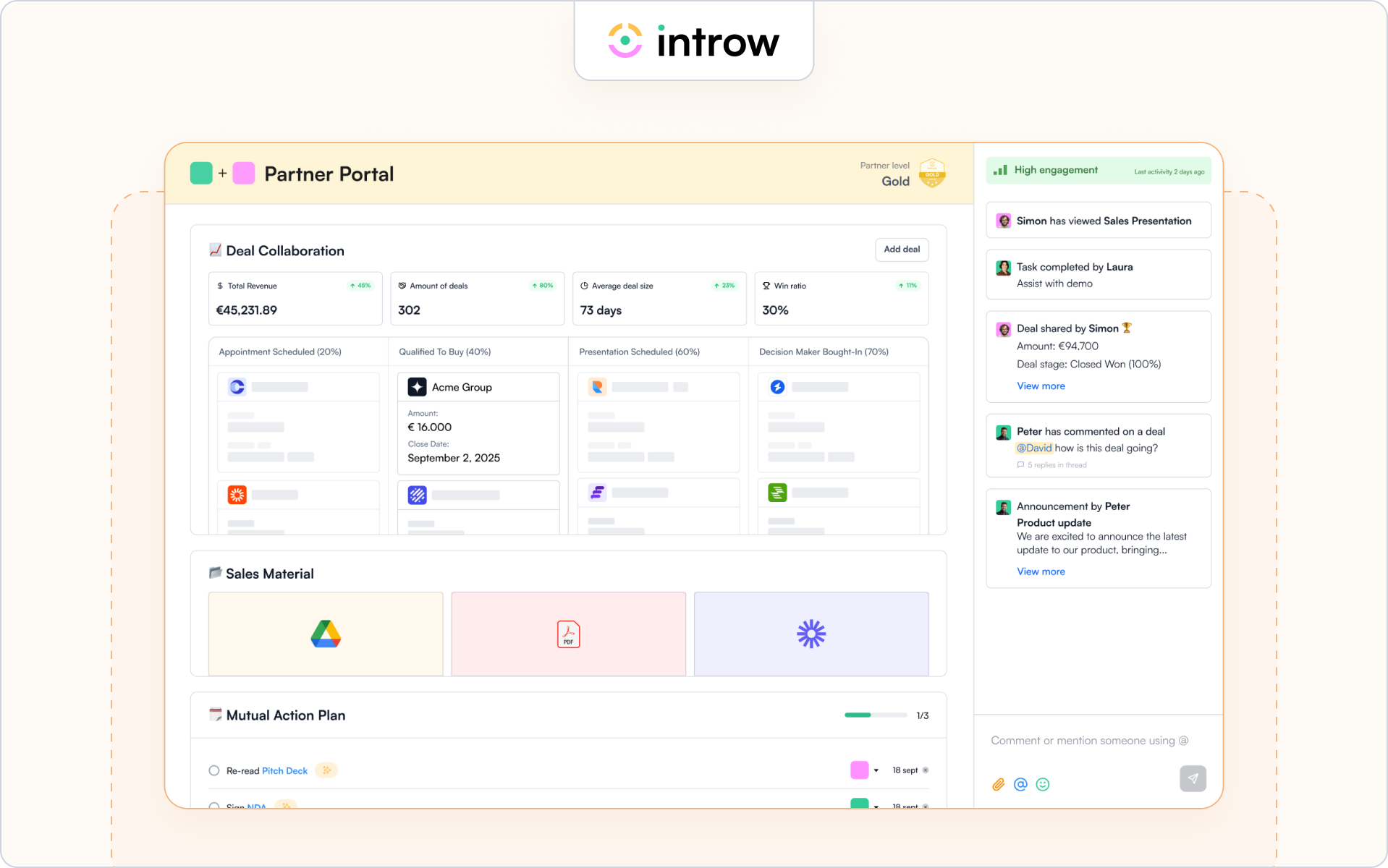
Introw’s Partner LMS is built for partner teams that want partner certification to directly control readiness, access, and revenue, not live as a standalone learning system.
Best for:
B2B teams on Salesforce or HubSpot that need fast partner courses, governed certification programs, and clear attribution to pipeline.
Why it stands out:
Introw treats partner certification as an operational control layer. Instead of manually building courses, an AI agent converts existing website or partner portal content into structured training programs with assessments.
Certificates are issued in one click, can expire automatically, and support recertification as products or services change.
Certification status then determines who can access specific solutions or selling motions, without relying on manual checks.
Key certification capabilities
- Certificates with expiration and recertification rules
- Customized learning paths by role or partner tier
- Manual and automated certificate assignment
- Assessment scores and progress tracking visible in CRM
- Centralized control to issue, revoke, or audit certifications
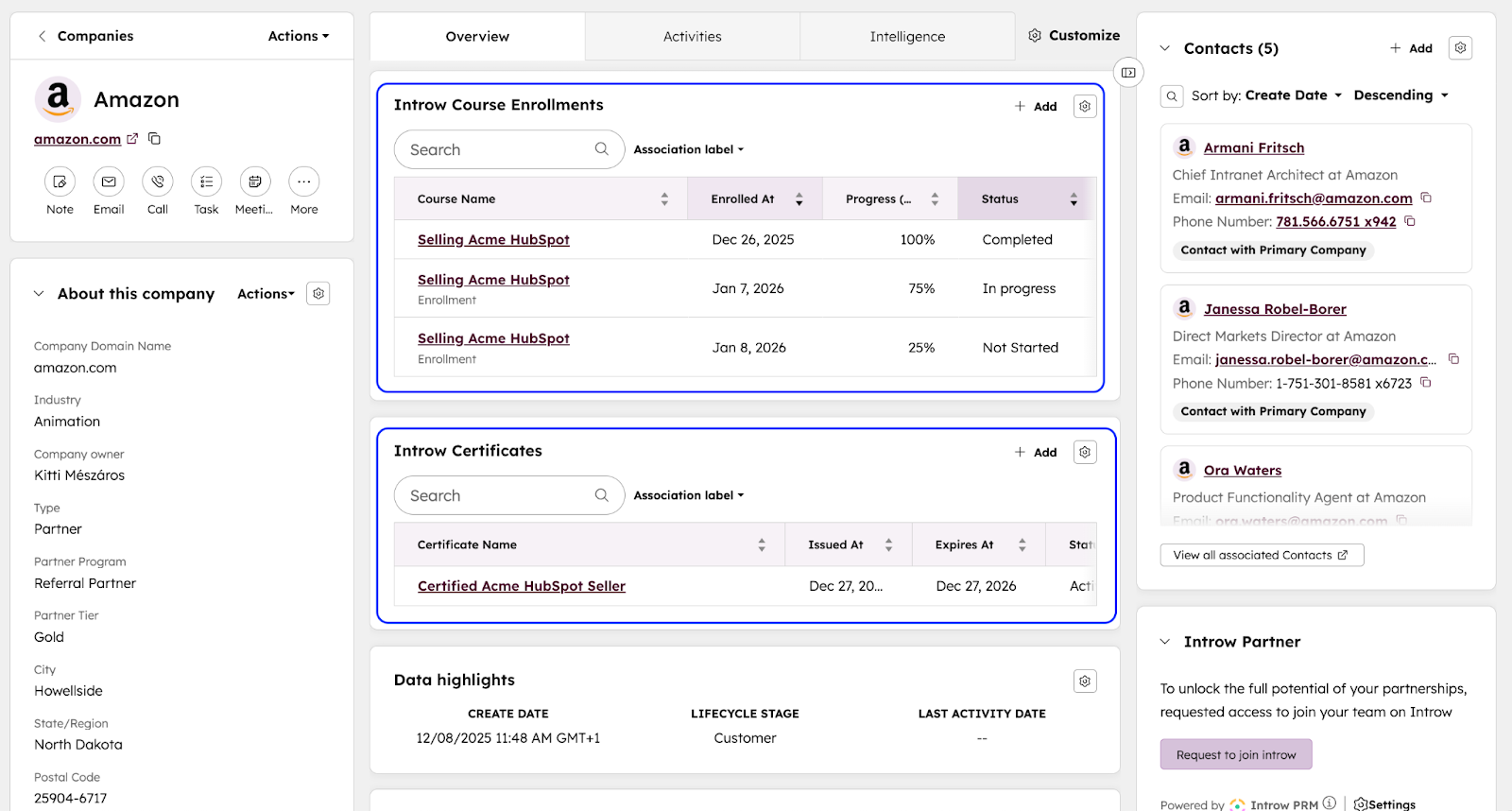
CRM-Aligned Reporting in Introw
Keep in mind
Introw works best when certification, engagement, and deal permissions move together. It's designed for teams that want certification to actively shape partner behavior.
Integrations:
Native integrations with Salesforce, HubSpot, Slack, and API access.
You can see how courses and certificates are created in practice in this short Introw Partner LMS walkthrough:
2. Skilljar by Gainsight - External academies with robust analytics
Skilljar is built for external training programs, with many teams using it for customer and partner academies.
Best for:
Teams running partner training at scale, with strong analytics tools.
Why it stands out:
Skilljar puts reporting and data access front and center. It’s a solid fit when you care about training completion signals.
Partner certification features:
- External learning portals for partners and customers.
- Certification capabilities, plus data and reporting for impact.
Keep in mind:
Skilljar is oriented around external education experiences. CRM tie-ins depend on your setup and data workflow.
3. LearnUpon - Multi-portal certification at extended-enterprise scale
LearnUpon is designed for extended-enterprise training, including partners and customers, with a strong focus on managing multiple external audiences.
Best for:
Teams that need to run partner certification programs across regions, partner tiers, or business units.
Why it stands out:
LearnUpon supports multiple branded portals from a single system.
This makes it easier to deliver different training programs without duplicating setup.
Partner certification features:
- Separate portals for different partner groups and audiences
- Certification programs with structured learning paths and reporting
Keep in mind:
Multi-portal setups require clear governance. Plan early how certification status feeds into reporting and partner operations.
4. Docebo - Enterprise AI and gamification with certification controls
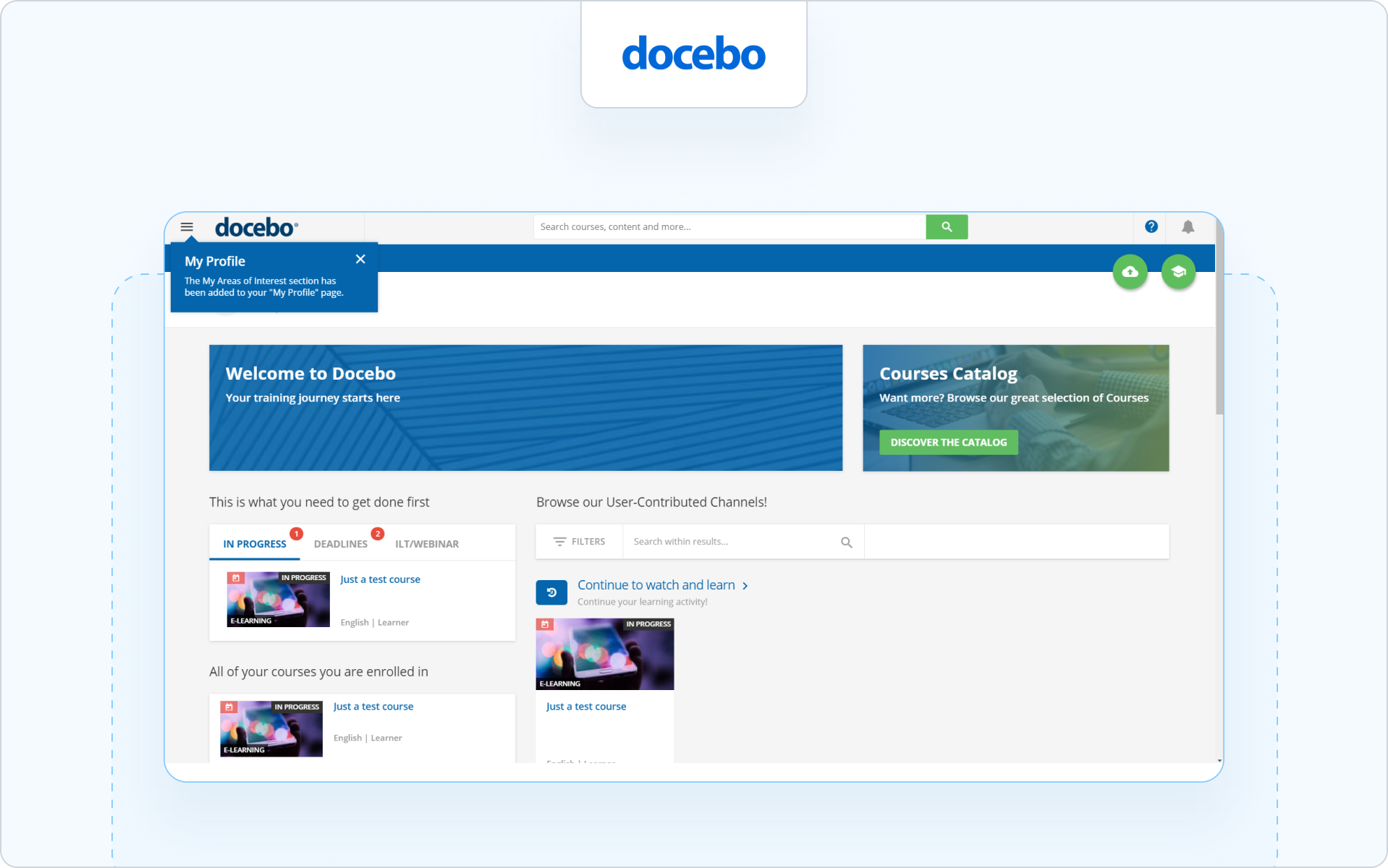
Docebo is an enterprise learning platform used for extended-enterprise training, including partners, resellers, and customers.
Best for:
Large organizations running complex partner training and certification programs at scale.
Why it stands out:
Docebo combines scalable delivery with AI-assisted content and engagement features. Gamification tools can help improve training completion across large partner networks.
Partner certification features:
- Certification programs for external audiences
- Learning paths, assessments, and automation for partner training
Keep in mind:
Implementation can be complex so teams should validate reporting depth and CRM alignment early.
5. Absorb LMS – Advanced reporting with branded partner portals
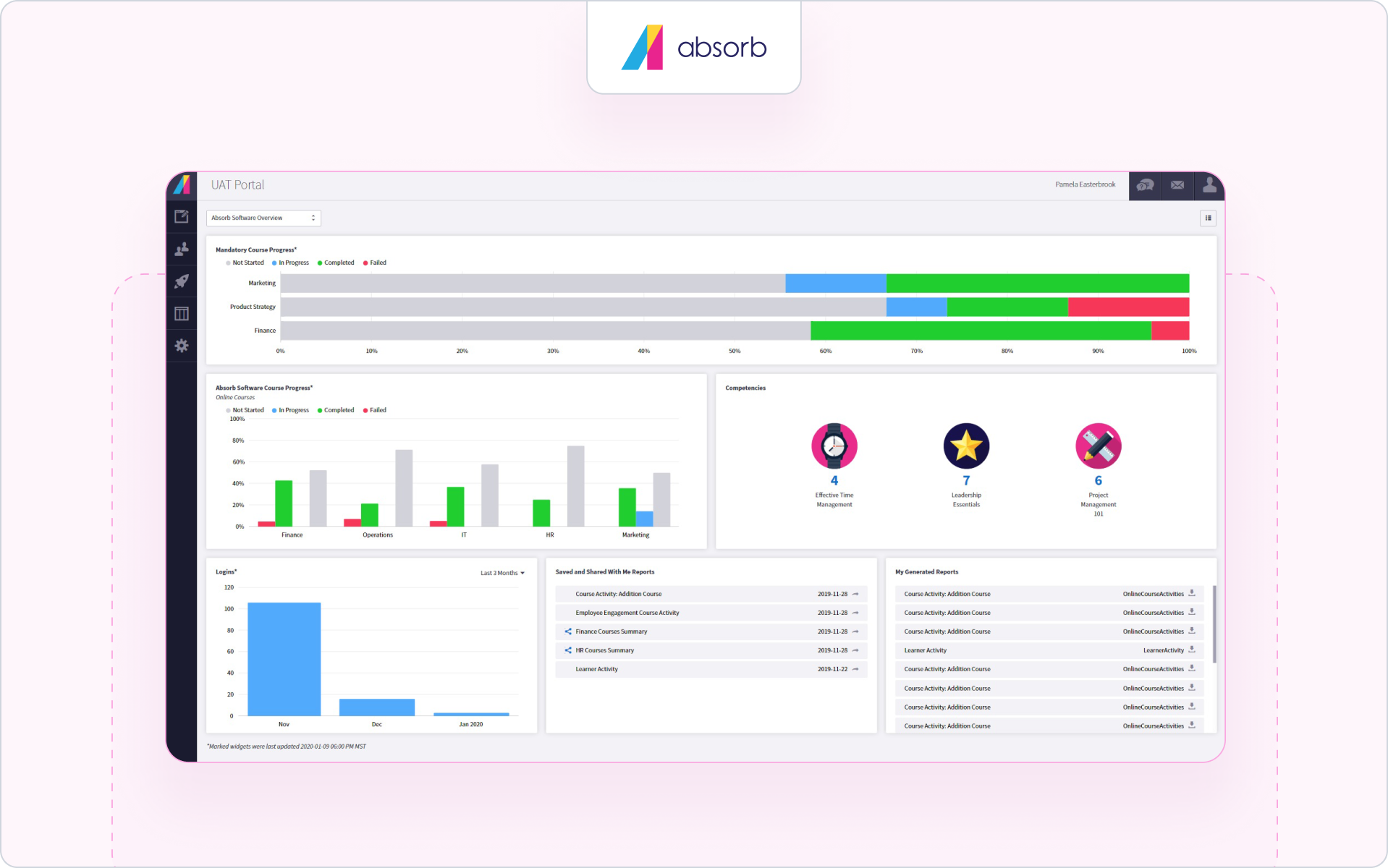
Absorb LMS supports partner and customer training through configurable, branded learning experiences.
Best for:
Teams that want strong reporting and polished partner-facing portals.
Why it stands out:
Absorb emphasizes dashboards and analytics across external learners. This helps teams monitor training completion and engagement trends.
Partner certification features:
- Branded portals for partners and customers
- Certification tracking with reporting and automation
Keep in mind:
Engagement outside the LMS often relies on integrations. Be sure to assess how partner certification connects to broader partner performance data.
6. 360Learning – Collaborative certification and peer-driven learning
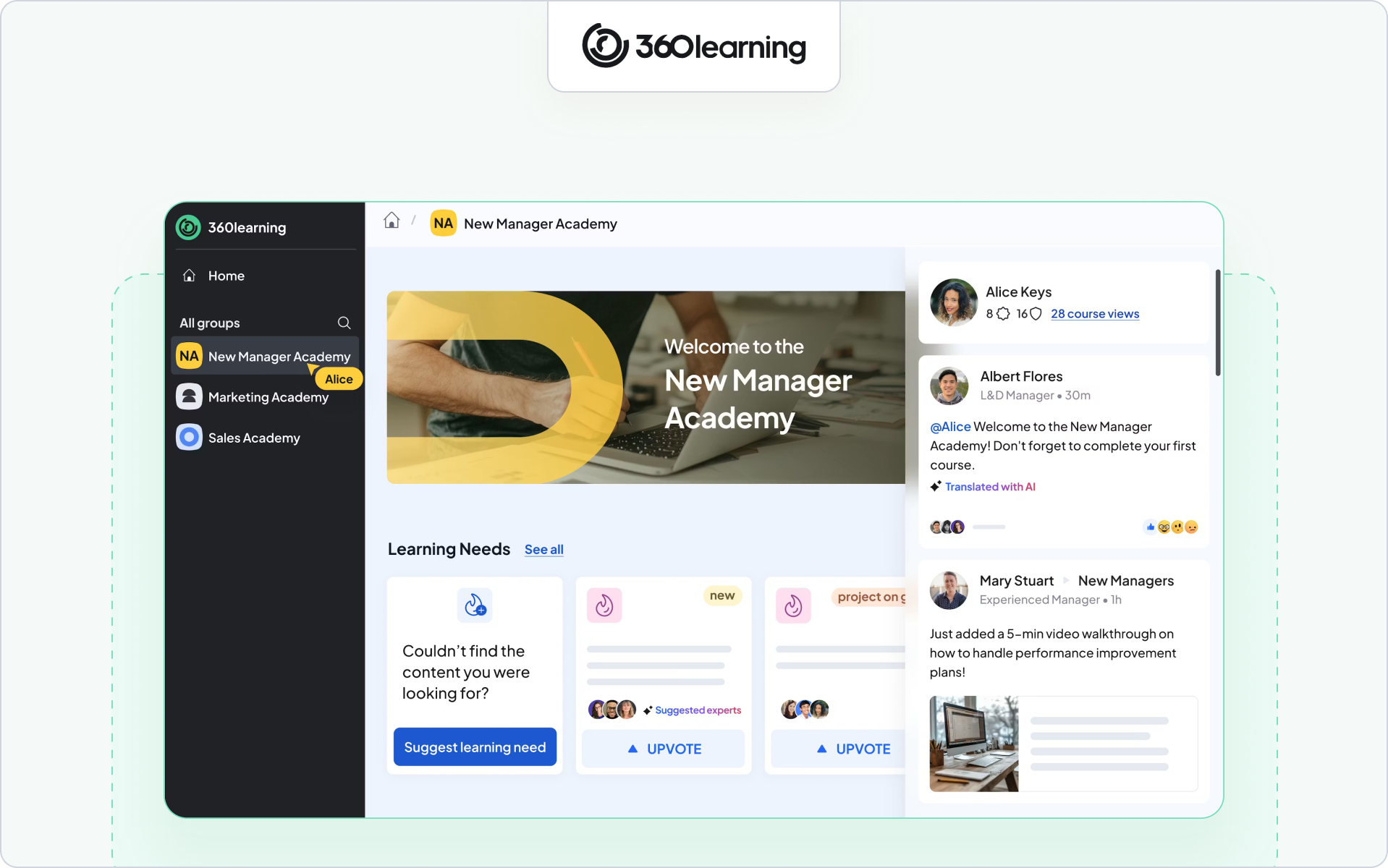
360Learning is a learning platform focused on collaborative and peer-driven training, sometimes extended to partners.
Best for:
Teams that want partners to contribute content or learn from each other.
Why it stands out:
360Learning emphasizes social learning and peer validation. This can support certification readiness in highly collaborative partner ecosystems.
Partner certification features:
- External partner groups and shared learning spaces
- Certifications supported through courses and assessments
Keep in mind:
The collaboration-first model needs clear governance. It works best when partner contribution is intentional and structured.
7. LearnWorlds – Branded certification academies with flexible learning paths
LearnWorlds is an online course platform often used to build external partner academies and certification hubs.
Best for:
Teams running partner certification programs that need branded academies and customized learning paths without enterprise complexity.
Why it stands out:
LearnWorlds focuses on structured learning experiences with strong control over course flow. It works well when different training programs need to support partners across regions or roles.
Partner certification features:
- Courses, assessments, and certificates for external partners and customers
- Customized learning paths and prerequisites to guide partners through different training
Keep in mind:
LearnWorlds is optimized for education delivery. Advanced CRM integration and partner performance reporting usually require additional tools.
8. Intellum – Enterprise academies with configurable certification programs

Intellum supports large-scale customer and partner education programs.
Best for:
Enterprise teams running structured partner certification at scale.
Why it stands out:
Intellum offers configurable learning experiences and analytics. It’s often used for complex partner and customer academies.
Partner certification features:
- Certification programs across external audiences
- Reporting on training completion and progress
Keep in mind:
Implementation effort can be significant, so CRM alignment and operational fit should be assessed early.
9. WorkRamp – Enablement-focused training with certification paths
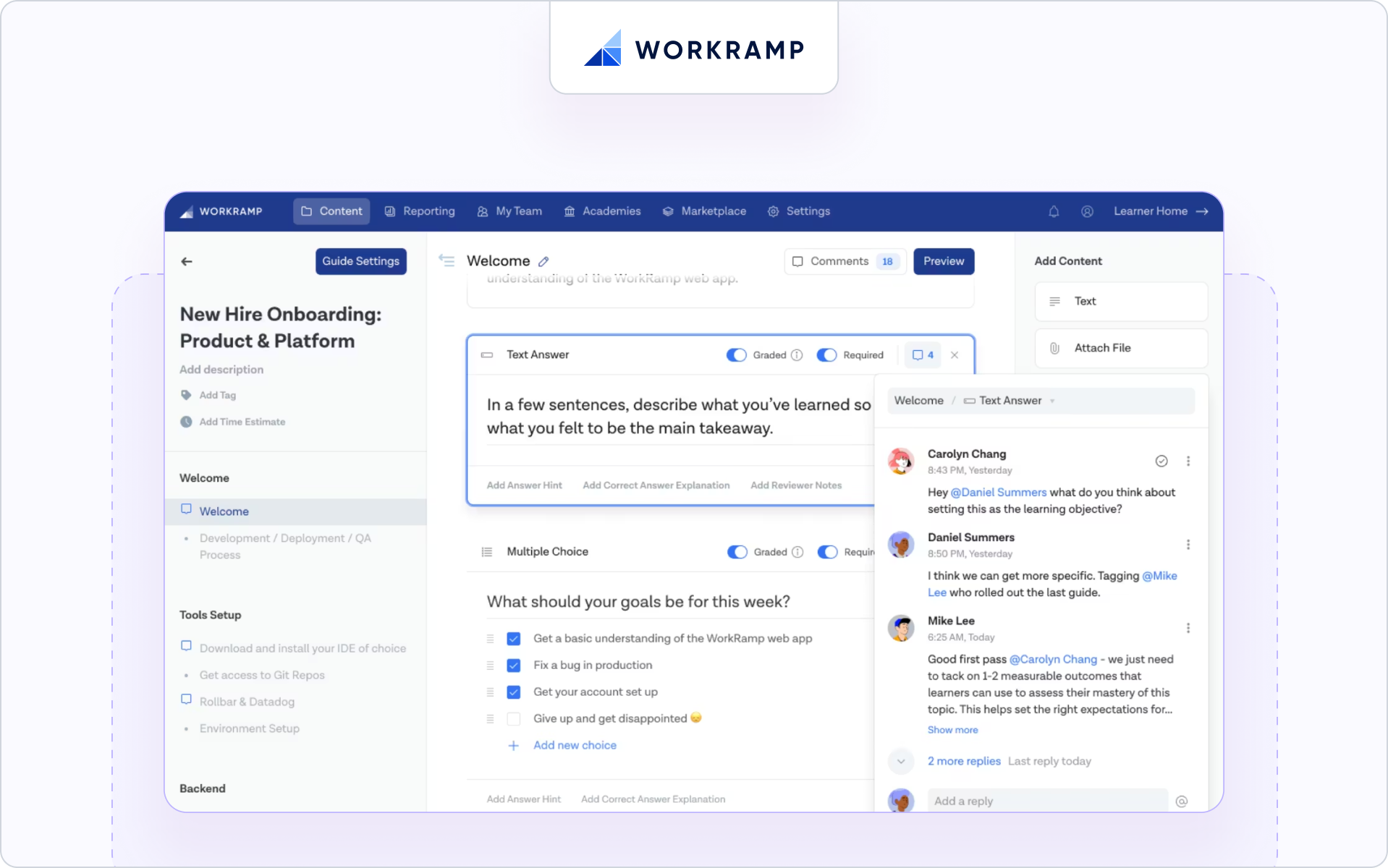
WorkRamp is used for partner training when certification supports broader enablement programs and sales motions.
Best for:
Teams aligning partner certification with enablement programs and customer success initiatives.
Why it stands out:
WorkRamp focuses on helping partners complete training that builds practical skills. Certification supports partner success by validating readiness across different training programs.
Partner certification features:
- Certification paths tied to enablement programs
- Assessments with clear assessment scores and progress tracking
Keep in mind:
Partner-specific governance may need planning. Evaluate how certification status supports sales performance and helps close deals.
10. Channeltivity (Training Module) – PRM with built-in certification

Channeltivity combines partner training with PRM workflows inside one platform.
Best for:
Teams managing partner ecosystems where certification supports partner tier rules.
Why it stands out:
Training and certification live alongside deal registration and partner operations.
This reduces time spent switching tools across the organization.
Partner certification features:
- Built-in training programs for partners
- Certification tracking tied to partner tier access
Keep in mind:
Training depth is limited compared to standalone tools. Many teams review this alongside partner relationship management software to assess long-term fit.
11. TalentLMS – Fast setup with branches for partner audiences
TalentLMS is often used as an entry-level partner certification program software.
Best for:
Teams that need to create training programs quickly for partners and customers.
Why it stands out:
TalentLMS supports fast rollout with minimal setup. Branches allow different training for partner groups and regions.
Partner certification features:
- Certifications tied to course completion
- Basic analytics tools for training completion
Keep in mind:
CRM integration is limited. As partner ecosystems grow, teams often reassess their certification status needs.
12. Litmos – Compliance-heavy certification for global partners
Litmos is used for certification programs with strict compliance needs.
Best for:
Organizations delivering standardized training programs across regions and industries.
Why it stands out:
Litmos supports consistent certification and reporting at scale. It’s common in industries with high regulatory demand.
Partner certification features:
- Certifications and assessments for partners and customers
- Reporting on completion rates and training completion
Keep in mind:
User experience can feel rigid, so engagement and relevant content often require additional marketing tools.
13. Mindtickle – Sales readiness and role-based certification

Mindtickle focuses on sales readiness rather than broad partner training.
Best for:
Teams prioritizing sales performance and selling skills.
Why it stands out:
Mindtickle emphasizes coaching, feedback, and assessments. Certification validates practical skills tied to real sales scenarios.
Partner certification features:
- Role-based certifications for partners
- Assessments and readiness scoring
Keep in mind:
Not designed as a full partner certification program software. Most teams pair it with other tools so partners can access training consistently.
14. Thought Industries – Multi-tenant academies with certification

Thought Industries supports external academies for partners and customers.
Best for:
Teams running multiple certification programs across brands or regions.
Why it stands out:
Multi-tenant architecture supports different training needs. Certification can support demand generation and customer success.
Partner certification features:
- External academies with certification paths
- Analytics and reporting for training completion
Keep in mind:
Configuration can be complex. Plan certification governance early to avoid operational pain points.
15. iSpring LMS – Affordable certification with built-in authoring
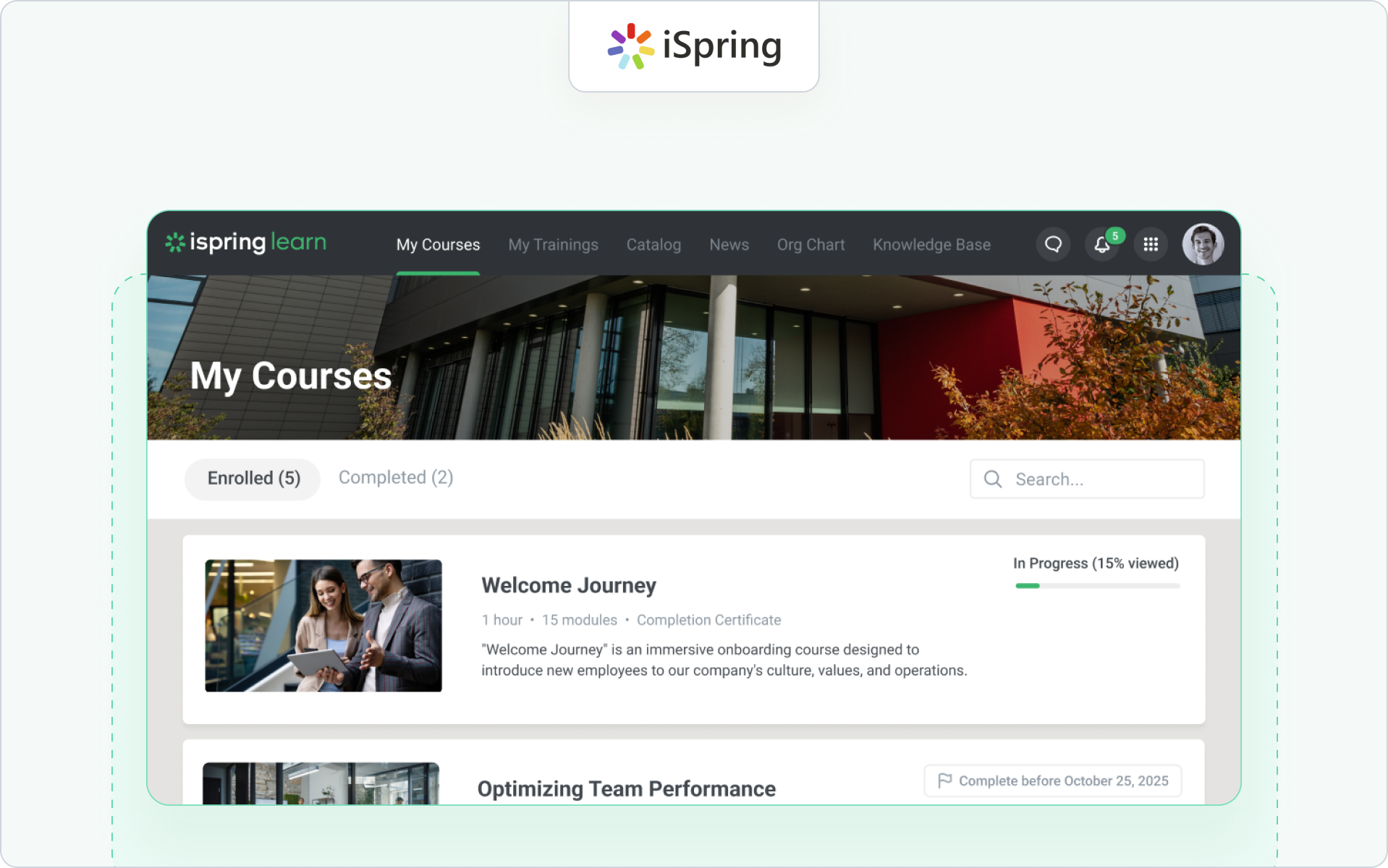
iSpring LMS combines course authoring with certification delivery.
Best for:
Teams looking to develop partner training without enterprise pricing.
Why it stands out:
Built-in authoring reduces time spent creating courses, supporting faster access to training for partners.
Partner certification features:
- Certifications and assessments
- Course creation tools for different training needs
Keep in mind:
Advanced integrations are limited. Teams often review CRM alignment separately when choosing the right CRM for partner management.
Choosing the right tool depends on how critical certification is to your partner motion.
That’s why the next step is breaking down the certification-critical features that actually matter when evaluating partner certification program software.
Buyer’s checklist: Certification-critical features
Partner certification program software only works if it holds up operationally.
This checklist helps you evaluate whether a tool supports real partner readiness, not just training delivery.
When these features work together, certification supports partner performance beyond training alone.
That’s why many teams align certification with a broader partner engagement strategy. From there, the real question is which platforms make this easy to run at scale.
That leads directly to why teams choose Introw for partner certification.
Why Teams Choose Introw for Partner Certification
Introw is a partner certification program software built for teams that treat certification as operational leverage. It helps you move faster without losing control as partner training and certification scale.
Create in minutes
Introw’s AI agent turns existing site or portal content into structured courses with quizzes and assessments. That means training programs evolve with your products, without extra time spent rebuilding content.
Certify with control
Certificates are issued in one click and expire automatically when knowledge changes. Certification status stays current and protects program benefits as partners move across solutions and services.
Enroll at scale
You can segment by role, region, or partner tier and invite partners in bulk. This supports different training needs while keeping access to training consistent across the partner ecosystem.
Drive adoption without friction
Partners receive reminders and updates through email or Slack. They can complete training without living inside another portal, which improves completion rates.
Prove impact where it matters
Training completion, assessment scores, and progress tracking sync with Salesforce and HubSpot. That connection turns certification into insight you can use to improve sales performance and customer success.
Before you commit, pressure-test this
- Will certification remove pain points or add more admin work?
- Can certified partners be trusted to sell and close deals confidently?
- Will certification still work as demand, growth, and complexity increase?
If certification needs to support real execution, not just compliance, Introw is designed for that.
Request a demo to see what Introw and your business can achieve together.
A Masterclass in Modern B2B SaaS Partnerships: What We Learned from Martin Scholz
As a team that spends every day talking to partnership professionals, we know one thing for sure: we can’t just talk the talk - we have to walk it, too. That’s why we brought in a true expert to level us up: Martin Scholz, seasoned SaaS partnership leader, strategist, and (bonus!) one of our own partners.
And wow, did he deliver.
Martin took us through a full-day training covering every nook and cranny of partnership management, from the fundamentals to the frameworks you won’t find in your average playbook. Here are the biggest takeaways from our session.
First Reality Check: 80% of Partnerships Fail
Martin opened with this stat: 80% of partnerships fail (source). Why? Because there’s no blueprint. No one-size-fits-all. Every company defines “partnership” differently.
The truth is, partnerships aren't a solo act. They're a team effort
What Successful Partnerships Actually Drive
Done right, partnerships don’t just generate revenue - they unlock scale:
- Shorter sales cycles
- Higher win rates
- Transparent deal flow
- Better-quality leads (hello, PQLs 👋)
- More focus on your core business while partners drive volume
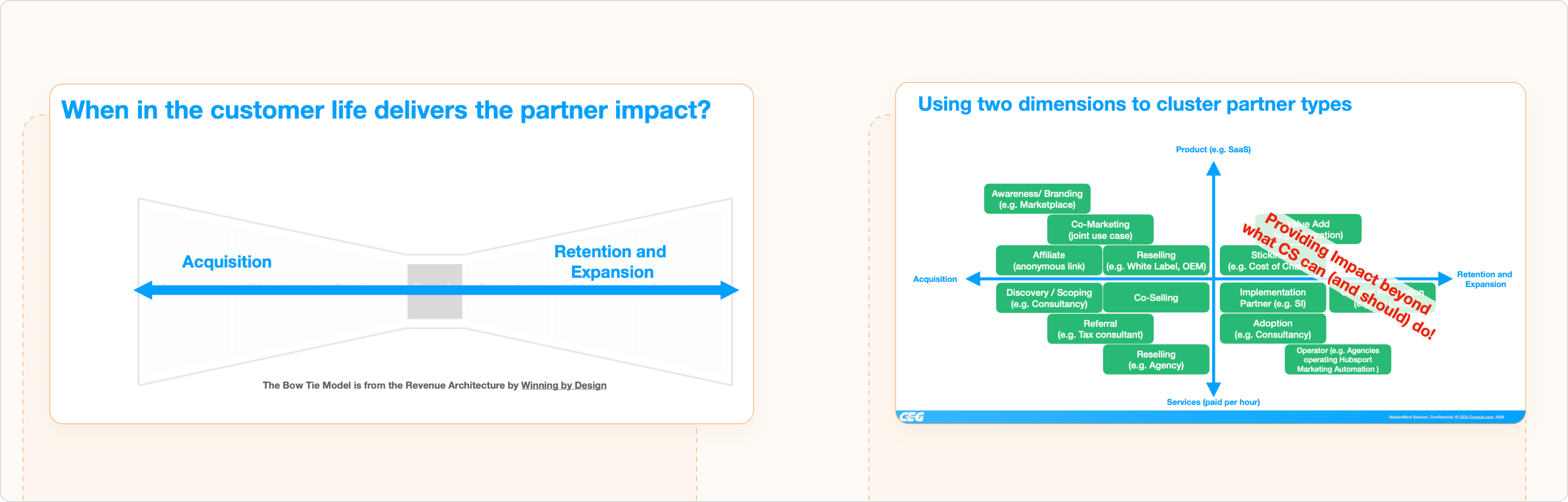
And yes - the Bow Tie model (Winning By Design) made an appearance.
Martin reminded us that many forget the power partners have across the entire customer lifecycle - not just in introducing or closing the deal, but in retention, expansion, and long-term value
Whether you're working with tech partners, service partners, or resellers, their role varies by stage - and your strategy should too.
Revenue is a Result, Not the Goal
A big mindset shift: Stop chasing revenue, start building outcomes.
Too many teams treat revenue as the first metric, but Martin reminded us it’s the result of well-executed partnership strategies. Instead, define shared targets and goals - then align around those.
The Biggest Risk? Too Many Wrong Partners
Here’s your new motto: Disqualify fast.
Don’t let “more” distract you from “better.” A bloated partner list full of misaligned or inactive collaborators is worse than having none at all.
The Secret Weapon: Your MAP (Mutual Action Plan)
Your MAP is your North Star.
It’s a living document, co-created with your partner, that defines what success looks like—milestones, metrics, activities. This is what keeps partnerships focused and accountable from day one.
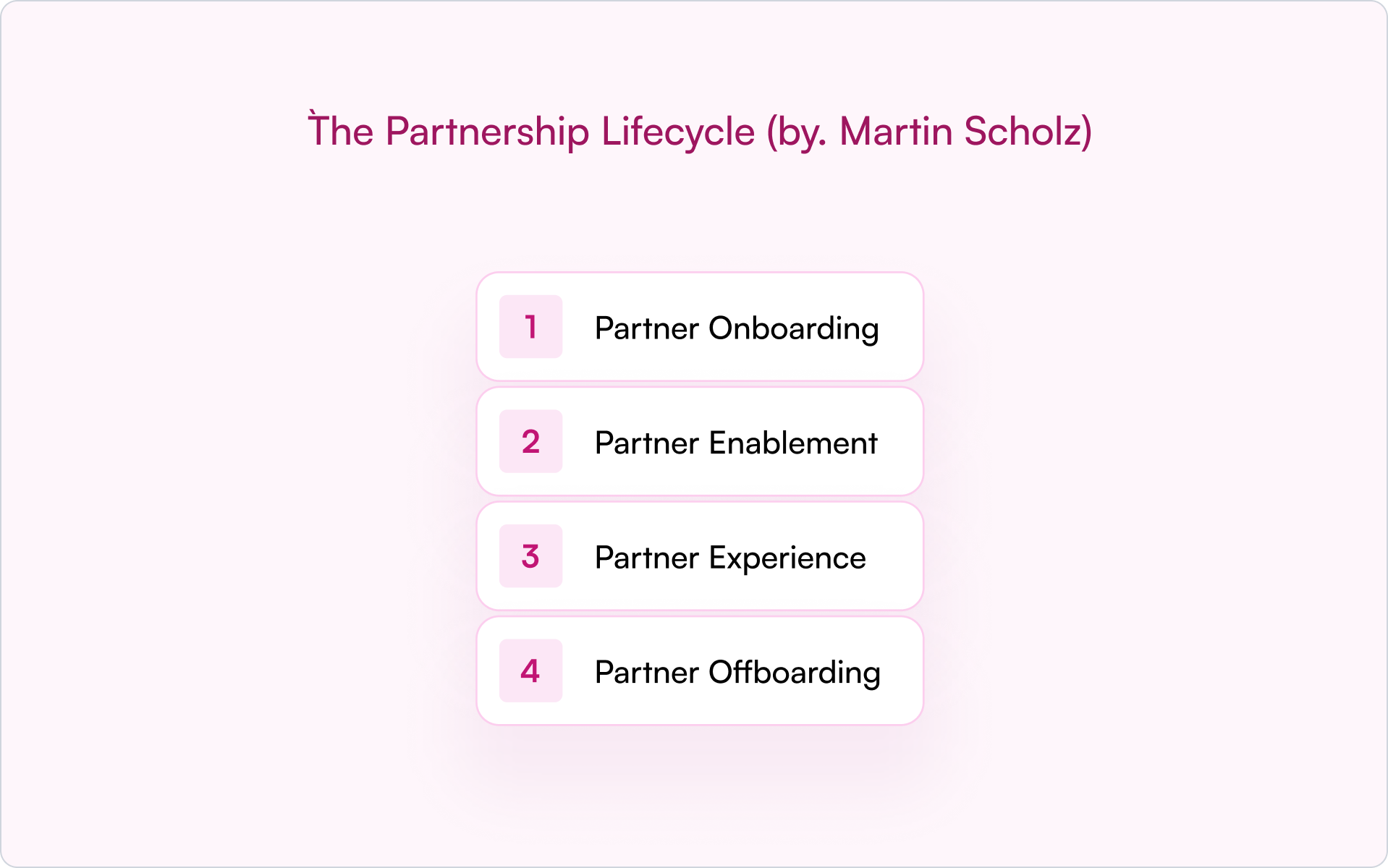
The Partnership Lifecycle According to Martin
Partner Onboarding = The Honeymoon Phase
First impressions matter. Use this phase to build trust, show value, and get wins on the board.
Tips:
- Deliver an amazing partner experience
- Connect teams & execs (use leadership wisely!)
- Execute on your MAP - don’t just let it sit in a doc
- Prioritize fast wins and momentum
- The first 90-120 days? Absolutely critical.
Partner Enablement = Where the Real Work Starts
Once the honeymoon is over, reality hits - and that’s when enablement really begins.
Key actions:
- Run a no-fluff business review (internal + external)
- Adjust the MAP to reflect reality
- Tier and prioritize your partner list
- Agree on new ways of working (cadence, content, etc.)
And a big one: Reality ≠ one single source per deal.
Most deals are touched by multiple sources (partners, marketing, sales) and yet traditional deal registration often gives credit to just one. It's time to rethink attribution and make space for the real complexity of modern sales motions.
Never forget: partnerships are built between people, not logos.
Best Practices for Partner Collaboration
Here's what Martin recommends:
- Be part of the first 3 intro calls before partners go solo
- Ensure strong overlap in goals and ICP
- Use a PRM tool to streamline the entire partnership workflow:
- Lead submission & deal registration
- Transparency around pipeline
- Goal tracking and performance measurement
- Communication & updates in real time
- Sales enablement that’s actually useful
Partner Experience is a Team Effort
Your partner doesn’t experience “the partnership” - they experience your product team, your CS team, your marketing team. Partner experience = everyone’s job.
And Yes - Some Partnerships End
Not every partnership is forever, and that’s OK. Offboarding should be handled with the same care and clarity as onboarding. It’s part of the cycle - not a failure.
Final Thought
Martin left us with this gem:
Work with partners so you can focus on your core business.
That’s the promise of a well-built, well-run partnership ecosystem. Not just revenue. Not just reach. But real business leverage.
Thanks again, Martin, for the masterclass. We’re sharper, smarter, and more aligned than ever, and we can’t wait to put these lessons into practice.
17 TalentLMS Alternatives for Partner Training in 2026
What would partner training look like if certifications stayed current, partners were engaged through email or Slack, and learner progress was visible inside your CRM?
For SaaS teams, partner training has different requirements than employee training. It often involves training multiple groups, role-based learning paths, certification governance, and CRM-first reporting to support partner enablement at scale.
This article compares TalentLMS alternatives for partner training in 2026, outlines the key features to prioritize, and explains how teams move from course completion to measurable business outcomes.
When it comes to partner training, what prompts teams to look for another solution?
Why Teams Look Beyond TalentLMS for Partner Training
As partner programs scale, training requirements start to look very different from traditional corporate training.
Partner enablement introduces more complex needs that go beyond a standard learning management system, especially when teams start formalizing certification, onboarding, and readiness as part of a broader partner enablement strategy.
What partner training typically needs
Compared to internal training programs, partner training usually requires:
- Training multiple groups across regions, partner types, and tiers
- Role- and tier-based learning paths aligned to how partners sell, implement, or support your product
- Certifications that gate access to deal registration, co-selling, or incentives
- CRM visibility so learner progress, certifications, and readiness connect directly to pipeline and revenue
At this stage, training is no longer just about delivering online courses.
It becomes part of a wider partner engagement and collaborative learning motion, where enablement, communication, and attribution reinforce each other as teams apply proven principles from a practical partner engagement guide.
Where programs commonly get stuck
As partner programs mature, teams often encounter friction in a few predictable areas:
Portal dependency
Partners must log into another learning platform, which reduces learner engagement and limits collaborative learning across the ecosystem.
Manual course creation
Updating training materials and certifications becomes time-consuming as products and messaging evolve.
Limited governance
Managing certification expirations, recertification windows, and prerequisites is difficult to scale across partner tiers.
Weak CRM linkage
Training data remains isolated inside the learning management system, making it harder to measure training ROI or align training programs with revenue.
These gaps are typically the point where teams begin evaluating TalentLMS alternatives designed for partner training rather than internal corporate learning alone.
With these needs in mind, here are the most relevant TalentLMS alternatives for partner training in 2026.
17 Best TalentLMS Alternatives for Partner Training (2026)
Here’s our carefully curated list of TalentLMS alternatives that support partner training, certification, and reporting at scale.
1. Introw Partner LMS
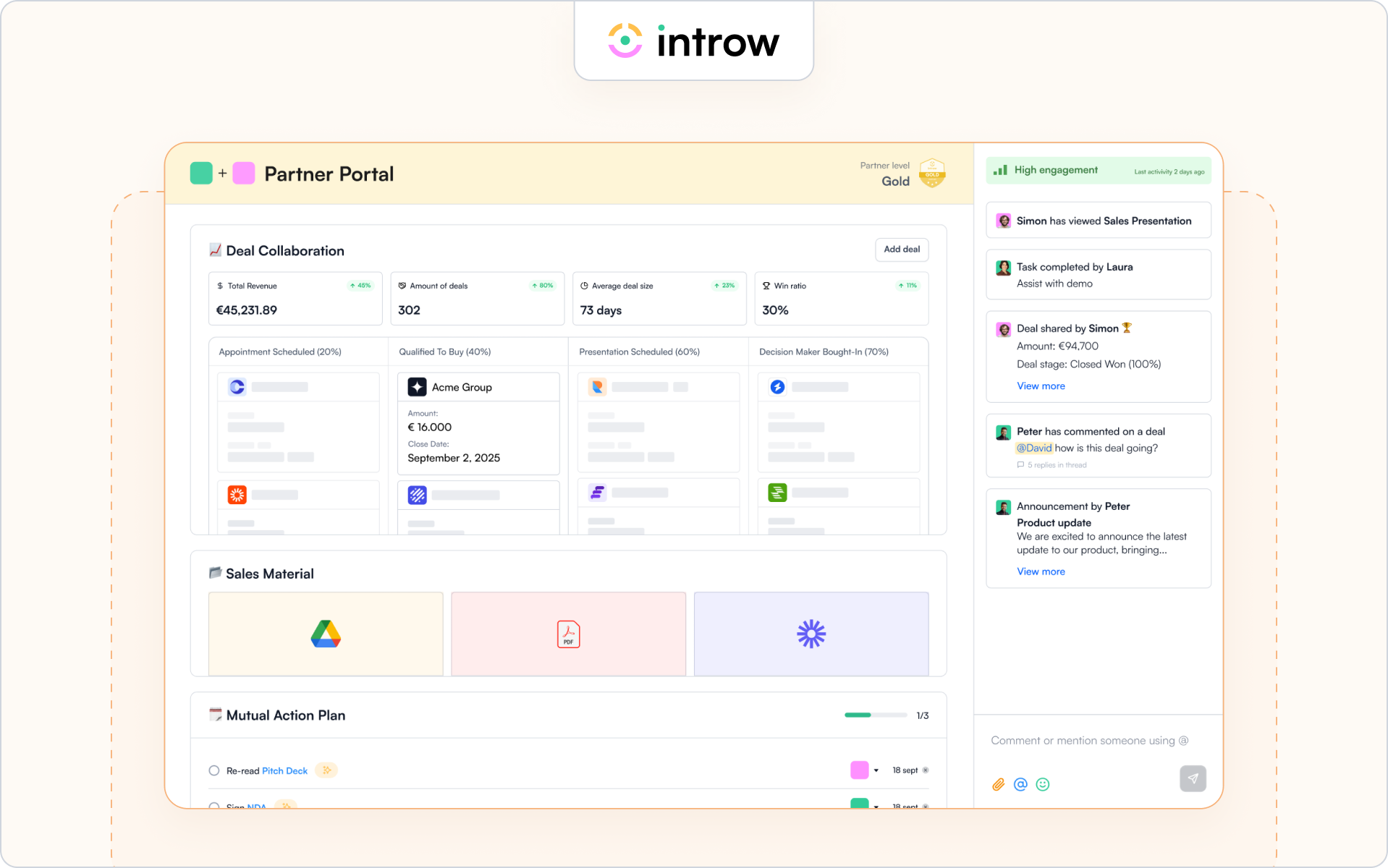
Introw is built for SaaS teams evaluating TalentLMS alternatives that need partner training to drive real outcomes, not live in a standalone learning management system. The focus is on connecting training programs, certifications, and learner progress directly to CRM workflows using the Introw Partner LMS.
Best for
B2B SaaS teams on Salesforce or HubSpot that need fast course creation, governed certification programs, and clear visibility into learner progress, deal registration, and partner performance.
Why it’s a strong alternative to TalentLMS
Introw uses AI-driven course creation to generate structured online courses, quizzes, and training materials from existing content in minutes. Certification programs include expiration and recertification, supporting complex training requirements across partner tiers.
Partner engagement happens off-portal through email and Slack, improving learner engagement without forcing logins. Training programs, learning paths, and certifications are visible inside Salesforce and HubSpot, making it easier to measure training ROI and connect training activity to pipeline.
Key features
- AI-driven course creation and role- or tier-based learning paths
- Certification governance with expiration and recertification
- Off-portal engagement via email and Slack
- Training multiple groups with bulk enrollment
- Tracking learner progress with CRM-visible reporting tools
Integrations
Salesforce, HubSpot, Slack, API.
2. Skilljar by Gainsight
Skilljar by Gainsight is a learning management system designed for customer and partner training programs at scale.
Best for
SaaS teams running external training programs that need structured certifications and strong learner engagement reporting.
Why it’s a strong alternative to TalentLMS
Skilljar supports partner-facing online courses, certification paths, and training programs across multiple audiences, making it suitable as teams move beyond basic corporate training.
Key features
- Multi-portal training programs
- Certification workflows with tracking
- Advanced analytics for learner progress
Keep in mind
Training data lives primarily inside the platform rather than the CRM.
Integrations
Salesforce, Gainsight, APIs
3. LearnUpon
LearnUpon is a learning management system used for employee training, customer training, and partner enablement.
Best for
Teams training multiple groups that need separate portals with consistent branding.
Why it’s a strong alternative to TalentLMS
LearnUpon supports structured learning paths, certification governance, and reporting tools, making it a common choice for scalable partner and customer training.
Key features
- Multi-portal learning management system
- Learning paths and certifications
- Reporting tools for learner progress
Keep in mind
Course creation is largely manual compared to AI-driven platforms.
Integrations
Salesforce, HRIS tools, APIs
4. Docebo
Docebo is an enterprise learning management system built for complex training requirements.
Best for
Organizations managing large-scale corporate training alongside customer or partner education.
Why it’s a strong alternative to TalentLMS
Docebo supports collaborative learning, personalized learning paths, and advanced features for organizations with complex training needs.
Key features
- AI-driven content recommendations
- Social and collaborative learning tools
- Advanced analytics and reporting
Keep in mind
Configuration and administration can be complex for smaller teams.
Integrations
Salesforce, HR systems, content tools
5. Absorb LMS
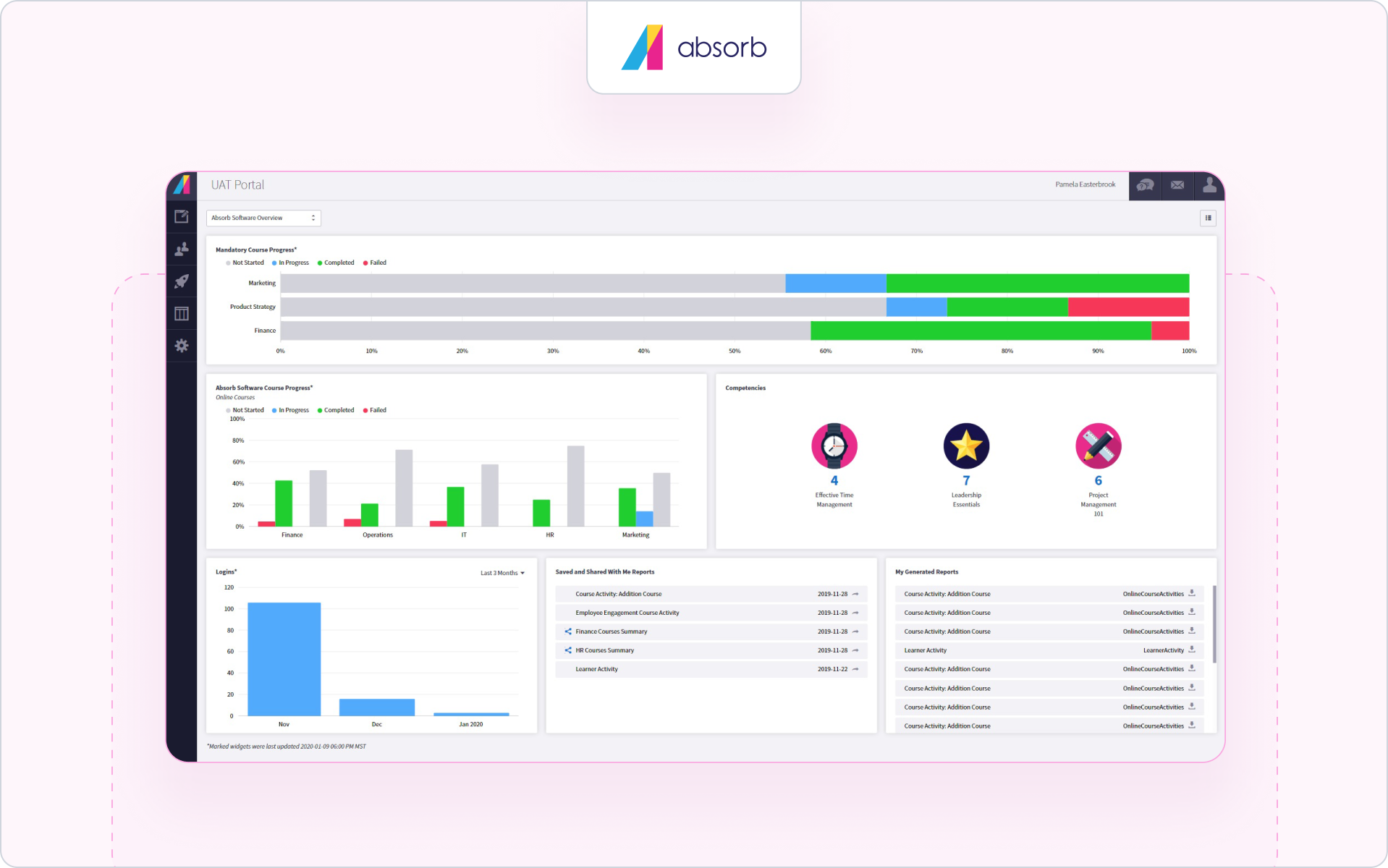
Absorb LMS is a learning management system used for corporate training and external learning programs.
Best for
Teams that need detailed reporting tools and custom branding for partner training.
Why it’s a strong alternative to TalentLMS
Absorb LMS supports structured learning, compliance training, and tracking learner progress across multiple audiences.
Key features
- Advanced reporting and analytics tools
- Branded portals and custom branding
- SCORM and xAPI support
Keep in mind
User experience and setup may require dedicated technical support.
Integrations
Salesforce, HRIS platforms, APIs
6. 360Learning
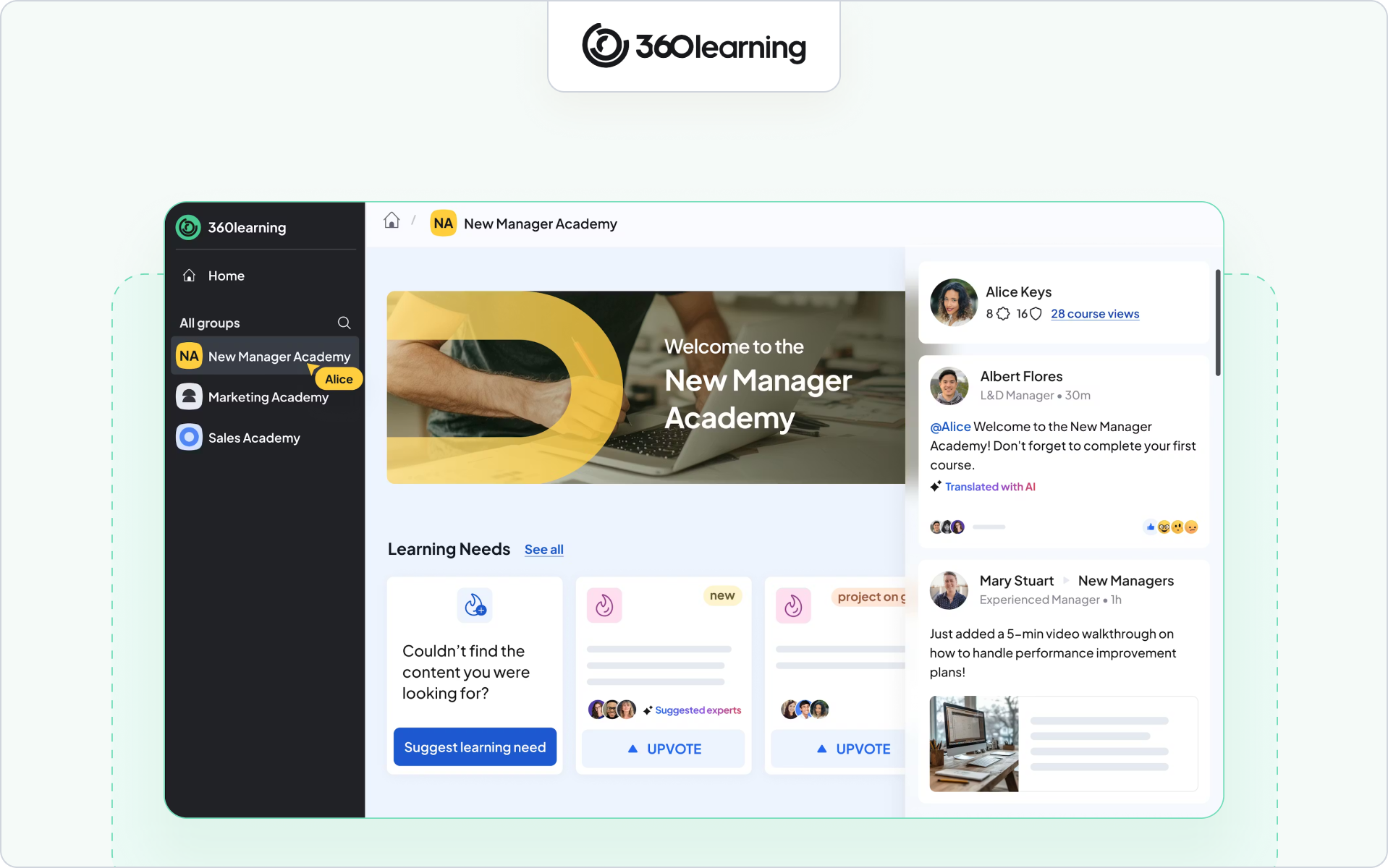
360Learning emphasizes social learning and internal knowledge sharing.
Best for
Teams prioritizing collaborative learning and rapid course creation.
Why it’s a strong alternative to TalentLMS
360Learning supports collaborative learning capabilities that enable subject-matter experts to create and update training content quickly.
Key features
- Collaborative course creation
- Social learning tools
- Learning paths and assessments
Keep in mind
Less focused on external partner certification governance.
Integrations
HR systems, content tools, APIs
7. Intellum

Intellum is a learning platform designed for customer training and partner enablement.
Best for
Organizations running structured external training programs with advanced reporting needs.
Why it’s a strong alternative to TalentLMS
Intellum supports scalable training programs, certification management, and detailed learner engagement analytics.
Key features
- Advanced authoring tools
- Certification and learner progress tracking
- Analytics for training effectiveness
Keep in mind
Often used by larger enterprises with dedicated learning teams.
Integrations
Salesforce, CRM tools, APIs
8. Thinkific

Thinkific is an online learning platform commonly used to deliver external training and online courses.
Best for
Teams creating partner-facing “universities” or training hubs.
Why it’s a strong alternative to TalentLMS
Thinkific makes it easy to deliver training content and structured courses to external audiences.
Key features
- Course creation and delivery
- Custom branding options
- Training videos and assessments
Keep in mind
Limited certification governance and enterprise reporting.
Integrations
Payment tools, marketing platforms, APIs
9. WorkRamp
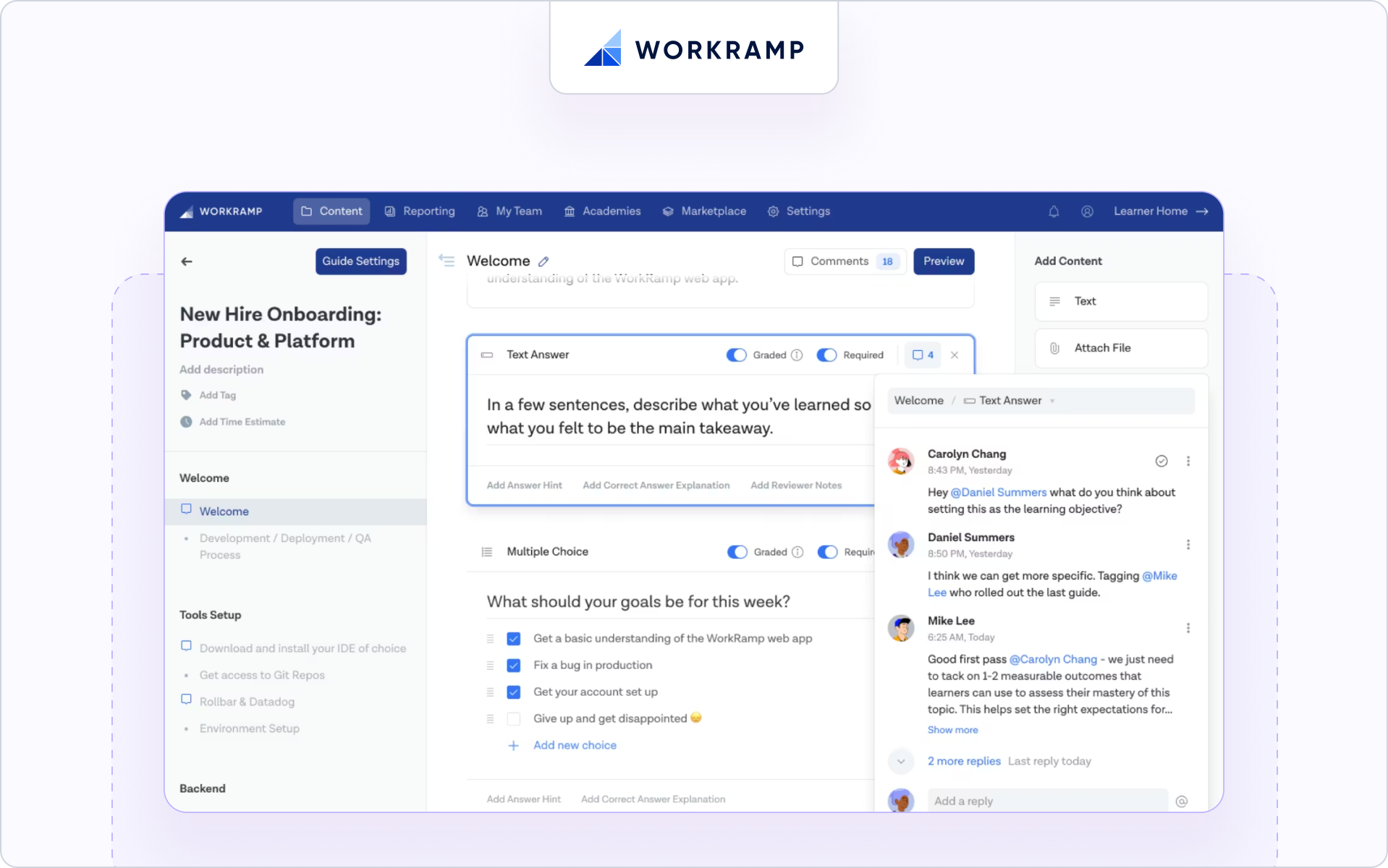
WorkRamp supports employee training, customer training, and partner enablement.
Best for
Teams looking for modern UX and certification paths across audiences.
Why it’s a strong alternative to TalentLMS
WorkRamp combines course creation, certification management, and learner engagement tools in a single platform.
Key features
- AI-assisted course creation
- Certification paths
- Learner engagement tools
Keep in mind
CRM attribution is not the primary focus.
Integrations
Salesforce, HRIS tools, APIs
10. Litmos
Litmos is a learning management system often used for compliance training and distributed teams.
Best for
Organizations delivering standardized training across regions.
Why it’s a strong alternative to TalentLMS
Litmos supports mobile learning, compliance training, and scalable training management.
Key features
- Compliance and regulatory training
- Mobile learning support
- Training management tools
Keep in mind
Less flexible for complex partner certification models.
Integrations
Salesforce, SAP ecosystem, APIs
11. iSpring Learn
iSpring Learn is a learning management system often paired with iSpring’s authoring tools for structured training delivery.
Best for
Teams delivering structured training courses with limited technical complexity.
Why it’s a strong alternative to TalentLMS
iSpring Learn supports training programs, certifications, and tracking learner progress with a straightforward interface.
Key features
- Course creation with certificates
- Mobile learning support
- Learner progress tracking
Keep in mind
Less flexible for complex partner or multi-portal training.
Integrations
HR systems, content tools, APIs
12. Tovuti LMS
Tovuti LMS supports customer training and partner training through a configurable learning platform.
Best for
Organizations running diverse external training programs with engagement-focused features.
Why it’s a strong alternative to TalentLMS
Tovuti supports blended learning, training videos, and social learning to improve learner engagement.
Key features
- Gamification and social learning
- Course creation and training content
- Events and live training support
Keep in mind
Administration can be complex for smaller teams.
Integrations
CRM systems, webinar tools, APIs
13. Adobe Learning Manager
Adobe Learning Manager is an enterprise learning management system designed for large-scale training delivery.
Best for
Enterprises managing corporate training and customer training across regions.
Why it’s a strong alternative to TalentLMS
Adobe Learning Manager supports complex training requirements, reporting tools, and enterprise learning workflows.
Key features
- Advanced analytics and reporting
- Personalized learning paths
- Mobile and blended learning
Keep in mind
Setup and customization often require technical expertise.
Integrations
Adobe ecosystem, HR systems, APIs
14. Cornerstone LMS
Cornerstone LMS is a learning management system used for enterprise learning and talent development.
Best for
Large organizations with complex corporate training and compliance training needs.
Why it’s a strong alternative to TalentLMS
Cornerstone supports structured learning, compliance training, and advanced reporting across large user bases.
Key features
- Enterprise learning management
- Compliance and regulatory training
- Advanced analytics
Keep in mind
Less focused on partner-specific training workflows.
Integrations
HRIS platforms, content providers, APIs
15. D2L Brightspace
D2L Brightspace is a learning platform used across enterprise learning and education sectors.
Best for
Organizations delivering structured learning at scale with diverse audiences.
Why it’s a strong alternative to TalentLMS
Brightspace supports personalized learning experiences, assessments, and analytics.
Key features
- Personalized learning journeys
- Analytics and reporting tools
- Mobile learning support
Keep in mind
Originally built for educational institutions, not partner-first workflows.
Integrations
Content tools, HR systems, APIs
16. Moodle
Moodle is an open-source learning management system widely used for online learning.
Best for
Teams with technical resources that need full control over their learning platform.
Why it’s a strong alternative to TalentLMS
Moodle supports custom training programs, learning paths, and collaborative learning through plugins.
Key features
- Open-source flexibility
- Community-driven plugins
- Structured learning paths
Keep in mind
Requires ongoing technical maintenance and support.
Integrations
Plugins, APIs, third-party extensions
17. Articulate 360
Articulate 360 is not a learning management system but a widely used tool for creating training content.
Best for
Teams that need to create high-quality e learning content to deliver through an LMS.
Why it’s a strong alternative to TalentLMS
Articulate 360 excels at course creation and training materials when paired with an existing LMS.
Key features
- Course creation and training videos
- Interactive assessments
- Content authoring tools
Keep in mind
Requires a separate LMS to manage learners and reporting.
Integrations
SCORM/xAPI-compatible LMS platforms
You've now seen how these TalentLMS alternatives vary by complexity, audience, and how training connects to revenue.
How do you know which one is right for you? Use our checklist to evaluate what will fit your partner training needs.
Buyer’s Checklist for TalentLMS Alternatives (Partner POV)
Use this checklist to quickly assess whether a learning management system can support partner training as part of a broader partnership motion.
Introw tip:
If partners must log in for every update, adoption drops. Favor off-portal nudges.
Now that you know how to narrow down your choice, here’s why many teams choose Introw over TalentLMS for partner training.
Why Teams Pick Introw Over TalentLMS for Partner Training
As partner programs mature, training needs to move faster, stay governed, and show impact beyond course completion. That’s where Introw stands apart from traditional learning platforms.
Create in minutes
Introw’s AI-driven course creation turns existing site or portal content into structured training modules and quizzes in minutes, removing the overhead of manual course building through the Introw Partner LMS.
Certify with control
One-click certificates, expiration and recertification rules, prerequisites, and sell-gating make certifications credible and scalable across partner tiers.
Engage off-portal
Training announcements and reminders reach partners where they already work through email and Slack, driving higher completion without relying on portal logins.
Prove impact
Training progress and certifications sync directly to Salesforce and HubSpot, making it easier to connect training programs to deal registration, pipeline, and forecasting.
Final takeaway
Partner training works best when it’s fast to create, easy to engage with, and visible where revenue decisions happen.
If you’re evaluating TalentLMS alternatives and want partner training to connect directly to CRM data and measurable outcomes, it’s worth seeing Introw in action.
Request a demo and explore how Introw supports modern partner training end-to-end.
Channel Partner Marketing Guide 2026: Strategies and Tactics
What would change if every partner campaign were easy to launch, easy to join, and easy to measure?
Most teams still juggle scattered content and manual follow-ups, which slows down even the best channel partner marketing programs.
A focused channel partner marketing strategy removes that friction by meeting partners where they work, using repeatable assets, and keeping everything aligned in your CRM.
With CRM-native tools like Introw, partner channel marketing programs become easier to run and easier for partners to engage with across both to-partner and through-partner motions.
If predictable revenue is the goal, clarity and automation are the starting point.
So what does channel partner marketing actually mean in 2026?
What is channel partner marketing? (SaaS 2026 definition)
Channel partner marketing is the work you do with and for partners to create demand, drive adoption, and grow revenue together.
In 2026, it’s a mix of to-partner enablement and through-partner campaigns, all tied back to your CRM so nothing gets lost in the shuffle.
To-partner vs through-partner
Here’s the quick way to think about the two motions:
Most strong partner programs run both motions at the same time.
Channel marketing vs partner marketing
People use these terms interchangeably, but they’re not the same.
- Channel marketing is your route-to-market strategy
- Partner marketing is the actual programs and campaigns you run with partners
Your channel partner marketing strategy sits right in the middle of the two.
Who counts as a channel partner?
A channel partner can be a reseller, referral partner, MSP, SI, tech integration partner, agency, or consultant.
Each one brings different strengths and sits at a different stage of the channel partner marketing journey, which is why segmentation early on matters so much.
Why this definition matters
To run channel partner marketing activities that move pipeline, you need clarity about who you’re enabling and what you expect from them.
When everyone shares the same definition, partner managers and RevOps can set goals and measure success directly in Salesforce or HubSpot.
A shared foundation makes your channel partner marketing plan easier to build and scale. Everything else in this guide builds on that framework.
The 4-part framework: Plan → Enable → Run → Measure
Every strong channel partner marketing strategy follows the same rhythm.
These four stages help you plan campaigns partners actually want to use, run consistent through-partner plays, and measure every result directly in Salesforce or HubSpot.
Think of this as the backbone of your entire channel partner marketing journey.
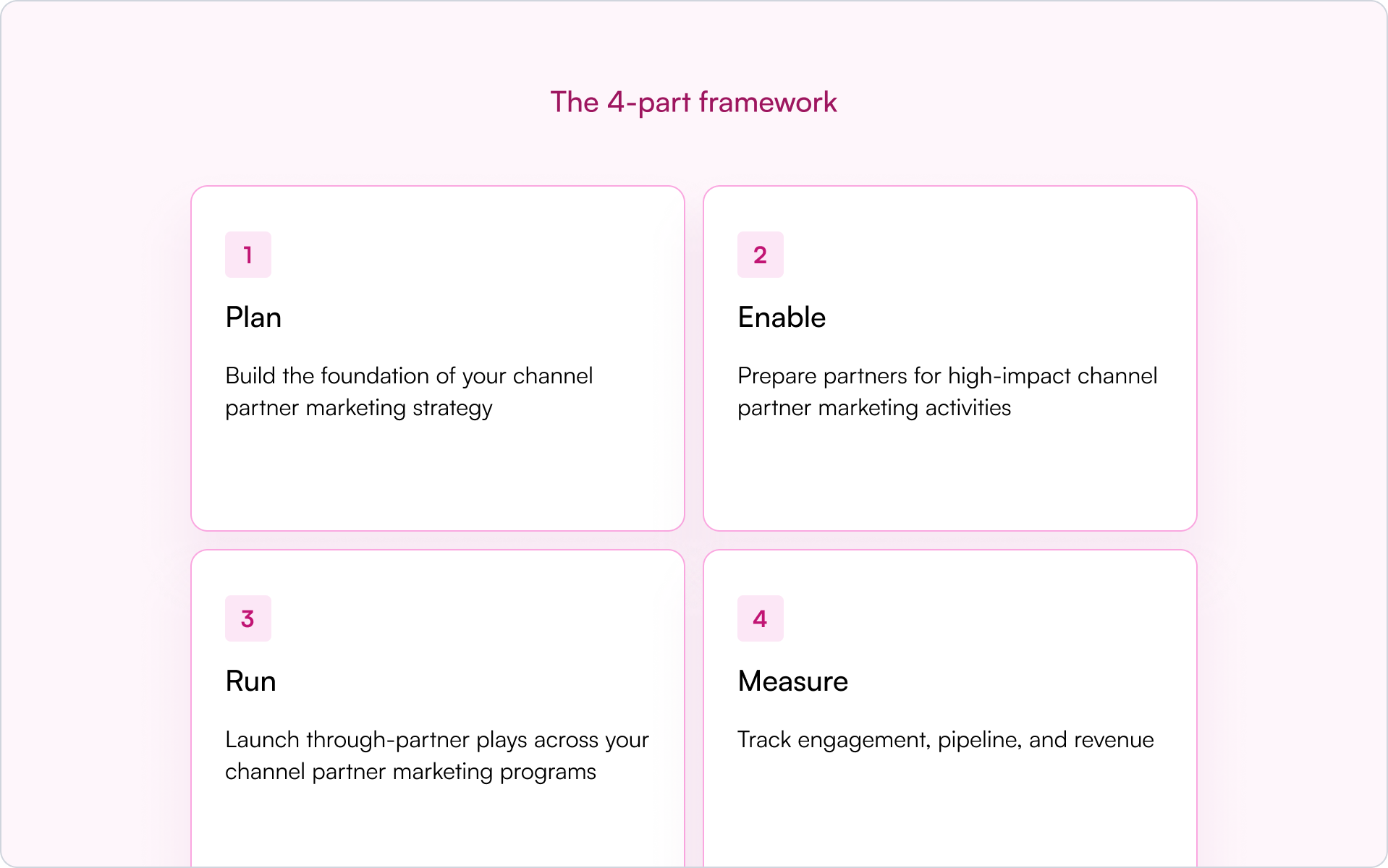
Plan: Build the foundation of your channel partner marketing strategy
Before you launch a partner campaign, you need a quick, clear plan that keeps everyone aligned
This stage shapes the full channel partner marketing journey. It also gives partner managers and RevOps the structure they need to measure outcomes in the CRM.
What to define
- Your partner ICP for each segment in your channel partner marketing programs
- A clear offer for referral, reseller, SI, MSP, or tech partners
- Goals tied to registered deals, qualified intros, and pipeline
- Quarterly focus areas that support your wider channel partner go-to-market strategy
- MDF guidelines and how they connect to channel partner marketing activities
- A campaign calendar with repeatable moments partners can rely on
Why it matters
This is one of the simplest channel partner marketing best practices to get right. If the plan is unclear, partners won’t know how to participate, and your channel partner marketing plan becomes harder to scale.
Example
A strong plan might segment partners by type and region, then map one or two through-partner plays to each group so marketing and partner teams stay aligned.
For a deeper starting point, the How to build a channel partner program guide is a helpful reference.
Enable: Prepare partners for high-impact channel partner marketing activities
Enablement is where your strategy becomes real for partners. When partners know what to say, what to share, and how the campaign works, execution gets a lot easier.
What to provide
- Campaign-in-a-box kits
- Talk tracks and positioning
- Onboarding materials that match each channel partner marketing segment
- Localizable content and co-brandable assets
- Email and social templates that reduce friction
- Clear instructions for through-partner execution
Why it matters
Enablement is the moment partners decide whether they will actually run your campaign. If assets are simple and accessible, your channel partner marketing programs instantly become more repeatable.
Example
A partner might open a kit, grab the email sequence, and start outreach the same day. This is the kind of activation every channel partner marketing plan aims for.
For more ideas, the partnership marketing guide offers helpful examples.
Run: Launch through-partner plays across your channel partner marketing programs
This stage turns planning into real execution. Through-partner campaigns should feel easy for partners and easy for your internal teams to manage.
What execution looks like
- Multi-channel campaigns that match each partner’s motion
- Off-portal updates through email or Slack so partners never need extra logins
- Automated reminders for deadlines, events, and asset usage
- Co-selling handoff steps that roll directly into Salesforce or HubSpot
Why it matters
If execution feels heavy, your partner channel marketing efforts slow down fast. When updates and communication run off-portal, channel partner marketing activities scale without manual follow-ups.
Example
A partner might receive a Slack update about a new campaign and start promoting it without ever logging into a portal. This keeps momentum high and adoption consistent.
Measure: Track engagement, pipeline, and revenue
Measurement is what turns channel partner marketing strategy into a predictable engine. It removes guesswork and shows exactly which partners and campaigns drive revenue.
What to track
- Engagement with assets and campaign kits
- Deal registration volume and influenced pipeline
- Co-selling activity tied to partner channel marketing plays
- Activation rates across each segment
- Conversion rates and influenced ARR
- Examples of channel partner marketing impact across the quarter
How Introw supports this
With Introw, every partner email click, asset download, deal update, and campaign touchpoint syncs directly into Salesforce or HubSpot.
RevOps, partner managers, and CROs get clear dashboards that tie channel partner marketing activities to pipeline and revenue. No portals, no manual reporting.
10 proven partner marketing plays for 2026
These plays help your partner program stay consistent without overloading your marketing team or your partners.
Each one can fit neatly into your channel partner marketing strategy and can support both lead generation and revenue growth.
Feel free to treat this list as a starting point and choose the plays that match your channel partnerships best.
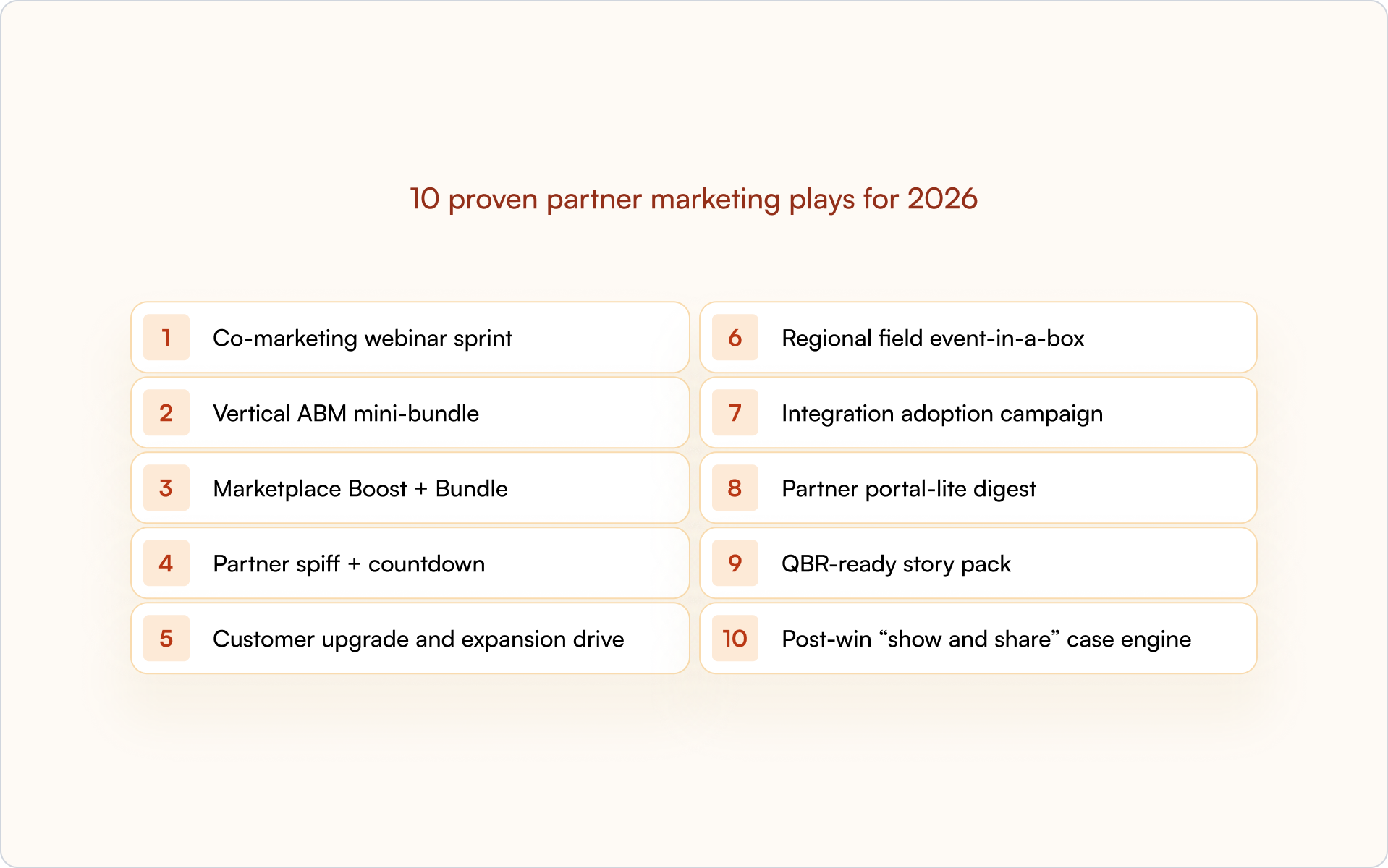
1. Co-marketing webinar sprint
What it is: A short, focused webinar campaign partners can run with you.
Why it works: Partners bring warm audiences, and your sales team gets qualified conversations.
How to launch: Pick a joint topic, share your campaign in a box, run a promo for two weeks, then follow up on attendees.
KPI: Registrations, attendance, meetings booked.
Introw tip: Automated announcements and attendance tracking show which partners amplify the campaign most.
2. Vertical ABM mini-bundle
What it is: A ready-made industry-specific bundle partners can use for targeted outreach.
Why it works: Vertical relevance increases conversion and helps partners tailor messaging.
How to launch: Give partners a landing page, case study, and email set for one key vertical.
KPI: Meetings booked in in-segment accounts.
Introw tip: Segment partners by vertical and schedule updates that match their territory.
3. Marketplace Boost + Bundle
What it is: A small campaign that refreshes your marketplace listing and gives partners a bundled offer to promote.
Why it works: Marketplaces are high-intent surfaces that help boost sales.
How to launch: Update your listing, share a co-branded bundle, and offer promotional copy partners can use.
KPI: Listing traffic, trials, influenced opportunities.
Introw tip: Track which partners use your marketing materials and which bundles drive activity.
4. Partner spiff + countdown
What it is: A short, incentive-based push for intros or registered deals.
Why it works: Deadlines create energy inside your partner ecosystem.
How to launch: Set a timeline, define a reward, and share daily reminders.
KPI: Registered deals, pipeline created.
Introw tip: Automated countdown nudges keep partners engaged without your team chasing updates.
5. Customer upgrade and expansion drive
What it is: A simple play where partners help existing customers adopt more features or expand usage.
Why it works: Partners already know shared accounts and can influence timing.
How to launch: Give partners an expansion playbook and match them with eligible accounts.
KPI: Expansion opportunities and ARR added.
Introw tip: Signals inside the CRM can trigger partner notifications with no manual work.
6. Regional field event-in-a-box
What it is: A small local event your partner can run with your support.
Why it works: In-person time improves partner engagement and helps your sales team move deals forward.
How to launch: Share a checklist, invite templates, and quick follow-up scripts.
KPI: Show rate, meetings booked after the event.
Introw tip: Use RSVPs and automated follow-ups to keep the momentum strong.
7. Integration adoption campaign
What it is: A targeted push promoting a shared integration.
Why it works: Integration usage is strongly tied to retention and expansion.
How to launch: Give partners “why this matters” messaging, in-product prompts, and ready-to-send emails.
KPI: Integration activations and related opportunities.
Introw tip: Track activation-related content usage to see which partners drive adoption.
8. Partner portal-lite digest
What it is: A monthly Slack or email roundup instead of a traditional partner portal experience.
Why it works: Partners stay informed without logging into another tool.
How to launch: Send a simple digest with top assets, deadlines, wins, and next steps.
KPI: Engagement score, reactivation of dormant partners.
Introw tip: Announcements show exactly which partners interact with each update.
9. QBR-ready story pack
What it is: A lightweight deck partners can use to plan next-quarter actions.
Why it works: Partners see their wins clearly and agree on priorities faster.
How to launch: Share a short deck with highlights, content performance, and next steps.
KPI: Quarterly commitment and pipeline alignment.
Introw tip: CRM-powered story packs help your marketing team and partner managers prep in minutes.
10. Post-win “show and share” case engine
What it is: A quick process for turning partner wins into case snippets.
Why it works: Proof points help partners sell more confidently.
How to launch: Offer a simple template and share the stories across your channel partnerships.
KPI: Case assets created, influenced pipeline lift.
Introw tip: Track downstream clicks to see which stories support your partner marketing strategy best.
These plays help your partner program focus on campaigns your partners can launch quickly, and your marketing team can measure easily.
Which tools actually support this level of consistency without overwhelming your business?
The tech stack you actually need (and nothing more)
A strong channel partner marketing strategy doesn’t require dozens of marketing tools.
Your marketing team, sales team, and partner managers only need a few systems that help you work with the right partners, support effective channel partner motions, and keep everything tied to your customer journey.
Core tools
- CRM (Salesforce or HubSpot): Your single source of truth for pipeline, attribution, sales qualified leads, and the full sales process.
- PRM and partner management: A CRM-native tool like partner management software keeps deal registration, partner engagement, and channel marketing activity aligned across third-party partners and strategic partnerships.
- Content hub: Stores the marketing materials your marketing department uses for each campaign in a box.
- Webinar or event tool: Helps your team run through-partner plays that fit your target audience.
- Light design tools: Support quick co-branding and save marketing resources when working with external partners.
Why this matters for your partner program
A simple tech stack helps channel partnerships move faster and reduces work for your marketing department.
It keeps your partner marketing strategy aligned and gives your team clear CRM reporting, partner clarity, and more predictable revenue growth.
A simple stack sets the stage. The final step is bringing your strategy together in a way partners can trust and act on.
Over to you: Bring your partner strategy to life
A strong channel partner marketing strategy comes down to clarity, simple campaigns, and tools that make it easy for partners to take action.
Your next steps
- Choose two or three channel partner marketing activities your partners can launch quickly
- Give them a campaign in a box with clear messaging and ready-to-use assets
- Measure engagement and pipeline in your CRM, so you know what to repeat
Ready to run high-performing partner campaigns without chasing updates? Request a demo!
Benefits of Selling SaaS on Cloud Marketplaces (And How Partners Make It Even Better)
You’re shipping a great SaaS product and your sales team keeps running into the same blockers: new vendor onboarding takes months, security reviews stall, and finance wants a cleaner procurement process. Listing on cloud marketplaces fixes a big chunk of that. When your SaaS solution is available via AWS Marketplace or Google Cloud Marketplace, enterprise buyers can use existing contracts and committed spend to purchase in days, not quarters. Below, we unpack the core benefits of selling SaaS on cloud marketplaces, how marketplace transactions actually work, and where partners turn a good motion into a great one.
Why cloud marketplaces matter right now
Enterprise buyers are already in the cloud. Procurement teams prefer buying cloud solutions through the platforms they trust because the vendor risk work is largely done, billing is centralized, and usage rolls into existing financial processes. That means your SaaS product benefits from shorter transaction time, cleaner paperwork, and access to budget buckets like committed spend.
For sellers, the advantages stack up: you tap into the marketplace’s global reach, ride the brand trust of the cloud provider, and remove “new vendor” friction from legal and finance. In most cases, the question isn’t “if” you should list — it’s “when” and “where” to start so you don’t spread product teams too thin.
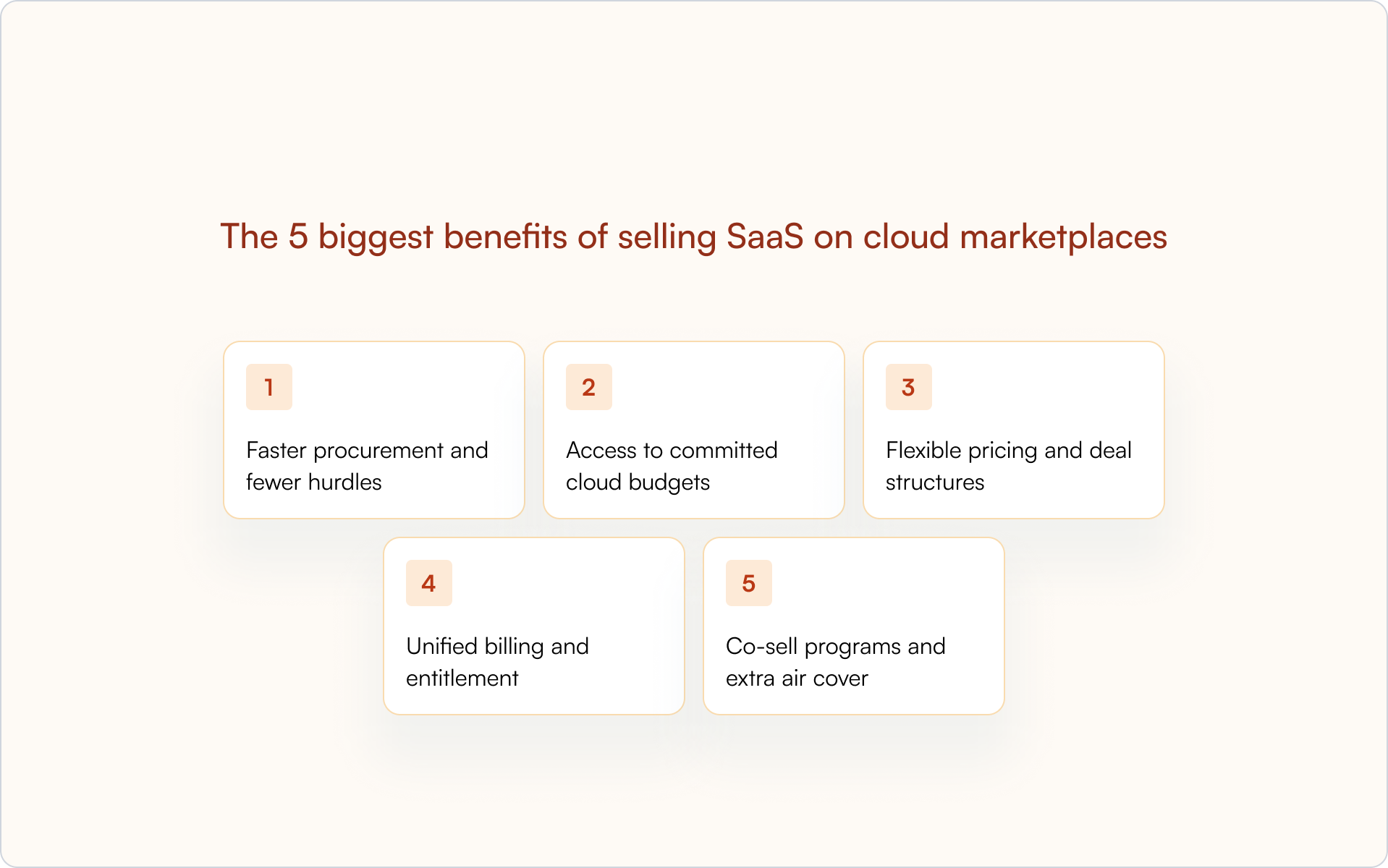
The five biggest benefits of selling SaaS on cloud marketplaces
Let’s get specific. These are the wins you can count on when SaaS companies list and transact on a marketplace.
- Faster procurement and fewer hurdles
Purchase via the buyer’s existing MSA with AWS or Google; no duplicate vendor onboarding. Security and commercial terms inherit marketplace protections, so the procurement process is simpler, and approvals move quicker.
- Access to committed cloud budgets
Many enterprises must burn down committed spend with the cloud provider. Buying your SaaS applications through the marketplace helps buyers hit those targets, which can be the deciding factor late in a cycle.
- Flexible pricing and deal structures
Public listing with pricing plans (monthly/annual), pay as you go, or bespoke private offers for large deals. This flexibility lets your sales team meet the buyer where they are without new paperwork each time.
- Unified billing and entitlement
Marketplace handles invoicing, collections, taxes, and remittance. Entitlements flow automatically to your system once the marketplace transactions close, reducing manual ops and mistakes with sensitive data.
- Co-sell programs and extra air cover
Marketplaces reward aligned co selling motions. When you work with cloud field reps, they bring intros, help shape procurement strategies, and often unblock tough accounts. That creates net-new buyers and sellers connections you won’t get elsewhere.
AWS Marketplace vs Google Cloud Marketplace (in practice)
Both platforms deliver the core value, but they feel different in the details:
- AWS Marketplace: deep maturity, broad buyer base, extensive private offers tooling, and robust Vendor Insights for security. Great for ISVs selling into teams already living in AWS services.
- Google Cloud Marketplace: strong if your customers are heavy Google Cloud users or lean into data/AI workloads on GCP. Co-sell alignment with Google field teams can be a force multiplier for marketplace success.
Most companies start with the platform that matches their customer base, then add the second once the operational motion hums.
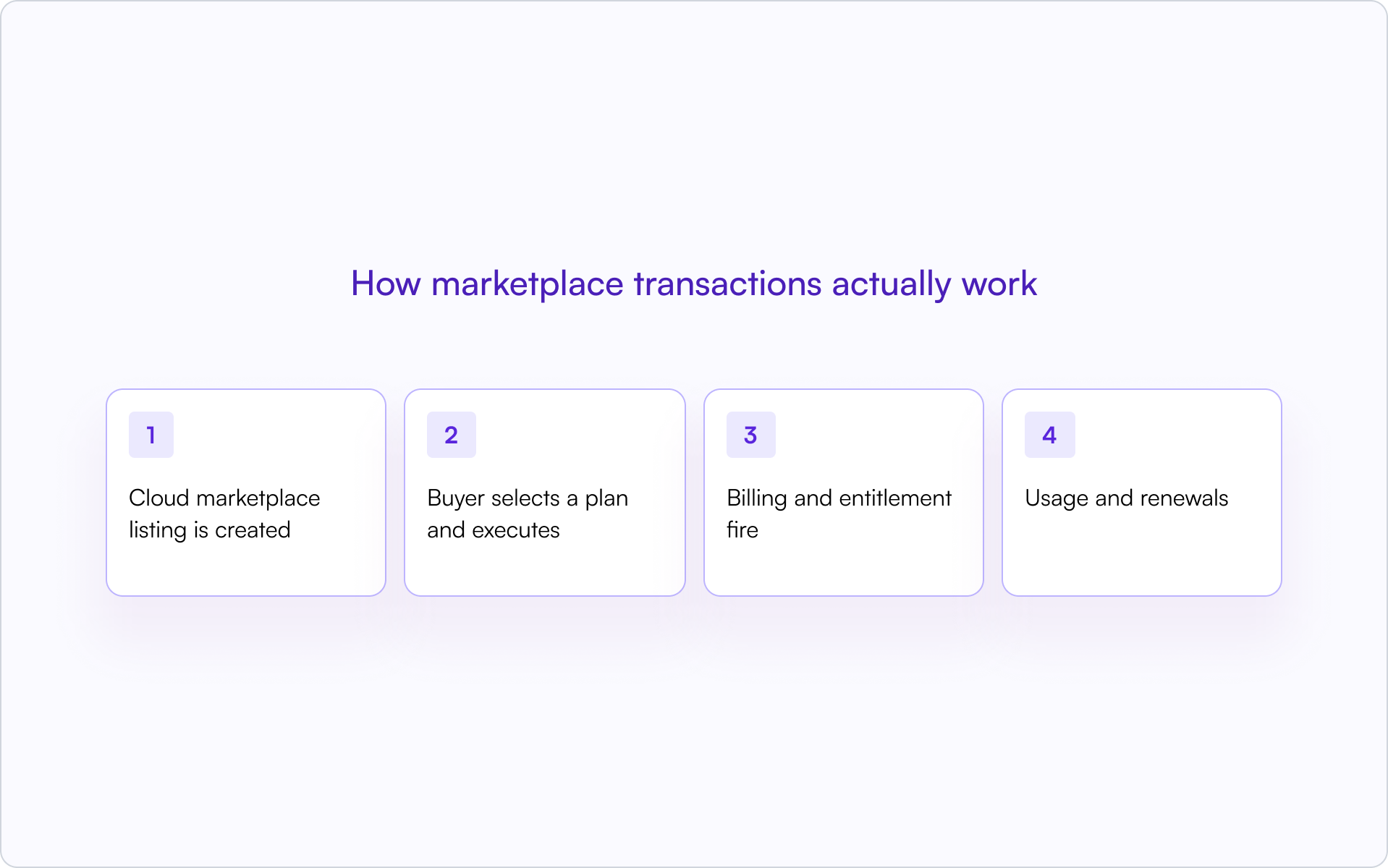
How marketplace transactions actually work (the short version)
Understanding the flow helps you design a listing that closes smoothly:
- Cloud marketplace listing is created
You publish a concise product page: value prop, supported regions, pricing model, technical overview, and free trials if offered. You also set the fulfillment method (SaaS callbacks, entitlement API, or private offer only).
- Buyer selects a plan and executes
For public pricing, it’s a click-through; for enterprise deals, your rep sends a private offer with negotiated terms. The buyer approves inside their console.
- Billing and entitlement fire
The cloud marketplace invoices the buyer; you receive payouts per their schedule. Your backend gets the entitlement signal (activate, upgrade, cancel) and provisions the account automatically.
- Usage and renewals
If metered, your service reports usage back to the marketplace. Renewals can be automated or handled via new private offers.
The key to cloud marketplace success is keeping this plumbing reliable and your product page crystal clear so buyers and sellers don’t stall on basics.
What to include on your listing (to build trust and conversions)
Think like a skeptical enterprise architect and a busy procurement lead. Your page should answer both in under two minutes.
- Who it’s for: ICP, industries, common use cases.
- What it does: outcome-first description; avoid jargon.
- How it deploys: regions, data residency, identity model, SSO/SCIM.
- Security & compliance: SOC 2/ISO, encryption, links to docs.
- Commercials: pricing plans, pay as you go, free trials, and contact for private offers.
- Proof: named customers, case studies, benchmarks.
- Integration notes: APIs, SDKS, popular connectors.
This is also where you anchor co selling: add a clear “Contact Sales” path for bespoke deals and a “Try Free” button for survey respondents who prefer self-serve.
How partners make marketplaces even better
Listing unlocks speed; partners create scale. Three partner types amplify the motion:
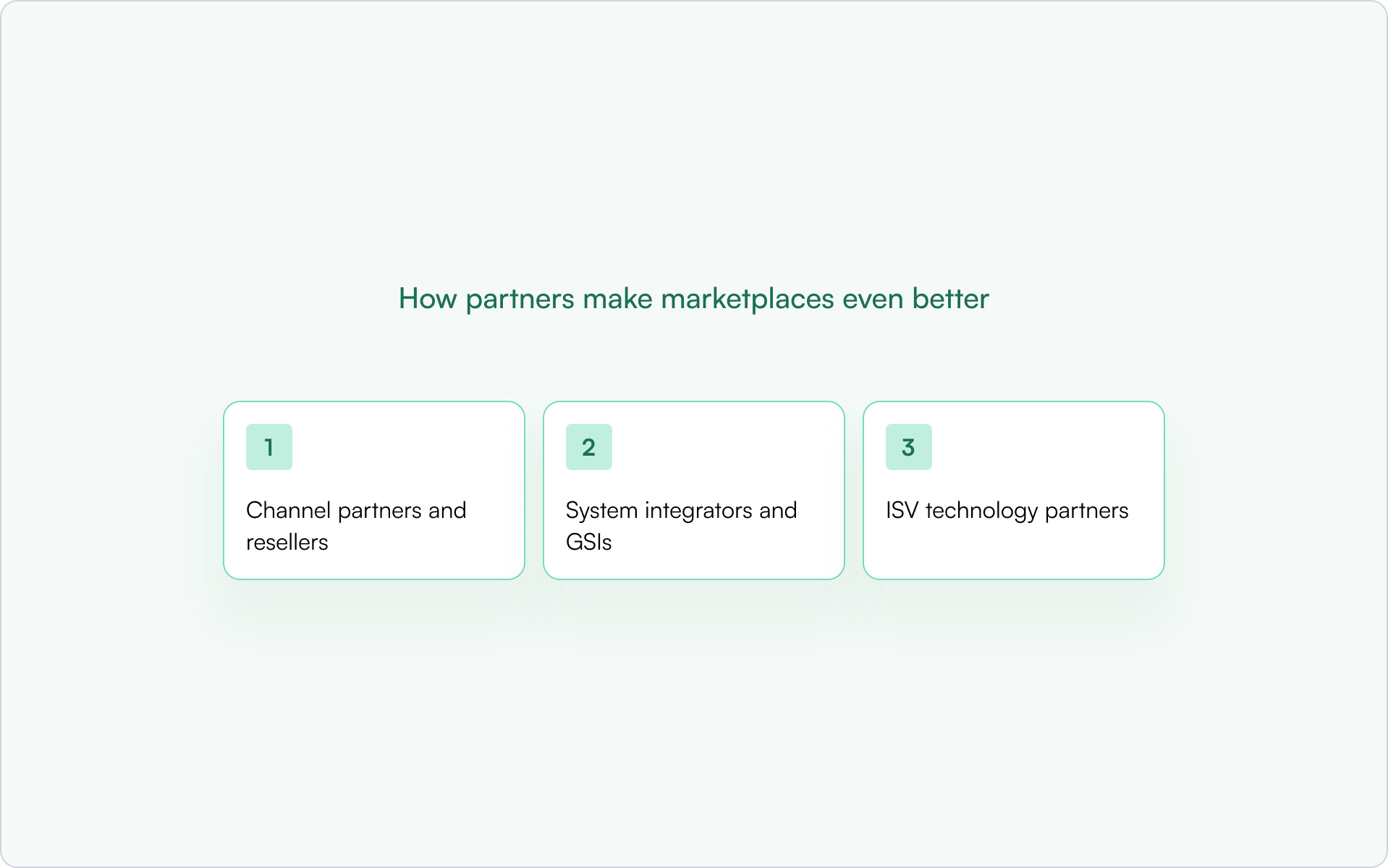
- Channel partners and resellers
They package your SaaS with services or other cloud solutions, route the purchase through the marketplace, and manage customer onboarding. Because they already handle compliance, they can move deals through vendor onboarding faster than you can alone.
- System integrators and GSIs
They design the business case, run pilots, and own rollout and change management. In enterprise accounts, the SI’s advocacy often determines whether an evaluation becomes a marketplace purchase.
- ISV technology partners
They turn your offer into part of a solution — especially for data, security, or observability. These integrations lift win rate and reduce churn because the SaaS offer fits the buyer’s stack from day one.
When you track partner engagement inside CRM and map it to the marketplace opportunity, the value is obvious: shorter cycles, larger ACVs, and higher expansion.
A pragmatic launch plan (without burning your team out)
You can ship a credible first listing in 8–12 weeks if you stay focused:
- Pick one marketplace that matches your customers.
- Choose the initial pricing model (simple subscription or pay-go) and add private offers later.
- Wire entitlement and billing callbacks; keep the technical surface small to start.
- Publish the trust signals (security, compliance, data flow).
- Train the sales team on how marketplace transactions work and how to ask about committed spend.
- Add a short free trial only if it mirrors your product-led experience — otherwise route to a public offer with a clear demo path.
- Stand up a partner brief so channel partners and SIs know how to transact your product and what services to add.
As you learn, expand pricing plans, launch co selling plays with the cloud field, and layer in a second marketplace.
What to watch after you go live (signals that matter)
Skip vanity stats and track the metrics that prove revenue impact:
- Marketplace-sourced pipeline and win rate
- Days from intro to executed marketplace listing purchase (vs direct)
- Share of deals using private offers
- Percentage of bookings tied to committed spend
- Time to provision and first value after entitlement
- Attach rate with partners (SI involvement, reseller influence)
- Renewal rate and expansion from marketplace cohorts
If cycles aren’t shrinking, tighten your listing, simplify commercial options, and make the “how to buy” path obvious. If attach rates lag, recruit services partners with clear plays and co-market together.
Where Introw fits
Marketplaces move fast; partner motions can lag if they’re stuck in spreadsheets. Introw keeps your partner GTM CRM-first: deal and lead registration for marketplace opportunities, co-sell tracking with field teams, and clean workflows for SIs, resellers, and ISV integrations. You’ll see exactly which partners helped drive revenue, which co selling plays convert, and where to double down. When you’re ready to turn marketplace momentum into a repeatable partner engine, Introw shows the path in Salesforce or HubSpot — no extra portals required.
Ready to accelerate marketplace deals and scale with partners? Request an Introw demo.
How To Win With Channel Partnership Programs in 2026
In the early days of SaaS channel partnership programs, companies relied heavily on static partner portals and endless email threads.
And although this approach was admittedly clunky and time-consuming, it worked okay while these programs were in their infancy and encompassed only one or two, easily-trackable partners.
But in 2026, the approach to partner programs has shifted dramatically.
Casual, ad hoc partnerships have been replaced by watertight, multi-channel ecosystems inhabited by a wide range of strategic partners.
At the heart of these sophisticated programs? Collaboration, data sharing, co-selling — and a tech stack that can keep up.
After all, manual tasks, disconnected tools, and outdated portals create friction in the partner journey, while platforms with limited automation capabilities put you at an automatic disadvantage.
So what should you be looking for in a modern SaaS partner program tool?
Automation, real-time visibility, and CRM-first platforms that seamlessly integrate into daily workflows.
Several key trends are reshaping the channel landscape:
- AI-powered partner discovery and enablement are accelerating matchmaking and performance tracking.
- Remote selling is making virtual collaboration tools essential.
- Self-service onboarding and content access are empowering partners to move at their own pace.
- “Always-on” enablement means support, training, and updates need to be embedded throughout the partner journey — not just during onboarding.
The future of channel partnership programs is not only more connected — it’s also more impactful, scalable, and aligned with how SaaS businesses grow today.
What Is a Channel Partnership?
Let’s start with an up-to-date channel partner definition.
In SaaS, a channel partnership is a strategic collaboration in which third-party organizations help market, sell, support, or integrate your product, thereby extending your reach beyond direct sales.
Unlike direct sales teams, which engage customers directly, channel partners act as multipliers, introducing your solution to new audiences, markets, or industries.
So, what is a channel partner?
There are many different types of channel partners, including:
- Resellers who purchase and sell your software under their own margins
- Referral partners who pass along leads in exchange for commission
- Managed Service Providers (MSPs) who include your SaaS in bundled services
- Agencies and consultants that implement or recommend your platform
- Tech integrations and ISVs that enhance your product’s capabilities
- OEM partners who embed your software into their offering
- Strategic alliances that co-market or co-sell complementary solutions
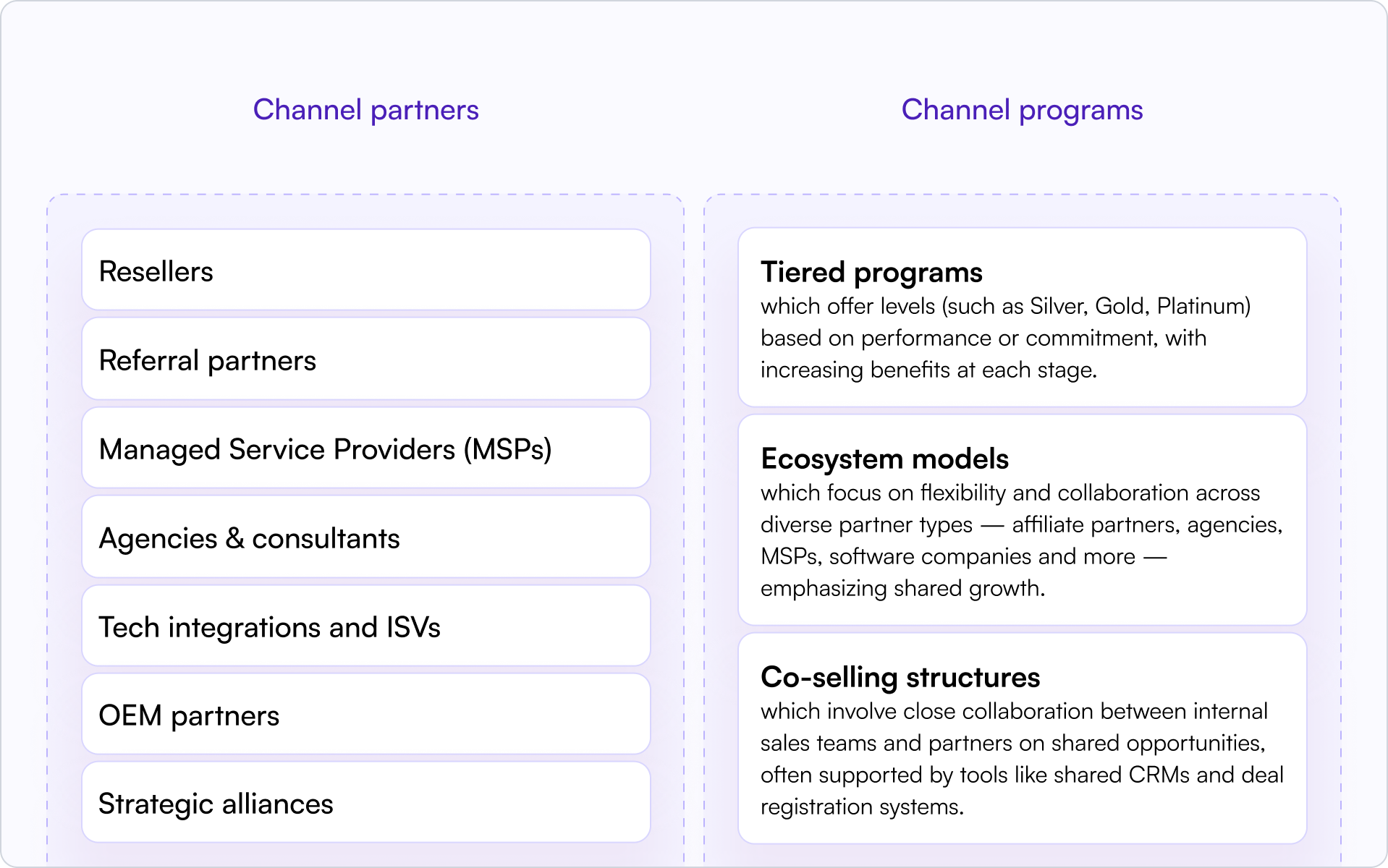
Channel partnership programs vary significantly, depending on the SaaS company’s size, product, needs, and goals.
Some of the most common structures are:
- Tiered programs, which offer levels (such as Silver, Gold, Platinum) based on performance or commitment, with increasing benefits at each stage.
- Ecosystem models, which focus on flexibility and collaboration across diverse partner types — affiliate partners, agencies, MSPs, software companies and more — emphasizing shared growth.
- Co-selling structures, which involve close collaboration between internal sales teams and partners on shared opportunities, often supported by tools like shared CRMs and deal registration systems.
In 2026, SaaS channel programs are increasingly built around flexible, ecosystem-driven structures rather than rigid, tier-based structures.
However, many programs blend the above approaches to support partner autonomy while driving alignment, scalability, and faster routes to market across different partner motions.
Why Channel Partnerships Are More Strategic Than Ever
Channel partnerships are now a core growth strategy for SaaS companies' business models — not just a sales supplement.
When approached strategically, they offer high-margin revenue, specialized expertise, expanded market reach into new market segments, and enable scalable growth without expanding headcount.
Partnerships also help mitigate risk by diversifying go-to-market motions.
The SaaS partner power law is relevant here: typically, 20% of partners drive 80% of the value, making a strategic focus essential.
From a CRO or RevOps perspective, strong channel programs support clearer attribution, more accurate forecasting, and greater operational efficiency.
But without a strategic approach, companies face channel conflict, missed pipeline opportunities, and partner churn — ultimately weakening revenue performance and market competitiveness.
12 Advanced Steps to Win at Channel Partnering in 2026
Ready to reap the benefits of an impactful channel partnership strategy?
Follow these 12 steps to take your SaaS partnerships to the next level.

Step 1: Revisit Your Channel Partner ICP Every Year
To build a high-performing channel, it’s crucial to regularly revisit your Ideal Channel Partner (ICP).
After all, the SaaS industry evolves at lightning speed, so your ICP this year could look very different from the last.
Start your review by analyzing which partners are actively contributing pipeline and revenue.
Note which verticals these top-performing partners operate in and consider their technology stacks, sales motions, and customer types.
Then, use CRM data, engagement tracking, and partner feedback to refine your ICP criteria.
This ensures you focus on partners who align with your product, go-to-market strategy, and growth stage.
Step 2: Build Dynamic, Role-Based Partner Segmentation
Developing effective customer segments allows you to deliver the right experience to the right partners at scale.
Segment by:
- Tier
- Partner type (for example, reseller, ISV, agency)
- Geography
- Engagement/activity level
- Strategic value
It’s also helpful to include roles within your partner companies — for example, sales, marketing, technical — so you can tailor communications and incentives to individual contributors.
This approach enables targeted enablement, personalized support, and performance-based rewards.
For example, high-engagement referral partners might receive co-marketing funds, while new ISVs get onboarding support.
Categorising customers into market segments doesn’t have to be complicated: you can structure it using a simple table like the example below.
Step 3: Invest in Proactive, Personalized Onboarding
In 2026, personalization is no longer merely a nice-to-have; it’s a must.
And it’s super important during the onboarding process, which is most likely your partner’s first real contact with your SaaS brand.
Indeed, a strong, personalized onboarding experience sets the tone for a productive and long-term partnership.
Tailor onboarding experiences based on partner type, tier, and role.
For example, a reseller might need sales training and pricing tools, while a technology partnership benefits more from API documentation and integration support.
Blend live interactions (such as kickoff calls, QBRs, and workshops) with self-serve resources, including videos, guides, and a searchable knowledge base.
Here’s a handy channel partnership best practice for proactive, personalized onboarding.
Auto-trigger onboarding flows when a partner registers a deal or completes signup — ensuring immediate engagement and faster time-to-value.
Step 4: Automate All Critical Partner Communications
Timely, relevant communication is key to keeping partners engaged — but manual outreach doesn’t scale.
Thanks to the rise of automation, in 2026, a small workforce is no longer a barrier to scaling.
Simply automate critical partner updates like:
- Deal status
- Spiff launches
- Deadlines
- Training rollouts
To achieve this, you can use triggers tied to specific partner actions or milestones.
Automating these updates ensures that none of your partners miss essential info while also freeing up your team’s time to focus on more valuable tasks.
It’s important to use a multi-channel approach — for instance, using Slack, email, in-app messages, and CRM alerts — alongside your PRM to meet partners where they already work.
With modern PRMs such as Introw, channel managers can send branded updates directly from their CRM without switching platforms or logging into a portal.
Step 5: Make Engagement Data Visible Across the Business
Transparency is pivotal to channel success.
Sharing partner engagement data (such as email opens, content downloads, meeting attendance, and portal activity) helps align sales, RevOps, and leadership around which partners are driving momentum.
Live dashboards are a game-changer when it comes to transparency and visibility.
Use them to clearly visualize partner engagement data, supporting QBRs, pipeline reviews, and forecasting.
With Introw, partner engagement data flows directly into Salesforce or HubSpot, so teams don’t need to leave their CRM to see which partners are active, which need attention, and where opportunities are growing.
Step 6: Empower Partners With Self-Service Tools
Self-service doesn’t just save time — it builds trust and drives faster, more scalable channel growth.
Empower your partners with self-service tools that make it easy to register deals, access channel partner sales content, complete training, and launch campaigns without login barriers or confusing portals, thereby eliminating friction.
Take it a step further by supporting custom assets and co-branded marketing, allowing partners to tailor their messaging to their target audience.
For example, with Introw, partners can submit co-marketing requests through branded, embedded forms, which automatically trigger internal workflows and approvals.
Step 7: Run Automated, Recurring Campaigns and Nurtures
When it comes to keeping partners engaged, consistency is key.
And, thanks to automation tools, it’s never been easier to stay consistent.
Set up automated, recurring campaigns that deliver timely content, training, and pipeline nudges to ensure consistent engagement.
This might look like:
- Monthly enablement newsletters
- QBR reminders
- Seasonal promotions
- Product update highlights
- Pipeline review reminders
Segment your content and tone of voice based on partner maturity.
For example, new partners may need onboarding touchpoints, while established ones benefit from co-selling tips or market-specific playbooks.
You can also use pre-built templates to re-engage top or at-risk partners with personalized outreach that reignites interest and activity.
Step 8: Master Attribution - Track Every Touch
We’ve always known the importance of accurate attribution in proving the value of a channel partnership program.
Yet historically, getting attribution right has been a time-consuming headache.
But, once you move beyond spreadsheets, accurate attribution is within reach.
Auto-sync all partner activities — for instance, deal registrations, campaign clicks, and content downloads — directly into your CRM.
This allows you to tie revenue back to specific partners, motions, marketing materials, and assets with complete visibility.
By automating attrition, you’ll gain invaluable (and accurate) answers to crucial questions, including:
- Which partners are influencing pipeline
- What content drives conversions
- Where to invest next
In addition to making attrition easier and more accurate, automation tools also enhance visibility, making data-driven decision-making easier across your business.
For example, a CRO could view a real-time forecast of partner-sourced deals within Salesforce or HubSpot, enabling them to report on performance, plan resources, and align teams.
In this way, clean, automated attribution turns insight into strategy.
Step 9: Regularly Review & Upgrade Incentive Structures
Your incentive program should evolve as your partner ecosystem grows.
Attaching incentives to the volume or value of partner bookings is obvious.
But to level up your incentive structure, move beyond one-dimensional rewards tied only to bookings and start rewarding engagement too.
For instance, you could offer bonuses for:
- Training completion
- Content usage
- Co-selling participation
- Marketing activity
Rewarding engagement encourages consistent, long-term behavior rather than chasing one-off wins.
It’s also important to regularly test and iterate incentives to determine what motivates different types of channel partnerships — MSPs, for example, may be motivated by very different rewards than ISVs — and adjust accordingly.
Bring your tier system into 2026 with dynamic tiering.
Within a dynamic tiering structure, quarterly reviews promote or demote partners based on performance and activity, not just deal volume, helping to ensure consistent engagement.
Step 10: Make QBRs (Quarterly Business Reviews) Data-Driven
It’s time to ditch QBR PowerPoints in favor of live dashboards, engagement metrics, and pipeline data.
This creates a more transparent, actionable conversation focused on what’s working, what’s blocked, and how to win together.
Start with a clear, mutual action plan that aligns goals across teams, then dive into valuable insights, such as deal velocity, content engagement, and training progress.
It’s also worth tailoring your prep by role.
For example, CROs should receive high-level growth strategies and revenue forecasts, while partner managers are more likely to want detailed activity breakdowns and enablement metrics.
Step 11: Predict, Not Just React - Use Analytics for Next Steps
The best partner programs don’t just measure — they anticipate.
Leverage engagement trends, pipeline activity, and content usage to identify at-risk partners early and spot emerging top performers.
With analytics and AI, channel managers can receive “next best action” recommendations, which suggest where they should focus their time for maximum impact — whether it’s reactivating a dormant partner or accelerating a high-potential one.
For example, Introw’s live dashboards automatically flag dormant partners showing signs of churn — such as declining logins or no recent deal activity — so you can step in before it’s too late.
Step 12: Create a Feedback Loop to Continuously Improve
Every strong channel partner program is built on two-way communication.
The key to success here is to make it as easy as possible for partners to share their input on their needs and challenges as well as feedback on enablement, product, support, and marketing efforts.
Establish regular feedback channels such as:
- Monthly surveys
- Partner advisory boards
- Open office hours
Most importantly, you must act on the feedback by incorporating it into program updates, campaign planning, and even roadmaps for products or services.
This shows partners that their voices matter.
5 Common Pitfalls & Outdated Practices to Avoid in 2026
So, we’ve discussed how to boost your channel partnership program in 2026, but what shouldn’t you be doing?
Here are five major pitfalls to avoid:

- Relying on static portals and spreadsheets — Manual tools are slow, siloed, and prone to error. They create friction for partners and limit your ability to scale or track real-time performance.
- Overcomplicating onboarding or incentive structures — If partners can’t quickly understand how to get started or what’s in it for them, they disengage with sales efforts.
- Ignoring low engagement signals until too late — A drop in logins or deal registrations often signals a deeper issue. Without proactive monitoring, you risk silent churn and lost revenue.
- One-size-fits-all comms — Generic emails or mass updates miss the mark and will cause partners to tune out.
- Failing to connect partner activity to revenue — Without clear attribution, it’s hard to prove value or optimize performance. Revenue-connected metrics help secure internal support and guide smarter investments.
Channel Tech Stack — Tools That Separate Winners From Laggards
In 2026, your channel tech stack is a key differentiator.
Leading SaaS companies are moving beyond legacy PRMs and static partner portals, adopting CRM-first, frictionless platforms that drive real engagement and measurable results.
Traditional PRMs often require logins, manual updates, and siloed data — making it hard for partners to stay active and for teams to track success.
So what’s new in the world of PRMs?
In 2026, you should be looking for a platform that offers off-portal updates, self-service enablement, automated campaigns, real-time attribution dashboards, and AI-powered nudges that guide partner and channel manager actions alike.
Furthermore, these systems should integrate directly into your CRM (like Salesforce or HubSpot), enabling seamless workflows, deal tracking, and self-service enablement without leaving familiar tools.
Modern PRM Checklist:
✅ CRM-first PRM (Salesforce/HubSpot native)
✅ No-login deal reg, content access, and tools to support co-marketing activities
✅ Automated partner campaigns
✅ Live dashboards for attribution and engagement
✅ AI insights: next-best-action, churn risk, high-potential partners
Upgrading your tech isn’t just about convenience — it’s about enabling scale, accountability, and partner success in a fast-changing SaaS landscape.
Why Introw?
So when choosing a modern PRM, why should you opt for Introw?
Built directly into your CRM (like Salesforce or HubSpot), Introw keeps your CRM as the single source of truth while automating multi-channel engagement, including emails, Slack alerts, updates, and more.
What’s more, it delivers an off-portal experience for partners, helping to eliminate friction and enable mutual growth.
Indeed, partners can submit leads, collaborate on deals, and receive updates through email or Slack, with everything synced back to your CRM.
And thanks to real-time engagement tracking for every role, managers, RevOps teams, and CROs gain instant visibility into metrics like partner-sourced leads, deal progression, support tickets, and engagement across the partner ecosystem.
👉Want to see Introw in action? Request a demo here.
Conclusion - The New Playbook for Channel Partnering
Winning SaaS teams in 2026 are embracing a new standard:
- Automating partner workflows
- Personalizing every interaction
- Measuring impact across the funnel
Channel partnership programs are no longer merely a sales lever — they’re becoming a core strategic revenue stream that drives scalable, efficient growth.
To stay competitive, now is the time to audit your current partner motion, identify gaps, and explore how Introw can help you build and power a next-generation, CRM-first channel program. ➡️ Request a demo here today.

