
A Masterclass in Modern B2B SaaS Partnerships: What We Learned from Martin Scholz
80% of partnerships fail - but after a full-day masterclass with Martin Scholz, we walked away with the blueprint to build smarter and stronger partner relationships.
As a team that spends every day talking to partnership professionals, we know one thing for sure: we can’t just talk the talk - we have to walk it, too. That’s why we brought in a true expert to level us up: Martin Scholz, seasoned SaaS partnership leader, strategist, and (bonus!) one of our own partners.
And wow, did he deliver.
Martin took us through a full-day training covering every nook and cranny of partnership management, from the fundamentals to the frameworks you won’t find in your average playbook. Here are the biggest takeaways from our session.
First Reality Check: 80% of Partnerships Fail
Martin opened with this stat: 80% of partnerships fail (source). Why? Because there’s no blueprint. No one-size-fits-all. Every company defines “partnership” differently.
The truth is, partnerships aren't a solo act. They're a team effort
What Successful Partnerships Actually Drive
Done right, partnerships don’t just generate revenue - they unlock scale:
Shorter sales cycles
Higher win rates
Transparent deal flow
Better-quality leads (hello, PQLs 👋)
More focus on your core business while partners drive volume
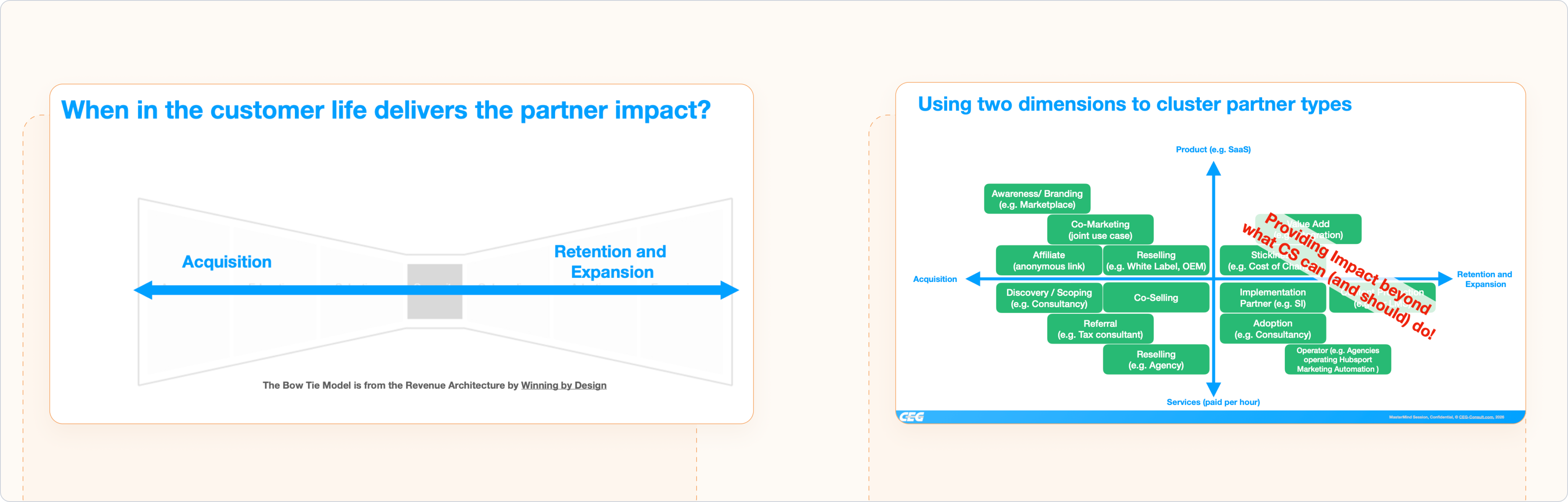
And yes - the Bow Tie model (Winning By Design) made an appearance.
Martin reminded us that many forget the power partners have across the entire customer lifecycle - not just in introducing or closing the deal, but in retention, expansion, and long-term value
Whether you're working with tech partners, service partners, or resellers, their role varies by stage - and your strategy should too.
Revenue is a Result, Not the Goal
A big mindset shift: Stop chasing revenue, start building outcomes.
Too many teams treat revenue as the first metric, but Martin reminded us it’s the result of well-executed partnership strategies. Instead, define shared targets and goals - then align around those.
The Biggest Risk? Too Many Wrong Partners
Here’s your new motto: Disqualify fast.
Don’t let “more” distract you from “better.” A bloated partner list full of misaligned or inactive collaborators is worse than having none at all.
The Secret Weapon: Your MAP (Mutual Action Plan)
Your MAP is your North Star.
It’s a living document, co-created with your partner, that defines what success looks like—milestones, metrics, activities. This is what keeps partnerships focused and accountable from day one.
The Partnership Lifecycle According to Martin
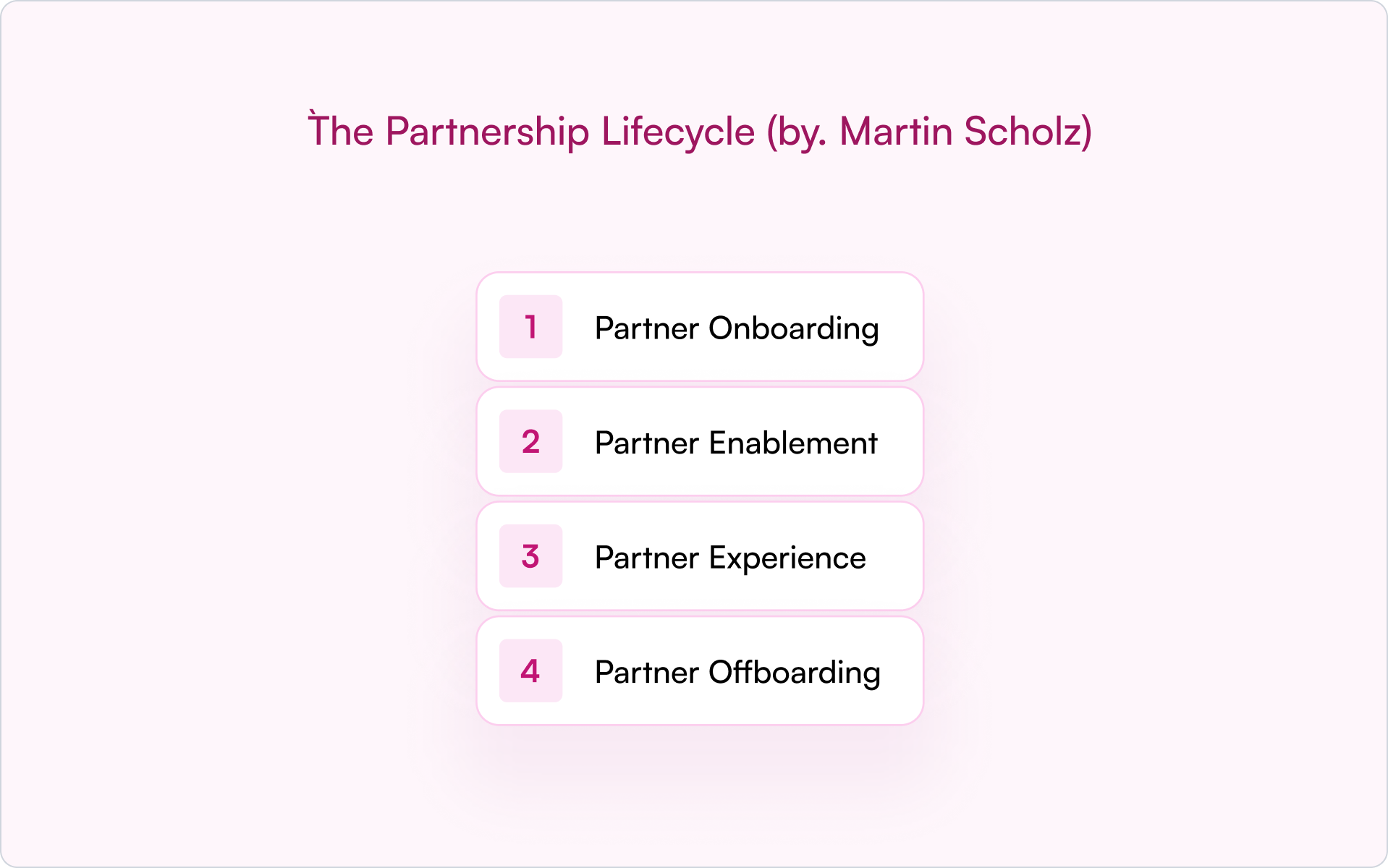
Partner Onboarding = The Honeymoon Phase
First impressions matter. Use this phase to build trust, show value, and get wins on the board.
Tips:
Deliver an amazing partner experience
Connect teams & execs (use leadership wisely!)
Execute on your MAP - don’t just let it sit in a doc
Prioritize fast wins and momentum
The first 90-120 days? Absolutely critical.
Partner Enablement = Where the Real Work Starts
Once the honeymoon is over, reality hits - and that’s when enablement really begins.
Key actions:
Run a no-fluff business review (internal + external)
Adjust the MAP to reflect reality
Tier and prioritize your partner list
Agree on new ways of working (cadence, content, etc.)
And a big one: Reality ≠ one single source per deal.
Most deals are touched by multiple sources (partners, marketing, sales) and yet traditional deal registration often gives credit to just one. It's time to rethink attribution and make space for the real complexity of modern sales motions.
Never forget: partnerships are built between people, not logos.
Best Practices for Partner Collaboration
Here's what Martin recommends:
Be part of the first 3 intro calls before partners go solo
Ensure strong overlap in goals and ICP
Use a PRM tool to streamline the entire partnership workflow:
Lead submission & deal registration
Transparency around pipeline
Goal tracking and performance measurement
Communication & updates in real time
Sales enablement that’s actually useful
Partner Experience is a Team Effort
Your partner doesn’t experience “the partnership” - they experience your product team, your CS team, your marketing team. Partner experience = everyone’s job.
And Yes - Some Partnerships End
Not every partnership is forever, and that’s OK. Offboarding should be handled with the same care and clarity as onboarding. It’s part of the cycle - not a failure.
Final Thought
Martin left us with this gem:
Work with partners so you can focus on your core business.
That’s the promise of a well-built, well-run partnership ecosystem. Not just revenue. Not just reach. But real business leverage.
Thanks again, Martin, for the masterclass. We’re sharper, smarter, and more aligned than ever, and we can’t wait to put these lessons into practice.
Channel conflict occurs when multiple channels or channel partners pursue the same deal without clear ownership.Most channel conflicts are preventable with strong channel management, clear deal registration rules, and clean CRM data. Teams that design for prevention spend less time resolving conflict and more time closing revenue.
Channel conflict rarely starts with open disagreement.
It usually appears late in the sales cycle, when a deal is already active, and expectations are already set. A partner believes they have ownership. The sales team believes otherwise. Another channel surfaces at the last moment.
At that point, resolving channel conflict becomes slow, political, and expensive.
The more effective approach is prevention. When rules are clear, data is shared correctly, and ownership is visible early, channel conflicts are far less likely to occur.
You'll learn about a prevention-first operating model for channel conflict, built for SaaS teams managing multiple channels, channel partners, and direct sales motions at the same time.
But, to prevent channel conflict, you need clarity on what channel conflict is and the types of channel conflict that show up in modern SaaS programs.
Channel Conflict 101 (Types, Causes, and B2B SaaS Context)
To prevent channel conflict, everyone needs to be aligned on what it actually means in a modern SaaS environment.
What is channel conflict?
In B2B SaaS, channel conflict occurs when multiple channels or channel partners pursue the same customers, accounts, or revenue without clear ownership, rules, or visibility.
This weakens channel relationships and makes effective channel partner management harder for partners and direct sales teams.
The main types of channel conflict in SaaS
Channel conflict type
What it looks like in practice
Where it shows up most
Vertical channel conflict
A vendor’s direct sales team competes with a partner on the same account, renewal, or expansion
Balancing direct sales with partners
Horizontal channel conflict
Two partners at the same level compete for the same account, product, or region
Resellers or SIs selling the same product in the same region
Multi-channel or ecosystem conflict
Referral, reseller, marketplace, and SI motions overlap at the same time
Programs using multiple distribution channels
These channel conflict types are rarely about bad behavior. They are a predictable outcome of multiple channels operating without shared rules or data.
Root causes of channel conflict in B2B SaaS
Most channel conflicts stem from a small set of structural issues:
Unclear rules of engagement across different channels
Overlapping territories, segments, or named accounts
Inconsistent pricing strategies, discounting, or price protection
Unmanaged renewals and expansions across the same customer base
Poor communication cadence and limited visibility into customer data
As SaaS teams scale and add new channels, these gaps quickly create potential conflicts, even when channel management intentions are sound. This is common when channel relationships evolve faster than the operating model behind channel partner management.
Next, we’ll look at how to detect channel conflict early, before it turns into an escalation, a stalled deal, or a damaged partner relationship.
Early Warning System: Spot Conflicts Before They Surface
Channel conflict is easiest to manage when you catch it early. The goal here isn’t perfect forecasting; it’s visibility into the signals that show channel conflicts forming before they slow a deal or damage channel relationships.
Signal categories
Pricing
Unusual discount requests, overlapping price protection, or duplicate quotes for the same product often signal early channel partner conflict. Left unchecked, these patterns can escalate into price wars that hurt brand integrity and market share.
Pipeline
Duplicate opportunities or accounts, missing partner fields, or sudden owner changes are classic indicators that multiple channels are touching the same account. In a customer relationship management system, this is often the first sign of horizontal conflict across the same channel or same region.
Engagement
Emails from partners raising concerns about fairness, silence after policy changes, or reduced response to announcements often indicate tension across channel members, even before it shows up in the sales channel data.
Renewals and expansions
When a direct sales team engages an account with an incumbent reseller or SI already in place, channel conflict occurs fast, especially if renewal ownership rules are unclear.
Automations to catch them
Early detection depends on automation, not vigilance.
Common safeguards include duplicate detection, stage-change alerts, two-opportunities-one-account reports, expiring deal registration timers, and renewal ownership rules enforced directly in your CRM.
A structured deal registration process is especially effective for surfacing potential conflicts early and keeping different channel partners on the same page.
Teams that rely on manual checks usually spot conflicts too late. Teams that automate signals spend far less time on conflict resolution and more time closing deals.
Let's design your channel program so these signals appear less often in the first place, starting with segmentation, territories, and pricing guardrails.
Program Design That Prevents Conflict (Get This Right First)
Most channel conflict is designed early. Strong program design aligns channel members across distribution channels before deals exist and reduces the need to resolve channel conflict later.
1) Segmentation & Territories
Clear segmentation is the foundation of conflict prevention.
Define a clear ICP and segment channel partners by region, vertical, tier, and install base
Use named-account programs for strategic partners operating at the same level
Set explicit rules for marketplace versus direct sales ownership
Avoid multiple distribution channels working the same customers by default
This kind of structure is a core pillar of effective channel management, especially as new channels are added.
2) Pricing & Commercial Guardrails
Pricing is where channel conflict escalates fastest.
Define pricing strategies by partner tier and sales channel, including referral, resale, marketplace, and SI
Set price protection duration and clarify renewal and expansion applicability
Enforce minimum advertised price policies where applicable to protect brand integrity
Use SPIFFs versus margin deliberately to prevent price wars and lower prices across channels
Fair pricing policies reduce direct competition between channel members selling the same product through different channels.
3) Exclusivity & Capacity
Exclusivity should be earned, not assumed.
Grant exclusivity only when justified by specialization, certification, or commitment
Set capacity limits per region, product line, or customer base
Avoid onboarding too many partners into the same sales channel
Capacity limits help minimize conflicts caused by too many partners competing in the same region or account.
4) Certification & Readiness Gates
Sell and deliver rights should reflect readiness across the supply chain.
Tie sell and deliver permissions to the certification status
Require certification for access to exclusive products or specific customer segments
Set expiration and re-certification SLAs aligned with supply chain management needs
Readiness gates protect customer satisfaction and reduce downstream conflict tied to poor execution.
5) Transparency by Design
Transparency keeps channel relationships stable as programs scale.
Publish rules of engagement in a partner portal as the single source of truth
Announce policy changes early and often through shared communication channels like email or Slack
Require acknowledgment to ensure all parties involved stay on the same page
Use SSO to remove access friction and reduce shadow communication
Platforms like Introw support this by combining a partner portal, announcements with read receipts, and frictionless access.
When paired with a structured deal registration process, teams can enforce rules consistently instead of relying on ad-hoc decisions.
Let's go deeper into deal registration itself and how to use it as a conflict firewall rather than a bottleneck.
Deal Registration: Your Primary Conflict Firewall
If you’re looking for a practical answer to how to manage channel conflict, deal registration is it. This is where ownership is established early and where most channel conflicts can be prevented instead of debated.
Policy Backbone
A clear deal registration process removes ambiguity across channel partners, direct sales, and other distribution channels.
Your policy should define:
Eligibility criteria, required fields, proof of work, and a customer uniqueness test to prevent different partners pursuing the same account
A protection window, typically 60–90 days, with explicit extension rules
Renewal and expansion of ownership rules when the same customers move between partners and the sales team
A conflict hierarchy, registered beats unregistered, incumbent beats net-new, certification status breaks ties
An appeals and escalation window with defined evidence requirements
This is the operational layer of channel conflict resolution. Without it, vertical conflict and horizontal conflict are left to judgment calls, which quickly strain existing channel relationships.
SLAs and Operating Rules
Policy without speed creates friction.
Set clear SLAs:
Approval or decline within 48 hours
Automatic reminders before protection expires, usually seven days out
Reassignment rules for inactive deals based on no-touch thresholds
These mechanics are a core part of effective channel management, especially in programs that rely on co-selling and shared ownership across teams.
Approvals, declines, timestamps, and rationale should live in your customer relationship management system, with shared pipeline visibility limited to safe fields like stage, owner, and protection status.
This keeps different partners on the same page without exposing pricing or internal notes.
In practice, this is where a structured deal registration process, supported by modern partner relationship management software, makes it far easier to resolve channel conflict consistently as programs scale.
Next, we’ll look at the CRM data model you need to support this, and how to enforce these rules automatically across multiple channels.
Your CRM Data Model for Conflict Prevention (Salesforce/HubSpot)
Channel conflict becomes expensive when your CRM can’t answer basic ownership questions. A clean data model makes channel conflict visible early and keeps channel partners, direct sales, and RevOps aligned across multiple channels.
Required fields on Opportunity or Deal
Field group
What it captures
Why it matters
Partner motion
Referral, reseller, marketplace, SI, MSP, ISV
Clarifies which sales channel owns the motion
Partner identity
Partner type and partner organization
Prevents confusion between different channel partners
Attribution
Sourced vs influenced with attribution %
Reduces disputes over credit and revenue
Deal registration
Deal reg ID with protection start/end dates
Establishes priority for the same account
Pricing controls
Price protection flag and discount band
Limits price wars and inconsistent pricing strategies
Renewals and expansions
Renewal/expansion flag with incumbent partner
Avoids vertical conflict during renewals
Partner roles
Partner contacts such as BDR, AE, SE, CS
Makes ownership and accountability explicit
Conflict tracking
Conflict status (none, risk, active) and notes
Surfaces potential conflicts early
Activity tracking
Last activity date
Supports reassignment when deals stall
Without these fields, channel conflict occurs late, often after multiple partners have already engaged the same customers.
Governance Rules That Enforce Discipline
Fields only work if they’re enforced.
Stage-change validations that require partner fields before deals advance
Duplicate rules on accounts and opportunities to catch horizontal conflict early
Renewal ownership logic to prevent overlap with direct sales
Dashboards segmented by motion and conflict status for fast visibility
This is what managing channel conflict looks like in practice, not spreadsheets and exceptions.
How This Works In Practice
With native integrations for Salesforce and HubSpot, partner-submitted data stays synced without manual updates.
Shared pipeline views expose only safe properties, such as stage, owner, and protection status, so different partners stay aligned without seeing sensitive pricing or internal notes.
Announcements can then be used to communicate policy changes tied to these fields, keeping channel members on the same page as rules evolve.
At this point, conflict is no longer hidden. The question becomes how consistently your team reviews signals and communicates decisions.
Operating Cadence & Communications (the “no-surprises” policy)
Once ownership and risk are visible, cadence is what keeps channel conflict from resurfacing. This is how to manage channel conflict day to day, without escalation or guesswork.
Catches channel conflict before it impacts active deals
Biweekly
Enablement and updates via announcements sent through email and Slack
Keeps channel partners aligned across communication channels
Monthly
Policy and pricing updates, decisions, and anonymized channel conflict example
Reinforces fair pricing policies and consistent decisions
Quarterly
Conflict metrics in QBRs, including rates, causes, and time-to-resolution
Makes channel conflict resolution measurable and actionable
This rhythm supports strong channel relationships across multiple channels and distribution strategies, especially as new channels are introduced.
Response SLAs That Reduce Escalation
Speed signals fairness.
Deal registration decision within 48 hours
Conflict acknowledgment within 24 hours, with a resolution plan in five business days
Renewal ownership confirmed at least 90 days before renewal
Clear SLAs help resolve channel conflict consistently and protect existing channel relationships when the same account is touched by different partners or direct sales.
Keeping Communication Operational, Not Performative
Announcements should push updates through email and Slack, so channel members don’t have to log into another portal. Replies via email should write back to the CRM timeline automatically, preserving context and evidence without slowing the sales team.
This approach supports open communication without adding friction, and it scales far better than ad-hoc outreach.
At this point, channel conflict refers to a managed process, not an unexpected interruption. Incentives, recognition, and feedback loops can then reinforce the right behaviors, something teams often pair with thoughtful channel partner gamification.
Introw supports this prevention-first approach by enforcing rules, surfacing risk early, and keeping partners aligned without adding friction. Here's how.
How Introw Helps Prevent Channel Conflict
If you want to prevent channel conflict, your rules can’t live in slide decks or policy docs. They have to show up where deals are registered, approved, and worked on every day, by your team and your partners.
Introw does that by embedding your channel rules directly into the workflow.
Single source of truth from day one.
Deal and lead registration ensure every opportunity starts with the same required context.
Ownership, approvals, protection windows, and timestamps are clear from the moment a deal is submitted, which matters when your channel partners and direct sales team are working the same account.
Rules your partners don’t have to hunt for.
Rules of engagement, pricing bands, and territories live in the partner portal with SSO. Your partners always know what applies right now, without forwarding old emails or guessing which version is current.
Shared visibility without oversharing.
Shared pipeline views show partners exactly what they need, like stage, next step, and protection expiry, without exposing pricing or internal notes.
That keeps everyone aligned while deals are active and reduces channel partner conflict before it escalates.
Signals your team can act on early.
Alerts for new registrations, approval deadlines, expiring protection windows, and stage changes are pushed through email and Slack.
Partners can reply by email, and those responses are written back to the CRM timeline so decisions are based on full context, not memory.
This is what modern partner relationship management software is meant to support: consistent execution, fewer surprises, and channel conflict resolution that scales with your business.
With the right structure in place, prevention does most of the work. What remains is a clear, repeatable way to resolve the few conflicts that still surface.
Over to You: Prevent First, Resolve Less
Channel conflict doesn’t have to be a constant fire drill. When you design for prevention, most issues never reach escalation, and the few that do are easier to resolve without damaging trust or momentum.
The teams that handle channel conflict well don’t rely on heroics or exceptions. They rely on clear rules, early signals, and consistent execution across partners, direct sales, and systems. That’s what keeps deals moving and relationships intact as your channel scales.
What to do next:
Review where channel conflict occurs today and identify which signals surface too late
Pressure-test your deal registration, ownership, and renewal rules against real scenarios
Make sure your tooling enforces the model instead of working around it
Final Takeaway
Channel conflict is rarely about intent. It’s about clarity, timing, and visibility. Get those right, and conflict becomes manageable instead of disruptive.
If you want to see how this prevention-first model works in practice, you can request a demo and walk through how Introw supports it across your channel program.
Partner lead registration works best when it’s dead simple for partners, validated quickly by you, and synced to your CRM in real time. Replace portal logins with lightweight capture (email, form, or Slack), auto-create clean records, and use clear rules to prevent channel conflict. Track status from submitted to approved to won, and give partners visibility without new passwords. If you use HubSpot, you can run HubSpot partner lead registration by mapping a short registration form to your deals and workflows. Introw lets partners register leads from email or a shared page, routes them to Salesforce or HubSpot, shows status back to partners, and keeps your team focused on revenue instead of spreadsheets.
Great partner programs die on their first form. You want partners engaged, but the moment they hit a login wall, many stop. The good news: you can run partner lead registration without a portal login, keep data clean, and still resolve ownership fast. Below is a practical guide for teams that want more registered leads, fewer disputes, and a smoother sales process.
Why partner lead registration matters now
As your partner ecosystem grows, multiple partners find the same end customer, sales reps ask “who owns this account,” and leadership needs pipeline visibility. Lead registration (capturing a partner-sourced prospect early) protects the partner’s effort, reduces channel conflict, and lets you assign leads to the right team fast. It also creates a trail you can trust for commission payments and co-sell attribution.
When you make registration lightweight and fair, partners stay engaged, your sales team sees context, and operations keep a single source of truth for registered leads and registered deal records.
What “partner lead registration” is (and how it differs from deal registration)
Think of lead registration as the earliest claim: the partner flags a prospect with enough data for you to review and accept or decline. Deal registration comes later, once there’s a qualified opportunity with stage, amount, and next steps. Both fit inside modern partner programs, but they serve different moments:
Lead registration: fast intake to assign leads, mark a cooling-off period, and prevent multiple partners from colliding on the same company.
Deal registration: deeper validation to approve an existing deal with co-sell motions, attached resources, and clear SLAs.
Successful programs use both. Start with easy lead registration to capture more top-of-funnel, then elevate to deal reg when real pipeline appears.
The no-portal approach: five simple ways to capture partner leads
Logins are the biggest drop-off point. You can capture leads without a portal login and still keep control.
Email-to-CRM
Give partners a single address (for example, partners@yourcompany.com). When they send a short “registration form” by email (company name, contact, problem, consent), an automated flow parses the message, creates the record, and returns a case number and status.
Open web form with allowlisting
Host a short registration form that’s public but gated by reCAPTCHA and a partner email domain check. Submissions create a lead and kick off validation, while approved third parties (your partners) get instant confirmation and a “pending” badge.
Slack (or Teams) app
If you co-sell in shared channels, let partners use a “/register” slash command. The bot collects company, contact, use case, and creates the registered deal or lead in your system, then posts back the record link.
HubSpot meetings + hidden fields
For HubSpot partner lead registration, use a short form attached to a partner-facing “Book a discovery” page. Hidden fields tag partner ID and program. When the form is submitted, HubSpot creates the contact, company, and a deal stub, and your workflow moves it to “Submitted for review.”
CSV drop for field teams
Some service partners prefer bulk. A controlled CSV upload (fields validated on import) lets them register a new deal list weekly. Your system dedupes by domain and company name, flags conflicts, and returns approved/declined with reasons.
All five methods can feed the same backend rules, the same partner portal views, and the same commission plan. The difference is friction: partners can register from wherever they already work.
Design a registration form partners will actually complete
Keep it under a minute. These fields usually give you enough to decide:
Results: approved (with hold window), ask for more info, or declined (with reason).
Hold window: 60–90 days of protection when partners complete the next step (for example, first meeting or intro email logged).
Channel conflict: if two partners submit the same prospect, the one who got the first meeting within the window wins, or you split by segment/solution if that’s your policy.
Introw codifies these rules so operations doesn’t have to referee edge cases every week.
Map it to your CRM: HubSpot and Salesforce without side spreadsheets
Whether you run Salesforce or HubSpot, treat partner lead registration like any other intake you want to automate and audit.
Objects: create a “Partner Registration” object or use a custom property set on Deals to track registration, status, partner, and window end date.
De-dupe: auto-link to Company by domain; show “existing deal” if one is open.
Workflows:
Submitted → Validation queue → Approved/Declined
Approved → Notify AE/partner → Start sales process tasks
First meeting scheduled → Lock or extend hold window
Dashboards: real time dashboards for operations and partner managers: pending, aging, approvals, meeting rates, win rates.
For HubSpot partner lead registration, keep your registration form in HubSpot, route through workflows, and surface status to partners via automated emails or a lightweight shared page. On Salesforce, mirror the same flow with Process Builder or Flow.
Incentives and SLAs that keep partners engaged (without overpaying)
You don’t need to pay for every submission. Reward progress, not spam.
Tiered incentives: small flat fee when the first meeting is completed, larger percentage on new customers won, and accelerators for high margin products.
Partner tier alignment: higher tiers may get faster response, priority support, or co-sell resources.
SLAs: you respond within two days; the partner books a meeting within 14 days; your rep updates next steps after every call. Clear, mutual commitments build trust.
Seven metrics that prove the system works
Leaders care about outcomes. Measure what moves revenue and reduces friction.
Registration-to-meeting rate within 14 days
Approval rate by partner and segment
Conflicts avoided vs. unresolved disputes
Win rate and sales volume on approved registrations
Time to first response and time to approval
Active protection windows by region and product
Commission payments accuracy and cycle time
When the numbers are visible, you can adjust commission structures, spot partner behavior trends, and focus enablement where it helps most.
A 30-day rollout you can actually ship
You don’t need a massive project to modernize lead reg. Keep it tight and iterative.
Week 1: Write your acceptance rules, conflict policy, and hold window. Draft the short form.
Week 2: Build the flow in your CRM. Stand up email-to-CRM and a public form. Test dedupe and routing.
Week 3: Pilot with 10 partners across motions (referral, services, reseller). Meet twice, gather feedback, refine fields and emails.
Week 4: Launch. Publish the rules and FAQs in your partner portal, start weekly status summaries, and open a short appeal path.
No-login capture: partners register via email, a shared page, or Slack; Introw creates the record and sends status.
Smart validation: automatic dedupe, account checks, and clear status transitions from submitted to approved to won.
CRM-first: bi-directional sync with Salesforce or HubSpot, so ops and reps work in systems they already know.
Visibility: partners see progress and next steps without asking you to “check the portal.”
Payments: clean attribution makes commission management straightforward and commission payments timely.
If you’re ready to move beyond “please log in and fill this long form,” Introw gives you a lightweight, auditable path to more revenue and fewer headaches.
Ready to simplify partner lead registration?
If you want partners engaged, fewer conflicts, and clean data, make registration effortless and visible. Introw lets you capture leads without logins, validate fairly, and sync everything to your CRM so your sales team and partners can focus on winning. Request a demo and see how it works in your environment.
A CRM-first approach is now essential for running high-performing partner programs. Traditional siloed PRM tools no longer cut it — modern SaaS teams need CRMs that offer native integrations, real-time deal tracking, partner engagement visibility, and forecasting capabilities. In this post, we break down the top 15 CRMs for partner management in 2026, from HubSpot and Salesforce to Creatio and Netsuite. Plus, we show how Introw — a CRM-native PRM — enhances your CRM with scalable workflows, co-sell automation, and clean, partner-attributed revenue tracking.
A strong CRM system should be the backbone of your partner programs.
Embrace your CRM when it comes to partner management, and you can expect centralized relationships, seamless collaboration, full alignment with business operations, fewer channel conflicts, and improved revenue projections.
What's more, by embedding partner management within a CRM, businesses gain a unified source of truth, improving efficiency, accountability, and long-term success in partner ecosystems.
Traditional, siloed partner tools simply can't keep up with the power of modern CRMs.
It makes sense, then, that businesses are increasingly shifting to CRM-first workflows, integrating partner management into broader customer and revenue strategies.
This transition eliminates inefficiencies caused by disconnected systems, enabling real-time visibility into partner performance.
When moving to a CRM-first workflow, businesses must understand the importance of native integrations, deal tracking, and forecasting.
Look for CRM tools that offer native integrations with marketing automation, sales pipelines, and support tools to ensure that partner activities are fully aligned with business operations.
Meanwhile, deal tracking within a CRM allows businesses to monitor partner-driven opportunities, assign leads effectively, and prevent channel conflicts.
And forecasting capabilities provide data-driven insights into revenue projections, helping companies optimize their partner strategies.
To sum up, a CRM-first approach fosters stronger, data-backed partnerships that drive sustainable growth.
⬇️In this guide, we'll cover everything you need to know to make the best CRM decision for your business and your partners.
What to Look for in a CRM for Partner Management
When considering which CRM to go for, you'll undoubtedly already have several 'must have' features in mind.
But here are the most important features to look out for when it comes to partner management:
Partner lead/deal registration
Custom fields and workflows for channel/reseller/referral types
Engagement tracking and collaboration tools
Reporting and forecasting across partner-attributed pipeline
15 Best CRM Platforms for Partner Management in 2026
So, we know that a CRM-first approach has a wide variety of benefits for partner management.
But choosing the right CRM can be daunting; after all, it's a pretty big decision.
And not every CRM is fit for partner management.
To help you out, we've compiled a list of the best 15 CRM for partner management, along with their pros and cons.
#1 HubSpot
A giant of the CRM world, HubSpot's CRM is super popular among growing SaaS teams.
This comprehensive, AI-powered platform is designed to unify customer data, streamline business operations, and enhance customer experiences.
It offers a suite of tools across marketing, sales, customer service, content management, and operations, all integrated into a single system to facilitate seamless collaboration and efficiency.
And when it comes to partner management, Hubspot's CRM boasts several key features, including:
For partner management, HubSpot CRM provides several key features:
✅ CRM partner relationship management (PRM) integrations: Access PRM software Introw through HubSpot's App Marketplace for partner engagement tracking, lead registration, and Slack-based collaboration.
✅ Association labels: Define and manage relationships with partners by labelling companies as "Partner" or "Distributor," clarifying roles and facilitating targeted communication.
✅ Partner services: Utilize Partner Services to track and manage services provided by partners, ensuring organized and efficient collaboration.
✅ Automation: Save time by automating workflows and repetitive processes
These features enable businesses to effectively manage and nurture their partner relationships within HubSpot CRM.
Salesforce remains the gold standard for enterprise partner programs.
This comprehensive, cloud-based platform streamlines customer relationship management and partner relationship management by integrating sales, marketing, customer service, and more into a unified system.
It empowers businesses to enhance customer interactions, improve satisfaction, and drive growth through data-driven insights and automation.
For partner management in CRM, Salesforce CRM offers several key features:
✅ Partner relationship management software integration: Seamlessly integrates with Introw to place PRM functionalities firmly within the CRM, enabling tracking of partner pipeline, engagement, and performance — all natively.
✅ Powerful reporting and forecasting: Delivers key data insights to enable data-driven decisions, as well as accurate forecasting.
✅ Personalized partner engagement: Provides personalized templates and data-driven enablement tools to engage partners effectively, enhancing communication and collaboration.
✅ Automated processes: Automates marketing fund requests, discounting, and service case management, reducing manual tasks and increasing efficiency in partner interactions.
✅ Real-time updates with partner connect: Facilitates secure deal tracking and real-time, automated updates on co-selling deals across different CRMs, ensuring transparency and reducing data duplication.
✅ Scalability: Built on the Salesforce platform, it scales easily to accommodate growing partner ecosystems, adapting to evolving business needs.
Zoho offers a flexible, cloud-based CRM that helps businesses manage sales, marketing, and customer relationships efficiently.
It's also a good option for those looking for a CRM that will support partner relationship management for sustainable business growth.
✅ Territory management: Organize and manage partner territories effectively, aligning sales strategies with specific regions or market segments.
✅ Workflow automation: Automate routine tasks and processes, enabling partners to focus on strategic activities and improving overall efficiency.
✅ Advanced analytics: Gain insights into partner performance through detailed reports and dashboards, facilitating data-driven decision-making.
✅ Customizable modules: Tailor CRM modules to fit specific partner management needs, ensuring a personalized and relevant experience.
✅ Multi-channel communication: Engage with partners across various channels, including email, phone, and social media, ensuring seamless communication.
Best For: SMEs or mid-market teams just starting their partner motion.
#4 Microsoft Dynamics 365
Microsoft Dynamics 365 is an AI-powered suite of business applications that combines CRM and ERP capabilities to enhance customer experiences and business operations.
It integrates sales, marketing, service, and financial data to help organizations innovate, automate processes, and drive growth.
It encompasses several key features for partner management:
✅ Manage partner relationships with shared data insights
✅ Automate lead and opportunity tracking
✅ Integrate partner sales data for streamlined collaboration
✅ Enable partner performance monitoring through analytics
✅ Use AI to provide personalized partner support
Pros: Deep integrations, enterprise-friendly
Cons: Steep learning curve, dev-heavy
Best For: Enterprises already deep in Microsoft's stack or those with in-house CRM admins
#5 Pipedrive
Pipedrive offers a clean, simple CRM that's easy to use.
It automates repetitive tasks, tracks communications, and provides actionable insights to help sales teams optimize performance.
Admittedly, this one isn't purpose-built for partners, but it can support small partner programs with the right tagging and workflows.
When it comes to partner management, Pipedrive allows you to:
✅ Organize and track partner interactions in one space
✅ Automate partner follow-ups and communications
✅ Visualize partner pipeline for better decision-making
✅ Use AI for personalized partner management insights
✅ Centralize partner data for easy collaboration and reporting
Pros: Visual pipeline, easy setup
Cons: Limited partner automation, no partner-specific fields
Best For: Early-stage teams experimenting with partnerships
#6 Close.com
Close CRM is a platform designed to streamline sales processes for small businesses, focusing on automation, communication, and deal management.
It offers an intuitive, fast interface for managing leads and communications — and can also prove useful for partner relationship management.
Here's how:
✅ Track partner interactions and pipeline progress
✅ Automate partner outreach and follow-ups
✅ Centralize partner data and activity
✅ Monitor partner performance with analytics
✅ Seamlessly integrate with other tools for collaboration
Pros: Simple, easy-to-use
Cons: Limited customization
Best For: Small businesses with big growth ambitions
#7 Freshsales
Freshsales by Freshworks is an AI-powered sales CRM that enhances revenue growth with automation, lead scoring, and predictive analytics.
It streamlines workflows and provides insights to improve sales efficiency.
Here's how it can boost partner management:
✅ Track and manage partner relationships efficiently
✅ Automate follow-ups and communication with partners
✅ Centralized data for seamless collaboration
✅ AI-powered insights to optimize partner engagement
✅ Customizable pipelines to monitor partner deals
Pros: Easy to use and excellent customer support
Cons: Limited features and a steep learning curve
Best For: Start-ups and SMEs that need a friendly, affordable CRM solution.
#8 Copper
A relationship-focused CRM designed for Google Workspace users, Copper is all about streamlining contact management, deal tracking, and workflow automation.
It also minimizes data entry and integrates seamlessly with Gmail.
Key features for partner management:
✅ Centralized partner contact and activity tracking
✅ Automated workflows for partner communications
✅ Custom pipelines to monitor partner deals
✅ Seamless integration with Google Workspace
✅ Real-time reporting and analytics for partner performance
Pros: Easy integration with Google properties, user-friendly
Cons: Limited scalability
Best For: Businesses that depend on Google Workspace
#9 Insightly
Insightly is a scalable CRM designed for businesses to manage customer relationships, sales, and marketing in one platform.
It offers automation, project tracking, and analytics to drive growth and efficiency.
Looking for a CRM to boost partner management?
Here's how Insightly can support PRM:
✅ Centralized partner relationship tracking
✅ Automated workflows for partner interactions
✅ Customizable pipelines for deal management
✅ Advanced analytics for partner performance monitoring
✅ Integration with third-party apps for collaboration
Pros: Great customer support and deep customization
Cons: Steep learning curve
Best For: SMEs and start-ups looking for a customizable and scalable CRM.
#10 SugarCRM
A flexible, AI-driven CRM platform, SugarCRM is designed for B2B sales, marketing, and customer service.
It automates data collection, provides predictive insights, and streamlines workflows for enhanced efficiency.
Key features for partner management include:
✅ Centralized partner relationship tracking
✅ AI-powered insights for partner engagement
✅ Automated workflows for seamless collaboration
✅ Custom dashboards for partner performance monitoring
✅ Integration with third-party tools for extended functionality
Pros: Lots of features, good customer support
Cons: Long implementation, steep learning curve
Best For: Large businesses and enterprises looking to commit to a CRM long-term
#11 Nutshell CRM
Nutshell is a user-friendly CRM that combines sales, marketing, and pipeline management into one intuitive platform.
It simplifies lead tracking, automates workflows, and integrates with essential tools to enhance team collaboration and efficiency.
Here are Nutshell's most useful partner management features:
✅ Centralized partner contact and deal tracking
✅ Automated follow-ups and task reminders
✅ Customizable pipelines for partner relationship management
✅ Integration with marketing automation tools for outreach
✅ Real-time reporting and analytics for partner performance
Pros: Simple, easy to use, great customer support
Cons: Steep learning curve, limited integrations
Best For: Smaller businesses looking for a simple, affordable CRM
It automates workflows and customer relationship management for sales, marketing, and service teams, empowering businesses to streamline operations, optimize engagement, and enhance productivity.
It's pretty helpful when it comes to partner management, too.
Here's how:
✅ Centralized partner relationship tracking
✅ AI-driven insights for partner engagement
✅ No-code automation for partner collaboration
✅ Custom dashboards for performance monitoring
✅ Seamless integrations for extended functionality
Pros: Great automation, customization, and usability
Cons: Steep learning curve
Best For: Large businesses with multiple departments that require smooth company-wide adoption
#13 NetSuite CRM
NetSuite is a cloud-based business management suite that includes CRM, ERP, and financial tools to streamline operations, automate workflows, and improve decision-making.
It provides robust partner management capabilities, such as:
✅ Partner relationship management with centralized data
✅ Automated workflows for seamless collaboration
✅ Real-time analytics for partner performance tracking
Three final tips for choosing a CRM for partner channel management:
Align with RevOps early
Evaluate scalability and workflow compatibility
Test integrations with tools like Introw
How Introw Supercharges CRM for Partner Management
Of course, when it comes to partner relationship management, a CRM alone won't do.
Sure, investing in the right CRM can significantly boost your partner relationships, but if you aim to establish a profitable ecosystem, PRM software is crucial.
And your PRM must integrate seamlessly with your CRM.
This is where state-of-the-art PRM Introw comes in.
CRM-first: your team works entirely within Salesforce or HubSpot — no extra logins, no tool-switching. Partners still collaborate via a dedicated portal, fully synced with your CRM.
Deal and lead registration are mapped directly to the CRM
Partner engagement tracking is synced with both the CRM and Slack
Forecasting and visibility operates across all partner-attributed revenue
No-code workflows for referrals, resellers, and MSPs