


If you have ever asked what is content enablement, think of it as the connective tissue between creating content and closing deals. It is the discipline of organizing, delivering, and measuring sales enablement materials so sellers and partners can move prospective customers through the sales funnel with less friction. In a partner context, content enablement meaning widens: you are equipping external channel partners with up to date partner content and giving your internal sales team visibility into how it was used before a purchase order shows up.
Why is this urgent in 2026? Creation points keep multiplying. Marketing teams ship pages, playbooks, and videos. Sales reps record custom demos. Product managers publish technical specifications and security FAQs. Without a content enablement strategy, valuable content scatters across drives and chat threads. Partners guess which version is current, legal fees rise because brand risk slips through, and sales cycles drag while people hunt for the right slide. A thoughtful partner enablement strategy fixes this by aligning business content to buyer engagement and making it simple for partners to find, send, and track.
The old way versus the new way of enabling partners
It helps to name the shift so your partner program knows what will change and why.
Old way, hard to scale
- Content lives in disparate workflow tools and inboxes.
- A heavy partner portal is the only door and logins go stale.
- Marketing and sales collateral is uploaded once and forgotten.
- Success is counted as downloads, not meetings or revenue.
- No one can answer how much revenue a specific asset helped create.
New way, built for adoption
- A centralized repository controls versions and permissions.
- Distribution happens where partners already work: email and Slack.
- Sales enablement tools and digital asset management talk to each other.
- Measurement ties sales content to meetings, stage progression, and closed won.
- Introw adds intelligent content enablement so assets route by role, tier, and industry, and partners engaged can act without extra logins.
The new way respects how sales partners actually sell and how marketing teams want to manage brand consistency.

The expanded definition: content enablement for partner ecosystems
Let’s expand the definition so you can design an effective partner enablement strategy that fits a modern partner ecosystem.
- Content strategy maps formats to customer personas, objections, and stages. This is where value propositions are clarified and marketing materials are prioritized.
- Content management ensures managing content is safe and simple. Digital asset management, access controls, and data security keep everything current and compliant.
- Distribution puts partner enablement content into the flow of work. Think push delivery for urgency and a partner content hub for browsing and training.
- Measurement connects actions to outcomes. Key performance indicators live in your CRM and show what content actually shortens the sales cycle and improves sales performance.
- Ongoing support keeps partners engaged. Sales training, partner enablement training, and office hours help partners apply the message on real sales calls.
- Enablement tools automate the boring parts. Sales AI tools can flag stale claims, suggest next best content, apply AI powered spell checking to drafts, and even trigger document generation for localized one pagers.
This expanded definition turns a pile of files into a repeatable system.

The formats partners actually use — and why they work
You do not need hundreds of assets to support channel partners. You need a tight core mapped to the buyer journey, plus a plan to keep it up to date. Here is a practical short list that consistently moves deals:
- ICP one pager that captures pains, triggers, and crisp value propositions for your target audience.
- Short case studies with outcomes, named roles, and a quote you can reuse.
- Competitive snapshots with three differentiators and traps to avoid.
- Security and privacy FAQ that answers procurement’s first questions and reduces back-and-forth.
- Demo storyboard and 90-second talk track that link features to jobs-to-be-done.
- Pricing guidance that explains models without revealing internal margins.
- Co-marketing kit with a landing page outline, two emails, and three social posts that partners can localize.
- Implementation checklist for services partners, including technical specifications and boundaries.
- Onboarding guide that sets expectations for handoff and adoption.
- Marketplace companion if you transact through AWS Marketplace or Google Cloud Marketplace.
Each item should show an owner, a version date, and a stage. That simple metadata is how sales and marketing teams keep confidence high.

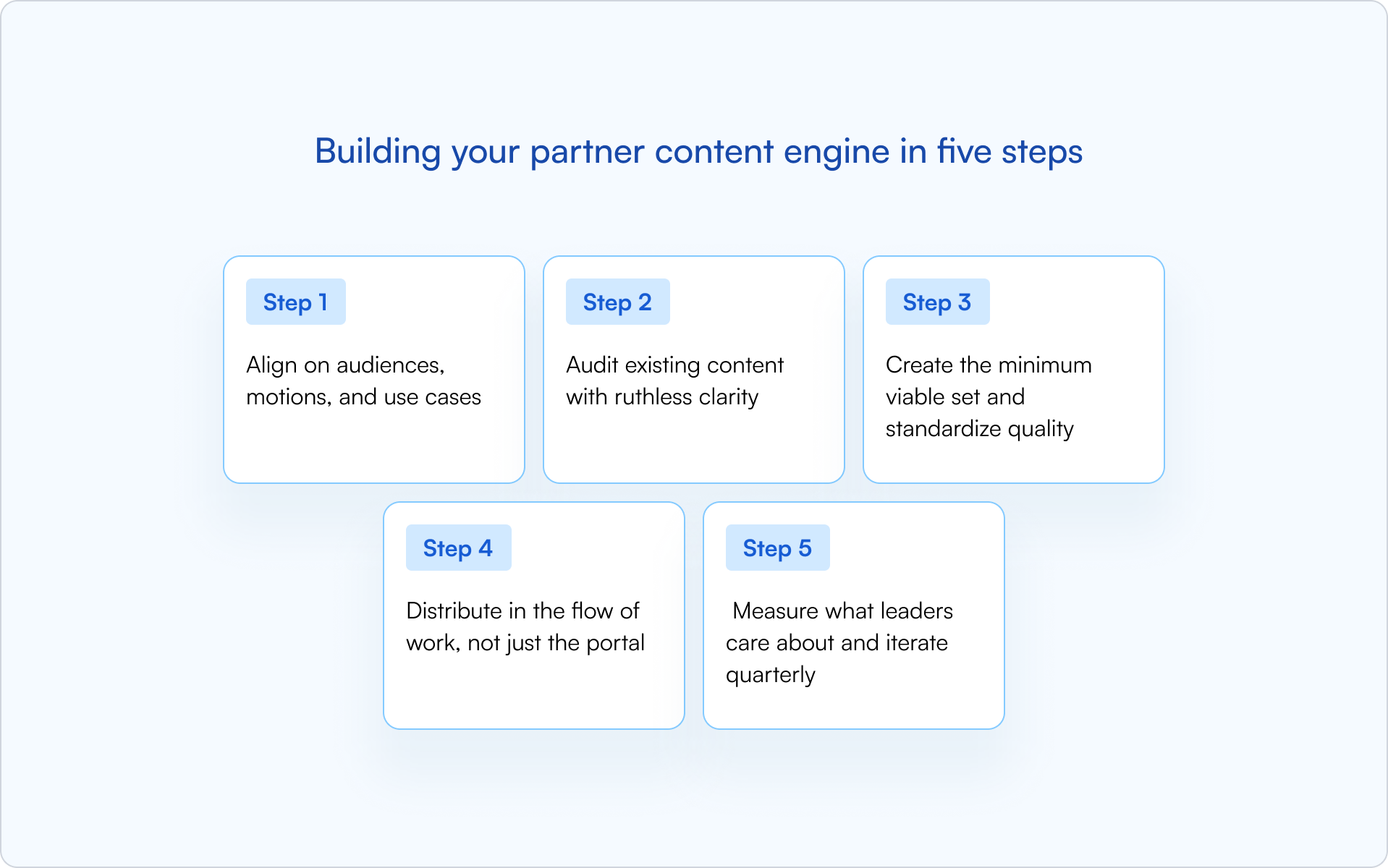
Building your partner content engine in five steps
Every step here flows into the next, so avoid skipping ahead. You are building a system, not just uploading files.
Step 1. Align on audiences, motions, and use cases
Start with segmentation. Split your partner ecosystem by motion — resell, referral, ISV, and services. Within each motion, separate sellers and consultants, then overlay partner tier and region. This gives you the targeting you need so a consultant does not receive first-call decks, and a reseller AE is not reading deep implementation playbooks.
Outcome: clear audiences for content and reporting, fewer irrelevant pings, better partner satisfaction.
Step 2. Audit existing content with ruthless clarity
Map every asset to discovery, evaluation, selection, or onboarding. Identify duplicates and outdated claims. Keep winners, merge near-duplicates, and retire risky files. Capture gaps that stall deals, like an absent security FAQ or a weak competitive snapshot. This is where content related technologies help: a digital asset management tool will expose duplicates, and enablement tools will surface low-use files to replace.
Outcome: a trimmed library that your internal team trusts and partners will actually reuse.
Step 3. Create the minimum viable set and standardize quality
Create marketing and sales collateral with a shared checklist: audience, use case, stage, owner, review cadence, legal status. Use standardized templates to speed document generation and maintain brand consistency. Where possible, add short narration guidance so sales reps know when and how to use the asset during sales calls.
Outcome: fewer, sharper pieces that are easier to keep up to date and safer to send.
Step 4. Distribute in the flow of work, not just the portal
A partner portal is useful, but it should not be the only door. Push content by email and Slack when timing matters. Let partners browse a partner content hub for training and self-serve discovery. Surface the next best asset inside your CRM when a sales rep opens an opportunity. Distribution should feel like today’s digital HQ, not a scavenger hunt.
Outcome: higher adoption, faster response, and less time spent hunting links.
Step 5. Measure what leaders care about and iterate quarterly
Replace vanity metrics with outcome metrics. Track first meetings within 14 days of send, stage progression on opportunities that received specific assets, influenced pipeline, and win rate deltas where content was used. Add operational KPIs like training completion and asset freshness. Review quarterly with partners and your internal sales team, then tune your content enablement strategy.
Outcome: proof that content moves revenue, not just downloads.
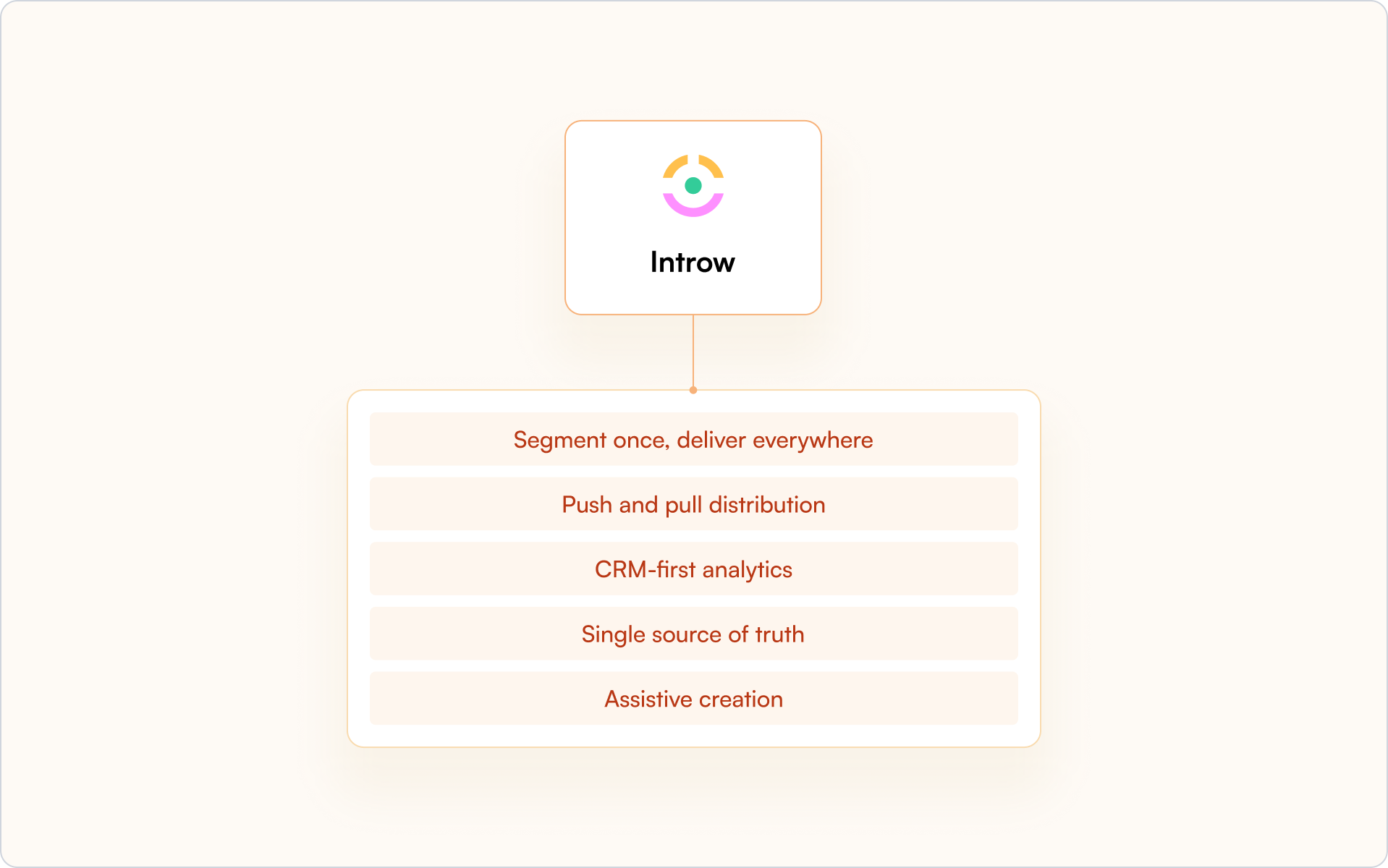
Where Introw fits — intelligent content enablement that partners adopt
Introw is built to make partner content reach the field and show up in your numbers.
- Segment once, deliver everywhere. Target by motion, tier, role, industry, certification status, or region. A reseller AE gets first-call assets and a co-marketing kit. A services architect sees implementation plays and product training.
- Push and pull distribution. Send content by email and Slack for urgency, while a lightweight partner content hub supports discovery and training. Partners do not need to learn a heavy system to stay current.
- CRM-first analytics. Engagement rolls up next to account and opportunity records so leaders can see which assets improve first-meeting rate, stage progression, and close won.
- Single source of truth. A centralized repository handles managing content, permissions, and data security. Owners and review cadences keep everything up to date.
- Assistive creation. Sales AI tools inside the workflow suggest next best content, flag stale messages, apply AI powered spell checking, and trigger document generation for localized one pagers.
This is partner content marketing that respects how partners sell and how marketing and sales teams want to measure.
A 90-day rollout plan that respects day jobs
Long rollouts lose momentum. This plan gets you live fast and gives you space to improve.
Weeks 1–2 — pick two motions and two roles, define KPIs, align owners.
Weeks 3–4 — audit, trim, and draft the core set with standardized templates.
Weeks 5–6 — stand up the centralized repository, permissions, and CRM tracking.
Weeks 7–8 — pilot with a small partner cohort, run one live enablement session, collect feedback.
Weeks 9–10 — tune assets, set review cadences, finalize distribution rules.
Weeks 11–12 — publish the playbook in the partner content hub, expand targeting, and schedule the next co-marketing kit.
Because Introw connects segmentation, delivery, and analytics to your CRM, most of the wiring is configuration rather than custom work.

Bringing it all together
Great partner enablement is not about more files. It is about delivering relevant marketing content to the right people at the right time and proving it helped close business. When sales and marketing teams share a centralized repository, when content management is tight, and when distribution meets partners where they already work, buyer engagement improves and closing deals gets easier.
Introw adds the missing glue by combining segmentation, a partner content hub, push delivery, and CRM analytics so your channel partner enablement program turns content into revenue. If you want an effective partner enablement strategy that partners adopt and leaders can measure, Introw is ready to help.
Still curious? Here are some quick answers to help clear things up
Partner content is the approved set of external materials for partners. A partner content hub is a lightweight site where partners can browse, search, and train while push distribution handles urgency.
You are sharing one engine. Internal sellers and channel partners use the same positioning, and your CRM shows who used what. That improves handoffs and makes forecasting more honest.
Yes, but keep it light. The portal is great for training, search, and FAQs. Push is for timing-critical moments. Together they cover how partners actually work.
A CRM for outcomes, a light DAM for governance, sales AI tools for recommendations and quality checks, and Introw to orchestrate segmentation, delivery, and analytics across your partner ecosystem.
Quarterly. Update claims, rotate case studies, retire risky files, and post a change log so partners see what changed and why.






Are you already an active Introw partner?
Book a demo with one of our partner program experts, or explore Introw on your own time.