


Most partner content follows a predictable path: it gets created, uploaded to a portal, and never touched again. Partners don’t know it exists, can’t find it when they need it, or discover it’s outdated the moment they try to use it.
When that happens, the issue usually isn’t the content quality — it’s the system around it. How content is organized, distributed, and tracked (or more often, how it isn’t) determines whether your channel motion scales or stalls.
This guide breaks down the role of content in channel partner marketing from a founder’s lens: what partners actually use, how to make assets self-serve (without losing control of your brand), and how to measure partner-level performance so you can connect enablement to pipeline.
Why content drives channel partner marketing success
Content in channel partner marketing acts as a bridge — it educates, enables, and empowers partners to market and sell your product accurately. Without ready-to-use assets, partners are forced to invent positioning, messaging, and objection handling on their own. That rarely ends well for brand consistency or deal velocity.
Partners represent your brand to their audiences. If you don’t provide approved, up-to-date materials, partners will either: (1) create their own (often off-message), or (2) stay silent because the lift feels too high.
- Brand consistency: Partners show up with current, approved messaging and visuals.
- Partner activation: New partners ramp faster when onboarding content answers their first questions.
- End-customer trust: Thought leadership and case studies build credibility partners can borrow.
- Engagement retention: Fresh content gives partners a reason to stay active instead of going quiet.
Types of content that engage channel partners
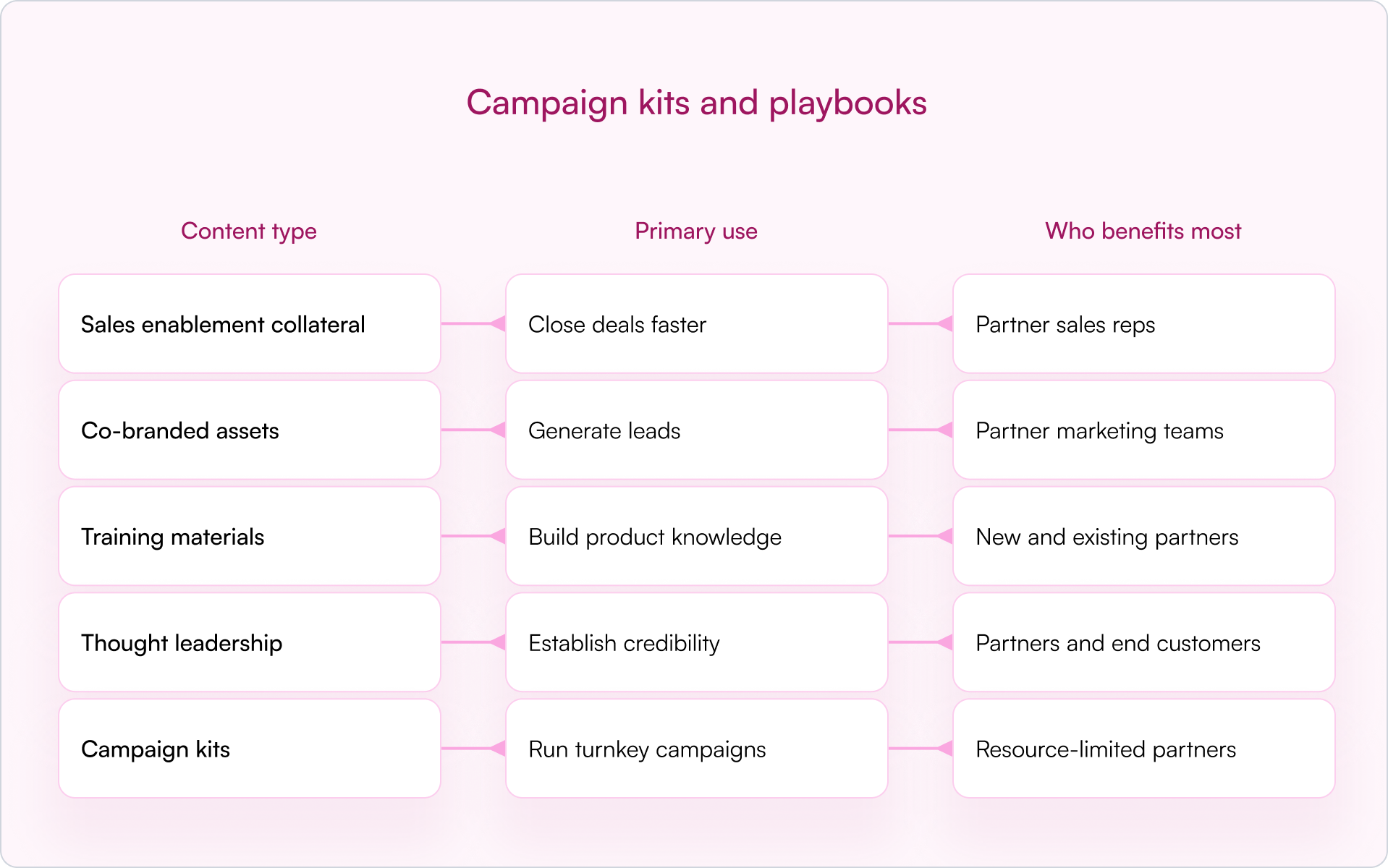
Not all content serves the same job. Some assets help partners close deals. Others help them generate leads. And some exist to build product knowledge before partners ever talk to a prospect.
The difference between a content library that drives revenue and one that collects dust usually comes down to a single question: when will partners use this — and what will they be trying to accomplish in that moment?
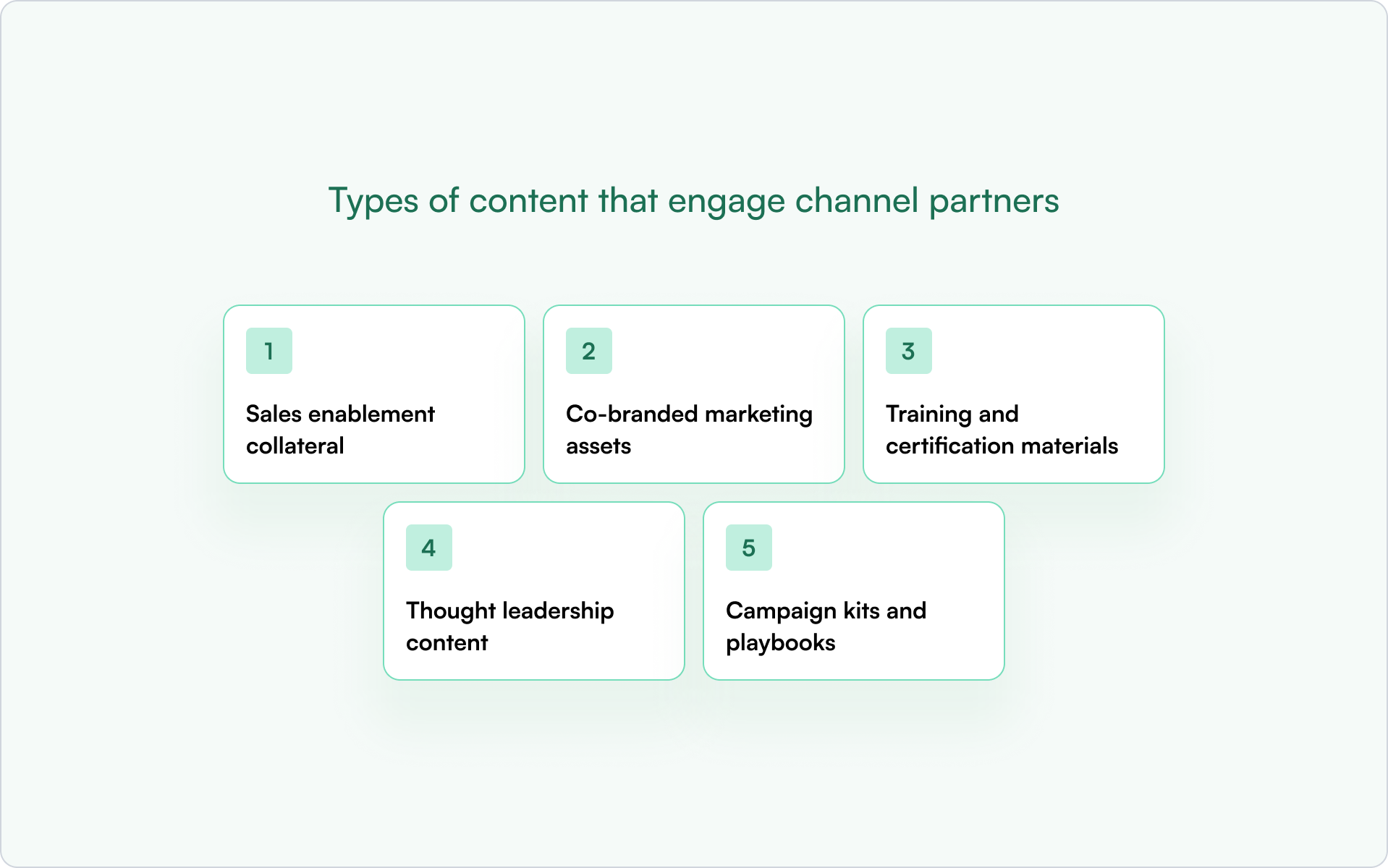
Sales enablement collateral
Sales enablement collateral includes battle cards, one-pagers, pricing guides, and competitive comparisons. Partners use these assets to answer buyer objections and position your product during active sales conversations.
If you’re prioritizing what to build first, start here. Partners ask for enablement content early because it supports deals they’re already working.
Co-branded marketing assets
Co-branded content includes landing pages, email templates, and social posts that partners customize with their logo and branding. Done well, it lets partners generate leads while maintaining your brand’s look and feel.
The balance is tricky: too much control and partners won’t use it; too little and your brand gets diluted. Editable templates in tools like Canva or Google Slides tend to see higher adoption than locked PDFs.
Training and certification materials
Training content includes onboarding decks, product tutorials, and certification tracks. Partners can’t sell what they don’t understand, so training directly impacts partner readiness.
Certification programs also create a natural gate for access to exclusive products, higher tiers, or specific customer segments.
Thought leadership content
Thought leadership includes blogs, whitepapers, and webinars. Partners use it to establish credibility with their audiences without building content from scratch. In practice, they get to “borrow” your expertise.
This is especially valuable for partners without in-house marketing resources who still want to position themselves as trusted advisors.
Campaign kits and playbooks
Campaign kits bundle everything a partner needs to run a campaign: email sequences, social copy, landing pages, and sometimes ad creative. Playbooks provide step-by-step guidance on how to deploy those kits.
For resource-limited partners, kits remove the friction of figuring out what to do next. They just execute.
How to tailor content for different partner types
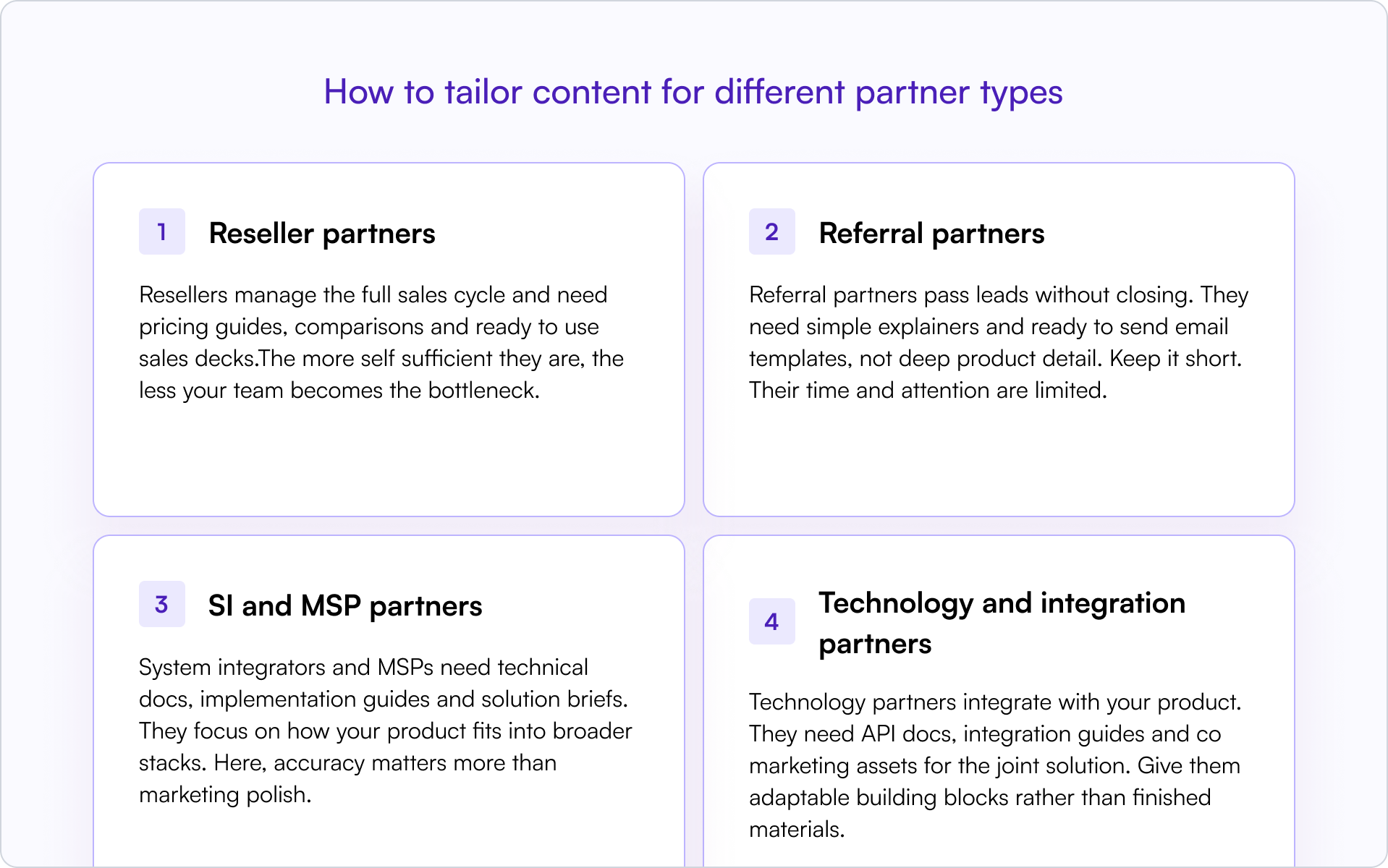
One-size-fits-all content rarely works. A reseller closing deals directly has different needs than a referral partner passing leads, and both differ from an SI building custom implementations.
If you want higher adoption, tailor content by partner type — and make that segmentation obvious in how you label and distribute assets.
Reseller partners
Resellers buy and resell your product, often handling the full sales cycle. They typically need pricing guides, product comparisons, and sales decks they can present directly to buyers.
The more self-sufficient you make resellers, the less your team becomes a bottleneck on every deal.
Referral partners
Referral partners pass leads without closing deals. Their content needs are lighter: simple explainer materials and email templates that introduce your product without requiring deep product expertise.
Keep referral content short. Referral partners often have limited time and attention for any single vendor.
SI and MSP partners
System integrators (SIs) and managed service providers (MSPs) need technical documentation, implementation guides, and solution briefs. They position your product as part of larger deployments, so they care about how your product fits into existing stacks.
Technical accuracy matters more here than marketing polish.
Technology and integration partners
Technology partners integrate with your product. They need API documentation, integration guides, and co-marketing assets that highlight the joint solution.
Many technology partners have their own marketing teams, so providing adaptable building blocks often works better than finished assets.
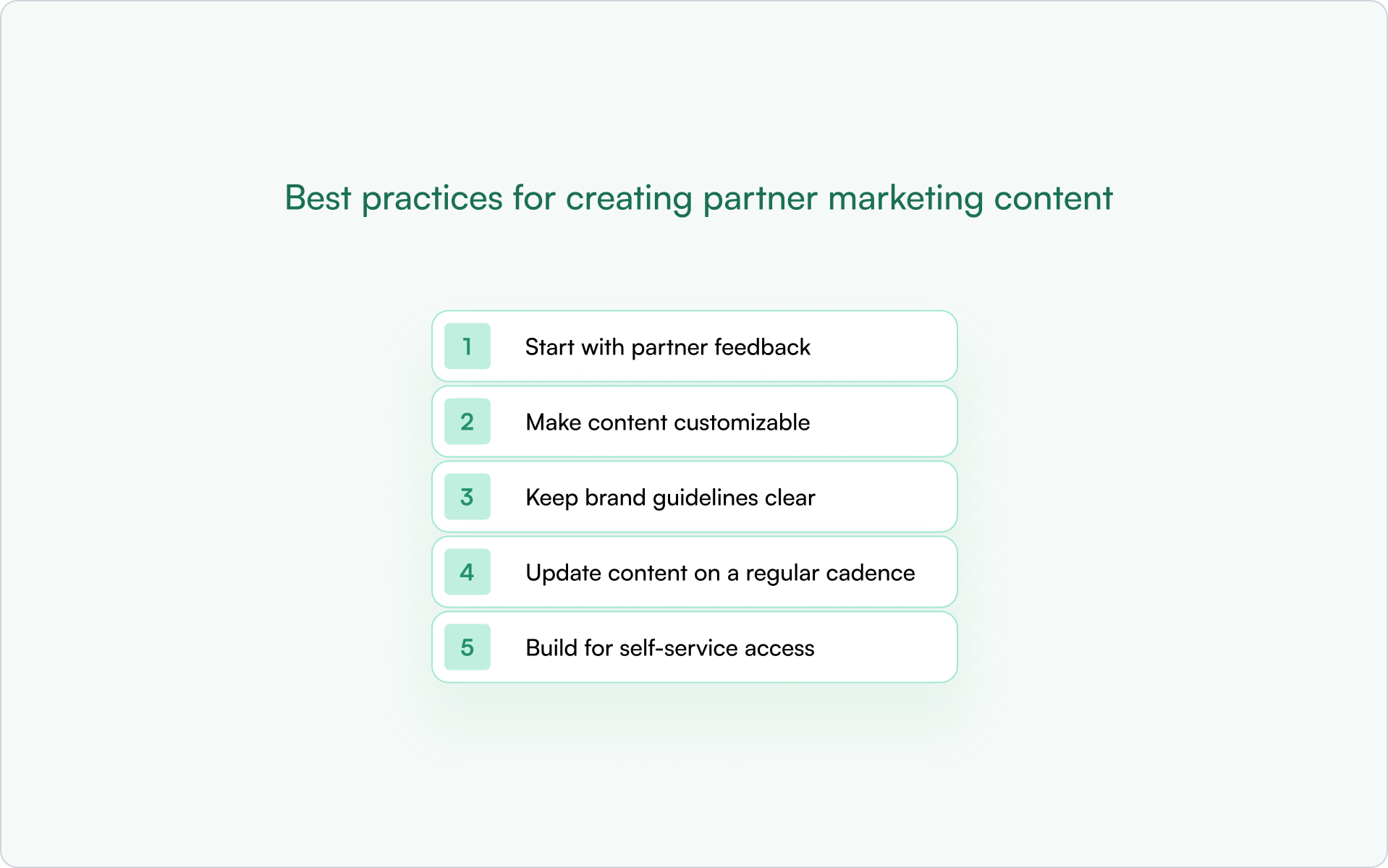
Best practices for creating partner marketing content
Great partner content is less about writing skill and more about operational discipline: building what partners will actually use, making it easy to customize, and keeping it current.
1. Start with partner feedback
Survey partners on what content they need and what’s missing. Content created without partner input often goes unused because it solves the wrong problem.
Even a quick Slack poll or quarterly check-in can surface gaps you didn’t know existed.
2. Make content customizable
Provide editable templates so partners can add their branding. Locked PDFs frustrate partners and often get ignored in favor of whatever they can actually modify.
Canva, Google Slides, and Figma templates tend to see higher adoption than static files.
3. Keep brand guidelines clear
Share a simple brand guide with logo usage, colors, and messaging dos and don’ts. Brand guidelines protect your brand while giving partners room to make content their own.
The goal is guardrails, not handcuffs.
4. Update content on a regular cadence
Stale content erodes partner trust. If a partner shares outdated pricing or discontinued features, it reflects poorly on both of you.
Set a quarterly review cycle and announce updates so partners know what’s current. Platforms like Introw let you push announcements directly to partners via email and Slack, with no portal login required.
5. Build for self-service access
Organize content in a searchable partner portal so partners find what they need without emailing you. The fewer barriers between a partner and the right asset, the more likely they are to use it.
CRM-first portals keep content tied to partner records, which matters when you’re tracking engagement and tying it back to pipeline.
How to distribute content through a partner portal
Creating content is only half the job. Distribution determines whether partners actually use content or whether carefully crafted assets sit in a folder no one opens.
A partner portal is a centralized hub where partners access resources, register deals, and collaborate with your team. How you organize and push content through that portal makes the difference between adoption and a content graveyard.
Organize content by partner tier and type
Structure your content library so partners see relevant assets first. Use folders or tags by partner tier (Gold, Silver) and type (reseller, referral, SI).
When partners log in and immediately see content that fits their motion, they engage. When they have to dig through irrelevant materials, they often give up.
Use announcements to drive engagement
Don’t rely on partners checking the portal. Push new content via email and Slack announcements so partners know when something relevant drops.
Introw’s announcements feature writes engagement data back to the CRM, so you can see which partners opened, clicked, or ignored your updates without guessing.
Enable off-portal access via email
Not all partners log into portals regularly. Some prefer email. Others forget their passwords. Either way, forcing portal logins creates friction.
Let partners receive and respond to content via email, with replies syncing back to your CRM for visibility. Off-portal access keeps content accessible without sacrificing tracking.
How content supports your channel partner sales strategy
Content isn’t just a marketing function. Content directly supports your channel partner sales strategy by mapping to different stages of the partner lifecycle.
The right content at the right stage accelerates partner performance. The wrong content — or no content — creates friction that slows everything down.
Content for partner recruitment
Attract new partners with program overviews, partner success stories, and benefits summaries. Recruitment content answers the question every prospective partner asks: “Why join this program?”
Strong recruitment content positions your program as worth the partner’s time and attention, especially when they’re evaluating multiple vendors.
Content for partner activation
Onboard partners faster with quick-start guides, first-deal playbooks, and product training. Activation content answers: “How do I get started?”
The faster a partner closes their first deal, the more likely they are to stay engaged. Activation content shortens that timeline.
Content for deal progression
Help partners close deals with battle cards, ROI calculators, and customer case studies. Deal progression content answers: “How do I win this deal?”
Partners working active opportunities often need specific assets on short notice. Having deal progression content ready and easy to find keeps deals moving.
- Recruitment stage: Program overview decks, partner testimonials, benefits one-pagers
- Activation stage: Onboarding checklists, product training videos, first-deal playbooks
- Deal progression stage: Battle cards, objection handlers, customer case studies
How to measure partner content performance
Content without measurement is guesswork. You might feel like you’re enabling partners, but without data, you can’t know which assets drive results and which ones get ignored.
Measuring content performance at the partner level, not just the end-customer level, is what separates strategic content programs from content graveyards.
Content engagement metrics
Track views, downloads, and time spent on content. Content engagement metrics show whether partners are consuming what you create.
Low engagement often signals a distribution problem, a relevance problem, or both.
Partner activation metrics
Measure how many partners complete onboarding content or certifications. Partner activation metrics indicate whether your content is actually ramping partners toward their first deal.
If partners consume training but never close deals, the content might be informative but not actionable.
Pipeline attribution metrics
Connect content usage to registered deals and closed revenue. Pipeline attribution is where content ROI becomes visible to leadership.
CRM-first platforms like Introw make attribution visible inside Salesforce or HubSpot, so you can tie specific content assets to specific pipeline outcomes without manual tracking.
Partner marketing ideas to try in your next quarter
If you’re looking for partner marketing ideas you can implement quickly, the following tactics tend to deliver results without requiring massive lift.
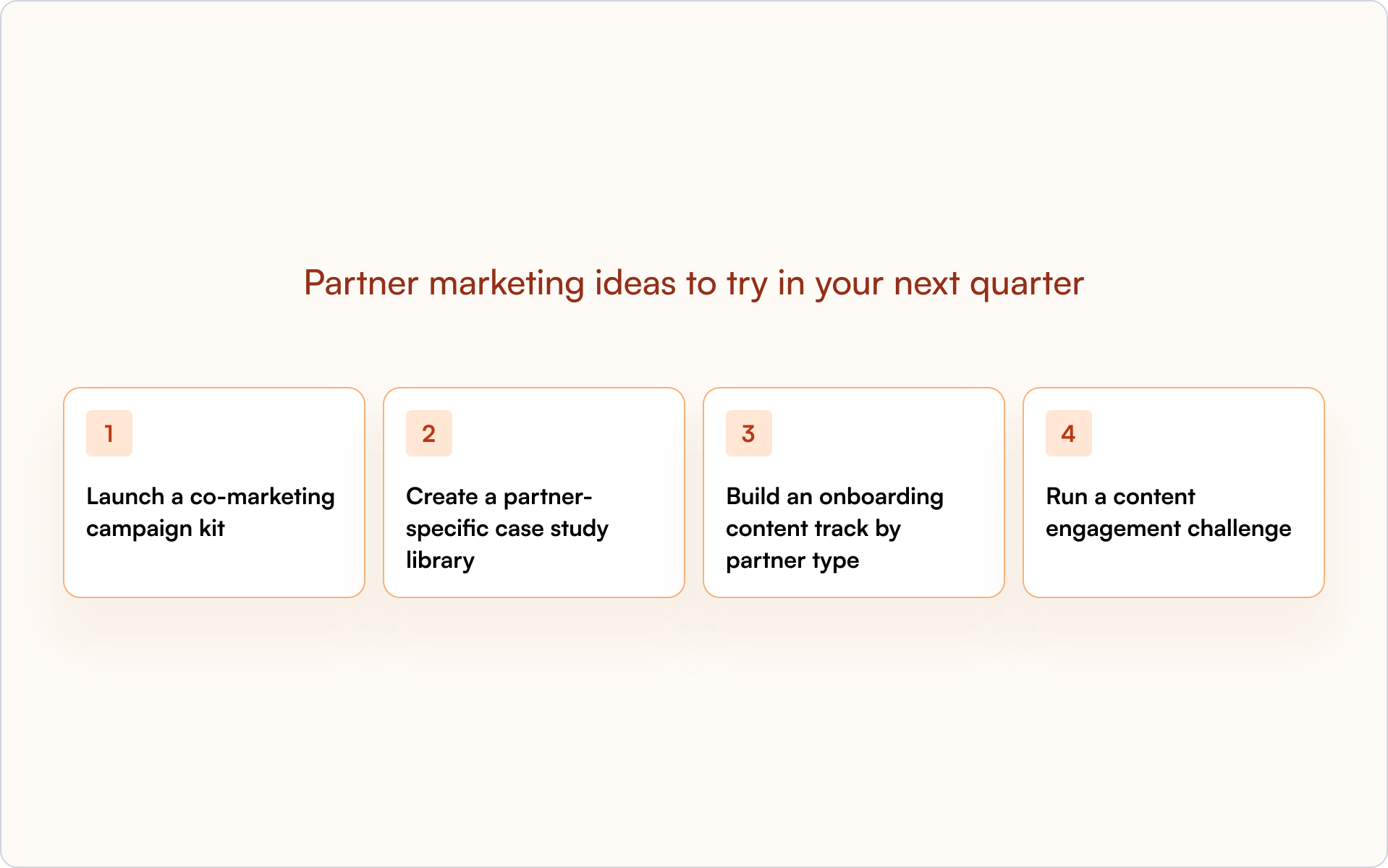
1. Launch a co-marketing campaign kit
Bundle email templates, social posts, and a landing page around a specific use case. Give partners everything they need to run a campaign in one download.
Co-marketing campaign kits work especially well for product launches or seasonal promotions where timing matters.
2. Create a partner-specific case study library
Develop case studies featuring deals partners helped close. Partner-specific case studies give partners social proof they can share with prospects, and they recognize partner contributions publicly.
Partners who see their wins highlighted tend to stay more engaged.
3. Build an onboarding content track by partner type
Create separate onboarding paths for resellers, referral partners, and SIs. Tailored onboarding content accelerates time-to-first-deal because partners aren’t wading through irrelevant materials.
Even simple segmentation — three tracks instead of one — can meaningfully improve activation rates.
4. Run a content engagement challenge
Gamify content consumption by rewarding partners who complete training or share co-branded assets. Leaderboards and SPIFFs drive participation, especially among competitive partner teams.
Content engagement challenges work best when the rewards are meaningful and the tracking is visible.
Turn partner content into pipeline with CRM-first distribution
Here’s the uncomfortable truth for founders: content only drives revenue when it’s accessible, trackable, and tied to your CRM. Otherwise, you’re creating assets that live in a silo — disconnected from the partners and deals they’re meant to support.
- Visibility: When content lives in a CRM-first portal, you see which partners engage and which don’t.
- Attribution: Content downloads tied to deal records prove marketing impact.
- Automation: Announcements push content to partners via email and Slack without manual follow-up.
See how Introw helps partner teams distribute content and track engagement inside HubSpot or Salesforce. Get a demo
Still curious? Here are some quick answers to help clear things up
The role of content in channel partner marketing is to make partners effective faster — with less effort and less guesswork. Great partner content: standardizes your message, enables partners to sell and market confidently, and reduces the number of “can you send me…” requests your team fields. The best programs treat content like product infrastructure: organized, continuously improved, and measurable.
Partner enablement content trains partners on your product and sales process. Enablement content includes onboarding decks, certification tracks, and product tutorials. Partner marketing content helps partners generate demand and nurture leads with end customers. Marketing content includes co-branded emails, social posts, and campaign kits. Both matter, but enablement and marketing content serve different purposes across the partner lifecycle.
Review and refresh content quarterly to ensure accuracy, then announce updates so partners know they’re using current materials. Stale content erodes trust and can lead to painful conversations with prospects (wrong pricing, missing features, outdated positioning).
Most programs allow customization within brand guidelines. Requiring approval for significant changes protects brand consistency, while giving partners flexibility for minor edits keeps adoption high. The right balance depends on your risk tolerance, your partner mix, and how tightly regulated your industry is.
Use editable templates with guardrails: pre-approved layouts, locked core messaging where needed, and a lightweight brand guide (logos, colors, do’s and don’ts). Then distribute content through a portal that supports segmentation so partners only see what’s relevant to their tier and motion. Accessibility drives adoption; guardrails protect consistency. You need both to scale. If you’re building a partner program in 2026, treat content like a growth lever, not a library. When the system is right — relevant assets, clean distribution, and partner-level measurement — the role of content in channel partner marketing becomes tangible: faster partner ramp, better brand consistency, and more pipeline you can actually attribute.




See AI-Native PRM in Action
Book a demo with one of our partner program experts, or explore Introw on your own time.