

Most partner programs don’t fail because of bad strategic partnerships. They fail because partner sales is rarely operated like a real go-to-market motion.
Teams that consistently generate partner-driven pipeline apply the same rigor they use in direct sales — motion-specific stages, mandatory CRM fields, forecast discipline, and clear SLAs. We’ll cover the stages, cadences, governance, and enablement systems high-performing teams use to make partner pipeline forecastable instead of aspirational.
If your partner pipeline feels harder to manage than direct sales, you don’t need a multi-quarter overhaul. You can stand this up in 14 days — and we’ll show you exactly how.
Why Partner Sales Needs Its Own Operating Model
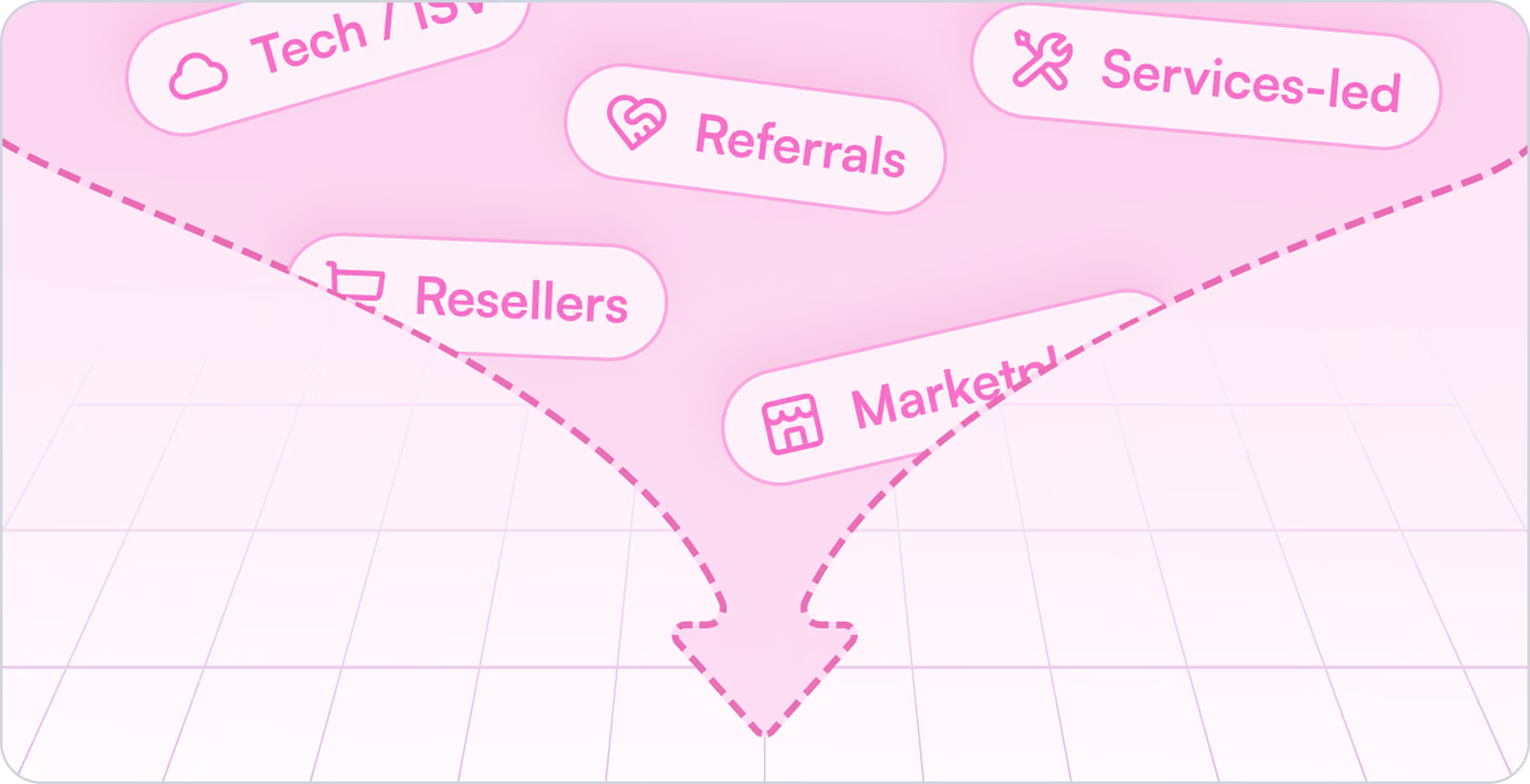
Partner sales is any revenue motion where a third party sources, influences, sells, or delivers your product as part of your go-to-market. But partner sales breaks when different motions are forced through the same process. Co-selling, referrals, and reselling all involve partners, but they create value differently:
- Referral partners introduce a lead, lend credibility, and step back.
- Co-sell partners stay engaged alongside your seller to advance the deal.
- Resellers own the commercial relationship and transact independently through indirect sales.
These motions require different stages, different handoffs, and different expectations about who does what. Running them all through one generic "Partner Opportunity" stage is what causes forecasts to break every quarter.
The most important distinction is whether the partner originated the opportunity or helped move it forward. Sourced means the partner originated the deal. Influenced means they impacted progression or close without originating it. This makes partner revenue measurable while deals are active, not debatable after the quarter closes.
High-performing teams run one opportunity record, one data model, and one source of truth across all motions. This clarity only works when your CRM captures sourcing and attribution in real time. PRM platforms like Introw lock sourced and influenced contribution directly on the opportunity in Salesforce or HubSpot as the deal unfolds. Partners see the deals they're involved in through shared views or a partner portal, with the same visibility your internal team has.
Matching Partner Motions To Your Go-To-Market Strategy
Matching partner motions to your GTM is foundational. It’s how you scale channel partner sales without introducing conflict or forecast noise. Before you design stages, SLAs, or incentives, you need clarity on which partner motions you’re supporting and why. Most SaaS teams should operate only two or three motions well, not five poorly.

Referral
A partner introduces a prospect, lends credibility, and steps back. You own the sales process and compensate the partner with a referral fee or SPIFF.
Best when: Your direct sales team needs warm introductions to get into target accounts or build initial credibility with skeptical buyers.
Reseller/VAR
Value-added resellers purchase your product at a discount and resell it independently, handling pricing, negotiation, and the customer relationship. You enable them with price protection, margin structures, and deal registration.
Best when: Your customers prefer buying through established local partners, or you're expanding into new markets where channel distribution is the dominant buying model.
Marketplace
Deals close through cloud marketplaces like AWS, Azure, or Google Cloud, allowing customers to use committed cloud spend or procurement credits. You'll manage private offers, co-marketing, and marketplace-specific SKUs as part of your channel sales model.
Best when: Your target market uses cloud procurement tied to committed spend, or your sales cycles are slowed by legal and contracting friction that marketplace transactions eliminate.
Services-led (SI / MSP)
Systems integrators build custom solutions around your product, while managed service providers deliver ongoing IT operations. The partner leads delivery, and your product becomes part of their broader solution, giving you expanded market reach.
Best when: Your product sells best bundled with professional services, or the customer base requires implementation and ongoing management that strategic partners deliver better than you can.
Tech/ISV
Another tech company (independent software vendor) integrates with your product, creating joint value propositions that amplify both sales teams' motions. Sales success and customer acquisition depends on field readiness, certification programs, and operationalized co-selling as part of your partner ecosystem.
Best when: Your product sells more effectively alongside complementary technology, or your buyers evaluate solutions as integrated stacks rather than standalone tools.
Stages and Exit Criteria Across Partner Motions
Partner sales exit criteria sit at the intersection of partner accountability and customer progress. They answer two key questions: Has the partner done what they're responsible for at this stage? Can we advance this deal without breaking trust, crediting, or economics?
Exit criteria prevent credit disputes, stalled deals, and pipeline inflation. If a deal can’t meet exit criteria, it doesn’t move — regardless of pressure. Below is a concise view of the five stages for each partner motion and how exit criteria differ where it matters most.
Referral Motion
Referral exit criteria focus on clean sourcing and fast vendor ownership.
- Intro Logged: The opportunity is created with the partner marked as sourced and ownership formally accepted by the vendor.
- Validate: ICP fit, urgency, and the partner’s limited role are confirmed at this sales stage.
- Prove Value: The vendor advances the deal without requiring ongoing partner involvement.
- Commercials: Commercial execution proceeds without partner participation.
- Closed & Credit: The deal is closed and referral credit is finalized.
Reseller / VAR Motion
Reseller exit criteria protect partner ownership and transaction economics.
- Deal Registration: The opportunity is registered with price protection and non-interference enforced.
- Qualification: The reseller confirms real end-customer demand and technical fit.
- Configure & Quote: Commercial terms reflect approved SKUs, discounts, and margin.
- Transact: The reseller completes the transaction and fulfillment.
- Launch & Enable: Delivery and renewal responsibilities are documented.
Marketplace Motion
Marketplace exit criteria ensure attribution and revenue integrity outside traditional sales flow.
- Listing Ready: The opportunity aligns to an approved marketplace offer.
- Private Offer: Discounts and terms are defined within marketplace constraints.
- Procurement: The transaction is executed through the marketplace system.
- Close & Disburse: Revenue and partner credit are recorded accurately.
- Adopt & Expand: Expansion is driven by usage, not renegotiation.
Services-led (SI / MSP) Motion
Services-led exit criteria prioritize delivery readiness over pipeline velocity.
- Solution Design: Joint success criteria are defined before committing revenue.
- Proof / Workshop: Delivery assumptions are validated and risks documented.
- Commercials: Software and services are sold together with milestone alignment.
- Delivery: The SI or MSP leads execution while the vendor provides ongoing support.
- Handoff: The account transitions to steady-state ownership and expansion.
Tech / ISV Motion
Tech partner exit criteria validate influenced impact rather than sourcing.
- Integration Fit: The opportunity reflects a clear integration-driven use case.
- Field Readiness: Sellers are enabled to position the joint solution.
- Pipeline Activation: Partner-driven influence is reflected in active deals.
- Validation: Joint proof points reinforce deal progression.
- Commercials & Close: Influence credit is captured and fed back into planning.
The Partner Sales Drumbeat: Cadence, Touchpoints, and SLAs
Partner sales management depends on rhythm. High-performing teams run on predictable cadences that keep deals moving and partners engaged.

Monthly or Quarterly Partner Sales Review (30–45 minutes)
The monthly or quarterly partner sales review is the heartbeat of the program. It should focus on signal, not deal recitation.
Each review should cover:
- Top partner deals by motion, not just by amount
- Whether deals are moving against their defined exit criteria
- Sourced vs influenced pipeline and closed revenue
- Risks around ownership, attribution, or partner engagement
Every decision and next step should be logged directly on the opportunity. If it’s not in Salesforce or HubSpot, it didn’t happen. This keeps sourced vs influenced attribution current, prevents deals from drifting, and ensures forecasts reflect reality rather than intent.
AE and Partner Touchpoints
The review inspects progress, but AE–partner touchpoints are where work actually happens. Effective AE–partner collaboration runs on a seven-day action cycle. Every sales rep interaction should produce a concrete next step within a week — a scheduled customer meeting, a delivered artifact, or a teed up decision. Weekly alignment validates motion execution (referral vs co-sell vs resale) and identifies blockers that prevent the next action from happening on time.
Core SLAs
SLAs show channel sales partners that their effort is respected and their deals won’t stall in your internal process.
You need, at a minimum:
- Partner referral to opportunity creation within 24 hours
- Deal registration approval or rejection within 48 hours
- Opportunity notes updated weekly
- Partner follow-up sent within 24 hours after meetings
When these SLAs slip, partners disengage quietly. When they’re met consistently, trust compounds.
Making Channel Partner Sales Visible: CRM, Data Model, and Forecasting
Partner sales is invisible until it's in the CRM. If your opportunity records don't capture motion, sourcing, and partner contribution, you're forecasting on anecdotes.

Required CRM Fields
Your CRM needs these fields to make partner sales pipeline forecastable and enable effective partner performance management:
- Partner Motion: Referral, reseller, marketplace, services, or tech
- Partner Type & Partner Org: Who the partner is and what type
- Sourced vs Influenced: Tag whether the partner originated the deal (sourced) or impacted it (influenced), with attribution percentage
- Deal Registration #: Tracks price protection and conflict policy
- Partner Contacts as Contact Roles: Logs who's involved on the partner side so you know who to loop in when a deal stalls
- Stage Notes: What happened, what's next — updated weekly
These fields should be mandatory at stage changes. Missing motion or attribution fields should block progression, and stale notes or expired price protection windows should be flagged automatically. This is easier when your PRM enforces field requirements automatically — Introw does this natively in Salesforce and HubSpot.
Deal Registration Policy
Your deal registration policy should define:
- Conflict rules: First-come-first-served vs partner tier priority
- Price protection window: How long protection lasts
- Approval criteria: What makes a deal eligible for registration
- Overlap handling: What happens when multiple partners claim the same account
Document this policy, share it with partners, and reference it in disputes.
Governance and Visibility
Because all motions live in the same pipeline, reporting becomes consistent across motions — comparing cycle time, win rates, ACV, and attach rates without manual cleanup. Visibility should also extend to partners through shared pipeline views that expose only approved opportunity, renewal, and onboarding fields. Partners should never be surprised by deal status, ownership, or credit.
Metrics That Matter
Mid-market and enterprise B2B SaaS companies report that roughly 35% of new pipeline is now partner-influenced or partner-sourced, making partner-driven deals a primary growth lever rather than a supplementary sales channel. Track these key metrics to show how partner motions contribute differently to revenue growth:
- Partner-sourced ARR and influenced ARR by motion to track revenue generated
- Cycle time by motion (are channel partner deals faster or slower than direct sales?)
- Win-rate deltas versus direct sales to measure sales performance
- Attach rates for services and integrations
- Renewal and expansion rates from partner-assisted accounts to measure customer satisfaction
These dashboards matter because they tell you where partners accelerate revenue — and where they slow it down. This lets you know where to invest in partner acquisition and better partner performance management.
Partner Sales Enablement That Drives Execution
Partner enablement fails when it’s built for storage instead of action. Enable your partners by giving them exactly what they need to move deals forward in the motion they’re operating in.
Types of Enablement That Must Exist
Effective enablement does two things. It gives partners practical assets they can use in live deals, and it gates access so only qualified partners are allowed to sell or deliver. Remember, onboarding new channel sales partners is just as important as onboarding new employees.
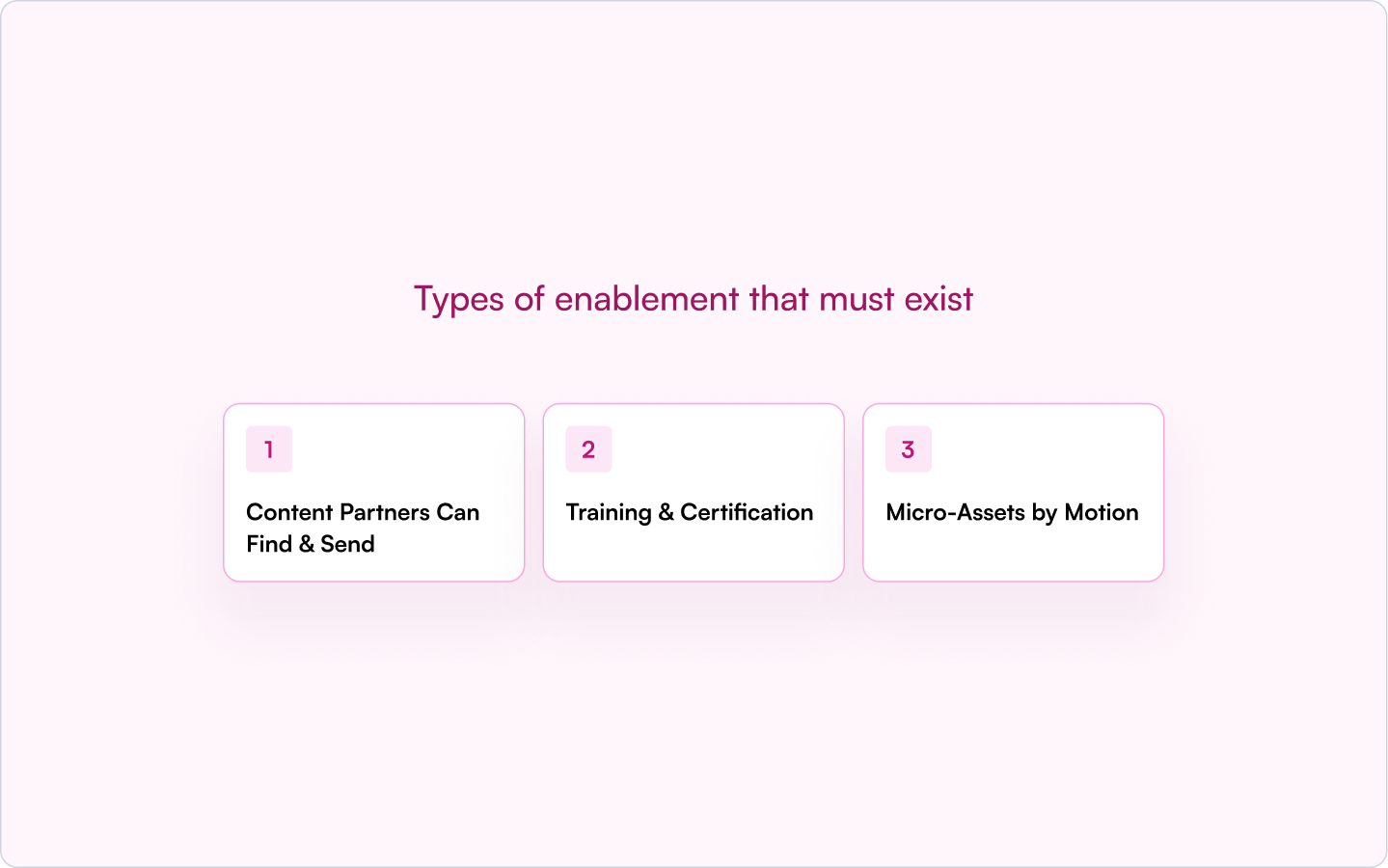
Content Partners Can Find & Send
Quality marketing materials support sales opportunities. Partners need plays, case studies, and ROI one-pagers that are truly helpful in sales conversations. Content should be organized by motion, industry, or use case — not buried in generic folders.
Training & Certification
Partner training works best when it unlocks privilege. Certifications should gate deal registration, partner pricing, delivery eligibility, or marketplace co-sell access. This ensures only qualified channel partners gain access to active deals, protecting both forecast accuracy and customer outcomes.
Micro-Assets by Motion
Generic enablement doesn't work. Build motion-specific micro-assets that match how partners actually work within each motion:
- Referral: Talk track for making warm introductions
- Reseller: Pricing matrix and margin structure
- Marketplace: Private offer explainer and procurement FAQ
- Services-led: SOW checklist and delivery scoping template
- Tech/ISV: Integration "why now" slide and joint demo guide
How To Deliver Enablement
Push new release notes, competitive intel, and win stories where partners already work. This is easier when you can publish updates with one click and distribute them automatically to email, Slack, or the partner portal. Introw's Announcements feature does this natively, tracking engagement across channels so partners see what's new and can act quickly in live deals.
Store searchable content in a partner portal where partners can filter by motion, industry, or use case and share directly with prospects. This eliminates the "can you send me that case study" requests and keeps partners engaged.
Your 14-Day Channel Sales Strategy Rollout
You don’t need months to operationalize a channel partner sales strategy or partner sales motion. Pick two motions and build the infrastructure in two weeks.

Days 1–3: Pick your two primary motions based on where deals already come from or where your ICP naturally buys. Define stages and exit criteria for each motion and add required CRM fields.
Days 4–6: Publish your deal registration policy and form. Stand up shared pipeline views so partners see their deals in real time. Enable announcement workflows for pushing updates to partners via email, Slack, or portal.
Days 7–10: Expect friction in week one — fix process gaps immediately before any bad habits form. Load your top enablement assets by motion. Brief your internal sales team on the new process and what changed. Notify partners that the new system is live and show them where to find what they need.
Days 11–14: Run your first weekly partner sales review. Measure field hygiene and fix gaps before they compound. Lock the cadence to set your operational rhythm for managing partner relationships — same day, same time, every week.
Conclusion
We’ve given you the operating model. Now you need the infrastructure to run it. Introw gives you deal registration workflows, partner portal access, shared pipeline views, and Salesforce/HubSpot sync — so your partner sales process isn't built on spreadsheets and hope. Request a demo to see how teams operationalize partner sales in weeks, not quarters.
Still curious? Here are some quick answers to help clear things up
Partner sales motions (referral, reseller, marketplace, services-led, tech/ISV) define how partners create value and transact, while co-selling is one specific motion where both companies actively sell together to close a deal. Each motion requires different stages, exit criteria, and partner relationships.
Partner Motion, Partner Type, Partner Org, Sourced vs Influenced (with attribution percentage), Deal Registration #, Partner Contacts as Contact Roles, and Stage Notes should block deal progression if missing. This ensures forecasting accuracy and proper partner performance tracking.
Use your partner relationship management system to tie certifications to privileges — partners can't register deals, access partner pricing, or deliver services until they complete required training modules. This ensures only the right partners are actively selling and protects deal quality.
Track partner-sourced ARR (originated by partner) and influenced ARR (impacted by partner) separately by motion in your weekly partner sales review, use consistent attribution percentages locked at deal creation, and report both metrics to show how channel sales partners contribute to new revenue streams. Sourced pipeline should be visible early while influenced impact should tie to progression milestones.






Are you already an active Introw partner?
Book a demo with one of our partner program experts, or explore Introw on your own time.