

.svg)


.svg)
.svg)








How Certification Programs Improve Partner Engagement
Certification programs improve partner engagement by transforming passive resellers into confident advocates who actually use your portal, register deals, and stay in your program longer. For founders building a repeatable channel, the “why” matters: partner activity rarely drops because people don’t like you — it drops because they’re unsure how to win with your product, and it’s easier to sell what they already know.
A good certification program solves that with a simple flywheel: structured training builds competence, competence builds confidence, and confidence drives action. Instead of onboarding being a one-time event, certification creates accountability, progress signals, and incentives that keep partners engaged long after week one.
What is partner certification?
Partner certification is a structured process where partners complete training, pass assessments, and earn credentials that validate their ability to sell, implement, or support your product. In B2B SaaS, certification confirms that a partner understands your product well enough to represent it accurately to customers.
You’ll hear this called channel partner certification when it applies to resellers and distributors, or PRM certification when the status is tracked inside a partner relationship management system. The label varies, but the purpose stays the same: a repeatable standard that separates prepared partners from those still ramping.
Certification fits within a broader partner enablement program, which includes all the training, content, tools, and support you provide to help partners succeed. Certification is the checkpoint that proves enablement is working — and highlights where it isn’t.
Why certification programs improve partner engagement
If your partner program is growing but partner activity is uneven, certification is one of the cleanest levers you can pull. It works because it aligns three forces that founders care about: partner confidence, operational accountability, and clear incentives.
Partners invest more time when they feel competent
Partners who understand your product are far more likely to pitch it. Certification removes the uncertainty that causes partners to default to competitors they already know.
When a partner completes structured training and passes an assessment, they gain confidence to answer customer questions, handle objections, and position your product correctly. That confidence translates into more customer conversations and more registered opportunities.
Certification creates accountability and progress signals
Certification acts as a commitment device: once partners invest time to earn a credential, they’re more likely to stay active because they’ve already put skin in the game.
Progress tracking reinforces this effect. Badges, levels, and visible milestones keep partners returning to the portal and moving through your partner training programs. Each module completion is a small win that nudges them toward the next step.
Certification becomes especially effective when it unlocks tangible benefits like better margins, deal registration access, or co-marketing eligibility — the credential becomes a visible reminder of what’s at stake.
Certified partners close deals faster and with higher quality
Certified partners require less hand-holding from your team. They position products correctly, set accurate expectations, and reduce support burden after the sale. Better deals lead to better outcomes, which builds more confidence — and that confidence feeds the next deal.
Over time, certified partners tend to become your most reliable source of partner-sourced revenue because their execution is consistent and repeatable.
Key engagement metrics certification programs impact
Certification isn’t just “nice enablement.” When it’s designed well, it shows up in the numbers quickly — especially in programs where partners have many competing priorities.
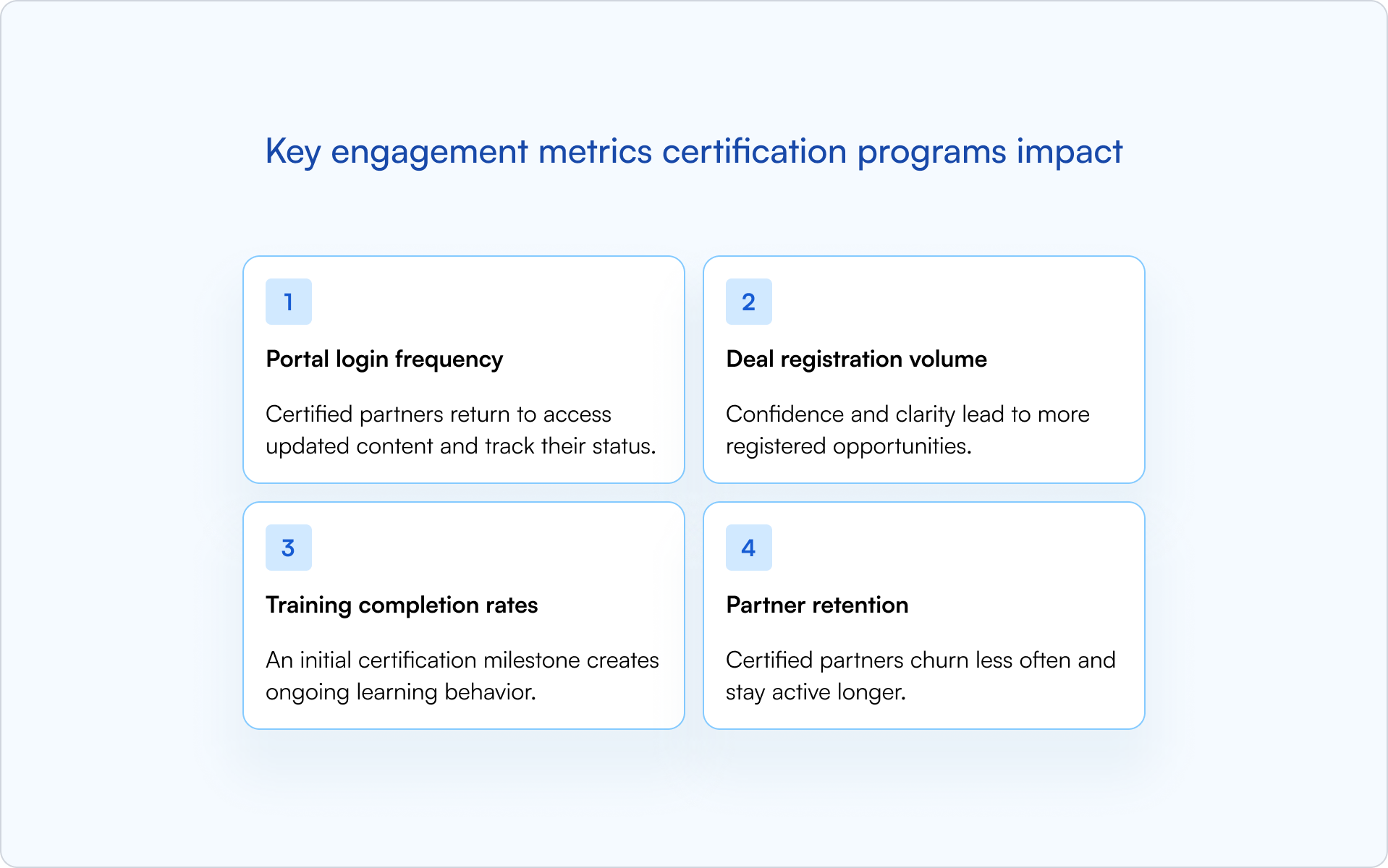
- Portal login frequency: Certified partners return to access updated content and track their status.
- Deal registration volume: Confidence and clarity lead to more registered opportunities.
- Training completion rates: An initial certification milestone creates ongoing learning behavior.
- Partner retention: Certified partners churn less often and stay active longer.
Portal login frequency and content consumption
Certification gives partners a reason to log in initially. Recertification keeps them coming back. The practical founder takeaway: if your portal experience is high-friction, you’ll kneecap adoption no matter how good your training is.
A low-friction partner portal makes engagement easier. When partners can access training, check their status, and find resources without repeated logins, engagement stays high. When every session requires a new password reset, it doesn’t.
Deal registration volume and velocity
Partners who complete training understand deal registration requirements and submit cleaner, faster registrations. They know what fields matter, what proof of work looks like, and how protection windows function.
Some programs gate deal registration behind channel partner certification. Done thoughtfully, gating reduces low-quality submissions and speeds approvals.
Training completion and recertification rates
Initial certification creates a habit of learning. Recertification windows keep partners engaged over time rather than dropping off after onboarding ends.
The key is treating certification as a repeatable partner certification process, not a one-time training event. Partners who recertify stay current on product updates and maintain their competitive edge.
Partner retention and program tenure
Certified partners have higher switching costs. They’ve invested time, earned credentials, and built expertise that doesn’t transfer to a competitor’s product. That investment compounds into longer tenure — more trust, more deal flow, and more willingness to co-sell with you.
Types of partner certification programs
Not all certifications serve the same purpose. The right mix depends on your partner types — and what you’re actually asking them to do in-market.
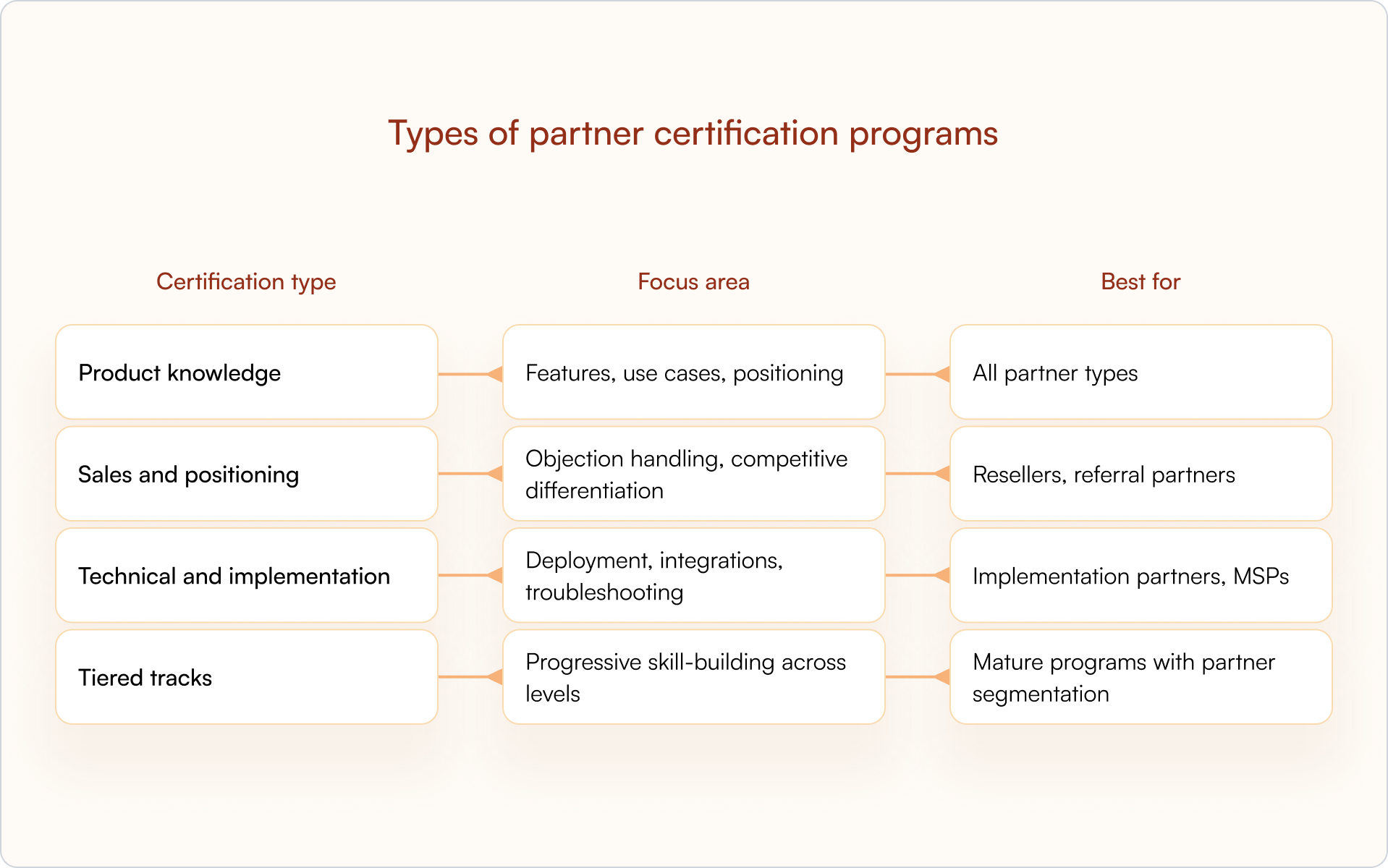
Product knowledge certifications
Product knowledge certifications cover core functionality and value propositions. Every partner who speaks to customers benefits from this foundation.
Product certifications are typically the first step in partner onboarding and the prerequisite for more advanced tracks.
Sales and positioning certifications
Sales certifications focus on how to sell: competitive positioning, discovery questions, demo skills, and objection handling. They’re most relevant for revenue-generating partners.
Sales certifications help standardize channel partner certification readiness across your partner base, so every partner tells a consistent story in the field.
Technical and implementation certifications
Technical certifications are for partners who deliver or support your product. They cover integrations, configuration, troubleshooting, and deployment best practices.
Technical certification often has the clearest impact on support burden and customer outcomes. A well-trained implementation partner reduces escalations and improves time-to-value.
Tiered certification tracks
Mature programs create bronze, silver, and gold tiers that unlock benefits as partners advance. Tiered structures motivate continued learning and provide clear milestones.
Tiered tracks also help you segment partners by capability, which informs how you allocate leads, MDF, and co-marketing resources.
How to build a certification program that drives engagement

Building a certification program that partners actually complete requires more than good content. It requires clear goals, smart segmentation, and operational discipline — the same fundamentals you’d apply to any growth lever.
1. Define certification goals tied to engagement outcomes
Start with the behavior you want to change. Map each certification to a specific engagement metric. For example: product certification might be tied to deal registrations; technical certification might be tied to implementation quality and lower escalations.
Treat certification as a core pillar of your enablement program rather than a standalone training project — that keeps the focus on outcomes, not content volume.
2. Segment certification paths by partner type
Resellers, referral partners, and implementation partners have different jobs. One-size-fits-all programs create friction and drop-off.
Offer role-specific tracks that respect what each partner type actually does. This matters even more in channel partner certification programs where “partner” can mean five different roles across sales and delivery.
3. Create modular and digestible learning content
Partners are busy. Marathon training sessions don’t work.
Break content into short modules that partners can complete between customer calls. A modern partner portal hosts partner training programs that are easy to consume and easy to resume.
4. Set clear completion criteria and expiration windows
Define what “certified” means: quiz scores, practical assessments, video completions, or live enablement sessions. Ambiguity creates disputes — and disputes create disengagement.
Expiration dates drive recertification and ongoing engagement. Clear criteria improve the partner certification process and reduce confusion about who qualifies for what.
5. Tie certification to deal registration and pricing access
Certification works best when it unlocks tangible benefits. Access to deal registration, better margins, and co-marketing funds create a real incentive to complete and maintain credentials.
Many vendors require channel partner certification before granting access to higher discounts, deal registration, or MDF. Linking enablement to revenue creates a direct connection between learning and earning.
6. Automate reminders and recertification workflows
Certifications lapse silently without automation. CRM-connected systems can trigger reminders based on expiration dates, keeping your partner enablement program active without manual chasing.
A CRM-first approach pays off here: certification status stays visible alongside deals and partner records, which is where your team already spends time.
How to track certification and engagement in your CRM
Certification data belongs in your CRM, not a disconnected LMS. When certification status lives alongside deals and partner records, you get visibility, attribution, and forecasting in one place. More importantly, you can answer the question founders get asked constantly: “Is this partner investment actually driving revenue?”
Required fields for certification tracking
Add fields to partner and contact records:
- Certification status: Active, expired, in progress
- Certification type: Product, sales, technical
- Certification date: When earned
- Expiration date: When renewal is required
- Certification level: Tier if applicable
Connecting certification to deal and partner records
Link certification status to opportunities. This lets you correlate certification with deal outcomes and identify which certifications actually drive revenue.
When you can see that certified partners close faster, submit higher-quality deal registrations, and churn less, you have the data to justify continued investment in enablement.
Dashboards for certification and engagement correlation
Build reports that show certification completion alongside engagement metrics. A CRM-first PRM makes visibility automatic and supports PRM certification reporting without manual exports.
With native integrations for Salesforce and HubSpot, partner data stays synced without spreadsheets or duplicate entry.
Common challenges with partner certification programs
Even well-designed programs hit obstacles. The difference between certification that drives engagement and certification that becomes shelfware is usually operational detail.
Low completion rates
Partners abandon certification when content is too long, the portal experience is frustrating, or the benefit isn’t clear. Reducing friction and communicating value upfront helps — especially when you highlight tangible benefits like discounts, deal registration access, and MDF eligibility.
Certification without behavioral change
Passing a quiz doesn’t guarantee better selling or implementation. Use practical assessments, role-based scenarios, and “show your work” requirements to close the gap between knowledge and execution.
Tracking fragmentation across systems
Certification data in an LMS while deals live in the CRM creates blind spots. Connected systems give you one source of truth — which is especially important for teams managing PRM certification requirements alongside pipeline metrics.
Recertification fatigue
Partners resent endless recertification requirements. Keep expiration windows reasonable, and make renewal content about what changed (product updates, new positioning, competitive shifts) rather than forcing them through the same material again.
Best practices for strategic partnerships certification
If your program includes strategic partners — where multiple stakeholders need to stay aligned across sales and delivery — certification is most effective when it’s simple, visible, and meaningfully rewarded.
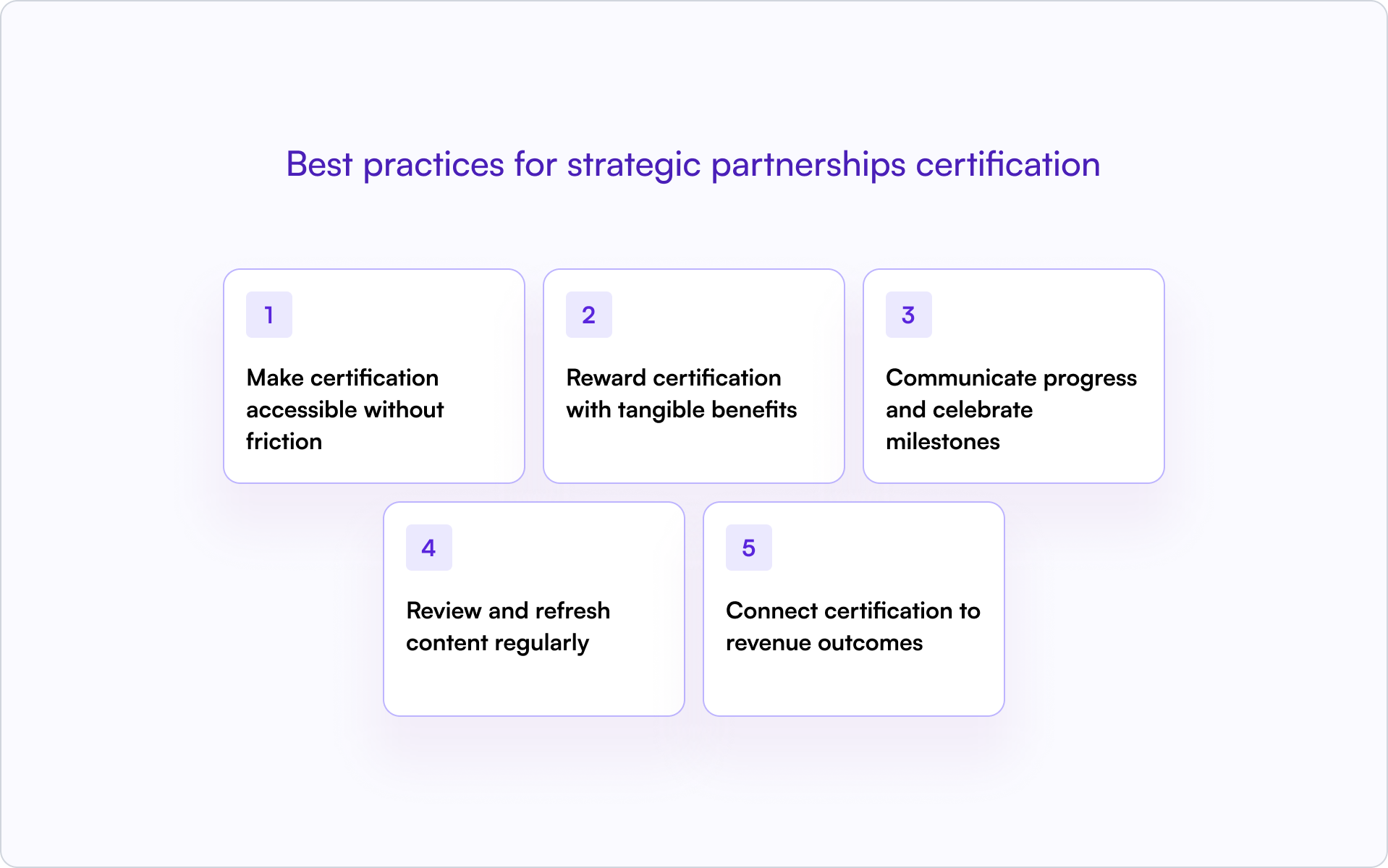
1. Make certification accessible without friction
SSO, no repeated logins, and mobile-friendly content remove barriers. Partners who hit login walls disengage. Frictionless access improves onboarding completion and long-term engagement.
2. Reward certification with tangible benefits
Certified partners expect something in return:
- Better margins or discount access
- Priority deal registration approval
- Co-marketing eligibility
- Badge or logo for their website
3. Communicate progress and celebrate milestones
Use announcements and notifications to recognize completions. Public recognition motivates others to participate. Visible milestones are especially effective in strategic partnerships certification programs where multiple stakeholders need shared clarity on progress.
4. Review and refresh content regularly
Stale certification content signals a neglected program. Update training when products or positioning change. Treat certification content as living training, not a one-time launch.
5. Connect certification to revenue outcomes
Show partners and your leadership that certification correlates with partner-sourced revenue. Connecting certification to revenue justifies investment in the program and makes partner certification benefits measurable.
Turn certification into a partner engagement engine
Certification isn’t a checkbox — it’s an ongoing engagement mechanism that compounds over time. When it’s connected to your CRM and partner portal, certification becomes measurable and manageable.
You can see which partners are certified, which certifications are expiring, and how certification status correlates with deal outcomes — all without leaving the workflows your team uses to run pipeline.
Introw helps teams track certification alongside deals and automate the workflows that keep partners engaged. Certification status syncs directly to HubSpot or Salesforce, reminders go out automatically, and partners can access training without repeated logins.
If you want to see how a CRM-first partner portal makes certification trackable and actionable, book a demo.
Partner Sales in 2026: Strategy, Cadence, and the Operating Model to Scale
Most partner programs don’t fail because of bad strategic partnerships. They fail because partner sales is rarely operated like a real go-to-market motion.
Teams that consistently generate partner-driven pipeline apply the same rigor they use in direct sales — motion-specific stages, mandatory CRM fields, forecast discipline, and clear SLAs. We’ll cover the stages, cadences, governance, and enablement systems high-performing teams use to make partner pipeline forecastable instead of aspirational.
If your partner pipeline feels harder to manage than direct sales, you don’t need a multi-quarter overhaul. You can stand this up in 14 days — and we’ll show you exactly how.
Why Partner Sales Needs Its Own Operating Model
Partner sales is any revenue motion where a third party sources, influences, sells, or delivers your product as part of your go-to-market. But partner sales breaks when different motions are forced through the same process. Co-selling, referrals, and reselling all involve partners, but they create value differently:
- Referral partners introduce a lead, lend credibility, and step back.
- Co-sell partners stay engaged alongside your seller to advance the deal.
- Resellers own the commercial relationship and transact independently through indirect sales.
These motions require different stages, different handoffs, and different expectations about who does what. Running them all through one generic "Partner Opportunity" stage is what causes forecasts to break every quarter.
The most important distinction is whether the partner originated the opportunity or helped move it forward. Sourced means the partner originated the deal. Influenced means they impacted progression or close without originating it. This makes partner revenue measurable while deals are active, not debatable after the quarter closes.
High-performing teams run one opportunity record, one data model, and one source of truth across all motions. This clarity only works when your CRM captures sourcing and attribution in real time. PRM platforms like Introw lock sourced and influenced contribution directly on the opportunity in Salesforce or HubSpot as the deal unfolds. Partners see the deals they're involved in through shared views or a partner portal, with the same visibility your internal team has.
Matching Partner Motions To Your Go-To-Market Strategy
Matching partner motions to your GTM is foundational. It’s how you scale channel partner sales without introducing conflict or forecast noise. Before you design stages, SLAs, or incentives, you need clarity on which partner motions you’re supporting and why. Most SaaS teams should operate only two or three motions well, not five poorly.
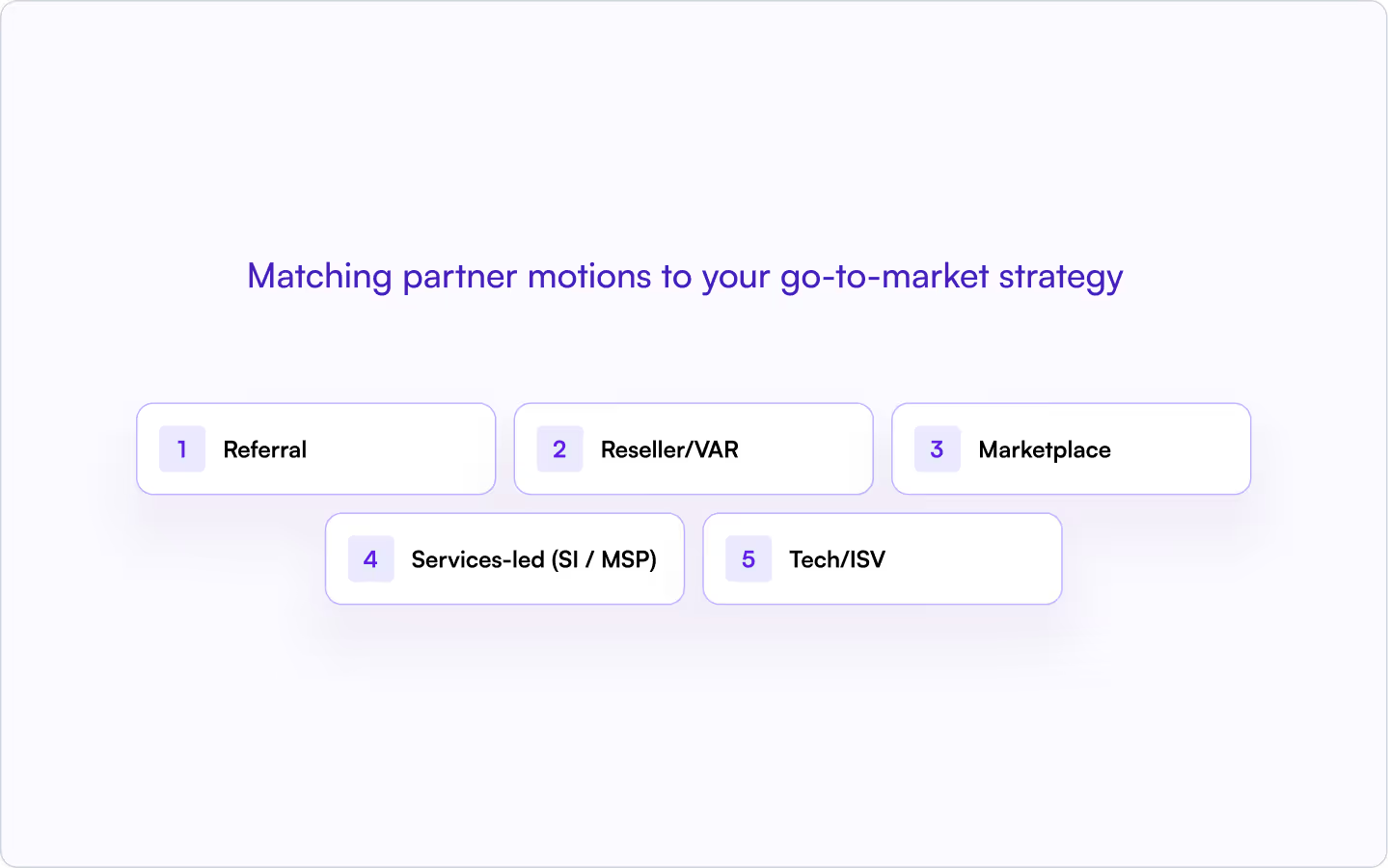
Referral
A partner introduces a prospect, lends credibility, and steps back. You own the sales process and compensate the partner with a referral fee or SPIFF.
Best when: Your direct sales team needs warm introductions to get into target accounts or build initial credibility with skeptical buyers.
Reseller/VAR
Value-added resellers purchase your product at a discount and resell it independently, handling pricing, negotiation, and the customer relationship. You enable them with price protection, margin structures, and deal registration.
Best when: Your customers prefer buying through established local partners, or you're expanding into new markets where channel distribution is the dominant buying model.
Marketplace
Deals close through cloud marketplaces like AWS, Azure, or Google Cloud, allowing customers to use committed cloud spend or procurement credits. You'll manage private offers, co-marketing, and marketplace-specific SKUs as part of your channel sales model.
Best when: Your target market uses cloud procurement tied to committed spend, or your sales cycles are slowed by legal and contracting friction that marketplace transactions eliminate.
Services-led (SI / MSP)
Systems integrators build custom solutions around your product, while managed service providers deliver ongoing IT operations. The partner leads delivery, and your product becomes part of their broader solution, giving you expanded market reach.
Best when: Your product sells best bundled with professional services, or the customer base requires implementation and ongoing management that strategic partners deliver better than you can.
Tech/ISV
Another tech company (independent software vendor) integrates with your product, creating joint value propositions that amplify both sales teams' motions. Sales success and customer acquisition depends on field readiness, certification programs, and operationalized co-selling as part of your partner ecosystem.
Best when: Your product sells more effectively alongside complementary technology, or your buyers evaluate solutions as integrated stacks rather than standalone tools.
Stages and Exit Criteria Across Partner Motions
Partner sales exit criteria sit at the intersection of partner accountability and customer progress. They answer two key questions: Has the partner done what they're responsible for at this stage? Can we advance this deal without breaking trust, crediting, or economics?
Exit criteria prevent credit disputes, stalled deals, and pipeline inflation. If a deal can’t meet exit criteria, it doesn’t move — regardless of pressure. Below is a concise view of the five stages for each partner motion and how exit criteria differ where it matters most.
Referral Motion
Referral exit criteria focus on clean sourcing and fast vendor ownership.
- Intro Logged: The opportunity is created with the partner marked as sourced and ownership formally accepted by the vendor.
- Validate: ICP fit, urgency, and the partner’s limited role are confirmed at this sales stage.
- Prove Value: The vendor advances the deal without requiring ongoing partner involvement.
- Commercials: Commercial execution proceeds without partner participation.
- Closed & Credit: The deal is closed and referral credit is finalized.
Reseller / VAR Motion
Reseller exit criteria protect partner ownership and transaction economics.
- Deal Registration: The opportunity is registered with price protection and non-interference enforced.
- Qualification: The reseller confirms real end-customer demand and technical fit.
- Configure & Quote: Commercial terms reflect approved SKUs, discounts, and margin.
- Transact: The reseller completes the transaction and fulfillment.
- Launch & Enable: Delivery and renewal responsibilities are documented.
Marketplace Motion
Marketplace exit criteria ensure attribution and revenue integrity outside traditional sales flow.
- Listing Ready: The opportunity aligns to an approved marketplace offer.
- Private Offer: Discounts and terms are defined within marketplace constraints.
- Procurement: The transaction is executed through the marketplace system.
- Close & Disburse: Revenue and partner credit are recorded accurately.
- Adopt & Expand: Expansion is driven by usage, not renegotiation.
Services-led (SI / MSP) Motion
Services-led exit criteria prioritize delivery readiness over pipeline velocity.
- Solution Design: Joint success criteria are defined before committing revenue.
- Proof / Workshop: Delivery assumptions are validated and risks documented.
- Commercials: Software and services are sold together with milestone alignment.
- Delivery: The SI or MSP leads execution while the vendor provides ongoing support.
- Handoff: The account transitions to steady-state ownership and expansion.
Tech / ISV Motion
Tech partner exit criteria validate influenced impact rather than sourcing.
- Integration Fit: The opportunity reflects a clear integration-driven use case.
- Field Readiness: Sellers are enabled to position the joint solution.
- Pipeline Activation: Partner-driven influence is reflected in active deals.
- Validation: Joint proof points reinforce deal progression.
- Commercials & Close: Influence credit is captured and fed back into planning.
The Partner Sales Drumbeat: Cadence, Touchpoints, and SLAs
Partner sales management depends on rhythm. High-performing teams run on predictable cadences that keep deals moving and partners engaged.
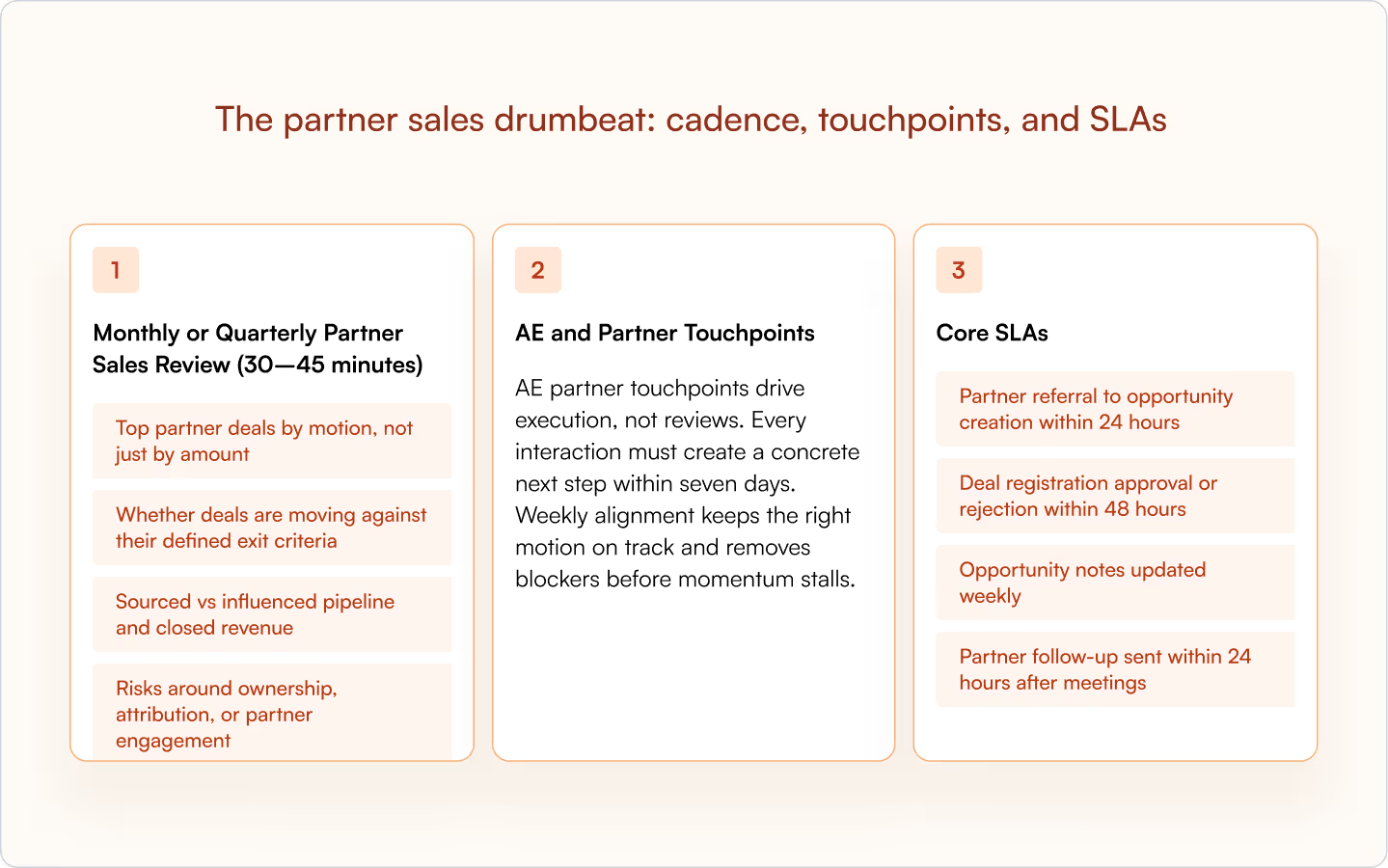
Monthly or Quarterly Partner Sales Review (30–45 minutes)
The monthly or quarterly partner sales review is the heartbeat of the program. It should focus on signal, not deal recitation.
Each review should cover:
- Top partner deals by motion, not just by amount
- Whether deals are moving against their defined exit criteria
- Sourced vs influenced pipeline and closed revenue
- Risks around ownership, attribution, or partner engagement
Every decision and next step should be logged directly on the opportunity. If it’s not in Salesforce or HubSpot, it didn’t happen. This keeps sourced vs influenced attribution current, prevents deals from drifting, and ensures forecasts reflect reality rather than intent.
AE and Partner Touchpoints
The review inspects progress, but AE–partner touchpoints are where work actually happens. Effective AE–partner collaboration runs on a seven-day action cycle. Every sales rep interaction should produce a concrete next step within a week — a scheduled customer meeting, a delivered artifact, or a teed up decision. Weekly alignment validates motion execution (referral vs co-sell vs resale) and identifies blockers that prevent the next action from happening on time.
Core SLAs
SLAs show channel sales partners that their effort is respected and their deals won’t stall in your internal process.
You need, at a minimum:
- Partner referral to opportunity creation within 24 hours
- Deal registration approval or rejection within 48 hours
- Opportunity notes updated weekly
- Partner follow-up sent within 24 hours after meetings
When these SLAs slip, partners disengage quietly. When they’re met consistently, trust compounds.
Making Channel Partner Sales Visible: CRM, Data Model, and Forecasting
Partner sales is invisible until it's in the CRM. If your opportunity records don't capture motion, sourcing, and partner contribution, you're forecasting on anecdotes.
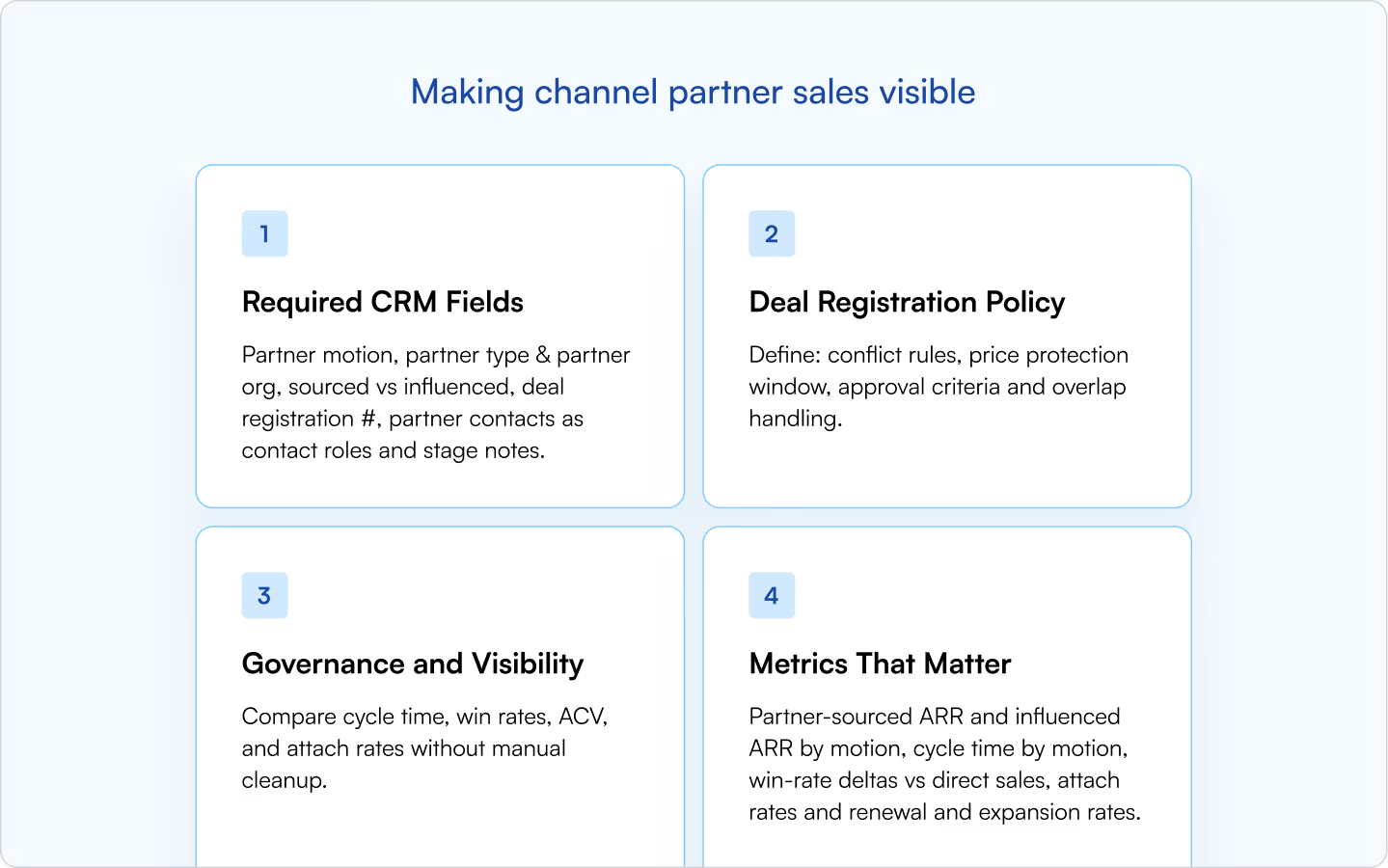
Required CRM Fields
Your CRM needs these fields to make partner sales pipeline forecastable and enable effective partner performance management:
- Partner Motion: Referral, reseller, marketplace, services, or tech
- Partner Type & Partner Org: Who the partner is and what type
- Sourced vs Influenced: Tag whether the partner originated the deal (sourced) or impacted it (influenced), with attribution percentage
- Deal Registration #: Tracks price protection and conflict policy
- Partner Contacts as Contact Roles: Logs who's involved on the partner side so you know who to loop in when a deal stalls
- Stage Notes: What happened, what's next — updated weekly
These fields should be mandatory at stage changes. Missing motion or attribution fields should block progression, and stale notes or expired price protection windows should be flagged automatically. This is easier when your PRM enforces field requirements automatically — Introw does this natively in Salesforce and HubSpot.
Deal Registration Policy
Your deal registration policy should define:
- Conflict rules: First-come-first-served vs partner tier priority
- Price protection window: How long protection lasts
- Approval criteria: What makes a deal eligible for registration
- Overlap handling: What happens when multiple partners claim the same account
Document this policy, share it with partners, and reference it in disputes.
Governance and Visibility
Because all motions live in the same pipeline, reporting becomes consistent across motions — comparing cycle time, win rates, ACV, and attach rates without manual cleanup. Visibility should also extend to partners through shared pipeline views that expose only approved opportunity, renewal, and onboarding fields. Partners should never be surprised by deal status, ownership, or credit.
Metrics That Matter
Mid-market and enterprise B2B SaaS companies report that roughly 35% of new pipeline is now partner-influenced or partner-sourced, making partner-driven deals a primary growth lever rather than a supplementary sales channel. Track these key metrics to show how partner motions contribute differently to revenue growth:
- Partner-sourced ARR and influenced ARR by motion to track revenue generated
- Cycle time by motion (are channel partner deals faster or slower than direct sales?)
- Win-rate deltas versus direct sales to measure sales performance
- Attach rates for services and integrations
- Renewal and expansion rates from partner-assisted accounts to measure customer satisfaction
These dashboards matter because they tell you where partners accelerate revenue — and where they slow it down. This lets you know where to invest in partner acquisition and better partner performance management.
Partner Sales Enablement That Drives Execution
Partner enablement fails when it’s built for storage instead of action. Enable your partners by giving them exactly what they need to move deals forward in the motion they’re operating in.
Types of Enablement That Must Exist
Effective enablement does two things. It gives partners practical assets they can use in live deals, and it gates access so only qualified partners are allowed to sell or deliver. Remember, onboarding new channel sales partners is just as important as onboarding new employees.
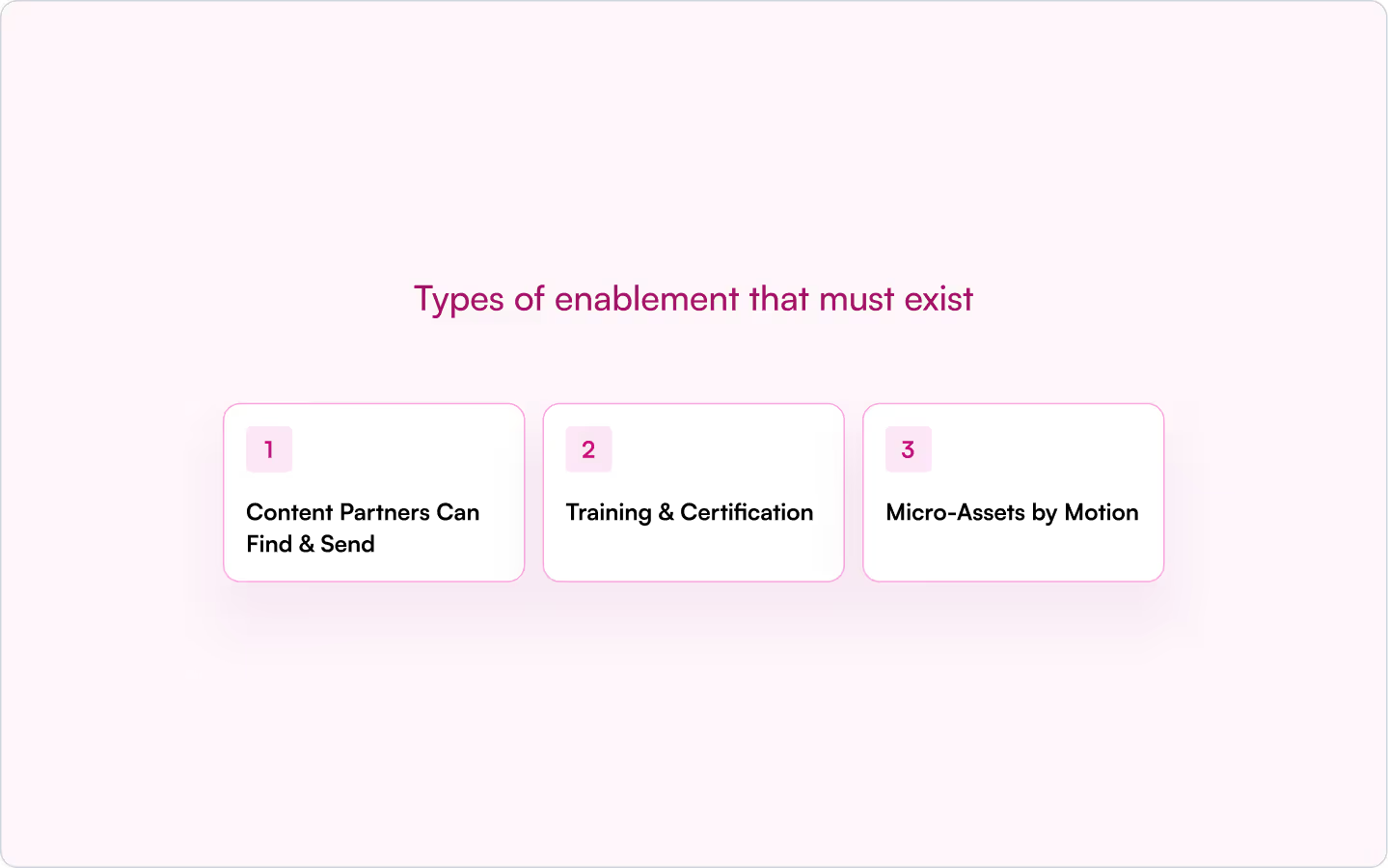
Content Partners Can Find & Send
Quality marketing materials support sales opportunities. Partners need plays, case studies, and ROI one-pagers that are truly helpful in sales conversations. Content should be organized by motion, industry, or use case — not buried in generic folders.
Training & Certification
Partner training works best when it unlocks privilege. Certifications should gate deal registration, partner pricing, delivery eligibility, or marketplace co-sell access. This ensures only qualified channel partners gain access to active deals, protecting both forecast accuracy and customer outcomes.
Micro-Assets by Motion
Generic enablement doesn't work. Build motion-specific micro-assets that match how partners actually work within each motion:
- Referral: Talk track for making warm introductions
- Reseller: Pricing matrix and margin structure
- Marketplace: Private offer explainer and procurement FAQ
- Services-led: SOW checklist and delivery scoping template
- Tech/ISV: Integration "why now" slide and joint demo guide
How To Deliver Enablement
Push new release notes, competitive intel, and win stories where partners already work. This is easier when you can publish updates with one click and distribute them automatically to email, Slack, or the partner portal. Introw's Announcements feature does this natively, tracking engagement across channels so partners see what's new and can act quickly in live deals.
Store searchable content in a partner portal where partners can filter by motion, industry, or use case and share directly with prospects. This eliminates the "can you send me that case study" requests and keeps partners engaged.
Your 14-Day Channel Sales Strategy Rollout
You don’t need months to operationalize a channel partner sales strategy or partner sales motion. Pick two motions and build the infrastructure in two weeks.
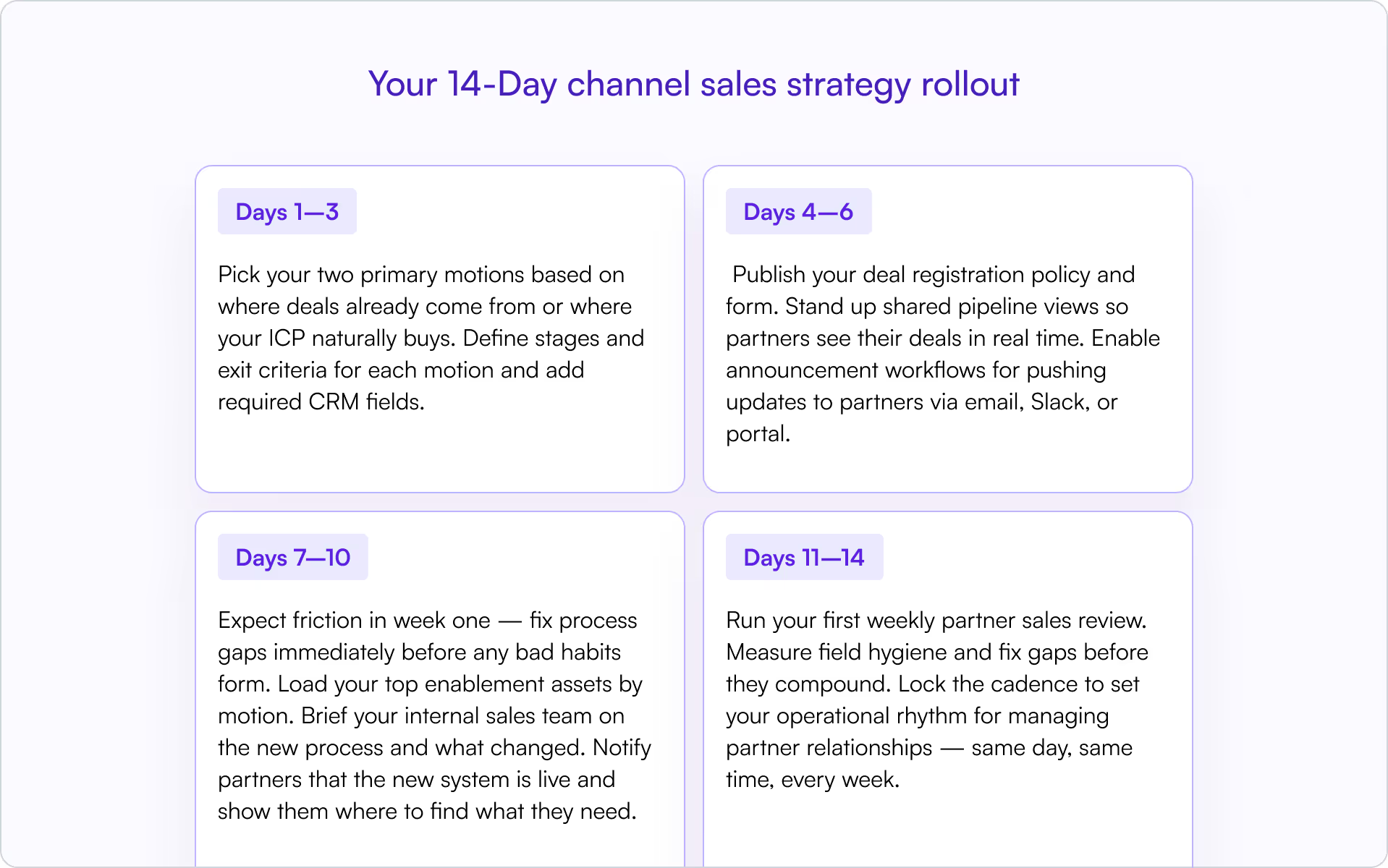
Days 1–3: Pick your two primary motions based on where deals already come from or where your ICP naturally buys. Define stages and exit criteria for each motion and add required CRM fields.
Days 4–6: Publish your deal registration policy and form. Stand up shared pipeline views so partners see their deals in real time. Enable announcement workflows for pushing updates to partners via email, Slack, or portal.
Days 7–10: Expect friction in week one — fix process gaps immediately before any bad habits form. Load your top enablement assets by motion. Brief your internal sales team on the new process and what changed. Notify partners that the new system is live and show them where to find what they need.
Days 11–14: Run your first weekly partner sales review. Measure field hygiene and fix gaps before they compound. Lock the cadence to set your operational rhythm for managing partner relationships — same day, same time, every week.
Conclusion
We’ve given you the operating model. Now you need the infrastructure to run it. Introw gives you deal registration workflows, partner portal access, shared pipeline views, and Salesforce/HubSpot sync — so your partner sales process isn't built on spreadsheets and hope. Request a demo to see how teams operationalize partner sales in weeks, not quarters.
The 13 Best Partner Management Systems: What to Look For (Plus Top Options)
Partner management system vs PRM: What’s the difference?
If you’re evaluating tools, you’ll quickly encounter the term partner relationship management (PRM). Not every platform, however, operates at the same operational depth.
Here’s the practical distinction:
Why this matters for revenue growth
A portal organizes content and workflows. A true operating layer moves pipeline.
The best partner management system for increasing revenue reduces handoffs between sales, RevOps, and channel teams.
It shortens approval cycles and connects collaboration directly to protected opportunity workflows, attribution, and performance reporting inside the CRM.
The result is less manual coordination and clearer execution.
If you want a deeper breakdown of portal-led approaches, explore our guide to the best PRM software.
The distinction is structural. But structure alone does not create impact. Next, we’ll break down what a revenue-ready system must include to influence pipeline this quarter.
What to look for (Revenue-critical checklist)
Choosing the right system is less about features and more about execution. The capabilities below determine whether your partner motion supports pipeline or slows it down.
1. CRM-first architecture (Salesforce/HubSpot)
If your system sits outside the CRM, friction starts immediately.
Look for:
- Two-way sync of opportunities, accounts, contacts, and activities
- Collaboration directly inside Salesforce or HubSpot
- Controlled field visibility for external users
- Real-time updates without manual imports
A CRM-native foundation keeps the system of record intact instead of duplicating data across disconnected tools.
Why it drives revenue
When every external touchpoint logs to the CRM timeline, forecast accuracy improves. Sales, RevOps, and channel teams operate from shared data instead of parallel spreadsheets.
If you’re unsure which CRM foundation is strongest, evaluating the top CRM for partner management should be part of your buying process.
2. Protected opportunity workflows with conflict prevention
Revenue protection is not just a form. It’s governance.
Look for:
- SLA timers with automated reminders
- Duplicate detection and conflict alerts
- Defined protection windows
- Escalation paths for disputes
- Automated routing rules
A modern system should prevent channel conflict before it hits your forecast.
Why it drives revenue
Clear ownership reduces friction between sales and external teams. Faster approvals shorten sales cycles and increase active participation across indirect motions.
3. Off-portal collaboration (Email/Slack → CRM timeline)
External teams do not want another login.
Look for:
- Reply-by-email or Slack that logs to the CRM record
- @mentions and shared next steps
- Mutual action plans with trackable tasks
- Notifications tied to stage changes
The best systems meet partners where they already work instead of forcing behavior change.
Why it drives revenue
Faster responses compress cycles. Logged conversations create auditable progress and clearer attribution without manual updates.
4. Enablement that lives in the flow
Training should support live deals, not sit in a separate portal.
Look for:
- Structured onboarding and certification paths
- Certificates tied to selling permissions
- Stage-aware content recommendations
- Gates before resellers can transact
This is where partner lifecycle management becomes operational instead of theoretical.
Why it drives revenue:
Certified partners ramp faster and close more effectively. Embedded enablement improves win rates without adding headcount.
5. Activation and communication controls
Engagement is about consistent activation, not mass emails.
Look for:
- Segmented announcements by tier, region, or type
- Campaign tracking and notification analytics
- Content engagement tied to opportunity movement
- Support for co-branded marketing initiatives
Healthy ecosystems depend on clear communication across indirect sales models.
Why it drives revenue
Consistent activation increases sourced and influenced pipeline. When communication connects to opportunity movement, marketing efforts become measurable.
6. Attribution and forecasting clarity
If influence cannot be measured, it cannot be scaled.
Look for:
- Sourced vs influenced revenue tracking
- Touch-to-stage movement analysis
- Time-to-close comparisons by partner type
- Incentive and tier performance reporting
This is where advanced platforms differentiate from basic management software.
Why it drives revenue
Attribution clarity helps tune incentives, enablement, and investments. That improves execution speed instead of relying on assumptions.
7. Governance, security, and scale
Growth without control introduces risk.
Look for:
- Field-level permission controls
- Time-boxed sharing links
- Audit logs and SSO
- Multi-org support
- Data residency safeguards
Why it drives revenue
Security enables broader participation without exposing sensitive data. Controlled scale allows more contributors without sacrificing visibility.
Taken together, these seven pillars determine whether a PMS simply organizes activity or actively drives revenue growth.
See how this works end-to-end inside your CRM and across your partner programs and request a demo today.
Now that you know what revenue-critical capabilities look like, let’s compare the top options that actually deliver them in practice.
The Shortlist: The 13 Best Partner Management Systems for Increasing Revenue (2026)
1. Introw
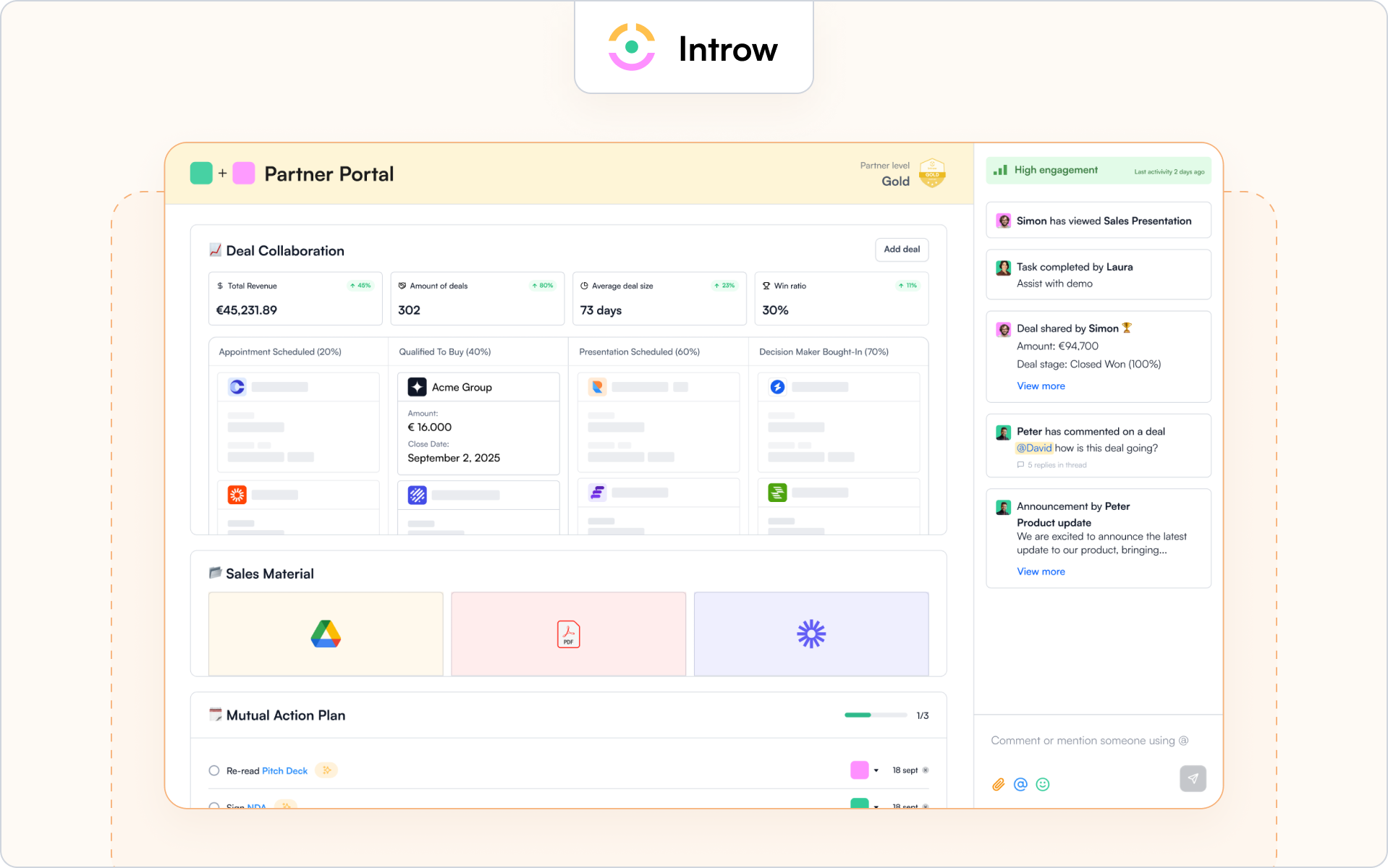
Best for
B2B SaaS teams running structured reseller or referral motions inside HubSpot or Salesforce that want CRM-first execution and real-time revenue visibility.
Why it increases revenue
Introw acts as a revenue operating layer rather than just a portal. It connects collaboration, protected opportunity workflows, enablement, and attribution directly to your CRM.
Revenue levers include:
- CRM side-panel collaboration that keeps sales and RevOps aligned
- Email and Slack conversations that log automatically to the CRM timeline
- Conflict detection and protection logic for submitted opportunities
- Stage-aware announcements tied to opportunity movement
- Built-in certifications connected to selling permissions
- Secure data sharing with audit trails and governance controls
Because everything syncs in real time, external activity influences forecasting instead of living in a separate system. That visibility improves win rates and execution speed across indirect motions.
Where it may not fit
Introw is not built for affiliate-heavy ecosystems or marketplace-style models.
It is also not a dedicated MDF accounting suite. And it is purpose-built for organizations using HubSpot or Salesforce, so companies without a CRM foundation will not unlock full value.
Good to know
Teams typically go live quickly because the platform works with existing CRM data structures rather than replacing them.
Introw is particularly strong for off-portal collaboration that still feeds attribution and forecasting.
If your priority is predictable indirect revenue inside your CRM, this is where Introw stands out. Request a demo to see how.
2. Impartner
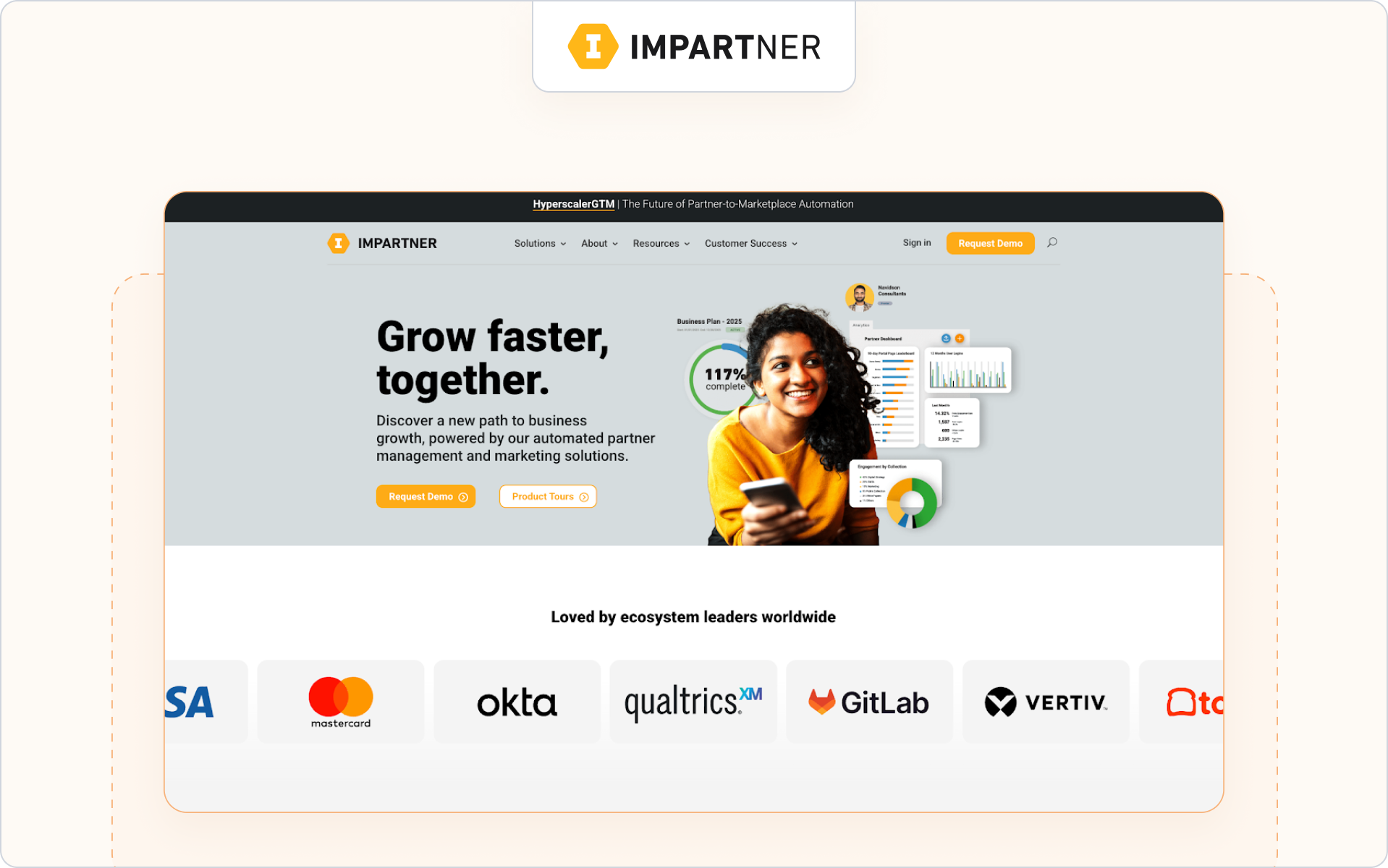
Best for
Large enterprises with complex global ecosystems that need structured workflow control and governance at scale.
Why it increases revenue
Impartner is an enterprise-focused PRM suite built for mature channel operations. It supports protected opportunity workflows, automated ramp processes, and advanced reporting across multi-tier structures.
Revenue levers include:
- Configurable opportunity approval and lead routing rules
- Tier-based performance dashboards
- Campaign execution through channel marketing automation
This structure can streamline global operations and improve visibility across regions.
Where it may not fit
Mid-market SaaS teams may find the configuration depth heavier than necessary for leaner indirect models.
Good to know
Impartner typically requires a structured rollout and dedicated channel operations resources.
3. Salesforce PRM (Experience Cloud)
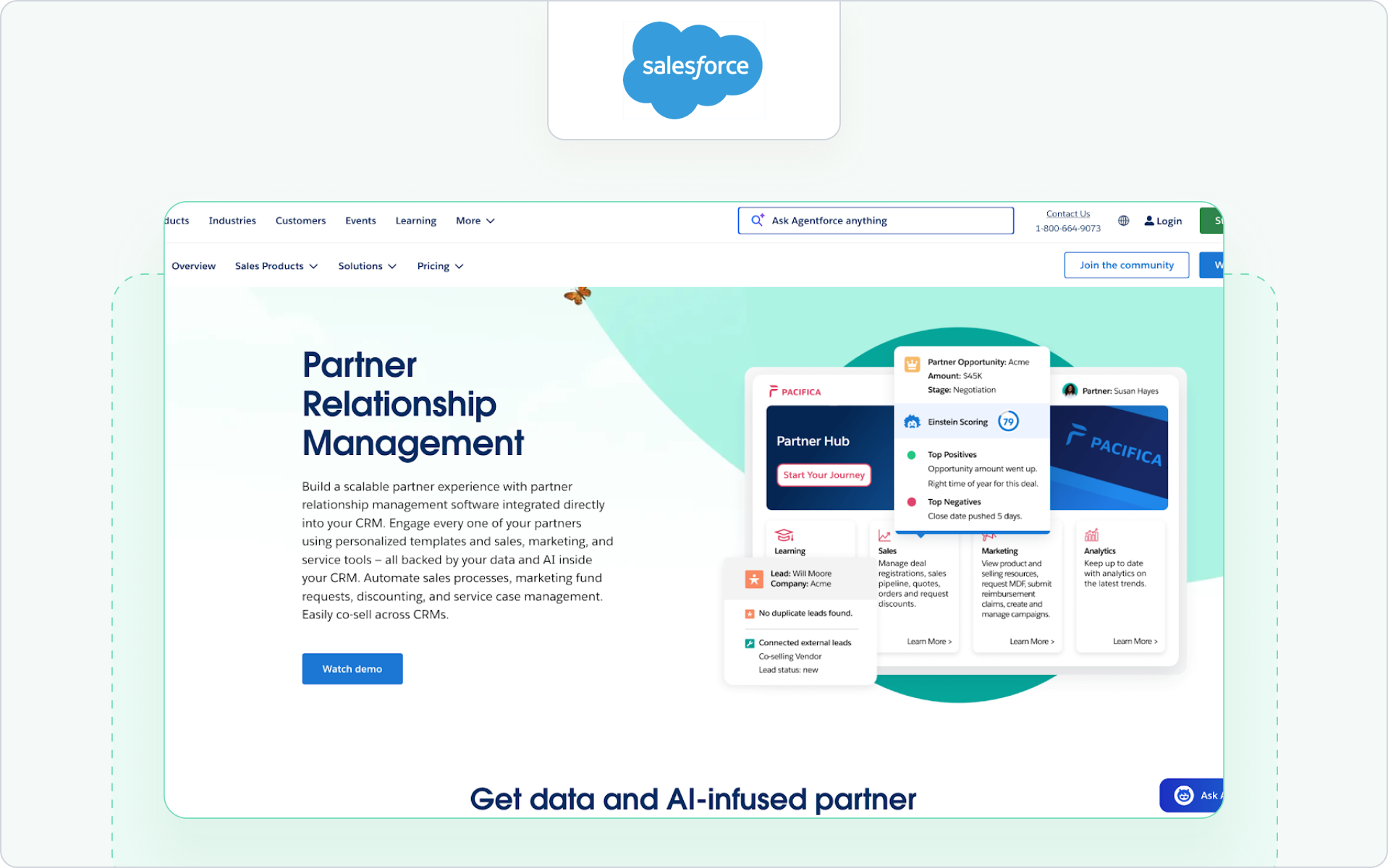
Best for
Organizations standardized on Salesforce that want structured channel execution directly inside Sales Cloud.
Why it increases revenue
Salesforce PRM extends Salesforce functionality through Experience Cloud. It centralizes protected opportunity workflows, onboarding processes, and portal-based coordination within existing CRM data structures.
Revenue levers include:
- Native opportunity and account visibility
- Configurable approval workflows
- Engagement reporting tied directly to CRM data
This alignment reduces silos and supports revenue growth when the entire go-to-market motion runs inside Salesforce. Teams evaluating this model often compare it with other approaches to Salesforce partner management to assess how deeply collaboration lives inside the CRM.
Where it may not fit
Teams seeking lightweight deployment or strong off-portal coordination may find it portal-centric.
Good to know
Best suited for companies already investing heavily in Salesforce customization and governance.
4. Channelscaler (formerly Allbound + Channel Mechanics)
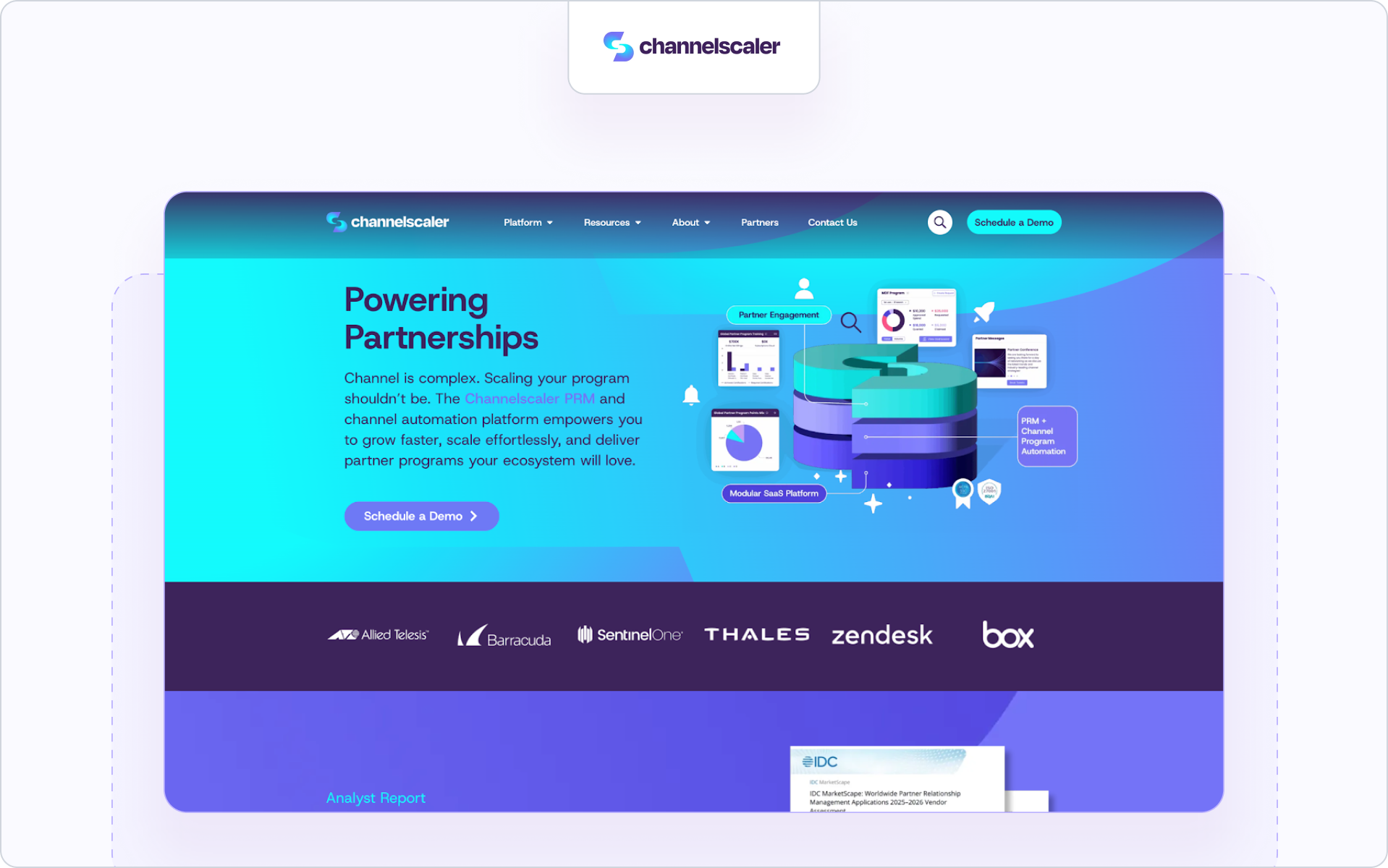
Best for
Channel-driven organizations that prioritize structured program design and incentive governance at scale.
Why it increases revenue
Channelscaler combines enablement, protected opportunity workflows, and incentive management into one system. It supports tiered structures and defined lead routing across large indirect ecosystems.
Revenue levers include:
- Playbook-driven ramp workflows
- Incentive and MDF tracking logic
- Regional governance controls
This model helps standardize operations in mature indirect sales environments, especially where incentive alignment directly influences performance. Companies refining their broader approach to channel partner management often evaluate systems like this for operational consistency.
Where it may not fit
Early-stage SaaS teams may find the configuration depth heavier than necessary.
Good to know
Strong for organizations prioritizing incentive design and structured governance over CRM-native collaboration.
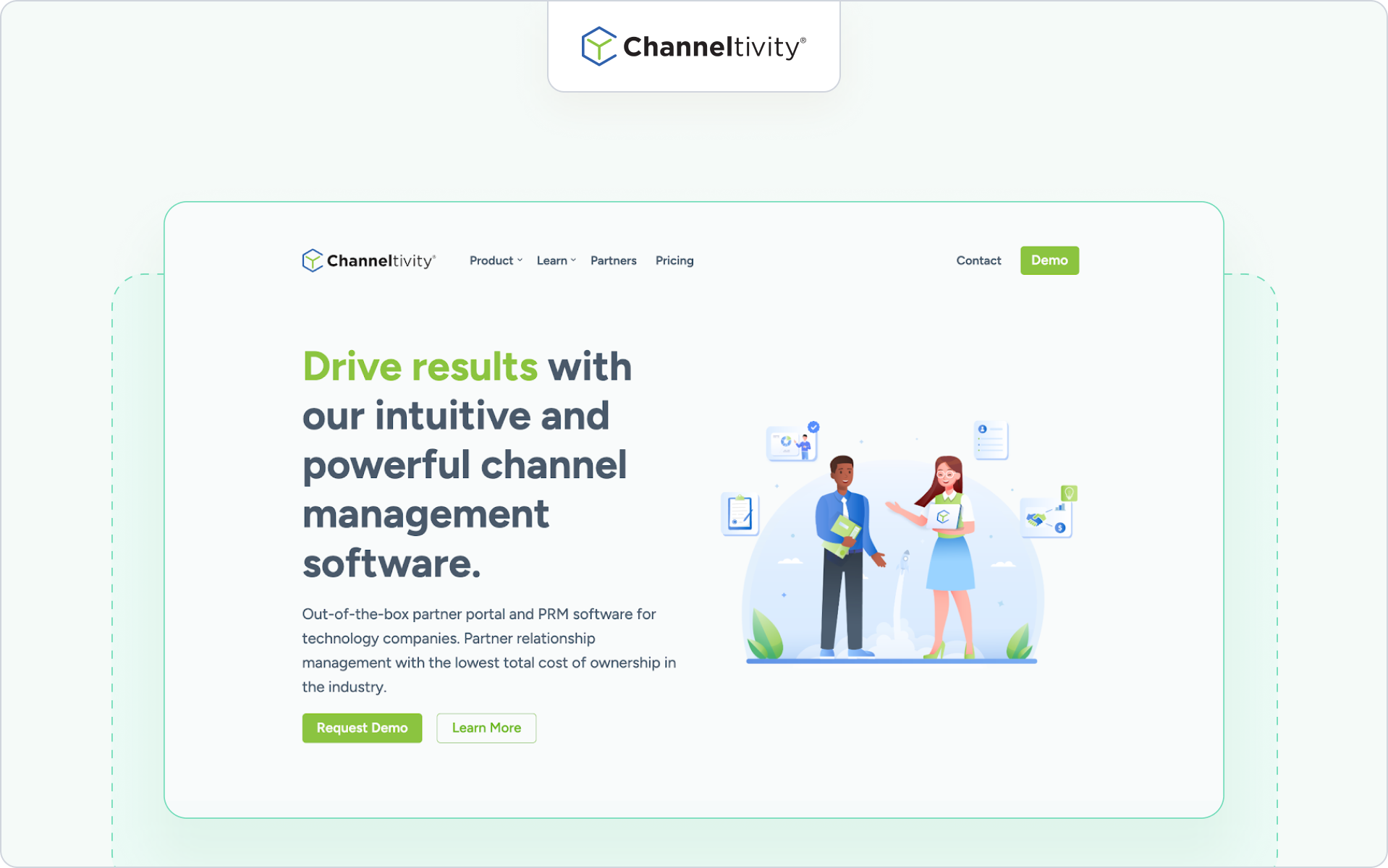
5. Channeltivity
Best for
Mid-market B2B companies seeking straightforward partner management software with clean workflows.
Why it increases revenue
Channeltivity focuses on practical deal registration, partner onboarding, and communication tools. It offers structured partner collaboration within a portal-based system.
Revenue levers include:
- Transparent deal registration approvals
- Centralized partner communication
- Reporting dashboards for partner performance
This can help streamline management for teams that want clarity without enterprise-level complexity. Companies refining their broader partner lifecycle management strategy often look at Channeltivity as a mid-market option.
Where it may not fit
Organizations needing advanced attribution modeling or complex multi-org governance may outgrow it.
Good to know
Often positioned as a balanced option for mid-market partner programs.
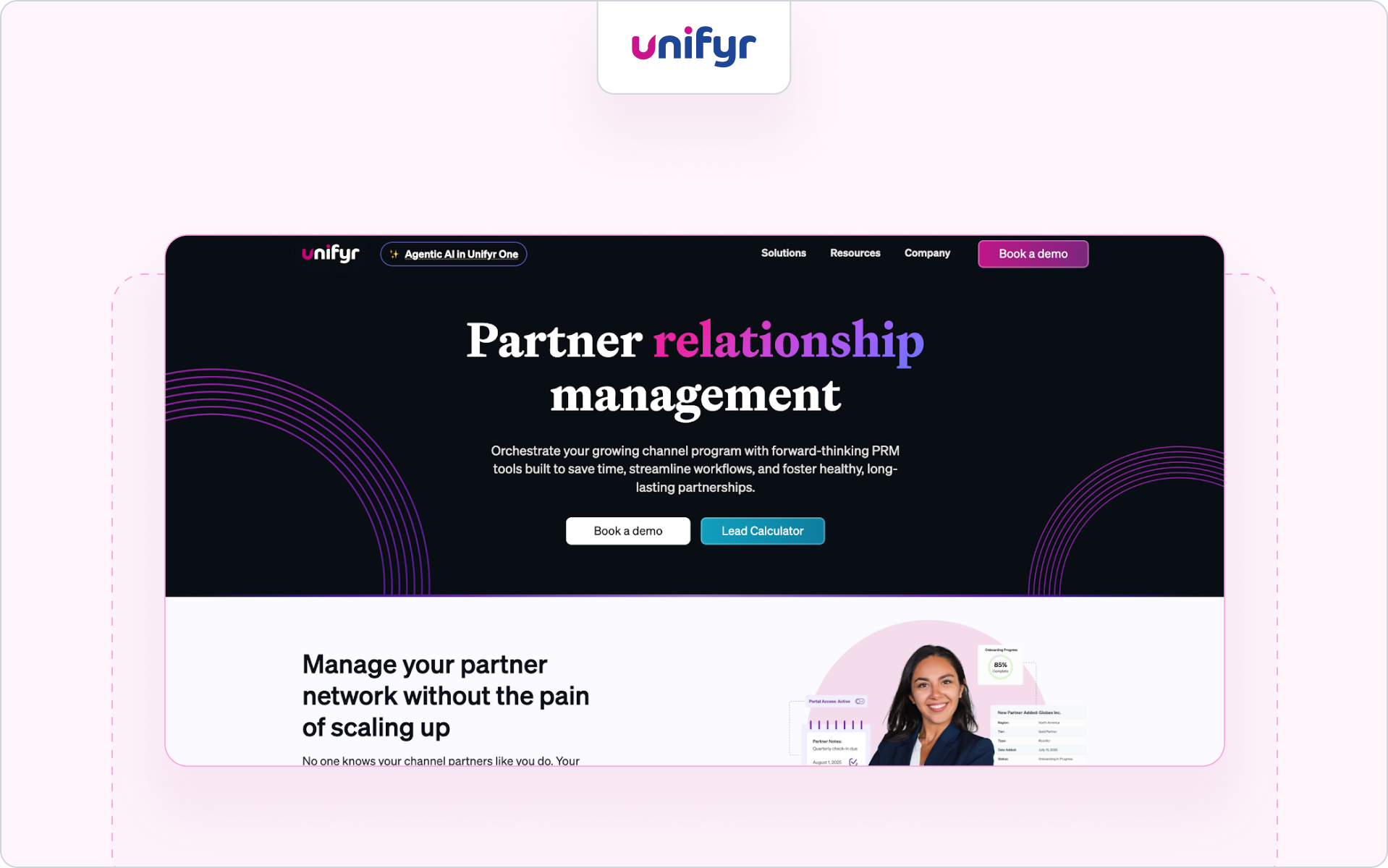
6. Unifyr One (formerly ZiftONE)
Best for
Complex channels that want marketing automation layered into partner management tools.
Why it increases revenue
Unifyr One combines partner portals, deal registration, and campaign execution through channel marketing automation. It emphasizes enhancing partner engagement through coordinated marketing programs.
Revenue levers include:
- Campaign distribution and co-branded marketing tools
- Deal registration with workflow automation
- Analytics tied to campaign and partner activity
This structure supports revenue growth in marketing-led partner ecosystems where structured PRM best practices are essential for scale.
Where it may not fit
Companies prioritizing CRM-first collaboration over marketing automation depth may prefer other partner management platforms.
Good to know
Best suited for organizations with mature channel marketing teams and defined program governance.
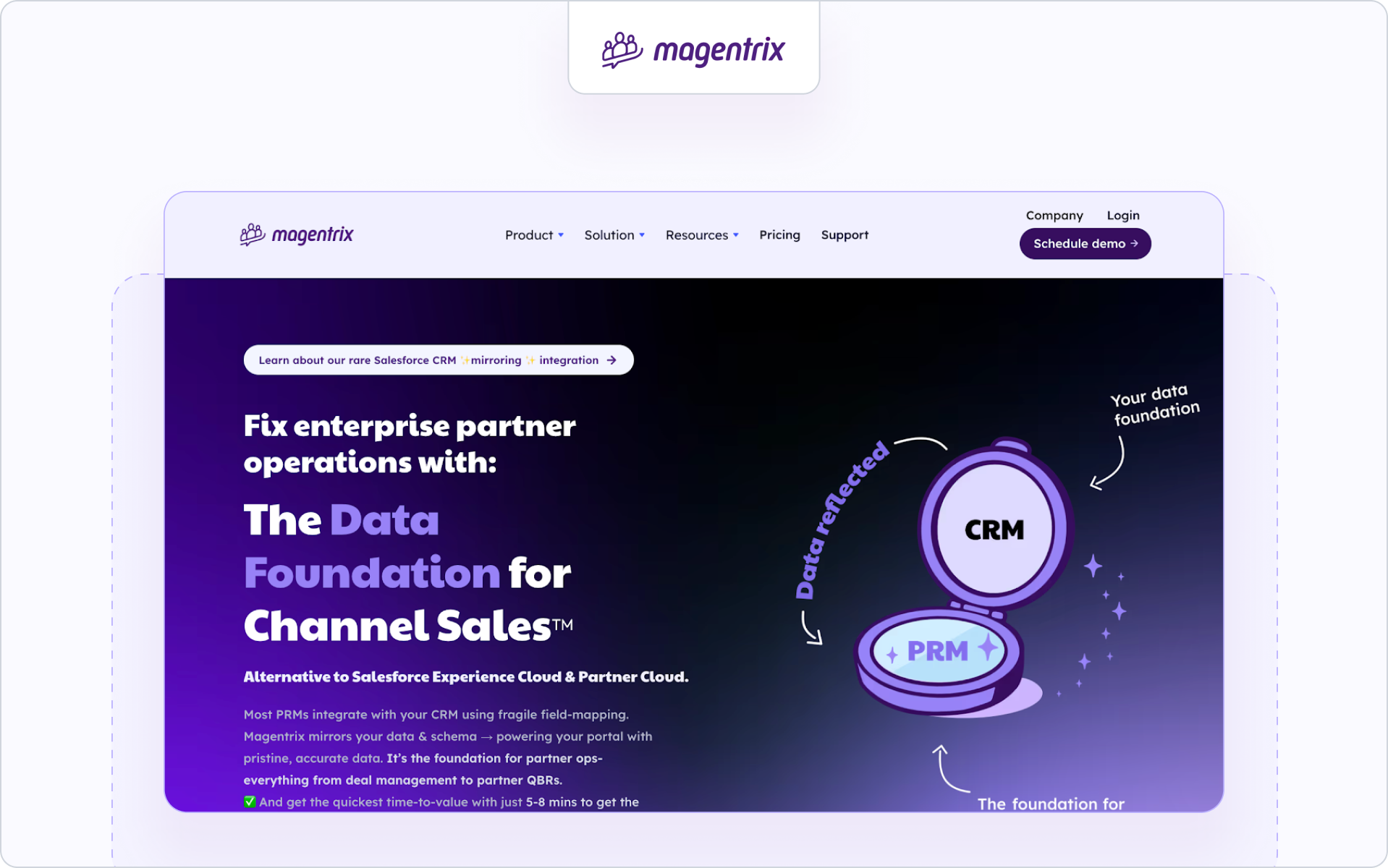
7. Magentrix
Best for
Salesforce-centric teams that want a flexible partner management platform built on top of existing CRM data.
Why it increases revenue
Magentrix delivers partner management through Salesforce-native data structures. It supports partner onboarding, deal registration, and partner collaboration via customizable portals.
Revenue levers include:
- Salesforce-based partner data control
- Structured deal registration processes
- Configurable partner engagement workflows
This alignment can accelerate revenue by keeping partner activity tied closely to CRM reporting. Teams evaluating different models of strategic partner management often assess Magentrix for its flexibility.
Where it may not fit
Teams looking for opinionated revenue workflows or built-in enablement logic may require additional configuration.
Good to know
Best for organizations that want flexibility and control within their Salesforce environment.
8. Kiflo

Best for
SMB and early-stage SaaS companies that want lightweight partner management software with a simple setup.
Why it increases revenue
Kiflo focuses on straightforward partner onboarding, deal registration, and visibility across smaller partner programs. It emphasizes usability and fast deployment.
Revenue levers include:
- Simple deal registration workflows
- Clear partner onboarding stages
- Basic performance tracking dashboards
For teams just formalizing their partner management approach, this can streamline management without heavy configuration. Companies building inside HubSpot often compare options within the broader landscape of HubSpot partner management.
Where it may not fit
Larger organizations with complex partner ecosystems may outgrow its feature depth.
Good to know
Best suited for teams prioritizing speed over enterprise-grade customization.
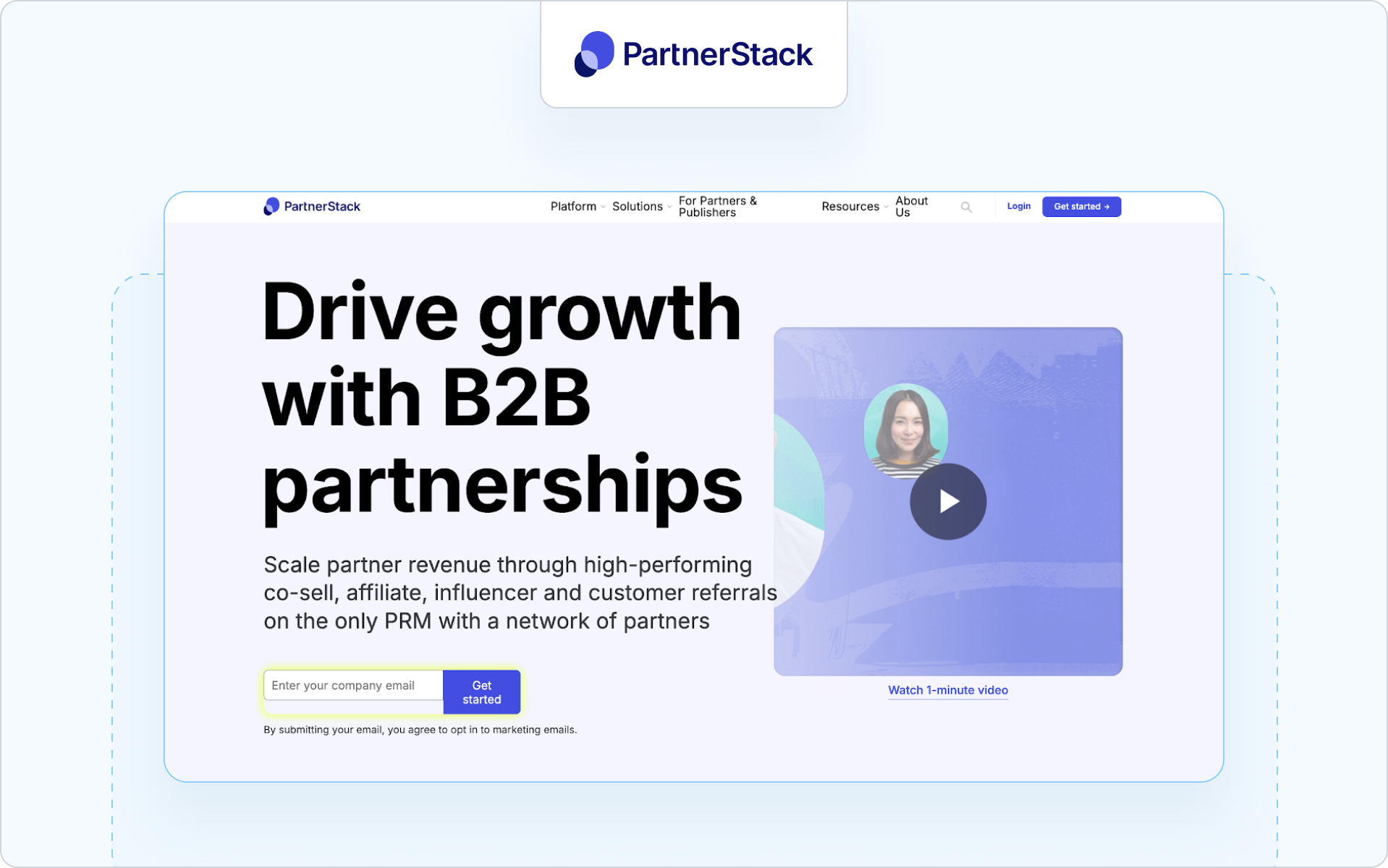
9. PartnerStack
Best for
SaaS companies running affiliate, referral, or ecosystem commerce models.
Why it increases revenue
PartnerStack is designed for ecosystem growth and payout automation. It focuses on tracking referrals, managing commissions, and scaling partner programs through structured incentives.
Revenue levers include:
- Automated commission and payout management
- Referral tracking and attribution
- Marketplace exposure to new partners
This model works well for transactional growth and affiliate-style channel partner management where scale and payout automation drive revenue growth.
Where it may not fit
Organizations needing deep CRM-native co-sell collaboration and complex deal registration may find it affiliate-focused.
Good to know
Strong for SaaS companies prioritizing ecosystem expansion over structured reseller collaboration.
10. WorkSpan
Best for
Large enterprises managing strategic alliances and co-sell motions across multiple business units.
Why it increases revenue
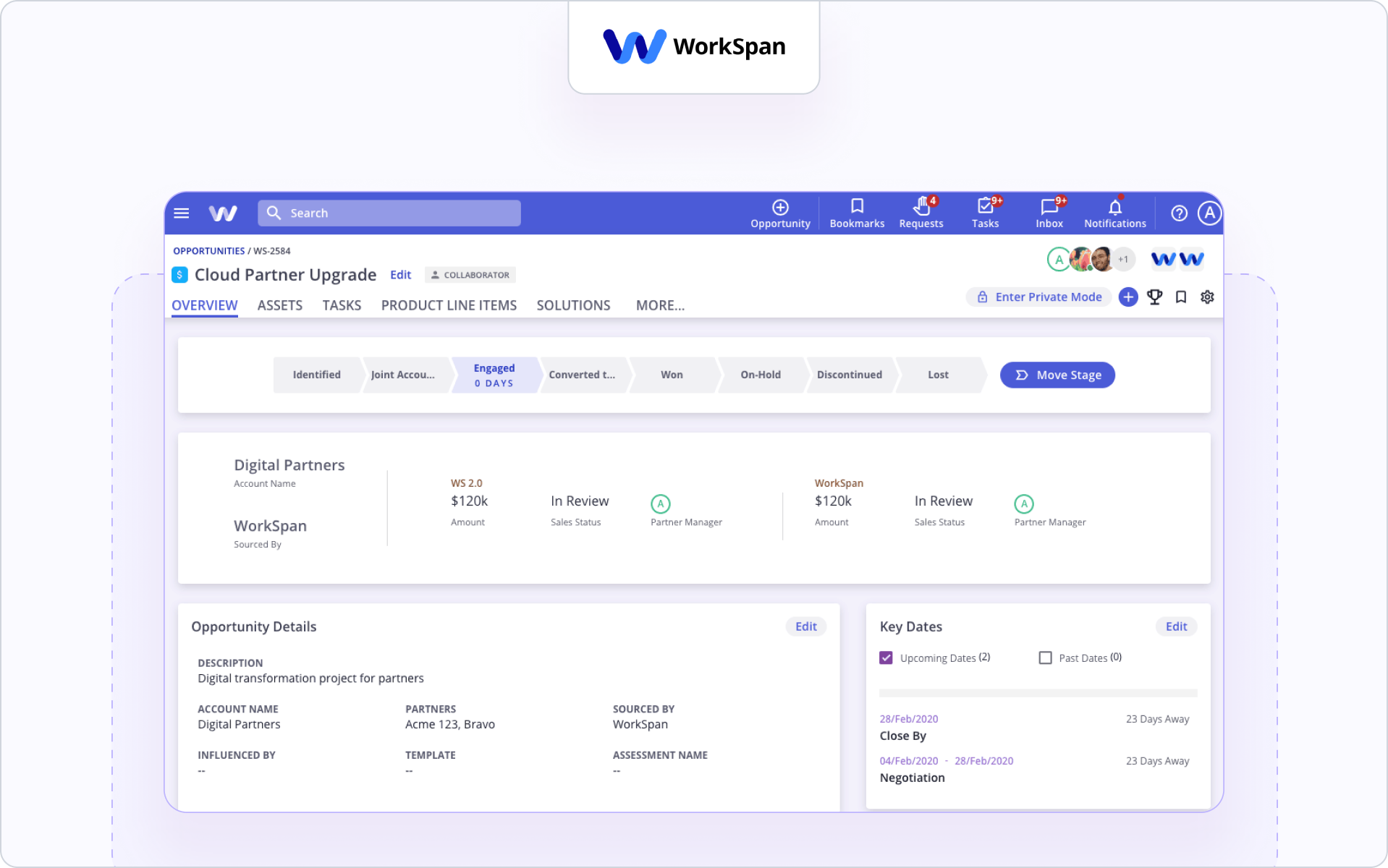
WorkSpan specializes in alliance orchestration and ecosystem revenue management. It supports joint account planning and structured partner collaboration between large organizations.
Revenue levers include:
- Co-sell pipeline visibility across alliances
- Joint account mapping and opportunity alignment
- Ecosystem-level performance analytics
This approach supports mature strategic partner management initiatives where multi-party coordination impacts pipeline outcomes.
Where it may not fit
Mid-market SaaS companies running simple reseller programs may find it too alliance-focused.
Good to know
Best suited for enterprises coordinating global co-sell motions across complex partner ecosystems.
11. ZINFI
Best for
Enterprises seeking broad module coverage across classic channel operations.
Why it increases revenue
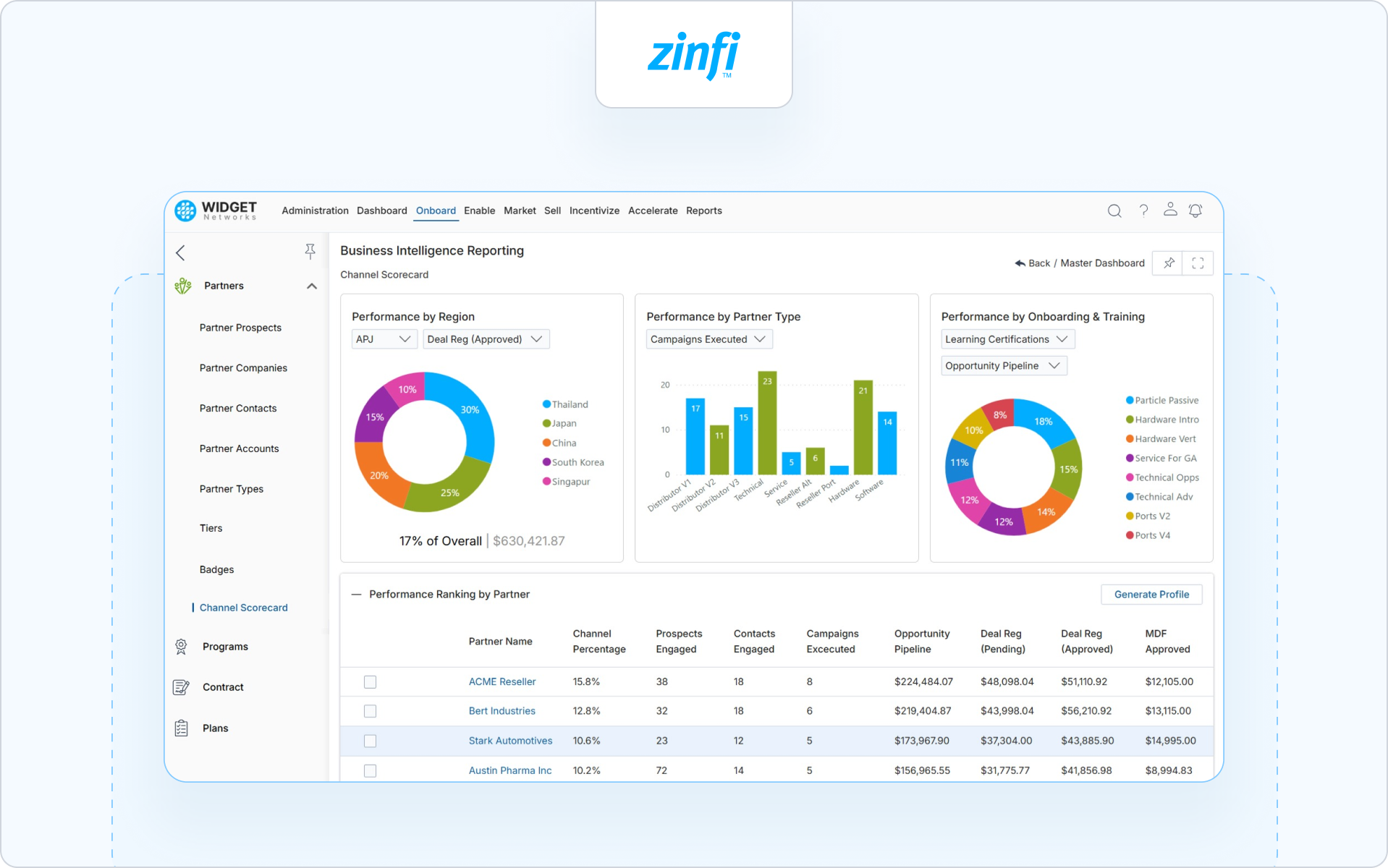
ZINFI provides a wide range of partner management tools, including deal registration, incentives, and marketing automation modules. It supports structured partner tiers and global program governance.
Revenue levers include:
- Multi-tier partner program management
- Integrated deal registration and incentive tracking
- Campaign automation across partner networks
For organizations benchmarking traditional systems, ZINFI is often compared within discussions of the best PRM software for established channel operations.
Where it may not fit
Teams prioritizing lightweight collaboration or CRM-first execution may find it module-heavy.
Good to know
Strong for mature channel environments with defined PRM best practices and governance structures.
12. Crossbeam
Best for
Companies focused on ecosystem mapping and account overlap analysis.
Why it increases revenue
Crossbeam helps companies identify shared accounts and co-sell opportunities across partner ecosystems. It emphasizes secure data sharing and ecosystem visibility rather than full partner management software workflows.
Revenue levers include:
- Account mapping and overlap analysis
- Secure partner data sharing
- Ecosystem pipeline visibility
This can accelerate revenue by uncovering hidden co-sell opportunities.
Where it may not fit
Crossbeam is not a full partner management platform. It works best alongside broader partner management systems that handle onboarding, deal registration, and enablement.
Good to know
Often paired with other partner management platforms to enhance ecosystem intelligence.
13. Mindmatrix
Best for
Enterprise channel organizations seeking integrated marketing, enablement, and partner management software.
Why it increases revenue
Mindmatrix delivers structured workflows across partner onboarding, marketing automation, and performance tracking. It supports multi-region channel partner management with integrated campaign tools.
Revenue levers include:
- Automated partner onboarding workflows
- Marketing execution through channel marketing automation
- Reporting across partner programs and incentives
This structure can streamline management for global indirect sales environments.
Where it may not fit
Smaller SaaS teams may find the breadth of modules heavier than necessary.
Good to know
Best suited for enterprises that want marketing automation and partner governance tightly connected.
No single system wins on feature count alone. What matters is how well it supports revenue control, forecast clarity, and execution speed inside your existing motion.
When revenue control, forecast clarity, and execution speed matter more than feature count, the evaluation shifts. Here’s why Introw was designed with that in mind.
Why Introw
Most partner systems create visibility. Introw connects partner activity directly to revenue systems.
Work where sales already works
Sales teams operate inside Salesforce and HubSpot. When partner collaboration happens outside the CRM, context fragments.
In our SANDSIV case study, HubSpot remained the single source of truth after implementing Introw. The integration allowed partner collaboration and deal visibility to stay aligned with existing CRM workflows.
Keeping execution inside the CRM reduced manual coordination and improved internal alignment.
Off-portal collaboration that increases adoption
Before implementing Introw, SANDSIV relied on manual updates and spreadsheets to keep referral partners informed.
After launching Introw, partner adoption increased by 30 percent. Partners gained real-time visibility into deal progress through the CRM-connected system.
When collaboration happens within existing workflows and updates are automated, participation increases.
Deal registration that drives measurable activity
Structured deal registration and improved visibility contributed to a clear operational outcome.
Following implementation, SANDSIV doubled the number of deals created.
Clear ownership and consistent tracking translated into higher deal volume.
Measurable operational efficiency
Automating the partnership process also delivered financial efficiency.
SANDSIV reported approximately $30,000 in annual cost savings after implementing Introw.
When partner collaboration, deal tracking, and CRM reporting operate in one connected system, the impact is visible in both pipeline and operational costs.
Introw is built to make partner revenue measurable inside the systems your sales team already uses.
See Introw in action inside your CRM and request a demo.

