


What is strategic partner management, really?
Strategic partner management is the structured process of planning, building, and managing strategic partnerships that directly support your company’s objectives — market access, product acceleration, or revenue growth. Unlike casual marketing partnerships or short-term campaigns, a strategic partnership is built for mutual success and governed by a long-range plan. It spans the entire relationship lifecycle: scouting potential partners, negotiation, joint planning, launch, co-marketing, co-selling, support, and continuous improvement.
Strategic partnerships take many shapes: strategic alliances to co-market a combined offer, joint ventures and equity-based partnerships to build a new line of business, technology partnerships to integrate new technologies, supply chain collaborations with external partners to stabilize delivery, or channel partnerships to broaden a customer base in new markets. However the partner operates, the goal is the same — a win-win business partnership that compounds over time.
A partnership manager (or strategic partner manager) orchestrates this motion across multiple partnerships. They set the partnership strategy, evaluate fit, manage the sales process for co-sell motions, coordinate marketing partnerships, provide training and offering guidance, and keep both companies on the same page with regular check-ins and clear metrics.
9 Ways to Maximize Partnership Value in 2026
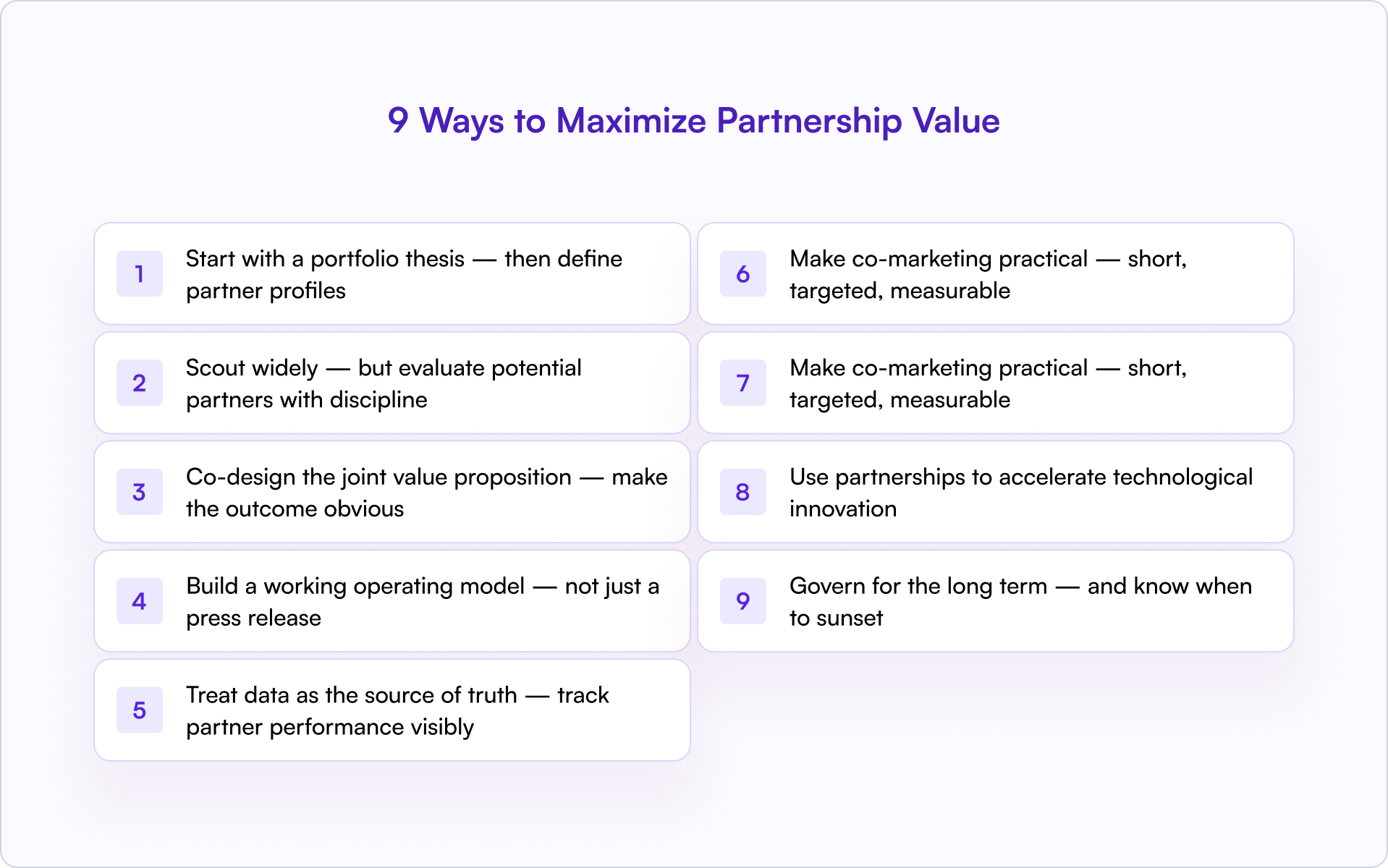
1) Start with a portfolio thesis — then define partner profiles
Before you approach a single potential partner, write a one-page partnership strategy that answers four questions:
- Why partner now — which objectives does your own company need help to achieve? New markets, a larger customer base, product coverage, or credibility in a specific industry?
- Where partnerships can help — list concrete use cases: a marketing partnership to reach a niche audience, a strategic alliance to bundle services, a supply chain relationship to reduce risk, or a technology collaboration to add an integration customers request.
- Which partner types — system integrators, managed service providers, ISVs, complementary SaaS, OEMs, value-added resellers, agencies, logistics providers.
- What good looks like — shared business goals, segment focus, sales model alignment, and the minimum resources each party commits.
Turn this thesis into two or three partner profiles. For each profile, capture the business model, ideal segment, where the partner operates geographically, and the value exchange — what your company gives and what you receive. That clarity filters noise and helps you find partners who can deliver at the same level you need.
2) Scout widely — but evaluate potential partners with discipline
Partner ecosystems are crowded. To find partners worth pursuing, combine outbound scouting with warm introductions and data:
- Build a short list of potential candidates from marketplaces, analyst lists, customer win stories, and events.
- Ask customers which other company they trust alongside you. That signal is gold for relationship building.
- Score each potential partner on strategic alignment, complementary capabilities, overlap in customer base, sales process compatibility, and resourcing.
Use a simple evaluation matrix. Weight the criteria that matter — segment focus, technical fit, strategic planning alignment, and executive sponsorship. Limit monthly adds to your pipeline of potential partners so your team can manage the negotiation phase and early enablement without spreading thin.
3) Co-design the joint value proposition — make the outcome obvious
A successful partnership starts with a shared narrative for the end customer. Write it down together:
- Who is the ideal customer and what problem are you solving together?
- What do the two companies create that neither can deliver alone — a complete solution, a bundled service, a faster sales process, a lower total cost, access to new markets?
- How will success be measured — opportunity creation, influenced revenue, activation rate for the integration, expansion within existing accounts?
Keep this to one slide and one page. If a seller from either side can’t explain the combined value in 30 seconds, you don’t have a partnership strategy — you have a handshake.
4) Build a working operating model — not just a press release
Strategic partners become successful when the relationship moves smoothly from idea to execution. Agree on the basics early:
- Owners and roles — name one partnership manager per side, plus marketing, product, and sales contacts.
- Cadence — regular check-ins, quarterly business reviews, and a shared calendar of campaigns and launches.
- Enablement plan — providing training for both sales teams and partner success managers, along with simple sales tools and marketing materials that sellers actually use.
- Rules of engagement — how you handle overlaps, route opportunities, manage channel conflict, and credit partner influence fairly.
- Mutually beneficial incentives — SPIFFs, referral fees, or margin structures that reward partners who invest.
Write it into a mutual action plan so both parties can track progress. Strong relationships thrive on transparency and accountability.
5) Treat data as the source of truth — track partner performance visibly
If you can’t see partner activities, you can’t manage them. Define the key performance indicators that prove the partnership is working:
- Sourced opportunities by stage and segment
- Influenced opportunities and attach rate to existing deals
- Time-to-first deal and ramp for new partners
- Win rate for co-sell motions vs. direct
- Pipeline coverage by partner type and region
- Integration adoption and retention where new technologies are involved
Share a simple dashboard with both sides, and run your regular check-ins from the same numbers. This keeps both companies on the same page, surfaces issues early, and shows where additional resources or support will unlock growth.
If you use a CRM-first partner platform like Introw, you can manage the entire partner journey — deal registration, mutual action plans, co-marketing — inside Salesforce or HubSpot. That reduces friction, makes relationship building easier, and gives leadership valuable insights without extra spreadsheets.
6) Make co-marketing practical — short, targeted, measurable
Not every strategic partnership needs a giant launch. In many cases, small, well-aimed marketing partnerships outperform broad campaigns:
- One page and one webinar per quarter, each aimed at a specific industry.
- Three social posts with a clear CTA and a landing page you both promote.
- A joint case study that shows how the two companies deliver a win-win outcome for a single customer.
- A field event tied to a conference, with a single sign-up path and agreed lead-sharing rules.
Keep attribution clear. Only share leads who engage with the content and consent to follow-up. Measure outcomes in the same dashboard you use for partner performance.
7) Align sales processes — reduce friction where sellers live
Strategic thinking is great, but sellers need practical steps. Make it easier for both sales teams to work together:
- Build a two-slide quick start for partner teams: which accounts to target, how to introduce each other, and what to say.
- Create a single intake form for co-sell opportunities with fields both CRMs can map.
- Define the negotiation phase — who leads pricing, who joins calls, and how to escalate blockers.
- Publish a short playbook for renewal and expansion so both parties know how to protect existing business.
When partners sell together without friction, successful strategic partnerships scale. When the basics are unclear, even strong relationships stall.
8) Use partnerships to accelerate technological innovation
Partnerships can help you move faster on new technologies and emerging technologies without hiring a team for every capability. Good examples:
- Technology partnerships that integrate your platform with an adjacent tool — reducing time-to-value and increasing retention.
- Joint ventures to explore a new product area when speed to market matters more than building in-house.
- Equity-based partnerships that align incentives for multi-year innovation.
- Multiple partnerships across a category so you can cover more use cases while staying vendor-neutral for customers.
Treat each integration or co-build like a product. Set a roadmap, quality bar, security review, and a clear definition of done. If the partner operates in your supply chain, add risk and continuity planning so both parties can manage disruption together.
9) Govern for the long term — and know when to sunset
Strategic alliances evolve. Some relationships become core; others fade. A healthy partner management program makes it safe to do both:
- Tier your strategic partners by impact and engagement — gold, silver, emerging.
- Review performance quarterly and reset objectives as markets change.
- Offer additional resources to high-performing partners — joint business planning, access to roadmaps, or early co-marketing funds.
- For low-impact partnerships, either improve the operating model or sunset the relationship respectfully with a transition plan.
Strong relationships last because both companies invest consistently, keep objectives aligned, and solve problems openly.
A simple framework to run strategic partner management day to day
Use this five-stage loop to manage the various stages of the partner journey:
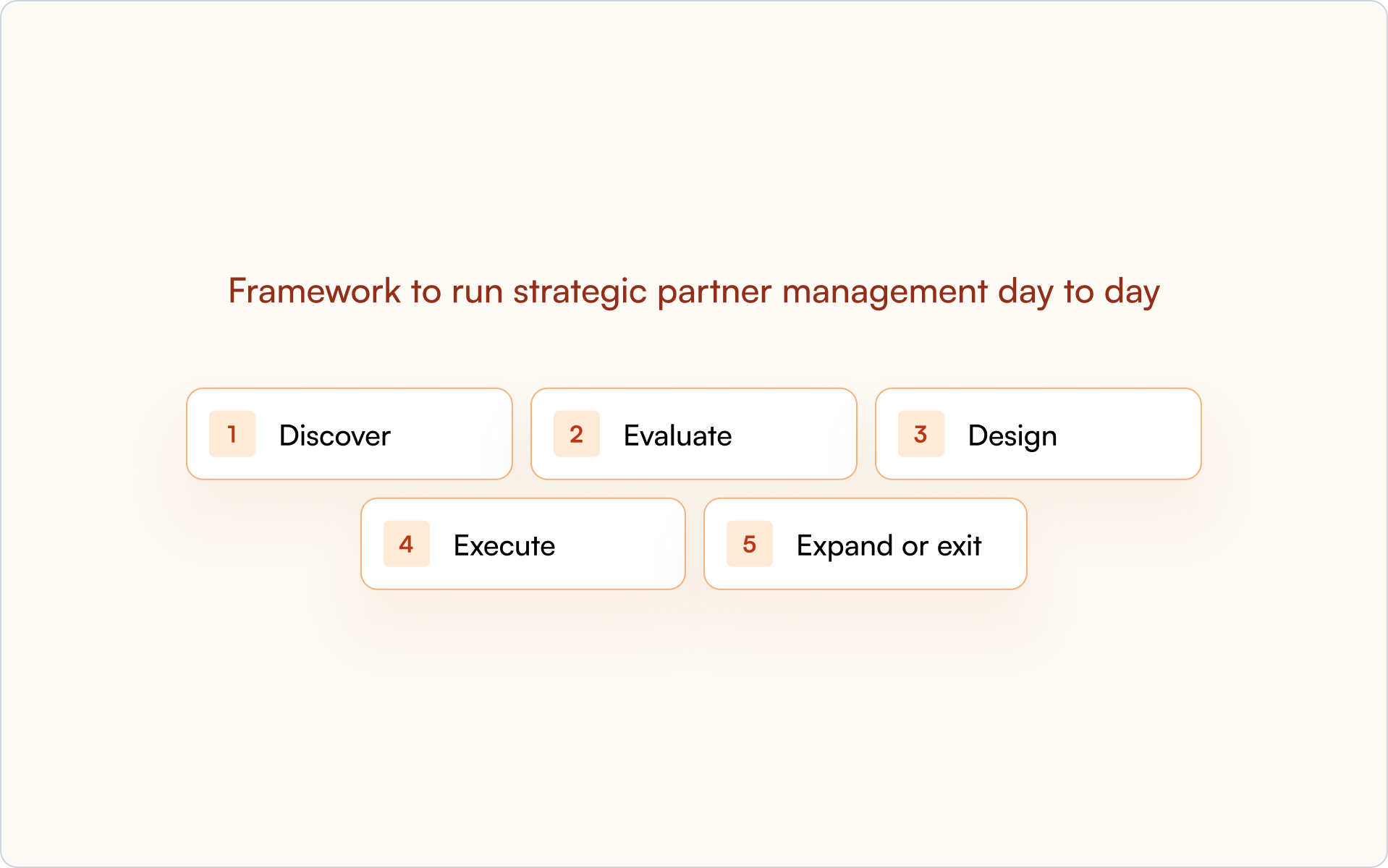
- Discover — find partners that match your thesis; validate interest.
- Evaluate — confirm strategic fit, capability, and resourcing; run an executive alignment call.
- Design — write the joint value proposition, rules of engagement, and first-quarter plan.
- Execute — launch one co-marketing motion and one co-sell motion; provide training and sales tools; track performance weekly.
- Expand or exit — double down with new partners in the same pattern if results are strong; otherwise, adjust or conclude the relationship.
Run this loop across multiple partnerships, but never at the expense of quality. Depth beats breadth when outcomes matter.
Templates and tools that keep partnerships on track
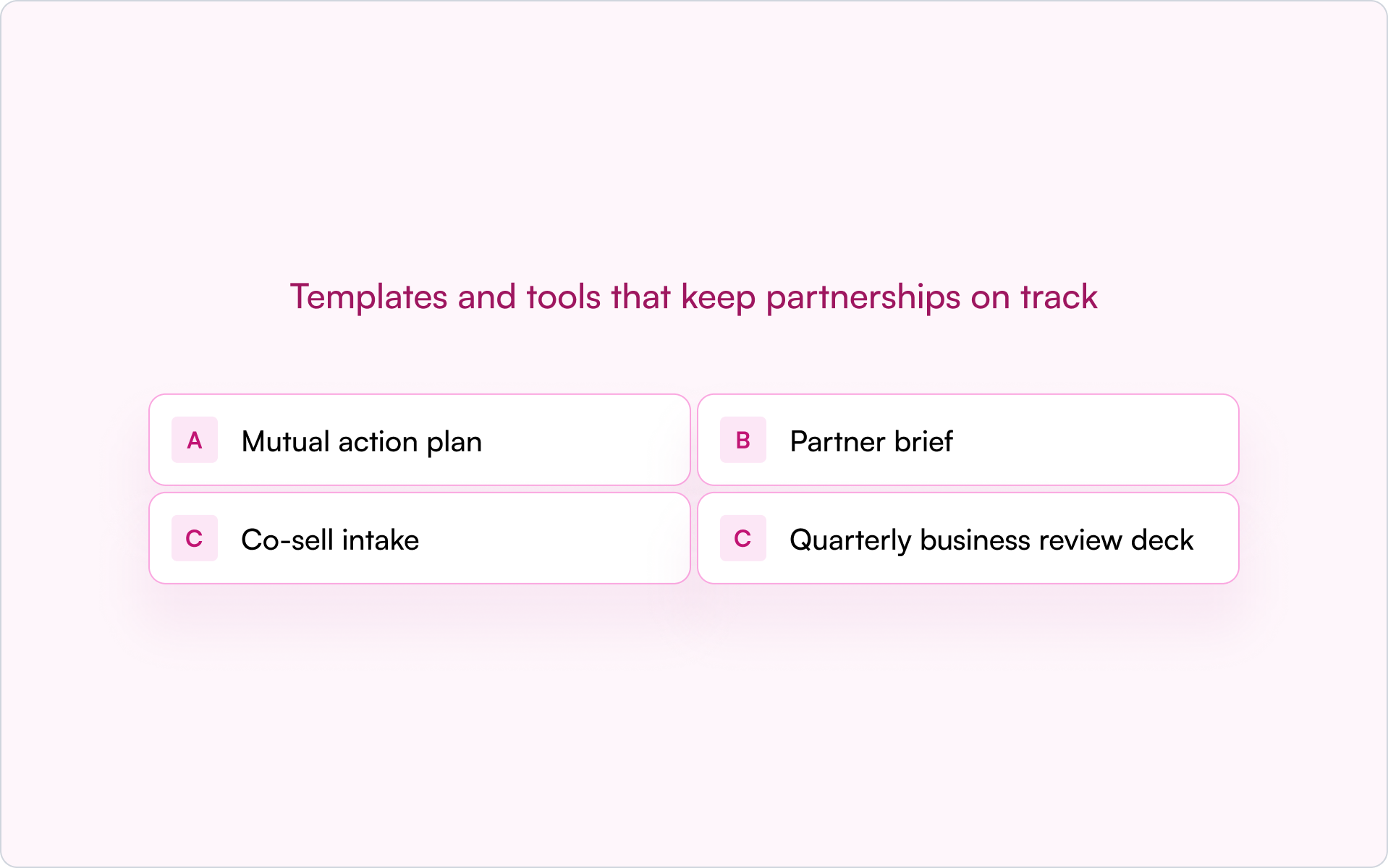
- Mutual action plan — a single, shared checklist with owners, dates, evidence, and risks.
- Partner brief — one page with ICP, key messages, approved claims, and three proof points.
- Co-sell intake — a minimal form both CRMs can accept.
- Quarterly business review deck — pipeline, wins, losses, customer feedback, next-quarter bets.
If you’re using Introw, you can host these templates in partner workspaces, let partners update milestones via email or Slack, and sync progress to your CRM. That keeps managing strategic partners lightweight and visible.
Example use cases across industries
- SaaS and services. A technology partnership with a system integrator to implement complex deployments, with co-selling into existing accounts.
- Supply chain collaborations. Two companies align forecasting and inventory data to reduce stockouts and serve new markets together.
- Marketing partnerships. A webinar and field series across a shared industry, feeding a joint landing page with a single lead-sharing process.
- Joint ventures. Equity-based partnerships that build a new solution faster than either company could alone.
Each case follows the same pattern — shared objectives, clear governance, and measurable outcomes.
Where to place strategic partner management inside the org
High-leverage programs typically report to a senior revenue leader or a GM who owns a partner ecosystem. The partnership manager coordinates with product, legal, finance, marketing, and sales, and brings problem solving to bear when priorities clash. For start-ups, begin with one experienced owner. As you grow, invest in partner operations to manage data, processes, and compliance at scale. Contact our team and we’ll show you how strategic partner management is done.
Still curious? Here are some quick answers to help clear things up
It’s the end-to-end process of planning, building, and managing relationships with strategic partners — from scouting potential partners and negotiating a shared plan to executing co-marketing and co-selling, tracking results, and improving over time.
A marketing partnership is often campaign-based. A strategic partnership ties directly to shared business goals — revenue, product capability, expansion — and is governed by a multi-quarter plan with joint resources, regular check-ins, and measurable KPIs.
Typically a partnership manager or head of partnerships. They coordinate multiple partnerships, align executives, manage the sales process for co-sell motions, and ensure both companies operate at the same level of quality.
Interpersonal communication, strategic thinking, analysis, stakeholder management, negotiation, and problem solving. Add operational strength — the ability to manage multiple partnerships and keep resources aligned.
Score strategic alignment, customer overlap, complementary capabilities, resource commitment, and executive sponsorship. If those are strong and you can write a one-page joint value proposition, you likely have a promising strategic partner.






Are you already an active Introw partner?
Book a demo with one of our partner program experts, or explore Introw on your own time.