

.svg)


.svg)
.svg)








10 Magentrix PRM Alternatives for Better Partner Engagement in 2026
We'll show you 10 Magentrix PRM alternatives in 2026, including options built for Salesforce, HubSpot, and growing partner programs. We’ll compare features, pricing, AI capabilities, and overall partner experience to help you find the right fit.
What Is Magentrix (And Why Teams Look for Alternatives)
Magentrix PRM is a partner portal platform. It gives users a branded place to share content, register deals, and manage partner access.
For teams that only need a portal, Magentrix can work well. But many businesses evaluating Magentrix alternatives need broader CRM support, stronger partner experience capabilities, and more complete partner lifecycle management.
1. Integrates with Hubspot & Salesforce
Magentrix integrates with Salesforce, Microsoft Dynamics, and HubSpot
2. Portal-first engagement model
Most partner activity happens inside the portal. Magentrix supports off-portal lead registration by email, but it doesn't offer CRM-synced email conversations or Slack-based collaboration workflows for ongoing engagement on live deals.
3. Limited AI capabilities
Magentrix doesn’t offer AI-automated QBR generation & AI course creation.
For teams looking to reduce manual work, this is a common reason to review Magentrix competitors.
4. No AI-powered LMS
Magentrix has a built-in LMS with courses, learning paths, and certifications. What it doesn't yet offer is an AI-powered LMS that generates courses and training content.
If you’re planning to choose your next PRM, it’s worth evaluating this.
Magentrix alternatives at a glance
Here’s a quick side-by-side comparison before we dive into each Magentrix alternative in more detail.
Now, let’s look at where each platform stands out and where it may fall short depending on your partner program.
10 Best Magentrix Alternatives in 2026
#1 Introw - Best overall Magentrix alternative for CRM-native partner management
.png)
What it does
Introw is an AI-first PRM software for revenue teams using HubSpot and Salesforce. The platform also adds capabilities beyond Magentrix's portal-first model, including off-portal email and Slack collaboration, agentic AI across the lifecycle, native MCP and Claude support, and an AI-powered partner LMS
Unlike most alternatives, Introw syncs live CRM data bi-directionally, including custom objects, so your team can manage customers, data, and workflows without duplicate records or manual updates.
Why someone might choose it over Magentrix
Introw fills the biggest gaps that push teams away from Magentrix PRM.
You can connect HubSpot or Salesforce instead of being locked into a single CRM. Partners can collaborate through email, Slack, embedded forms, or a white-label partner portal, with information synced automatically to the CRM.
The AI agent helps automate repetitive tasks across the lifecycle by generating training content, building announcements, surfacing QBR insights, and coaching live deals. The platform also includes capabilities Magentrix doesn’t offer, including MDF, CPQ, goal tracking, and an AI-powered partner LMS.
Key differences from Magentrix
- Off-portal email + Slack collaboration vs. portal-first engagement
- Agentic, action-taking AI vs. limited AI
- Full lifecycle management vs. portal-focused functionality
- AI-powered LMS with AI-generated courses vs. a standard LMS with certifications
- Native MCP and Claude support vs. none
CRM integrations
See the Claude integration in action:
Pricing
Introw offers custom pricing based on your partner program size, CRM setup, and required features.
Best for
SaaS businesses that want a complete partner management platform instead of just a partner portal.
For a deeper review, see our guide to choosing your next PRM or request a demo.
#2 Salesforce Experience Cloud (Partner Cloud) - Best for Salesforce teams wanting maximum native control
.png)
What it does
Salesforce Experience Cloud is Salesforce’s portal-building platform. It gives administrators complete control over how partner experiences are designed, displayed, and connected to Salesforce data.
Why someone might choose it over Magentrix
Teams that need maximum customization and direct access to Salesforce objects often choose Experience Cloud over Magentrix.
Where it falls short
- Requires significant developer resources
- No dedicated PRM admin layer
- No embedded LMS
- No AI deal coaching
- No off-portal collaboration
- Long implementation time
- Can become expensive to upgrade and maintain
CRM integrations
- Salesforce (native)
Pricing
Customer Community Plus: $15/login or $35/member. Partner Community: $20/login or $50/member.
Best for
Large Salesforce organizations with dedicated developers and administrators.
See how it compares in our roundup of best Salesforce PRM alternatives.
#3 Impartner — Best for enterprise-scale PRM beyond just a portal
.png)
What it does
Impartner is an enterprise PRM platform covering partner portals, TCMA, marketplaces, and partner lifecycle management.
Why someone might choose it over Magentrix
Impartner offers a broader set of features than Magentrix, including TCMA, marketplace functionality, and enterprise partner programs.
Where it falls short
- Long implementation cycles
- Middleware-based CRM integrations
- Dated user experience
- Complex setup and maintenance
- Difficult to migrate once heavily customized
CRM integrations
- Salesforce (via middleware)
Pricing
Custom enterprise pricing.
Best for
Enterprise businesses running mature partner ecosystems.
Our guide to the best Impartner competitors covers additional options.
#4 PartnerStack- Best for affiliate and referral programs with payouts
.png)
What it does
PartnerStack helps businesses manage affiliate, referral, and reseller programs with built-in payouts and marketplace access.
Why someone might choose it over Magentrix
PartnerStack includes payout automation, a free partner marketplace, and support for affiliate programs that Magentrix wasn’t designed to manage.
Where it falls short
- Transaction fees on payouts
- Limited co-sell functionality
- Rigid portal experience
- No distributor management
- CRM integrations require middleware
CRM integrations
- HubSpot (via Workato)
- Salesforce (via Workato)
Pricing
Launch: $1,000/month. Growth: $1,520/month. Enterprise: custom.
Best for
Businesses focused on affiliate and referral revenue.
Explore our guide to the best PartnerStack alternatives.
#5 Kiflo - Best for SMBs on HubSpot launching their first program
.png)
What it does
Kiflo is a lightweight PRM platform designed for small businesses that want an easy way to start managing partners.
Why someone might choose it over Magentrix
Kiflo supports HubSpot, offers simpler workflows, and is less expensive to get started with.
Where it falls short
- No AI capabilities
- No off-portal collaboration
- No white-label portal options
- No LMS
- No CPQ
- Limited scalability
CRM integrations
- HubSpot
- Salesforce
Pricing
Core: $399/month (annual billing). Plus: custom.
Best for
Small businesses with fewer than 20 active partners.
Take a look at our in-depth guide to Kiflo alternatives.
#6 Euler - Best for modern PRM with AI assistants

What it does
Euler is a modern PRM platform with AI assistants, partner management workflows, and support for both Salesforce and HubSpot.
Why someone might choose it over Magentrix
Euler offers a more modern user experience, HubSpot support, and AI features that Magentrix lacks.
Where it falls short
- No custom object support
- No white-label portal builder
- No LMS
- No MDF management
- Limited onboarding flexibility
CRM integrations
- HubSpot
- Salesforce
Pricing
Custom pricing.
Best for
Growing partner programs that want a modern interface and advisory AI.
Explore our guide to the best Euler PRM alternatives.
#7 Mindmatrix - Best for through-channel marketing automation
.png)
What it does
Mindmatrix combines PRM software, TCMA, LMS, content management, and partner enablement in a single platform.
Why someone might choose it over Magentrix
Mindmatrix offers broader services, LMS capabilities, content automation, and support for both Salesforce and HubSpot.
Where it falls short
- Steep learning curve
- Long implementation cycles
- Complex administration
- LMS often requires support involvement
CRM integrations
- HubSpot
- Salesforce
Pricing
Custom enterprise pricing.
Best for
Enterprise organizations focused on through-channel marketing.
See how it compares in our roundup of the best Mindmatrix alternatives.
#8 ChannelScaler - Best for incentive and rebate management
.png)
What it does
ChannelScaler combines PRM, MDF, incentives, rebates, and channel management into a single platform.
Why someone might choose it over Magentrix
ChannelScaler provides incentive management, rebate programs, budget controls, and MDF capabilities that extend beyond portal functionality.
Where it falls short
- Admin-heavy workflows
- No AI capabilities
- No Slack collaboration
- CRM changes often require support assistance
- Some updates require additional waiting time
CRM integrations
- Salesforce
- HubSpot (middleware)
Pricing
Custom pricing.
Best for
Businesses with complex rebate, incentive, and budget management requirements.
Explore our guide to the best ChannelScaler alternatives.
#9 Channeltivity - Best for mid-market Salesforce teams wanting MDF
.png)
What it does
Channeltivity is a mid-market PRM platform focused on portals, deal registration, MDF, and channel analytics.
Why someone might choose it over Magentrix
Channeltivity includes MDF management and analytics capabilities that go beyond standard portal features.
Where it falls short
- Limited AI functionality
- Salesforce-focused architecture
- No off-portal collaboration
CRM integrations
- Salesforce
Pricing
Standard: $1,899/month annually. CRM Edition: $2,199/month annually.
Best for
Mid-market Salesforce customers looking for MDF and analytics.
Our guide to the best Channeltivity competitors covers additional options.
#10 Partner.io - Best for pipeline-focused partner collaboration
.png)
What it does
Partner.io is a partner management platform built around pipeline visibility, deal collaboration, and partner communication.
Why someone might choose it over Magentrix
Partner.io focuses on helping teams manage live deal collaboration rather than primarily serving as a portal.
Where it falls short
- Smaller market presence
- Narrower feature set
- Fewer enterprise capabilities than some competitors
- Less information available than many established vendors
CRM integrations
- HubSpot
- Salesforce
Pricing
Solo starts at $79/month. Growing starts at $299/month. Enterprise pricing is custom.
Best for
Teams focused on pipeline visibility and collaborative selling.
See how it compares in our roundup of the best Partner.io alternatives.
The Bottom Line
Magentrix is a good choice if you’re a team that wants a branded partner portal for deal registration, content sharing, and partner access.
Many teams start looking at the best alternatives when they struggle with portal engagement, or need more than a portal can provide.
If that’s you, Introw stands out by combining partner management, AI, training, deal collaboration, and CRM connectivity in one place across both HubSpot and Salesforce. It offers one of the best alternatives for teams that have outgrown a portal-only approach.
As you compare options, focus on what helps your team work faster and keeps partners engaged. Features like security verification and protection from malicious bots matter, but so does day-to-day usability.
For a deeper side-by-side review, see the full Magentrix comparison.
Why Teams Choose Introw When Looking for Magentrix Alternatives
If you’ve reviewed this list, you’ve probably noticed a pattern. Most alternatives solve one or two Magentrix limitations. Introw is one of the few PRM software platforms designed to address all of them in one place.
.png)
+70% more partner pipeline
Introw helps teams turn dormant programs into revenue engines. Partners register more deals, faster, with deal flow synced directly into your CRM.
Off-portal collaboration means partners can work without logging in, while AI helps protect pipeline quality by identifying duplicate opportunities before they become problems.
+75% faster partner onboarding
Go live in 2 to 4 days with no custom coding.
Partners move from signup to selling with AI-driven onboarding, certification, and content in one intuitive platform. Integrated HubSpot and Salesforce support means you’re never locked into a single CRM if your business grows or your needs change.
+60% more partner-influenced revenue
Get full visibility into every partner-touched deal.
Attribution lives inside your CRM, making it easier to prove what’s working and expand successful programs. Deal coaching, engagement automation, and powerful reporting features help keep partners active without creating extra tasks for your team.
Ready to compare Introw to Magentrix?
If you still have questions after reviewing the most alternatives on this list, the best way to evaluate fit is to see the platform in action.
Request a demo and see how leading SaaS teams grow partner pipeline, speed up onboarding, and increase partner-influenced revenue with Introw.
How to Launch an MSP Partner Program in 2026
MSPs already have the clients you want to reach. They’ve built trust, signed contracts, and deliver services month after month — which means one strong partnership can open doors to dozens of accounts your direct team would spend quarters chasing.
The real question isn’t whether MSP partnerships make sense. It’s whether you can build an MSP partner program that actually attracts the right partners, gets them enabled fast, and turns signups into recurring revenue. This guide walks through what to include, how to launch it step by step, and the mistakes that quietly kill most programs before they gain traction.
What is an MSP partner program?
An MSP partner program is a structured partnership between a technology vendor and Managed Service Providers (MSPs). MSPs manage IT infrastructure, security, cloud services, and support for end customers on an ongoing basis. You provide the product plus training, resources, and program incentives. The MSP operationalizes your technology inside their managed services offering.
This differs from a classic reseller relationship in one crucial way: MSPs don’t sell your product once and move on. They bundle it into a recurring service they deliver month after month, meaning your success is tied to their ability to retain clients and standardize delivery.
How the relationship works
- Technology vendor: the company (like yours) that builds the product
- MSP partner: the managed service provider who bundles your product into their client offerings
- End customer: the MSP’s client who benefits from the combined solution
MSP partnerships are especially common in cybersecurity, cloud services, backup, and remote monitoring — anywhere ongoing service delivery matters more than a one-time transaction.
Why launch a managed service provider partner program?
If you’re a founder building a B2B software company, an MSP channel can be one of the most capital-efficient paths to scale. Done right, it expands revenue without requiring a linear increase in direct sales headcount.
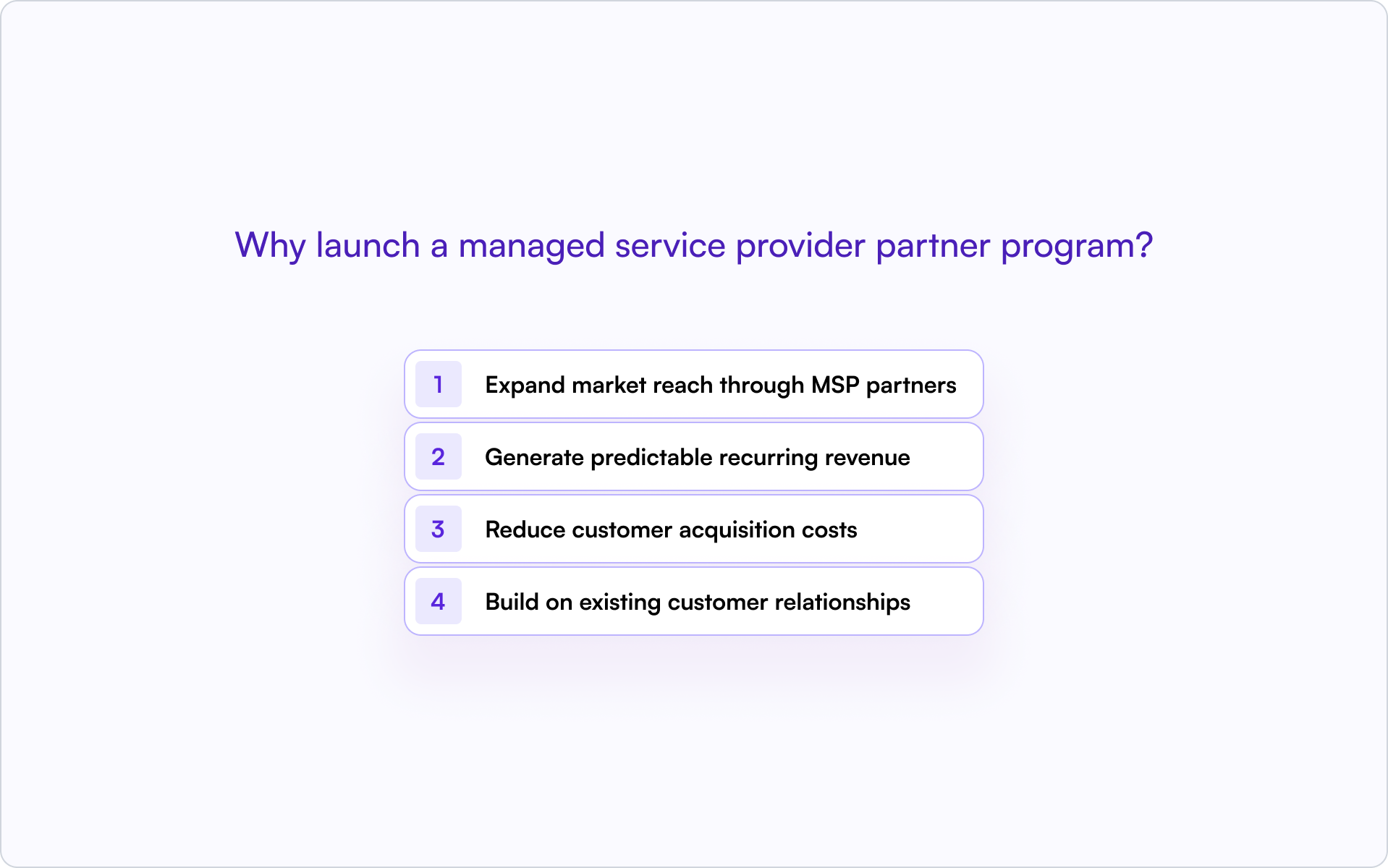
Expand market reach through MSP partners
MSPs already serve the SMB and mid-market accounts that are hardest to reach through cold outbound. They have contracts, renewal cycles, and ongoing service touchpoints — which gives them distribution you can’t replicate quickly.
One MSP partnership can unlock access to dozens (or hundreds) of end customers. Accounts your direct team would spend months identifying and closing become reachable through a single partner relationship.
Generate predictable recurring revenue
MSPs bill monthly, often on a per-user or per-device basis. When they bundle your product into their service, your revenue becomes recurring and correlated with their retention — incentives stay aligned.
Reduce customer acquisition costs
MSPs do the selling and often the implementation. You trade margin for distribution, which can be far cheaper than scaling AEs into every segment and region you want to win.
Build on existing customer relationships
MSPs are trusted advisors. Their recommendation carries more weight than vendor-led outreach — which typically shortens sales cycles and increases close rates.
What to include in your MSP partner program
Program design is where most teams accidentally lose. MSPs evaluate vendor programs constantly; if yours is confusing, under-incentivized, or operationally painful, they’ll simply prioritize someone else.
Partner tiers and qualification criteria
Define tiers based on commitment, volume, or certification status. Keep it simple — three tiers is usually enough.
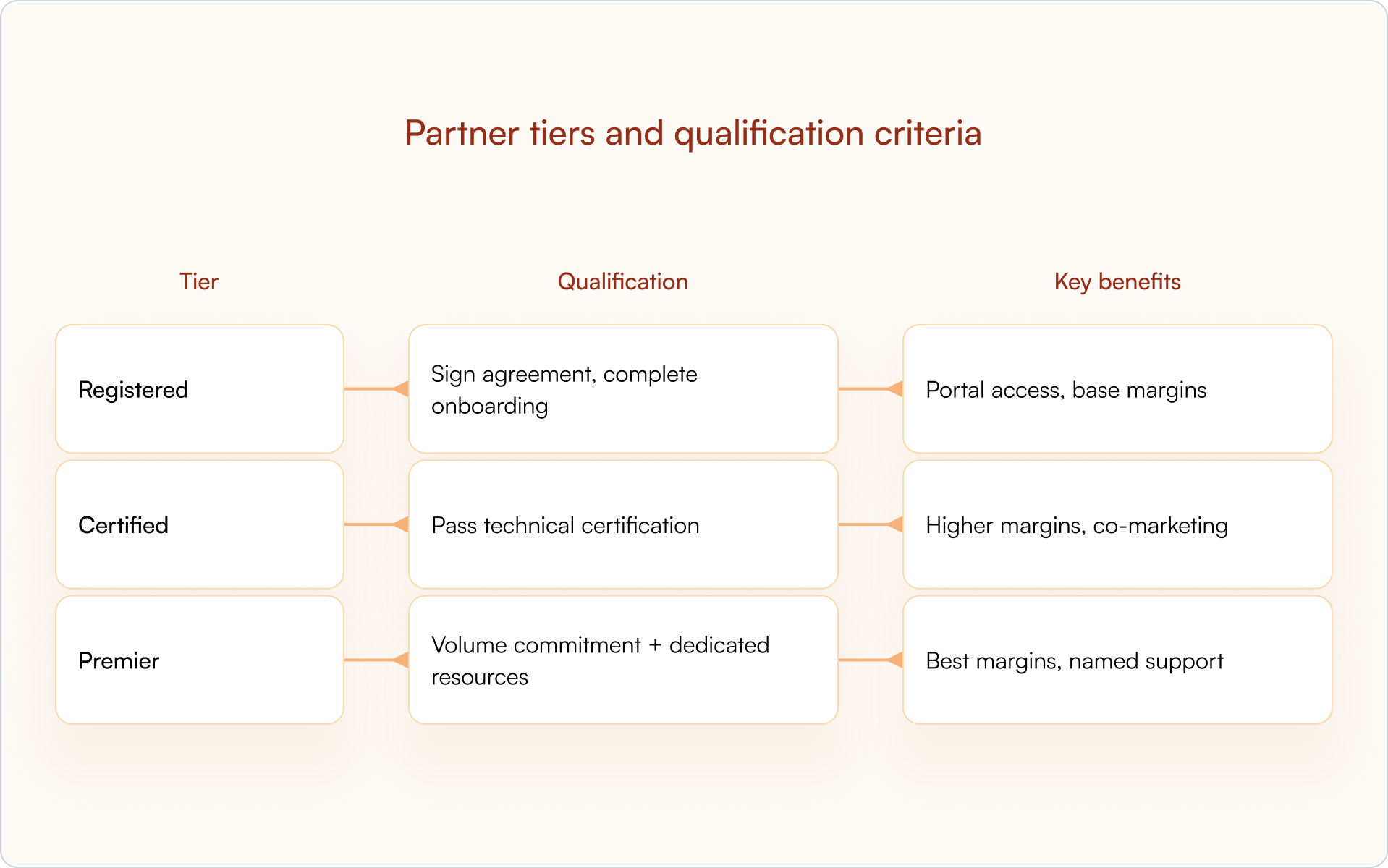
A common failure mode: teams add too many tiers to “cover every case,” and partners can’t quickly understand where they fit or what to do next.
Margin and pricing structure
MSPs need healthy margins to justify bundling your product. Wholesale pricing, volume discounts, rebates, or consumption-based billing can all work — but the economics must match the MSP business model.
- Align to monthly billing where possible (MSPs typically invoice monthly).
- Reduce upfront friction (annual-only commitments can be a deal-killer for monthly service bundles).
- Be explicit about what’s margin, what’s rebate, and what’s conditional on certification or volume.
Certification and enablement requirements
Certification protects your brand and reduces support load. Define what partners must complete before selling, implementing, or supporting your product.
Include technical training, sales enablement, and ongoing recertification. Partners who understand your product close more deals and create fewer escalations.
Deal registration and lead protection
Deal registration is how MSPs claim opportunities, earn protection windows, and avoid conflicts with your direct team or other partners.
Without clear rules, partners won’t invest in building pipeline for you. Define:
- Registration workflow: what they submit and where
- Approval SLA: 48 hours is a common standard
- Protection duration: typically 60–90 days (with clear extension criteria)
- Conflict resolution: what happens if two parties claim the same account
A structured deal registration process is one of the most effective tools for preventing channel conflict and keeping partners engaged.
Partner portal and self-service resources
MSPs expect a professional portal where they can self-serve pricing, training, marketing assets, deal registration, and support — without waiting on your team.
The portal should be connected to your CRM so data stays accurate and reporting stays real. If partners operate in one place and your revenue team operates in another, you’ll spend your time reconciling instead of scaling.
Co-marketing and sales support
Outline what support partners can expect: MDF (Market Development Funds), co-branded campaigns, lead sharing, joint webinars, and sales engineering help. Many MSPs don’t need “more collateral” — they need demand-generation support and a path to their first few wins.
How to launch an MSP partner program step by step
Strategy is the easy part. The program wins or loses in execution — especially in your first 90 days, when partners decide whether you’re worth their time.

1) Define your ideal MSP partner profile
Not all MSPs are a fit. Define your criteria the same way you define an ICP for direct sales:
- Vertical focus (healthcare, legal, financial services, general SMB)
- Client base size and maturity
- Technical capabilities (security operations, cloud migrations, compliance)
- Geographic footprint and service model
- Existing vendor stack and overlaps
This prevents you from recruiting partners who will sign an agreement but never activate.
2) Structure program tiers and incentives
Build out the tier structure, margin tables, and incentive programs (SPIFFs, rebates, MDF). Put it in a partner-facing program guide that’s clear enough to forward internally.
MSPs compare programs constantly. Ambiguity loses to clarity every time.
3) Build certification and onboarding paths
Create the training curriculum: product training, sales certification, technical certification. Then design the onboarding journey from signup to first registered deal.
- Set expectations for time-to-certification.
- Provide a “first deal” playbook (ideal customer, pitch, implementation outline).
- Make enablement easy to complete in the flow of work.
4) Set up deal registration and pipeline tracking
Implement deal registration workflows (submission, approval routing, protection windows, expiration reminders) and connect it to your CRM so partner pipeline is visible alongside direct pipeline.
If partner deals live in spreadsheets or disconnected tools, you’ll create invisible pipeline and messy attribution — and you’ll pay for that later in forecasting, comp plans, and board reporting.
5) Launch your MSP partner portal
Launch the portal with everything a partner needs on day one: program guide, pricing, training, deal registration, and support paths.
Reduce login friction. In the real world, partners abandon portals that feel like extra work.
6) Recruit and activate your first MSP partners
Start targeted recruitment: identify the right MSPs, run outreach, and pitch the program with concrete economics and a clear onboarding plan. Optimize for activation, not signups — a “signed” partner who never registers a deal is a rounding error.
Define activation milestones: completed training, first deal registered, first closed deal, and track them from day one.
Tools for managing MSP partnerships at scale
Most early MSP partner programs don’t fail because the idea is wrong. They fail because operations can’t keep up — approvals lag, data is missing, and partners stop engaging.
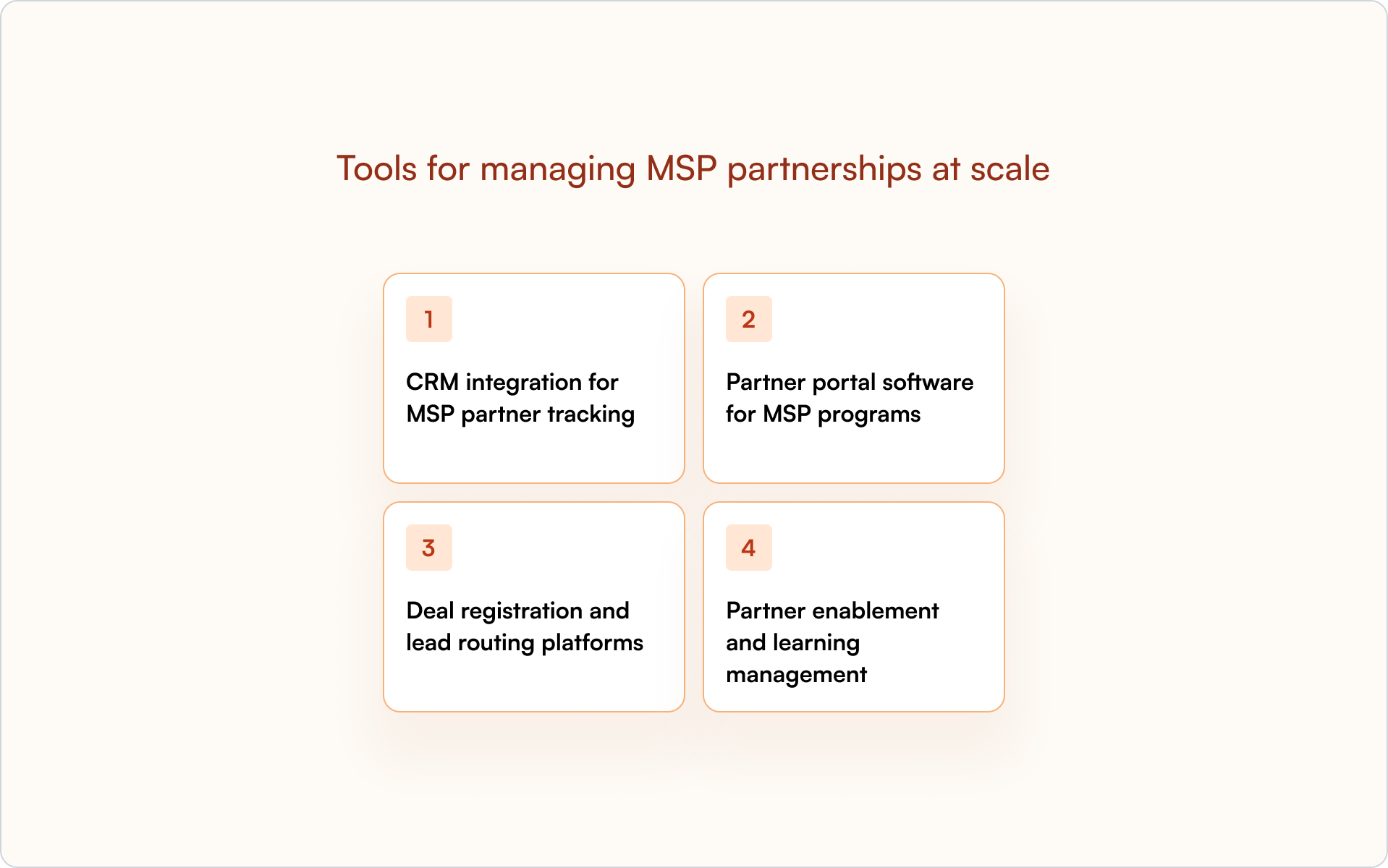
CRM integration for MSP partner tracking
Your CRM (HubSpot, Salesforce) is the system of record for partner deals. Track partner-sourced pipeline, deal registration status, and attribution inside the CRM — not in a separate system.
That’s how RevOps and sales leadership get real visibility without reconciling spreadsheets at the end of every month.
Partner portal software for MSP programs
A partner portal centralizes resources, deal registration, and communication. Prioritize portals that integrate with your CRM so data flows automatically.
Avoid portals that create data silos or require heavy partner logins. The best portals feel like an extension of your CRM — not a separate destination.
Deal registration and lead routing platforms
Deal registration needs workflow automation: submission → approval → protection → expiration alerts. Route registrations to the right approver, enforce required fields, and track protection windows automatically.
Partner enablement and learning management
Deliver training through an LMS or enablement platform. Track certification status, send recertification reminders, and gate key benefits behind completed training.
Trained partners close more deals. Your job is to make “getting trained” feel like momentum, not homework.
Common mistakes when building an MSP partner program
Most MSP partner programs stall for predictable reasons. If you’re building this in 2026, you can avoid months of rework by designing around these failure modes up front.
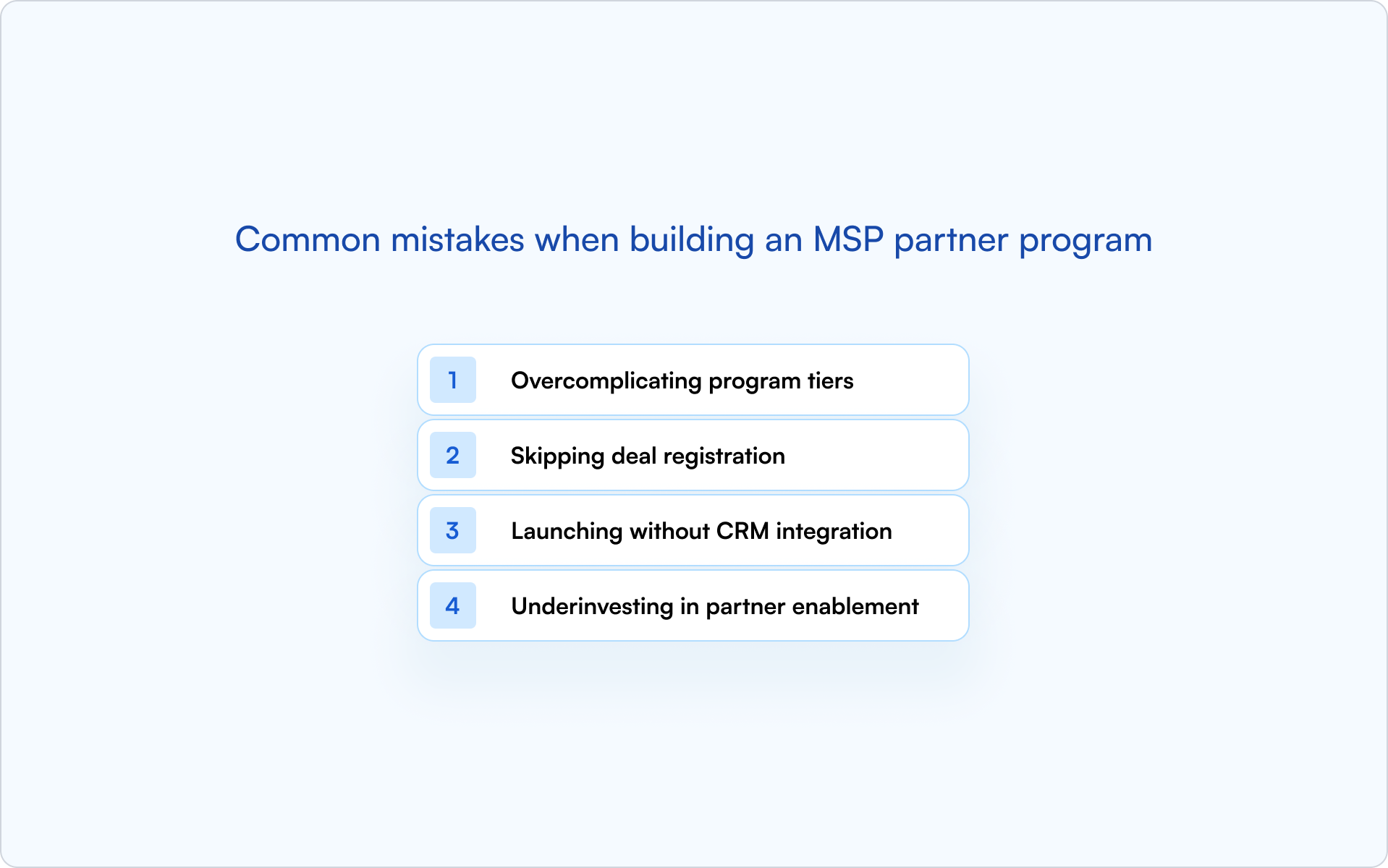
Overcomplicating program tiers
Too many tiers or unclear qualification criteria overwhelm partners. MSPs evaluate dozens of vendor programs — if yours is hard to understand, they’ll skip it. Start simple and add complexity only when real partners ask for it.
Skipping deal registration
Without deal registration, you can’t protect partner deals or prevent channel conflict. Partners won’t invest in selling if they risk losing deals to your direct team or another partner.
Treat deal registration as non-negotiable infrastructure, not a “phase two” feature.
Launching without CRM integration
If partner pipeline lives outside your CRM, you lose visibility, attribution, and forecasting accuracy. Your sales team can’t see partner deals. RevOps can’t reliably report on partner-sourced revenue. Leadership can’t trust the numbers.
Build CRM-first from the start. Retrofitting integration later is painful and expensive.
Underinvesting in partner enablement
MSPs can’t sell what they don’t understand. If training, documentation, and support are thin, partners won’t close — and they’ll blame the product. Enablement is an investment that shows up in activation rate, deal velocity, and retention.
Build your MSP partner program on your CRM with Introw
Launching an MSP partner program gets much easier when your tools work together. Introw connects your partner portal directly to HubSpot or Salesforce, so every MSP deal, lead, and activity lives in one system.
- CRM-first architecture: Partner deals live in the same system as direct deals. No hidden pipeline, no attribution guesswork.
- Deal registration: Partners register deals through the portal or email. Registrations sync to your CRM with protection windows and approval workflows — automatically.
- Partner portal: Launch a branded portal in minutes with resources, deal registration, and pipeline visibility. Partners stay engaged without logging in constantly.
- Real-time visibility: See partner pipeline alongside direct pipeline and forecast with confidence.
If you’re building an MSP channel and want it to scale without spreadsheets or disconnected systems, book a demo to see how Introw supports it.
Conclusion
A successful MSP partner program is less about flashy perks and more about operational trust: clear economics, fast enablement, protected deals, and clean data in your CRM. If you get those foundations right, the channel can become one of the most efficient growth engines in your go-to-market.
Understanding Partner Pipeline: The Complete Guide for 2026
Partner pipeline is the collection of active sales opportunities your channel partners are working — from the moment they register a deal through close. It’s distinct from your direct sales pipeline and represents the revenue potential flowing through your partner ecosystem.
In a lot of startups, partner teams track this inconsistently (or not at all). Deals end up scattered across spreadsheets, portals, and email threads, which means forecasts are incomplete and attribution becomes a guessing game.
This guide breaks down what partner pipeline actually means, how it differs from partner-sourced and partner-influenced pipeline, and how to track it in your CRM without adding friction for partners or your RevOps team.
What is partner pipeline?
Partner pipeline is the set of active sales opportunities that your channel partners are working through your sales process. It tracks deals from the moment a partner registers an opportunity through close — whether that’s a referral partner submitting a lead, a reseller quoting a prospect, or an SI co-selling alongside your team.
This is different from your direct sales pipeline. Partner pipeline represents revenue potential flowing through your partner ecosystem, not deals your internal team is working alone.
Depending on your go-to-market, you might hear related terms:
- Channel partner pipeline: partner pipeline in organizations with formal channel programs.
- Co-sell pipeline: opportunities where partners and your team work the deal together.
The key distinction: partner pipeline isn’t just “deals partners touched.” It’s the full set of opportunities where partners have active involvement and some level of ownership or contribution.
Why partner pipeline matters for revenue growth
Founders and revenue leaders care about partner programs for one reason: growth. But you can’t manage what you can’t see. Tracking partner pipeline separately changes how leadership forecasts, plans, and measures partner program ROI.
Accurate revenue forecasting
If partner deals live in spreadsheets or disconnected portals, your forecast is incomplete. You either miss pipeline that could close this quarter or double-count deals that show up in both partner and direct reports.
Tracking partner opportunities alongside direct deals gives leadership a complete picture — especially in co-sell motions across regions and segments, where the same account can involve both partner and direct participation.
Clear partner attribution
Attribution answers a simple question: which partner brought or influenced this deal?
- Partner-sourced: The partner originated the opportunity (they found the prospect and brought them to you).
- Partner-influenced: The partner contributed to a deal your team (or another source) originated, through technical expertise, relationships, or implementation support.
Getting attribution right matters for commission accuracy, partner tiering, and understanding which partnerships actually drive results. Without clean attribution, you’re guessing.
Reduced channel conflict
Channel conflict happens when multiple partners, or your direct team and a partner, pursue the same account without clear ownership. It’s frustrating for everyone and often surfaces late — when a deal is already in motion.
Visible partner pipeline plus consistent deal registration reduces duplicate efforts and disputed deals. When ownership is clear from day one, conflicts are far less likely to escalate.
Measurable partner program ROI
Tracking pipeline lets you measure whether your partner program investment pays off. You can see deal flow, conversion rates, and revenue tied to partners — not just anecdotes about “good relationships.”
This is what makes partner programs defensible in budget conversations. If you can’t show pipeline and revenue, you can’t prove value.
Partner pipeline vs partner-sourced vs partner-influenced pipeline
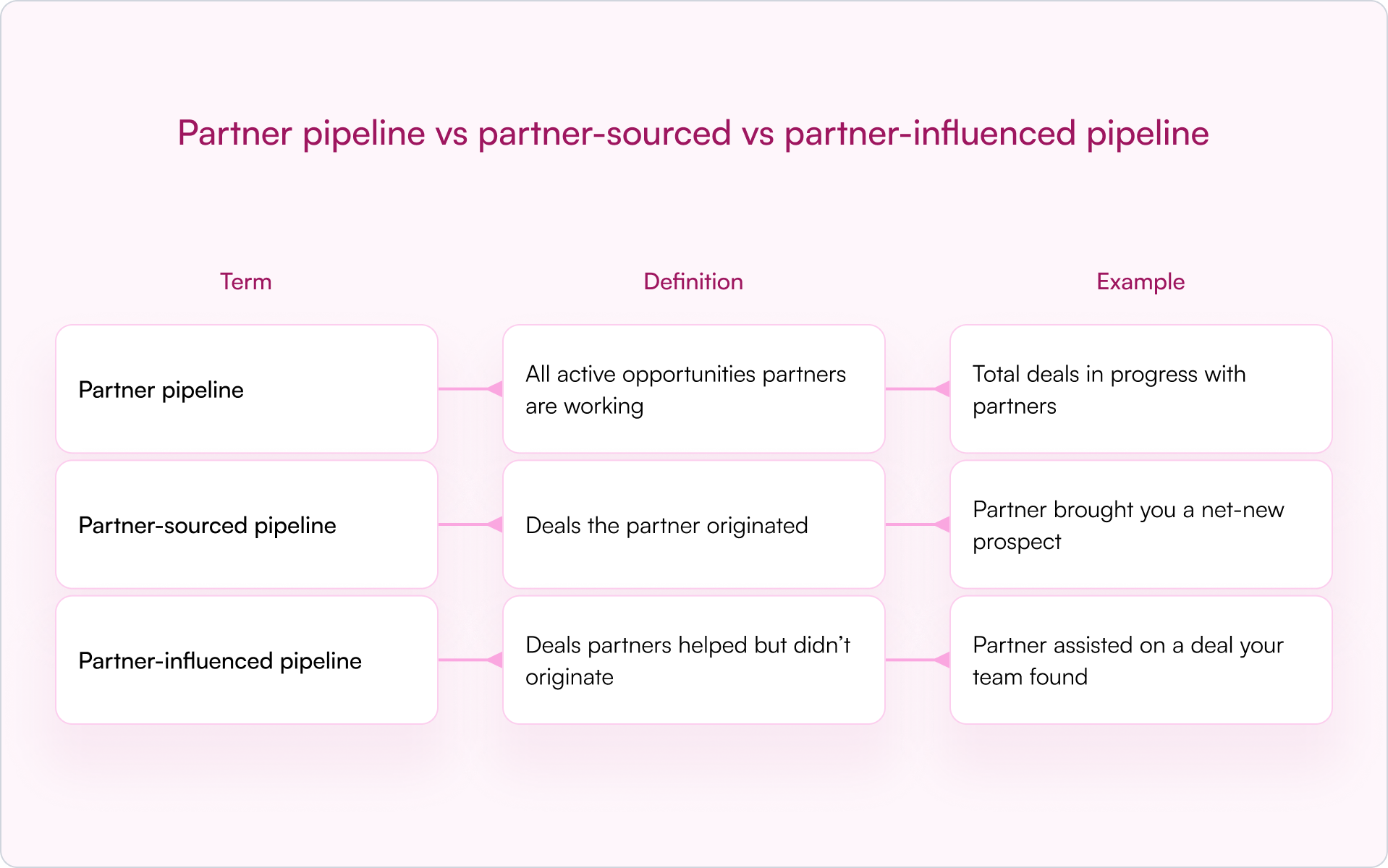
These terms get used interchangeably in board decks and QBRs, but they mean different things. Here’s the clean way to keep them straight.
Partner pipeline defined
Partner pipeline is the full set of opportunities in your partner channel, regardless of who found them first. It includes deals partners sourced, deals they’re influencing, and co-sell motions where both teams are actively involved.
Partner-sourced pipeline defined
Partner-sourced deals are opportunities where the partner identified and referred the prospect. They’re net-new to your business, meaning the partner created the demand. This is often the cleanest input into attribution and the easiest to credit.
Partner-influenced pipeline defined
Partner-influenced deals are opportunities where a partner contributed — through technical expertise, customer relationships, or implementation support — but your direct team (or another source) originated the lead.
Influenced deals still matter for forecasting and fair attribution. Many teams split credit between sourced and influenced to reflect the actual contribution.
How partner pipeline management works
Partner pipeline management is the operational workflow that moves deals from registration through close. It’s not a concept — it’s a set of repeatable steps you can instrument and improve.
Deal registration and lead intake
Deal registration is the process where partners formally submit opportunities for approval and protection. This is the entry point for pipeline.
When a partner registers a deal, they’re claiming ownership and requesting protection from competition, whether from other partners or your direct team. Modern approaches allow registration via forms, email, or portal without forcing partner logins.
Opportunity tracking and stage updates
Once registered, deals move through stages. Partners (or partner managers) update status as opportunities progress — from qualified to proposal to negotiation to close.
The common failure mode is predictable: you end up chasing partners for updates, partners don’t respond, and the partner pipeline becomes stale. Low-friction update methods (for example, email replies that sync back to your CRM) improve compliance without nagging.
CRM sync and data flow
Partner pipeline data belongs in your CRM (Salesforce, HubSpot) — not a separate spreadsheet or a disconnected portal. This is where a CRM-first approach matters.
When partner data lives in your CRM, everyone sees the same reality: Sales, Partnerships, RevOps, and leadership. Clean CRM data enables accurate reporting, forecasting, and attribution.
Pipeline reporting and dashboards
Once data flows into your CRM, you can build reports showing partner pipeline by stage, partner, region, product, and sourced vs. influenced contribution.
This is what makes a partner program measurable. Without reporting, you’re relying on memory and anecdotes — which doesn’t scale past a handful of deals.
Common partner pipeline stages
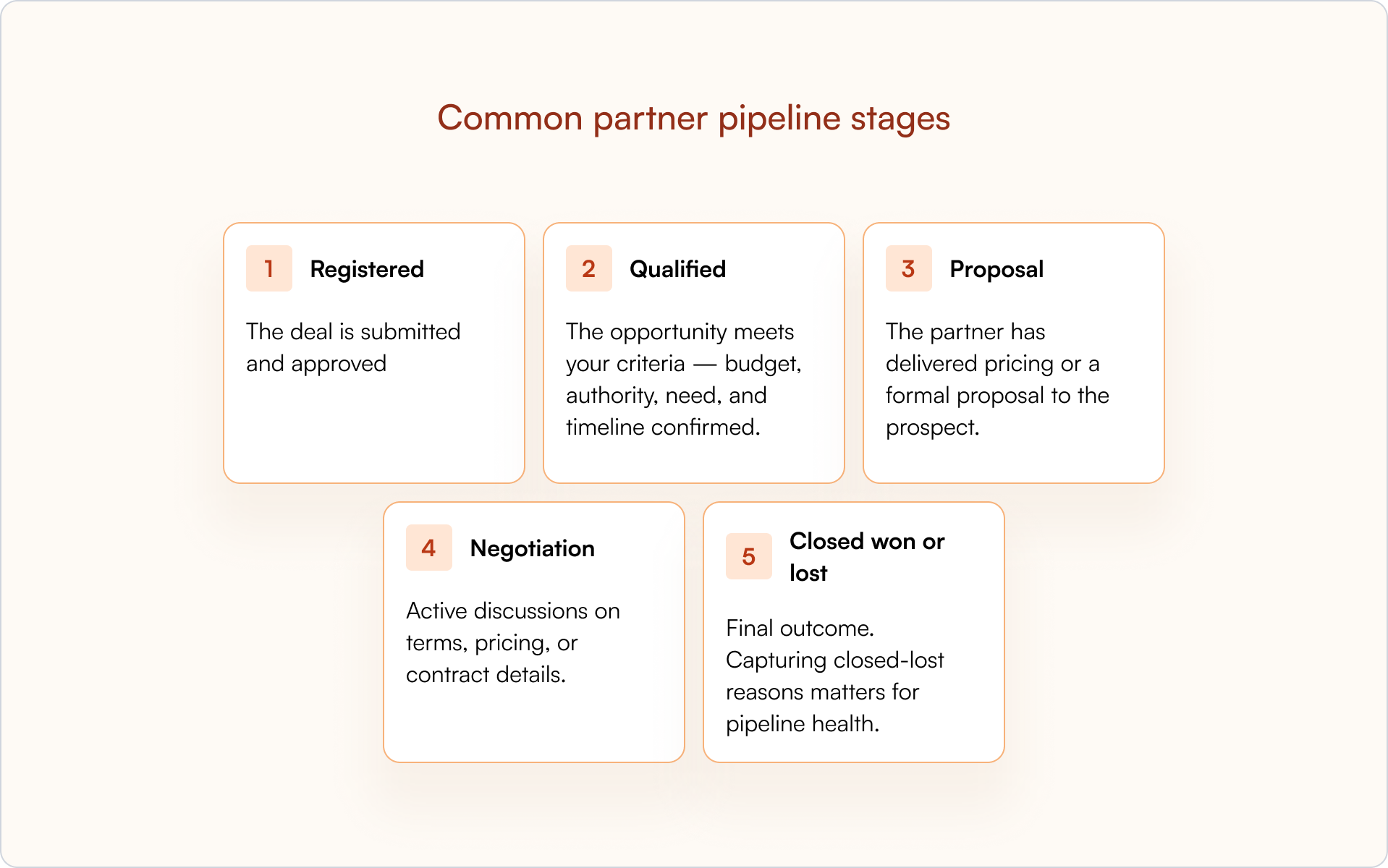
Partner pipeline stages typically mirror your direct sales stages, though some teams simplify them for partners. A common structure looks like this:
Registered
The deal is submitted and approved. The protection period begins, typically 60–90 days where the partner has exclusive ownership.
Qualified
The opportunity meets your criteria — budget, authority, need, and timeline confirmed. This is where you know the deal is real.
Proposal
The partner has delivered pricing or a formal proposal to the prospect. The deal is actively being worked.
Negotiation
Active discussions on terms, pricing, or contract details. The deal is close to a decision.
Closed won or lost
Final outcome. Capturing closed-lost reasons matters for pipeline health: it tells you where deals are falling apart and whether partners need enablement, better positioning, or faster internal support.
Key partner pipeline metrics to track
Here are the metrics partner managers and revenue leaders typically monitor:
- Partner pipeline coverage: Ratio of partner pipeline to partner revenue target. Indicates whether you have enough deals in motion to hit goals.
- Partner pipeline velocity: How quickly deals move through stages. Slower velocity can signal enablement gaps or stuck deals.
- Partner win rate: Percentage of partner deals that close successfully. Compare to direct sales to understand partner effectiveness.
- Partner-sourced revenue: Total closed revenue from partner-originated deals. Often the clearest output metric.
- Average deal size by partner: Reveals which partners bring larger opportunities and informs where to invest (enablement, MDF, co-sell support).
How to track partner pipeline in your CRM
Setting up partner pipeline tracking in Salesforce or HubSpot is where “CRM-first” becomes real. The goal is simple: partner-submitted data should land in the same system your revenue team actually uses to run the business.
Essential fields for partner opportunities
Add the following fields to your opportunity (or deal) records:
- Partner name: which partner is working the deal
- Partner type: referral, reseller, SI, etc.
- Deal registration ID: link to the registration record
- Sourced vs. influenced: how the partner contributed
- Registration expiration date: when protection ends
Without partner fields, you can’t report on partner pipeline accurately — and you’ll struggle to resolve conflicts when they inevitably show up mid-quarter.
Partner pipeline tracking in Salesforce
In Salesforce, partner pipeline tracking typically means custom fields on the Opportunity object, partner account relationships, and reports filtered by partner. Stage-change validations can enforce that partner fields are populated before deals advance.
Introw’s Salesforce integration syncs partner-submitted data automatically, so you don’t rely on manual entry.
Partner pipeline tracking in HubSpot
In HubSpot, you’ll use deal properties, partner company associations, and dashboards. The same principle applies: partner data flows into your CRM without manual work.
Introw’s HubSpot integration keeps partner data clean and visible to everyone who needs it.
How to share partner pipeline visibility without exposing sensitive data
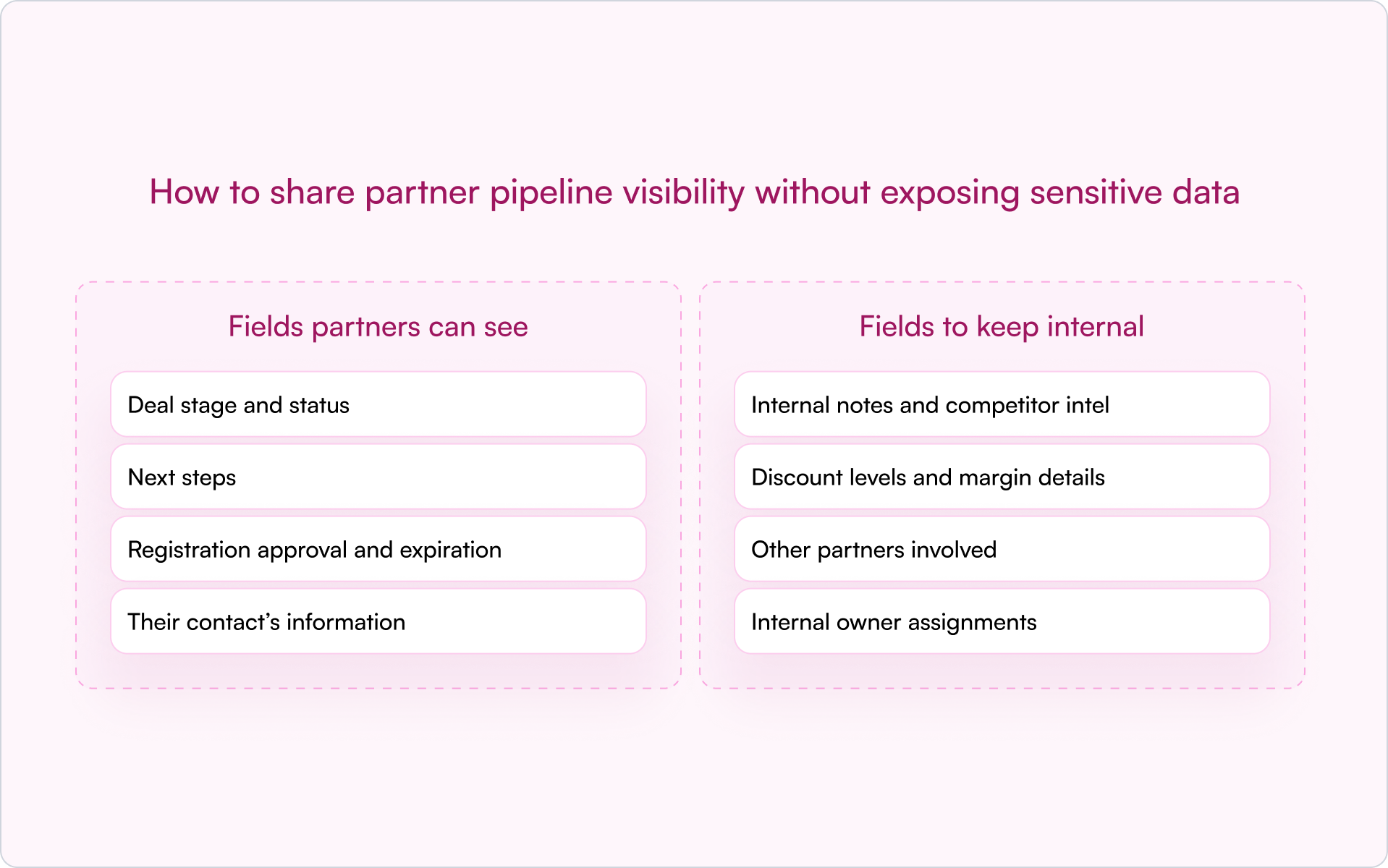
Partners want to see their deal status. That’s reasonable — it helps them sell. But you typically can’t (and shouldn’t) expose everything you track internally, like pricing strategy, discount levels, margin, or internal deal notes.
Fields partners can see
- Deal stage and status
- Next steps
- Registration approval and expiration
- Their contact’s information
Fields to keep internal
- Internal notes and competitor intel
- Discount levels and margin details
- Other partners involved
- Internal owner assignments
Permission controls and role-based access
CRM-first tools let you define exactly which fields partners can view. SSO and role-based access ensure the right people see the right data — and only that data.
Introw’s shared pipeline feature handles this without building custom portals. Partners see their deals; you control what’s visible.
When to start tracking partner pipeline
Not every company needs formal partner pipeline tracking from day one. But there are clear signals you’ve outgrown informal processes.
- You have more than a handful of active partners
- Deals are being disputed or duplicated
- You can’t forecast partner revenue accurately
- Partners complain about lack of visibility into their deals
If any of that sounds familiar, the “spreadsheet + email thread + memory” system is already costing you deals and trust. The fix isn’t more admin work — it’s better plumbing.
How to build a CRM-first partner pipeline
A CRM-first approach means partner pipeline tracking is built on top of your existing CRM, not in a separate system that hides partner activity and forces your team to reconcile data at the end of every month.
The benefits are practical:
- Single source of truth: Sales, Partnerships, and RevOps see the same data.
- No partner login friction: Partners can register deals and get updates without logging into another portal.
- Real-time visibility: Pipeline stays current instead of waiting on manual syncs.
- Clean attribution: Partner-sourced and partner-influenced revenue becomes trackable and forecastable.
This is what modern partner relationship management software is designed to support: not a second system, but an extension of the CRM you already use.
Conclusion: make partner pipeline a first-class revenue input
If you’re serious about partnerships as a growth lever, your partner pipeline can’t live in the shadows. Once you track it inside your CRM, you get better forecasting, cleaner attribution, and fewer surprises — which is exactly what you want as you scale.
If you want to see how this works in practice, book a demo and walk through how Introw tracks partner pipeline inside your CRM.
12 Partner Relationship Management Best Practices for 2026
Partner programs often stall not because of bad partners, but because your internal processes are scattered. Onboarding lives in one place, deal registration in another, and communication happens wherever someone remembers to send an email.
The teams that scale partner revenue treat PRM as an operational discipline, not a collection of disconnected tools. Below are 12 partner relationship management best practices that keep partner data clean, partners engaged, and pipeline visible — without adding complexity.
What is partner relationship management?
Partner relationship management (PRM) focuses on building trust, enabling partners through technology, and driving mutual profitability. PRM includes structured onboarding, consistent communication, deal registration workflows, and performance tracking — all designed to improve collaboration between your company and your channel partners.
PRM sits alongside your CRM but serves a different purpose. While CRM tracks your direct relationships with customers, PRM tracks your relationships with the resellers, referral partners, distributors, and implementation partners who sell on your behalf.
What PRM typically covers
- Partner onboarding: Getting new partners trained and ready to sell your product
- Deal and lead registration: Tracking partner-sourced opportunities and protecting them from conflict
- Enablement: Providing sales materials, training, and ongoing support
- Performance tracking: Measuring each partner’s contribution to pipeline and revenue
- Communication: Keeping partners informed, engaged, and aligned with your goals
When onboarding, registration, enablement, tracking, and communication work together, partner programs become measurable and operationally tight — not a side project running on spreadsheets.
Key components of partner relationship management
Before diving into partner relationship management best practices, it helps to name the building blocks of any partner program. The components below form the foundation that PRM software supports at scale.
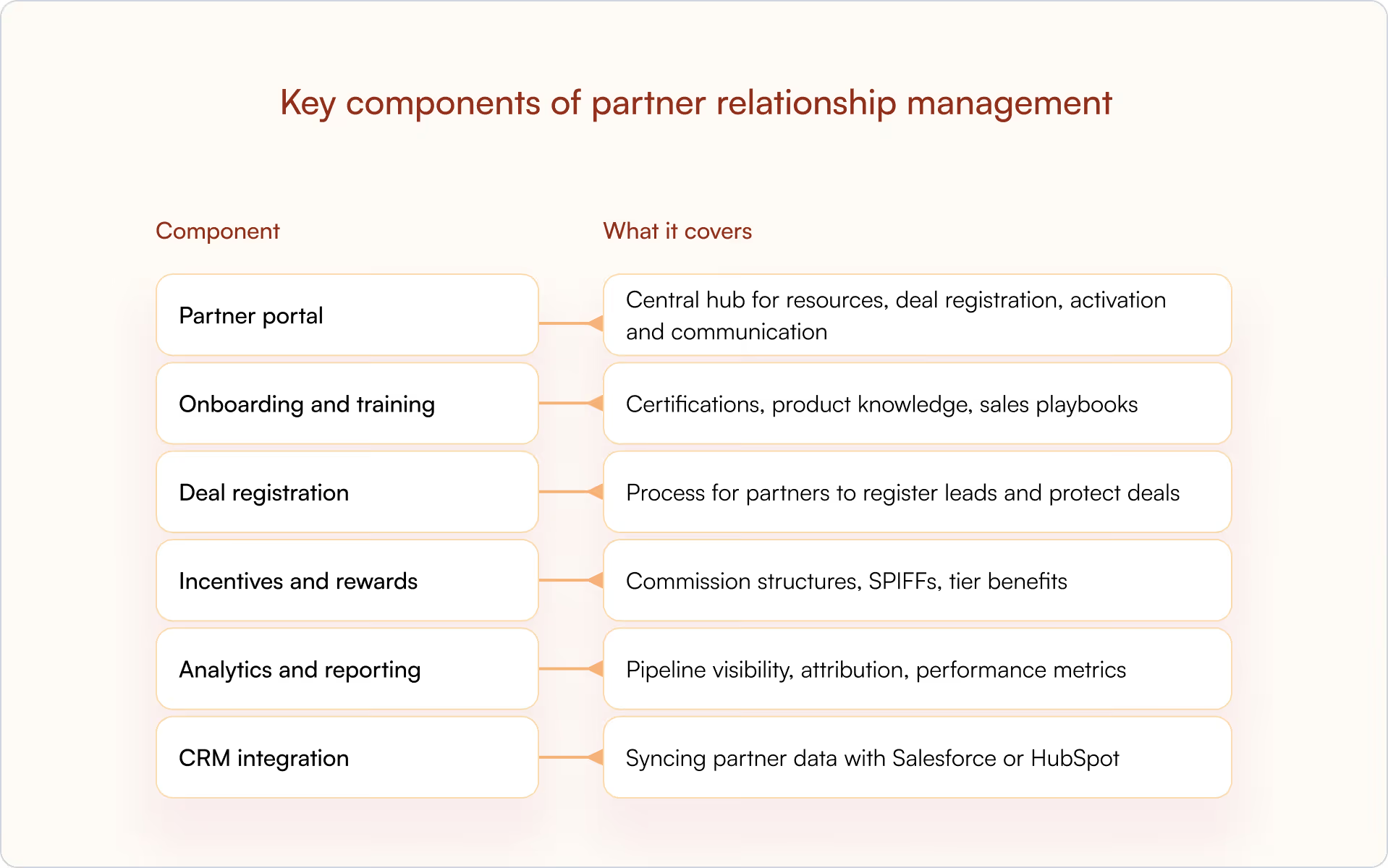
Each component addresses a specific operational gap. The best practices below show how to implement each one effectively — and how to keep it founder-friendly: simple, measurable, and scalable.
12 partner relationship management best practices to grow your program
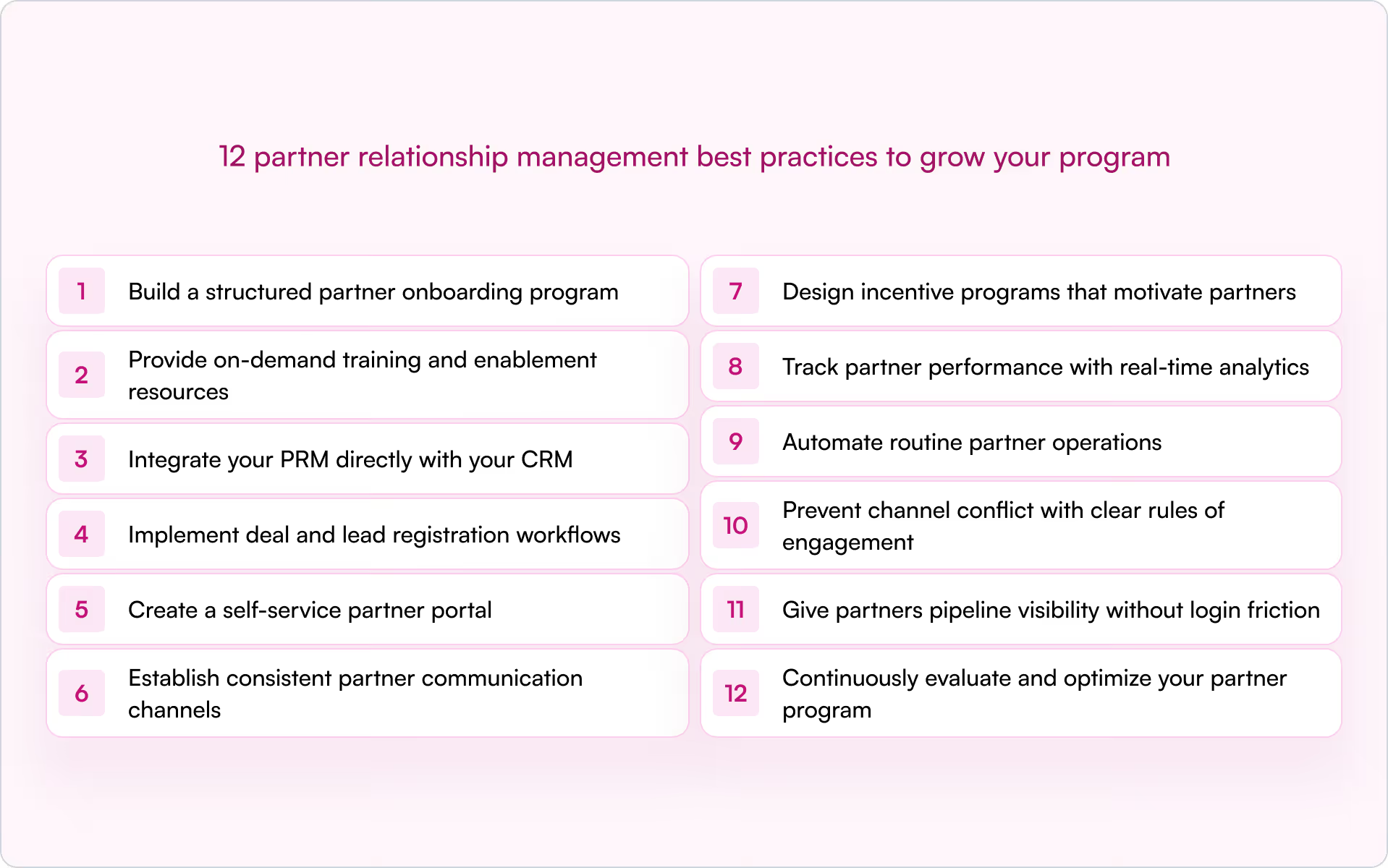
1. Build a structured partner onboarding program
Partners who complete onboarding quickly tend to sell faster. Yet many programs leave new partners to figure things out on their own, which leads to slow ramp times and early disengagement.
A structured onboarding program gives every partner the same foundation: a welcome sequence, product training, certification paths, and defined milestones so partners know exactly what “ready to sell” looks like.
Key onboarding elements
- Welcome kit: Program overview, key contacts, and first steps
- Product training: Core features, use cases, and competitive positioning
- Sales certification: Ensures partners can represent your product accurately
- Defined milestones: Clear checkpoints that signal readiness
Self-serve onboarding works better than scheduled calls for most partners. Partners can move at their own pace without waiting on your team’s availability.
2. Provide on-demand training and enablement resources
Onboarding gets partners started. Ongoing enablement keeps them sharp.
Partners juggle multiple vendor relationships. The vendors who make it easy to find answers and stay current usually earn more mindshare. That means battle cards, demo scripts, objection handling, and pricing documentation — all accessible without emailing a partner manager.
Resources that drive engagement
- Battle cards: Competitive comparisons partners can reference mid-conversation
- Demo environments: Sandbox access so partners can show the product themselves
- Pricing and packaging guides: Clear documentation to avoid quoting errors
- Case studies: Customer stories partners can share with prospects
If a partner has to ask for basic information, you’ve added friction that slows deals.
3. Integrate your PRM directly with your CRM
When PRM lives outside the CRM, partner pipeline becomes invisible to sales and RevOps. Forecasting suffers. Attribution breaks. And you end up with two systems that don’t agree on what’s happening.
CRM-first PRM solves this by keeping partner data inside HubSpot or Salesforce, where your revenue team already works.
Benefits of native CRM integration
- Single source of truth: No duplicate records or conflicting data
- Pipeline visibility: Sales and partner teams see the same deals
- Accurate attribution: Partner-sourced revenue is trackable for comp and planning
- Automated workflows: Deal registration triggers can route approvals and alerts inside the CRM
If your PRM creates a separate database, you’re building a visibility gap that grows with every new partner.
4. Implement deal and lead registration workflows
Deal registration is how partners claim an opportunity and receive protection from conflict. Without deal registration, you’re left resolving disputes after the fact, which damages trust and slows deals.
A good registration workflow includes required fields, approval SLAs, protection windows, and clear expiration rules. Partners know what to submit, how long they’re protected, and what happens if a deal stalls.
Workflow elements to define
- Required fields: Company name, contact info, estimated deal size, expected close date
- Approval SLA: How quickly you commit to approving or declining registrations
- Protection window: How long the partner has exclusivity on the deal
- Expiration and extension rules: What happens when protection expires or deals go quiet
When registration is fast and fair, partners participate. When registration is slow or opaque, partners stop submitting — and you lose visibility into partner-sourced pipeline.
5. Create a self-service partner portal
A partner portal gives partners a single destination for resources, deal registration, deal status, and communication with your team. Done well, it reduces the back-and-forth that bogs down partner managers.
The key is reducing friction, not adding it. Partners don’t want to email someone for basic information or log into multiple systems to check on a deal.
Portal capabilities that matter
- Resource library: Training materials, sales collateral, product docs
- Deal registration forms: Submit and track opportunities
- Pipeline visibility: Partners see status updates on their deals
- Announcements: Policy changes, new resources, program updates
A portal that’s hard to access or navigate will be ignored. One that’s fast and useful becomes the default way partners engage with your program.
6. Establish consistent partner communication channels
Partners disengage when they don’t hear from you. And when partners are surprised by policy changes, trust erodes quickly.
Consistent communication means defining what you share, how often, and through which channels. Email, Slack, and portal announcements all work. The key is predictability.
Communication types to establish
- Program announcements: Policy changes, new incentives, product launches
- Pipeline updates: Deal status changes, approval decisions, expiring protections
- Enablement broadcasts: New training, updated collateral, competitive intel
- QBR invitations: Quarterly reviews for strategic partners
Partners manage multiple vendor relationships. The vendors who communicate clearly and consistently tend to stay top of mind.
7. Design incentive programs that motivate partners
Incentives shape behavior. If you want partners to bring new logos, incentivize new business. If you want partners to expand accounts, reward upsells.
The most effective incentive programs are simple to understand and easy to claim. Complexity kills participation.
Align incentives with your program goals. And make sure partners can actually track their progress. Hidden or delayed payouts undermine trust.
8. Track partner performance with real-time analytics
You can’t improve what you can’t measure. Partner performance tracking gives you visibility into who’s contributing, who’s stalling, and where to focus your attention.
Dashboards that live in or sync to your CRM make tracking easier. Partner managers don’t want to pull manual reports just to understand what’s happening.
Key metrics to track
- Deal registration volume: How many opportunities partners are submitting
- Pipeline value: Total value of partner-sourced deals in progress
- Conversion rate: Percentage of registered deals that close
- Partner engagement: Portal logins, training completions, resource downloads
Real-time visibility helps you spot problems early and double down on what’s working.
9. Automate routine partner operations
Partner managers often spend too much time on tasks that could be automated: registration approvals, status notifications, expiration reminders, welcome sequences.
Automation reduces manual work and ensures nothing falls through the cracks. It also makes it possible to scale your program without proportionally scaling headcount.
Automation opportunities
- Registration routing: Auto-assign approvals based on deal size or territory
- Status notifications: Alert partners when deals move stages
- Expiration reminders: Warn partners before protection windows close
- Onboarding sequences: Trigger welcome emails and training assignments automatically
The goal isn’t to remove the human element. The goal is to free up partner managers for relationship-building instead of administrative tasks.
10. Prevent channel conflict with clear rules of engagement
Channel conflict happens when partners compete with each other, or with your direct sales team, for the same deal. Channel conflict is one of the fastest ways to damage partner trust.
Prevention starts with clear rules: territory definitions, deal registration policies, and escalation paths. When everyone knows the rules upfront, disputes become rare.
Conflict prevention elements
- Territory and segment rules: Who can sell to which accounts
- First-to-register protection: Registered deals get exclusivity
- Direct vs. partner prioritization: When direct sales can engage partner accounts
- Escalation process: How to resolve disputes when conflicts occur
Practical tip: Publish your rules of engagement in your partner portal so partners can reference them anytime, not just when a dispute arises.
Ambiguity creates conflict. Clarity prevents it.
11. Give partners pipeline visibility without login friction
Partners disengage when they can’t see what’s happening with their deals. But requiring portal logins for every update creates friction that slows engagement.
The solution is off-portal collaboration. Partners can receive updates via email and respond without logging into a separate system. Partner replies sync back to your CRM automatically.
Visibility approaches that reduce friction
- Shared pipeline views: Partners see their deals and current status
- Email notifications: Automatic alerts for stage changes and approvals
- Reply-by-email: Partners respond to updates without portal login
- Property-level controls: Show partners relevant fields without exposing sensitive data
Visibility keeps partners motivated. Friction kills momentum.
12. Continuously evaluate and optimize your partner program
Partner programs require iteration. What works at 20 partners often breaks at 100. Reviewing performance quarterly, gathering partner feedback, and adjusting based on results keeps your program healthy as it scales.
Optimization activities to build into your cadence
- Quarterly business reviews: Deep-dive with strategic partners on performance and roadblocks
- Partner feedback surveys: Understand what’s working and what’s frustrating
- Incentive analysis: Check if incentives are driving desired behavior
- Process audits: Identify bottlenecks in onboarding, registration, and support
The best partner programs treat optimization as ongoing work, not a one-time project.
How PRM software supports partner relationship management best practices
PRM software operationalizes the best practices above. The right platform integrates with your CRM, reduces manual work, and gives partners a professional experience that keeps them engaged.
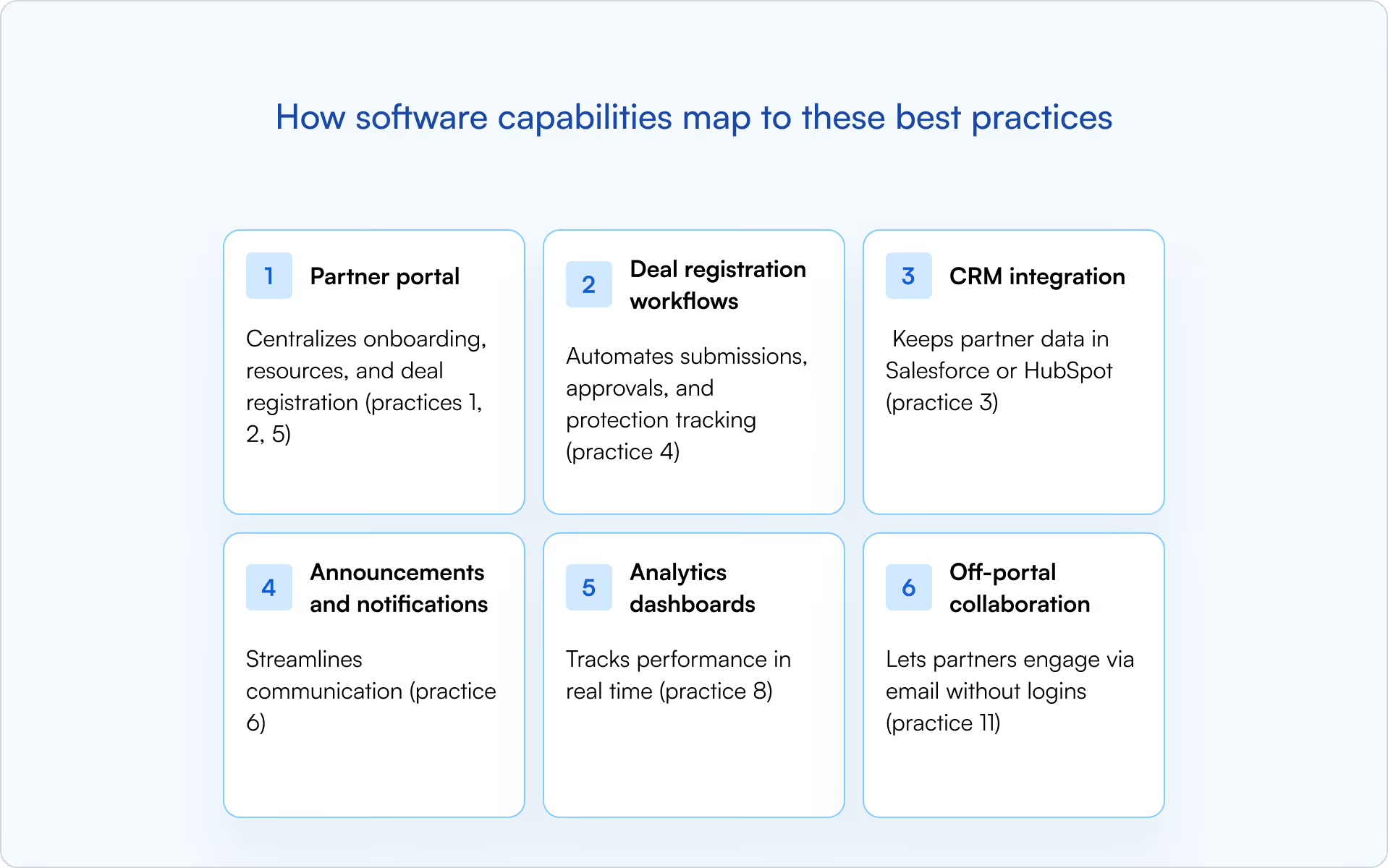
How software capabilities map to these best practices
- Partner portal: Centralizes onboarding, resources, and deal registration (practices 1, 2, 5)
- Deal registration workflows: Automates submissions, approvals, and protection tracking (practice 4)
- CRM integration: Keeps partner data in Salesforce or HubSpot (practice 3)
- Announcements and notifications: Streamlines communication (practice 6)
- Analytics dashboards: Tracks performance in real time (practice 8)
- Off-portal collaboration: Lets partners engage via email without logins (practice 11)
Introw is built on a CRM-first approach. Partner data stays inside HubSpot or Salesforce, partners can engage without managing another login, and your team gets real-time visibility into partner-sourced pipeline.
Get a demo to see how Introw helps partner teams put partner relationship management best practices into action.
Conclusion: keep PRM simple, measurable, and CRM-first
If you’re building a partner motion as a founder, the biggest unlock is treating PRM like revenue infrastructure. Start with clean data in your CRM, make partner participation easy (self-serve + low-friction collaboration), and automate the operational noise.
Do that, and your partner program stops being “extra pipeline” and becomes a predictable channel you can actually forecast.
Partner Content Enablement Guide (That Actually Reaches Your Partners in 2026)
If you have ever asked what is content enablement, think of it as the connective tissue between creating content and closing deals. It is the discipline of organizing, delivering, and measuring sales enablement materials so sellers and partners can move prospective customers through the sales funnel with less friction. In a partner context, content enablement meaning widens: you are equipping external channel partners with up to date partner content and giving your internal sales team visibility into how it was used before a purchase order shows up.
Why is this urgent in 2026? Creation points keep multiplying. Marketing teams ship pages, playbooks, and videos. Sales reps record custom demos. Product managers publish technical specifications and security FAQs. Without a content enablement strategy, valuable content scatters across drives and chat threads. Partners guess which version is current, legal fees rise because brand risk slips through, and sales cycles drag while people hunt for the right slide. A thoughtful partner enablement strategy fixes this by aligning business content to buyer engagement and making it simple for partners to find, send, and track.
The old way versus the new way of enabling partners
It helps to name the shift so your partner program knows what will change and why.
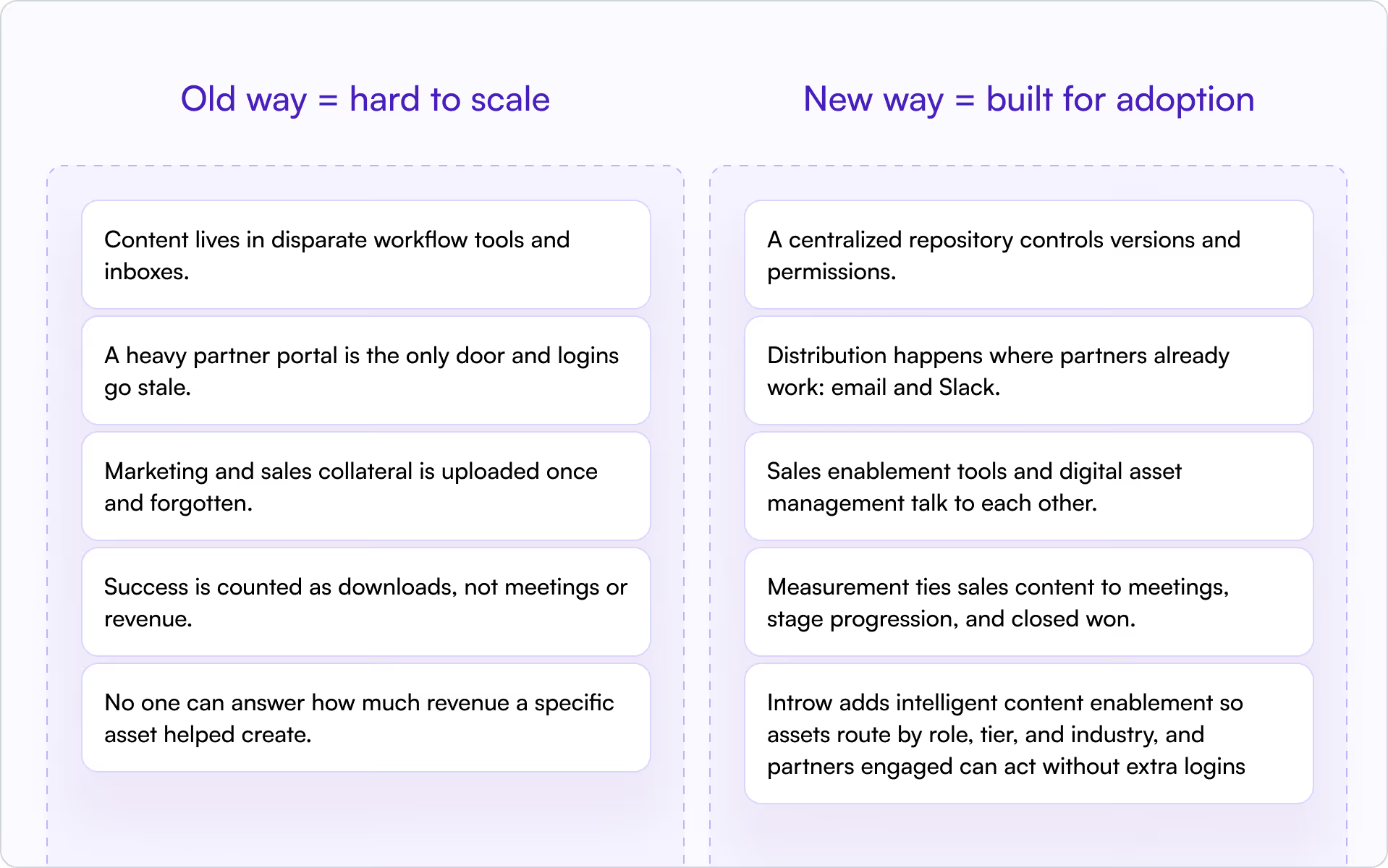
Old way, hard to scale
- Content lives in disparate workflow tools and inboxes.
- A heavy partner portal is the only door and logins go stale.
- Marketing and sales collateral is uploaded once and forgotten.
- Success is counted as downloads, not meetings or revenue.
- No one can answer how much revenue a specific asset helped create.
New way, built for adoption
- A centralized repository controls versions and permissions.
- Distribution happens where partners already work: email and Slack.
- Sales enablement tools and digital asset management talk to each other.
- Measurement ties sales content to meetings, stage progression, and closed won.
- Introw adds intelligent content enablement so assets route by role, tier, and industry, and partners engaged can act without extra logins.
The new way respects how sales partners actually sell and how marketing teams want to manage brand consistency.
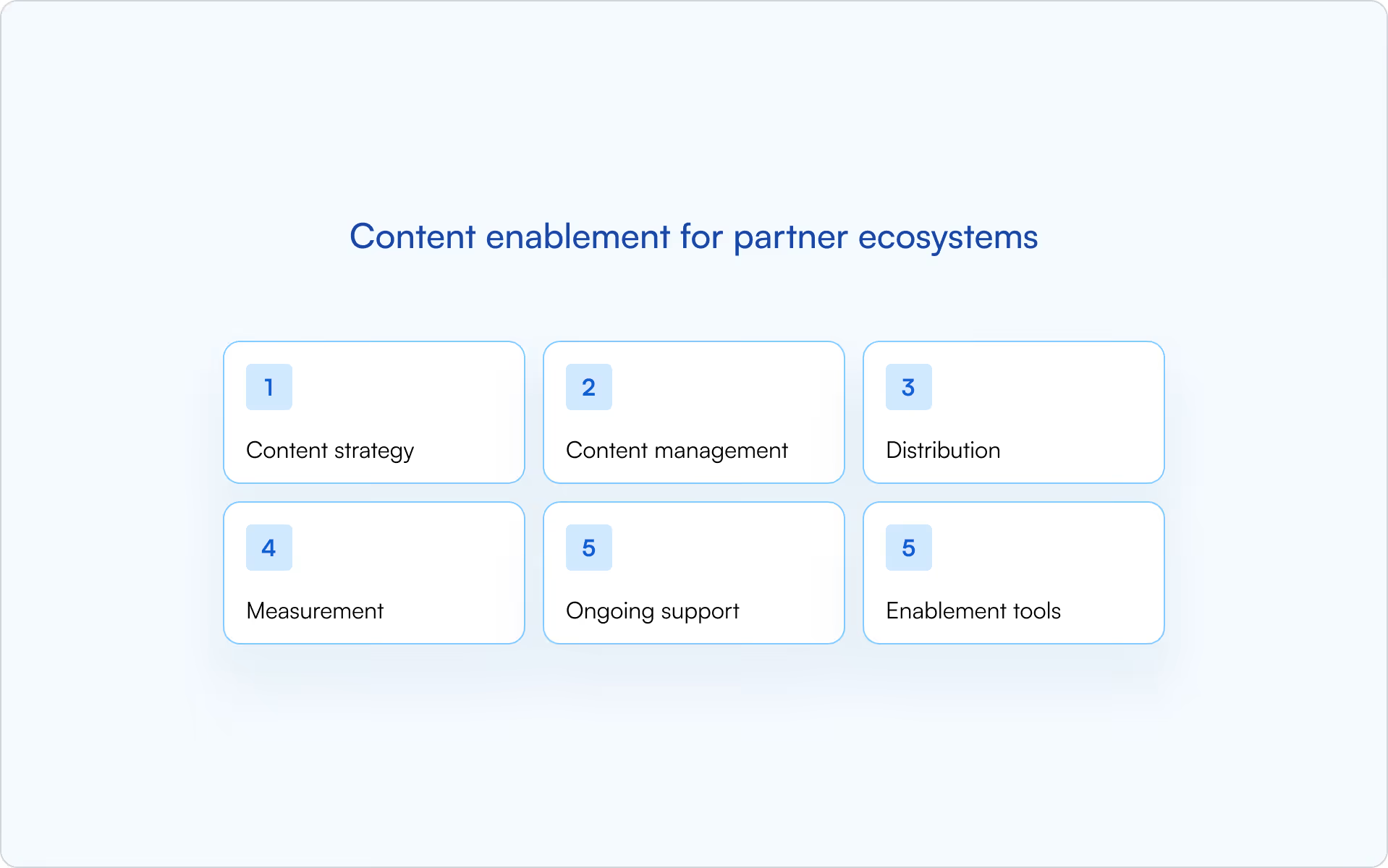
The expanded definition: content enablement for partner ecosystems
Let’s expand the definition so you can design an effective partner enablement strategy that fits a modern partner ecosystem.
- Content strategy maps formats to customer personas, objections, and stages. This is where value propositions are clarified and marketing materials are prioritized.
- Content management ensures managing content is safe and simple. Digital asset management, access controls, and data security keep everything current and compliant.
- Distribution puts partner enablement content into the flow of work. Think push delivery for urgency and a partner content hub for browsing and training.
- Measurement connects actions to outcomes. Key performance indicators live in your CRM and show what content actually shortens the sales cycle and improves sales performance.
- Ongoing support keeps partners engaged. Sales training, partner enablement training, and office hours help partners apply the message on real sales calls.
- Enablement tools automate the boring parts. Sales AI tools can flag stale claims, suggest next best content, apply AI powered spell checking to drafts, and even trigger document generation for localized one pagers.
This expanded definition turns a pile of files into a repeatable system.
The formats partners actually use — and why they work
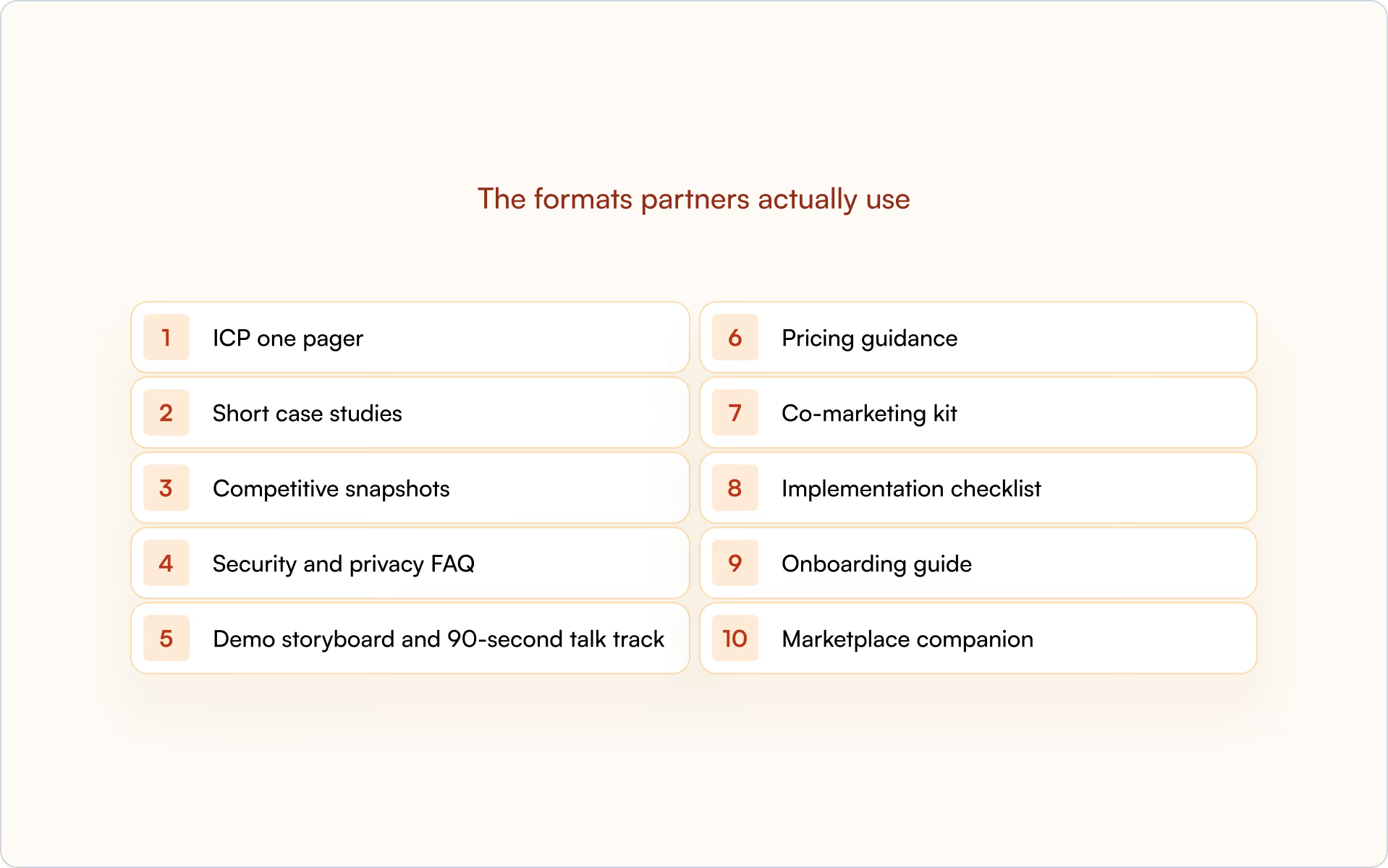
You do not need hundreds of assets to support channel partners. You need a tight core mapped to the buyer journey, plus a plan to keep it up to date. Here is a practical short list that consistently moves deals:
- ICP one pager that captures pains, triggers, and crisp value propositions for your target audience.
- Short case studies with outcomes, named roles, and a quote you can reuse.
- Competitive snapshots with three differentiators and traps to avoid.
- Security and privacy FAQ that answers procurement’s first questions and reduces back-and-forth.
- Demo storyboard and 90-second talk track that link features to jobs-to-be-done.
- Pricing guidance that explains models without revealing internal margins.
- Co-marketing kit with a landing page outline, two emails, and three social posts that partners can localize.
- Implementation checklist for services partners, including technical specifications and boundaries.
- Onboarding guide that sets expectations for handoff and adoption.
- Marketplace companion if you transact through AWS Marketplace or Google Cloud Marketplace.
Each item should show an owner, a version date, and a stage. That simple metadata is how sales and marketing teams keep confidence high.
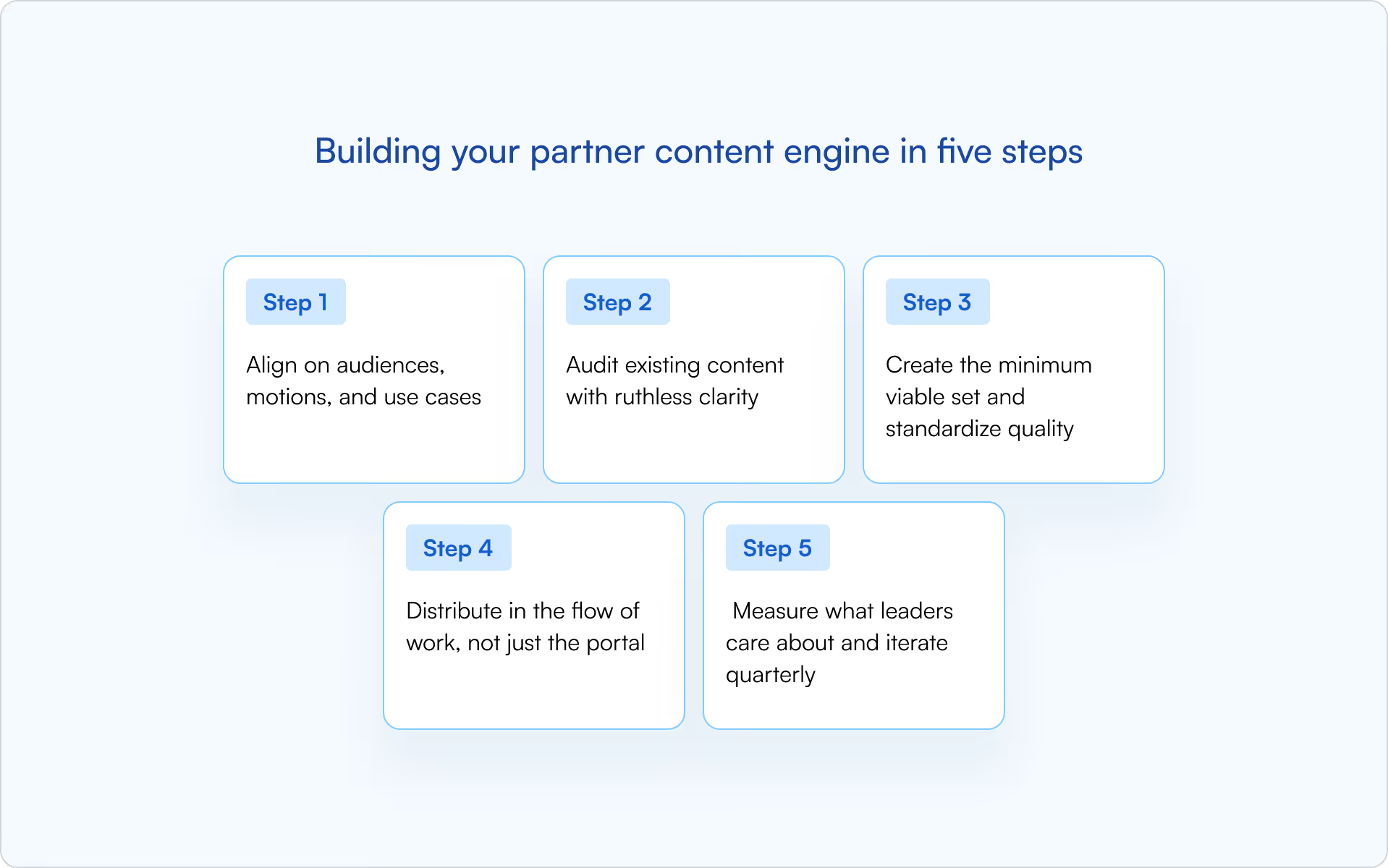
Building your partner content engine in five steps
Every step here flows into the next, so avoid skipping ahead. You are building a system, not just uploading files.
Step 1. Align on audiences, motions, and use cases
Start with segmentation. Split your partner ecosystem by motion — resell, referral, ISV, and services. Within each motion, separate sellers and consultants, then overlay partner tier and region. This gives you the targeting you need so a consultant does not receive first-call decks, and a reseller AE is not reading deep implementation playbooks.
Outcome: clear audiences for content and reporting, fewer irrelevant pings, better partner satisfaction.
Step 2. Audit existing content with ruthless clarity
Map every asset to discovery, evaluation, selection, or onboarding. Identify duplicates and outdated claims. Keep winners, merge near-duplicates, and retire risky files. Capture gaps that stall deals, like an absent security FAQ or a weak competitive snapshot. This is where content related technologies help: a digital asset management tool will expose duplicates, and enablement tools will surface low-use files to replace.
Outcome: a trimmed library that your internal team trusts and partners will actually reuse.
Step 3. Create the minimum viable set and standardize quality
Create marketing and sales collateral with a shared checklist: audience, use case, stage, owner, review cadence, legal status. Use standardized templates to speed document generation and maintain brand consistency. Where possible, add short narration guidance so sales reps know when and how to use the asset during sales calls.
Outcome: fewer, sharper pieces that are easier to keep up to date and safer to send.
Step 4. Distribute in the flow of work, not just the portal
A partner portal is useful, but it should not be the only door. Push content by email and Slack when timing matters. Let partners browse a partner content hub for training and self-serve discovery. Surface the next best asset inside your CRM when a sales rep opens an opportunity. Distribution should feel like today’s digital HQ, not a scavenger hunt.
Outcome: higher adoption, faster response, and less time spent hunting links.
Step 5. Measure what leaders care about and iterate quarterly
Replace vanity metrics with outcome metrics. Track first meetings within 14 days of send, stage progression on opportunities that received specific assets, influenced pipeline, and win rate deltas where content was used. Add operational KPIs like training completion and asset freshness. Review quarterly with partners and your internal sales team, then tune your content enablement strategy.
Outcome: proof that content moves revenue, not just downloads.
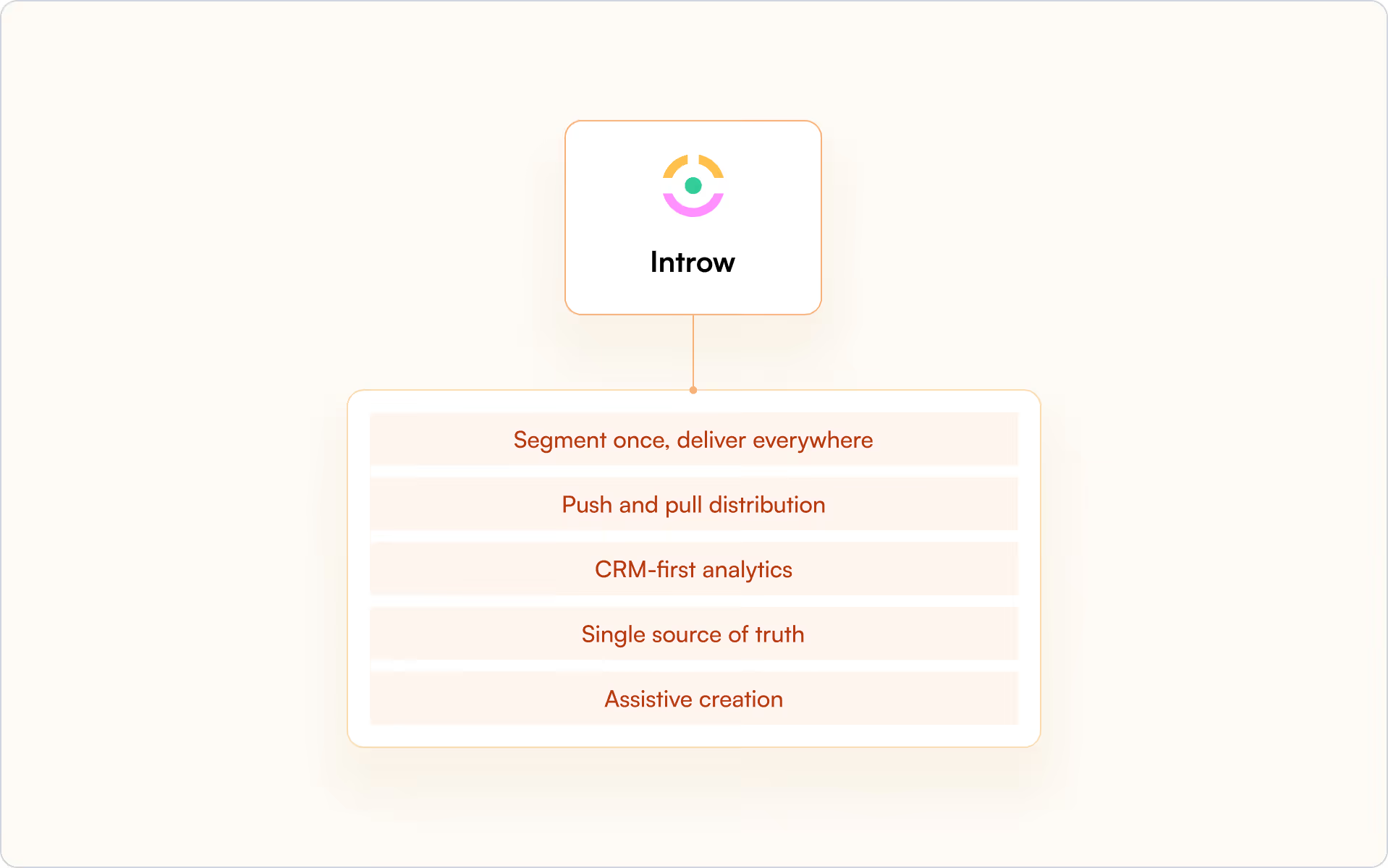
Where Introw fits — intelligent content enablement that partners adopt
Introw is built to make partner content reach the field and show up in your numbers.
- Segment once, deliver everywhere. Target by motion, tier, role, industry, certification status, or region. A reseller AE gets first-call assets and a co-marketing kit. A services architect sees implementation plays and product training.
- Push and pull distribution. Send content by email and Slack for urgency, while a lightweight partner content hub supports discovery and training. Partners do not need to learn a heavy system to stay current.
- CRM-first analytics. Engagement rolls up next to account and opportunity records so leaders can see which assets improve first-meeting rate, stage progression, and close won.
- Single source of truth. A centralized repository handles managing content, permissions, and data security. Owners and review cadences keep everything up to date.
- Assistive creation. Sales AI tools inside the workflow suggest next best content, flag stale messages, apply AI powered spell checking, and trigger document generation for localized one pagers.
This is partner content marketing that respects how partners sell and how marketing and sales teams want to measure.
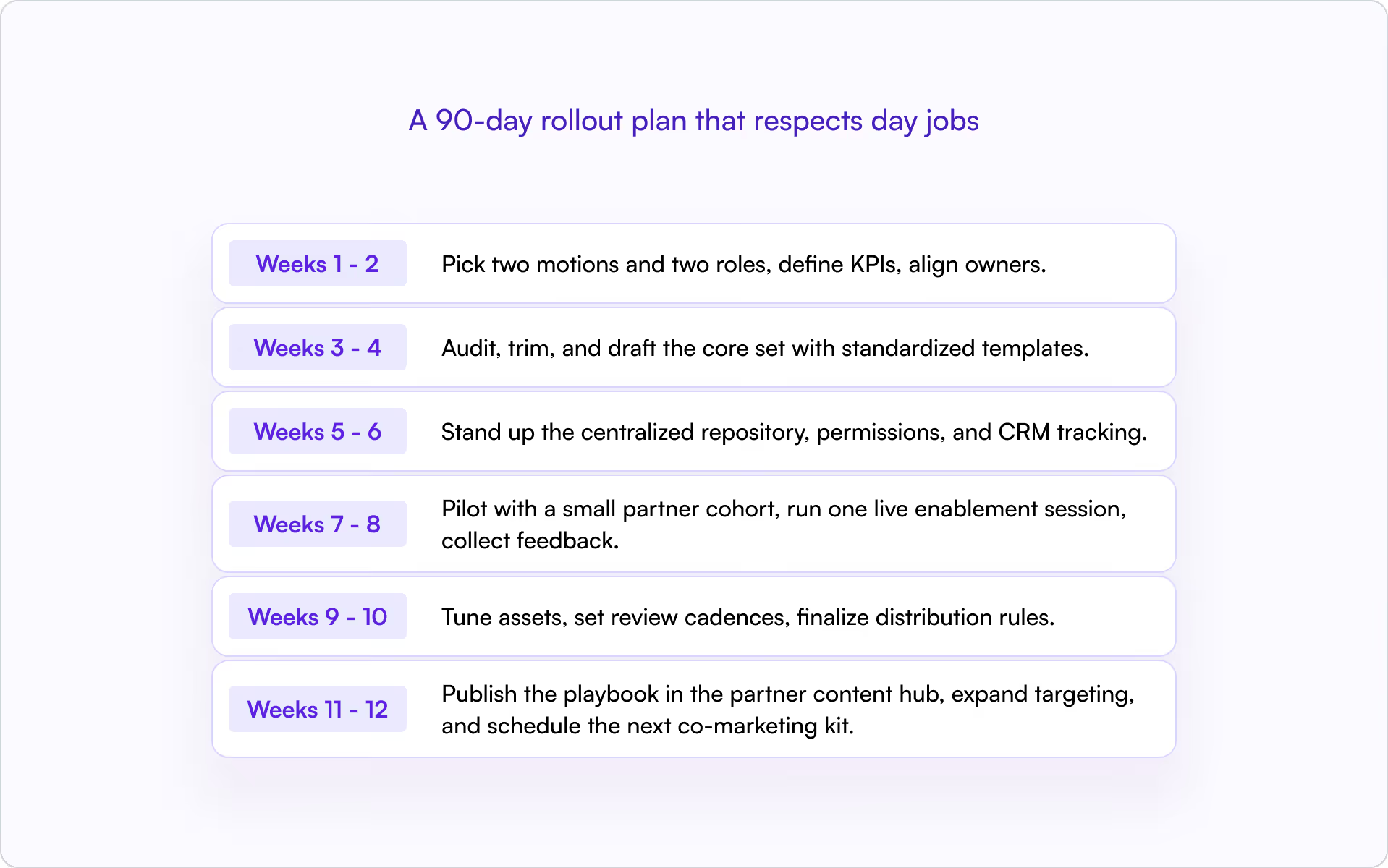
A 90-day rollout plan that respects day jobs
Long rollouts lose momentum. This plan gets you live fast and gives you space to improve.
Weeks 1–2 — pick two motions and two roles, define KPIs, align owners.
Weeks 3–4 — audit, trim, and draft the core set with standardized templates.
Weeks 5–6 — stand up the centralized repository, permissions, and CRM tracking.
Weeks 7–8 — pilot with a small partner cohort, run one live enablement session, collect feedback.
Weeks 9–10 — tune assets, set review cadences, finalize distribution rules.
Weeks 11–12 — publish the playbook in the partner content hub, expand targeting, and schedule the next co-marketing kit.
Because Introw connects segmentation, delivery, and analytics to your CRM, most of the wiring is configuration rather than custom work.
Bringing it all together
Great partner enablement is not about more files. It is about delivering relevant marketing content to the right people at the right time and proving it helped close business. When sales and marketing teams share a centralized repository, when content management is tight, and when distribution meets partners where they already work, buyer engagement improves and closing deals gets easier.
Introw adds the missing glue by combining segmentation, a partner content hub, push delivery, and CRM analytics so your channel partner enablement program turns content into revenue. If you want an effective partner enablement strategy that partners adopt and leaders can measure, Introw is ready to help.
17 Salesforce PRM Alternatives to Choose From in 2026 (Partner Cloud)
Salesforce’s native PRM — now packaged as Partner Cloud on Experience Cloud — lets you build a partner portal, run deal registration, and connect partner activity into Sales Cloud and other Salesforce products. If your team is already all-in on Salesforce, it can be compelling. Still, many SaaS companies consider alternatives in 2026 for faster rollout, lower total cost, stronger HubSpot coexistence, or deeper support for motions like hyperscaler co-selling deals and affiliate marketing. The right partner relationship management software should automate sales processes, support opportunity management, and surface real time data for pipeline inspection across partners, customers, and channel sales.
Who this guide is for: B2B SaaS teams with active partner programs, at least two channel managers, and Salesforce or HubSpot CRM as the source of truth.
How we evaluated: CRM alignment (Salesforce and HubSpot), time-to-value, partner performance and adoption without logins, co-sell capability, affiliate needs across various industries, governance for RevOps, and reporting in the CRM. We also looked at AI capabilities, content management for enablement, and operational efficiency to drive long term success.
What to look for instead of Salesforce PRM
If you are replacing Experience Cloud for partners, prioritize CRM-first operations so sellers never leave Sales Cloud or HubSpot. Look for partner relationship management PRM workflows that reduce channel conflict, guide partners with in app guidance, and enable real time collaboration by email or Slack. You also want clean attribution and forecasting in the CRM, outcome based enablement that helps partners track progress and monitor performance, plus role-based access that keeps RevOps happy as you scale. Tools that automate sales processes, support custom objects, and give a complete view of customers, partners, and deals on a single platform will help many businesses improve market reach and reduce costs.
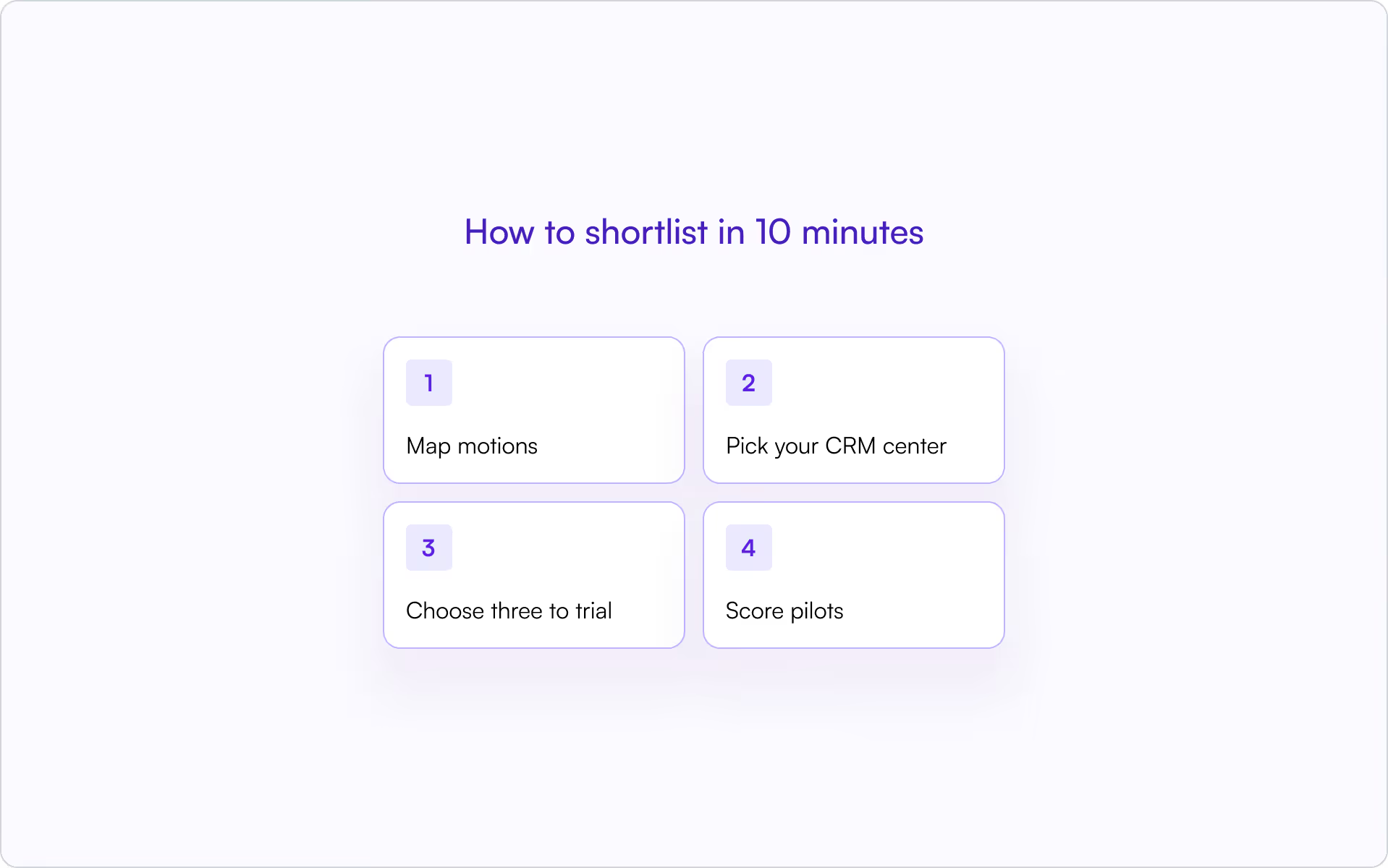
How to shortlist in 10 minutes
- Map motions — reseller, referral, co-sell, affiliate.
- Pick your CRM center — Salesforce only or Salesforce + HubSpot.
- Choose three to trial — e.g., Introw, Channeltivity, and Magentrix for CRM-first PRM; Impartner, ZINFI, Unifyr for enterprise channel scale; impact.com or Everflow for affiliate-heavy strategies; WorkSpan for hyperscaler co-sell.
- Score pilots on — time to first live deal registration, partner engagement without logins, CRM visibility, pipeline inspection, and forecast accuracy.
The 17 best Salesforce PRM alternatives in 2026
Whether you lean into referrals, resellers, co-sell, or affiliate, the options below span pure PRM software, co-sell orchestration, and performance-partner tools. For each, we highlight key features that affect partner productivity, customer data hygiene, and how easily channel managers can manage leads and opportunities across third party partners while staying fully integrated with your AI CRM and other Salesforce products like Service Cloud.
1) Introw
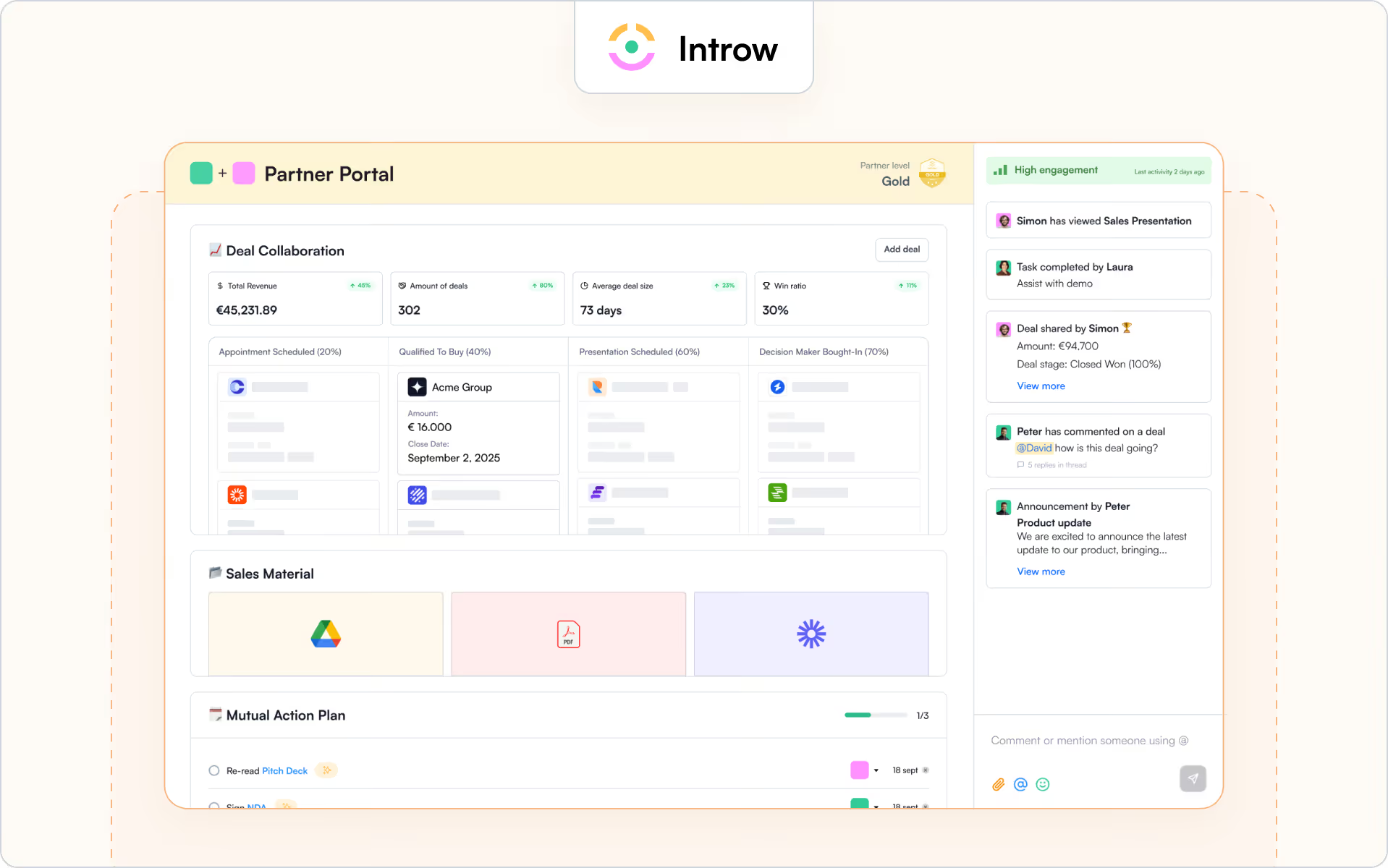
Best for: SaaS companies running referral, reseller, and co-sell motions that want the entire partner workflow to live in Salesforce or HubSpot — while keeping partners engaged through email and Slack so no one is forced to log in.
Why it’s an alternative: Instead of building a heavy Experience Cloud site, Introw keeps deal registration, collaboration, and reporting in your CRM and uses off-portal notifications so partners can reply to updates by email or collaborate via Slack — all synced back to Salesforce or HubSpot. That is a practical way to reduce portal fatigue, track deals and track leads with real time data, and speed time-to-value.
Callouts: Native integrations for Slack, HubSpot, and Salesforce help you capture leads and opportunities quickly. Partners can submit leads via public forms, email, or Slack, and every submission maps to the right CRM fields for clean attribution. If you are scaling a mixed motion — reseller, referral, MSP — the no-code partner portal, content management for enablement, and analytics make it easy to personalize experiences by partner type and monitor performance.
2) Impartner
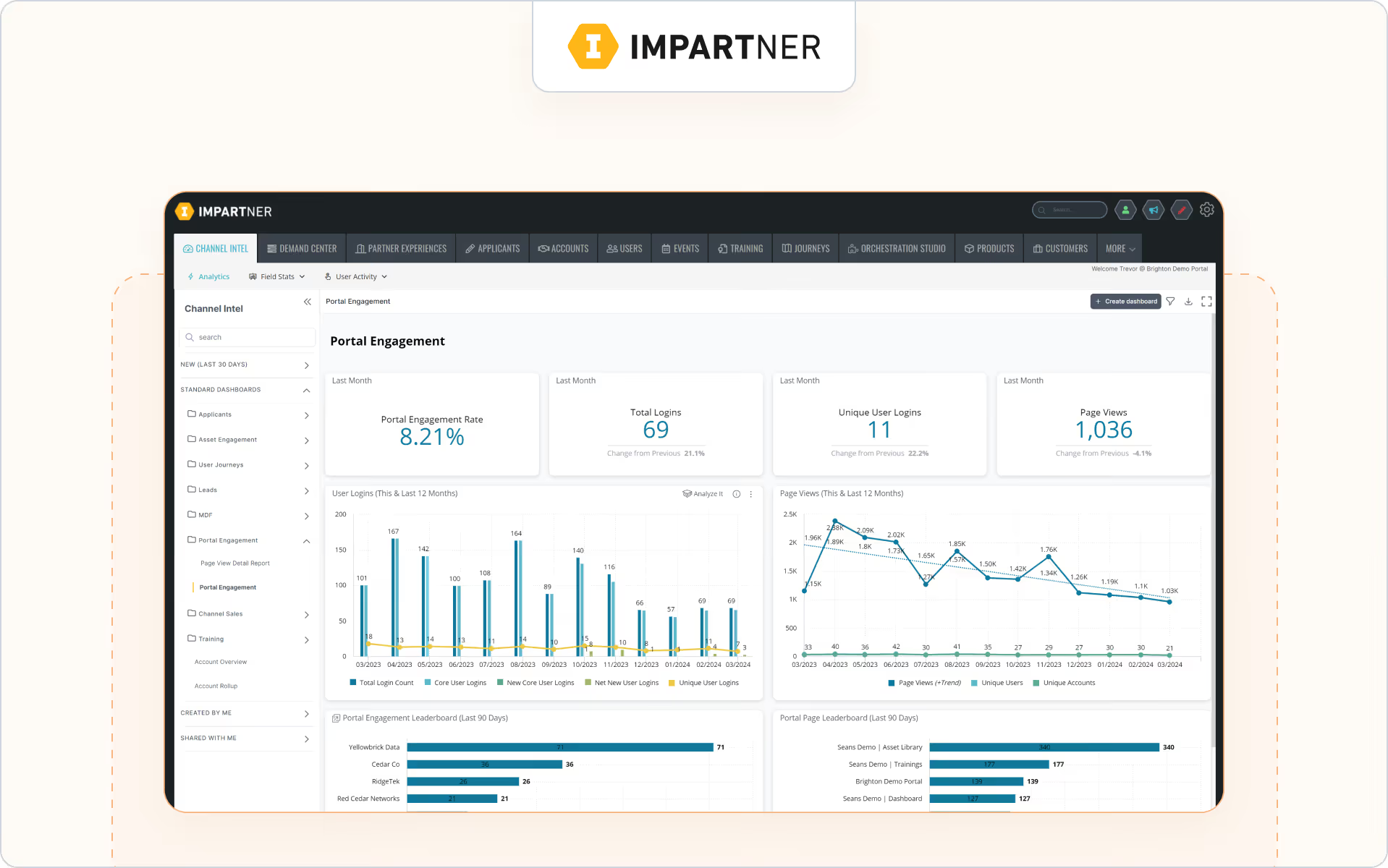
Best for: Enterprises with global channels that rely on structured tiering, incentives, and MDF — and need proven governance at scale.
Why it’s an alternative: If custom-building PRM on Experience Cloud is too slow or complex, Impartner delivers mature modules out of the box — recruitment, enablement, deal reg, and MDF — with a track record in large channel programs.
Callouts: Its MDF tooling stands out — budgeting, approvals, reimbursements, and notifications are built into the PRM, which is valuable if partner funding drives growth. Third-party directories and analyst sites also show broad deployments and comparisons, plus AI functionality appearing across enablement and analytics.
3) ZINFI (Unified Partner Management)
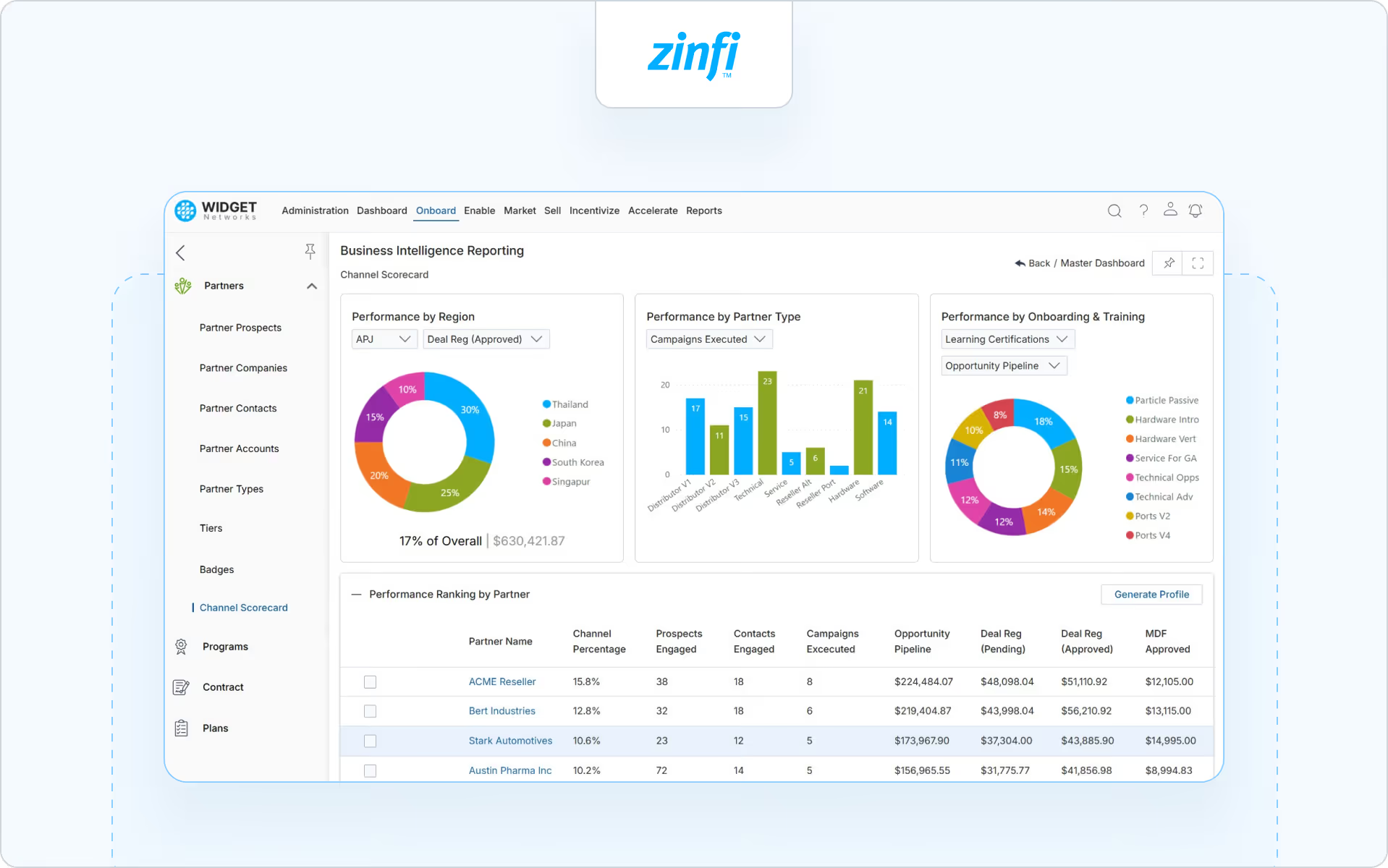
Best for: Teams seeking a comprehensive PRM suite with strong analyst and peer recognition, plus a steady cadence of product updates.
Why it’s an alternative: ZINFI’s Unified Partner Management spans recruit, enable, market, sell, and incentivize. In 2026 the company continues to emphasize AI-assisted workflows — useful if you want breadth without assembling point tools.
Callouts: The company highlights ease of use and modularity across UPM. If you have multiple partner types and need one platform to cover lifecycle workflows end to end, this is a credible shortlist option for partner enablement and opportunity management.
4) Unifyr (formerly Zift Solutions)

Best for: Channel-heavy orgs that prefer one vendor for PRM, through-channel marketing, and training — rather than stitching together separate systems.
Why it’s an alternative: Zift Solutions rebranded as Unifyr and now positions an AI-enabled partner ecosystem platform. If your Experience Cloud setup became a patchwork of apps, Unifyr’s all-in-one packaging can simplify operations.
Callouts: Messaging focuses on onboarding, activation, and performance insights across the partner lifecycle — helping guide partners, track progress, and align sales processes with marketing.
5) Channelscaler (Allbound + Channel Mechanics)

Best for: Companies that want modern PRM UX combined with enterprise-grade pricing, rebates, and incentive automation — all in one platform.
Why it’s an alternative: Allbound and Channel Mechanics merged and rebranded as Channelscaler. For teams that would otherwise combine a PRM front end with a separate channel automation engine, this unified approach is attractive.
Callouts: Press and analyst notes highlight scalability and intelligence post-merger, with emphasis on accelerating indirect revenue, expanding market reach, and improving operational efficiency.
6) Channeltivity
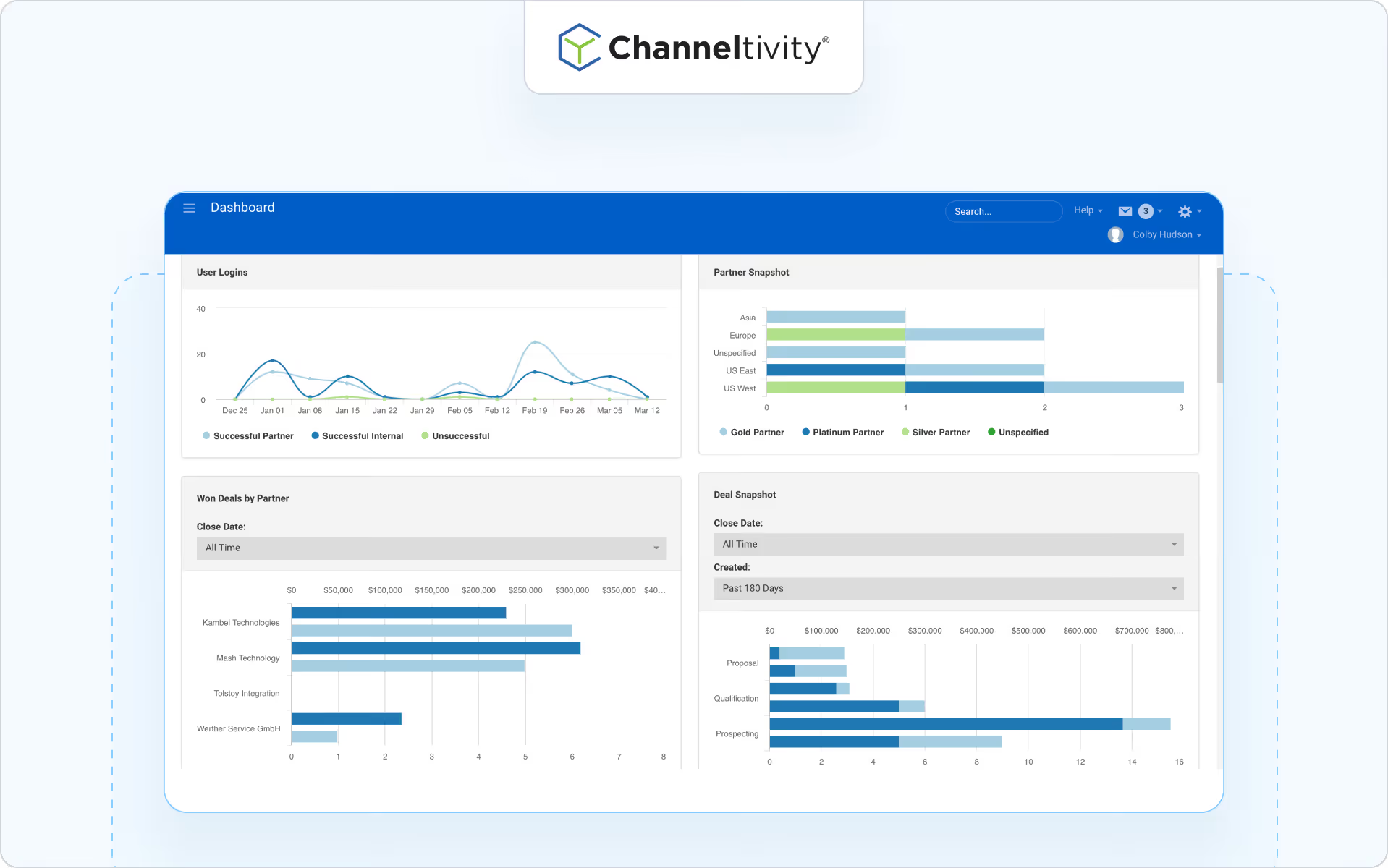
Best for: Mid-market teams looking for fast time-to-value and clicks-not-code integrations with Sales Cloud or HubSpot.
Why it’s an alternative: Channeltivity’s plug-and-play CRM integrations minimize implementation risk versus custom sites. Deal reg and referrals sync into the CRM so sales and RevOps get partner pipeline inspection and visibility without manual work.
Callouts: The HubSpot marketplace listing and help center show two-way sync, field mapping, and setup guides — handy if you want to go live quickly without heavy IT, and still monitor performance and track deals.
7) Magentrix
Best for: Salesforce-centric programs that want a configurable partner portal tightly coupled to CRM objects and data.
Why it’s an alternative: Magentrix is a long-standing AppExchange PRM. Its approach centers on mirroring CRM structure and reducing brittle syncs, which can be smoother than building and maintaining a bespoke Experience Cloud site.
Callouts: Features include deal registration and assignment with automated notifications. The company also publishes guidance on CRM-to-PRM data mirroring — useful for teams managing customer data at scale.
8) PartnerStack

Best for: SaaS teams combining affiliate, referral, and reseller motions — and wanting marketplace reach plus automated payouts.
Why it’s an alternative: PartnerStack pairs PRM-like workflows with a robust rewards engine and partner marketplace. If paying many partners on time is your bottleneck, this can be more turnkey than building equivalents on Salesforce.
Callouts: Flexible commission triggers and scheduled payouts help finance and ops keep partners confident, especially when scaling long-tail programs across partners and customers.
9) Kiflo
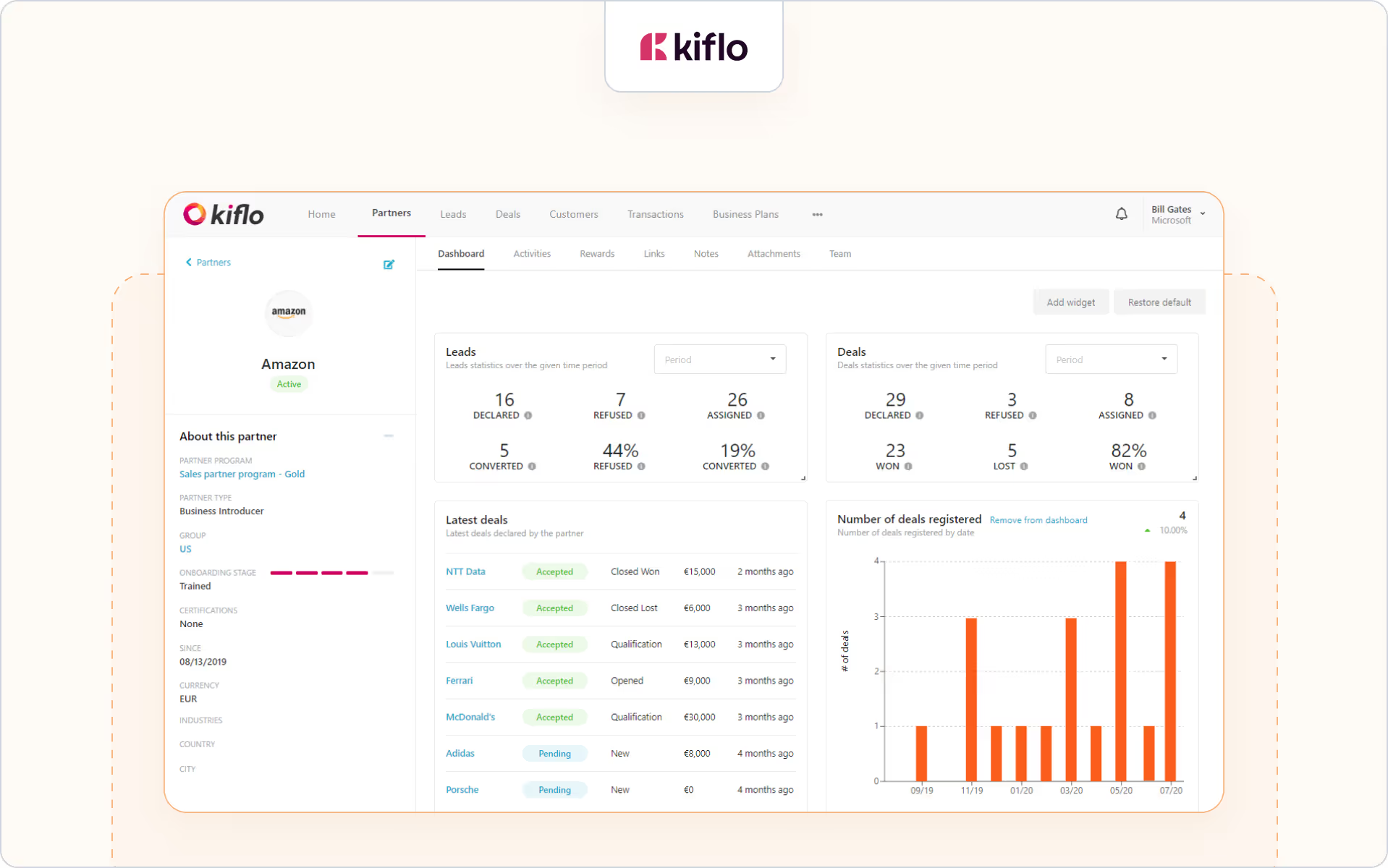
Best for: SMBs and scale-ups formalizing their first partner program with a straightforward CRM sync.
Why it’s an alternative: Kiflo focuses on PRM basics — referrals, resellers, simple enablement — and integrates natively with HubSpot to sync leads, deals, and contacts. If Experience Cloud feels over-powered for your stage, this is a pragmatic start.
Callouts: Marketplace listings and docs show two-way sync and mapping, which reduces swivel-chair work for partner managers and RevOps.
10) WorkSpan
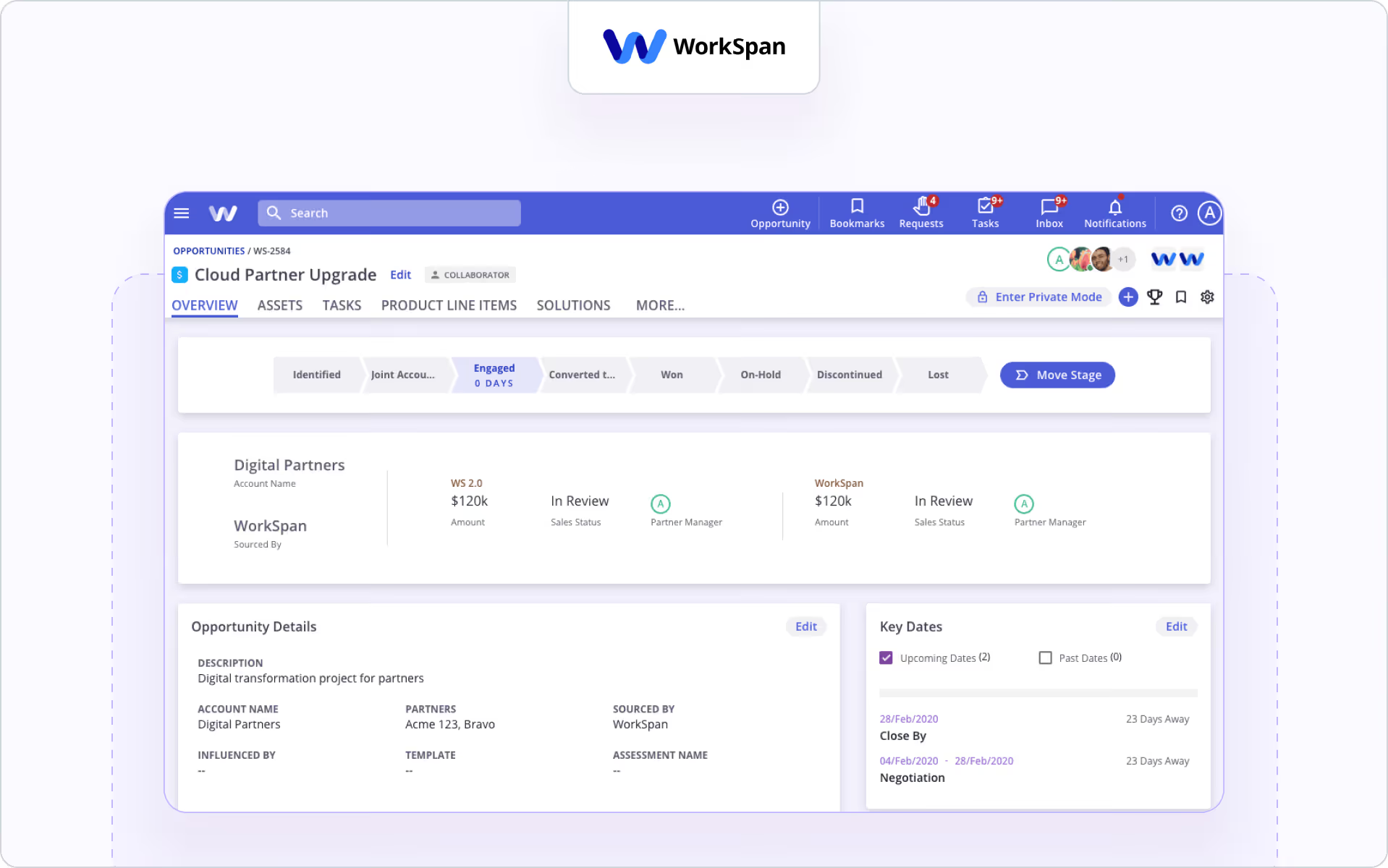
Best for: ISVs pursuing hyperscaler co-sell with AWS, Microsoft, or Google — and running marketplace private offers — who want those processes embedded in Salesforce.
Why it’s an alternative: WorkSpan is purpose-built for co-sell and marketplace operations and ships a Salesforce app to automate referral sharing with AWS ACE and Microsoft Partner Center. If your gap with Salesforce PRM is hyperscaler motion, this is a strong fit.
Callouts: The Hyperscaler Edition supports marketplace listings and private offer workflows and integrates with Salesforce, HubSpot, and Dynamics so alliance teams and AEs can operate from the CRM with real time data.
11) impact.com
Best for: Affiliate, influencer, and advocacy programs where discovery, contracting, tracking, and payouts need to live together.
Why it’s an alternative: Rather than bolt affiliate tools onto a PRM, impact.com centralizes the performance side of partnerships and automates contracts and payments. Many B2B brands pair it with CRM reporting to measure influenced revenue.
Callouts: Reviews and third-party roundups repeatedly highlight automation, fraud controls, and reporting — useful if partner marketing is your growth lever.
12) Everflow
Best for: Advanced partner and affiliate programs that need granular tracking, analytics, and a white-label experience for agencies or multi-brand portfolios.
Why it’s an alternative: Everflow emphasizes measurement — cross-channel tracking, detailed attribution, and integrations — so you can quantify pipeline and revenue without stitching multiple tools.
Callouts: Independent reviews point to robust analytics, clickless tracking, and marketplace options that help teams scale efficiently and track leads from various industries.
13) TUNE

Best for: Marketers who need a highly customizable partner marketing platform — flexible commissioning, deep tracking, and brandable partner experiences.
Why it’s an alternative: TUNE is known for configurability. If your commissioning logic or partner types do not fit a standard mold, TUNE’s platform can be easier than forcing that complexity into a generic affiliate add-on or a DIY Experience Cloud build.
Callouts: The product’s positioning around flexibility across mobile and web, plus pricing options, makes it an option when you want control more than templates.
14) Partnerize

Best for: Global brands scaling affiliate and partnership channels with AI-assisted optimization.
Why it’s an alternative: Partnerize has invested in AI functionality and data intelligence — helpful for predictive insights in partner recruitment and optimization. If your Salesforce PRM alternative needs performance marketing depth, shortlist this.
Callouts: Public posts underscore ambitions for category growth and an AI-powered roadmap, pointing to continued velocity.
15) PartnerPortal.io
Best for: HubSpot-centric channel managers who want a portal to capture leads and deals, share resources, and push updates — without heavyweight implementation.
Why it’s an alternative: Rather than rolling your own Experience Cloud site, PartnerPortal.io is plug-and-play for HubSpot. Partner-submitted leads can create or link deals, and the product ships a simple resource center and accounting integrations. There is even native Crossbeam support for attribution and account mapping.
Callouts: The marketplace pages show quick deployment, two-way sync, and a focus on keeping everything inside HubSpot — handy for teams trying to avoid net-new systems.
16) Partnero

Best for: Lean partner teams that need low-friction lead submission and simple affiliate or referral flows rather than a full PRM suite.
Why it’s an alternative: Partnero makes it easy to accept partner or public lead submissions through a customizable page and manage the accept or reject workflow — a lightweight way to operationalize referrals without a big build.
Callouts: Product updates highlight continued investment in lead submission, attribution, and payouts — useful when simplicity and speed matter most.
17) RocketPRM (Impulse Creative)
Best for: Organizations that are all-in on HubSpot and want a turnkey PRM built entirely on HubSpot CRM and CMS — no separate platform to administer.
Why it’s an alternative: RocketPRM lives inside HubSpot, so you can keep your existing deal pipeline and manage a partner-facing portal with HubSpot page layouts and forms. If your team wants to avoid juggling another vendor while staying native to HubSpot, this is a clean option.
Callouts: The vendor site and community posts explain the architecture and implementation, emphasizing a HubSpot-only approach that keeps partner data and workflows in one place.
When to stay with Salesforce PRM
Stick with Salesforce Partner Cloud when your GTM is truly Salesforce-only, you want to keep data and AI CRM investments under one roof, and your team can support an Experience Cloud build. Salesforce provides native deal registration, lead distribution, and partner portals within that ecosystem — which can be the most straightforward path if you are standardized on Sales Cloud, Service Cloud, and related platform services that collaborate with other Salesforce products on a single platform.
Switch when you need HubSpot coexistence, faster rollout, off-portal engagement, or hyperscaler co-sell. Those needs are precisely where the alternatives above usually win on time-to-value, partner productivity, and adoption.
Why Introw is your choice in 2026
If your team wants partner relationship management that is fully integrated with your CRM, Introw’s CRM-first approach keeps partners, AEs, and RevOps in one workflow. You can create and manage leads and opportunities, use custom objects where needed, and rely on real time data for tracking deals, attribution, and forecasting.
Off-portal email and Slack let third party partners collaborate without friction; outcome based enablement and a lightweight content management layer help guide partners, share resources, and monitor performance. The result is higher partner productivity, fewer sync issues when managing customer data, and measurable revenue impact across sales, marketing, and service teams — without the overhead of a custom Experience Cloud build. For many businesses, this combination of automation, AI capabilities, and operational efficiency translates to lower total cost and long term success. Book a demo to see for yourself.

