


Partner programs often stall not because of bad partners, but because your internal processes are scattered. Onboarding lives in one place, deal registration in another, and communication happens wherever someone remembers to send an email.
The teams that scale partner revenue treat PRM as an operational discipline, not a collection of disconnected tools. Below are 12 partner relationship management best practices that keep partner data clean, partners engaged, and pipeline visible — without adding complexity.
What is partner relationship management?
Partner relationship management (PRM) focuses on building trust, enabling partners through technology, and driving mutual profitability. PRM includes structured onboarding, consistent communication, deal registration workflows, and performance tracking — all designed to improve collaboration between your company and your channel partners.
PRM sits alongside your CRM but serves a different purpose. While CRM tracks your direct relationships with customers, PRM tracks your relationships with the resellers, referral partners, distributors, and implementation partners who sell on your behalf.
What PRM typically covers
- Partner onboarding: Getting new partners trained and ready to sell your product
- Deal and lead registration: Tracking partner-sourced opportunities and protecting them from conflict
- Enablement: Providing sales materials, training, and ongoing support
- Performance tracking: Measuring each partner’s contribution to pipeline and revenue
- Communication: Keeping partners informed, engaged, and aligned with your goals
When onboarding, registration, enablement, tracking, and communication work together, partner programs become measurable and operationally tight — not a side project running on spreadsheets.
Key components of partner relationship management
Before diving into partner relationship management best practices, it helps to name the building blocks of any partner program. The components below form the foundation that PRM software supports at scale.
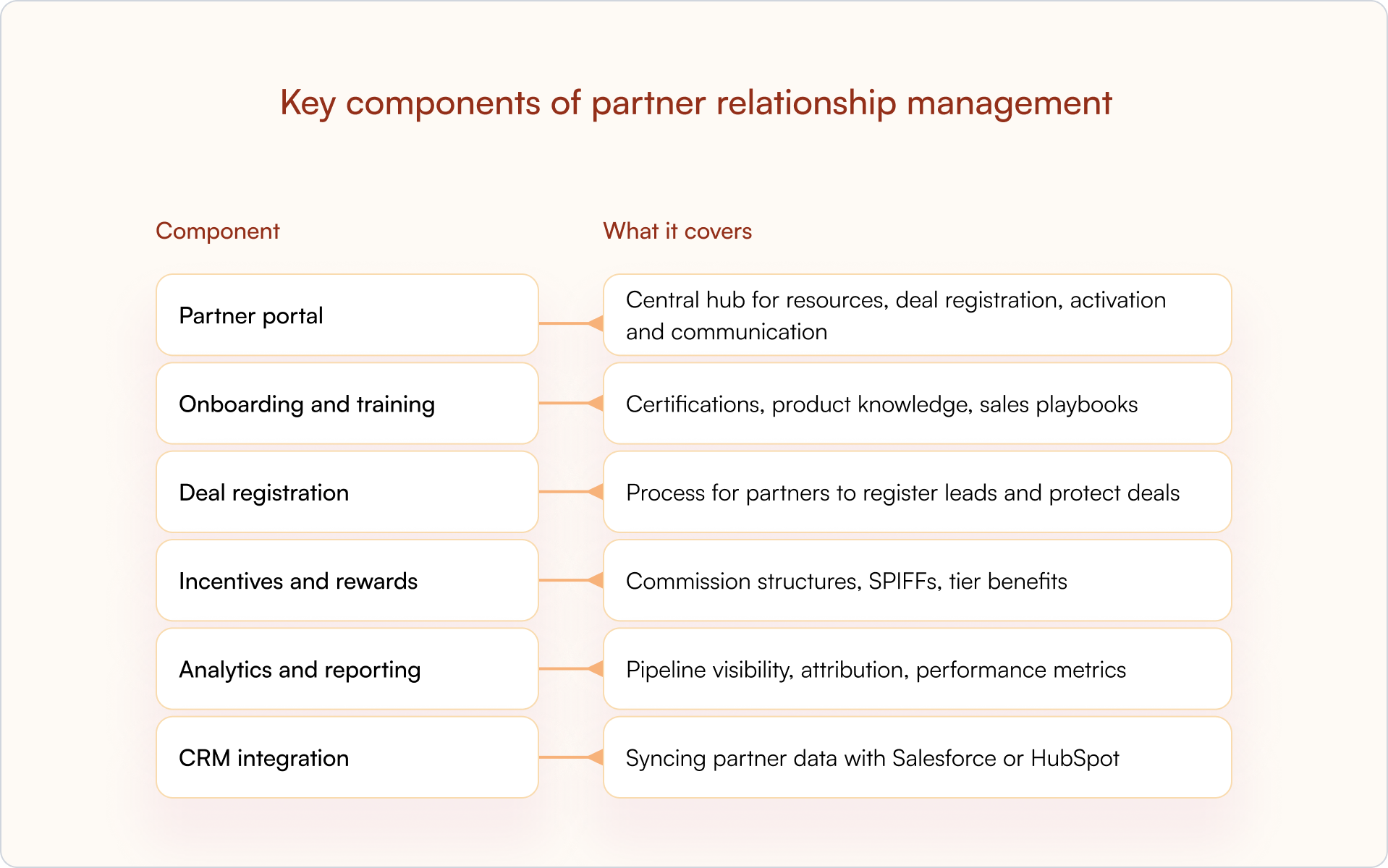
Each component addresses a specific operational gap. The best practices below show how to implement each one effectively — and how to keep it founder-friendly: simple, measurable, and scalable.
12 partner relationship management best practices to grow your program
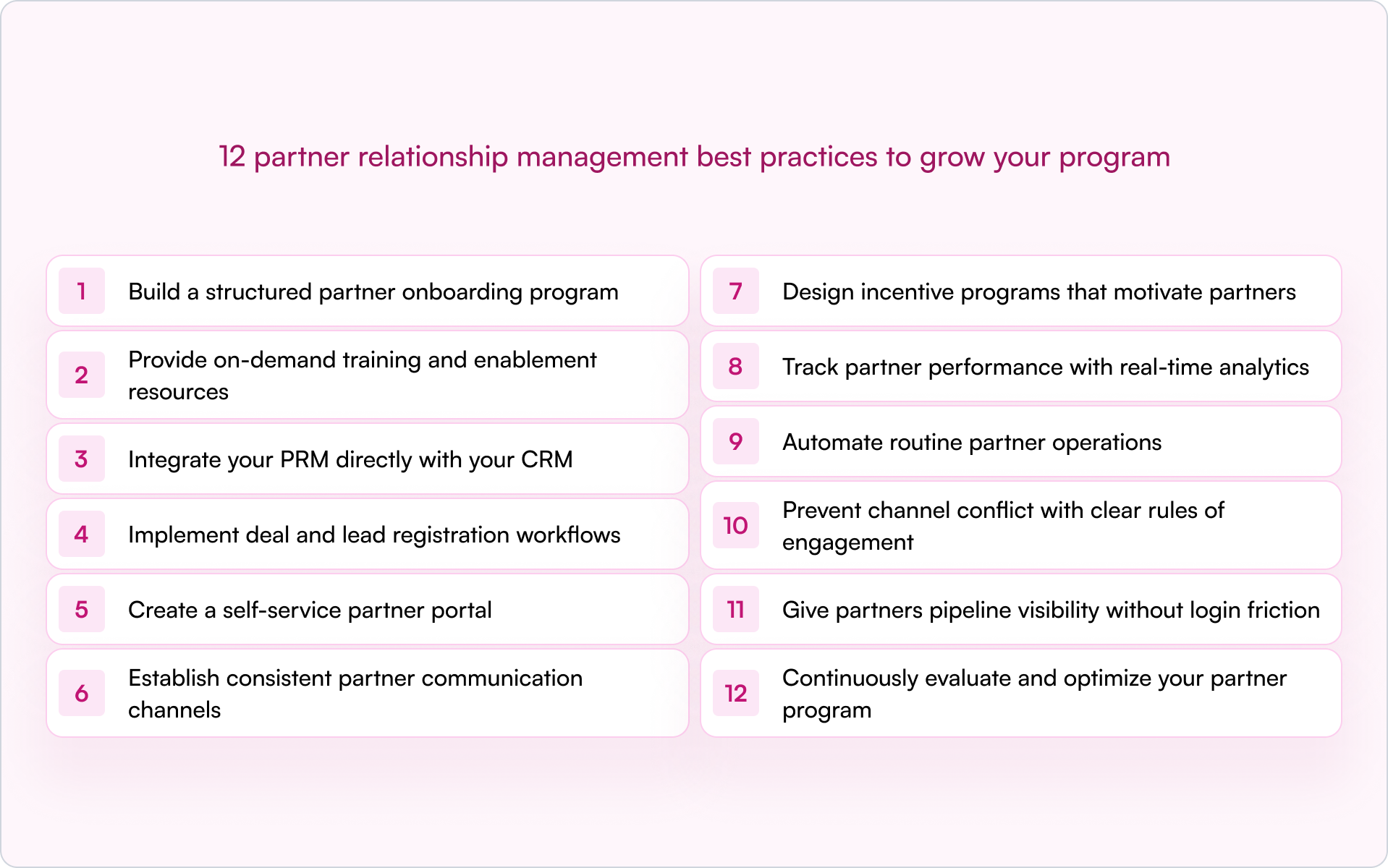
1. Build a structured partner onboarding program
Partners who complete onboarding quickly tend to sell faster. Yet many programs leave new partners to figure things out on their own, which leads to slow ramp times and early disengagement.
A structured onboarding program gives every partner the same foundation: a welcome sequence, product training, certification paths, and defined milestones so partners know exactly what “ready to sell” looks like.
Key onboarding elements
- Welcome kit: Program overview, key contacts, and first steps
- Product training: Core features, use cases, and competitive positioning
- Sales certification: Ensures partners can represent your product accurately
- Defined milestones: Clear checkpoints that signal readiness
Self-serve onboarding works better than scheduled calls for most partners. Partners can move at their own pace without waiting on your team’s availability.
2. Provide on-demand training and enablement resources
Onboarding gets partners started. Ongoing enablement keeps them sharp.
Partners juggle multiple vendor relationships. The vendors who make it easy to find answers and stay current usually earn more mindshare. That means battle cards, demo scripts, objection handling, and pricing documentation — all accessible without emailing a partner manager.
Resources that drive engagement
- Battle cards: Competitive comparisons partners can reference mid-conversation
- Demo environments: Sandbox access so partners can show the product themselves
- Pricing and packaging guides: Clear documentation to avoid quoting errors
- Case studies: Customer stories partners can share with prospects
If a partner has to ask for basic information, you’ve added friction that slows deals.
3. Integrate your PRM directly with your CRM
When PRM lives outside the CRM, partner pipeline becomes invisible to sales and RevOps. Forecasting suffers. Attribution breaks. And you end up with two systems that don’t agree on what’s happening.
CRM-first PRM solves this by keeping partner data inside HubSpot or Salesforce, where your revenue team already works.
Benefits of native CRM integration
- Single source of truth: No duplicate records or conflicting data
- Pipeline visibility: Sales and partner teams see the same deals
- Accurate attribution: Partner-sourced revenue is trackable for comp and planning
- Automated workflows: Deal registration triggers can route approvals and alerts inside the CRM
If your PRM creates a separate database, you’re building a visibility gap that grows with every new partner.
4. Implement deal and lead registration workflows
Deal registration is how partners claim an opportunity and receive protection from conflict. Without deal registration, you’re left resolving disputes after the fact, which damages trust and slows deals.
A good registration workflow includes required fields, approval SLAs, protection windows, and clear expiration rules. Partners know what to submit, how long they’re protected, and what happens if a deal stalls.
Workflow elements to define
- Required fields: Company name, contact info, estimated deal size, expected close date
- Approval SLA: How quickly you commit to approving or declining registrations
- Protection window: How long the partner has exclusivity on the deal
- Expiration and extension rules: What happens when protection expires or deals go quiet
When registration is fast and fair, partners participate. When registration is slow or opaque, partners stop submitting — and you lose visibility into partner-sourced pipeline.
5. Create a self-service partner portal
A partner portal gives partners a single destination for resources, deal registration, deal status, and communication with your team. Done well, it reduces the back-and-forth that bogs down partner managers.
The key is reducing friction, not adding it. Partners don’t want to email someone for basic information or log into multiple systems to check on a deal.
Portal capabilities that matter
- Resource library: Training materials, sales collateral, product docs
- Deal registration forms: Submit and track opportunities
- Pipeline visibility: Partners see status updates on their deals
- Announcements: Policy changes, new resources, program updates
A portal that’s hard to access or navigate will be ignored. One that’s fast and useful becomes the default way partners engage with your program.
6. Establish consistent partner communication channels
Partners disengage when they don’t hear from you. And when partners are surprised by policy changes, trust erodes quickly.
Consistent communication means defining what you share, how often, and through which channels. Email, Slack, and portal announcements all work. The key is predictability.
Communication types to establish
- Program announcements: Policy changes, new incentives, product launches
- Pipeline updates: Deal status changes, approval decisions, expiring protections
- Enablement broadcasts: New training, updated collateral, competitive intel
- QBR invitations: Quarterly reviews for strategic partners
Partners manage multiple vendor relationships. The vendors who communicate clearly and consistently tend to stay top of mind.
7. Design incentive programs that motivate partners
Incentives shape behavior. If you want partners to bring new logos, incentivize new business. If you want partners to expand accounts, reward upsells.
The most effective incentive programs are simple to understand and easy to claim. Complexity kills participation.
Align incentives with your program goals. And make sure partners can actually track their progress. Hidden or delayed payouts undermine trust.
8. Track partner performance with real-time analytics
You can’t improve what you can’t measure. Partner performance tracking gives you visibility into who’s contributing, who’s stalling, and where to focus your attention.
Dashboards that live in or sync to your CRM make tracking easier. Partner managers don’t want to pull manual reports just to understand what’s happening.
Key metrics to track
- Deal registration volume: How many opportunities partners are submitting
- Pipeline value: Total value of partner-sourced deals in progress
- Conversion rate: Percentage of registered deals that close
- Partner engagement: Portal logins, training completions, resource downloads
Real-time visibility helps you spot problems early and double down on what’s working.
9. Automate routine partner operations
Partner managers often spend too much time on tasks that could be automated: registration approvals, status notifications, expiration reminders, welcome sequences.
Automation reduces manual work and ensures nothing falls through the cracks. It also makes it possible to scale your program without proportionally scaling headcount.
Automation opportunities
- Registration routing: Auto-assign approvals based on deal size or territory
- Status notifications: Alert partners when deals move stages
- Expiration reminders: Warn partners before protection windows close
- Onboarding sequences: Trigger welcome emails and training assignments automatically
The goal isn’t to remove the human element. The goal is to free up partner managers for relationship-building instead of administrative tasks.
10. Prevent channel conflict with clear rules of engagement
Channel conflict happens when partners compete with each other, or with your direct sales team, for the same deal. Channel conflict is one of the fastest ways to damage partner trust.
Prevention starts with clear rules: territory definitions, deal registration policies, and escalation paths. When everyone knows the rules upfront, disputes become rare.
Conflict prevention elements
- Territory and segment rules: Who can sell to which accounts
- First-to-register protection: Registered deals get exclusivity
- Direct vs. partner prioritization: When direct sales can engage partner accounts
- Escalation process: How to resolve disputes when conflicts occur
Practical tip: Publish your rules of engagement in your partner portal so partners can reference them anytime, not just when a dispute arises.
Ambiguity creates conflict. Clarity prevents it.
11. Give partners pipeline visibility without login friction
Partners disengage when they can’t see what’s happening with their deals. But requiring portal logins for every update creates friction that slows engagement.
The solution is off-portal collaboration. Partners can receive updates via email and respond without logging into a separate system. Partner replies sync back to your CRM automatically.
Visibility approaches that reduce friction
- Shared pipeline views: Partners see their deals and current status
- Email notifications: Automatic alerts for stage changes and approvals
- Reply-by-email: Partners respond to updates without portal login
- Property-level controls: Show partners relevant fields without exposing sensitive data
Visibility keeps partners motivated. Friction kills momentum.
12. Continuously evaluate and optimize your partner program
Partner programs require iteration. What works at 20 partners often breaks at 100. Reviewing performance quarterly, gathering partner feedback, and adjusting based on results keeps your program healthy as it scales.
Optimization activities to build into your cadence
- Quarterly business reviews: Deep-dive with strategic partners on performance and roadblocks
- Partner feedback surveys: Understand what’s working and what’s frustrating
- Incentive analysis: Check if incentives are driving desired behavior
- Process audits: Identify bottlenecks in onboarding, registration, and support
The best partner programs treat optimization as ongoing work, not a one-time project.
How PRM software supports partner relationship management best practices
PRM software operationalizes the best practices above. The right platform integrates with your CRM, reduces manual work, and gives partners a professional experience that keeps them engaged.
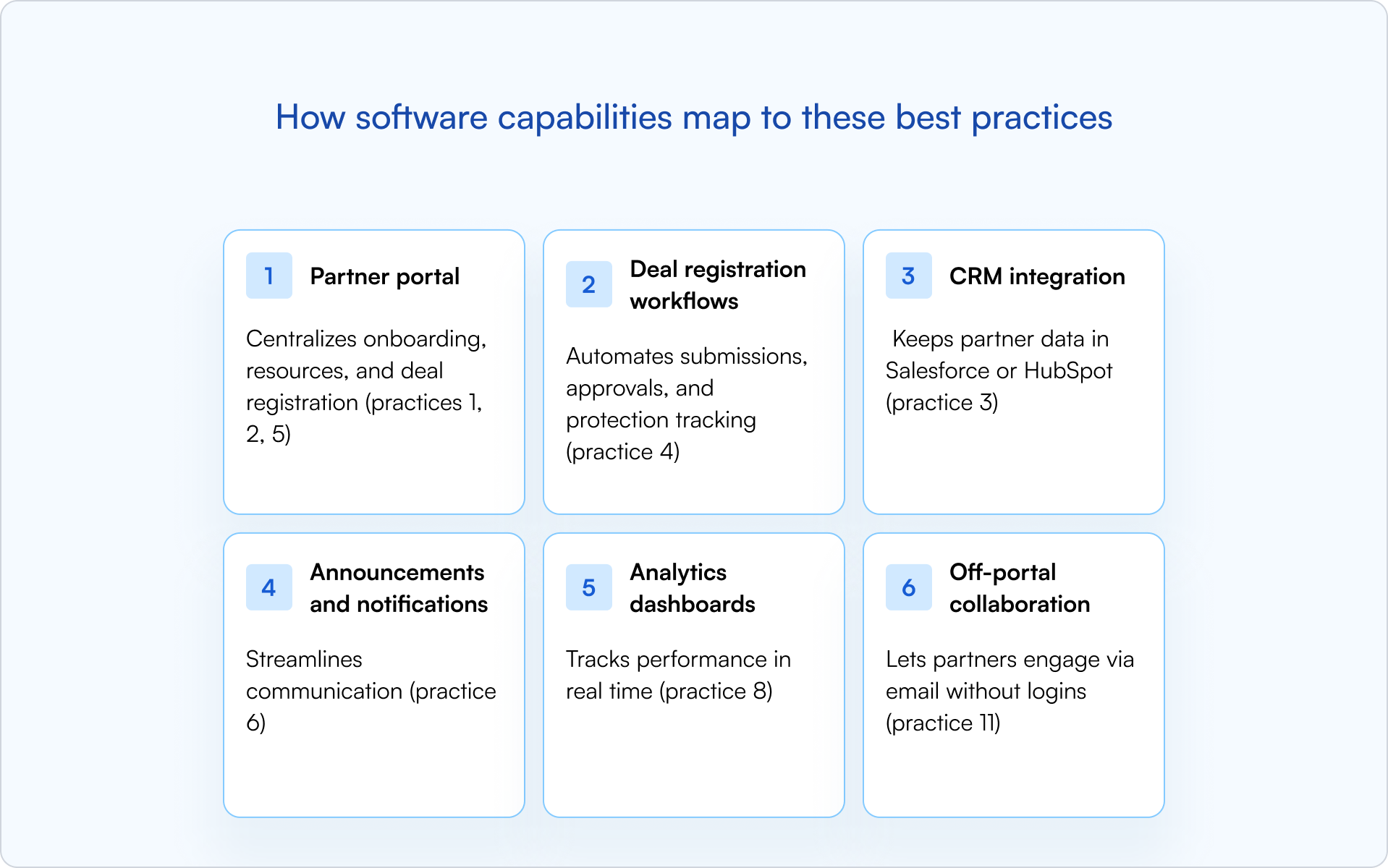
How software capabilities map to these best practices
- Partner portal: Centralizes onboarding, resources, and deal registration (practices 1, 2, 5)
- Deal registration workflows: Automates submissions, approvals, and protection tracking (practice 4)
- CRM integration: Keeps partner data in Salesforce or HubSpot (practice 3)
- Announcements and notifications: Streamlines communication (practice 6)
- Analytics dashboards: Tracks performance in real time (practice 8)
- Off-portal collaboration: Lets partners engage via email without logins (practice 11)
Introw is built on a CRM-first approach. Partner data stays inside HubSpot or Salesforce, partners can engage without managing another login, and your team gets real-time visibility into partner-sourced pipeline.
Get a demo to see how Introw helps partner teams put partner relationship management best practices into action.
Conclusion: keep PRM simple, measurable, and CRM-first
If you’re building a partner motion as a founder, the biggest unlock is treating PRM like revenue infrastructure. Start with clean data in your CRM, make partner participation easy (self-serve + low-friction collaboration), and automate the operational noise.
Do that, and your partner program stops being “extra pipeline” and becomes a predictable channel you can actually forecast.
Still curious? Here are some quick answers to help clear things up
CRM tracks your direct relationships with customers. PRM tracks your relationships with channel partners who sell on your behalf. The best PRM software integrates directly with your CRM so both systems share the same data, with no duplicate records and no conflicting pipeline views.
Look for PRM software that integrates natively with your existing CRM (Salesforce or HubSpot), offers self-service partner portal capabilities, and reduces friction for partners through features like deal registration and off-portal collaboration. Avoid platforms that create a separate database disconnected from your revenue systems.
Yes. Modern PRM platforms support off-portal collaboration where partners can register deals, receive updates, and respond via email without logging into a separate portal. Off-portal collaboration reduces friction and keeps partners engaged without adding another password to manage.
Partner-sourced revenue comes from deals the partner originated and registered. Partner-influenced revenue comes from deals where the partner assisted but didn’t originate. Tracking both requires clear attribution fields in your CRM, typically a “sourced vs. influenced” flag with an attribution percentage.
The ratio depends on partner complexity and program maturity. Early-stage programs often run at 1:20 or 1:30. Scaling programs aim to increase the ratio over time by automating routine tasks and providing self-service resources through a partner portal.




See AI-Native PRM in Action
Book a demo with one of our partner program experts, or explore Introw on your own time.