

Partner programs don’t fail because of bad partners. They fail because partner managers run out of hours — chasing updates, answering the same questions, and manually personalizing outreach that never truly scales.
AI for partner engagement changes that equation. Not by replacing relationships (the thing that actually drives partner revenue), but by taking repetitive work off your team’s plate so they can spend more time in the conversations that matter.
Below is a practical playbook: what to automate, what to keep human, and how to implement AI without eroding the trust you’ve built.
Why AI for Partner Engagement Matters Now
AI for partner engagement means using artificial intelligence tools — automation, machine learning, and generative AI — to personalize communication, anticipate partner needs, and reduce operational drag. It sits under the broader umbrella of partner relationship management AI, where the goal is simple: keep partners enabled and responsive without adding headcount at the same rate as partner growth.
The underlying math has changed. Partner counts grow quickly, partner expectations rise even faster, and your team is left stitching together engagement across spreadsheets, portals, inboxes, and CRM notes. The result is predictable: slower responses, inconsistent follow-up, and partner managers spending their best hours on admin instead of revenue.
AI addresses that bottleneck by handling the repeatable parts of engagement — so your team can focus on building trust, driving pipeline, and solving real partner problems.
How AI Improves Partner Engagement Without Replacing Your Team
The highest-performing programs don’t automate everything. They automate the right things. AI works best when it amplifies what your team already does well — and removes the friction that prevents consistency.
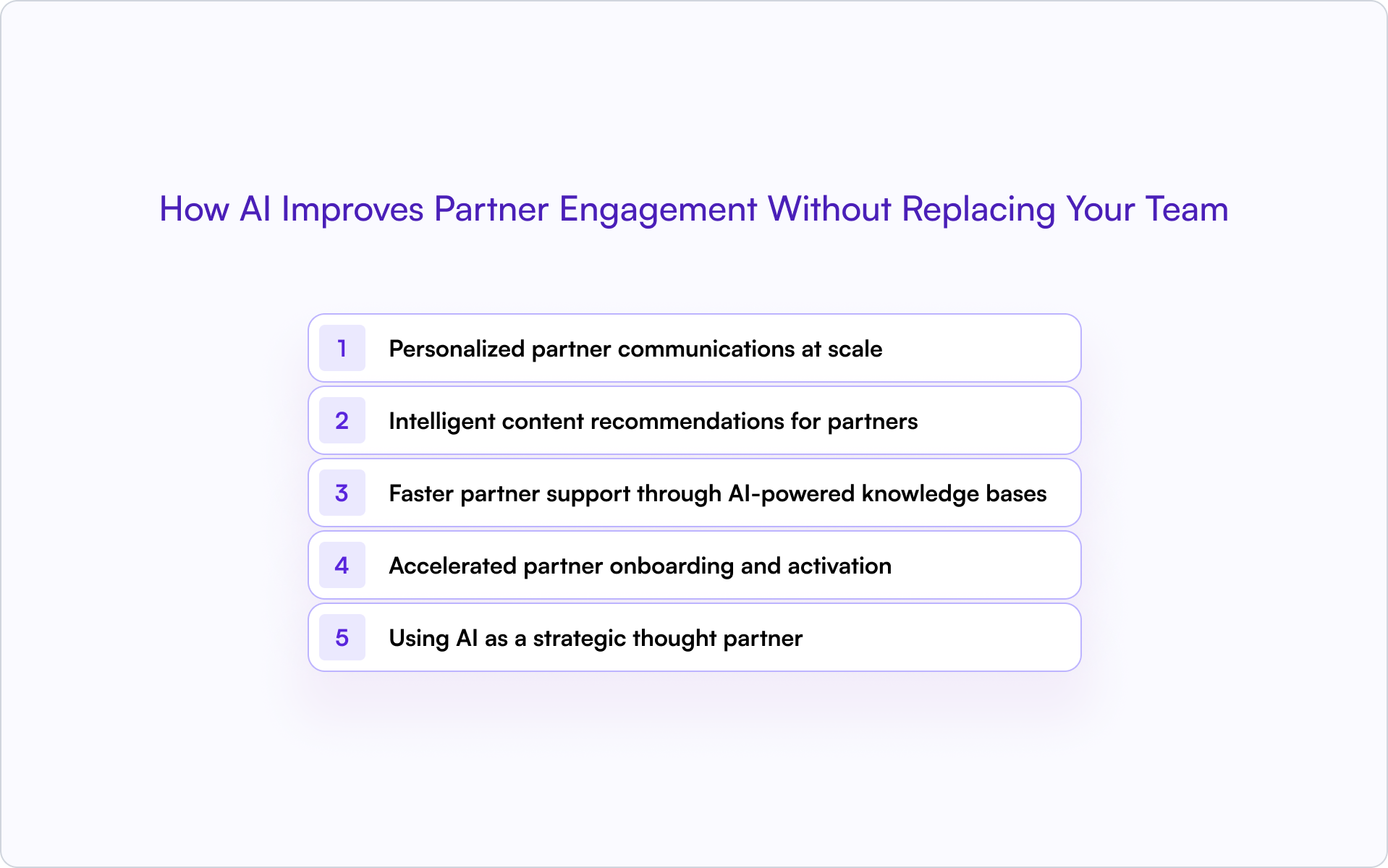
Personalized partner communications at scale
AI can analyze partner data — behavior, preferences, deal history, portal activity — and help tailor messaging without you writing from scratch each time. Done right, the voice stays “yours,” but the volume scales.
- Behavior-based messaging: AI can detect who’s active vs. disengaged and tailor follow-ups accordingly. A partner who hasn’t logged in for 30 days should get a different nudge than one who just registered a deal.
- Segment-specific campaigns: Generative AI can draft outreach by tier, region, or vertical. Your team reviews and sends — keeping quality control and the human touch.
Intelligent content recommendations for partners
Partners often struggle to find the right enablement content at the right time. AI helps by surfacing the most relevant case studies, battle cards, product docs, or training based on partner activity, segment, or deal stage.
This reduces the steady stream of “Where do I find X?” requests and improves time-to-first-deal because partners get what they need when they need it — without hunting.
Faster partner support through AI-powered knowledge bases
An AI-powered knowledge base is a self-serve library where partners ask a question and the AI returns the most relevant answer from your documentation. This works especially well for routine requests like pricing sheets, deal status questions, and portal navigation.
The win isn’t just speed. It’s consistency: partners get accurate answers instantly, while your team stays available for nuanced or sensitive situations.
Accelerated partner onboarding and activation
Partner onboarding AI guides new partners through onboarding steps, auto-assigns training content, and prompts next actions. Instead of manually tracking who completed what, your team gets visibility into progress and can step in only when a partner gets stuck.
Using AI as a strategic thought partner
Partnership leaders also use AI to brainstorm campaign ideas, draft program policies, and summarize what’s working across segments. Think of it as a strategy assistant that’s always available — while final decisions stay with your team.
AI can surface patterns your team might miss, but judgment calls that shape partner relationships should remain human-led.
Practical AI Use Cases for Partner Programs
If you’re building (or scaling) a partner motion, you don’t need “AI everywhere.” You need a few targeted workflows that reduce noise and increase partner responsiveness. These are the patterns that tend to deliver ROI quickly.
Drafting personalized partner outreach and updates
AI can generate email drafts, partner newsletters, and Slack messages tailored to partner segments. Your team reviews and sends — which keeps messages authentic, while eliminating blank-page work.
Tracking partner engagement signals in your CRM
AI can flag disengaged partners, highlight high-activity accounts, and detect patterns in deal registration behavior. The key is CRM-first visibility — data should live in HubSpot or Salesforce, not scattered across tools. That way, partner relationship management AI can operate on a reliable system of record.
Surfacing expansion and cross-sell opportunities
AI can identify partners with upsell or cross-sell potential based on customer fit, deal history, or product usage signals. The output should be a prioritized list for a human follow-up — not a fully automated “spray and pray” campaign.
Automating repetitive partner support queries
Common questions can be handled by AI chatbots, knowledge bases, or automated responses. This is often one of the highest-ROI forms of partner program automation — partners get instant answers, and your team spends less time on repeat tickets.
Delivering tailored partner enablement content
AI recommends relevant training, playbooks, or collateral based on partner type, certification level, or current deals as part of your partner enablement strategy. Partners see what’s relevant to them, rather than a generic content library that overwhelms them.
What to Automate vs. What to Keep Human in Partner Engagement
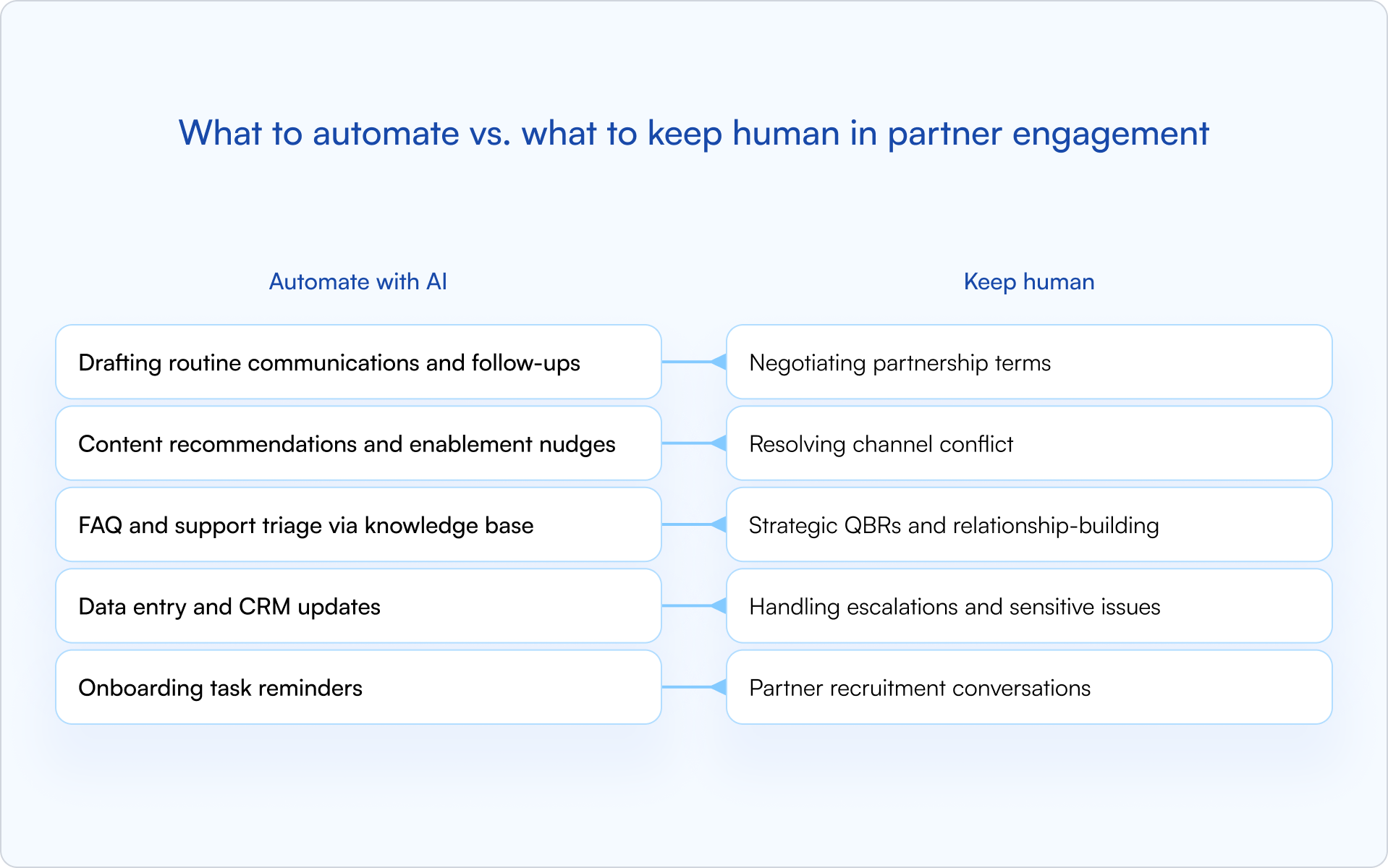
The easiest way to lose partner trust with AI is to automate moments that require judgment, empathy, or context. The goal is to automate the repeatable work — while protecting the high-stakes relationship moments.
Tasks AI handles well
Repetitive, time-consuming, low-judgment work is ideal: status updates, content requests, FAQ replies, meeting summaries, and CRM hygiene. AI can also assist with partner recruitment by shortlisting candidates or scoring fit — but the qualification conversation should remain human-led.
Moments that require a human touch
Trust-building, conflict resolution, and strategic decision-making don’t automate well. Partners can tell when a program is “bot-led,” especially during escalations, sensitive program changes, and negotiation moments.
A simple rule for drawing the line
If the task requires judgment, empathy, negotiation, or deep relationship context, keep it human. If it’s repetitive and data-driven — especially CRM-based — automate it.
What You Need for AI to Work in Your Partner Program
AI doesn’t magically fix a messy program. It scales what’s already there. Before you roll out AI for partner engagement, make sure a few fundamentals are in place.
Clean partner data in your CRM
Clean data means fewer duplicates, consistent field definitions, and accurate partner records. AI insights are only as good as the data they’re built on. When your partner activity and engagement signals live in HubSpot or Salesforce, AI-driven support, recommendations, and scoring become practical — not theoretical.
Defined processes before implementing technology
Clarify workflows first: onboarding steps, deal registration rules, communication cadence, and support handoffs. AI amplifies your process — so if your process is inconsistent, AI will scale that inconsistency.
Partner buy-in and transparency about AI use
Partners should know when AI is used in communications or support. Transparency builds trust, and it lowers the risk of awkward moments when a partner assumes they’re speaking to a person.
Always provide a clear path to reach a human — and be explicit about what AI can (and can’t) do.
How to Get Started With AI for Partner Engagement
You don’t need a massive implementation to see results. The fastest path is to pick one high-volume pain point, pilot it, measure impact, and expand from there.
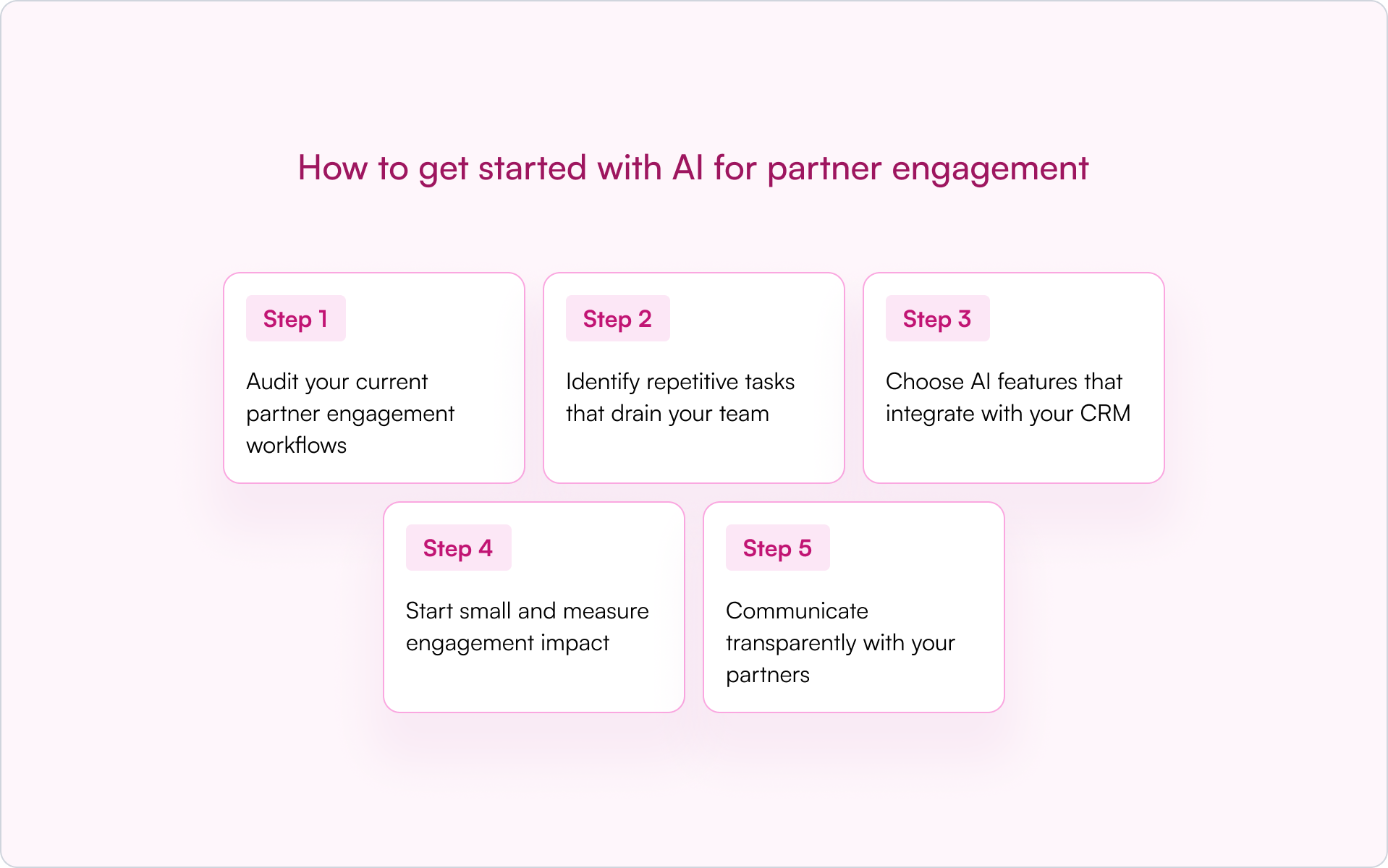
1) Audit your current partner engagement workflows
Map out how you communicate with partners today across their lifecycle stages. Where are the bottlenecks, manual tasks, and repetitive work across communications, enablement, and support?
2) Identify repetitive tasks that drain your team
List the recurring work that eats time but doesn’t require strategic thinking: status updates, content requests, meeting recaps, deal follow-ups, and FAQ replies. Prioritize tasks that can be reliably automated from CRM data.
3) Choose AI features that integrate with your CRM
CRM-first tools matter. AI that writes back to HubSpot or Salesforce keeps data clean, visible, and actionable. AI that creates a separate system becomes another silo your team has to manage.
Platforms like Introw offer AI-powered partner support and engagement features that integrate directly with your CRM — without creating a parallel universe of partner data.
4) Start small and measure engagement impact
Pilot one use case before scaling — onboarding emails and an AI-powered knowledge base are common “quick wins.” Track partner response rates, time saved, and engagement metrics like portal logins or content consumption.
5) Communicate transparently with your partners
Tell partners how AI is being used and where humans are still involved. Offer an escalation path to a person for complex issues. Trust comes from being upfront — not from hiding automation.
Build Stronger Partner Relationships With AI-Powered Engagement Tools
AI handles scale and speed across partner engagement, enablement, and support. Humans handle trust, strategy, and the moments that define long-term partnerships. That balance is where AI becomes a competitive advantage — not as a replacement, but as an enabler.
If you want to see what CRM-first AI for partner engagement looks like in practice, tools like Introw let you keep partner communications, support, and engagement history visible inside HubSpot or Salesforce — where your revenue team already works.
Book a demo to see how AI-powered partner engagement works inside your CRM.
Still curious? Here are some quick answers to help clear things up
They should. Best practice is transparency: label AI-assisted support clearly, set expectations about what the AI can answer, and always provide an easy path to reach a human. In partner ecosystems, trust is an asset — don’t trade it for a slightly higher automation rate.
AI is strongest with questions that are already documented and repeatable (pricing sheets, process questions, enablement links, portal navigation). For nuanced technical issues, contract questions, escalations, and anything sensitive, route to a human. Many teams use AI for triage first — then escalate with full context.
Lead with benefits partners actually feel: faster answers, clearer onboarding, and more relevant enablement content. Be explicit that AI is there to reduce friction, not to replace relationship access. Then back it up with a visible human escalation path and a consistent cadence of real check-ins.
Not necessarily. What matters most is where your partner data lives and whether AI can use it safely and reliably. CRM-first approaches work well because engagement signals, account history, and partner communications remain in one system of record. If you do use a portal, prioritize tools that sync activity back to your CRM rather than creating new silos.




See what your partner program actually could look like
Book a demo with one of our partner program experts, or explore Introw on your own time.