

Most partner programs generate revenue. Fewer can predict it.
The difference isn’t luck or partner quality — it’s whether your systems make channel partner revenue visible, attributable, and repeatable. When deals appear without context, ownership gets disputed, or pipeline hides in spreadsheets, forecasting turns into guesswork.
This guide breaks down the business models, metrics, partner engagement practices, and CRM architecture that turn partners into a reliable revenue engine you can actually plan around.
What makes channel partner revenue predictable
Channel partner revenue is income generated through third-party intermediaries — resellers, distributors, referral partners, or implementation partners — rather than your direct sales team. Partners increase market reach and drive sales through commissions, margins, and co-selling initiatives. For many technology vendors, indirect revenue accounts for a significant share of total revenue, yet it often remains the hardest to forecast.
The difference between predictable and unpredictable partner revenue usually comes down to three things:
- Clear attribution: You know which partner brought the deal, and you can prove it in reporting.
- Documented processes: Deal registration, pricing rules, and territory assignments follow consistent, enforced workflows.
- Real-time visibility: Pipeline data lives in your CRM, not in partner inboxes or disconnected spreadsheets.
When attribution is unclear, deals appear without context. When processes are informal, ownership gets disputed. When pipeline is hidden in portals or email threads, forecasts miss.
Put those three foundations in place and partner revenue becomes something you can plan around — not just hope for.
Channel partner business models that drive growth
Different partner types generate revenue differently. The mix you choose shapes how predictable your channel partner revenue can become — and which systems you need to support it.
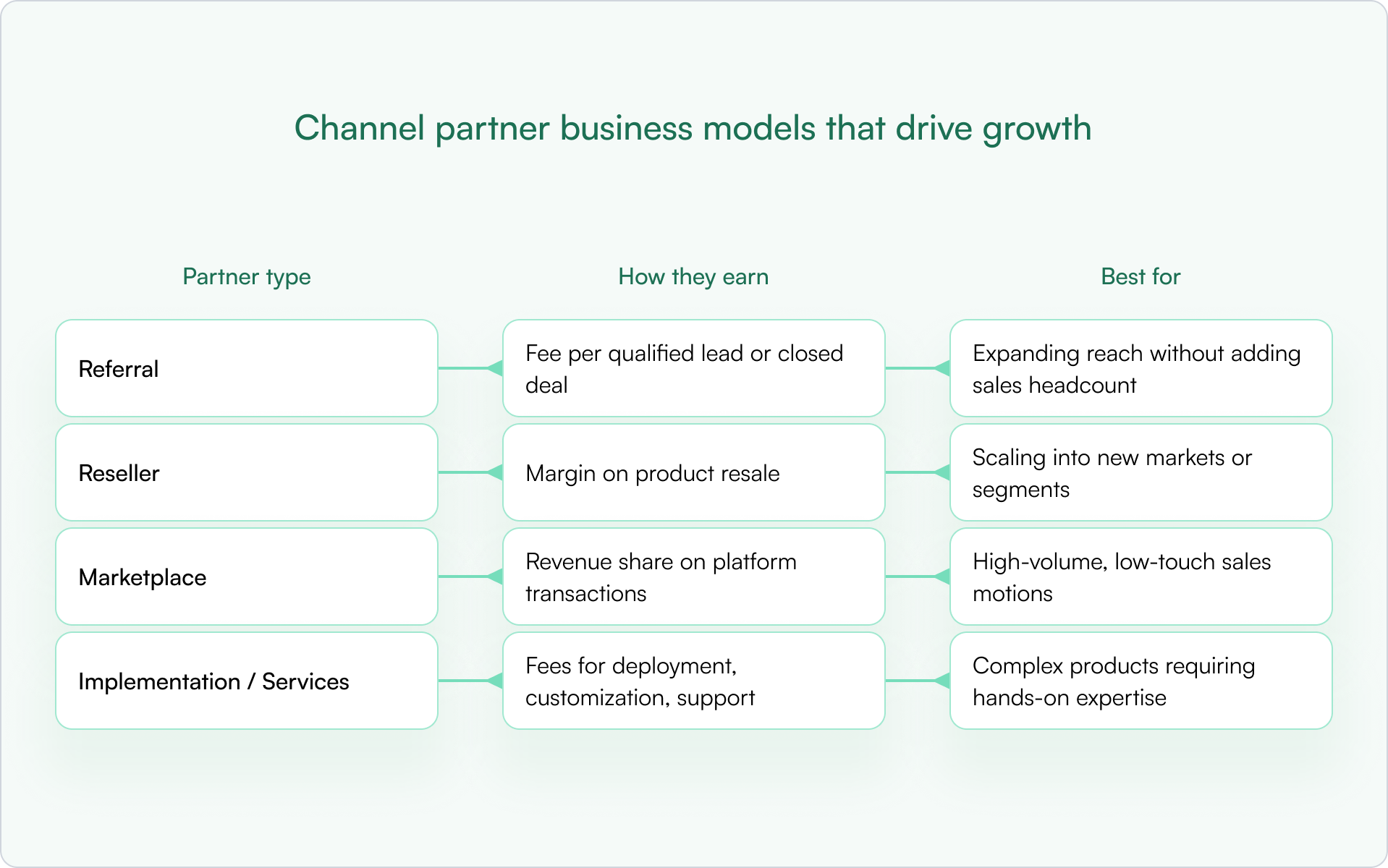
Most companies end up with a blend. The key is to match the model to the segment and build rules that prevent overlap, confusion, and channel conflict.
Referral partners
Referral partners send qualified leads in exchange for a fee. They don’t own the customer relationship or handle the sale. Referral programs are a strong entry point because commitment is low on both sides, and the operational overhead is minimal.
Reseller partners
Resellers purchase and resell your product at a margin. They own the customer relationship and handle the sales process. This motion can scale quickly into new markets, but it only stays predictable if you have clear pricing guardrails and a clean ownership model.
Marketplace partners
Marketplace partners sell through platforms like AWS, Azure, or app marketplaces. Revenue is shared based on platform terms. Marketplace motions work best for high-volume, low-touch sales where buyers expect self-serve discovery, purchase, and provisioning.
Implementation and services partners
System integrators, consultants, and MSPs earn from services around your product — deployment, customization, and ongoing support. These partners often influence deals even when they don’t close them directly, which makes attribution and forecasting more nuanced. If you don’t model “influence” in your CRM, you’ll systematically undercount their impact.
Key metrics for channel partner revenue analytics
If you’re trying to make channel partner revenue predictable, you need metrics that support decisions, not vanity dashboards. You can’t build a predictable revenue engine without knowing what to measure. The right metrics give you the analytics to make decisions, spot problems early, and improve forecast accuracy over time.
Partner-sourced revenue and attribution
Partner-sourced revenue is the primary measure of channel success: revenue directly generated by partners. The distinction between “sourced” and “influenced” matters here.
- Sourced: The partner originated the deal and brought it to you.
- Influenced: The partner materially helped progress or close a deal they didn’t originate.
Both are real value, but they require different rules, reporting, and incentives. If you mix them, you’ll misread performance and misallocate enablement effort.
Deal registration volume and conversion
Deal registration volume tracks how many deals partners register. Conversion rate tracks what percentage of registered deals become closed-won.
- Low registration volume usually signals an engagement or incentives problem — partners don’t see value in registering.
- Low conversion typically points to enablement gaps, weak qualification, or slow internal follow-up.
Partner engagement and enablement rates
Engagement metrics include portal logins, training completions, content downloads, and deal activity. High engagement correlates with higher revenue contribution. Low engagement is often an early warning sign that shows up before your pipeline starts slipping.
Sales cycle length by partner type
Compare how long partner-sourced deals take versus direct deals. Some partner types close faster because they bring existing relationships. Others take longer due to handoffs and multi-party coordination. Knowing these differences is what makes forecasting credible.
Customer retention from partner deals
Retention reveals partner quality and fit. If partner-sourced customers churn faster than direct customers, you may need tighter qualification, better handoffs, or different partner incentives. If they churn less, your best move may be to double down on the partners (and segments) producing that outcome.
How to improve partner engagement to grow channel partner revenue
Predictability isn’t just systems and policy. It’s also behavior. Engagement drives revenue. Partners who are active, enabled, and informed close more deals. Partners who feel ignored or confused go quiet — and so does their pipeline.
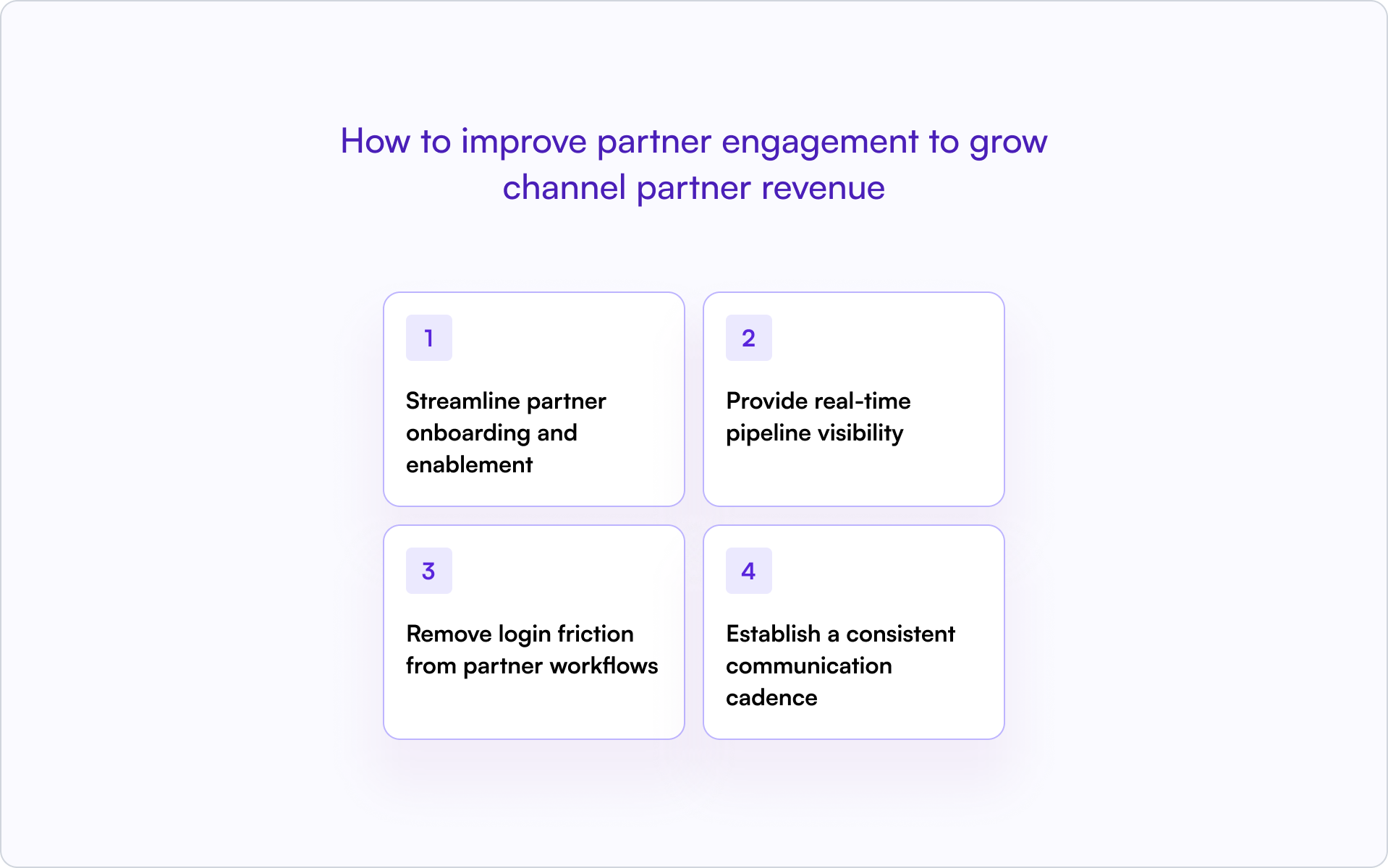
1) Streamline partner onboarding and enablement
Fast onboarding means faster revenue. Partners who know how to sell and position your product within their first week are far more likely to register deals early.
Provide self-serve training, clear playbooks, and certification paths. Define what “activated” means for your program — first registration, first co-sell meeting, first closed-won — and track it like a core funnel stage.
2) Provide real-time pipeline visibility
Partners want to see deal status without chasing your team for updates. Shared pipeline views — with limited, safe fields — keep them engaged and accountable.
When partners can see stage, next step, and protection expiry, they stay involved. When they can’t, they disengage or escalate.
3) Remove login friction from partner workflows
Every login wall kills engagement. The moment partners hit a portal login, many stop — especially for “quick” actions like registering a lead or sharing an update.
Allow partners to register deals, submit updates, and respond via email without forcing portal access. Off-portal collaboration keeps deals moving without adding friction.
4) Establish a consistent communication cadence
Regular updates prevent surprises. Weekly pipeline reviews for active partners, biweekly announcements, and monthly policy updates keep everyone aligned on pricing, program changes, and expectations.
Silence breeds confusion. Consistent communication builds trust — and trust is what keeps partners registering deals instead of “just trying it” and hoping you notice later.
CRM data model for channel partner revenue attribution
Your CRM is the foundation for tracking and forecasting channel partner revenue. Without the right fields and governance, attribution becomes a guessing game — and the quarter-end scramble becomes normal.
Required fields on opportunities and deals
The following fields make partner revenue visible and attributable:
- Partner Type: Referral, Reseller, Marketplace, SI/MSP
- Partner Organization: The specific partner company
- Sourced vs. Influenced: Who found the deal versus who helped
- Deal Registration ID: Links back to the registration record
- Protection Start / End Date: When exclusivity expires
- Incumbent Partner: For renewals, who currently owns the relationship
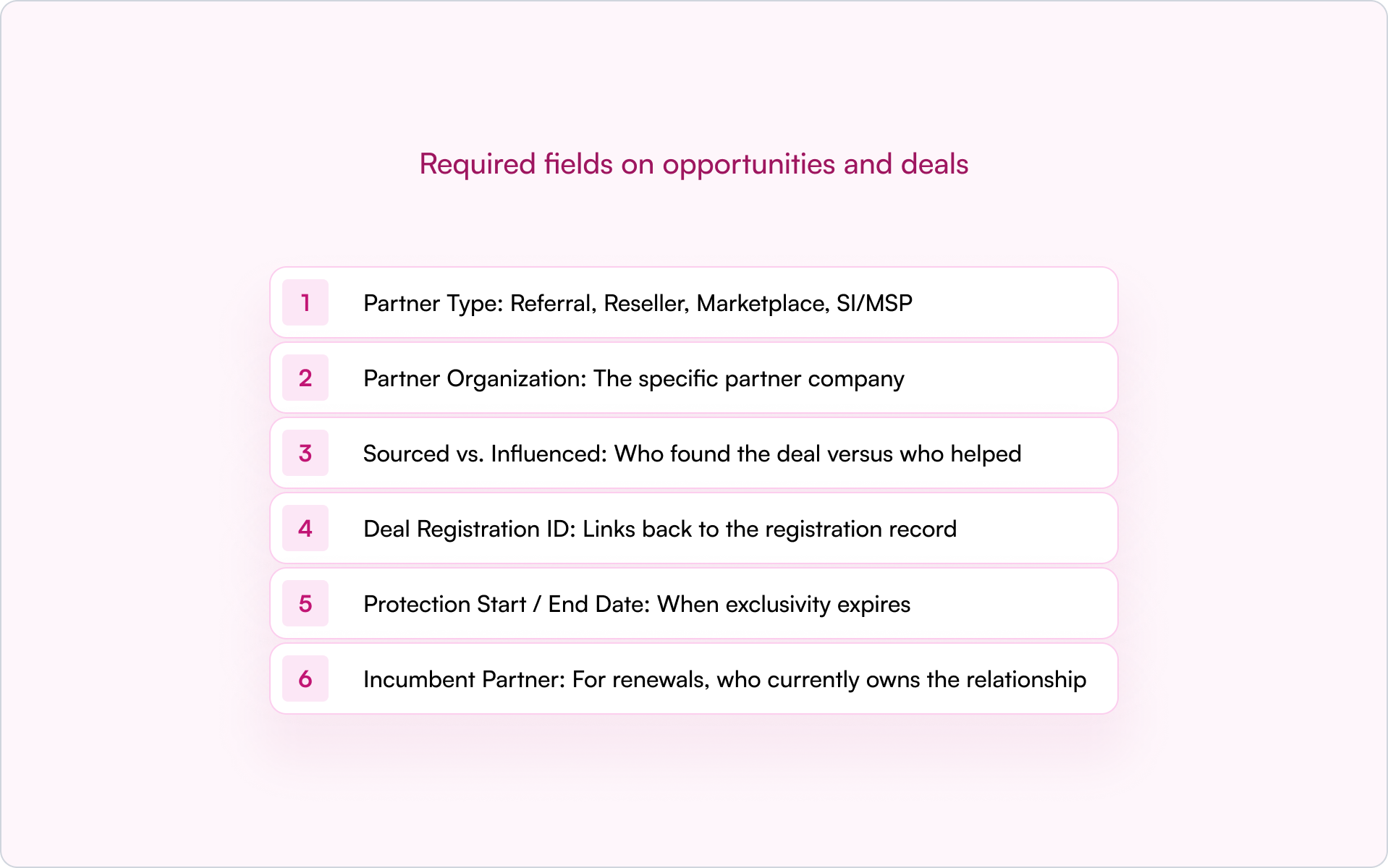
Without partner fields on opportunities, you can’t answer basic questions about partner contribution — and disputes become inevitable because everyone is relying on memory and screenshots.
Sourced vs. influenced attribution models
Sourced means the partner originated the opportunity. Influenced means the partner participated but didn’t originate it.
Some companies split credit. Others use primary attribution. There’s no single right answer — but you need a clear rule, applied consistently, before deals close. Otherwise you’ll end up negotiating credit in the most emotional moment of the cycle.
Governance rules to keep partner data clean
Fields only work if they’re enforced. A practical governance layer usually includes:
- Stage-change validations: Require partner fields before deals advance
- Duplicate rules: Catch overlap on accounts and opportunities early
- Renewal ownership logic: Prevent conflict between partners and direct sales
- Dashboards: Segment by motion and conflict status for fast visibility
Clean data means accurate forecasting. Messy data means surprises at quarter-end — and surprises are expensive.
How deal registration drives channel partner revenue
Deal registration is where ownership gets established early — and where most channel conflicts can be prevented instead of debated later.
Deal registration policy essentials
A clear policy removes ambiguity across partners, direct sales, and other channels. Your policy should define:
- Eligibility criteria, required fields, and proof of engagement
- Customer uniqueness rules to prevent multiple partners pursuing the same account
- A protection window — typically 60–90 days — with explicit extension rules
- Renewal and expansion ownership rules
- A conflict hierarchy: registered beats unregistered, incumbent beats net-new, certification status breaks ties
Without a clear policy, ownership disputes slow deals and strain partner relationships. Worse, partners learn that registration doesn’t protect them, so they stop registering.
Protection windows and SLAs
The protection window is the period a partner has exclusive rights to a registered deal. Most teams set protection windows between 60 and 90 days, depending on sales cycle length.
Approval SLAs matter too. Partners expect a decision quickly — 48 hours is a common benchmark. Slow approvals signal that registration isn’t valued, which reduces adoption and makes your channel harder to forecast.
Conflict resolution hierarchy
When two partners claim the same deal, speed and consistency matter more than debate.
Establish rules such as: registered beats unregistered, incumbent beats net-new, certification status as a tiebreaker. Document escalation paths and evidence requirements. When the rules are clear upfront, resolution is faster and fairer — and your internal teams spend less time litigating deals.
Building your channel partner revenue tech stack
The right tools make predictable channel partner revenue possible. The wrong tools — or too many tools — create friction and hide data.
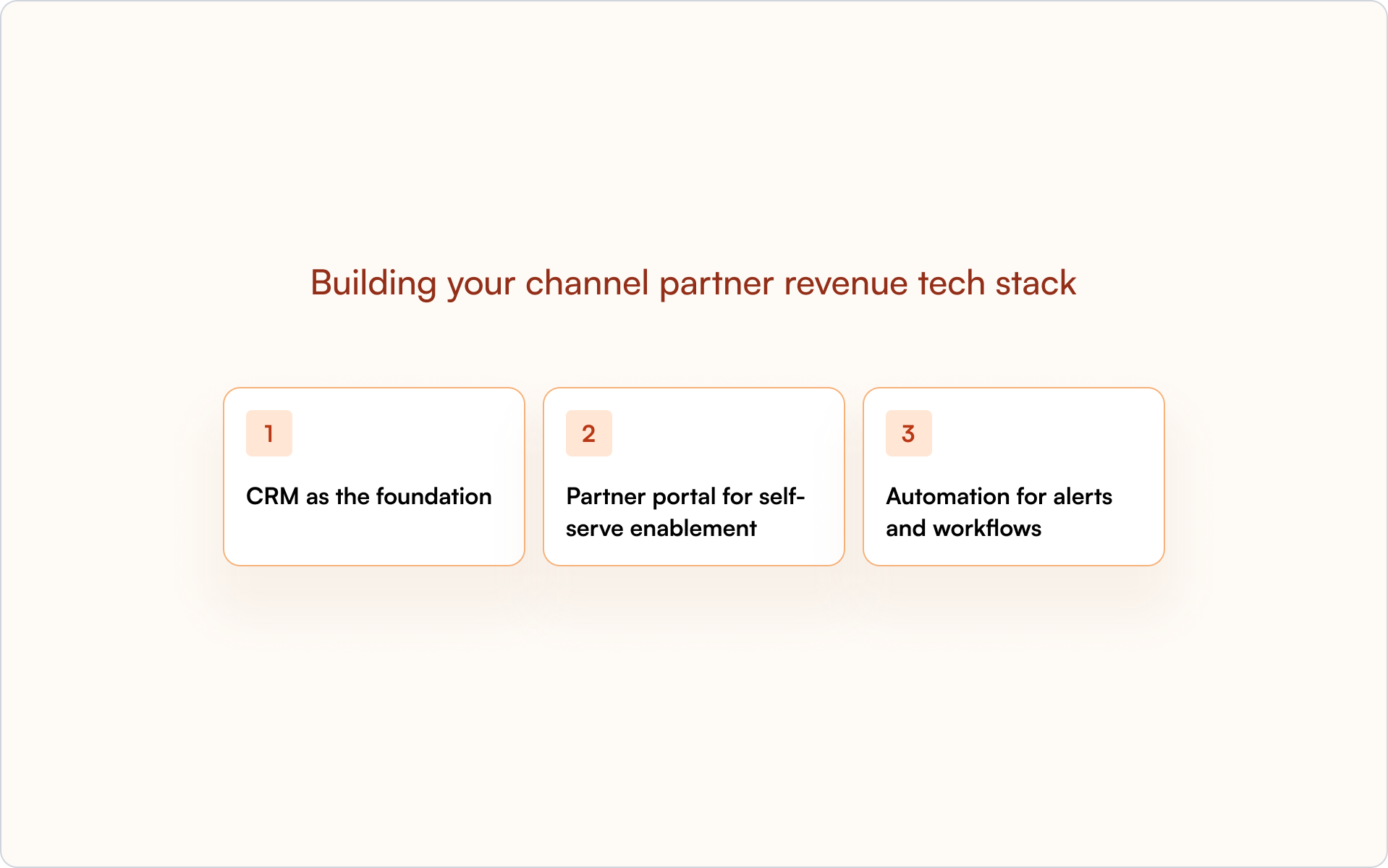
CRM as the foundation
HubSpot or Salesforce should be the single source of truth. Partner data belongs in the CRM, not a disconnected system.
A CRM-first architecture enables forecasting, attribution, and alignment between Sales, Partnerships, and RevOps. When partner activity is visible in the CRM, everyone works from the same reality.
Partner portal for self-serve enablement
A portal gives partners access to training, content, deal registration, and pipeline status. The best portals are CRM-connected, so data stays in sync without manual updates.
Partners get what they need without chasing your team. Your team gets clean data without chasing partners.
Automation for alerts and workflows
Automate deal registration approvals, expiration reminders, stage-change notifications, and partner announcements. Automation reduces manual work and prevents deals from slipping through cracks.
Most importantly, automation enforces consistency. Your program stops relying on tribal knowledge and “who happens to see the email.”
Build a partner revenue engine inside your CRM
Predictable channel partner revenue comes from CRM-first systems, not disconnected tools.
When partner activity lives inside your CRM, you get visibility, attribution, and forecasting in one place. Sales, Partnerships, and RevOps see the same pipeline. Disputes decrease because ownership is clear. Forecasts improve because data isn’t trapped in portals or spreadsheets.
A real partner revenue engine looks like consistent processes, clean data, and real-time visibility — all inside the system your team already uses.
If you want to see how a CRM-first approach works in practice, get a demo and walk through how Introw supports it across your partner program.
Still curious? Here are some quick answers to help clear things up
Channel partner revenue is revenue generated through third-party partners — such as referral partners, resellers, marketplaces, and implementation/services firms — instead of being closed exclusively by your direct sales team. A predictable program ties that revenue back to specific partners, motions, and processes inside your CRM.
Partners earn through referral fees, resale margins, revenue share, or service fees — depending on their partner type and agreement terms. The compensation model usually aligns with how much of the sales process and customer relationship the partner owns.
Partner-sourced revenue comes from deals the partner originated and brought to you. Partner-influenced revenue comes from deals where the partner helped move or close an opportunity they didn’t originate. Both matter, but they require different attribution rules, incentives, and reporting.
There’s no universal benchmark. Some companies generate the majority of revenue through partners, while others use the channel as a supplement to direct sales. The right mix depends on your product complexity, ACV, market maturity, partner leverage (distribution or influence), and your ability to operationalize attribution and deal registration.
Most programs take several quarters to ramp. Partners need time to complete onboarding, find a repeatable pitch for your product, build pipeline, and close their first deals. Your sales cycle length and enablement quality are the biggest drivers of timeline.





Are you already an active Introw partner?
Book a demo with one of our partner program experts, or explore Introw on your own time.