

MSPs already have the clients you want to reach. They’ve built trust, signed contracts, and deliver services month after month — which means one strong partnership can open doors to dozens of accounts your direct team would spend quarters chasing.
The real question isn’t whether MSP partnerships make sense. It’s whether you can build an MSP partner program that actually attracts the right partners, gets them enabled fast, and turns signups into recurring revenue. This guide walks through what to include, how to launch it step by step, and the mistakes that quietly kill most programs before they gain traction.
What is an MSP partner program?
An MSP partner program is a structured partnership between a technology vendor and Managed Service Providers (MSPs). MSPs manage IT infrastructure, security, cloud services, and support for end customers on an ongoing basis. You provide the product plus training, resources, and program incentives. The MSP operationalizes your technology inside their managed services offering.
This differs from a classic reseller relationship in one crucial way: MSPs don’t sell your product once and move on. They bundle it into a recurring service they deliver month after month, meaning your success is tied to their ability to retain clients and standardize delivery.
How the relationship works
- Technology vendor: the company (like yours) that builds the product
- MSP partner: the managed service provider who bundles your product into their client offerings
- End customer: the MSP’s client who benefits from the combined solution
MSP partnerships are especially common in cybersecurity, cloud services, backup, and remote monitoring — anywhere ongoing service delivery matters more than a one-time transaction.
Why launch a managed service provider partner program?
If you’re a founder building a B2B software company, an MSP channel can be one of the most capital-efficient paths to scale. Done right, it expands revenue without requiring a linear increase in direct sales headcount.
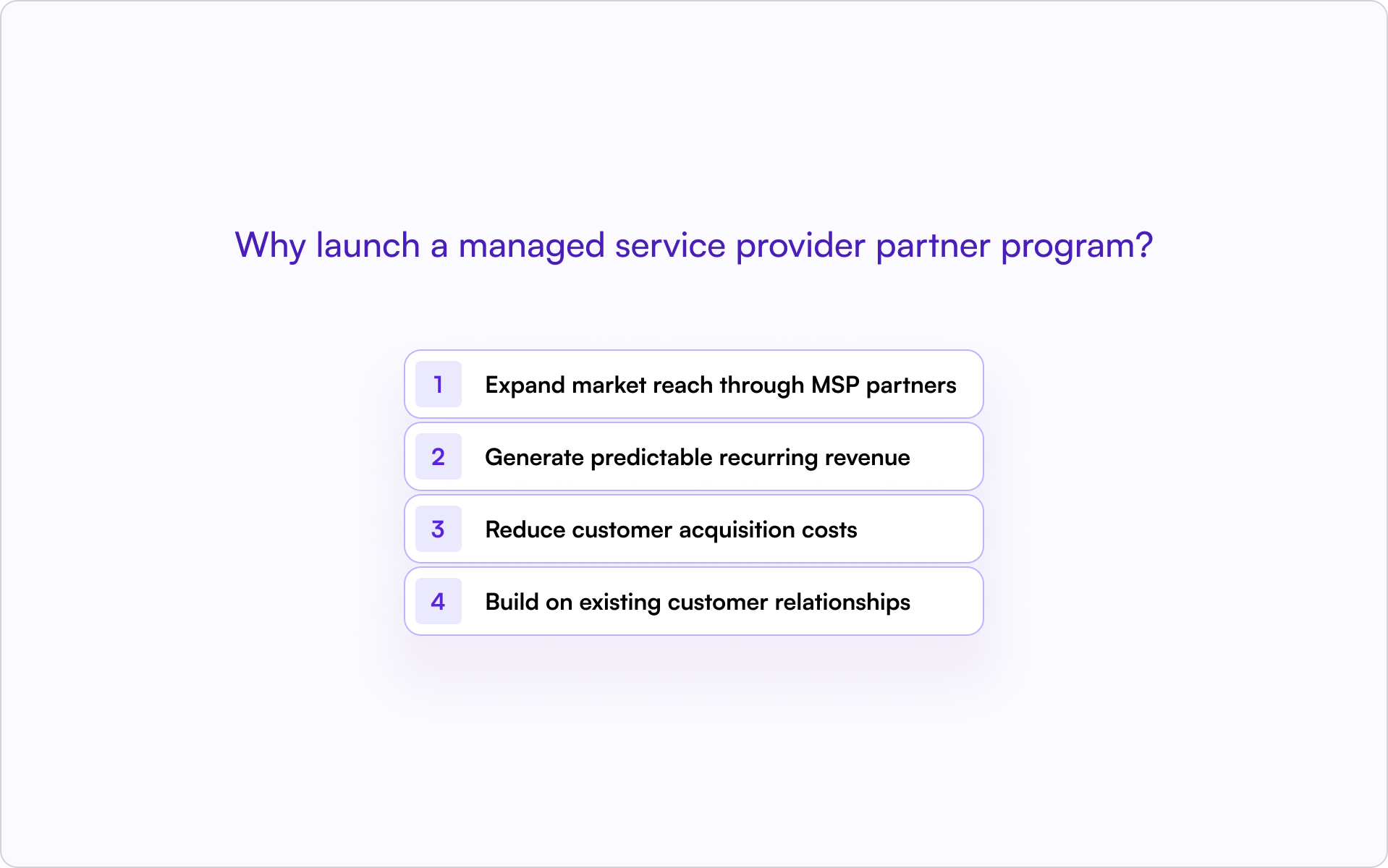
Expand market reach through MSP partners
MSPs already serve the SMB and mid-market accounts that are hardest to reach through cold outbound. They have contracts, renewal cycles, and ongoing service touchpoints — which gives them distribution you can’t replicate quickly.
One MSP partnership can unlock access to dozens (or hundreds) of end customers. Accounts your direct team would spend months identifying and closing become reachable through a single partner relationship.
Generate predictable recurring revenue
MSPs bill monthly, often on a per-user or per-device basis. When they bundle your product into their service, your revenue becomes recurring and correlated with their retention — incentives stay aligned.
Reduce customer acquisition costs
MSPs do the selling and often the implementation. You trade margin for distribution, which can be far cheaper than scaling AEs into every segment and region you want to win.
Build on existing customer relationships
MSPs are trusted advisors. Their recommendation carries more weight than vendor-led outreach — which typically shortens sales cycles and increases close rates.
What to include in your MSP partner program
Program design is where most teams accidentally lose. MSPs evaluate vendor programs constantly; if yours is confusing, under-incentivized, or operationally painful, they’ll simply prioritize someone else.
Partner tiers and qualification criteria
Define tiers based on commitment, volume, or certification status. Keep it simple — three tiers is usually enough.
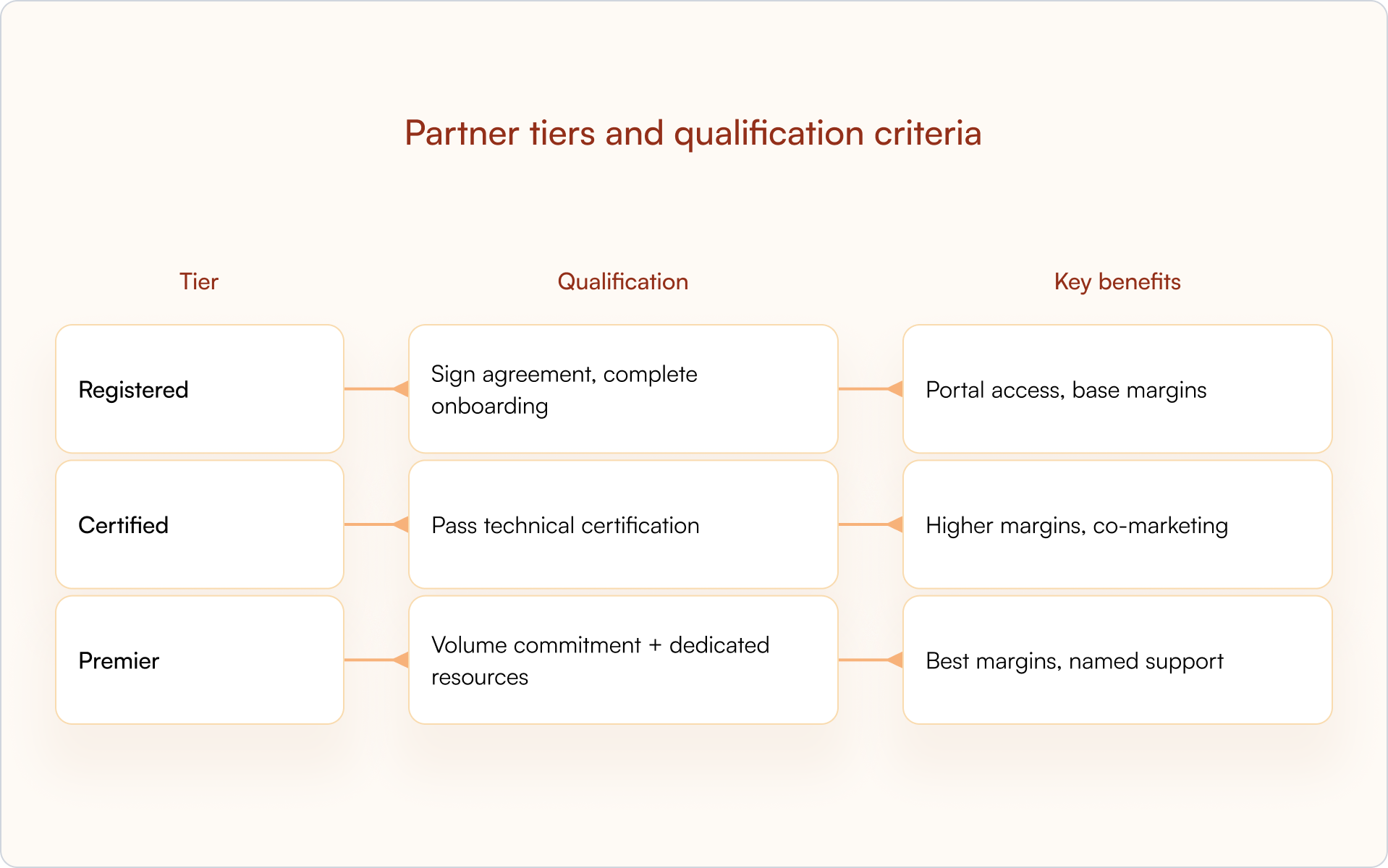
A common failure mode: teams add too many tiers to “cover every case,” and partners can’t quickly understand where they fit or what to do next.
Margin and pricing structure
MSPs need healthy margins to justify bundling your product. Wholesale pricing, volume discounts, rebates, or consumption-based billing can all work — but the economics must match the MSP business model.
- Align to monthly billing where possible (MSPs typically invoice monthly).
- Reduce upfront friction (annual-only commitments can be a deal-killer for monthly service bundles).
- Be explicit about what’s margin, what’s rebate, and what’s conditional on certification or volume.
Certification and enablement requirements
Certification protects your brand and reduces support load. Define what partners must complete before selling, implementing, or supporting your product.
Include technical training, sales enablement, and ongoing recertification. Partners who understand your product close more deals and create fewer escalations.
Deal registration and lead protection
Deal registration is how MSPs claim opportunities, earn protection windows, and avoid conflicts with your direct team or other partners.
Without clear rules, partners won’t invest in building pipeline for you. Define:
- Registration workflow: what they submit and where
- Approval SLA: 48 hours is a common standard
- Protection duration: typically 60–90 days (with clear extension criteria)
- Conflict resolution: what happens if two parties claim the same account
A structured deal registration process is one of the most effective tools for preventing channel conflict and keeping partners engaged.
Partner portal and self-service resources
MSPs expect a professional portal where they can self-serve pricing, training, marketing assets, deal registration, and support — without waiting on your team.
The portal should be connected to your CRM so data stays accurate and reporting stays real. If partners operate in one place and your revenue team operates in another, you’ll spend your time reconciling instead of scaling.
Co-marketing and sales support
Outline what support partners can expect: MDF (Market Development Funds), co-branded campaigns, lead sharing, joint webinars, and sales engineering help. Many MSPs don’t need “more collateral” — they need demand-generation support and a path to their first few wins.
How to launch an MSP partner program step by step
Strategy is the easy part. The program wins or loses in execution — especially in your first 90 days, when partners decide whether you’re worth their time.
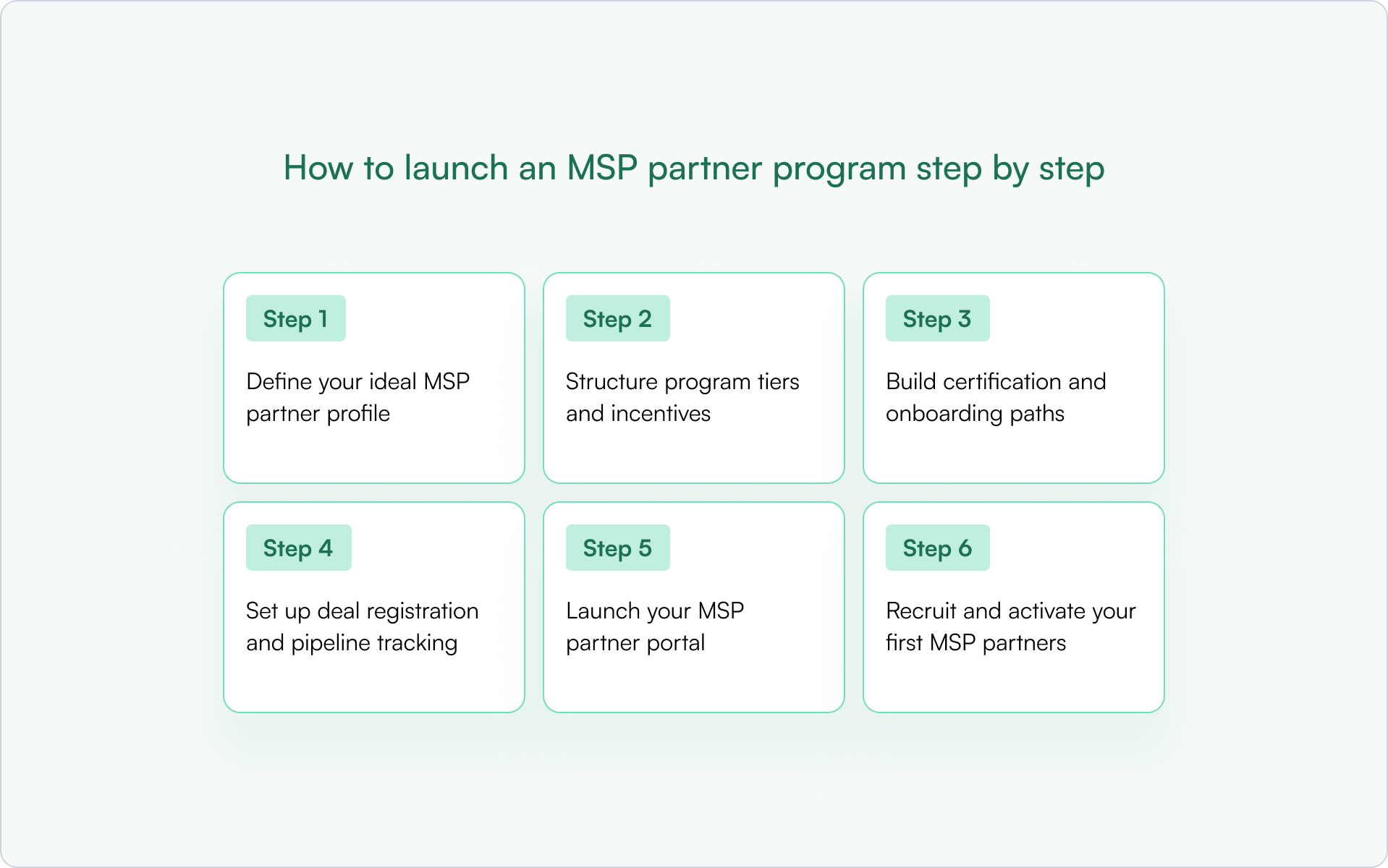
1) Define your ideal MSP partner profile
Not all MSPs are a fit. Define your criteria the same way you define an ICP for direct sales:
- Vertical focus (healthcare, legal, financial services, general SMB)
- Client base size and maturity
- Technical capabilities (security operations, cloud migrations, compliance)
- Geographic footprint and service model
- Existing vendor stack and overlaps
This prevents you from recruiting partners who will sign an agreement but never activate.
2) Structure program tiers and incentives
Build out the tier structure, margin tables, and incentive programs (SPIFFs, rebates, MDF). Put it in a partner-facing program guide that’s clear enough to forward internally.
MSPs compare programs constantly. Ambiguity loses to clarity every time.
3) Build certification and onboarding paths
Create the training curriculum: product training, sales certification, technical certification. Then design the onboarding journey from signup to first registered deal.
- Set expectations for time-to-certification.
- Provide a “first deal” playbook (ideal customer, pitch, implementation outline).
- Make enablement easy to complete in the flow of work.
4) Set up deal registration and pipeline tracking
Implement deal registration workflows (submission, approval routing, protection windows, expiration reminders) and connect it to your CRM so partner pipeline is visible alongside direct pipeline.
If partner deals live in spreadsheets or disconnected tools, you’ll create invisible pipeline and messy attribution — and you’ll pay for that later in forecasting, comp plans, and board reporting.
5) Launch your MSP partner portal
Launch the portal with everything a partner needs on day one: program guide, pricing, training, deal registration, and support paths.
Reduce login friction. In the real world, partners abandon portals that feel like extra work.
6) Recruit and activate your first MSP partners
Start targeted recruitment: identify the right MSPs, run outreach, and pitch the program with concrete economics and a clear onboarding plan. Optimize for activation, not signups — a “signed” partner who never registers a deal is a rounding error.
Define activation milestones: completed training, first deal registered, first closed deal, and track them from day one.
Tools for managing MSP partnerships at scale
Most early MSP partner programs don’t fail because the idea is wrong. They fail because operations can’t keep up — approvals lag, data is missing, and partners stop engaging.
CRM integration for MSP partner tracking
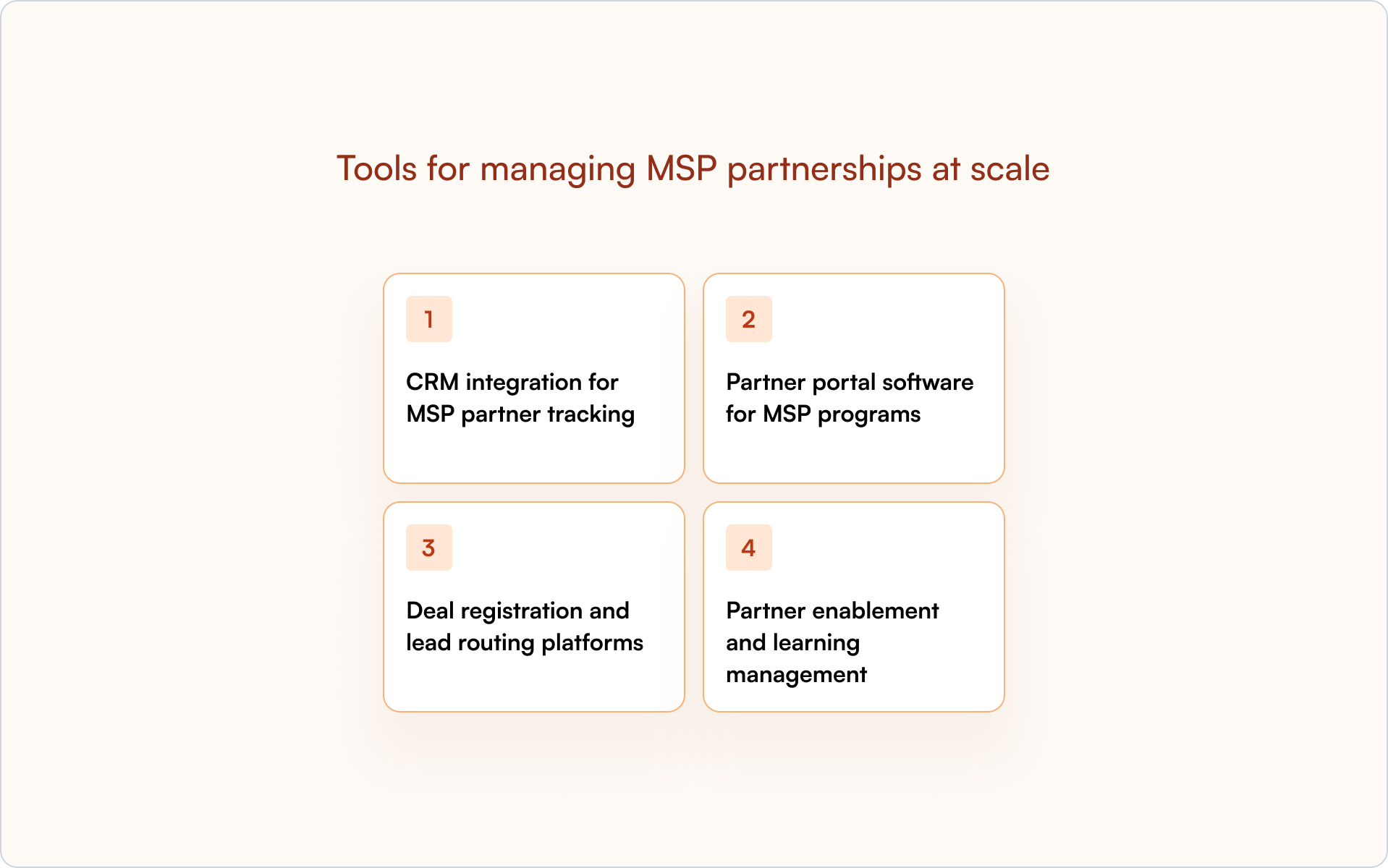
Your CRM (HubSpot, Salesforce) is the system of record for partner deals. Track partner-sourced pipeline, deal registration status, and attribution inside the CRM — not in a separate system.
That’s how RevOps and sales leadership get real visibility without reconciling spreadsheets at the end of every month.
Partner portal software for MSP programs
A partner portal centralizes resources, deal registration, and communication. Prioritize portals that integrate with your CRM so data flows automatically.
Avoid portals that create data silos or require heavy partner logins. The best portals feel like an extension of your CRM — not a separate destination.
Deal registration and lead routing platforms
Deal registration needs workflow automation: submission → approval → protection → expiration alerts. Route registrations to the right approver, enforce required fields, and track protection windows automatically.
Partner enablement and learning management
Deliver training through an LMS or enablement platform. Track certification status, send recertification reminders, and gate key benefits behind completed training.
Trained partners close more deals. Your job is to make “getting trained” feel like momentum, not homework.
Common mistakes when building an MSP partner program
Most MSP partner programs stall for predictable reasons. If you’re building this in 2026, you can avoid months of rework by designing around these failure modes up front.
Overcomplicating program tiers
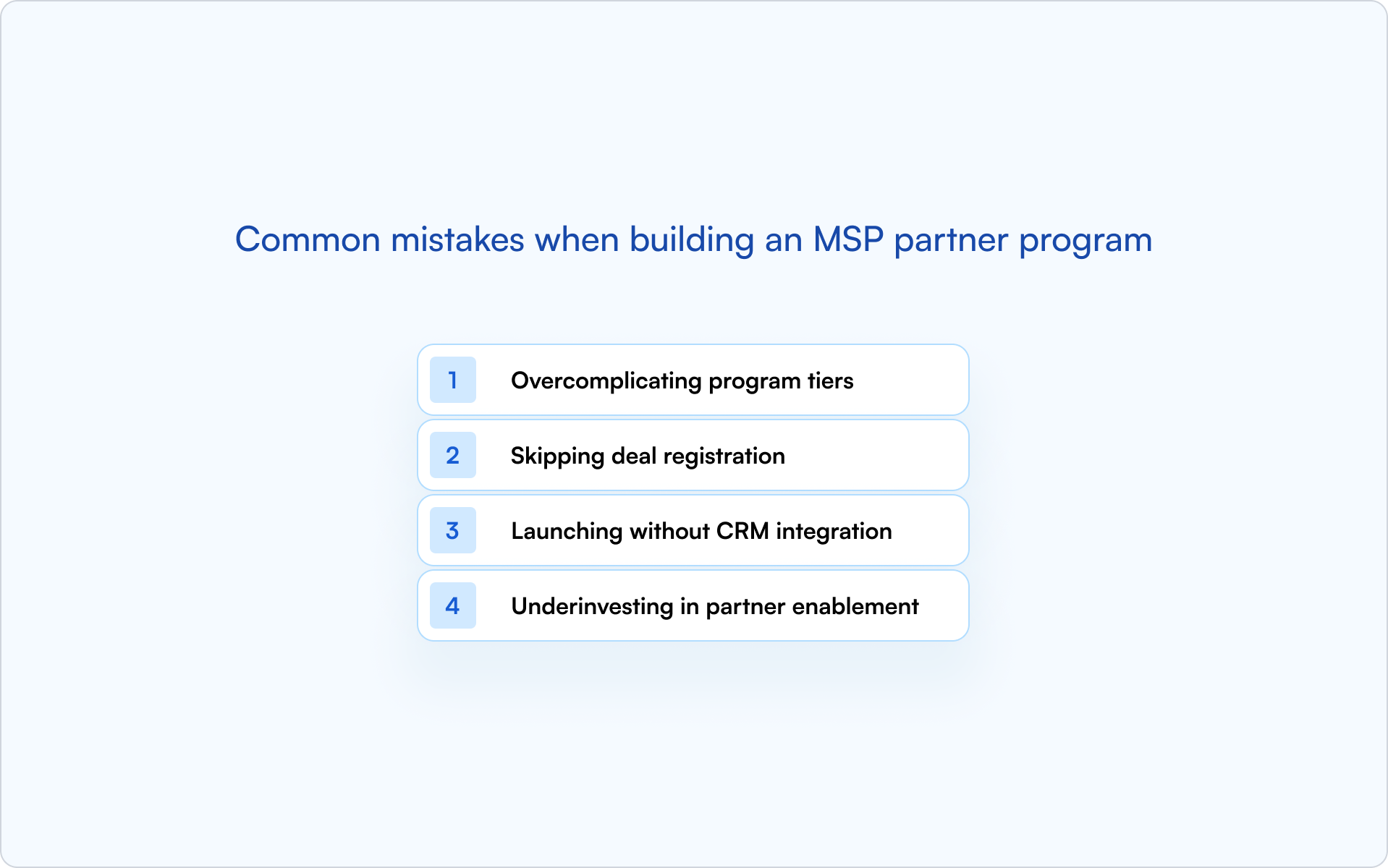
Too many tiers or unclear qualification criteria overwhelm partners. MSPs evaluate dozens of vendor programs — if yours is hard to understand, they’ll skip it. Start simple and add complexity only when real partners ask for it.
Skipping deal registration
Without deal registration, you can’t protect partner deals or prevent channel conflict. Partners won’t invest in selling if they risk losing deals to your direct team or another partner.
Treat deal registration as non-negotiable infrastructure, not a “phase two” feature.
Launching without CRM integration
If partner pipeline lives outside your CRM, you lose visibility, attribution, and forecasting accuracy. Your sales team can’t see partner deals. RevOps can’t reliably report on partner-sourced revenue. Leadership can’t trust the numbers.
Build CRM-first from the start. Retrofitting integration later is painful and expensive.
Underinvesting in partner enablement
MSPs can’t sell what they don’t understand. If training, documentation, and support are thin, partners won’t close — and they’ll blame the product. Enablement is an investment that shows up in activation rate, deal velocity, and retention.
Build your MSP partner program on your CRM with Introw
Launching an MSP partner program gets much easier when your tools work together. Introw connects your partner portal directly to HubSpot or Salesforce, so every MSP deal, lead, and activity lives in one system.
- CRM-first architecture: Partner deals live in the same system as direct deals. No hidden pipeline, no attribution guesswork.
- Deal registration: Partners register deals through the portal or email. Registrations sync to your CRM with protection windows and approval workflows — automatically.
- Partner portal: Launch a branded portal in minutes with resources, deal registration, and pipeline visibility. Partners stay engaged without logging in constantly.
- Real-time visibility: See partner pipeline alongside direct pipeline and forecast with confidence.
If you’re building an MSP channel and want it to scale without spreadsheets or disconnected systems, book a demo to see how Introw supports it.
Conclusion
A successful MSP partner program is less about flashy perks and more about operational trust: clear economics, fast enablement, protected deals, and clean data in your CRM. If you get those foundations right, the channel can become one of the most efficient growth engines in your go-to-market.
Still curious? Here are some quick answers to help clear things up
An MSP partner bundles your product into an ongoing managed service they deliver to clients. A reseller typically sells your product as a standalone transaction and may not provide continuous service delivery. MSP relationships are recurring by design; reseller relationships are often transactional.
A basic MSP partner program can launch in a few weeks to a few months depending on how much you already have in place (pricing model, onboarding, training, deal registration, and portal). CRM-first platforms can accelerate the timeline by reducing manual setup and integration work.
Margins vary by category, competitive pressure, and your delivery requirements. Many vendors land in the 20–40% range, often with higher margins for more committed tiers. The key is whether an MSP can profitably bundle your product into monthly services while still covering their support, tooling, and account management costs.
Yes in almost every case. Deal registration gives partners confidence they can invest in creating pipeline without losing the opportunity to your direct team or another partner. It also gives you a clean audit trail for attribution, forecasting, and conflict resolution.
Most vendors recruit MSP partners through targeted outreach, industry events, existing customer referrals, MSP directories, and distributor ecosystems. Prioritize partners who fit your ideal profile and who can realistically activate (complete training and register deals) within the first 30–60 days.




See what your partner program actually could look like
Book a demo with one of our partner program experts, or explore Introw on your own time.