
Your partner just finished your certification. They aced the product quiz, collected the badge, and logged their first deal. Then they called your rep to run the demo, handle the objection, and quote the price. The partner learned your product, but they just can't sell it without you. The goal of channel partner sales training is a deal self-sufficiency: a partner who can win with your team out of the room. This guide shows you the plays, the certification, and the metrics that get you there.
What channel partner sales training is and what it's for
Channel partner sales training, sometimes called channel business training, is how a vendor equips partner sales reps to sell its product and solutions: the core concepts, the pitch, the plays, and the resources and tools they need to close deals across your products and services. It's one part of channel partner management, and it sits alongside channel marketing, your marketing team's programs, and the ongoing support a healthy program provides. In the technology industry especially, most companies now sell through these sales partners rather than direct.
Here's what makes it different from training your own sales team. Your reps are a captive audience. Partners are not. A partner rep sells several vendors' products, represents several brands, and spends time on whatever helps them earn and grow their business. So channel sales training competes for attention, and knowledge transfer alone doesn't win it.
Why trained partners still lean on your team
If certificates worked, your best-trained partners wouldn't escalate every deal. They do, for two reasons.
First, the productivity skew is real. A long tail of signed-but-dormant partners produces nothing while a handful carry the number. The classic pattern is sign 30 partners and watch four ever close a deal. Completion certificates coexist with total dependence on your reps.
Second, and more fixable, is a set of specific capability gaps. A partner rep escalates the moment a deal needs a skill they don't have:
- They can't run discovery, so they never surface the customer needs a deal turns on.
- They can't qualify, so they burn cycles on bad-fit opportunities.
- They can't handle objections, so one hard question stalls the deal.
- They can't demo without pulling in your sales engineer.
- They can't navigate competitive or pricing conversations.
The buyer shift makes these gaps fatal. Gartner finds B2B buyers spend only 17% of their purchase journey meeting with any supplier. A partner whose only move is a 45-minute demo loses to one who can send a product experience in a link. Brochure-level partners don't just underperform. They lose.
Build training around the deal, not the product catalog
Because partners are a non-captive target audience, the training that lands is the training that helps them earn. Organize around the partner's live deals and commission, not your product catalog.
Three design principles, the key strategies that make partner training stick, carry most of the weight.
- Just-in-time. Deliver the objection cheat-sheet when the rep hits the objection, not in a week-one onboarding they've forgotten by the time it matters.
- Mobile and short. A partner rep learns between meetings. Long video training modules go unwatched; a two-minute play gets used.
- WIIFM-first. Lead with what's in it for them: this play helps you close this deal and earn this commission. Tie every asset to partner sales performance, and attention follows.
Build training this way and partner engagement stops being something you nag about. It becomes a byproduct of usefulness, and the trust it builds is the foundation of durable partnerships.
The partner play library: what a rep can run solo
Self-sufficiency is made of assets, not intentions. A partner rep can run a deal through the sales funnel alone only if you've handed them the plays. Six belong in every library:
- Discovery scripts. The questions that surface customer needs, so the rep leads the conversation instead of pitching blind.
- Qualification criteria. A simple good-fit versus bad-fit checklist, so reps stop chasing deals that were never going to close.
- Objection cheat-sheets. The top ten objections and a crisp answer to each, so a hard question doesn't end the call.
- Competitive battlecards. Head-to-head positioning against the alternatives.
- A shareable demo or product experience. A link the partner can share to create the aha moment, so the buyer sees value without booking your sales engineer. This is the single asset that most reduces reliance on your team.
- Pricing guardrails. The discount bands and deal structures a rep can offer without escalating, so pricing stops being a reason to call you.
Give reps the right tools and the escalations that used to route to your team resolve on the partner's side. That's the whole point: fewer deals that need you in the room.
Certify on selling capability, not course completion
Many organizations still certify on completion. A completion certificate proves a partner sat through your course. It says nothing about whether they can sell. Certify the thing you actually care about: can this rep win a deal?
Test capability directly. A mock pitch, a recorded demo, or a live deal simulation shows whether a partner can run discovery, handle objections, and close in a way a quiz never will. Certify on that, then tie the certification to tier and benefits: better leads, higher margins, co-marketing, and incentive programs reserved for partners who prove they can sell solo.
The partner self-sufficiency scorecard
Course completion is a vanity metric. To manage self-sufficiency, measure it. Track these by partner for a clear read on partner performance, and the picture of who can actually sell gets sharp.
Read together, these replace attendance with independence. A partner with a high solo-win rate and a low escalation rate is self-sufficient. One with a full certificate wall and a 100% attach rate is not, whatever the LMS says. Structured onboarding also shortens the ramp: it cuts new-rep ramp time by 40 to 50%, per G2, so time-to-first-deal is a lever you can actually pull, and it shows up as pipeline growth your partner-facing teams can act on.
If you want to stand up a scorecard against your own partner data, get a demo and we'll map it to your CRM.
A graduation model: co-sell to supported to solo
Self-sufficiency is a destination, not a switch. Graduate partners off your support as their capability grows.
- Co-sell. Early on, your rep runs the deal while the partner watches and learns. High touch, low independence.
- Supported. The partner runs the deal; your team is on call for the hard moments. Touch drops as trust builds.
- Solo. The partner runs and closes without you. Your involvement is the exception, not the rule.
Move partners up as their scorecard earns it, not on a calendar. The aim is to work yourself out of every deal you can, so your team can focus on the deals that truly need it.
Segment training by partner type and stage
One curriculum doesn't fit every partner. Segment on two axes.
By partner type: a reseller rep needs pitch and objection plays; an MSP needs to sell an outcome and build strong relationships around a managed service; a systems integrator needs depth on integration and the technical sale. By stage: a pre-first-deal partner needs the fastest possible path to one win; a scaling partner needs advanced competitive and pricing plays to grow into new markets. Everyone gets the same strong foundation. Not everyone needs the same depth.
Build it yourself or buy a program?
Most vendors ask whether to build training in-house or buy it. Short version: it depends on how specific your sale is.
Develop it yourself when your pitch, your objections, and your competitive landscape are unique, which for most software sales they are. No off-the-shelf courses know your deals. Buy a program, from providers like the Channel Institute or a general course library, when you need foundational channel selling skills fast and your product layer is thin. Many providers offer a free trial module so you can test fit before committing. An LMS or partner portal sits underneath either choice as the place partners actually access the plays.
The honest rule: buy the generic sales fundamentals if you must, but the plays that win your deals, you build. Those are the ones that reduce reliance on your team.
When not to (anti-patterns)
Four ways channel partner training fails:
- Feature-dumping. Teaching every feature instead of the two or three that win deals. Partners drown and remember none of it.
- Certifying on completion. A finished course is not a proven seller. If your certificate doesn't predict revenue, it's theater.
- Training the wrong people. Enabling the procurement or marketing contact instead of the partner sales reps who face customers. Train the people who carry the bag.
- Scaling before you have a pitch. If you can't hand a partner a repeatable, winning pitch, don't scale training. You'll just teach improvisation at volume. Codify the pitch first.
How Introw helps partners sell without your team in the room
Training only reduces reliance on your team if the plays are where partners work and their results are where you can see them. Slides in a portal nobody opens don't change behavior, and completion data doesn't tell you who can sell. Introw closes both gaps. It's the CRM-native operating layer that puts deal-ready plays in front of partners and their real selling data in front of you, inside HubSpot or Salesforce.
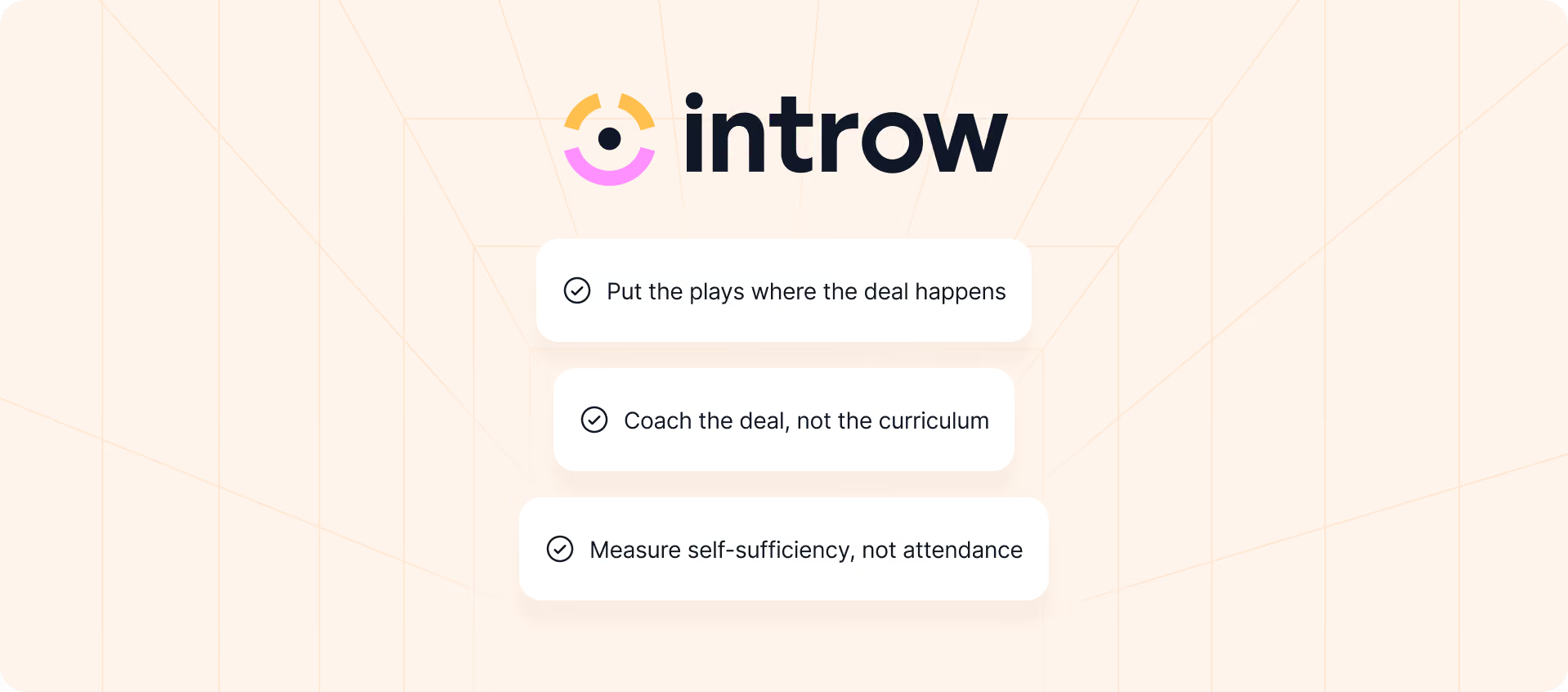
Put the plays where the deal happens
Partners work their deals in a partner portal that syncs to your CRM, with the right play surfaced on the deal in front of them. A rep gets the objection cheat-sheet or battlecard at the moment they need it, not in a course they've forgotten, so they resolve the deal instead of escalating to you.
Coach the deal, not the curriculum
Introw reads live deal data and surfaces next best actions and deal guidance as the deal moves. The partner gets sales guidance in the flow of the work, which builds the confidence to run the next one solo.
Measure self-sufficiency, not attendance
Because partner selling lands in your CRM, the scorecard becomes real: solo-win rate, escalation rate, and percent producing by partner, instead of completion counts. You see which partners are independent and which need coaching, and you stay in control of what each partner sees. Introw doesn't replace your training. It makes training show up as deals your team didn't have to run, and stronger partner relationships along the way.
Ringover moved partner activity from 20% to over 70% after making its motion visible this way (case study).
Suggested further reading: how partner data syncs to your CRM in the Introw docs, alongside the partner portal overview.
Want partners who close without pulling in your team? Book a demo.
Still curious? Here are some quick answers to help clear things up
A channel partner is a third-party company that sells, delivers, or supports your product for you in exchange for margin or fees. In sales terms, their reps carry your product to customers you reach through the partner rather than directly.
The three most common are resellers (including value-added resellers), managed service providers, and systems integrators. Distributors and referral or affiliate partners are also widely used. Each sells in a different way, which is why training has to be segmented by type.
Usage varies. The classic distribution framework lists cost, capital, control, coverage, character, and continuity as the lenses for evaluating a channel. Some marketing sources swap in customer, convenience, collaboration, and competitive advantage. Either way, they sit upstream of training, at the channel management and strategy layer.
Build around their live deals, not your product catalog. Give reps a play library they can run solo (discovery, qualification, objections, battlecards, a shareable demo, pricing guardrails), certify them on a mock pitch or deal simulation rather than course completion, and track a self-sufficiency scorecard instead of attendance.
Your own reps are a captive audience who sell only your product. Partner reps are not: they sell several vendors and spend time on whatever helps them earn. So channel partner sales training has to compete for attention and prove its worth in the partner's economics, which direct training never has to do.



See AI-Native PRM in Action
Book a demo with one of our partner program experts, or explore Introw on your own time.