

Partner program ROI compares the gross profit attributed to your partner program with the full cost of running it. The calculation is straightforward. Agreeing on revenue, attribution, and cost definitions is the hard part. Partner program success can't be judged by attributed revenue alone.
A CRM can tell you which partner sourced a deal. It can't, on its own, prove that the deal would not have happened without that partner. Finance needs both a reproducible calculation and a clear account of its limitations.
This guide shows B2B SaaS partnership leaders and RevOps teams how to calculate ROI, avoid double counting, and present a worked example leadership can audit.
A partner manager reports €300,000 in partner-sourced revenue. Finance asks how much of that became gross profit, whether commissions were included, and why the CRM shows a different total.
Nobody disagrees about the formula. They disagree about the inputs.
That's the reconciliation gap: a partner program can generate real business while its return remains impossible to defend. Here's how to close it.
What is partner program ROI?
Partner program return on investment (ROI) is the percentage of return attributed to a partner program after its defined costs have been deducted, relative to those costs.
For a B2B SaaS company, a practical operating measure compares partner-attributed gross profit with the costs required to produce and support that activity. This goes further than reporting partner-sourced annual recurring revenue (ARR), but it is still an attribution-based estimate. Partner marketing ROI is narrower: it measures the return on specific partner marketing campaigns, not every cost of running a channel partner program. Partner marketing programs may deserve their own campaign-level analysis, but that calculation should not be confused with full program ROI.
Attributed ROI isn't the same as incremental ROI
A partner-sourced opportunity has a recorded origin. That doesn't prove the customer would never have bought through direct sales. A healthy channel program needs to distinguish partner contribution from revenue that existing direct sales efforts might have generated. Channel partners represent one route to market, not automatic proof of incremental sales.
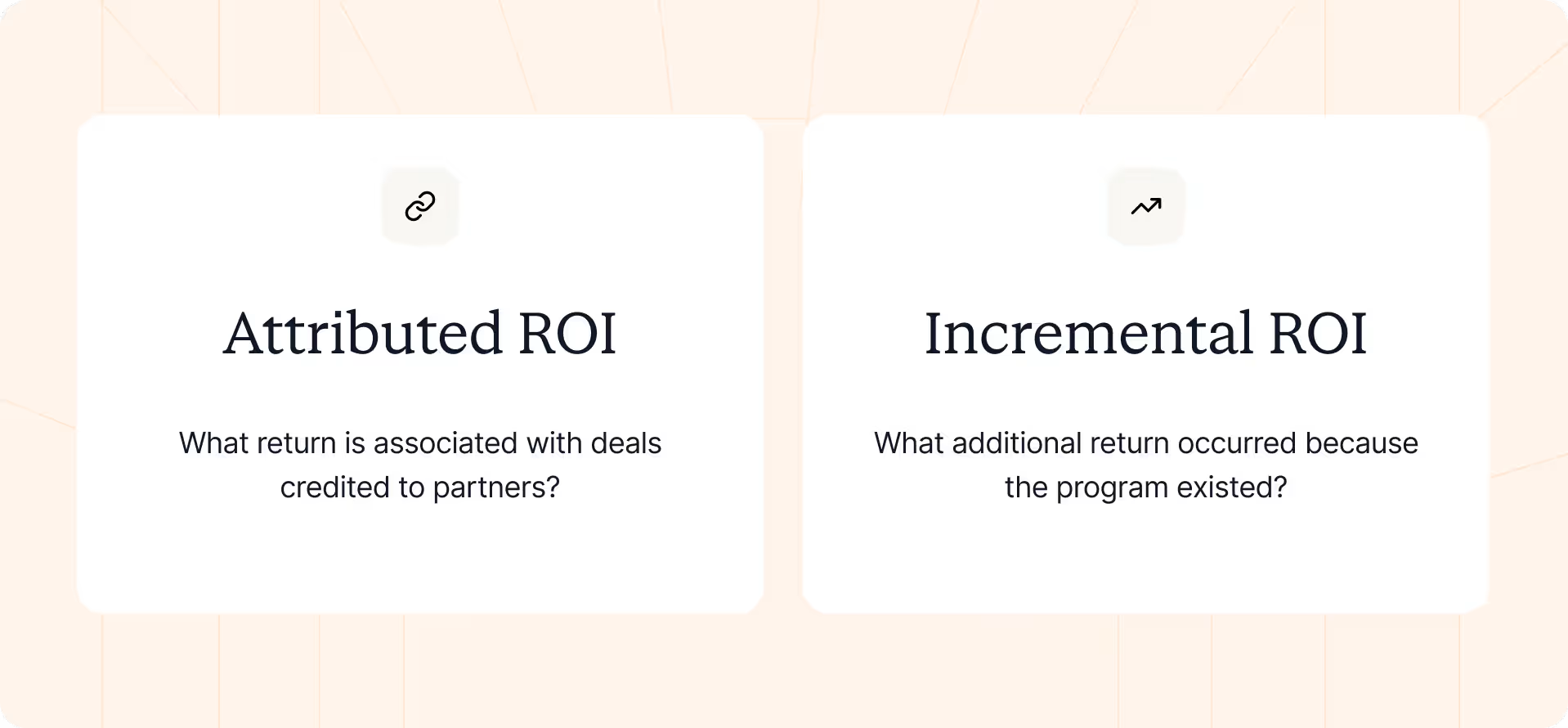
Attributed ROI answers, “What return is associated with deals credited to partners?” Incremental ROI asks, “What additional return occurred because the program existed?” The second question needs a credible baseline, such as comparable customer cohorts or a controlled test. You need that baseline before treating attributed return as evidence of business growth caused by the program.
Start with an auditable attributed ROI calculation. Label it correctly, then investigate incrementality before making stronger claims about causation. Channel partners can contribute at different points in the customer journey, from an introduction to a technical evaluation, so their roles must be recorded separately. For the underlying CRM relationships, see our partner attribution guide.
The partner program ROI formula
Partner program ROI (%) = [(partner-attributed gross profit − program costs) ÷ program costs] × 100
Gross profit is net recognized revenue minus the cost of delivering the product or service. For subscription businesses, that commonly includes hosting and service-delivery costs. Revenue alone isn't the return you want in this formula.
A 25% ROI means €1.25 of attributed gross profit for each €1 of program costs, including recovery of the original euro. It does not mean €1.25 of additional profit.

What costs should you include?
Include both direct spending and fairly allocated shared expenses. Missing the people line is a common reason channel ROI looks better than finance expects. Channel partners can generate revenue while the internal teams supporting them still carry significant program costs. A partner marketing program can incur creative, event, and agency expenses even before the first partner-led deal closes. For a channel partner program, count only the share of those costs that supports the deals and period being measured, including campaigns in which partners participate.
Use this checklist to reconcile the cost side:
| Cost | Include | Watch out for |
|---|---|---|
| Commissions and incentives | Referral fees, reseller commissions, SPIFFs | Separate acquisition and renewal payments |
| Partner marketing | MDF, co-marketing, partner marketing campaigns | Count actual expense, not an unused budget |
| People | Fully loaded Partner Ops, partner managers, allocated sales support | Document the allocation method |
| Technology | PRM, relevant tools, reporting software | Don't charge the same platform twice |
| Enablement | Channel partner training, certifications, and marketing materials | Exclude unrelated company-wide work |
| Discounts | Reflect lower net selling price | Don't subtract again if revenue is already net |
Watch the double-counting trap
A discount usually reduces the transaction price and therefore recognized revenue. If your gross profit already uses that lower revenue, subtracting the discount again as a program expense would count it twice.
The same applies to customer support or partner-delivered implementation. If finance has included a cost in cost of goods sold, don't include it again as program overhead. A learning management system or partner enablement platform belongs in the program-cost line only to the extent that the program actually uses and pays for it. The same principle applies to a separate training program or shared marketing tools. Keeping training materials easily accessible may reduce support requests, but count a saving only when it is measurable.
How do you attribute returns from channel partners?
Attribution rules decide which revenue enters the ROI calculation. Write them down before someone asks for a higher number.
Separate sourced and influenced contributions
A partner-sourced deal originates with a partner introduction or registered opportunity. A partner-influenced deal starts elsewhere but receives meaningful partner support, such as technical validation or a co-selling introduction.
Use sourced deals for a clearly labeled, conservative headline view if that is your agreed convention. If partner marketing ROI is measured separately, assign shared campaign costs consistently across that view and program ROI. Report influenced revenue separately, or use a documented contribution model. There is no universal rule requiring sourced-only ROI.
One CRM opportunity may involve a reseller and a technology partner. Record both roles, but don't count the full deal twice. Ask how many partners contributed, then decide how the credited return is apportioned rather than duplicating it. Channel partnerships often combine referrals, co-selling, and implementation, but that doesn't create three separate sources of revenue.
Check what the program actually changed
Deal registration gives you a timestamp and ownership trail. It doesn't prove incremental demand.
To test partner effectiveness, compare reasonably similar partner-acquired and direct cohorts by customer profile, deal size, win rate, sales-cycle length, and retention. Differences are useful signals, not automatic proof of causation. Where possible, test a specific partner motion against a credible baseline.
The test: Can you trace every euro of reported return to a unique deal, a recognized-revenue record, and a documented attribution rule? This establishes what partnerships contribute in your reporting model, not what would have happened without them.
Example: Calculate ROI for a SaaS partner cohort
This is an illustrative model, not a benchmark. Assume all 20 customers start a 12-month subscription on January 1. That artificial start date keeps the revenue-recognition example easier. Real customer cohorts require actual contract dates.
Step 1: Fix the assumptions
| Input | Assumption |
|---|---|
| New partner-sourced customers | 20 |
| Annual net subscription price | €15,000 each |
| Gross margin | 80% |
| Year-one recognized revenue | €300,000 |
| Year-one gross profit | €240,000 |
All 20 customers receive 12 months of service, with no expansion or churn in year one. These customers acquired through partners are treated as one cohort for the calculation. Prices are net of discounts. Delivery costs are captured in the 20% cost-of-service assumption.
Step 2: Reconcile year-one costs
| Program expense | Year one |
|---|---|
| Acquisition commissions, 15% of revenue | €45,000 |
| Partner manager and operations time | €60,000 |
| PRM and related tooling | €12,000 |
| Enablement and content | €8,000 |
| MDF and partner campaigns | €10,000 |
| Total program costs | €135,000 |
| Year-one attributed ROI = [(€240,000 − €135,000) ÷ €135,000] × 100 = 77.8% | |
The result is approximately 78% attributed ROI. It isn't an incremental ROI claim, and it assumes every listed cost belongs to this cohort rather than other partners or customer groups. That allocation matters when a channel partner program serves several industries or partner groups.
Higher value customers can also require more technical support, which changes the profitability of the cohort. If an expense supports three partner teams, document how you split it rather than assuming the whole amount belongs to one. Without that split, the report can misstate the partnership's financial viability.
Step 3: Carry the same cohort into year two
Assume 18 of the 20 customers renew at the same price, with the same 80% gross margin. Year-two recognized revenue is €270,000 and gross profit is €216,000.
The program still incurs costs: €27,000 in renewal commissions, €35,000 in partner management, €12,000 in tooling, and €4,000 in enablement. That is €78,000 in year-two costs, with no newly acquired customers included.
| Period | Cumulative gross profit | Cumulative costs | Cumulative ROI |
|---|---|---|---|
| 12 months | €240,000 | €135,000 | 77.8% |
| 24 months | €456,000 | €213,000 | 114.1% |
| 24-month ROI = [(€456,000 − €213,000) ÷ €213,000] × 100 = 114.1% | |||
Without year-two costs, that figure would be overstated. A real model must also adjust for expansions, downgrades, cancellations, variable margins, and the timing of partner payments.
Which key metrics explain channel partner performance?
ROI is the outcome. Supporting metrics tell you whether the program is becoming more efficient or simply benefiting from an established customer base.
Partner CAC and payback
Customer acquisition cost (CAC) uses acquisition costs, not automatically every dollar spent on operating a partner program.
In this example, suppose €35,000 of the people expense and €5,000 of enablement are acquisition-specific. Combined with €45,000 in acquisition commissions and €10,000 in campaigns, acquisition spending is €95,000.
Partner CAC = €95,000 ÷ 20 customers = €4,750
Monthly gross profit per customer is €15,000 × 80% ÷ 12 = €1,000. Simplified CAC payback = €4,750 ÷ €1,000 = 4.75 months. This assumes an upfront acquisition-cost basis and steady gross profit; actual cash recovery depends on when expenses and receipts occur.
Defining channel partner performance beyond revenue
Keep a small supporting scorecard: partner activation, time to first qualified deal, partner-sourced win rate, average deal value, and customer retention rates. Customer retention rates measure the durability of a cohort, not simply how many deals were closed. These key performance indicators help you evaluate channel partner performance, but they're diagnostic measures, not substitutes for ROI.
They help measure performance across acquisition, deal quality, and retention without equating activity with profit. Review the leads partners generate as qualified opportunities, not just raw lead counts. Compare sales cycle length for partner-led deals against similar direct deals, and review customer churn rate within each acquisition cohort. Compare acquisition economics for partners versus direct sales on matching customer profiles.
Tracking partner engagement through training course completion rates and partner deal registration rates can reveal friction for new partners. Assessment results can also identify partner skills gaps, but don't convert those activity measures into invented ROI.
Even a well trained partner can produce no pipeline. Completion isn't a financial return until outcomes are measured. Monitoring customer feedback through customer satisfaction surveys, customer satisfaction scores, and support records can flag problems after the sale.
If channel partners also represent your brand and support customers, compare satisfaction and retention by partner type. Use these signals to determine partner effectiveness and relationship health, not to manufacture financial returns from activity. They can reveal customer loyalty or retention risks that a revenue-only report misses.
How to make your channel program ROI report finance-ready
You don't need 20 dashboard widgets. You need a repeatable method and one agreed version of the numbers.
Give every input an owner
- CRM and RevOps: partner roles, deal IDs, deal status, customer cohorts, and attribution rules.
- Finance: recognized revenue, gross margin, commission expense, payroll allocation, and reporting periods.
- Partnerships and channel operations: program activities, partner tiers, partner marketing spend, and explanations for changes.
Reconcile totals quarterly. Preserve the definitions when comparing periods, and disclose any rule change rather than quietly restating the past.
Report the result and its limitations together
Use a one-page summary containing attributed gross profit, fully allocated costs, ROI, sourced and influenced contributions, CAC, payback, and the most important change since last quarter. These key performance metrics need a consistent cost basis to be useful. Separate investment in partner marketing campaigns from program-wide operating expense so leaders can assess cost efficiency at both levels.
Then explain what the number does not establish: incremental causation, untracked influence, or future renewal performance. Segment the view by partner type or tier only when each group has a defensible cost allocation. A channel partner's business model changes the support it needs, so compare like with like. The partner operations guide explains how partner teams maintain those groups and their data.
The report should contain exceptions and decisions, not another reconciliation exercise.
How Introw helps you measure partner program ROI
Most partner ROI reporting breaks before the calculation. Credit is missing from deals, commission expenses sit elsewhere, and each team rebuilds its own version of the numbers. The goal is a reliable financial view of how channel partners contribute to the business. The same view can help customer success and finance understand which partner relationships are sustaining revenue.
Introw helps connect the partner activity and revenue records. Finance still owns the final cost model and ROI assumptions.

Keep partner credit on the CRM deal
Introw uses HubSpot or Salesforce attribution to connect partners with the opportunities they source or influence. Multiple partner roles can be represented on the same deal, so the same revenue doesn't need duplicate CRM records. See deal and lead registration.
Make incentive costs traceable
Commission and SPIFF management links plan rules, eligible transactions, statements, and payout status to partner activity. That gives finance a clearer starting point for the incentive cost line. It doesn't replace payroll allocation or revenue recognition.
Give partnership leaders a consistent view
Reports and dashboards combine CRM performance with Introw engagement data. You can review partner-attributed deals, revenue, and activity without rebuilding every report in spreadsheets. Finance can then reconcile those inputs to its own recognized-revenue and expense records.
Ready to connect partner attribution and commission data to a finance-ready ROI report? Book a demo and see how Introw keeps partner revenue tied to your CRM.
Still curious? Here are some quick answers to help clear things up
There is no universal benchmark. Compare ROI against your program's maturity, capital needs, margins, and alternative investments. Always disclose the cost basis and measurement period.
It can, when you use an agreed contribution model that avoids double counting. Otherwise, report influenced revenue separately and use sourced-attributed ROI as a clearly labeled baseline.
Not twice. If your recognized revenue already reflects the discount, it has reduced gross profit. Don't also subtract that same discount as an expense.
CAC measures acquisition expense per new customer. Program ROI compares attributed gross profit with the broader costs of running the program. They answer different financial questions.
Review it quarterly using consistent rules, and track acquisition cohorts over 12 and 24 months where useful. Pair the financial view with pipeline and activation indicators while revenue matures.





See AI-Native PRM in Action
Book a demo with one of our partner program experts, or explore Introw on your own time.