

.svg)


.svg)
.svg)








Articles by Géraldine
AI Sales Coaching for Partner Teams: The Missing Layer in Partner Revenue
The real reason partner deals stall (and it is not your partners)
Partner-sourced opportunities are often your most valuable pipeline.
They tend to be larger, more strategic, and more likely to convert when they move forward. Introw’s own research shows partner deal stats that partner-sourced opportunities consistently outperform average direct deals when they reach the finish line.
So, the issue is the difference between how your partners vs. your sales teams are coached.
Think about how partners actually work:
- They juggle multiple vendors at once
- They do not live inside your product every day
- They have not gone through your internal sales training
- They rarely get real-time feedback during customer interactions
When partners hit objections they have not seen before or reach stages they do not fully understand, they usually do not escalate. They guess. They pause. Or they quietly move on.
Nearly 60% of forecasted deals never close. For partner deals, the number is worse because partners are operating without the same level of sales coaching as your internal sales reps.
Inside your business, your sales reps get deal reviews and support from sales managers across your revenue teams. Your partners typically get a content library, a quarterly QBR, and generic partner enablement that sits outside the deal instead of helping them move it forward.
Most AI sales coaching tools still focus on internal sales calls and call analysis. But partners do not work inside those environments. Without an AI sales coach built for partner teams, they do not get the targeted feedback needed to close more deals consistently.
Why traditional AI sales coaching does not work for partner teams
Most AI sales coaching tools were built to coach sales reps inside your organization.
They rely on call recordings, conversation intelligence, and deal review workflows that assume partners are part of your internal sales process. They are not.
This is where channel partner sales enablement breaks down.
Partners typically:
- Do not join your coaching sessions
- Do not receive real-time coaching during customer interactions
- Do not get support when deals begin to stall
The result is predictable: slower deal progression, weaker sales performance, and fewer partner-sourced wins across your broader partner sales motion.
Instead of reviewing deals after they slip, an AI deal coach delivers personalized coaching during the sales cycle, helping partners respond to objections, take the right next step, and keep opportunities moving.
Modern deal coaching makes this possible by embedding AI assistance in deal coaching directly into partner workflows, so guidance appears where partners already collaborate.
Why traditional partner enablement does not fix this
Most teams see the coaching gap and try to solve it with traditional enablement.
They invest in content hubs, LMS programs, quarterly reviews, and more partner-manager time. All useful. None designed for coaching partners inside live deals.
Here is the pattern most partner teams run into:
Each of these gaps shows up differently across your partner motion.
Content libraries go unread
Content libraries solve access, not timing.
You built a strong asset hub with pitch decks, battle cards, and case studies. But partners do not stop mid–sales cycle to search for the right file. They need the right asset surfaced inside the deal.
This is the gap between documentation and real sales coaching solutions built around AI in deal coaching.
Structured partner content enablement improves access. It does not create coaching in the moment.
Training gets forgotten
Training builds a foundation. It does not support execution months later.
LMS programs help partners understand your product and process. But when a partner faces a difficult objection four months later, that knowledge is gone. Traditional sales training cannot provide personalized feedback during active opportunities.
Even with a strong partner LMS, partners still need guidance inside the deal itself.
QBRs review the past, not the present
Quarterly business reviews improve alignment. They do not improve deal movement.
By the time a stalled opportunity appears in a QBR deck, the coaching window has already closed. Traditional coaching works retrospectively. AI powered sales coaching works inside the deal while it is still active.
Partner managers cannot be in every deal
This is where most programs hit a scaling limit.
Even strong partner managers cannot coach every opportunity across dozens or hundreds of partners. They cannot review every deal, respond to every Slack question, or support every objection in time.
This is not a hiring problem. It is a structural constraint.
That is why teams are turning to AI sales coaching software and sales coaching AI approaches that support partners directly inside the sales cycle instead of relying only on humans to coach sales reps manually.
The use cases: where AI deal coaching lifts partner win rates, deal sizes, and sales cycles
AI deal coaching is not just a feature. It is the layer that lifts win rates, expands deal sizes, and shortens sales cycles across your partner pipeline. Not by replacing partner managers, and not by adding another training partners will forget. By coaching partners inside live deals, the moment they need it.
Stage guidance: Coaching partners through unfamiliar deal stages
Partners don't always know how to best sell in all these different scenarios. They hit stages they have only navigated a few times, prospects with unfamiliar buying patterns, deal types they rarely run. Without clear guidance in the moment, they default to what worked last time. Sometimes that translates. Often it does not.
AI deal coaching surfaces stage-specific guidance inside the deal: what needs to be true to advance, the actions to take, and ready-to-send email templates for that exact stage. Partners get clarity on how your sales process works, without sitting through another training they will forget by next Friday.
The result: shorter sales cycles, because partners stop stalling at stages they have not mastered.
Handling objections partners have not seen before
A partner gets "we already use a competitor" or a pricing pushback they have not encountered. They send a generic reply, the deal goes quiet, and three weeks later it is gone.
AI deal coaching pulls the right objection-handling response based on the objection itself, the deal stage, and the deal context. The partner gets the framework, the proof points, and the talk track inside the deal, before they reply. Newer partners get the institutional knowledge of your top sellers without scheduling a call.
The result: higher partner win rates, because partners stop losing deals to objections your top AEs would have closed.
Surfacing the right asset at the right stage
Content libraries fail because partners do not stop mid-deal to search a folder for the right battle card. They send what they remember, which is usually the wrong asset for the stage they are in.
AI deal coaching attaches an asset library to the coach itself: pitch decks, one-pagers, battle cards, case studies. The AI surfaces the right one at the right stage automatically. The partner does not search. The right asset just appears.
The result: larger deal sizes, because the right case study or ROI document shows up before the prospect asks for budget justification.
Keeping partners and your internal team aligned on escalations
Partners hesitate to escalate when they are unsure. They sit on pricing questions, hold off on involving an AE, or loop in technical support too late. By the time you find out, the deal has slipped.
AI deal coaching embeds rules of engagement directly into the coach: when pricing needs approval, when to bring in an AE, when to involve technical support, when a deal needs your team's attention. Partners know exactly what is in and out of bounds, and stop hesitating.
The result: faster deals and higher partner confidence, because partners stop sitting on questions and start moving.
Onboarding new partner reps without a multi-week ramp
A new rep starts at one of your partners. In the old model, you send them to a partner LMS, walk them through a deck, hand off a content folder, and hope it sticks. By the time they hit a real deal three weeks later, most of it is gone.
AI deal coaching collapses that timeline. The new rep gets dropped straight into a real opportunity, with stage guidance, objection responses, the right assets, and clear escalation rules surfaced inside the deal itself. They learn your sales process by running it, with an expert coach in the deal alongside them. No three-week ramp. No lengthy training they will forget. The first deal becomes the training.
The result: faster partner ramp, lower training overhead, and new reps contributing pipeline from week one instead of month three.
Catching stalled deals before the coaching window closes
The biggest gap in partner programs is timing. Coaching that arrives in next quarter's QBR is too late. Coaching that arrives when a deal stops moving is on time.
Because AI deal coaching reads stage, vertical, engagement signals, and full deal history, it surfaces guidance proactively the moment the deal needs it. Partners get the next best action while the opportunity is still active, not after it has been written off.
The result: fewer deals lost to silence, and a measurable lift in partner-sourced win rate.
Where AI coaching actually shows up for partners
Most AI sales coaching tools assume partners will log into a platform, review insights, and adjust how they run deals.
That rarely happens.
For AI coaching to improve real partner execution, it has to appear inside the places partners already work. Not in dashboards. Not in transcripts. Not in separate sales coaching platforms.
Here is where effective AI sales coaching actually shows up.
In the CRM
Most partners already live inside HubSpot or Salesforce. It is where they log activity, manage pipeline, and review what is happening across deals.
A modern AI sales coaching platform meets them there first. Guidance appears directly on the deal record, surfaced alongside the data partners are already looking at:
- The next best action for that specific opportunity
- Risk signals based on stage, activity, and recent changes
- Suggested talk tracks for the next conversation
- Context pulled from related deals and past interactions
Because the coaching lives inside the CRM, partners do not have to switch tools, learn a new workflow, or remember to check anything extra. The guidance shows up in the same view where they are already working the deal.
This is the most natural surface for AI coaching, and the one with the highest adoption, because it requires zero behavior change.
In the partner portal
Inside a modern AI sales coaching platform, guidance appears directly in the deal detail view.
Every time a partner opens an opportunity, they see:
- The next best action
- Relevant objection handling
- Suggested assets
- Stage-specific deal guidance
This creates real-time coaching tied to the exact opportunity they are working on. It improves sales conversations without requiring partners to search for help or revisit traditional sales training materials.
Over time, this kind of embedded AI coaching increases sales velocity because partners always know what to do next inside the sales cycle.
In Slack deal notifications
Partners already rely on notifications to track deal movement.
When a stage changes, AI coaching tools can surface guidance alongside the alert itself:
- What changed in the deal
- What action to take next
- What risk signals to watch
- When to involve your team
This turns activity alerts into coaching moments and gives partners instant feedback while deals are still moving.
Instead of waiting for a human sales manager to step in, partners get direction exactly when they need it.
In email deal updates
Some partners never log into portals consistently. That is normal.
AI-powered sales coaching solves this by embedding guidance directly into deal update emails. Even if a partner never opens your PRM, coaching still reaches them inside their inbox.
That means:
- No new tools to learn
- No passwords to remember
- No extra workflows to adopt
Guidance simply follows the deal.
This is why AI sales coaching works differently from static enablement or content libraries. It delivers support inside active customer interactions, where partners actually make decisions that affect outcomes and sales velocity.
When coaching meets partners where they already work, adoption stops being the problem and execution starts improving.
What changes when every partner deal is coached
When AI sales coaching runs inside every opportunity, partner execution stops depending on memory, timing, or partner-manager availability. Coaching becomes consistent across your ecosystem and visible where deals actually move forward.
Here is what changes in practice.
Partner-sourced pipeline starts closing like direct pipeline
Your internal sales reps already benefit from structured sales coaching across every stage. Partners usually do not.
AI sales coaching closes that gap by delivering:
- Stage-specific next steps
- Objection handling guidance
- Asset recommendations inside the deal
- Real-time coaching during active sales conversations
This is where AI sales coaching solutions begin improving sales performance across partner pipeline without changing your existing sales strategy.
You improve execution without adding headcount
Traditional coaching depends on access to a human sales manager. That model does not scale.
With AI-powered sales coaching embedded directly into partner workflows:
- Every deal receives consistent support
- Guidance appears automatically
- No manual coaching sessions are required
- No additional partner-manager coverage is needed
Unlike most sales tools, this type of coaching runs continuously once configured.
Partners get guidance before deals stall
Most traditional coaching happens after something slips. AI coaching changes the timing.
Partners receive:
- Instant feedback when deal stages change
- Targeted feedback during customer interactions
- Conversation insights before risks grow
- Actionable insights while opportunities are still active
That shift from reactive support to proactive coaching is where artificial intelligence starts to boost performance across partner-led sales conversations.
Enablement finally gets used because it lives inside the deal
Enablement fails when partners have to go looking for it. It works when guidance appears exactly when it matters.
Instead of digging through folders or repeating old sales training, partners see:
- The right battle card
- The right objection response
- The right next step
- The right supporting asset
All surfaced inside the opportunity itself through a structured partner content enablement guide.
When coaching follows the deal instead of waiting in a library, adoption increases naturally, and partners close more deals with less friction.
How Introw brings coaching into every partner deal
If you manage partner pipeline, you’ve probably had this happen more than once.
A deal looks strong. The partner is engaged. The customer is interested. Then things slow down. No clear next step. No question from the partner. And by the time you notice, the deal is already stuck.
Not because the partner did something wrong. They just didn’t have the same support your internal team gets.
Introw changes that by adding coaching directly to the deal itself, so partners always know what to do next while the opportunity is still moving.
Here’s what that looks like in practice.
Stage guidance that shows partners what “good” looks like
At each deal stage, partners see what needs to happen before moving forward.
That might include:
- What to confirm with the customer
- What risks to check for early
- What signals mean the deal is healthy
- When to involve your team
Instead of guessing their way through your process, partners follow the same structure your internal sales reps already use.
Objection handling when partners actually need it
Partners do not remember every positioning detail from training.
So when a customer raises a pricing concern, mentions a competitor, or asks a technical question, Introw surfaces the response right inside the deal.
That keeps sales conversations moving instead of going quiet while partners wait for help.
The right assets appear at the right moment
Most content libraries fail because partners have to go looking for them.
Introw surfaces the exact case study, battle card, or message they need based on the deal stage they are in. The guidance shows up automatically instead of sitting in a folder somewhere else.
Clear rules about when to loop your team in
Partners often hesitate because they are unsure when to escalate.
Introw makes that visible. Partners know:
- When pricing needs approval
- When to bring in an AE
- When to involve technical support
- When a deal needs extra attention
That removes hesitation and keeps opportunities moving forward.
For your team, this usually means fewer deals drifting off track, fewer last-minute surprises in pipeline reviews, and more partner deals progressing with the same structure as your direct deals.
If that’s the kind of change you’re trying to make this year, you can request a demo and see how it would work with your partner deals.
Partner Performance 101: What Every Channel Leader Should Know
Partner performance is how you measure and evaluate a partner’s contribution to your revenue goals — including leads, sales, retention, and deal influence. If you’re building a partner program inside a startup, it’s also the difference between “partners feel promising” and “partners are a predictable growth channel.”
Most channel leaders know they should track partner performance. Fewer know what to measure, where to track it, or how to turn the data into decisions that improve outcomes. This guide walks through the metrics, CRM setup, and operating practices that make partner performance measurable — and improvable.
What is partner performance?
Partner performance refers to how you measure and evaluate a partner’s contribution to your broader go-to-market goals. It’s not just “how many leads did they send?” It’s their impact on sales outcomes (pipeline and revenue), customer retention, conversion rates, and the real influence they have on deals.
A useful mental model is to treat partners like an extension of your revenue team. You wouldn’t manage an AE purely on “emails sent,” so you shouldn’t manage a partner purely on “leads submitted.”
- What it measures: leads, sales, retention, deal conversions, engagement, and enablement activity
- Why it’s more than lead counts: a partner who registers ten leads that never close is performing differently than one who registers three that all convert.
- How it’s measured in practice: combine leading indicators (training completion, portal activity) with lagging indicators (pipeline, closed revenue) so you can both coach partners and forecast outcomes.
This distinction matters because programs that only track top-of-funnel activity often over-invest in partners who generate noise, and under-invest in the partners who actually drive revenue.
Why partner performance analysis matters for revenue teams
If you can’t measure partner contribution, you can’t manage it. And if you can’t manage it, you definitely can’t forecast it.
Partner performance analysis is what turns a partner program from a cost center into a revenue function. It aligns partners with your internal teams, reduces attribution debates, and gives leadership a clear story about what the channel is producing.
- Alignment: ensures partners and internal teams share the same objectives
- Value demonstration: proves partner contribution beyond lead volume — critical for budget conversations
- Optimization: identifies underperformers and top contributors so you can allocate resources smarter
- Forecasting: enables accurate revenue predictions when data lives in the CRM instead of spreadsheets
Practically, teams that treat performance analysis as optional end up firefighting: chasing updates, debating credit, and trying to scale on messy data. Teams that treat it as foundational spend more time growing revenue and less time untangling process.
12 Partner performance metrics and KPIs to track
To measure partner performance effectively, you track the right metrics and Key Performance Indicators (KPIs).
When you set targets, use a SMART lens (Specific, Measurable, Achievable, Relevant, Time-bound). “Improve engagement” is vague. “Increase deal registration volume by 20% in Q2” is measurable and operational.
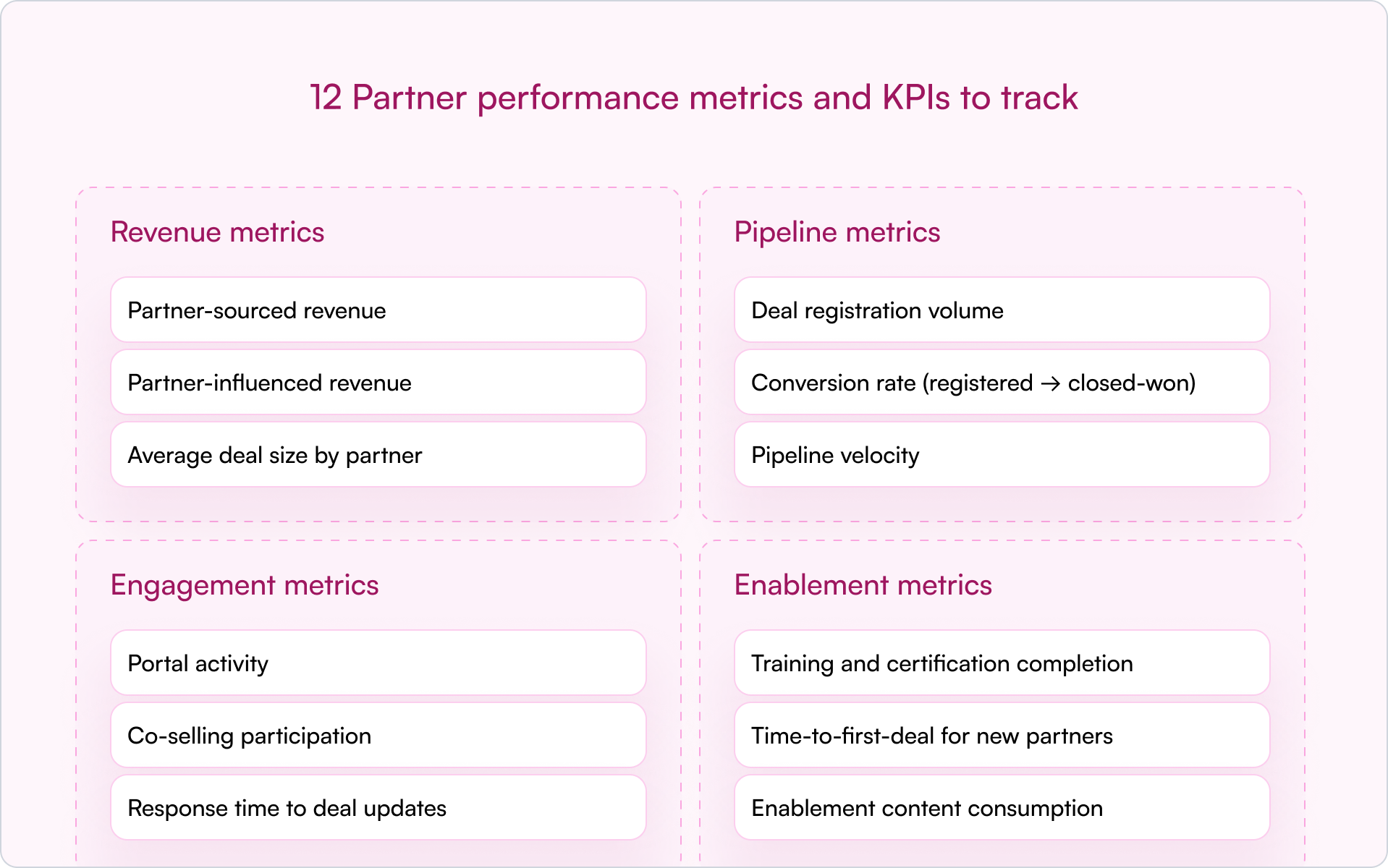
Revenue metrics
Revenue metrics tie partner activity directly to financial outcomes:
- Partner-sourced revenue: revenue from deals the partner originated and brought to you
- Partner-influenced revenue: revenue from deals the partner helped close but didn’t originate
- Average deal size by partner: identifies which partners bring larger, more strategic opportunities
In early-stage companies, sourced vs. influenced is where things often get messy. Define both up front. Otherwise, you’ll burn cycles debating credit instead of building pipeline.
Pipeline metrics
Pipeline metrics show the health and velocity of your partner funnel:
- Deal registration volume: how many deals partners are submitting
- Conversion rate (registered → closed-won): a quality signal behind the volume
- Pipeline velocity: time from registration to close — slow velocity often signals enablement gaps or deal complexity
Engagement metrics
Engagement metrics help you see whether partners are truly active:
- Portal activity: logins, content views, resource downloads
- Co-selling participation: joint calls, shared opportunities, collaboration frequency
- Response time to deal updates: how quickly partners respond on active deals
Engagement is often the earliest warning signal. If a partner stops showing up — fewer logins, slower responses, no co-selling — performance usually drops next.
Enablement metrics
Enablement metrics are leading indicators of future partner performance:
- Training and certification completion: are partners equipped to sell and implement?
- Time-to-first-deal for new partners: how long until they register their first real opportunity?
- Enablement content consumption: what materials are they actually using?
When a partner underperforms, enablement is often the first place to look. Low output isn’t always low effort — it can be low support.
How to track partner performance in your CRM
Tracking partner performance directly in your CRM is the most effective approach. A CRM-first model keeps partner data in one central location so Sales, Partnerships, and RevOps can work from the same source of truth.
Traditional PRM software often lives in a separate platform. That separation creates predictable problems: siloed data, messy attribution, and reporting that requires manual cleanup. A CRM-first approach avoids that by keeping partner workflows and reporting where your revenue team already operates.
Essential fields for partner attribution
Accurate tracking starts with clean data. To attribute deals and revenue properly, your CRM needs consistent partner fields and definitions.
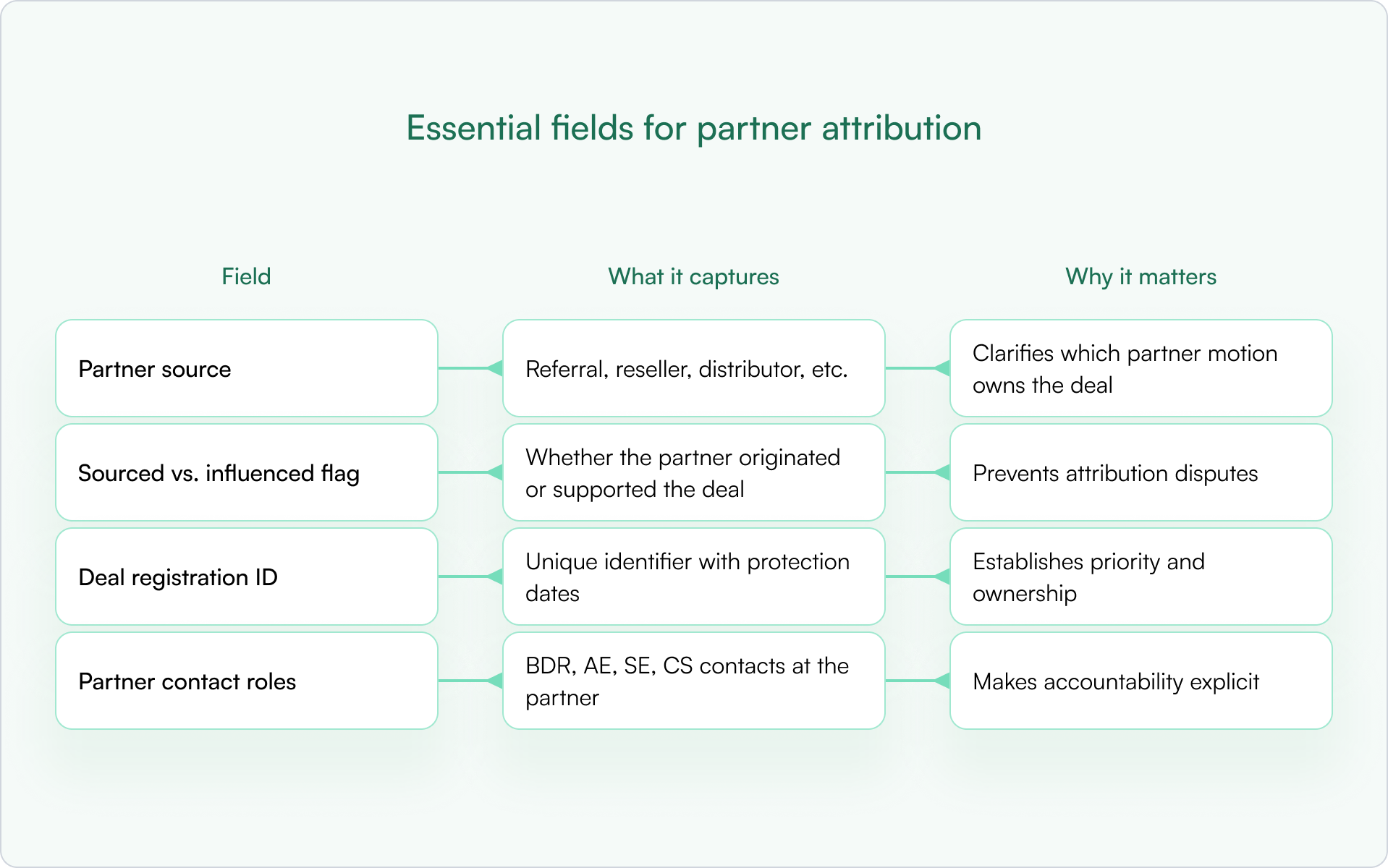
Without these basics, you’ll spend more time debating ownership than closing deals — and your reporting won’t be trusted.
Dashboards and reports every channel leader needs
Once the fields are in place, build dashboards that answer “what’s happening?” in under 60 seconds:
- Revenue by partner (sourced vs. influenced): who’s actually driving outcomes?
- Pipeline by partner tier: are top-tier partners outperforming?
- Deal registration approval and conversion rates: where are deals getting stuck?
- Engagement trends over time: is activity increasing or declining?
Automation for real-time partner performance visibility
Automation is how you scale partner performance tracking without adding headcount. Automated workflows can sync deal updates, alert you on stale deals, and surface underperforming partners early.
CRM-first PRMs like Introw support this inside HubSpot or Salesforce, keeping partner data up-to-date without relying on a disconnected portal. The alternative — manual spreadsheet updates — breaks as soon as you go beyond a handful of partners.
How to improve partner performance in 5 steps
Improving partner performance is an ongoing operating rhythm, not a one-time fix. The goal is to build a system where expectations are clear, data is shared, and interventions happen early — before a quarter is already lost.
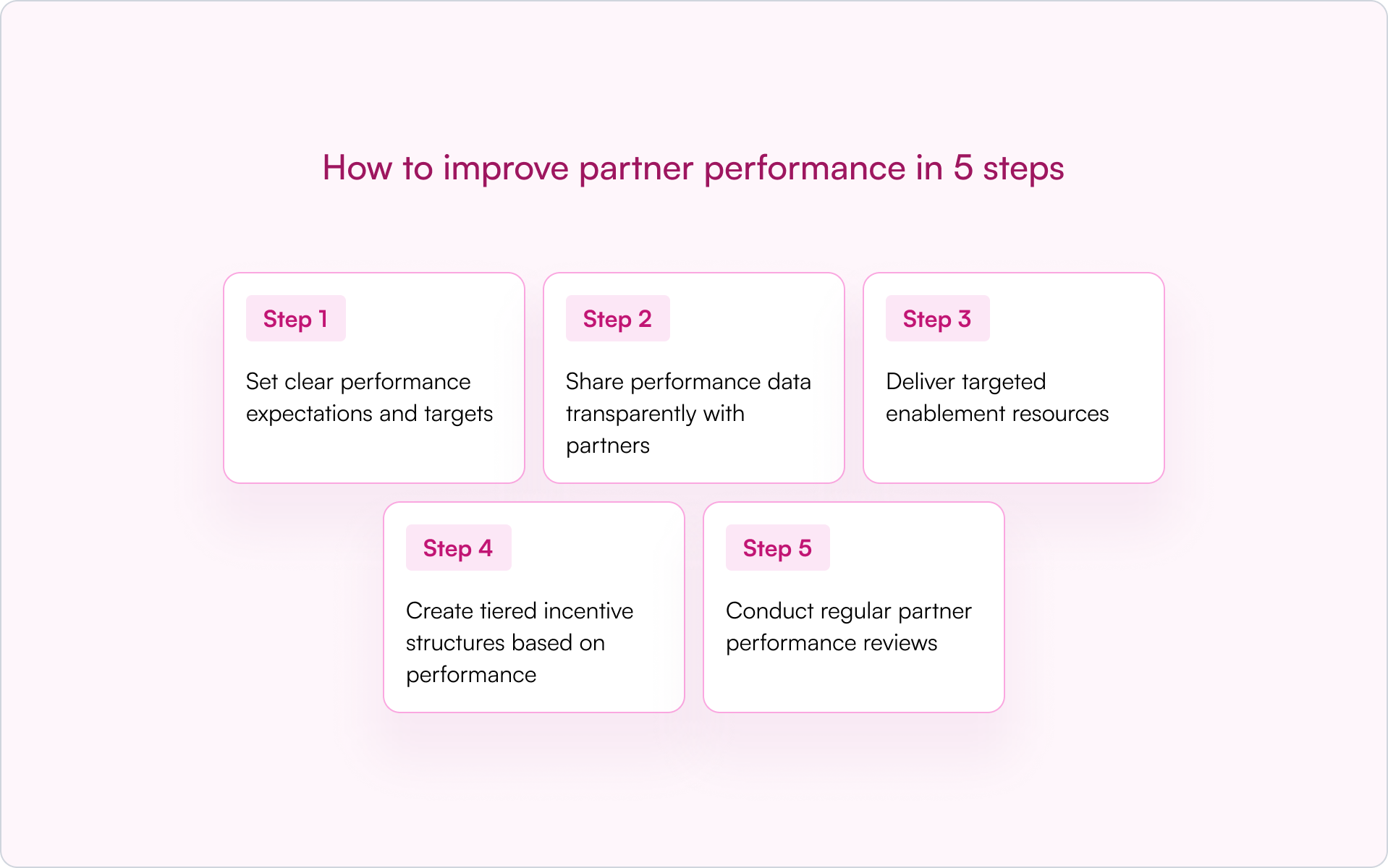
1) Set clear performance expectations and targets
Partners perform better when “good” is defined. Use SMART goals and write them down — in your partner agreement, onboarding plan, or QBR template. Targets can be revenue-based, pipeline-based, or activity-based depending on partner maturity.
Ambiguity creates friction. Clarity creates accountability.
2) Share performance data transparently with partners
If you want partners to behave like a revenue channel, show them the score. Give partners visibility into their pipeline, deal status, and next actions so they don’t rely on ad hoc status checks.
Modern tools like Introw support shared pipeline views so partners can see impact without needing a portal login or full CRM access.
3) Deliver targeted enablement resources
Underperformance is often a capability gap, not a motivation gap. Use enablement metrics to pinpoint what’s missing: product training, competitive positioning, discovery questions, or implementation readiness.
Don’t assume low performance means low effort. Sometimes it means low support.
4) Create tiered incentive structures based on performance
Tiered programs (Bronze, Silver, Gold) are a powerful way to motivate partners. They reward top performers with better benefits and give others a clear path to level up.
Partner scoring — a systematic method for ranking partners based on a combination of performance data — can power tiering. The criteria should be transparent so partners know exactly how to advance.
5) Conduct regular partner performance reviews
Build a cadence: QBRs for strategic alignment and monthly (or biweekly) pipeline reviews for active partners. Reviews work best when guided by CRM data, not gut feel.
Come prepared with trends, specific stuck deals, and a short action plan. That turns the meeting from a status update into a growth lever.
4 Common partner performance management challenges
If you’re searching for better partner performance, you’re usually running into a few predictable bottlenecks. The good news is that most are process and data problems — and those are fixable.
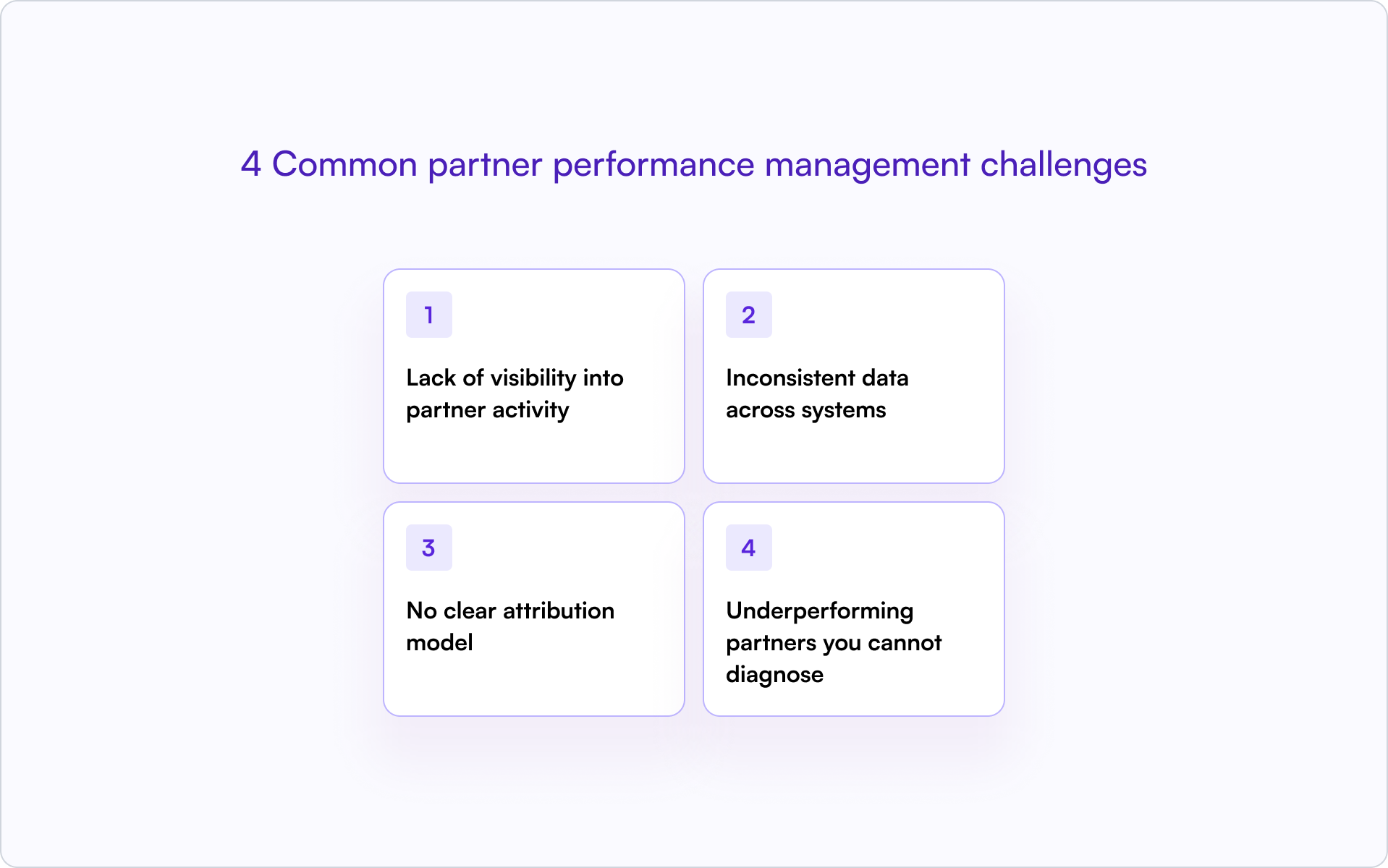
Lack of visibility into partner activity
When partner data lives in spreadsheets or disconnected portals, you’re effectively operating blind. You can’t see deal progress in real time, which makes forecasting unreliable and prevents early intervention.
Inconsistent data across systems
Duplicate records, missing fields, and mismatched lifecycle stages break reporting. The bigger issue is trust: once teams stop trusting the data, they stop using it — and your partner program becomes “feelings-based” again.
No clear attribution model
Without a documented attribution model, it’s difficult to credit partners fairly — especially for influenced deals. Ambiguity leads to disputes that damage partner relationships and slow deal cycles.
Underperforming partners you cannot diagnose
Without performance metrics, you’ll know a partner is struggling but not why. Is it lack of training? Poor lead quality? No internal champion? Low activity? Data turns vague concern into a clear plan.
How to scale partner performance tracking without manual work with Introw
As your program grows, manual tracking breaks. Spreadsheets become time-consuming, error-prone, and outdated — exactly when you need real-time visibility the most.
The solution is to adopt CRM-first PRM software. With this approach, partner data stays inside your core CRM (HubSpot or Salesforce), partners can collaborate without separate logins, and partner performance metrics update automatically.
That gives you a scalable operating system for partner performance — one source of truth, clean attribution, and reporting your revenue leaders can actually trust.
For example, Introw’s Dashboard section allows you to define the metrics that matter most to your partners by pulling data directly from your CRM. You can select which pipeline to use (for example, Sales Pipeline or Renewal Pipeline), decide which attributed deals to include, such as Partner-Sourced Deals or Reseller Deals, and choose which property to use for aggregated data (such as Deal Amount, MRR, or Contract Value). This flexibility provides clear, real-time insights into your partnership performance.
.png)
Introw shows the following default metrics.
- Total Revenue: All deals with this partner that are marked in your CRM as closed won
- Weighed pipeline : All deals with this partner that are neither closed won nor closed lost.
- Number of deals: Total value of all deals closed won with this partner.
- Total deals: All deals registered including closed won.
- Average deal size: Total value of all deals (incl. closed lost) divided by the amount of deals.
- Average sales cycle: The average 'days to close' for all closed won deals in your CRM, showing the average time between Create Date and Close Date.
- Revenue over time
Conclusion: partner performance is a system, not a spreadsheet
The fastest way to improve partner performance is to stop treating it like a vague relationship metric and start treating it like a revenue discipline. Define what “performance” means, track it inside your CRM, and build a cadence to review and improve it.
When you do, partners stop being an unpredictable side bet and start becoming a channel you can scale with confidence.
Subtle next step: If you want partner performance visibility without spreadsheets or a disconnected portal, see how Introw helps channel leaders track partner performance inside their CRM. Book a demo.
11 Ways to Use Partner Performance Incentives to Motivate Channel Partners
If you sell through partners, you’re not just competing in your market — you’re competing inside your partners’ inboxes. Most partners sell for multiple vendors. Without a clear reason to prioritize your product, they’ll default to whoever makes it easiest to earn and easiest to close.
Partner performance incentives solve that problem. They’re structured rewards — financial bonuses, rebates, training access, exclusive perks — that motivate channel partners to focus on your deals instead of a competitor’s. Below are 11 specific strategies you can use to build an incentive program that drives engagement, loyalty, and partner-sourced revenue.
What are partner performance incentives?
Partner performance incentives are rewards offered to channel partners — resellers, referral partners, distributors — to encourage specific behaviors that drive mutual business goals. The rewards tie directly to measurable outcomes like:
- Deal registrations submitted and approved
- Closed-won revenue and product mix
- Certifications completed and enablement milestones
In practice, partner incentives give partners a clear reason to prioritize your products over competitors’. Without incentives, you’re relying on goodwill alone — and goodwill doesn’t scale.
Why partner incentive programs drive channel sales
Partners have limited time, limited mindshare, and competing priorities. A strong incentive program makes your offer straightforward: “If you invest here, you’ll get rewarded — predictably.”
Increased partner engagement and mindshare
When partners can quickly understand how they earn — and can see progress toward rewards — they’re more likely to dedicate time to your deals instead of a competitor’s. Incentives keep your product top-of-mind and reduce “random vendor drift.”
Higher partner-sourced revenue
Incentives that reward pipeline creation (not just closed revenue) pull more qualified opportunities into your funnel. A solid deal registration process protects the partner’s investment in sourcing an opportunity and ensures they’re compensated for their work.
Stronger partner retention and loyalty
Consistent, fair, and transparent incentive programs build long-term relationships. Partners stay where they feel valued, can forecast earning potential, and trust that their effort will be rewarded without last-minute rule changes.
Types of channel partner incentives
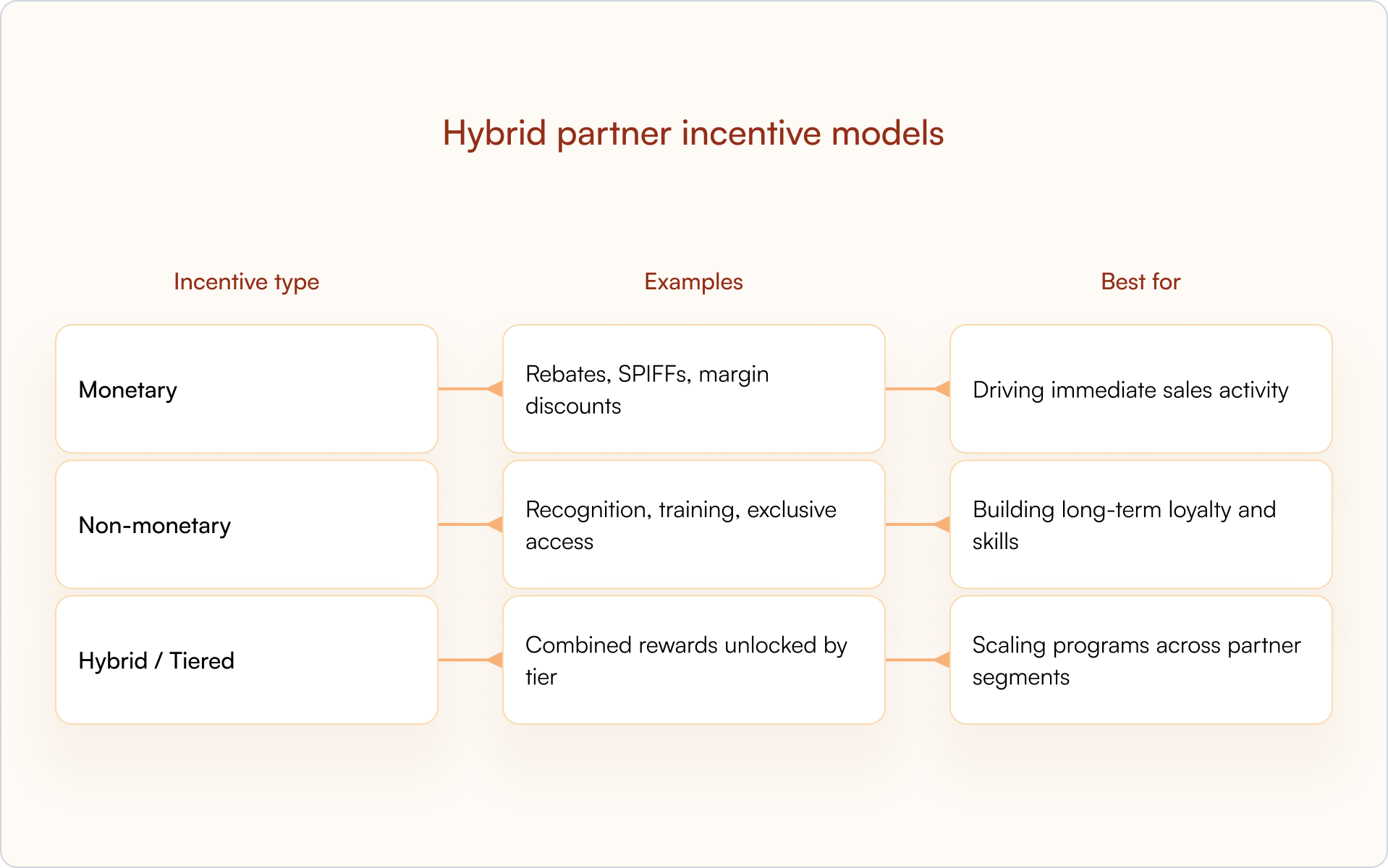
Most effective programs use a mix of monetary and non-monetary rewards. Different partner models and partner personas respond to different levers — and using only one lever limits your program’s ceiling.
Monetary partner incentives
Monetary incentives are direct financial rewards tied to performance. They’re especially effective when you need a short-term push or you’re changing partner behavior (new product, new segment, new motion).
- Rebates: Volume-based discounts paid back after sales thresholds are met.
- SPIFFs: Short-term cash bonuses for specific sales behaviors, like selling a new product or closing by quarter-end.
- Margin discounts: Better pricing for higher-tier or high-performing partners, increasing their profit on every sale.
Non-monetary partner incentives
Non-monetary incentives build loyalty and capability without always increasing cost of sale. They can also work better than cash for certain partner types (boutique consultancies, agencies, implementation partners).
- Recognition programs: Leaderboards, partner-of-the-year awards, and public acknowledgment at events.
- Training and certifications: Skills development that helps partners sell and deliver more effectively.
- Exclusive access: Early product previews, roadmap visibility, and beta invitations.
Hybrid partner incentive models
The best programs combine both. Tiered programs are the most common hybrid model — partners unlock better margins (monetary) and more recognition or exclusive access (non-monetary) as they advance through performance-based tiers.
11 partner performance incentive strategies to motivate resellers and channel partners
Think of the list below as a toolbox. Most startups get better results from combining 3–5 incentives that reinforce each other (for example: deal protection + tiering + certification perks) rather than launching 11 at once.
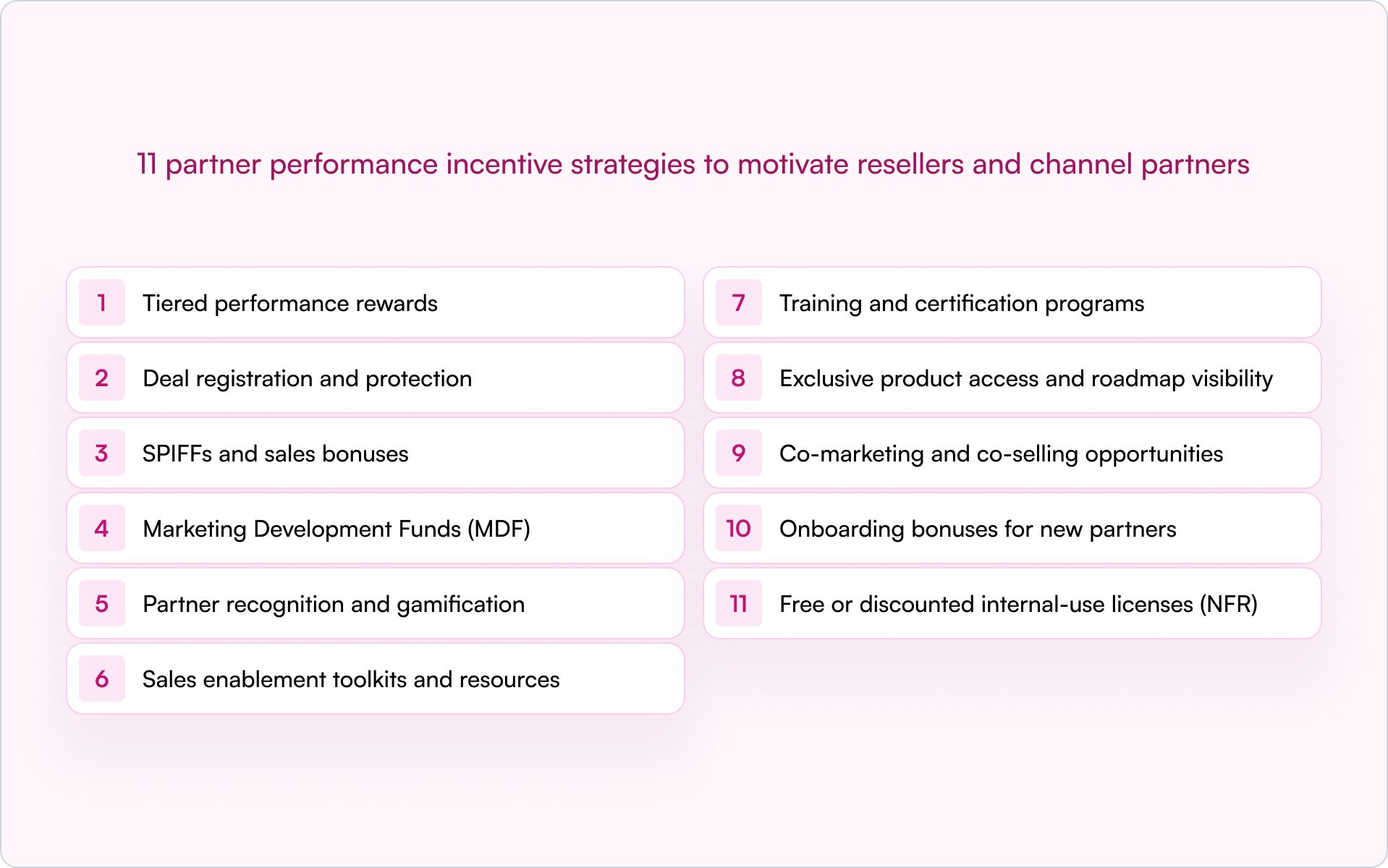
- Tiered performance rewards
Tiered programs create a clear path for partner growth. Partners unlock better incentives — higher margins, more support, co-marketing funds — as they hit performance thresholds like revenue sold or deals closed. Tiers work because they motivate partners to “level up” and invest more in the partnership.
Keep tiers achievable but meaningful. If the first tier is too hard to reach, partners won’t bother. If it’s too easy, the reward loses its value and you end up “giving away” benefits for baseline behavior.
- Deal registration and protection
Deal registration is where partners register opportunities to claim protection and secure their margin. This prevents channel conflict and rewards partners who proactively source new deals.
Partners won’t engage if they fear losing a deal to your direct team or another partner. A CRM-first approach keeps the process transparent and reduces disputes — especially when status and protection windows are visible to both sides.
- SPIFFs and sales bonuses
A SPIFF (Sales Performance Incentive Fund) is a short-term cash bonus for specific, time-bound actions. It’s a practical way to focus partner attention on immediate priorities.
- Use SPIFFs for: New product launches, end-of-quarter pushes, or clearing specific inventory.
- Use margin for: Ongoing, predictable partner compensation that forms the baseline of their earning potential.
- Marketing Development Funds (MDF)
Marketing Development Funds are funds you provide to partners for co-branded marketing activities — webinars, local events, digital campaigns. MDF motivates partners to invest their own time in generating demand for your product.
MDF works best when tied to performance. Partners earn more funds as they deliver more results, which protects your ROI and reduces “free money” spend.
- Partner recognition and gamification
Recognition programs like leaderboards, partner awards, and public shout-outs are powerful non-monetary incentives. Gamification — points, badges, competitions — keeps partners engaged between deals.
Making performance visible in a shared partner portal can drive healthy competition without adding friction — as long as the scoring rules are transparent.
- Sales enablement toolkits and resources
Giving partners better sales tools and enablement resources is an incentive in itself. Ready-to-use pitch decks, battle cards, ROI calculators, and demo environments help partners look good in front of customers and close deals faster.
Partners naturally gravitate toward vendors who equip them for success — especially when your competitors are slow to update materials or keep messaging consistent.
- Training and certification programs
Certifications build partner capability and act as a durable incentive. Tie certification status to tangible benefits — access to better leads, higher margins, or exclusive co-selling opportunities — and partners will invest in learning your product.
For founders, this is also a quality lever: a certified ecosystem usually means fewer failed implementations and fewer escalations landing back on your team.
- Exclusive product access and roadmap visibility
Sharing your product roadmap, offering beta access, or giving early previews makes partners feel like true insiders. This builds loyalty and helps them plan their own sales motion around upcoming releases.
It’s a low-cost, high-impact incentive — and it tends to attract the partners who want to build something long-term, not just resell the easiest SKU.
- Co-marketing and co-selling opportunities
Co-marketing involves joint campaigns and shared content. Co-selling involves joint sales calls and shared pipeline with your direct sales team.
For many partners, access to your internal sales and marketing resources is extremely valuable — especially when they want to close larger, more complex deals or break into a new segment.
- Onboarding bonuses for new partners
Onboarding bonuses reward new partners for completing key activation milestones within a specific timeframe — registering their first deal, closing their first sale, or completing initial certifications.
Done right, onboarding incentives accelerate time-to-first-revenue and reduce churn in the first 60–90 days, when partners are most likely to drop you for “something easier.”
- Free or discounted internal-use licenses (NFR)
Giving partners free or heavily discounted licenses to use your product internally (often called NFR — “Not For Resale” licenses) helps them become product experts and genuine advocates.
Partners who use your product every day understand its value proposition deeply and sell it more authentically — which matters a lot when your category is crowded and messaging sounds the same.
Six common mistakes in channel sales incentive programs
Incentives don’t fail because partners are “unmotivated.” They fail because the program is confusing, feels unfair, or pays out too slowly to change behavior.
- Overcomplicating the program: If partners can’t understand the rules or estimate earnings, they won’t participate.
- Setting unachievable targets: If thresholds feel impossible, partners disengage instead of “trying harder.”
- Inconsistent communication: Partners can’t act on incentives they don’t know exist. Announce early and repeat often.
- Ignoring partner feedback: Programs designed without partner input often miss what actually motivates the channel.
- Delayed payouts or recognition: Slow reward fulfillment kills momentum and erodes trust.
- One-size-fits-all incentives: Different partner types respond to different motivators. Segment and tailor.
How to design an effective partner performance incentive plan
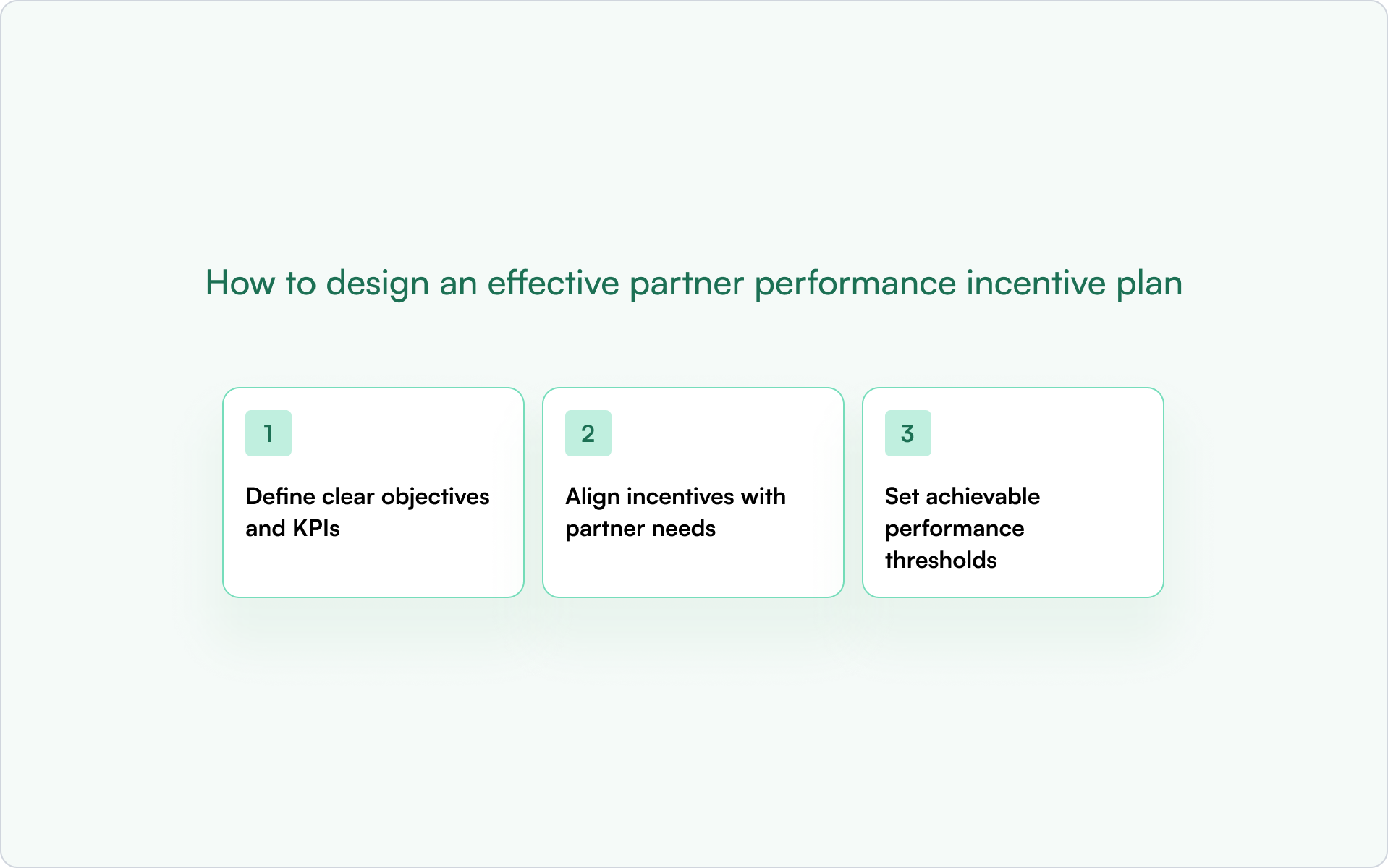
1) Define clear objectives and KPIs
Every incentive should map to a specific, measurable business goal. Before launching, define what success looks like, such as:
- Increase deal registrations from a specific partner segment by 20%
- Accelerate time-to-close on partner-sourced deals by 15 days
- Drive adoption of a new product line through partners to 10% of total sales
2) Align incentives with partner needs
Different partners want different things. Some are motivated purely by cash; others value leads, recognition, enablement, or access. Survey partners or segment them by type (referral vs reseller vs services) so incentives match what they actually care about.
3) Set achievable performance thresholds
Targets should stretch partners but remain realistic. If thresholds are too high, partners disengage. If they’re too low, you risk overpaying for results you would have gotten anyway.
How to measure partner incentive program ROI
Partner performance metrics to track
- Deal registrations submitted: Are partners actively engaging and bringing new opportunities?
- Deal registrations converted: Are registered deals high-quality and leading to closed-won revenue?
- Partner-sourced vs. partner-influenced revenue: What’s the true financial contribution of your channel?
- Average deal size by partner tier: Are higher-tier partners closing bigger deals?
Engagement and participation rates
Tracking who participates is as important as tracking results. Low participation is usually a design or communication issue — not a “partner quality” issue. Track partner portal logins, certification completions, MDF usage, and responsiveness to announcements.
Revenue attribution and ROI calculation
To calculate incentive ROI, compare the total cost of incentives paid out against the incremental revenue generated by partner-sourced deals. Accurate attribution requires clean CRM data and a single source of truth for all partner activity tracking and analytics.
How to communicate incentive programs to partners
Even the most generous incentive program fails if partners don’t know about it — or can’t find the rules when they need them.
- Announce in multiple channels: Email, your partner portal, Slack, and partner QBRs. Don’t rely on one message.
- Make rules accessible: Publish clear program rules where partners can reference them anytime.
- Send reminders: Notify partners when they’re close to a threshold or when a SPIFF is about to expire.
- Celebrate wins publicly: Recognition keeps momentum and signals that the program is real.
- Confirm receipt: For major updates, use read receipts or acknowledgments. Tools like Introw’s Announcements feature push updates via email and Slack with read tracking.
Build a scalable partner incentive program with Introw
A CRM-first partner relationship management platform makes partner performance incentives easier to manage, track, and scale — without creating a spreadsheet-driven mess.
- Deal registration and protection: Introw centralizes deal registration inside HubSpot or Salesforce, so partners can register deals and see protection status without chasing your team.
- Partner portal for program visibility: Publish incentive rules, tier requirements, and leaderboards in a single portal partners can access without friction.
- Announcements and notifications: Push incentive updates, SPIFF deadlines, and recognition via email and Slack — and track who’s seen them.
- Real-time pipeline visibility: Partners see deal status in real time, building trust that registered deals are being worked.
- Clean CRM data for attribution: Because Introw is built on your CRM, partner-sourced revenue is accurately attributed — no more arguing about who brought the deal.
If you’re building your channel motion and want incentives that scale without adding headcount, get a demo to see how Introw works.
Conclusion
The goal of partner performance incentives isn’t to “pay partners more.” It’s to create a system where the right partner behaviors — sourcing deals, getting certified, building pipeline, closing revenue — are clearly rewarded, easy to understand, and consistently tracked.
Start simple, protect partner effort early (deal registration is often the highest-leverage first step), and iterate quarterly based on participation and ROI. The best incentive programs don’t just drive short-term sales — they build a channel partners actually want to invest in.
The Real LMS Benefits for Channel Partner Certification
Partner training that lives in spreadsheets and scattered folders doesn’t scale. The moment your network grows past a handful of partners, inconsistent product knowledge, expired certifications, and invisible compliance gaps start costing you deals.
The fix isn’t “more webinars.” It’s a system: a partner LMS that centralizes training, automates certification tracking, and connects partner readiness to your CRM. Below, you’ll learn what a partner LMS actually does, how it differs from internal training tools, and how to tie certification status directly to deal registration and revenue outcomes.
What is a partner learning management system?
A partner LMS is a platform that delivers, tracks, and manages training for external channel partners like resellers, referral partners, and distributors. It accelerates onboarding, ensures brand consistency, and boosts sales by providing centralized, on-demand training. Unlike scattered PDFs or ad-hoc webinars, a partner learning management system gives every partner the same foundation of product knowledge, automates certification tracking, and reduces admin overhead.
Think of it as a centralized learning hub where partners access courses, complete certifications, and stay current on your product. The platform tracks who completed what, when they did it, and whether they passed.
What a partner LMS typically includes
- Course hosting: Product training, sales enablement, and compliance modules
- Certification tracking: Records of completed courses and earned credentials
- Progress visibility: Dashboards showing partner learning activity across your network
Partners represent your brand to end customers. When they’re trained inconsistently, customer experience suffers — and so does your pipeline.
How a partner LMS differs from an internal employee LMS
An internal LMS is built for employees who already have company context and access to internal systems. A partner training LMS, on the other hand, serves external users who may represent multiple organizations, lack IT support, and forget logins easily.
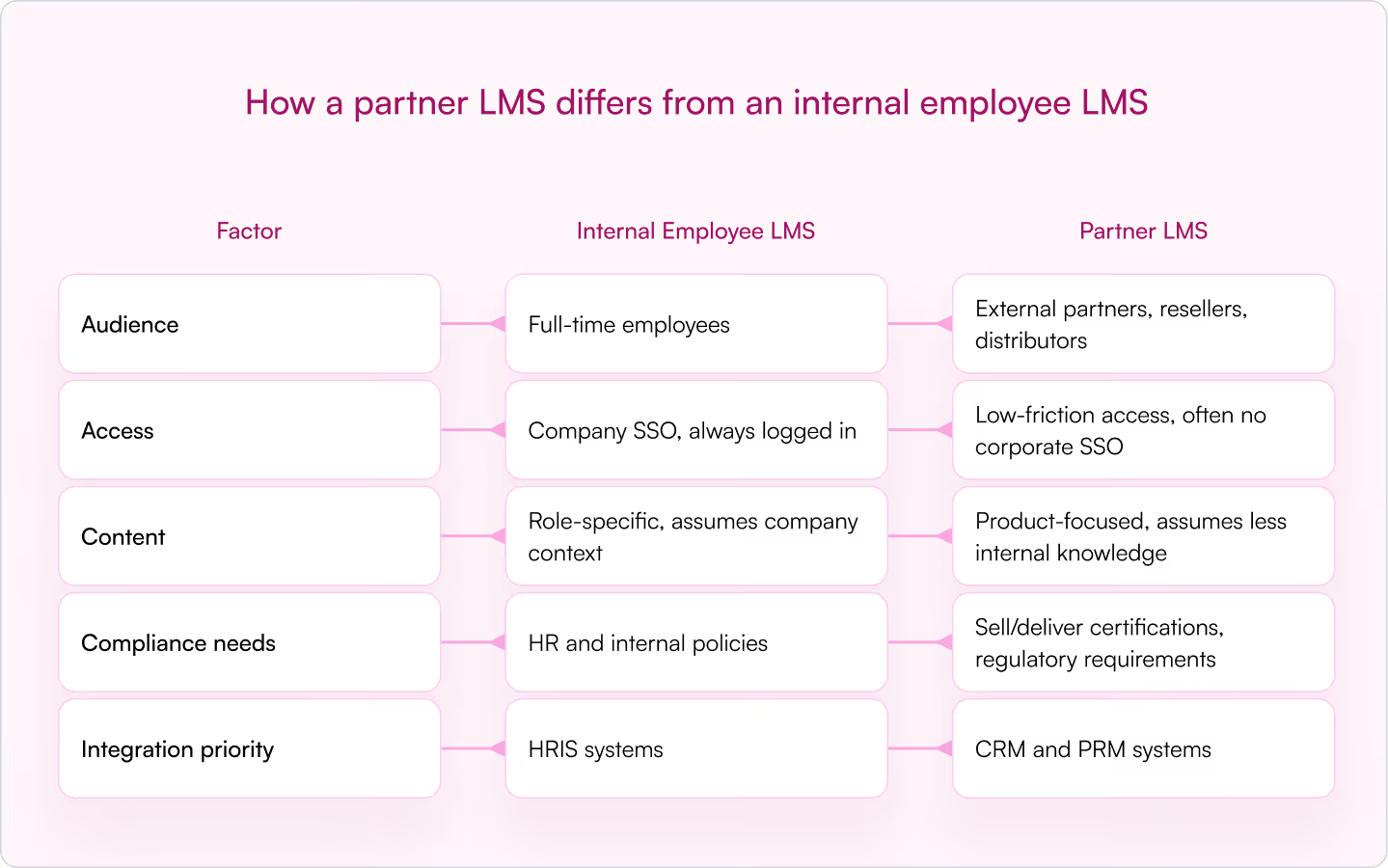
Partners don’t have the patience for clunky portals or password resets. Every login barrier reduces completion rates, which is why frictionless access matters more for external training than internal.
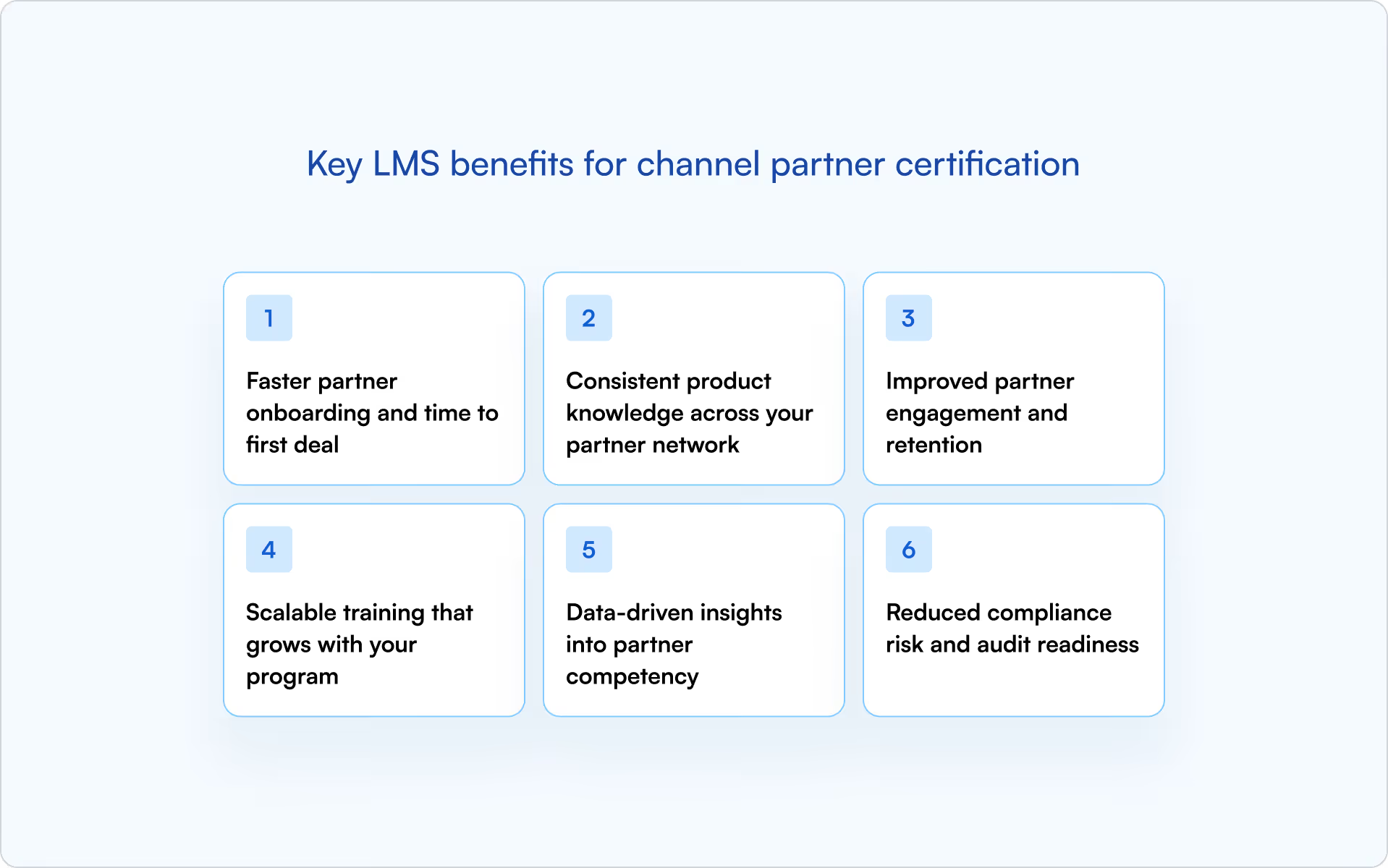
Key LMS benefits for channel partner certification
Each benefit below addresses a specific pain point that partner managers and RevOps teams deal with regularly.
Faster partner onboarding and time to first deal
Structured partner onboarding paths get partners selling faster. Instead of ad-hoc training calls or scattered documentation, partners follow a defined curriculum at their own pace.
Faster ramp means faster revenue from the channel. When LMS data connects to your CRM, you can see which partners completed onboarding and are ready to register deals, without chasing updates manually.
Consistent product knowledge across your partner network
Partners giving inconsistent or outdated information to prospects is a common problem. An LMS ensures every partner learns the same messaging, positioning, and technical details.
Consistency protects brand integrity and reduces support tickets from partner-sourced deals gone wrong. It also matters when multiple partners operate in the same region or vertical.
Improved partner engagement and retention
Partners who feel invested in and properly enabled through strategic programs stay active longer. Certification programs give partners a sense of progression and achievement, something a PDF library can’t replicate.
Engaged partners register more deals and stay loyal to vendors who make them successful. Gamification elements like badges and leaderboards can reinforce engagement, though they’re not required.
Scalable training that grows with your program
Manual training doesn’t scale. Webinars and 1:1 calls work for a handful of partners, but they become a bottleneck as your network grows.
An LMS for partner training lets you add partners without adding headcount. Update content once, and every partner sees the latest version — whether you have 20 partners or 300.
Data-driven insights into partner competency
Visibility into who completed what, where partners drop off, and which certifications correlate with deal success helps partner managers prioritize enablement efforts.
CRM-connected systems make certification data actionable. You can see certification status alongside pipeline, which means you’re not guessing which partners are ready to sell.
Reduced compliance risk and audit readiness
For regulated industries like fintech, cybersecurity, or healthcare, partners often need to meet compliance requirements before selling. An LMS creates an audit trail of who completed mandatory training and when.
Every completion, assessment score, and certification issuance gets logged with timestamps. Audit-readiness protects the vendor from liability and makes audits far less painful.
Essential features to look for in a partner training LMS
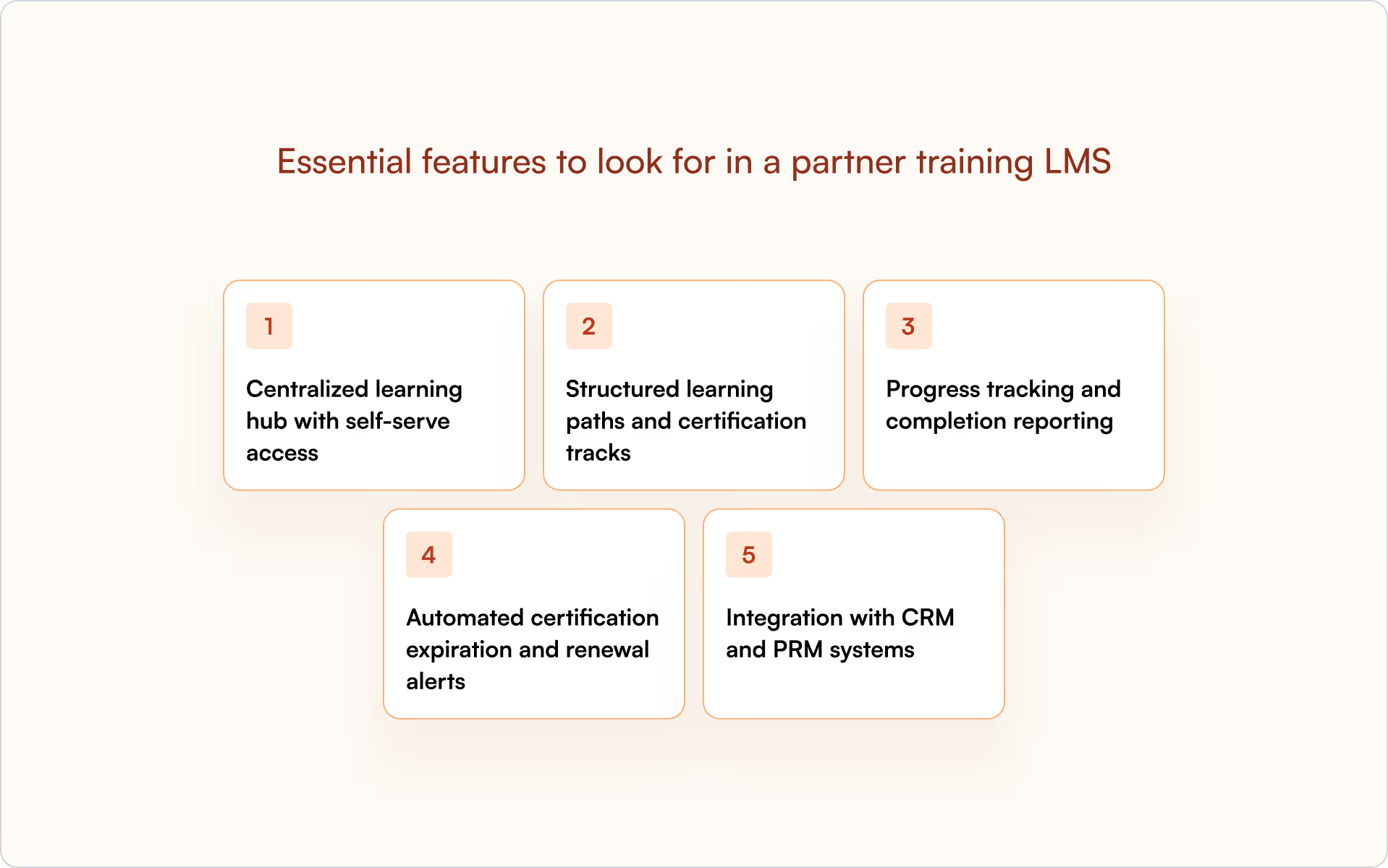
Not all LMS platforms are built for external partner networks. If you’re evaluating options, focus on the features that reduce partner friction and make certification data usable for revenue teams.
Centralized learning hub with self-serve access
Partners should find all training in one place without hunting through emails or shared drives. Access works best when it’s frictionless, ideally without forcing partners to remember another password.
- Magic links
- SSO options
- Embedded access through a partner portal
Structured learning paths and certification tracks
Guided curricula beat content libraries. Learning paths ensure partners complete prerequisites before advanced material, and certification tracks tie completion to credentials that unlock privileges.
Structured paths also make it easier to enforce readiness gates — especially when you tie certification to deal workflows.
Progress tracking and completion reporting
Partner managers need visibility into who’s engaged and who’s stalled. Dashboards showing completion rates, time spent, and assessment scores enable proactive outreach to partners falling behind.
Without visibility into partner progress, you’re flying blind on readiness.
Automated certification expiration and renewal alerts
Certifications aren’t “set and forget.” Products change, compliance requirements update, and partners need to recertify before credentials lapse.
Automated reminders prevent gaps in authorized sellers and reduce the manual work of tracking expiration dates in spreadsheets.
Integration with CRM and PRM systems
Certification data trapped in a standalone LMS doesn’t help RevOps or sales. When partner certification status syncs to HubSpot or Salesforce, you can gate deal registration, prioritize co-sell resources, and forecast accurately.
CRM-first tools keep certification data visible without manual exports or duplicate entry.
How partner certification programs ensure compliance across your network
Compliance isn’t just about ticking boxes. It’s about reducing risk before deals close — and protecting your brand when partners are the ones in front of customers.
Gate sell and deliver rights based on certification status
Partners should register deals or deliver services only after they’re certified. Gating protects customers from underqualified partners and protects you from liability.
Tying certification status to deal registration eligibility enforces readiness automatically, without manual checking.
Automate policy updates and mandatory training
When regulations change or products update, push new required courses to all partners through your LMS. Automated assignments ensure no one misses critical updates.
Tracking acknowledgment proves partners received the information, which is useful for audits and internal governance.
Maintain audit trails for regulatory requirements
Every completion, assessment score, and certification issuance gets logged with timestamps. Logged records create defensible documentation for audits without manual record-keeping.
For industries with strict regulatory requirements, audit-readiness is a strategic advantage, not just a convenience.
How to connect your LMS for partner training to your CRM
The goal is to make certification status visible where revenue teams work — inside Salesforce or HubSpot — so “trained” isn’t a vague promise. It’s a field you can report on, automate from, and use to qualify partner-sourced pipeline.
What to sync
- Certification status: Current, expired, or in-progress
- Certification name: Which specific credentials the partner holds
- Expiration date: When recertification is required
- Partner tier: If certification unlocks higher partnership levels
When certification data lives in your CRM, you can build deal registration rules that automatically validate whether a partner is qualified to sell or deliver before approving the deal. CRM-first PRM platforms like Introw display certification data alongside deal registration and pipeline, creating a single source of truth.
Best practices for implementing a partner LMS
Rolling out partner training works better with a structured approach. If you’re building a channel motion inside a fast-moving startup, you want a rollout that’s lightweight, measurable, and easy for partners to adopt.
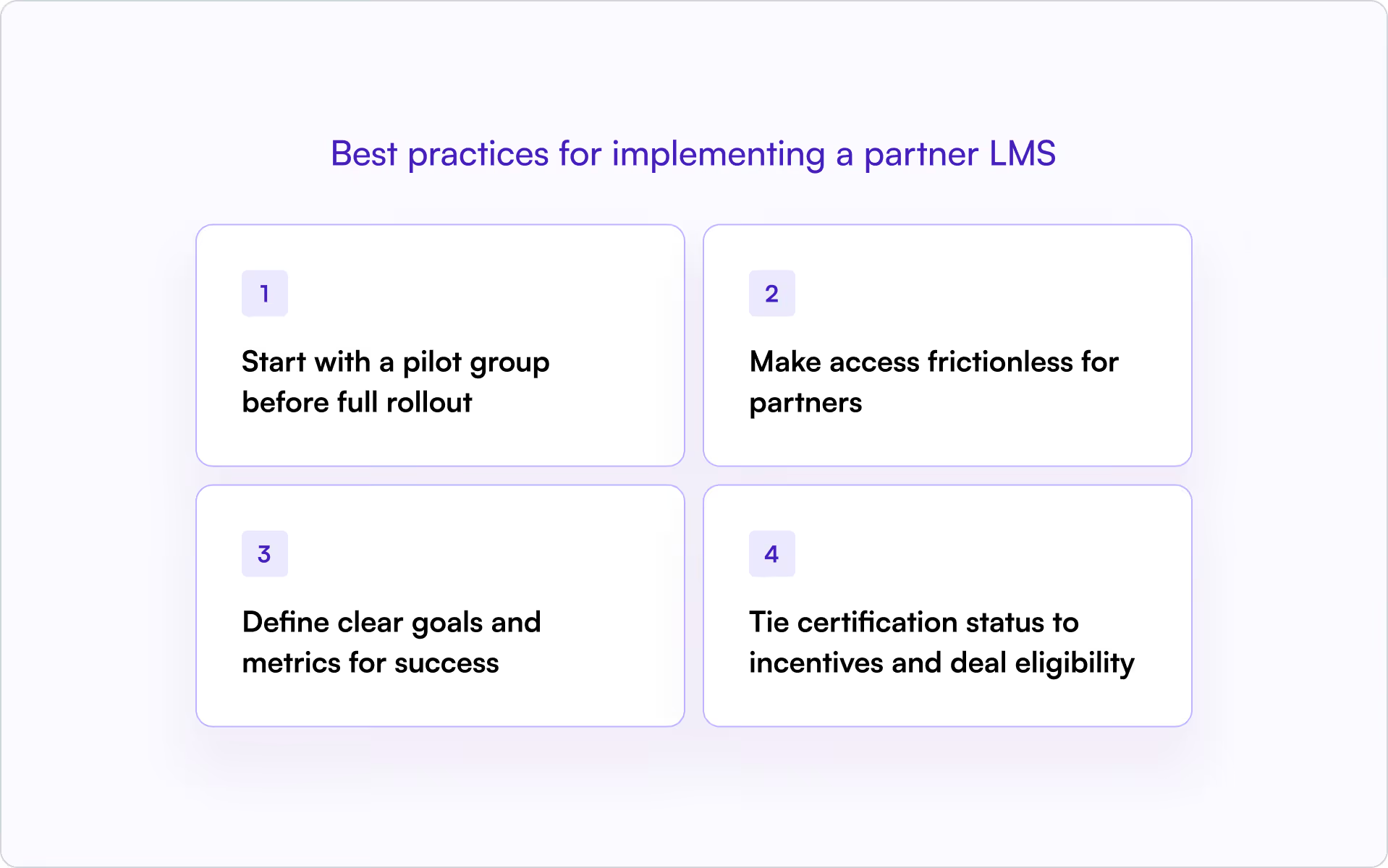
1) Start with a pilot group before full rollout
Test with a small cohort of engaged partners. Gather feedback on content clarity, platform usability, and time-to-complete.
Fix issues before scaling to the full partner base. A pilot also helps you identify the right user groups and prepare for questions during network-wide rollout.
2) Make access frictionless for partners
Every login barrier reduces completion rates. Consider SSO options, magic links, or embedding training access in your partner portal.
Partners who don’t have to remember another password are more likely to complete certification at scale.
3) Define clear goals and metrics for success
Decide what success looks like before launch. Common metrics include completion rates, time to first certified deal, and reduction in support tickets.
Align LMS reporting to outcomes so you can measure whether the investment is paying off.
4) Tie certification status to incentives and deal eligibility
Certification without consequence gets ignored. Make completion meaningful by linking it to SPIFF eligibility, deal registration access, or higher margin tiers.
When certification unlocks revenue, partners prioritize it.
Why certification status should tie to deal registration
Certification data is only valuable if it’s actionable. When certification status connects to deal registration workflows, you can automatically approve or flag deals based on partner readiness.
Connecting certification to deal registration prevents unqualified partners from registering deals they can’t close, reduces channel conflict, and protects deal quality. It also removes the manual work of checking certification status before approving registrations.
Platforms like Introw let you set deal registration eligibility rules that reference certification status, without spreadsheet cross-referencing.
Run a smarter partner certification program with CRM-first tools
The real LMS benefits for channel partner certification show up when training data connects to your CRM and partner workflows. Standalone LMS platforms create data silos. CRM-first approaches keep certification status visible alongside pipeline, deal registration, and partner engagement.
Introw helps teams connect partner enablement to revenue outcomes, with partner portals, deal registration, and CRM integrations that keep everything in one place.
If you want to see how certification status can tie directly to your partner workflows, book a demo and walk through how it works in practice.
Top 10 Partnership Trackers: Driving Co-Sell Revenue in 2026
Partnerships can be a lucrative revenue stream — when your business has the right tools for the job.
Indeed, many SaaS companies miss out on potential partner-driven revenue because they lack precise partnership tracking.
It's no secret that, in 2026, the traditional spreadsheet tracking is dead.
Manual updates, delayed insights, and fragmented data no longer cut it.
Instead, today's partner programs demand real-time visibility from overlap to close, ensuring every deal is tracked, attributed, and optimized for growth.
Modern solutions replace outdated spreadsheets with automated, CRM-integrated partnership tracking software, ensuring that partner-sourced revenue is captured seamlessly.
A precision-driven, real-time partnership tracker gives SaaS companies the edge by aligning sales teams, automating reporting, and enabling data-driven decisions.
With clear visibility into partner-influenced deals, businesses can maximize partner ROI, improve collaboration, and scale revenue faster.
In today's competitive landscape, partnership tracking isn't optional — it's essential for unlocking sustainable, repeatable growth.
What to Look for in a Partnership Tracking Platform
So, you know you need a modern partnership tracking platform.
But which features should you be looking out for?
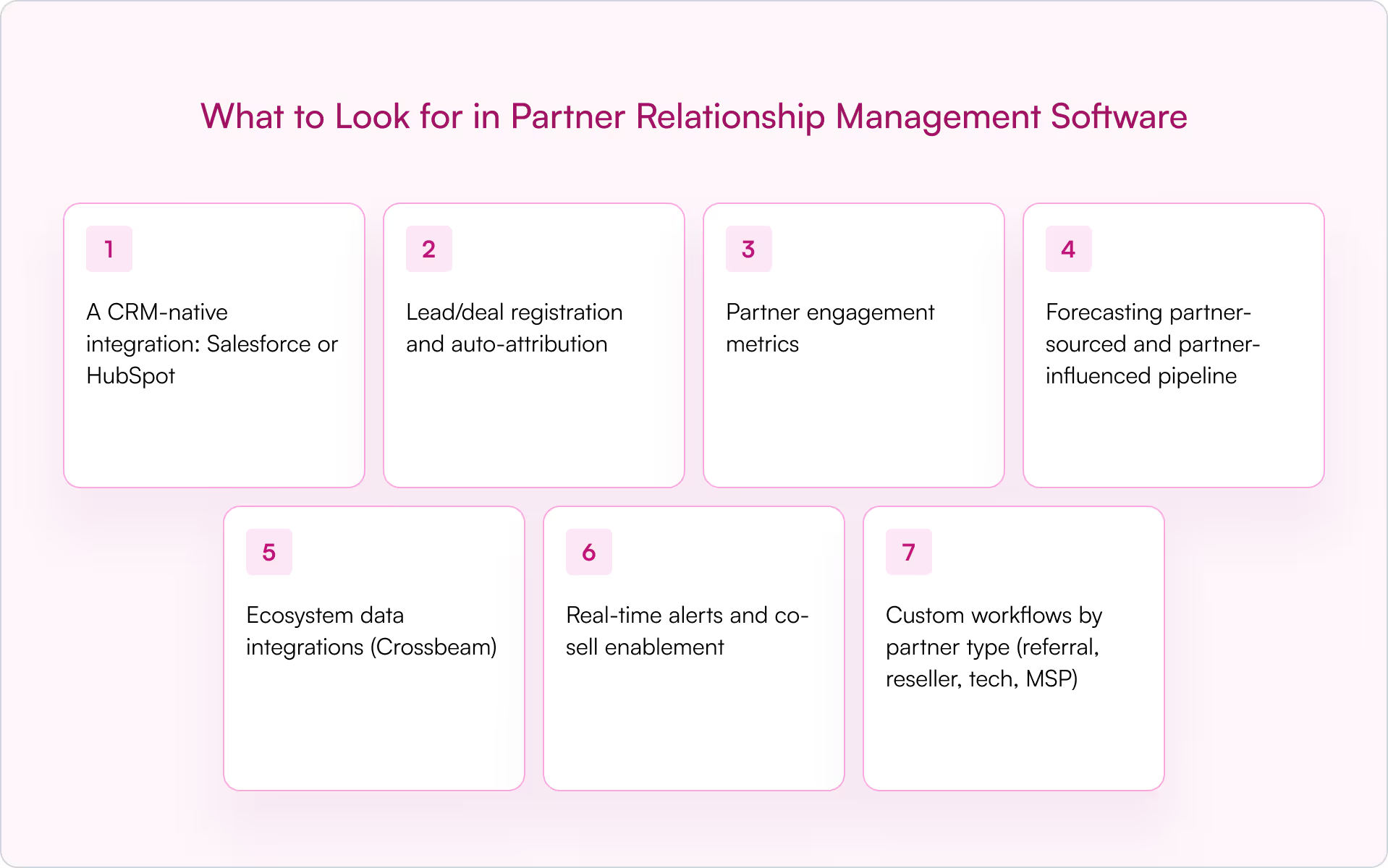
Here are seven features that every strong partnership tracking platform should have in 2026:
- A CRM-native integration: Salesforce or HubSpot
- Lead/deal registration and auto-attribution
- Partner engagement metrics — for example: Slack or email syncs, partner activities log
- Forecasting partner-sourced and partner-influenced pipeline
- Ecosystem data integrations (Crossbeam)
- Real-time alerts and co-sell enablement
- Custom workflows by partner type (referral, reseller, tech, MSP)
10 Best Partnership Trackers to Use in 2026
Ready to revolutionize your partnerships by investing in a new partnerships tracker?
Here are ten top tools to consider.
#1 Introw (with Crossbeam Integration)
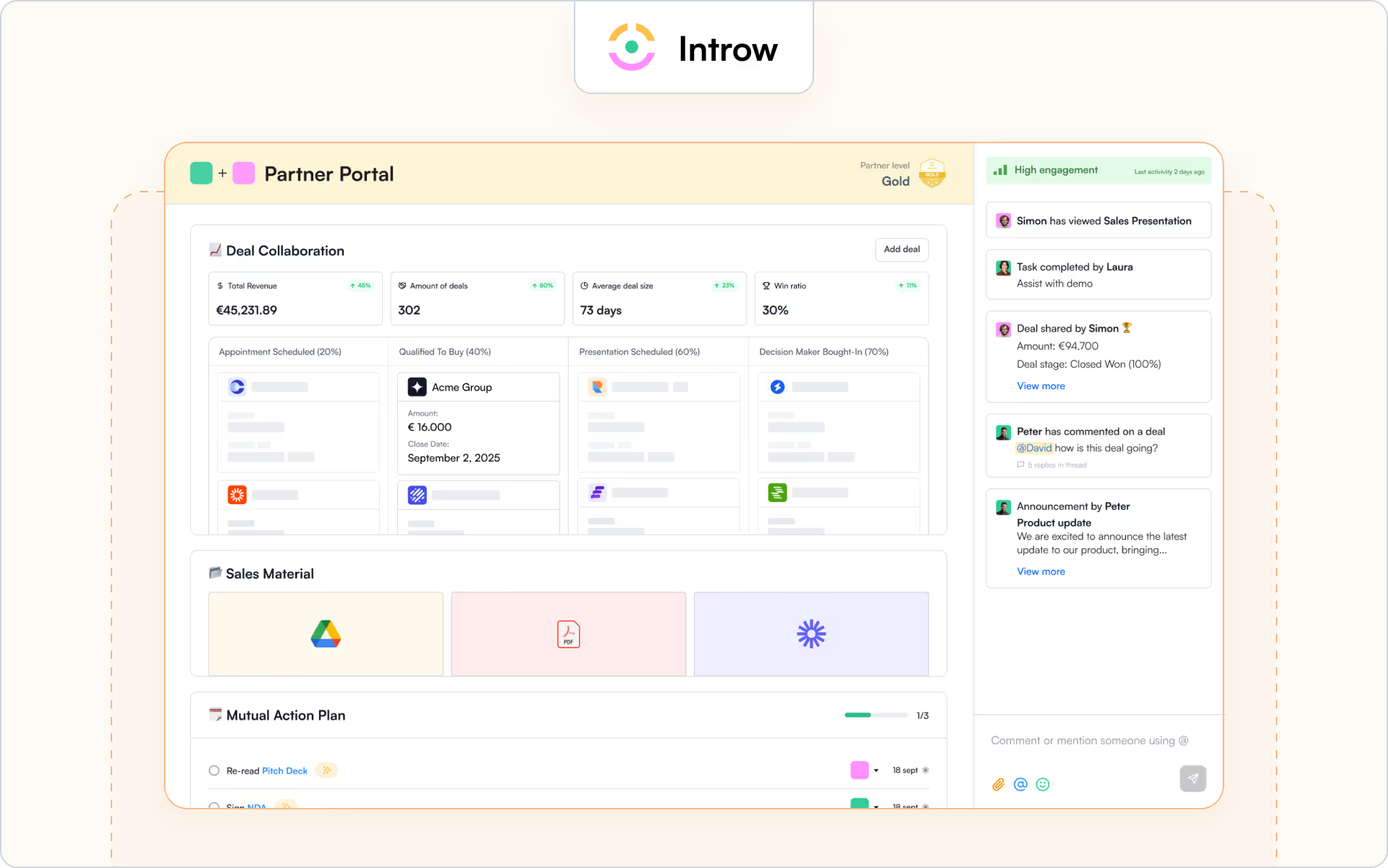
Introw is the most powerful PRM for modern SaaS companies — and its native integration with Crossbeam supercharges the entire partner revenue workflow.
Here's Why It's #1:
- Starts where your team lives: Salesforce or HubSpot
- Tracks every partner deal, lead, and engagement touch in real time
- Uses Crossbeam's account mapping data to identify overlapping customers and prospects across your ecosystem
- Tracks every engagement your partners have with content/sales presentations
- Tracks commissions in real-time
- All activity is tracked and visible to Partner Managers, RevOps, and CROs
Quick Feature Rundown:
- CRM-native lead & deal registration
- Real-time alerts via Slack and email
- Deal attribution and forecasting built into your pipeline
- Partner segmentation, enablement, and engagement tracking
- Modular workflows (referral, reseller, MSP, tech)
- Set-up in minutes — not months
Find out more:
🔗 Introw + Crossbeam Integration Overview
#2 PartnerStack
Referral and affiliate program software PartnerStack comes with some handy partner performance tracking features designed to help businesses recruit, track, and optimize partnerships effectively.
Quick Feature Rundown:
- Lead Monitoring
- CRM Integration
- Automated Attribution
- Performance Reporting
- Commission Automation
- UTM Tracking Support
- Fraud Protection
Pros: Commission automation, partner marketplace
Cons: Not ideal for co-sell motions or deep CRM integration
#3 Impartner
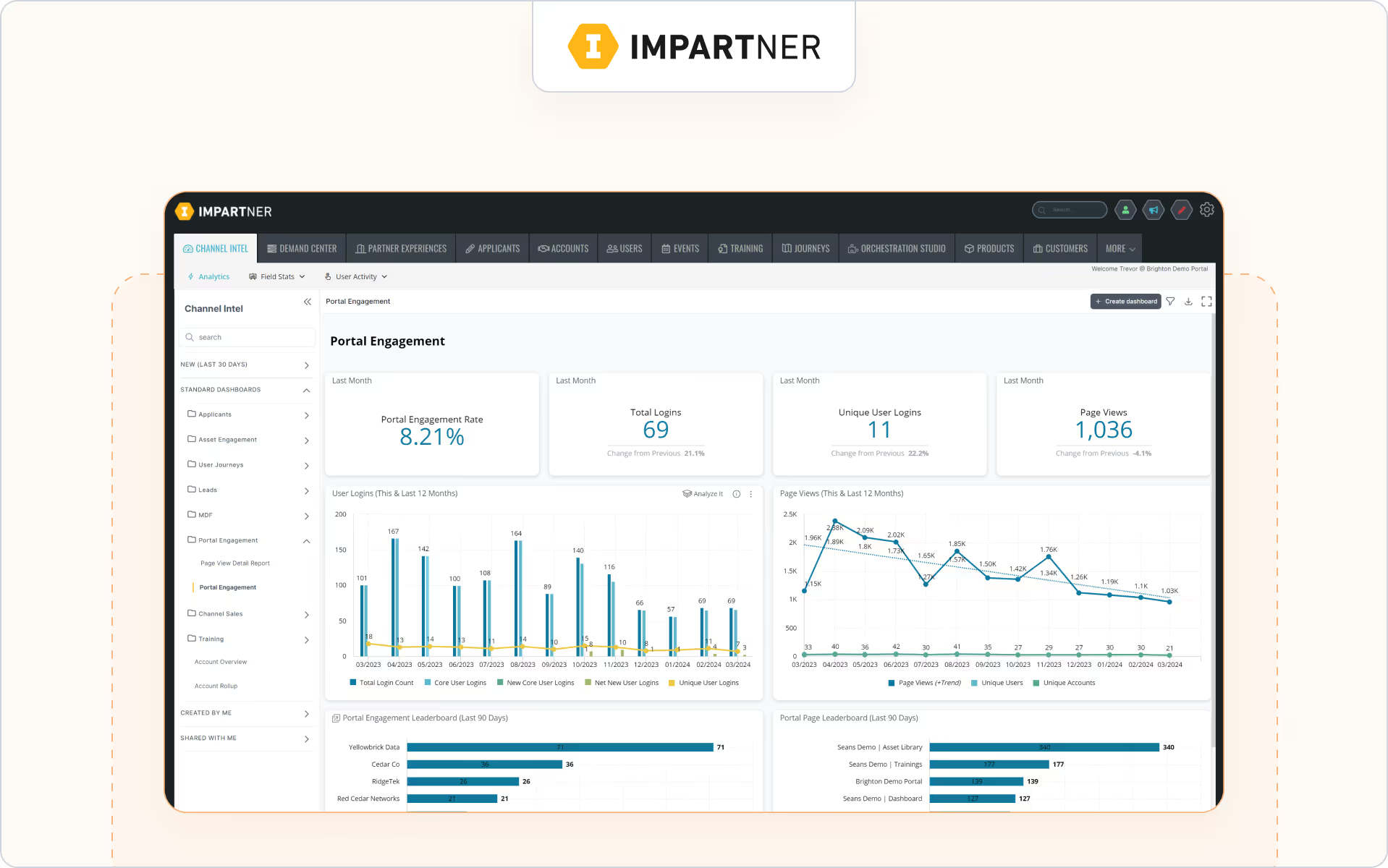
Impartner is a leading Partner Relationship Management platform designed to optimize and automate the entire partner lifecycle, enhancing collaboration and driving revenue growth.
Quick Feature Rundown:
- Partner dashboards
- Individual Partner Portals
- Portal workflows
- Role-based permissions
- Opportunity management
- Action tracking
- Lead management
- Partner performance reporting
- Partner engagement tools
- CRM integration
Pros: Comprehensive tracking, robust backend
Cons: Heavier set-up, limited CRM-native tracking
#4 Allbound (now Channelscaler)

Channelscaler (previously Allbound) helps leaders scale by winning partner mindshare, ensuring high levels of partner engagement and placing ease of doing business at the heart of your go-to-market channel strategy.
Quick Feature Rundown:
- Lead Management
- Opportunity Management
- Action Tracking
- Partner Performance Reporting
- CRM Integration
- Program Compliance Manager
- Business Planning Tools
- Journey Builder
- Analytics Studio
Pros: Great partner management, easy to use, good customer support
Cons: Limited customization
#5 ZINFI
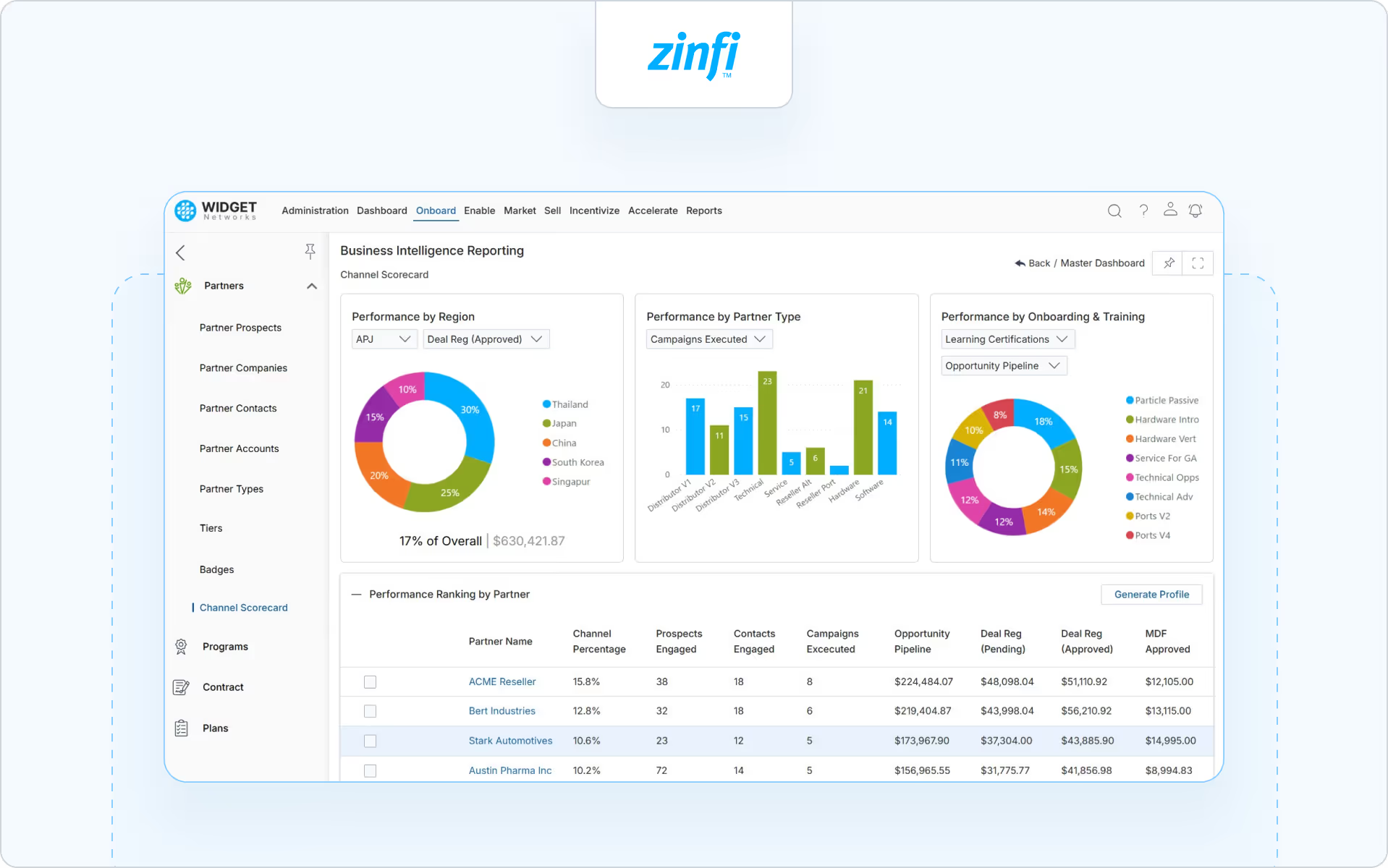
ZINFI is a comprehensive Partner Relationship Management platform that streamlines partner engagement and performance tracking.
This platform puts a heavy focus on automation, empowering you to save time and money when managing your partnerships.
Quick Feature Rundown:
- Lead management
- Opportunity management
- Performance analytics
- Incentive management
- Partner portal
- Partner onboarding
- Partner training
- Deal registration
- Automated partner onboarding, training, marketing, selling, and performance tracking
Pros: Easy to use, strong partner management, good customer support
Cons: Some features are limited
#6 Kiflo
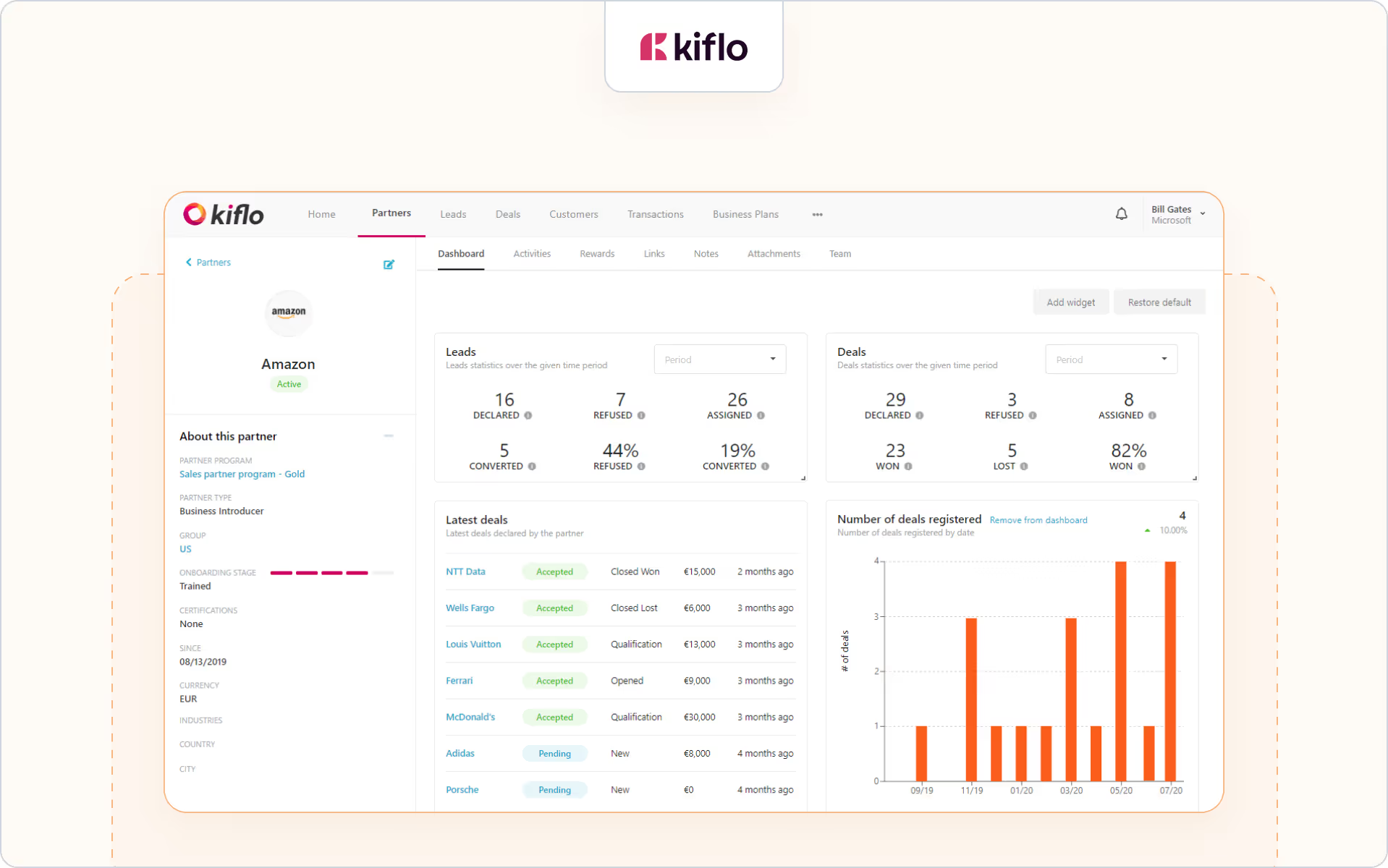
Partner Relationship Management platform Kiflo is designed to streamline partner engagement, growth, and success.
It offers customizable and automated tools that show users a visual representation of their partnerships.
Furthermore, Kiflo caters specifically to small to medium-sized businesses, providing a personalized approach to partner management.
Quick Feature Rundown:
- Lead and Deal Registration
- Real-Time Deal Tracking
- Dynamic Performance Dashboards
- Automated Partner Onboarding
- Customizable Certifications
- Content Management and Sharing
- Automated Reward and Incentive Management
- Comprehensive Analytics
- CRM Integration
Pros: Good customer support, strong partner management features
Cons: Integrations have limitations
#7 WorkSpan
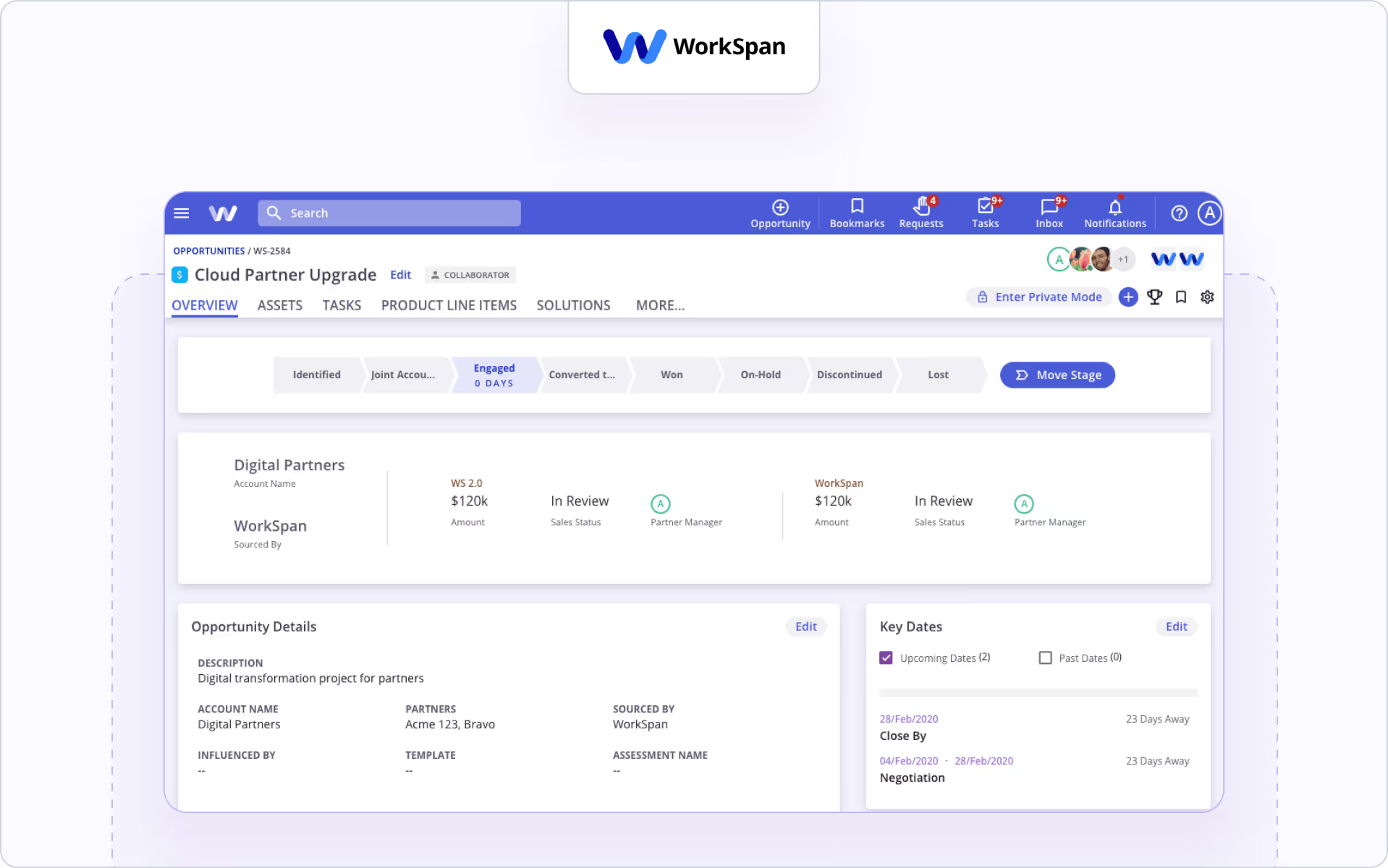
WorkSpan is a Partner Relationship Management platform designed to enhance collaboration and drive revenue growth through strategic partnerships.
It provides a comprehensive ecosystem for co-selling, co-innovating, co-marketing, and co-investing, enabling organizations to optimize their partnership strategies effectively.
Quick Feature Rundown:
- Co-sell opportunity management
- Performance measurement
- Best-practice partnership planning templates
- Comprehensive reporting and analytics
- Real-time data sharing and collaboration
- AI-driven insights and recommendations
- Secure ecosystem access control
- Automated referral creation and sharing
- Customizable dashboards and metrics
- Integration with existing CRM systems
Pros: Strong partner management and collaboration tools
Cons: Steep learning curve
#8 LeadsBridge
LeadsBridge is a comprehensive integration platform designed to streamline lead generation and management processes by connecting various marketing and CRM tools.
Its unique value proposition lies in offering over 380 integrations.
These integrations include custom solutions tailored to specific business needs, ensuring seamless data synchronization and enhanced marketing efficiency.
Quick Feature Rundown:
- Lead sync
- Audience targeting
- Online-to-offline tracking
- Custom integration
- Real-time data syncing
- Lookalike audiences
- Platform-to-platform integration
- Lead nurturing
- eCommerce synchronization
Pros: Helpful customer support, thorough automation, seamless integrations
Cons: Initial set-up can be complex
#9 ZiftONE

Zift Solutions is a comprehensive Partner Relationship Management platform that streamlines channel management, enhances partner engagement, and drives revenue growth.
This software integrates marketing, sales, and learning processes into a single platform, offering personalized experiences for businesses and their partners.
Quick Feature Rundown:
- Partner explorer
- Tier Programs
- User achievements
- Partner groups
- Customizable partner portals
- Real-time analytics and reporting
- Seamless CRM integration
- Automated lead distribution
- Partner onboarding tools
Pros: Easy to use and good customer support
Cons: Limited customization
#10 Channeltivity
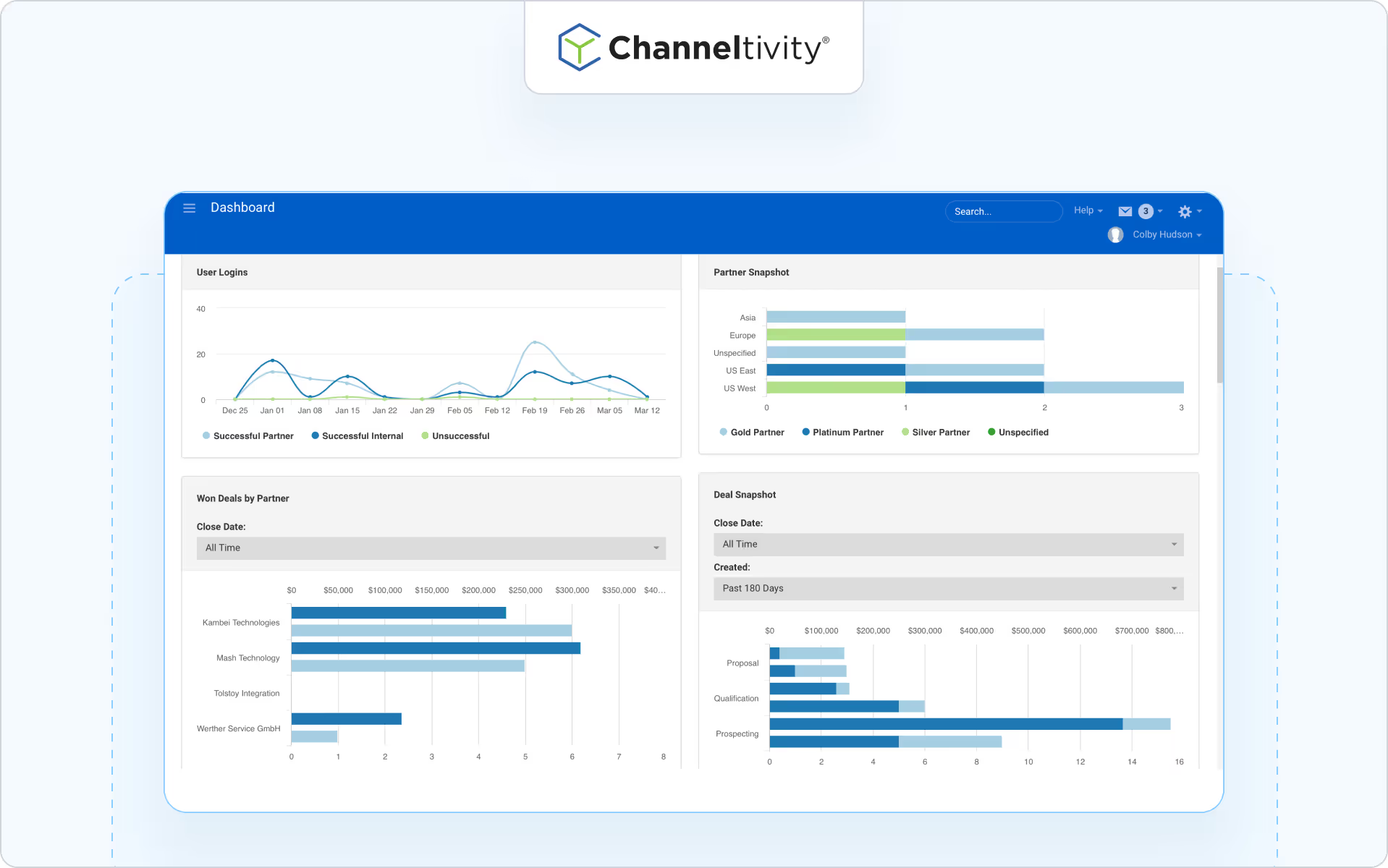
Channeltivity is a Partner Relationship Management platform designed to streamline channel management, enhance partner engagement, and drive revenue growth.
The software offers a comprehensive suite of tools — including deal registration, lead distribution, and partnership performance tracking — tailored to optimize channel operations for technology companies.
Meanwhile, its analytics and reporting suite, empowers leaders to make data-driven decisions and improve resource allocation.
Quick Feature Rundown:
- Deal registration
- Lead distribution
- Referrals and commissions
- Distributor management
- Partner dashboards
- Analytics and reporting
- Notifications and reminders
- Partner portal
- Training and certification
- Business planning
Pros: Streamlined partner engagement and deal tracking and responsive support to ensure customer satisfaction
Cons: Customization limitations
Why Introw + Crossbeam is the Best Partnership Tracking Stack in 2026
If you're ready to integrate account mapping into your PRM, consider Introw with Crossbeam.
So, how do the two platforms work together?
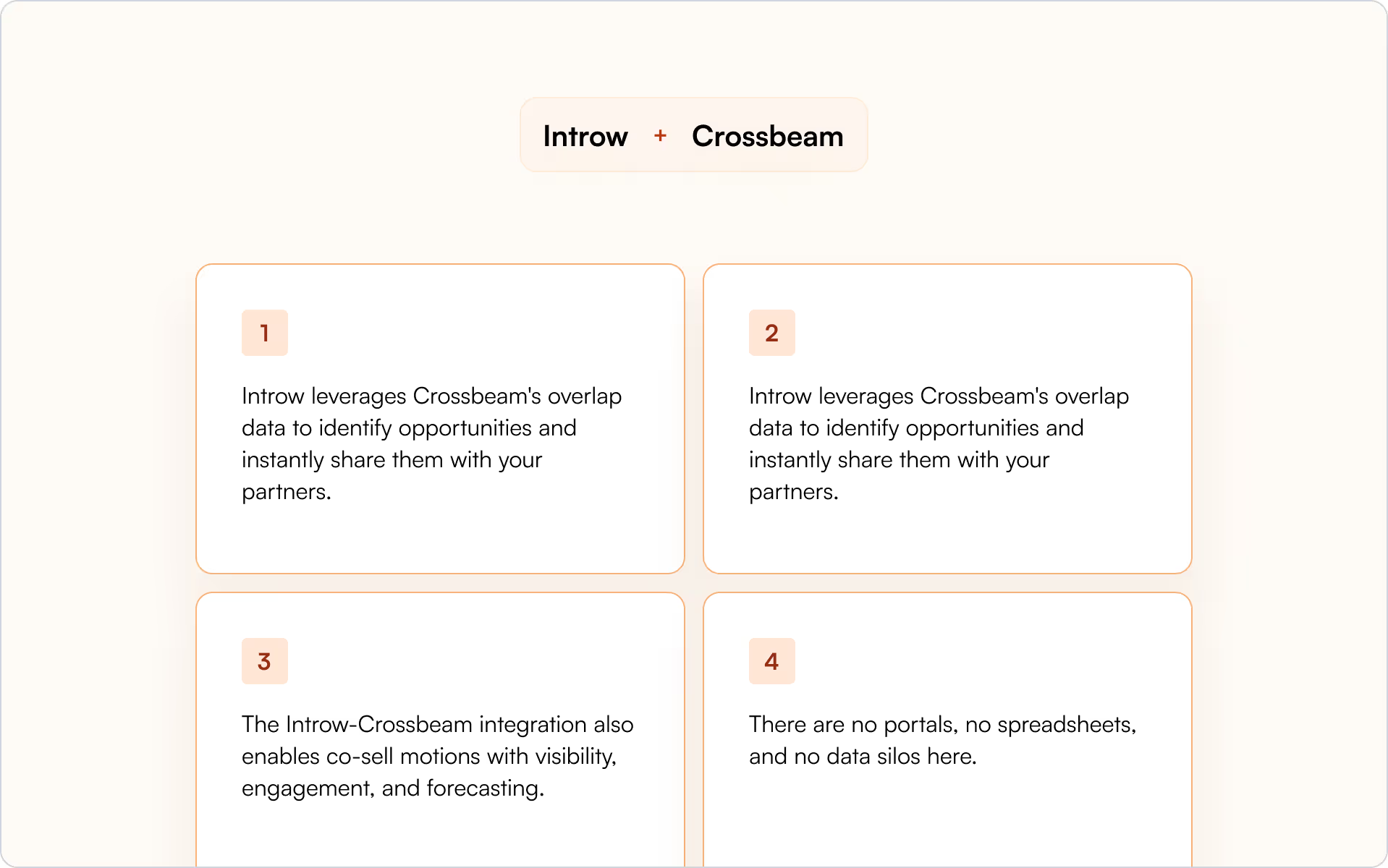
Introw leverages Crossbeam's overlap data to identify opportunities and instantly share them with your partners.
Essentially, Crossbeam finds the opportunity, and Introw then turns it into revenue.
This process is super simple too — one-click integration connects the partner overlap data to the actual pipeline.
What's more, Introw (with Crossbeam) syncs seamlessly into Salesforce or HubSpot, empowering you to manage your partner tracking process from inside your CRM.
The Introw-Crossbeam integration also enables co-sell motions with visibility, engagement, and forecasting.
And Introw is built for scale!
There are no portals, no spreadsheets, and no data silos here.
Conclusion
Today's partner programs live and die by what they can track.
Introw + Crossbeam is the only solution that handles account mapping, lead registration, engagement tracking, and forecasting — all in one flow
So, say goodbye to portal logins and spreadsheet chaos.
✅ Ready to track every opportunity and turn partnerships into pipeline? Book your personalized Introw demo
Partner Lifecycle Management: 8 Key Steps to Optimize Your Processes
Partner lifecycle management is how you turn potential partners into high performing partners — and keep them productive through every stage of the relationship. In 2026, the standouts treat the partner lifecycle as an operating system, not a campaign: a structured approach to recruiting partners, accelerating the onboarding process, establishing clear communication channels, monitoring partner performance, and renewing or exiting with professionalism. Done well, the partner management lifecycle delivers mutual benefits: expanding market reach, steadier pipeline, and long-term success for both sides. This guide lays out a practical playbook you can put to work across various stages of the partnership lifecycle, with notes on where a CRM-first partner relationship management stack (like Introw) simplifies the work.
What Is Partner Lifecycle Management?
Partner lifecycle management (PLM) is the structured management of the entire partner journey — from first contact through onboarding, activation, growth, renewal, or exit. Think of it as lifecycle management for two or more organizations working toward shared outcomes. In practice, PLM coordinates people, processes, and tools so partners receive the necessary resources at the right time: marketing materials when prospecting, sales tools at first opportunity, technical assistance at validation, and ongoing support after the first deal. The lifecycle of partner management commonly spans five stages: attract and qualify; onboard and enable; activate and co-sell; grow and retain; renew or exit. Whether you run a channel partner lifecycle management process, manage a services-led ecosystem, or blend in an affiliate program, the scaffolding stays the same — the emphasis and pacing change by motion and segment. A mature PLM function ties each stage to clear strategy, roles, and measurable outcomes so both companies see progress, not just activity.
Why Partner Lifecycle Management Still Matters in 2026
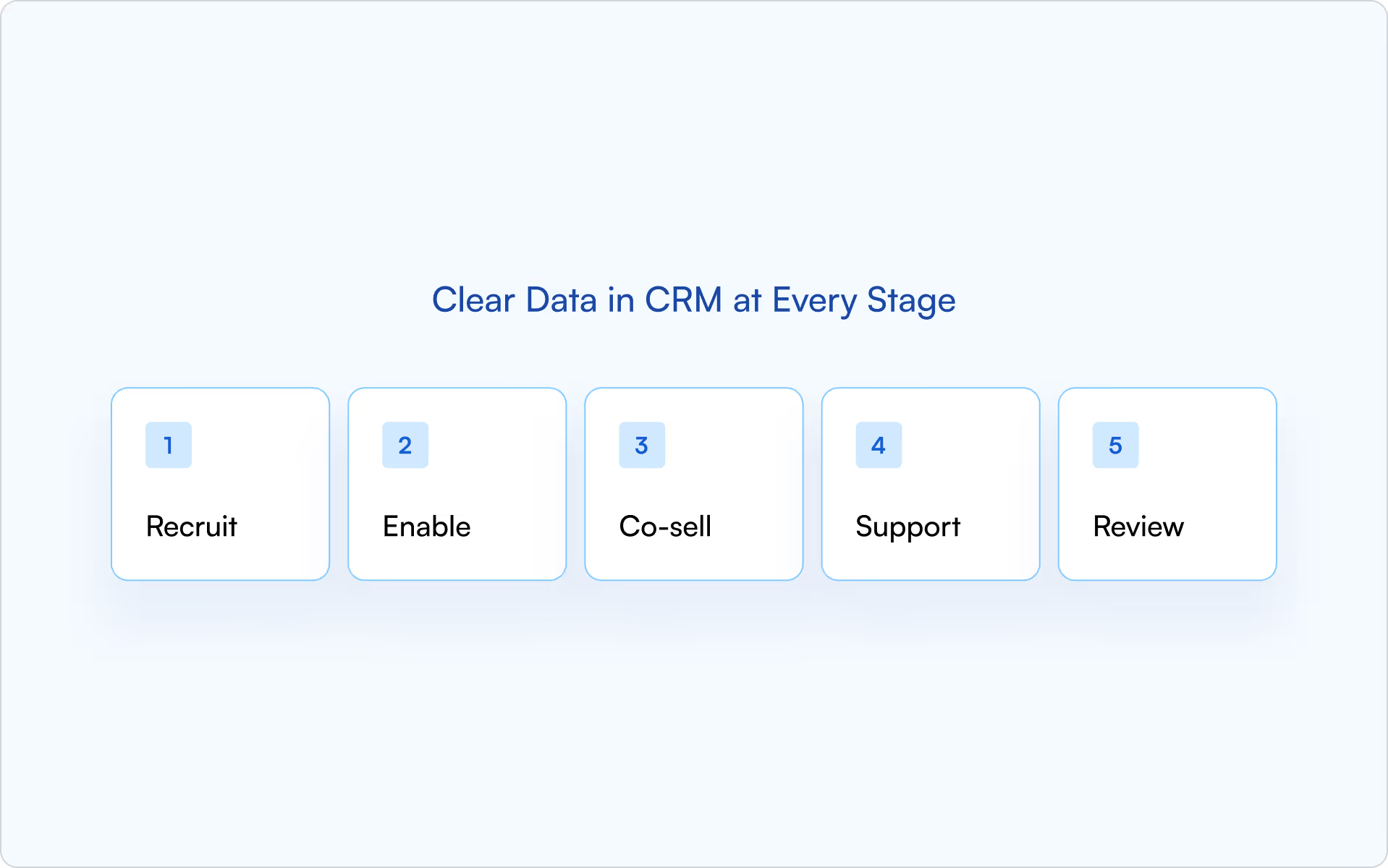
Partner ecosystems are broader and more specialized than ever: technology alliances, system integrators, services firms, and affiliate programs often collaborate on the same accounts. Buyers expect vendors and partners to move as one team, bringing complementary capabilities and credible local services. That expectation puts pressure on lifecycle management. If your stages are fuzzy or your data is scattered, you’ll feel it fast — slow onboarding, missed handoffs, and deals that stall because two companies aren’t on the same page. Effective partner lifecycle management fixes this by giving every stakeholder a clear map of the journey: how you’ll recruit, enable, co-sell, support, and review. It also anchors the relationship to business growth: shared goals, joint offers, and a cadence of regular reviews that turn activity into outcomes. When the lifecycle is visible inside your CRM, you can track performance, identify areas to coach, and allocate resources to the partners and plays that actually convert. The result is a healthier partner portfolio, stronger relationships, and a predictable route to revenue across new markets and existing accounts.
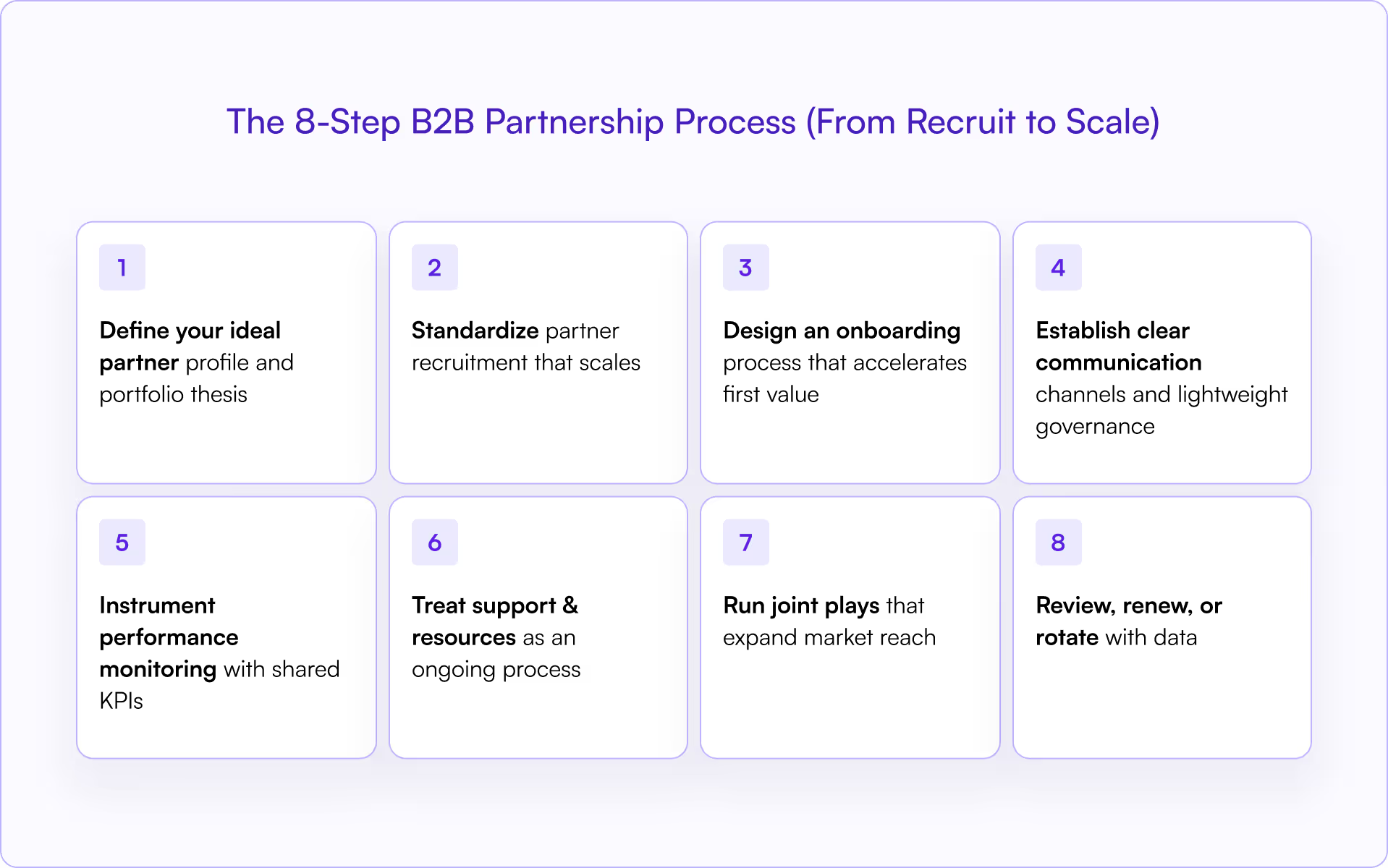
An 8-Step Framework for Effective Partner Lifecycle Management
Use this structured approach to align shared goals, streamline collaboration, and turn your partner portfolio into sustainable business growth across the full partner journey. Each step builds on the last and can be audited during quarterly reviews.
1) Define Your Ideal Partner Profile and Portfolio Thesis
Strong programs begin by naming the right partners up front. Build an ideal partner profile around business needs (industries, regions, customer base), complementary capabilities (integrations, services, routes to market), and the partner journey you can reliably support. Score prospective partners for strategic alignment, overlap with your respective customers, readiness to co-sell, and senior leadership sponsorship. Then write a simple portfolio thesis: how many partners per segment, which services matter, and where you’ll place early bets. This avoids the “many partners, little progress” trap and keeps resources focused where partnership strategies will pay off. Capture partnership goals, mutual benefits, and first-quarter actions in a one-pager for each target — it speeds quickly from interest to action and helps you maintain professionalism as conversations scale.
2) Standardize Partner Recruitment That Scales
Recruiting partners is a process, not a roadshow. Publish a short, public path for potential partners: a landing page, a qualification checklist, and clear owners for each stage. Mix outreach across your ecosystem — technology partnerships, system integrators, services firms, and (if it fits) a tightly scoped affiliate program. Make it easy to reach potential partners with transparent timeframes and who attends the first stage call. Share agendas and follow-ups with resources so candidates can evaluate fit without friction. Keep a “no-for-now” list and revisit quarterly; the market shifts, and new technologies or emerging trends can change strategic alignment. A repeatable recruitment motion preserves momentum, keeps the experience consistent across regions, and helps you identify the lifecycle of partner management signals that predict success early.
3) Design an Onboarding Process That Accelerates First Value
The handoff from recruiting to enabling is where many programs stall. Build a 30–60 day onboarding process with role-based, comprehensive training (seller, SE, marketer), current marketing materials, and a compact solution certification. Provide a starter kit: one-page positioning, a discovery guide, a 5-slide demo, and two co-brandable assets. Give partners the necessary resources to run their first motion without waiting on your team. Define roles and responsibilities, share a point-of-contact list, and set expectations for deal registration and response times. Close with a brief readiness check — who they’ll target, which sales tools they’ll use, and what success in the first quarter looks like. Well-run onboarding shortens time-to-first-deal, improves partner engagement, and sets the tone for a mutually beneficial relationship grounded in shared execution.
4) Establish Clear Communication Channels and Lightweight Governance
Clarity beats volume. Agree on clear communication channels (email/Slack) and a simple governance rhythm: weekly pipeline syncs during activation, monthly operating reviews, and a quarterly strategy checkpoint. Document owners on both sides — a partner manager, sales lead, marketing lead — and write how to escalate blockers. Keep meetings short and focused on progress, not status. Encourage both organizations to share insights from the field so you can adjust messaging and plays quickly. Lightweight governance helps many partners move in parallel without creating bureaucracy, and it’s a key element of channel partner lifecycle management where multiple vendors may touch the same customer. When communication is structured and visible in the CRM, teams stay aligned and issues surface early, before they threaten deals.
5) Instrument Performance Monitoring With Shared KPIs
You can’t manage what you can’t see. Decide on a short list of KPIs that actually describe partner performance: sourced pipeline, acceptance time for deal registrations, stage conversion, win rate, and adoption of integrations or services. Add health signals like content usage, meeting cadence, and response times. Review data where the work happens — your CRM — so you can track performance without spreadsheets, then coach to specifics: where a partner stalls, which assets work, and which markets convert. Segment reports by various stages of the partner lifecycle so you can identify areas to improve (e.g., partners strong at sourcing but weak at validation). Shared dashboards and regular reviews turn conversations from opinion to plan and spotlight high performing partners for investment.
6) Treat Support and Resources as an Ongoing Process
Effective PLM doesn’t end after onboarding. Partners need ongoing support that matches their maturity: faster answers during early co-selling, deeper enablement as deal sizes grow, and guidance on industry regulations or security for complex accounts. Maintain a living catalog of additional resources — case studies, security briefs, ROI models — and update them as products evolve. Ensure partners receive timely technical help during proofs and clean, co-owned mutual action plans. Give customer success a clear role in the partnership lifecycle so joint wins become references and renewals. The goal is a steady experience that reinforces trust and keeps engagement high across the lifecycle of partner management.
7) Run Joint Plays That Expand Market Reach
Activation sticks when both sides see pipeline. Package one or two joint plays aimed at new markets or specific use cases: a webinar with a follow-up sequence, a field workshop for an account list, or a services-plus-product bundle. Align on routes to market, lead flow, and attribution so mutual benefits translate into revenue growth and brand visibility. Combine complementary capabilities — a cloud solution with a compliance specialist, for instance — to strengthen the business relationship and create partnership success with clear offers. Share wins publicly; it motivates teams and gives the next partner a model to follow. Over time, a few proven plays will do more for business growth than a shelf full of unused assets.
8) Review, Renew, or Rotate With Data
End each quarter with a concise review: what worked, what lagged, and one change to test. Decide whether to renew, expand scope, or pause. If you renew, raise the bar with new partnership objectives and a larger target list; if you exit, keep a documented handover and protect customer experience. A respectful close protects your reputation and may reopen doors later. This adaptive management approach keeps your partner portfolio healthy, aligns investment with results, and ensures your PLM remains a comprehensive approach — not a set-and-forget checklist.
Metrics & Dashboards That Keep You Honest
A clean measurement layer is the difference between anecdotes and accountability. Tie the channel partner lifecycle management process to a handful of outcome metrics (sourced pipeline, bookings, cycle time, win rate, expansion on joint accounts) and a few leading indicators (registrations responded to within 24 hours, mutual action plans created in first meeting, enablement completions). Track by stage of the partner management lifecycle so you can see where partners speed quickly or stall. Layer in program health signals — active partners by segment, ramp time, content adoption — so you can plan capacity and resources. The goal isn’t a flashy BI stack; it’s a dashboard you trust enough to make decisions weekly. When your key takeaways are visible to the key stakeholders who own sales, marketing, and success, the program improves continuously instead of once a year.
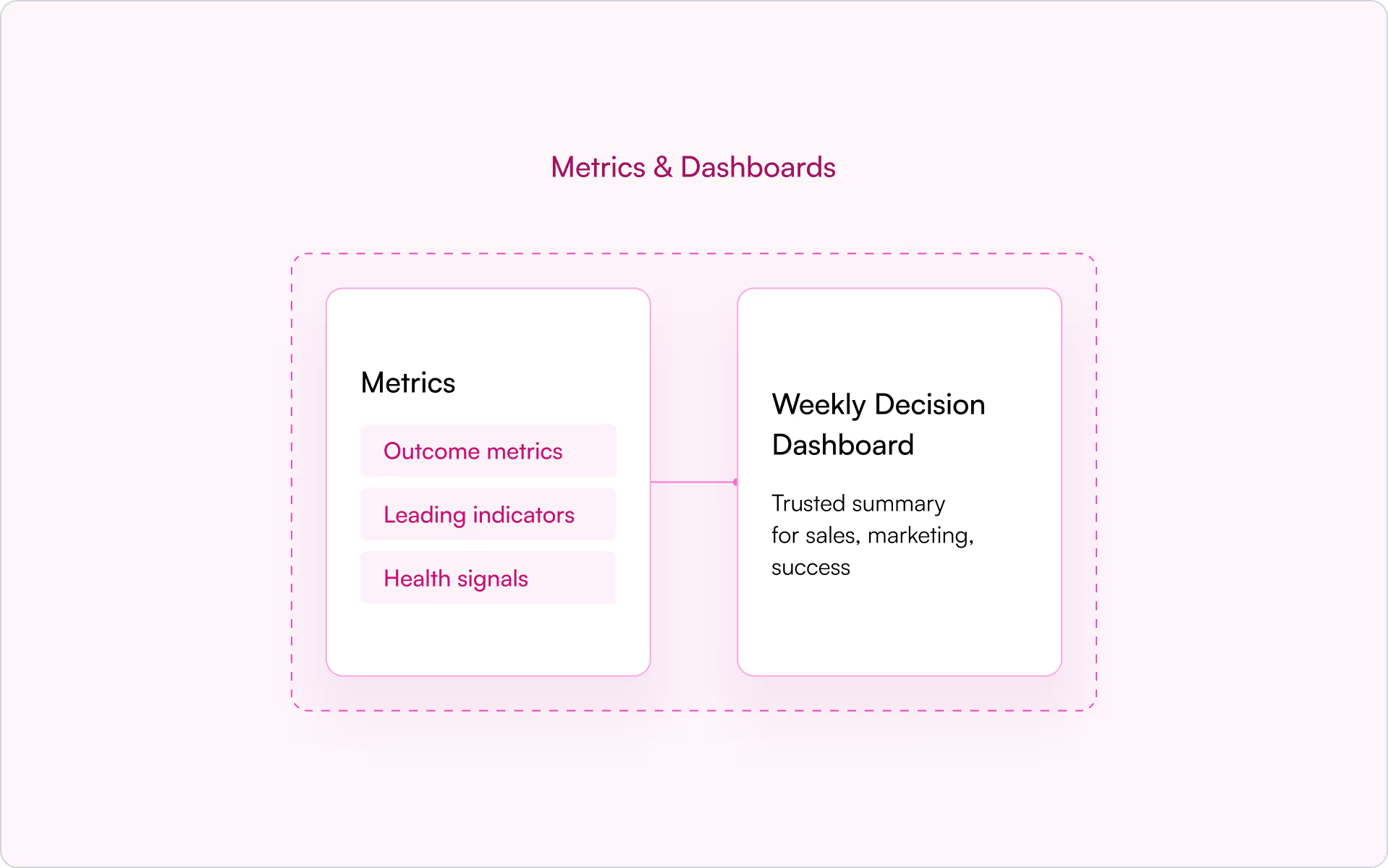
Conclusion
Partner lifecycle management is a comprehensive approach to turning partnership intent into durable results. Define who you’ll work with, start them quickly, keep communication and governance light but consistent, measure what matters, and renew relationships with confidence — or close them cleanly. When you operate the lifecycle inside your CRM and design for adoption, you get mutual success: stronger collaborations, predictable pipeline, and customers who experience coordinated service from first meeting through renewal. If you want the mechanics to feel easier, consider Introw’s CRM-first PRM to keep the work simple and the results visible.

