

Imagine that your learning system is built for your external partners. You can speed up partner onboarding, boost partner engagement, and clearly connect training to real partner performance.
So, instead of investing heavily in partner training, you'll be able to see who’s enabled, certified, or actually ready to sell.
To understand what makes that possible, it helps to first clarify what partner LMS software actually is, and why it’s fundamentally different from an employee LMS.
Partner LMS Software - What It Is (and Why It’s Different)
Partner LMS software is a learning management system built specifically for partner training.
It helps SaaS teams:
- onboard external partners faster,
- deliver partner education at scale, run certification programs,
- and track partner progress in a way that supports real partner performance and business growth.
Unlike employee training, partner training has to work across a distributed partner network with different partner tiers, regions, and goals.
That’s why modern partner training LMS software is often part of a broader partner enablement strategy, working hand in hand with partner relationship management software to support long-term partner performance.
The difference becomes clearer when you compare it directly:
For teams comparing the best partner training LMS software, this list focuses on what actually matters in a partner LMS tool, not generic employee training features.
The 15 Best Partner LMS Software Options (2026)
When you’re choosing partner LMS software for your business, you’re not trying to pile on features. What you want is a system your partners will actually use.
Here’s the selection we put together to help you compare the options and see which ones might fit how your team works.
1. Introw Partner LMS (Best for CRM-first SaaS partner programs)

Introw's Partner LMS is designed for B2B teams that want partner training, certification programs, and partner engagement to directly support partner performance and revenue, not live in a disconnected learning management system.
Best for:
Teams using Salesforce or HubSpot that need fast external training, clear certification management, and visibility into partner progress tied to pipeline.
Why it stands out:
Introw focuses on speed, relevance, and real adoption. Instead of building training programs from scratch, an AI agent turns your existing website content, partner portal docs, or sales materials into structured courses in minutes. You can see this flow in the feature walkthrough.
Key features:
- AI-powered course creation with modules, quizzes, and assessments
- One-click certification tools to ensure only certified partners sell specific solutions
- Bulk partner enrollment by partner tier, region, or partner group
- Automated reminders and announcements via email and Slack, for example: “Company X has enrolled you in Advanced Product Training 2026.”
- Progress tracking and engagement data aligned to deals and partner performance
Keep in mind:
Introw works best when partner training, partner enablement, and partner engagement are part of the same CRM-first motion.
Integrations:
Native integrations with Salesforce, HubSpot, and Slack, with partner LMS data flowing into the wider Introw platform.
Learn more: Explore the Partner LMS or request a demo.
2. TalentLMS
TalentLMS is a learning management system often used as partner training software by teams that want to deliver external training without a steep learning curve. It’s typically chosen for straightforward partner onboarding and partner education.
Best for:
SMB to mid-market teams that need a simple way to run partner training programs, sales training, and basic certification programs.
Why it stands out:
TalentLMS is easy to use and quick to set up. Teams can create courses, organize training materials, and deliver on-demand training with minimal administration.
Partner training features:
- Separate learning spaces for different partner groups
- Course creation for product knowledge and sales training
- Certifications, assessments, and progress tracking
Keep in mind:
TalentLMS handles training delivery well, but deeper CRM visibility and advanced partner performance analytics usually sit outside the platform. This is often where teams start thinking more about partner engagement beyond training alone.
3. Thinkific

Thinkific is a platform often used to package partner education into branded academies and certification hubs. It’s sometimes chosen as partner training software when the focus is on presentation and structured learning experiences rather than deep partner operations.
Best for:
Product-led or marketing teams building partner academies, certification tracks, or external training portals.
Why it stands out:
Thinkific offers polished course and landing page experiences, with built-in support for cohorts, quizzes, and certificates.
Partner training features:
- Course creation for partner education and product knowledge
- Certificates and assessments
- Community and cohort-based learning
Keep in mind:
Thinkific is oriented toward external education. Advanced partner onboarding workflows, CRM attribution, and partner performance tracking typically require add-ons or integrations.
4. Intellum

Intellum is an enterprise learning platform used for large-scale customer and partner education programs. It’s designed to support complex training delivery across broad partner ecosystems.
Best for:
Enterprise teams running structured partner training programs at scale.
Why it stands out:
Intellum offers robust learning experiences, advanced analytics, and extensibility for complex training environments.
Partner training features:
- External audiences and partner portals
- Certification programs and events
- Reporting tools for training effectiveness
Keep in mind:
Intellum is an enterprise-grade system. Implementation effort and CRM alignment for partner performance should be evaluated early.
5. 360Learning

360Learning focuses on collaborative and peer-driven learning. It’s sometimes used for partner enablement training where shared knowledge and social learning matter.
Best for:
Teams that want partners to co-create content and learn from each other.
Why it stands out:
360Learning emphasizes social learning, peer reviews, and collaborative course creation.
Partner training features:
- External partner groups
- Certifications and blended learning
- Social and peer-generated content
Keep in mind:
The collaboration-first model works best with clear governance, especially when applied to external partners.
6. Articulate 360

Articulate 360 is a content creation suite rather than a full learning management system. It’s often paired with partner training software to build rich courses.
Best for:
Teams that want to author high-quality SCORM or xAPI training content.
Why it stands out:
Articulate’s tools, like Storyline and Rise, are widely used to create responsive, interactive training materials.
Partner training features:
- Advanced course creation for product knowledge and sales training
- SCORM and xAPI support
Keep in mind:
Articulate handles content creation only. You’ll need a separate LMS to deliver training, manage certifications, and track partner progress.
7. LearnUpon

LearnUpon is an LMS designed for extended enterprise use, including customer and partner training. It’s often used when teams need clear admin controls across audiences.
Best for:
Teams training customers and partners through structured portals.
Why it stands out:
LearnUpon offers a clean interface and multi-portal setup for different audiences.
Partner training features:
- Separate learning portals for partner groups
- Learning paths and certifications
- Reporting on training delivery and progress
Keep in mind:
For teams focused on channel sales performance or CRM-level partner analytics, integration depth should be reviewed.
8. Skilljar

Skilljar is a platform focused on customer and partner education, often used by teams running structured certification and compliance-driven training programs.
Best for:
Teams that need to deliver partner education at scale with an emphasis on certifications and reporting.
Why it stands out:
Skilljar is purpose-built for external training and offers strong APIs and analytics for education programs.
Partner training features:
- External partner portals
- Certification programs and badges
- Reporting tools for training effectiveness
Keep in mind:
Skilljar focuses on education delivery. Partner engagement flows and CRM-level partner performance tracking may require additional integrations.
9. Docebo
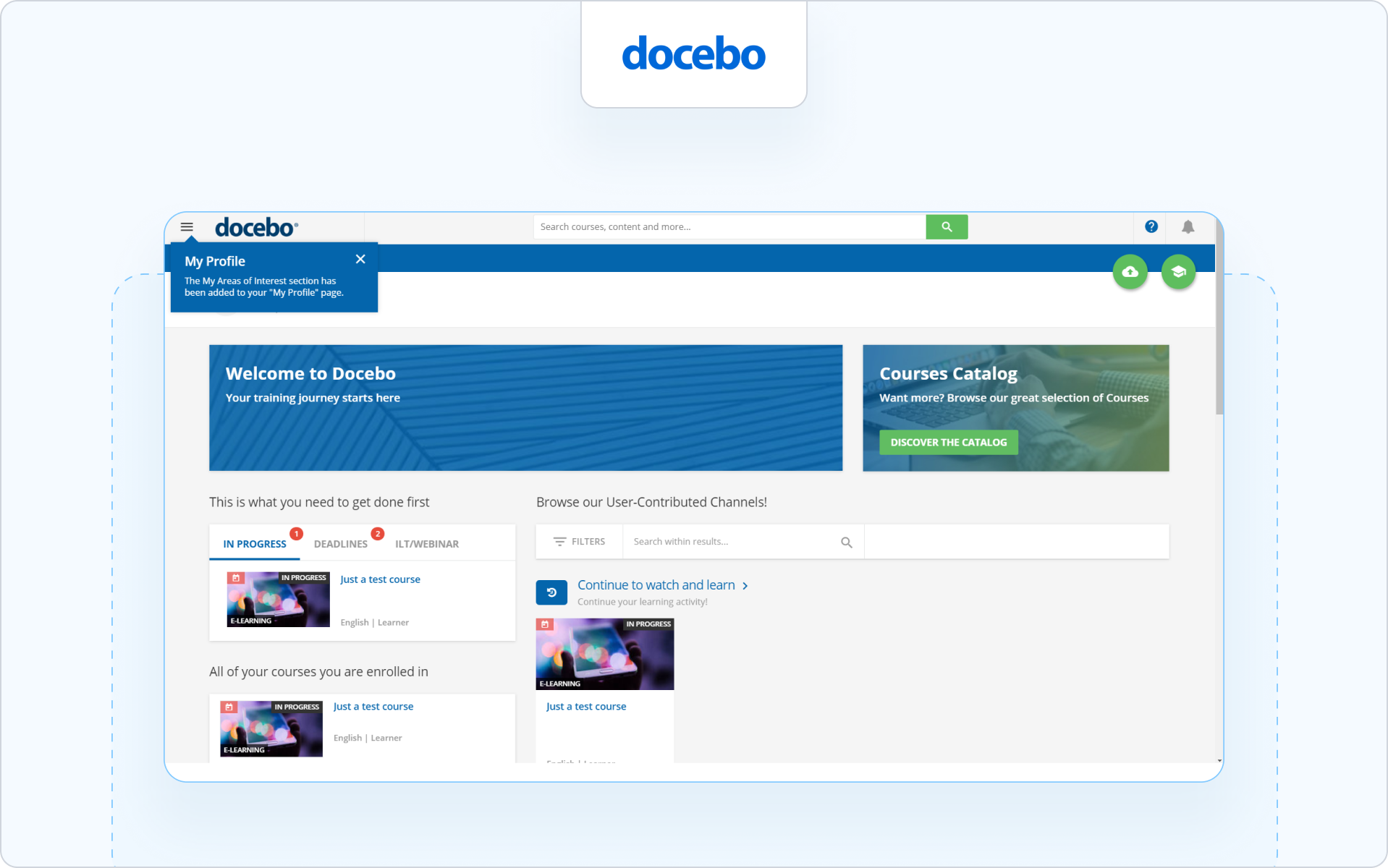
Docebo is an enterprise learning management system used for extended enterprise training, including customers and partners. It’s sometimes selected as partner training software for large, global programs.
Best for:
Enterprise organizations managing complex partner training programs across regions.
Why it stands out:
Docebo offers AI-assisted content curation and a broad ecosystem of integrations.
Partner training features:
- Multi-audience portals for external partners
- Certification management and automation
- Advanced analytics and reporting
Keep in mind:
Implementation can be complex. Teams should validate CRM alignment and partner performance visibility early.
10. Litmos

Litmos is an LMS commonly used in compliance-heavy environments with large partner networks.
Best for:
Organizations that need consistent training delivery and compliance tracking for global partners.
Why it stands out:
Litmos offers compliance tooling, assessments, and a large off-the-shelf content library.
Partner training features:
- External learners and partner groups
- Certifications and assessments
- Reporting on training completion
Keep in mind:
User experience can feel more traditional. Partner segmentation and engagement flexibility should be reviewed.
11. Absorb LMS

Absorb LMS is an LMS designed for extended enterprise training, including partner and customer education.
Best for:
Teams that want flexible portals and strong reporting across external audiences.
Why it stands out:
Absorb LMS combines configurable learning portals with solid analytics and automation options.
Partner training features:
- Multi-tenant portals for partner groups
- Certification programs and automation
- Reporting on progress tracking and training delivery
Keep in mind:
Engagement outside the LMS, such as email or Slack-based updates, may require integrations.
12. Mindtickle

Mindtickle is a sales readiness platform sometimes used for partner enablement training, particularly when the focus is on sales execution rather than broad partner education.
Best for:
Teams focused on partner sales readiness, pitching, and certification tied to sales motions.
Why it stands out:
Mindtickle emphasizes coaching, role-play, and readiness scoring to support sales performance.
Partner training features:
- Partner sales tracks and certifications
- Content, practice, and assessments
- Readiness scoring and coaching workflows
Keep in mind:
Mindtickle is readiness-first. Most teams pair it with a PRM or LMS to cover broader partner onboarding and operations.
13. LearnWorlds
LearnWorlds is a platform designed for external education, often used to build branded academies and certification hubs.
Best for:
Teams that want to launch partner education programs with strong branding and optional monetization.
Why it stands out:
LearnWorlds offers flexible course creation, interactive content, and polished learning experiences.
Partner training features:
- Course creation for partner education and product knowledge
- Certifications, assessments, and learning paths
- Branded portals for external partners
Keep in mind:
Partner-specific governance, segmentation, and CRM visibility typically require additional setup or integrations.
14. Cornerstone Customer & Partner LMS

Cornerstone Customer & Partner LMS supports customer and partner training through branded external learning experiences designed to scale across regions, audiences, and partner ecosystems.
Best for:
Large enterprises that already use Cornerstone and want to extend customer and partner training through branded external learning experiences.
Why it stands out:
Cornerstone focuses on scalable external learning with strong governance, making it easier to manage training across complex partner ecosystems and regions.
Partner training features:
- Branded external learning portals for partners and customers
- Certifications, assessments, and structured learning journeys
- Reporting and analytics across large partner networks
Keep in mind:
Cornerstone is built for enterprise scale. Setup and customization can require more time, and teams should closely evaluate partner user experience during implementation.
15. Tovuti LMS
Tovuti LMS is a flexible learning management system used for customer and partner training, with an emphasis on configurable learning experiences rather than rigid workflows.
Best for:
Teams looking for a customizable LMS to support partner training programs, partner onboarding, and external training without enterprise-level complexity.
Why it stands out:
Tovuti offers a wide range of configuration options for courses, portals, and learning experiences, making it easier to adapt training to different partner groups and use cases.
Partner training features:
- Branded learning portals for external partners
- Course creation, assessments, and certifications
- Learning paths and engagement features
Keep in mind:
Tovuti provides flexibility, but teams should assess how well reporting, CRM visibility, and partner performance tracking align with their broader partner operations.
There’s no single best partner LMS software for every team. What matters is choosing a system that fits how your channel actually works, not just how training looks on a feature list.
The next section breaks down the must-have evaluation criteria SaaS teams should focus on when comparing partner LMS software, from course creation and certifications to engagement and CRM visibility.
Must-Have Evaluation Criteria (SaaS Channel POV)
When you’re narrowing down partner LMS software, this is usually where the decision becomes clearer.
Beyond feature lists, what matters is whether a system can support partner training at scale, fit into your existing setup, and keep working as your partner ecosystem grows, especially for channel partner training.
The table below reflects how SaaS teams typically evaluate partner LMS tools when comparing options like a channel partner LMS or the best partner training LMS software for their model.
Taken together, these criteria make it easier to compare a partner LMS, a training partner LMS, or the best LMS for partner training without over-indexing on features that won’t matter long term.
When the foundation is right, partner training supports partner knowledge, partner credibility, and partnership marketing instead of sitting in a silo.
After reviewing the criteria, it becomes easier to see why some teams look beyond a standalone learning management system and choose a platform built specifically for partner learning.
Why Teams Choose Introw for Partner Learning (in 90 Seconds)

Create partner learning without slowing teams down
Most teams already have the right content; it’s just spread across websites, docs, and partner portals.
Teams like Factorial moved away from manually rebuilding training by turning existing materials into structured courses with modules and quizzes, making it easier to launch and update partner learning as the business evolves.
Use certifications to protect quality, not add friction
Introw supports certificates, expirations, and gated tracks so advanced training and selling motions stay aligned with partner readiness.
Enroll the right partners at the right time
With Introw, teams can segment partners by type, tier, or region and enroll them in bulk, keeping training relevant without adding operational overhead.
Keep partners engaged without another portal to check
One of the biggest blockers to partner learning is relying on portals that partners don’t visit regularly.
Cubbit and Factorial saw stronger adoption once training communication moved into channels partners already use, with announcements and reminders delivered through email and Slack instead of another login.
Connect learning to what matters
Training becomes far more useful when it doesn’t live in isolation. For teams like Coder, visibility into which partners were trained and ready to co-sell was essential.
By aligning course completion and certification data with Salesforce or HubSpot, Introw helps teams understand partner readiness in the context of pipeline and revenue.
If you’re at the point of making a decision, a few simple next steps can help bring everything together:
- Map your current gaps
Look at where partner learning slows down today, whether that’s course creation, partner onboarding, engagement, or visibility into partner readiness. - Pressure-test your criteria
Revisit the evaluation criteria above and shortlist the capabilities that matter most for your partner ecosystem, not just what looks good on a feature list. - See the workflow end-to-end
Before committing, make sure you understand how partner learning fits into your existing CRM, partner operations, and revenue motion.
Now it's time for you to see how this works in practice.
Request a demo and walk through the partner learning flow end-to-end.
Still curious? Here are some quick answers to help clear things up
A partner LMS is designed for external partners and channel partner training, supporting separate learning spaces, certification management, and partner onboarding as part of a broader partner enablement program. A standard learning management system is built for internal teams and HR use cases.
The best partner LMS for 2026 is one that combines fast course creation, partner training LMS software capabilities, certifications, and adaptive learning paths that adjust to partner roles, tiers, or experience levels.
Yes. Partner training software supports certification programs that allow you to gate partner sales behind required certifications, ensuring only certified partners can sell specific products.
By using partner LMS software that connects progress tracking, certifications, and partner performance data with Salesforce or HubSpot, making training part of ongoing knowledge sharing tied to pipeline and revenue.
Yes. Many partner LMS platforms deliver external training through email or Slack notifications and on-demand training, helping partners stay active users without needing to log into a portal for every interaction.




Are you already an active Introw partner?
Book a demo with one of our partner program experts, or explore Introw on your own time.