


Partner training that lives in spreadsheets and scattered folders doesn’t scale. The moment your network grows past a handful of partners, inconsistent product knowledge, expired certifications, and invisible compliance gaps start costing you deals.
The fix isn’t “more webinars.” It’s a system: a partner LMS that centralizes training, automates certification tracking, and connects partner readiness to your CRM. Below, you’ll learn what a partner LMS actually does, how it differs from internal training tools, and how to tie certification status directly to deal registration and revenue outcomes.
What is a partner learning management system?
A partner LMS is a platform that delivers, tracks, and manages training for external channel partners like resellers, referral partners, and distributors. It accelerates onboarding, ensures brand consistency, and boosts sales by providing centralized, on-demand training. Unlike scattered PDFs or ad-hoc webinars, a partner learning management system gives every partner the same foundation of product knowledge, automates certification tracking, and reduces admin overhead.
Think of it as a centralized learning hub where partners access courses, complete certifications, and stay current on your product. The platform tracks who completed what, when they did it, and whether they passed.
What a partner LMS typically includes
- Course hosting: Product training, sales enablement, and compliance modules
- Certification tracking: Records of completed courses and earned credentials
- Progress visibility: Dashboards showing partner learning activity across your network
Partners represent your brand to end customers. When they’re trained inconsistently, customer experience suffers — and so does your pipeline.
How a partner LMS differs from an internal employee LMS
An internal LMS is built for employees who already have company context and access to internal systems. A partner training LMS, on the other hand, serves external users who may represent multiple organizations, lack IT support, and forget logins easily.
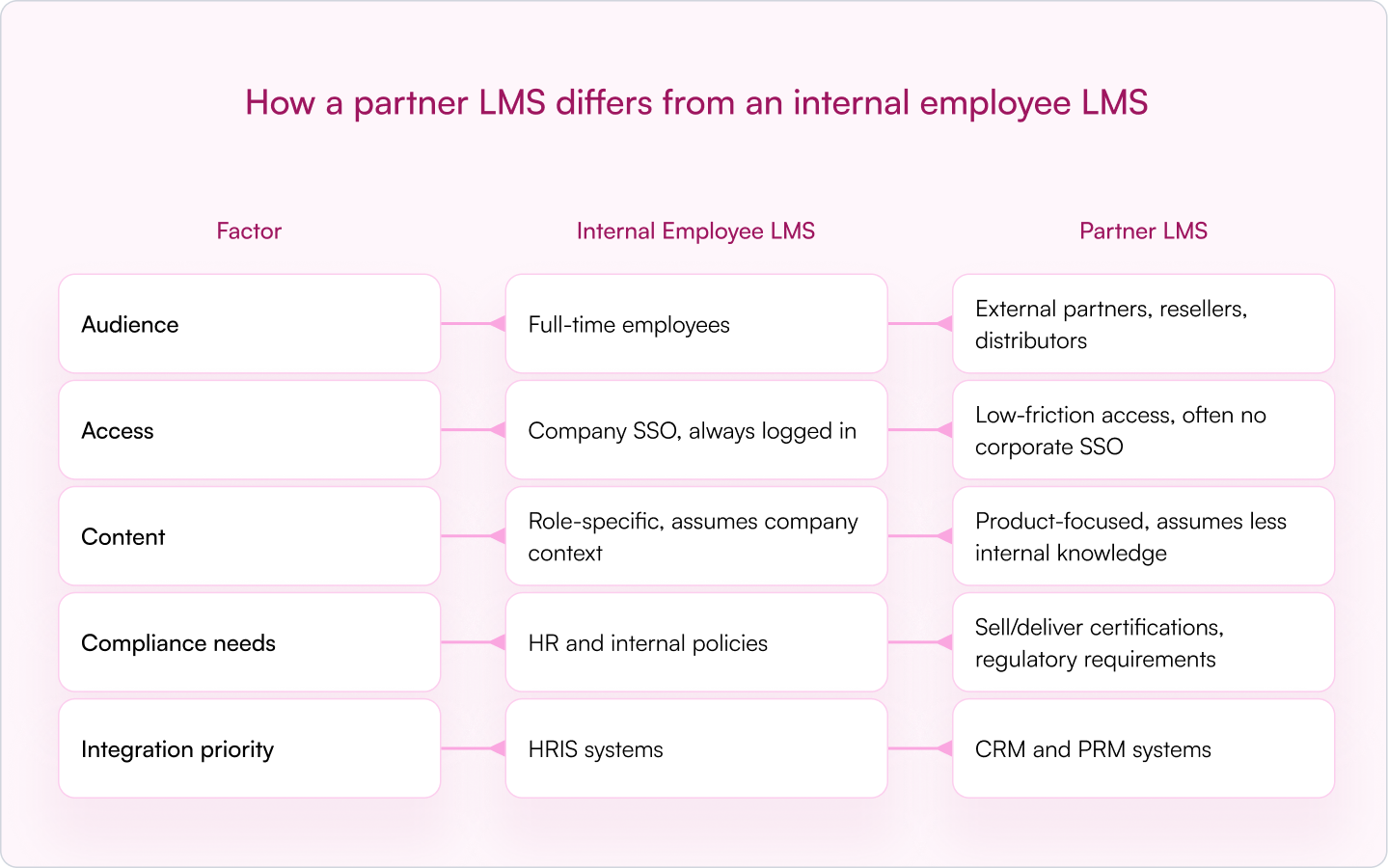
Partners don’t have the patience for clunky portals or password resets. Every login barrier reduces completion rates, which is why frictionless access matters more for external training than internal.
Key LMS benefits for channel partner certification
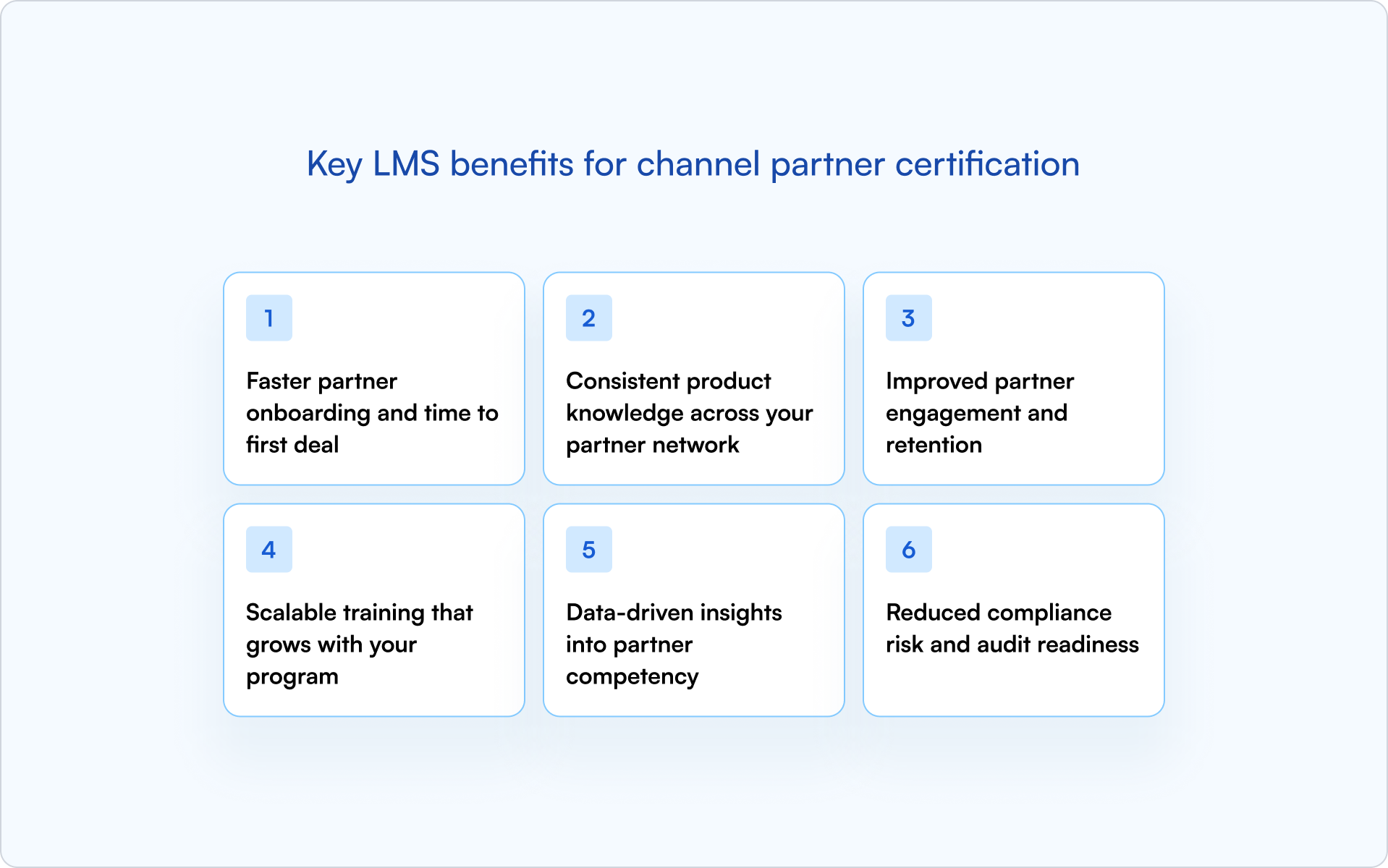
Each benefit below addresses a specific pain point that partner managers and RevOps teams deal with regularly.
Faster partner onboarding and time to first deal
Structured partner onboarding paths get partners selling faster. Instead of ad-hoc training calls or scattered documentation, partners follow a defined curriculum at their own pace.
Faster ramp means faster revenue from the channel. When LMS data connects to your CRM, you can see which partners completed onboarding and are ready to register deals, without chasing updates manually.
Consistent product knowledge across your partner network
Partners giving inconsistent or outdated information to prospects is a common problem. An LMS ensures every partner learns the same messaging, positioning, and technical details.
Consistency protects brand integrity and reduces support tickets from partner-sourced deals gone wrong. It also matters when multiple partners operate in the same region or vertical.
Improved partner engagement and retention
Partners who feel invested in and properly enabled through strategic programs stay active longer. Certification programs give partners a sense of progression and achievement, something a PDF library can’t replicate.
Engaged partners register more deals and stay loyal to vendors who make them successful. Gamification elements like badges and leaderboards can reinforce engagement, though they’re not required.
Scalable training that grows with your program
Manual training doesn’t scale. Webinars and 1:1 calls work for a handful of partners, but they become a bottleneck as your network grows.
An LMS for partner training lets you add partners without adding headcount. Update content once, and every partner sees the latest version — whether you have 20 partners or 300.
Data-driven insights into partner competency
Visibility into who completed what, where partners drop off, and which certifications correlate with deal success helps partner managers prioritize enablement efforts.
CRM-connected systems make certification data actionable. You can see certification status alongside pipeline, which means you’re not guessing which partners are ready to sell.
Reduced compliance risk and audit readiness
For regulated industries like fintech, cybersecurity, or healthcare, partners often need to meet compliance requirements before selling. An LMS creates an audit trail of who completed mandatory training and when.
Every completion, assessment score, and certification issuance gets logged with timestamps. Audit-readiness protects the vendor from liability and makes audits far less painful.
Essential features to look for in a partner training LMS
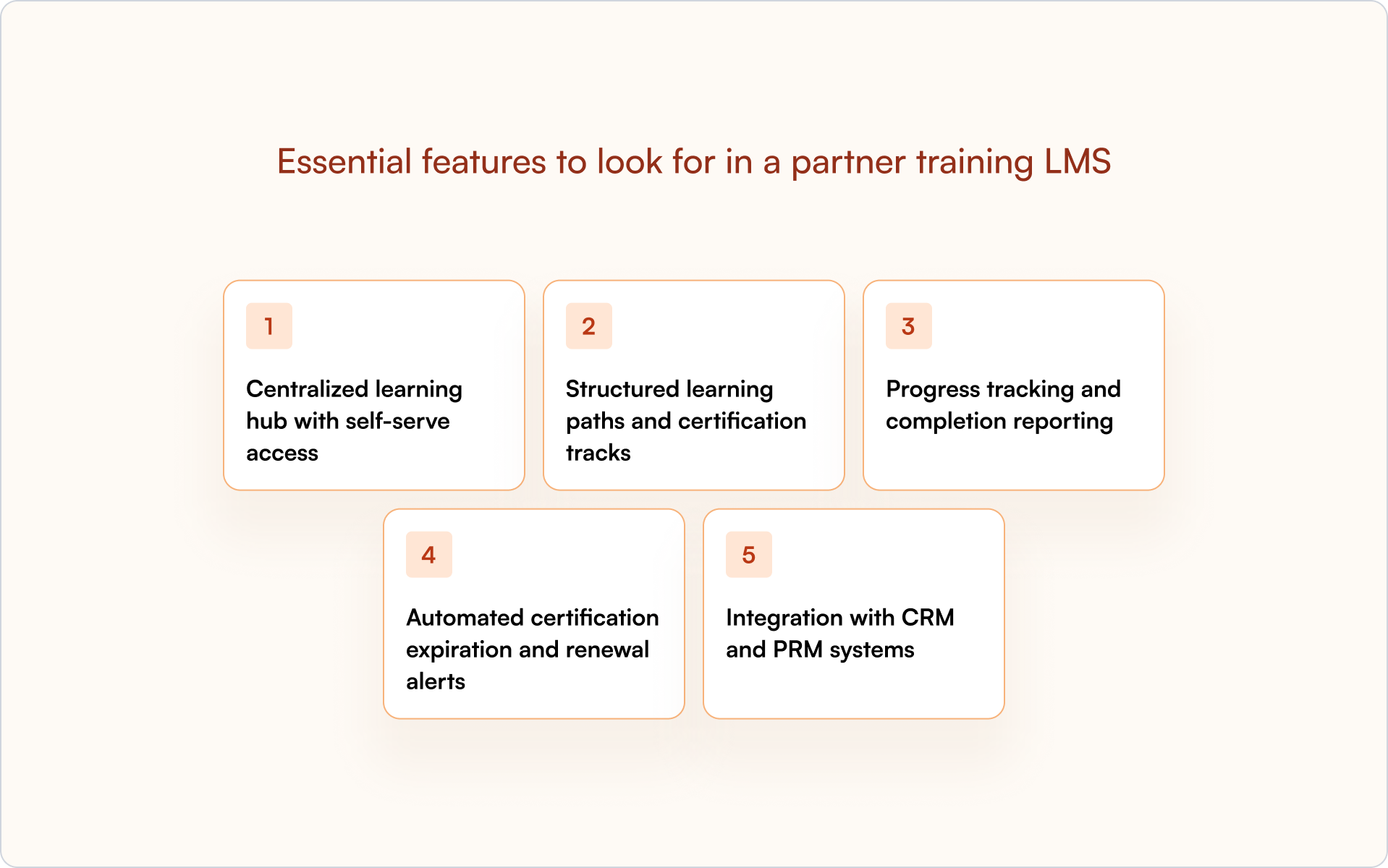
Not all LMS platforms are built for external partner networks. If you’re evaluating options, focus on the features that reduce partner friction and make certification data usable for revenue teams.
Centralized learning hub with self-serve access
Partners should find all training in one place without hunting through emails or shared drives. Access works best when it’s frictionless, ideally without forcing partners to remember another password.
- Magic links
- SSO options
- Embedded access through a partner portal
Structured learning paths and certification tracks
Guided curricula beat content libraries. Learning paths ensure partners complete prerequisites before advanced material, and certification tracks tie completion to credentials that unlock privileges.
Structured paths also make it easier to enforce readiness gates — especially when you tie certification to deal workflows.
Progress tracking and completion reporting
Partner managers need visibility into who’s engaged and who’s stalled. Dashboards showing completion rates, time spent, and assessment scores enable proactive outreach to partners falling behind.
Without visibility into partner progress, you’re flying blind on readiness.
Automated certification expiration and renewal alerts
Certifications aren’t “set and forget.” Products change, compliance requirements update, and partners need to recertify before credentials lapse.
Automated reminders prevent gaps in authorized sellers and reduce the manual work of tracking expiration dates in spreadsheets.
Integration with CRM and PRM systems
Certification data trapped in a standalone LMS doesn’t help RevOps or sales. When partner certification status syncs to HubSpot or Salesforce, you can gate deal registration, prioritize co-sell resources, and forecast accurately.
CRM-first tools keep certification data visible without manual exports or duplicate entry.
How partner certification programs ensure compliance across your network
Compliance isn’t just about ticking boxes. It’s about reducing risk before deals close — and protecting your brand when partners are the ones in front of customers.
Gate sell and deliver rights based on certification status
Partners should register deals or deliver services only after they’re certified. Gating protects customers from underqualified partners and protects you from liability.
Tying certification status to deal registration eligibility enforces readiness automatically, without manual checking.
Automate policy updates and mandatory training
When regulations change or products update, push new required courses to all partners through your LMS. Automated assignments ensure no one misses critical updates.
Tracking acknowledgment proves partners received the information, which is useful for audits and internal governance.
Maintain audit trails for regulatory requirements
Every completion, assessment score, and certification issuance gets logged with timestamps. Logged records create defensible documentation for audits without manual record-keeping.
For industries with strict regulatory requirements, audit-readiness is a strategic advantage, not just a convenience.
How to connect your LMS for partner training to your CRM
The goal is to make certification status visible where revenue teams work — inside Salesforce or HubSpot — so “trained” isn’t a vague promise. It’s a field you can report on, automate from, and use to qualify partner-sourced pipeline.
What to sync
- Certification status: Current, expired, or in-progress
- Certification name: Which specific credentials the partner holds
- Expiration date: When recertification is required
- Partner tier: If certification unlocks higher partnership levels
When certification data lives in your CRM, you can build deal registration rules that automatically validate whether a partner is qualified to sell or deliver before approving the deal. CRM-first PRM platforms like Introw display certification data alongside deal registration and pipeline, creating a single source of truth.
Best practices for implementing a partner LMS
Rolling out partner training works better with a structured approach. If you’re building a channel motion inside a fast-moving startup, you want a rollout that’s lightweight, measurable, and easy for partners to adopt.
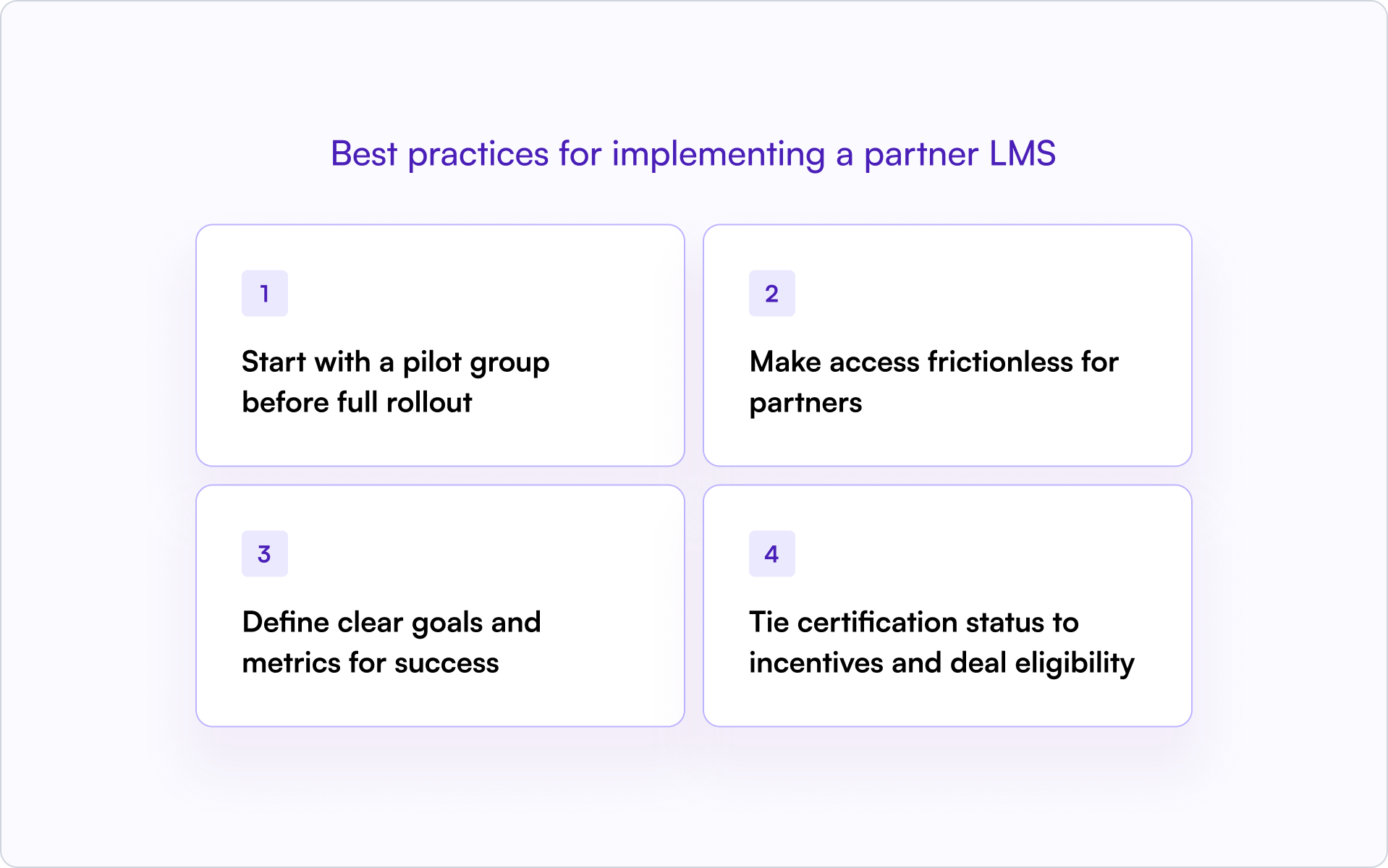
1) Start with a pilot group before full rollout
Test with a small cohort of engaged partners. Gather feedback on content clarity, platform usability, and time-to-complete.
Fix issues before scaling to the full partner base. A pilot also helps you identify the right user groups and prepare for questions during network-wide rollout.
2) Make access frictionless for partners
Every login barrier reduces completion rates. Consider SSO options, magic links, or embedding training access in your partner portal.
Partners who don’t have to remember another password are more likely to complete certification at scale.
3) Define clear goals and metrics for success
Decide what success looks like before launch. Common metrics include completion rates, time to first certified deal, and reduction in support tickets.
Align LMS reporting to outcomes so you can measure whether the investment is paying off.
4) Tie certification status to incentives and deal eligibility
Certification without consequence gets ignored. Make completion meaningful by linking it to SPIFF eligibility, deal registration access, or higher margin tiers.
When certification unlocks revenue, partners prioritize it.
Why certification status should tie to deal registration
Certification data is only valuable if it’s actionable. When certification status connects to deal registration workflows, you can automatically approve or flag deals based on partner readiness.
Connecting certification to deal registration prevents unqualified partners from registering deals they can’t close, reduces channel conflict, and protects deal quality. It also removes the manual work of checking certification status before approving registrations.
Platforms like Introw let you set deal registration eligibility rules that reference certification status, without spreadsheet cross-referencing.
Run a smarter partner certification program with CRM-first tools
The real LMS benefits for channel partner certification show up when training data connects to your CRM and partner workflows. Standalone LMS platforms create data silos. CRM-first approaches keep certification status visible alongside pipeline, deal registration, and partner engagement.
Introw helps teams connect partner enablement to revenue outcomes, with partner portals, deal registration, and CRM integrations that keep everything in one place.
If you want to see how certification status can tie directly to your partner workflows, book a demo and walk through how it works in practice.
Still curious? Here are some quick answers to help clear things up
The biggest benefits are speed, consistency, and control: faster onboarding for new partners, standardized product and sales messaging across the channel, automated certification tracking (including expirations), and clearer visibility into partner readiness. The value compounds when certification status is synced into your CRM so revenue teams can operationalize it.
Implementation timelines vary based on content readiness and integration complexity. Many teams can launch a basic partner LMS in a few weeks if content already exists. Deeper rollouts — like CRM sync, tiering logic, and deal registration gating — usually take longer, but they’re also where the ROI becomes easiest to prove.
Yes. Many modern partner LMS platforms support SSO, magic links, or embedded access through partner portals. Reducing login friction is one of the simplest ways to improve completion rates, especially when partners are managing multiple vendor portals.
Measure outcomes, not activity. Common ROI indicators include time-to-first-deal for newly certified partners, win rate and average deal size by certification status, pipeline velocity for partner-sourced deals, and reduction in support escalations caused by incorrect implementations or mis-positioning. Connecting LMS certification data to your CRM makes these comparisons straightforward.
Best practice is to trigger automated alerts to both the partner and the partner manager, then enforce a policy: for example, restricting deal registration, MDF access, or implementation rights until recertification is completed. This prevents “silent” compliance gaps where an expired credential still looks active in a spreadsheet.




See AI-Native PRM in Action
Book a demo with one of our partner program experts, or explore Introw on your own time.