
Partner Learning Management

8 LMS Partner Certification Strategies That Drive Revenue Growth

Learn eight LMS partner certification strategies that connect training to pipeline, deal registration, CRM visibility, and measurable revenue growth.

5 min. read
13 Mar 2026
⚡ TL;DR

The most effective LMS partner certification strategies do not stop at course completion. They connect certification status directly to pipeline and revenue in your CRM, so training becomes a measurable go-to-market signal rather than isolated learning data. High-performing programmes gate important workflows such as deal registration based on certification, use tiered and role-based learning paths to keep training relevant for referral, reseller, and implementation partners, and treat certification as part of revenue operations rather than enablement alone. To prove ROI, teams should track metrics in the CRM such as revenue per certified partner, certification-to-deal conversion, and time to first certified deal.

Partner certification programs look great on paper. But if completion data stays trapped in your LMS while Sales and RevOps work from a CRM that knows nothing about partner competency, you’re running training theater — not a revenue program.

The difference between certification as a checkbox and certification as a growth lever comes down to one thing: whether the data connects to pipeline. Below are practical LMS partner certification strategies that tie training directly to deal registration, CRM visibility, and measurable revenue outcomes.

Why partner certification programs drive revenue growth

A partner certification program is a structured training and credentialing system, typically delivered through a learning management system, that validates whether partners actually understand your product, positioning, and sales process.

The moment certification data is visible in your CRM, it stops being “learning data” and becomes go-to-market signal: who’s qualified to sell, who should get leads, and which partners are likely to close.

In practice, certified partners tend to outperform non-certified ones because they:

  • Represent your product accurately, keeping messaging consistent across channels.
  • Handle objections independently, reducing escalations to your internal team.
  • Move deals forward faster, because they know the process and the pitfalls.

That shows up in a few common revenue levers:

  • Consistent messaging: Certified partners position your product the way you intend, protecting brand integrity across channels.
  • Faster sales cycles: Partners who understand the product don’t slow deals down asking for help mid-cycle.
  • Reduced channel conflict: Certification status can serve as a tiebreaker when two partners claim the same account.
  • Scalable enablement: An LMS lets you train hundreds of partners without adding headcount or running live sessions for every cohort.

The trap: many teams stop at completion rates. If you can’t connect certification outcomes to pipeline and revenue, it’s hard to justify investment — and impossible to know which certifications actually matter.

8 LMS partner certification strategies that make training measurable

If you’re building a partner motion inside a startup, you don’t have time for programs that “feel” helpful. You need a system that changes partner behavior and shows up in pipeline. These strategies are designed to do exactly that.
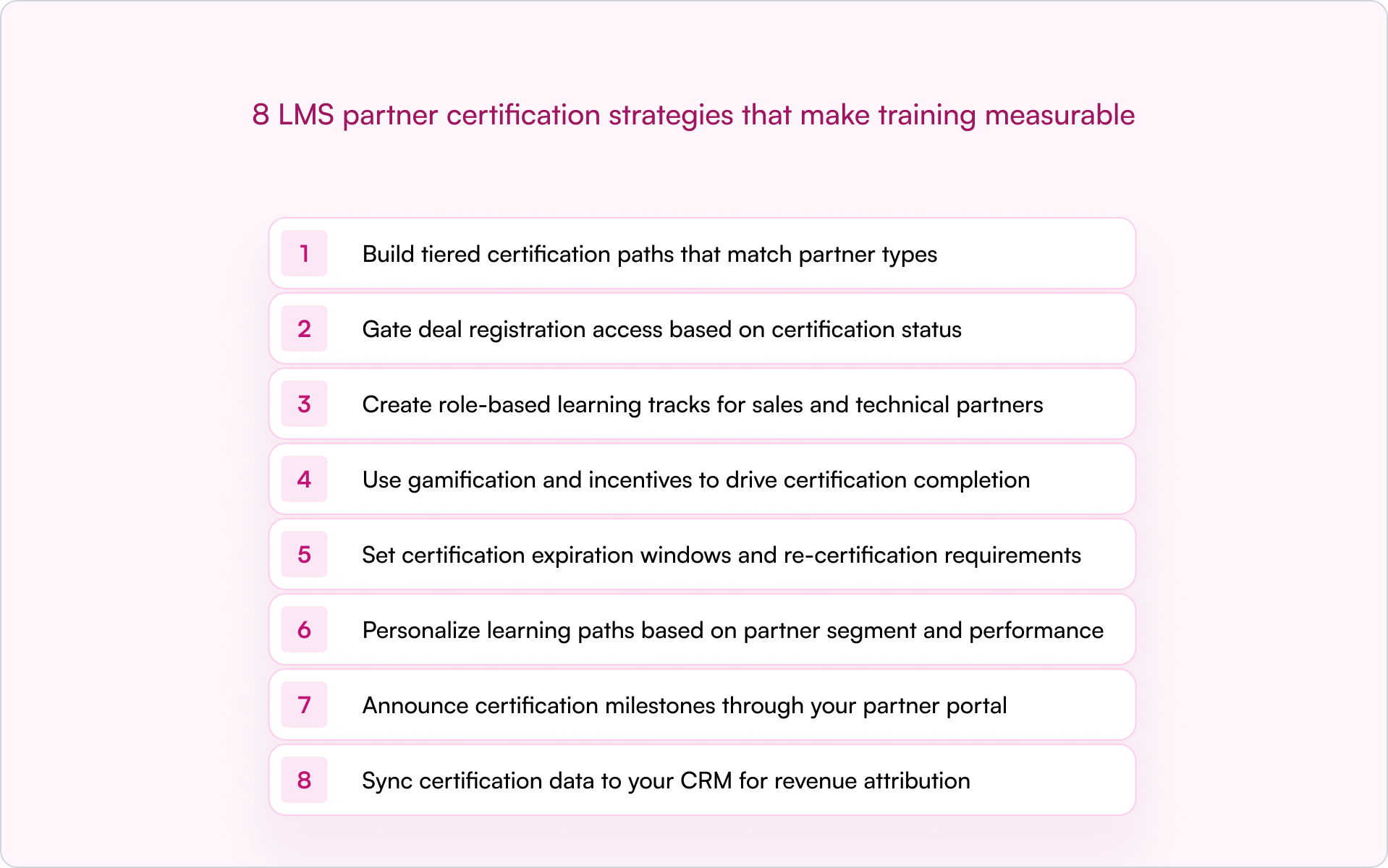
1. Build tiered certification paths that match partner types

Not every partner needs the same training. A referral partner introducing leads needs positioning basics. A reseller closing deals needs pricing, objection handling, and competitive differentiation. An implementation partner deploying your product needs technical depth.

Your certification tiers typically map to your partner program tiers, like Bronze, Silver, Gold or Authorized, Premier, Elite, with escalating requirements at each level.

Partner type Certification focus Example requirements
Referral partners Product positioning, ICP basics Complete intro course, pass quiz
Resellers Sales process, pricing, objection handling Tier 1 + sales simulation
Implementation/SI partners Technical deployment, integrations Tier 2 + hands-on lab, customer scenario

This structure keeps training relevant (which protects completion rates) and gives you a clean framework for gating access to deals, leads, or exclusive benefits based on demonstrated competency.

2. Gate deal registration access based on certification status

This is where certification becomes operational. Partners who haven’t completed the required training can’t register deals in your system, which protects deal quality and ensures only qualified partners are submitting pipeline.

The concept of “sell rights” is common in mature programs for a reason: it prevents untrained partners from creating friction in your sales process or misrepresenting your product to prospects.

A CRM-first PRM like Introw can enforce sell rights automatically by checking certification status before allowing deal registration — keeping the workflow aligned across your partner portal without manual verification.

3. Create role-based learning tracks for sales and technical partners

Within a single partner organization, different roles need different training. A partner’s sales rep needs competitive positioning and demo basics. Their solutions architect needs API documentation and implementation methodology. Their executive sponsor needs the business case for co-selling.

Role-based tracks keep training focused:

  • Sales track: Product positioning, competitive differentiation, demo basics, pricing and packaging
  • Technical track: Implementation methodology, API/integration training, troubleshooting
  • Executive track: Partnership value prop, co-selling motions, business case development

If you want higher completion and better outcomes, this is one of the highest-ROI LMS partner certification strategies you can implement. Relevance is what keeps partners moving.

4. Use gamification and incentives to drive certification completion

Partners are busy. They’re juggling multiple vendors, their own customers, and internal priorities. Without motivation, certification often drops to the bottom of the list — even if the content is genuinely good.

Gamification, which includes digital badges, leaderboards, points, and rewards, creates visible progress and recognition that keeps partners engaged:

  • Digital badges: Shareable credentials partners can display on LinkedIn
  • SPIFFs: Cash or gift card bonuses for completing certifications
  • Tiered benefits: Higher margins or exclusive leads for certified partners
  • Leaderboards: Public recognition in the partner portal

The goal is simple: make certification feel like an investment that pays off, not compliance work.

5. Set certification expiration windows and re-certification requirements

Products evolve. Messaging changes. Compliance requirements shift. A certification earned two years ago may no longer reflect current reality — and your customers will feel that gap quickly.

Expiration windows (often 12 months, shorter for fast-moving categories) prevent competency drift. Automated reminders before expiration give partners time to re-certify without losing access to deal registration or other benefits.

Tip: Announce re-certification deadlines through your partner portal and email or Slack notifications so partners aren’t surprised when access changes.

6. Personalize learning paths based on partner segment and performance

Not all partners start from the same place. A high-performing partner who’s been selling your product for two years doesn’t need the same onboarding content as a new partner getting started.

Personalization — serving different content based on region, vertical, role, or performance — keeps training relevant. High performers can skip basics. Struggling partners get targeted reinforcement. Everyone’s time is respected.

This is also how certification becomes more than “completion.” You can track whether partners improve and which interventions correlate with higher-quality pipeline.

7. Announce certification milestones through your partner portal

Recognition reinforces behavior. When a partner earns certification, celebrate it publicly (when appropriate). It signals that certification matters and creates social proof inside the ecosystem.

Partner portal announcements, email notifications, or Slack messages highlighting achievements can motivate other partners to complete training — without you adding more meetings to your calendar.

A CRM-first partner portal can automate announcements when certification status updates, so you’re not manually tracking who earned what and when.

8. Sync certification data to your CRM for revenue attribution

This is the strategy that makes everything else measurable. Certification status belongs in HubSpot or Salesforce as a partner property — not trapped in a separate LMS where Sales, RevOps, and leadership can’t see it.

When certification data lives in your CRM, you unlock:

  • Attribution: See whether certified partners close more revenue than non-certified partners
  • Deal routing: Auto-assign leads to certified partners only
  • Forecasting: Include certification status in pipeline reports
  • Conflict resolution: Use certification as a tiebreaker when two partners claim the same deal

Introw syncs partner data directly to the CRM, so certification status is always visible to Sales, Partnerships, and RevOps — making certification ROI measurable instead of assumed.

LMS features that support partner certification programs

Not every LMS is built for external partner enablement. Internal employee training platforms often lack the controls you need to manage certifications across dozens (or hundreds) of partner organizations.
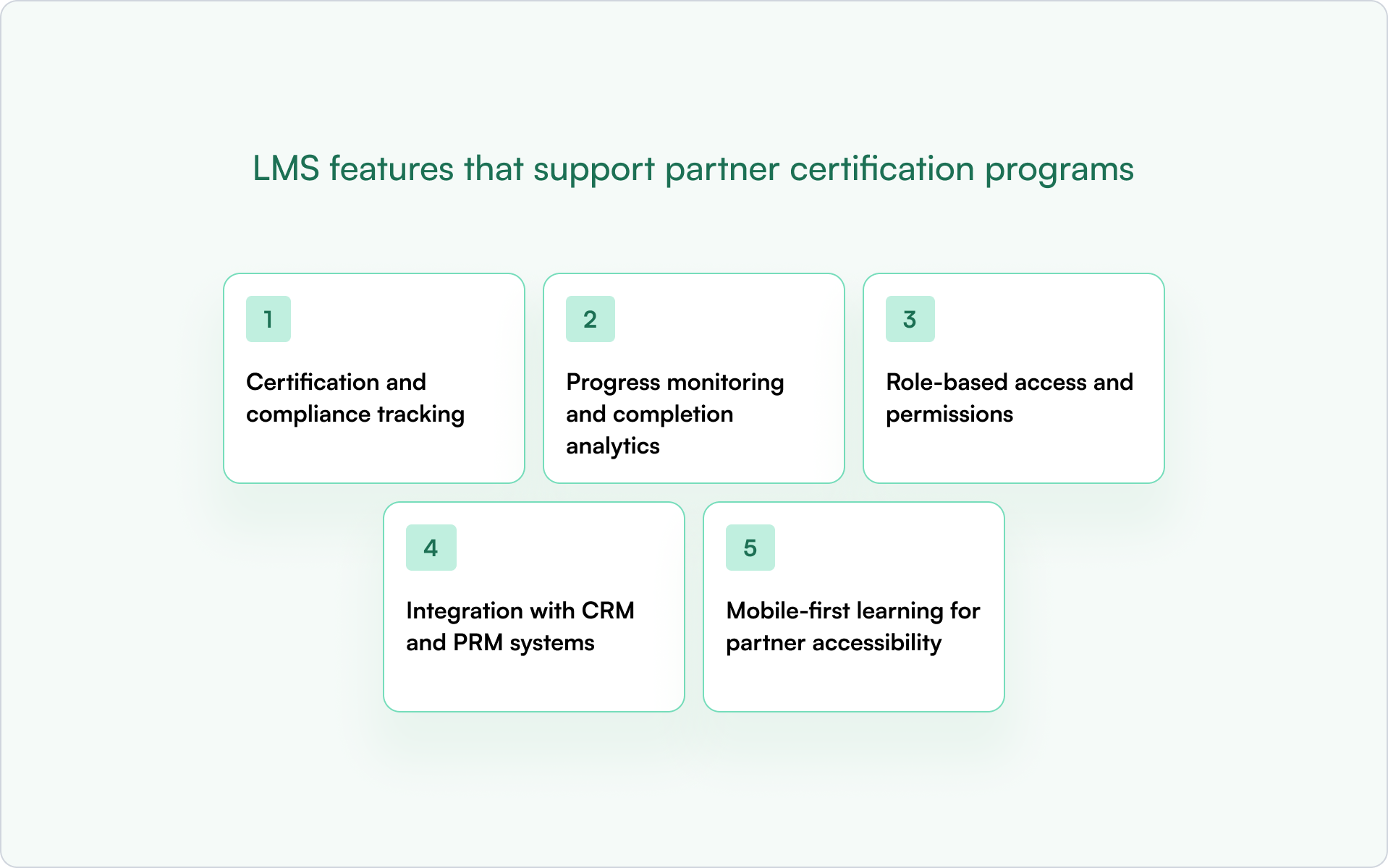
Certification and compliance tracking

Your LMS should track who completed what, when, and whether they passed. That audit trail supports compliance requirements and enables expiration and re-certification workflows.

Progress monitoring and completion analytics

Partner managers need visibility into where partners are stuck, who’s falling behind, and which courses have low completion rates — especially at scale.

Role-based access and permissions

Different partner organizations should only see content relevant to them. Admins need full access; partner users should see only their assigned tracks.

Integration with CRM and PRM systems

If certification data doesn’t sync to HubSpot or Salesforce, it’s invisible to the rest of the business. A CRM-first PRM like Introw connects partner data — including certification status — directly to your CRM.

Mobile-first learning for partner accessibility

Partners are often in the field or between meetings. Mobile-friendly delivery makes it easier to complete certification without being tied to a desk.

How to measure ROI for LMS partner certification strategies

Certification programs require investment in content creation, LMS licensing, and partner manager time. To keep momentum — and budget — you need proof.
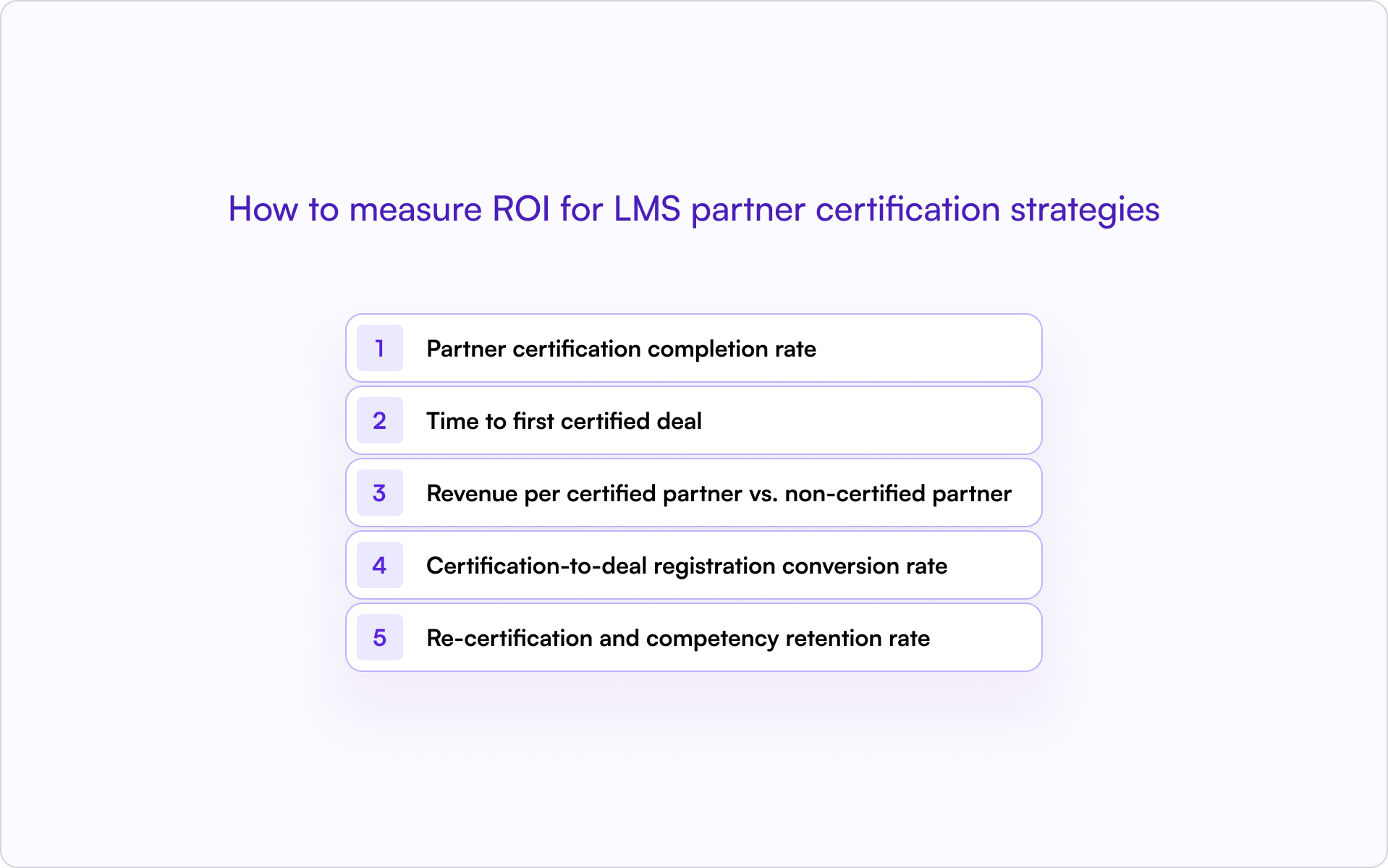
Partner certification completion rate

What percentage of onboarded partners complete certification? Low rates usually mean friction (too long, too generic, too hard) or unclear incentives.

Time to first certified deal

How long after certification does a partner register their first deal? Shorter is better — it shows certification accelerates activation, not just learning.

Revenue per certified partner vs. non-certified partner

Compare average revenue contribution. This is the core ROI proof point most founders and operators care about.

Certification-to-deal registration conversion rate

What percentage of certified partners actually register deals? Certification without activation is wasted effort — and a signal your program may be rewarding “learning” more than “selling.”

Re-certification and competency retention rate

Are partners staying current? High lapse rates suggest the re-certification experience is too burdensome or the value is not clear enough.

How to connect LMS certification data to your CRM

The mechanics of syncing LMS data to HubSpot or Salesforce determine whether certification status becomes actionable or stays siloed.

  1. Custom properties: Create a “Certification Status” field on the Partner or Contact object with values like Certified, Expired, In Progress, Not Started.
  2. Certification date fields: Track when certification was earned and when it expires.
  3. Automation triggers: Use certification status changes to trigger workflows — for example, notifying partner managers when a partner becomes certified or alerting when certification is expiring.
  4. Reporting: Build dashboards that segment partner pipeline by certification status.

Introw’s Salesforce and HubSpot integrations enable this without custom development work. Certification status flows into the CRM automatically.

Scale partner certification with a CRM-first approach

Partner certification programs only drive revenue when the data is visible and actionable in your CRM. Otherwise, you’re running a training program with no connection to pipeline, attribution, or forecasting.

A CRM-first approach delivers:

  • Visibility: Sales, partnerships, and RevOps see certification status on every partner record.
  • Attribution: You can prove which certifications correlate with closed revenue.
  • Automation: Deal registration, lead routing, and conflict resolution can factor in certification status.

Teams that get this right spend less time chasing training completion and more time closing partner-sourced revenue.

If you’re ready to treat certification like a revenue system (not a content library), see how Introw connects partner certification data to your CRM — book a demo.

FAQs

Still curious? Here are some quick answers to help clear things up.

Contact us

What are LMS partner certification strategies, in plain terms?

LMS partner certification strategies are the tactics you use to design, deliver, and enforce partner training in a way that validates competency (via tests, practical exercises, and credentials) and influences go-to-market outcomes. The best strategies go beyond “course completion” by tying certification status to real workflows like deal registration, lead routing, and partner tier benefits.

Should I require certification before partners can register deals?

Often, yes. Gating deal registration behind certification improves deal quality and ensures partners understand your positioning, qualification standards, and sales process before they introduce risk into your pipeline. If you’re worried about slowing down new partners, a common compromise is a short grace period during onboarding — then certification becomes required for net-new registrations.

What is the ideal certification expiration window for partner programs?

Expiration windows typically align with product release cycles or annual refresh requirements. Most programs use a 12-month window, while fast-moving products (or compliance-heavy categories) may require shorter cycles. The key is consistency: partners should know exactly when credentials expire, what changes, and what they need to do to regain access to sell or service rights.

How do I handle partners who let certifications lapse mid-deal?

Most programs honor existing deal registrations to avoid creating customer friction, but require re-certification before new registrations or before the partner can access higher-tier benefits. Document this clearly in your rules of engagement so expectations are predictable and enforceable.

Can certification status serve as a tiebreaker for channel conflict?

Yes. Many teams use certification level as one factor in resolving channel conflict. When two partners claim the same account, certification can be a neutral, behavior-based tiebreaker that encourages partners to invest in enablement.

Launch your partner portal
in minutes!

Thank you! Your submission has been received!
Oops! Something went wrong while submitting the form.

Related blog articles

Partner Learning Management

15 LearnUpon LMS Alternatives for Partner Teams in 2026 (Compared)

Adèle Coolens
Marketing & Partnerships
5 min. read
12 Mar 2026
⚡ TL;DR

Looking for LearnUpon LMS alternatives built for partner teams? LearnUpon works well for employee training and internal programs, but many SaaS companies struggle to connect partner training and external training to revenue. Platforms like Introw combine a CRM-native Partner LMS with certification programs and partner engagement tools so teams can track training activity and measure partner outcomes.

What is LearnUpon (and why teams look for alternatives)?

LearnUpon is a learning management system used for employee training, customer education, and external training. Many mid-market companies choose it because it's user-friendly and supports online courses, certification programs, and multiple training audiences.

A key strength is its multi-portal architecture, which lets teams run separate training environments for employees, partners, or customers.

For many organizations, that works well.

But partner teams often run into limitations when they try to connect training with pipeline activity and revenue visibility.

If the goal is simply to deliver online courses or compliance training, LearnUpon can be a strong fit.

However, if the goal is to turn partner training into measurable business outcomes, many teams begin exploring LearnUpon alternatives and modern partner training software built for partner ecosystems.

Here are the most common reasons partner teams start looking for a LearnUpon alternative.

1. Training data is separate from CRM

Training is only one part of partner enablement. Teams also need visibility into which partners complete certifications, submit deals, and influence pipeline.

Traditional learning management systems store course progress inside the LMS, while partner accounts and deal activity live in the CRM. When those systems are separate, reporting becomes difficult, and teams often rely on spreadsheets to understand whether training programs influence revenue.

2. Certification is not tied to revenue outcomes

Certification programs help partners build technical expertise and improve sales conversations. But most LMS platforms treat certifications as learning milestones rather than business signals.

You can see who completed training. It is harder to see whether certified partners generate more pipeline or close deals faster.

3. Engagement stays inside the portal

Most LMS platforms rely on a portal experience where partners log in, browse a course library, and complete training.

Employee training often works this way, but partner engagement typically happens in email, Slack, CRM workflows, and conversations with your team. When learning activity stays inside the portal, learner engagement can drop.

4. AI and automation are limited for scaling partner programs

As partner ecosystems grow, training programs become harder to manage. Teams must create courses for multiple partner tiers, maintain a growing content library, and manage certification programs across regions.

Many partner teams now want AI tools that help create courses faster and automation that supports engagement across large partner ecosystems.

None of this means LearnUpon is the wrong platform. It simply means the tool was designed primarily for employee and customer education.

If your goal is to connect partner training with certification programs, partner engagement, and revenue outcomes, it may be worth exploring LearnUpon LMS alternatives built specifically for partner teams.

The 15 Best LearnUpon LMS Alternatives for Partner Teams

If you’re evaluating LearnUpon LMS alternatives, you’re likely looking for a learning platform that supports partner training, certification programs, and external training that connects to real business outcomes.

We've curated 15 LearnUpon alternatives partner teams evaluate when they need stronger visibility, better learner engagement, and training programs that scale with their partner ecosystem.

1. Introw: Best CRM-native partner LMS for revenue teams

Best for

SaaS partner teams that want partner training, certifications, and partner collaboration connected directly to their CRM and pipeline.

Why it’s a LearnUpon LMS alternative

Most learning management systems treat training as a separate environment from sales activity. Introw connects partner training programs directly to CRM data, so partner managers can see how certifications, course completion, and partner engagement influence pipeline.

Instead of managing external training in isolation, teams can track training activity alongside partner deals and account data.

You can see how this works in Introw’s AI-powered LMS demo and learn how teams can create courses, launch certification programs, and manage training programs quickly.

Key features

  • AI course builder for creating online courses faster
  • One-click certification programs for partner enablement
  • CRM-visible training tied to partner accounts and deals
  • Bulk enrollment for onboarding large partner groups
  • Off-portal engagement through email and Slack
  • Deep integrations with Salesforce and HubSpot
  • Revenue-linked analytics connecting training activity to pipeline
Pros Limitations
CRM visibility connects partner training with revenue outcomes Not designed primarily for internal employee training
Built specifically for external training and partner ecosystems Companies focused only on employee development may prefer traditional LMS tools
AI-powered course creation speeds up training program setup Requires CRM-driven partner workflows to unlock full value
Off-portal engagement improves learner participation

Ideal company size

Mid-market and enterprise SaaS companies with active partner programs, especially teams managing multiple partner tiers and CRM-driven partner revenue.

2. TalentLMS: Best for simple SMB training programs

Best for

Small and mid-sized companies that want a user friendly learning management system for employee training and simple external training.

Why it’s a LearnUpon LMS alternative

Teams compare TalentLMS with LearnUpon when they want a simpler LMS for managing online courses and employee training without the heavier multi-portal setup.

For more context, you can evaluate our list of Talent LMS alternatives.

Key features

  • Tools to create courses and manage online courses
  • Built-in course library for training content
  • Support for instructor-led training and self-paced learning
  • Basic reporting capabilities for tracking completion rates
Pros Limitations
Easy to set up and use Limited advanced features for complex partner ecosystems
Good fit for smaller training programs Reporting and analytics are basic
Works well for employee training and simple external training Less suited for revenue-linked partner training

Ideal company size

Small businesses and mid-sized companies that need a straightforward LMS for employee training or basic external training.

3. 360Learning: Best for collaborative internal learning

Best for

Companies that want collaborative learning and strong knowledge sharing across internal teams.

Why it’s a LearnUpon LMS alternative

360Learning appeals to companies that want collaborative learning and peer-driven course creation rather than the more structured training model used in traditional LMS platforms like LearnUpon.

Take a look at some 360Learning alternatives to evaluate what might work for your team.

Key features

  • Collaborative course creation tools
  • Social learning features that help engage learners
  • Support for blended learning and virtual classroom training
  • Built-in authoring tool for managing training content
Pros Limitations
Strong collaborative learning model Primarily built for employee training
Encourages internal knowledge sharing Less focused on partner training ecosystems
Helps teams update training content quickly Limited revenue visibility for partner programs

Ideal company size

Mid-sized companies and large enterprises focused on employee training and internal knowledge sharing.

4. Absorb LMS: Best for enterprise compliance and scale

Best for

Large organizations running compliance training and large training programs across multiple audiences.

Why it’s a LearnUpon LMS alternative

Absorb LMS is often evaluated by large enterprises that need stronger compliance training, advanced reporting, and multi portal architecture for managing complex training environments.

Key features

  • Multi-portal architecture for managing multiple branded portals
  • Advanced reporting and analytics dashboards
  • Compliance and skills training tools
  • Large content library for structured training programs
Pros Limitations
Strong enterprise features for large training environments Can require technical expertise to manage
Good compliance training capabilities Higher setup complexity
Advanced reporting capabilities Often more complex than mid-market teams need

Ideal company size

Large enterprises running global employee training and compliance programs.

5. Docebo: Best for AI-driven enterprise learning

Best for

Large organizations that want AI-powered learning and adaptive learning paths.

Why it’s a LearnUpon LMS alternative

Docebo attracts organizations that want AI-driven automation, adaptive learning paths, and deeper analytics across large training programs.

Key features

  • AI tools that help create courses and recommend training content
  • Adaptive learning paths that personalize the learning process
  • Assessment tools for evaluating learner progress
  • Reporting and analytics dashboards for monitoring training programs
Pros Limitations
AI-powered learning capabilities Implementation can be complex
Scales well for large enterprises Requires technical expertise to configure
Supports employee training and customer education Often more than smaller teams need

Ideal company size

Mid-market companies and large enterprises managing complex training programs.

6. Litmos: Best for multi-audience training

Best for

Organizations delivering employee training, partner training, and customer training from one platform.

Why it’s a LearnUpon LMS alternative

Litmos is commonly evaluated by teams delivering multi audience training, including employee training, partner training, and customer training from one platform.

Key features

  • Tools to enroll learners across multiple audiences
  • Virtual classroom and classroom-style training support
  • Certification programs and compliance training workflows
  • Prebuilt content library for common training topics
Pros Limitations
Designed for multi-audience training Interface feels dated compared with newer platforms
Strong compliance training support Limited partner revenue visibility
Built-in course library speeds onboarding Customization options are limited

Ideal company size

Mid-sized organizations and enterprises delivering training to employees, partners, and customers.

7. LearnWorlds: Best for academy-style external training

Best for

Companies building online academies for customer education or partner onboarding.

Why it’s a LearnUpon LMS alternative

LearnWorlds stands out for companies building external training academies or selling online courses, which differs from the internal training focus many LMS platforms prioritize.

Key features

  • Tools for building academy-style online courses
  • Ecommerce capabilities for selling training programs
  • Interactive course creation tools
  • Analytics dashboards for tracking completion rates
Pros Limitations
Good platform for branded training academies Not designed for partner revenue tracking
Flexible tools for managing online courses Enterprise reporting capabilities are limited
Interactive learning features Integration capabilities are narrower

Ideal company size

Small businesses and mid-sized companies delivering customer education or partner onboarding programs.

8. Thought Industries: Best for customer education platforms

Best for

Companies delivering large customer education and external training programs.

Why it’s a LearnUpon LMS alternative

Thought Industries is designed for large customer education and external training programs, making it attractive to companies building scalable learning environments for external learners.

Key features

  • Scalable customer education environments for external learners
  • Tools for managing large training programs
  • Ecommerce capabilities for monetizing course content
  • Reporting and analytics dashboards for training activity
Pros Limitations
Strong platform for customer education Implementation can require technical expertise
Supports large external training programs Higher cost compared with many LMS tools
Flexible course management capabilities Admin complexity can be higher

Ideal company size

Mid-market companies and large enterprises running global customer education or partner enablement programs.

9. WorkRamp: Best for revenue enablement training

Best for

Revenue teams that want structured training for the sales team, customer success teams, and partner enablement.

Why it’s a LearnUpon LMS alternative

WorkRamp attracts revenue teams that want training programs aligned with sales enablement, onboarding, and partner readiness rather than traditional LMS course management.

Key features

  • Sales enablement training programs for the sales team
  • Certification programs for partner and customer training
  • Course builder for onboarding and online training
  • Reporting and analytics dashboards for tracking training activity
Pros Limitations
Designed for revenue and enablement teams Less focused on compliance training
Combines employee training and customer education Limited customization compared with enterprise LMS tools
Good onboarding workflows for the sales team Not purpose-built for partner ecosystems

Ideal company size

Mid-sized SaaS companies and enterprises running sales enablement and partner training programs.

10. iSpring Learn: Best for affordable mid-market LMS/

Best for

Organizations that want a user-friendly LMS with simple course creation and straightforward pricing.

Why it’s a LearnUpon LMS alternative

iSpring Learn appeals to mid-market companies that want a user friendly LMS with straightforward course creation and a lower learning curve.

Key features

  • Authoring tool for creating online courses and training content
  • Reporting capabilities for tracking learner progress
  • Mobile learning with offline access
  • Tools for employee training and external learners
Pros Limitations
Easy to use and quick to deploy Limited advanced analytics
Good option for mid-market employee development Fewer enterprise features
Straightforward course creation tools Less suited for large partner ecosystems

Ideal company size

Small businesses and mid-sized companies running employee training and simple external training programs.

11. Cornerstone OnDemand: Best for global enterprise learning

Best for

Large enterprises running global employee development and compliance training programs.

Why it’s a LearnUpon LMS alternative

Cornerstone OnDemand is often chosen by large enterprises that need extensive customization, global compliance training, and advanced analytics for workforce development.

Key features

  • Enterprise features for global learning management systems
  • Advanced analytics for identifying skills gaps
  • Compliance training and employee development tools
  • Extensive customization for large training environments
Pros Limitations
Built for large enterprises Complex implementation
Strong analytics for workforce training Requires significant admin resources
Broad support for employee development programs Often too heavy for partner-focused training

Ideal company size

Large enterprises managing global employee training and compliance initiatives.

12. Moodle: Best for open-source flexibility

Best for

Organizations that want full control over their learning platform and have technical teams managing the system.

Why it’s a LearnUpon LMS alternative

Moodle appeals to organizations that want full control over their learning platform through open-source customization rather than a vendor-managed LMS.

Key features

  • Open-source learning management system architecture
  • Large ecosystem of plugins and integrations
  • Support for blended learning and online training
  • Flexible tools for managing course content
Pros Limitations
Highly customizable Requires technical expertise
No vendor lock-in Interface can feel outdated
Large global user community Hosting and maintenance required

Ideal company size

Universities, training organizations, and companies with internal development resources.

13. Sana Learn: Best for adaptive AI learning

Best for

Organizations that want AI-driven training experiences and adaptive learning paths.

Why it’s a LearnUpon LMS alternative

Sana Learn focuses on AI-driven training programs that personalize learning paths and improve knowledge retention based on learner progress.

Key features

  • Adaptive learning paths that personalize training programs
  • AI tools for recommending training content
  • Analytics dashboards that help identify skills gaps
  • Tools designed to improve knowledge retention
Pros Limitations
Strong AI-driven learning experience Smaller ecosystem than traditional LMS platforms
Personalized learning paths for learners Still growing compared with larger vendors
Focus on improving knowledge retention Implementation may require AI-focused strategy

Ideal company size

Mid-market companies and enterprises exploring AI-driven employee development programs.

14. Seismic Learning (Lessonly): Best for sales enablement training

Best for

Organizations focused on onboarding and training the sales team.

Why it’s a LearnUpon LMS alternative

Seismic Learning is designed for revenue teams that need structured onboarding and training programs for the sales team.

Key features

  • Sales enablement training for the sales team
  • Coaching workflows for revenue teams
  • Certification programs for onboarding
  • Reporting dashboards for tracking learner progress
Pros Limitations
Strong focus on sales enablement Limited broader LMS functionality
Good onboarding workflows Not designed for large multi-audience training
Helps standardize revenue team training Limited compliance training features

Ideal company size

Mid-sized companies and enterprises running sales enablement and onboarding programs.

15. CYPHER Learning: Best for modern AI-powered LMS platforms

Best for

Organizations that want a modern learning platform with AI-powered automation.

Why it’s a LearnUpon LMS alternative

CYPHER Learning attracts organizations looking for modern LMS platforms that combine AI-powered course creation with automated learner management.

Key features

  • AI tools for creating and managing course content
  • Automation for managing online courses and learners
  • Personalized learning paths for training programs
  • Reporting and analytics dashboards
Pros Limitations
Modern interface and AI automation Smaller market presence
Strong course creation tools Enterprise integrations are still evolving
Supports multiple training audiences Advanced features are still expanding

Ideal company size

Mid-sized companies and enterprises exploring modern LMS platforms with AI-driven learning tools.

Before choosing between LearnUpon and other LMS platforms, it helps to look at how these tools compare across the capabilities partner teams care about most. The table below highlights where different platforms focus, and why some teams choose solutions built specifically for partner enablement.

Comparison table: LearnUpon vs. alternatives

Platform Built for Partner Training CRM Integration AI Course Builder Certification Off-Portal Engagement Revenue Visibility
Introw Yes Native Salesforce & HubSpot Yes Yes Yes Yes
LearnUpon Partial Limited No Yes No No
TalentLMS Partial Limited No Yes No No
360Learning No Limited No Yes No No
Absorb LMS Partial Limited No Yes No No
Docebo Partial Limited Yes Yes No Limited
Litmos Partial Limited No Yes No No
LearnWorlds Partial Limited Limited Yes No No
Thought Industries Partial Limited Limited Yes No Limited
WorkRamp Partial Limited No Yes No Limited
iSpring Learn Partial Limited No Yes No No
Cornerstone No Limited Limited Yes No No
Moodle No Custom No Custom No No
Sana Labs Partial Limited Yes Yes No Limited
CYPHER Learning Partial Limited Yes Yes No Limited

For partner teams, the biggest difference usually comes down to visibility and engagement. In the next section, we’ll look at the specific criteria partner managers use when evaluating LearnUpon LMS alternatives.

What to compare when evaluating LearnUpon LMS alternatives

When evaluating LearnUpon LMS alternatives, partner teams usually focus on a few capabilities that influence partner adoption and revenue impact.

CRM & revenue visibility

Partner managers need to see training activity alongside partner deals and pipeline. If certification data lives outside the CRM, it’s difficult to understand which training programs influence revenue.

That’s why many teams prioritize platforms that help them measure partner training ROI.

AI course creation capabilities

As partner ecosystems grow, training programs expand quickly. AI tools help teams create courses faster, update training content, and reduce manual work.

This is especially helpful when managing large partner onboarding programs or frequent product updates.

Certification automation

Certification programs help standardize partner readiness, but manual management quickly becomes difficult.

Automated certification paths and recertification rules make it easier to scale programs and demonstrate the channel partner certification benefits across partner ecosystems.

Partner engagement & nudging

External training only works if partners actually complete courses. Platforms that support reminders, notifications, and off-platform nudges can improve completion rates and learner engagement.

These features help partner training programs maintain momentum.

Reporting that leadership cares about

Leadership teams want to see outcomes, not just course completions. They want visibility into how training influences partner pipeline and productivity.

That’s why many teams explore platforms designed specifically as partner LMS software when evaluating alternatives.

The right LMS depends on what you expect training to achieve. If partner training needs to influence pipeline, certifications, and partner productivity, those capabilities quickly become essential evaluation criteria.

But it’s also worth noting that LearnUpon still fits many organizations well. Here's why.

When LearnUpon is still the right choice

Despite the many LearnUpon LMS alternatives available, LearnUpon still works well for many organizations.

Primarily internal HR training

LearnUpon is a strong fit for companies focused on employee training, onboarding, and internal compliance training. HR and L&D teams can use it to manage structured training programs, deliver online courses, and support employee development across departments.

No CRM reporting requirement

If your training programs do not need to connect to sales data or partner pipeline, LearnUpon’s reporting capabilities are usually sufficient. Many companies only need to track completion rates, assessment scores, and general learner progress.

Limited partner enablement complexity

Some companies only run basic partner onboarding courses rather than full partner enablement programs. In those cases, a traditional learning management system like LearnUpon may be enough to deliver simple partner training without additional automation or integrations.

However, as your partner programs scale, your training needs often change.

When it’s time to switch to a LearnUpon LMS alternative

LearnUpon works well for many training environments. But partner teams sometimes need capabilities that traditional LMS platforms don’t provide.

Use this quick checklist to evaluate whether it may be time to consider a LearnUpon LMS alternative.

You need partner revenue visibility

☐ Training data needs to connect to partner pipeline or deals

☐ Certifications should be visible alongside CRM partner records

Certification must influence pipeline

☐ Certifications determine partner tiers or deal eligibility

☐ Your team needs automated certification paths and renewals

RevOps needs better reporting

☐ Leadership asks how partner training influences revenue

☐ Reporting must combine CRM and training data

You want AI-powered content scaling

☐ Your team regularly creates or updates course content

☐ AI tools could speed up course creation

You need engagement automation

☐ Partners enroll but often don’t finish courses

☐ Automated reminders or nudges would improve completion rates

If several of these apply to your program, it may be time to consider a partner LMS built specifically for partner ecosystems.

Why Introw is the best choice

For many SaaS partner teams, the challenge is not delivering training. It is connecting training to real partner outcomes.

Traditional learning platforms focus on managing courses, tracking completion, and delivering employee training. But partner teams often need more visibility and automation across their ecosystem.

With Introw, partner training becomes part of your partner operations instead of a separate LMS environment. Certifications, training activity, and partner engagement all connect directly to your partner program workflows.

What makes Introw different

  • CRM-native visibility for partner certifications and training activity
  • AI tools that help teams create and scale training content quickly
  • Certification automation that supports partner tiers and onboarding
  • Off-platform engagement to keep partners progressing through training
  • Revenue reporting that shows how training supports partner performance

If you would like to explore how partner enablement works in practice, you can review Introw’s partner training and certification resources.

For teams that want partner training programs tied to pipeline, productivity, and partner success, Introw is built specifically for that purpose.

Ready to see how Introw works?

Request a demo and explore how Introw helps partner teams turn training into measurable partner revenue.

Partner Learning Management

Measuring Channel Partner Training ROI: Framework, Metrics

Stijn Provoost
Marketing
5 min. read
26 Feb 2026
⚡ TL;DR

Measuring channel partner training ROI means connecting your partner training programs to real pipeline and revenue, not just training completion. The right framework separates leading indicators like partner engagement from lagging indicators like revenue growth and customer retention rates. When your learning management system connects directly to your CRM, measuring partner training ROI becomes clear, defensible, and tied to business outcomes.

Why measuring channel partner training ROI is so difficult

On paper, measuring channel partner training ROI sounds simple. Train partners. Track results. Show revenue.

In reality, it’s messy.

1. Disconnected systems

Your learning management system tracks training completion. Your CRM tracks pipeline. Your spreadsheets track everything else.

When your LMS and CRM don’t talk to each other, measuring partner training ROI becomes guesswork. You can see who finished training courses, but not whether those training efforts improved partner sales or revenue growth.

2. Long sales cycles

Channel partnerships often involve complex deals. A partner might complete channel partner training today, but the deal influenced by that training might close six months later.

That delay makes calculating ROI harder, especially if you’re not tying training initiatives directly to CRM data.

3. Indirect revenue attribution

Was that $250K deal closed because of partner education? Better marketing materials? A stronger channel partner marketing strategy?

Without clear key performance indicators and financial data inside your CRM, it’s hard to isolate training’s impact from other enablement efforts.

4. Channel conflict and deal overlap

When multiple channel partner relationships touch the same account, attribution gets blurry. Issues like channel conflict can make it unclear who influenced the deal and which training investments actually drove performance.

5. Partner-sourced vs. partner-influenced confusion

Many teams track partner-sourced revenue but ignore partner-influenced pipeline. A partner may not register the deal, but their partner training and customer education still shaped the outcome.

Most companies end up measuring training completion and attendance at training sessions. They don’t measure ROI accurately because they never connect training → pipeline → revenue.

To fix this, you need a clear framework that separates leading indicators from lagging indicators and ties both back to real business goals.

The 3-layer framework for measuring channel partner training ROI

Measuring channel partner training ROI isn’t about finding one magic metric.

It’s about understanding progression.

Training impacts revenue in layers. If you only look at the final number, you miss the signals that explain why that number moved.

Here’s the model:

  • Layer 1: Training engagement (Leading indicators)
    Are partners enrolling, completing, and engaging with training materials?
  • Layer 2: Partner performance shift
    Do trained channel partner cohorts behave differently in the pipeline?
  • Layer 3: Revenue and financial impact (Lagging indicators)
    Is partner training influencing pipeline, closed-won revenue, and gross margin?

ROI isn’t a single data point. It’s a connected chain from training efforts to measurable business outcomes.

Let’s break it down layer by layer.

Layer 1 - Engagement metrics (Leading indicators)

Leading indicators tell you whether your partner training programs could drive revenue. They don’t prove the financial impact yet. They predict it.

At this stage, you’re looking at training effectiveness and early partner engagement.

Key metrics include:

  • Course enrollment rate
  • Training completion rate
  • Certification rate
  • Time to certification
  • Module-level drop-off
  • Knowledge assessment scores
  • Usage of training materials and sales playbooks
  • Training-to-first-opportunity time

If partners aren’t enrolling, finishing, or passing training courses, revenue growth won’t magically follow. These training metrics show whether your training initiatives are strong enough to influence future performance.

This is where your tech stack matters. A CRM-connected partner LMS helps you track training completion alongside real pipeline activity.

And if you’re evaluating partner certification program software, you should ask one question: Does it connect certification data to actual partner performance?

Leading indicators don’t prove ROI. They show whether ROI is even possible.

Layer 2 - Performance metrics (Behavior change)

Layer 2 is where measuring partner training ROI starts becoming visible.

Now you’re no longer tracking learning. You’re tracking behavior. The most important insight here is cohort comparison.

Instead of asking, “Did training work?” ask:

“How do trained partners perform compared to untrained partners?”

Here’s a simple cohort model:

Metric Certified partners Non-certified partners
Deals registered Higher / Lower Higher / Lower
Win rate Higher / Lower Higher / Lower
Sales cycle length Shorter / Longer Shorter / Longer
Average deal size Larger / Smaller Larger / Smaller
Time-to-first-deal Faster / Slower Faster / Slower

The goal is to compare:

  • Pre-training vs post-training
  • Certified vs non-certified
  • Control group vs trained group (if possible)

This is where key performance indicators become powerful. You can measure partner performance shifts in stage progression rate, partner activation rate, upsell rate, and sales performance.

If trained channel partner cohorts consistently move deals faster, register more opportunities, and close at higher rates, your partner training ROI is starting to show real business outcomes.

ROI becomes visible when trained partners behave differently from untrained ones.

Layer 3 - Revenue impact (Lagging indicators)

Lagging indicators are what executives care about.

This is where training investments must connect directly to financial value.

Now you’re measuring:

  • Partner-sourced pipeline
  • Partner-influenced pipeline
  • Closed-won revenue
  • Revenue per active channel partner
  • Gross margin impact
  • Retention and expansion uplift

This is also where confusion often creeps in. Partner-sourced vs partner-influenced revenue can overlap. Long sales cycles blur attribution. Channel partnerships may touch the same account.

Without clear visibility, measuring ROI turns into a debate.

That’s why strong partner analytics are essential. When your CRM connects training data, pipeline data, and revenue data in one system, measuring ROI becomes objective instead of political.

You can calculate training ROI using a simple ROI formula:

(Revenue impact – total training costs) ÷ total training costs

But the formula only works if your financial data and training data live in the same environment. Otherwise, calculating ROI becomes manual and unreliable.

At this layer, you’re answering the question your CRO actually asks:

“How much revenue did this training budget generate?”

And once you can answer that clearly, measuring channel partner training ROI stops being theoretical and becomes a strategic advantage.

In the next section, we’ll break down exactly how to calculate training ROI step by step by using this three-layer model as your foundation.

The core formula for partner training ROI

Let’s keep this simple.

When leadership asks about partner training ROI, they’re asking one thing:

“Did this training generate more revenue than it cost?”

Here’s the classic ROI formula:

Component Formula
ROI % ((Financial Gain – Training Cost) ÷ Training Cost) × 100

But for channel partner training, “financial gain” isn’t vague. It usually comes from three areas:

  • Revenue uplift from trained partners
  • Margin improvement
  • Sales cycle reduction value

If you can measure those clearly, measuring ROI becomes straightforward.

Step 1 - Calculate training costs

Before you calculate training ROI, you need a full view of your total training costs.

And yes, this is where most teams underestimate.

Direct costs

  • Learning management system subscription
  • Content development and training materials
  • Certification program administration
  • Incentives and gamification
  • MDF tied to enablement initiatives

If you’re evaluating the best partner LMS software, cost alone shouldn’t drive the decision. The real question is whether it helps you measure ROI accurately.

Understanding the LMS benefits for channel partner certification also clarifies whether your training investments are positioned to drive business outcomes.

Indirect costs

  • Partner time spent in training sessions
  • Internal team time
  • Admin overhead
  • Ongoing certification tracking

When calculating ROI, your denominator is total training costs — not just your LMS invoice.

If you don’t calculate this clearly, every ROI conversation becomes a debate.

Step 2 - Quantify revenue uplift

Now let’s get to the interesting part. This is where measuring partner training ROI starts feeling real.

Instead of asking “Did training work?”, compare trained vs untrained partner cohorts.

Imagine two groups of channel partners:

Metric Before certification After certification
Avg deal size $18,000 $24,000
Win rate 21% 27%

Now apply this to 100 opportunities.

Scenario Revenue
Before training $378,000
After training $648,000

Revenue uplift: $270,000

That’s not theoretical. That’s measurable financial value.

This is where partner education connects directly to partner sales performance. Strong training materials and aligned messaging influence how partners position your solution. The role of content in channel partner marketing becomes measurable when certified partners close larger deals at higher rates.

This is how you calculate training ROI in a way leadership understands.

Step 3 - Add cycle time impact

Revenue uplift is only part of the story.

If training reduces your average sales cycle by 15 days, revenue is recognized faster. That improves cash flow and allows reps to close more deals per quarter.

Here’s the pipeline velocity formula:

Variable Example
Deals 100
Win rate 27%
Avg deal size $24,000
Sales cycle 75 days

Pipeline Velocity =

(Deals × Win Rate × Avg Deal Size) ÷ Sales Cycle Length

When the sales cycle shortens, velocity increases. That means more revenue per channel partner in the same timeframe.

This is where strong channel partner management systems matter. When training data, deal data, and revenue data live in the same CRM environment, you can measure ROI accurately instead of stitching reports together manually.

Once you combine revenue uplift, margin improvement, and cycle acceleration (and subtract total training costs), you have a defensible return on investment.

And if your systems can’t connect certification data to pipeline and revenue inside your CRM, you can’t measure ROI accurately.

But, how do you build a feedback loop so measuring partner training ROI becomes continuous, not a once-a-year calculation?

A simple channel partner training ROI calculator

Let’s make this practical.

Here’s a simplified example of measuring channel partner training ROI using real inputs.

Example inputs

Input Value
Trained partners 40
Active partners 25
Revenue uplift per deal $6,000
Deals per year 60
Total training cost $120,000

Now let’s calculate.

Start here: Calculate revenue uplift

Revenue uplift = Deals × Uplift per deal

60 × $6,000

= $360,000

Total annual revenue uplift: $360,000

Then: Apply the ROI formula

ROI =

((Revenue Uplift – Training Cost) ÷ Training Cost) × 100

($360,000 – $120,000) ÷ $120,000

= 2.0

2.0 × 100

= 200% ROI

(That means for every $1 invested in partner training, the program generated $2 in return.)

If you can calculate ROI using uplift and cycle time, you’re already ahead of most teams.

But mature channel programs often need more precision. Especially when multiple partners influence the same deal.

That’s where advanced attribution models come in.

Advanced attribution models (For mature programs)

Once your channel partner program scales, attribution gets complicated.

Multiple partners influence the same deal. Marketing campaigns overlap. Certification impacts positioning months before revenue closes.

At that point, simple uplift math isn’t enough. You need stronger attribution models that align with your business objectives.

Here are the most common approaches and when they actually make sense.

First-touch attribution

First-touch gives 100% revenue credit to the partner who created the opportunity.

It’s clean and easy to explain. For programs heavily focused on lead generation, this can work well.

But it ignores what happens after the deal is registered. If another partner improves positioning, helps with customer education, or increases customer satisfaction during the sales cycle, that value disappears in reporting.

First-touch works best for simple referral programs. It struggles in mature channel partnerships.

Multi-touch attribution

Multi-touch spreads revenue credit across multiple interactions.

This model reflects how modern partner enablement actually works. A partner might:

  • Drive initial interest
  • Support product education
  • Join sales calls
  • Help close the deal

If your channel partner marketing strategy includes co-marketing and shared campaigns, multi-touch attribution gives you more valuable insights into how training outcomes influence revenue.

It also better reflects the real customer experience across touchpoints.

Cohort-based and certification segmentation

For many SaaS teams, cohort analysis is more practical than complex attribution math.

Instead of asking who influenced a single deal, compare groups over time:

  • Certified vs non-certified partners
  • Pre-training vs post-training cohorts
  • Gamified vs non-gamified engagement groups

If partners who completed certification consistently show stronger partner performance, higher customer satisfaction, and better partner satisfaction scores, you’ve isolated a measurable return on investment.

This is where certification-based segmentation becomes powerful. It connects partner education directly to business outcomes.

Structured programs outlined in a strong channel partnership guide often rely on this model because it reduces political debates around attribution.

Time-bound uplift modeling

Another mature approach is time-bound analysis.

Instead of waiting a full year to evaluate training effectiveness, you measure impact within a defined window - 60, 90, or 120 days after certification.

  • Did win rates improve?
  • Did sales cycles shorten?
  • Did customer feedback trends shift?

Time-bound modeling helps you evaluate progress faster and adjust future initiatives before budget season.

The real takeaway

Training completion rate is not ROI.

It’s a leading indicator. It tells you partners finished training sessions. It does not tell you whether revenue grew or whether partner needs were met more effectively.

Mature attribution models connect training data, pipeline data, and financial data in one system.

When you do that, measuring partner training ROI stops being a vanity metric exercise and becomes a strategic advantage.

Not sure what to look out for? Here are a few things you need to keep an eye on.

Common mistakes when measuring partner training ROI

Even strong partner programs undermine their own ROI story.

Here are the mistakes that quietly distort your numbers.

1. Measuring vanity engagement

High enrollment and training completion rates look good on a dashboard.

But if they don’t connect to partner performance, sales performance, or revenue growth, they don’t prove return on investment. Engagement is a leading indicator — not the outcome.

2. Ignoring baseline comparisons

If you don’t measure pre-training vs post-training, you can’t calculate uplift.

Without baseline data, measuring ROI becomes opinion-based instead of financial.

3. Failing to isolate trained cohorts

Blending trained and untrained channel partner data hides the signal.

Certified vs non-certified comparisons are one of the most powerful key performance metrics in partner enablement. Without cohort isolation, training outcomes disappear inside averages.

4. No CRM integration

If your learning management system lives outside your CRM, measuring partner training ROI becomes manual.

Spreadsheets break. Attribution gets disputed. And leadership loses confidence in the numbers.

Real ROI requires pipeline, financial data, and training data in the same system.

5. Not accounting for channel conflict

When multiple partners influence the same deal, attribution becomes political.

If you don’t actively manage channel conflict, you risk over-crediting one partner and underestimating training’s impact across the ecosystem.

6. Over-attributing influenced revenue

Not every influenced deal is a training success.

If a partner attended one webinar and later touched a deal, that doesn’t automatically equal ROI. Mature programs tie influenced revenue back to measurable partner education shifts and documented behavior change.

The bottom line

Most ROI reporting problems aren’t mathematical. They’re structural.

Fix the structure, and measuring partner training ROI becomes clear, defensible, and aligned with your business objectives.

How Introw makes measuring channel partner training ROI practical

At this point, the framework is clear. The formula is clear. The attribution models are clear.

But none of it works if your training data and CRM data live in different systems. That’s where things usually break.

When partner training lives in one tool and pipeline lives in another, measuring channel partner training ROI becomes manual. Reports get stitched together. Numbers get questioned. Confidence drops.

This is exactly the gap Introw closes.

Training rollout without delay

If you want to train partners quickly, speed matters.

Introw’s AI course creation helps you turn existing content into structured training courses fast. That means faster partner enablement and faster measurable training outcomes.

When rollout time shrinks, time-to-impact shrinks with it.

One-click certification tracking

Certification only drives ROI if it’s visible.

Inside the partner LMS, certification status is tied directly to CRM data. You can instantly segment certified vs non-certified cohorts and compare partner performance.

No exports. No manual reconciliation.

If you want to see how that works in practice, Andreas walks through it clearly in our partner LMS overview video

CRM-visible partner activity

Measuring partner training ROI requires more than course completion.

You need to see:

  • Which partners register deals
  • Which partners influence opportunities
  • Which partners move deals forward
  • Which partners drive revenue growth

Because Introw is CRM-first, partner activity, deal registration, and certification status live in HubSpot or Salesforce in real time.

That means measuring ROI becomes a reporting exercise, not a data project.

Cohort segmentation that makes sense

Want to compare:

  • Certified vs non-certified partners?
  • Pre-training vs post-training performance?
  • Gamified vs non-gamified engagement groups?

Cohort segmentation is built into reporting dashboards.

This is where measuring partner training ROI shifts from theoretical to defensible. You can isolate trained cohorts and tie training initiatives directly to business outcomes.

Partner-sourced vs influenced tracking

One of the biggest ROI blind spots is attribution confusion.

Introw tracks both partner-sourced and partner-influenced pipeline inside the CRM. That means you can distinguish between lead generation impact and collaborative revenue impact.

Add deal registration protection, and you reduce channel conflict while protecting partner trust.

When attribution is clean, return on investment becomes measurable.

Reporting dashboards leadership understands

Executives don’t want training completion rates. They want financial value.

Introw’s dashboards connect:

  • Training data
  • Pipeline metrics
  • Revenue performance
  • Certification segmentation

When everything lives in one system, measuring partner training ROI becomes consistent, repeatable, and aligned with business objectives.

Not once a year. Continuously.

The real shift

When training data and CRM data live in the same system, ROI stops being theoretical. It becomes measurable, defensible, and scalable.

If you want to see how this works inside your own HubSpot or Salesforce environment, you can request a demo and walk through the ROI logic with your own numbers.

Partner Learning Management

What Makes B2B Partner Training Successful in 2026

Simon Van Den Hende
Co-founder & AI engineer
5 min. read
20 Feb 2026
⚡ TL;DR

Partner training equips external partners to sell, implement, and support your product with confidence and consistency, but the strongest programmes reduce friction through fewer logins, stay role-based so each partner sees the right content for their job, and ship fast by iterating monthly rather than yearly. Training only becomes a true growth lever when completions and certifications are connected to your CRM, letting you tie learning directly to pipeline and revenue. And to make it stick, use incentives like tiers, margins, and lead access so completion becomes a business decision for partners — not a “nice-to-do.”

Partner training is the process of equipping your channel partners — resellers, referral partners, distributors, and implementation partners — with the knowledge to sell, support, and deliver your product. For founders, it’s one of the most leveraged parts of a partner program: done well, it improves revenue, brand consistency, and customer outcomes without linearly increasing your headcount.

Most partner training programs fail not because the content is “bad,” but because the experience is high-friction and hard to connect to business results — too many logins, disconnected tools, stale materials, and no clear link between completion and pipeline. This guide breaks down what partner training is, why it matters, how to build a program that scales, and how to measure whether it’s actually working.

What is partner training?

Partner training is a structured approach to giving your channel partners the knowledge and skills to successfully sell, implement, and support your products. It’s different from internal enablement because partners sit outside your org, represent multiple vendors, and will always prioritize what’s easiest and most profitable this quarter.

That reality shapes your program design: your training must be fast to access, immediately useful, and clearly tied to partner outcomes (more deals closed, fewer escalations, higher margins).

Who partner training is for

  • Resellers: Purchase and resell your product to end customers
  • Referral partners: Send qualified leads in exchange for a commission
  • Implementation partners: Deploy, integrate, or customize your product for customers
  • Distributors: Sell through their own network of sub-partners

In practice, partner training fills the gap between “we signed a partner” and “that partner reliably drives revenue and delivers great customer experiences.”

Why partner training matters for B2B revenue

If you’re building a partner-led motion, partner training isn’t a side project — it’s a revenue lever. Partners who understand your positioning, product, and sales motion close more deals and create fewer downstream issues.

Consistent brand messaging across partners

Untrained partners misrepresent products all the time — not out of malice, but because they’re guessing. The result is predictable: incorrect pricing expectations, wrong feature assumptions, and deal cycles slowed by re-education.

Training aligns partners on what to say, what not to say, and how to position you in a crowded market.

Faster partner ramp time

Ramp time is the window between onboarding and the first closed deal. The shorter that window, the more confident a partner feels in your program — and the more likely they are to keep investing.

The goal isn’t to “teach everything.” It’s to teach what’s required to get to a credible demo, a clean handoff, and a first win.

Lower support and escalation costs

When partners know how to handle common questions and first-line troubleshooting, they escalate less. That protects your internal team’s time and keeps support focused on complex issues, not repetitive basics.

Higher partner-sourced (and partner-influenced) revenue

Training makes partners better at identifying the right use cases, qualifying opportunities, and navigating objections. When paired with CRM visibility, you can directly answer: “Do certified partners close more deals?” and then double down on what works.

Stronger customer satisfaction

Customers served by trained partners get more accurate expectations, smoother implementations, and cleaner support experiences — which shows up as lower churn and more expansion.

Types of partner training programs

The best partner training program is rarely one format. Most teams combine modules, live sessions, certifications, and reference docs — then tailor them by partner type and role.

Training type Focus Example content
Product knowledge Features, use cases, positioning Product demo walkthroughs, feature deep-dives
Sales enablement Selling motion, objection handling Competitive battlecards, buyer personas
Technical Implementation, integrations API documentation, sandbox access
Compliance Certifications, legal requirements Data privacy policies, brand guidelines

Product knowledge training

Product knowledge is the foundation. Partners need to understand what your product does, the primary use cases, and where you win. Without it, demos are shaky and deals stall during basic discovery.

Sales enablement training

Sales training is how you translate “features” into “revenue.” It covers buyer personas, qualification, pricing conversations, competitive positioning, and objection handling. This matters most for resellers and referral partners who are sourcing and shaping deals.

Technical and implementation training

For SIs and implementation partners, technical training is non-negotiable. Strong programs include hands-on labs, sandbox environments, and practical scenarios that mirror real customer deployments.

Many companies gate delivery rights behind technical certification — partners can’t implement until they’ve proven competence.

Compliance and certification training

Compliance training protects the business. It can include data privacy, security requirements, procurement standards, and brand usage guidelines. Certifications, meanwhile, give you a scalable “quality bar” across an ecosystem.

How to build a partner training program (step-by-step)

If you’re building partner training as a founder or lean GTM team, your advantage is speed. Start with outcomes, ship a minimum viable curriculum, and iterate based on what moves pipeline.

a

1) Define partner training goals

Start with outcomes, not content. What should a trained partner be able to do?

  • Independently run a credible demo
  • Handle first-line support and common troubleshooting
  • Close deals without constant sales engineer involvement

Goals tied to measurable business metrics — like time-to-first-deal, win rate, or ticket volume — are easier to prioritize and defend internally.

2) Segment your partner audience

Not all partners need the same training. A referral partner needs messaging and qualification, while an SI needs implementation depth. Segment by partner type, tier, and role (sales, technical, support).

3) Design your curriculum as role-based learning paths

Map training content to each segment and goal, then package it into clear paths like:

  • Sales Certification Path (positioning, discovery, objections, demo)
  • Technical Certification Path (setup, integrations, troubleshooting)
  • Support Readiness Path (FAQs, escalation rules, SLAs)

Start small. Your first version should be “the shortest route to competence,” not a comprehensive encyclopedia.

4) Choose formats and delivery methods

Use the format that matches the job to be done:

  • Self-paced modules: scalable across time zones; best for foundational knowledge
  • Live webinars: interactive Q&A; best for launches and complex topics
  • On-demand video: easy to consume; great for demo walkthroughs
  • In-person workshops: high-trust and high-touch; best for strategic partners
  • Documentation and guides: durable reference; best for technical details

5) Embed training into partner onboarding

Training works best when it's embedded into the partner onboarding process — not treated as a separate initiative.

The best partner portals surface training content alongside deal registration, resources, and support. When training lives where partners already work, completion rates rise naturally.

6) Collect feedback and iterate

Products change, competitors reposition, and partners forget. Treat partner training like a product: review what’s being used, what’s being skipped, and what correlates with revenue outcomes.

  • Short surveys after modules
  • Quarterly reviews with partner managers
  • Regular updates tied to releases and competitive changes

Partner training best practices for 2026

Once the basics are in place, the biggest improvements come from removing friction, aligning incentives, and making training measurable.

Connect partner training data to your CRM

Training completion only becomes strategically useful when it’s connected to partner records in your CRM. With CRM integration, you can trigger workflows based on training status and correlate certifications with deal performance.

Without it, you’ll keep debating training impact with opinions instead of answers.

Make training accessible without portal logins

Login friction is a silent killer. Partners juggle multiple vendor portals and credentials, and every extra step reduces completion.

Consider SSO, training embedded in email, or lightweight portal experiences. Off-portal access — where partners can engage without logging in — consistently increases completion rates.

Tie completion to tiers, benefits, and delivery rights

Incentives drive behavior. When certification unlocks tier advancement, higher margins, MDF access, or lead distribution, training becomes a business decision for the partner.

This also protects your customers: partners who aren’t trained shouldn’t be delivering complex implementations under your brand.

Use AI to scale personalized learning (without losing the human layer)

AI can recommend the right modules based on partner role and performance and answer common questions in real time. The goal isn’t to replace enablement — it’s to scale what your best partner managers already do manually.

How to choose partner training software

If you're evaluating partner training software or a channel partner training platform, prioritize capabilities that support partner-led growth — not generic LMS checklists.

CRM integration and data sync

The platform you choose will ideally write training data — certifications, completion dates, learning paths — back to HubSpot or Salesforce. Without CRM integration, training data becomes a silo and you lose visibility into how learning impacts revenue.

Self-serve partner portal capabilities

Training adoption improves when it lives next to the rest of the partner experience: deals, content, updates, and support. Look for platforms that reduce tool sprawl instead of adding another login.

Content hosting and certification management

The platform will ideally host various content types (videos, documents, quizzes), issue certifications, and track completion. Expiration tracking and re-certification workflows are especially useful once your program scales.

Engagement features and notifications

Partners forget — and they’re busy. Automated reminders for required training, expiring certifications, and new modules help keep completion rates high. Bonus points if partners can engage without logging in.

How to evaluate partner training programs

A partner training program is “working” when it measurably improves partner performance — not when it has a lot of content. Use metrics that connect learning activity to outcomes.

Training completion rates (by segment)

Track completion for required modules and certifications, then segment by partner type and tier. Low completion usually signals friction, irrelevant content, or unclear incentives.

Time to first deal

Measure time from onboarding to first closed deal. If training is effective, ramp time should compress. If it doesn’t, your curriculum likely isn’t aligned to what partners actually need in the sales process.

Partner-sourced revenue attribution

The hardest metric is also the most important: do certified partners create more pipeline and close more revenue? Answering this requires clean CRM attribution and consistent partner records.

Partner satisfaction and usefulness

Survey partners on the relevance and quality of training, and ask what’s missing. Satisfaction often highlights issues completion rates won’t — for example, modules that are “finished” but not actionable.

How a CRM-first partner portal simplifies partner training

Training works best when it's integrated into the partner experience — not siloed in a separate LMS. A CRM-first approach means training data, deal data, and partner data live in one system of record.

What “CRM-first” looks like in practice

  • Single source of truth: training completion is visible alongside deals and partner info in HubSpot or Salesforce
  • Automated workflows: trigger certifications, tier upgrades, and reminders based on training status
  • Fewer logins: partners access training in the same place they register deals and get updates
  • Real-time visibility: partner managers see who’s trained and who’s not without chasing reports

For founders, this is the real win: less operational overhead, clearer accountability, and better answers to “what’s driving revenue?”

Conclusion: treat partner training like a growth system

In 2026, successful partner training isn’t defined by how much content you ship. It’s defined by whether partners can access it quickly, apply it immediately, and whether you can tie completion to real outcomes in your CRM.

If you’re building a partner channel from scratch, start with the shortest path to competence, remove friction (especially logins), and attach incentives to the behaviors you want. Then iterate relentlessly based on performance data.

If you want to make training part of a single partner experience — alongside onboarding, deal registration, and performance reporting — see how Introw’s partner portal supports that workflow: get a demo.