

What is partner operations?
Partner operations, often called partner ops or channel ops, is the function responsible for the processes, technology, and information that keep a partner program running.
It covers areas such as partner records, approvals, attribution, commissions, training, and performance reporting.
The simplest way to separate partner management, partnership operations, and RevOps is:
- Partner management owns relationships. Partner managers recruit, onboard, enable, and grow partners.
- Partner operations owns the processes and infrastructure underneath them. Partnership operations keeps partner data, approvals, attribution, commissions, and reporting running smoothly.
- RevOps owns revenue systems across the company. Partner revenue operations is the channel-specific specialization within that wider discipline.
The exact role varies by industry and program size.
In retail and distribution, channel operations may also cover inventory management, order processing, logistics, pricing, distributors, marketing campaigns, and real-time sales and inventory visibility. These roles often require strong analytical and supply chain skills.
Whatever the industry, effective channel operations need clear ownership, coordination across departments, and a sensible split between strategy and execution. In larger programs, that may mean assigning a C-suite leader to oversee the channel and breaking down silos between sales, marketing, finance, and operations.
For B2B partner teams, the goal is simpler: effective partner operations support mutual growth and success by making the program easier to run, measure, and scale.
This guide focuses on that B2B SaaS model, where strong partner management depends on the operational layer working quietly in the background.
What partner and channel operations actually own
Channel operations teams oversee the day-to-day processes that make a partner program executable, measurable, and scalable.
A channel operations manager or partner operations manager is usually responsible for keeping these processes consistent as the program grows.
Channel operations ensure accurate sales commissioning and deal registration, but they also connect those processes to attribution, finance, enablement, and performance reporting.
The role crosses departments constantly.
- Channel marketing needs accurate segments.
- Sales operations needs clean opportunity ownership.
- Finance needs trustworthy commission information.
- Leadership needs a holistic view of performance.
That’s why effective partner operations support mutual growth and success. They give internal teams and external partners a consistent way to contribute without every activity becoming a custom request.
When partner ops works, it’s almost invisible. When it fails, everybody notices.
Why partner operations descends into chaos
Most partner ops teams don’t become overloaded overnight. They accumulate manual work one reasonable exception at a time.
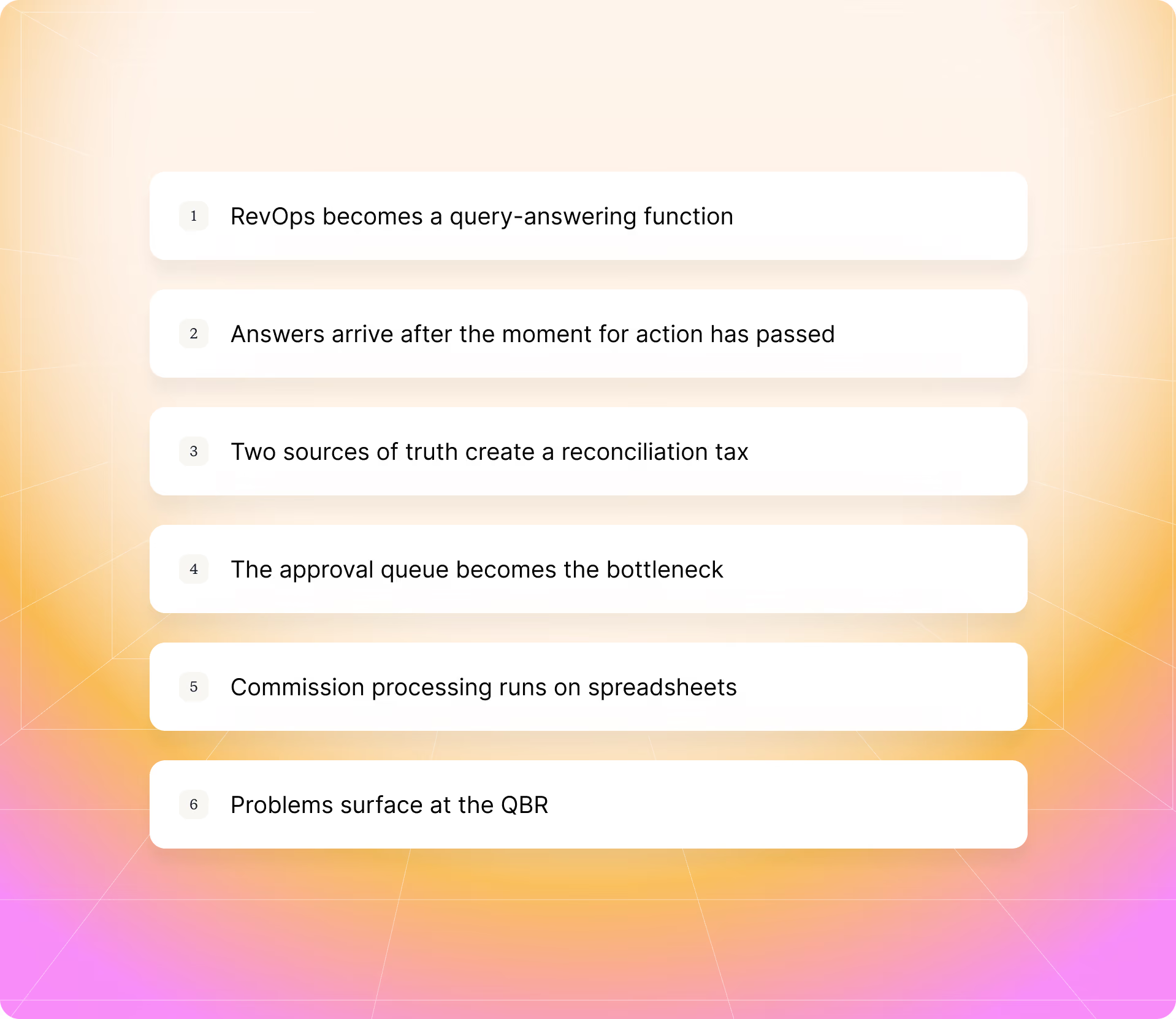
RevOps becomes a query-answering function
Channel leaders ask questions constantly:
- Which gold partners have pipeline but low engagement?
- Which new partners haven’t progressed?
- Which regions should we prioritize for market expansion?
The information may exist, but answering the question often requires somebody to pull it together.
We estimate that ad-hoc analytics requests can consume 30% to 50% of channel RevOps capacity in mid-to-large programs.
Instead of improving channel strategy or identifying areas for improvement, RevOps becomes a human search engine.
A good partner dashboard handles repeatable questions. The challenge is everything leadership didn’t know it would want to ask.
The problem isn’t curiosity. It’s requiring an analyst every time somebody is curious.
Answers arrive after the moment for action has passed
Slow answers create a second problem: latency.
If a director asks on Monday which strategic accounts need attention and gets the answer on Thursday, the business has lost three days of intervention time.
Multiply that across regular decisions, and the program becomes reactive. Teams manage between reports instead of responding to what’s happening now.
Fast access to insights isn’t just convenient. It gives people time to act.
Two sources of truth create a reconciliation tax
When a PRM maintains separate records from the CRM, someone has to keep both versions aligned.
Was the stage updated? Is the tier correct? Which amount should finance use? Did the right company get partner credit?
That work usually lands with channel ops.
Making attribution structural inside the CRM removes much of that reconstruction. It’s also the foundation of reliable partner attribution.
Two competing records don’t give you more visibility. They give you more things to reconcile.
The approval queue becomes the bottleneck
Many approval processes treat every submission as an edge case.
A clean referral waits beside an incomplete one. A straightforward opportunity waits beside a genuine conflict. Everything moves at the speed of the same human reviewer.
Better deal and lead registration separates routine submissions from decisions that actually need judgment.
The queue should contain exceptions, not paperwork.
Commission processing runs on spreadsheets
Month-end can become an assembly project: identify eligible sales, apply plan rules, verify amounts, generate statements, hand them to finance, and then resolve questions.
Manual processing gets harder as the network grows, and mistakes can quickly damage trust.
Automated commission and SPIFF management turns repeated calculation into a review process instead.
Partner ops should oversee commission accuracy, not rebuild the calculation every month.
Problems surface at the QBR
A reseller goes quiet in week two. Nobody notices until week ten.
Two routes to market collide around the same customer. The issue surfaces after both sides have invested time.
Channel conflict can be especially damaging when direct-to-consumer or direct sales motions overlap with resellers or other independent retail partners. Clear rules and early detection protect relationships before pricing, ownership, or customer communication becomes contentious.
The same principle applies to inactivity. Continuous monitoring helps teams catch falling partner activation before the next review.
And detecting channel conflict when an opportunity enters the pipeline is far easier than untangling it weeks later.
Good channel operations turn problems into current events, not quarterly surprises.
The insight: partner ops scales with exceptions, not with partners
The most useful capacity metric for partner operations isn’t partners per employee.
It’s exceptions per week.
Adding 50 partners to a well-automated program may create very little extra operational work. Add the same 50 to a program where every approval needs review, every commission is calculated manually, and every question needs an analyst, and the workload explodes.
An exception is anything that requires somebody to step in because the normal process couldn’t complete the task.
For two weeks, log every intervention and group it into five buckets:
- Data fix
- Approval
- Reconciliation
- Calculation
- Query
The biggest category tells you where optimization is likely to produce the fastest return.
This also changes the budget conversation.
Instead of saying, “We need another ops hire,” you can say, “These exception types consume most of our capacity. Here’s what removing them would give back.”
That’s a stronger scalability argument because you’re fixing the source of the workload rather than hiring more people to absorb it.
Scale the process first, then decide whether you still need the headcount.
How to scale partner operations without adding headcount
Effective channel operations don’t remove people from the program. They reserve people for work that genuinely needs judgment, communication, and strategy.
1. Make the CRM your single source of truth
Every partner, contact, referral, opportunity, and attribution decision should connect back to the CRM your business already trusts.
For HubSpot teams, that means running partner operations with HubSpot rather than maintaining a parallel database.
The same principle applies when connecting your partner program to Salesforce.
One authoritative record reduces reconciliation and gives sales, marketing, finance, and partnerships a shared view of the business.
One truth means fewer exceptions.
2. Automate routine approvals
Review your approval queue and ask how many submissions truly need a person.
Clear cases can move automatically. Missing information can trigger a request. Ambiguous ownership or unusual terms can go to a human.
Automation tools help scale channel operations because they keep human attention for the minority of decisions where it matters.
Automate the routine majority, escalate the unusual minority.
3. Catch conflict at submission
Screen new opportunities against existing direct and indirect sales activity immediately.
If there’s an overlap, resolve it while expectations are still manageable.
This also helps maintain consistent pricing and rules across routes to market, which protects customer trust as market reach expands.
Early conflict detection protects both partner relationships and the customer experience.
4. Make attribution structural
Don’t reconstruct partner credit after the quarter.
Capture the partner relationship when the opportunity or referral enters the process and keep that connection attached to the CRM record.
That makes sourced versus influenced analysis far easier and gives leadership a cleaner track record of what the ecosystem actually contributes.
Attribution should be infrastructure, not archaeology.
5. Replace the query queue with self-serve answers
Leadership will always ask new questions.
The capacity problem appears when every question becomes a ticket.
An AI agent for partner teams can let users ask questions in plain language and retrieve answers from current ecosystem information.
For instance: Which gold partners haven’t submitted an opportunity in 60 days? Which segment has the strongest pipeline? Where is engagement dropping?
RevOps gets time back for deeper analysis and improvement.
RevOps should design the operating model, not spend the day acting as its search bar.
6. Monitor continuously
Regular meetings still matter, but they shouldn’t be your alerting system.
Track the KPIs that require action, including pipeline movement, activation, pending approvals, tier progress, and program effectiveness.
Technology platforms can surface the exceptions automatically instead of asking someone to inspect the entire network.
That’s one of the practical applications covered in Introw’s guide to AI in partnerships.
Reporting tells you what happened. Monitoring tells you when to act.
What effective channel operations change for the team
Once routine exceptions disappear, the work itself starts to look very different.
The benefit goes beyond employee efficiency.
Teams get more time to:
- Optimize partner strategies and improve communication
- Support market expansion and activities that contribute to revenue growth
- Reduce delays, errors, and unnecessary manual work across the program
Effective channel operations also improve customer experiences and cost efficiencies.
In retail channel operations, that can mean better inventory visibility, faster delivery, smoother fulfillment, and higher customer satisfaction. In SaaS, it means cleaner indirect sales execution and faster decisions across the partner network.
In either case, technology improves efficiency when it removes repeated operational work instead of adding another system people have to maintain.
The team spends less time maintaining the machine and more time improving it.
How Introw removes the exception load
Introw helps partner and RevOps teams take repetitive work off their plate without creating another system they have to babysit.
The CRM stays in control. Introw handles more of the work around it.
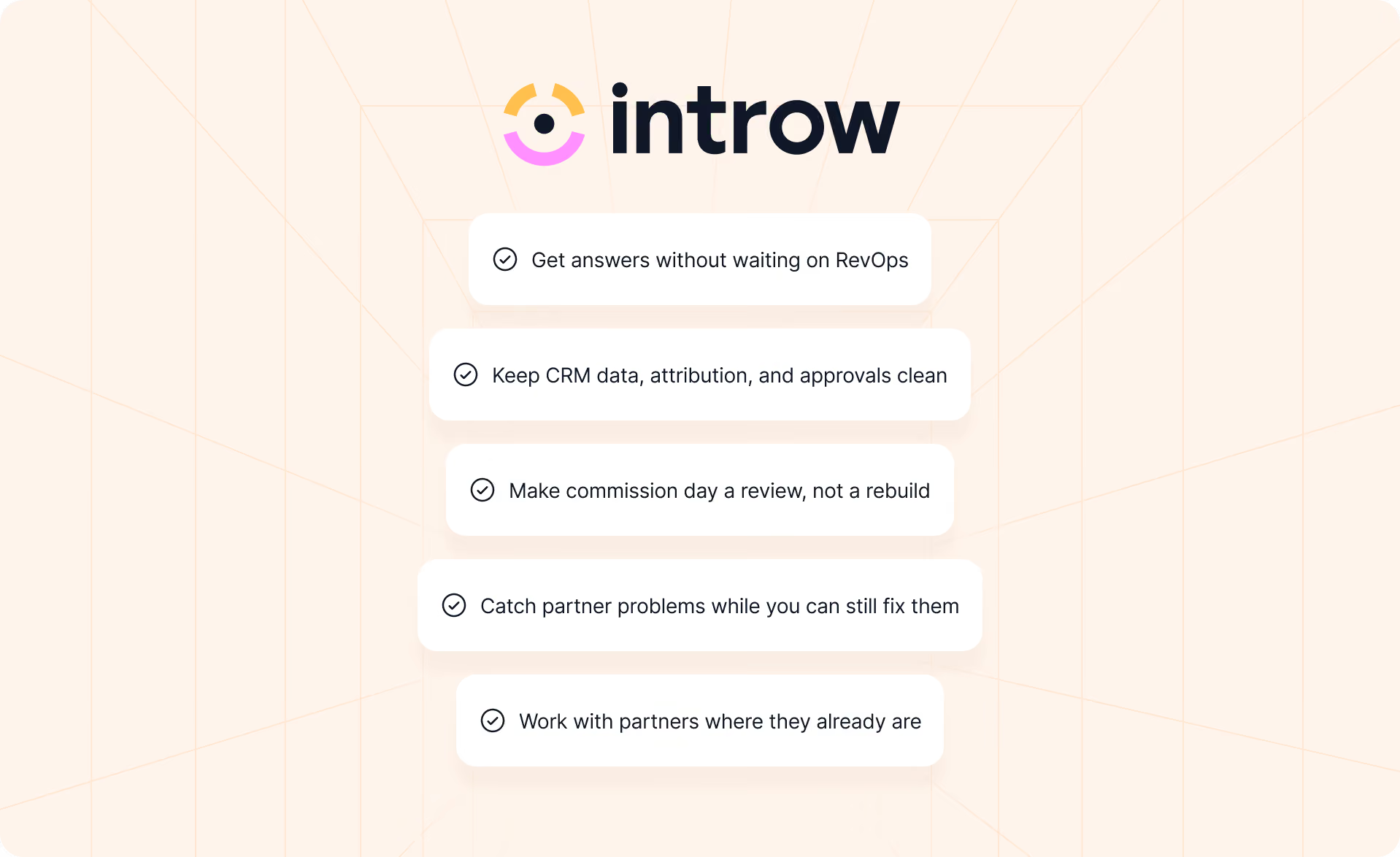
Get answers without waiting on RevOps
You shouldn’t need an analyst every time someone asks:
- Which partners are falling behind?
- Which tier has the strongest pipeline?
- Where has engagement dropped?
With Introw, you can ask ecosystem questions in plain language and get answers from current CRM-connected information.
For repeatable KPIs, you can also build partner reports and dashboards around what your team actually wants to track.
So instead of opening a ticket, waiting two days, and then asking a follow-up question, you can get to the answer while it still matters.
Keep CRM data, attribution, and approvals clean
Much of the work in partner ops comes from fixing things after the fact.
The PRM says one thing. Salesforce says another. A partner gets missed in attribution. A straightforward registration sits in a queue because nobody has reviewed it yet.
Introw keeps HubSpot or Salesforce as the source of truth and connects partner activity back to those CRM records.
That means you can:
- Keep partner and deal information aligned
- Capture sourced and influenced credit as the deal moves
- Let clear registrations move automatically
- Route conflicts or unusual cases to a person
It’s the same principle behind headless partnerships. People can work through the tools that suit them without creating another disconnected version of the truth.
You spend less time cleaning up yesterday’s work.
Make commission day a review, not a rebuild
Commission processing shouldn’t mean reconstructing the month in a spreadsheet.
Introw can:
- Generate commission lines from configured plans
- Connect them to the underlying CRM revenue
- Create statements for the relevant period
- Give finance a clear review and approval flow
You still control the process.
You just stop doing the repetitive calculation and assembly work before you can even review it.
Catch partner problems while you can still fix them
A partner going quiet isn’t useful information three months later.
Neither is discovering a conflict after two teams have spent weeks working on the same opportunity.
Introw can continuously surface the things that actually need your attention, such as:
- At-risk or inactive partners
- Pending approvals
- Important KPI changes
- Recent wins
- Pipeline issues that need intervention
Instead of checking every account and dashboard yourself, you start with the exceptions.
That changes the conversation from “What happened last quarter?” to “What needs us today?”
Work with partners where they already are
Not every task needs another portal login.
Partners can interact through email, Slack, Teams, AI assistants, or the partner experience depending on what they need to do. Internal teams can keep working from the CRM.
That matters in everyday situations.
A partner can reply to an update by email instead of logging in somewhere else. Your sales team can see partner context without leaving HubSpot or Salesforce. An announcement can go into shared Slack channels without you copying it into each one manually.
You spend less time chasing people into the process because the process comes to them.
What changes in your day-to-day work?
The difference isn’t another dashboard. It’s fewer things landing back on your desk.
- Fewer reports to pull
- Fewer approvals to babysit
- Fewer spreadsheets to reconcile
- Fewer commission calculations to rebuild
- Fewer partners to chase for updates
- Fewer problems discovered too late
And that leaves more time for the work that actually needs you: helping partners move deals, improving the program, and deciding what to do next.
We know your team is probably spending too much time pulling reports, chasing approvals, and fixing work that should already be handled.
If you want to fast-track the move from manual partner ops to a program that runs with fewer exceptions, book a demo, and we’ll show you how Introw can help.
Still curious? Here are some quick answers to help clear things up
A partner operations manager keeps the program running smoothly by managing its CRM structure, operational processes, approvals, commissions, segmentation, enablement, and measurement.
Partner management owns relationships. Partner operations owns the infrastructure and processes supporting those relationships.
There’s no useful universal number. Capacity depends more on exceptions per week than on partner count.
Usually a CRM as the source of truth, a CRM-native PRM, automation, analytics, and communication tools that work together without creating duplicate records.
Reduce manual exceptions. Centralize CRM information, automate routine approvals, catch conflict early, assign attribution automatically, enable self-serve analytics, and monitor partner performance continuously.






Are you already an active Introw partner?
Book a demo with one of our partner program experts, or explore Introw on your own time.