

A partner manager presents a finished plan at kickoff. The partner nods, agrees to a revenue target, and leaves without committing any sales capacity. Three months later, the numbers haven’t moved. Neither side can explain which action was supposed to happen first.
That isn’t a planning problem. It’s an ownership problem. A joint business plan has value only when it changes what both teams do between meetings. If you need a ready-made starting document, Introw also offers a partner business plan resource. Here, we’ll focus on building agreement and making the plan useful after kickoff.
What is a joint business plan with partners?
A joint business plan (JBP), also called a partner business plan, is a shared operating document for a defined quarter or year. Unlike a generic partnership plan, it assigns decisions and responsibilities to both teams. It captures joint commercial goals, target customers, go-to-market activities, contributions from each organization, and the cadence for reviewing results.

It’s distinct from three related concepts:
- A partnership agreement defines legal obligations, commercial terms, and rights. The JBP sits on top of that contract and can change as priorities evolve.
- An internal business plan describes your company’s priorities. A JBP must reflect the partner’s objectives, resources, and expectations, not only the vendor’s.
- A deal-level mutual action plan tracks the milestones for one opportunity. A JBP covers the relationship and may contain several co-selling motions.
Retailers and suppliers also use JBPs, but this guide focuses on B2B resellers, referral partners, technology partners, and alliances. If the broader program itself needs work, start with the partner enablement strategy guide.
Which partners need a joint business plan?
Not every signed partner warrants a planning workshop. Joint planning requires attention from both teams, so reserve the deepest version for relationships with a credible path to mutual value.
Look for revenue growth potential, overlap with your ideal customers, partner sales capacity, and a counterpart willing to commit to a mutually beneficial plan. A high partner tier alone isn’t enough. Check whether the partner can put the agreed work into its own calendar and sales process.
Match the planning effort to the relationship:
- Strategic partners: a full JBP, named owners, executive sponsorship, and regular joint decisions.
- Growth partners: a light one-page plan with a small number of shared targets and actions.
- Long-tail partners: an automated progress summary, self-service partner enablement, and an escalation contact.
Revisit these levels as partner performance, capacity, or opportunity changes. The aim isn’t to produce more plans. It’s to give each partnership the attention it can actually use.
What goes in a joint business plan?
The planning process starts with a document short enough to use in a meeting. Keep the decision-making summary to one page and link supporting account lists or forecasts. Seven elements are usually enough; focus on three to five priorities, not a catalog of everything either company might do.

Partner profile and joint ideal customer
Record the partner’s model, strengths, market reach, and reason for working with you. Define your shared ideal customer, but ask which accounts and problems the partner actually wants to pursue. A plan that fits only the vendor’s strategy will not earn sustained attention from the partner’s sellers.
Goals and success metrics
Set revenue goals, activity goals, and capability targets. Each needs a baseline, target, owner, and milestone both sides accept. These partner KPIs should measure progress, not merely activity. Pipeline targets set expectations; actual pipeline and revenue show commercial progress. Registrations and campaign activity show momentum; certifications show readiness. Keep detailed metric definitions in your enablement KPI guide, not in the JBP itself.
Go-to-market and target accounts
Agree on a joint value proposition, priority use cases, and a named account list informed by market trends. Identify which company leads each introduction or co-sell conversation. When both teams might pursue an account, settle the rules of engagement before outreach starts.
What each side commits to
Commitments must run in both directions:
- Partner: seller capacity, qualified introductions, registrations, partner marketing campaigns, and people assigned to training.
- Vendor: introductions or leads, presales availability, approved funding, relevant content, response times, and a named owner.
Write down the commitment, responsible person, and date. A document containing only partner quotas is a target sheet, not a joint business plan. Mutual commitments make this a collaborative process, with accountability on both sides.
Enablement and certification
Identify which partner sellers or technical contacts need which training, and by when. Include a route for new hires rather than assuming the team remains unchanged. A partner certification program can support readiness, but certificates alone aren’t a commercial outcome.
Incentives and funding
Summarize how the partner earns through commissions, tier benefits, or approved rebates, and what marketing development funds are available. Note co-marketing eligibility, approval owners, and spending conditions. Keep the detailed commercial rules in your incentive program, not the planning summary.
Forecast and review cadence
Capture quarterly pipeline assumptions, committed activities, review dates, attendees, and escalation contacts. Specify which data source governs the numbers.
How to build a partner business plan together
Prepare a first draft from the CRM: existing opportunities, registration history, current tier, certifications, and previous commitments. That lets the joint session focus on decisions rather than collecting numbers. The point is alignment, not a longer document.
Start the conversation with the partner’s business goals. Ask what its team can realistically sell, which customers it wants to reach, and what it needs from you. Then align on three to five shared priorities and turn them into a clear roadmap of actions both organizations can own.
Keep a one-page decision summary with links to deeper account or budget detail. Get written acknowledgment from each owner and place the current version somewhere both can access. A document buried in one person’s inbox won’t guide a partnership.
How to agree on commitments and approve changes
Before the plan goes live, agree what mutual success means and separate goals from promises. A goal states the result you want. A commitment states what each company will provide. An action gives that commitment an owner and deadline. Evidence shows whether it happened.
For every significant commitment, record who approves it on each side. Funding, shared account ownership, and revised revenue targets may need different approvers. The partner manager shouldn’t promise resources that finance or sales hasn’t agreed to provide.
When assumptions change, update the shared plan together. Record what changed, why, who approved it, and which tasks or targets are affected. Keep the previous baseline visible so reviews remain honest. A plan can change; accountability shouldn’t disappear with the old version.
How to run the plan so both sides execute
The useful JBP isn’t the one everyone signed. Stronger relationships come from delivery, with the plan shaping each next conversation.
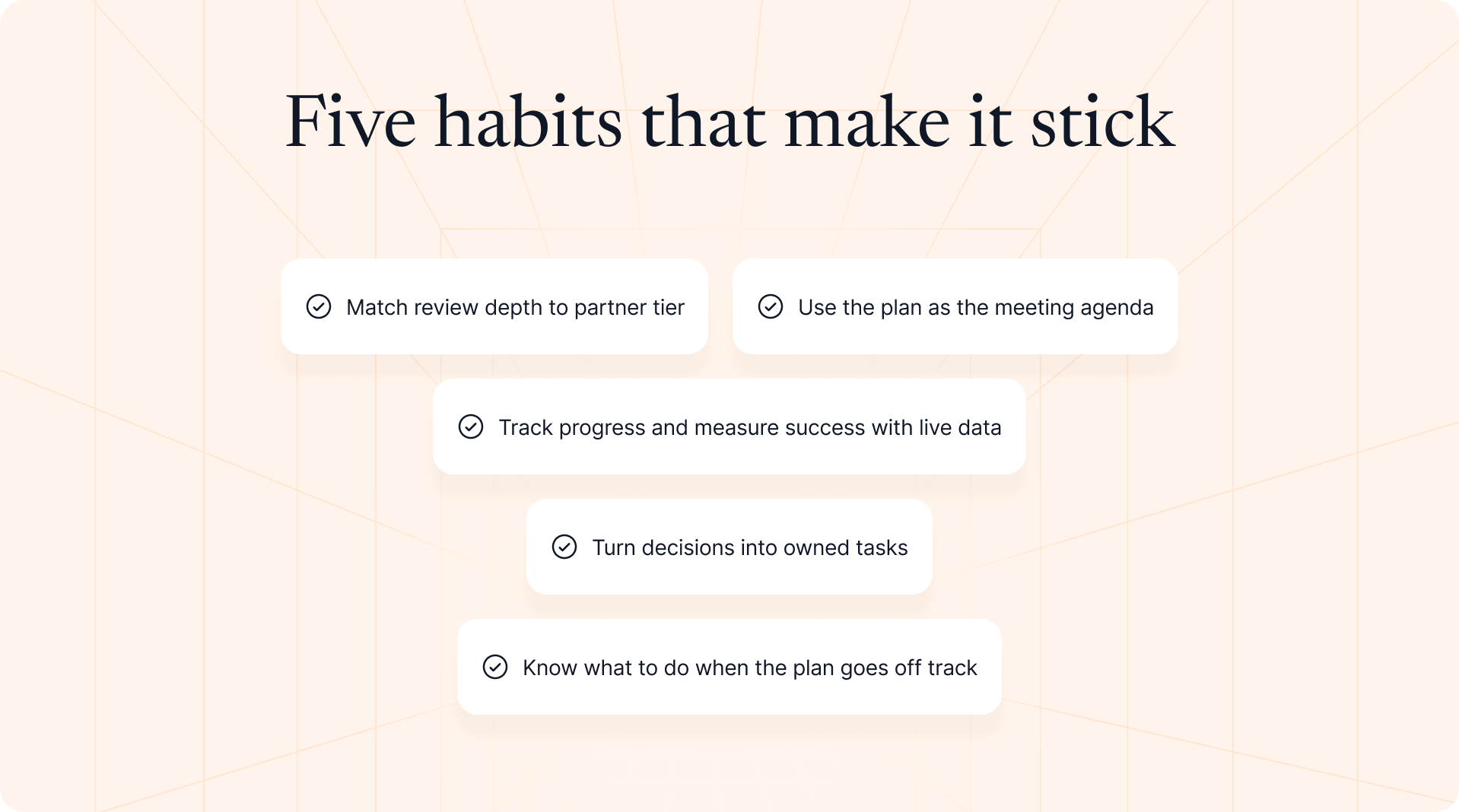
Match review depth to partner tier
Give strategic partners enough time for an executive sponsor to remove blockers, approve investments, and make tradeoffs. Growth partners may need a shorter working review with their channel manager. For the long tail, share a progress update and a named contact rather than scheduling a meeting nobody needs.
Use partner performance, business potential, and engagement to decide the cadence. Don’t make a high-performing partner sit through a lengthy meeting just because its tier requires one.
Use the plan as the meeting agenda
Open with commitments from the previous review. What was completed? What slipped? Which result changed because of the work? Then discuss target accounts, pipeline, enablement, funding, and decisions needed before the next session.
Bring the numbers before the meeting. Keep a short decision log alongside the JBP so a new stakeholder can see why a priority was added, delayed, or dropped.
Track progress and measure success with live data
Pull opportunity stages, deal registrations, partner training status, and approved partner marketing spend from the CRM or partner platform into a shared dashboard both sides can inspect. Agree on whose data wins when a portal report and spreadsheet disagree. Goal tracking only works when both parties trust the same numbers.
Look at leading indicators such as qualified pipeline created, seller activation, and completed co-sell activity alongside lagging results such as closed revenue. That way, you can intervene before a weak quarter becomes obvious in the final revenue number. Use the regular quarterly business review to make decisions, not to read back slides.
Turn decisions into owned tasks
End each review with the action, the owner at the vendor or partner, and the due date. Put those tasks where the people responsible already work. If a campaign needs vendor approval before a partner can launch, track the dependency as well as the launch date.
At the next meeting, check old actions before introducing new requests. A plan with twenty open tasks and no decisions isn’t more thorough. It’s a backlog that neither side trusts.
Know what to do when the plan goes off track
Ask what changed before blaming the partner. Market trends and shifting customer needs may explain a missed milestone. A major customer may have postponed a purchase, a seller may have left, or a market shift may have made the original use case less attractive. Positive surprises also deserve a review: a new opportunity may justify moving resources.
Re-baseline the relevant target with mutual approval, not a silent spreadsheet edit. Agree on the next test and a date to revisit it. If a full quarter passes without meaningful action, involve the executive sponsor or move the relationship to a lighter planning cadence. A smaller credible plan is better for long-term success than an ambitious one nobody runs.
How Introw helps with joint business planning
Introw provides CRM-based reporting, insights, and execution tools around a JBP in HubSpot or Salesforce. It shouldn’t be mistaken for a dedicated joint business plan document builder.
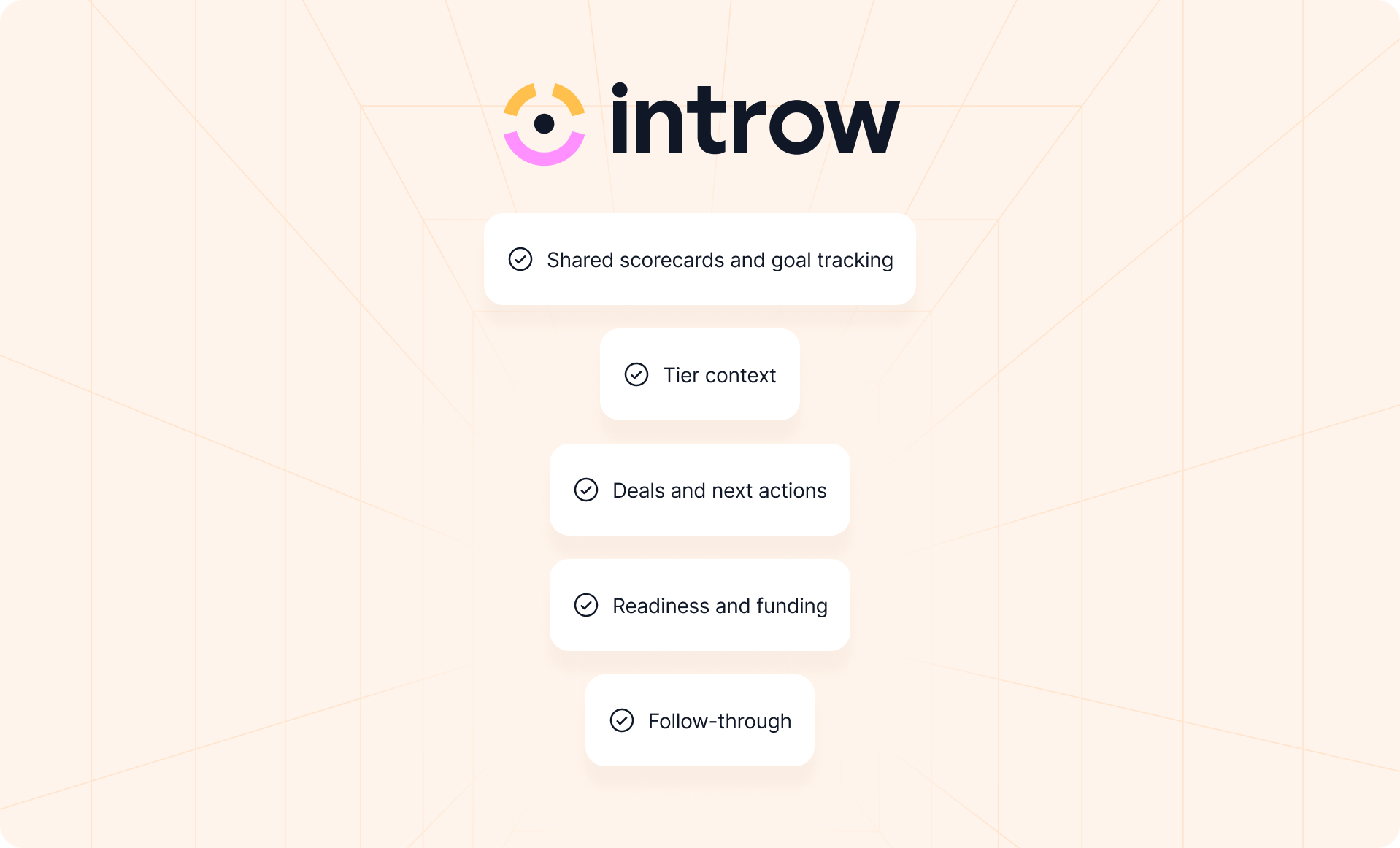
- Shared scorecards and goal tracking: CRM-based partner goals and performance dashboards let both sides review agreed measures. Partner-facing views show each partner its own data.
- Tier context: Partner tiers can have distinct requirements and benefits, linked to CRM properties, so reviews reflect the partner’s actual program standing.
- Deals and next actions: Shared pipelines, deal collaboration, and assignable tasks connect partner activity to work already happening on CRM records.
- Readiness and funding: Courses and certifications provide enablement progress; MDF tracking shows requests, approvals, claims, and spend alongside related pipeline.
- Follow-through: Partner-facing notifications and workflows support follow-up when deals stall or activity drops, reducing the need to chase every update manually.
The JBP still needs two people to agree on priorities and make tradeoffs. Software makes their evidence easier.
Want a JBP review built on the same deal and performance data both sides use? Start free and connect HubSpot or Salesforce.
Still curious? Here are some quick answers to help clear things up
A partnership agreement is the legal contract governing terms and obligations. A JBP sits alongside it and sets the current commercial priorities and actions. The operating plan changes more often.
In retail, suppliers and retailers use joint business planning to align sales, promotions, marketing, and commercial goals. The principle also applies to B2B partner programs, with different sales motions.
Quarterly is a useful practitioner cadence for formal reviews, with shorter working check-ins between them. Strategic partners may need more frequent decisions. Long-tail partners may use automated progress summaries.
Keep the summary short enough to use during a meeting, ideally one page with three to five priorities. Store account lists, budgets, and detailed forecasts as linked supporting material. Keep owners and dates visible.
Each organization should name an accountable owner, usually the vendor’s partner manager and their partner counterpart. Strategic relationships may also need executive sponsors to approve material changes or remove blockers. One side can prepare the document, but both sides must agree to it.






See AI-Native PRM in Action
Book a demo with one of our partner program experts, or explore Introw on your own time.