

What is horizontal channel conflict?
Horizontal channel conflict occurs when two or more channel partners at the same level of a distribution channel compete for the same customer, account, territory, or deal.
Think of two resellers, two MSPs, or two agencies representing the same vendor and pursuing the same prospect.
What makes the conflict horizontal?
The parties involved sit at the same level in the distribution chain. The horizontal channel conflict definition marketing teams use can cover several situations:
- Two partners pursuing the same deal
- Distributors competing in the same territory
- Retailers selling the same product at different prices
- Franchisees targeting the same customers
In B2B SaaS, horizontal conflict usually centers on account ownership and deal registration.
How horizontal conflict puts revenue at risk
The cost lands on a real opportunity. A prospect may receive different messages or quotes for the same brand while the partners compete instead of collaborating.
The partner manager must then resolve channel conflict while the buyer waits. This can delay the sales process, damage trust, and put the deal at risk.
There are three main types of channel conflict: horizontal, vertical, and multichannel. This article focuses on horizontal channel conflict and the controls that prevent same-level partners from colliding.
A B2B example of horizontal channel conflict
Here is a typical example of horizontal channel conflict in a B2B SaaS partner program.
Two resellers pursue the same enterprise account
- Partner A starts the deal. The reseller runs discovery and prepares a proposal for a financial services company. It does not register the opportunity because the deal registration process feels slow.
- Partner B enters through another contact. It begins its own sales process for the same product and account. Neither partner knows the other is involved because their opportunities sit in separate systems.
- The prospect receives two quotes. Both partners represent the same vendor, but Partner B offers a lower price. The buyer is left wondering why the same brand is competing with itself.
- The deal becomes an ownership dispute. Partner A asks the vendor to protect the work it has already done. The vendor must now decide which partner owns the opportunity while the prospect waits.
Most horizontal channel conflict examples focus on retail stores or franchisees. In B2B SaaS, the problem is often this simple: one enterprise account, two partners, and no trusted record of who developed the opportunity first.
How a horizontal channel conflict kills a deal
A channel conflict rarely starts as an open dispute. It becomes visible only after two partners have already spent time on the same deal.
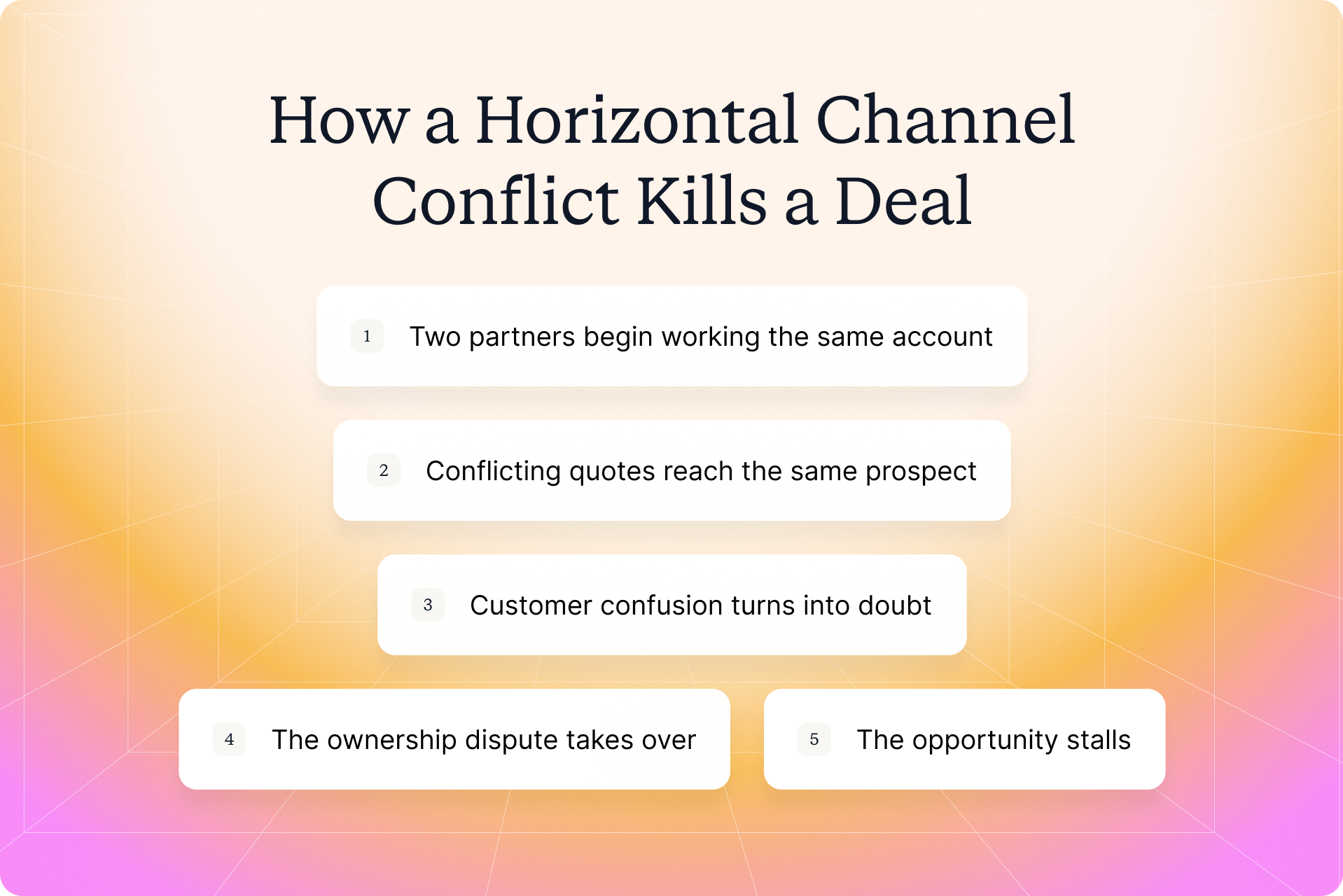
1. Two partners begin working the same account
The first partner starts discovery while the other reaches a different buyer at the same company. With no shared registration record, both believe they own the opportunity.
2. Conflicting quotes reach the same prospect
The channel partners position the same product differently or offer different discounts. The prospect may use one quote to push for lower prices. Margins shrink, and the vendor loses control of the commercial story.
3. Customer confusion turns into doubt
The buyer asks why the vendor appears to be competing with itself. Different claims or timelines make the partner ecosystem look poorly managed.
4. The ownership dispute takes over
Partner A and Partner B send emails, notes, and CRM activity to prove who got there first. The channel team stops helping the prospect buy and starts reconstructing the deal's history.
5. The opportunity stalls
The buyer waits while the vendor decides who can continue. The delay creates room for a competitor, and the losing partner may stop sharing future deals early.
Horizontal channel conflict can therefore damage future pipeline as well as the active opportunity.
The channel conflict could have been stopped when the second partner tried to register the same account. A reliable deal registration system would have found the existing claim, flagged the overlap, and applied the ownership rule before both partners reached the quote stage.
Why horizontal channel conflict happens
Horizontal channel conflict usually comes from gaps in program design, data, or enforcement. Poor communication may expose the problem, but it is rarely the only cause.
Territories overlap or remain undefined
Partners compete when geographic, vertical, segment, or account boundaries are unclear. Even distinct territorial boundaries can fail if a global customer spans several regions and the program does not explain who owns the parent account.
There is no trusted deal registration process
When partners cannot register their own deals quickly, ownership stays in email, chat, or spreadsheets. The vendor sees potential channel conflicts too late, after two partners have already contacted the same customers.
Account ownership rules leave room for judgment
Define whether ownership depends on first registration, prior activity, customer preference, partner tier, or another form of proof. Otherwise, similar cases can receive different outcomes.
Too many partners chase the same market
Over-enrollment creates structural competition. If two or more partners offer the same product to the same target markets, overlap becomes more likely even when each partner behaves fairly.
Partners undercut each other
Price differences can turn healthy competition into destructive horizontal conflict. One partner cuts margin, the other responds, and the buyer waits for a better offer. Consistent pricing and discount rules can minimize conflicts. Minimum Advertised Price policies are more relevant to retail than most B2B SaaS deals.
Incentives reward winning without rewarding transparency
Incentive programs may pay for closed revenue without rewarding early registration. If sharing a deal brings work but no protection, partners will keep it hidden longer.
Horizontal vs. vertical and multichannel conflict
The fastest way to classify channel conflict is to ask who is colliding. The answer changes how you manage channel conflict and which rule should prevent it.
Vertical channel conflict occurs when parties at different levels of the distribution channel compete or disagree. In B2B SaaS, vertical conflict often appears when direct sales works an account that a partner believed it owned. That requires different controls from a horizontal channel collision.
Multi-channel conflict happens when multiple distribution channels clash, rather than two partners in the same distribution channel.
Working through a broader channel conflict guide can help teams like yours identify the type of conflict they're facing and choose the right way to prevent it.
How to stop horizontal channel conflict with deal registration
Deal registration prevents horizontal channel conflict by establishing ownership before two partners invest in the same deal. Once approved, the timestamped claim protects that partner from competing claims by other partners or direct sales for a defined window.
Define what “first” really means
A first-to-register policy sounds simple until two partners submit the same account within hours of each other.
Your policy should define:
- What information makes a registration complete.
- Whether the partner must show recent customer contact or proof of work.
- How duplicate domains, subsidiaries, and regional entities are handled.
- Which rule breaks a tie, such as prior verified activity or customer preference.
- Who can appeal and what evidence they must provide.
The first valid registration should win, not the first empty form.
Match the protection window to the sales cycle
Once a deal is approved, protect the partner for a defined period. Our recommended way to prevent channel conflict is to start with a 60-to-90-day protection window, then adjust it to match your sales cycle.
A short window can punish enterprise partners. An open-ended one lets inactive registrations block other opportunities. Set an expiry date, extension criteria, and an alert before protection ends.
Make expiry and reassignment predictable
If the partner stops working the deal, define the no-activity threshold and reassignment process. Show the decision and its reason so everyone can see that the same rule was applied to the same evidence. This helps resolve channel conflict consistently.
Make registration easy enough to use
The strongest policy fails if partners avoid the form. Collect only what you need to find duplicates, qualify the opportunity, and assign ownership. A modern deal and lead registration process can work through the CRM, email, Slack, Teams, or an AI interface instead of forcing every partner into a portal.
How CRM-native detection catches channel conflict early
Deal registration creates the claim. Automated conflict detection checks that claim against existing records before horizontal channel conflict occurs.
At the exact moment a partner registers a lead or deal, the system can compare the account name, company domain, and contact with:
- Existing registrations from the other partner
- Open partner opportunities
- Open opportunities owned by the direct sales team
- Recent activity on the same account or same prospect
- Territory, tier, named-account, and exclusion rules
Conflicts appear while the evidence is fresh
If the system finds an overlap, it flags the potential conflict immediately. The partner manager can then approve the first claim, split credit, request proof, or apply another documented rule before two partners work the account.
CRM data makes ownership easier to verify
Conflict detection works best when partner data and direct pipeline meet on the CRM record.
Clear partner attribution shows who sourced or influenced the opportunity. Registration timestamps and protection status show who currently owns it.
One source of truth prevents detection delays
When partner deals live in a separate partner relationship management database, conflict detection depends on synchronization. A delay or mapping error can hide a duplicate until a quote exposes it.
A PRM that works with your CRM keeps HubSpot or Salesforce as the customer relationship management source of truth. Direct and partner activity becomes visible sooner, while your team keeps control of the final decision.
How territory design helps prevent horizontal channel conflict
Territories reduce the number of situations your deal registration process has to resolve. The goal is not to eliminate all partner competition. It is to eliminate unmanaged overlap.
You can segment a horizontal channel by:
- Geography: Country, region, or local market
- Industry: Healthcare, financial services, manufacturing, or another vertical
- Customer segment: SMB, mid-market, or enterprise
- Specialization: Product expertise, implementation skill, language, or certification
- Named accounts: Strategic customers assigned to a specific partner or motion
Two partners may serve the same territory while bringing different expertise. That can work if ownership becomes clear when both touch the same account.
Review coverage and channel partner performance together. If one market has too many partners and another has none, recruitment has created competition without adding reach. Regular account mapping can identify conflict early, before distributors competing for the same demand undercut each other.
How Introw prevents horizontal channel conflict
Introw connects deal registration, automated conflict detection, and CRM data so the channel team can manage channel conflict when a submission arrives, rather than after the buyer receives competing quotes.
We flag potential conflicts as soon as a registration arrives and suggest the next step based on your rules. Your team still makes the final call.
Partners can register deals on or off the portal, and every approved opportunity stays attributed and synced with your CRM. This keeps a messy ownership debate from landing in your inbox after both partners have already contacted the buyer.
If duplicate claims are still surfacing through email threads and escalations, active deals are already absorbing the delay.
Our CRM-native deal registration catches that overlap earlier, while there is still time to protect the opportunity. Book a demo to see it in action.
Still curious? Here are some quick answers to help clear things up
The three types of channel conflict are horizontal, vertical, and multichannel. Horizontal channel conflict occurs between partners at the same level. Vertical channel conflict occurs between different levels in a distribution channel, such as a vendor and reseller. Multichannel conflict happens when different channels or sales motions compete. Introw's channel conflict guide explains all three.
Horizontal channel conflict usually comes from overlapping territories, unclear account ownership, too many partners in one market, inconsistent pricing, or inadequate deal registration governance. It becomes more likely when partner opportunities and direct sales data live in separate systems.
To prevent horizontal channel conflict, use a clear deal registration process, CRM-native automated conflict detection, transparent ownership rules, and sensible territory design. Deal registration is key because it establishes who is working the opportunity and can flag a second claim before two partners contact the same customer.
Yes. Some competition can show that a market is active and well covered. The goal is not zero overlap. It is zero unmanaged overlap. Healthy competition gives customers a choice, while destructive horizontal conflict creates duplicate approaches, price pressure, and ownership disputes.



Are you already an active Introw partner?
Book a demo with one of our partner program experts, or explore Introw on your own time.