

What is vertical conflict in a distribution channel?
Vertical channel conflict occurs when businesses at different levels of the same channel or supply chain compete or disagree. The clearest B2B example is a software vendor's direct team pursuing an account that a reseller, VAR, MSP, or distributor is already working.
Across a wider distribution network, channel conflict can affect several channel members. The defining feature is that each party operates at a different point in the distribution channel.
At a glance
- Who collides: The vendor and a channel partner
- What they contest: The same deal, customer, pricing, or account ownership
- Why it matters: The vendor breaks partner trust with a business it depends on for pipeline, services, or market coverage
That vertical conflict definition separates it from friction between two partners at the same level. It also explains why vertical channel conflict is widely considered the most damaging type of channel conflict.
This conflict damages more than one deal
The immediate deal may stall, but the damage rarely stops there.
- The partner loses confidence that its investment will be protected.
- The customer receives conflicting prices, messages, or promises.
- The partner keeps future opportunities outside the partner program.
- The vendor loses pipeline it may never know existed.
Policy can discourage this behavior. To avoid vertical channel conflict consistently, the system must show ownership and apply the same rules before either sales team acts.
A B2B SaaS example of vertical conflict
A cloud security VAR identifies an enterprise account, brings in technical resources, runs discovery, and spends months shaping the opportunity. The partner has discussed the account with its partner manager, but its work is not visible on the shared CRM record.
Here is how this vertical conflict example unfolds.
- The direct rep sees an unclaimed name. The account appears in Salesforce without a visible partner owner.
- The rep starts a competing motion. Under quarterly pressure, the rep adds the same account to an outreach sequence.
- Direct pricing undercuts the partner. The internal sales team offers a discount the reseller partner cannot match.
- The customer gets two versions of the deal. It is unclear who owns the sale, whose price is valid, or who will support the rollout.
- Trust breaks on both sides. The customer loses confidence, the partner feels undermined, and the same deal stalls.
Many channel conflict examples focus on a manufacturer undercutting a brick-and-mortar store or a supplier bypassing a distributor. In B2B SaaS, the contested asset is usually the account rather than physical inventory.
The preventable moment comes before customer contact
The conflict did not begin when the customer complained. It began when the direct rep touched the account without seeing the partner's claim.
If the CRM had surfaced a protected deal registration at that point, the rep could have stepped back or joined a defined co-sell motion. This point-of-action check is what separates preventing channel conflict from repairing it after the damage is done.
What causes vertical channel conflict?
Vertical channel conflict rarely comes from one bad decision. It typically combines human incentives with gaps in visibility and enforcement.
In each case, channel conflict occurs because the partner program has not aligned incentives, ownership, and enforcement.
Direct sales and channel partners work to different clocks
A direct rep may need revenue this quarter, while a partner is building a long-term customer base. If the internal sales team is penalized for supporting partner-led deals, it has a reason to pull those opportunities direct.
This is a channel power problem expressed through compensation. Direct reps need credit for helping a partner close, not a penalty for letting the partner lead.
Fragmented data enables the collision
Direct pipeline may live in HubSpot or Salesforce, while partner activity sits in email, a spreadsheet, a partner portal, or a separate partner relationship management platform. The partner manager knows the history, but the sales team sees only a company record.
Without a shared source of truth, your team cannot answer three basic questions quickly.
- Who introduced or developed this account?
- Is there already an active deal registration?
- Can direct sales engage, support the partner, or wait?
This is why partner relationship management and CRM cannot operate as disconnected systems. Potential conflicts surface too late when the partner ecosystem and direct sales work from different records.
How vertical channel conflict unfolds inside one deal
The damage follows a predictable sequence. Seeing that sequence makes the best point of intervention clear.
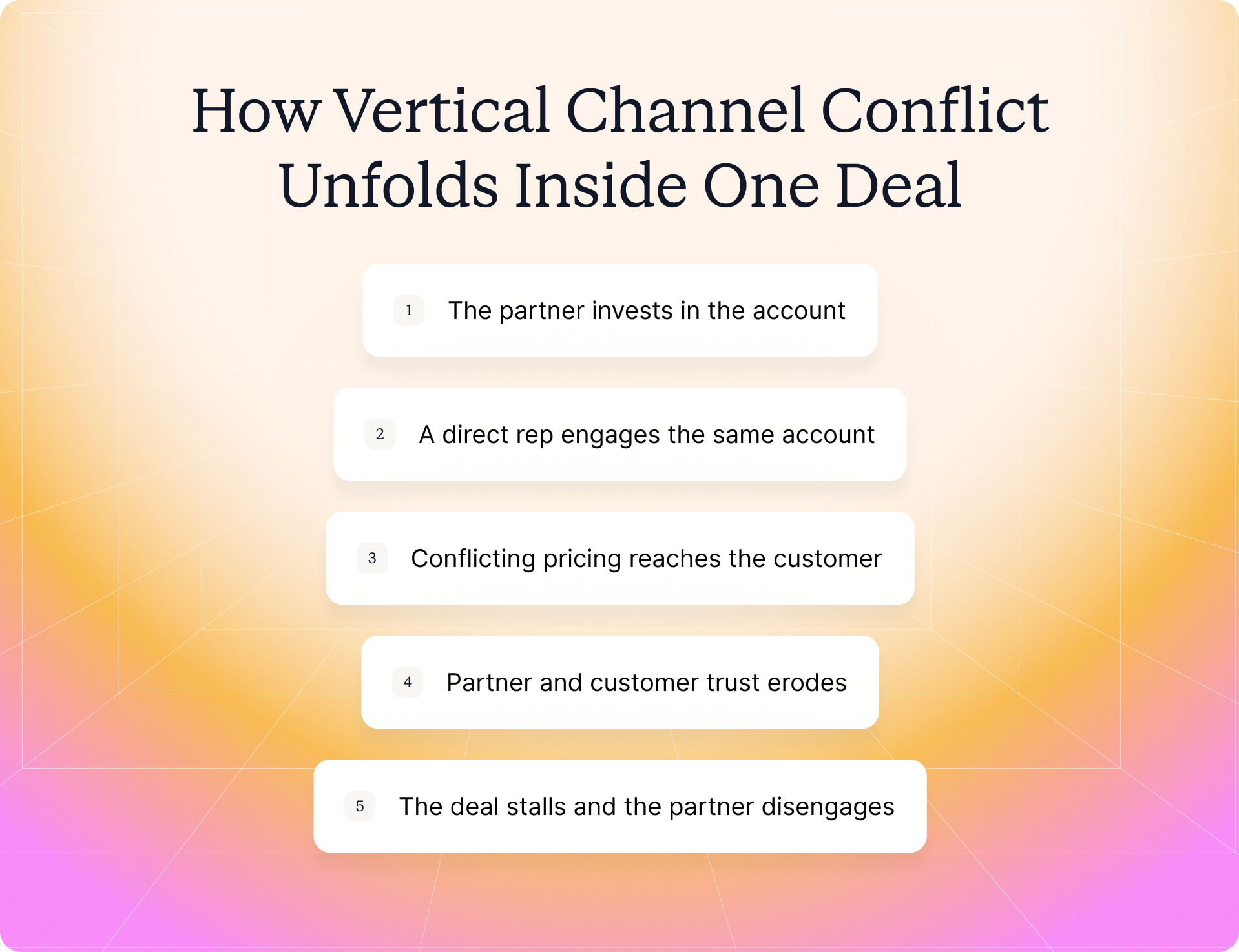
1. The partner invests in the account
A reseller partner finds the opportunity, develops the relationship, and commits commercial or technical resources.
2. A direct rep engages the same account
The rep may be unaware of the partner or may have a compensation reason to pursue the opportunity. This is the exact moment when the CRM should surface partner ownership.
3. Conflicting pricing reaches the customer
Two sales channels present different prices, responsibilities, or timelines for the same product. The customer now has to make sense of the vendor's internal competition.
4. Partner and customer trust erodes
The customer questions the vendor's coordination. The partner questions whether the vendor will protect its investment.
5. The deal stalls and the partner disengages
The immediate opportunity slows while the parties involved argue about credit. The other cost appears later, when the partner stops registering deals or shifts its effort to another vendor.
The preventable moment is step two. If the CRM surfaces a registered claim and enforces the protection window, the direct sales team knows whether to step back, support the partner, or follow an agreed-upon exception process.
Vertical vs. horizontal and multichannel conflict
The types of channel conflict are defined by who collides. That difference determines the right preventive control.
Horizontal conflict occurs when two or more partners compete at the same level, often for the same territory or account. A clear deal registration process can prevent horizontal channel conflict by recognizing the first valid claim and giving both partners the same decision trail.
Multichannel conflict occurs when multiple channels target the same customers with different prices or offers. With sales channels competing over the same product, clear attribution helps channel members see where revenue credit belongs.
A broader channel conflict framework covers all three models. The rules for resolving horizontal channel conflict go deeper into partner-versus-partner overlap without confusing it with direct-versus-partner conflict.
How to avoid vertical channel conflict with enforceable rules
Clear rules of engagement help direct sales, indirect sales teams, and channel partners manage channel conflict consistently. A mature partner program uses each rule to settle a decision the team faces during a live deal.
Compensation should not reward internal competition
Direct reps should not lose out when they support a partner-led opportunity. Partner managers also need measures that reward healthy pipeline, fair approvals, and customer success, not just deal registration volume.
Connecting incentives to channel partner performance management helps keep the rules credible. Both sides can work toward the same revenue outcome.
Communication helps, but it cannot enforce the rules
Standardized onboarding gives channel partners the same information. Regular account mapping sessions help identify potential conflicts early. Transparent communication also helps the partner program resolve conflict without damaging partner loyalty.
Clear contracts defining roles, pricing, and territories help resolve vertical conflicts after a disagreement. Mediation or arbitration can stop a serious dispute from escalating into a legal fight.
None of these steps can monitor daily account activity. A document nobody reads does not help you avoid channel conflict. Policy sets the rule, but the CRM must turn it into an enforced check.
How Introw prevents vertical channel conflict at the point of action
Policy sets the rule. Introw helps enforce it where direct and partner pipeline meet, inside HubSpot or Salesforce.
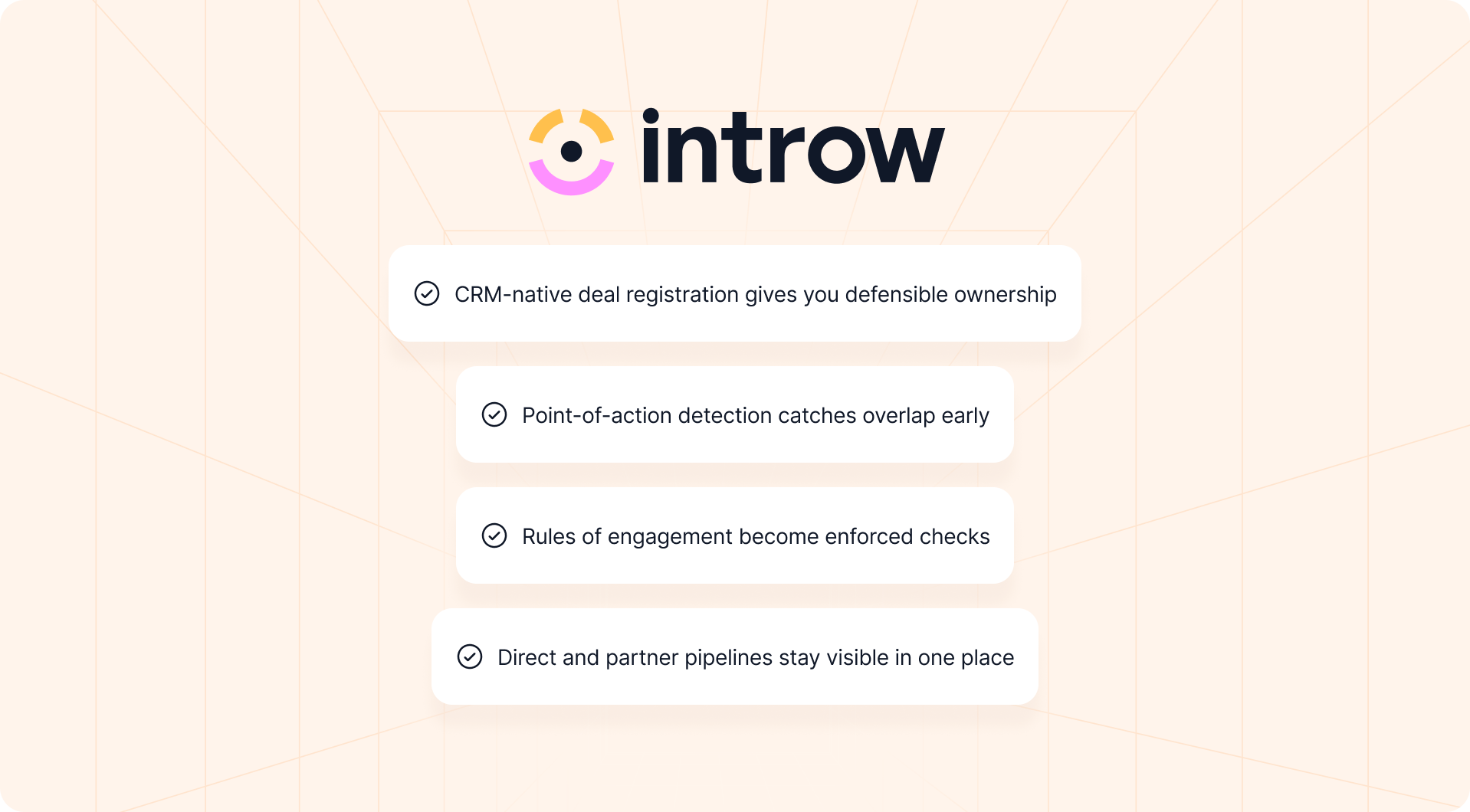
CRM-native deal registration gives you defensible ownership
Why it matters: You have a clear record of who brought in the opportunity and when, without reconstructing the history from emails or spreadsheets.
CRM-native deal and lead registration records the partner, account, contacts, submission time, and supporting context.
Partners can submit through several channels, but every registration feeds the same deal registration process. This gives the partners involved one consistent route for claiming and protecting an opportunity.
Once approved, the deal is linked to the partner and protected from other partners and the direct team for the agreed window. Activity requirements release stalled opportunities, so protection stays fair.
Point-of-action detection catches overlap early
Why it matters: Your team can resolve ownership before competing messages reach the customer.
Introw checks each registration against direct and partner pipeline using the account, domain, contact, or another identifier you choose. If it finds a match, your team sees the existing record, owner, and reason for the conflict before approving or declining the claim.
This connects partner attribution, which shows who contributed, with conflict detection, which identifies competing claims.
Rules of engagement become enforced checks
Introw can route a registration through an approval gate and show the overlapping CRM records. AI validation can assist above a certainty threshold chosen by your team, while unclear cases stay with a human reviewer.
The decision follows a consistent set of questions.
- Is there an active opportunity for the same account, domain, or contact?
- Is the existing activity recent and meaningful?
- Is the account reserved for direct sales, a specific channel, or a partner tier?
- Should the outcome be partner ownership, direct ownership, co-sell, split credit, or rejection?
The result is an explainable decision with an audit trail, not a rule trapped in a PDF. That consistency helps the partner program manage channel conflict without renegotiating ownership every time.
Direct and partner pipelines stay visible in one place
Once Introw accepts a partner deal, it writes the deal back to HubSpot or Salesforce with the partner attribution attached. Channel operations, partner leaders, and direct sales can then see both pipelines in the CRM, before any overlap reaches the customer.
This shared view also makes recurring problems easier to spot:
- Repeated conflicts in one region may point to unclear territory rules.
- Low deal registration approval rates may signal weak onboarding or overly broad claims.
- Frequent direct-versus-partner collisions may mean the compensation model still rewards internal competition.
If partner claims still sit outside the system your sales team uses, the next collision is already challenging to prevent.
Book a demo to see how registration, conflict checks, approvals, and attribution help resolve channel conflict before it reaches the customer.
Still curious? Here are some quick answers to help clear things up
A vertical conflict is a dispute between businesses at different levels of the same distribution channel. In B2B SaaS, it usually means a vendor's direct sales team competing with a partner for the same customer or deal.
Vertical channel conflict usually comes from unclear account ownership, inconsistent pricing, misaligned compensation, or poor visibility between direct and partner pipelines. Without enforced rules of engagement, both teams may pursue the same deal.
A common example is a reseller developing an account before the vendor's direct rep contacts the same customer with a lower price. The competing approaches confuse the customer and undermine the partner.
Use CRM-native deal registration to surface partner ownership, protect approved registrations for a defined window, and reward direct reps for supporting partner-led deals. These rules should be visible and enforced in the CRM.
Some overlap can reveal unclear rules, territory gaps, or pricing inconsistencies, but ongoing channel conflict is not healthy. The goal is predictable resolution before the conflict damages the customer experience or partner trust.



Are you already an active Introw partner?
Book a demo with one of our partner program experts, or explore Introw on your own time.