

What is ecosystem-led growth?
Ecosystem-led growth (ELG) is a go-to-market motion where a company's partner ecosystem becomes a primary engine for sourcing, converting, retaining, and expanding customers, rather than relying on outbound and paid acquisition alone.
Bob Moore and Crossbeam popularized the term and category through Moore's book, Ecosystem-Led Growth: A Blueprint for Sales and Marketing Success Using the Power of Partnerships, introduced in March 2024.
The timing makes sense. Customer acquisition costs have risen, cold outreach is losing impact, and buyers increasingly trust peers, existing vendors, and partners who already understand their needs. A firm's partner ecosystem can create warmer introductions, add useful context, and support new relationships that its sales team might struggle to reach alone.
In practice, this can support:
- ecosystem-led marketing, using shared audiences and partner trust to generate leads
- ecosystem-led sales, using warm introductions and account context to improve sales cycles
- ecosystem-led customer success, using integrations and joint customer success initiatives to strengthen retention and expansion
Collaboration between non-competing partners defines an ecosystem-led strategy. Effective ecosystems create mutual value for customers and partners, while strong ecosystems use network effects to create more value as participation grows.
ELG won't automatically unlock countless leads or break sales records. Company growth leveraging partnerships still depends on execution.
The concept is well understood. This guide explains how partner teams put it into practice and prove the revenue.
Ecosystem-led vs. product-led vs. sales-led growth
Product-led growth, sales-led growth, and ecosystem-led growth describe different routes to company growth. ELG doesn't replace the other two. It adds partner trust, partner data, and shared execution.
Led growth motions work better together
An integration partner can improve the product experience. A referral partner can open a trusted door for the sales team. A solution partner can help deliver a joint solution and strengthen customer success. In each case, the partner ecosystem makes product-led growth or sales-led growth more effective instead of competing with it.
The flywheel effect emphasizes retention and expansion post-purchase. Ecosystem-led growth isn't limited to customer acquisition. When integration partners, service providers, and channel partners keep creating value, customers have more reasons to renew and expand.
How ecosystem-led growth works from signal to closed deal
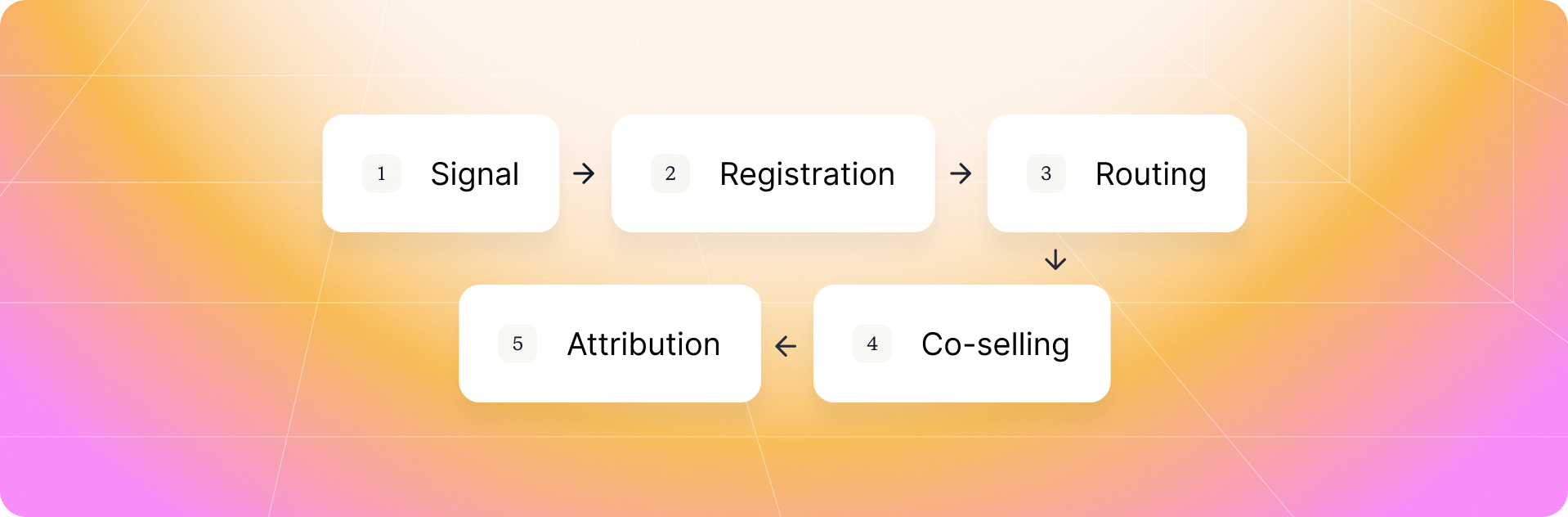
The practical ELG loop has five stages. Revenue leaders need all five, or the partner ecosystem may create activity without evidence.
Signal → Registration → Routing → Co-selling → Attribution
Capture the ecosystem signal
A signal might come from:
- An account overlap
- A warm introduction
- A referral form
- A partner-sourced lead
- A partner who sees expansion potential inside a shared customer
These signals often disappear in inboxes, Slack threads, spreadsheets, and call notes. Use a consistent intake path that captures the account, contact, partner, motion, context, and requested next step.
Register the lead or deal in the CRM
The signal becomes operational when it enters HubSpot or Salesforce. A deal and lead registration workflow should:
- Attach the right partner
- Identify whether the deal is sourced or influenced
- Capture the relevant notes
- Check for duplicate or competing claims
This is how you bring partner data into the system the sales team already uses. Clear governance and trust mechanisms also tell partners how opportunities are accepted, protected, routed, updated, and credited.
Route it to the right owner
Routing rules can assign the opportunity based on:
- Territory
- Segment
- Product
- Language
- Existing account ownership
The partner team should also define who manages the relationship and who owns the next customer action. Good routing prevents a warm lead from waiting without an owner or a sales rep contacting the account without the context that made the introduction valuable.
Work the opportunity through co-selling
Co-selling is coordinated work around a shared opportunity. Depending on the deal, the partner might:
- Make the introduction
- Provide account context
- Validate the joint solution
- Join a customer call
- Help answer a technical question
Guided selling for partners gives sales reps the relevant guidance without turning every deal into a manual partner-team project.
Operationalizing nearbound workflows enhances prospect introductions because each introduction arrives with context and a clear action. ELG strategies can improve conversion velocity across sales cycles when both companies agree on the problem, roles, and next step.
Close and attribute the result
When the deal moves, keep the sourcing and influencing partners attached to the CRM record. Track:
- The outcome
- Deal amount
- Cycle time
- Each partner's role
If more than one partner contributed, separate the credits instead of forcing every contribution into one field.
The signal then becomes a partner-sourced deal or partner-influenced deal, connecting ecosystem-led activity to pipeline and revenue.
How to start ecosystem-led growth with a small partner ecosystem
Many ELG explanations begin with a large ecosystem data layer and hundreds of mapped relationships. That can make the motion feel reserved for leading tech companies implementing ELG at scale. It isn't.
A small partner ecosystem can start with one or two partners that share customers, target accounts, or a clear joint use case. Prove one repeatable workflow before expanding the company's ecosystem.
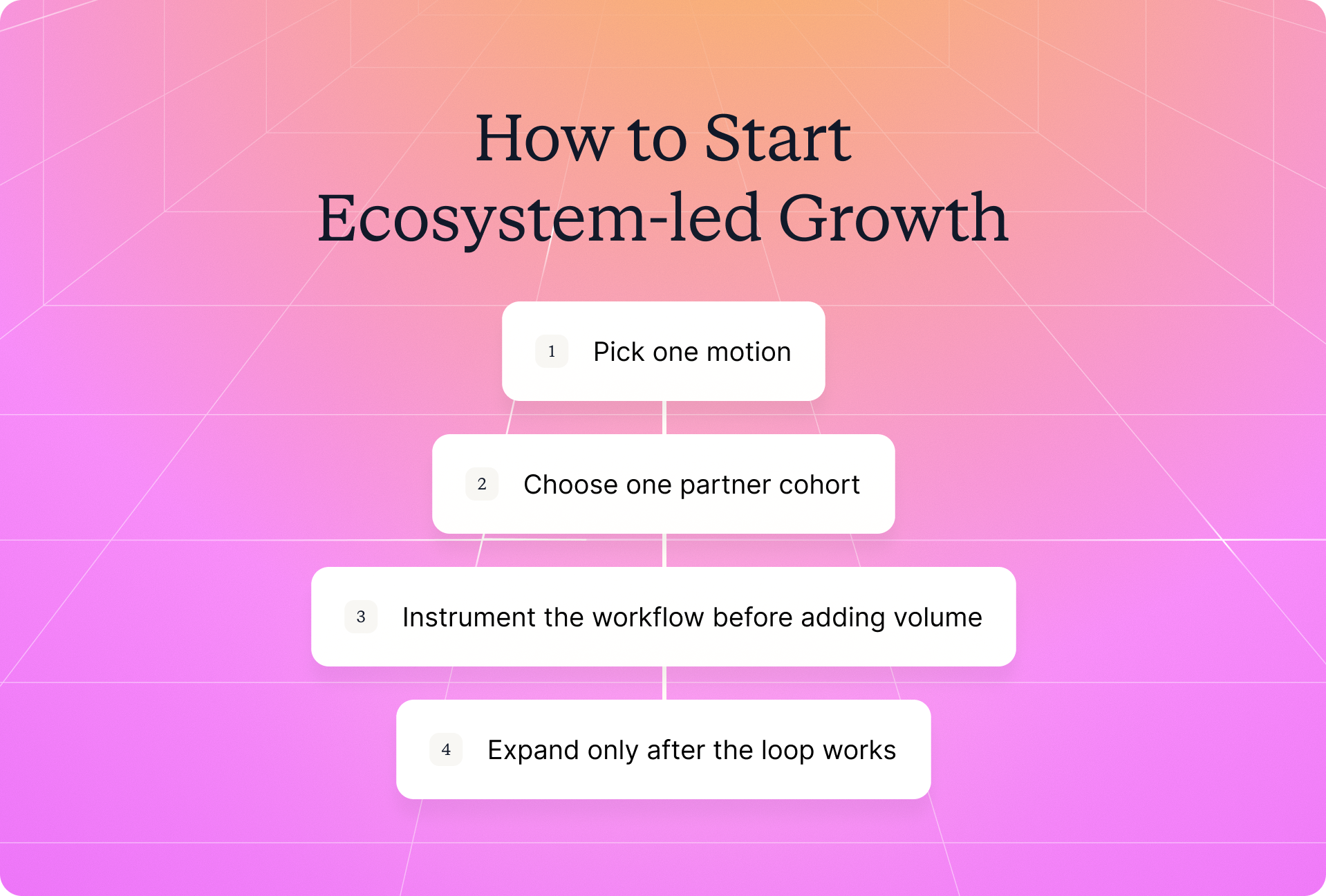
Step 1: Pick one motion
Choose a motion that matches the relationships you already have. A B2B referral program is often the lightest starting point. Co-selling works when both companies serve the same buyer with a complementary offer. Reseller channel partnerships make more sense when a partner is expected to own more of the commercial process.
Step 2: Choose one partner cohort
Choose a small first cohort with strong customer fit, responsive contacts, and enough trust to share context. Do not select partners only because their logos look impressive.
Step 3: Instrument the workflow before adding volume
Define intake, qualification, routing, follow-up, and attribution in the CRM. Agree on what counts as an accepted referral, an influenced deal, and a useful introduction. Decide how both teams will manage relationships and resolve conflicts.
This turns an exciting new strategy into an operating motion and gives go-to-market leaders a controlled cohort. Company growth leveraging partners becomes easier to fund when that group produces clean evidence.
Step 4: Expand only after the loop works
Once the team can register, work, and measure the first opportunities, add more partners or a second motion. This is how smaller SaaS companies develop scalable growth plays without creating a large partner program before they know what works.
The result may not break sales records in the first quarter. It should produce a repeatable process that can generate leads, protect new relationships, and guide the next investment.
Do you need account mapping for ecosystem-led growth?
No, you do not need mapping software to start ecosystem-led growth. It becomes powerful as partner ecosystems grow because it helps teams find overlap at scale. It is a discovery layer, not the complete execution system.
The ecosystem data layer supports account mapping and market expansion
An account mapping matrix compares the customers and prospects held by two companies. The ecosystem data layer enables secure data sharing among partners, helps identify overlapping customers and co-selling opportunities, and supports data-driven decisions without exposing full customer lists.
This ecosystem data layer addresses a lack of hard partner data. The technology emphasizes data integrity in managing partner data, while a mature mapping process helps teams prioritize accounts. High-density partner ecosystems can indicate ecosystem health and capacity because the density of partner interactions shows how often useful connections form.
The CRM runs the motion
Mapping tells you that an overlap exists. It doesn't, by itself, register the lead, assign the sales rep, record a warm introduction, manage deal updates, or attribute the result.
Referral, co-sell, and reseller motions act on ecosystem relationships in the CRM. You can run meaningful ELG with known relationships before adopting a mapping platform. Once overlap volume becomes difficult to review manually, mapping helps you find and prioritize opportunities faster.
Introw works alongside Crossbeam rather than replacing it. The Crossbeam integration brings overlap data into partner workflows, while HubSpot or Salesforce remains the source of truth for execution and proof.
How to prove ecosystem-led growth is working
A partnerships leader still has to prove what happened in their pipeline. That means defining credit clearly and measuring outcomes from CRM records.
Separate sourced and influenced credit
A sourcing partner creates the opportunity. An influencing partner helps advance an existing opportunity through context, access, expertise, or delivery support. Keep those roles distinct so one partner doesn't receive the wrong kind of credit.
Partner attribution should link each deal to the partner or partners involved. Introw's deal-attribution documentation supports separate sourced and influenced relationships, including multiple partners on one deal. Accurate attribution also supports shared pipeline visibility, reporting, and commission eligibility.
Track the metrics that show commercial lift
Use a compact set of key metrics that your CRO and RevOps team can inspect:
Metrics like ecosystem-sourced revenue track ELG performance, while partner-influenced pipeline measures deals involving partners' roles. Conversion velocity indicates the time from introduction to closed-won. Expansion and retention rates compare churn and growth for partner-supported customers.
Do not claim that ecosystem-qualified leads show higher win rates and larger deal sizes unless your data proves it. Define ecosystem qualified leads by agreed fit, partner context, and intent criteria, then compare them with a relevant baseline.
Measure ecosystem health below the revenue line
Revenue is the outcome, but partner interaction density shows whether the motion can sustain it. Review accepted introductions, active co-sell deals, response times, repeated collaboration, and funnel coverage.
Channel partner performance management helps you act on which partners produce, while a clear PRM vs. CRM model keeps the underlying revenue evidence in the right system. This makes partner-sourced revenue easier to defend and fund.
The channel partnerships that deliver ecosystem-led growth
ELG is the strategy. These are the executional plays underneath it. Match the partner mix to the buyer, product, and ownership each relationship can support.
Co-selling turns shared context into action
Co-selling coordinates two companies around shared target accounts or active deals. One partner might introduce the buyer while the other leads discovery. In a deeper motion, both shape the joint solution through close.
Use guided selling for partners to give each seller the next best action and relevant context.
Referral partnerships create warm introductions
Referral partners introduce a qualified prospect and usually do not own the sale. A B2B referral program defines qualification, registration, sales ownership, updates, and rewards so introductions do not become untracked emails.
The right partner types support different outcomes
Referral partners, resellers, solution partners, integration partners, agencies, and service providers contribute in different ways. Review the types of channel partners before applying one process or incentive model to every relationship.
Partner journey management moves partners to productive
Partner journey management connects onboarding, enablement, activation, deal work, and growth so partners know what progress looks like.
Partner performance shows where to invest
Channel partner performance management helps leaders compare fair peer groups and decide where to add enablement, co-sell support, or executive attention. It also shows when a relationship isn't producing enough mutual value.
Ecosystem-led growth: A step-by-step starting plan
Use this directional sequence, adjusting ownership and timing to fit your business.
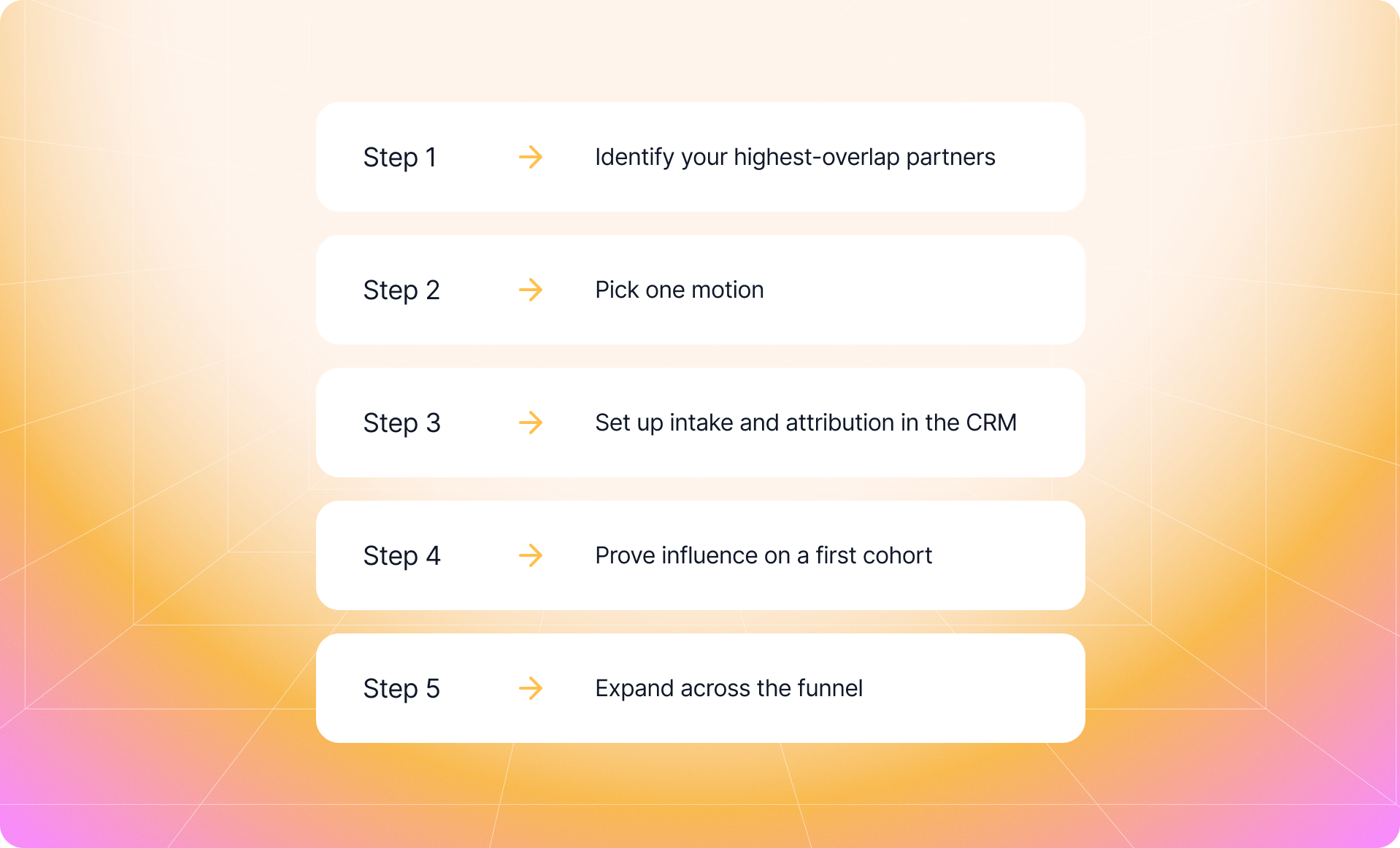
1. Identify your highest-overlap partners
Start with partners that share a buyer, customer problem, or complementary product. Ask sales and customer success where partners already influence accounts. You do not need vast amounts of data at your fingertips. Savvy companies can start with known relationships and validate them against CRM records.
2. Pick one motion
Choose referral, co-selling, reseller, integration, or another defined motion. Record who creates demand, qualifies it, owns the deal, and supports the customer.
3. Set up intake and attribution in the CRM
Create a repeatable registration path. Capture the partner, motion, source, account, contact, context, status, and owner. Decide whether contributions are sourced or influenced before deals arrive.
4. Prove influence on a first cohort
Track a manageable set of partner sourced deals and influenced deals. Compare win rate, deal cycles, deal size, and conversion velocity with a relevant non-partner cohort. Review it with RevOps and revenue leaders.
5. Expand across the funnel
Begin with acquisition, then add retention and expansion where partners create real value. Establish joint customer success initiatives for shared accounts. Add ecosystem-led marketing only when the audience and offer are genuinely useful, not simply because two logos can appear on a webinar.
As the motion grows, effective ecosystems create mutual value through repeated participation. This is where leveraging partner ecosystems can support market expansion, stronger customer relationships, and durable revenue growth.
How Introw supports ecosystem-led growth
Introw provides a CRM-first execution and proof layer for partner programs. It helps partner teams act on ecosystem signals in HubSpot or Salesforce, with an optional portal.
An ecosystem-led growth platform should execute a known motion, not create another data silo. Introw helps bring partner data into the revenue process and show sales and marketing success through CRM evidence.
If ecosystem signals still disappear between spreadsheets, inboxes, and the CRM, request a demo to see how Introw turns them into tracked, attributed revenue.
Still curious? Here are some quick answers to help clear things up
Partner teams register an ecosystem signal in the CRM, route it, work it through a referral, co-sell, reseller, or integration motion, and attribute the outcome. The loop turns partner activity into measurable pipeline, revenue, retention, or expansion.
No. You can start with known relationships. Account mapping helps larger partner ecosystems find overlaps and prioritize accounts at scale. The resulting motions still need intake, ownership, collaboration, and attribution in the CRM.
Track ecosystem-sourced revenue, partner-influenced pipeline, win rate, conversion velocity, deal size, retention, and expansion. Keep sourced and influenced credit separate, and compare ecosystem-touched deals with a fair baseline. High-density partner ecosystems may signal capacity, but commercial performance must still be proven in your own CRM.
Bob Moore and Crossbeam popularized ecosystem-led growth through Moore's March 2024 book. The concept gives companies a framework for using partnerships to support sales, customer success, and market expansion.




Are you already an active Introw partner?
Book a demo with one of our partner program experts, or explore Introw on your own time.