

What is channel partner performance management?
Channel partner performance management measures, compares, and acts on the commercial results of channel partners.
Effective partner performance management includes defining clear expectations and metrics, then using the resulting data to decide where investment, intervention, or exit is warranted.
It directs resources toward channel partners producing strong business outcomes while helping underperforming partners recover.
Companies with performance management can see higher partner retention rates because they identify and address problems earlier.
1. Measure: Track partner activity, pipeline, revenue contribution, engagement metrics, and other performance metrics.
2. Analyze: Compare results over time and with relevant peers. A balanced scorecard approach can mix quantitative metrics with qualitative inputs, but the inputs and weighting belong in a dedicated partner scorecard.
3. Act: Decide whether to invest, intervene, downgrade, or exit. That final step turns tracking partner performance into management.
A dashboard can show that partner-sourced revenue fell last quarter. Partner performance management asks what changed first, whether the decline is isolated, and what channel account managers should do next.
It also differs from structured lifecycle management. A partner lifecycle describes how one relationship progresses. Partner relationship management (PRM) covers the broader processes and technology used to manage the entire partner relationship.
Partner relationship management software, or PRM software, centralizes partner access to resources and tools. Performance management then judges results across the partner network and decides where resources should go.
Partner, segment, and program: three levels of performance
Useful performance tracking operates at three connected levels.
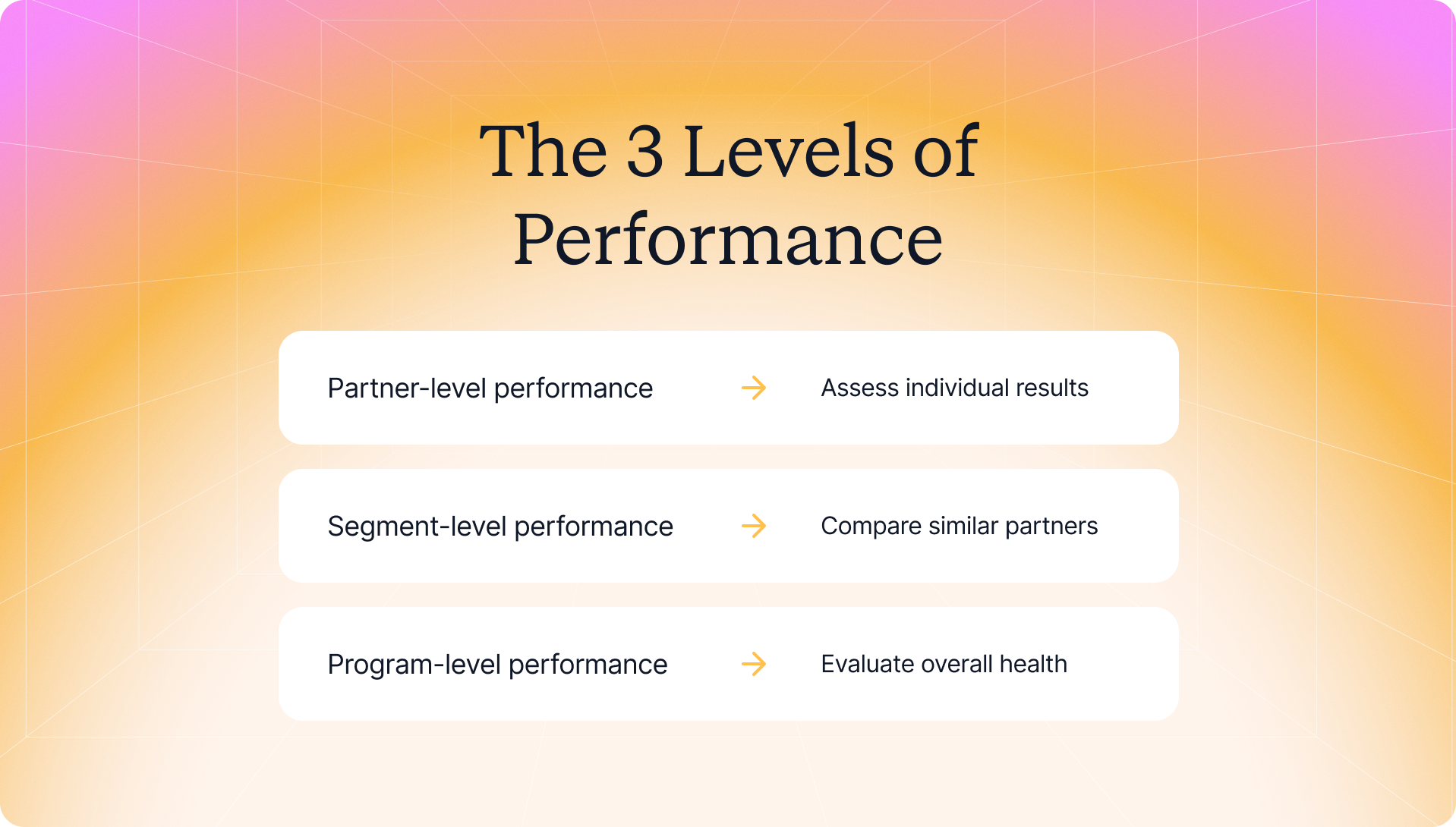
1. Partner-level performance: assess individual results
This shows whether one partner is meeting agreed-upon goals. Look at deal registration, pipeline, win rate, revenue, engagement, and recent trends. A channel partner management team should diagnose any decline.
2. Segment-level performance: compare similar partners
This compares like with like: referral channel partners with similar channel partners, newer resellers with similar resellers, or channel partners in the same region. If a segment declines, the cause may lie in the offer, incentive management, partner training, marketing materials, or product fit.
3. Program-level performance: evaluate overall health
This shows the health of partner ecosystems through pipeline, revenue outcomes, partner retention, partner satisfaction, customer satisfaction, and return on investment. Channel partner management uses cost optimization here to expose inefficient incentives and administrative overhead for external partners.
All three views matter. Strong aggregate revenue can hide declining channel partners, while one poor quarter from one partner says little about the wider program. If many partners miss the same milestone, fix the partner program before treating the result as a list of individual failures.
The leading vs. lagging KPIs
Lagging indicators tell you what already happened. Leading indicators show behavior that tends to happen before a commercial result, giving you time to act.
Both belong in partner performance management. Lagging indicators rank results and review past investments. Leading indicators support performance monitoring and show where future results may be at risk. Revenue-only performance tracking discovers the problem after its earlier causes have compounded.
Lagging indicators: use the scoreboard to rank results
Lagging indicators show which channel partners produced results across tiers, regions, and motions. Revenue metrics include total channel revenue and revenue growth rate.
Use them to:
- Rank commercial performance using revenue, attainment, win rate, margin, and retention.
- Separate sourced revenue from influenced revenue. Partner-sourced revenue measures business the partner originated, while influenced revenue credits meaningful contributions to deals created elsewhere. Introw's guide to partner attribution explains why these relationships need to be defined on the CRM deal rather than reconstructed later.
- Review past investments during partner business planning, while recognizing that these measures are weak early warnings. When quarterly revenue drops, its cause may be months old.
Leading indicators: use early signals to anticipate results
Leading indicators show whether the behaviors that produce revenue are strengthening or fading. Focus on four questions.
1. Is opportunity creation slowing?
Deal registration velocity shows whether channel partners are still producing new opportunities. A partner that usually registers four deals a month and suddenly registers none has changed its behavior before the decline appears in its revenue report.
Make deal and lead registration easy enough that the data is representative. If channel partners keep deals in email or private spreadsheets, low registration may reflect process friction rather than lower demand.
2. Is partner engagement fading?
Engagement metrics include portal activity frequency and MDF utilization. A sustained decline can indicate that the partner is giving the program less attention, even before pipeline or revenue falls.
3. Are enablement gaps widening?
Enablement metrics assess training completion rates and certification depth. Effective onboarding includes product knowledge and sales tools training, while ongoing enablement includes sales playbooks and marketing materials. Companies with structured onboarding can see higher partner retention rates because partners reach productive activity sooner and encounter fewer early barriers.
4. Do the signals point to the same problem?
Don't intervene based on one signal alone. Falling deal registration, fewer active opportunities, and lower partner engagement together provide stronger evidence of decline. Compare the pattern with the partner's baseline and a fair peer group while there is still time to change the outcome.
Together, these checks show when to investigate before an early warning becomes a missed revenue target.
Benchmarking and tiering: turning scores into decisions
Performance only becomes meaningful when you compare it fairly and connect the result to a resource decision.
Benchmark each partner against the right context and peer group, then use tiers to determine who receives more investment, support, and attention.
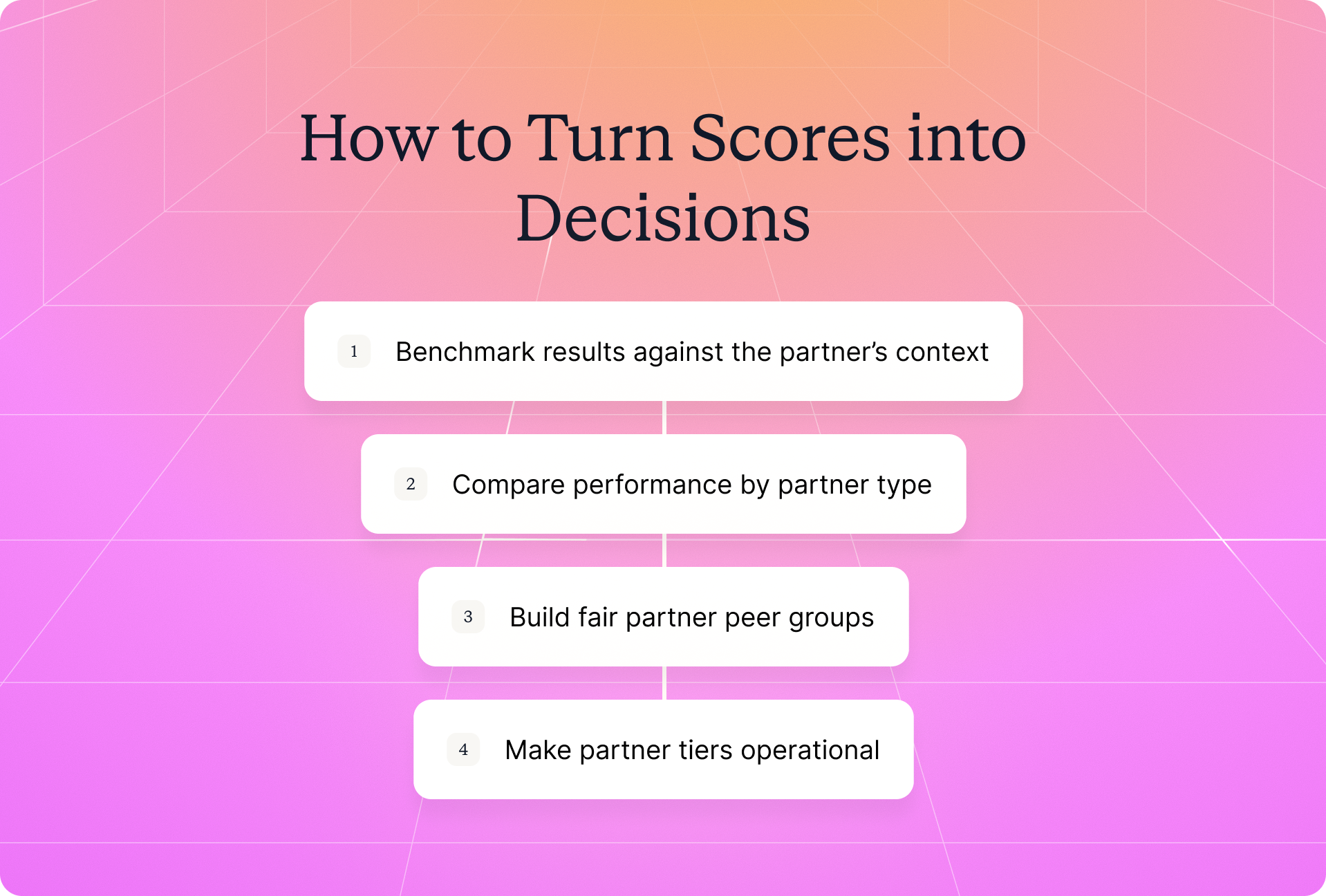
Benchmark results against the partner's context
Ten registered deals may be excellent for a new referral partner and weak for an established reseller. Effective partner performance management compares results against a relevant baseline before changing resources or status.
Compare performance by partner type
Different channel partners create value differently. Referral channel partners may be judged on qualified introductions and payout accuracy. Resellers may need certification, quota, margin, and renewal measures.
Introw's partner-type setup tracks show why channel partners require different workflows. Its overview of partner types provides wider context.
Build fair partner peer groups
Use tenure, market, region, size, or assigned potential to compare similar partners. Not all partners begin with the same opportunity, so don't assume partners contribute equally without accounting for role and potential.
Make partner tiers operational
In tiered partner programs, tiers should change what both sides receive and owe. Performance-based rewards drive partners to achieve better results; a badge without different access, requirements, or investment doesn't.
Adapt these tiers to your program's economics and sales motion. A PRM system can combine inputs into a health score, while partner performance management software uses the tier to set MDF eligibility, co-sell priority, QBR cadence, and executive involvement.
Reading the early warning signs of a declining partner
Use this four-step check to determine whether a change is temporary, partner-specific, or evidence of a wider problem.
Step 1: Confirm that the partner is actually declining
Start with the right scenario. A declining partner was previously productive but is now trending down. A new recruit that never activates needs a dedicated partner activation process rather than being treated as a performance issue.
Step 2: Trace what changed before revenue fell
Trace the sequence: deal registration slows, pipeline thins, partner activity and communication weaken, and revenue falls last.
Missing events can be equally revealing. No registration this month, no update on deal progress, or a QBR moved twice may say more than completed activity.
Step 3: Test the signal against the right context
Compare the change:
- Against the partner's recent pattern
- Against peers with similar type, tenure, region, and potential
- Across partner ecosystems to determine whether the problem is isolated
Account for seasonality and reporting changes before escalating. One quiet week rarely warrants intervention, but several leading indicators moving together deserve attention.
Step 4: Set an alert that prompts human review
Define normal partner activity and flag material deviations from it. Partner relationship management software can centralize partner data, engagement metrics, and pipeline, but an owner must interpret the change.
Use partner communications to establish the outreach cadence. The channel partner management decision is whether intervention is warranted, not how to rebuild a re-engagement sequence.
What to do when a partner's numbers slip: the intervention playbook
Catching decline matters only if it changes the response. Recruiting a new partner can be costly, so intervene before replacing a partner whose fit remains sound.
Set a review date, define the consequence of continued decline, and reserve greater investment for strong performers.
Turn the diagnosis into a time-bound decision
- Confirm where the problem sits. Compare the change with the partner's baseline and peer group. If many channel partners decline together, investigate partner ecosystems and optimize partner programs rather than repeat individual interventions for underperforming partners.
- Match support to the blocker. If opportunities stall at configuration, pricing, or next-step decisions, guided selling for partners may be more useful than general training. Enabling partners around live deals makes the outcome measurable.
- Define what recovery looks like. Record the baseline, actions, targets, and review date in your PRM system. Regular business reviews help assess partner performance and facilitate improvement discussions. Define partner success as progressing named opportunities or restoring a consistent deal registration cadence.
- Reallocate based on the result. Invest in high-performing partners when the pipeline supports more co-sell time or executive access. Optimizing partner performance still requires proof of future potential. If support fails, pause market development funds and consider a downgrade or exit. Reassign accounts carefully to avoid channel conflict, protect the partner relationship, and limit disruption to customer interactions.
This process turns tracking performance into partner performance management by connecting each signal to a proportionate decision and measurable outcome.
How Introw manages partner performance from your CRM
Effective partner relationship management (PRM) systems automate workflows and enhance partner engagement. PRM tools integrate with CRM systems for better data consistency, giving teams faster, clearer decisions without another disconnected system.
Introw supports channel partner management on top of HubSpot or Salesforce.
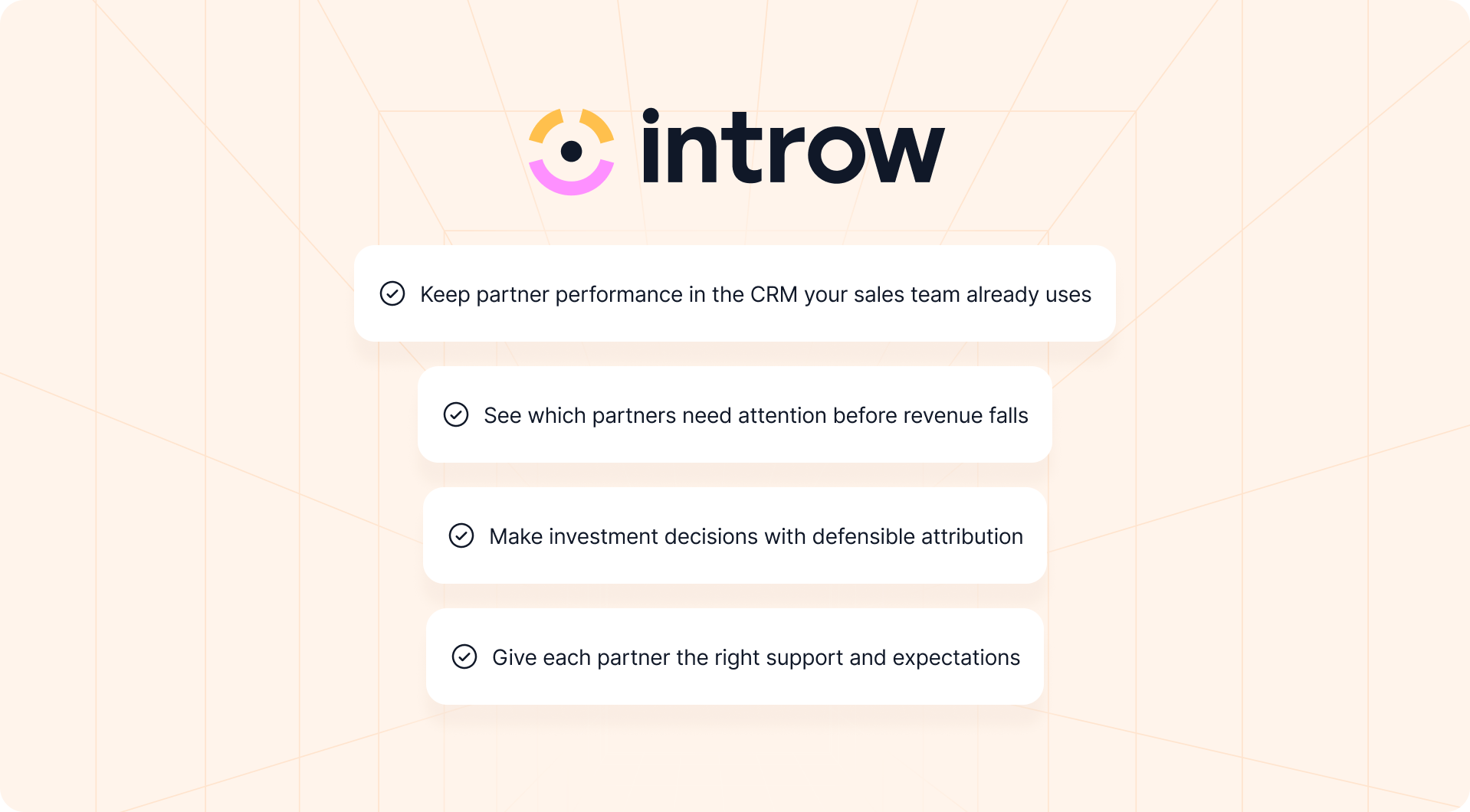
Keep partner performance in the CRM your sales team already uses
Sales and channel teams work from the same partner records, activity, deals, and revenue. Fostering collaboration helps build trust and drive mutual value in partnerships, while shared data reduces reconciliation work.
See which partners need attention before revenue falls
Introw's partner reports and dashboards let you compare performance by partner, segment, or partner manager, including:
- Revenue and weighted pipeline
- Deal count and average deal size
- Sales-cycle length
- Partner activity and interactions
This combines performance tracking with the context needed to identify what changed, where support is required, and whether an intervention is working.
Make investment decisions with defensible attribution
Introw's help documentation explains how to configure deal attribution using CRM properties or associations. Sourced and influenced relationships then feed partner records, shared pipelines, reporting, and commissions.
That gives teams a clearer basis for deciding which partners deserve MDF, co-sell support, or executive attention.
Give each partner the right support and expectations
Introw's partner relationship management (PRM) software lets you tailor:
- Benefits, access levels, and requirements by partner tier
- Reporting by partner type, tier, region, or role
- Experiences that reflect how different channel partners create value
Your team remains responsible for:
- Defining peer groups and performance thresholds
- Deciding where to invest, intervene, or exit
- Managing the people behind each partner relationship
Introw provides the partner data and reporting tools to support those decisions. Channel partner management software should improve partner engagement and help protect partner retention without replacing human judgment.
Don't wait for quarterly revenue to reveal which partners are slipping. Introw's partner management platform brings partner activity, pipeline, attribution, and performance into your CRM so you can act sooner.
Book a demo to see it in action.
Still curious? Here are some quick answers to help clear things up
Leading indicators, such as deal registration and pipeline creation, signal what may happen next. Lagging indicators, including revenue, win rate, and retention, report completed results. Partner performance management uses both, while performance tracking connects each change to an action.
Partner performance management evaluates individual channel partners and comparable groups. Channel performance management covers aggregate pipeline, revenue, costs, and indirect sales channels. Partner relationship management (PRM) organizes the data, while channel partner management determines where to invest or intervene.
Compare the partner with its baseline and peers, identify the likely cause, and choose a focused intervention. Set a review date and clear expectations. If partner performance doesn't recover, reconsider the tier, pause investment, or plan an exit. If several channel partners decline together, investigate the partner program.





Are you already an active Introw partner?
Book a demo with one of our partner program experts, or explore Introw on your own time.