

What is through-channel marketing automation?
Through-channel marketing automation (TCMA) is a category of software and process that lets a brand distribute, customize, and automate marketing campaigns run through its partners while keeping brand control. It's sometimes called distributed marketing.
This approach combines traditional marketing automation with workflows designed for partner channels. For B2B SaaS teams, TCMA marketing works best when campaign activity, partner attribution, and CRM revenue data stay connected.
Core TCMA capabilities
The core capabilities are content syndication, co-branded assets, campaign automation, MDF and co-op funding, lead routing, and analytics.
Together, these tools help partners launch approved campaigns while the brand controls its messaging, design, and campaign rules.
What TCMA means for B2B SaaS
Traditional channel marketing automation often supports brand-to-local marketing across large franchise, dealer, or branch networks. Those programs may need to coordinate thousands of localized campaigns across digital, print, social media, and paid advertising.
B2B SaaS programs usually need a narrower setup. A reseller might run a co-branded webinar, a referral partner might send an approved email sequence, or a co-sell partner might share a joint asset with an attributed link.
Distribution is only half the job
Distributing content is the easy half of through-channel marketing automation.
The harder half is connecting each partner campaign to the leads, registered deals, pipeline, and revenue it produces. That's where B2B SaaS programs should focus. TCMA becomes valuable when partner marketing activity flows back into the CRM and gives the business a clear, defensible view of revenue impact.
TCMA vs. partner marketing automation vs. channel marketing
These terms overlap, but they describe different levels of control and partner autonomy. The right model depends on who designs and executes the campaign, and how much freedom the partner needs.
Through-channel marketing automation is ideal for top-down coordination. It lets a vendor maintain brand integrity while empowering partners to reach their audiences. PMA gives partners more autonomy and supports collaborative marketing strategies. Channel marketing covers both approaches, plus recruitment, enablement, incentives, and partner engagement.
Most B2B SaaS programs don't need a full PMA suite on day one. They need focused through-channel marketing automation tools, usually co-branded content, campaign support, and CRM attribution. Add autonomy when partners have the skills and business needs to use it.
What you can actually do with TCMA
The key features of through-channel marketing automation remove repeatable work for both sides. Good tools help partners launch relevant content without weakening brand standards.
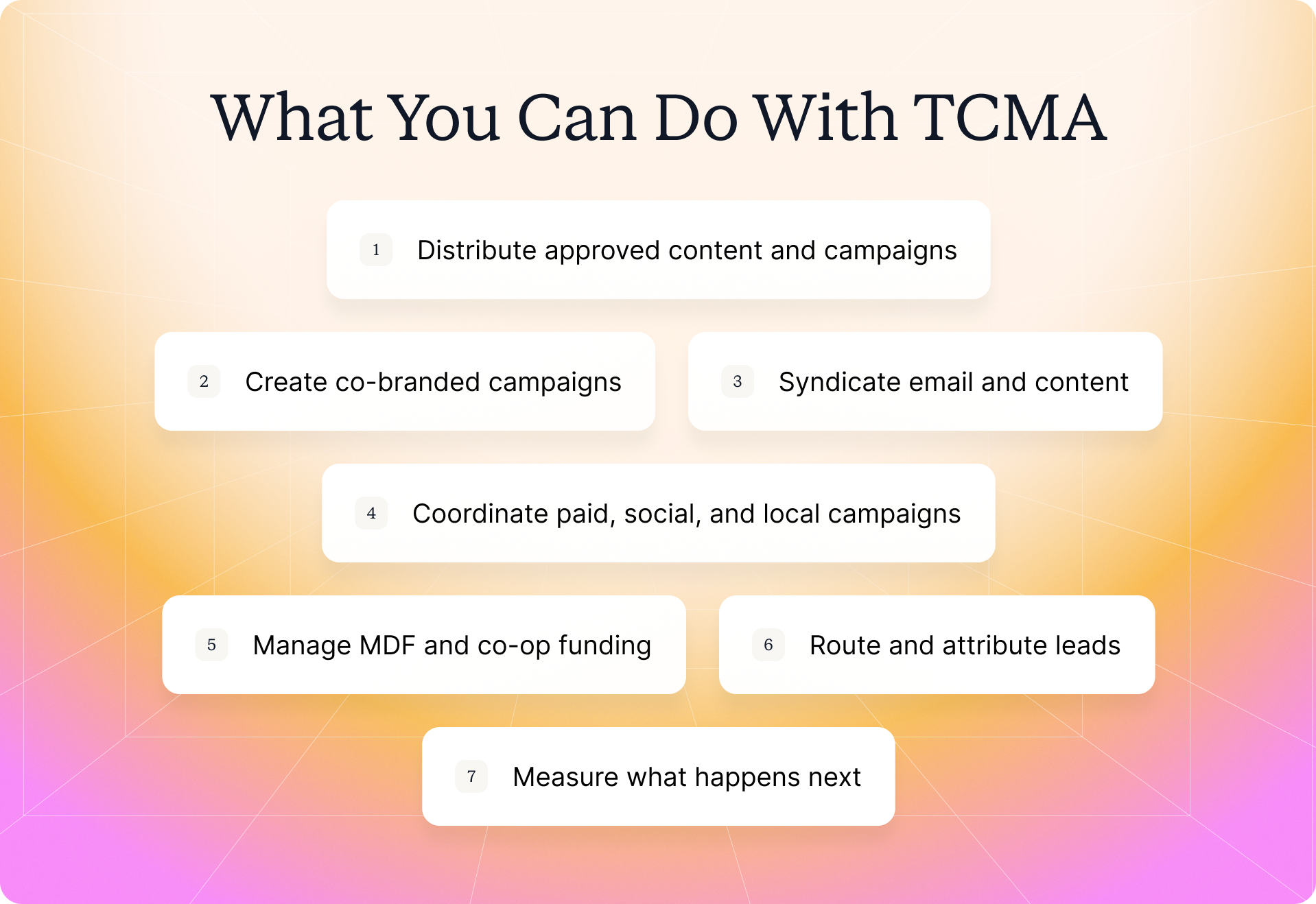
- Distribute approved content and campaigns. Give partners a centralized hub for current decks, emails, landing-page copy, event kits, and other marketing materials. Content distribution can be self-service or pushed to selected partner segments.
- Create co-branded campaigns. Local partners can customize templates with their name, logo, and offer while the core brand messaging stays fixed. This ensures brand consistency while keeping campaigns relevant to end customers.
- Syndicate email and content. Partners can deploy vendor-approved sequences or publish marketing content through their existing systems. This reduces rewriting and keeps marketing messages consistent.
- Coordinate paid, social, and local campaigns. Full distributed marketing platforms may support digital advertising, print, and local media across multiple regions. They can use customer behavior to adapt work across various channels and customer journeys.
- Manage MDF and co-op funding. Partners request funds, submit plans and proof of spend, and report results. The vendor can apply consistent approval rules and track where the money goes.
- Route and attribute leads. Form submissions and partner-generated leads can flow to the correct CRM owner with the partner relationship attached from the start.
- Measure what happens next. Centralized dashboards can combine content use, campaign performance, lead generation, registered deals, and revenue outcomes.
Through-channel marketing automation can deliver enhanced brand consistency, but control isn't the only goal. It also reduces campaign friction. Easy-to-use tools help partners generate demand without waiting for the vendor to launch every campaign.
How to run TCMA so it produces pipeline, not just campaigns
Many through-channel marketing automation programs report emails sent, assets downloaded, or partners active. Those signals don't tell you whether the marketing efforts produced revenue.
Build one measurable campaign-to-revenue loop
The core loop should be simple enough for Marketing, Partnerships, Sales, and RevOps to follow:
Co-branded campaign → partner-generated lead → registered deal → attributed pipeline → closed revenue
Give every campaign or partner a unique identifier. Carry it into the lead record when someone clicks or submits a form, then preserve it when the lead becomes a deal. A CRM-native deal and lead registration process stops that credit from disappearing during handoff.
Here, through-channel marketing automation and lead management must work together. Automation speeds up routing, but that gain disappears if the record loses its campaign and partner data.
Separate sourced revenue from influenced revenue
A partner-sourced deal exists because the partner created it. A partner-influenced deal already existed, but the partner helped advance it. Keep those relationships separate on the CRM record.
Clear partner attribution makes the channel marketing story defensible. It also prevents a single deal from giving full credit to several partners or marketing campaigns at once.
Track the metrics that support decisions
Use activity data to diagnose execution, then use pipeline data to judge value.
Tracking campaign performance across these layers gives you actionable insights and supports data-driven decisions. Stop weak campaigns and invest in partner types and marketing programs that produce revenue.
How MDF fits and how to make it attributable
MDF and co-op funding are the investment layer beneath many through-channel marketing campaigns. The vendor helps pay for a webinar, event, email campaign, or digital advertising program that a partner runs.
The basic workflow allocates funds, collects a proposal, gathers proof of expense, and reimburses the partner. It controls spend but doesn't show whether the marketing activities worked.
An attributable MDF workflow adds campaign and CRM data to the same chain:
- The partner requests funding for a defined activity and audience.
- The vendor approves the amount, timeline, and expected outcome.
- The campaign uses partner-specific links, forms, or tracking identifiers.
- Leads and registered deals retain the partner and campaign relationship.
- The team compares the MDF spend with sourced pipeline and revenue.
This turns fund management into an investment decision. Introw's CRM-connected marketing development funds workflow supports allocation, proposals, approvals, proof of spend, ROI, and reimbursement with partner attribution. Start simply, then add stricter proof and ROI stages as the program matures.
How much TCMA do you actually need?
The right answer depends on partner workflows, not the longest feature list. A SaaS business with 40 partners has different needs from a manufacturer coordinating thousands of dealers across local markets.
A lightweight, CRM-native setup is enough when
- Your partners already use HubSpot, Salesforce, Marketo, or another marketing automation platform.
- Your main use cases are co-branded assets, referral links, webinars, email sequences, or joint content.
- You need better partner attribution, deal registration, and campaign reporting.
- One partner marketing team manages the program without a large services operation, improving the partner experience without adding headcount.
- Partners can execute campaigns in their own tools once you supply approved content and tracking.
This approach uses through-channel marketing automation as an asset and data layer. Partners keep their existing systems. The vendor focuses on maintaining brand integrity and gets performance data back in the CRM.
A full, distributed marketing platform makes sense when
- You support hundreds or thousands of franchisees, dealers, branches, or agents.
- Local markets need different languages, offers, prices, print materials, or media plans.
- Brand compliance must be enforced across digital, social, print, and paid media.
- Partners lack their own marketing teams and need done-for-me campaign management.
- Your channel strategy requires centralized buying, budget controls, predictive analytics, or complex approval chains across multiple channels.
In that case, full through-channel marketing automation tools provide control and cost efficiency at high volume. For many SaaS teams, the whole stack adds work before value. Start with the smallest system that closes the loop from partner activity to pipeline.
Where TCMA fits in the rest of your partner motion
Through-channel marketing automation is one part of a partner program. It enables partners to market, while surrounding motions turn leads into deals and performance into investment decisions.
Partner journey management prepares partners to execute
Campaign access should follow onboarding and readiness. Partner journey management gives each partner the right action and marketing resources instead of opening the entire partner ecosystem to every campaign.
Referral and co-sell motions create different campaign needs
Referral partners may need an attributed link and email sequence. Resellers may need a webinar kit and follow-up assets. A structured B2B referral program keeps ownership clear when those campaigns generate interest.
Performance data guides investment
Campaign activity matters when it changes a decision. Channel partner performance management connects participation, pipeline, and revenue so you know where to train and support partners, invest, or pull back.
Attribution connects every motion to revenue
The CRM relationship between partner, campaign, and deal protects credit as the opportunity moves. Without it, content use and campaign effectiveness stay isolated from the sales outcome.
Ecosystem-led growth is the wider strategy
Ecosystem-led growth covers referrals, co-selling, integrations, services, and partner-led demand. Through-channel marketing automation is the marketing execution layer within that system.
In short, through-channel marketing automation is how partners market. The rest of the motion is how those marketing efforts become tracked, attributed revenue.
How to run TCMA in 2026: A practical starting sequence
You don't need to automate every channel at once. Start with one repeatable through-channel marketing automation path, learn where it breaks, and expand from evidence.
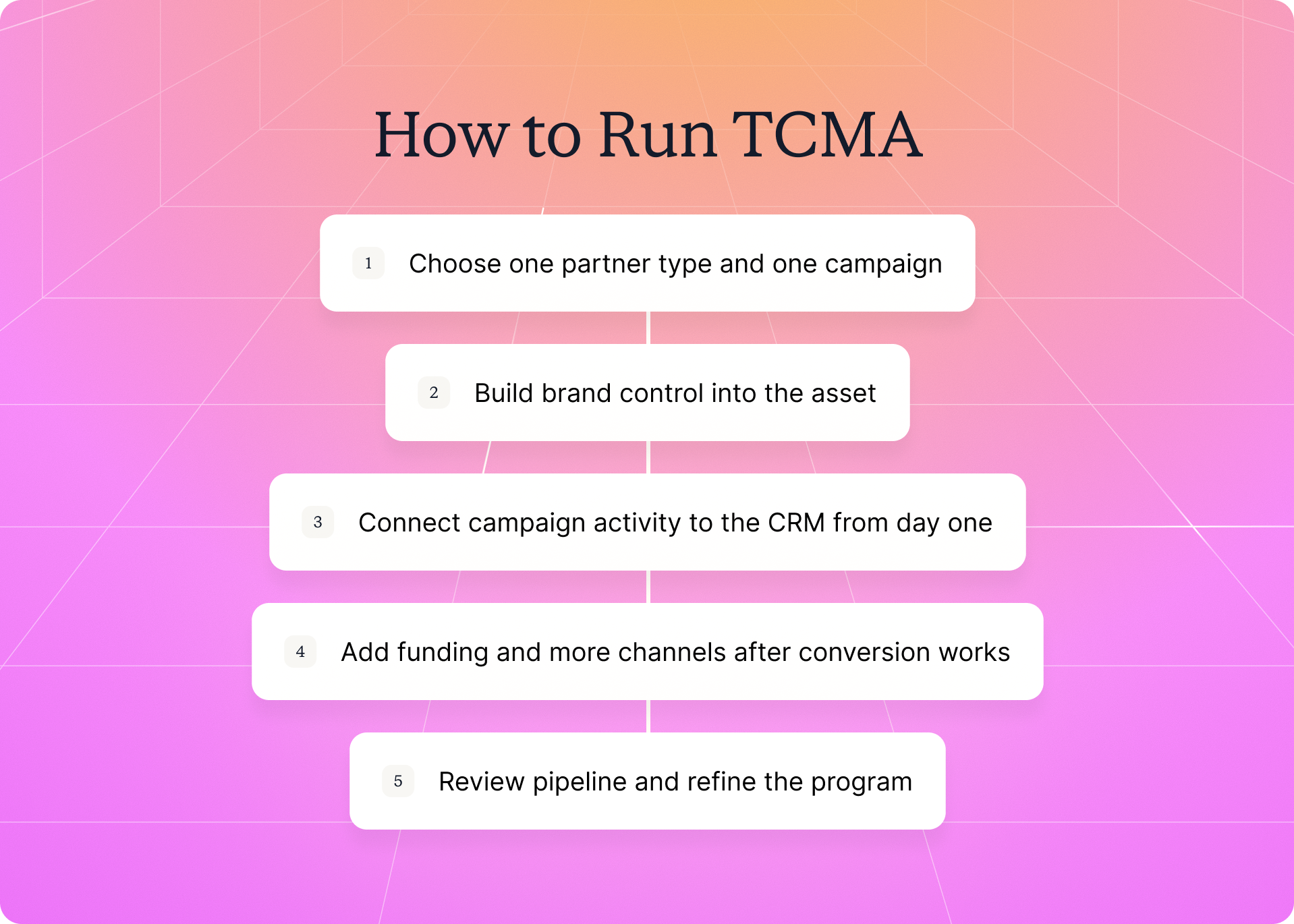
1. Choose one partner type and one campaign
Pick a high-value partner segment and one simple motion, such as a co-branded email, webinar, or guide. Document who creates and approves it, how the partner launches it, and who owns the leads.
2. Build brand control into the asset
Lock positioning, design, legal language, and the main offer. Let partners personalize their logo, contact details, examples, or call to action. This maintains brand consistency without blocking useful customization.
3. Connect campaign activity to the CRM from day one
Create the campaign identifier, attributed link, form fields, routing rules, and partner relationship before launch. Test the path with a sample submission and fix any lost credit before scaling.
4. Add funding and more channels after conversion works
Once one campaign produces clean data, add MDF, paid promotion, social posts, or more through-channel marketing automation. Smart automation should remove proven bottlenecks, not multiply untested workflows.
5. Review pipeline and refine the program
Compare campaign performance by partner type, asset, channel, and audience. Use those data-driven insights to improve content, focus ongoing support, and decide where the next dollar goes.
There's a clear reason to act now, but it isn't the stale TCMA adoption statistic repeated online. Forrester's 2026 Partner Ecosystem Marketing Survey found that 75% of decision-makers expected partner marketing technology investment to rise. Nearly 70% of their partners still had low-to-medium marketing and demand maturity. Choose technology around real partner workflows.
How Introw runs TCMA from your CRM
Introw covers the parts of through-channel marketing automation that matter most to B2B SaaS. It isn't an enterprise brand-to-local suite for thousands of franchise ad campaigns. It's the CRM-native asset, workflow, and attribution layer around tools partners already use.
That boundary matters. Introw doesn't ask a reseller to abandon its marketing automation system. The vendor supplies brand-compliant content and attributable links, the partner runs the campaign, and results flow back to the CRM.
The broader partner management platform connects marketing activity to partner records, journeys, deal workflows, reporting, and revenue. You get one view without making a distributed marketing database the source of truth.
If partners use your assets but you can't show what produced pipeline, book a demo to see how Introw connects through-channel marketing automation to attributed revenue in HubSpot or Salesforce.
Still curious? Here are some quick answers to help clear things up
Through-channel marketing automation lets you distribute approved content, create co-branded assets, automate campaigns, manage MDF, route leads, and track performance. For B2B SaaS, content enablement plus CRM attribution is often enough.
Track through-channel marketing automation participation and campaign metrics, then connect them to leads, registered deals, pipeline, and revenue in your CRM. Separate sourced from influenced credit.
Market development funds help partners pay for approved marketing activities. An attributable MDF process connects each request to leads, pipeline, revenue, and ROI.
Not always. Many programs need only a subset of through-channel marketing automation, such as co-branded content, attributed links, deal registration, and CRM reporting. Full platforms suit large networks running complex campaigns across many channels.
Through-channel marketing automation examples include a reseller webinar, a referral email sequence with an attributed link, and a co-sell one-pager that leads to a registered deal. Each should preserve brand consistency and connect activity to revenue.





Are you already an active Introw partner?
Book a demo with one of our partner program experts, or explore Introw on your own time.