


Why distributor sales training is different from standard partner training
Distributor sales training is different because distributors do not sell the same way referral partners do. They support resellers, coordinate pipeline, and help move deals forward across multiple layers of the channel.
That changes what your training needs to cover.
Here’s where they differ:
Software distributors need visibility into reseller activity without full CRM access. Training should explain attribution, pipeline flow, and where distributors support deals.
Hardware distributors work across longer deal cycles with technical contacts and quotes. Their training should cover specs, territory rules, and installation readiness early.
Once training reflects how distributors actually support deals, it becomes easier to define what they need to perform effectively across software and hardware motions.
What software and hardware distributors actually need to win deals
Most distributors are not closing deals themselves. They help resellers move opportunities forward. So distributor sales training should focus on coordination, visibility, and readiness, not just product knowledge.
Here’s how software and hardware distributor needs compare:
Many teams support these workflows through structured partner environments built for software distributors and hardware distributors, where visibility stays clear without opening the full CRM.
Across both motions, strong distributor sales training programs still rely on the same foundations:
- current assets distributors can trust and reuse
- clear rules for deal registration and ownership
- onboarding tailored to the distribution sales team
- visibility into downstream reseller activity
- confidence that attribution supports revenue growth
When distributors understand how they support deals inside your distribution sales process, they engage earlier and help create more pipeline.
With those needs clear, the structure of an effective distributor sales training program becomes much easier to design.
4 Core components of an effective distributor sales training program
Strong training works when it supports real deals, not just theory. Your goal is to help distributors understand how to act inside your motion and support resellers across indirect sales channels.
This applies whether you are running IT distributor sales training, building structured sales training for distributors, or improving how you are training the distributors sales team across regions.
Here are the components that make distribution sales training improve sales performance.
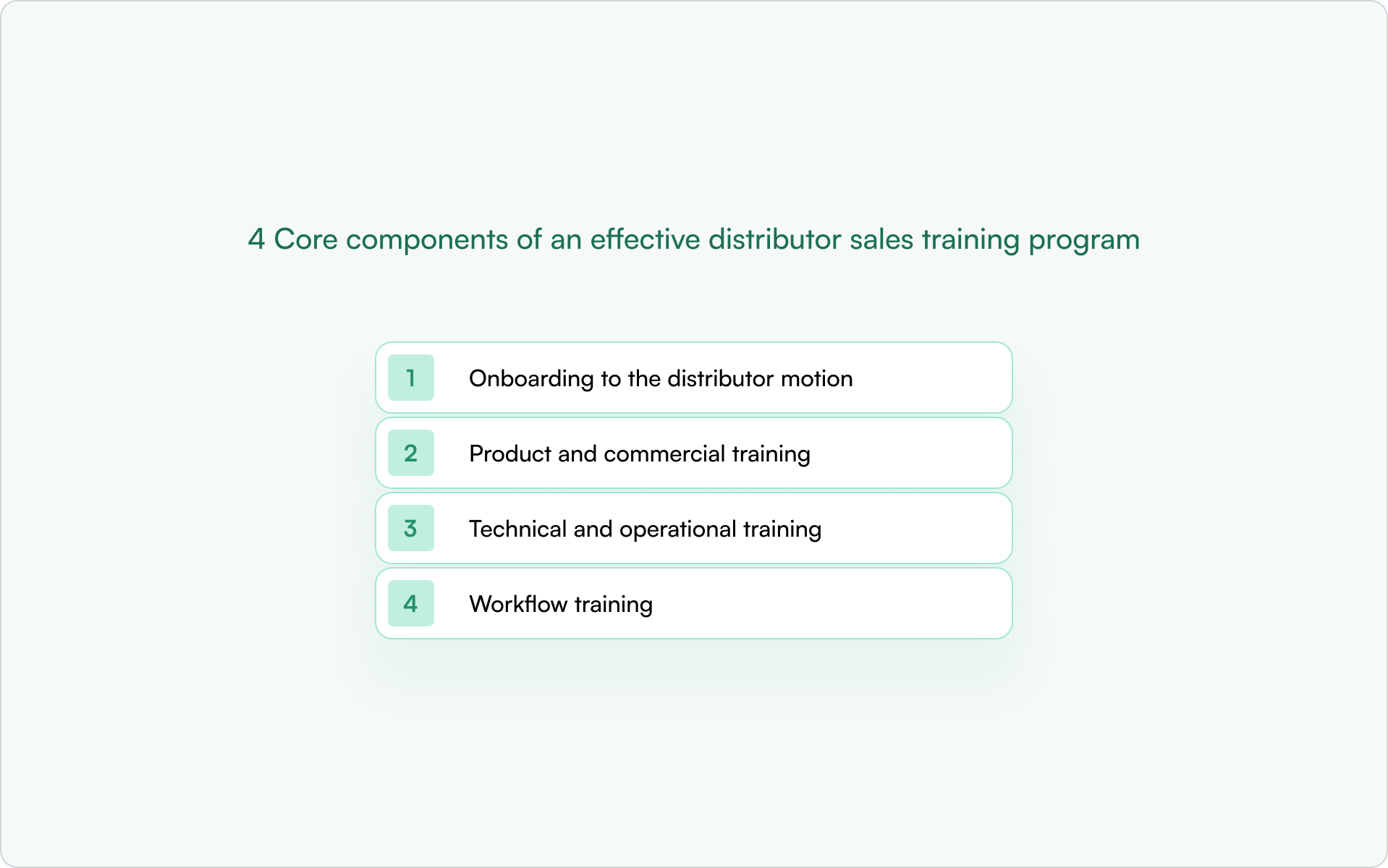
1. Onboarding to the distributor motion
Start by explaining how distributors fit into your distribution processes.
Your team should cover:
- how distributors support external partners and resellers
- how attribution works across the sales force
- where distributors influence pipeline and follow-ups
- what ownership rules affect daily operations
This helps sales reps and sales managers understand how they support customers earlier in the sales process.
Clear onboarding closes skill gaps fast and improves distributor performance. Next comes positioning and commercial readiness.
2. Product and commercial training
Generic sales training is not enough for distributors. They need positioning that fits your ecosystem and market.
Focus on:
- buyer pain points and market trends
- objection handling and consultative selling
- competitor positioning
- pricing context and sales conversation readiness
- modern sales foundations that help distributors sell smarter
This strengthens customer relationships and helps distributors increase sales without adding friction to reseller coordination.
Commercial clarity improves selling confidence. Technical readiness comes next.
3. Technical and operational training
Distributors often support installation, implementation, quoting, or inventory management depending on your industry.
Training should include:
- technical details needed during pre sales coordination
- specs and documentation access
- territory rules and stock levels awareness
- onboarding tasks tied to training completion
- short training videos that reinforce new skills
Structured training modules like these support stronger relationship building across multi-contact deal teams and create strong relationships with customers over time.
Operational readiness keeps deals moving. Workflow readiness makes them easier to close.
4. Workflow training
This is where many distributor training programs fall short.
Distributors need to know:
- how deal registration works
- how pipeline visibility supports more deals
- how to collaborate without CRM access
- how to support product launches
- how to manage follow ups across partner layers
When training connects directly to workflows, your teams see better sales results and clearer performance tracking tied to business goals.
If you want certification paths that reinforce these workflows, structured guidance like LMS partner certification strategies and practical frameworks explaining the LMS benefits for channel partner certification can help you design programs that scale across markets.
But even well-designed programs can underperform if they introduce friction too early, which is where many teams run into avoidable mistakes.
Common mistakes in distributor sales training
Distributor sales training fails when it looks like generic partner enablement instead of support for real channel work.
Here are six mistakes to avoid.
.png)
1. Starting with too much training before showing value
Many teams launch long certification tracks before distributors support real opportunities. Start with positioning, deal registration basics, and early workflows. Add deeper skills later.
Structured paths help once partners are active. Guidance on how certification programs improve partner engagement shows how training supports pipeline instead of passive learning.
2. Using one training path for every role
Sales and technical contacts need different training. Commercial teams need positioning and sales techniques. Technical teams need specs and installation readiness.
Role-based training improves adoption and customer loyalty.
3. Treating distributors like referral partners
Distributors coordinate resellers, attribution, and shared pipeline visibility. Training should reflect these responsibilities, not generic partner programs.
4. Ignoring workflows like deal registration and quoting
If distributors cannot support quoting, territory rules, or reseller coordination, they cannot influence deal outcomes.
Training must match real distribution processes.
5. Overloading distributors with content instead of relevant content
Large learning libraries create friction. Start with the skills needed to support active deals, then expand later.
Resources comparing the best partner certification program software help structure certification without slowing adoption.
6. Not connecting training to pipeline visibility or performance
Distributor training should support measurable activity across resellers and deals. When it does, adoption improves quickly.
Avoiding these issues makes it much easier to build role-specific learning paths that distributors can actually use in active opportunities.
How to structure distributor sales training by role
Start by separating distributor training into role-based tracks. Most programs fail because they treat the entire distributor team the same, even though commercial, technical, and manager roles support different parts of the motion.
.png)
Step 1: Define the commercial track for distributor sales reps
Sales reps need to support resellers and move deals forward early. Focus training on positioning, ownership rules, territory clarity, and handling sales conversations during active opportunities.
The goal is simple: help reps contribute quickly instead of waiting for full certification paths.
Step 2: Build a technical track for pre-sales and implementation contacts
Technical contacts support evaluations, quoting, and delivery readiness. Their training should focus on specs, solution structure, and implementation coordination so they can answer questions without slowing deals.
Short certification paths work best here. Many teams structure these using systems like the best partner LMS software.
Step 3: Create a coordination track for distributor managers
Distributor managers oversee reseller alignment and pipeline visibility. They do not need deep product detail. They need clarity on partner progress, attribution, and shared dashboards.
A simple structure works well:
- track reseller activity across regions
- monitor partner goals and engagement
- support opportunities as they move forward
Once roles are defined, the priority shifts to delivering training in a way that scales across partners and regions without adding overhead.
How to deliver distributor sales training at scale
Once your role tracks are clear, focus on delivery. Distributor sales training should be easy to launch, easy to update, and tied to real partner activity.
Start with short learning paths, not long programs. Distributors engage faster when training supports active opportunities.
.png)
Use modular learning paths
Break training into small modules by role. Commercial contacts need positioning first. Technical contacts need specs and implementation readiness. Managers need pipeline visibility and coordination guidance.
Short modules make training easier to adopt and apply immediately.
Add certifications at the right moment
Certifications work best after distributors begin supporting deals. At that stage, training reinforces confidence instead of creating friction.
Track completion by role so you know who is ready to support resellers.
Keep assets and updates in one place
Distributors should not search across emails, portals, and documents. A single workspace for materials and announcements keeps teams aligned as opportunities move forward.
Connect training to pipeline activity
Training should support deal registration, reseller coordination, and shared progress tracking. When learning connects to real channel workflows, adoption improves and programs scale naturally.
With delivery in place, the focus moves to understanding whether training is improving coordination, pipeline activity, and deal outcomes.
What to measure in distributor sales training
Distributor sales training should improve how partners support real opportunities. If your program is working, you should see changes in readiness, pipeline activity, deal quality, and revenue contribution.
Here are the metrics that matter most:
When these signals improve, your distributor sales training is supporting real-deal execution instead of passive learning.
Next, let’s look at how Introw helps teams run distributor training more effectively.
How Introw helps teams train distributors more effectively
Distributor sales training works best when it supports what your partners are already doing inside active deals. Introw connects training to pipeline activity so distributors learn in context, not in isolation.
In daily work, that changes a few important things.
- Sales contacts can see where they support opportunities without needing full CRM access.
- Technical teams get specs and coordination steps in one place.
- Distributor managers gain visibility into reseller progress and attribution across regions.
With Salesforce and HubSpot integrations, training milestones appear alongside pipeline activity instead of in a separate portal. That makes it clear who is ready to support deals and where enablement is still needed.
If you want to connect distributor training to pipeline visibility, attribution, and partner collaboration, you can request a demo.
With the right structure and tools in place, rolling out distributor training can start delivering results within weeks rather than months.
A 30-day distributor training rollout plan
You do not need a full academy to start distributor sales training. A simple four-week rollout is enough to give your distributors clarity, confidence, and early pipeline impact.
.png)
Week 1: Define your motion and partner roles
Start by mapping how your distributors support deals.
Identify:
- whether you work with software or hardware distributors
- which contacts are commercial vs technical
- how distributors interact with resellers
- where deal registration and attribution happen
This ensures your training reflects real channel workflows from the beginning.
Week 2: Build the first training modules
Focus only on the training that helps distributors support opportunities early.
Create:
- a short onboarding module explaining the distributor role
- positioning guidance for commercial contacts
- technical readiness content where needed
- a simple workflow guide for deal registration and coordination
Keep this phase light so distributors can apply what they learn immediately.
Week 3: Launch with a small distributor group
Start with a pilot instead of rolling training out to everyone at once.
Enroll:
- Distributor sales contacts
- technical contacts supporting evaluations
- distributor managers coordinating reseller activity
Collect feedback quickly and adjust modules before expanding further.
Week 4: Connect training to real partner activity
Now measure whether training supports execution.
Track:
- onboarding completion by role
- first deal registrations
- early reseller coordination activity
- participation in technical collaboration
At this point, you should already see distributors engaging earlier in opportunities. From here, you can expand certifications and scale the program across the broader distributor team.
Still curious? Here are some quick answers to help clear things up
Distributor sales training helps distributor teams understand how to support deals across reseller layers. It usually covers positioning, deal registration, coordination workflows, and technical readiness so distributors can contribute earlier in the sales process.
Standard partner training focuses on product knowledge. Distributor sales training explains how distributors support resellers, manage attribution, and stay aligned across multi-tier pipeline activity.
A strong program includes role-based onboarding, product positioning, technical readiness where needed, and workflow guidance for deal registration, quoting, and reseller coordination.
Software distributors usually need reseller pipeline visibility and attribution clarity. Hardware distributors need additional support around specs, quoting, territory alignment, and installation readiness.
Track onboarding completion, certification rates, time to first registered deal, deal registration quality, and revenue attributed to trained distributor contacts. These show whether training improves real deal execution.






Are you already an active Introw partner?
Book a demo with one of our partner program experts, or explore Introw on your own time.