


Most partner marketing campaigns look great in a recap deck and go nowhere in the pipeline. Two brands post about each other, share a webinar link, and call it a success — but nobody can trace a single deal back to the effort.
The partner marketing campaigns worth copying work differently. They’re built to scale across multiple partners, track back to revenue, and run again without a full rebuild. This guide breaks down the campaign types that actually drive pipeline, examples you can replicate, and a practical planning and measurement approach that connects to your CRM.
What is a partner marketing campaign?
A partner marketing campaign is a joint marketing effort between a vendor and one or more partners — resellers, referral partners, technology partners, or strategic alliances — designed to generate leads, build awareness, or drive pipeline together.
Both sides contribute resources, distribution, and credibility. The outcome you’re aiming for is mutual: expanded reach, higher trust, and pipeline neither party could generate as efficiently on their own.
Partner marketing campaigns typically live inside broader partner marketing programs. You’ll also hear these called partnership marketing examples or co-marketing initiatives. The mechanics vary, but the principle stays the same: two brands coordinating around a shared customer, shared narrative, and shared outcomes.
What makes partner marketing campaigns worth copying?
Some partner campaigns generate buzz but no pipeline. Others “work” once, then fall apart when you try to roll them out across ten partners and two quarters.
The partner marketing campaigns worth copying share a few operational qualities that make them repeatable, measurable, and scalable.
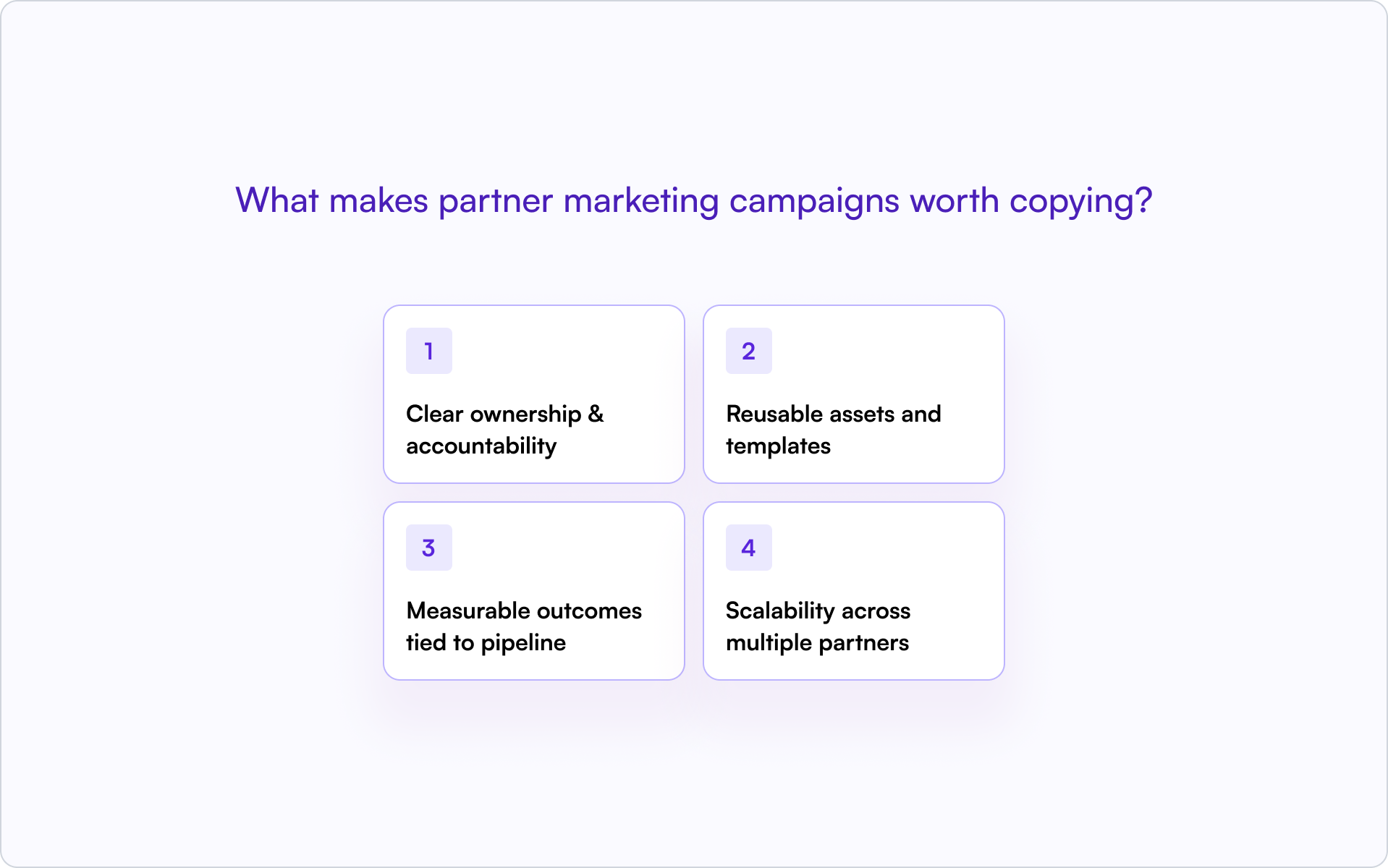
Clear ownership and accountability
Before anything goes live, the best teams define who owns what — the vendor, the partner, or both. When ownership is fuzzy, follow-up stalls, leads go cold, and the campaign gets remembered as “a nice collaboration” instead of a repeatable pipeline motion.
Reusable assets and templates
Scalable campaigns come with a “campaign-in-a-box”: pre-built emails, social posts, landing pages, and talking points partners can customize without starting from scratch. Reusable assets reduce partner friction and make opt-in easy.
Measurable outcomes tied to pipeline
Impressions and clicks are fine inputs, but the campaigns worth copying connect to revenue. If you can’t trace leads back to a partner and into opportunities, you’re running activity — not a growth channel.
Scalability across multiple partners
A great campaign can be rolled out to many partners without heavy customization each time. The goal is a library of repeatable motions partners can join — not one-off collaborations that require a rebuild every launch.
Types of partner marketing programs that drive pipeline
Before you pick tactics, anchor on program structure. Different partner marketing programs serve different jobs — and the best stacks combine several.
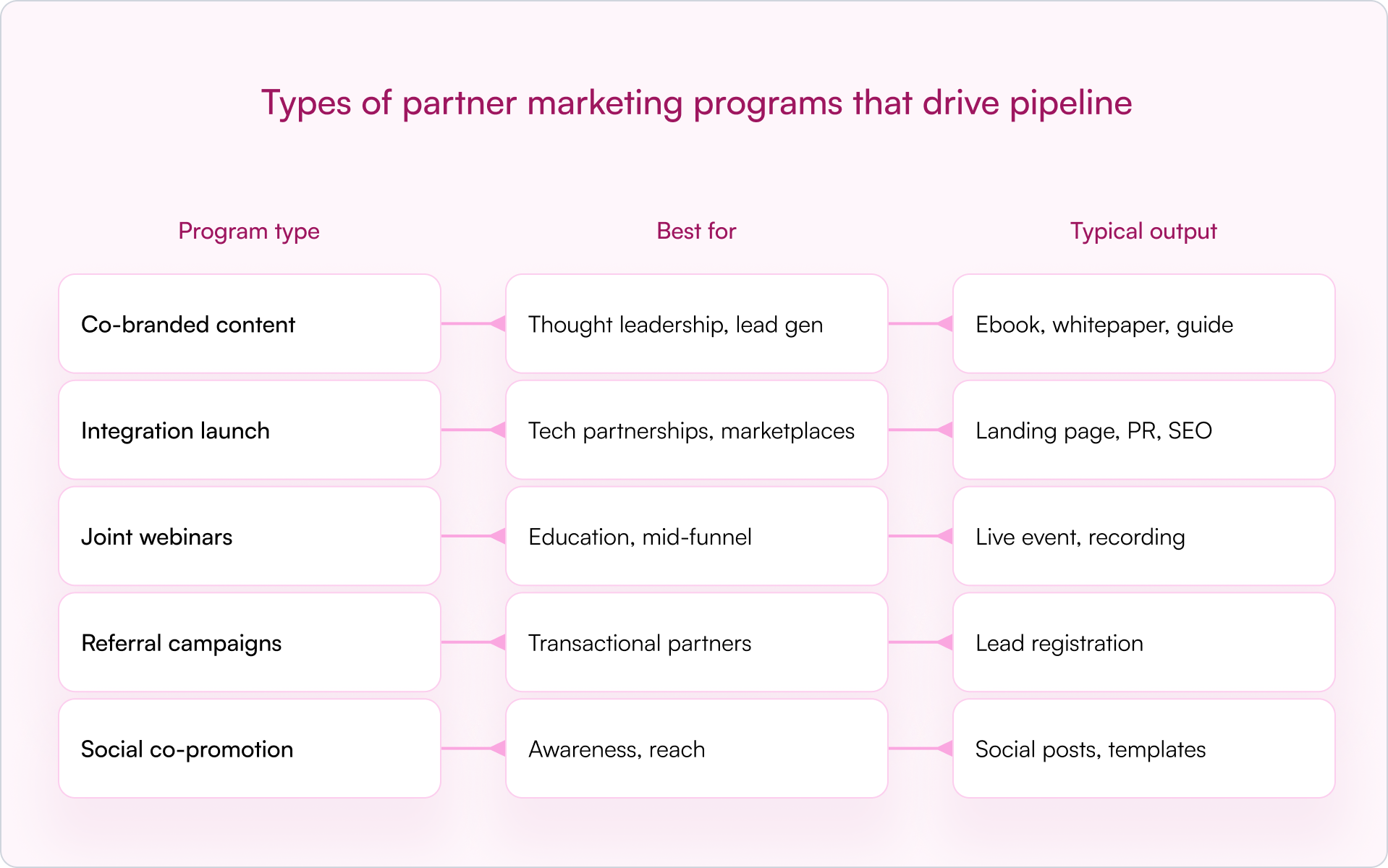
Co-branded content campaigns
Joint whitepapers, ebooks, or guides featuring both brands. Both parties co-create and co-distribute — which means shared audience, shared credibility, and shared leads. Co-branded content campaigns are classic partnership marketing examples in B2B because the content lives on long after the launch.
Integration and marketplace launch campaigns
Campaigns that announce a new tech integration or app marketplace listing often include landing pages, PR, and SEO-optimized content. Done right, these assets compound — a well-built integration page can drive organic traffic for years.
Joint webinars and virtual events
Co-hosted educational sessions where both parties promote and both capture leads. Joint webinars are one of the most repeatable joint marketing examples when you have clear audience overlap and a topic that matters to both ICPs.
Referral and incentive campaigns
A partner refers leads in exchange for rewards — SPIFFs (short-term incentive bonuses), commissions, or other incentives. Referral campaigns tie directly to partner-sourced revenue and work well for transactional partner motions.
Social media co-promotion campaigns
Coordinated posts across both brands’ channels, often with templates provided to partners. Social co-promotion is a lightweight way to test new partner marketing ideas before committing to bigger co-marketing investments.
B2B partner marketing campaign examples to replicate
Theory is cheap. The following partner marketing campaign structures are practical, repeatable, and designed to scale beyond a single partner.
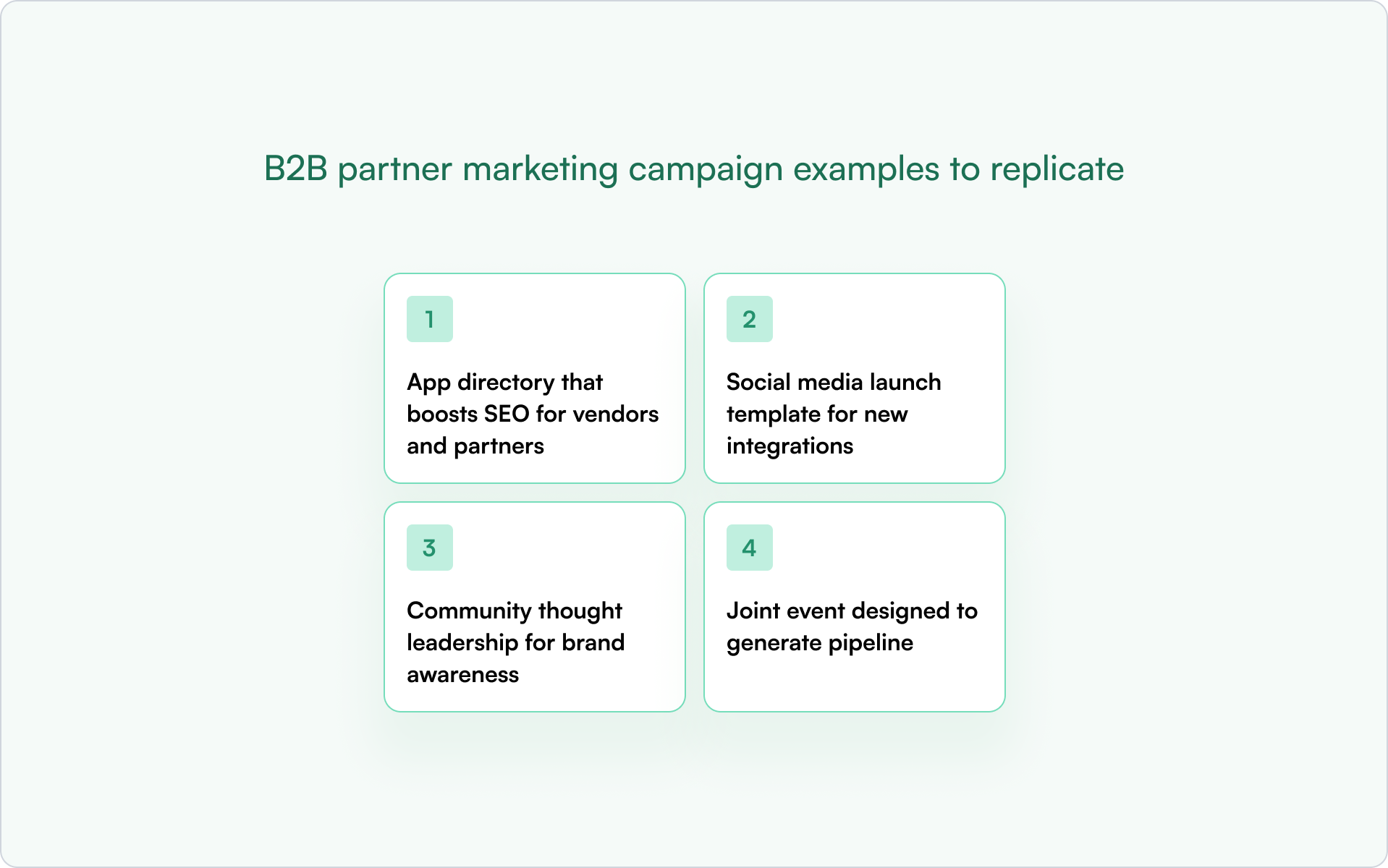
1) App directory that boosts SEO for vendors and partners
A searchable partner or integration directory drives organic traffic for both parties. Each listing becomes a landing page that can rank for relevant keywords. It’s one of the strongest long-term partner marketing campaigns because it creates always-on demand without ongoing campaign spend.
- What it is: A public directory of integrations or partners, optimized for search.
- Why it works: Compounds over time; drives inbound for both vendor and partner.
- How to replicate: Create a directory with unique content per partner, and optimize pages for “[your product] + [partner product] integration” search intent.
2) Social media launch template for new integrations
When a new integration goes live, give partners ready-to-post social templates — images, copy, and hashtags. This increases participation because partners don’t have to write anything from scratch, and you get coordinated reach across multiple audiences.
- What it is: Pre-built social assets partners can post on launch day.
- Why it works: Low lift for partners, high participation rates.
- How to replicate: Create a shared folder with 3–5 copy variations, images sized per channel, and posting guidelines. Send it 48 hours before launch.
3) Community thought leadership for brand awareness
Feature partner experts in blog posts, podcasts, or LinkedIn content. Both brands benefit from credibility transfer, and the content reads as more authentic than solo marketing.
- What it is: Vendor-hosted content featuring partner voices.
- Why it works: Builds trust when paid channels are saturated.
- How to replicate: Invite partners to contribute quotes, guest posts, or podcast episodes, then cross-promote to both audiences.
4) Joint event designed to generate pipeline
Co-hosted dinners, roundtables, or virtual events targeting a shared ICP. Both parties invite prospects and both capture leads. The key is to productize the format so it doesn’t become a one-off.
- What it is: A co-branded event with shared invite lists and coordinated follow-up.
- Why it works: High-intent leads, shared costs, mutual credibility.
- How to replicate: Build an event-in-a-box kit: agenda template, invite copy, registration page, day-of run-of-show, and follow-up sequences for both sales teams.
Partner marketing campaign ideas beyond the usual playbook
If you’ve already run webinars and co-branded content, the next step is to create partner marketing campaigns that feel native to how your buyers actually learn and decide.
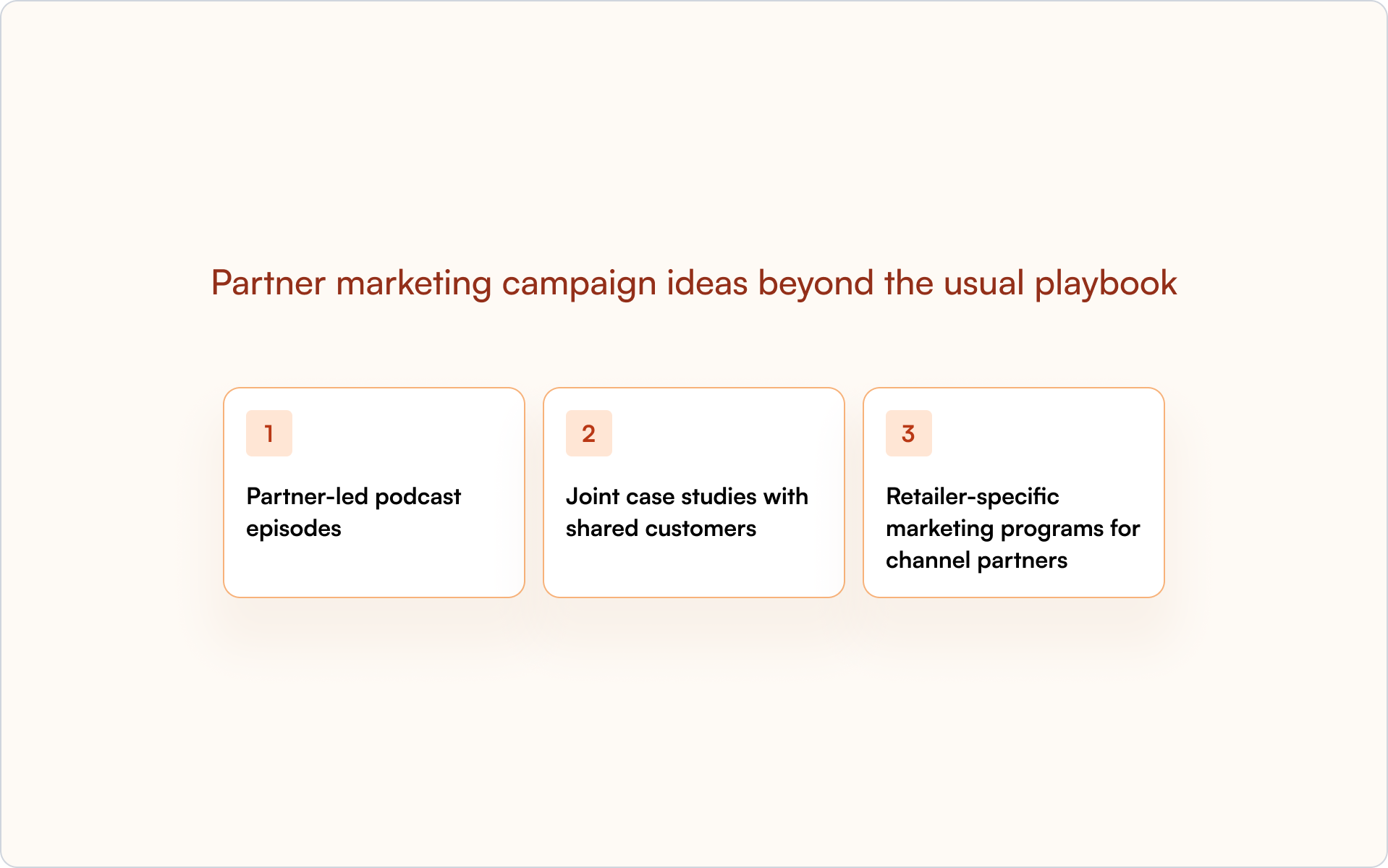
Partner-led podcast episodes
Invite partners as guests or let them host an episode. You get shared distribution, authentic content, and an evergreen backlog you can repurpose into clips, posts, and newsletters.
Joint case studies with shared customers
When a customer uses both vendor and partner, co-create the case study. Joint case studies often outperform generic partner marketing examples because they prove end-to-end outcomes for a shared ICP — with less “marketing speak.”
Retailer-specific marketing programs for channel partners
For companies selling through distributors or resellers, tailored campaigns by region, vertical, or partner tier can increase adoption. The key is to provide modular assets partners can localize without rewriting the offer.
How to plan and execute partner marketing campaigns
Planning is where most partner marketing campaigns succeed or fail. If you’re a founder, this is the part that turns “we should do something with partners” into a repeatable growth motion your team can run without heroics.
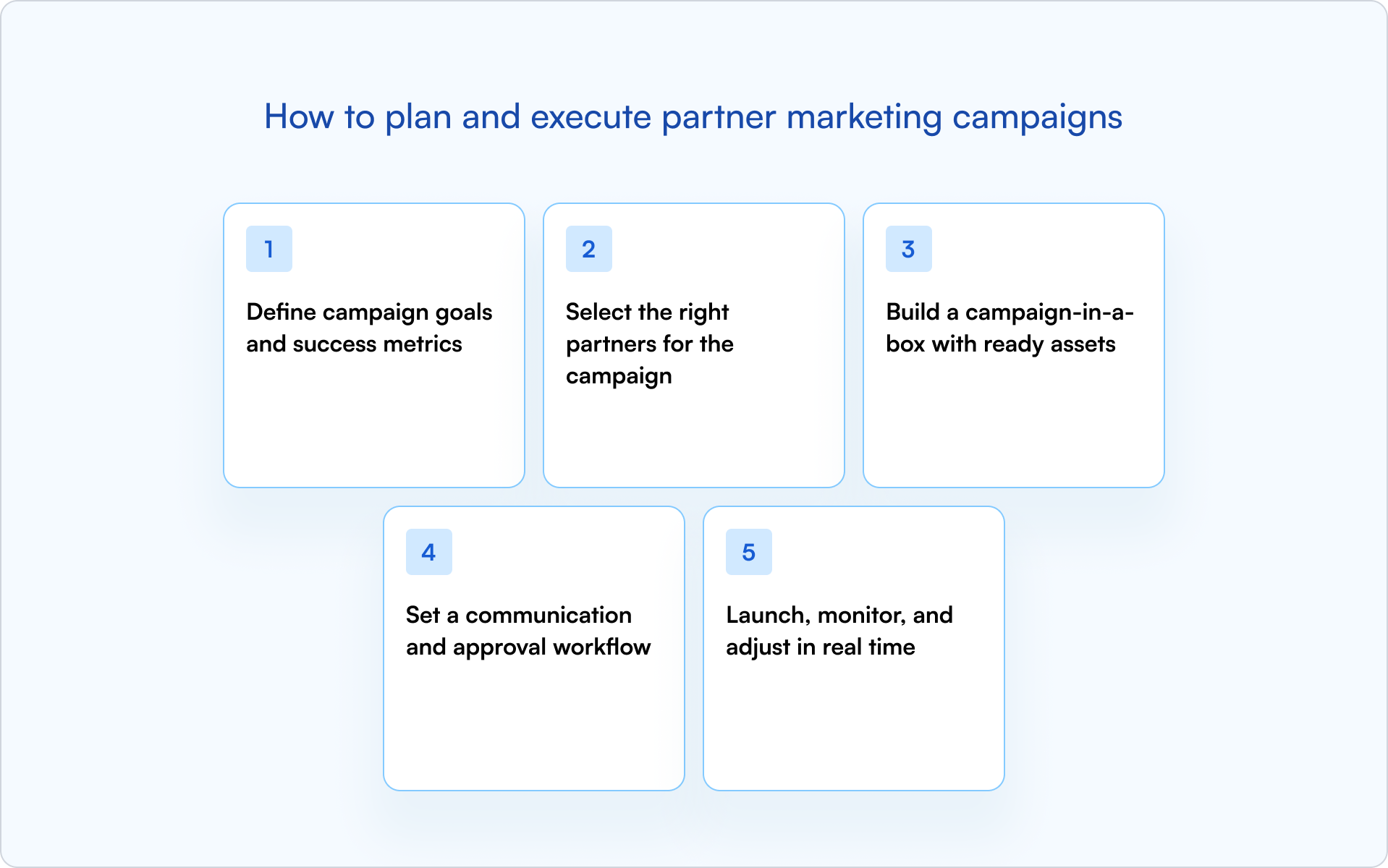
1) Define campaign goals and success metrics
Start with what you want: leads, pipeline, awareness, or something else. Whenever possible, tie goals to partner-attributed revenue. Consistent goal-setting lets you compare performance across partner marketing campaigns and double down on what actually converts.
2) Select the right partners for the campaign
Not every partner fits every campaign. Consider partner tier, audience overlap, and engagement level. The best joint marketing examples happen when there’s obvious ICP overlap and a believable shared story.
3) Build a campaign-in-a-box with ready assets
Reduce friction by providing everything partners need to participate:
- Email templates (customizable)
- Social media copy and images
- Co-branded landing page
- Tracking links for attribution
- Partner talking points or FAQ
Campaign-in-a-box is what turns good ideas into repeatable motions inside your partner marketing programs.
4) Set a communication and approval workflow
Define who approves what, how partners submit content for review, and timeline expectations. A simple workflow keeps multi-partner campaigns consistent and on-brand without slowing everything down.
5) Launch, monitor, and adjust in real time
Track engagement and leads as the campaign runs. Sync partner activity to your CRM so you can quickly see which partner marketing campaigns are generating meetings and opportunities — and which ones need a tweak to targeting, messaging, or follow-up.
How to measure partner marketing campaigns (without guessing)
Attribution is where most partner marketing programs struggle. Without clean data, you can’t tell which campaigns drive revenue and which ones just look good in a slide deck.
Leads and pipeline attributed to partners
Track which partners sourced or influenced which deals. Your CRM should be the source of truth. This is what separates “fun co-marketing” from partner marketing campaigns you can scale quarter after quarter.
Campaign engagement and conversion metrics
Measure opens, clicks, registrations, meetings booked, and conversion rates — and compare across formats. Over time, you’ll see patterns: which topics drive attendance, which partners consistently activate, and which campaigns convert into pipeline for your ICP.
Solving the attribution problem with CRM-first tracking
Attribution is hard because deals usually have multiple touches, and partner versus direct overlap is common. CRM-first tracking helps by syncing partner activity directly to deal records. Once your data is clean, it’s easier to invest in the partner marketing campaigns that influence revenue — and stop funding the ones that don’t.
Tip: If your partner activity lives outside your CRM — in spreadsheets, email threads, or a disconnected portal — attribution becomes guesswork. The teams that measure partner marketing well keep everything connected to HubSpot or Salesforce from day one.
Run partner marketing campaigns that actually scale
The partner marketing campaigns worth copying aren’t just creative — they’re structured, measurable, and repeatable. They come with clear ownership, reusable assets, and a direct line to pipeline.
Most teams run partner marketing campaigns that feel productive but don’t connect to revenue. The difference is infrastructure: clean CRM data, consistent attribution, and a process that works across many partners, not just one.
If you want partner marketing campaigns with real visibility into what’s working, consider tightening your workflow around CRM-first attribution and standardized campaign kits. When you’re ready to operationalize it, get a demo to see how Introw keeps partner activity connected to your CRM — so you can scale what works and stop guessing.
Still curious? Here are some quick answers to help clear things up
Partner marketing campaigns are coordinated marketing efforts between two (or more) companies — typically a vendor and a reseller, referral partner, tech partner, or alliance — to generate leads, build brand trust, or drive pipeline. The best campaigns share audiences, share distribution, and share measurable outcomes tied to your CRM.
Make the lift small and the upside obvious. Participation tends to spike when you provide a “campaign-in-a-box” with ready-to-use assets (emails, social posts, landing pages, and tracking links) and remove friction like extra portal logins or unclear approval steps. Also, pick campaigns that align with how that partner sells. A referral-focused partner will engage with lead registration and incentives, while a platform partner may prefer integration launches and SEO assets.
Early-stage teams usually win with campaigns that are fast to launch and easy to repeat:Integration launch pages (compounding SEO value)Co-hosted webinars (shared audience and lead capture)Referral motions (direct pipeline linkage)Co-branded “how-to” guides (evergreen content you can reuse in sales)The key is choosing one format you can run monthly, then building templates so it becomes a system — not a scramble.
Budget depends on the format and partner tier. Many companies use MDF (market development funds) or co-op funds to share costs with partners, especially for events or paid distribution. If you’re budget-constrained, start with low-cost, high-leverage plays like co-branded content, integration launch assets, and social kits.As you get data, allocate more budget to the partner marketing campaigns that repeatedly convert into meetings and opportunities — not the ones with the best engagement screenshots.
MDF (market development funds) are typically allocated upfront by the vendor to a partner for approved marketing activities. Co-op funds generally reimburse partners after they spend money on approved campaigns and submit proof of performance. Both can work — but each requires clear rules, approval workflows, and measurement so spend ties back to pipeline.





Are you already an active Introw partner?
Book a demo with one of our partner program experts, or explore Introw on your own time.