
This guide covers the main incentive types, an 8-step process to design reseller incentive programs, four examples, and how to measure program success.
What are reseller incentives?
Reseller incentive programs are everything a vendor puts on the table to make its product worth a reseller's time: the margin on every deal, plus the discounts, rebates, bonuses, funds, and benefits layered on top. The goal isn't to make resellers like you. It's to win a bigger share of their limited selling time against every other vendor in their portfolio.
That's harder than it sounds, because a reseller isn't just another partner.
Ownership is what makes reseller incentive programs different. Resellers are external partners that invest their own sales time, pre-sales resources, and customer relationships in every deal, and they only get paid if they keep the deal and close it at a healthy margin. Every incentive you design has to protect that ownership first and reward it second.
If you run several partner types, such as distributors, resellers, and referral partners, our guide to channel partner incentive programs covers incentives across all of them.
Types of reseller incentives
Most strong reseller incentive programs combine a few incentive types rather than relying on one:
How to design a reseller incentive program
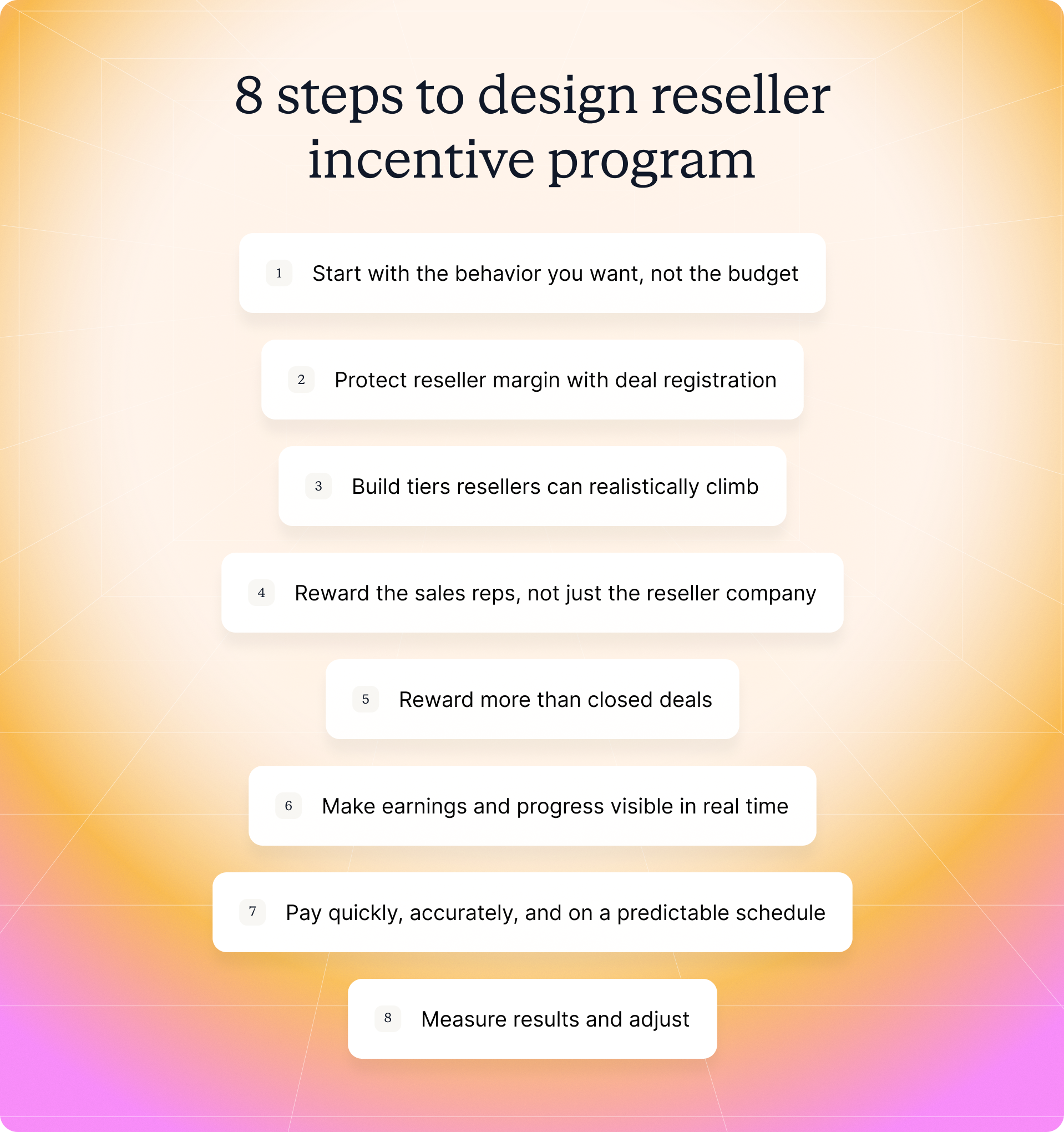
Reseller incentive programs work when every reward pays for a named behavior and resellers trust the rules. These eight steps take you from the behavior you want to an incentive structure you can measure.
1. Start with the behavior you want, not the budget
Don't start with a budget and spread it across partners. Start with the reseller action you want more of, such as registering deals, selling a new product, or earning a certification, and pick an incentive that pays for exactly that.
The test: if you can't name the action an incentive pays for, it's just a discount.
Keep it to two or three priorities a year. An incentive structure that rewards everything tells resellers that nothing in particular matters.
2. Protect reseller margin with deal registration
No incentive motivates a reseller who fears losing the deal to your direct team or another partner. Deal registration fixes that: the reseller registers the opportunity, it's checked for conflicts and approved, and the reseller gets protected pricing or an extra discount.
Set a clear protection period that covers a typical sales cycle, and approve fast. Unclear ownership is the most common source of channel conflict, and it costs you the next deal as well as this one.
3. Build tiers resellers can realistically climb
Use three or four tiers, with requirements that combine revenue and capability, such as certified staff, and publish exactly what each tier unlocks. A good tiered incentive structure also creates healthy competition between resellers, and different partner tiers can carry different benefits without leaving anyone behind.
Above all, keep the next tier within reach of a reseller that has a good year. Tiers that feel out of reach demotivate the middle of the program, where most of your sales growth sits. Our guide to partner tiers goes deeper.
[Visual: sample three-tier reseller program. Alt text: "Illustrative three-tier reseller program showing revenue and certification requirements and the discount, rebate, and support benefits for each tier."]
4. Reward the sales reps, not just the reseller company
The reseller's leadership picks its vendors, but individual sales reps decide what to pitch in each meeting. Combine company-level rewards, such as margin and rebates, with rep-level sales incentives that shape day-to-day sales performance.
Agree the rules with the reseller first: CarltonOne notes that partners often allow rep incentives when they're aligned with company-level ones. Paying a partner's employees can also trigger anti-bribery or tax rules in some countries, so check with legal before you launch.
5. Reward more than closed deals
Reward the behaviors that lead to revenue too: certifications, selling new products, attaching services, and renewals or expansion. Paying on bookings alone encourages deals that churn, and it rewards sales volume over customers who stay.
Non-cash rewards count too: many incentive programs share qualified leads with resellers that hit their goals. For new resellers, a first-deal bonus can be the best-value incentive you offer, because Unifyr notes that a reseller that doesn't register a deal within 90 days of signing rarely becomes an active partner.
6. Make earnings and progress visible in real time
Resellers chase incentives they can track. Show each reseller their current earnings, pending rewards, progress toward the next tier, and goal attainment, in the portal, in email updates, or in their own CRM.
Visibility is the cheapest way to improve partner engagement, and most incentive programs underuse it. An incentive they only hear about in a quarterly spreadsheet won't change their sales performance this week.
7. Pay quickly, accurately, and on a predictable schedule
Late or wrong payments destroy trust faster than low rewards, and the best incentive programs pay on a schedule resellers can plan around. If the incentive structure is too complex to calculate, it's too complex to trust. Calculate earnings from CRM or billing data, send a clear statement with every payout, publish the payout schedule, and resolve disputes fast.
All of it depends on clean partner attribution. If you can't tell which reseller owns a deal, you can't pay them for it correctly.
8. Measure results and adjust
Review each incentive at least quarterly against the behavior it was meant to drive, and compare it to overall sales performance and sales growth across the program. Cut the incentives that don't change behavior, and fund the ones that do.
Announce changes ahead of the next period, and never change published terms mid-period. Reseller incentive programs only work when resellers can plan around them.
How Introw helps you run reseller incentives
Introw runs reseller incentive programs on top of HubSpot or Salesforce, so registrations, pricing, tiers, and payouts all work from the same CRM records your sales team uses.

Protected deals and the right price on every quote
Resellers register deals from the portal, email, Slack, Teams, or their AI assistant. Introw screens each registration for channel conflict, applies your approval rules, and writes an attributed deal into HubSpot or Salesforce. When the reseller builds a quote from your CRM product catalog, tier-based and partner-specific discounts are applied automatically, so margin follows your policy instead of a negotiation.
Tiers resellers can see and climb
Build tier programs with published requirements and benefits, show resellers exactly what the next tier takes, and keep every tier synced to a CRM property. Workflows can move a reseller up a tier the moment they earn a certification, or book a bonus when they finish onboarding.
Earnings resellers can trust
Commission plans support revenue shares, fixed fees, tiered rates, and one-time bonuses that work like SPIFFs, calculated from CRM or billing data. Resellers see their earnings and payouts in the portal. Every payout comes with a statement, and Introw Pay settles every partner from one consolidated invoice per cycle, in each partner's own currency.
Marketing funds tied to pipeline
Introw allows you to allocate market development funds, approve proposals, collect proof of spend, and track what each demand generation activity returned next to the pipeline on your CRM records.
Resellers give their time to the vendor that makes selling simple, profitable, and predictable. Your incentive programs should make that vendor you.
Ready to run incentive programs your resellers can trust? Start free and connect HubSpot or Salesforce. No credit card, no time limit.
3 Reseller incentive program examples
All numbers in these examples are illustrative.
Tiered discount program: different incentives for different partner tiers
Goal: reward resellers that invest in your product.
Structure: three tiers. Silver resellers get a 15% discount. Gold requires €250,000 in annual revenue and two certified reps, and unlocks 20%. Platinum requires €750,000 and five certified reps, and unlocks 25% plus a dedicated channel manager.
Why it works: resellers see a clear path, and the certification requirement means higher discounts go to resellers that can deliver.
Watch out for: a Platinum bar so high that only one or two resellers ever reach it.
New product SPIFF: short-term sales incentives for reps
Goal: get a new product into quotes quickly.
Structure: reps earn €500 for each closed deal that includes the new product during a 90-day launch window, paid monthly.
Why it works: it's simple, time-bound, and pays the person who decides what to pitch. A rep can explain the rule to a colleague in one sentence.
Watch out for: agree the SPIFF with each reseller's leadership first, and end it on the date you announced, even if results are strong, so the next launch SPIFF is taken seriously.
Growth rebate: rewarding sales growth, not size
Goal: reward business growth, including growth in new markets, not size.
Structure: resellers earn a 4% rebate on revenue above last year's baseline, paid quarterly. A reseller that grows from €400,000 to €500,000 earns €4,000 on the €100,000 of growth.
Why it works: large resellers don't get paid for standing still, and small resellers can earn meaningful rebates through higher sales volumes.
Watch out for: agree the baseline in writing at the start of the year, and decide upfront how one-off deals and price changes count, so the calculation is never a surprise.
Certification incentives: the path to the next tier
Goal: build reseller capability.
Structure: completing training programs for three sales and technical certifications automatically moves a reseller from Silver to Gold, with Gold's discount applied to the next quote.
Why it works: the reward is immediate and automatic, so resellers see a direct line from training to margin.
Watch out for: certifications that test product trivia rather than selling and delivery skills. Tie each one to what a reseller actually needs to win and implement a deal.
Building a reseller incentive program that works
Every week, your resellers decide which vendor’s product to put in front of their customers, and they make that call with every other vendor’s offer on the table. You won’t win that decision with the biggest reward. You’ll win it by being the vendor a reseller trusts: deals stay protected, earnings are easy to see, and payouts arrive exactly when promised.
So before you add another rebate or raise a SPIFF, check the basics. If deals get lost to channel conflict, payouts run late, or resellers can’t work out what they’ve earned, a bigger incentive will only paper over the problem. Fix those first, start with one or two incentives tied to the behavior you need most, and cut anything that doesn’t change what resellers do. A small, predictable program that resellers trust will outperform a generous one they have to chase.
Still curious? Here are some quick answers to help clear things up
A rebate is paid to the reseller company after it hits sales targets for volume or growth, usually quarterly or annually. A SPIFF, short for sales performance incentive fund, is a short-term bonus paid to individual reps for a specific action, such as selling a new product during a launch window.
Margin applies on every deal, SPIFFs should be paid within days or weeks, and rebates are typically paid quarterly. Whatever the schedule, publish it and stick to it.
Both. Company-level rewards secure the partnership, and rep-level rewards influence what gets pitched in each meeting. Get the reseller's approval and check local rules before paying individuals.





See AI-Native PRM in Action
Book a demo with one of our partner program experts, or explore Introw on your own time.