

Partner training is the process of equipping your channel partners — resellers, referral partners, distributors, and implementation partners — with the knowledge to sell, support, and deliver your product. For founders, it’s one of the most leveraged parts of a partner program: done well, it improves revenue, brand consistency, and customer outcomes without linearly increasing your headcount.
Most partner training programs fail not because the content is “bad,” but because the experience is high-friction and hard to connect to business results — too many logins, disconnected tools, stale materials, and no clear link between completion and pipeline. This guide breaks down what partner training is, why it matters, how to build a program that scales, and how to measure whether it’s actually working.
What is partner training?
Partner training is a structured approach to giving your channel partners the knowledge and skills to successfully sell, implement, and support your products. It’s different from internal enablement because partners sit outside your org, represent multiple vendors, and will always prioritize what’s easiest and most profitable this quarter.
That reality shapes your program design: your training must be fast to access, immediately useful, and clearly tied to partner outcomes (more deals closed, fewer escalations, higher margins).
Who partner training is for
- Resellers: Purchase and resell your product to end customers
- Referral partners: Send qualified leads in exchange for a commission
- Implementation partners: Deploy, integrate, or customize your product for customers
- Distributors: Sell through their own network of sub-partners
In practice, partner training fills the gap between “we signed a partner” and “that partner reliably drives revenue and delivers great customer experiences.”
Why partner training matters for B2B revenue
If you’re building a partner-led motion, partner training isn’t a side project — it’s a revenue lever. Partners who understand your positioning, product, and sales motion close more deals and create fewer downstream issues.
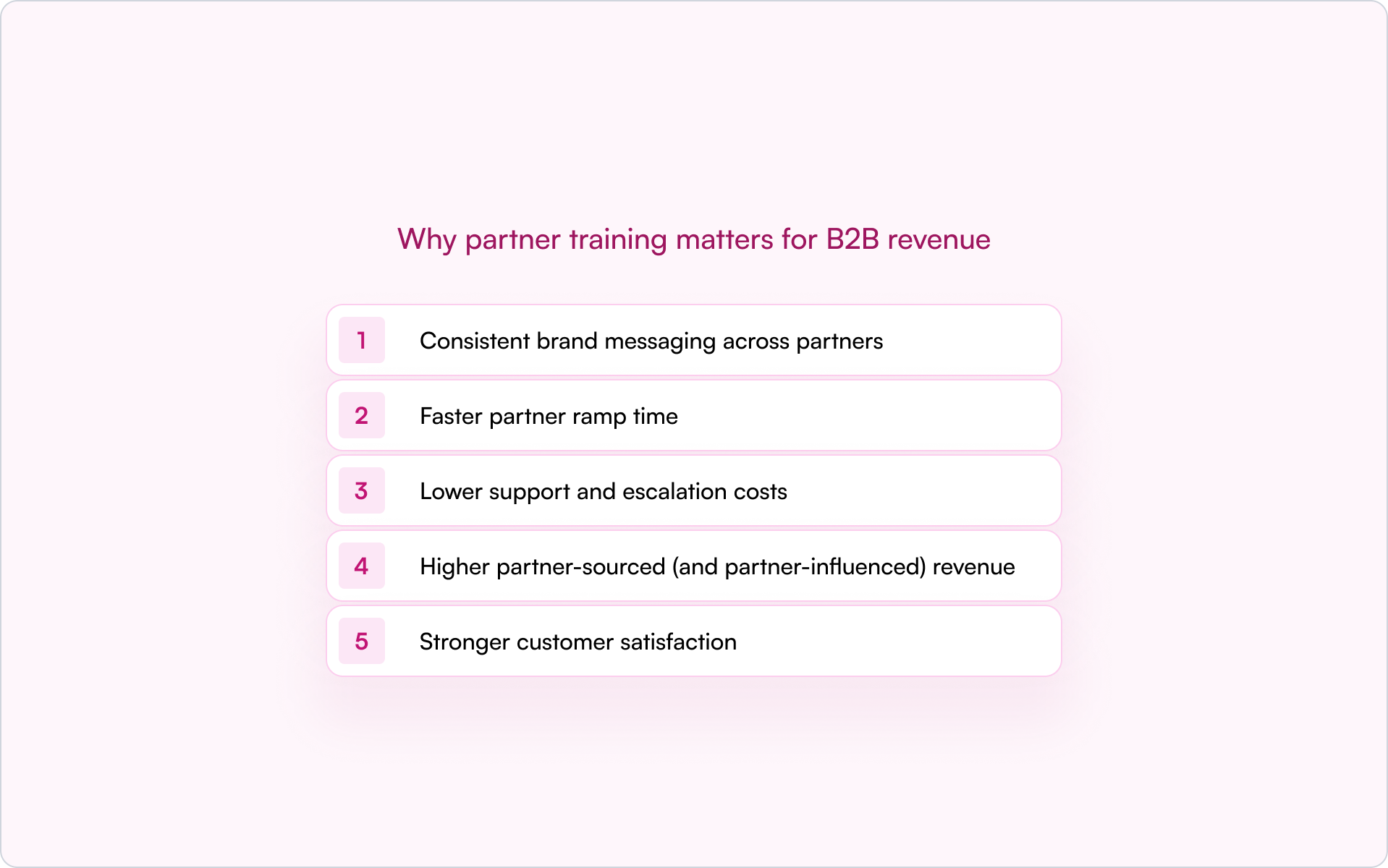
Consistent brand messaging across partners
Untrained partners misrepresent products all the time — not out of malice, but because they’re guessing. The result is predictable: incorrect pricing expectations, wrong feature assumptions, and deal cycles slowed by re-education.
Training aligns partners on what to say, what not to say, and how to position you in a crowded market.
Faster partner ramp time
Ramp time is the window between onboarding and the first closed deal. The shorter that window, the more confident a partner feels in your program — and the more likely they are to keep investing.
The goal isn’t to “teach everything.” It’s to teach what’s required to get to a credible demo, a clean handoff, and a first win.
Lower support and escalation costs
When partners know how to handle common questions and first-line troubleshooting, they escalate less. That protects your internal team’s time and keeps support focused on complex issues, not repetitive basics.
Higher partner-sourced (and partner-influenced) revenue
Training makes partners better at identifying the right use cases, qualifying opportunities, and navigating objections. When paired with CRM visibility, you can directly answer: “Do certified partners close more deals?” and then double down on what works.
Stronger customer satisfaction
Customers served by trained partners get more accurate expectations, smoother implementations, and cleaner support experiences — which shows up as lower churn and more expansion.
Types of partner training programs
The best partner training program is rarely one format. Most teams combine modules, live sessions, certifications, and reference docs — then tailor them by partner type and role.
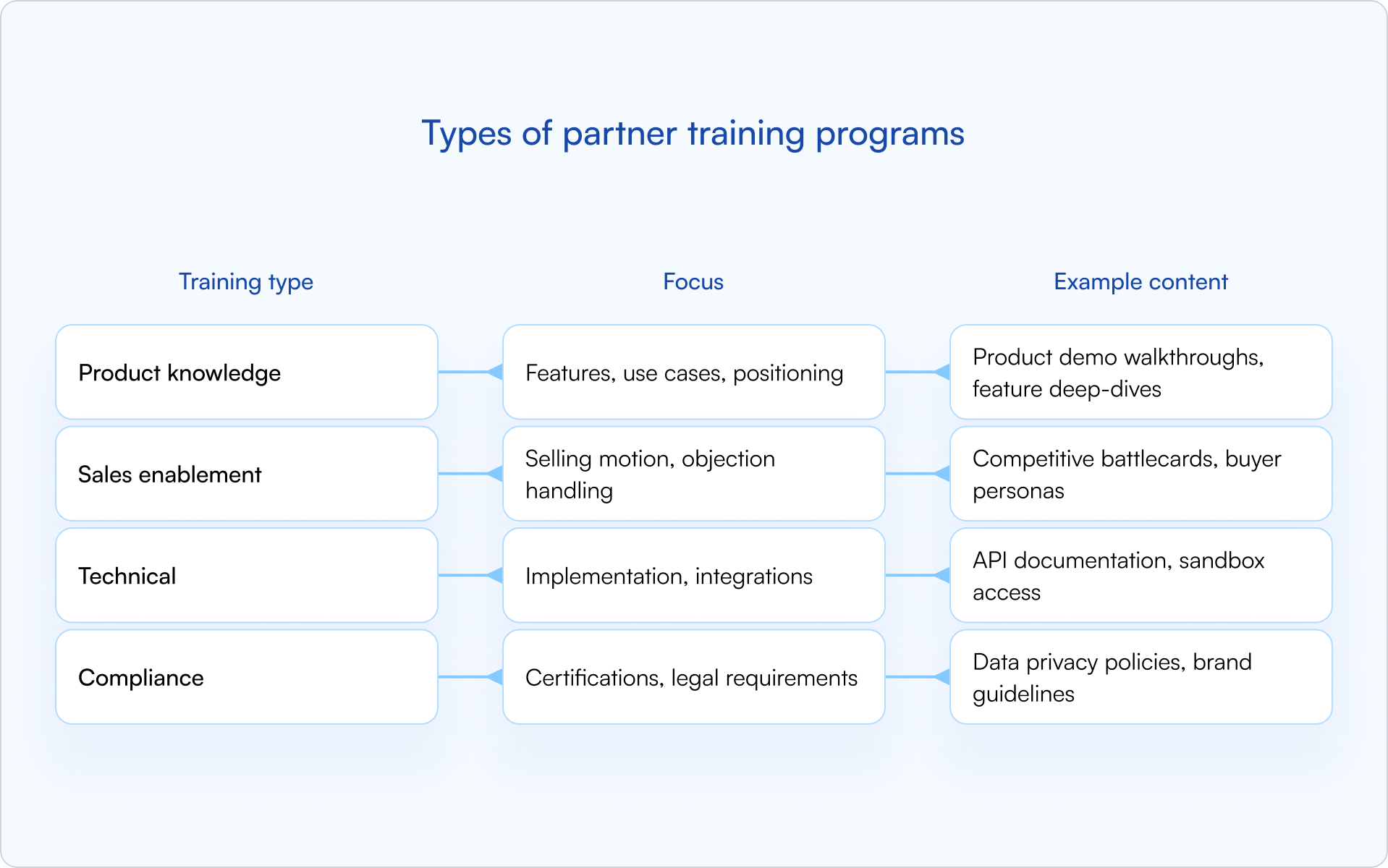
Product knowledge training
Product knowledge is the foundation. Partners need to understand what your product does, the primary use cases, and where you win. Without it, demos are shaky and deals stall during basic discovery.
Sales enablement training
Sales training is how you translate “features” into “revenue.” It covers buyer personas, qualification, pricing conversations, competitive positioning, and objection handling. This matters most for resellers and referral partners who are sourcing and shaping deals.
Technical and implementation training
For SIs and implementation partners, technical training is non-negotiable. Strong programs include hands-on labs, sandbox environments, and practical scenarios that mirror real customer deployments.
Many companies gate delivery rights behind technical certification — partners can’t implement until they’ve proven competence.
Compliance and certification training
Compliance training protects the business. It can include data privacy, security requirements, procurement standards, and brand usage guidelines. Certifications, meanwhile, give you a scalable “quality bar” across an ecosystem.
How to build a partner training program (step-by-step)
If you’re building partner training as a founder or lean GTM team, your advantage is speed. Start with outcomes, ship a minimum viable curriculum, and iterate based on what moves pipeline.
a
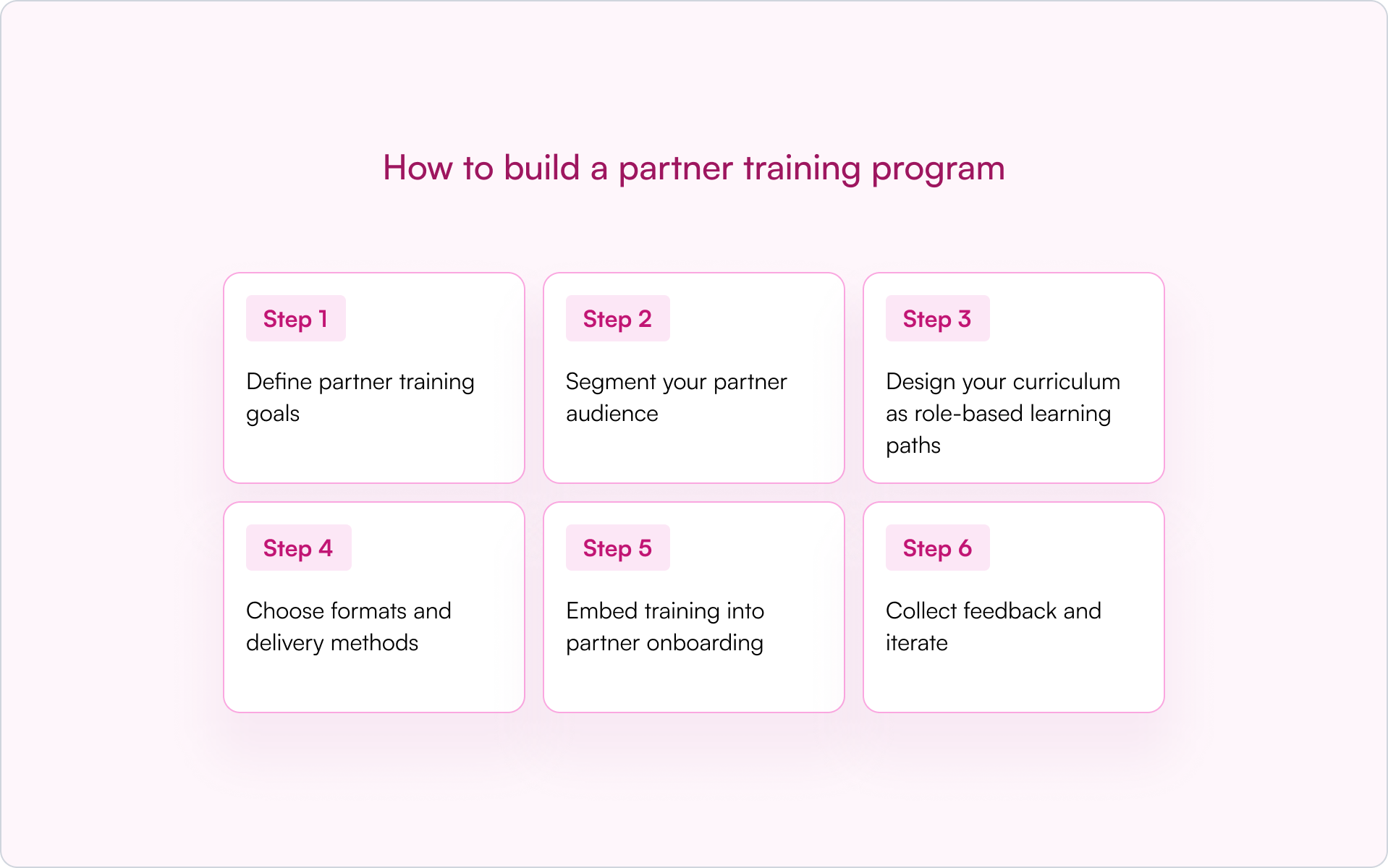
1) Define partner training goals
Start with outcomes, not content. What should a trained partner be able to do?
- Independently run a credible demo
- Handle first-line support and common troubleshooting
- Close deals without constant sales engineer involvement
Goals tied to measurable business metrics — like time-to-first-deal, win rate, or ticket volume — are easier to prioritize and defend internally.
2) Segment your partner audience
Not all partners need the same training. A referral partner needs messaging and qualification, while an SI needs implementation depth. Segment by partner type, tier, and role (sales, technical, support).
3) Design your curriculum as role-based learning paths
Map training content to each segment and goal, then package it into clear paths like:
- Sales Certification Path (positioning, discovery, objections, demo)
- Technical Certification Path (setup, integrations, troubleshooting)
- Support Readiness Path (FAQs, escalation rules, SLAs)
Start small. Your first version should be “the shortest route to competence,” not a comprehensive encyclopedia.
4) Choose formats and delivery methods
Use the format that matches the job to be done:
- Self-paced modules: scalable across time zones; best for foundational knowledge
- Live webinars: interactive Q&A; best for launches and complex topics
- On-demand video: easy to consume; great for demo walkthroughs
- In-person workshops: high-trust and high-touch; best for strategic partners
- Documentation and guides: durable reference; best for technical details
5) Embed training into partner onboarding
Training works best when it's embedded into the partner onboarding process — not treated as a separate initiative.
The best partner portals surface training content alongside deal registration, resources, and support. When training lives where partners already work, completion rates rise naturally.
6) Collect feedback and iterate
Products change, competitors reposition, and partners forget. Treat partner training like a product: review what’s being used, what’s being skipped, and what correlates with revenue outcomes.
- Short surveys after modules
- Quarterly reviews with partner managers
- Regular updates tied to releases and competitive changes
Partner training best practices for 2026
Once the basics are in place, the biggest improvements come from removing friction, aligning incentives, and making training measurable.
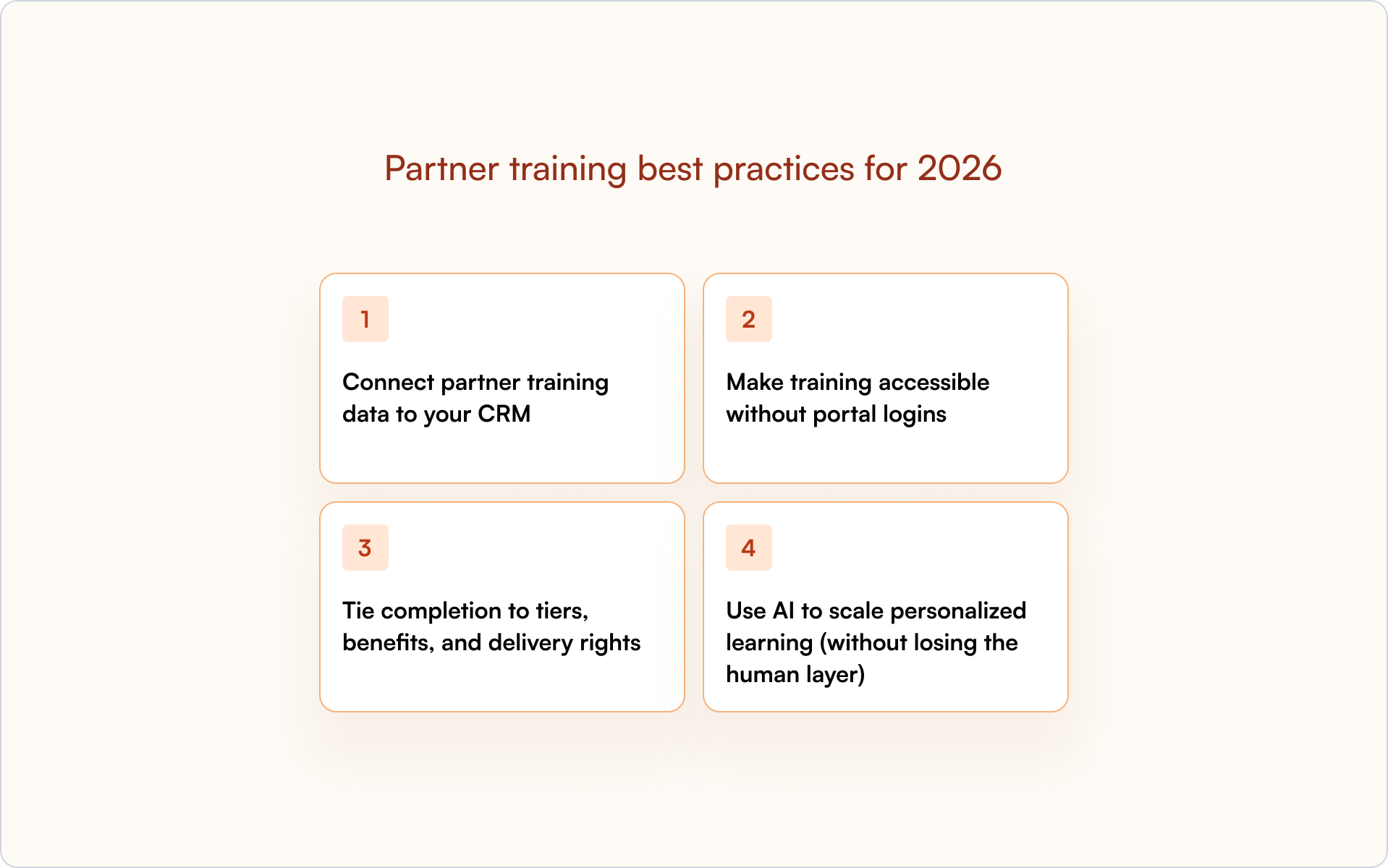
Connect partner training data to your CRM
Training completion only becomes strategically useful when it’s connected to partner records in your CRM. With CRM integration, you can trigger workflows based on training status and correlate certifications with deal performance.
Without it, you’ll keep debating training impact with opinions instead of answers.
Make training accessible without portal logins
Login friction is a silent killer. Partners juggle multiple vendor portals and credentials, and every extra step reduces completion.
Consider SSO, training embedded in email, or lightweight portal experiences. Off-portal access — where partners can engage without logging in — consistently increases completion rates.
Tie completion to tiers, benefits, and delivery rights
Incentives drive behavior. When certification unlocks tier advancement, higher margins, MDF access, or lead distribution, training becomes a business decision for the partner.
This also protects your customers: partners who aren’t trained shouldn’t be delivering complex implementations under your brand.
Use AI to scale personalized learning (without losing the human layer)
AI can recommend the right modules based on partner role and performance and answer common questions in real time. The goal isn’t to replace enablement — it’s to scale what your best partner managers already do manually.
How to choose partner training software
If you're evaluating partner training software or a channel partner training platform, prioritize capabilities that support partner-led growth — not generic LMS checklists.
CRM integration and data sync
The platform you choose will ideally write training data — certifications, completion dates, learning paths — back to HubSpot or Salesforce. Without CRM integration, training data becomes a silo and you lose visibility into how learning impacts revenue.
Self-serve partner portal capabilities
Training adoption improves when it lives next to the rest of the partner experience: deals, content, updates, and support. Look for platforms that reduce tool sprawl instead of adding another login.
Content hosting and certification management
The platform will ideally host various content types (videos, documents, quizzes), issue certifications, and track completion. Expiration tracking and re-certification workflows are especially useful once your program scales.
Engagement features and notifications
Partners forget — and they’re busy. Automated reminders for required training, expiring certifications, and new modules help keep completion rates high. Bonus points if partners can engage without logging in.
How to evaluate partner training programs
A partner training program is “working” when it measurably improves partner performance — not when it has a lot of content. Use metrics that connect learning activity to outcomes.
Training completion rates (by segment)
Track completion for required modules and certifications, then segment by partner type and tier. Low completion usually signals friction, irrelevant content, or unclear incentives.
Time to first deal
Measure time from onboarding to first closed deal. If training is effective, ramp time should compress. If it doesn’t, your curriculum likely isn’t aligned to what partners actually need in the sales process.
Partner-sourced revenue attribution
The hardest metric is also the most important: do certified partners create more pipeline and close more revenue? Answering this requires clean CRM attribution and consistent partner records.
Partner satisfaction and usefulness
Survey partners on the relevance and quality of training, and ask what’s missing. Satisfaction often highlights issues completion rates won’t — for example, modules that are “finished” but not actionable.
How a CRM-first partner portal simplifies partner training
Training works best when it's integrated into the partner experience — not siloed in a separate LMS. A CRM-first approach means training data, deal data, and partner data live in one system of record.
What “CRM-first” looks like in practice
- Single source of truth: training completion is visible alongside deals and partner info in HubSpot or Salesforce
- Automated workflows: trigger certifications, tier upgrades, and reminders based on training status
- Fewer logins: partners access training in the same place they register deals and get updates
- Real-time visibility: partner managers see who’s trained and who’s not without chasing reports
For founders, this is the real win: less operational overhead, clearer accountability, and better answers to “what’s driving revenue?”
Conclusion: treat partner training like a growth system
In 2026, successful partner training isn’t defined by how much content you ship. It’s defined by whether partners can access it quickly, apply it immediately, and whether you can tie completion to real outcomes in your CRM.
If you’re building a partner channel from scratch, start with the shortest path to competence, remove friction (especially logins), and attach incentives to the behaviors you want. Then iterate relentlessly based on performance data.
If you want to make training part of a single partner experience — alongside onboarding, deal registration, and performance reporting — see how Introw’s partner portal supports that workflow: get a demo.
Still curious? Here are some quick answers to help clear things up
Partner training is the process of educating external partners (resellers, referral partners, distributors, and implementation partners) on your product, positioning, and delivery standards. The goal is to help partners sell and support your solution correctly — and to create a consistent customer experience at scale.
A training partner is an organization that delivers training services (for example, a third-party firm that runs courses). Partner training is your program for educating your channel partners on your product and sales motion.
For most B2B products, a foundational partner training track should take a few hours total, broken into short modules. More advanced technical certifications can take longer, especially if they include labs, a sandbox project, or a proctored exam.
Foundational training is typically required for all partners who represent your brand or touch customers. Advanced certifications can be optional, but they work best when tied to clear benefits — tier advancement, higher margins, lead access, or implementation rights.
Partner training is a subset of partner enablement. Enablement also includes sales tools, co-marketing resources, deal registration, and ongoing support — everything partners require to succeed, not just education.





See AI-Native PRM in Action
Book a demo with one of our partner program experts, or explore Introw on your own time.