


What is channel partner recruitment?
Channel partner recruitment is the process of identifying, qualifying, and signing companies that can resell, refer, co-sell, implement, or support your product.
The aim isn't to collect logos. It's to build a partner base that can reach new customers, open new markets, and generate revenue.
A strong channel partner recruitment process has three phases:
- Find: Identify potential partners that match the profile of companies already succeeding with you.
- Qualify: Assess strategic fit, partner capabilities, ecosystem reach, and commitment before you sign.
- Sign: Agree on commercial terms and expectations, then create a clean handoff into onboarding.
Your approach will also depend on the partner types you're recruiting. A referral partner, reseller, system integrator, agency, or managed service provider may need a very different value proposition, business model, and level of enablement.
Recruitment ends when the agreement is signed.
From there, partner activation begins. Activation is the process of moving that new partner toward their first productive action, such as registering an opportunity or closing a deal.
That distinction matters because a signed agreement is only potential. Revenue starts when the partner acts.
The real cost of recruiting the wrong channel partners
Successful channel partner recruitment isn't about how many companies you can convince to sign. It's about how many of those companies become productive.
Typical activation rates for newly recruited partners sit between 30% and 50%. Programs that don't actively manage activation can drop below 20%.
That creates a simple economic problem.
The €15,000 figure here is an illustrative partner CAC, not a universal benchmark. Your cost may be much lower or higher depending on recruiting time, channel account managers, legal review, onboarding, training, tooling, and support.
But the math shows why partner quality matters.
If you spend €15,000 acquiring each prospective partner and half never produce pipeline, half of that investment has no direct revenue return.
Now change one input.
Moving from a 30% activation rate to 50% means moving from 30 productive partners to 50 from the same 100-partner cohort.
That’s a 67% increase in productive partners without recruiting a single additional company.
This is also why partner attribution matters. If you can’t connect partners to sourced and influenced pipeline, you can’t tell which partner profiles deserve more investment.
Track signals such as:
- Attributed sales
- Sourced and influenced pipeline
- Activation rate
Those metrics tell you far more about recruitment quality than the number of companies that sign up.
The opportunity cost also goes beyond recruitment spend. Poor-fit partners consume onboarding time, support, partner marketing resources, deal registration capacity, and attention that your best partners could have used.
Recruiting channel partners on evidence gives you a chance to avoid that cost before it enters your program.
The fix is to make channel partner recruitment a repeatable process instead of a series of one-off decisions. Use data to decide who to target, a clear scorecard to decide who qualifies, and shared expectations to decide who is actually worth signing.
Here’s what that looks like in three phases.
Phase 1, find: Build an ideal partner profile from your own data
Most channel partner recruitment strategies start by asking, "Who should we recruit?"
Start with a better question:
What do the partners that already work have in common?
Your current partner ecosystem gives you a sample of both outcomes. You have top performers that create pipeline, and you probably have other partners that signed up but never gained traction.
Compare them.
An ideal partner profile (IPP), is a data-derived description of the companies most likely to succeed in your channel partner program. Creating ideal partner profiles makes your recruitment process more focused because you're looking for evidence of fit instead of relying on a general idea of what a good partner "should" look like.
Look for the patterns your best partners share
Start with a small set of dimensions that have a plausible connection to partner performance.
Don't assume every dimension matters equally.
You may find that company size has almost no effect while customer ICP overlap strongly separates your top partners from dormant ones. Another business may discover that technical capability or vertical experience matters much more.
The point is to let your own partner performance show you what to prioritize. That gives you an ideal partner profile grounded in real outcomes rather than assumptions.
Run a coverage gap analysis before you source anyone
Next, compare your current channel ecosystem with the markets you want to serve.
Look at your partner footprint across:
- Geography
- Vertical
- Product or solution area
Suppose Germany produces three times the revenue of another market, but your business has half the partner bandwidth there. Perhaps you have no strong implementation partner in-region at all.
That's a recruitment priority.
The partner that happened to sign up through your website last Tuesday isn't.
This turns a broad partner recruitment plan into a focused brief: We need this partner type, in this market, with these capabilities and this customer profile.
It also stops teams from assuming that more partners automatically means more market share. Ten ideal partners in the right gaps may be worth far more than 100 companies with no clear role in your channel sales motion.
Source lookalikes, then reach out on signal
Once you know the profile and the gap, partner recruiting becomes much more mechanical.
Find companies that:
- Match the characteristics of your best partners.
- Fill a real coverage gap.
- Have a clear reason to build a relationship with you.
Enrichment platforms, CRM systems, account mapping, and ABM tools can help build the list. Networking events can still be useful too, but your ideal partner profile should determine who you spend time meeting.
Omnichannel outreach can help you reach potential partners across inbound applications, targeted outbound, referrals, events, and ecosystem introductions. The channel can change, but the targeting logic shouldn’t. Every route should still work from the same ideal partner profile.
Then give the prospective partner a reason to care.
A compelling Partner Value Proposition explains why the relationship creates value for them, not just why your business wants more channel partners.
That may include:
- Access to a customer segment they want to reach
- A complementary product that creates new revenue streams
- Co-selling or co-marketing opportunities
- Services revenue around implementation or support
You should be able to explain why the partnership makes sense for that specific company. "Join our award-winning partner program" isn't enough.
This is one of the best practices for partner recruitment that gets overlooked: targeting and messaging should come from the same evidence.
Use AI-assisted research without giving up judgment
Research tools for AI-assisted channel partner recruitment can now take much of the manual list-building work off your team.
An AI agent for partnerships connected to CRM, engagement, and revenue data can inspect your existing partner profiles, identify common traits, suggest lookalike candidates, and pass those candidates into enrichment or outbound workflows.
Introw's partner acquisition documentation describes this as agentic acquisition, with the agent working across CRM data and MCP-connected tools such as Clay and ABM platforms.
For example, a channel manager could ask:
"Show me the five strongest patterns across our top ten partners by sourced ARR, then find 100 lookalike candidates in DACH."
The software can handle pattern extraction and research. Your team still decides whether those patterns make business sense and which companies deserve outreach.
That's the useful role of AI in partnerships: reduce repetitive work while keeping human judgment where it belongs.
For teams exploring B2B partner recruitment automation, that's much more useful than simply generating more cold emails.
Your best channel partners aren't always your highest-revenue partners
Revenue tells you what a partner has already produced. It doesn't tell you everything they could produce.
Imagine one partner has sourced €500,000 in revenue but serves very few companies in your ideal customer profile.
Another has sourced €100,000 but already works with 200 customers that fit your ICP, including several accounts your sales teams are actively pursuing.
Which one gives you the better template for finding new partners?
You need two signals:
- Realized revenue: What the partner has already sourced or influenced.
- Ecosystem reach: The customers and prospects the partner can realistically help you reach.
This is where account mapping with Crossbeam becomes useful. Introw's Crossbeam integration uses overlap data to surface shared accounts and partner relationships around new, open, and closed opportunities.
Look for overlap across:
- The partner's total customer base
- Customers matching your ICP
- Accounts already sitting in your open pipeline
That last group is especially useful.
If one of your potential partners already has a trusted relationship with an account your direct team is pursuing, you may have a warm route into that opportunity.
That's the logic behind nearbound marketing: use relationships already present in your ecosystem instead of treating every account like a cold prospect.
It also creates a useful partner segment: high ecosystem reach, low realized revenue.
Those companies may be under-leveraged rather than poor performers. They can become both a template for the ideal partners you recruit next and a priority for stronger activation inside your existing partner base.
Revenue matters. Potential does too.
Phase 2, qualify: Use real channel partner due diligence
Sourcing gives you candidates. Qualification keeps you from signing companies that were unlikely to activate in the first place.
Treat channel partner due diligence like a scorecard, not an informal conversation.
Rigorous qualification and vetting matter because a good conversation doesn't prove that a company can effectively represent your product.
The commitment row deserves extra attention.
A prospective partner may have the perfect customer base, cultural fit, sales team, and market reach. But if nobody is willing to own the relationship internally, that potential may never turn into action.
Ask direct questions:
- Who owns this partnership on your side?
- What are you willing to commit in the first 90 days?
- Who will complete training?
- Which customers do you believe we can pursue first?
- How will we know this relationship is working?
Clear, measurable recruitment goals help both sides decide whether the partnership deserves investment.
Your qualification process should also match the partner type. You shouldn't score a referral partner against the same technical capability requirements as a system integrator or MSP.
This is why successful channel partner recruitment requires more than a universal application form.
You aren't trying to find companies that can technically sign up.
You're trying to find the right partners that can achieve success within the business model you're offering.
Phase 3, sign: Set channel partners up for activation before the ink dries
Signing should confirm the plan you've already discussed, not reveal a new set of expectations.
Agree on the commercial and operating model before either side commits.
Be transparent about margins, fees, commissions, and payment terms from the start. That financial clarity helps build trust with channel partners and gives them a much clearer view of the value proposition before they sign.
That normally includes:
- Partner tier, margin, fee, or commission structure
- Deal registration and margin protection rules
- Responsibilities on both sides
- Required certification or training
- Ownership of the partner relationship
- A target for the first deal or other activation milestone
Communicating expectations early helps build trust because both sides know what they have agreed to.
Your new partners should also know what happens immediately after signing. That means partner onboarding needs to start cleanly on day one.
Don't sign the agreement on Friday and then disappear for three weeks while someone figures out portal access.
Give the partner a clear first experience with the right content, contacts, expectations, and next action. If you use a partner portal, configure it for that partner type instead of dumping every new company into the same generic experience.
Then focus on activation.
A reseller may need training, pricing, and an initial target account. A referral partner may simply need a clear lead submission process and confidence that your sales team will follow up. Different channel partnerships need different paths.
Once they're active, ongoing partner management takes over. Regular communication, useful support, partner engagement tracking, and quarterly business reviews help you nurture relationships and monitor long-term partner performance.
But recruitment has one final job before that happens:
Make sure the partner you're handing over was worth recruiting in the first place.
How Introw makes channel partner recruitment evidence-based
Introw uses the partner, CRM, engagement, and revenue data you already have to help you make better recruitment decisions.
That means less time building lists, fewer decisions based on gut feel, and a clearer reason for why each partner belongs in your program.
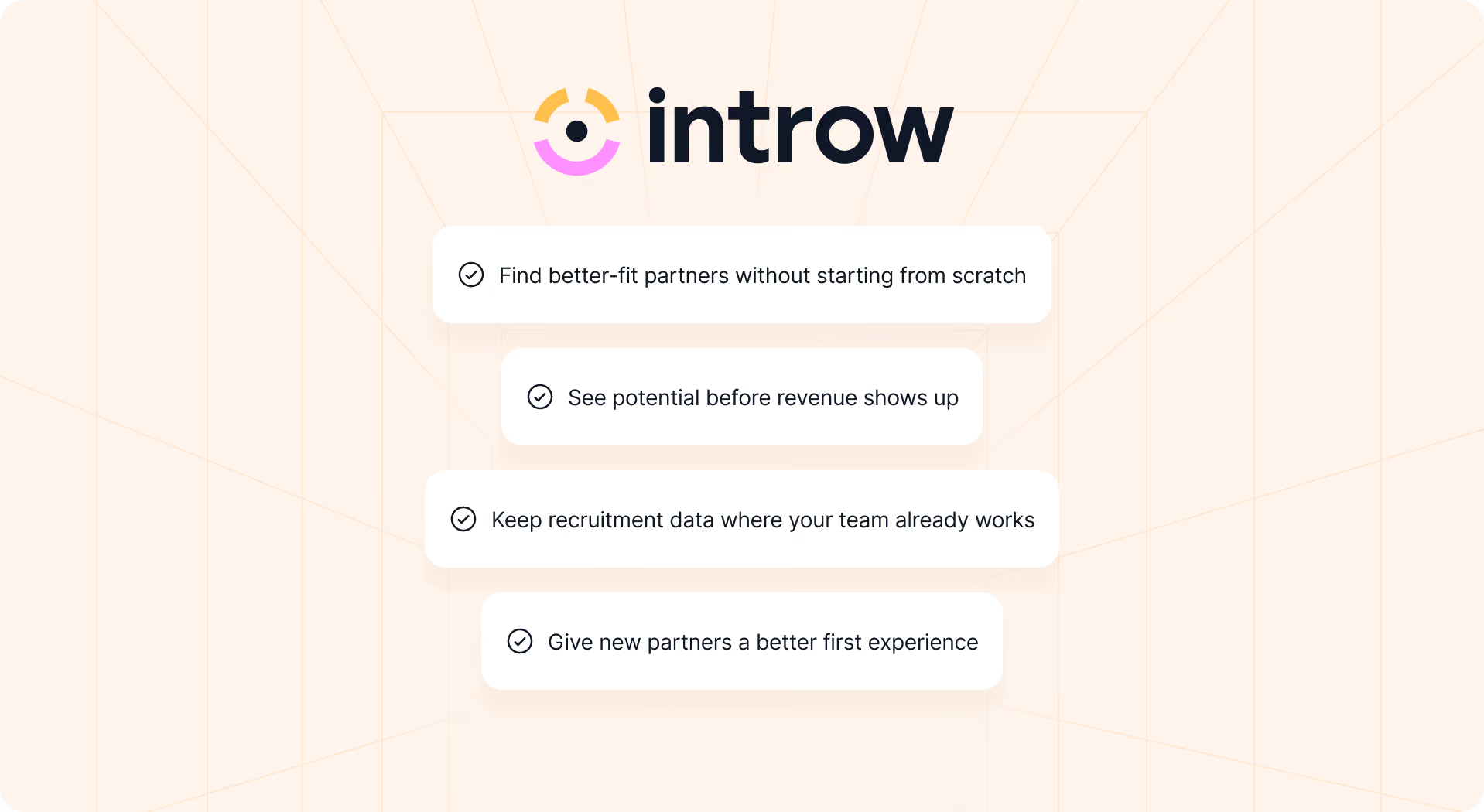
Find better-fit partners without starting from scratch
Introw's agentic acquisition workflow can analyze your existing partner data and identify the traits your top performers share, from geography and vertical to tech stack, headcount, and customer ICP overlap.
From there, it can help you:
- Find lookalike companies that match those patterns
- Spot gaps by region, vertical, or partner type
- Trigger targeted outbound through connected tools
So instead of telling your team to “find more partners,” you can give them a much sharper brief: find this type of partner, in this market, with these characteristics.
See potential before revenue shows up
A partner with low sourced revenue isn't always a weak partner.
By combining CRM performance with Crossbeam overlap data, Introw can surface partners that already have relationships with customers in your ICP or accounts sitting in your open pipeline.
That helps you separate genuinely poor-fit partners from under-leveraged ones, and gives you a better template for who to recruit next.
Keep recruitment data where your team already works
Introw works on top of your HubSpot integration or Salesforce integration, so you don't have to build and maintain a second partner database.
Partner records, pipeline, engagement, deal registration, and attribution stay connected to the CRM.
For your team, that means:
- No duplicate spreadsheets
- No manual partner lists to reconcile
- No guessing which data is current
Your CRM stays the source of truth from recruitment through revenue.
Give new partners a better first experience
Once you decide to sign a company, Introw lets you tailor the experience by partner type, tier, and CRM data.
Partners can use a branded partner portal, or collaborate through channels they already use, including email, Slack, Teams, CRM workflows, and AI assistants.
That matters because the first few days shouldn't feel like admin. A new partner should know what they need to do, where to find it, and what happens next.
If you're comparing partner ecosystem software, the bigger difference is that these stay connected instead of becoming separate workflows:
- Recruitment
- Onboarding
- Partner relationships
- Pipeline
- Reporting
A partner manager can ask an agent to identify the traits shared by the best partners, find lookalikes in a priority market, and start the outreach workflow without exporting data across several tools.
You still make the call on who gets signed. Introw just gives you better evidence to make it.
If you're tired of signing partners that never turn into pipeline, book a demo to see how Introw helps you recruit with evidence, not guesswork.
Still curious? Here are some quick answers to help clear things up
The simplest framework is find, qualify, sign. Find potential partners that match your ideal partner profile, qualify their strategic fit, capabilities, ecosystem reach, and commitment, then sign clear commercial terms and move them directly into onboarding.
If you’re figuring out how to recruit channel partners, start by studying your existing partners instead of building a prospect list from scratch. Identify what your best partners share, find lookalikes in coverage gaps, approach them with a clear Partner Value Proposition, complete channel partner due diligence, and only sign companies that show both capability and commitment.
The best strategies for recruiting B2B channel partners focus on quality over quantity. Use CRM performance data to create an ideal partner profile, map gaps in your channel ecosystem, assess ecosystem reach, target lookalikes, and use clear qualification criteria before signing.
Typical activation rates for newly recruited partners range from 30% to 50%. Programs that don't actively manage activation can fall below 20%.
Yes. AI can analyze CRM, partner engagement, and revenue data to identify the traits shared by successful partners, source lookalike companies, enrich those profiles, and trigger signal-based outreach. Introw's agentic acquisition workflow supports this through MCP-connected CRM and revenue tools while leaving the final qualification and signing decisions with your team.





Are you already an active Introw partner?
Book a demo with one of our partner program experts, or explore Introw on your own time.