

What is a B2B referral program?
A B2B referral program is a structured way for consultants, agencies, complementary businesses, or existing customers to introduce potential buyers in exchange for a reward. That reward is often a commission on a closed deal.
The referral partner makes the introduction, and your team qualifies the prospect and manages the sale.
For example, an HR consultant might introduce a client that needs payroll software. The software vendor handles discovery, demos, and the contract. The consultant receives the agreed-upon reward if the deal meets the referral program's terms.
These referral partnerships turn word of mouth into a repeatable source of business. But introductions alone don't tell you whether your referral program works.
You need to know which referrals become real sales opportunities, who deserves credit, and whether partners keep participating.
That's the work this guide covers, from building your referral program to qualifying, measuring, and sustaining it.
How referral partners differ from other programs
Start by deciding what you want the partner to do. Different partner types need different rewards, tools, and levels of access.
Reseller partners may need quoting tools, pricing information, and deeper access to each deal. Referral partners need a quick way to submit an introduction and see what happens next.
Referral partner programs and customer referral programs
These programs both rely on recommendations, but they serve different purposes.
Several well-known customer programs show how those rewards work.
- Dropbox's referral rewards give eligible users and their invited friends extra storage after the required steps. These double-sided incentives benefit both the referrer and the person joining.
- GetResponse gives the referrer and buyer a $30 credit each when the buyer purchases an account.
- ActiveCampaign rewards referrers with $25 to $100, depending on the purchased plan, after a 60-day review period.
This guide focuses on the partner motion. B2B introductions often involve higher contract values, longer sales cycles, and several decision-makers. They need clear qualification, sales ownership, CRM tracking, and commission rules.
A customer referral loop built around sharing links and earning account credits cannot manage that process on its own. The two programs should have separate workflows, even when existing customers take part in both.
Why B2B referral programs work
Referral programs matter because a trusted introduction gives a buyer a reason to listen. A consultant who understands customer needs can explain why your product deserves a closer look.
That context is where referral marketing works best. Word of mouth carries more detail when the referrer knows the problem, the buyer, and your product. It gives new leads a useful starting point for a conversation.
- A strong referral program can help you reach new customers through relationships you haven't built yourself. Compared with traditional marketing channels, referrals may open conversations that paid channels struggle to start. You can reach a new segment without immediately hiring a sales team dedicated to it.
- Referral rewards tied to closed business also connect spending to results. That can make referrals one of the more cost-effective ways to support customer acquisition. Still, count staff time, software, and partner support before assuming your costs are lower.
- Trust can reduce early skepticism, improve conversion compared with cold outbound leads, and help referral sales conversations move faster. It doesn't remove a buyer's security review, budget limits, or procurement process.
When a referral program struggles
Even enthusiastic brand advocates can't compensate for a broken handoff. A referral program will struggle when nobody follows up, partners introduce poor-fit companies, or the buyer needs a partner who can own the sale.
- If sales lacks capacity, fix that before asking for more referrals. If buyers need local selling and support, consider a reseller arrangement.
- If submissions rarely become opportunities, inspect your acceptance criteria before increasing referral rewards.
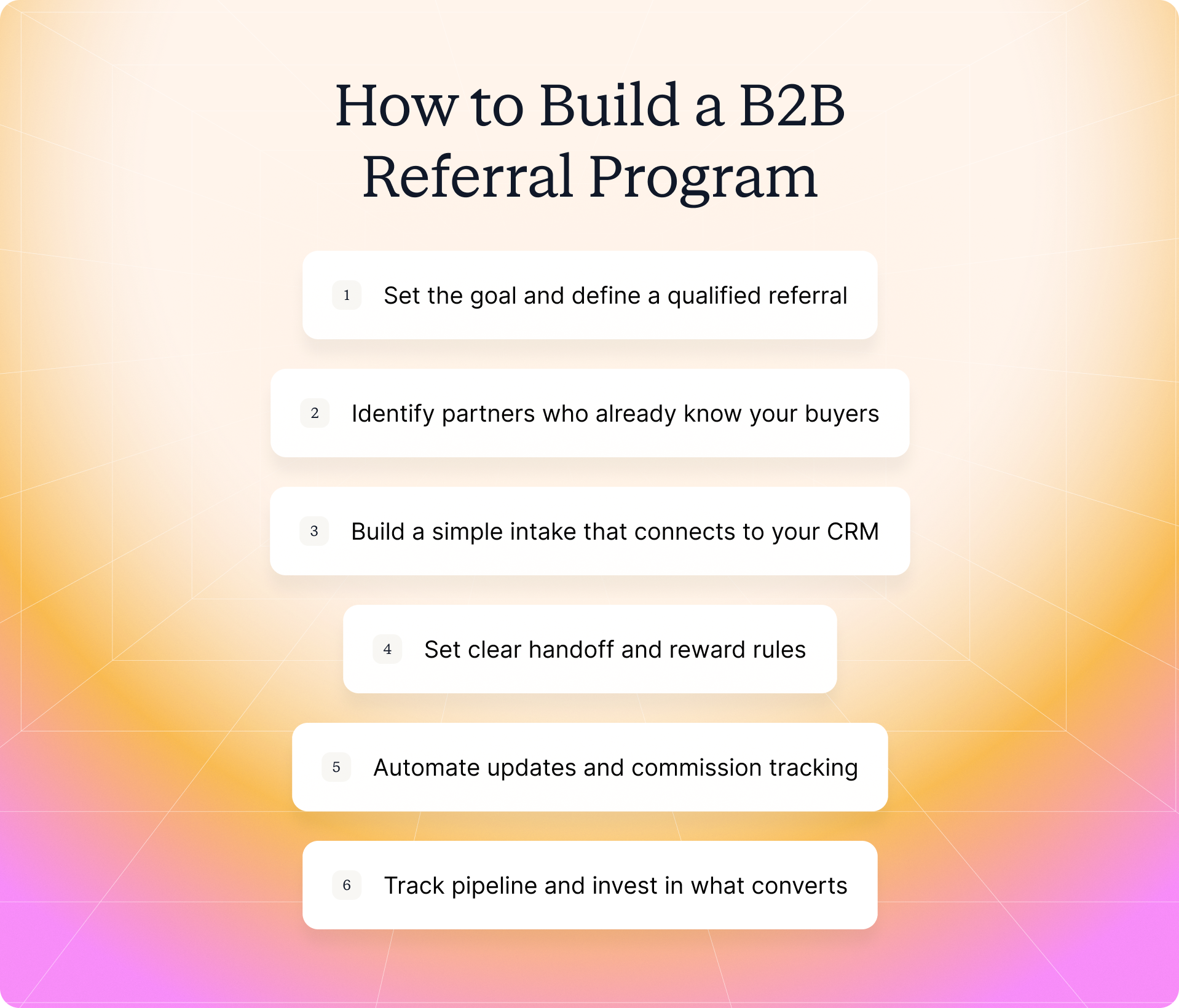
How to build a B2B referral program in 6 steps
Build the referral program around the path from introduction to paying customers. These six steps cover the setup. Qualification, measurement, and engagement each get a closer look afterward.
1. Set the goal and define a qualified referral
Give your B2B referral program one clear starting goal. You might want new customers in a specific industry, access to a new region, or more opportunities among larger accounts.
Then work backward:
- Which companies fit?
- What problem should they have?
- What evidence makes an introduction worth sales follow-up?
Agree on a target, a review date, and what counts toward it. For example, a pilot could aim to create ten accepted opportunities in one segment over a quarter. Choose a target that fits your sales team's capacity.
A successful referral program needs shared definitions before it needs a larger partner list.
2. Identify partners who already know your buyers
Look for complementary businesses that regularly advise your target audience. A consultant with five relevant client relationships may offer better referral opportunities than a large network with little overlap.
Use partner recruitment to assess trust, buyer access, and fit. Ask candidates which customer problems they see and when they'd feel comfortable recommending you.
Your existing customers can help you find these relationships. Ask satisfied customers which agencies or advisers they work with.
Within your customer base, loyal customers and power users may also become brand advocates or formal referral partners.
Start those conversations after measurable success. Happy customers can explain the real value they've received, and satisfied clients can offer customer insights that sharpen your partner profile.
Customer satisfaction is a useful opening, but access to suitable buyers matters just as much.
3. Build a simple intake that connects to your CRM
Make the referral process easy to complete. Removing unnecessary steps makes it easier for customers and partners to participate and send introductions. Use a short form or a partner-specific conversion link that connects each submission to its source.
With deal and lead registration, Introw can map form submissions into HubSpot or Salesforce and attribute them to the right partner. A form can sit on a landing page without requiring a portal login.
Capture the key details sales needs to judge the introduction. Don't ask partners to complete your entire discovery checklist.
Test the referral program with a sample submission. Check that it reaches the right owner, retains partner credit, and triggers an acknowledgment.
4. Set clear handoff and reward rules
Put your referral program terms in plain English. Cover eligible referrals, existing opportunities, competing claims, follow-up ownership, and when partners receive rewards.
Explain how long referral credit lasts and who can extend it when a buyer delays the decision.
Choose rewards that fit
Choose meaningful incentives for the partner's business model. A monetary incentive may suit a consultant. Service credits, joint marketing, or exclusive access to training may suit others.
Favor rewards that help partners grow their business over unrelated consumer perks. Account benefits only help partners who use your product.
Double-sided incentives can support both the referrer and the new buyer. For instance, you might pair a partner commission with onboarding support for new customers.
Offering rewards to both sides should still leave enough margin to serve the account well.
Explain payment terms
Keep referral rewards easy to explain. Add tiered rewards only when you can define the behavior they encourage.
Separate commission eligibility from payment timing, including whether payment depends on collecting the customer's invoice.
Google Workspace rewards up to 200 new users per year, capped at 100 per account. Make any limits equally clear.
Both you and the partner should know what a successful referral earns before the introduction happens.
5. Automate updates and commission tracking
Send a confirmation when referrals arrive, followed by useful updates as they progress. Let partners see whether an introduction was accepted, needs information, or has reached a new stage.
Connect commission and SPIFF rules to the relevant deal data. Introw supports commission calculations, partner earnings visibility, and statements, giving your team a shared record to review.
Keep a person responsible for exceptions. An automated calculation won't decide whether an unusual claim deserves credit under your referral program agreement.
6. Track pipeline and invest in what converts
Review which partners produce accepted referrals, sales opportunities, and new customers. A successful referral program rewards quality in its decisions about where to invest time.
Work backward from your target
To generate hundreds of leads each month through B2B referrals, work backward from partner activity. For example, 100 active partners sending two introductions each would produce 200 monthly leads.
Your qualification checks determine how many become real opportunities.
Improve before expanding
Start with a small group so you can examine unsuccessful referrals together.
- Ask for valuable feedback on the form, handoff, and rewards before expanding.
- Bringing in more customers should also leave your team able to serve them well.
- Early access to product briefings can help active partners spot better matches.
But prioritize fixing stalled referrals before adding benefits to your referral marketing program.
What makes a referral actually qualified
“Pre-qualified” is a claim until your team checks it. A B2B referral program needs a clear distinction between receiving a name, accepting an introduction, and creating a sales opportunity.
Warm leads can still lack fit, urgency, or permission to contact the buyer. Assess referred leads against the same standard as other opportunities.
The referral program should help partners describe what they know without asking them to promise what they can't verify.
Capture enough context to assess the introduction
Use your intake fields to explain what qualified leads look like. Give partners examples, and allow “not yet known” where sales can fill a gap later.
The second column shouldn't enter your forecast just because someone submitted it. The third gives sales something concrete to review but still requires validation.
For example, an agency referring clients might identify a retailer replacing its support platform before a contract renewal. It knows the operations lead and can arrange an introduction.
That's stronger than a list of retailers that might someday need your software.
Separate acceptance from opportunity creation
Build three simple checks into the referral process.
- Check eligibility. Does the referred business fit your criteria? Is it a duplicate, an existing opportunity, or already claimed by another partner?
- Confirm the introduction. Is the contact relevant, and do they expect to hear from you? Request missing context before accepting referrals.
- Validate the opportunity. Sales confirms a real problem and an agreed-upon next step before adding the deal to qualified pipeline.
Keep rejected referrals with a reason. Missing information, poor fit, and duplicate submissions need different responses. Those reasons also help brand advocates improve their next introductions.
Route accepted referrals to a named owner
Route by segment, geography, or account ownership, with a fallback owner for anything unmatched. Set a response target your team can meet and flag overdue referrals.
Check existing account ownership before creating another record for a referred account. Your deal and lead registration setup should help preserve that context as submissions reach sales.
These referral program best practices make later decisions more reliable. Attribution has a clear starting point, payouts follow agreed conditions, and the forecast contains reviewed opportunities.
How to measure B2B partner referrals
A referrer may wait months for a deal to close. Their credit needs to survive every handoff, record change, and delayed decision along the way.
If referrals stay in forms and inboxes, the introduction can become detached from the closed deal. Your referral program then depends on someone remembering who helped.
Automated tracking of referral requests helps in measuring program effectiveness by connecting each submission to its eventual outcome.
Preserve credit from submission through payout
Record the partner, submission date, acceptance decision, and linked opportunity. When a lead becomes a contact or opportunity, check that the partner relationship carries over.
Test what happens when records merge or account owners change.
Separate sourced credit, where the partner originated the opportunity, from influenced credit, where they helped advance an existing deal. Clear partner attribution keeps those contributions visible without treating them as interchangeable.
When several partners contribute, record their roles separately. If your referral program splits commission, agree on the split and approval owner.
Multiple partner links don't automatically determine payout shares, and one deal mustn't become two deals in your revenue total.
Keep these relationships in HubSpot or Salesforce. The practical PRM vs. CRM distinction is that your CRM holds sales records, while partner relationship management software supports the external partner experience around them.
Measure progress across the full sales cycle
Choose a few key metrics that answer whether your referral program produces business.
- Accepted-referral rate. Accepted referrals divided by submitted referrals, using a consistent rule for duplicates and invalid submissions.
- Referral-to-opportunity conversion. Accepted referrals that become qualified opportunities divided by accepted referrals from the same group.
- Sourced pipeline and revenue. Opportunity value and closed revenue tied to the originating partner, shown separately.
- Time-to-payout. Time from the agreed payment trigger to actual payment. Track the earlier submission-to-close period separately.
Compare results over time
Group referrals by submission month or quarter, then compare groups of similar age. Last month's introductions haven't had the same chance to close as last year's.
Otherwise, a healthy B2B referral program can look weak simply because its deals are young.
Include open, lost, and won opportunities when reviewing progress. Track stage age so a successful referral doesn't disappear inside a stalled deal.
Check the economics
Once enough referred customers have bought and renewed, compare customer lifetime value and customer acquisition costs with other sources. Include the cost of running the referral program.
Then, check whether your buyers spend more or stay longer.
A 3:1 or higher LTV/CAC ratio is a planning benchmark, meaning at least $3 of lifetime value per $1 in acquisition costs. It isn't a guaranteed result.
That gives referral marketing a fair comparison with paid channels and shows whether referral revenue can drive growth profitably.
How to keep referral partners engaged
A partner who sends referrals and hears nothing has little reason to repeat the effort. They also risk their reputation when introducing someone to you.
A successful referral program closes that information gap throughout the sales process.
Send updates that answer the partner's next question
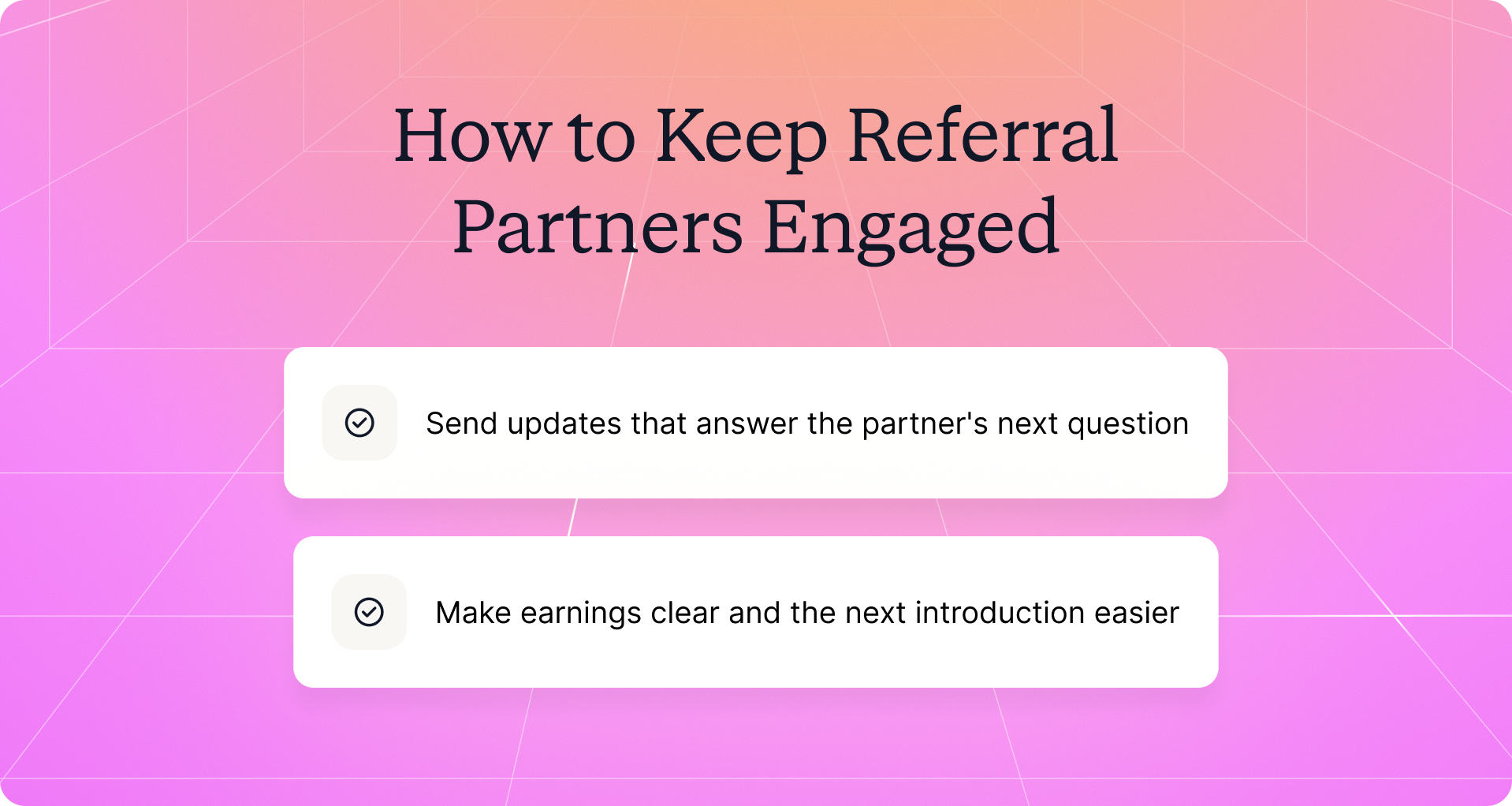
Build partner communications around useful events. Confirm receipt, explain acceptance or rejection, share meaningful progress, and report the outcome.
Choose communication channels partners already use, such as email or Slack. Share a clear reason when referrals stall, rather than sending empty reminders that a deal is still open.
Set boundaries on shared information. Partners need progress and next steps without access to private sales notes or your full CRM.
Make earnings clear and the next introduction easier
Show expected commissions, what remains pending, and when payment is due. Reliable recognition and referral rewards help brand advocates feel that their contribution matters.
For customers who also refer, that recognition can support customer loyalty.
Then give partners just enough support for better referrals. Short messaging, a buyer-fit checklist, FAQs, and early access to relevant product updates can be more useful than a large content library.
Show them how to assess potential referrals before submitting a name.
Ask which questions current customers raise most often. Those conversations can improve enablement for partners and new customers alike.
Treat partner activation as progress toward useful action. Define “participation rate” as the share of eligible partners submitting a referral during a stated period.
Also track how many return with a second accepted introduction.
If the participation rate falls, ask why before changing incentives. The referral program may be challenging to use, the fit may be unclear, or partners may still be waiting for news. Resolving those issues can encourage participation and more referrals.
Keep referral programs lightweight
A well-designed referral program respects how little time partners have. Start with a fast way to submit, a quick acknowledgment, and confidence that someone is handling the introduction.
A landing page with a short form may be enough for your first partners. Test whether they can complete it without help. Remove steps that don't improve qualification or the handoff.
Add a partner portal when partners need a place to check earnings, revisit content, or review several referrals. Let a clear need justify each addition to the referral program.
Resellers may need deeper tools because they're managing quotes and closing deals. Referral partners shouldn't need that level of training just to send an introduction.
Keep referral marketing focused on the action you're asking for. A clear example of a suitable buyer is often more helpful than another campaign asset.
The same principle applies across the referral program. Make it easy to submit useful information, preserve it through the sale, and return useful updates.
Word of mouth becomes repeatable when the work stays manageable.
How Introw runs referral partner programs from your CRM
Your sales team already updates HubSpot or Salesforce. Introw connects the partner experience to those records, so a B2B referral program can use the information your team already maintains.
Connect each introduction to sales
Introw's setup for referral partners supports forms and conversion links, automatic status updates, and commission visibility. Partners can introduce buyers without needing access to your CRM.
With deal attribution, Introw reads the relationship between the partner and the CRM record. Separate sourced and influenced relationships help preserve credit when a deal involves several contributors.
Keep partners informed
Email and Slack updates keep partners informed as referrals progress. Your team can then spend its time on introductions that need attention, rather than answering routine status questions.
Make earnings visible
Introw's commissions connect plans, calculations, reviews, and statements. Partners can see earnings while your team checks the underlying records and manages payment steps.
Start your referral program with intake and notifications. Add content, dashboards, and portal access when partners need them.
If your team is still piecing together who sent each introduction and what they're owed, adding partners adds more work. Book a demo to see how Introw connects referrals, deal progress, and commission tracking to your CRM.
Still curious? Here are some quick answers to help clear things up
A referral partner introduces potential buyers to your business under an agreed arrangement. They might be a consultant, an agency, or one of your existing customers. Your team handles qualification and closing, while the partner earns the agreed reward for eligible referrals.
A partner referral program centers on business introductions and a sales handoff. A customer referral program usually asks satisfied customers to recommend the product to other users. Both use word of mouth, but partner referrals need clear ownership and credit throughout a longer buying process.
Typically through a fixed fee or commission on eligible business. Define a successful referral, the amount, and the payment trigger in advance. A signed contract and a collected invoice are different events, so your referral program terms should specify which matters.
Link each introduction to its partner and eventual CRM opportunity. Preserve that connection through lead conversion, record merges, and ownership changes. Use the same deal record to review progress, revenue, and commission eligibility.
No. A referral program can start with a simple form or conversion link and automatic updates. Add a portal when partners need ongoing access to several referrals, earnings, or content. Make access useful rather than a condition for sending an introduction.





Are you already an active Introw partner?
Book a demo with one of our partner program experts, or explore Introw on your own time.